Normal view

Hacking Safari with GPT 5.4 

23 April 2026 at 20:58

When Anthropic unveiled Mythos and Project Glasswing, the reaction was immediate and polarized. Some dismissed it as fear-driven marketing, while others treated it as a credible shift in the threat landscape.

Like with many things, the truth is probably somewhere in the middle. I wanted to test that for myself, and since I recently got access to OpenAI’s Trusted Access for Cyber program, I decided to take it for a spin.

GPT-5.4 identified the bugs and helped assemble a working exploit chain, but it wasn’t a simple “build me an exploit” prompt. Guiding it required domain knowledge, iterative probing, and knowing which paths were actually exploitable.

On modern browsers like Safari, exploitation is less about finding bugs and more about finding bugs that still matter after multiple layers of defense.

The bug I’m going to talk about today sits in a more interesting category. The bug itself looked contained, and in many ways it was. It did not provide a path to RCE or a sandbox escape. What it did instead was cross a different boundary entirely: it broke the Same-Origin Policy.

If you visited a malicious page from any Apple device, it could read authenticated cross-origin data from other sites you use, including access tokens and other sensitive data, making account takeover trivial.

The video below shows the PoC we sent Apple, demonstrating leakage of sensitive data from both Apple Connect and iCloud / Apple ID endpoints. Although this demo focuses on Apple services, the issue affects all websites. This means that by visiting a malicious website, sensitive data from other domains is at risk of being leaked.


The Sandbox Russian Doll

Browser exploitation in 2026 is a lot like being trapped in a Russian doll.

You start in the smallest doll, and every time you escape one layer you discover you are still trapped inside another one.

Finding a low-level memory bug is not the same thing as finding an exploit. Most of these bugs die in the gap between “memory corruption happened” and “something meaningful crossed a security boundary.”

On the outside you have the browser process model. Even if renderer code goes wrong, the browser is trying very hard to keep that damage inside the web content process.

infographic

Inside that you have the web security model: Same-Origin Policy, CORS, opaque responses, cookie scoping, and credential modes. Even if a page can trigger a cross-origin request, the renderer, and especially the Gigacage, should not be able to access the response bytes. Right?…

The Bug

The original bug lives in the refresh logic for non-shared resizable WebAssembly memory.

When a non-shared WebAssembly.Memory grows in BoundsChecking mode, JavaScriptCore can replace the underlying memory handle. That part is not the bug. The bug is what happens after that to the JS-visible resizable buffer returned by memory.toResizableBuffer().

diagram

The bug is simple enough that once I saw it, it was hard to unsee it. Safari’s grow path effectively does this:

code1

And the refresh step effectively does this:

code2

After memory.grow(), WebKit updates the buffer metadata, but leaves m_data pointing at the old freed allocation.

So after a grow, JavaScript can hold a buffer whose reported size is new, whose handle is new, but whose actual data pointer still references the old freed Primitive Gigacage allocation.

That turns into a stale typed-array window over freed memory.

On its own, this is already a real bug. But we’re still stuck inside the JavaScriptCore gigacage, effectively sandboxed. Without a second bug to break out into the renderer, it doesn’t chain into anything meaningful. What we have is a solid first-stage primitive, but no real security impact on its own.

Why it did not look exploitable at first

The stale window is confined to the Primitive Gigacage, which immediately limits what you can do with it. Many typical targets either never land there, lack useful structure, or fail to produce any cross-boundary effect.

So early on, it had all the hallmarks of a bug that looks promising but rarely goes the distance:

  • easy source-level root cause
  • visible stale memory behavior
  • real reclaim
  • no clean escape path

This is where a lot of low-level browser bugs die.

What changed the problem was a very different framing: maybe I did not need to escape the cage at all.

Maybe I just needed the browser to place something valuable inside it.

The Pivot

Instead of asking “how do I get from my stale WASM view to some protected browser state?” I started asking a better question:

“What browser code takes data that JavaScript is not allowed to read, but still copies that data into normal renderer memory?”

Because that is all I need.

I don’t need to break the abstraction.

I just need the browser to break it for me.

That naturally narrows the search space to subsystems that:

  • handle sensitive cross-origin data, and
  • still allocate ArrayBuffer-backed memory as part of their internal pipeline

That points straight at Fetch. The Fetch API clearly indicates that the response is opaque, meaning that its headers and body are not available to JavaScript.

Opaque Responses Are Supposed to Be Opaque

At the API level, the Fetch model here is straightforward.

If I do a cross-origin request with:

fetch(url, { mode: “no-cors”, credentials: “include” });

The browser may send the request, including cookies depending on context, but JavaScript receives an opaque response.

That means:

  • I can hold the Response object
  • but I cannot read the body bytes

And WebKit enforces that in the obvious place:

FetchBodyOwner::readableStream() blocks opaque bodies via isBodyNullOrOpaque().

So at first glance, everything looks fine. The body is hidden. The policy is enforced. Same-Origin Policy survives another day.

Except it does not.

The Fetch Behavior that Broke the Modal

The surprising part is Response.clone().

If FetchResponse::clone() is called while the response is still loading, WebKit will internally create a readable stream so it can tee the body between the original response and the clone.

That internal path does not apply the same opaque-body check first.

And once that happens, hidden response bytes start becoming very real renderer objects.

This is the part that made me stop and stare at the source, because the mismatch is right there.

The normal body path blocks opaque responses:

code3

But FetchResponse::clone() does this while the response is still loading:

code4

That is why it works.

The visible accessor path says “opaque bodies do not get a stream.” The clone path says “if it is still loading, create a stream so both clones can tee it.”

That second path is exactly what I needed.

The data flows through normal ArrayBuffer creation paths:

  • buffered chunks go through tryCreateArrayBuffer()
  • later chunks go through takeAsArrayBuffer()
  • shared buffer data gets copied into ordinary ArrayBuffer allocations inside the renderer

So the policy ends up split in two:

  • the public Fetch API says the body is opaque
  • the renderer still materializes the opaque body into readable byte arrays during clone-time streaming

Combined with the stale WASM window, it becomes a SOP break.

The Chain

At a high level, the exploit became:

  1. Force the target WASM memory into the BoundsChecking path.
  2. Call memory.toResizableBuffer().
  3. Grow the memory.
  4. Keep the stale resizable buffer whose pointer still targets freed Primitive Gigacage pages.
  5. Trigger a cross-origin fetch(…, { mode: “no-cors”, credentials: “include” }).
  6. Call response.clone() while the response is still loading.
  7. Let Fetch internals materialize the hidden body bytes into ordinary renderer ArrayBuffers.
  8. Reclaim the stale WASM-covered pages with those allocations.
  9. Read the cross-origin bytes through the stale view.

That is the entire trick.

I never needed response.text(). I never needed response.arrayBuffer(). I never needed the public API to hand me the body.

The browser copied the body into memory for its own internal bookkeeping, and the stale WASM view read it directly.

That is why this bug stopped being “some weird WASM UAF” and became “this completely breaks the Same-Origin Policy.”

The file:// Detour

One of the weirdest parts of the research was that the request side behaved differently depending on where I launched it from.

In my testing, cross-origin requests were much easier to get moving from file:// than from a normal https attacker page.

That sounds backwards until you look at WebKit’s handling of local origins.

Document.cpp has explicit special-casing around local documents and settings like:

  • allowUniversalAccessFromFileURLs
  • allowFileAccessFromFileURLs

MiniBrowser exposes those knobs too, which made file:// very useful as a research environment. It let me focus on the memory side and confirm the leak path before I had a clean web-facing story.

But I did not want a local-file party trick.

I wanted a real web exploit.

And from a normal https page, the same request pattern was not giving me the reliability I wanted.

That is where about:blank saved me.

Why about:blank saved the final POC

The final PoC opens an about:blank popup and performs the fetches from there:

code5

This ended up mattering a lot.

At first I thought this was just an origin-inheritance trick. That part is real:

code6

So about:blank does inherit the opener’s origin.

But that alone does not explain why the popup path behaved differently.

What actually seems to matter is Safari’s cookie / first-party bookkeeping. Fetch subresource requests copy document->firstPartyForCookies() into the request:

code7

And WebKit’s cookie blocking logic bails out immediately if that first-party domain is empty:

code8

That is a very different path from a normal attacker-controlled https page. From a regular https://attacker.example origin, the first party is the attacker site, so a request to the victim site looks third-party and Safari’s tracking-prevention logic can suppress cookies.

From the about:blank popup path, the security origin still comes from the opener, but the popup’s top-level URL / first-party context is no longer a normal registrable https site in the same way. In practice, that was enough to make credentials: “include” requests behave differently and get me the authenticated traffic pattern I needed.

So the important point is not “about:blank disabled CORS.” It did not. The important point is:

  • the popup kept the opener’s origin
  • the request still went through normal Fetch/CORS code
  • Safari’s first-party cookie logic treated that popup context differently

That was the difference between “cross-origin request happens but is useless” and “cross-origin request comes back with authenticated bytes worth stealing.”

Why this was fun

This is my favorite kind of browser bug.

Not because the root cause was complicated. It was not. The WASM bug was almost embarrassingly direct.

And not because the final chain was huge. It was not.

It was fun because it is exactly the kind of bug modern browser architecture is supposed to suppress.

A stale pointer inside a cage is supposed to stay a stale pointer inside a cage.

An opaque response is supposed to stay opaque.

Those are both reasonable assumptions.

The exploit works because both assumptions were true only locally.

JavaScriptCore gave me a stale view that looked hard to use. WebCore Fetch gave me sensitive bytes that looked impossible to read.

Put them together and Safari’s Same-Origin Policy fell apart.

Disclosure

We reported our findings to Apple. Shortly after, a fix shipped, suggesting the issue was already known internally.

The vulnerability (CVE-2026-20664) is addressed in iOS 26.4 and iPadOS 26.4 (23E6254 and later), and macOS Tahoe 26.4 (25E253 and later). Make sure your systems are up to date.

Closing Thoughts

The biggest thing on my mind after working with these models is the leverage they provide, and what that means for N-days. A security patch in popular software used to hide the underlying exploit behind time, effort, and expertise. Now that you can scale tokens instead of effort, that barrier is mostly gone.

This doesn’t turn exploitation into a trivial task. You still need someone who understands what they are looking at, can filter noise, and can steer the process when it stalls. But AI changes the unit of work. Instead of deep, sequential effort, you get parallel exploration and rapid iteration. The constraint shifts from raw effort to how effectively an operator can guide multiple lines of inquiry at once.
`

The post Hacking Safari with GPT 5.4  appeared first on Blog.

Spam and phishing targeting taxpayers | Kaspersky official blog

In many countries, spring is the traditional time for filing income tax returns. These documents are a goldmine for bad actors because they contain a wealth of personal data, such as employment history, income, assets, bank account details — the list goes on. It’s no surprise that scammers ramp up their efforts around this time; the internet is currently crawling with fake websites designed to look exactly like government resources and tax authorities.

With deadlines looming and numbers to crunch, the rush to get everything done in good time can cause people to let their guard down. In the shuffle, it’s easy to miss the signs that the site where you’re detailing your finances has zero connection to the revenue service, or that the file you just downloaded, supposedly from a tax inspector, is actually malware.

In this post, we break down how these fraudulent tax agency sites operate across different countries and what you should absolutely avoid doing to keep your money and sensitive information safe.

Taxpayer phishing

This season, attackers have been spoofing tax authority websites across numerous countries, including the official government portals of Germany, France, Austria, Switzerland, Brazil, Chile, and Colombia. On these fraudulent sites, scammers harvest credentials for legitimate services, and steal personal data before offering to process a tax deduction — provided the victim enters their credit card details. In some cases, they even charge a fee for this fraudulent service.

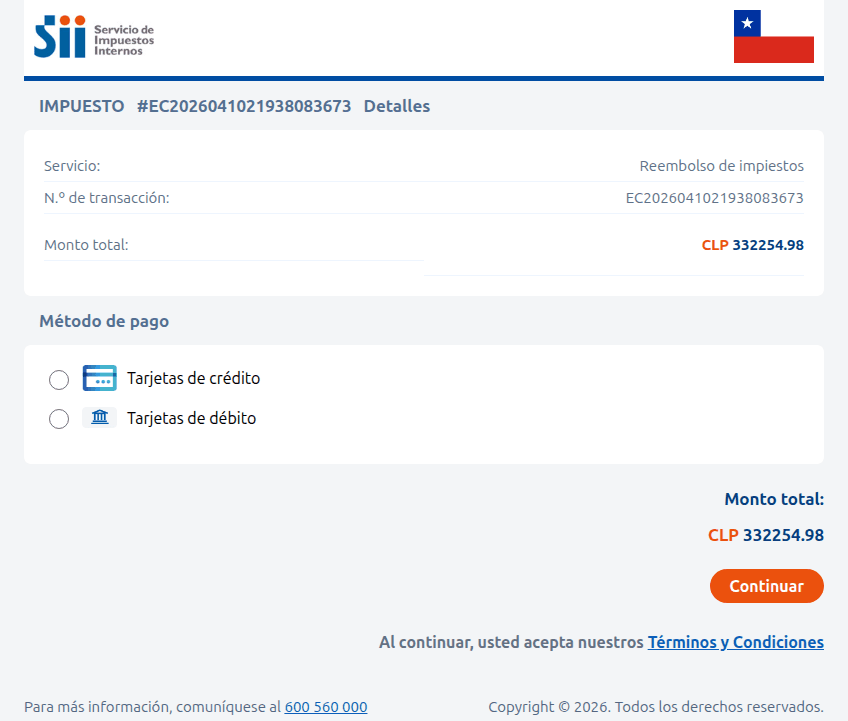
Fraudulent Chilean tax service website

A site imitating the Chilean tax authority. The victim is prompted to enter their credit card information to receive a substantial tax refund — roughly US$375. Instead, the funds are siphoned from the victim’s account directly to the scammers

Sometimes, the tactic involves accusations issued on behalf of government bodies. In the image below, for example, a “head of tax audit” in Paris informs the victim that they provided incomplete income information. To avoid penalties, the user is told to download a document and make corrections immediately. However, the PDF file hides something much worse: malware.

Spoofed French tax portal (Impots.gouv)

Instead of an official document from the French tax service, the user finds malware waiting inside the PDF

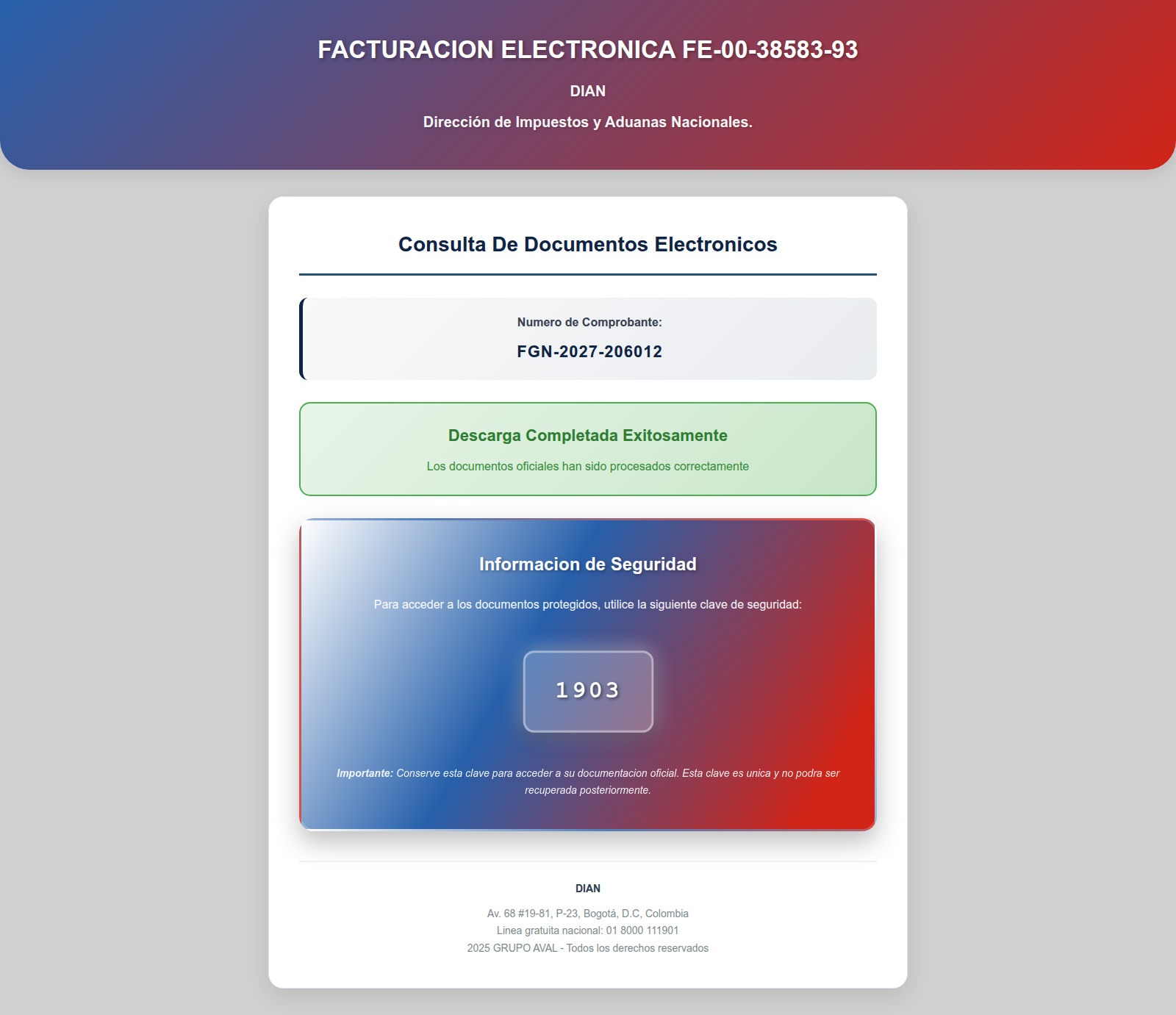
In Colombia, a fake National Directorate of Taxes and Customs site similarly prompts users to download documents that must be “unlocked with a security key”. In reality, this is simply a password-protected, malicious ZIP archive.

Fake website impersonating the Colombian National Directorate of Taxes and Customs

After entering the password, the user opens a malicious archive that infects their device

Beyond phishing sites mimicking legitimate resources, our experts have discovered fraudulent websites promising paid services for filling out and auditing tax documents — and stealing high-value data, such as taxpayer identification numbers (TINs), instead.

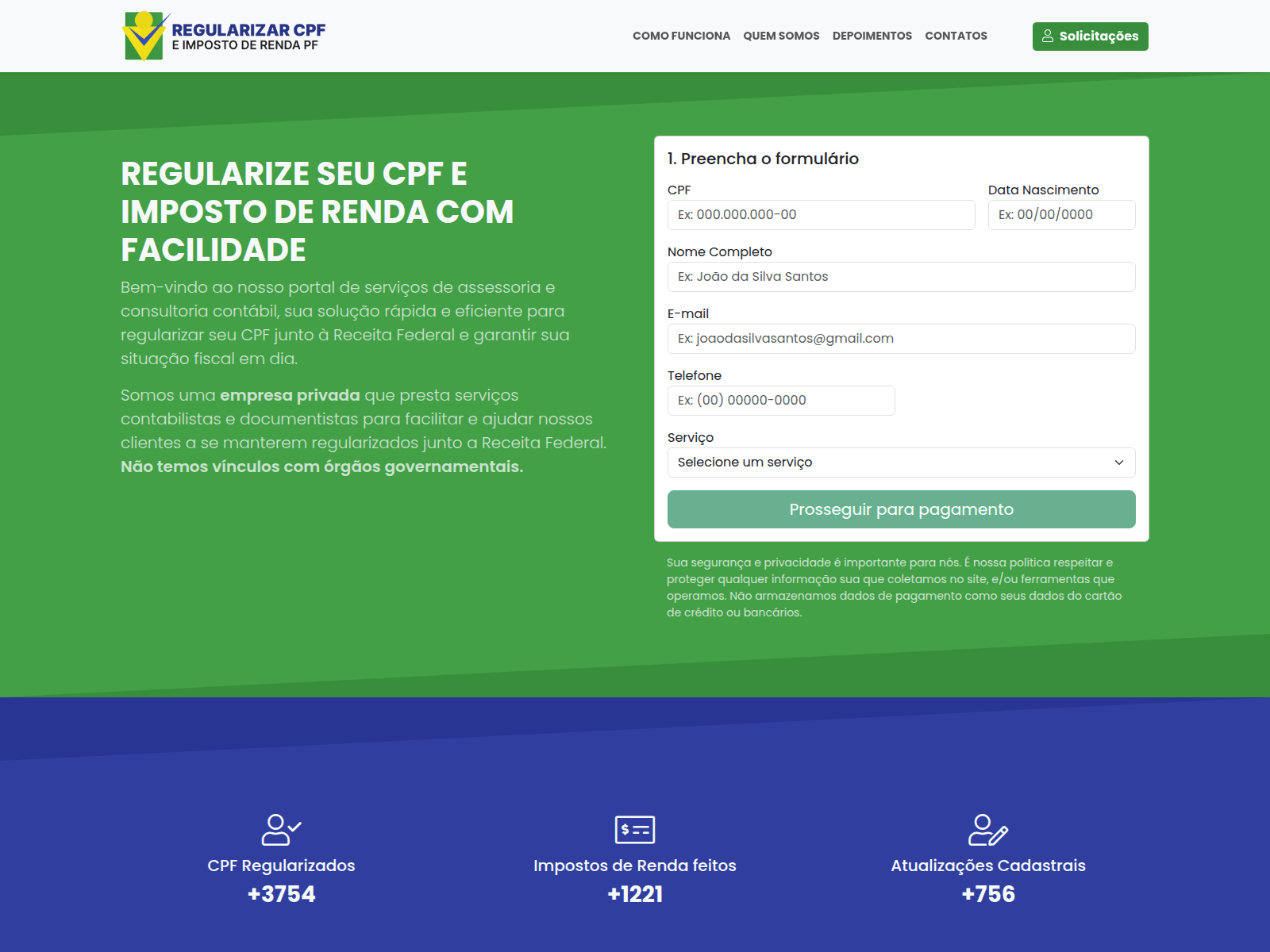
Scammers in Brazil offering tax prep assistance
Scammers in Brazil offer help with tax returns. To contact them, the user must provide their name, phone number, address, date of birth, email, and TIN in a special form. Handing over a TIN puts the victim at risk of fraudulent loan applications, hijacked government service accounts, and further social engineering attacks
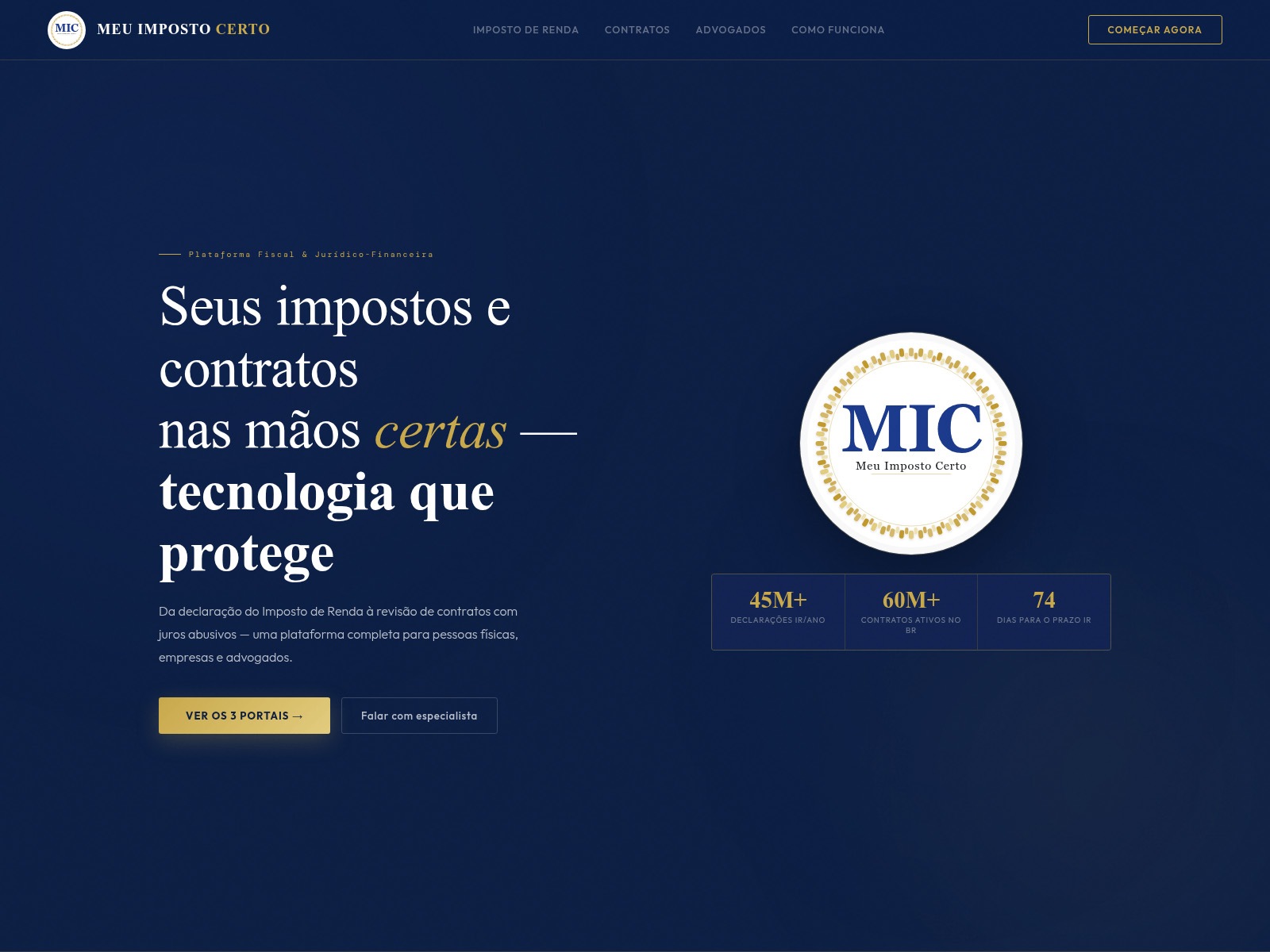
Scammers in Brazil offering tax prep assistance
Another Brazilian scam site. If you believe the attackers, they file 60 million tax returns annually — supposedly assisting a staggering 28% of the Brazilian population

Tax-free crypto earnings

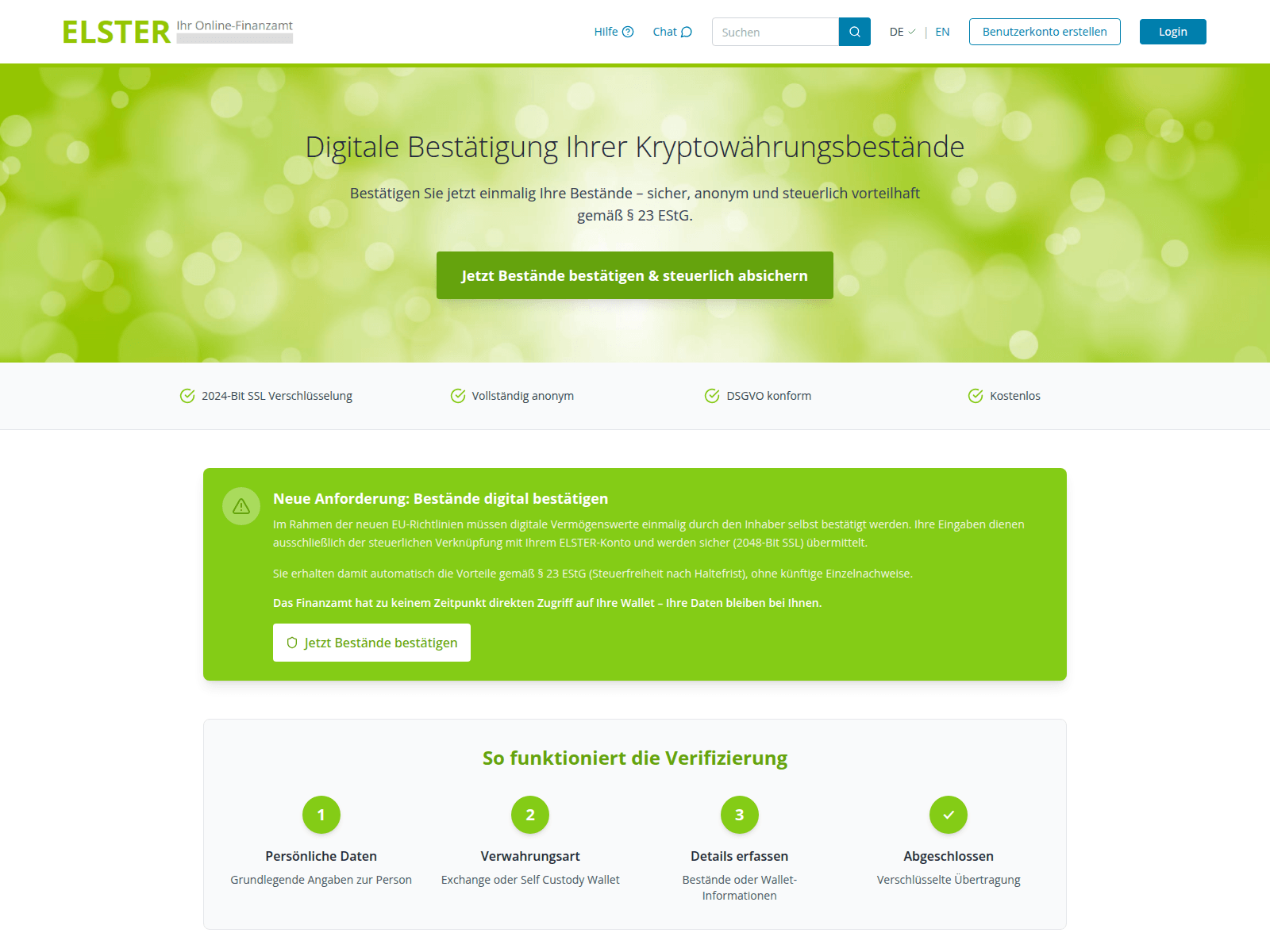
Cryptocurrency holders have emerged as a specific target for attackers. Fake German tax authorities are demanding that wallet owners “verify their digital asset holdings”, citing EU regulations for tax calculation purposes. And of course, there’s a “silver lining”: it turns out crypto earnings are supposedly tax-exempt! However, to claim this generous benefit, users must go through a “verification” procedure. The site even promises to encrypt data using a “2048-bit SSL protocol”.

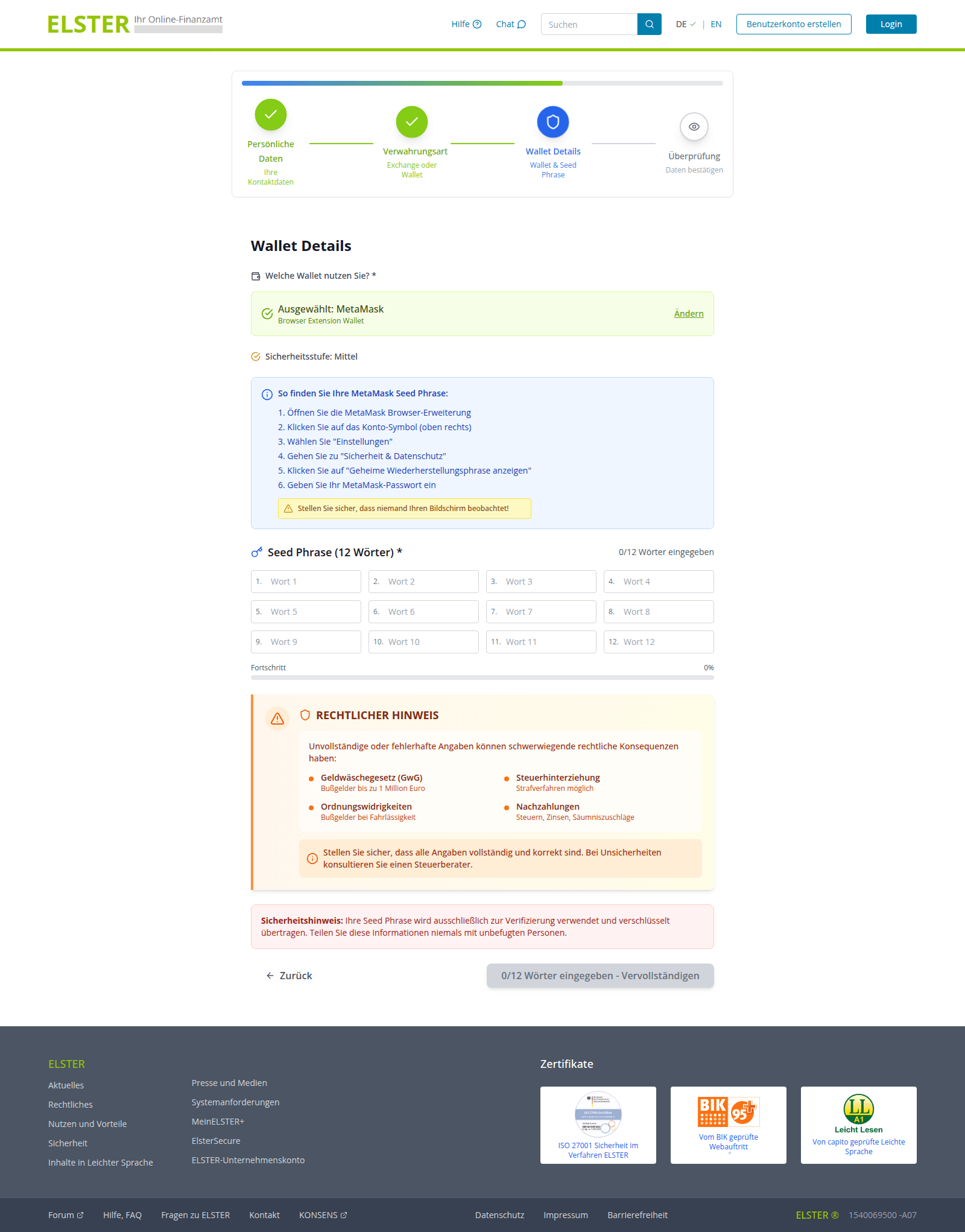
To complete the “verification” process, users are prompted to enter their seed phrase — the unique sequence of words tied to a crypto wallet that grants full recovery access. This request is paired with a threat: refusing to provide the data will lead to serious legal consequences, such as fines up to one million euros or criminal prosecution.

Spoofed German tax portal (ELSTER)
An announcement on the fake ELSTER portal claims that crypto earnings are tax-free following "verification" — and that the "tax service" has no direct access to users' wallets. Should we believe it?
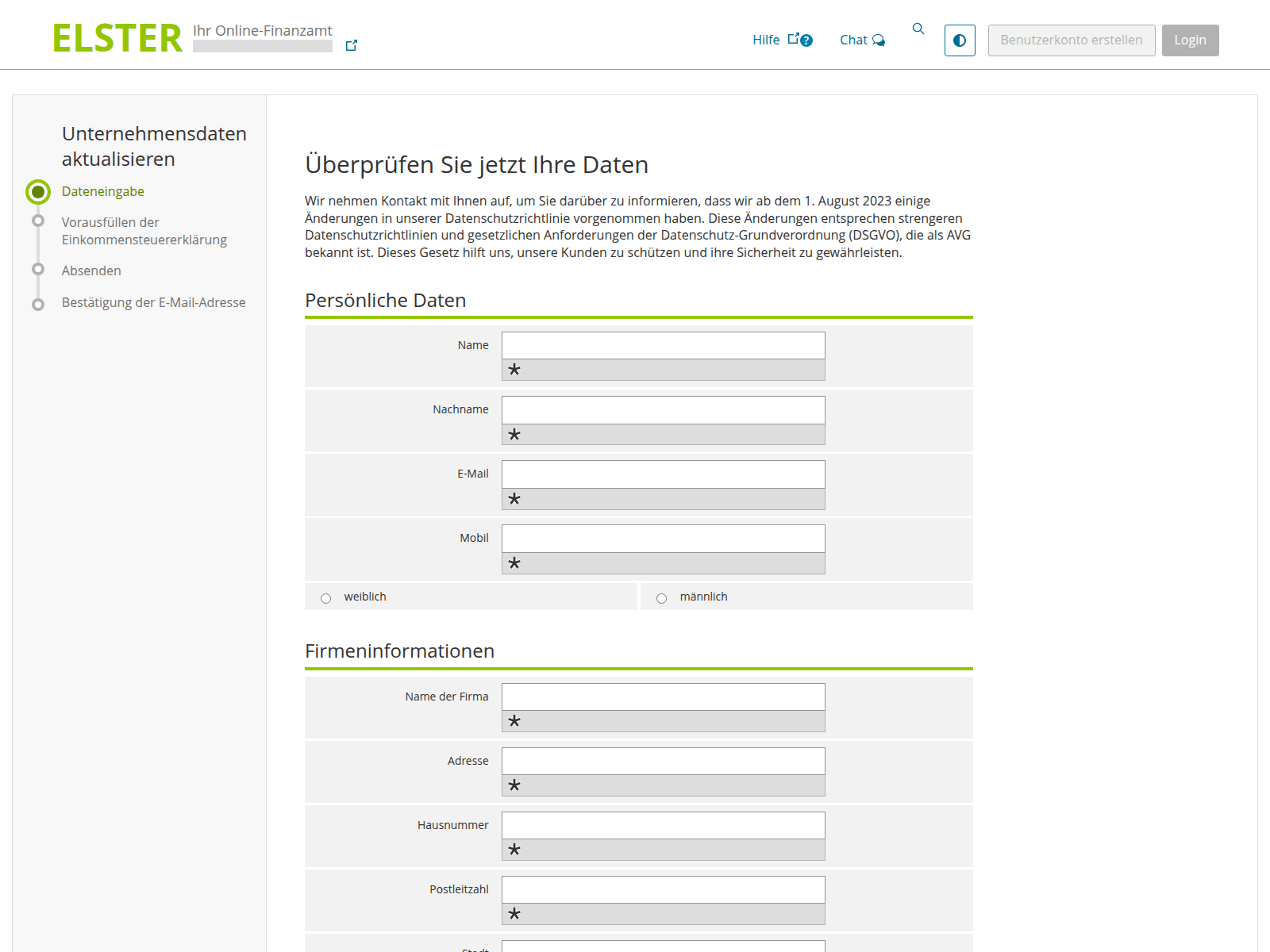
Spoofed German tax portal (ELSTER)
First, the user is prompted to enter their personal information…
Spoofed German tax portal (ELSTER)
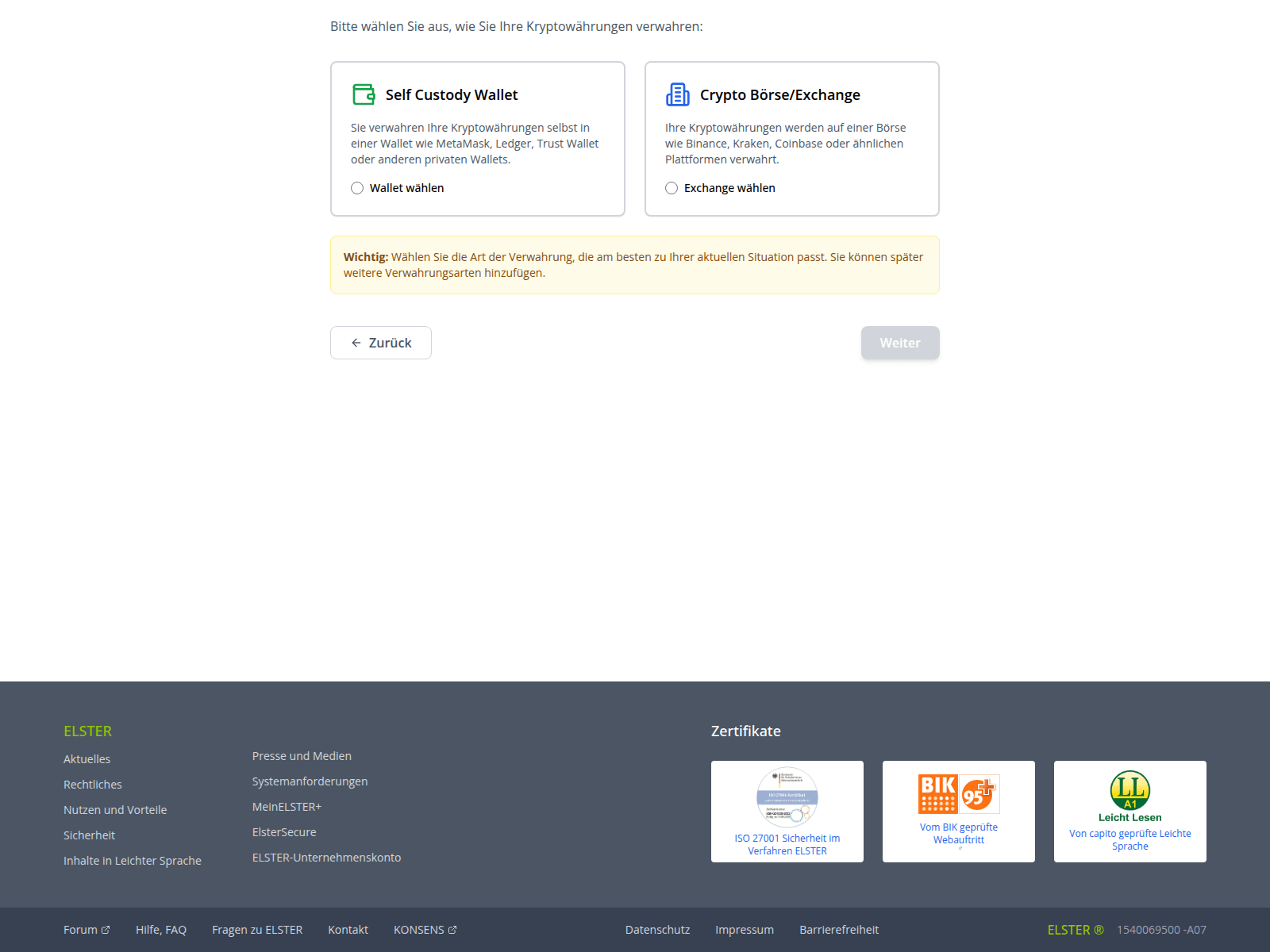
…And then they choose how to verify their crypto holdings: by linking a crypto wallet or an exchange account. Among the services targeted by these scammers are Ledger, Trezor, Trust Wallet, BitBox02, KeepKey, MetaMask, Phantom, and Coinbase
Spoofed German tax portal (ELSTER)
Finally, the victim is asked to provide their seed phrase, giving scammers total control over the wallet. The attackers kindly warn the victim to make sure no one is looking at their screen while they threaten them with non-existent legal penalties for non-compliance

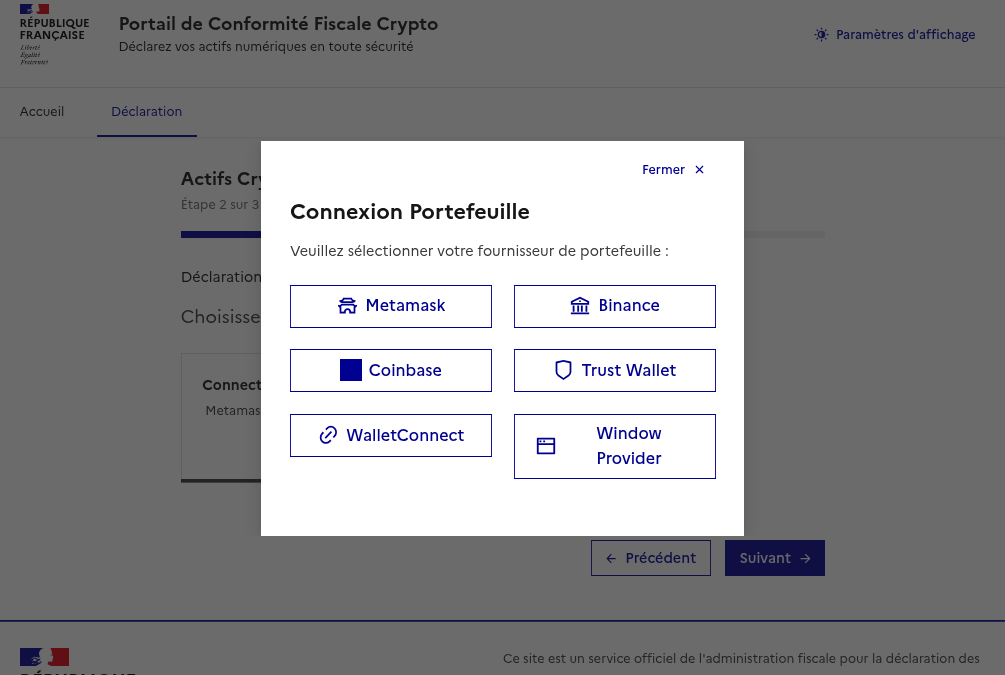
Attackers pulled a similar stunt on French users as well. They created a non-existent “Crypto Tax Compliance Portal”, which mimics the design of the French Ministry of Economy and Finance website. The phishing site aggressively demands that French residents submit a “digital asset declaration”.

After the user enters their personal information, the scammers prompt them to either manually enter their seed phrase, or “link” their crypto wallet to the portal. If they go through with this, their MetaMask, Binance, Coinbase, Trust Wallet, or WalletConnect wallets will be drained.

Phishing website spoofing the French Ministry of Economy and Finance
The phishing site aggressively demands that French residents provide a "digital asset declaration" (translation: they want to hijack your crypto accounts)
Phishing website spoofing the French Ministry of Economy and Finance
Once personal data is entered, scammers offer the choice of manually entering a seed phrase or "linking" a wallet to the portal

Can AI help with your tax returns?

When you have AI at your fingertips that can instantly generate text and fill out spreadsheets, there’s a serious temptation to delegate everything to it. Unfortunately, this can lead to serious consequences. First, all popular chatbots process your data on their servers, which puts your sensitive information at risk of a leak. Second, they sometimes make incredibly foolish mistakes, and that can lead to actual trouble with the taxman.

Before you tell a chatbot or an AI agent how much money you made last year — complete with detailed personal and banking info — remember how frequently leaks occur within AI-powered services and consider the risks. Don’t discuss your income with AI, don’t give it personal details like your name or address, and under no circumstances should you upload photos or numbers of vital documents such as passports, insurance info, or social security numbers. Files containing confidential information should be kept in encrypted containers, such as Kaspersky Password Manager.

If you’re still determined to use AI tools, run them locally. This can be done for free even on a standard laptop, and we’ve previously covered how to set up local language models using DeepSeek as an example. However, the quality of the output from these models is often subpar. It’s quite possible that double-checking every digit in an AI-generated response will take more time than just filling out the paperwork manually. Remember, you’re the one accountable to the tax office for any errors — not the AI.

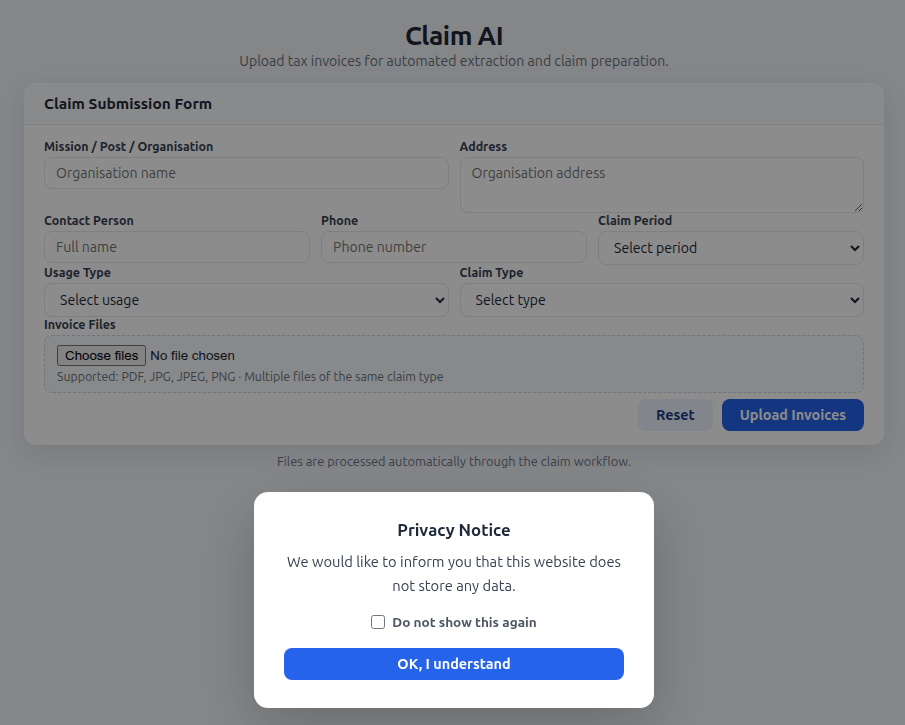
Finally, watch out for phishing AI models that offer “assistance” with tax filing. Kaspersky experts have discovered websites where users are prompted to upload tax invoices, supposedly for the automated generation of returns and deduction claims. Instead, attackers collect this personal data to resell on the dark web, or to use in future phishing attacks, blackmail, and extortion schemes.

Phishing AI steals data from taxpayers seeking filing assistance

The creators of a fake AI tool prompt users to upload tax documents, and kindly assure them that the site doesn’t store any user data. In reality, every piece of information entered — name, address, documents, contact person, phone number — ends up in the hands of cybercriminals

Remember that all legitimate AI services explicitly warn users not to share confidential data, and tax documents certainly fall into this category. Any AI tools promising to help you handle your tax paperwork are quite simply a scam.

How to protect yourself and your data

  • File your taxes yourself. The risk of running into scammers is extremely high. Even if a consulting firm is legitimate, you’re inevitably handing over a complete dossier on yourself: passport details, employment and income info, your address, and more. Remember that even the most honest services aren’t immune to hacks and data breaches.
  • Watch out for fake websites. Use a reliable security solution that prevents you from visiting phishing sites and blocks malicious file downloads.
  • Keep all important documents encrypted. Storing photos, notes, or files on your desktop, or starred messages in a messaging app isn’t a secure way to handle sensitive data. A secure vault like Kaspersky Password Manager can store more than just passwords and credit card info; it can also safeguard documents and even photos.
  • Don’t trust AI. Even the most advanced chatbots are prone to errors and hallucinations, and in theory, developers can read any conversation you have with their AI. If you absolutely must use AI, install and run a local version on your own computer.
  • Stick to official channels only. The “chief tax inspector” of your country or city is definitely not going to message you: high-ranking officials have more important things to do. Only contact tax authorities through official channels, and carefully verify the sender of any emails you receive. Most often, even a slight deviation in the name or address is a telltale sign of a phishing campaign.

Further reading on phishing and data security:

How cyberattacks on companies affect everyone

23 April 2026 at 17:34

If you use the internet, you’ve likely been affected by cybercrime in some way. Even when an attack is aimed at a company, the fallout usually lands on ordinary people.

The most obvious harm is stolen data. When attackers break into a business, it is usually customer information that ends up in criminal hands, and that can lead to identity theft, tax fraud, credit card fraud, and a long tail of scam attempts that can continue for months or years. For consumers, the breach itself is often just the start of the cleanup.

That work is annoying, time-consuming, and sometimes expensive. People may have to freeze credit, replace cards, change passwords, be on the lookout for suspicious transactions, and dispute charges. The Federal Trade Commission (FTC) specifically advises consumers to use IdentityTheft.gov after a breach and recommends steps like credit freezes and fraud alerts to reduce the chance of further abuse.

When sensitive data is exposed, the harm is not only financial. Medical, insurance, and other deeply personal records can be used to create more convincing phishing or extortion attempts, and the stress of knowing that private information is circulating among criminals can linger long after the technical incident is over. In other words, breach victims are not just cleaning up a data problem, they are dealing with a loss of trust.


Breaches happen every day. Don’t be the last to know.


Cybercrime also hits consumers through service disruption. Ransomware and intrusion campaigns can interrupt payment systems, telecom services, shipping, energy distribution, booking platforms, and other infrastructure people rely on every day. In those cases, the consumer impact is immediate: you may not be able to pay, travel, call, buy, or even work normally. The CSIS timeline and Canada’s cyberthreat assessment both show that these disruptions are increasingly tied to high-value targets and can be part of broader state or criminal campaigns.

Not all these incidents are driven by cybercriminals. Recently, Britain’s cybersecurity chief warned that the UK is handling 4 nationally significant cyberincidents every week, with the majority now traced back to foreign governments rather than cybercriminal groups.

Another cost is easy to overlook: disinformation and confusion. When attackers steal data, disrupt services, or impersonate trusted brands, they can also flood the public with fake support messages, scam calls, refund schemes, and phishing emails pretending to be the breached company. The breach becomes a launchpad for more fraud, and consumers are left trying to separate legitimate notifications from those sent by attackers.

Then there is the security backlash. After a breach, companies usually tighten access rules, add more multi-factor authentication prompts, force reauthentication, shorten sessions, and increase fraud checks. Those measures are often necessary, but they also make ordinary digital life more cumbersome. The consumer ends up paying with time and frustration for security problems they did not create.

That is why company-targeted cybercrime is not really only a business problem. It is a consumer issue, a public-trust issue, and sometimes even a national security issue. A single breach can leak data, trigger fraud, interrupt essential services, amplify scams, and make using the internet more frustrating for everyone else. The real cost is rarely confined to the company that got hit.

Knowing this, it’s worth thinking carefully about which companies to trust with your data and how much you’re willing to share . You cannot stop every attack against every company you deal with, but you can limit the fallout by being more selective. Some considerations:

  • Do they need all the information they are asking for?
  • Would it hurt anything if you leave some fields blank or give less specific answers?
  • Has this company been breached in the past, and how did they handle it?
  • How long will they store the data you provide?
  • Can you easily have your data removed at your request?

Your name, address, and phone number are probably already for sale.  

Data brokers collect and sell your personal details to anyone willing to pay. Malwarebytes Personal Data Remover finds them and gets your information removed, then keeps watch so it stays that way. 

The Fortinet 2025 Sustainability Report

23 April 2026 at 17:00
The Fortinet 2025 Sustainability Report outlines progress in securing the digital world, reducing environmental impact through energy-efficiency products and operations, expanding access to cybersecurity education, and strengthening responsible business practices.

Check Point WAF Leads Application Security-Validated by Frost & Sullivan

By: anap
23 April 2026 at 15:00

Check Point has been honored Frost & Sullivan’s 2026 Technology Innovation Leadership recognition in WAF and API security, positioning us as a Company to Action shaping the future of cybersecurity. This recognition reflects a major shift in how application security must operate today. Application Security Has Fundamentally Changed Applications are no longer just web apps they now run on APIs, microservices, and AI-driven services, rapidly expanding across hybrid and multi-cloud environments. Each release introduces new components, increasing the attack surface. At the same time, accelerated DevSecOps cycles are making both web and AI applications harder to secure, while threats continue […]

The post Check Point WAF Leads Application Security-Validated by Frost & Sullivan appeared first on Check Point Blog.

Trailmark turns code into graphs

23 April 2026 at 14:00

We’re open-sourcing Trailmark, a library that parses source code into a queryable call graph of functions, classes, call relationships, and semantic metadata, then exposes that graph through a Python API that Claude skills can call directly. Install it now:

uv pip install trailmark

“Defenders think in lists. Attackers think in graphs. As long as this is true, attackers win.” John Lambert’s widely cited observation about network security applies just as well to AI-assisted software analysis.

When Claude reasons about a codebase, it reasons about lists: findings from static analyzers, surviving mutants from mutation testing, and line-by-line coverage reports. But the question that actually matters is a graph question: can untrusted input reach this code, and what breaks if it’s wrong?

We built Trailmark to answer that question. It gives Claude a graph to think with instead of a list. We’re also releasing eight Claude Code skills we’ve built on top of it, designed for mutation triage, test vector generation, protocol diagramming, and more.

When lists fall short

Mutation testing is a great example of a method that benefits from graph-level reasoning. It’s one of the best ways to measure test quality. It makes small changes to your source code (e.g., swapping a < for <=, replacing + with -) and checks whether your tests catch the difference. Mutants that survive reveal gaps in your test suite that code coverage metrics might miss. The downside is that a mutation testing run on a real codebase can produce hundreds of surviving mutants of varying significance. This is very much a list.

Some surviving mutants are equivalent: the mutation doesn’t change the program’s behavior because of structural or mathematical constraints that the mutation testing tool can’t see. Some are in dead code; some are in error message formatting; some are in the finite field arithmetic that underpins every cryptographic operation in your library. A flat list of surviving mutants doesn’t tell you which is which.

We wanted to know whether Claude could use graph-level reasoning about a codebase to automatically triage surviving mutants by security relevance: which are reachable from untrusted input, which affect high-blast-radius functions, and which represent genuine gaps in security-critical code?

How Trailmark works

Trailmark uses tree-sitter for language-agnostic AST parsing and rustworkx for high-performance graph traversal. It operates in three phases:

  1. Parse: Walk a directory, extract functions, classes, call edges, type annotations, cyclomatic complexity, and branch counts from source code.
  2. Index: Load the resulting graph into a rustworkx PyDiGraph with bidirectional ID/index mappings for fast traversal.
  3. Query: Answer questions: callers, callees, all paths between two nodes, attack surface enumeration, and complexity hotspots.

It currently supports 17 languages, including C, Rust, Go, Python, PHP, JavaScript, Solidity, Circom, and Miden Assembly.

The graph is the substrate. The skills are where the analysis happens.

The skills

The Trailmark plugin ships eight Claude Code skills that use the graph API as their backbone:

Skill What it does
trailmark Build and query a code graph with pre-analysis passes: blast radius, taint propagation, privilege boundaries, and entrypoint enumeration
diagram Generate Mermaid diagrams from code graphs: call graphs, class hierarchies, complexity heatmaps, data flow
crypto-protocol-diagram Extract protocol message flow from source code or specs (RFCs, ProVerif, Tamarin) into annotated sequence diagrams
genotoxic Triage mutation testing results using graph analysis: classify surviving mutants as equivalent, missing test coverage, or fuzzing targets
vector-forge Mutation-driven test vector generation: find coverage gaps via mutation testing, then generate Wycheproof-style vectors that close them
graph-evolution Compare code graphs at two snapshots to surface security-relevant structural changes that text diffs miss
mermaid-to-proverif Convert Mermaid sequence diagrams into ProVerif formal verification models
audit-augmentation Project SARIF and weAudit findings onto code graph nodes as annotations, enabling cross-referencing of static analysis results with blast radius and taint data

Each skill calls the Trailmark Python API directly. When genotoxic triages a surviving mutant, it queries engine.paths_between to check reachability from untrusted input. When diagram generates a complexity heatmap, it calls engine.complexity_hotspots. The graph is what makes those questions answerable in seconds rather than hours of manual tracing.

Trailmark also ingests SARIF output from static analyzers and weAudit annotations, mapping external findings onto graph nodes by file and line range. This lets Claude layer static analysis results, audit notes, and mutation testing data onto a single unified graph, then query across all of them.

What Claude found

We’ve been using these skills internally on several cryptographic libraries, combining graph analysis with language-appropriate mutation testing frameworks. Here’s what the graph let Claude see that flat lists couldn’t.

Equivalent mutants are the majority in well-tested crypto

When we ran mutation testing against an Ed448 implementation in Go, 45 mutants survived out of 583 covered. A flat list of 45 surviving mutants looks like a serious test gap. But when Claude used the Trailmark call graph (332 nodes, 3,259 call edges) to triage via genotoxic, 33 of those 45 (73%) were equivalent mutants. The mutations were unobservable because the code’s mathematical structure constrained values more tightly than the explicit bounds checks that were mutated.

For example, nine surviving mutants modified boundary conditions in NAF (non-adjacent form) digit range checks. These look like real bugs in isolation. But the NAF digits are structurally bounded by the nonAdjacentForm algorithm itself: the values that would trigger the altered boundary can never appear. The graph confirmed these functions were called from specific contexts that made the mutations undetectable.

The 12 genuine gaps were concrete and actionable: a cross-package coverage gap where Go’s coverage profiling attributed execution to the calling package instead of the defining package, a 255-byte context string boundary condition that was never tested, and overflow carry paths in wide-integer parsing that required near-maximum input values that no existing test vector produced.

Architectural bottlenecks are invisible without a graph

When Claude built a Trailmark graph of libhydrogen, a compact C cryptographic library, the graph immediately highlighted something that wasn’t obvious from linearly reading the source files: the entire library funnels through a single permutation primitive, gimli_core_u8, which receives 37 direct calls. Every cryptographic operation (hashing, encryption, key exchange, signatures, and password hashing) depends on this one function.

This isn’t a bug. It’s a deliberate design choice common in lightweight crypto libraries. But it means the blast radius of a flaw in Gimli is total. The graph quantified this: a mutation in gimli_core_u8 affects 100% of the library’s security-critical functionality. Gimli was also eliminated from the NIST Lightweight Cryptography competition. Together, these facts represent the kind of architectural risk that’s invisible in a line-by-line code review. The graph makes it obvious.

Mutation testing finds what KATs can’t cover

For standardized algorithms like Ed25519 or ML-KEM, known-answer tests (KATs) and projects like Wycheproof provide test vectors that exercise edge cases. But for novel constructions (libhydrogen’s combination of Gimli and Curve25519, for instance), independent KATs don’t exist. No one has published “if you give Gimli-based AEAD this input, you should get this output” vectors, because the construction is unique to this library.

This is where mutation testing fills the gap. It doesn’t need reference implementations or published test vectors. It tests whether your tests actually constrain your code’s behavior. The surviving mutants tell you exactly which aspects of the implementation aren’t pinned down by your test suite, regardless of whether anyone else has ever tested that specific construction.

In the RustCrypto/KEMs crates (ML-KEM, X-Wing), vector-forge found that seven surviving mutants targeted NTT multiplication (mutations like replacing * with + in polynomial dot products). These survived because the test suite only exercised NTT through full KEM round-trips. The algebraic properties of NTT were never tested directly. Existing Wycheproof vectors and NIST KATs caught most higher-level issues, but the internal algebraic invariants had no direct coverage.

Three patterns that showed up everywhere

Across multiple codebases analyzed with Trailmark, the same patterns emerged:

  • Blast radius concentrates in arithmetic modules. In libsodium (1,597 nodes, 9,574 call edges), the ed25519_ref10 module had the highest blast radius, underpinning Ed25519 signatures, Curve25519 key exchange, Ristretto255, and X-Wing KEM. In ML-KEM, the algebra module had a blast radius of 28; every polynomial and matrix operation depended on its Elem arithmetic. Graph analysis consistently identified these modules as the highest-priority targets for thorough testing.

  • Codec parsers are high-value fuzzing targets that rarely get prioritized. Multiple analyses flagged hex/Base64 decoders and IP address parsers as high-complexity functions with external input exposure. libsodium’s parse_ipv6 had a cyclomatic complexity of 18; libhydrogen’s hydro_hex2bin was the most complex function in the entire library, with a cyclomatic complexity of 11. These functions are natural targets for fuzzing, and the graph confirms they’re reachable from untrusted input.

  • Property-based testing is sparse. Across the Rust cryptographic crates we examined, property-based testing was either absent or incomplete. The KEMs crates had zero property-based tests. Barrett reduction in ML-KEM was tested with only five points, even though exhaustive testing over all 11 million values of q = 3329 is computationally feasible. The graph’s blast radius analysis shows where property-based tests would have the greatest impact.

Connecting the graph to everything else

The graph is most useful when it serves as the connective tissue between other analysis tools. When the constant-time analysis skill flags a function, Trailmark tells Claude its blast radius. When mutation testing produces survivors, Trailmark tells Claude which ones are reachable from untrusted input. When an auditor annotates a finding in weAudit, audit-augmentation shows what else in the graph is affected.

We use this internally to write targeted fuzzing harnesses. The graph identifies high-complexity functions reachable from external input; mutation testing identifies which of those functions have test gaps; the combination tells Claude exactly where a fuzzing harness will have the highest marginal value.

Start querying your codebase

Trailmark is open source under Apache-2.0. The library is on PyPI; the skills plugin is in the same repository.

Install the library (required by the skills):

uv pip install trailmark

Add the skills to Claude Code:

/plugin marketplace add trailofbits/skills

Then select the Trailmark plugin from the menu.

You can also explore the graph directly from the CLI:

# Full JSON graph
trailmark analyze path/to/project

# Analyze a specific language
trailmark analyze --language rust path/to/project

# Complexity hotspots
trailmark analyze --complexity 10 path/to/project

Or call the Python API to build your own skills on top of the graph:

from trailmark.query.api import QueryEngine

engine = QueryEngine.from_directory("path/to/project", language="c")

# What's reachable from this entrypoint?
engine.callees_of("handle_request")

# Call paths from entrypoint to sensitive function
engine.paths_between("handle_request", "crypto_verify")

# Functions with cyclomatic complexity >= 10
engine.complexity_hotspots(10)

# Run pre-analysis (blast radius, taint, privilege boundaries)
engine.preanalysis()

The graph API is designed to be called by skills, not just humans. If you’re building Claude Code skills for security analysis, code review, or test generation, Trailmark gives you the structural substrate to ask questions that lists can’t answer.

Seventeen languages. A graph, not a list. The code is on GitHub.

Apple fixes iOS bug that kept deleted notifications, including chat previews

23 April 2026 at 12:27

Apple has released a software update that deals with an issue that could allow deleted notifications to be retrieved. Something that, in at least one reported case, was used by law enforcement during forensic analysis.

Apple fixed the issue in iOS and iPadOS versions 18.7.8 and 26.4.2 (check availability for your device at those links). The update deals with a singular security vulnerability, tracked as CVE-2026-28950.

Although the description is brief—“a logging issue was addressed with improved data redaction”—the impact points us in the right direction.

“Notifications marked for deletion could be unexpectedly retained on the device.”

This suggests that Apple’s bug was that iOS kept copies of notification content in an internal database for longer than intended, even after the messages “disappeared” or the app was uninstalled. In a case reported by 404 Media, law enforcement was able to recover those notifications using standard forensic tools once they had access to the unlocked device. The example in that reported case involved Signal.


Mobile protection, anywhere, anytime.


A response on X by Signal states:

“The FBI was able to forensically extract copies of incoming Signal messages from a defendant’s iPhone, even after the app was deleted, because copies of the content were saved in the device’s push notification database.”

Before we go into the update process, you may want to know that you can mute or hide notifications in Signal, which also protects them from prying eyes. In Signal, open your Settings and tap on Notifications. You can adjust several settings there. For example, I have mine set so I only see the name of the sender.

Install the update

For iOS and iPadOS users, you can check if you’re using the latest software version by going to Settings > General > Software Update. It’s also worth turning on Automatic Updates if you haven’t already. You can do that on the same screen.

Update settings on iPad

Scammers know more about you than you think. 

Malwarebytes Mobile Security protects you from phishing, scam texts, malicious sites, and more. With real-time AI-powered Scam Guard built right in. 

Download for iOS → Download for Android → 

Roblox clamps down on chats and age checks as legal pressure builds

23 April 2026 at 09:57

Roblox has long faced criticism over child safety on its platform. Now it has started settling with state attorneys over the issue, and the total is climbing fast.

On April 21, Alabama Attorney General Steve Marshall announced a $12.2 million settlement with the child-focused online gaming platform. The State of West Virginia also settled for $11 million the same day. Those came a week after Nevada Attorney General Aaron Ford got the company to hand over $12 million.

Their problem with Roblox is clear from the settlement documents: they believe it hasn’t been adequately protecting children from predators on its platform.

What Roblox has to change

As part of Alabama’s settlement, Roblox must now run age checks on everyone via facial age estimation or a government ID starting May 1. That applies to both new and existing accounts. The company must now also monitor account behavior to catch users who lied about their age.

Adults and under-16s won’t be able to talk with each other at all unless they’re on a “trusted friend” list, added via QR code or a phone-contact import, and users that don’t undergo age verification can’t chat to anyone. 

Communication involving any minor cannot be encrypted, so law enforcement can read it during investigations. West Virginia’s settlement also insists that Roblox alert minors the first time they enter a private chat, so children understand how to communicate safely.

Roblox already stopped people from chatting without age verification as of January this year, but under new measures it will start restricting access to games for those that don’t undergo the process. Starting in June, the platform will split into three tiers: Roblox Kids for ages 5–8 will forbid any chats at all, and will only allow access to games labeled ‘minimal’ or ‘mild’ on its maturity scale. Those who don’t complete age verification will also have these restrictions. The other two account levels are Roblox Select for 9–15 year-olds, and standard accounts for those 16 and up.

Plenty more lawsuits to come

Three settlements in eight days totaling more than $35 million must hurt, but it’s just the beginning. Texas, Florida, Louisiana, Iowa, Nebraska, Kentucky, and Tennessee are all pursuing similar claims: that Roblox exposed children to risk and then misled parents about its safeguards.

In February, LA County sued Roblox, accusing the platform of choosing profit over safety and leaving kids exposed to grooming and explicit content.

Roblox is also separately dealing with nearly 80 federal lawsuits filed by families in California alone. And Australia’s eSafety Commissioner has also issued legally-enforceable transparency notices to Roblox and other tech companies. These force them to detail what they’re doing to protect children. Those notices are backed by fines of A$825,000 a day (that’s about US$590,783) for non-compliance.

Where the money will go

The $12.2 million from Alabama’s settlement funds school resource officers through the state’s Safe School Initiative. Nevada’s is earmarked for the Boys & Girls Club and “nondigital activities,” plus a law-enforcement liaison and an online-safety awareness campaign. West Virginia will invest $500,000 in safety education workshops for parents and children, create a $1.5 million three-year public safety campaign, and spend $2.4 million on a dedicated internet safety specialist for six years.

Stay alert

There’s a predictable rhythm to how big tech companies face down state attorneys general. First comes pushback, then rhetoric about shared values, and then they start handing over cash.

It is a step forward that Roblox is agreeing to new safeguards, but questions remain.

In its own lawsuit against Roblox launched last month, Nebraska complained that the company’s existing age-check technology was inadequate. From the complaint:

“Rather than meaningfully protecting children, the system has repeatedly misclassified users’ ages, placing adults in child chat groups and minors in adult categories, while age-verified accounts for young children have already been traded on third-party marketplaces, undermining any purported safety benefits.”

What happens when the age-estimation AI guesses wrong on a 14-year-old who looks 17, or when a “trusted friend” QR code gets passed around a group chat somewhere it shouldn’t?

The company’s Persona age-check tool has also turned out to do more than check ages: researchers say they found an exposed frontend showing the system was also running facial recognition against watchlists.

Settlements address past concerns, but they don’t guarantee future safety. Parents must still do the work to ensure that they know what their kids are signing up for and who else they might be playing with.

For more information about the safety of Roblox and other services, check out our research: How Safe are Kids Using Social Media?


CNET Editors' Choice Award 2026

“One of the best cybersecurity suites on the planet.” 

According to CNET. Read their review


Critical minerals and cyber operations

23 April 2026 at 02:00

Summary

Critical elements and rare earth elements REEs are no longer commodities; they are strategic dependencies. Chinaʼs dominance in processing and refining provides it with enormous geopolitical leverage over other industrialized economies.

Geopolitical competition over mining and refining critical elements and REEs is accelerating. Competition to mine them will almost certainly expand into the Arctic, Greenland, Antarctica, the seabed, and space. These emerging arenas introduce legal ambiguity, environmental tension, and strategic rivalry, creating new geopolitical flashpoints.

Cyber operations are increasingly intertwined with resource competition. Insikt Group has identified state-sponsored and criminally aligned cyber threat actors targeting mining organizations to gain a strategic advantage. As critical mineral supply chains grow in importance, cyber activity targeting the sector is expected to increase, with criminal groups potentially serving as proxies or access brokers for state-backed operations.

Figure 1: Map of where critical elements and REEs are being mined or have been located, along with key findings in the report Source: Recorded Future)

Analysis

What Are Rare Earth Elements and Critical Elements?

Rare earth elements (REEs) are a group of seventeen metals that are essential to modern technologies. REEs are vital to the Fourth Industrial Revolution, a term for the current era of connectivity, advanced analytics, automation, and advanced manufacturing technology. REEs are used in small but essential quantities; they significantly impact the efficiency, precision, and reliability of equipment. They also differ from most other critical elements because they are difficult to process and refine. The refining process requires complex separation, making supply chains slow to build and capital-intensive.

Figure 2: Simplified REE production process from mining to refining (Source: Recorded Future)

Critical elements such as lithium, copper, nickel, cobalt, and graphite are primarily used as structural, conductive, or energy-storage materials and are consumed in much larger quantities. These elements form the physical backbone of products like batteries, wiring, and digital infrastructure. In simple terms, critical elements build the systems, and REEs enable the systems to perform at high levels.

Where Are REEs and Critical Elements Located?

On land, critical elements are unevenly distributed globally, with mining concentrated in a few countries. REEs are primarily mined in China, with significant deposits in Australia and the United States (US).

Figure 3: The distribution of where critical minerals were mined in 2023 Source: World Resources Institute)

The seabed is an emerging arena for mining due to vast critical mineral reserves that are believed to lie on the ocean floor. On the seabed, minerals are packed into potato-sized nodules, form hard crusts, accumulate in sediment layers, and are emitted from hydrothermal vents. In April 2025, the Trump administration issued an executive order directing the US to rapidly scale its capability to mine and process seabed critical elements. Meanwhile, China continues to expand its deep-sea mining capabilities. Japan is also accelerating its deep-sea mining program and, in February 2026, recovered REEs from 6,000 meters below the surface of the Pacific Ocean.

Figure 4: Diagram showing how minerals containing critical elements can be extracted from the seabed Source: US Government Accountability Office)

Arctic ice volume has declined by more than 70% since the 1980s, opening new shipping routes and exposing vast natural resources. As ice retreats, significant deposits of critical elements such as cobalt, tin, and REEs are becoming accessible, alongside oil and gas reserves. Mineral-rich seabed nodules are also being uncovered, attracting increasing interest from both nation-states and private investors.

Greenland contains 25 of the European Commission’s 34 designated critical raw materials as well as substantial oil and gas potential. Mining remains difficult due to harsh conditions and limited infrastructure, but continued ice retreat combined with sufficient capital investment could unlock resources of major economic and geopolitical importance.

Figures 5 and 6: Map showing critical minerals located on Greenland (left) Source: The Telegraph);Map showing critical minerals in the Arctic region (right) Source: The Economist)

Antarctica is currently off-limits to mining until at least 2048 under a 1991 environmental agreement that designated the continent as a natural reserve. Antarctica is believed to hold significant reserves of oil, coal, and iron ore, which are already attracting growing interest for the future. China and Russia have announced plans to expand their presence in Antarctica. China’s intentions appear to be focused on resource exploitation, which could open up a new geopolitical fault line, this time in the South Pole.

Space is quickly becoming the next frontier for critical resource extraction. Critical elements are abundant on asteroids and on the Moon. As companies move toward space mining, the US and China are simultaneously racing to establish a permanent presence in space by the 2030s, intensifying an already highly competitive astropolitical environment.

What Is the Geopolitical Importance of REEs and Critical Elements?

Because industrialized nations need critical elements and REEs to manufacture advanced technologies, global demand is rapidly accelerating. China’s control over critical elements and REEs stems primarily from its dominance of processing and refining rather than extraction. By controlling much of the world’s REE separation and refining capacity, China holds significant leverage over global supply chains and strategic technologies.

This reliance has heightened anxiety in the US over access to critical and rare earth elements. In 2025, China demonstrated its leverage by threatening to suspend REE exports to the US, which compelled Washington to back away from plans to restrict the transfer of critical semiconductor technology.

The US government has since accelerated international critical minerals deals and begun investing in US mining operations to minimize its reliance on China, where over 90% of the world’s REEs are processed. Furthermore, we are now seeing the US strategically stockpiling critical minerals and seeking to form “critical minerals trade blocs.”

Have Any Cyberattacks Been Linked to REEs and Critical Elements?

State-sponsored cyber capabilities are deployed to support national objectives linked to mining operations and the exploration of new critical minerals.

In 2021, Insikt Group identified infrastructure previously linked to APT15, a Chinese state-sponsored threat actor targeting a Canada-based mining company focused on mining zinc, copper, and lead. While there is no public record of Chinese investment in that specific mining company, Chinese firms invested approximately CAD 40 million (USD $30 million) in other Canadian lithium miners during the same period. Ottawa later forced those companies to divest on national security grounds.

In 2025, Insikt Group identified several Chinese state-sponsored threat actors targeting an organization focused on monitoring and regulating seabed mining. These cyberattacks occurred around the same time that China entered into seabed exploration and mining partnerships with nations such as the Cook Islands, Kiribati, and Tonga. This campaign was almost certainly driven by a desire to gain advanced insight into deep-sea mining rules and rival nations' positions, helping it protect its critical minerals dominance and secure strategic seabed access ahead of its competitors.

Between January 2021 and January 2026, Insikt Group identified multiple sophisticated cyber operations targeting Indonesia. While not every intrusion can be conclusively attributed to mining activity, these attacks align with China’s strategic interest in Indonesia’s natural resources; for example, Chinese companies control about 75% of Indonesia’s nickel refining capacity. Furthermore, Indonesia holds approximately 55 million metric tons of nickel reserves, which is over 40% of global reserves.

Figure 7: Timeline of Chinese cyber threat actor campaigns identified by Insikt Group targeting Indonesia from January 2021 to January 2026,alongside large mining deals Source: Recorded Future)

In 2025, a hacker group known as Silent Lynx (or YoroTrooper) was reported to be targeting Russia's mining sector. Security researchers assessed that Silent Lynx is likely Kazakhstan-based, due to its language fluency, use of local currency, and regional targeting.

Ransomware and criminal cyber groups frequently target the mining sector, primarily for financial gain. As the sector’s global economic importance grows, it may attract increased extortion efforts. Insikt Group has previously identified ransomware groups operating in close coordination with state actors, effectively using ransomware as a smokescreen; as a result, we cannot rule out criminal groups increasingly providing access to mining organizations for state-sponsored cyber operations.

Figure 8: Data from Recorded Futureʼs Ransomware Dashboard showing the top five ransomware groups targeting the mining and metals sector in 2025 Source: Recorded Future)

Figure 9: Timeline from January 2021 to January 2026 showing mining companies being named on ransomware extortion sites,

alongside mining company access being sold on dark web sites Source: Recorded Future)

In 2024, Northern Minerals, an Australian rare earths producer, was compromised by the ransomware group BianLian. They published stolen data on the dark web shortly after Northern Minerals ordered Chinese-linked investors to divest their 10.4% stake. BianLian is a financially motivated group that opportunistically targets multiple sectors and is believed to be operated by Russia-based threat actors. While this leak was likely financially driven, state collusion cannot be ruled out, as state-sponsored threat actors increasingly hide operations behind criminal activity.

Outlook

The US and its allies will almost certainly intensify efforts to reduce strategic dependence on China for critical minerals. This is because control of mineral supply chains will be a decisive factor in determining leadership in the Fourth Industrial Revolution.

Mining activity will almost certainly expand into new frontiers, including the deep sea, the Arctic, and Antarctica, permanently reshaping both economic competition and geopolitical risk.

Space will very likely emerge as the final frontier for resource extraction. The US and China will accelerate competition to secure access to lunar and asteroid-based minerals, extending terrestrial resource rivalries beyond Earth’s orbit.

State-sponsored cyber threat actors operating on behalf of industrialized nations will almost certainly increase their focus on targeting mining companies and governments operating in strategically significant mining regions.

Criminal cyber activity will very likely increasingly serve as a smokescreen or initial access vector for state-sponsored operations targeting critical mineral mining companies.

Recommended D3FEND Actions

Tighten who can access sensitive supply-chain data
Control access to key network systems
Reduce account takeover risk on the systems that hold this data
Recover quickly from ransomware or destructive attacks
Replace compromised credentials quickly at scale
Shorten the “useful life” of stolen credentials and keys

Further Reading

Mitigations

Know your exposure to changes in critical mineral supplies: Map the locations of critical minerals in your products and suppliers, and identify potential single points of failure.
Resilience question: Are there any single points of failure in critical products or business lines if China were to restrict the supply of REEs?

Build a fallback plan: Put backup suppliers, alternate materials, and realistic inventory buffers in place for the highest-risk supplies your organization relies on.
Resilience question: What is our Plan B for our top three critical electronic supplies, such as laptops?

Prepare for criminal and state-sponsored cyberattacks: If you operate in or supply the mining and critical minerals sector, treat criminal intrusions as potentially more than financially motivated. In some cases, they may serve as cover for espionage. Actively monitor the latest indicators of compromise (IoCs) and the tactics, techniques, and procedures (TTPs) associated with threat actors known to target the sector or government bodies responsible for nation-state mining interests. Use Recorded Future’s Threat Intelligence Module to monitor for dark web and closed-source mentions tied to mining targeting.
Resilience question: If we’re hit with ransomware, how quickly can we restore operations? Do we have backup systems and data?

Map out your supply-chain risks: If your organization operates in or near the mining industry, you might have robust security measures — but your suppliers might not. Use Recorded Future’s Third-Party Intelligence Module to identify risks in your supply chain.
Resilience question: Which supplier or contractor would cause us the most problems if they were hacked, and could they be easily hacked from what we can identify?

Monitor the new mining hotspots: Track developments in the Arctic, Greenland, Antarctica, deep-sea mining, and space, as rules and conflicts there can quickly affect supply and reputation. Use Recorded Future’s Geopolitical Intelligence Module to gain visibility into new mining contracts and potential geopolitical risks from new deals.
Resilience question: What early warning signs are we monitoring that could disrupt our supply chain in the next 6–12 months?

Today, trust is the superpower that makes innovation possible

23 April 2026 at 02:00

The paradoxes of today’s digital world are well-known to anyone with a smartphone.

Over the last decade, connectivity has expanded, yet the world has become more fragmented. Our everyday lives are more digital, but we spend more time parsing text messages for scams or deliberating the authenticity of potential deepfakes. Technology is delivering great productivity gains to small businesses while making them a larger target for cybercriminals.

In this environment, exposure becomes the default: Access points are growing, control is hard and reacting to change stops working. AI intensifies these dynamics because it compresses time for everyone, including adversaries.

Today, trust has become the most critical tool to move all businesses forward. Without trust, even the best ideas stall. People hesitate, adoption slows and growth stagnates.

Trust used to be something businesses tried to repair after a breach. Now it must be the starting point, and something to nurture and continuously prove in a world that has fundamentally changed.

It would be impossible to eliminate the risk entirely. Some estimates project cybercrime could cost the world $15.6 trillion annually before 2030, surpassing all but two of the world’s largest economies. Instead, the goal must be to build the ability to see sooner, decide faster and limit impact when, not if, something breaks. Trust today is all about bringing together speed, intelligence and collaboration, and that’s exactly what we’re developing across our teams.

Getting this right isn’t just good business sense, but the only way to ensure new technologies are embraced and economies can keep growing.

The advantage is intelligence

Real advantage comes from understanding context and connecting signals across systems. That’s what turns data into better decisions. This kind of intelligence increases speed, reduces risk and enables proactive action. With the right intelligence, teams can hunt for threats continuously, test assumptions and act before harm occurs, not just triage alerts after the fact.

You can see this shift in how the payments industry is evolving, including the work we’re doing by bringing Recorded Future’s threat intelligence together with Mastercard’s security capabilities, payments infrastructure and partnership models. We’re helping organizations understand where risk concentrates, how it propagates, and how quick, collective action can reduce the cost of cybercrime.

Faster insights mean earlier action, which minimizes impact — and deepens trust.

Trust is built through collaboration

Security doesn’t scale through isolated heroics. It scales through ecosystems: shared signals, shared standards and partners who can move together as new threats arise, attack vectors shift and failures spread.

Resilience is strongest when public and private sectors plan, exercise and respond together, rather than in parallel. Different players have different sightlines in the digital ecosystem. Startups look at the edges of innovation. Enterprises understand the realities of operating in today’s environment. Governments see where systemic risk concentrates. When those visions combine, our shields strengthen and expand, pushing cybercriminals out of the frame.

During our time here in Miami for the eMerge Americas conference, we’ve had the opportunity to speak to enterprises, startups, investors and government leaders about the need to accelerate resilience in Latin America, where the digital economy is booming but security hasn’t always kept pace. The region has the world’s fastest-growing rate of disclosed cyber incidents — in 2025 alone, Recorded Future tracked 452 ransomware incidents — but only seven countries have developed cybersecurity plans protecting critical infrastructure, and only 20 have formal computer security incident response teams.

That gap is where trust breaks, and where more collaboration can become a growth necessity. We can’t build sustainable economic growth in Latin America without building digital trust and cyber resilience. That’s why we are deepening our footprint here, enhancing regional threat intelligence and resilience and paving the way for stronger public-private collaboration to address these complex risks.

Secure digital access unlocks economic opportunity — and insecurity shuts it down fast. For a first-time digital user, one fraud incident can be enough to opt out for good. For a small business, one account takeover can wipe out months of progress. That’s why trust is inextricably linked to financial health. People can’t build stability on top of systems they’re afraid to use. At Mastercard, we’ve committed to connecting and protecting 500 million people and small businesses by 2030, because secure participation is foundational, not optional.

The bar for digital innovation today is not what we can deliver, but what people will trust enough to use, depend upon and harness for their own financial health. Because in the end, trust is the superpower.

AI-powered defense for an AI-accelerated threat landscape

22 April 2026 at 19:00

We are at an inflection point in cybersecurity.

Recent advances in AI model capabilities are changing how vulnerabilities are discovered and exploited. AI models can autonomously discover weaknesses, chain multiple lower-severity issues into working end-to-end exploits, and produce working proof-of-concept code. This significantly compresses the window between vulnerability discovery and exploitation.

These changes require organizations to rethink exposure, response, and risk. However, the same capabilities that can give attackers an advantage also create a unique opportunity for defenders. When applied correctly, they can accelerate vulnerability discovery, improve detection engineering, and reduce time to mitigation. We look forward to working together as an industry to use these AI model capabilities as part of enterprise-grade solutions to tilt the balance in favor of defenders.

Partnering with leading model providers

Security has been and remains the top priority at Microsoft. Over the last two years, through our Secure Future Initiative (SFI), we have strengthened our security foundations for this age of AI, in part by using AI to accelerate vulnerability discovery and remediation and help defend against threats. We have also invested in fundamental AI for security research, including the development of open-source industry benchmarks that can be used to evaluate whether models are ready for real-world security work.

As we move forward, we are accelerating this work and partnering with the industry to use leading models, paired with our platforms and expertise, to turn AI-driven discovery into protection at scale.

Through Project Glasswing, Microsoft is working closely with Anthropic and industry partners to test Claude Mythos Preview, identify and mitigate vulnerabilities earlier, and coordinate defensive response. We evaluated Mythos using CTI-REALM, our open-source benchmark for real-world detection engineering tasks, and the results showed substantial improvements relative to prior models.

Microsoft is also evaluating other models. As part of our overall security approach, we continuously evaluate models from multiple providers as they are made available and integrate them into our enterprise-grade security platform. This multi-model approach is intentional as no single model defines our strategy.

Taking action in three fundamental areas

Defenders need to move faster to keep pace with AI-driven threats. We are focusing on three areas to help customers reduce risk and improve resilience.

1. AI-led vulnerability discovery and mitigations to stay current on software

We plan to incorporate advanced AI models, like Claude Mythos Preview, directly into our Security Development Lifecycle (SDL) to identify vulnerabilities and develop mitigations and updates. This allows us to discover more issues more quickly across a broader surface area than previous methods and address them earlier in the lifecycle.

AI-assisted discoveries are handled through our existing Microsoft Security Response Center (MSRC) processes, including Update Tuesday—our predictable and systematic way of distributing updates to customers—and out-of-band updates, where appropriate. Customers using Microsoft platform as a service (PaaS) and software as a service (SaaS) cloud services do not need to take any action; mitigations and updates are applied automatically. For customers who deploy Microsoft products on their own infrastructure, whether on-premises or self-hosted, staying current on all security updates is now not only the best practice; it is a fundamental requirement for staying secure against AI exposure.

We will deploy detections to Microsoft Defender, our threat protection solution, when updates are released and share details through the Microsoft Active Protections Program (MAPP) partners to help mitigate risk. We are also using advanced AI models to proactively scan select open-source codebases. Identified issues will be addressed through coordinated vulnerability disclosure.

2. AI-ready posture to reduce exposure

Patching, while critical, is not sufficient on its own. We have identified the five dimensions where autonomous AI driven attacks gain disproportionate advantage—patching, open-source software, customer source code, internet-facing assets, and baseline security hygiene.

For each dimension, Microsoft Security Exposure Management provides guidance and capabilities that customers can use to:

  • Assess their current state.
  • Understand prioritized actions to reduce risk.
  • Evaluate “what-if” scenarios before making changes.
  • Apply automation to remediate issues at scale.

These capabilities include tools like Microsoft Defender External Attack Surface Management (EASM) for continuous discovery of internet-facing assets, GitHub Advanced Security with CodeQL, Copilot Autofix for open-source and first-party code, and Microsoft Baseline Security Mode (BSM) to apply foundational controls across Exchange, Microsoft Teams, SharePoint, OneDrive, Office, and Microsoft Entra—with impact simulation before enforcement.

Others in the industry have shared guidance and rightly emphasized the importance of continuous asset discovery and posture management. We are delivering an integrated experience through a new Microsoft Security Exposure Management blade—Secure Now—that combines guidance with the ability to act, so customers proactively reduce their exposure. Secure Now is available today at https://security.microsoft.com/securenow

3. AI-powered solutions to defend at scale

Beyond plans to use advanced AI models directly into our Security Development Lifecycle (SDL), we are separately building new solutions to help customers leverage advanced AI models to improve their security at enterprise scale.

  • Rapidly deployed Defender detections developed for AI-discovered vulnerabilities, sim-shipping with corresponding updates to help mitigate risk immediately.
  • We have learned through our own testing that model capability to discover potential vulnerabilities is only the beginning. Organizations must also be able to use AI to validate and prioritize based on exploitability and impact, and build the fix. To help we plan to productize a new multi-model AI-driven scanning harness developed internally and make it available to customers to streamline their experience and deliver outcomes more quickly. This solution is expected to be available in preview in June 2026.

Our goal is to ensure findings are actionable. While models are powerful on their own, without prioritization and context, large volumes of results can overwhelm development teams. These new solutions are designed to pair model output with the context and security solutions needed for enterprises to drive security effectiveness at scale.

Get started today

Customers can get started now by reviewing the guidance at https://security.microsoft.com/securenow. Any customer with a Microsoft Entra ID will be able to access the guidance. In addition, Microsoft Security customers will have access to capabilities that enable them to assess their exposure and take action.

We have also mobilized our Customer Success organization to support customers in implementing this guidance.

What’s ahead

This work is ongoing. We will continue to share updates as testing progresses, new models emerge, and new guidance and solutions become available. The threat landscape will continue to evolve, but so will our defenses—and we are committed to ensuring that our customers have the tools, guidance, and partnership they need to stay ahead.

Security is a team sport. The organizations that act on this shift—by staying current on patches, reducing exposure, and leveraging AI-powered security solutions—will be significantly harder to compromise than those that do not. The time to act is now and we look forward to partnering with the industry to build a safer world for all.

To learn more about Microsoft Security solutions, visit our website. Bookmark the Security blog to keep up with our expert coverage on security matters. Also, follow us on LinkedIn (Microsoft Security) and X (@MSFTSecurity) for the latest news and updates on cybersecurity.

The post AI-powered defense for an AI-accelerated threat landscape appeared first on Microsoft Security Blog.

A technical walkthrough of multicloud full-stack security using AWS Security Hub Extended

22 April 2026 at 18:31

Building on our recent announcement of AWS Security Hub Extended —our full-stack enterprise security offering — we want to show you how we’re simplifying security procurement and operations for your multicloud environments. Whether you’re a security architect evaluating solutions or a CISO looking to streamline vendor management, this post walks through the streamlined experience that transforms how you acquire, deploy, and manage end-to-end enterprise security solutions across endpoint, identity, email, network, data, browser, cloud, AI, and security operations. Security Hub Extended brings together AWS security services with carefully curated security partners. Delivering better outcomes together through unified procurement, billing, and operations that significantly reduce vendor management overhead so you can focus on what matters most: protecting your organization.

The challenge we’re addressing

Security teams today spend too much time on vendor management, evaluating services, negotiating contracts, and managing multiple billing cycles instead of focusing on what matters most: managing risk. But the procurement challenge runs even deeper. Until now, customers really only had one option: sign multi-year agreements based solely on proof-of-concept testing and estimated annual usage. This forces organizations to commit budget before they can validate whether a solution will work for them at scale.

AWS Security Hub Extended transforms this procurement model. Security Hub Extended offers customers the option to get started with pay-as-you-go pricing and no commitments, so they can move fast and validate solutions in their actual environment. After they’ve confirmed a solution works at scale, they can then align their vendor strategy and sign longer-term commitments for even more favorable pricing.

Security Hub Extended provides a curated set of carefully chosen partner solutions with competitive pricing, unified billing through your AWS account, and seamless integration. Our initial launch partners, selected by customers for their proven value, include 7AI, Britive, CrowdStrike, Cyera, Island, Noma, Okta, Oligo, Opti, Proofpoint, SailPoint, Splunk, Upwind, and Zscaler.

Getting started with Security Hub Extended

AWS Security Hub consolidates threat analytics from Amazon GuardDuty, vulnerability management from Amazon Inspector, and sensitive data discovery from Amazon Macie, correlating these signals with Security Hub Exposure findings to determine overall risk, reachability, and assumability. Security Hub Extended builds on this foundation by adding curated partner solutions, extending these unified security operations across your entire organization including multicloud, on-premises, and endpoint environments. If you’re already using Security Hub, you can navigate directly to the Extended plan section.

Getting started with Security Hub is straightforward. From the AWS Management Console, search for Security Hub to start the onboarding walkthrough. If you’re not already a Security Hub customer, you can quickly complete onboarding by designating an AWS organization delegated administrator (DA) account. You can then centrally enable and manage Security Hub across your entire organization’s accounts and AWS Regions from a single location (see Introduction to AWS Security Hub). After you’ve onboarded, navigate to the Extended plan section to add curated partner solutions.

Figure 1- Security Hub centralized configuration

Figure 1: Security Hub centralized configuration

From this single interface, you can enable detection and response capabilities across your entire organization, provide granular configurations at the organizational unit or member account level, select specific Regions, and turn individual features on or off as needed.

Understanding risk through attack paths

The Security Hub risk correlation engine identifies potential exposures by correlating threats, vulnerabilities, and misconfigurations to reveal how they connect and could lead to compromise of critical resources.

Figure 2 - Security Hub exposure attack path visualization

Figure 2: Security Hub exposure attack path visualization

The attack path visualization in the preceding figure reveals critical insights including upstream root causes and blast radius, showing the potential impact if a threat actor exploits a vulnerability. You can use this visualization to focus on fixing the root cause rather than addressing symptoms. For example, updating one security group configuration can eliminate the entire attack path, cutting off all downstream exposure.

Accessing Security Hub Extended

You can find Security Hub Extended, shown in the following figure, in the left navigation pane under Management in your Security Hub delegated administrator (DA) account; Security Hub Extended will only be visible from the delegated administrator account. The Extended plan brings curated third-party security solutions directly into the Security Hub experience. Because Extended is built into Security Hub, there’s no separate console to manage. You discover, subscribe to, and operate curated partner solutions from the same place you manage enterprise security, delivering unified operations across your entire security estate.

Figure 3- Security Hub Extended partners

Figure 3: Security Hub Extended partners


Transparent, competitive pricing consolidated with Security Hub

Unlike traditional third-party engagements that require lengthy negotiations, private pricing deals, and multi-year commitments, Security Hub Extended offers complete pricing transparency. Every partner solution displays clear, competitive monthly pay-as-you-go rates billed directly with Security Hub requiring no commitments. For example, Cloud Security from Upwind costs $3.75 per resource per month, and Identity Security from Okta costs $20 per user per month.

All Security Hub Extended offerings are also eligible for AWS Enterprise Discount Program (EDP) discounts that will be applied automatically. If you have an existing AWS enterprise discount agreement, those discounts automatically apply to Security Hub Extended offerings, further reducing your effective costs. All partner solutions you deploy through Security Hub Extended appear on your consolidated AWS bill, no separate invoices or payment processes.

Streamlined onboarding

Adopting curated partner solutions through Security Hub Extended is straightforward. Choose View Product to initiate an automated workflow. Depending on the solution, you’ll either be directed to the partner onboarding console or provide information for the partner to guide you through their onboarding process tailored to your environment.

Billing begins only after you’re fully activated on the partner solution and starts automatically, no additional action is required to benefit from the unified billing. If you’re already using one of the curated partner solutions, transitioning to Security Hub Extended for consolidated billing and flexible pricing won’t disrupt your current services. Now, instead of receiving separate invoices for each partner in addition to Amazon Inspector, GuardDuty, and Security Hub CSPM you get one unified bill through Security Hub. This consolidates visibility to support better understanding of spend and to manage cost.

Unified operations

Security Hub Extended unifies security operations by consolidating findings from AWS and curated partner solutions. All findings use the Open Cybersecurity Schema Framework (OCSF) for consistency, without the need for complex data normalization, transformation, and extract, transform, and load (ETL) processes.

When you deploy solutions such as CrowdStrike, Noma, and Upwind alongside Splunk and 7AI through Security Hub Extended, security findings automatically flow into Security Hub and then seamlessly route to Splunk and 7AI. All in OCSF format so your security team can focus on responding to threats, not managing pipelines, so you can quickly identify and respond to security risks that span boundaries—from endpoint compromises to cloud infrastructure—without spending valuable time on manual integration work.

The full-stack security vision

Security Hub Extended represents a shift in how you discover, procure, and build comprehensive security programs. Instead of managing dozens of vendor relationships, negotiating separate contracts, agreeing to multi-year annual commitments, and integrating disparate tools, you now have one procurement process through AWS, one bill with transparent competitive pay-as-you-go pricing, one console for unified security operations, one support channel for AWS Enterprise Support customers, and one schema (OCSF) for all security findings. The result: reduced security risk, improved team productivity, and a more unified approach to security operations across your enterprise.

Get started

Try Security Hub Extended today and experience how simplified procurement and unified operations can transform your security program. Security Hub Extended is generally available globally in all AWS commercial Regions where Security Hub is available. We’ve also published a walk through video to further explain how Security Hub Extended works.

It’s still Day 1, but we’re iterating fast, so share your feedback with us on AWS re:Post for Security Hub or through your AWS Support contacts and watch for future blog posts on our progress.


Matt Meck

Matt Meck

Matt is a Worldwide Security Specialist at Amazon Web Services, based in New York, with 10 years of experience in the tech industry. For the past 4 years at AWS, he’s focused on Detection and Response, helping solve complex security challenges in the rapidly evolving security space. He works closely with product teams, customers, partners, and field teams to deliver effective security solutions.


Michael Fuller

Michael Fuller

Michael has been with AWS for 16 years and led product for AWS Security Services for 11 years. Michael has 29 years in the industry and held several roles in product management, business development, and software development for IBM, Cisco, and Amazon. Michael has a Bachelor’s of Science in Computer Engineering from the University of Arizona and an MBA from the University of Washington.


Targeting developers: real-world cases, tactics, and defense strategies | Kaspersky official blog

22 April 2026 at 18:11

Lately, hackers have been turning up the heat on software developers. On the surface, this might seem like a puzzling move — why go after someone who’s literally paid to understand tech when there are plenty of less-savvy targets in the office? As it turns out, compromising a developer’s machine offers a much bigger payoff for an attacker.

Why developers are such high-value targets

For starters, compromising a coder’s workstation can give attackers a direct line to source code, credentials, authentication tokens, or even the entire development infrastructure. If the company builds software for others, a hijacked dev environment allows attackers to launch a massive supply chain attack, using the company’s products to infect its customer base. If the developer works on internal services, their machine becomes a perfect beachhead for lateral movement, allowing hackers to spread deeper into the corporate network.

Even when attackers are purely chasing cryptocurrency (and let’s face it, tech pros are much more likely to hold crypto than the average person), the malware used in these hits doesn’t just swap out wallet addresses; it vacuums up every scrap of valuable data it can find — especially those login credentials and session tokens. Even if the original attackers don’t care about corporate access, they can easily flip those credentials to initial access brokers or more specialized threat actors on the dark web.

Why developers are sitting ducks

In practice, developers aren’t nearly as good at understanding cyberthreats and spotting social engineering as they think they are. This misconception is a big reason why they often fall prey to cybercriminals. Professional expertise can often create a false sense of digital invincibility. This often leads technical professionals to cut corners on security protocols, bypass restrictions set by the security team, or even disable security software on their corporate machines when it gets in the way of their workflow. That mindset, combined with a job that requires them to constantly download and run third-party code, makes them sitting ducks for cyberattackers.

Attack vectors targeting developers

Once an attacker sets their sights on a software engineer, their go-to move is usually finding a way to slip malicious code onto the machine. But that’s just the tip of the iceberg — hackers are also masters at rebranding classic, battle-tested tactics.

Compromising open-source packages

One of the most common ways to hit a developer is by poisoning open-source software. We’ve seen a flood of these attacks over the past year. A prime example hit in March 2026, when attackers managed to inject malicious code into LiteLLM, a popular Python library hosted in the PyPI repository. Because this library acts as a versatile gateway for connecting various AI agents, it’s baked into a massive number of projects. These trojanized versions of LiteLLM delivered scripts designed to hunt for credentials across the victim’s system. Once stolen, that data serves as a skeleton key for attackers to infiltrate any company that was unlucky enough to download the infected packages.

Malware hidden in technical assignments

Every so often, attackers post enticing job openings for developers, complete with take-home test assignments that are laced with malicious code. For instance, in late February 2026, malicious actors pushed out web application projects built on Next.js via several malicious repositories, framing them as coding tests. Once a developer cloned the repo and fired up the project locally, a script would trigger automatically to download and install a backdoor. The attackers gained full remote access to the developer’s machine.

Fake development tools

Recently, our experts described an attack where hackers used paid search-engine ads to push malware disguised as popular AI tools. One of the primary baits was Claude Code, an AI coding assistant. This campaign specifically targeted developers looking for a way to use AI-assistants under the radar, without getting the green light from their company’s infosec team. The ads directed users to a malicious site that perfectly mimicked the official Claude Code documentation. It even included “installation instructions”, which prompted the user to copy and run a command. In reality, running that command installed an infostealer that harvested credentials and shuttled them off to a remote server.

Social engineering tactics

That said, attackers often stick to the basics when trying to plant malware. A recent investigation into a compromised npm package — Axios — revealed that hackers had gained access to a maintainer’s system using a shockingly simple “outdated software” ruse. The attackers reached out to the Axios repository maintainer while posing as the founder of a well-known company. After some back-and-forth, they invited him to a video interview. When the developer tried to join the meeting on what looked like Microsoft Teams, he hit a fake notification claiming his software was out of date and needed an immediate update. That “update” was actually a Remote Access Trojan, giving the attackers access to his machine.

Niche spam

Sometimes, even a blast of fake notifications does the trick, especially when it’s tailored to the audience. For example, just recently, attackers were caught posting fake alerts in the Discussions tabs of various GitHub projects, claiming there was a critical vulnerability in Visual Studio Code that required an immediate update. Because developers subscribed to those discussions received these alerts directly via email, the notifications looked like legitimate security warnings. Of course, the link in the message didn’t lead to an official patch; it pointed to a “fixed” version of VS Code that was actually laced with malware.

How to safeguard an organization

To minimize the risk of a breach, companies should lean into the following best practices:

Palo Alto Networks and Google Cloud

22 April 2026 at 18:00

Expand Strategic Collaboration to Secure the AI Enterprise

The transition from generative AI to agentic AI represents one of the most significant shifts in the history of enterprise technology. As organizations move from simple chatbots to autonomous agents that can execute business processes, the attack surface isn't just changing, it's exploding.

At Google Cloud Next 2026 in Las Vegas, Palo Alto Networks is proud to announce a series of groundbreaking integrations with Google Cloud. These innovations are designed to do more than just monitor the new AI-driven landscape; they are built to secure it by design. AI deployment is currently outpacing AI governance. By embedding our security platform into Google Cloud’s infrastructure, we are giving today’s enterprises the foundation to become the autonomous organizations of tomorrow.

Here is a look at the four major milestones of our partnership being unveiled this week.

Secure AI Agents with Google Cloud + Prisma AIRS

As autonomous AI agents become the new enterprise standard, security can no longer be an afterthought; it must be architectural. By integrating Prisma AIRS™ natively with Google Cloud Gemini Enterprise Agent Platform, we provide the proactive defenses required to govern complex agentic workflows. This integration ensures that as you scale your autonomous workforce, your security scales with it, providing comprehensive operational integrity without hindering the speed of innovation.

We are delivering capabilities across three critical pillars:

  • Protecting Agent-Specific Runtime Risks: In an agentic ecosystem, the primary risk is unauthorized or a destructive action taken by the AI agents themselves. Prisma AIRS secures the "agent-to-tool" interface, preventing poisoned context from triggering malicious scripts or destructive actions. The solution monitors agent execution in real-time, so agents cannot leak sensitive credentials or tool schemas, maintaining the boundary between agents and their access to enterprise data.
  • Securing the GenAI Application Surface: Modern AI applications and agents require a secure-by-design approach. Prisma AIRS AI Runtime Security™ provides prevention of more than 30 adversarial prompt injection and jailbreak techniques, as well as malicious code and URLs within LLM outputs. Prisma AIRS utilizes over 1,000 predefined patterns out of the box and ML-powered Enterprise DLP to stop sensitive data leakage.
  • Enforcing Enterprise AI Safety and Grounding: Trust in AI is built on the consistency and safety of its output. Prisma AIRS allows organizations to define safety policies in natural language and filter toxic content across eight distinct categories to protect brand reputation. Using contextual grounding, Prisma AIRS can prevent misleading outputs that contradict internal RAG data, keeping agents tied to real facts.

This integration ensures that as you scale your autonomous workforce, your security posture scales with it, providing operational integrity without hindering the speed of innovation.

Security-as-Code for Prisma AIRS Integration with Application Design Center (ADC)

The traditional bolt-on approach to security is no longer viable in a cloud-first world. Google Cloud’s Application Design Center (ADC) is revolutionizing how applications are built, using an intuitive canvas and natural language via Gemini Code Assist.

Palo Alto Networks is announcing that it will be published as a template within the Application Design Center, providing more capabilities to engineering teams:

  • Drag-and-Drop Security – Visually "snap" VM-Series firewalls and Prisma AIRS AI protections directly into network flows.
  • AI-Driven Architecture – Use natural language prompts to generate secure-by-default, multiregion architectures.
  • Simultaneous Deployment – Deploy entire application stacks and security services in a single, unified workflow, ensuring protection is present from the very first minute of deployment.

Zero-Day Protection at Scale with Advanced Malware Sandboxing for Google Cloud NGFW Enterprise

The battle against malware has shifted to the cloud. Modern attacks are faster, more evasive and capable of bypassing traditional defenses.

That is why we are excited to announce Advanced WildFire®, powered by Palo Alto Networks, natively integrated into Google Cloud NGFW Enterprise, delivering AI-driven malware prevention directly within Google Cloud environments.

This integration embeds inline sandboxing and real-time threat intelligence directly into Google Cloud’s distributed firewall to stop advanced and unknown threats before they impact workloads, enabling:

  • Secure Detonation – Suspicious files are safely executed in a controlled sandbox environment to uncover hidden and unknown threats.
  • Inline Traffic Inspection – Inbound and outbound traffic is analyzed in real time to prevent lateral movement of malicious payloads across cloud environments.
  • AI-Driven Threat Prevention – Leverages global threat intelligence by Palo Alto Networks to block zero-day threats before they compromise workloads.

With Advanced WildFire embedded directly into Google Cloud NGFW Enterprise, organizations can extend consistent protection across their cloud infrastructure while maintaining operational simplicity.

Cloud NGFW Enterprise Advanced Malware Sandboxing will be available in Public Preview soon.

Defining the Future with the Google Cloud Marketplace

Palo Alto Networks has joined the Google Cloud Marketplace Agent-as-a-Service as a launch partner to introduce the Prisma AIRS Model Security agent. Operating as an Agent-as-a-Service, this solution scans AI models for vulnerabilities and policy noncompliance before they reach production.

Available in the Agent Gallery inside Gemini Enterprise, this marketplace offering runs entirely within the customer’s own Google Cloud environment, providing both new and existing Prisma AIRS users a seamless and simple deployment experience inside Gemini Enterprise.

Securing AI Innovation at Scale

The collaboration between Palo Alto Networks and Google Cloud is built on a shared vision: Security should be an accelerator for innovation, not a bottleneck. As we look toward the future of the AI-powered enterprise, our commitment remains to provide the most robust, platform-driven security for every workload, every agent and every interaction.

Want to see these integrations in action? Contact your Palo Alto Networks representative to learn more about how we are securing the future of the cloud together. If you’re attending Google Cloud Next 2026, join us at these sponsored sessions:

The post Palo Alto Networks and Google Cloud appeared first on Palo Alto Networks Blog.

Scaling AI Agents with Confidence

22 April 2026 at 17:59

The Google Cloud and Palo Alto Networks Partnership

As AI agents move into business-critical environments, they are transforming everything from security operations to internal workflows. However, scaling these AI applications introduces unprecedented hurdles for security executives, from detecting "shadow AI" and unsanctioned usage to governing complex nonhuman identities across multimodel environments.

To overcome these challenges, organizations need more than just tools; they need a layered architecture built on a foundation of platformization. The long-standing partnership between Palo Alto Networks and Google Cloud provides this essential framework, offering customers:

  • Integrated Security Ecosystems: Seamlessly manage the full agent lifecycle with visibility and observability across your entire AI infrastructure.
  • Jointly Engineered Solutions: Leverage over 80 co-engineered integrations designed to eliminate the tradeoff between a cloud-native experience and best-in-class security.
  • Proven Scale and Performance: Benefit from a partnership that has already delivered impactful, AI-driven solutions to protect joint customers from evolving threats.

Google Cloud Marketplace enables customers to discover, try, buy and use industry-leading applications that have been validated to run on Google Cloud. Palo Alto Networks has closed $2.4 billion in GCP bookings, helping address evolving customer needs, such as simplified procurement and seamless deployment.

Kevin Ichhpurani, President, Global Partner Ecosystem at Google Cloud:

We’re pleased to celebrate Palo Alto Networks as our Global Technology Partner of the Year… Palo Alto Networks has consistently delivered impactful, AI-driven security solutions that help Google Cloud customers better protect their organizations from evolving threats.

The extensive, long-standing collaboration between Palo Alto Networks and Google Cloud includes jointly engineered offerings, built on 80 solution integrations that help customers build, run and secure AI-enhanced cloud infrastructure and applications with end-to-end protection.

Palo Alto Networks Wins 2026 Global Technology Google Cloud Partner of the Year Award

At Google Cloud Next, Palo Alto Networks has been recognized with four 2026 Google Cloud Partner of the Year awards. By partnering with Google Cloud, we help customers securely leverage the power of the cloud and AI-driven growth with comprehensive cloud-native security offerings. Wins included the following:

  • Global Technology
  • Marketplace: Technology
  • Marketplace: Security
  • Security: Artificial Intelligence

These Partner of the Year Awards underscore our expanding partnership with Google Cloud. We share a mutual dedication to improve cloud, network security and AI observability, as well as the progress we’ve made in protecting our joint customers from today’s and tomorrow’s cyberthreats.

By combining our industry-leading security engineering with Google Cloud’s industry-leading cloud infrastructure and services, we’re providing advanced protection for every stage of a customer’s digital journey. We want customers to feel secure from the formative steps of lifting workloads into the cloud, to expanding digital innovation across platforms, to reaching new levels of business scale and velocity.

Protecting these journeys requires alignment and modernization of infrastructure (lift and shift), applications (refactoring) and user access models (zero trust). It requires an advanced AI drive security operations transformation across all IT domains, leveraging machine learning and sophisticated models to minimize human interventions and unguarded sides.

Our relationship with Google Cloud is based on a deep engineering relationship, yielding integrated solutions that help customers achieve better digital outcomes. Our partnership can help your organization eliminate tradeoffs between a cloud-native experience and best-in-class security. We have more than 80 co-engineered integrations, helping to improve and protect hybrid workers, cloud migrations and application modernization efforts.

We remain committed to our goals of outpacing cyberthreats, helping customers at every stage of their cloud journey, and creating a world where tomorrow is more secure than today.

Whether you’re just beginning your cloud journey or managing complex transformational projects, our jointly engineered, AI-driven solutions are designed to deliver seamless, scalable security. Explore the dynamic partnership between Palo Alto Networks and Google Cloud. Join us at Google Cloud Next '26 in Las Vegas from April 22-24 to discover how to secure your development lifecycle from code to cloud.

The post Scaling AI Agents with Confidence appeared first on Palo Alto Networks Blog.

Network Engineering Basics

By: BHIS
22 April 2026 at 17:40

The computer networking field is broad, encompassing many focus areas similar to cybersecurity. If you’re new to the field or just interested in networking, knowing where to start can be challenging. Searching for a network engineer position on any job listing site will yield thousands of results, and no two job descriptions will be the same.

The post Network Engineering Basics appeared first on Black Hills Information Security, Inc..

From Access Control to Outcome Control: Securing AI Agents with Check Point and Google Cloud

22 April 2026 at 15:00

AI is changing how software works. Applications no longer just process requests. They reason, make decisions, and take action. AI agents now retrieve data, invoke tools, and execute workflows across systems in real time. That shift introduces a new kind of risk. Because in an agentic world, security is no longer just about who has access. It’s about what AI is allowed to do. A new control point for agentic systems in Google Cloud Google Cloud’s Gemini Enterprise Agent Platform provides a centralized control point for agentic systems enabling identity, access, policy enforcement, and observability across how agents operate. This […]

The post From Access Control to Outcome Control: Securing AI Agents with Check Point and Google Cloud appeared first on Check Point Blog.

Experience AI-Powered Check Point Firewall at Google Cloud Next

22 April 2026 at 15:00

Today’s enterprises demand Zero Trust security, everywhere. Cloud security teams require high-performance protection without the burden of managing firewalls at scale. For this reason, organizations are seeking managed network security solutions that reduce operational overhead while improving consistency, visibility, and prevention across complex multi-cloud environments. Responding to that demand, Check Point is continuing rollout of an AI-powered cloud firewall as a service now available for preview on Google Cloud, as well as Amazon Web Services (AWS) and Microsoft Azure.  There will be demos of the new firewall service at the Check Point Booth #3101 in the Google Next Solution Expo.  Check Point Cloud Firewall as a Service eliminates the complex overhead of managing firewall software infrastructure, giving busy DevOps and Security teams time to focus on policy management, compliance, and other strategic initiatives.   Continued Evolution of Cloud Firewalls  Cloud Firewall as a Service on Google Cloud marketplace delivers the power of Cloud Firewall (formerly Guard Network Security) with advanced threat prevention, AI-driven security intelligence, automated policy […]

The post Experience AI-Powered Check Point Firewall at Google Cloud Next appeared first on Check Point Blog.

❌