

Normal view

Received today — 8 September 2026 Palo Alto Networks Blog

Building Securely From Day One: Palo Alto Networks Partners with the Zendesk Startup Program

2 September 2026 at 16:59

A secure workspace for your team - so you can focus on building, not on what could go wrong.

Every customer support agent starts their day the same way: opening a browser, logging into Zendesk, and handling sensitive customer interactions. For most early-stage teams, that workspace is completely unprotected. The browser is where your people work, where your customer data lives, and where most security incidents begin - yet it's the layer that gets secured last, if at all.

AI is now part of everyday work. Your team is using agents and AI-powered workflows to move faster. But as your AI usage scales, so does your exposure: sensitive customer data, keys, source code, credentials, and proprietary information can flow into unvetted AI tools without anyone noticing - including you. And the browser is where all of it happens.

The startup ecosystem thrives when founders can focus on building. That's why Palo Alto Networks partners with the Zendesk Startup Program to provide early-stage teams access to the same browser security used by large enterprises - so startups are not forced to choose between preserving runway and protecting their customers' data.

A secure workspace, not just a secure browser.

Picture this: a support agent on your team gets a convincing phishing email that looks like a familiar notification. They click the link, land on a spoofed login page, and enter their credentials. Within hours, an attacker has access to your support system, and every customer conversation, ticket, and piece of sensitive data inside it. You find out when a customer calls to ask why your support team reached out, asking for payment details.

This isn't a hypothetical. It's how many small business breaches actually play out - and it's exactly what Prisma Browser for Business stops. We use Palo Alto Networks’s Precision AI-powered security to recognize the destination as malicious and block it before the page ever loads. No credentials entered. The agent sees a warning and moves on with their day.

That's the core idea behind Prisma Browser for Business (PBB): a secure workspace that sits at the intersection of work, AI use and threats - the browser. PBB wraps your entire browser session in enterprise-grade security, protecting every app, every tab, and every interaction, without requiring your team to change how they work.

For Zendesk users specifically, PBB can be configured with Zendesk as a dedicated workspace app - automatically applying the right security policies to everything Zendesk-related the moment your team opens it. Phishing attempts are blocked. Data leakage from support conversations is prevented. And your agents work inside a protected environment without any extra steps on their end.

The result: your team gets a seamless experience, and you get end-to-end visibility and control over how Zendesk is accessed across every device on your team.

The security gap startups can't afford to ignore.

When you're building a company, security can feel like something to tackle later - after the product ships, after the team grows, after the next funding round. But phishing, malware, and data leakage are not enterprise problems. They're startup problems too - and they can be significantly more damaging when you don't have a dedicated security team to catch them.

Three risks in particular are growing fast for early-stage teams:

  • AI tools without guardrails. Your team is almost certainly using AI tools - Claude, ChatGPT, Copilot, and others - to move faster. But without controls in place, sensitive customer data, internal documents, and proprietary information can flow into these tools without anyone noticing. PBB lets you set guardrails around how AI tools are used in the browser, so your team can stay productive without inadvertently exposing data they shouldn't.
  • Unvetted browser extensions. Extensions are one of the most overlooked attack surfaces in any organization. A single malicious or compromised extension can silently capture credentials, intercept data, or give an attacker persistent access to your environment. PBB gives you control over which extensions can be installed across your team's browsers, and alerts you when a suspicious or malicious extension is detected - before it can do damage.
  • Phishing and malware. The browser is the primary delivery mechanism for both. PBB blocks malicious sites and stops malware downloads in real time, protecting your team and your customer data at the point of risk.

PBB brings all of this together in a way that is simple to deploy and easy to manage - no security expertise required, no complex infrastructure to stand up.

Built for where startups actually are.

The Zendesk Startup Program is designed to support founders from their earliest stages through scale - including when security becomes a core business priority. Startups eligible for the program can access PBB as a practical way to evaluate enterprise-grade workspace security without a large upfront commitment. It's a way to build securely from the start, preserve runway, and scale your operations with confidence.

As a rapidly growing startup, you shouldn't have to choose between moving fast and staying secure.

  • The browser is your biggest security gap - and it's where startups get hit first. Phishing, credential theft, malicious extensions: these aren't enterprise problems. They're startup problems, and they land in the browser before you even have a security team to respond.
  • Security doesn't have to slow your team down. PBB applies enterprise-grade protection automatically - no behavior change required from agents, no complex infrastructure to stand up. Your team works exactly as they do today, just inside a protected environment.
  • Build securely from day one, without the day-one security budget. Leverage protection large enterprises rely on - so you don't have to choose between your runway and your customers' trust.

Ready to get started?

Startups participating in the Zendesk Startup Program are eligible to apply for PBB as part of their program benefits. Visit the Prisma Browser for Business dedicated landing page for Zendesk to take advantage of our partner’s promotion.

The post Building Securely From Day One: Palo Alto Networks Partners with the Zendesk Startup Program appeared first on Palo Alto Networks Blog.


Making the Most of the Cloud Marketplace Opportunity

1 September 2026 at 21:59

How Partners Can Turn Marketplace Momentum into Customer Value.

Cloud marketplaces have become an increasingly important way for customers to buy technology. They can offer a familiar route to procurement, help organizations use their precommitted cloud budgets for eligible purchases and support goals such as consolidating IT spend and simplifying governance.

For partners, though, the opportunity goes well beyond the transaction. A recent report from Canalys (now Omdia) predicts that by 2027, more than half of all hyperscaler marketplace business will flow through partners. That points to an important shift in how technology is bought and sold – and creates an opportunity for partners to bring much more than purchasing convenience to the table.

Partners know their customers. They understand their environments, priorities and cloud investments. Many also bring the services and technical expertise needed to migrate, integrate, deploy, and manage technology after it’s purchased. When we combine that customer intimacy with the reach and capabilities of leading cloud service providers (CSPs) and the Palo Alto Networks platform, marketplaces can become a powerful vehicle for creating value across the ecosystem.

Meeting Customers Where They Want to Buy.

One of the most important principles in any marketplace strategy is also one of the simplest: Meet customers where they want to buy.

Organizations have established relationships with CSPs and, in many cases, significant cloud commitments. They may also have specific pricing arrangements, governance requirements and procurement processes tied to those relationships. A marketplace purchase can allow them to work within that existing framework rather than introduce an entirely separate buying motion.

The opportunity for partners is to understand those dynamics early. Does the customer have a cloud commitment? Is there a marketplace budget available? Are there CSP programs that could support the opportunity? Would purchasing through the marketplace make the process easier or provide a commercial advantage?

Palo Alto Networks works across the four major CSP ecosystems – AWS, Google Cloud, Microsoft Azure and Oracle Cloud Infrastructure (OCI) – giving partners the flexibility to follow customers to the cloud environments and marketplaces that make sense for them. Through Palo Alto Networks agreements with CSPs and benefits available through the reimagined NextWave Partner Program, marketplace transactions can also carry relevant pricing advantages for eligible partners and customers.

The goal is to understand how and where the customer wants to buy, then build the opportunity from there. 

Bringing More Value to the Transaction.

Of course, procurement is only the beginning. A marketplace can make technology easier to purchase, but partners can help customers turn that purchase into adoption and value.

Say a customer is looking to secure AI adoption, migrate infrastructure to the cloud, modernize on-premises infrastructure or transform its network. Addressing any of those priorities takes more than selecting technology. The customer may also need help assessing their IT environment, deploying and integrating new capabilities, and connecting their investment to a broader security strategy.

Partners are often closest to those needs because they already have trusted relationships with customers. Many are also managed security services providers (MSSPs) or have other services capabilities they can provide around a marketplace transaction.

That creates an opportunity to do more than facilitate a sale. Partners can combine Palo Alto Networks technology with their own services and expertise to develop a more complete offer for the customer. In turn, that can expand the value of the engagement, support technology adoption and create opportunities to develop and expand more strategic customer relationships.

Palo Alto Networks has long recognized this role for partners. The newly evolved NextWave Partner Program includes marketplace, resale, managed security services, support and delivery models, reflecting the different ways partners contribute throughout the customer lifecycle.

Turning a Customer Need into a Broader Platform Conversation.

Marketplace opportunities can also open the door to platform discussions. Customers rarely look for “platformization” from the outset. Most often, they just want to solve a specific problem. They may need to protect an AI initiative, secure a cloud migration, modernize infrastructure or improve connectivity for a cloud-first environment. But those priorities often intersect with other cybersecurity needs.

That gives partners an opportunity to start with the customer’s immediate need and identify how a more integrated, consolidated approach can deliver additional value. This is where complementary capabilities across the ecosystem can come together. CSPs provide the cloud platforms and services customers use. Palo Alto Networks extends security across those environments. And partners bring the technical expertise, services and customer context needed to connect those capabilities to specific needs.

Rather than viewing each technology purchase in isolation, partners can help customers consider how it contributes to a broader security strategy. And as we develop marketplace sales motions in additional areas, including identity, partners will have even more opportunities to connect capabilities around customers’ evolving needs.

Collaboration: The Key to Unlocking Marketplace Opportunities.

For all the attention cloud marketplaces receive as a digital route to market, much of the opportunity today is still deeply relationship-based. It starts with identifying the customer need, understanding that customer’s cloud strategy and commitments, bringing the right value proposition and then getting the right people around the table.

Success hinges on effective collaboration between the partner, the customer, the CSP, and our dedicated Palo Alto Networks account and alliance teams. Through early qualification and joint account planning, we can collectively pinpoint customer challenges, determine the best purchasing route, and define how each stakeholder can contribute to the solution.

This is also where marketplace strategy connects directly to the value exchange in cybersecurity I’ve discussed previously. Partners, vendors and other members of the ecosystem invest in different capabilities – technology, knowledge, skills, services and customer relationships – and create greater value when those investments are aligned around the customer. Public cloud marketplaces give us another way to put that model into action.

We Are Only Scratching the Surface of What’s Possible.

Cloud marketplaces are already changing how customers purchase technology; however, I believe we have only scratched the surface of what partners, CSPs and technology providers can accomplish together as these marketplaces evolve.

For partners, the next step is to understand the CSP initiatives and marketplace programs relevant to their customers, identify where their own services and expertise can add value, and be ready to act when the right opportunity emerges. 

Ready to Make the Most of Cloud Marketplaces? 

Reach out to your Palo Alto Networks team to schedule a sales enablement session, learn the relevant CSP sales motions, identify opportunities within your customer base and understand how to submit deal registrations through the NextWave Partner Program.

Key Takeaways:

  • Meet customers where they want to buy. Cloud marketplaces can align purchases with existing cloud relationships, commitments and procurement preferences.
  • Partners add value beyond the transaction. Customer knowledge, services and technical expertise can help turn purchases into adoption and lasting business value.
  • Collaboration expands the opportunity. Early coordination among partners, Palo Alto Networks and CSPs can uncover opportunities and support a broader platformization strategy.

The post Making the Most of the Cloud Marketplace Opportunity appeared first on Palo Alto Networks Blog.
Celebrating excellence: Palo Alto Networks announces the 2026 North America Partner of the Year Awards

26 August 2026 at 16:00

At the 2026 Executive Partner Summit, Palo Alto Networks President BJ Jenkins made one thing clear: the AI era is the platform era — and above all, the AI era is the partner era. Palo Alto Networks tightly integrates its platforms to work seamlessly together and give customers full end-to-end protection. 

But securing the world’s largest organizations requires both advanced AI security technology and the combined power of our ecosystem, spanning resellers, service providers, cloud providers, distributors, and strategic advisors, to drive success at every stage. From initial architecture and deployment to 24/7 managed services, our partners ensure complex environments stay protected at scale.

As organizations navigate unprecedented technological transformation, partners are more critical than ever before in helping our customers modernize by adopting AI-powered platform security.

Anar Desai
North America Channel Sales at Palo Alto Networks


Together, Palo Alto Networks and our partner community are redefining what it means to secure the enterprise. As we continue to deepen our commitment to our partner ecosystem, we're proud to announce the winners of the Palo Alto Networks 2026 North America Partner of the Year Awards

This year’s award winners have demonstrated exceptional performance, deep expertise, and an unwavering commitment to our joint customers. Together, they reflect what is possible when Palo Alto Networks and our partners align around a shared goal: helping customers secure today while preparing for what’s next.

Congratulations to our:

  • North America Cloud Provider of the Year: Amazon Web Services
  • North America Distributor of the Year: TD SYNNEX
  • North America Managed Security Services Provider of the Year: Norlem
  • North America Service Provider of the Year: AT&T Business
  • North America Solution Provider of the Year: World Wide Technology 
  • North America System Integrator Partner of the Year: Deloitte
  • North America Frontier AI Partner of the Year: NTT DATA
  • North America Idira Advisory Partner of the Year: Accenture
  • North America Idira Partner of the Year: Optiv
  • North America Network Security Partner of the Year: Sycomp
  • North America Prisma AIRS Partner of the Year: Cognizant
  • North America SASE Partner of the Year: Trace3
  • North America Cortex Partner of the Year: Presidio
  • North America Software Firewall Partner of the Year: AHEAD
  • North America Commercial Select Partner of the Year: GuidePoint Security
  • North America Federal Growth Partner of the Year: Vibrint
  • North America Federal Partner of the Year: ThunderCat Technology
  • North America Growth Partner of the Year: Insight Enterprises
  • North America Small-Medium Business Partner of the Year: CDW
  • North America State, Local & Education Partner of the Year: NWN
  • Canada Partner of the Year: Kyndryl

Building a more secure future, together. 

Our awards honor a shared commitment to customers. Our partners bring their expertise, capabilities and perspective to the table, and that collaboration helps turn our technology into outcomes. 

For our partners, this award celebrates the shared effort that keeps our customers safer every single day. As trusted advisors, they bring the strategic guidance and domain experience clients rely on to navigate an ever-changing threat landscape. Together, we help customers turn complex security challenges into lasting confidence and trust. 

To our 2026 North America partner award winners: thank you for your relentless commitment to protecting our customers and setting the standard for excellence across our ecosystem. We look forward to deepening our alignment and driving the next wave of platform innovation together.

Join us in securing the frontier and protecting our digital world. Learn more about our Palo Alto Networks Partner Program and how to become a partner today.

The post Celebrating excellence: Palo Alto Networks announces the 2026 North America Partner of the Year Awards appeared first on Palo Alto Networks Blog.

Unit 42 Defends Organizations Against Next-Gen Frontier AI Risks with Anthropic’s Mythos 5

21 August 2026 at 19:21

Frontier AI has compressed attack timelines from weeks to minutes. 

For defenders to gain the upper hand, they need to fight back at machine speed. That’s why Palo Alto Networks Unit 42 launched Frontier AI Defense, our comprehensive service that pairs advanced frontier AI models with leading threat intelligence to uncover hidden risks, validate real attack paths, and accelerate remediation before adversaries strike. 

Today, in a major milestone for organizations to defend themselves against AI-powered attacks, Unit 42 is expanding its Frontier AI Exposure Analysis capabilities with Anthropic’s Claude Mythos 5, giving organizations access to its advanced cyber capabilities.

Unlocking High-Fidelity Security with the Right Models, Harness and Expertise

While incredibly powerful, achieving high-fidelity results with frontier AI requires three things: the right models, an advanced harness, and the expertise to run it. With Unit 42 Frontier AI Exposure Analysis, guided and reviewed by Unit 42 experts, Claude Mythos 5 goes beyond identifying exposures. It tests whether those exposures can actually be exploited, connects weaknesses into attack paths, and helps prioritize the most urgently needed fixes. That answers the questions conventional scanners alone cannot: Is this exploitable? What can an attacker reach from here? And what should we fix first?

Further, our research shows models have different strengths. Unit 42’s multi-model approach applies the model best suited for the task, improving coverage and results while allowing us to continuously incorporate the strongest new capabilities as models advance. 

Human expertise remains at the center. Unit 42 combines these models with our offensive security experts, global Palo Alto Networks telemetry, and Unit 42 Threat Intelligence to turn model output into validated attack paths, prioritized remediation, and clear defensive action.

How It Works

Our Frontier AI Defense service uses the most advanced AI models to discover exposures, test whether they are exploitable, validate attack paths and help customers prioritize what to fix first, including: 

  • Leading Cyber Models: Advanced AI applied to discovery, testing, and validation.
  • Multi-Model Harness: Dynamic routing for stronger results, wider coverage, and managed costs.
  • Exposure Discovery: Identification of vulnerabilities, misconfigurations, exposed credentials, and unmanaged attack surfaces across apps and networks.
  • Advanced Adversary Simulation: Live exploitability testing and end-to-end attack path validation.
  • Custom Remediation Plans: Prioritized fixes delivered directly into existing IT, development, and security workflows.

Security teams do not need more findings. They need to know which weaknesses lead to a viable attack path. Attackers do not think about applications, identity, cloud, and infrastructure in isolation. They look for ways to move across them to reach their objective.

By putting frontier models to work with Unit 42 experts, we can identify and validate those attack paths before attackers do, and help organizations close them first.

Visit Palo Alto Networks Frontier AI Defense to learn more.

The post Unit 42 Defends Organizations Against Next-Gen Frontier AI Risks with Anthropic’s Mythos 5 appeared first on Palo Alto Networks Blog.

Putting OpenAI Cyber Models to Work for Defenders

12 August 2026 at 16:00

Unit 42 is putting the latest frontier cyber models to work across customer environments to find, validate and help remediate the attack paths that matter most.

In May, we introduced Frontier AI Defense with a warning: the window to get ahead of AI-enabled attacks was shorter than most people realized. Since then, we have briefed more than 1,000 security teams around the world and introduced our Frontier AI Defense service to hundreds of customers.

Today, through our partnership with OpenAI, we are expanding Unit 42 Frontier AI Exposure Analysis to put advanced frontier cyber models directly to work in customer environments. Under Unit 42 direction, these models can find exposures, test whether they are exploitable, validate attack paths and help customers prioritize what to fix first.

Our early work shows why this approach matters: 36% of the exposures we identified map to no known CVE, often because they involve multiple gaps that have to be discovered, chained and tested together.

Bringing the Latest Frontier Cyber Capabilities to Defenders

Palo Alto Networks has been among a limited group of organizations with early access to advanced cyber capabilities from the leading frontier AI labs. Through our partnership with OpenAI, Unit 42 can now bring its latest advanced cyber capabilities, including GPT-5.6 Daybreak, to security testing and validation for our customers. Until now, GPT-5.6 Daybreak has not been available for commercial use.

Frontier models have helped inform the work of our experts. Now they can increasingly perform complex offensive security tasks directly, at machine speed and under Unit 42 direction. That allows us to go deeper than traditional vulnerability discovery by testing exploitability, reasoning across multiple weaknesses and determining how an attacker could use them to achieve an objective.

There is no single best model for every cyber task. Our research has shown that different models have different strengths and find vulnerabilities others miss. A multi-model harness routes work to the model best suited for the task, improving efficacy and coverage while managing the cost of frontier AI at scale. As stronger models emerge, we can incorporate them without rebuilding the offering around a single model or provider.

Unit 42 experts remain central to the process. We combine frontier models with our offensive security expertise, Palo Alto Networks telemetry and Unit 42 Threat Intelligence to validate findings, connect exposures into attack paths and understand what an attacker could ultimately achieve.

Built to Find What Attackers Can Exploit

The expanded service brings five capabilities together:

  • Leading cyber models: Apply the latest advanced cyber models to improve exposure discovery, testing and validation.
  • Multi-model harness: Use the right model for the right task to improve efficacy, expand coverage and optimize cost.
  • Exposure discovery: Find vulnerabilities, misconfigurations, leaked credentials, unmanaged attack surface and other posture gaps across applications and network assets.
  • Advanced adversary simulation: Actively test exploitability and validate end-to-end attack paths to understand how an attacker could compromise the environment.
  • Custom remediation plan: Prioritize the fixes that break the most important attack paths and feed those findings into existing IT, development and security workflows.

Most security teams already have more findings than they can act on. The harder problem is knowing which ones create a real path to compromise. Attackers look across applications, infrastructure, identity and cloud for weaknesses they can combine to achieve an objective. Frontier AI Exposure Analysis applies that same adversarial perspective, helping defenders understand which paths matter and what to fix first.

The Asymmetry Runs Both Ways Now

For the past several months, frontier AI has been a story about what is coming for defenders: vulnerability discovery at scale, exploit chaining that sees full-stack logic no scanner catches, and attack cycles compressed to seconds from initial access to exfiltration.

All of that is still true. Our answer has been to put everything we learn testing these frontier models into the hands of defenders. Today, that gets more direct: not just what frontier models have taught us, but the models themselves, working in your environment for your defenders before those same capabilities are working for the attacker.

The window is still closing. We intend to spend it building on the side of the defenders.

Visit Palo Alto Networks Frontier AI Defense to learn more.

The post Putting OpenAI Cyber Models to Work for Defenders appeared first on Palo Alto Networks Blog.
Palo Alto Networks Recognized as the Only Vendor to be Named a 4X Leader in SASE and SSE Gartner Magic Quadrant Reports

10 August 2026 at 16:00

As organizations race to deploy agentic AI, legacy network security solutions are ill-equipped to keep up, forcing productivity tradeoffs while exposing coverage gaps. At the same time, Frontier AI is proving capable of discovering vulnerabilities and creating exploits in real-time. Navigating this shift requires more than incremental feature enhancements; it requires a bold, market-defining vision backed by relentless customer focused execution. 

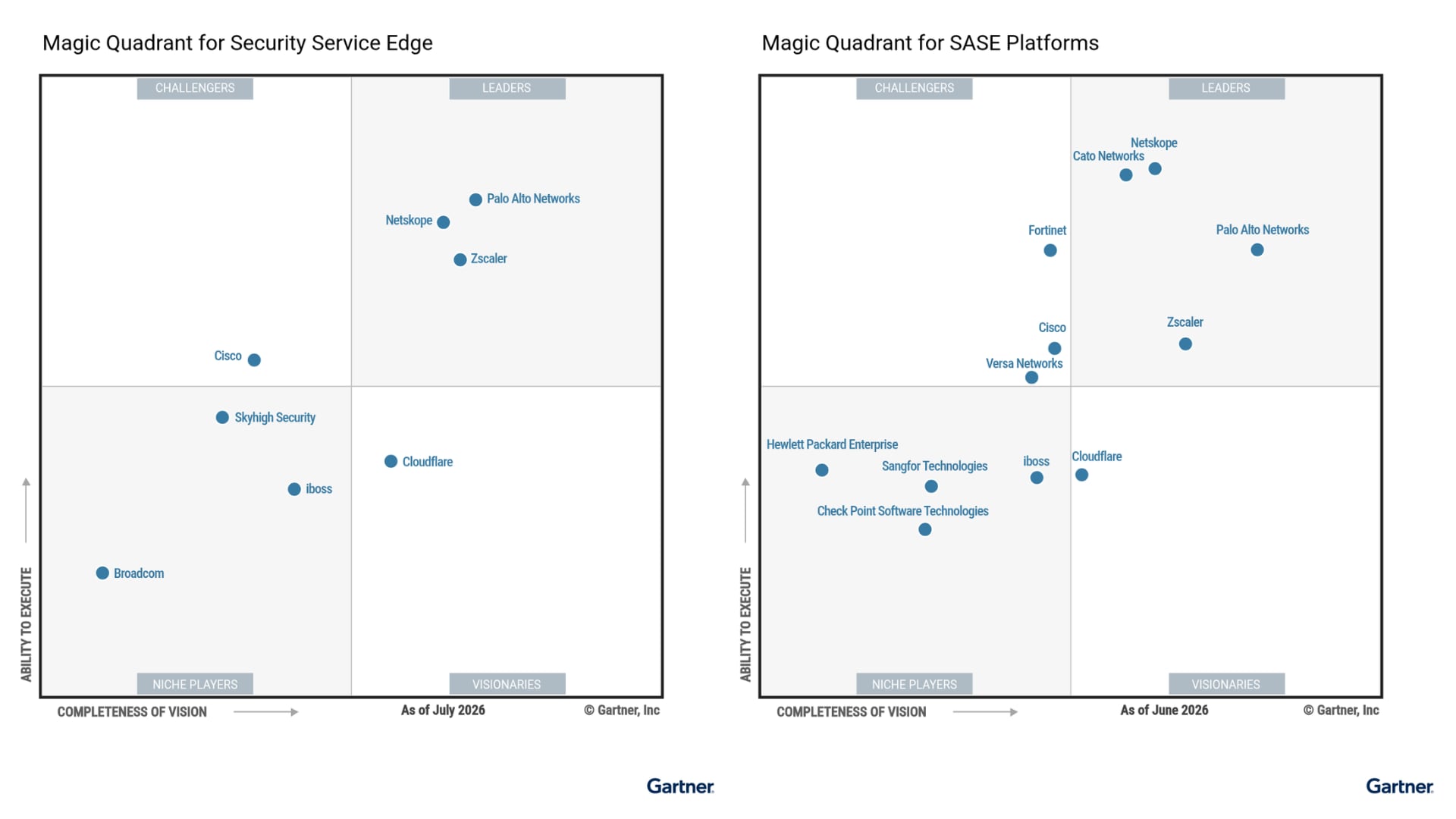
Today, we’re proud to announce that Gartner® has once again recognized Palo Alto Networks as a Leader in the 2026 Magic Quadrant™ reports for both Security Service Edge and SASE Platforms. This marks the fourth consecutive year that Palo Alto Networks has been recognized, making us the only security vendor to be recognized as a Leader in both reports for four years in a row.

In this year’s Magic Quadrant for SSE, Palo Alto Networks was placed highest in ability to execute and furthest in completeness of vision for Prisma Access.

Every day we focus relentlessly on understanding the needs of our customers and channeling that back into products and services that create real value for them. Our product strategy centers on where our customers' environments and security needs are heading, not just where it sits today.

Vision Matters More than Ever in the AI Era

The AI landscape is changing daily - in this new reality, we strive to be the visionary leaders to serve our customers. GenAI and Agentic AI are exposing enterprises to novel categories of risks like prompt injection, over-privileged agents, and poisoned models. At the same time, Frontier AI is accelerating vulnerability discovery and attack speed resulting in attack timelines being compressed by over 95%.

Gartner projects that by the end of this year, 40% of enterprise applications will feature embedded agents, up from less than 5% today. And by 2028, 60% of brands will use agentic AI to facilitate streamlined one-to-one interactions. Operating a business in this new reality requires security architecture engineered to anticipate threats that haven't yet emerged. Success cannot be achieved by retrofitting legacy products with support for AI infrastructure. It demands a unified future-ready foundation that natively secures users, applications, sensitive data, and non-human identities across every touchpoint. The platform enterprises use today determines whether they'll be prepared for tomorrow's threats.

As the cybersecurity landscape undergoes its biggest shift in decades, to us, the Gartner recognition as a Leader on vision and execution across both reports means more than ever before. In our opinion, it not only validates Palo Alto Network’s ability to serve the world’s largest enterprises but also celebrates our strategic product capabilities as shaping the future of cybersecurity through industry leading innovation such as securing AI traffic flows and agents that simplify manageability of SASE operations.

Vision Backed by Relentless Execution

We believe being placed highest in execution and furthest in vision is only as valuable as the ability to execute on it, and Palo Alto Networks has a proven record of creating value for our customers. Our recent milestone of crossing the $1.6 billion ARR mark while growing 40% year over year for Prisma SASE reflects the trust customers have placed in us. Over 6,800 organizations, including over one third of the fortune 500, trust us because we consistently turn market-defining innovation into enterprise-grade reality. Our execution leadership is built on a strong foundation:

  • Security powered by Precision AI: Our platform delivers universal zero trust through distributed and flexible enforcement points. We inspect traffic as close to the user as possible to ensure that whether your teams are at the corporate HQ, a remote branch, a coffee shop or working from home, they receive the same protection at their precise point of interaction.
  • Unmatched performance and resilience: By leveraging global hyperscalers, we provide the massive scale and reach that modern organizations require. For specialized, high-performance and sensitive needs, SASE Private Location brings that same cloud-delivered resilience directly to private campuses.
  • Unified platform: With a truly unified policy engine, data platform and operations, we ensure that as enterprises adapt to the future, our architecture remains an accelerator for secure productivity rather than a bottleneck. We accelerate vendor consolidation for enterprise customers, replacing fragmented legacy point products with a single platform that slashes operational overhead and reduces total cost of ownership (TCO) by up to 50%.

Building for the Future 

As the rules of cybersecurity are rewritten in real time, leading the market requires more than following past trends, it requires setting the trajectory. Our aim is to continuously be at the forefront of defining the future of cybersecurity to power the agentic enterprise of tomorrow.

Protecting with AI

Palo Alto Networks continues to innovate to keep enterprises safe at the speed of AI. Our Precision AI security service blocks over 30B threats every single day defeating sophisticated and highly evasive tactics. When combined with our virtual patching and IP defense security services, organizations receive proactive defense that secures at the speed of Frontier AI with flexible enforcement that provides consistent protection everywhere. We are delivering comprehensive security across network, edge, and cloud infrastructure to stop hidden threats that are invisible to traditional networks security solutions. 

This AI-powered defense in depth strategy operates across the entire attack lifecycle to enable proactive protection that shifts enterprise security postures from reactive incident response to preemptive defense. 

Securing AI 

Safely enabling employee adoption of AI tools and agents requires special considerations to mitigate risks around data leaks, intellectual property exposure, and compliance. Prisma SASE and Prisma Access solve these challenges by discovering all AI usage and agentic actions, enforcing granular least privilege access for human and non-human identities, and preventing exposure of risky data to AI and agents. Through AI Access Security™, Prisma SASE provides unified data security across the AI lifecycle by integrating GenAI app visibility and control, real-time prompt analysis, shadow data discovery, and  protection on endpoint. Prisma Browser provides a secure AI workspace that safeguards both human and autonomous agent workflows across any LLM by defending against data leaks, prompt injections, and agent hijacking. 

To secure the rapid adoption of AI agents by enterprises, Prisma Access will natively integrate with Prisma AIRS AI Gateway to provide a unified LLM, MCP, and A2A gateway giving security teams a single pane of glass for AI observability, cost governance, and runtime inspection.

This innovative approach represents an evolution away from traditional device and user centric fabrics towards an agent-aware platform capable of securing AI for the enterprise of tomorrow, today. 

Operating with AI

We continue to invest in capabilities that make our platforms proactive, efficient and easier to use. Our new deployment agents enable customers to onboard their SSE or SASE environment more efficiently, reducing their time to value while increasing productivity. Once onboarded, autonomous AI agents within Strata Cloud Manager continuously evaluate network and security posture to proactively identify configuration drift, performance degradation, and security policy gaps. By uncovering potential disruptions before they impact users or expose the organization to risk we’ve created automated systems capable of finding issues and automatically remediating them, with human-in-the-loop oversight calibrated to the administrator's comfort level, from guided recommendations to full autonomy.

The practical outcome is a dramatic reduction in mean time to resolution (MTTR) and a measurable reduction in total cost of ownership (TCO) while significantly reducing administrative burdens and making Palo Alto Networks products easier to maintain and operate.

Learn More

Download your complimentary copies of the 2026 Gartner® Magic Quadrant™ reports to learn why Palo Alto Networks has been recognized as a Leader in both SASE and SSE for the fourth consecutive year.


Gartner, Magic Quadrant for Security Service Edge, 29 July 2026, John Watts Et Al.
Gartner, Magic Quadrant for SASE Platforms, 28 July 2026, By Jonathan Forest Et Al.
Gartner does not endorse any company, vendor, product or service depicted in its publications, and does not advise technology users to select only those vendors with the highest ratings or other designation. Gartner publications consist of the opinions of Gartner’s business and technology insights organization and should not be construed as statements of fact. Gartner disclaims all warranties, expressed or implied, with respect to this publication, including any warranties of merchantability or fitness for a particular purpose.
Gartner and Magic Quadrant are a trademark of Gartner, Inc., and/or its affiliates.
This graphic was published by Gartner, Inc. as part of a larger research document and should be evaluated in the context of the entire document. The Gartner document is available upon request from Palo Alto Networks.

The post Palo Alto Networks Recognized as the Only Vendor to be Named a 4X Leader in SASE and SSE Gartner Magic Quadrant Reports appeared first on Palo Alto Networks Blog.

Strengthening Security of AI Coding: Prisma AIRS API Integration with OpenAI Codex

Palo Alto Networks works closely with OpenAI across our product platform and Unit 42, leveraging advanced frontier model capabilities. Furthermore, we are a partner in the OpenAI Daybreak Cyber Partner Program, working with OpenAI to bring trusted, AI-powered cyber defense to more organizations. Today, we’re announcing native integration of Prisma AIRS Runtime API with OpenAI Codex. This milestone deepens our partnership and drives our shared mission forward: equipping defenders with the industry's most advanced tools.

AI coding assistants have transformed software development, accelerating shipping velocity and changing how engineers solve problems. But as integration of AI coding assistants deepens across development teams, security and compliance teams constantly struggle with enabling developer productivity while helping protect proprietary source code and credentials, and reducing the risk of runtime threats entering the codebase.

Streamlined Security in Minutes

We designed this integration to eliminate complex traffic steering and heavy client-side hooks. Securing your entire developer organization takes just a few clicks inside Codex Enterprise Management UI. Here is how you can enable it:

  1. Retrieve Credentials: Generate your API key and endpoint from the Prisma AIRS management console.
  2. Configure Codex: Paste the Prisma AIRS API key and endpoint directly into your Global Admin Console.
  3. Activate Org-Wide Scanning: Once saved, all user prompts across your entire organization in Codex are automatically routed through the Prisma AIRS Runtime API for real-time inspection.

What Prisma AIRS Brings to OpenAI Codex

By connecting the Codex in ChatGPT for Enterprise workspace to the Prisma AIRS Runtime API, security teams gain comprehensive, automated security controls across two critical vectors:

1. Enterprise Data Loss Prevention (DLP)

Developers frequently paste context – logs, config snippets, or functions – into AI coding assistants. Prisma AIRS scans inputs to help identify sensitive data before it is submitted.

  • Secrets & Credentials: Intercept API keys, hardcoded passwords, tokens, and private keys.
  • PII & Financial Data: Automatically detect personally identifiable information and regulated data patterns.
  • Proprietary Code & IP: Enforce custom pattern rules to help prevent sensitive internal code, architecture details, or trade secrets from being submitted.

2. Advanced Threat & Malicious Code Detection

AI prompts and contextual inputs can contain content that introduces security risks into development workflows. Prisma AIRS Runtime API inspects incoming developer inputs for:

  • Malicious Code Patterns: Detect obfuscated scripts, dangerous command executions, or known exploit patterns within developer prompts.
  • Malicious URLs & Links: Flag unverified, phishing, or malicious domain references before they influence generated code or enter internal repos.
  • Prompt Manipulation Attacks: Detect adversarial inputs that may attempt to bypass system controls or alter model behavior.

Built for DevSecOps Alignment

Security controls only work if developers actually use them. Because the inspection happens at the platform administrative level via API, developers continue working natively in Codex without changing their IDE setup or downloading local hooks. SecOps gain centralized visibility, consistent policy enforcement, and audit-ready logging capabilities across the entire engineering organization, while developers keep the speed and experience they expect.

Key Takeaways

  • Security as Invisible Infrastructure: Prisma AIRS integrates at the Codex administrative layer, applying security and DLP controls without requiring additional developer workflow changes. Developers can continue working in Codex while security teams maintain centralized policy controls.
  • Unified Governance for Frontier Models: Prisma AIRS acts as an inline security layer that scans AI traffic in real-time before prompts ever reach the destination model. This architecture can help organizations identify sensitive information moving outward while detecting prompt manipulation and potentially malicious content moving into development workflows. If Prisma AIRS API detects a threat, a block verdict is sent to OpenAI Codex, and the prompt does not reach the destination model or MCP server.
  • Organization-Wide Compliance: Deployment speed is a strategic advantage, not just an IT convenience. By configuring the Prisma AIRS API within the Global Admin Console, organizations can achieve org-wide governance without complex traffic steering. This can help development teams shift from unmanaged AI use toward more consistent, auditable security practices.

Getting Started

The Prisma AIRS integration helps organizations maintain consistent security controls while preserving the speed and productivity gains of Codex. Organizations can combine Palo Alto Networks’ security capabilities with OpenAI Codex to maintain centralized security and governance controls.

Choose your path forward:


Forward-Looking Statements

This blog contains forward-looking statements that involve risks, uncertainties and assumptions, including, without limitation, statements regarding the benefits, impact, or performance or potential benefits, impact or performance of our products and technologies or future products and technologies. These forward-looking statements are not guarantees of future performance, and there are a significant number of factors that could cause actual results to differ materially from statements made in this blog. We identify certain important risks and uncertainties that could affect our results and performance in our most recent Annual Report on Form 10-K, our most recent Quarterly Report on Form 10-Q, and our other filings with the U.S. Securities and Exchange Commission from time-to-time, each of which are available on our website at investors.paloaltonetworks.com and on the SEC's website at www.sec.gov. All forward-looking statements in this blog are based on information available to us as of the date hereof, and we do not assume any obligation to update the forward-looking statements provided to reflect events that occur or circumstances that exist after the date on which they were made.

The post Strengthening Security of AI Coding: Prisma AIRS API Integration with OpenAI Codex appeared first on Palo Alto Networks Blog.
Bridging the Gap: An Unprecedented Approach to Browser and Endpoint Security

The enterprise workforce now operates almost entirely within the web browser. In fact, employees do roughly 85% of their daily work inside it, turning the browser into the sole operating system of the modern organization that connects every application, data interaction, and identity. Yet, for modern Security Operations Center (SOC) teams, the browser remains a frustrating and dangerous "black box."

While traditional Extended Detection and Response (XDR) platforms excel at monitoring endpoint hosts and processes, they treat the browser as a single, opaque process. This creates a critical visibility gap. According to research from Unit 42, over 90% of breaches are preventable by solving for factors such as visibility gaps. Because modern AI tools are predominantly accessed directly through the browser, it is now critical that SOCs get visibility into what’s happening within the browser. Leaving browser activity unmonitored forces your SOC to fight today's AI-driven workflows in the dark.

The Operational Fallout of Browser Blind Spots

SOC analysts frequently see alerts for malicious endpoint processes but lack the granular telemetry to pinpoint the exact web tab, malicious script, or user interaction that initiated the threat. This leaves incident responders blind to sophisticated tactics like rogue extensions and cross-origin attack chains, making it nearly impossible to reconstruct the full attack narrative.

When a security team operates with a fragmented view, a dangerous domino effect triggers the moment an attack strikes.

  • The root cause is hidden as analysts frequently see alerts for malicious endpoint processes but do not have enough context. Lacking the necessary telemetry, the SOC is forced to take extreme containment measures and completely isolate the entire endpoint machine.
  • In some cases, SOCs use third party investigation tools which create problems with disconnected context and long investigation times.
  • What starts as a simple browser blind spot ultimately leads to an aggressive response that unnecessarily halts daily operations, disrupts user productivity, and floods the help desk with tickets.

Recent research on Palo Alto Networks customer incidents highlights the sheer scale of this problem, revealing massive monthly volume of Cortex threat detections stemming from siloed browser activity.

To eliminate this vulnerability, Palo Alto Networks is thrilled to announce the native integration of Prisma Browser and Cortex XDR.

Cortex XDR and Prisma Browser Better Together

By unifying deep browser-level telemetry with industry-leading endpoint detection, we are providing SOC teams with visibility into the user’s primary workspace, transforming the browser from an unmonitored process into an active security sensor.

Prisma Browser and Cortex XDR Better Together
Figure1: Prisma Browser and Cortex XDR Better Together

Organizations can achieve the full benefits of this integration without complex APIs or heavy deployment overhead. Prisma Browser events including DLP violations, browser tampering, and unauthorized configuration updates are automatically fed directly into your Cortex tenant, making it incredibly easy to adopt this joint offering.

Moreover, when Cortex XDR raises an issue, browser-based events are correlated with the user’s malicious activity on the same endpoint, to add browser-based context and adding visibility to the possible starting point of the attack when it is initiated from the browser context.

What Makes Our Approach Different?

Many legacy vendors attempt to solve this problem using brittle, easily bypassed browser extensions that provide basic, surface-level visibility especially providing poor visibility into unmanaged devices. Palo Alto Networks takes a fundamentally different approach. Cortex XDR now integrates natively with Prisma Browser under the hood. This ensures both layers "speak the same language," turning a massive blind spot into a rich engine of security telemetry and visibility into everything from each user action to specific activities into their device posture while executing a particular activity..

True workspace security requires a unified defense system that understands exactly how web activity can impact the host device. This first-of-its-kind integration achieves this through three fundamental pillars:

1. Find the Root Source of Attacks in Seconds

Integrating Prisma Browser with Cortex XDR connects comprehensive endpoint visibility with deep web context. By seamlessly linking endpoint process execution directly to browser events and host execution, Cortex XDR provides an unprecedented unified data foundation that allows SOC teams to analyze complete attack narratives rather than isolated, disjointed issues.

SOC Teams Get Insights Into Attack Scenarios with Prisma Browser Investigation Panel
Figure 2: SOC Teams Get Insights Into Attack Scenarios with Prisma Browser Investigation Panel

SOC Teams Get Insights Into Attack Scenarios with Prisma Browser Investigation Panel

Scenario: Unmasking Phishing and Malware Narratives

When a malicious payload executes on an endpoint, traditional tools show the threat on the host but leave analysts guessing the source of the attack. By correlating Prisma Browser events directly with Cortex XDR eliminates this guesswork. Analysts can effortlessly trace a malware alert back to the exact phishing URL, original download source, or hidden iFrame metadata, uncovering the precise forensic root cause in seconds while easily dismissing false positives.

Connecting the Dots: Instantly correlate browser activity with endpoint execution for faster response and zero false positives.
Figure 3: Connecting the Dots: Instantly correlate browser activity with endpoint execution for faster response and zero false positives.

2. Respond Without Disrupting Business

Traditional XDR tools often need to disconnect a device to mitigate a threat. While effective at stopping lateral movement, it severely disrupts user productivity and halts business operations. The integration of Prisma Browser and Cortex XDR introduces granular, precision control.

Prisma Browser detects a malicious file download, blocks the action and sends a detailed report to the SOC
Figure 4: Prisma Browser detects a malicious file download, blocks the action and sends a detailed report to the SOC

For example, when a rogue browser extension attempts to compromise a web session, traditional tools are forced to isolate the device, forcing the employee offline, and disrupting daily operations. The integration of Prisma Browser and Cortex XDR introduces surgical containment instead. The threat is instantly neutralized and terminated only at the browser layer while simultaneously alerting Cortex, allowing the employee's laptop to stay completely online and productive.

3. Detect Evasive Threats in Real Time

Prisma Browser uses a pioneering approach to analyze activity in real time, detecting threats as they happen. This ensures that even the most sophisticated, evasive threats, such as rogue extension behavior or malicious script execution, are identified and flagged in real-time within your Cortex dashboard.

Prisma Browser detects an evasive threat in real time and shows in the Cortex dashboard
Figure 5: Prisma Browser detects an evasive threat in real time and shows in the Cortex dashboard

4. Securing GenAI Use Cases:

As employees rush to adopt GenAI tools, critical risks emerge, such as an engineer copying proprietary source code and pasting it into an unapproved, public AI model to fix a bug. To traditional XDR, this looks like safe, standard web traffic. Prisma Browser solves this by monitoring user behavior inside the workspace to automatically detect and block data loss prevention (DLP) violations in real time. Because it connects natively to the Cortex tenant without complex APIs, shadow AI risks are instantly flagged in the SOC dashboard before they turn into major compliance issues.

Future-Proof Your Workspace Security

Security operations can no longer afford to leave the browser unmonitored. By bridging the gap between what happens in the browser and activities on the endpoint, the integration of Prisma Browser and Cortex XDR accelerates investigation times, exposes hidden threats, and allows your SOC to respond with unprecedented precision.

New to Prisma Browser? Talk to your account team

The post Bridging the Gap: An Unprecedented Approach to Browser and Endpoint Security appeared first on Palo Alto Networks Blog.

Prisma AIRS - Unified Data Protection for Claude

As AI adoption shifts from experimental tools to the business core, enterprises are deploying AI agents and assistants across every department. Developers are accelerating software delivery with Claude Code and business functions are collaborating in Claude.ai, Claude Cowork, and Claude Design, using Anthropic's Claude to fundamentally rewire how they operate and drive complex, autonomous workflows across their most critical tasks.

Broad AI adoption has forced enterprise security into a difficult paradox: secure the business without stalling innovation. Today, security teams must answer three critical questions: How do we prevent sensitive data from leaking into AI models? How do we intercept runtime attacks, like prompt injection, before they execute? And how do we enforce these guardrails consistently across every AI interaction, in real-time?

We are thrilled to announce that Palo Alto Networks Prisma AIRS API now directly integrates with Claude Enterprise via inference hooks.

Key Takeaways:

  • Synchronous Governance at the Speed of AI: Enforce critical runtime policy guardrails instantly before model inference occurs. By evaluating every Claude interaction in real-time, security teams can confidently enable high-speed AI innovation without introducing unacceptable risk or operational bottlenecks.
  • Extending Proven DLP to AI Workflows: Safeguard PII, intellectual property, and proprietary code across all Claude environments (Claude Code, Claude.ai, Claude Cowork) seamlessly. By directly leveraging your organization’s existing enterprise DLP policies, you get consistent, unified data protection without the friction of managing disparate rule sets.
  • Neutralizing AI-Specific Threats Proactively: Deploy enterprise AI with confidence by intercepting malicious activity before it executes. Proactively block sophisticated runtime threats, including prompt injections, jailbreaks, and toxic inputs, enabling your AI workflows to remain secure and your business operations uninterrupted.

How It Works

Setting up zero-trust governance for your Claude Enterprise environment takes just a few clicks:

  • Configure Claude Enterprise: In your Claude Enterprise organization settings, navigate to inference hooks, set the hook endpoint URL to your designated Prisma AIRS webhook URL, and include your custom Prisma AIRS API key in the custom headers (x-pan-token).
  • Activate Cryptographic Verification in Prisma AIRS: Claude generates a unique, one-time signing secret. You simply drop this signing secret into the Prisma AIRS UI.

Prisma AIRS securely stores the signing secret in an encrypted edge Key-Value Map (KVM) to cryptographically verify the authenticity of every incoming request before processing.

Unified Governance Across All Claude Surfaces

Before Claude reads a prompt, Claude POSTs the payload to Prisma AIRS, which evaluates the input against the configured security profile and returns a synchronous allow or deny verdict back to Claude.

Removing the Data Inspection Blind Spot

This Prisma AIRS integration natively leverages the Palo Alto Networks Enterprise DLP engine your organization already runs. Your current policies, custom definitions of "confidential," and compliance dashboards now instantly govern Claude. No redundant rule creation, and no new management overhead. Every prompt is classified in real-time, before anything reaches the model. Data Policy updates reach Claude the moment they reach everything else, and Claude events land in the same dashboards and audit reporting as every other channel. AI stops being the exception to your data protection strategy and becomes just another channel that is covered.

In practice, this helps prevent:

  • Accidental exposure of PII and regulated data: a Social Security number, card number, or patient record pasted into a prompt is detected  on the spot by advanced RegEx patterns and ML classifiers,  with Exact Data Matching (EDM) recognizing your actual customer records.   When policy requires, Prisma AIRS enforces a deny policy to help keep Claude usage stays aligned with GDPR, HIPAA, and PCI-DSS requirements.
  • Misuse of credentials in code: Developers working in Claude Code can't inadvertently submit hardcoded API keys, private tokens, or environment credentials into prompt context.
  • Disclosure of confidential business matters. Document classifiers flag prompts touching M&A, legal, or HR material — even when they contain no identifier a pattern could match.

AI Safety & Runtime Threat Protection

Simultaneously, Prisma AIRS inspects payloads for operational risks specific to large language models:

  • Prompt Injection & Jailbreak Attacks: Intercepts malicious attempts to manipulate model context or bypass system instructions.
  • Malicious Code & Malicious URLs: Prevents execution or processing of untrusted scripts and risky links embedded within prompts.
  • Toxic Content & Topic Guardrails: Enforces compliance with corporate policies and custom business topics.

If a prompt violates your security policy, Prisma AIRS issues a deny verdict. Claude immediately blocks the prompt, optionally presenting a user-facing explanation while returning a unique audit correlation code to your security telemetry dashboards.

Deploy Claude Without the Risk

The Prisma AIRS integration with Claude transforms security from a deployment bottleneck into a business enabler. You no longer have to choose between the operational control of Palo Alto Networks and the cognitive velocity of Claude.

Choose Your Path Forward:


Forward-Looking Statements

This blog contains forward-looking statements that involve risks, uncertainties and assumptions, including, without limitation, statements regarding the benefits, impact, or performance or potential benefits, impact or performance of our products and technologies or future products and technologies. These forward-looking statements are not guarantees of future performance, and there are a significant number of factors that could cause actual results to differ materially from statements made in this blog. We identify certain important risks and uncertainties that could affect our results and performance in our most recent Annual Report on Form 10-K, our most recent Quarterly Report on Form 10-Q, and our other filings with the U.S. Securities and Exchange Commission from time-to-time, each of which are available on our website at investors.paloaltonetworks.com and on the SEC's website at www.sec.gov.  All forward-looking statements in this blog are based on information available to us as of the date hereof, and we do not assume any obligation to update the forward-looking statements provided to reflect events that occur or circumstances that exist after the date on which they were made.

The post Prisma AIRS - Unified Data Protection for Claude appeared first on Palo Alto Networks Blog.

Redefining Network Security for the Frontier AI Era

4 August 2026 at 15:00

Modern enterprise security is at a pivotal moment where CIOs and CISOs have a clear opportunity to build a cybersecurity architecture for both today’s environment, and for the future. Doing so requires redefining enterprise resilience across three critical dimensions. 

First, Frontier AI driven threat velocity and novelty. Frontier AI models have automated the entire attack lifecycle. Adversaries aren’t just compressing exploit windows to near-zero timelines, they are also generating novel, highly evasive threats at machine speed, bypassing traditional signatures and often before patches are generated. 

Second, surging network traffic is overwhelming traditional defenses. Driven by AI workloads, inter-datacenter traffic will nearly triple1 over the next decade dramatically expanding the volume of data teams must inspect and secure. 

Finally, major shifts are forcing a “cryptographic reset.” Shrinking certificate lifecycles, internet-scale distrust events, and quantum computers powerful enough to crack public key cryptography are combining to shake the foundation of all digital communications. 

Meeting these challenges requires more than incremental fixes. Today, we are proud to introduce PAN-OS 12.2 Ceres, a landmark release representing a major leap forward in network security. 

Ceres brings to market 55+ innovations, including three flagship, core capabilities, designed to shift the balance of power back to defenders.

Introducing Frontier Virtual Patching: Preemptive Defense Against Frontier AI Exploits

Today, Palo Alto Networks is giving defenders the ultimate advantage with the launch of Frontier Virtual Patching. By harnessing Frontier AI to discover unknown vulnerabilities, and deploying protections in hours, we are collapsing the exposure window from the industry-average 55 days2 it takes to deploy a traditional patch down into a near-zero window of exposure. This isn’t just about faster patching; it’s about eliminating the attacker’s chance by neutralizing exploits before they ever reach your network.

Frontier AI models - Collapse the patch window

The new reality: Exploitation far outpaces patch deployment

We’ve built this capability as a collaborative, force-multiplying ecosystem, with our industry partnerships across the enterprise software and OT vendor landscape to accelerate vulnerability disclosure, remediation and customer protection. This includes our collaboration with Project Lightwell, which combines our rapid network-level protection with software remediation to help organizations reduce exposure to emerging threats. We’re also partnering with vulnerability clearinghouses, software maintainers, and industry initiatives to continuously expand a real-time pool of protected vulnerabilities.

This approach builds on recent Unit 42 research, where the autonomous AI system NOVA identified more than 14,000 previously unknown vulnerabilities in just two months – a clear signal that defenders must pair AI-powered discovery with equally fast, coordinated protection. We have built an all-new detection engine, “vaulted protection," that enables us to deliver these rapid protections in a safe and responsible manner. When one participant identifies a threat, the entire ecosystem is protected instantly. Individual discovery becomes global protection. 

This is especially valuable for operational technology (OT), critical infrastructure, healthcare, and IoT: environments where systems can’t be taken offline to patch, where patch cycles can stretch for months, and where a single unpatched device can expose an entire network. Frontier Virtual Patching closes that gap in the network, blocking the exploit without applying a patch, rebooting a system, or causing any downtime to critical operations.

Bad actors will lean into Frontier AI to reduce the attack lifecycle from months to minutes. To keep pace, organizations require security partners to match that machine speed. To this end, Palo Alto Networks is raising the bar with its Frontier Virtual Patching, moving beyond compensating controls. By safely and efficiently discovering undisclosed vulnerabilities and deploying protection long before traditional patches can be rolled out, Palo Alto Networks deep security capabilities are flipping network defense from a reactive to proactive operational model.


Will Townsend
Chief Analyst, LoneStar Advisory & Research

And for existing Palo Alto Networks network security customers, getting started is effortless.  Frontier Virtual Patching is available as a PAN-OS software upgrade with persistent, automatic content updates, so protections keep arriving as new threats emerge, with no new hardware and no manual intervention. 

Clearly, Network Security is evolving quickly. Frontier Virtual Patching is part of a huge set of innovations that the team at Palo Alto Networks is delivering in PAN-OS Ceres 12.2 to enable you to stay protected.

Advanced IP Defense: Blocking attacker infrastructure before they can strike

Modern threat actors continuously work to hide their attacks and evade existing controls. Adversaries are increasingly evading traditional perimeter detection of their command-and-control traffic by leveraging direct-to-IP connection techniques that bypass DNS and URL inspection entirely. Attackers are also weaponizing massive proxy networks and hundreds of thousands of residential IP addresses to conduct stealthy, large-scale scanning, brute-force attacks, and exploitation that bypass traditional defenses such as IP reputation and blocklists.

To counter this, Palo Alto Networks is introducing a new preventative solution, Advanced IP Defense, with three powerful new capabilities:

  • Real-time IP-layer intelligence. We leverage global telemetry from over 70,000 customers to track and block attacker infrastructure inline across the entire attack lifecycle. Our researchers track these threats 24/7, so your team doesn’t have to.
  • Zero-Trust IP enforcement. We don’t just look at an IP’s past reputation. We verify the intent of the connection itself. By validating that every network connection maps to a legitimate DNS resolution, we provide a critical guardrail against attackers attempting to evade detection.
  • Powerful IP-layer context. We continuously monitor every connection across more than 40 distinct security attributes, letting you proactively shrink your attack surface and block high-risk traffic from the internet’s “bad neighborhoods” with confidence.

The transition to the Frontier AI era isn't a distant future. It’s happening right now. The organizations that thrive won't be those trying to run old, reactive playbooks faster; they have to scale their defenses to match a whole new velocity of risk. When threats occur at machine speed, relying on human-scale operations is no longer an option. That is why AI and automation are becoming essential tools to meet these challenges head-on.

Varinder Singh
CIO, NXP Semiconductors

Network Security Agents: Making admins superhuman

When threats execute in minutes, human-only operations become a bottleneck. To reduce fatigue and accelerate response, we’re launching an elite suite of AI agents for every major role a network administrator performs.

These six specialized AI-powered Network Security Agents, available through Strata Cloud Manager, are trained on your enterprise context and operational workflows. From onboarding and configuration to threat assessment and troubleshooting, they automate the hundreds of routine, repetitive tasks that consume an admin’s day. And you stay in control: for each workflow, you choose the level of oversight that matches your risk tolerance — human-in-the-loop, human-on-the-loop, or human-out-of-the-loop.

Expanding platform protection across every edge

Securing the modern enterprise means extending these AI-powered capabilities across every surface, from data center cores to remote industrial sites, and from custom AI applications to the web browser.

Today we’re introducing PAN-OS Ceres 12.2, which, in addition to the innovations above, expands our platform across five more areas:

  • Quantum-safe & next-generation trust security. Automates digital certificate lifecycle management and accelerates post-quantum cryptographic readiness, including a cryptographic inventory spanning network security, endpoint, SIEM, and vulnerability management integrations for a complete view of enterprise readiness.
  • 5th-generation ML-optimized hardware. New high-performance PA-Series firewalls equipped with 400G interfaces, and 300 Gbps of threat inspection, and active clustering, these platforms eliminate capacity limits for AI-era data centers. These firewalls also  scale to 1.4Tbps of throughput while delivering 5-microsecond latency ensuring peak performance. 
  • Modernized OT & critical infrastructure defense. Purpose-built PA-50R ruggedized 5G firewalls that extend real-time, AI-powered threat prevention to remote, extreme-environment OT networks and critical infrastructure.
  • AI and agent security. Prisma AIRS is now delivered as a scalable, cloud-native service explicitly engineered to secure AI models, applications, and autonomous agent workflows. The same platform on which we built CloudNGFW has now been extended to provide security for AI with the addition of Prisma AIRS.
  • Browser-to-firewall integration. Imagine the browser as a secure fast-lane that doesn’t just protect users, it empowers them. By integrating Prisma Browser with our NGFWs, we’ve eliminated the need to decrypt on the endpoint while delivering full Layer 7 protection. This is proactive security that neutralizes threats before they can even touch your network. For security admins, policy is fully unified from device to network, delivering a streamlined, automated experience.

Pan-OS 12.2 Ceres

The path forward

We are investing heavily in the innovations you need to defeat today’s threats while future-proofing your enterprise for tomorrow.

The transition to the Frontier AI era demands a bold strategy. The winners will be the organizations that adopt a prevention-first architecture capable of stopping threats long before weaponization occurs. With PAN-OS Ceres 12.2, Palo Alto Networks is giving defenders the speed, scale, and platform foundation to turn the tables on modern adversaries.


Forward-Looking Statements 

This blog contains forward-looking statements that involve risks, uncertainties and assumptions, including, without limitation, statements regarding the benefits, impact, or performance or potential benefits, impact or performance of our products and technologies or future products and technologies. Any unreleased services or features (and any services or features not generally available to customers) referenced in this or other press releases or public statements are not currently available (or are not yet generally available to customers) and may not be delivered when expected or at all. Customers who purchase Palo Alto Networks applications should make their purchase decisions based on services and features currently generally available.


​​Sources
1 https://www.nokia.com/artificial-intelligence/explainer-network-traffic-is-fundamentally-changing-in-the-ai-supercycle/
2 According to the Verizon 2024 Data Breach Investigations Report


The future of Frontier AI network security

Join Palo Alto Networks virtual InterSECt 2026 event on Aug. 19–20 
to see PAN-OS 12.2 Ceres and learn how to preempt AI-driven network attacks.
Secure your spot

Secure your future at the edge of the frontier

Explore our leading Frontier AI Ecosystem and essential resources
Learn more

The Future of Vulnerability Discovery Is Here

4,000 projects. 14,000 previously unknown vulnerabilities. Two months. Read Unit 42's latest research on why defenders must prepare for a dramatically faster threat landscape.
Read the report

The post Redefining Network Security for the Frontier AI Era appeared first on Palo Alto Networks Blog.

Received — 3 August 2026 Palo Alto Networks Blog

Palo Alto Networks Achieves Global CBPR and PRP Certifications

28 July 2026 at 21:05

Our mission is to be the cybersecurity partner of choice, protecting our digital way of life. Fulfilling that mission demands that we continually ensure our customers’ trust and instill confidence in our commitments.

In continuing to elevate global data trust, we have obtained both the Global Cross-Border Privacy Rules (CBPR) Certification and the Global Privacy Recognition for Processors (PRP) Certification.

These systems were originally established under the Asia-Pacific Economic Cooperation (APEC) Privacy Framework and expanded by the Global CBPR Forum. Through independent third-party audits, these globally recognized credentials validate that our data privacy practices meet rigorous international privacy standards.

These milestones join our existing portfolio of privacy and security certifications, reinforcing our ongoing commitment to responsible, accountable cross-border data protection.

To learn more, see the following resources:

The post Palo Alto Networks Achieves Global CBPR and PRP Certifications appeared first on Palo Alto Networks Blog.

Announcing the General Availability of Prisma AIRS AI Gateway

16 July 2026 at 16:50

Every modern enterprise is moving from an organization run by software to one orchestrated by AI, creating a tension between velocity and control. To resolve this tension, organizations require a unified architecture. Today, we are announcing the general availability of the Prisma AIRS AI Gateway, the AI control plane for the enterprise. 

Driven by the absolute conviction that an AI Gateway is foundational to the modern AI infrastructure stack, we are bringing AI innovations from the Portkey acquisition to Prisma AIRS just six weeks after closing. You can now scale AI at machine speed without compromising on enterprise-grade security and control.

Your AI Footprint is Outpacing Controls

Our next-generation firewall telemetry reveals that MCP activity climbed from 11% late last year to 41.4% by mid-2026. Monthly AI transaction volume grew twelve-fold over the same six months; some individual sessions moved hundreds of megabytes of enterprise data outbound. The AI footprint you can govern today is the smallest it will ever be.

Some of the most rapid AI adoption is happening with – coding assistants, enterprise agents and copilots.

  • Coding agents access code repositories, file systems, configurations, and credentials. When this context, including source code and secrets, is sent to a frontier model, it risks exposing sensitive data, and a runaway loop could burn a fortune in tokens overnight.
  • Enterprise agents run with broad access and standing privileges sharing context with each other. A single agent stretched beyond its scope can massively increase the risk of data breach, impact business reputation and customer trust.
  • Copilots now sit inside the SaaS and productivity tools employees already use. Copilots with broad access can surface data an employee was never meant to see.

As this enterprise data leaves when an AI request goes out, it creates a security and governance challenge at an unprecedented scale and speed.

What breaks when every team adopts AI 

AI adoption rapidly outpaces the security and governance infrastructure meant to secure it:

  • Shadow AI (Cost and usage are both hidden): You can't see the AI your teams already use or what it costs. 
  • Data Exposure (Sensitive data leaves without a trace): AI interactions can expose sensitive data, bypass policy and trigger unsafe outputs.
  • Agents Overstep (Actions run without accountability): Agents act across systems without clear identity, permission, or accountability. Keys get shared and agents run with broad, standing privileges, so no one can say which identity authorized a specific action or reverse it when an agent takes a wrong turn at machine speed.

Faced with this, most leaders either block traffic entirely or stay permissive and promise to govern later. Both approaches fail because they skip the critical step: seeing what agents do at runtime and controlling their actions while they happen.

Accelerate AI Adoption with Control

To scale AI adoption safely, you need a single control plane sitting between every AI interaction and the backend models. Prisma AIRS AI Gateway brings AI governance, identity and runtime controls together in one place. With the AI Gateway, you can:

  • Discover AI usage: Know exactly which apps, models, users, teams and agents are active, what they are accessing, and what they cost in a single unified view.
  • Govern AI interactions: Enforce central rules for model access, tool use and budgets while inspecting prompts and responses inline to prevent data leaks.
  • Secure every agent: Verify agent identities and enforce just-in-time, least-privilege access so autonomous systems only touch what they need, when they need it.

How the AI Gateway works 

Prisma AIRS AI Gateway sits inline between every AI interaction, model provider, and agentic interaction (Agent/AI App to LLMs, MCP Tool Calls, and A2A). It acts as a unified LLM, MCP, and A2A Gateway with a single enforcement point for all operational and security controls. Your teams keep using their existing coding assistants, enterprise agents, and copilots, while enforcement moves to the infrastructure layer where the platform team can own it.

Capabilities delivered through this unified control plane are:

Observability

Every request maps to a single unified view: tracking usage, users, projects, token counts, latency and cost so you can retire shadow AI infrastructure immediately.

Governance

Centrally define approved models, tools, and access without touching developer configurations. To drive FinOps and usage management, track every request's cost, tokens, and latency by team or project. Answer cost questions instantly, shut down unsanctioned AI usage, and proactively enforce budgets and rate limits before access is granted.

Coding Assistant Security

Protect credentials, proprietary code and development systems from risky AI actions. The gateway replaces raw provider keys with scoped credentials per user and team.

Operational Controls

Apply data protection, usage limits and policy checks as AI interactions happen. Traffic distributes via a Universal API across providers ensuring quotas are enforced and outages never stall your pipeline.

Agent Identity Security

Establish trusted identities by binding a verifiable, ephemeral identity to agents at execution. The AI Gateway acts as an enforcement point to enable only authenticated agents to make approved calls.

Runtime Security 

Powered by Prisma AIRS AI Runtime Security, the gateway inspects every prompt and response inline, stopping source code, secrets and customer data from leaving the network while neutralizing prompt injection attempts aligned with the OWASP LLM Top 10 and OWASP Top 10 for Agentic Applications.

Watch Anand Oswal break down why an AI gateway is foundational to this architecture.

the ai control plane of every enterprise

The AI Control Plane for the Enterprise

Prisma AIRS AI Gateway brings AI governance, identity and runtime controls together in one place. Point products filter text strings or route a single API call and they buckle under real enterprise volume.
Most products fail at scale. Prisma AIRS AI Gateway is built on an architecture tested in the most demanding enterprises for their ever evolving AI workloads: 

  • 68 Trillion+ tokens processed in the last month alone.
  • Sub-millisecond routing latency and inline inspection secures AI interactions without degrading user experience.
  • 99.999% availability helps ensure your AI operational pipeline does not experience a single point of failure.

Learn about Prisma AIRS AI Gateway and register for our webinar to see the AI Gateway in action. 

Your developers have already adopted their agents. The agentic enterprise is a reality. As the recently named "company to beat" in AI Security Platforms by Gartner, Palo Alto Networks is uniquely positioned to help you. Let’s build it securely, together.

The post Announcing the General Availability of Prisma AIRS AI Gateway appeared first on Palo Alto Networks Blog.

Palo Alto Networks and AT&T - Delivering Quantum-Resilient SASE Fabric

16 July 2026 at 16:00

By Yogesh Ranade from Palo Alto Networks, and Senthil Ramakrishnan from AT&T

The digital world is currently navigating a dual-speed revolution. Acceleration of AI and hyperconnectivity is unlocking unprecedented economic value. The silent but rapid progress of quantum computing is fundamentally threatening the cryptographic foundation upon which that value is built.

As leaders in global networking and cybersecurity, Palo Alto Networks and AT&T Business launched Secure Connectivity solutions for Business Customers. We recognize that quantum-readiness is no longer a distant milestone; it is now a strategic imperative. With threatening data longevity and Trust Now, Forge Later targeting digital identities, the risks are already looming. 

By integrating Prisma SD-WAN’s cryptographic innovation with AT&T’s global network, Palo Alto Networks and AT&T Business are proud to deliver the Quantum-Resilient SASE Fabric.

The Quantum Shift Towards Building Resilience for Tomorrow’s Reality

For over 30 years, the difficulty of mathematics has been our primary defense. Classical algorithms, like RSA and Diffie-Hellman, provided the shield for our global economy because they were computationally impossible for classical machines to solve. However, quantum computing fundamentally changes this landscape by providing an exponential speed-up. By leveraging Shor’s Algorithm, quantum computers can break these classical cryptographic foundations, turning a decryption process that would take a classic supercomputer millennia into a task of mere hours.

Neutralizing the Quantum Crisis

Palo Alto Networks is embedding Post-Quantum Cryptography (PQC) as a native pillar of the Prisma SASE fabric. We are moving beyond the forklift-upgrade model to a software-defined, standards-based foundation, which is built on strict separation of management and data plane components:

  • Universal Control Plane Hardening (TLS 1.3): We have transitioned all control plane traffic to TLS 1.3 (Transport Layer Security 1.3), the global gold standard for Internet encryption. This secures the "brain" of the network (where routing configurations and security policies are managed), making it immune to quantum-enabled impersonation and credential theft.
  • PQC-Hardened Data Plane (IETF Standards): We are operationalizing PQC across the entire fabric by adopting official standards published by the Internet Engineering Task Force (IETF), specifically RFC 9370, 9242, and 8784. In plain terms, these standards allow us to use "hybrid key exchanges." This means we wrap your data in two layers of protection at once: a classical mathematical shield for immediate compatibility, and a quantum-resistant shield to protect against future decryption threats, all without causing packet fragmentation or network slowdowns.
  • Logs and Telemetry Plane: All network telemetry and metadata (the automated operational logs and traffic pattern data generated by the network, rather than the actual content of your business files) are encrypted in transit via TLS 1.3. This architecture guarantees that even this secondary network metadata is geofenced to your chosen region with no cross-region aggregation, satisfying the most stringent data residency mandates.
  • Crypto-Agility as a Standard: "Crypto-agility" is natively built into our systems, which means the software is designed to adopt new mathematical algorithms. As the National Institute of Standards and Technology (NIST) refines its guidelines, our systems can be upgraded seamlessly via simple, automated cloud updates without requiring expensive hardware replacements to ensure our customers’ security posture.
  • Secure Boot Support: Palo Alto Networks Prisma SD-WAN ION hardware supports Secure Boot to ensure that only cryptographically signed bootloaders, kernels, and trusted applications are executed during the boot process. This establishes a chain of trust from the BIOS firmware to the operating system, preventing the execution of unauthorized or tampered software. ION hardware appliances ship with an integrated, dedicated Trusted Platform Module (TPM), which provides hardware-level root-of-trust by securely storing cryptographic keys, certificates, and sensitive data to prevent unauthorized physical tampering and ensure secure device authentication. The OS/software layers use PQC algorithms to negotiate and secure the management, control plane and data plane tunnels. This ensures quantum readiness without requiring an immediate, widespread rip-and-replace of physical branch hardware.

The AT&T Perspective Views Security at Global Scale

From the perspective of a global leader like AT&T, PQC is an operational mandate. Providing connectivity to the world’s most regulated industries means that security cannot be bolted on. Security must be an inherent property of the transport layer and the connectivity infrastructure itself.

Turning Complexity into a Strategic Advantage

Managing a global footprint that spans across 5G, fiber, and legacy underlays requires an institutional expertise that few can match. For AT&T, the move to a more secure quantum-ready fabric with Dynamic Defense is about providing security where it matters most: the network. Our customers shouldn't have to worry about whether their data is traveling over an MPLS circuit or the public internet.

Through this collaboration, AT&T expands the delivery of Dynamic Defense:

  • Cross-Underlay Consistency: We enable PQC protection to be applied uniformly across all transport mediums, eliminating the "weak links" that often exist in hybrid environments where data moves between private and public circuits.
  • Automated PQC Policy Orchestration: New branch locations are seamlessly integrated into the quantum-ready fabric through automated policy distribution. The moment a device is activated via zero touch provisioning, the branch is enabled to be protected against HNDL threats from the first packet without requiring manual site-by-site intervention.
  • Compliance: With mandates like NIS2/DORA in Europe and NORA/CNSA 2.0 in the U.S., our clients face a closing window for compliance. AT&T provides the verifiable chain of trust required to prove "Quantum Readiness" across the entire circuit path, ensuring your fabric is audit-ready and compliant with global standards.

The Power of the Post-Quantum Secure Fabric

The true value of this relationship lies in the synergy between the network and the security stack. By combining our strengths, we have built a solution that is significantly more resilient than the sum of its parts.

The SPI Advantage Is Performance Without Compromise

Through Service Provider Interconnect (SPI), Palo Alto Networks' security platforms natively integrate with AT&T’s private network core to deliver a seamless quantum-safe on-ramp. This means business traffic can connect directly to a secure AT&T network without having to build slow, complex software tunnels over the public internet, preserving high performance while delivering next-generation encryption. Historically, high-level encryption meant a "performance tax" on latency and throughput. Our combined architecture allows quantum-safe traffic to flow over AT&T’s network backbone, enabling organizations to modernize their security without sacrificing the user experience.

Securing the Decentralized Perimeter (The Branch as the Edge)

In today’s highly distributed business landscape, the traditional corporate "headquarters" is no longer the center of gravity. The network perimeter has shifted to the branch (decentralized edge locations like retail storefronts, remote clinics, regional bank offices, and warehouse hubs) and the individual 5G-connected devices employees use. Securing these remote, local edge points is critical because they represent the primary gateway where sensitive company data first enters the network. 

By utilizing AT&T’s leadership in WAN, 5G and cellular technologies, we leverage Hybrid Public Key Infrastructure (PKI) to secure these edge locations. Hybrid PKI is a digital identity framework that issues dual security credentials to every device: one "classical" identity to ensure compatibility with existing networks today, and one "quantum-resistant" identity. This double-verification guarantees that a cellular-connected remote branch or a mobile site is just as immune to quantum decryption or identity spoofing as a fortified corporate data center.

The Path Forward Is a Vision for Long-Term Trust

The transition to a quantum-ready future is a marathon, not a sprint, and the first steps must be taken now. Palo Alto Networks and AT&T Business are offering a clear, practical path to quantum resilience.

We are delivering more than a simple software update as we prepare customers for the next generation of digital commerce. Together, we are designing our network to help ensure the data of today remains protected against the threats of tomorrow, securing the digital integrity of every enterprise we serve.

As we redefine the boundaries of security in connectivity, we invite you to join us in helping secure your organization’s digital future. Contact your or Palo Alto Networks account representative today to begin a strategic Quantum-Readiness Assessment and experience the power of the Quantum-Resilient SASE Fabric.

The post Palo Alto Networks and AT&T - Delivering Quantum-Resilient SASE Fabric appeared first on Palo Alto Networks Blog.

Received — 10 July 2026 Palo Alto Networks Blog

What It Takes to Secure Claude Cowork Across the AI Enterprise

You've watched the demos. Whether it's Claude Cowork, ChatGPT Enterprise, GitHub Copilot, Cursor, or internally developed agents, AI systems are no longer answering questions. They are connecting to enterprise data, invoking tools, making decisions, and executing multi-step workflows across applications without human intervention. The capability is real, and organizations are rapidly moving from experimentation to deployment.

Teams are no longer asking if they should use this, they have accepted agentic tools as the reality. But the board and the infosec team are asking a different question: can this capability be secured and controlled at enterprise scale? Can security teams prevent sensitive company data from being exchanged without oversight?

Anthropic built meaningful access controls into Cowork — role-based permissions, group spend limits, usage analytics and connector restrictions — so the answer is a qualified yes. Those controls handle who can use the tool and what they can connect to, but they don't answer whether a specific action inside a given session is safe. That gap is the one standing between a successful pilot and a successful org-wide rollout.

The Gap That a Demo Doesn’t Expose

The organization’s admin assigns roles, sets spend ceilings per user group and restricts which connectors have access to write to your database. Anthropic's OpenTelemetry support even lets your team pipe session events into your SIEM. These controls cover real ground, but they operate at the permissions level — answering whether a person is authorized to use the tool rather than whether what's happening inside a session is safe.

Consider what that gap looks like in practice. Let’s consider two scenarios. Your finance analyst has full Cowork access and uploads a quarterly forecast containing unannounced acquisition figures. The access controls confirm she is authorized to use the tool, but nothing evaluates whether that information should be exposed to a model. That's an AI data loss prevention risk, and access controls are blind to it.

The risk becomes greater when agents move beyond information retrieval and begin taking actions. Let’s say a scheduled Cowork automation is set up to pull weekly competitor pricing from the web. A target site embeds hidden instructions in its page content. The agent, running unattended, reads them as legitimate commands and begins modifying local files and triggering actions your team never authorized. By the time anyone notices, the agent has already acted.

The first scenario exposes a governance problem because your security team has no visibility into what data is flowing through AI tools across the organization. The second is a runtime security problem as there is nothing evaluating whether an action in progress is safe, regardless of whether the user was authorized to start it. Neither gap is addressed with the predefined controls in Cowork; both need to be solved before you can say yes to Cowork adoption in the whole organization.

Why Traditional Controls Break Down

Traditional enterprise software behaves predictably. Access controls work because administrators can reasonably anticipate what an authorized user or application will do once access is granted. 

AI systems operate differently. Agents combine models, tools, data sources, and reasoning paths dynamically at runtime. An authorized user may start with a simple request, but the resulting chain of actions may evolve in ways that were never explicitly programmed or anticipated. The challenge is no longer controlling who can access a system. The challenge is securing and governing what happens after access has been granted.

The Missing Layer is Runtime Security 

Anthropic's access controls establish who can use Cowork and what they can connect to. But as the examples above show, they don't protect against what happens inside a session: a finance analyst uploading sensitive acquisition data to the model, or a scheduled automation being hijacked by a malicious instruction embedded in a webpage it was directed to visit. What organizations working with Cowork need is a layer that enforces data and security controls and gives complete visibility at runtime across all Cowork agents in the enterprise every interaction boundary.

An AI runtime security layer that sits between your teams and the model providers such as  Anthropic, AWS Bedrock, Google Vertex or any combination, and evaluates risk in every interaction. It inspects every request, every tool call and detects sensitive data like client names, financial projections, internal pricing and contract terms.  It enforces agent identity controls, so every automated action is traceable to a specific workflow and owner. 

Your CISO gets the audit trail and your Infosec team gets the evidence.

The AI Enterprise Needs a Control Plane

The CIO needs the observability for all Cowork activity and costs. An AI control plane allows the CIO to set spending limits per team and use case across every AI tool from a single console. Procurement asks for a quarterly forecast across all AI spend, and you pull it from one place instead of aggregating reports from four different vendor dashboards. If you need to move providers for cost or compliance, the gateway reroutes traffic without disrupting your teams or breaking your workflows.

Claude Cowork may be where organizations begin scaling their AI journey, but it won't be the only AI tool your teams use. Developers will use coding assistants,  business teams will leverage the AI built into SaaS applications and data science teams will deploy custom agents for their workflows. New models, new providers and new workflows will continue to appear.

The challenge isn't just governing one AI application; it’s governing AI activity across the entire AI enterprise.

Everyone looks to secure each tool individually: configure Cowork's controls, configure your coding assistant's controls, configure your internal agents separately. But this approach doesn't scale. This is the sole purpose of the control plane. It sits above individual tools, applications and models and enforces  security policies,  across every AI interaction. 

Prisma AIRS AI Gateway provides that centralised control plane. Organizations that deploy Cowork behind our gateway get runtime security, data protection, agent identity controls, and full visibility, applied consistently, without changing how teams use the tool. The same gateway secures every other AI tool in your environment on the same terms.

Cowork may be where the journey begins, the gateway is what allows it to scale and secure the AI Enterprise.

The post What It Takes to Secure Claude Cowork Across the AI Enterprise appeared first on Palo Alto Networks Blog.

It Might Feel Like We’ve Been Here Before, But We Haven’t

6 July 2026 at 13:09

As artificial intelligence (AI) adoption surges and organisations move from the ‘should we?’ phase to the ‘how do we?’ phase, it’s natural to evaluate the likelihood of positive returns on AI investments. That’s always been the case with the onset of each new technology paradigm: C-suite executives, guided by their boards and aided by technical and business teams, remain keenly focused on traditional metrics such as return on investment, shareholder equity, developing and extending competitive advantage, and ensuring superior customer relationships.

This time is different, however. I recently experienced that firsthand when I went to visit a major customer. My contact, a senior decision maker, gave me a pointed piece of advice about how to talk about AI with his boss, the CEO: “Please don’t say anything negative about AI.” The subtext was clear: The company was fully committed to AI and didn’t want any cognitive dissonance to dissuade them from their mission.

It's hard to imagine a CEO taking such an absolutist stance on previous technology waves, such as cloud, bring your own device, or the internet of things. CEOs, board members, and technical leaders would be pragmatic in evaluating the benefits of investments and put mileposts in place to gauge progress – and to determine if and how to proceed.

AI is certainly a different kind of paradigm, though. While no one is casting aside careful evaluation and monitoring of AI investments, the underlying assumption is that we’re stepping on the accelerator. We’re all enthused not only by its potential for transformation and innovation, but also by how this technology can be leveraged for remarkable societal good.

However, while the accelerating momentum toward AI and agentic systems is undeniable, it is vitally important to set aside the fervour around AI and take a sober look at how to deliver safe, secure, and tightly governed systems at enterprise scale. 

Many organisations are underestimating the challenges of AI governance, in large part because they think they’ve been here before. They already have many experiences of ensuring robust cybersecurity and strict governance for new technologies, as they’ve done for remote systems, cloud computing, the internet of things, and more. They already have a corporate commitment to doing governance correctly and a sound governance model. 

But this new era of AI and agentic systems is different. New challenges abound, and AI strategy, build-out, and governance must be in alignment from the start to ensure proper operational, ethical, and regulatory outcomes. 

Our intention with this Peer Insights guide is to raise what we believe are existential issues around governance for this powerful, complex, and unprecedented technology wave. Few technologies have merited the often overused phrase ‘inflection point’ more than AI. The speed of AI adoption is nothing short of breathtaking; however, today’s runaway embrace of AI is far stronger than our current ability to govern it. That’s because AI represents a fundamental shift in how organisations do their business, interact with customers, make vital decisions, and execute their plans. This isn’t just a technology play: It’s a strategy for success and survival for entire industries and our global economy. The stakes have never been higher.

CEOs care so passionately about AI because they see it changing nearly everything we’ve learned and believed to be true about organisational success and failure. CEOs are in their positions for one purpose: to grow the business. AI can do that by transforming their processes and sparking new ideas. When that customer representative forewarned me, I really wasn’t surprised to hear his CEO felt so strongly about AI: Research from BCG indicates that more than 94% of CEOs say they still plan to deploy AI irrespective of demonstrated business value, even if there is a lack of tangible ROI or financial benefits from the start. 

Which brings us to the central role of AI governance. As we all know, there are many fundamental elements to any governance strategy, starting with robust, scalable, and intelligent cybersecurity. Cybersecurity - the foundation of governance - also includes the twin imperatives of accountability (‘rogue AI’ being a real thing, after all) and regulatory compliance.

But good AI governance has to go even further. Operational integrity is key to good governance because so much sensitive and even proprietary data is poured into AI models and accessed through powerful agentic AI systems. Now more than ever, organisations have to be transparent with customers and trading partners about how their AI systems operate, what kind of data is accessed, and how it is protected. And that doesn’t just mean being upfront with customers by telling them when they are interacting with an AI agent. Let’s take a typical retail use case: Imagine you’re on a website looking at clothing, and the agent recommends specific styles of clothing in specific colours. True operational integrity would allow you to discover why and when the agent made those recommendations. Was it based on your prior purchasing history, or on your browsing patterns on a recent web session? AI and agentic governance take the guesswork out of the equation for those interacting with the system and help breed greater confidence and trust.

It's critically important for decision makers to view AI governance holistically, rather than through a series of narrow lenses. For instance, even though cybersecurity is the foundation of good AI governance, it’s a mistake to treat AI governance primarily as a cybersecurity problem. If asked about ownership of AI governance, CEOs cannot and should not reply, “Oh yeah, the CISO has that covered.”

AI governance is fundamentally an enterprise risk problem, which means everyone must be involved in creating, deploying, managing, evaluating, and adjusting AI governance guardrails on a real-time basis. Again, AI is a different kind of risk environment than any we’ve previously encountered. For the most part, organisations are simply not adequately prepared to apply the right level and right type of governance to AI and agentic systems. I’ve spent much of the past 15 years of my career building governance frameworks, and while it has never been easy, we have had the advantage of being able to control many of the variables – such as infrastructure and network access – impacting governance decisions. With AI and agentic, we no longer have that advantage.

To explore the critical and complex issues of AI governance, we’ve enlisted five leading voices to bring their real-world experience to the discussion. Together, our five authors help lay out the new rules of the road for governing AI and agentic systems at scale.

Just as my customer gave me a heads up about the realities of speaking with his boss about AI, I’d like to offer you a heads up about the realities of AI governance challenges before you read this Peer Insights guide

  1. Visibility is paramount for successful AI governance. As we learned during the growth of trends such as cloud, bring your own device, and remote work, our employees will push the envelope with a do-it-yourself mindset. These tech-savvy and resourceful users are already making rogue AI a reality, so organisations need more visibility than ever into where AI ‘science projects’ and sandboxes are operating without anyone’s knowledge.
  2. AI governance must reflect the stunning velocity of change in AI development and deployment. Not only does AI have its own never-imagined rate of change, but the technology is changing everything else faster – product development, supply chains, marketing programmes, and more. AI governance has to evolve just as rapidly. Governance in the AI world must be a living system, constantly evolving with new technology use cases.
  3. Trust boundaries are incredibly different and difficult to manage in AI governance. AI represents a new class of identity that simply didn’t exist before. That means AI doesn’t fit neatly into your existing identity management framework, making things like application whitelists and zero trust network access less effective.

Unfortunately, many CEOs, board members, and business executives simply don’t understand the profound importance and complexity of these issues. They may have been heartened by how they integrated generative AI into their technology frameworks and their business processes, but GenAI was pretty familiar territory for CIOs, CTOs, and CISOs. Agentic AI is different for several reasons, including its automation and self-learning capabilities. Don’t be lulled into a false sense of security: Agentic AI is not simply a refresh of GenAI.

As you get ready to dive into the following chapters, rethink how you define governance when applying it to AI systems and agentic AI. Most traditional governance models are imagined, constructed, and deployed as gates, preventing people from doing things or going places they shouldn’t. Instead, think of AI governance as a guardrail to guide and direct people to get the most out of AI without creating problems. With so much excitement and investment around AI, organisations – and their employees – want to get the most out of their AI and agentic systems. We all know people don’t want to hear “no, you can’t do that”, so an effective governance system should use guardrails to drive proper, responsible, and safe usage of the technology.

Finally, as complex as AI and agentic governance are and will continue to be, don’t overthink things in hopes of creating the perfect model – it doesn’t exist. My advice is to start now, even if the model and framework are imperfect, and then bring the business along with you.

We at Palo Alto Networks are excited to give you insights, ideas, and actions you can take away from the chapters of this guide. We encourage you to share what you learn with your colleagues, peers, and team members – and to take prudent steps to build an AI governance model that rewards innovation without allowing your organisation to drift into dangerous waters.


Click here to download the guide today. Visit Executive Edge, our C-level thought leadership platform, for more insights for EMEA CXOs.

Haider Pasha is VP & Chief Security Officer, EMEA, Palo Alto Networks

The post It Might Feel Like We’ve Been Here Before, But We Haven’t appeared first on Palo Alto Networks Blog.

A Defining Moment in Identity Security

30 June 2026 at 18:28

Artificial intelligence (AI) is changing the enterprise faster than most security models were built to handle. In just a few years, it has become part of everyday enterprise work. And soon, AI agents will do much more than provide assistance. They will act autonomously across applications, workflows, data stores and infrastructure.

This shift is already changing the security conversation – as it should. When agents can act on behalf of users, systems and business processes, identity is no longer a supporting layer of cybersecurity. It becomes the control plane for deciding who or what can act, what they can access, how much privilege they should have and when that access should be removed. Fragmented tools weren’t built to support this level of real-time visibility and control. It requires a unified identity security platform.

Palo Alto Networks recent acquisition of CyberArk reflects our conviction that identity is a core platform pillar for securing the future of AI. Identity security is now a foundational layer across our portfolio, building on CyberArk's trusted privileged access management (PAM) heritage and extending it to address the complexity of hybrid, cloud-native, and AI-driven environments. It also advances Palo Alto Networks broader platformization strategy, driven by customer demand for integrated, AI-powered security solutions that reduce complexity and close gaps created by disparate point products.

For partners, the launch of Idira™, our next-generation identity security platform, represents a significant opportunity to help customers secure access, privilege and identity risk through a more unified platform approach. More than ever, our customers need knowledgeable, trusted advisers to help them rethink how identity connects to the rest of their security architecture across network security, cloud, security operations (SecOps) and the broader AI-enabled enterprise.

Identity Security is No Longer Human-Centered

Research for our 2026 Identity Security Landscape report found that 96% of organizations have human identities operating with access far beyond what is required for their roles. That finding is unsettling enough, but also consider how modern identity security must account for far more than human users and privileged administrators. It includes machine identities and AI agent identities, ranging from service accounts, workloads and APIs to secrets and certificates and to agents operating across multiple systems.

Our recent report on identity security also notes that there are now roughly 109 machine identities for every human identity. Each identity can carry privilege, create risk and expand the attack surface. That scale makes real-time discovery, governance and control of identities essential. Yet many organizations are still managing privilege in ways that weren’t built for the AI era. When identities can act across systems and attacks can move faster, standing privilege (i.e., always-on access rights granted to users or machines) becomes harder to defend.

The premise of Idira is that every identity within an enterprise is privileged. The platform helps enterprises move from the traditional operating model of human-centered identity architectures and static access tools to embrace one platform that secures every identity – human, machine and AI agent. Idira discovers identities, entitlements and access paths, dynamically applies privileges through just-in-time controls and continuously governs identity lifecycles.

These capabilities become even more crucial as customers work to reduce fragmentation across their security environments. They want better visibility, faster time to value, stronger controls and a simpler way to manage risk across the enterprise. They still need advisory, implementation and managed services expertise, but the conversation is no longer limited to firewalls, privileged access, cloud workloads or SOC operations in isolation. Customers want expert help in connecting these areas into a unified strategy that reflects how their environments actually operate, especially with AI in the mix.

The Identity Security Opportunity for Partners

My message to partners following our launch of Idira is simple but direct: Now is the time to seize this defining moment in identity security. The speed of business is accelerating, as is the speed of attacks. And we know many of our customers around the world are already trying to understand what AI means for their security architecture, operating model and risk posture.

Partners can help lead those conversations with customers. For specialized and regional partners, this might mean expanding the advisory conversation beyond a single domain of cybersecurity. For global systems integrators, it might involve creating a more scalable delivery model by reducing the cost and complexity of stitching together multiple vendor environments. We are also actively welcoming partners into the broader Palo Alto Networks ecosystem, creating new opportunities for identity-focused partners to expand their role across the full platformization strategy.

Across partner types, the identity security opportunity is both strategic and economic. By connecting identity security to the broader Palo Alto Networks platform strategy, partners can expand services offerings, deepen customer relationships and build a stronger model for helping customers reduce complexity, improve visibility, strengthen controls and get to value faster. 

But first, sales teams, technical teams, solution consultants and managed service teams need to understand how Idira fits into the Palo Alto Networks platformization strategy and where identity security connects to customer priorities. That means taking full advantage of the sales demos, AI role plays, technical enablement and other active learning resources in Palo Alto Networks newly evolved NextWave program.

I encourage you to move quickly to build your understanding of Idira’s role in securing human, machine and AI agent identities and the shift from standing privilege to dynamic access. Be prepared to talk with customers about identity security in the context of cloud, network, SASE and SOC transformation, as you can be assured questions will be coming. Also, think about the services and offerings you can build around this opportunity. Identity security assessments, privilege modernization, machine identity protection, AI agent identity readiness and broader platformization road maps can all help customers take practical steps toward strengthening security in the rapidly evolving AI era.

Our partners play a frontline role in driving Palo Alto Networks platformization strategy and enabling our shared success. To help your teams educate customers about AI-related identity risk and how Idira can help them secure every identity in the enterprise, human or not, explore the latest resources, enablement and partner tools available through the NextWave Partner Portal.

Key Takeaways

  • With the launch of Idira, identity security became a core pillar of Palo Alto Networks platformization strategy for the AI era.
  • Idira helps organizations secure every identity – human, machine and AI agent – with dynamic access, continuous governance and real-time control.
  • Partners have a timely opportunity to help customers reduce complexity, improve visibility and connect identity security to broader cloud, network, SASE and SecOps priorities.

The post A Defining Moment in Identity Security appeared first on Palo Alto Networks Blog.

New Executive Order Accelerates Post-Quantum Readiness Amid the Cryptographic Reset

24 June 2026 at 01:30

The White House Executive Order on securing the nation against advanced cryptographic attacks accelerates the mandatory timeline for post-quantum readiness.

For years, post-quantum cryptography has been discussed as an important, yet abstract future technical migration. Because of the uncertain timeline for quantum computing, it has been difficult for most organizations to prioritize quantum readiness against more immediate security demands.

That is changing.

Signed on June 22, 2026, the Executive Order mandates the transition of federal information systems to post-quantum cryptography and establishes a national policy to migrate them to NIST-approved standards. It also extends the urgency beyond government by directing support for critical infrastructure owners and operators, advancing requirements for federal contractors, and calling for cryptographic bill of materials guidance.

The order directly addresses harvest now, decrypt later risk and sets transition milestones for federal high-value assets and high-impact systems: 2030 for key establishment and 2031 for digital signatures.

While the order directly applies to U.S. Federal civilian agencies, it should be seen as a signal of broader policy and procurement momentum. Organizations that do business with the government, support critical infrastructure, or operate in regulated industries such as energy, financial services, and healthcare should expect post-quantum readiness expectations to accelerate.

Quantum risk has shifted from a long-term research concern to a national cybersecurity priority tied to sensitive data, critical infrastructure, federal systems, procurement, and the broader digital economy. For security teams, the challenge now is turning that urgency into an operational plan.

Operationalizing the quantum mandate

As quantum computing advances, widely used public-key cryptography will become vulnerable to future attacks. Even before a cryptographically relevant quantum computer exists, adversaries can capture encrypted data now with the goal of decrypting it later.

This “harvest now, decrypt later” risk is especially concerning for organizations that protect sensitive information with a long shelf life. The response cannot wait until the threat fully materializes.

The broader ripple effect matters because compliance alone will not equal readiness. As requirements flow into federal acquisition rules and contractor obligations, the vendor ecosystem will be pushed to support quantum-safe capabilities in the products and services that enterprises, critical infrastructure organizations, and regulated industries rely on.

Adding support for post-quantum algorithms is not the same as safely migrating to them. Support means a system can use new algorithms. Readiness means the organization knows where cryptography exists, which systems are exposed, which dependencies matter most, and how to execute changes without creating disruption or new risk.

That matters because post-quantum migration can affect more than cryptographic libraries. Larger cryptographic objects, new protocol behaviors, hybrid modes, hardware acceleration requirements, interoperability constraints, and legacy system limitations can create real performance, availability, and compatibility challenges if changes are made blindly.

This is why cryptographic visibility must lead to actionable migration planning.

Security teams cannot migrate what they cannot see. But visibility by itself is not enough. They also need to classify exposure, prioritize high-value systems and long-lived data, understand operational dependencies, and plan changes in a way that avoids disruption, downgrade risk, or incomplete migration.

Cryptographic bill of materials guidance will be an important step toward mapping cryptographic assets. But a CBOM should be the starting point, not the finish line. An inventory can show where cryptography exists, but readiness requires understanding business impact, migration complexity, interoperability risk, ownership, and the order in which changes should happen.

Post-quantum readiness is not just an algorithm swap. It is an operating model for managing cryptographic change at scale.

Five actions for post-quantum readiness

The path forward starts with five practical actions.

  • First, see cryptographic exposure. Organizations must gain visibility into cryptographic usage across all environments to mitigate the risks associated with undocumented encryption.
  • Second, prioritize what matters most. Cryptographic exposure varies in urgency. Organizations should prioritize protecting authentication, high-value assets, and long-lived sensitive data based on risk and business impact.
  • Third, modernize trust infrastructure. Existing systems rely on fixed cryptographic assumptions. Post-quantum readiness demands flexible infrastructure and trust services that support evolving standards.
  • Fourth, automate cryptographic change. Manual tracking with spreadsheets provides an incomplete, point-in-time snapshot that quickly becomes outdated and is insufficient for the coming changes. Automation allows organizations to manage cryptographic updates and trust operations in a consistent, controlled manner.
  • Fifth, govern readiness over time. Post-quantum migration requires continuous governance to track progress, align ownership, and adapt to evolving threats and standards.

These actions help security leaders move from awareness to readiness.

What this means for cybersecurity now

The Cryptographic Reset is already underway, driven by post-quantum risk, shorter certificate lifecycles, machine identity growth, fragmented cryptographic ownership, CA distrust events, and expanding digital infrastructure.

The organizations that move first will not simply be the ones that adopt new algorithms the fastest. They will be the ones that build the visibility, operating model, and governance needed to manage cryptographic change continuously.

Take the next step

Read the guide: The Post-Quantum Readiness Race Is On: Five Actions Security Leaders Can Take to Accelerate Crypto Agility.

More resources

The post New Executive Order Accelerates Post-Quantum Readiness Amid the Cryptographic Reset appeared first on Palo Alto Networks Blog.

Built to Last: What Stonehenge Teaches us About IT Architecture & Cyber Resilience

23 June 2026 at 17:55

Anyone who has seen the impressive frame of Stonehenge against the morning’s sunrise cannot help but be struck by its resilience, how it has withstood time and the unpredictable impact of nature and humans. And partly because of this, a recent conversation I had with the CIO of a large healthcare technology company made me realize that it was a fitting metaphor for cybersecurity.

As our conversation wove through familiar topics — the challenges and breakthroughs in enterprise IT architecture — we recognised and discussed a recurring pattern throughout most EMEA and multinational enterprises. Those organisations have gradually but surely evolved into a mosaic of vendor fragmentation, ‘micro-platforms’ across vendor-specific technologies, and rapidly developing data silos that no single IT architecture can solve on its own. 

The increased heterogeneity of hardware, operating systems, and cloud architectures now comes with a dizzying mix of cybersecurity tools and services, often optimised for Vendor X’s platform. This has led to the situation that a large organisation typically has more than 30 cybersecurity point solutions in place to protect their digital assets. And now that we have thrown AI into that mix, designing the right cybersecurity solution is as confusing as it is imperative.

That’s when I was reminded of Stonehenge. Its lintel-and-joinery design is strikingly simple and elegant, and it stands as a brilliant monument to long-term resilience. Just as Stonehenge has endured against natural and human threats, so organisations must build a cybersecurity architecture that endures a revolutionary rate of change and threat diversity, including geopolitical turbulence and AI entering the value chain. 

For CISOs, CIOs, board members, C-suite executives and line-of-business leaders concerned with operational resilience, cybersecurity architecture matters—deeply. 

And we should not forget that cybersecurity is a data problem. The more telemetry data you have, the more effectively you can execute security algorithms and protect your digital essentials across all your enterprise IT pillars, i.e., IT, OT, Clouds, Networks, Workplace, Endpoints, etc. We at Palo Alto Networks are able to combine relevant telemetry data from networks, firewalls, clouds, browsers, endpoints and the internet. 

Stonehenge was built from massive, self-reinforcing pillars and platforms of stone. The lintels and joinery help hold together the overall structure as a cohesive unit, and they have striking similarities to how IT architects are now thinking about cybersecurity. In today’s technology architecture, Stonehenge’s vertical pillars are an IT organisation’s specialised, vendor-specific IT domains—sometimes with its own security tools and capabilities rather than as a strategically integrated zero-trust cybersecurity framework across your enterprise IT pillars.

Now, Stonehenge’s with its unique resilience, can also serve in its own construction as a model for modern cybersecurity architecture. Like our evolution towards modular platformisation evolved deliberately and assuredly over time and it spans all key domains of cybersecurity, ie network, cloud, AI,  identity security and all key building blocks for an AI-driven SOC, the last line of defense that has to be real-time. In other words, it is the linchpin of our strategy for enterprise security built upon such key areas as Identity, the Autonomous SOC, and Network Security. 

Stonehenge’s lintel is analogous to cybersecurity platformization, a growing trend rapidly replacing the now-outdated best-of-breed point solution mindset. This employs a modular approach that gives flexibility and control to the security architect looking to add security domain capabilities as needs evolve. The mortise-and-tenon joinery of Stonehenge works because the parts fit together rather than being stacked as an afterthought, in much the same way modern cybersecurity frameworks are built upon the concept of embedded functionality rather than being bolted on. 

An important example here is Palo Alto Networks’ decision to power the cybersecurity platform core with Precision AI, rather than its technology being added as a separate tool. This approach enables Precision AI to power data, analytics, and workflows, making it an omnipresent resource for smarter and faster prevention, detection and response.

Another important element of any enduring architecture is its ability to provide stability to the overall framework. In cybersecurity architecture, this is the all-important cyber data layer across an integrated zero trust framework. As organisations continue to struggle with data silos across networks, cloud environments, security operations centres, and edge systems, the cybersecurity data lake takes on a heightened role of importance for the resilience of the entire cyber framework. Again, let’s not forget, cybersecurity is a data problem, a domain in its own right across all vertical IT pillars.

Now, Stonehenge with its unique resilience, can also serve in its own construction as a model for modern cybersecurity architecture. Like our evolution towards modular platformization evolved deliberately and assuredly over time and it spans all key domains of cybersecurity, i.e.  network, cloud, AI, endpoints, identity security and all key building blocks for an AI-driven SOC, the last line of defense that has to be real-time. In other words, it is the linchpin of our strategy for enterprise security built upon such key areas as Identity, the Autonomous SOC, and Network Security/SASE. 

Another critical element of the cyber platform is something even Stonehenge hasn't had to face: securing AI itself, especially the opportunity and threat represented by agentic AI. AI security must become part of the platform design and implementation, as we have done with our Prisma AIRS (AI Runtime Security) platform for enabling an organisation's growing AI portfolio to remain a vital asset and not an inviting attack vector. Agents now are not just another non-human identity; they are an entirely new class of identity, with a striking mismatch in speed between agent decision-making and human governance. The inside-out attack paths taken by hackers' ill-intentioned agents represent a major threat to under-protected AI supply chains. The same pressure now also comes from geopolitics and from AI moving into the value chain itself, such as in the case of the Factory of the Future.

Similarly, our recent acquisition of CyberArk gives us what we believe is the industry’s strongest identity security platform, Idira, positioning it as yet another vertical pillar connected to the overall cybersecurity platform lintel. Cortex XSIAM and its security data lake are deliberately open — ingesting and correlating third-party telemetry alongside our own, over 17 petabytes of telemetry data each day — to form a secure data layer that is accessible to users based on policy management and credentials validation. Palo Alto Networks leverages this mountain of data, along with around-the-clock scanning of more than 5 billion daily security events, to feed Precision AI in order to detect and block potentially devastating attacks. Currently, we detect about 9,6m new attacks per day that have not been there the day before. The use of automated AI in attack vectors has been accelerating the time of exfiltration of data from the compromise of an organization. This delay was 9 days about 3 years ago, now data is exfiltrated in most cases in less than a day, sometimes already within less than one hour!

In this context, it's also important to highlight the importance of an Autonomous SOC pillar, particularly since compliance reporting windows are continuously contracting from days to mere hours calling for real-time, highly automated defence. Today, mean-time-to-detect and mean-time-to-respond are board-level imperatives commanding more conversation and attention at an organisation’s highest levels. The Autonomous SOC pillar is a vital element in helping enterprises achieve even faster detection and remediation, ideally down into single minutes. If it also integrates the historic enterprise SIEM you can further simplify your SOC operations and gain solid financial benefits by platformization of your security relevant data.

Finally, keep in mind the use of supply chains to build the actual platform. For Stonehenge, that was an impressive physical supply chain: The bluestones used in the structure were hauled about 250 kilometers from Wales without the benefit of air, rail, or truck transport. For Palo Alto Networks’ cybersecurity platform, the supply chain was no less impressive, but more virtual than physical, often faced with attacks on third-party interdependencies such as SaaS applications, APIs and in times of Frontier AI models, the Open Source components. 

Like the pyramids, the Great Wall of China, and the Roman road system, the most remarkable aspect to Stonehenge isn’t just its engineering elegance, but its ability to withstand changing conditions and threats over time. Whether you’re a CEO, board member, CIO, CISO or security engineer, the decisions you make about cybersecurity carry significant impact and implications. In order to achieve Stonehenge-like resiliency, technical and business leaders should commit to an architectural model designed not only for today’s needs, but for what those needs are likely to be over the long term. 

Therefore, cybersecurity should be architected as a horizontal, dedicated platform across all your IT domains and businesses. With this you are able to provide real-time and platformized cybersecurity for tomorrow. And tomorrow is going to be a more and more AI-driven business world. 


Helmut Reisinger is CEO for Europe, Middle East, and Africa at Palo Alto Networks.

The post Built to Last: What Stonehenge Teaches us About IT Architecture & Cyber Resilience appeared first on Palo Alto Networks Blog.

Expanding Our Footprint: Local Cloud Availability for Prisma AIRS in Japan

Securing the Future of Japan’s AI Landscape

The shift from static LLMs to autonomous agents has fundamentally changed the global threat surface. Frontier models like Anthropic's Mythos can now autonomously discover hundreds of zero-day vulnerabilities, rapidly shrinking the gap between discovery to exploitation from days to minutes. With the rise of autonomous offensive AI, multi-agent systems like the 'Zealot' proof-of-concept can independently perform reconnaissance, escalate privileges, and exfiltrate cloud data.

Prisma AIRS 3.0 is a comprehensive AI security platform that secures the new AI estate end-to-end: scanning models, agents, and artifacts before deployment, protecting runtime behavior, and enforcing unified control through posture management.To secure this new AI estate against these advanced global threats, Palo Alto Networks is pleased to announce a strategic investment designed to enhance cyber resilience: the establishment of our new local cloud location for Prisma® AIRS™ in Japan. This localized presence simplifies complex operations, enabling local data residency and low-latency processing to accelerate the secure adoption of Generative AI and Agentic Workflows.


Comprehensive Agent Security Platform The new regional expansion in Japan hosting Prisma AIRS provides Japanese organizations with domestic, high-performance access to critical AI security capabilities. As we progressively roll out our full suite of features in the region, Prisma Airs is designed to be a comprehensive AI security platform that secures an organization's entire AI ecosystem including AI applications, models, agents, and datasets, from the development phase all the way through active deployment.  

  • AI Model Security:
    Enables the safe adoption of third-party AI models by scanning them for vulnerabilities and secures the AI ecosystem against risks, such as model tampering, malicious scripts and deserialization attacks.
  • AI Red Teaming:
    Uncovers potential exposure before bad actors do. Performs automated penetration tests using our Red Teaming agent that learns and adapts like a real attacker to stress test AI deployments at machine speed.
  • AI Runtime Security™:
    Protects LLM-powered AI apps against runtime threats, such as prompt injection, sensitive data leaks, and Indirect Prompt Injection (IDPI) embedded in benign-looking websites.
  • AI Agent SSPM (SaaS Security Posture Management):
    Secures AI agents against new agentic threats, such as identity impersonation, memory manipulation and tool misuse. This governs autonomous connections and prevents attackers from weaponizing a company's internal AI assistants.

Please visit the regional cloud locations of Palo Alto Networks for more information. This infrastructure optimizes operational efficiency and provides the essential security foundation for large-scale Digital Transformation (DX) projects, empowering Japanese enterprises to innovate with confidence and Deploy Bravely

The post Expanding Our Footprint: Local Cloud Availability for Prisma AIRS in Japan appeared first on Palo Alto Networks Blog.

The Invisible CEO of Crisis: Breaking the Cycle of CISO Burnout

18 June 2026 at 22:55

When a major cyber incident hits, all eyes are on the CISO.

They become the invisible CEO of crisis, steering the entire enterprise through the storm, managing stakeholders and making major decisions under immense pressure. The clock is ticking. Every minute can mean more systems affected, more data exposed, greater operational disruption and a growing risk to customer trust and corporate reputation.

And this on top of an already expanded day-to-day role, where they are expected to make decisions with incomplete information, brief the board, support legal and communications teams, manage technical response and reassure the business, all while knowing that any delay could increase the damage.

But a troubling pattern often emerges once the smoke clears. The CISO may find themselves held responsible for the incident that just happened, and in some cases personally liable, while still being expected to prevent the next one. Yet, at the same time, their influence over the strategic decisions that shape cyber risk can quickly diminish. 

This cycle takes a toll. Across EMEA, we are seeing the personal and organisational impact of that pressure, from burnout and leadership turnover to growing concerns about long-term resilience.

That pressure often comes at a demanding stage of life too. Many security leaders reach the CISO role when career responsibility is peaking at the same time as responsibilities outside work, from ageing parents and family commitments to their own health.

With an average CISO tenure now reduced to between 18 and 26 months, and nine out ten reporting feeling moderate to high stress, a more sustainable model is needed for structural and personal resilience.

Cybersecurity is far more complex than it was a decade ago. AI-powered attacks and autonomous agents are increasing the speed and scale of threats. At the same time, the CISO has never had more potential influence over business strategy. The challenge is ensuring the support around the role evolves as quickly as the threat landscape.

That is why it’s time to stop treating cybersecurity as a technical function alone and recognise the CISO as a strategic business leader.

Structural equity - breaking the cycle of isolation

The burden of cyber resilience should not rest on one individual. Yet too often, organisations place responsibility on the CISO without providing the support, influence or measures of success needed to help them thrive.

Part of the problem is how the role is measured. CISOs are judged by whether incidents happen, rather than by the quality of preparation, resilience planning, risk reduction and secure business enablement.

And preparation can really help reduce the pressure. Regular red teaming, tabletop exercises and incident simulations mean the CISO is not carrying the crisis alone when a breach happens. The organisation has rehearsed its roles, decision points and escalation paths before the stakes are at their highest. 

But after a crisis, organisations also often fall back into day-to-day survival mode, undoing the progress made when security was treated as a critical part of business planning rather than a technical function. Strong resilience requires the CISO to have a permanent seat at the table for all strategic decisions, from M&A to digital transformation.

That influence only comes with strong foundations. This includes visibility of critical assets and risks, security controls that are fit for purpose and the operational discipline to maintain them over time.

  • Invest in leadership as much as certifications: The modern CISO needs diplomacy, judgement and the ability to translate risk into business terms. Different backgrounds can strengthen that role, bringing fresh perspective when solving problems that are no longer purely technical
  • The ‘Shared CISO’ model: Cyber resilience should not rest on one pair of shoulders. The most resilient organisations embed responsibility for cybersecurity across the business, while creating stronger support structures around the CISO through deputies, shared ownership of cyber risk and clear succession planning. This reduces pressure on individual leaders and helps ensure resilience is built into the organisation itself

Strategic diplomacy - aligning people and purpose

Cyber resilience depends on people as much as technology, and a CISO’s success depends on building alliances across the business. The strategic diplomat CISO focuses on moving the conversation from ‘no’ to ‘how?’ by building deep relationships with other leaders, every team and every department across the organisation.

By understanding the business’ growth drivers, the CISO can align security goals with the board’s priorities. That means agreeing meaningful measures of risk and readiness, preparing for difficult questions and giving the business a clear view of where it is exposed. 

Security and growth must be seen as a single strategic fabric. Integrating security into the development of internal AI tools and customer-facing products helps ensure innovation is secure by design, rather than being a hurdle to overcome later.

The post The Invisible CEO of Crisis: Breaking the Cycle of CISO Burnout appeared first on Palo Alto Networks Blog.

❌