When your encryption system generates millions of duplicate API calls per hour, costs spiral and performance degrades. That’s exactly the challenge NICE Actimize faced while operating their global-scale, event-driven financial crime detection platform on Amazon Web Services (AWS).
NICE Actimize, a leading provider of financial crime, risk, and compliance solutions, processes millions of encrypted messages daily across hundreds of tenants. By rethinking how they cache encryption keys, they reduced their AWS Key Management Service (AWS KMS) costs by 77% while maintaining strict security guarantees and per-tenant encryption isolation.
In this post, we explore the cache stampede problem that emerges when envelope encryption meets high-concurrency, multi-tenant architectures. We walk through two solutions: the AWS-recommended hierarchical keyring pattern and a custom caching approach that NICE Actimize built for their regulated environment. These patterns apply to multi-tenant software as a service (SaaS) environments and high-throughput systems where per-tenant encryption generates significant KMS API volume.
Why per-tenant encryption matters
Financial services systems operate under strict regulatory requirements. You must encrypt data at rest and in transit. For multi-tenant SaaS providers, this requirement might go further: each tenant’s data must be encrypted with separate keys to provide complete cryptographic isolation. If one tenant’s key is compromised, no other tenant’s data is at risk.
Consider an enterprise SaaS environment built on an event-driven architecture using Amazon Managed Streaming for Apache Kafka (Amazon MSK), with many different databases for storing data and Amazon Simple Queue Service (Amazon SQS) for messaging. Messages flow continuously between producers and consumers, and each message must be encrypted with the correct tenant-specific key. At scale with millions of messages daily across hundreds of tenants, this creates a massive volume of encryption and decryption operations.
To handle this volume efficiently, the standard approach is envelope encryption: a two-tier model where an AWS KMS key encrypts short-lived data keys, and those data keys encrypt the actual data. Your application can encrypt large volumes of data locally without calling AWS KMS for every operation, reducing latency and costs.
The cache stampede problem
Envelope encryption reduces AWS KMS calls, but it doesn’t eliminate them. Each encrypt operation still requires a data key, either generated fresh using GenerateDataKey or retrieved from a cache, and each decrypt operation must unwrap an encrypted data key (EDK) by calling Decrypt. In high-throughput systems processing millions of messages, these calls add up quickly.
The AWS Encryption SDK provides a built-in solution for this: the CachingCryptoMaterialsManager. This component caches data encryption materials (data keys) locally, so your application can reuse them across multiple operations without calling AWS KMS each time. You configure a time-to-live (TTL), a maximum message-use limit, and a local cache, and the SDK handles the rest.
This approach works well under moderate load when you partition the cache by tenant AWS KMS key Amazon Resource Name (ARN) so that each tenant’s encryption materials remain cryptographically isolated. However, a critical problem emerges as concurrency scales to hundreds of threads processing millions of encrypted messages in parallel: the cache stampede, also known as the thundering herd problem.
How the stampede occurs
The CachingCryptoMaterialsManager caches the result of the SDK’s internal getMaterialsForEncrypt and decryptMaterials calls at the materials level. The cache stampede, however, happens at the KMS API call level. When a cached data key expires or a new, previously-unseen EDK arrives, the following sequence unfolds:
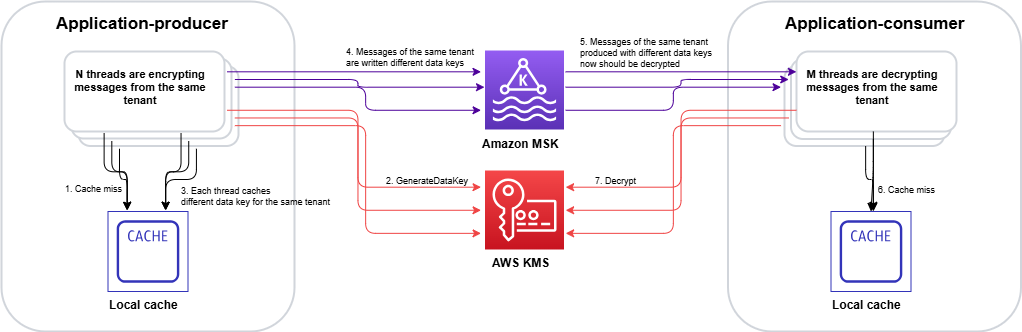
On encrypt – data key explosion: Multiple threads simultaneously call encrypt() for the same tenant. Each thread finds the cache entry expired and independently calls GenerateDataKey against AWS KMS. Instead of one thread generating a data key while others wait, N threads create N distinct data keys. Each new data key produces a unique EDK, which inflates the EDK cardinality across the system.
On decrypt – redundant unwrap calls: Those extra unique EDKs propagate downstream. When consumers later read encrypted records, each distinct EDK is a separate cache key. Multiple threads encountering the same EDK simultaneously each trigger an independent Decrypt call to AWS KMS because the cache has no coordination mechanism to make competing threads wait for a single in-flight request.
Compounding effect: The encrypt-side stampede creates excess EDK cardinality, which degrades the decrypt-side cache hit ratio, which triggers more KMS calls, which drives up costs further. In the NICE Actimize case, this produced a ratio of 30% unique data keys to data records in DynamoDB tables, meaning nearly one in three records was encrypted with a different data key.
At enterprise SaaS scale, this compounding effect can generate millions of redundant AWS KMS GenerateDataKey and Decrypt calls per hour, even with the SDK’s built-in caching enabled. The following figure shows the pattern leading to a stampede.
Figure 1: Cache stampede – multiple threads independently calling AWS KMS for the same encrypted data key, creating duplicate requests
The stampede follows this sequence on the encrypt side:
Multiple threads call encrypt() for the same tenant concurrently.
Each thread checks the CachingCryptoMaterialsManager and finds the cache entry expired.
With no coordination mechanism, each thread independently calls GenerateDataKey.
AWS KMS returns N distinct data keys (one per thread).
Each data key produces a unique EDK, inflating cardinality across the system.
On the decrypt side, the inflated EDK cardinality compounds the problem:
Consumer threads encounter unique EDKs that were never cached.
Multiple threads hitting the same EDK simultaneously each trigger a separate Decrypt call. AWS KMS returns the same plaintext data key N times, doing redundant work.
Two paths forward
We evaluated two approaches to solve the cache stampede problem. Each fits different architectural requirements and regulatory constraints.
Option A: Hierarchical keyring with DynamoDB (AWS-recommended)
AWS addresses the cache stampede challenge through the hierarchical keyring pattern, which introduces an additional level of key hierarchy that significantly reduces how often cache stampedes occur.
In this architecture, branch keys serve as intermediate wrapping keys stored in a DynamoDB table. This DynamoDB table acts as a shared cache layer that coordinates across all instances in your distributed fleet.
Figure 2: Hierarchical keyring architecture – branch keys in DynamoDB coordinating across distributed instances
The architecture (shown in Figure 2) works as follows:
The application requests encryption through the hierarchical keyring.
The keyring checks the local cache for the tenant’s branch key.
On a cache miss, it queries the DynamoDB Key Store table for the active branch key.
AWS KMS decrypts the branch key (this is the only KMS call in the flow).
The decrypted branch key is returned to the keyring.
The keyring stores the branch key in the local cache for subsequent requests.
The keyring derives a unique wrapping key from the branch key and generates the data key locally.
The key insight is that the cache is thread-aware. When the cache expires, threads coordinate to make a single request to refresh the cache. Only a single thread is used to make a call to the branch key, rather than all the threads acting independently. Additionally, by adding an additional key into the key hierarchy, branch keys don’t live within AWS KMS. This means cache misses and the stampedes they trigger interact with the branch key, and don’t make as many calls to the AWS KMS service at the top of the hierarchy:
Without hierarchical keyrings: Your local cache needs to store all the data encryption keys, and has constant misses as new, unique data keys arrive with each encrypted message. A miss can trigger a stampede.
With hierarchical keyrings: The same branch key wraps thousands or millions of data keys. A cache miss only occurs when a branch key expires or is first requested, which happens orders of magnitude less frequently than without hierarchical keyrings.
The DynamoDB table acts as a coordination point. The first thread to request a missing branch key retrieves it from AWS KMS and stores it in DynamoDB (the Key Store table). Subsequent requests from instances in the fleet retrieve the cached branch key from DynamoDB instead of making duplicate AWS KMS calls.
Beyond reducing cache miss frequency, the hierarchical keyring provides built-in stampede protection within its local cache implementation. The SDK offers multiple cache types, and the Default cache, designed for heavily multi-threaded environments, prevents multiple threads from calling AWS KMS on cache expiry by notifying a single thread that the branch key materials entry is about to expire 10 seconds in advance. That one thread refreshes the cache while all other threads continue serving requests using the still-valid entry.
This solution integrates with the AWS Encryption SDK and requires minimal code changes to existing applications. For event-driven architectures processing encrypted Kafka streams, this approach reduces KMS call volume by orders of magnitude while preserving per-tenant cryptographic isolation.
Option B: Custom KMS client caching – Solving the stampede at the API layer
While the hierarchical keyring (Option A) addresses the stampede by reducing how often cache misses occur, there’s a complementary approach: eliminating the stampede at its source by caching KMS API responses directly, using atomic, single-flight cache loading that prevents concurrent threads from issuing duplicate calls. This is the path NICE Actimize took.
The IClientSupplier extension point in AWS Encryption SDK v3
In the AWS Encryption SDK v2, decorating the AWS KMS client on a per-request basis was possible through the RegionalClientSupplier interface, but it was an advanced and undocumented use case. Without explicit guidance or a supported pattern, caching strategies typically operated above the SDK layer, making it difficult to prevent duplicate KMS calls at their source. The AWS Encryption SDK v3 introduced the IClientSupplier interface, which the AwsKmsMrkMultiKeyring accepts at construction time. This interface is called by the SDK whenever it needs a KMS client for a given AWS Region, and you control what it returns, making it possible to insert a caching layer between the SDK and AWS KMS.
Architecture: A decorated KMS client with two Caffeine caches The solution is a CachedKmsClient—a decorator that wraps the standard AWS SDK KmsClient and interposes two Caffeine LoadingCache instances between the application and AWS KMS:
Cache
Key
Value
Purpose
GenerateDataKey cache
GenerateDataKeyRequest (tenant KMS key ARN and key spec)
GenerateDataKeyResponse (EDK and plaintext data key)
Ensures encrypt operations on the same node reuse the same data key for a given tenant KMS key during the cache window
Decrypt cache
DecryptRequest (EDK and key ARN)
DecryptResponse (plaintext data key)
Ensures decrypt operations for the same EDK share a single KMS call result
Both caches are configured with refreshAfterWrite (default: 1 hour, configurable), which means:
During the refresh window, concurrent threads receive the cached response instantly resulting in zero KMS calls.
When a cache entry expires, Caffeine’s LoadingCache.get() guarantees that exactly one thread executes the loader function (the actual KMS API call), while all other concurrent threads block and wait for that single result. This is the atomic, single-flight property that eliminates the stampede.
Security consideration: Caching plaintext data keys in memory means the keys exist in process memory for the duration of the cache TTL. The TTL acts as a security control: shorter TTLs reduce the window of exposure in the event of a memory dump, while longer TTLs reduce KMS call volume. Choose a TTL that balances your security requirements with your cost and performance goals. Key rotation at the KMS key level remains unaffected by the cache, because rotated keys produce new data keys on the next cache refresh.
Integration with the AWS Encryption SDK v3
The integration is minimal. The IClientSupplierAWS Lambda function returns a CachedKmsClient singleton for each AWS Region, this singleton is passed into the AwsKmsMrkMultiKeyring at keyring construction time. From that point forward, each GenerateDataKey and Decrypt call the SDK makes flows through the caching decorator transparently, with no changes to the encrypt or decrypt call sites.
The CachedKmsClient is a singleton per Region (managed using a ConcurrentHashMap), so all tenants on the same node share the same caching layer but their data keys remain fully isolated because the cache keys include the tenant-specific AWS KMS key ARN.
Why Caffeine?
Caffeine is a high-performance, near-optimal Java caching library well-suited for this pattern for several reasons:
Atomic loading: LoadingCache.get() guarantees that on a cache miss, only one thread executes the loader while others wait. This is the core property that eliminates the stampede.
refreshAfterWrite semantics: Unlike expireAfterWrite (which blocks all threads during refresh), refreshAfterWrite allows one thread to asynchronously reload the entry while other threads continue to serve the stale-but-valid cached value. This eliminates latency spikes during key rotation.
Observability: Cache eviction listeners and Micrometer metric counters can be wired in to track actual KMS call volume per tenant KMS key, enabling real-time cost monitoring.
Choosing between the two options
The hierarchical keyring with DynamoDB (Option A) is a production-ready, AWS-recommended solution that reduces stampede frequency by introducing longer-lived branch keys. It’s the best choice for most organizations. Particularly when starting fresh or when the operational overhead of an additional data store is acceptable.
NICE Actimize chose the custom caching approach (Option B) for a pragmatic reason: it avoided introducing a new infrastructure dependency into the encryption critical path. Their platform already operated at scale across hundreds of tenants, and adding a DynamoDB table as a key coordination layer would have meant taking on additional operational responsibility: provisioning, monitoring, backup, access control, and ensuring high availability for a component that sits directly in the encrypt/decrypt hot path. In a regulated financial services environment, each new stateful component in the security chain requires its own resilience planning, failure-mode analysis, and compliance review. The Caffeine cache used in Option B, by contrast, is an in-process library (a JAR on the classpath). It is stateless, requires no network calls, no provisioning and no operational overhead. It makes a lighter dependency than a managed cloud resource in the critical path. There is no shared state to lose, no additional infrastructure to protect, and no new failure mode beyond what already exists with AWS KMS itself. If a node restarts, the cache rebuilds on the next KMS call.
Results
By implementing a rotation policy with the optimized caching approach, NICE Actimize achieved the following results:
77% reduction in AWS KMS costs – Eliminating millions of redundant API calls translated directly into significant cost savings.
Maintained strict per-tenant isolation – Per-tenant encryption isolation remained fully intact, with no compromise to their security posture.
Improved system performance – Removing the stampede of duplicate AWS KMS calls reduced latency and freed up system resources for core processing.
The cache stampede problem compounds in multi-tenant encryption systems: excess data key generation on the encrypt side degrades cache hit ratios on the decrypt side, creating a feedback loop of redundant KMS calls. The AWS-recommended hierarchical keyring pattern with DynamoDB provides a production-ready solution that integrates with the AWS Encryption SDK with minimal code changes. For regulated environments requiring additional control, a custom caching approach can deliver similar results.
If you operate a multi-tenant SaaS platform or a high-throughput system with per-tenant encryption requirements, consider these patterns to optimize your encryption costs and performance.
Fortnite scam pages like the ones below appear by the dozen every day, recycled endlessly under different names and designs.
One version promises $50 from a fake superhero collaboration. Another claims it can calculate what your locker is worth. Both lead to the same destination: a fake Epic Games login page designed to steal your account. It’s an old trick, but it still catches people out.
The short version
If a website promises free V-Bucks, cash, or a tool to calculate your locker’s value, then asks you to log in with your Epic account to get it, it’s not run by Epic.
Epic doesn’t offer an official tool that values accounts, and no legitimate giveaway requires you to sign in through a third-party site. You’re just handing your Epic username and password to scammers.
If you or your child entered your Epic login details on one of these sites, assume the account has been compromised. Change the password immediately, turn on two-factor authentication, and don’t reuse that password on any other accounts.
Why do they want your login?
A stolen Fortnite account can be worth real money. Criminals can take over accounts with rare skins, spend any saved payment methods, sell the account on underground marketplaces, or use it to scam the owner’s friends. They may also try the same username and password on other online accounts, hoping the password has been reused.
Why Fortnite?
Fortnite still attracts around 110 million monthly players and has more than 650 million registered accounts. That alone makes it an attractive target for cybercriminals.
The audience’s age matters too. In December 2022, the US Federal Trade Commission (FTC) fined Epic Games a record $520 million, after alleging that the company knew children made up a substantial share of its player base and left voice and text chat turned on by default, exposing them to strangers. The Consumer Financial Protection Bureau (CFPB) also cites industry experts who say young gamers are especially vulnerable to phishing because they spend more time on social media and are less familiar with social engineering.
The game is also built around visible status. Skins, emotes, and pickaxes cost real money, making the idea that “your locker has a price” feel plausible. Rare or discontinued skins really do sell for hundreds of dollars on unofficial marketplaces, even though Epic offers no official way to cash out V-Bucks and selling accounts violates its terms of service. That kernel of truth is exactly what these locker-value scams exploit.
That’s also what makes them more convincing than a simple V-Bucks giveaway. Instead of promising something for nothing, they play on curiosity about something the player already owns. That’s probably why this version keeps coming back.
How the scam works
Some pages promise rewards:
Others skip the free-reward pitch and frame the locker itself as hidden value the player is owed:
Others frame it as competition instead of currency:
The hook changes, but the fake login page doesn’t. These sites all do the same thing. They ask you to sign in with your Epic account so they can steal your username and password.
Another variant: Fake settlement claims
This one borrows a real story. Epic did settle with the FTC for $520 million, and real payments are still going out in 2026. But the real settlement pays actual dollars through the FTC’s own process, not in-game V-Bucks through an “Epic Games Locker,” and the claim window closed in July 2025.
References to an “EU Regulatory Mandate” and the case number shown on these pages don’t match any genuine legal action.
How to stay safe
Fortnite scams change constantly, but the advice doesn’t.
Use Malwarebytes Browser Guard to block known phishing sites before they have a chance to steal your login details.
Only sign in to your Epic account at epicgames.com. If another website asks for your Epic login, leave.
Be sceptical of offers that sound too good to be true. Free V-Bucks, locker valuations, and surprise rewards are all common phishing lures.
Verify refunds and settlements on the official source. If a page claims you’re owed money, check the regulator’s website yourself instead of following its links.
Turn on two-factor authentication (2FA). It can stop attackers from accessing your account even if they steal your password.
Use Malwarebytes Scam Guard. It can help you identify suspicious links and messages before you click.
What to do if you clicked
Change the Epic password immediately, going directly to epicgames.com, not through the suspicious link.
Turn on two-factor authentication if you haven’t already.
Check your linked email for password reset requests or login alerts you didn’t make.
Review connected devices/services on the account and remove anything unfamiliar.
If you entered payment details anywhere, contact your card issuer and monitor your statements.
Report the page to Epic’s support and flag it as phishing in your browser.
If the page claims to be part of a settlement or refund, verify it on the regulator’s official website. For the Epic settlement, that’s ftc.gov.
Stop threats before they can do any harm.
Malwarebytes Browser Guard blocks phishing pages and malicious sites automatically. Free, one click to install. Add it to your browser →
A whole industry has sprung up around selling TikTok “growth.”
Cheap views by the hundred, pre-made ad accounts, and polished sales pages promising a repeatable path to serious revenue.
None of it is officially sanctioned by TikTok, and depending on what you’re buying, you could end up wasting money, losing your account, or handing your login details to scammers.
Scam 1: Sites selling cheap likes and engagement
Sites selling bulk engagement all look remarkably similar.
They offer small bundles of views, likes, or followers for a few pounds, usually alongside identical packages for YouTube, Instagram, and other platforms.
The sales pitch is almost always the same: “100% real profiles,” “no bots, no click farms,” and “completely safe.”
Those claims are worth reading carefully because they’re addressing the biggest concern buyers already have.
At this price point, bulk engagement is usually generated through bots, click farms, or other artificial means—the very thing these sites insist they don’t use.
Even if your engagement numbers increase initially, TikTok’s fraud detection systems can remove artificial engagement, and accounts that repeatedly use these services risk being flagged or restricted.
Scam 2: The “aged” ad account marketplace
Another common offer is bulk TikTok Ads accounts sold as “aged” or “trusted,” often bundled with a replacement guarantee if an account stops working. The pitch is that you skip the hassle of setting up and verifying a new advertising account.
The problem is that you don’t know how those accounts were created. Many are built using stolen or synthetic identities, compromised payment details, or other deceptive methods. Buying one means inheriting that history—and the very real risk that TikTok detects it and suspends the account, along with any campaigns or ad budget attached to it. A replacement guarantee won’t help if your advertising is suddenly brought to a halt.
Scam 3: The growth framework
A third type of offer is less obviously a scam and more of a marketing funnel.
Slick landing pages—often hosted on free platforms and paired with an embedded video—promise a “proven blueprint” for turning TikTok into a major source of income, usually backed by impressive but unverifiable claims about past clients.
The immediate goal is usually to collect your email address, and sometimes your phone number, before revealing what’s actually for sale. That might be a paid course, a “done-for-you” management service, or a request for direct access to your TikTok Shop or Ads account.
What happens next varies, but the common thread is the same: you’re being asked to trust an unverified third party with your business, your money, or your account.
What you’re really signing up for
Not every TikTok marketing service is a scam. But if someone’s offering thousands of views for a few pounds, bulk “aged” ad accounts, or guaranteed growth, you’re in a very different part of the market.
These services promise shortcuts. What they often deliver is fake engagement, accounts with questionable histories, or requests for access to your own account.
At best, you’ve wasted your money on engagement TikTok later strips away. At worst, you’re buying an account built on stolen information or giving an untrusted third party full access to your own.
Our advice
Don’t pay for views, likes, or followers. Artificial engagement isn’t real growth and can put your account at risk under TikTok’s rules.
Never share your TikTok username and password with a “boosting” service, regardless of how it’s presented.
Don’t buy or sell TikTok Ads or Business accounts outside TikTok’s own account creation process.
Treat “guaranteed revenue” frameworks and courses like any other business opportunity: they’re sales pages first, educational content second.
None of this is unique to TikTok. The platform’s explosive growth has simply given a familiar ecosystem of low-effort scams a new audience.
Scammers don’t need to hack you. They just need you to click once.
Shoppers browsing on their phones are landing on convincing Walmart lookalike sites offering name-brand liquor at 40% to 70% off, only to be led straight to a checkout page asking for a full credit card number, expiry date, and CVV.
The sites have no connection to Walmart. They’re part of a network of more than 120 near-identical domains built to look like a legitimate retailer just long enough to steal your card details.
Fake Walmart websites
The name “Walmart” is doing most of the work here. It’s one of the most recognized retailers in the world, and it’s that familiarity that makes people lower their guard. A shopper who’d hesitate on an unfamiliar website may think nothing of an unusually large discount because the logo, colours, and layout look familiar.
That trust hasn’t been earned by the site. It’s borrowed from a brand that has nothing to do with it.
If you’ve entered your card details on one of these pages, the safest assumption is that your card has been compromised.
How the scam works
The scam follows a simple pattern: a Walmart-branded homepage, category pages stacked with heavily discounted liquor, and a checkout form asking for full card details.
The discounts do much of the persuading. Seeing premium brands advertised at 60% or 70% off encourages people to buy first and ask questions later.
The same WordPress/WooCommerce template powers every site in the network. They share the same product catalogue, prices, and images. The only differences are fabricated US business addresses and phone numbers that are swapped out for each domain.
How to avoid this scam
Be sceptical of discounts that don’t match a retailer’s usual promotions, especially on liquor or electronics.
Check the address bar before entering payment details. A genuine Walmart sale won’t send you to an unfamiliar .shop domain.
Use tools that can identify scam websites automatically, such as Malwarebytes Browser Guard on desktop, or ask Scam Guard if it thinks a domain is suspicious.
On mobile, where these sites are designed to work, Malwarebytes Mobile Security can block known phishing and scam domains before you reach the checkout.
If you already entered your card details
Contact your card issuer immediately. Explain what happened and ask whether the card should be cancelled and replaced.
Watch your account for unauthorized charges, including small “test” transactions.
Report the domain through your browser’s phishing reporting feature and to the FTC at reportfraud.ftc.gov if you’re in the US.
The simplest defence is also the most effective: if a retailer needs a lookalike domain to sell you something, it’s probably a scam.
Choosing the right cryptographic key management service on Amazon Web Services (AWS) starts with understanding the difference between AWS Key Management Service (AWS KMS) and AWS CloudHSM. Both provide key storage backed by a hardware security module (HSM) but serve very different needs. AWS KMS is a fully managed service that integrates with all AWS services and all AWS Regions, making it the right choice for most key management workloads. AWS CloudHSM is a specialized option for use cases where you have strict requirements for dedicated HSM instances or must support legacy applications built around traditional HSM interfaces.
Quick comparison
The following table shows the pricing, AWS Region availability, algorithms, and AWS service integrations as of July 2026.
Criteria
AWS KMS
AWS CloudHSM
Best for
Most cloud-based key management needs
Lift-and-shift from on-premises applications and use of legacy algorithms
Deployment
AWS managed HSMs, accessed through API endpoints
Customer managed HSMs, accessed through an Elastic Network Interface (ENI) in your virtual private cloud (VPC)
Cost
Pay per use (symmetric and RSA 2048 operations): $1 per key plus $0.03 per 10,000 requests per month
Pay by the hour (us-east-1): $1.60 per HSM instance per hour
AWS integration
All AWS services
Custom integration with AWS services
Region coverage
All AWS Regions
32 Regions
Quick decision guide
Choose AWS KMS for most use cases. Choose AWS CloudHSM only if you require:
Direct integration with third-party tools such as Microsoft SignTool, Nginx, and HAProxy that rely on traditional HSM interfaces, including: PKCS#11, Java Cryptographic Extension (JCE), OpenSSL Provider, and Key Storage Provider (KSP). These interfaces are required when your application is built to communicate with an HSM directly rather than through a cloud API.
Deprecated algorithms such as 3DES and PKCS#1 v1.5 with RSA. If you need to run less commonly used operations not supported by AWS KMS such as AES key wrapping and AES with CTR or CBC modes.
Shared benefits
AWS KMS and AWS CloudHSM both provide robust encryption key management capabilities that help organizations meet their security and compliance requirements. While each service offers distinct features tailored to different use cases, they share several core benefits that make them valuable tools for protecting sensitive data in the cloud.
Security
AWS KMS and AWS CloudHSM both provide tamper-resistant, HSM-based key management with physical data center controls. They secure administration and workloads with Transport Layer Security (TLS). Neither service allows AWS employees to access your key material. Both services deliver equivalent security through Federal Information Processing Standard (FIPS) 140-3 Level 3 validated hardware and enforce strict cryptographic isolation of customer keys. Compliance frameworks such as the ones listed below validate security based on cryptographic boundaries rather than hardware or partition dedication. The multi-tenant architecture of AWS KMS provides the same security guarantees as the single-tenant model used by AWS CloudHSM while reducing operational complexity and cost. Customer security teams consistently approve AWS KMS adoption after confirming that cryptographic isolation meets their single-tenant security and compliance requirements.
Regulatory compliance
AWS KMS and AWS CloudHSM meet major compliance certifications, including:
Federal Information Processing Standard (FIPS) 140-3 Level 3
Payment Card Industry Data Security Standard (PCI-DSS)
Health Insurance Portability and Accountability Act (HIPAA)
Federal Risk and Authorization Management Program (FedRAMP)
Both services protect data including personally identifiable information (PII) and Protected Health Information (PHI).
Standard algorithms
AWS KMS and AWS CloudHSM support standard cryptographic operations including AES-256, RSA, ECDSA, Ed25519, ECDH, ML-DSA, SHA-2, and HMAC. Both services are actively investing in post-quantum cryptography (PQC) to help customers prepare for future quantum computing threats and are committed to expanding PQC algorithm support as National Institute of Standards and Technology (NIST) standards are finalized.
Performance
AWS KMS supports a default request rate for cryptographic operations ranging from 10,000 transactions per second (TPS) to 100,000 TPS per account based on Region. You can request quota increases beyond the default limits. AWS CloudHSM requires explicit provisioning of additional instances for higher throughput. Customers typically provision at least one additional HSM instance to handle peak activity, which can be difficult to predict due to lack of utilization metrics.
Operational support
AWS KMS and AWS CloudHSM both support high availability, durability, automatic backup, and software patching. AWS KMS is a Regional service with high availability and durability provided without any customer management required. AWS CloudHSM is a zonal service with customers required to manage high availability and durability.
Given these shared capabilities, the choice of which service to use depends on your specific requirements. The following sections outline decision points to help you choose.
When to choose AWS KMS
AWS KMS offers a fully managed service that simplifies key management operations and reduces operational overhead compared to AWS CloudHSM. Organizations choose AWS KMS when they need seamless integration with AWS services, automatic key rotation, and a cost-effective solution that doesn’t require dedicated HSM management.
AWS integration
AWS KMS integrates with all AWS services across all major categories. These include AI platforms, storage, databases, and compute services. Most of these services support AWS KMS customer managed keys, giving you full control over the key using policies and access controls. For customers that value convenience over control, AWS services provide transparent encryption using AWS owned keys, eliminating the cost and lifecycle management overhead of customer-owned keys. Both customer managed and AWS owned keys are AWS KMS keys. AWS Identity and Access Management (IAM) enables least-privilege access controls, key policies to control access, and auditing all key usage through AWS CloudTrail.
Operational simplicity
AWS KMS handles all operational tasks including HSM instance provisioning and maintenance, automatic key rotation, auto-scaling, disaster recovery, and comprehensive audit logging. This eliminates the operational overhead required to maintain a solution based on AWS CloudHSM.
Cost considerations
AWS KMS costs $1 per month per key plus $0.03 per 10,000 requests (symmetric and RSA 2048 operations). AWS CloudHSM costs approximately $1.60 per hour per HSM (approximately $1,152 per month), excluding the operational overhead for staff to manage the cluster—which further favors AWS KMS for most workloads.
Break-even analysis:
Less than 500 million operations per month: AWS KMS typically costs 35–99% less
500 million–1 billion operations per month: Costs are comparable
More than 1 billion operations per month: AWS CloudHSM might be more cost-effective.
Note: Many AWS services cache Data Encryption Keys (DEKs) locally, significantly reducing the number of AWS KMS API calls. Actual AWS KMS costs at scale are often much lower than raw operation counts suggest. For example: A workload with 100 keys and 100 million monthly operations using two HSMs for high availability:
AWS CloudHSM: Approximately $2,304 per month for two HSMs plus operational costs
AWS KMS: $100 per month (keys) plus $300 per month in operational costs for a total of $400 per month
Savings using AWS KMS: $1904 per month (83% reduction)
Region coverage
AWS KMS operates in every AWS Region, including all commercial Regions, GovCloud, China Regions, and the European Sovereign Cloud Region. AWS CloudHSM operates in 34 Regions, and AWS evaluates each new Region individually for AWS CloudHSM support.
When to choose AWS CloudHSM
AWS CloudHSM provides HSM-specific interfaces and support for legacy cryptographic algorithms that aren’t available from AWS KMS.
Lift-and-shift on-premises workloads
AWS CloudHSM supports traditional HSM interfaces such as PKCS#11, JCE, OpenSSL, and KSP, simplifying migration to AWS with minimal application changes. AWS is actively expanding AWS KMS integration options for these workloads. Contact AWS Support to discuss current alternatives.
Legacy cryptographic algorithms
AWS CloudHSM supports deprecated algorithms such as 3DES and PKCS#1 v1.5 padding with RSA. It also supports less commonly used operations such as AES key wrapping and AES with CTR or CBC modes.
Conclusion
For most organizations, AWS KMS delivers enterprise-grade security with lower costs and zero operational overhead. Choose AWS CloudHSM only if you have specific requirements for traditional HSM interfaces or less commonly used algorithms and can justify the additional cost and operational complexity.
Ready to get started? Use these guides to implement your chosen solution:
Sextortion scammers are using email addresses from data leaked by the ShinyHunters hacking group to add some credibility to their feeble attempts to convince people they have embarrassing information about them.
Sextortion emails are messages claiming that the scammer recorded you through your webcam while you watched pornography and now demand payment. They have been around for years and keep evolving with small changes in wording and fake technical detail.
In this campaign, the scammers pretend to be ShinyHunters. What hasn’t changed is the basic truth: there is no malware, no recording, and no credible evidence behind the threat. Despite seeing countless versions of these emails over the years, I’ve yet to encounter one that was backed up by the evidence the sender claimed to have.
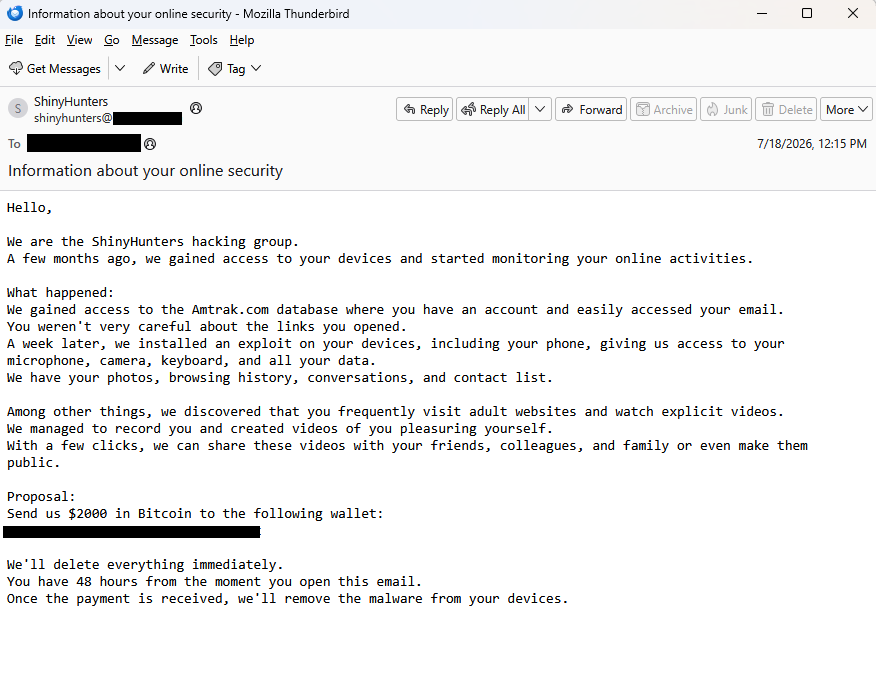
BleepingComputer reports that ShinyHunters data leaks are fueling a $2,000 sextortion email scam and shared the following example:
“Subject: Information about your online security
Hello,
We are the ShinyHunters hacking group. A few months ago, we gained access to your devices and started monitoring your online activities.
What happened: We gained access to the Amtrak.com database where you have an account and easily accessed your email. You weren’t very careful about the links you opened. A week later, we installed an exploit on your devices, including your phone, giving us access to your microphone, camera, keyboard, and all your data. We have your photos, browsing history, conversations, and contact list.
Among other things, we discovered that you frequently visit adult websites and watch explicit videos. We managed to record you and created videos of you pleasuring yourself. With a few clicks, we can share these videos with your friends, colleagues, and family or even make them public.
Proposal: Send us $2000 in Bitcoin to the following wallet: xxxxxxxxxxxxxxxxxxxxxxxxxxxxxxxxx
We’ll delete everything immediately. You have 48 hours from the moment you open this email. Once the payment is received, we’ll remove the malware from your devices.”
BleepingComputer states it has seen data from the Amtrak, Hallmark, ADT, Substack, Betterment, CarGurus, Panera Bread, and McGraw Hill breaches used to target victims in this sextortion email campaign.
A California community college also issued a warning after seeing the campaign target people affected by the Canvas data breach.
They confirmed that the targeted email addresses had previously appeared in data leaked by ShinyHunters. They also contacted the group, which denied being behind the sextortion emails.
The increase to a $2,000 demand may suggest the scammers paid someone for the email lists. Although it’s more likely they simply downloaded the leaked data after ShinyHunters published it following failed extortion attempts.
A quick check of the Bitcoin address used in the email shows no activity.
No activity on their Bitcoin address
Let’s keep it that way. With any luck, these dungeon dwellers will eventually give up trying to scare people out of their hard-earned money.
How to react to sextortion emails
Some sextortion emails are badly written, but many have been polished by AI and look convincing. Regardless of how professional they look, they should be treated the same way: as unsubstantiated threats designed to scare victims into paying.
First and foremost, never reply to emails of this kind. Responding confirms that someone is actively reading messages sent to that address and may encourage further scam attempts.
Don’t let yourself be rushed into action. Scammers rely on the fact that you will not take the time to think this through and subsequently make mistakes. Ask for advice if you’re not sure.
An attachment is not proof. Most sextortion emails contain no evidence at all, and attachments are often used to deliver malware or make the threats appear more convincing.
If the email includes a password you’ve used before, change it immediately anywhere it’s still in use. Then enable two-factor authentication (2FA) wherever possible. If you’re having trouble keeping track of your passwords, consider using a password manager.
Delete the message, report it as spam, and move on.
Pro tip: Malwarebytes Scam Guard recognized this email for what it is: sextortion. It can recognize scams and advise you how to proceed.
While these sextortion emails are almost always bluffs, if you’re concerned about webcam spying, Malwarebytes Webcam Monitoring can alert you when applications attempt to access your camera.
Resin art has become a popular corner of TikTok, with some videos attracting millions of views. But not every glossy, colorful post is what it claims to be. Scammers are using the look of handmade resin art to trick buyers, collectors, and even fellow artists into sending money for work that either doesn’t exist or wasn’t created by the person posting it.
There are plenty of genuine resin artists on TikTok. Unfortunately, the platform has also attracted scammers who steal videos and impersonate legitimate creators.
The scam is fairly straightforward. A TikTok account presents itself as a resin artist, posts satisfying videos, and invites people to “DM to order.” In some cases, the videos are stolen from other creators, the account has no real process footage, and the seller disappears after receiving payment.
One resin artist discovered that scammers were using their videos to impersonate them and scam TikTok users. They shared the following comment:
Ridiculous TikTok scammer…lol. Profile says they’re a resin artist and to DM them to order, but none of the videos are theirs. When I wrote to them asking them to take down the many videos of mine that they posted, passing them off as their own with no credit, their answer was that they aren’t a resin artist and are just sharing videos they like Literally about 1/4 of “their” videos are mine
These scams often rely on trust and urgency. The account may show polished clips of poured resin, finished coasters, trays, jewelry, or wall art, then push buyers to move the conversation into direct messages. Once the buyer moves to a different platform, the scammer typically requests a deposit, full payment, or personal details with little chance of being held accountable.
And real artists don’t just get their work ripped off. A scammer may contact a creator claiming to want to buy, feature, or license their work, but the real goal is to extract fees, banking information, or other sensitive data. Social media art scams are often repetitive because they are built from the same templates and scripts.
Different videos, same script
How to spot a TikTok resin art scam
The safest approach is the boring one: verify before you pay. If the artwork looks amazing but the seller’s identity is vague, the risk is real.
Check the TikTok account
Before ordering, look for signs that the artist is genuine:
The account didn’t appear overnight and has a history of original posts.
The same videos don’t appear under multiple creator names or belong to another artist.
The creator shows themselves making the artwork, with consistent process videos, a recognizable workspace, and works in progress.
The videos don’t contain obvious AI artifacts, such as impossible resin effects or objects moving after they’ve supposedly been sealed inside hardened resin.
Comments raising concerns haven’t been deleted or buried under generic praise.
The seller isn’t pushing you to order only through direct messages or asking for payment before you’ve verified who they are.
Check the website
If you do click through to a website, spend a few minutes checking it before you buy:
Look for a genuine returns and refunds policy, a physical business address, company or VAT details (where applicable), and consistent contact information.
Check how old the website is. Scam sites often use domains that were registered only weeks or months ago, especially when they claim to have been selling handmade products for years.
Search for recent independent reviews rather than relying on testimonials published on the site itself.
Run a reverse image search on the product photos to see whether they’ve been copied from another artist.
Only pay using a method that offers buyer protection, such as a credit card or PayPal. If a seller insists on a bank transfer, cryptocurrency, or another irreversible payment method, walk away.
Not every resin art account is a scam. Many belong to genuine artists, and that’s why impersonation scams can be so convincing.
If you’re unsure, paste the website address into Malwarebytes Scam Guard and ask whether it shows signs of being fraudulent. It can help identify suspiciously new domains and other common scam indicators.
Use real-time web protection to block known fraudulent and malicious websites, like Browser Guard did for this web shop:
Browser Guard blocks the fraudulent website
Both are free—making them much cheaper than sending money to a scammer.
Something feel off? Check it before you click.
Malwarebytes Scam Guard helps you analyze suspicious links, texts, and screenshots instantly.
Starting last year, Android users have been seeing the “number is now verified” system notification more frequently. And in some cases people even find mysterious outgoing text messages in their history that they never sent.
These messages often cause confusion and even anxiety: has a virus infected the phone? Are tech giants spying on our phone numbers? Let’s break down how this feature works, and what potential risks it poses to your privacy.
Why all these phone number verifications?
The notification pops up whenever Google’s phone number verification feature is triggered on your device.
Its main job is to make sure that the SIM card tied to a specific phone number is physically inside the phone. Once verified, that phone number automatically links to all active Google accounts on the device.
There are several key services that rely on the verification. Most importantly, it drives Rich Communication Services (RCS) — the modern standard for “rich” messaging right inside your standard text messaging app. It feels like a popular chat app, but without the need to install anything extra. Unlike iMessage, which is locked to Apple’s ecosystem, RCS works across compatible smartphones on various platforms since it’s an industry standard set by carriers rather than tech giants. Since recently, both Apple and Android users have been able to exchange RCS messages. For this feature to work in the Google Messages app, Google needs ongoing confirmation that your SIM card is active. If you pull out your SIM card, RCS chats will keep working for about eight days before turning off automatically.
According to Google, phone number verification serves several other purposes as well:
Account security and recovery. A verified phone number enables quick sign-ins to your Google account, two-factor authentication, and easy password recovery.
Emergency services and device location. This includes Find My Device, remote phone lock, and sharing your location with emergency responders — including via satellite messaging on the Pixel 9 and certain other modern smartphones.
Better sharing on Google. This feature helps other people find you faster on Google Meet or Duo, use Quick Share to send you files, and see that the phone number is linked to your profile.
Google also recently confirmed that this data is used to counter scams. Verification helps block calls or text messages from spoofed numbers if both the real owner of the number and the recipient are using Android devices with verified phone numbers.
How does Google verify phone numbers?
Phone number verification technology has been around on Android for quite some time — Google was sending test SMS messages as far back as in 2019. However, it became widely visible to most users following a Google system update in September 2025. The process was baked deeper into the operating system, with number verification now running by default during initial phone setup, and re-running periodically in the background.
There are two main technical methods for the verification process. Which one your device uses depends on your mobile carrier and your version of Android.
The older method relies on hidden text messages. In the background, your smartphone sends a specialized technical text message to Google’s servers. The operating system intercepts this message before you ever see it, which is why it rarely appears in your standard text messaging app. However, due to software glitches or Android customization quirks, these texts occasionally surface in sent messages, startling users. They typically look like this: “(string of letters and numbers) Google is re-verifying the phone# of this device.” Google explicitly notes in its help documentation that standard messaging rates from your carrier may apply.
In recent years, direct carrier verification (via carrier APIs) has become the primary verification method. This approach is more modern and secure than previous ones. The smartphone sends an encrypted token containing device and SIM card identifiers to the mobile carrier, and the carrier responds with the confirmed phone number. The whole process takes just a couple of seconds and runs completely unnoticed by the user. Both global telecom giants and smaller providers have connected to this verification network. Notably, third-party apps can also tap into the results of this check through Firebase Phone Number Verification, getting confirmation from your mobile carrier about which phone number is active on the device.
“Other device data” and privacy concerns
In its official documentation, Google notes that device identifiers and SIM card data may be collected during verification. In practice, this refers to unique identifiers for the SIM card and its subscriber profile (ICCID and IMSI), as well as technical device identifiers needed to run mobile networks. Google also explicitly states that it does not sell your personal information, including your phone number, to anyone.
Naturally, sending additional unique identifiers to Google — especially given the scale of its advertising business — always raises concern among privacy-conscious users. Here’s what you should keep in mind:
Metadata collection. To run RCS, Google exchanges data with your mobile carrier. Even when the content of RCS messages is encrypted, metadata — such as who is messaging whom and when — can still be stored on your carrier’s servers, and in some cases, on Google’s servers. As cybersecurity experts at the Electronic Frontier Foundation point out, if privacy is your top priority, you’re better off sticking to dedicated encrypted messaging apps.
Linked accounts. If you have both a personal and a work Google account (or a personal and a family account) set up on the same phone, the verified number will automatically link to both profiles. The operating system does not offer built-in tools to separate numbers for different accounts on a single device.
Phone number leaks. Apps on your device can already access various user identifiers, including your phone number. However, this verification system makes it easier to link multiple phone numbers to a user who has multiple Google accounts. And while Google states that it never sells phone numbers, you cannot say the same with confidence about obscure third-party Android developers.
On by default. The feature is enabled out of the box, and most users have no idea their device is silently querying their carrier in the background. While you can opt out in your Google settings once you notice it, there’s no guarantee that any data already collected will actually be deleted.
Turning off verification — why and how
For most users, verification is genuinely helpful. It simplifies account recovery, makes finding a lost phone easier, powers modern text messaging features, and assists emergency services when every second counts.
However, if you want to minimize the amount of metadata sent to Google, mobile carriers, and other data brokers, you can manually disable the feature. Here’s how:
Open your Android smartphone’s settings.
Tap Google, select the account at the top, and switch to the All services tab.
Under Privacy and security, tap Phone number verification.
Turn off automatic phone number verification.
If you also want to disable Better sharing on Google, go to Settings → Google → Manage your Google Account → Personal info → Contact info → Phone, select your number, and turn off the setting.
If you have multiple Google accounts on your phone, you’ll need to repeat these steps for each one. Unfortunately, verification sometimes turns itself back on automatically, and there’s no reliable way to prevent this on standard consumer phones with stock software.
Keep in mind that disabling verification means losing access to RCS chats in Google Messages — forcing you to fall back on basic SMS, or switch to alternative secure messaging apps. You also won’t be able to use that number for quick account recovery should you forget your password.
To thoughtfully customize your privacy settings across all your devices — regardless of the operating system, browser, or app — check out our free online tool, Privacy Checker.
Curious about other privacy risks you might not even know exist? Check out our other deep dives, here:
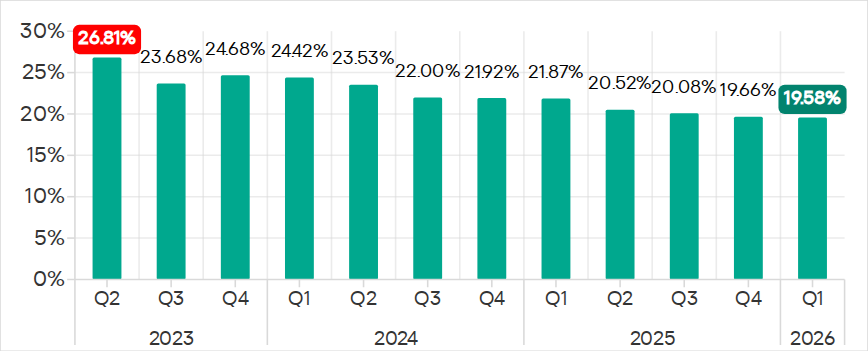
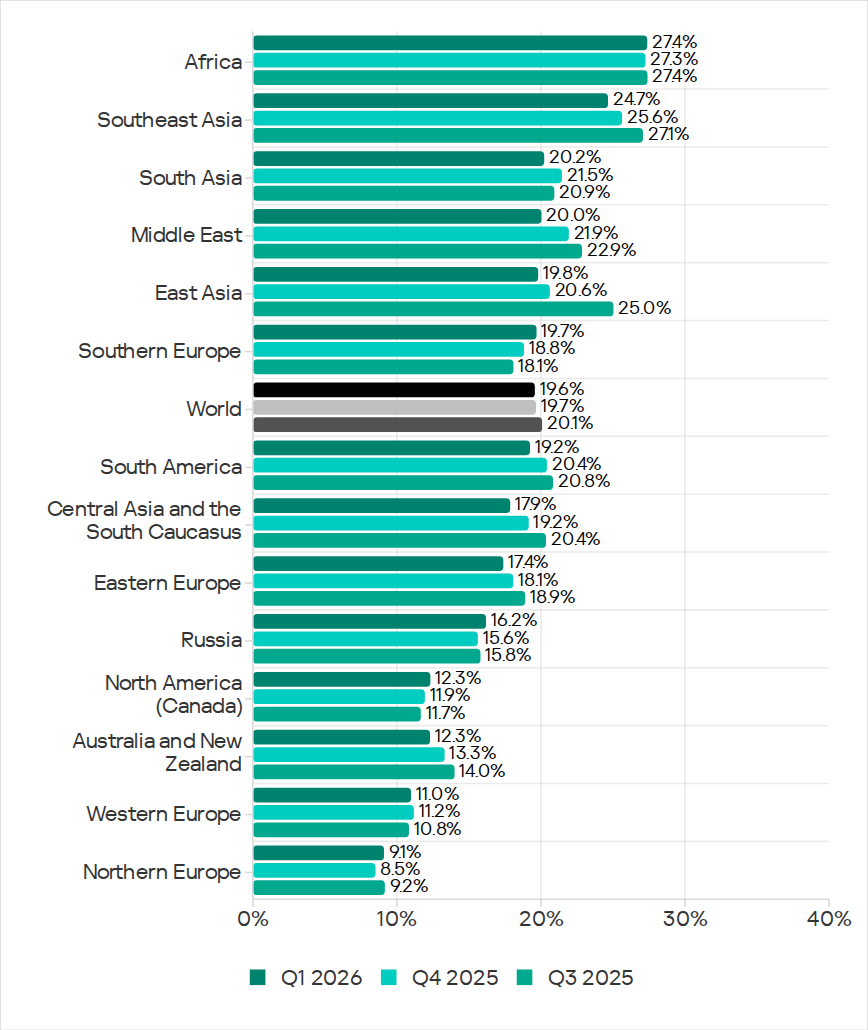
The percentage of ICS computers on which malicious objects were blocked continued to decrease, reaching 19.6% in Q1 2026. This is the lowest value in three years, and it is 1.4 times lower than in Q2 2023.
Percentage of ICS computers on which malicious objects were blocked, Q2 2023–Q1 2026
Regionally, the percentages ranged from 9.1% in Northern Europe to 27.4% in Africa.
Regions ranked by percentage of attacked ICS computers
The percentage of ICS computers on which malicious objects were blocked increased in five regions over the quarter, most notably in Southern Europe, Northern Europe, and Russia.
In Q1 2026, Southern Europe led the way in growth for internet and email threats. The region also saw the fastest growth in spyware, as well as malicious scripts and phishing pages.
In Russia, the percentage of ICS computers on which malicious objects were blocked exceeded the figures for the previous two quarters. Russia saw an increase in the percentage for threats from the internet, and a slight increase in the figure for threats from email clients (Russia is one of three regions where this figure did not decrease).
Among the threat categories, the greatest increases were observed in the percentages for denylisted internet resources, as well as spyware (distributed in the region via the internet and email clients).
Selected industries
Biometric systems (26.4%) traditionally rank top among the industries and OT infrastructure types covered in this report in terms of the percentage of ICS computers on which malicious objects were blocked. These systems are characterized by internet access, extensive email use for data exchange and approvals (such as access granting), and, in many cases, minimal cybersecurity controls within the organizations that use these systems.
Industries ranked by the percentage of ICS computers on which malicious objects were blocked
Biometric systems rank first among industries in terms of email threats. At the same time, unlike other industries, the percentage for email threats in biometric systems exceeds that for internet threats.
In all selected industries, the global average follows a downward trend. In Q1 2026, the percentage of ICS computers on which malicious objects were blocked increased only in the manufacturing sector — by 1.0 pp. The percentages for this industry increased across 10 regions, with the most notable increases in Western Europe, Northern Europe, and Russia.
Threat categories
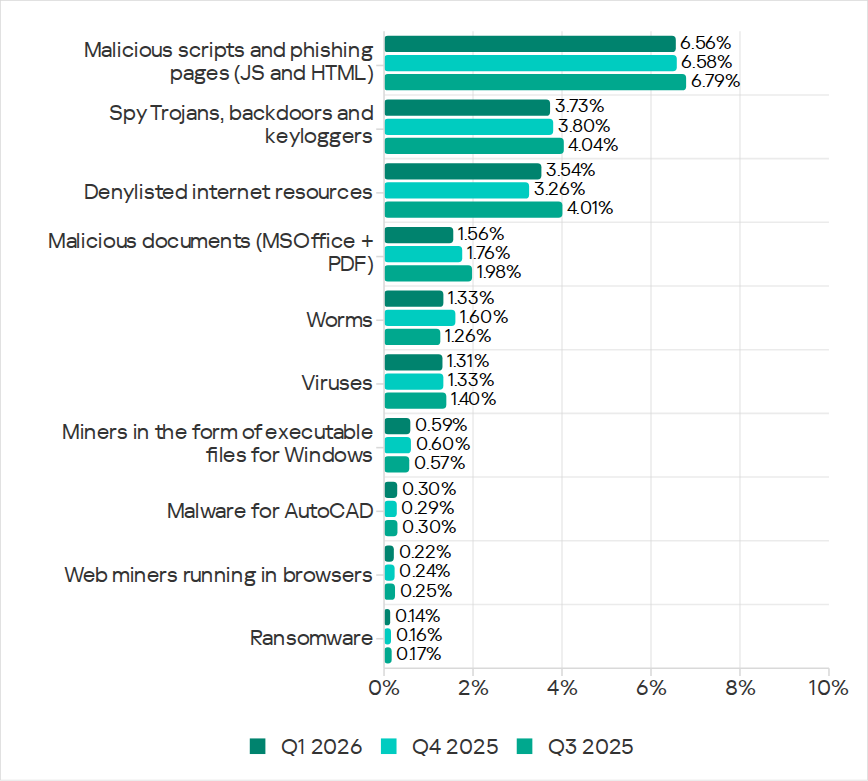
In Q1 2026, Kaspersky security solutions blocked malware from 10,052 different malware families of various categories on industrial automation systems.
Over the quarter, the percentage of ICS computers on which denylisted internet resources were blocked increased (after decreasing over the previous two quarters), and there was a slight increase in the percentage for AutoCAD malware.
Percentage of ICS computers on which the activity of malicious objects from various categories was prevented
Malicious scripts and phishing pages (JS and HTML)
Malicious scripts and phishing pages retained their to spot among threat categories by the percentage of ICS computers on which these threats were blocked. The global average in Q1 2026 was 6.56%.
Over the quarter, the percentages increased in four regions. The most significant change was observed in Southern Europe (9.85%, +0.94 pp). The figures for malicious scripts in the region increased over three consecutive quarters.
Among the selected industries, across all regions, the highest percentages for the malicious scripts and phishing pages category were recorded for biometric systems (19.59%) and building automation (15.43%) in Southern Europe. These same industries lead in similar rankings for malicious documents and spyware.
Spyware
The percentage of ICS computers on which spyware was blocked decreased over two consecutive quarters, dropping to 3.73%. Despite the decline, spyware has ranked second among threat categories by the percentage of attacked computers for three consecutive quarters.
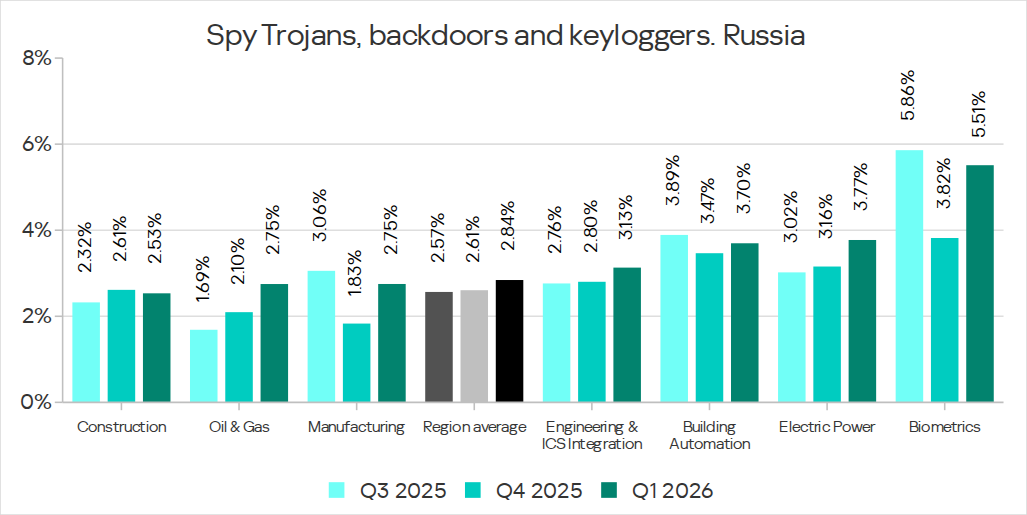
The percentages increased in five regions over the quarter, most notably in Southern Europe (5.46%, +0.35 pp) and Russia (2.84%, +0.24 pp).
In Southern Europe, the percentage of ICS computers on which spyware was blocked increased in all the selected industries except manufacturing. The greatest increase was observed in biometric systems.
Among the selected industries, the highest percentage of spyware in Russia was recorded in biometric systems. That said, the percentage of ICS computers on which spyware was blocked increased in all industries in the region except construction. The percentage figure has been increasing for two consecutive quarters in the oil and gas industry (by a factor of 1.63 over six months), and for three consecutive quarters in engineering and ICS integration, as well as electric power. In the remaining sectors, the values have been fluctuating.
Percentage of ICS computers on which spyware was blocked in various industries in Russia, Q3 2025–Q1 2026
Denylisted internet resources
The percentage of ICS computers on which denylisted internet resources were blocked increased to 3.54%.
The most notable increase over the quarter occurred in Southeast Asia (4.58%, +0.65 pp). Among the industries in the region, the highest percentage figures for this threat category were recorded in electric power and construction. Over the quarter, the largest increases in percentages figures were observed in the electric power and manufacturing industries.
In North America (Canada), denylisted internet resources (2.14%) showed the greatest increase among all categories — by a factor of 1.22.
Among the selected industries across all regions, the highest percentage figures for the denylisted internet resources category were in the electric power (7.11%) and construction (6.25%) industries in Southeast Asia.
Malicious documents (Microsoft Office + PDF)
The percentage figure for this category decreased over two consecutive quarters, reaching its lowest value (1.56%) for the entire period of observations in Q1 2026. It increased just in two regions: Australia and New Zealand (1.12%, +0.04 pp), and Russia (0.62%, +0.01 pp).
Among the selected industries across all regions, the highest percentages for malicious documents were recorded for biometric systems (9.02%) and building automation (6.97%) in Southern Europe. These same industries also lead in similar rankings for malicious scripts and spyware.
Ransomware
The percentage of ICS computers on which ransomware was blocked has decreased for two consecutive quarters, dropping to 0.14%. This is the lowest value among all categories.
The percentage increased in two regions: North America (Canada) (0.11%, +0.04 pp) and slightly in Northern Europe (0.06%, +0.01 pp).
Among the selected industries across all regions, the highest percentages for ransomware were recorded in the oil and gas and manufacturing industries (0.92% and 0.65%, respectively) in Central Asia and the South Caucasus, and in biometric systems (0.89%) in Russia.
Miners in the form of executable files for Windows
The percentage of ICS computers on which miners in the form of executable files for Windows were blocked decreased to 0.59%.
The percentage increased in seven regions. The largest increase was observed in Africa (0.63%, +0.16 pp). Among the selected industries, the largest increases in the region were in the manufacturing and oil and gas industries.
Among the selected industries across all regions, the highest percentages for miners in the form of executable files were recorded in construction (1.99%), biometric systems (1.98%), and the oil and gas industry (1.97%) in Central Asia and the South Caucasus.
Web miners
The percentage of ICS computers on which web miners were blocked has been declining for a year, and in Q1 2026, it reached the lowest value for the entire period under review (0.22%).
At the same time, the percentage increased in seven regions. The largest increases were observed in South Asia (0.28%, +0.11 pp), the Middle East (0.31%, +0.09 pp), and Africa (0.34%, +0.08 pp). Despite the increases, the percentages in these regions for Q1 2026 did not exceed those observed in 2023–2024 and in Q1 2025.
Among the selected industries across all regions, the highest percentages for web miners were recorded for biometric systems (0.97%) in Russia. Biometric systems in South Asia (0.79%) ranked second, and the electric power sector in Southeast Asia (0.76%) ranked third.
Worms
The percentage of ICS computers on which worms were blocked decreased to 1.33%.
The percentage decreased across all regions following an increase in the previous quarter (due to a wave of phishing attacks that distributed the Backdoor.MSIL.XWorm backdoor worm across all regions of the world).
Among the selected industries across all regions, the highest percentage figure for worms was recorded for biometric systems (4.80%) in Central Asia and the South Caucasus. Two industries in Africa – biometric systems (4.04%) and electric power (3.53%) – took the second and third spots, respectively.
Viruses
The percentage of ICS computers on which viruses were blocked decreased to 1.31%.
The top 3 regions by this figure remained the same: Southeast Asia (6.11%, first by a wide margin), Africa (4.15%), and East Asia (2.97%). These same regions are also among the leaders by the percentage of systems affected by AutoCAD malware. The largest increase in this figure was observed in Africa (+0.41 pp).
Among the selected industries across all regions, the highest percentages for viruses were recorded in the construction industry (6.35%) and building automation (5.50%) in Southeast Asia.
Malware for AutoCAD
The percentage of ICS computers on which malware for AutoCAD was blocked increased to 0.30%.
The most notable increase over the quarter was observed in Africa, with the region’s percentage figure rising by 0.47 pp, a very significant increase for this category, and almost doubling (to 0.91%).
Among the selected industries across all regions, the highest percentages for AutoCAD malware were recorded in the construction industry in East Asia (5.58%) and Southeast Asia (3.87%).
Main threat sources
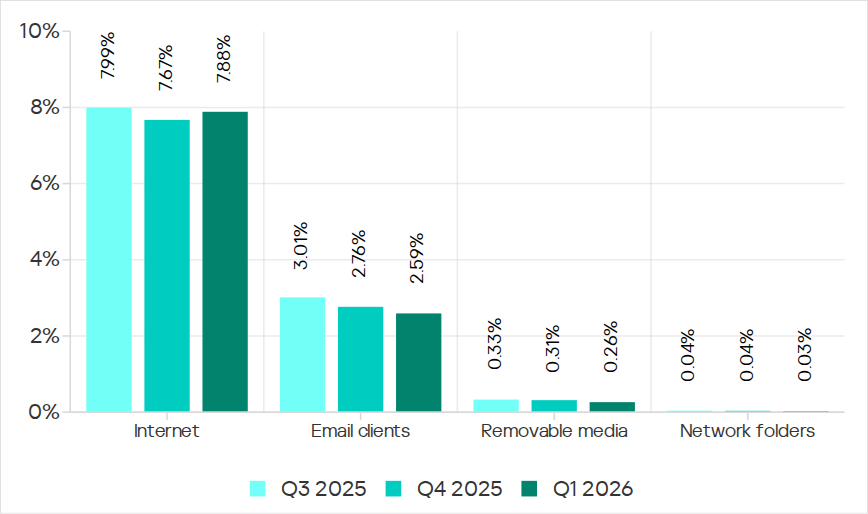
In Q1 2026, the average percentages across all threat sources, except threats from the internet, decreased globally.
Percentage of ICS computers on which malicious objects from various sources were blocked
Internet
The percentage of ICS computers on which threats from the internet were blocked increased to 7.88%. However, over the past three years, the percentage figure for internet threats has followed a downward trend.
The largest increases in the percentages were recorded in Southern Europe (8.59%, +0.59 pp), Southeast Asia (10.16%, +0.55 pp), and Northern Europe (4.47%, +0.51 pp).
Among the selected industries across all regions, the highest percentages for threats from the internet were recorded in electric power (13.16%) and construction (12.55%) in Southeast Asia, and in the engineering and ICS integration sector (12.33%) in South Asia.
Email clients
The percentage of ICS computers on which threats delivered via email clients were blocked decreased to 2.59%. This is a three-year low.
The percentage of this threat source increased in three regions: Southern Europe (6.54%, +0.2 pp), East Asia (1.5%, +0.09 pp), and slightly in Russia (0.7%, +0.04 pp).
Among the selected industries across all regions, the highest percentages for email threats were recorded for biometric systems (19.78%) and building automation (12.34%) in Southern Europe. In these two industries, the percentage of ICS computers on which email threats are blocked is higher than the percentage for threats from the internet. A similar situation was observed in two other instances, both in biometric systems (in South America and Southeast Asia).
Removable media
The percentage of ICS computers on which threats were detected when connecting removable media continued to decrease, reaching its lowest value for the period under review (0.26%).
Among the selected industries across all regions, the highest percentages for removable media threats blocked on ICS computers were observed in the electric power sector in Central Asia and the South Caucasus (1.45%), East Asia (1.34%), and Africa (1.16%).
Network folders
The percentage of ICS computers on which threats are blocked in network folders is steadily decreasing. In Q1 2026, it was the lowest for the period under review (0.029%).
East Asia has traditionally led by a wide margin. The percentage for East Asia (0.135%) is 27 times higher than the lowest regional value (recorded in Northern Europe).
The largest increases in the percentages for threats from network folders were observed in Africa (0.037%, +0.006 pp) and South America (0.013%, +0.006 pp).
Among the selected industries across all regions, the construction industry in East Asia, at 0.36%, holds the top positions in the ranking by the percentage of ICS computers on which threats are blocked in network folders.
Account theft usually ends with someone losing a password. This one ends with hackers walking off with the entire game.
Developers behind some of Roblox’s millions of games told 404 Media that attackers persuaded them to run a single file. Then they watched their group, their game, and their Robux (in-platform currency) balance vanish into someone else’s account within hours. In several cases, Roblox support didn’t help them get the games back until a reporter called the company for comment.
From beaming to hostile takeover
Roblox attacks used to be opportunistic. “Beamers” targeted individual players to steal rare hats, limited items, and accounts, then resold them. The pattern has shifted. The new targets are developer accounts, and the prize is the game itself.
Ioannis Matziaris told 404 Media that his two 20-year-old sons spent five years building a Roblox game called The Shadow Network. In April, attackers approached one of them with a job offer and convinced him to run a particular file. It was malware. The attackers stole control of the game, the group’s Roblox account, and their Robux balance.
Another developer, Jovan Rai, received the same project-manager job pitch. This time, the attackers were impersonating Cheesy Studios, the Matziaris brothers’ company, to lend the offer credibility. The 15-year-old was earning roughly 10,000 Robux (around $38) per day from his game. He spent more than 30 days trying to recover it through Roblox support before media attention helped move the case forward.
The malware behind the theft
Developer Mohamed Kaparoza described how the attack worked. Attackers contacted him on Discord, dangled a project-manager role, and asked him to install a Python package called “robase,” which they claimed was a database tool. Shortly after installing it, he was logged out of Roblox on both his PC and his phone. His Discord account went with it, and his two-step verification settings and passkey were changed.
This is a case of session-token theft, rather than credential theft. Once an infostealer steals an authenticated browser session, attackers can often bypass security measures such as two-factor authentication (2FA) because they are reusing a session that has already been authenticated.
The technique itself isn’t new. We reported on a similar campaign in January 2025 that targeted Roblox players with offers to beta test new games. The “installer” was actually an infostealer designed to steal data, including Discord and Steam sessions, and cryptocurrency wallet information.
What developers can do
If you build Roblox games, the defensive advice is unglamorous and mostly behavioral.
Treat unsolicited Discord job offers with caution. If a stranger asks you to install a “database tool,” a custom installer, or any file at all, do not run it.
Developers who need to test unfamiliar software should do so in an isolated environment, such as a virtual machine, rather than on a device where they are signed in to Roblox, Discord, GitHub, or other important accounts.
Review active Roblox sessions and signed-in devices regularly, and switch on Roblox’s Enhanced Protection features where available. They won’t stop session-stealer malware, but they can help protect against many other forms of account compromise.
If the worst happens, document everything as early as possible. Keep records of messages, screenshots, account changes, and support requests to help with any recovery process.
Use security software with real-time protection. Malwarebytes Premium can detect and block infostealers and other malware before they compromise your accounts.
We don’t just report on threats—we remove them
Cybersecurity risks should never spread beyond a headline. Keep threats off your devices by downloading Malwarebytes today.
In this blog post you’ll learn how to detect and prevent subdomain takeover – a tactic where threat actors exploit dangling DNS records to redirect traffic to attacker-controlled resources. We’ll explain the issue, how the situation arises, and how you can use various AWS features and services to help mitigate the impact of this tactic.
Under the shared responsibility model, securing configurations in the cloud is your responsibility. AWS supports you through strong defaults, guidance in the Security Pillar of the Well-Architected Framework, and security services to help you meet that responsibility. The AWS Customer Incident Response Team (AWS CIRT) also monitors for new and trending tactics that threat actors use to exploit specific customer configurations, so that you can make informed design decisions and improve your response plans.
AWS CIRT has observed threat actors actively scanning for public DNS CNAME records that point to resources that no longer exist, looking for subdomain takeover opportunities.
Note: The subdomain takeover tactic does not leverage vulnerabilities of AWS services. It exploits a dangling DNS record to redirect traffic to an attacker-controlled resource.
Quick DNS Primer
CNAME Records: A CNAME (Canonical Name) record is a DNS entry that points one domain name to another. For example, api.example.com can be configured to point to api.example.s3-website-us-east-1.amazonaws.com. This feature of DNS enables users to configure a memorable, human-friendly domain name while the actual resource lives at a longer, machine-generated AWS hostname. A security issue emerges when the target resource is deleted but the CNAME record pointing to it remains – creating a “dangling” record.
Dangling Records: When a resource (like an S3 bucket) is deleted but the DNS record pointing to it is left behind, that DNS record becomes “dangling”, pointing to a resource that no longer exists. For resources in globally shared namespaces, threat actors can potentially reclaim the name of your deleted resource and serve malicious content through your DNS record.
What is subdomain takeover?
A subdomain is a prefix added to a domain that allows you to organize access to your resources. A subdomain takeover occurs when you delete the underlying resource and a threat actor creates a new resource with the same name to take advantage of the DNS records still pointing to it.
A subdomain takeover is possible when a CNAME record points to an AWS resource that uses a globally shared DNS namespace where the resource name can be chosen by any AWS customer. The following AWS resources meet these criteria:
Amazon S3 (global namespace): Bucket names like mybucket.s3.amazonaws.com are globally unique and can be claimed by any account if the bucket is deleted. Note: S3 buckets created with account regional namespaces (launched March 2026) are scoped to your account and are not subject to this issue.
Amazon CloudFront: Distribution domain names like d111111abcdef8.cloudfront.net are assigned by AWS and cannot be chosen by an attacker. However, if you delete a distribution and another customer creates one that happens to receive the same domain name, a dangling CNAME could resolve to their content.
AWS Elastic Beanstalk: Environment names like myapp.elasticbeanstalk.com are globally unique and can be claimed by any account if the environment is terminated.
Resources like Amazon VPC, Amazon EC2 instances, or private hosted zones are not subject to this tactic because they do not expose globally claimable DNS namespaces.
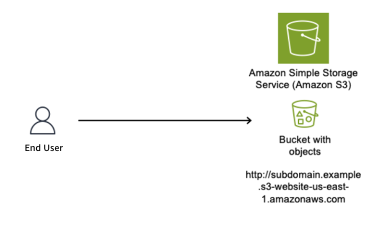
You create a DNS CNAME record pointing to your S3 website endpoint. The subdomain subdomain.example.com now resolves to subdomain.example.s3-website-us-east-1.amazonaws.com, which serves content from the S3 bucket named subdomain.example. If your team deletes the bucket and forgets to delete the DNS record, users that navigate to the site will see an error stating that the bucket doesn’t exist. However, at this point, if a threat actor sees this error and moves in to claim the bucket name, they will be able to set up their own site that users will see when they navigate to the subdomain.example.com site.
Figure 1 shows an S3 bucket named subdomain.example (a globally unique bucket name) configured to host a static website, with the S3 website endpoint subdomain.example.s3-website-us-east-1.amazonaws.com.
Figure 1: S3 bucket configured as a static website
As shown in Figure 2, we use Amazon Route 53 to create a CNAME record to resolve to our Amazon domain name; to give users a friendly name and so they do not have to remember the long S3 website name in URLs.
Figure 2: DNS Resolver configured with CNAME record pointing to origin bucket
The customer’s AWS administrator decides to stop serving content from the S3 bucket and deletes it, as shown in Figure 3.
Figure 3: Resource deleted without removing the CNAME record
With the S3 bucket deleted and the CNAME record still in place, the DNS record is now dangling. A threat actor identifies this situation and creates a new S3 bucket with the same global name subdomain.example in an AWS account that the threat actor controls, as shown in Figure 4. The threat actor can now serve content from this new bucket, including potentially malicious content. End users remain unaware of this switch and continue to access subdomain.example.com, trusting the content because it appears to originate from a URL they recognize.
Figure 4: Subdomain takeover happens
Potential impacts of a sub-domain takeover
Consider these potential impacts:
Reputation risk: There is a potential risk to your organization’s reputation, because you don’t control the content being served from the threat actor’s site that your DNS record points to.
Potential exposure to phishing campaigns: Users within your organization might have the subdomain bookmarked in their browser, not knowing the resource is no longer available, then unsuspectingly navigate to the site that now hosts malware or is used to phish user credentials.
Blocking: If the subdomain is flagged by security vendors for malicious activity, it could impact your business operations.
Financial loss: Subdomain takeover incidents can result in a financial impact due to the potential disruption to service delivery as you deal with the event.
Proactive detection
AWS Config for proactive detection
For proactive detection, you can use AWS Config to continuously monitor your Route 53 CNAME records and verify that the target resources exist in your account.
Prerequisite: This approach requires AWS Config recorder to be enabled for the resource types you want to monitor (S3 buckets, CloudFront distributions, Elastic Beanstalk environments). If Config isn’t recording a resource type, it won’t appear in the inventory check. For more information, see Setting up AWS Config with the console.
Why use AWS Config inventory instead of DNS resolution checks?
A common approach is to check whether a CNAME resolves to a valid endpoint. However, this method has a critical flaw: if an attacker has already claimed the resource, DNS resolution will succeed – to their resource, not yours. You would have no indication that you don’t own what’s responding.
By querying AWS Config’s recorded configuration items, you’re checking whether the resource exists in your account inventory, not just whether something responds at that DNS name. This approach correctly identifies dangling CNAMEs even after a takeover has occurred.
Implementation approach:
Account-level vs. organization-level scope
The reference implementation queries AWS Config inventory within a single account. This means that if a CNAME record in Account A points to a resource that legitimately exists in Account B within the same AWS organization, the rule will flag it as NON_COMPLIANT.
For organizations that share resources across accounts, you can modify the solution to use an AWS Config Aggregator, which queries resource inventory across all accounts in your organization. This is similar to how IAM Access Analyzer supports both account-level and organization-level scopes. To use this approach, you need an organization-level Config Aggregator already configured, and the Lambda function’s IAM role needs the config:SelectAggregateResourceConfig permission.
We recommend starting with account-level scope for simplicity, then expanding to organization-level if your environment includes cross-account resource sharing.
The main idea is to create a custom AWS Config rule that queries your Route 53 hosted zones for CNAME records, then parses each CNAME target to determine whether it points to a known AWS resource pattern such as S3, CloudFront, or Elastic Beanstalk. For each match, the rule cross-references the target against your AWS Config inventory to verify that the resource actually exists in your account. If the resource isn’t found, the rule marks the CNAME record as NON_COMPLIANT, surfacing it for review.
The Config rule should focus on known AWS resource patterns:
Note: CNAME records pointing to external third-party services are outside the scope of this detection mechanism, as those resources won’t appear in your AWS Config inventory.
NON_COMPLIANT findings from your Config rule can be routed to AWS Security Hub for centralized visibility, or trigger SNS notifications to alert your security team.
Figure 5: Dangling DNS Detection Solution
Reference implementation:
We’ve published a complete implementation of this detection approach as an open-source solution. The solution deploys a Lambda function that discovers CNAME records across all your Route 53 hosted zones and uses pattern matching to identify targets pointing to S3, CloudFront, and Elastic Beanstalk. It then queries your AWS Config inventory to verify whether each target resource still exists in your account. When a dangling record is detected, the solution generates a HIGH severity finding in Security Hub and can optionally send SNS notifications to alert your security team. A CloudWatch metrics dashboard is also included for ongoing compliance tracking.
Deployment:
# Clone the repository
git clone https://github.com/aws-samples/sample-dangling-dns-detection
cd sample-dangling-dns-detection

# Build the Lambda deployment package
./scripts/package.sh

# Upload to S3
aws s3 cp dist/dangling-dns-detection.zip s3://YOUR_BUCKET/

# Deploy the CloudFormation stack
aws cloudformation deploy \
  --template-file infrastructure/template.yaml \
  --stack-name dangling-dns-detection \
  --parameter-overrides \
      LambdaCodeS3Bucket=YOUR_BUCKET \
      EvaluationFrequency=TwentyFour_Hours \
  --capabilities CAPABILITY_NAMED_IAM
The stack creates an AWS Config custom rule that runs on your specified schedule (default: every 24 hours), evaluating all CNAME records and reporting compliance status.
Mitigating the effects
Mitigating subdomain takeover requires both preventive procedures and responsive capabilities.
Prevention: Standard operating procedure
The most effective mitigation is a standard operating procedure for resource deprovisioning that ensures DNS records are removed before the underlying resource:
Within your DNS zone, delete the CNAME record that points to the fully qualified domain name (FQDN) of the resource that you plan to deprovision.
Wait for the DNS TTL to expire before deleting the resource. DNS resolvers cache records for the duration of the TTL (for example, a TTL of 3600 means resolvers may serve the old record for up to one hour). If you delete the resource before the TTL expires, a threat actor could claim the resource name while cached CNAME entries are still directing traffic to it.
Deprovision the resource that you no longer want to use.
Run a DNS check of the CNAME record that you removed to verify that the resource is no longer resolving.
Key principle: Always delete DNS first, wait for the TTL to expire, then delete the resource. This order eliminates the window where a dangling record could be exploited.
Prevention: S3 account regional namespaces
As mentioned earlier, AWS introduced account regional namespaces for Amazon S3 general purpose buckets in March 2026. While this is a meaningful step toward mitigating the S3-specific takeover vector, there are important operational limitations to be aware of:
Existing buckets are unaffected. Buckets already created in the global namespace cannot be migrated to an account regional namespace. The bucket names remain globally unique and claimable by anyone if the bucket is deleted.
Global namespace is still the default. When creating a new bucket through the console, CLI, or SDK, the global namespace remains the default selection. Users who aren’t aware of the new option will continue creating globally-scoped buckets.
Existing IaC templates require updates. Existing infrastructure-as-code templates (CloudFormation, CDK, Terraform) that don’t explicitly opt in to the account regional namespace will continue provisioning buckets in the global namespace. For CloudFormation, this means setting the BucketNamespace property to account-regional. For other IaC tools, consult their documentation for the equivalent configuration. Organizations need to audit and update their templates to opt in.
For these reasons, the dangling DNS detection approach described in this post remains critical – particularly for organizations with existing S3 infrastructure, and for CloudFront, and Elastic Beanstalk resources where no equivalent namespace scoping exists.
Response: Notification and remediation
When a dangling DNS record is detected, the reference solution described in the Detection section automatically creates a HIGH severity finding in AWS Security Hub and reports the CNAME record as NON_COMPLIANT in AWS Config. If you provide an SNS topic ARN during deployment, the solution also sends notifications to alert your security or operations team via email, Slack, or other channels. For production environments, consider a human-in-the-loop workflow where these notifications are reviewed by a team member who approves the DNS record deletion before it’s executed. This prevents accidental deletion of legitimate records during transient issues.
The reference solution also includes a CloudWatch dashboard for tracking compliance status and evaluation metrics over time, giving your team ongoing visibility into DNS health across your hosted zones.
Note: Fully automated remediation (auto-deleting DNS records) carries risk – a false positive could disrupt legitimate services. We recommend starting with detection and notification, then evaluating automation based on your detection accuracy and operational maturity.
Conclusion
Subdomain takeover is a preventable misconfiguration that can have significant impact on your organization. A layered defense approach provides the best protection:
Prevention: Implement a standard operating procedure that deletes DNS records before deprovisioning the underlying resource.
Detection: Use AWS Config custom rules to proactively identify CNAME records pointing to resources that no longer exist in your account.
Response: Configure notifications through SNS or Security Hub so your team can respond quickly when dangling records are detected.
Monitoring: Maintain ongoing visibility through CloudWatch dashboards to track DNS health and compliance status.
The key insight is that good DNS hygiene – knowing when your CNAME records point to a nonexistent resource – is your first line of defense. Automated detection through AWS Config provides a safety net when operational procedures fail. And if you detect an issue, having a playbook ready to enact your response can lower the impact and your mean time to recovery.
If you have feedback about this post, submit comments in the Comments section below.
With the World Cup on, you’ll find no shortage of websites promising every match, live, in HD, for free. They look convincing, usually with a video player, a “Live Stream Available” indicator, a row of server buttons, maybe a match schedule, and a “Watch Live” button. There’s no signup, no paywall, and seemingly, no catch.
But of course there’s a catch. These sites aren’t really in the business of streaming football. What the page is really built to do is fire pop-ups, hidden ads, and redirects through an advertising network we detect as malicious. Instead of watching the match, visitors end up facing scams, malware, and fraudulent downloads.
Here’s how the scam works and how to stay out of it.
If they’re not real streaming sites, what are they?
We’ve identified more than 40 websites that are effectively identical. They use different World Cup-themed names, but behind the scenes they’re running the same page template, the same code, and the same advertising infrastructure.
A script generates a separate page for every match, making the operation cheap to run and easy to scale.
When a stream appears at all, it’s usually embedded from a third-party piracy service. The real business is the advertising surrounding the player.
A typical page loads eight or more ad and tracking scripts from the same shady network, plus a handful of other ad domains. The hub the whole page is wired to is a domain we detect as malicious. Your data is the product; the “stream” is the bait.
Why these sites are dangerous, not just annoying
It’s tempting to shrug this off as the usual price of free streams. But it’s worse than facing a few annoying ads.
The real threat is the ad network. This isn’t mainstream, vetted advertising. The kind of ad network we flag as malicious is a common delivery route for the stuff that causes harm: fake virus warnings, bogus software update prompts that install malware, fake prize and verification pages, and forced redirects into subscription traps.
The video window itself is untrusted. The stream is pulled from a third-party piracy service, not anything the site controls or vets. Pirated stream embeds are a well-known source of their own ads, redirects, and hidden clickable overlays, so even the part that looks like a video player can be working against you.
There’s nobody behind the counter. These are anonymous, disposable sites built around a major sporting event. There’s no real company, no support, no accountability, and no reason for them to care what lands on your screen.
It’s the oldest play in the scam handbook: take something millions of people want right now, present it nicely, and monetize the rush. Scammers don’t create the demand, they just stand in front of it with a bucket and collect payment.
How it works (a quick technical version)
The first tap is hijacked. A script waits for your first click or tap anywhere on the page and uses it to open an ad in a new tab or window, often in the background. Before you’ve watched a second of football, you’ve already triggered an ad.
The “Play” button is a maze. Clicking Play doesn’t play anything. Instead, you’re sent through prompts like “Click Resume to continue” before you might reach a video. Every extra step is another click, and each click triggers more ads.
Invisible ads load. The page quietly loads tiny, invisible 1×1-pixel ads and opens more tabs. These exist purely to generate paid ad views. The tactic has many of the hallmarks of ad fraud, and you’re the unwitting traffic. More ads are injected into the player area the moment you try to watch.
The stream is an afterthought. Often there’s no working stream at all, so the page loops you through “Streams loading… Retry,” which means more clicks and more ads. Whether you ever see the match or not, the ads have already cashed in.
What the ads are serving up
The code fires the ads; but here’s what comes out the other end. On these pages, the injected ads tend to fall into two buckets, and neither has anything to do with football.
The first is fake message notifications: little pop-ups designed to look like real chat alerts, complete with a stranger’s photo and messages such as “Seen my message yet? Let’s talk!” Some include fake voice messages or explicit thumbnails. They’re made to look like notifications you’ve forgotten to check so you’ll click them.
The second is crypto bait. These ads promote “play-to-earn” games with promises of daily rewards, surprise drops, massive airdrops, and eye-catching claims like a “124% APY yield engine.”
One warning sign is the promise of guaranteed triple-digit returns and free money for tapping a button. That’s not how legitimate financial products work.
That’s the whole machine working end to end: football is the doorway, the malicious advertising network is the engine, and the scams are what it’s actually selling.
How to watch the World Cup safely
These “Free HD stream, every match, no catch” sites use football as bait to funnel visitors through a malicious advertising network. Here’s how to stay safe:
Use official broadcasters and streaming services. That’s where the legal and safe coverage lives.
Treat “every match, free, HD, no signup” as a red flag. Broadcast rights are expensive. If a random website is giving everything away for free, it’s making money some other way.
Don’t follow a maze of interactions. If a streaming site opens pop-ups, launches extra tabs, or sends you through endless “click to continue” screens, close it.
Never trust warnings or download prompts on these sites. Don’t download anything, install anything, or enter any information.
Block ads and trackers in the browser. A tool like Malwarebytes Browser Guard can block the advertising and tracking domains these sites rely on, helping stop pop-ups and redirects before they load.
Keep your software up to date. Browser and operating system updates often fix security vulnerabilities that attackers try to exploit.
Use up-to-date, real-time anti-malware. If you do click something malicious, products like Malwarebytes Premium can block and remove malware before it causes damage.
Online gamers should watch out for a convincing scam that aims to steal your Steam account.
The scam uses fake FACEIT verification pages that look legitimate, complete with official branding, working links, and what appears to be a real Steam login window. By the time it asks for your password, many victims are convinced they’re interacting with a genuine service.
The goal is to steal your Steam account.
Why this scam targets FACEIT players
If you’re not a competitive gamer, FACEIT might not mean anything to you. But to millions of people, it’s a big deal, and that makes it a target for impersonation by cybercriminals.
FACEIT is one of the largest competitive gaming platforms for Counter-Strike 2 (CS2). Millions of players use it for ranked matches, tournaments, leagues, and advanced anti-cheat protections.
To use FACEIT, players typically connect their Steam platform accounts, which are valuable for scammers.
A stolen Steam account can contain:
Hundreds or thousands of dollars’ worth of purchased games
Valuable CS2 skins and items, some worth significant amounts of real money
Wallet funds and saved payment methods
Years of friends, messages, and community reputation
Once criminals gain access, they can steal items, scam friends, or sell the account on criminal marketplaces.
Because FACEIT connects to Steam, a fake “FACEIT verification” page is an easy way to trick people. Victims think they’re updating their account, but attackers are really trying to steal Steam accounts that may contain valuable games, skins, and wallet funds. Gamers are especially vulnerable because they’re used to linking accounts and following verification steps, and may act quickly if they think their access to a game is at risk.
How the scam works
The attack starts with a website that looks like an official FACEIT page. The scam pages are likely distributed through the same channels gamers use every day: community forums, chat servers, social media posts, and direct messages.
The page claims FACEIT is offering free, optional identity verification to help build a more trusted community. It’s polished, uses the correct branding, and even includes working links to FACEIT’s real blog and support pages. Everything about it is designed to make you think you’re on a genuine FACEIT website, but you’re not.
Fake FACEIT verification page
Instead of using the official faceit.com domain, the scammers use lookalike addresses such as:
faceit-discord.com
faceit-clubs-verify.com
faceit-verification-clubs.com
The extra words like “verification” or “discord,” are designed to make these addresses look legitimate at a glance, but they’re sites that are controlled by cybercriminals.
Many of these domains are only days or even hours old. Scammers constantly register new ones, knowing they’ll likely be blocked eventually. That’s why a site not being flagged as dangerous doesn’t mean it’s safe.
There are small clues, though. In one example, the page listed both “Copyright 2024” and “Copyright 2025.” Legitimate companies rarely make mistakes like that, but scam sites often do.
After the verification pitch, the page claims there’s a problem with your CS2 account and asks you to update your information to prove you’re not a cheater or using a smurf account.
Here’s the clever part. The QR code appears blurry and difficult to scan. Researchers believe that’s intentional. After a few failed attempts, many users are likely to give up and click the easier-looking “Sign in through Steam” button instead.
The broken QR code is the nudge that guides victims toward the part of the page where the real theft happens.
Fake FACEIT page with a blurry QR code and “Sign in with Steam” button
When users eventually give up on the QR code and click the button, a Steam login window appears. It looks convincing, complete with the Steam logo, login fields, and what appears to be a steamcommunity.com address bar.
But the window is fake.
Fake Steam sign-in window steals your account details
Instead of opening a real Steam login page, the scammers display a convincing copy inside the website itself. Security researchers call this a Browser-in-the-Browser attack. The fake window looks and behaves like a genuine browser pop-up, but the address bar is just part of the image.
Anything entered into the form goes straight to the criminals. If the page also asks for a Steam Guard code, that gets stolen too, allowing attackers to access the account. Some victims are then tricked into “protecting” their items by transferring them to a friend or backup account, when they’re actually sending them directly to the scammers.
How to protect yourself against this scam
A few simple habits can stop this scam:
Check the real address bar. FACEIT’s official website is faceit.com. Be wary of lookalike domains such as faceit-discord.com or faceit-clubs-verify.com. Remember: a login window inside a webpage can fake its own address bar. Trust the one at the top of your browser, not the one inside the page.
Be suspicious of blurry QR codes. Researchers believe the QR code in this scam is deliberately blurred to push users toward the “Sign in through Steam” button instead.
Treat urgency as a warning sign. Messages about account problems, verification, or losing access are designed to make you act quickly. Slow down and verify first.
Go to the source. If you’re unsure whether FACEIT or Steam needs something from you, open the official website or app yourself rather than following links from Discord, messages, or ads.
Add another layer of protection. Scam sites often look legitimate. Malwarebytes Browser Guard can help block known phishing pages and other online scams before you enter your username and password.
If you already entered your details
Change your Steam password immediately, make sure Steam Guard is enabled, and sign out of all other devices. Check your Steam API key settings and remove any key you don’t recognize. Change the password anywhere else you reused it and review your account for unauthorized trades or purchases.
Why this scam works
This scam works because it doesn’t look like a scam. The branding is convincing, the story makes sense, and even the Steam login window appears legitimate.
Most people know to check the address bar before entering a password. Browser-in-the-Browser attacks are designed to defeat that habit. Because the fake Steam window is built into the page itself, the criminals can make its address bar say whatever they want, including steamcommunity.com.
The safest approach is to be suspicious of any login window that appears inside another website. If you’re unsure, close the page and sign in to Steam the way you normally would, through the official app or by typing the address yourself.
That small pause, that refusal to take the convenient shortcut a page is pushing you toward, is all it takes to keep your account yours.
Stop threats before they can do any harm.
Malwarebytes Browser Guard blocks phishing pages and malicious sites automatically. Free, one click to install. Add it to your browser →
Short-form video platforms like TikTok and Instagram Reels have become the latest way cybercriminals spread malware.
We’ve already seen attackers move away from traditional phishing emails and toward tactics that trick people into installing malware themselves. Now they’re being lured with slick social media videos that promise free Spotify Premium, free Windows activation, or free Microsoft Office, but instead leave people with infostealers on their Windows devices.
Researchers at ReversingLabs uncovered two active campaigns that use short videos to trick users into running dangerous PowerShell commands or visiting malicious download sites. Similar campaigns have been reported by other researchers and national cybersecurity agencies, suggesting a growing trend: Cybercriminals are learning how to use social media algorithms just as effectively as marketers.
In true social media fashion, the videos on platforms like TikTok and Instagram Reels claim to solve a problem you didn’t know you had. The catch is that following the instructions delivers malware to your device.
How the scam works
The first campaign looks deceptively professional.
Accounts with names like “windows.tips” or “windows.insights” use Windows-style branding and post polished tutorial videos that resemble genuine tech support content. The videos are tagged with Windows and Office-related keywords so they appear alongside legitimate troubleshooting and tips content.
The videos promise to unlock Spotify Premium, Microsoft Office, or Windows for free. Viewers are then guided through step-by-step instructions that include opening Powershell, a legitimate Windows admin tool, and pasting in commands. Those commands download and run malware, much like the ClickFix scams we’ve covered before.
The malware was identified as Vidar, an infostealer designed to steal sensitive informtion from infected devices. Vidar commonly targets:
Saved browser passwords
Autofill data
Browser cookies
Cryptocurrency wallets
Two-factor authentication (2FA) data
TOR browser data
The stolen information is then sent back to servers controlled by the attackers.
How to stay safe
Research into similar TikTok-based attacks shows these scripts commonly add exclusions to Windows Defender, making it harder for security software to detect future malicious activity.
Fortunately, there are a few simple ways to protect yourself:
Only download software from official vendor websites.
Be skeptical of “free”, cracked, or unofficial versions of paid software.
Don’t follow instructions on a webpage without thinking them through, especially if the page asks you to run commands on your device or copy and paste code. Many ClickFix pages use countdowns, fake user counters, or other pressure tactics to make you act quickly.
Check that downloaded files match what you expected to download.
Verify a file’s publisher and digital signature before you run it. On Windows, you can usually check this by right-clicking the file, selecting Properties > Digital Signatures. Keep in mind that a valid signature does not guarantee a file is safe, but missing or suspicious signatures are often a red flag.
Use a real-time, up-to-date anti-malware solution to block malware like infostealers before it runs.
Pro tip: If you’re unsure whether a video, message, or website is legitimate, you can ask Malwarebytes Scam Guard about it. It can help identify suspicious content and advise you on what to do next.
What would you trade for a technology that can do almost anything? For many people, the answer is clear: Everything they thought they could trust.
In a few, short years, Artificial Intelligence (AI) tools have granted people unfettered access to easier writing, faster image generation, quicker coding, and near-instantaneous answers, advice, and information—advantages they value and want. But the same tools that can spruce up a dating profile or reimagine an old photograph can also manipulate the broader world online, and people are noticing.
According to new research from Malwarebytes, 88% of people said it’s becoming harder to tell what content online is genuinely human or real, with 84% saying that “convincing video evidence” no longer feels like proof. Further, 85% said it can be hard to tell scams apart from the real thing—a major uptick from the 66% who said the same thing last year.
These are the first signs of AI’s counterfeit world. Replete with fake websites, fake products, fake videos, fake pictures, fake voices, and even fake people, it is threatening to swallow the web.
The damage arrives in large moments and small, from the US parent who said they “received a voicemail that sounded exactly like my son’s voice, saying he was in trouble and needed money for legal fees,” to the two entirely unrelated respondents fooled by the same AI-generated video of rabbits bouncing on a trampoline, to the individual worried about “my grandfather showing me AI slop and he thought it was real.”
For this research, Malwarebytes surveyed 1,500 adults aged 18 and older across the US, UK, Austria, Germany, and Switzerland about their uses, feelings, and concerns regarding AI. The sample was equally split for gender with a spread of ages, geographical regions, and race groups, and weighted to provide a balanced view.
The complete findings can be found in the full report:
88% said it’s becoming harder to tell what content online is genuinely human or real
84% said convincing video evidence no longer feels like proof
85% of people said it’s hard to tell a scam from the real thing (up from 66% last year)
50% have experienced some form of AI fraud or scam, such as being misled by AI-generated photos of products or receiving a highly personalized scam message
19% have specifically experienced some form of AI-driven identity harm, including the 10% who have had someone use AI to generate sexually explicit content of them without permission
81% fear someone stealing their family’s likeness, yet only 13% have created a family codeword to guard against it
67% worry about voice cloning, yet only 19% have turned off voicemail recordings to prevent it
45% say it’s okay to use AI for personal emotional tasks (like writing wedding vows or a eulogy)
34% say it’s okay to use AI to help create or improve a dating profile
One in three self-avowed daily users of AI said it’s okay to generate explicit images of someone without their consent
Defeat would be the wrong lesson to take from all this. It is true now that the internet requires assistance, but there are plenty of safe places to seek help.
While Malwarebytes works to provide new tools, we’d like to remind both the AI anxious and the eager about the first rule of the internet: Remember the human. People’s voices, bodies, choices, and agency belong to them and them alone.
As for every fake video, product, website, and image, understand that there’s help. No one needs to navigate an artificial internet alone. Whether through scam detection, identity protection, and simple awareness, people have more options than they may realize.
Those losses stem from 22,364 AI-related complaints. And these figures represent only the reported losses, which may well be the proverbial tip of the iceberg.
The main drivers behind the rise in AI-powered scams are voice cloning, deepfake images and videos, and AI‑generated scripts. These tools have supercharged classic fraud schemes such as romance scams, kidnapping and extortion calls, fake influencers, and government impersonation.
Michael Machtinger, deputy assistant director of the FBI Cyber Division, told the Wall Street Journal:
“AI-created fraudulent communications can look very official and very legitimate to even the most trained individuals.”
The FBI and financial institutions recommend verifying identities via official contact channels. One of their biggest concerns is government impersonation scams, which have evolved from crude IRS gift‑card phone calls into sophisticated, multi‑channel operations that combine spoofed caller ID, stolen agency logos, and AI‑generated audio and video of public officials.
This report, and others like it, shows how AI is being weaponized to automate research on victims, generate convincing scripts, and create highly believable deepfake personas at scale.
AI is also increasingly used in business email compromise (BEC), romance scams, and impersonation fraud. In BEC cases involving AI, losses have already reached tens of millions of dollars for businesses alone.
For a broader look at why AI is simultaneously fueling scams like these and becoming indispensable to defending against them, see my article AI: Threat, tool, or both?
It explains how both defenders and criminals use AI to find vulnerabilities, and why security vendors increasingly rely on AI to process vast amounts of telemetry, detect anomalies, and keep pace with threats that “no longer move at human speed.”
How to stay safe
Consumer protection agencies have documented a growing list of the ways scammers are using AI to try to rip people off. The main problem is that we can no longer take it at face value that the person we’re talking to is who they claim to be.
Government agencies and financial institutions recommend that you:
Be skeptical of urgent payment demands, especially those involving cryptocurrency or gift cards
Limit the amount of voice and video content you share publicly, as it can be reused by scammers
Report incidents quickly to your bank(s) and IC3.gov
Pro tip: Malwarebytes Scam Guard can help you determine whether a message is a scam and guide you through the next steps.
Something feel off? Check it before you click.
Malwarebytes Scam Guard helps you analyze suspicious links, texts, and screenshots instantly.
Planning a holiday should be exciting, fun, and not a cybersecurity risk. But booking flights, hotels, and rental properties often means sharing sensitive personal and financial information across multiple platforms. Combined with frequent travel scams and recurring data breaches in the travel and hospitality sector, it creates plenty of opportunities for criminals.
This guide covers the most common risks when making travel reservations and explains how to avoid them. Save the adventure for your destination.
Travel bookings combine high-value payments with urgency and emotional decision-making. Attackers love that for several reasons:
Large upfront payments make scams profitable.
Booking confirmations often contain valuable personal data, such as names, travel dates, contact details, and sometimes passport information.
Travel and hospitality companies are frequent breach targets due to complex IT environments and third-party integrations.
Recent years have seen repeated breaches involving hotel chains, booking platforms, cruise operators, and airlines, exposing everything from email addresses to passport numbers.
Common travel-related scams
Fake booking websites
Attackers create convincing clones of airline, hotel, and travel booking websites, often promoted through online ads or SEO poisoning (manipulating search engine results). Victims enter payment details, receive fake confirmations, and only discover the fraud later.
Emails, texts, or messaging app notifications may claim there’s a problem with your booking and urge you to click a link, open an attachment, or call a number. The scammers often impersonate legitimate travel brands and may include real stolen data from previous breaches.
Earlier this year, we wrote about a Booking.com breach that provided scammers with a lot of useful information that could make their messages appear more convincing.
Vacation rental fraud
Scammers post fake listings or hijack legitimate ones on rental platforms. They typically encourage off-platform communication or payments to avoid built-in protections.
In 2024, one of our researchers encountered exactly this type of scam. A supposedly legitimate Airbnb listing in Amsterdam turned out to be fake, and the scammer sent an email claiming to be from TripAdvisor in an attempt to collect payment details.
“Too good to be true” deals
Deep discounts on flights or accommodation are used to lure victims into paying for offers that don’t exist.
If a deal seems unusually generous, look for the catch. Be especially cautious when advertisers claim the offer will end very soon. Creating urgency is one of the oldest tricks in the scammer playbook.
Booking.com has become an increasingly popular brand for scammers to impersonate. According to our—anonymized—Scam Guard data, we’ve recently seen:
Fake cashback emails promising a €435 refund that lead to phishing websites
In-app messages requesting an additional reservation fee
Emails containing PDF attachments that require a “secure viewer,” which turns out to be malware
WhatsApp messages claiming credit card details are missing and directing users to phishing sites
Text messages linking to fake Booking.com pages and demanding card verification before a deadline
The number of scams impersonating Booking.com has been growing. Since the breach disclosed in April, Scam Guard data shows a 56% increase in Booking.com-related scams compared to the previous period, with weekly volume up consistently across five straight weeks.
How to book travel safely
There are a few simple things that can dramatically reduce your risk:
Use secure payment methods. Credit cards offer better fraud protection than debit cards or bank transfers. Never pay anyone asking for payment in cryptocurrencies or gift cards.
Stick to trusted platforms. Even though these are not guaranteed to be safe, using them is better than gambling on an unknown platform.
Don’t click on sponsored search results. I cannot say this often enough.
Verify the existence of the booked accommodation through other channels.
Treat requests to move communication or payment to another platform as suspicious.
Consider urgent language, unexpected attachments, and mismatched sender domains as red flags.
Downloads needed to open an attachment are not to be trusted. These downloads often turn out to be malware. To block and remove malware, use an up-to-date, real-time anti-malware solution.
Pro tip: Malwarebytes Browser Guard will block known phishing websites and can even recognize suspicious websites that are not in our database yet.
We don’t just report on threats—we remove them
Cybersecurity risks should never spread beyond a headline. Keep threats off your devices by downloading Malwarebytes today.

 Login
Login