Login
Login

Researching Employment Scams
3 September 2026 at 13:18
Researchers built a fake company to study fake employee scams.

Researchers built a fake company to study fake employee scams.
To subscribe to my monthly email newsletter, you have to enter your information on the webpage, and then reply to an automatically generated email. This is, of course, to prevent people from subscribing addresses other than their own.
Starting last weekend, I have been receiving a lot of individual responses to those emails. Always one line:
Thank you for the positive impact your emails have had on my life.
Your emails are a game-changer.
Your emails are a constant reminder of why I subscribed.
Your emails rock.
Thank you for the time and effort you put into creating these informative emails.
Thank you for the passion and enthusiasm you infuse into your email content.
Your emails consistently exceed my expectations. Thank you for the exceptional value!
I responded to the first few, because sometimes I do get these nice emails from readers and I hadn’t yet realized it was all fake. But so many, and all at once—this is obviously AI. And obviously a scam, except I can’t figure out what the scam is.
The addresses are things like:
jnnvcddghjgfdryhj67@gmail.com
nbhgdfhjedty896565@gmail.com
jesikawells6873@gmail.com
niffelatopserean92@gmail.com
reinareyes983@gmail.com
htfhtfhhjkgth@gmail.com
All Gmail. None of the addresses has actually subscribed to Crypto-Gram. They could; whoever is sending the emails could easily have confirmed the subscription.
My first thought was pig butchering—wanting me to respond and turn this into a conversation—but no one has responded to any of my responses. Anyone have any idea?
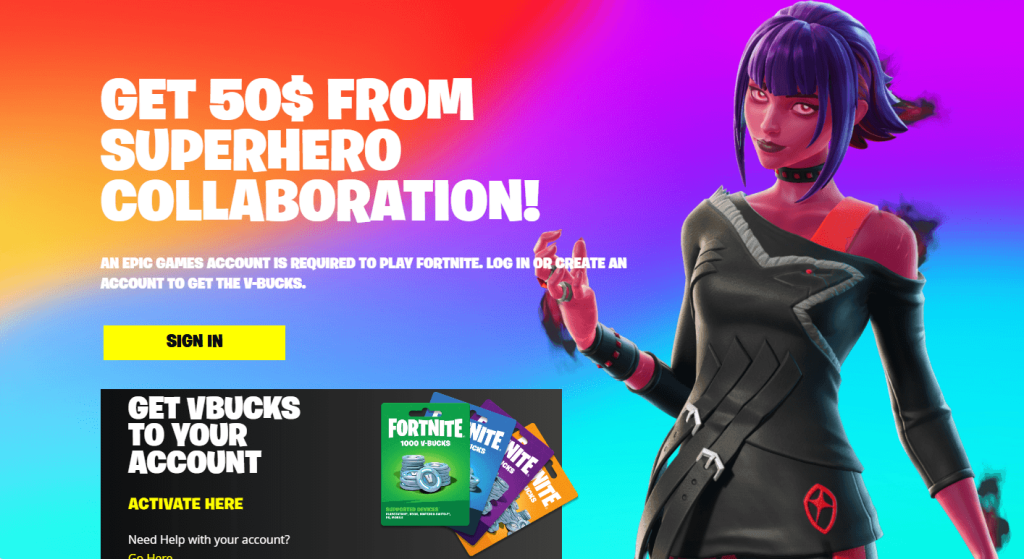
Fortnite scam pages like the ones below appear by the dozen every day, recycled endlessly under different names and designs.
One version promises $50 from a fake superhero collaboration. Another claims it can calculate what your locker is worth. Both lead to the same destination: a fake Epic Games login page designed to steal your account. It’s an old trick, but it still catches people out.
If a website promises free V-Bucks, cash, or a tool to calculate your locker’s value, then asks you to log in with your Epic account to get it, it’s not run by Epic.
Epic doesn’t offer an official tool that values accounts, and no legitimate giveaway requires you to sign in through a third-party site. You’re just handing your Epic username and password to scammers.
If you or your child entered your Epic login details on one of these sites, assume the account has been compromised. Change the password immediately, turn on two-factor authentication, and don’t reuse that password on any other accounts.
A stolen Fortnite account can be worth real money. Criminals can take over accounts with rare skins, spend any saved payment methods, sell the account on underground marketplaces, or use it to scam the owner’s friends. They may also try the same username and password on other online accounts, hoping the password has been reused.
Fortnite still attracts around 110 million monthly players and has more than 650 million registered accounts. That alone makes it an attractive target for cybercriminals.
The audience’s age matters too. In December 2022, the US Federal Trade Commission (FTC) fined Epic Games a record $520 million, after alleging that the company knew children made up a substantial share of its player base and left voice and text chat turned on by default, exposing them to strangers. The Consumer Financial Protection Bureau (CFPB) also cites industry experts who say young gamers are especially vulnerable to phishing because they spend more time on social media and are less familiar with social engineering.
The game is also built around visible status. Skins, emotes, and pickaxes cost real money, making the idea that “your locker has a price” feel plausible. Rare or discontinued skins really do sell for hundreds of dollars on unofficial marketplaces, even though Epic offers no official way to cash out V-Bucks and selling accounts violates its terms of service. That kernel of truth is exactly what these locker-value scams exploit.
That’s also what makes them more convincing than a simple V-Bucks giveaway. Instead of promising something for nothing, they play on curiosity about something the player already owns. That’s probably why this version keeps coming back.
Some pages promise rewards:

Others skip the free-reward pitch and frame the locker itself as hidden value the player is owed:
Others frame it as competition instead of currency:
The hook changes, but the fake login page doesn’t. These sites all do the same thing. They ask you to sign in with your Epic account so they can steal your username and password.
This one borrows a real story. Epic did settle with the FTC for $520 million, and real payments are still going out in 2026. But the real settlement pays actual dollars through the FTC’s own process, not in-game V-Bucks through an “Epic Games Locker,” and the claim window closed in July 2025.
References to an “EU Regulatory Mandate” and the case number shown on these pages don’t match any genuine legal action.
Fortnite scams change constantly, but the advice doesn’t.
Stop threats before they can do any harm.
Malwarebytes Browser Guard blocks phishing pages and malicious sites automatically. Free, one click to install. Add it to your browser →
Fortnite scam pages like the ones below appear by the dozen every day, recycled endlessly under different names and designs.
One version promises $50 from a fake superhero collaboration. Another claims it can calculate what your locker is worth. Both lead to the same destination: a fake Epic Games login page designed to steal your account. It’s an old trick, but it still catches people out.
If a website promises free V-Bucks, cash, or a tool to calculate your locker’s value, then asks you to log in with your Epic account to get it, it’s not run by Epic.
Epic doesn’t offer an official tool that values accounts, and no legitimate giveaway requires you to sign in through a third-party site. You’re just handing your Epic username and password to scammers.
If you or your child entered your Epic login details on one of these sites, assume the account has been compromised. Change the password immediately, turn on two-factor authentication, and don’t reuse that password on any other accounts.
A stolen Fortnite account can be worth real money. Criminals can take over accounts with rare skins, spend any saved payment methods, sell the account on underground marketplaces, or use it to scam the owner’s friends. They may also try the same username and password on other online accounts, hoping the password has been reused.
Fortnite still attracts around 110 million monthly players and has more than 650 million registered accounts. That alone makes it an attractive target for cybercriminals.
The audience’s age matters too. In December 2022, the US Federal Trade Commission (FTC) fined Epic Games a record $520 million, after alleging that the company knew children made up a substantial share of its player base and left voice and text chat turned on by default, exposing them to strangers. The Consumer Financial Protection Bureau (CFPB) also cites industry experts who say young gamers are especially vulnerable to phishing because they spend more time on social media and are less familiar with social engineering.
The game is also built around visible status. Skins, emotes, and pickaxes cost real money, making the idea that “your locker has a price” feel plausible. Rare or discontinued skins really do sell for hundreds of dollars on unofficial marketplaces, even though Epic offers no official way to cash out V-Bucks and selling accounts violates its terms of service. That kernel of truth is exactly what these locker-value scams exploit.
That’s also what makes them more convincing than a simple V-Bucks giveaway. Instead of promising something for nothing, they play on curiosity about something the player already owns. That’s probably why this version keeps coming back.
Some pages promise rewards:
Others skip the free-reward pitch and frame the locker itself as hidden value the player is owed:
Others frame it as competition instead of currency:
The hook changes, but the fake login page doesn’t. These sites all do the same thing. They ask you to sign in with your Epic account so they can steal your username and password.
This one borrows a real story. Epic did settle with the FTC for $520 million, and real payments are still going out in 2026. But the real settlement pays actual dollars through the FTC’s own process, not in-game V-Bucks through an “Epic Games Locker,” and the claim window closed in July 2025.
References to an “EU Regulatory Mandate” and the case number shown on these pages don’t match any genuine legal action.
Fortnite scams change constantly, but the advice doesn’t.
Stop threats before they can do any harm.
Malwarebytes Browser Guard blocks phishing pages and malicious sites automatically. Free, one click to install. Add it to your browser →
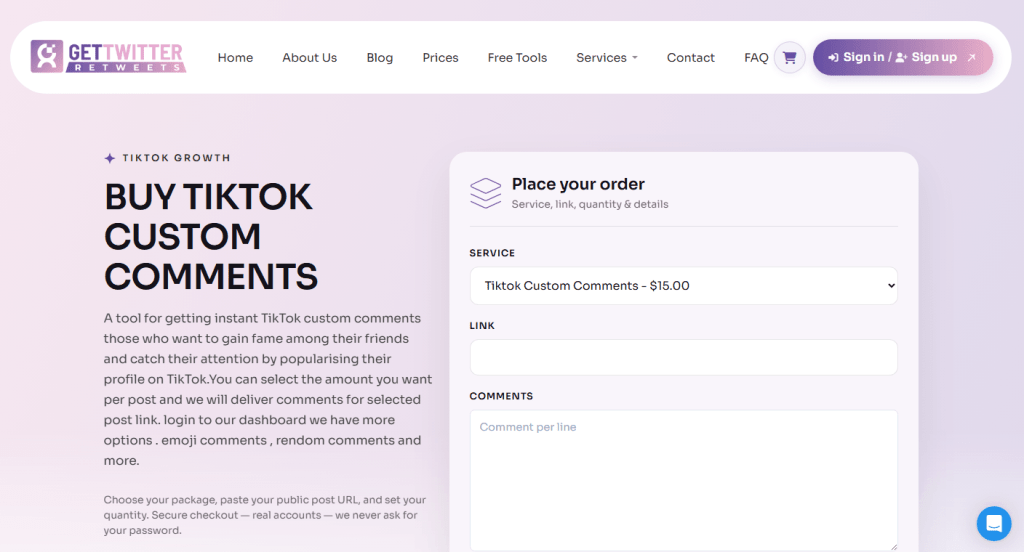
A whole industry has sprung up around selling TikTok “growth.”
Cheap views by the hundred, pre-made ad accounts, and polished sales pages promising a repeatable path to serious revenue.
None of it is officially sanctioned by TikTok, and depending on what you’re buying, you could end up wasting money, losing your account, or handing your login details to scammers.
Sites selling bulk engagement all look remarkably similar.
They offer small bundles of views, likes, or followers for a few pounds, usually alongside identical packages for YouTube, Instagram, and other platforms.
The sales pitch is almost always the same: “100% real profiles,” “no bots, no click farms,” and “completely safe.”
Those claims are worth reading carefully because they’re addressing the biggest concern buyers already have.
At this price point, bulk engagement is usually generated through bots, click farms, or other artificial means—the very thing these sites insist they don’t use.
Even if your engagement numbers increase initially, TikTok’s fraud detection systems can remove artificial engagement, and accounts that repeatedly use these services risk being flagged or restricted.
Another common offer is bulk TikTok Ads accounts sold as “aged” or “trusted,” often bundled with a replacement guarantee if an account stops working. The pitch is that you skip the hassle of setting up and verifying a new advertising account.
The problem is that you don’t know how those accounts were created. Many are built using stolen or synthetic identities, compromised payment details, or other deceptive methods. Buying one means inheriting that history—and the very real risk that TikTok detects it and suspends the account, along with any campaigns or ad budget attached to it. A replacement guarantee won’t help if your advertising is suddenly brought to a halt.
A third type of offer is less obviously a scam and more of a marketing funnel.
Slick landing pages—often hosted on free platforms and paired with an embedded video—promise a “proven blueprint” for turning TikTok into a major source of income, usually backed by impressive but unverifiable claims about past clients.
The immediate goal is usually to collect your email address, and sometimes your phone number, before revealing what’s actually for sale. That might be a paid course, a “done-for-you” management service, or a request for direct access to your TikTok Shop or Ads account.
What happens next varies, but the common thread is the same: you’re being asked to trust an unverified third party with your business, your money, or your account.
Not every TikTok marketing service is a scam. But if someone’s offering thousands of views for a few pounds, bulk “aged” ad accounts, or guaranteed growth, you’re in a very different part of the market.
These services promise shortcuts. What they often deliver is fake engagement, accounts with questionable histories, or requests for access to your own account.
At best, you’ve wasted your money on engagement TikTok later strips away. At worst, you’re buying an account built on stolen information or giving an untrusted third party full access to your own.
None of this is unique to TikTok. The platform’s explosive growth has simply given a familiar ecosystem of low-effort scams a new audience.
Scammers don’t need to hack you. They just need you to click once.
Malwarebytes Identity Theft Protection catches suspicious activity before it becomes a problem.
A whole industry has sprung up around selling TikTok “growth.”
Cheap views by the hundred, pre-made ad accounts, and polished sales pages promising a repeatable path to serious revenue.
None of it is officially sanctioned by TikTok, and depending on what you’re buying, you could end up wasting money, losing your account, or handing your login details to scammers.
Sites selling bulk engagement all look remarkably similar.
They offer small bundles of views, likes, or followers for a few pounds, usually alongside identical packages for YouTube, Instagram, and other platforms.
The sales pitch is almost always the same: “100% real profiles,” “no bots, no click farms,” and “completely safe.”
Those claims are worth reading carefully because they’re addressing the biggest concern buyers already have.
At this price point, bulk engagement is usually generated through bots, click farms, or other artificial means—the very thing these sites insist they don’t use.
Even if your engagement numbers increase initially, TikTok’s fraud detection systems can remove artificial engagement, and accounts that repeatedly use these services risk being flagged or restricted.
Another common offer is bulk TikTok Ads accounts sold as “aged” or “trusted,” often bundled with a replacement guarantee if an account stops working. The pitch is that you skip the hassle of setting up and verifying a new advertising account.
The problem is that you don’t know how those accounts were created. Many are built using stolen or synthetic identities, compromised payment details, or other deceptive methods. Buying one means inheriting that history—and the very real risk that TikTok detects it and suspends the account, along with any campaigns or ad budget attached to it. A replacement guarantee won’t help if your advertising is suddenly brought to a halt.
A third type of offer is less obviously a scam and more of a marketing funnel.
Slick landing pages—often hosted on free platforms and paired with an embedded video—promise a “proven blueprint” for turning TikTok into a major source of income, usually backed by impressive but unverifiable claims about past clients.
The immediate goal is usually to collect your email address, and sometimes your phone number, before revealing what’s actually for sale. That might be a paid course, a “done-for-you” management service, or a request for direct access to your TikTok Shop or Ads account.
What happens next varies, but the common thread is the same: you’re being asked to trust an unverified third party with your business, your money, or your account.
Not every TikTok marketing service is a scam. But if someone’s offering thousands of views for a few pounds, bulk “aged” ad accounts, or guaranteed growth, you’re in a very different part of the market.
These services promise shortcuts. What they often deliver is fake engagement, accounts with questionable histories, or requests for access to your own account.
At best, you’ve wasted your money on engagement TikTok later strips away. At worst, you’re buying an account built on stolen information or giving an untrusted third party full access to your own.
None of this is unique to TikTok. The platform’s explosive growth has simply given a familiar ecosystem of low-effort scams a new audience.
Scammers don’t need to hack you. They just need you to click once.
Malwarebytes Identity Theft Protection catches suspicious activity before it becomes a problem.
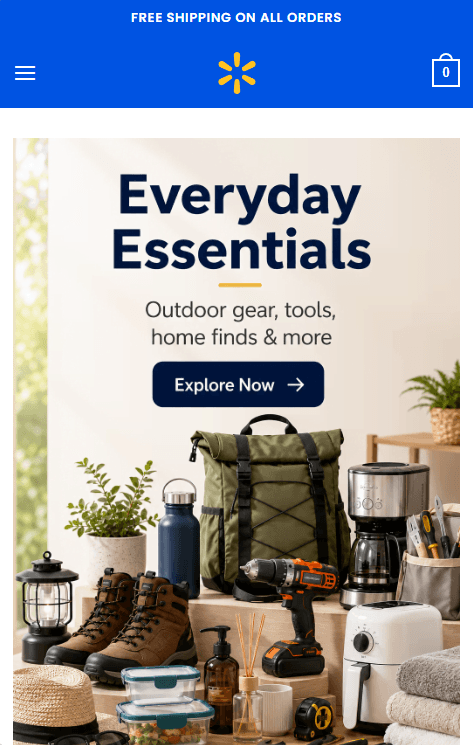
Shoppers browsing on their phones are landing on convincing Walmart lookalike sites offering name-brand liquor at 40% to 70% off, only to be led straight to a checkout page asking for a full credit card number, expiry date, and CVV.
The sites have no connection to Walmart. They’re part of a network of more than 120 near-identical domains built to look like a legitimate retailer just long enough to steal your card details.
The name “Walmart” is doing most of the work here. It’s one of the most recognized retailers in the world, and it’s that familiarity that makes people lower their guard. A shopper who’d hesitate on an unfamiliar website may think nothing of an unusually large discount because the logo, colours, and layout look familiar.
That trust hasn’t been earned by the site. It’s borrowed from a brand that has nothing to do with it.
If you’ve entered your card details on one of these pages, the safest assumption is that your card has been compromised.
The scam follows a simple pattern: a Walmart-branded homepage, category pages stacked with heavily discounted liquor, and a checkout form asking for full card details.
The discounts do much of the persuading. Seeing premium brands advertised at 60% or 70% off encourages people to buy first and ask questions later.
The same WordPress/WooCommerce template powers every site in the network. They share the same product catalogue, prices, and images. The only differences are fabricated US business addresses and phone numbers that are swapped out for each domain.
.shop domain.The simplest defence is also the most effective: if a retailer needs a lookalike domain to sell you something, it’s probably a scam.
allgoodscenter.shop, allneedsbay.shop, allneedslane.shop, allneedsmarket.shop, allneedsstore.shop, allpurposebay.shop, basketandmore.shop, broadbasket.shop, broadbasketbay.shop, broadbasketco.shop, broadbasketlane.shop, broadbasketplace.shop, broadbasketway.shop, broadchoice.shop, broadgoodsbay.shop, broadgoodscenter.shop, broadgoodsplace.shop, broadgoodsway.shop, broadmarketplacehub.shop, broadutility.shop, broadutilityhub.shop, broadvalue.shop, broadvaluebay.shop, broadvalueplace.shop, cartandcrate.shop, completehomegoods.shop, dailybasketport.shop, dailybasketway.shop, dailychoiceway.shop, dailycrate.shop, dailyfindslane.shop, dailygoodscrest.shop, dailygoodsfield.shop, dailygoodspark.shop, dailygoodsridge.shop, dailygoodsway.shop, dailygoodswayhub.shop, dailyhomemarket.shop, dailyutilitybay.shop, dailyutilityway.shop, everydaycartshop.shop, everydayneedsco.shop, everydayvaluebay.shop, generalcart.shop, generalcartlane.shop, generalgoodsport.shop, generalgoodsridge.shop, generalgoodsway.shop, generalgoodsyard.shop, generalmarketbay.shop, generalmarketfield.shop, generalneedsplace.shop, generalvaluebay.shop, goodsandhomebay.shop, goodsandhomeco.shop, goodsandhomehub.shop, goodsandlivinghub.shop, goodsandmoreco.shop, goodsandvaluehub.shop, goodsdistrict.shop, goodslanding.shop, goodsmeadow.shop, goodsroute.shop, goodsvalley.shop, homeandutility.shop, homebasketlane.shop, homebasketway.shop, homecartcenter.shop, homefieldmarket.shop, homefindsco.shop, homegoodscrate.shop, homegoodsport.shop, homegoodsway.shop, homelivinggoods.shop, homeneedslane.shop, homeneedsmarket.shop, homeparcel.shop, homesteadmart.shop, homeutilitystore.shop, homevaluebay.shop, homevalueplace.shop, homevalueway.shop, marketbasketcenter.shop, marketcanvas.shop, marketchoicebay.shop, marketchoiceplace.shop, marketfieldhub.shop, marketfindsbay.shop, marketfoundry.shop, marketgrovehub.shop, markethomeplace.shop, marketpillar.shop, marketpine.shop, marketridge.shop, markettrailway.shop, marketwarehouse.shop, modernsupplyhub.shop, smartbasketplace.shop, smartdailygoods.shop, smartneedshub.shop, smartutilityhub.shop, smartvaluebay.shop, trustedgoods.shop, usefulbasketlane.shop, usefulcartcenter.shop, usefulchoicebay.shop, usefuldailyhub.shop, usefulgoodsbay.shop, usefulgoodscenter.shop, usefulgoodspark.shop, usefulgoodsway.shop, usefulgoodswayhub.shop, usefulgoodsyard.shop, usefulmarket.shop, usefulmarketbay.shop, usefulshelf.shop, usefulutility.shop, usefulvalueplace.shop, utilitygoods.shop, valuechoicebay.shop, valuegoodspark.shop, valuegoodsridge.shop, valuegrove.shop, valueparcel.shop
Stop threats before they can do any harm.
Malwarebytes Browser Guard blocks phishing pages and malicious sites automatically. Free, one click to install. Add it to your browser →
Shoppers browsing on their phones are landing on convincing Walmart lookalike sites offering name-brand liquor at 40% to 70% off, only to be led straight to a checkout page asking for a full credit card number, expiry date, and CVV.
The sites have no connection to Walmart. They’re part of a network of more than 120 near-identical domains built to look like a legitimate retailer just long enough to steal your card details.
The name “Walmart” is doing most of the work here. It’s one of the most recognized retailers in the world, and it’s that familiarity that makes people lower their guard. A shopper who’d hesitate on an unfamiliar website may think nothing of an unusually large discount because the logo, colours, and layout look familiar.
That trust hasn’t been earned by the site. It’s borrowed from a brand that has nothing to do with it.
If you’ve entered your card details on one of these pages, the safest assumption is that your card has been compromised.
The scam follows a simple pattern: a Walmart-branded homepage, category pages stacked with heavily discounted liquor, and a checkout form asking for full card details.
The discounts do much of the persuading. Seeing premium brands advertised at 60% or 70% off encourages people to buy first and ask questions later.
The same WordPress/WooCommerce template powers every site in the network. They share the same product catalogue, prices, and images. The only differences are fabricated US business addresses and phone numbers that are swapped out for each domain.
.shop domain.The simplest defence is also the most effective: if a retailer needs a lookalike domain to sell you something, it’s probably a scam.
allgoodscenter.shop, allneedsbay.shop, allneedslane.shop, allneedsmarket.shop, allneedsstore.shop, allpurposebay.shop, basketandmore.shop, broadbasket.shop, broadbasketbay.shop, broadbasketco.shop, broadbasketlane.shop, broadbasketplace.shop, broadbasketway.shop, broadchoice.shop, broadgoodsbay.shop, broadgoodscenter.shop, broadgoodsplace.shop, broadgoodsway.shop, broadmarketplacehub.shop, broadutility.shop, broadutilityhub.shop, broadvalue.shop, broadvaluebay.shop, broadvalueplace.shop, cartandcrate.shop, completehomegoods.shop, dailybasketport.shop, dailybasketway.shop, dailychoiceway.shop, dailycrate.shop, dailyfindslane.shop, dailygoodscrest.shop, dailygoodsfield.shop, dailygoodspark.shop, dailygoodsridge.shop, dailygoodsway.shop, dailygoodswayhub.shop, dailyhomemarket.shop, dailyutilitybay.shop, dailyutilityway.shop, everydaycartshop.shop, everydayneedsco.shop, everydayvaluebay.shop, generalcart.shop, generalcartlane.shop, generalgoodsport.shop, generalgoodsridge.shop, generalgoodsway.shop, generalgoodsyard.shop, generalmarketbay.shop, generalmarketfield.shop, generalneedsplace.shop, generalvaluebay.shop, goodsandhomebay.shop, goodsandhomeco.shop, goodsandhomehub.shop, goodsandlivinghub.shop, goodsandmoreco.shop, goodsandvaluehub.shop, goodsdistrict.shop, goodslanding.shop, goodsmeadow.shop, goodsroute.shop, goodsvalley.shop, homeandutility.shop, homebasketlane.shop, homebasketway.shop, homecartcenter.shop, homefieldmarket.shop, homefindsco.shop, homegoodscrate.shop, homegoodsport.shop, homegoodsway.shop, homelivinggoods.shop, homeneedslane.shop, homeneedsmarket.shop, homeparcel.shop, homesteadmart.shop, homeutilitystore.shop, homevaluebay.shop, homevalueplace.shop, homevalueway.shop, marketbasketcenter.shop, marketcanvas.shop, marketchoicebay.shop, marketchoiceplace.shop, marketfieldhub.shop, marketfindsbay.shop, marketfoundry.shop, marketgrovehub.shop, markethomeplace.shop, marketpillar.shop, marketpine.shop, marketridge.shop, markettrailway.shop, marketwarehouse.shop, modernsupplyhub.shop, smartbasketplace.shop, smartdailygoods.shop, smartneedshub.shop, smartutilityhub.shop, smartvaluebay.shop, trustedgoods.shop, usefulbasketlane.shop, usefulcartcenter.shop, usefulchoicebay.shop, usefuldailyhub.shop, usefulgoodsbay.shop, usefulgoodscenter.shop, usefulgoodspark.shop, usefulgoodsway.shop, usefulgoodswayhub.shop, usefulgoodsyard.shop, usefulmarket.shop, usefulmarketbay.shop, usefulshelf.shop, usefulutility.shop, usefulvalueplace.shop, utilitygoods.shop, valuechoicebay.shop, valuegoodspark.shop, valuegoodsridge.shop, valuegrove.shop, valueparcel.shop
Stop threats before they can do any harm.
Malwarebytes Browser Guard blocks phishing pages and malicious sites automatically. Free, one click to install. Add it to your browser →
Sextortion scammers are using email addresses from data leaked by the ShinyHunters hacking group to add some credibility to their feeble attempts to convince people they have embarrassing information about them.
Sextortion emails are messages claiming that the scammer recorded you through your webcam while you watched pornography and now demand payment. They have been around for years and keep evolving with small changes in wording and fake technical detail.
In this campaign, the scammers pretend to be ShinyHunters. What hasn’t changed is the basic truth: there is no malware, no recording, and no credible evidence behind the threat. Despite seeing countless versions of these emails over the years, I’ve yet to encounter one that was backed up by the evidence the sender claimed to have.
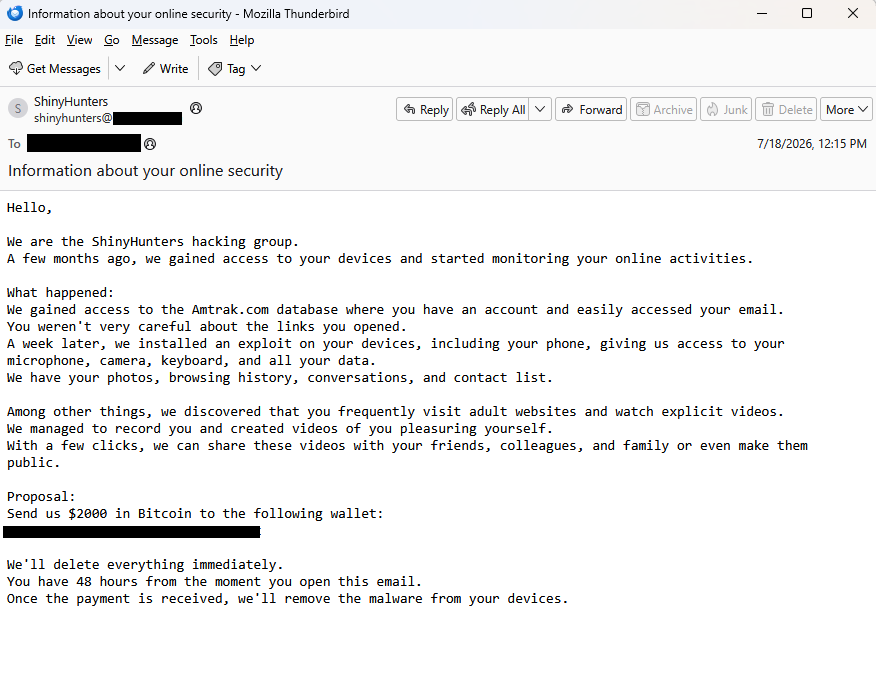
BleepingComputer reports that ShinyHunters data leaks are fueling a $2,000 sextortion email scam and shared the following example:
“Subject: Information about your online security
Hello,
We are the ShinyHunters hacking group.
A few months ago, we gained access to your devices and started monitoring your online activities.What happened:
We gained access to the Amtrak.com database where you have an account and easily accessed your email.
You weren’t very careful about the links you opened.
A week later, we installed an exploit on your devices, including your phone, giving us access to your microphone,
camera, keyboard, and all your data.
We have your photos, browsing history, conversations, and contact list.Among other things, we discovered that you frequently visit adult websites and watch explicit videos.
We managed to record you and created videos of you pleasuring yourself.
With a few clicks, we can share these videos with your friends,
colleagues, and family or even make them public.Proposal:
Send us $2000 in Bitcoin to the following wallet:
xxxxxxxxxxxxxxxxxxxxxxxxxxxxxxxxxWe’ll delete everything immediately.
You have 48 hours from the moment you open this email.
Once the payment is received, we’ll remove the malware from your devices.”
BleepingComputer states it has seen data from the Amtrak, Hallmark, ADT, Substack, Betterment, CarGurus, Panera Bread, and McGraw Hill breaches used to target victims in this sextortion email campaign.
A California community college also issued a warning after seeing the campaign target people affected by the Canvas data breach.
They confirmed that the targeted email addresses had previously appeared in data leaked by ShinyHunters. They also contacted the group, which denied being behind the sextortion emails.
The increase to a $2,000 demand may suggest the scammers paid someone for the email lists. Although it’s more likely they simply downloaded the leaked data after ShinyHunters published it following failed extortion attempts.
A quick check of the Bitcoin address used in the email shows no activity.
Let’s keep it that way. With any luck, these dungeon dwellers will eventually give up trying to scare people out of their hard-earned money.
Some sextortion emails are badly written, but many have been polished by AI and look convincing. Regardless of how professional they look, they should be treated the same way: as unsubstantiated threats designed to scare victims into paying.
Pro tip: Malwarebytes Scam Guard recognized this email for what it is: sextortion. It can recognize scams and advise you how to proceed.
While these sextortion emails are almost always bluffs, if you’re concerned about webcam spying, Malwarebytes Webcam Monitoring can alert you when applications attempt to access your camera.
Sextortion scammers are using email addresses from data leaked by the ShinyHunters hacking group to add some credibility to their feeble attempts to convince people they have embarrassing information about them.
Sextortion emails are messages claiming that the scammer recorded you through your webcam while you watched pornography and now demand payment. They have been around for years and keep evolving with small changes in wording and fake technical detail.
In this campaign, the scammers pretend to be ShinyHunters. What hasn’t changed is the basic truth: there is no malware, no recording, and no credible evidence behind the threat. Despite seeing countless versions of these emails over the years, I’ve yet to encounter one that was backed up by the evidence the sender claimed to have.
BleepingComputer reports that ShinyHunters data leaks are fueling a $2,000 sextortion email scam and shared the following example:
“Subject: Information about your online security
Hello,
We are the ShinyHunters hacking group.
A few months ago, we gained access to your devices and started monitoring your online activities.What happened:
We gained access to the Amtrak.com database where you have an account and easily accessed your email.
You weren’t very careful about the links you opened.
A week later, we installed an exploit on your devices, including your phone, giving us access to your microphone,
camera, keyboard, and all your data.
We have your photos, browsing history, conversations, and contact list.Among other things, we discovered that you frequently visit adult websites and watch explicit videos.
We managed to record you and created videos of you pleasuring yourself.
With a few clicks, we can share these videos with your friends,
colleagues, and family or even make them public.Proposal:
Send us $2000 in Bitcoin to the following wallet:
xxxxxxxxxxxxxxxxxxxxxxxxxxxxxxxxxWe’ll delete everything immediately.
You have 48 hours from the moment you open this email.
Once the payment is received, we’ll remove the malware from your devices.”
BleepingComputer states it has seen data from the Amtrak, Hallmark, ADT, Substack, Betterment, CarGurus, Panera Bread, and McGraw Hill breaches used to target victims in this sextortion email campaign.
A California community college also issued a warning after seeing the campaign target people affected by the Canvas data breach.
They confirmed that the targeted email addresses had previously appeared in data leaked by ShinyHunters. They also contacted the group, which denied being behind the sextortion emails.
The increase to a $2,000 demand may suggest the scammers paid someone for the email lists. Although it’s more likely they simply downloaded the leaked data after ShinyHunters published it following failed extortion attempts.
A quick check of the Bitcoin address used in the email shows no activity.
Let’s keep it that way. With any luck, these dungeon dwellers will eventually give up trying to scare people out of their hard-earned money.
Some sextortion emails are badly written, but many have been polished by AI and look convincing. Regardless of how professional they look, they should be treated the same way: as unsubstantiated threats designed to scare victims into paying.
Pro tip: Malwarebytes Scam Guard recognized this email for what it is: sextortion. It can recognize scams and advise you how to proceed.
While these sextortion emails are almost always bluffs, if you’re concerned about webcam spying, Malwarebytes Webcam Monitoring can alert you when applications attempt to access your camera.
Resin art has become a popular corner of TikTok, with some videos attracting millions of views. But not every glossy, colorful post is what it claims to be. Scammers are using the look of handmade resin art to trick buyers, collectors, and even fellow artists into sending money for work that either doesn’t exist or wasn’t created by the person posting it.
There are plenty of genuine resin artists on TikTok. Unfortunately, the platform has also attracted scammers who steal videos and impersonate legitimate creators.
The scam is fairly straightforward. A TikTok account presents itself as a resin artist, posts satisfying videos, and invites people to “DM to order.” In some cases, the videos are stolen from other creators, the account has no real process footage, and the seller disappears after receiving payment.
One resin artist discovered that scammers were using their videos to impersonate them and scam TikTok users. They shared the following comment:
Ridiculous TikTok scammer…lol. Profile says they’re a resin artist and to DM them to order, but none of the videos are theirs. When I wrote to them asking them to take down the many videos of mine that they posted, passing them off as their own with no credit, their answer was that they aren’t a resin artist and are just sharing videos they like
These scams often rely on trust and urgency. The account may show polished clips of poured resin, finished coasters, trays, jewelry, or wall art, then push buyers to move the conversation into direct messages. Once the buyer moves to a different platform, the scammer typically requests a deposit, full payment, or personal details with little chance of being held accountable.
And real artists don’t just get their work ripped off. A scammer may contact a creator claiming to want to buy, feature, or license their work, but the real goal is to extract fees, banking information, or other sensitive data. Social media art scams are often repetitive because they are built from the same templates and scripts.
The safest approach is the boring one: verify before you pay. If the artwork looks amazing but the seller’s identity is vague, the risk is real.
Before ordering, look for signs that the artist is genuine:
If you do click through to a website, spend a few minutes checking it before you buy:
Not every resin art account is a scam. Many belong to genuine artists, and that’s why impersonation scams can be so convincing.
If you’re unsure, paste the website address into Malwarebytes Scam Guard and ask whether it shows signs of being fraudulent. It can help identify suspiciously new domains and other common scam indicators.
Use real-time web protection to block known fraudulent and malicious websites, like Browser Guard did for this web shop:
Both are free—making them much cheaper than sending money to a scammer.
Malwarebytes Scam Guard helps you analyze suspicious links, texts, and screenshots instantly.
Available with Malwarebytes Premium Security for all your devices, and in the Malwarebytes app for iOS and Android.
Resin art has become a popular corner of TikTok, with some videos attracting millions of views. But not every glossy, colorful post is what it claims to be. Scammers are using the look of handmade resin art to trick buyers, collectors, and even fellow artists into sending money for work that either doesn’t exist or wasn’t created by the person posting it.
There are plenty of genuine resin artists on TikTok. Unfortunately, the platform has also attracted scammers who steal videos and impersonate legitimate creators.
The scam is fairly straightforward. A TikTok account presents itself as a resin artist, posts satisfying videos, and invites people to “DM to order.” In some cases, the videos are stolen from other creators, the account has no real process footage, and the seller disappears after receiving payment.
One resin artist discovered that scammers were using their videos to impersonate them and scam TikTok users. They shared the following comment:
Ridiculous TikTok scammer…lol. Profile says they’re a resin artist and to DM them to order, but none of the videos are theirs. When I wrote to them asking them to take down the many videos of mine that they posted, passing them off as their own with no credit, their answer was that they aren’t a resin artist and are just sharing videos they like
These scams often rely on trust and urgency. The account may show polished clips of poured resin, finished coasters, trays, jewelry, or wall art, then push buyers to move the conversation into direct messages. Once the buyer moves to a different platform, the scammer typically requests a deposit, full payment, or personal details with little chance of being held accountable.
And real artists don’t just get their work ripped off. A scammer may contact a creator claiming to want to buy, feature, or license their work, but the real goal is to extract fees, banking information, or other sensitive data. Social media art scams are often repetitive because they are built from the same templates and scripts.
The safest approach is the boring one: verify before you pay. If the artwork looks amazing but the seller’s identity is vague, the risk is real.
Before ordering, look for signs that the artist is genuine:
If you do click through to a website, spend a few minutes checking it before you buy:
Not every resin art account is a scam. Many belong to genuine artists, and that’s why impersonation scams can be so convincing.
If you’re unsure, paste the website address into Malwarebytes Scam Guard and ask whether it shows signs of being fraudulent. It can help identify suspiciously new domains and other common scam indicators.
Use real-time web protection to block known fraudulent and malicious websites, like Browser Guard did for this web shop:
Both are free—making them much cheaper than sending money to a scammer.
Malwarebytes Scam Guard helps you analyze suspicious links, texts, and screenshots instantly.
Available with Malwarebytes Premium Security for all your devices, and in the Malwarebytes app for iOS and Android.
Not sure this will have any effect, but I support the effort:
According to Google’s legal filing, Outsider Enterprise operates through Telegram. The group offers phishing-as-a-service to individuals who may not be technically savvy enough to set up fraudulent websites and text campaigns on their own. In its Telegram channels, Outsider Enterprise reportedly provided instructions on how to use Google’s Gemini AI to create websites that imitate those of Google, YouTube, and government agencies such as New York’s E-ZPass. The group offered nearly 300 scam templates.
[…]
Google worked with AT&T, Verizon, and T-Mobile to block many of these malicious text messages, and Google notes that its on-device scam detection in Google Messages probably helped reduce the number of successful phishing attempts, too. This AI-powered feature apparently stops 10 billion scam texts every month, so it’s fair to expect it caught at least some Outsider Enterprise activity.
Another article.
Account theft usually ends with someone losing a password. This one ends with hackers walking off with the entire game.
Developers behind some of Roblox’s millions of games told 404 Media that attackers persuaded them to run a single file. Then they watched their group, their game, and their Robux (in-platform currency) balance vanish into someone else’s account within hours. In several cases, Roblox support didn’t help them get the games back until a reporter called the company for comment.
Roblox attacks used to be opportunistic. “Beamers” targeted individual players to steal rare hats, limited items, and accounts, then resold them. The pattern has shifted. The new targets are developer accounts, and the prize is the game itself.
Ioannis Matziaris told 404 Media that his two 20-year-old sons spent five years building a Roblox game called The Shadow Network. In April, attackers approached one of them with a job offer and convinced him to run a particular file. It was malware. The attackers stole control of the game, the group’s Roblox account, and their Robux balance.
Another developer, Jovan Rai, received the same project-manager job pitch. This time, the attackers were impersonating Cheesy Studios, the Matziaris brothers’ company, to lend the offer credibility. The 15-year-old was earning roughly 10,000 Robux (around $38) per day from his game. He spent more than 30 days trying to recover it through Roblox support before media attention helped move the case forward.
Developer Mohamed Kaparoza described how the attack worked. Attackers contacted him on Discord, dangled a project-manager role, and asked him to install a Python package called “robase,” which they claimed was a database tool. Shortly after installing it, he was logged out of Roblox on both his PC and his phone. His Discord account went with it, and his two-step verification settings and passkey were changed.
This is a case of session-token theft, rather than credential theft. Once an infostealer steals an authenticated browser session, attackers can often bypass security measures such as two-factor authentication (2FA) because they are reusing a session that has already been authenticated.
The technique itself isn’t new. We reported on a similar campaign in January 2025 that targeted Roblox players with offers to beta test new games. The “installer” was actually an infostealer designed to steal data, including Discord and Steam sessions, and cryptocurrency wallet information.
If you build Roblox games, the defensive advice is unglamorous and mostly behavioral.
We don’t just report on threats—we remove them
Cybersecurity risks should never spread beyond a headline. Keep threats off your devices by downloading Malwarebytes today.
Account theft usually ends with someone losing a password. This one ends with hackers walking off with the entire game.
Developers behind some of Roblox’s millions of games told 404 Media that attackers persuaded them to run a single file. Then they watched their group, their game, and their Robux (in-platform currency) balance vanish into someone else’s account within hours. In several cases, Roblox support didn’t help them get the games back until a reporter called the company for comment.
Roblox attacks used to be opportunistic. “Beamers” targeted individual players to steal rare hats, limited items, and accounts, then resold them. The pattern has shifted. The new targets are developer accounts, and the prize is the game itself.
Ioannis Matziaris told 404 Media that his two 20-year-old sons spent five years building a Roblox game called The Shadow Network. In April, attackers approached one of them with a job offer and convinced him to run a particular file. It was malware. The attackers stole control of the game, the group’s Roblox account, and their Robux balance.
Another developer, Jovan Rai, received the same project-manager job pitch. This time, the attackers were impersonating Cheesy Studios, the Matziaris brothers’ company, to lend the offer credibility. The 15-year-old was earning roughly 10,000 Robux (around $38) per day from his game. He spent more than 30 days trying to recover it through Roblox support before media attention helped move the case forward.
Developer Mohamed Kaparoza described how the attack worked. Attackers contacted him on Discord, dangled a project-manager role, and asked him to install a Python package called “robase,” which they claimed was a database tool. Shortly after installing it, he was logged out of Roblox on both his PC and his phone. His Discord account went with it, and his two-step verification settings and passkey were changed.
This is a case of session-token theft, rather than credential theft. Once an infostealer steals an authenticated browser session, attackers can often bypass security measures such as two-factor authentication (2FA) because they are reusing a session that has already been authenticated.
The technique itself isn’t new. We reported on a similar campaign in January 2025 that targeted Roblox players with offers to beta test new games. The “installer” was actually an infostealer designed to steal data, including Discord and Steam sessions, and cryptocurrency wallet information.
If you build Roblox games, the defensive advice is unglamorous and mostly behavioral.
We don’t just report on threats—we remove them
Cybersecurity risks should never spread beyond a headline. Keep threats off your devices by downloading Malwarebytes today.
With the World Cup on, you’ll find no shortage of websites promising every match, live, in HD, for free. They look convincing, usually with a video player, a “Live Stream Available” indicator, a row of server buttons, maybe a match schedule, and a “Watch Live” button. There’s no signup, no paywall, and seemingly, no catch.
But of course there’s a catch. These sites aren’t really in the business of streaming football. What the page is really built to do is fire pop-ups, hidden ads, and redirects through an advertising network we detect as malicious. Instead of watching the match, visitors end up facing scams, malware, and fraudulent downloads.
Here’s how the scam works and how to stay out of it.
We’ve identified more than 40 websites that are effectively identical. They use different World Cup-themed names, but behind the scenes they’re running the same page template, the same code, and the same advertising infrastructure.
A script generates a separate page for every match, making the operation cheap to run and easy to scale.
When a stream appears at all, it’s usually embedded from a third-party piracy service. The real business is the advertising surrounding the player.
A typical page loads eight or more ad and tracking scripts from the same shady network, plus a handful of other ad domains. The hub the whole page is wired to is a domain we detect as malicious. Your data is the product; the “stream” is the bait.
It’s tempting to shrug this off as the usual price of free streams. But it’s worse than facing a few annoying ads.
The real threat is the ad network. This isn’t mainstream, vetted advertising. The kind of ad network we flag as malicious is a common delivery route for the stuff that causes harm: fake virus warnings, bogus software update prompts that install malware, fake prize and verification pages, and forced redirects into subscription traps.
The video window itself is untrusted. The stream is pulled from a third-party piracy service, not anything the site controls or vets. Pirated stream embeds are a well-known source of their own ads, redirects, and hidden clickable overlays, so even the part that looks like a video player can be working against you.
There’s nobody behind the counter. These are anonymous, disposable sites built around a major sporting event. There’s no real company, no support, no accountability, and no reason for them to care what lands on your screen.
It’s the oldest play in the scam handbook: take something millions of people want right now, present it nicely, and monetize the rush. Scammers don’t create the demand, they just stand in front of it with a bucket and collect payment.
The first tap is hijacked. A script waits for your first click or tap anywhere on the page and uses it to open an ad in a new tab or window, often in the background. Before you’ve watched a second of football, you’ve already triggered an ad.
The “Play” button is a maze. Clicking Play doesn’t play anything. Instead, you’re sent through prompts like “Click Resume to continue” before you might reach a video. Every extra step is another click, and each click triggers more ads.
Invisible ads load. The page quietly loads tiny, invisible 1×1-pixel ads and opens more tabs. These exist purely to generate paid ad views. The tactic has many of the hallmarks of ad fraud, and you’re the unwitting traffic. More ads are injected into the player area the moment you try to watch.
The stream is an afterthought. Often there’s no working stream at all, so the page loops you through “Streams loading… Retry,” which means more clicks and more ads. Whether you ever see the match or not, the ads have already cashed in.
The code fires the ads; but here’s what comes out the other end. On these pages, the injected ads tend to fall into two buckets, and neither has anything to do with football.
The first is fake message notifications: little pop-ups designed to look like real chat alerts, complete with a stranger’s photo and messages such as “Seen my message yet? Let’s talk!” Some include fake voice messages or explicit thumbnails. They’re made to look like notifications you’ve forgotten to check so you’ll click them.
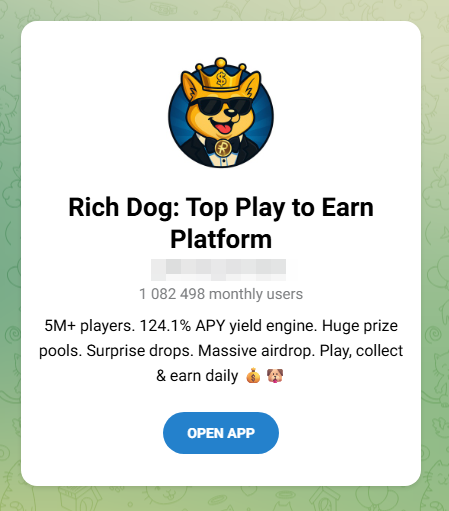
The second is crypto bait. These ads promote “play-to-earn” games with promises of daily rewards, surprise drops, massive airdrops, and eye-catching claims like a “124% APY yield engine.”
One warning sign is the promise of guaranteed triple-digit returns and free money for tapping a button. That’s not how legitimate financial products work.
That’s the whole machine working end to end: football is the doorway, the malicious advertising network is the engine, and the scams are what it’s actually selling.
These “Free HD stream, every match, no catch” sites use football as bait to funnel visitors through a malicious advertising network. Here’s how to stay safe:
Domains
arenaworldcupfootball.xyzfootballworldcup.xyzfreeworldcup.xyzfreeworldcupstream.xyzfreeworldcupstreaming.xyzlivestreamingworldcup.xyzlivestreamworldcup.xyzliveworldcup.todayliveworldcup.xyzliveworldcup2026.xyzliveworldcupmatch.xyzmatchoraworldcup.worldmatchworldcup.xyzsportivaworldcup.xyzsportworldcuponline.xyzwatchworldcup.watchwatchworldcup.worldwatchworldcup2026.xyzwatchworldcupfree.livewatchworldcupfree.onlinewatchworldcupfree.xyzworldcup2026match.xyzworldcuparena.xyzworldcupfoootballmatch.xyzworldcupfootball.liveworldcupfootballmat.liveworldcupfootballmatch.liveworldcupfootbmatch.xyzworldcupfreeonline.xyzworldcuplive.worldworldcuplivestream.onlineworldcupmatch.onlineworldcupmatch.worldworldcupmatch.xyzworldcupmatchlive.liveworldcupsoccer.liveworldcupsoccermatch.liveworldcupstreameast.onlineworldcupstreameast.xyzworldcupusa.worldworldcupusa.xyz
Stop threats before they can do any harm.
Malwarebytes Browser Guard blocks phishing pages and malicious sites automatically. Free, one click to install. Add it to your browser →
With the World Cup on, you’ll find no shortage of websites promising every match, live, in HD, for free. They look convincing, usually with a video player, a “Live Stream Available” indicator, a row of server buttons, maybe a match schedule, and a “Watch Live” button. There’s no signup, no paywall, and seemingly, no catch.
But of course there’s a catch. These sites aren’t really in the business of streaming football. What the page is really built to do is fire pop-ups, hidden ads, and redirects through an advertising network we detect as malicious. Instead of watching the match, visitors end up facing scams, malware, and fraudulent downloads.
Here’s how the scam works and how to stay out of it.
We’ve identified more than 40 websites that are effectively identical. They use different World Cup-themed names, but behind the scenes they’re running the same page template, the same code, and the same advertising infrastructure.
A script generates a separate page for every match, making the operation cheap to run and easy to scale.
When a stream appears at all, it’s usually embedded from a third-party piracy service. The real business is the advertising surrounding the player.
A typical page loads eight or more ad and tracking scripts from the same shady network, plus a handful of other ad domains. The hub the whole page is wired to is a domain we detect as malicious. Your data is the product; the “stream” is the bait.
It’s tempting to shrug this off as the usual price of free streams. But it’s worse than facing a few annoying ads.
The real threat is the ad network. This isn’t mainstream, vetted advertising. The kind of ad network we flag as malicious is a common delivery route for the stuff that causes harm: fake virus warnings, bogus software update prompts that install malware, fake prize and verification pages, and forced redirects into subscription traps.
The video window itself is untrusted. The stream is pulled from a third-party piracy service, not anything the site controls or vets. Pirated stream embeds are a well-known source of their own ads, redirects, and hidden clickable overlays, so even the part that looks like a video player can be working against you.
There’s nobody behind the counter. These are anonymous, disposable sites built around a major sporting event. There’s no real company, no support, no accountability, and no reason for them to care what lands on your screen.
It’s the oldest play in the scam handbook: take something millions of people want right now, present it nicely, and monetize the rush. Scammers don’t create the demand, they just stand in front of it with a bucket and collect payment.
The first tap is hijacked. A script waits for your first click or tap anywhere on the page and uses it to open an ad in a new tab or window, often in the background. Before you’ve watched a second of football, you’ve already triggered an ad.
The “Play” button is a maze. Clicking Play doesn’t play anything. Instead, you’re sent through prompts like “Click Resume to continue” before you might reach a video. Every extra step is another click, and each click triggers more ads.
Invisible ads load. The page quietly loads tiny, invisible 1×1-pixel ads and opens more tabs. These exist purely to generate paid ad views. The tactic has many of the hallmarks of ad fraud, and you’re the unwitting traffic. More ads are injected into the player area the moment you try to watch.
The stream is an afterthought. Often there’s no working stream at all, so the page loops you through “Streams loading… Retry,” which means more clicks and more ads. Whether you ever see the match or not, the ads have already cashed in.
The code fires the ads; but here’s what comes out the other end. On these pages, the injected ads tend to fall into two buckets, and neither has anything to do with football.
The first is fake message notifications: little pop-ups designed to look like real chat alerts, complete with a stranger’s photo and messages such as “Seen my message yet? Let’s talk!” Some include fake voice messages or explicit thumbnails. They’re made to look like notifications you’ve forgotten to check so you’ll click them.
The second is crypto bait. These ads promote “play-to-earn” games with promises of daily rewards, surprise drops, massive airdrops, and eye-catching claims like a “124% APY yield engine.”
One warning sign is the promise of guaranteed triple-digit returns and free money for tapping a button. That’s not how legitimate financial products work.
That’s the whole machine working end to end: football is the doorway, the malicious advertising network is the engine, and the scams are what it’s actually selling.
These “Free HD stream, every match, no catch” sites use football as bait to funnel visitors through a malicious advertising network. Here’s how to stay safe:
Domains
arenaworldcupfootball.xyzfootballworldcup.xyzfreeworldcup.xyzfreeworldcupstream.xyzfreeworldcupstreaming.xyzlivestreamingworldcup.xyzlivestreamworldcup.xyzliveworldcup.todayliveworldcup.xyzliveworldcup2026.xyzliveworldcupmatch.xyzmatchoraworldcup.worldmatchworldcup.xyzsportivaworldcup.xyzsportworldcuponline.xyzwatchworldcup.watchwatchworldcup.worldwatchworldcup2026.xyzwatchworldcupfree.livewatchworldcupfree.onlinewatchworldcupfree.xyzworldcup2026match.xyzworldcuparena.xyzworldcupfoootballmatch.xyzworldcupfootball.liveworldcupfootballmat.liveworldcupfootballmatch.liveworldcupfootbmatch.xyzworldcupfreeonline.xyzworldcuplive.worldworldcuplivestream.onlineworldcupmatch.onlineworldcupmatch.worldworldcupmatch.xyzworldcupmatchlive.liveworldcupsoccer.liveworldcupsoccermatch.liveworldcupstreameast.onlineworldcupstreameast.xyzworldcupusa.worldworldcupusa.xyz
Stop threats before they can do any harm.
Malwarebytes Browser Guard blocks phishing pages and malicious sites automatically. Free, one click to install. Add it to your browser →
Online gamers should watch out for a convincing scam that aims to steal your Steam account.
The scam uses fake FACEIT verification pages that look legitimate, complete with official branding, working links, and what appears to be a real Steam login window. By the time it asks for your password, many victims are convinced they’re interacting with a genuine service.
The goal is to steal your Steam account.
If you’re not a competitive gamer, FACEIT might not mean anything to you. But to millions of people, it’s a big deal, and that makes it a target for impersonation by cybercriminals.
FACEIT is one of the largest competitive gaming platforms for Counter-Strike 2 (CS2). Millions of players use it for ranked matches, tournaments, leagues, and advanced anti-cheat protections.
To use FACEIT, players typically connect their Steam platform accounts, which are valuable for scammers.
A stolen Steam account can contain:
Once criminals gain access, they can steal items, scam friends, or sell the account on criminal marketplaces.
Because FACEIT connects to Steam, a fake “FACEIT verification” page is an easy way to trick people. Victims think they’re updating their account, but attackers are really trying to steal Steam accounts that may contain valuable games, skins, and wallet funds. Gamers are especially vulnerable because they’re used to linking accounts and following verification steps, and may act quickly if they think their access to a game is at risk.
The attack starts with a website that looks like an official FACEIT page. The scam pages are likely distributed through the same channels gamers use every day: community forums, chat servers, social media posts, and direct messages.
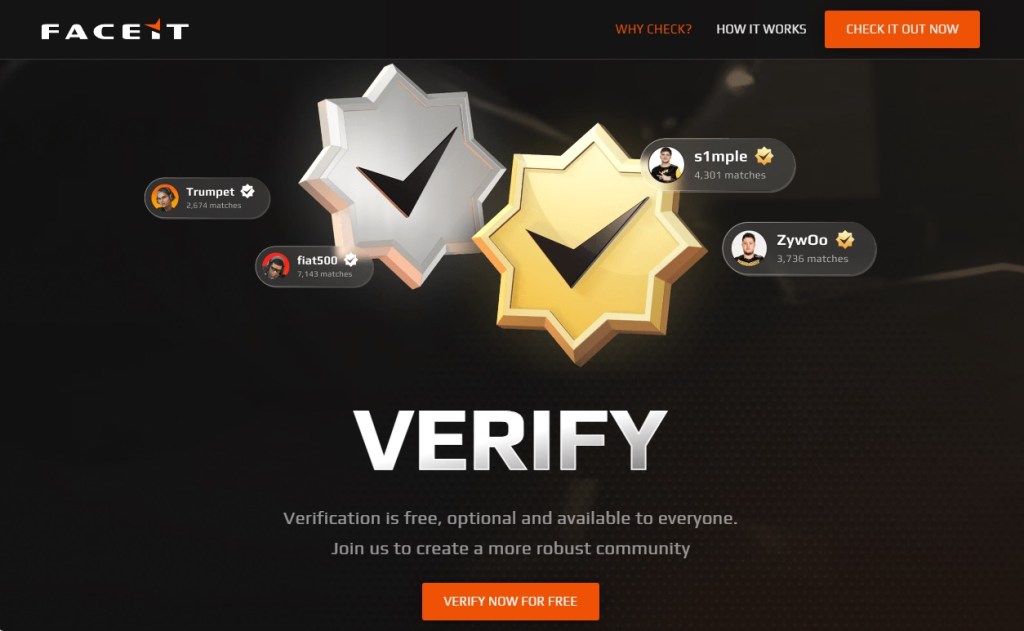
The page claims FACEIT is offering free, optional identity verification to help build a more trusted community. It’s polished, uses the correct branding, and even includes working links to FACEIT’s real blog and support pages. Everything about it is designed to make you think you’re on a genuine FACEIT website, but you’re not.
Instead of using the official faceit.com domain, the scammers use lookalike addresses such as:
faceit-discord.comfaceit-clubs-verify.comfaceit-verification-clubs.comThe extra words like “verification” or “discord,” are designed to make these addresses look legitimate at a glance, but they’re sites that are controlled by cybercriminals.
Many of these domains are only days or even hours old. Scammers constantly register new ones, knowing they’ll likely be blocked eventually. That’s why a site not being flagged as dangerous doesn’t mean it’s safe.
There are small clues, though. In one example, the page listed both “Copyright 2024” and “Copyright 2025.” Legitimate companies rarely make mistakes like that, but scam sites often do.
After the verification pitch, the page claims there’s a problem with your CS2 account and asks you to update your information to prove you’re not a cheater or using a smurf account.
Here’s the clever part. The QR code appears blurry and difficult to scan. Researchers believe that’s intentional. After a few failed attempts, many users are likely to give up and click the easier-looking “Sign in through Steam” button instead.
The broken QR code is the nudge that guides victims toward the part of the page where the real theft happens.
When users eventually give up on the QR code and click the button, a Steam login window appears. It looks convincing, complete with the Steam logo, login fields, and what appears to be a steamcommunity.com address bar.
But the window is fake.
Instead of opening a real Steam login page, the scammers display a convincing copy inside the website itself. Security researchers call this a Browser-in-the-Browser attack. The fake window looks and behaves like a genuine browser pop-up, but the address bar is just part of the image.
Anything entered into the form goes straight to the criminals. If the page also asks for a Steam Guard code, that gets stolen too, allowing attackers to access the account. Some victims are then tricked into “protecting” their items by transferring them to a friend or backup account, when they’re actually sending them directly to the scammers.
A few simple habits can stop this scam:
faceit.com. Be wary of lookalike domains such as faceit-discord.com or faceit-clubs-verify.com. Remember: a login window inside a webpage can fake its own address bar. Trust the one at the top of your browser, not the one inside the page.Change your Steam password immediately, make sure Steam Guard is enabled, and sign out of all other devices. Check your Steam API key settings and remove any key you don’t recognize. Change the password anywhere else you reused it and review your account for unauthorized trades or purchases.
This scam works because it doesn’t look like a scam. The branding is convincing, the story makes sense, and even the Steam login window appears legitimate.
Most people know to check the address bar before entering a password. Browser-in-the-Browser attacks are designed to defeat that habit. Because the fake Steam window is built into the page itself, the criminals can make its address bar say whatever they want, including steamcommunity.com.
The safest approach is to be suspicious of any login window that appears inside another website. If you’re unsure, close the page and sign in to Steam the way you normally would, through the official app or by typing the address yourself.
That small pause, that refusal to take the convenient shortcut a page is pushing you toward, is all it takes to keep your account yours.
Stop threats before they can do any harm.
Malwarebytes Browser Guard blocks phishing pages and malicious sites automatically. Free, one click to install. Add it to your browser →
Online gamers should watch out for a convincing scam that aims to steal your Steam account.
The scam uses fake FACEIT verification pages that look legitimate, complete with official branding, working links, and what appears to be a real Steam login window. By the time it asks for your password, many victims are convinced they’re interacting with a genuine service.
The goal is to steal your Steam account.
If you’re not a competitive gamer, FACEIT might not mean anything to you. But to millions of people, it’s a big deal, and that makes it a target for impersonation by cybercriminals.
FACEIT is one of the largest competitive gaming platforms for Counter-Strike 2 (CS2). Millions of players use it for ranked matches, tournaments, leagues, and advanced anti-cheat protections.
To use FACEIT, players typically connect their Steam platform accounts, which are valuable for scammers.
A stolen Steam account can contain:
Once criminals gain access, they can steal items, scam friends, or sell the account on criminal marketplaces.
Because FACEIT connects to Steam, a fake “FACEIT verification” page is an easy way to trick people. Victims think they’re updating their account, but attackers are really trying to steal Steam accounts that may contain valuable games, skins, and wallet funds. Gamers are especially vulnerable because they’re used to linking accounts and following verification steps, and may act quickly if they think their access to a game is at risk.
The attack starts with a website that looks like an official FACEIT page. The scam pages are likely distributed through the same channels gamers use every day: community forums, chat servers, social media posts, and direct messages.
The page claims FACEIT is offering free, optional identity verification to help build a more trusted community. It’s polished, uses the correct branding, and even includes working links to FACEIT’s real blog and support pages. Everything about it is designed to make you think you’re on a genuine FACEIT website, but you’re not.
Instead of using the official faceit.com domain, the scammers use lookalike addresses such as:
faceit-discord.comfaceit-clubs-verify.comfaceit-verification-clubs.comThe extra words like “verification” or “discord,” are designed to make these addresses look legitimate at a glance, but they’re sites that are controlled by cybercriminals.
Many of these domains are only days or even hours old. Scammers constantly register new ones, knowing they’ll likely be blocked eventually. That’s why a site not being flagged as dangerous doesn’t mean it’s safe.
There are small clues, though. In one example, the page listed both “Copyright 2024” and “Copyright 2025.” Legitimate companies rarely make mistakes like that, but scam sites often do.
After the verification pitch, the page claims there’s a problem with your CS2 account and asks you to update your information to prove you’re not a cheater or using a smurf account.
Here’s the clever part. The QR code appears blurry and difficult to scan. Researchers believe that’s intentional. After a few failed attempts, many users are likely to give up and click the easier-looking “Sign in through Steam” button instead.
The broken QR code is the nudge that guides victims toward the part of the page where the real theft happens.
When users eventually give up on the QR code and click the button, a Steam login window appears. It looks convincing, complete with the Steam logo, login fields, and what appears to be a steamcommunity.com address bar.
But the window is fake.
Instead of opening a real Steam login page, the scammers display a convincing copy inside the website itself. Security researchers call this a Browser-in-the-Browser attack. The fake window looks and behaves like a genuine browser pop-up, but the address bar is just part of the image.
Anything entered into the form goes straight to the criminals. If the page also asks for a Steam Guard code, that gets stolen too, allowing attackers to access the account. Some victims are then tricked into “protecting” their items by transferring them to a friend or backup account, when they’re actually sending them directly to the scammers.
A few simple habits can stop this scam:
faceit.com. Be wary of lookalike domains such as faceit-discord.com or faceit-clubs-verify.com. Remember: a login window inside a webpage can fake its own address bar. Trust the one at the top of your browser, not the one inside the page.Change your Steam password immediately, make sure Steam Guard is enabled, and sign out of all other devices. Check your Steam API key settings and remove any key you don’t recognize. Change the password anywhere else you reused it and review your account for unauthorized trades or purchases.
This scam works because it doesn’t look like a scam. The branding is convincing, the story makes sense, and even the Steam login window appears legitimate.
Most people know to check the address bar before entering a password. Browser-in-the-Browser attacks are designed to defeat that habit. Because the fake Steam window is built into the page itself, the criminals can make its address bar say whatever they want, including steamcommunity.com.
The safest approach is to be suspicious of any login window that appears inside another website. If you’re unsure, close the page and sign in to Steam the way you normally would, through the official app or by typing the address yourself.
That small pause, that refusal to take the convenient shortcut a page is pushing you toward, is all it takes to keep your account yours.
Stop threats before they can do any harm.
Malwarebytes Browser Guard blocks phishing pages and malicious sites automatically. Free, one click to install. Add it to your browser →
Short-form video platforms like TikTok and Instagram Reels have become the latest way cybercriminals spread malware.
We’ve already seen attackers move away from traditional phishing emails and toward tactics that trick people into installing malware themselves. Now they’re being lured with slick social media videos that promise free Spotify Premium, free Windows activation, or free Microsoft Office, but instead leave people with infostealers on their Windows devices.
Researchers at ReversingLabs uncovered two active campaigns that use short videos to trick users into running dangerous PowerShell commands or visiting malicious download sites. Similar campaigns have been reported by other researchers and national cybersecurity agencies, suggesting a growing trend: Cybercriminals are learning how to use social media algorithms just as effectively as marketers.
In true social media fashion, the videos on platforms like TikTok and Instagram Reels claim to solve a problem you didn’t know you had. The catch is that following the instructions delivers malware to your device.
The first campaign looks deceptively professional.
Accounts with names like “windows.tips” or “windows.insights” use Windows-style branding and post polished tutorial videos that resemble genuine tech support content. The videos are tagged with Windows and Office-related keywords so they appear alongside legitimate troubleshooting and tips content.
The videos promise to unlock Spotify Premium, Microsoft Office, or Windows for free. Viewers are then guided through step-by-step instructions that include opening Powershell, a legitimate Windows admin tool, and pasting in commands. Those commands download and run malware, much like the ClickFix scams we’ve covered before.
The malware was identified as Vidar, an infostealer designed to steal sensitive informtion from infected devices. Vidar commonly targets:
The stolen information is then sent back to servers controlled by the attackers.
Research into similar TikTok-based attacks shows these scripts commonly add exclusions to Windows Defender, making it harder for security software to detect future malicious activity.
Fortunately, there are a few simple ways to protect yourself:
Pro tip: If you’re unsure whether a video, message, or website is legitimate, you can ask Malwarebytes Scam Guard about it. It can help identify suspicious content and advise you on what to do next.
Image courtesy of ReversingLabs
We don’t just report on threats—we remove them
Cybersecurity risks should never spread beyond a headline. Keep threats off your devices by downloading Malwarebytes today.