 Login

Studying Fraudulent North Korean IT Workers
Researchers set up a fake start-up company to study fraudulent North Korean IT workers.

Researchers set up a fake start-up company to study fraudulent North Korean IT workers.
 Table Of Contents

More than 3.7 million fraudulent online accounts removed. Twenty-eight arrests across Ghana and Nigeria. More than $11 million in potentially freezable funds identified. And 117 human trafficking victims identified.
These were among the results of Joint Disruption Week, an international operation targeting criminal networks responsible for online fraud, including cryptocurrency investment scams, impersonation schemes, and financial extortion.
“Transnational criminal scam networks operating from West Africa suffered major disruptions last week during a coordinated international ‘Joint Disruption Week,’ an effort that produced arrests, seizures, and the largest-ever takedown of fraudulent social media accounts linked to scam centers in the region.”
Department of Justice
Hosted by the UK’s National Crime Agency (NCA) in London during the week beginning October 6, 2026, Joint Disruption Week brought together investigators from the DOJ, FBI, U.S. Secret Service, Homeland Security Investigations, and international law enforcement agencies, alongside private-sector organizations including Flashpoint.
Throughout the week, participants exchanged real-time intelligence and developed investigative leads to support enforcement actions in Ghana and Nigeria, as well as the disruption of online accounts and infrastructure used by scam networks.
The operation targeted criminal organizations whose activities extend across borders and online platforms. According to the DOJ, scam centers operating in West Africa share characteristics with those previously identified in Southeast Asia, including organized recruitment, training in social engineering techniques, and coordinated fraud campaigns targeting victims internationally. Some operations also involve human trafficking, with individuals coerced into participating in fraudulent activities.
By bringing together law enforcement and private-sector capabilities, Joint Disruption Week targeted both the infrastructure used to perpetrate fraud and the individuals behind these schemes.
The coordinated effort produced results across criminal investigations, financial intelligence, and online infrastructure disruption.
According to the DOJ:
The figures illustrate the reach of these operations. Millions of accounts can support criminal activity across multiple platforms, while the individuals directing those activities may be operating thousands of miles from their intended victims.
The arrests and account removals represent different aspects of the same challenge: identifying the individuals behind criminal operations while disrupting the infrastructure they use to reach victims.
Online scam networks can operate across social media platforms, messaging services, and financial systems, with evidence of criminal activity spread across multiple organizations and jurisdictions. Investigations often depend on connecting information from these different sources to identify the actors involved and the infrastructure supporting their operations.
During Joint Disruption Week, private-sector partners contributed by removing fraudulent accounts, identifying potentially recoverable funds, and sharing investigative leads with law enforcement.
Flashpoint was among the organizations specifically recognized by the DOJ for participating in the operation, alongside Meta, Microsoft, Google, OpenAI, Coinbase, Binance, Chainalysis, Elliptic, TRM Labs, and others. For threat intelligence teams, operations like this highlight the value of identifying criminal actors, understanding how their operations are structured, and connecting activity across disparate sources to support investigative action.
“These scam networks operate like businesses, investing in infrastructure, recruiting people, and developing increasingly sophisticated ways to defraud victims at scale. To meaningfully disrupt them, we have to go after the economics of their operations, making it more costly and difficult to recruit, reach victims, and move illicit funds. The more pressure we put on those operations, the harder it becomes for the criminals behind them to sustain and expand their activities.”
Josh LefkowitzCEO, Flashpoint
Together, the arrests, account removals, and financial investigations demonstrate how coordinated efforts can target multiple components of criminal operations, from the infrastructure used to perpetrate fraud to the individuals responsible.
Joint Disruption Week marked the first coordinated international operation focused specifically on West African scam networks, according to the DOJ.
The arrests, infrastructure disruptions, and investigative leads generated during the operation represent progress against criminal organizations responsible for large-scale financial fraud and human exploitation.
Flashpoint continues to support efforts to identify and disrupt criminal activity through primary source intelligence that helps investigators understand emerging threats and the networks behind them.
For additional information on the operation and its results, read the full Department of Justice announcement.
The post Inside Joint Disruption Week: 28 Arrests and 3.7 Million Scam Accounts Removed appeared first on Flashpoint.
An investigation into a threat actor bypassing AI safety controls to coordinate credential theft, VoIP fraud planning, and database exfiltration.
The post “Next Exploit Opportunities”: How a Threat Actor Used AI to Help Plan and Execute Multiple Types of Cybercrime Activities appeared first on Unit 42.

Your phone rings, you pick up and say hello. On the other end: total silence. No one answers, and the call abruptly disconnects. If you don’t already use spam call blockers, you’ve almost certainly run into this situation before.
In most cases, these are scam calls. Today, we explain why these calls happen, what the callers want from you, and how to protect yourself. Most importantly, we’ll look at whether you even need to bother protecting yourself against them in the first place.
It’s not just scammers on the line — robots, legitimate call center operators, and ordinary folks make these calls too. Let’s break down each type of caller — ordered from best-case to worst-case scenario for your security.
The most harmless scenario is that an actual person called you, but their microphone is acting up. Maybe they accidentally muted themselves with their ear, or their smartphone connected to a Bluetooth headset, speaker, or car system that isn’t capturing their voice. Carrier glitches can also mute one side of a call. The caller might have no idea there’s a problem — as far as they know, they are speaking, but no one can hear them. In cases like this, you usually recognize the incoming phone number.
If the call comes from an unknown number, there’s still no need to panic — though the list of those who might be calling gets much longer.
One legitimate possibility is a call center agent who simply didn’t pick up or connect their headset in time. Call center systems are designed to dial numbers faster than agents can wrap up their calls. The system tried to route the call to a human, but no reps were available. That’s why you sometimes have to wait a few seconds before hearing a single word, or why you might hear ringing tones as if you were the one making the call.
Silence on the line is a common sign of robocalls. Robots test whether a phone number is active and, if it is, pass it along to a human — meaning a real sales rep (or scammer) will call you back in the next few days. It’s worth noting that scammers aren’t the only ones making these pinging calls. Legitimate call centers use the exact same tools to reduce the workload on their live agents.
An AI agent could also be behind the silent call. To the person answering, there’s no practical difference: the call looks identical to one made by a standard bot. However, AI can do more than just auto-dial numbers — it can analyze your response and use that data to decide whether your number is active and ready to be handed off to a live person for follow-up.
Now we get to the real threat. Perhaps one of the most dangerous and unpleasant sources of silent phone calls is a scammer. A quick, silent call like this can actually be the groundwork for a long, elaborate attack with cover stories about loans, government agencies, other fraudsters, even law enforcement.
Debt collectors might also be calling and staying quiet. Your number could end up on their radar if you, your family, or close contacts have outstanding debts. In these cases, a silent call is often used as a tactic for psychological pressure.
A similar technique is used in stalking. While silent calls cause no direct harm on their own, they can be leveraged to induce anxiety, create a feeling of being constantly watched, and cause ongoing emotional distress.
When you pick up, you likely respond out of habit with a quick “Hello?” or “Hi there.” That’s all it takes for the other party to gather a wealth of data. While this information used to be difficult to process, the rise of artificial intelligence has made the task significantly easier. Let’s look at what someone can learn about you from just one spoken word:
Back to the “why do they call and stay silent”, the main reason is to harvest biometric data. Just a few seconds of recorded audio can help cybercriminals create a voice deepfake. While one or two words might not yield a convincing clone on their own, attackers can stitch together recordings from multiple silent calls to build a believable replica.
This technology is already being used in real-world scams. Impersonating a relative, colleague, or boss, fraudsters can urgently ask you to send them money, to share a two-factor authentication code for government services, or to complete some other seemingly innocuous request. The more realistic the deepfake sounds, the harder it is to spot the scam — especially when backed by a convincing backstory.
If you answer a call, say a few words, and hang up, there’s no need to panic. However, that brief interaction can confirm to attackers that your number is active and that you’ll answer calls from unknown numbers. As a result, your phone number could end up on target lists for future spam or scam campaigns. That said, it’s important to remember that a single silent call poses no immediate security threat.
Here are a few tips to help you stay calm and avoid falling for scam tactics if those silent calls are becoming a problem:
Further reading on scammers and deepfakes:




This week on the Lock and Code podcast…
Twenty years ago, a British mathematician named Clive Humby popularized a phrase that came to describe data’s relationship with the entire global economy: “Data is the new oil.”
Pithy as the phrase sounds, it is undeniably true.
Data steers decisions at businesses of every size. Data created entirely new industries built around its capture. And, for a select number of companies, data has produced billions—if not trillions—of dollars in value.
So how is it that, on the dark web, your stolen identity can be purchased for just 95 cents?
That’s what a Malwarebytes researcher found last month after spending 48 hours inside the dark web to investigate cybercrime. Across a variety of forums and directories, he found subscription plans for malware that steals information once implanted on a device. He found guides for deploying social engineering scams. He found people selling their services to build fake websites that trick people into handing over their usernames and passwords. And he found one of the dark web’s most traded commodities—personal data, packaged together about individual people, to help a cybercriminal commit identity fraud.
These packages are called “fullz.” For victims in the United States, a fullz contains a full name, Social Security Number, date of birth, address, and other personal details. That is enough, on its own, for a cybercriminal to potentially open a bogus line of credit, file a fake tax return, access financial accounts, or obtain medical services under someone else’s name.
As we wrote on Malwarebytes Labs:
“For less than the cost of a cup of coffee, a cybercriminal can buy enough information to devastate someone’s financial life.”
It’s the kind of risk that could scare anyone, especially considering the scale behind it. In just the first six months of 2026, Malwarebytes found more than 7,500 compromised data sets on the dark web containing more than 8.4 billion records.
And yet, even today, cybersecurity professionals still get asked why anyone should bother protecting their data.
The public, understandably, are exhausted. With data breaches happening every week—if not every day—cybersecurity can start to feel pointless. With young people unable to build financial security, they start believing that they have nothing worth stealing. And with Big Tech already collecting our every movement, behavior, click, and concern, people understandably feel powerless to fight any kind of data abuse, be it corporate or criminal.
So today’s episode approaches the question from a different direction. This isn’t about why you should protect yourself—plenty of company websites will tell you that, and most of them rely on fear. This is about why hackers want your data in the first place.
Today, on the Lock and Code podcast, host David Ruiz explains how cybercriminals turn a single repeated password into account takeover, how a screenshot of your house from Google Maps became a tool in extortion emails, and why the most benign information about you—an address, an age, one public photo—is often the most useful data a stranger can buy.
Tune in today to listen to the full episode.
Show notes and credits:
Intro Music: “Spellbound” by Kevin MacLeod (incompetech.com)
Licensed under Creative Commons: By Attribution 4.0 License
http://creativecommons.org/licenses/by/4.0/
Outro Music: “Good God” by Wowa (unminus.com)
Listen up—Malwarebytes doesn’t just talk cybersecurity, we provide it.
Protect yourself from online attacks that threaten your identity, your files, your system, and your financial well-being with our exclusive offer for Malwarebytes Premium for Lock and Code listeners.
This week on the Lock and Code podcast…
Twenty years ago, a British mathematician named Clive Humby popularized a phrase that came to describe data’s relationship with the entire global economy: “Data is the new oil.”
Pithy as the phrase sounds, it is undeniably true.
Data steers decisions at businesses of every size. Data created entirely new industries built around its capture. And, for a select number of companies, data has produced billions—if not trillions—of dollars in value.
So how is it that, on the dark web, your stolen identity can be purchased for just 95 cents?
That’s what a Malwarebytes researcher found last month after spending 48 hours inside the dark web to investigate cybercrime. Across a variety of forums and directories, he found subscription plans for malware that steals information once implanted on a device. He found guides for deploying social engineering scams. He found people selling their services to build fake websites that trick people into handing over their usernames and passwords. And he found one of the dark web’s most traded commodities—personal data, packaged together about individual people, to help a cybercriminal commit identity fraud.
These packages are called “fullz.” For victims in the United States, a fullz contains a full name, Social Security Number, date of birth, address, and other personal details. That is enough, on its own, for a cybercriminal to potentially open a bogus line of credit, file a fake tax return, access financial accounts, or obtain medical services under someone else’s name.
As we wrote on Malwarebytes Labs:
“For less than the cost of a cup of coffee, a cybercriminal can buy enough information to devastate someone’s financial life.”
It’s the kind of risk that could scare anyone, especially considering the scale behind it. In just the first six months of 2026, Malwarebytes found more than 7,500 compromised data sets on the dark web containing more than 8.4 billion records.
And yet, even today, cybersecurity professionals still get asked why anyone should bother protecting their data.
The public, understandably, are exhausted. With data breaches happening every week—if not every day—cybersecurity can start to feel pointless. With young people unable to build financial security, they start believing that they have nothing worth stealing. And with Big Tech already collecting our every movement, behavior, click, and concern, people understandably feel powerless to fight any kind of data abuse, be it corporate or criminal.
So today’s episode approaches the question from a different direction. This isn’t about why you should protect yourself—plenty of company websites will tell you that, and most of them rely on fear. This is about why hackers want your data in the first place.
Today, on the Lock and Code podcast, host David Ruiz explains how cybercriminals turn a single repeated password into account takeover, how a screenshot of your house from Google Maps became a tool in extortion emails, and why the most benign information about you—an address, an age, one public photo—is often the most useful data a stranger can buy.
Tune in today to listen to the full episode.
Show notes and credits:
Intro Music: “Spellbound” by Kevin MacLeod (incompetech.com)
Licensed under Creative Commons: By Attribution 4.0 License
http://creativecommons.org/licenses/by/4.0/
Outro Music: “Good God” by Wowa (unminus.com)
Listen up—Malwarebytes doesn’t just talk cybersecurity, we provide it.
Protect yourself from online attacks that threaten your identity, your files, your system, and your financial well-being with our exclusive offer for Malwarebytes Premium for Lock and Code listeners.
The World Cup attracts a great many fans — but also a great many scammers. While millions of fans tune in to watch the matches, cybercriminals are hard at work trying to get at their money and personal data. In fact, we’ve already flagged more than 336 fake websites designed to look exactly like the official World Cup page! As the biggest sporting event of the year heats up, here are the top red flags you need to watch out for.
Scoring a seat at WC26 has turned into quite the mission. Soccer fans are furious over ticket prices, which have officially been dubbed the highest in World Cup history. On top of lodging and travel costs, the situation is made even worse by America’s stringent immigration policies — where referees, team staff, and even players have faced major visa and entry headaches. But fans still want to watch the games, and that’s exactly where fake streaming platforms step in to “help”.
Here’s how the scam plays out: cybercriminals set up fake websites promising free access to World Cup match streams. But the moment you click Watch Now, you’re prompted to sign up and then pay for “lifetime access” to the entire tournament. In the example below, they’re asking for cryptocurrency — which is still a bit unusual, since scammers typically prefer good old-fashioned bank cards.

An example of a fake video streaming website requiring users to register and pay with cryptocurrency to watch all World Cup 2026 matches
Fans who are desperate to catch their favorite teams live risk losing not just their money, but also their personal data, which hackers can later weaponize in targeted phishing attacks.
Match result predictions and sports betting always skyrocket in popularity during the World Cup, and scammers waste no time cashing in on the trend. And behind the flashy slogans lie classic scam tactics.
Take this beautifully designed Spanish-language website. To sign up, it demands a massive amount of personal information, including your full name, national ID number, email address, and phone number — and, of course, it asks you to create a password. If a victim uses the exact same password for multiple accounts, they’re essentially handing the keys to their digital life over to cybercriminals.
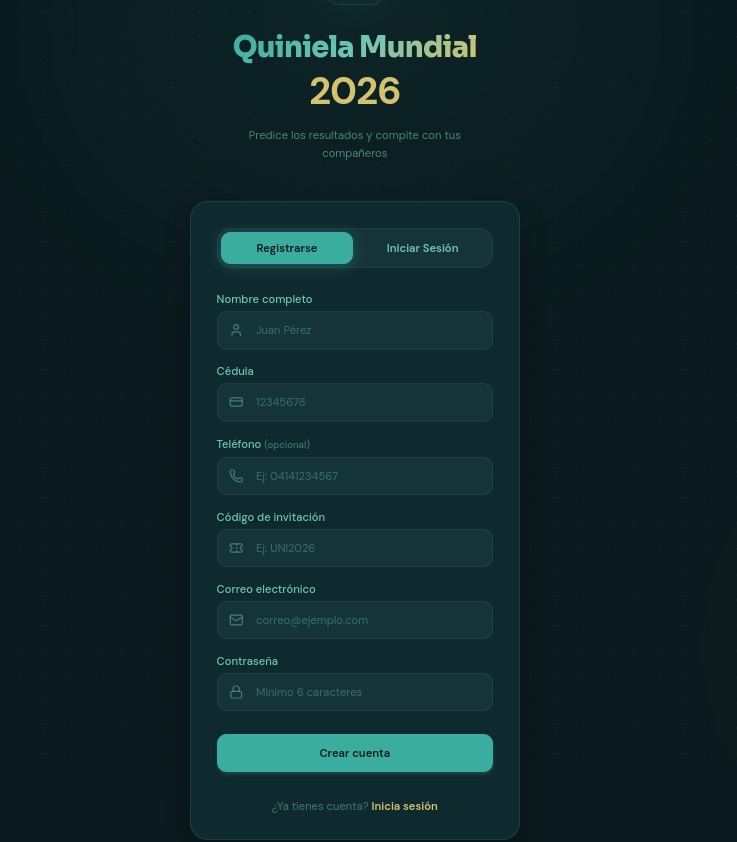
To guess match outcomes on this site, you have to hand over way too much personal info — everything short of biometrics
Another site, specifically targeting users in Colombia, turned the sign-up process into a paid ordeal — and it features every trick in the book.
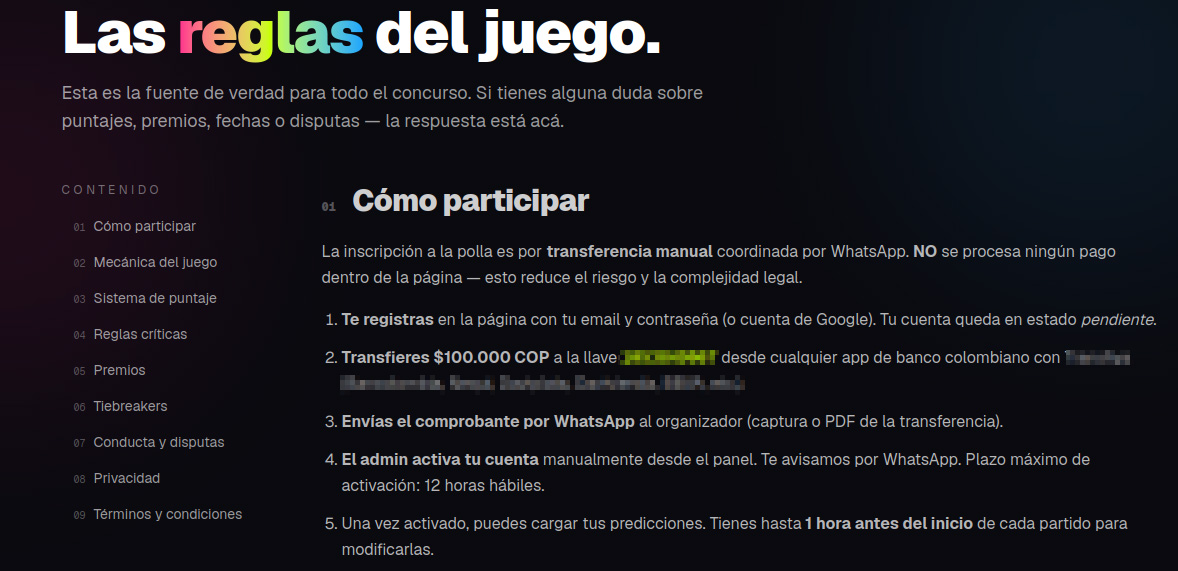
These scammers built a whole website, but they do all their business over WhatsApp. That’s a red flag!
In many countries — including Colombia — sports betting is strictly regulated. Only a handful of licensed operators are legally allowed to run these sites, and users are required by law to verify their identity. Because of this, these shady workarounds can look tempting to people who love to gamble but don’t want to — or can’t — go through the official verification process.
Unfortunately, the scammers always win in this scenario. They walk away with your initial deposit and every single bet you place on their site. At the end of the day, their only real goal is to drain their victims’ wallets for as much as they possibly can.
The World Cup isn’t just about the matches; it also drives record-breaking sales of collectible merchandise — stickers, scarves, team jerseys, official match balls, and more. Naturally, plenty of scammers are eager to get a piece of that action.
Take a look at this website offering “exclusive, limited-edition” stickers and albums. Notice anything suspicious?

Talk about a steal! Too bad the whole website is a scam
Check out those prices: everything is heavily discounted, even though the tournament is in full swing. All it takes is a quick price check against the real deal to spot the trap. In the screenshot above, the scammers are charging 67 euros for a sticker collection. On actual online marketplaces, that exact same set goes for at least twice as much, and on the official Panini website, it’s three times the price.
Fake websites mimicking popular sporting goods stores also offer to sell you shin guards, socks, jerseys, and any other gear. Of course, you’ll never see the merchandise, and you’ll lose both your money and your bank card details.

When they’ve absolutely no intention of delivering any products, they can easily offer massive discounts and free shipping
Deals that seem too good to be true are one of the biggest red flags. To make matters worse, with the help of AI, fake websites now look just as professional as the real ones, making them harder than ever to spot. That’s why we recommend installing our security suite before you start shopping online. It blocks phishing sites in real time and uses the Safe Money feature to keep your financial data secure.
Another attack strategy involves spam campaigns centered around the World Cup. In one email, our experts uncovered an ad for a soccer analytics and betting-tips service. It uses the classic high-pressure playbook: “ONLY 10 SPOTS AVAILABLE” — so hurry up before they run out! Naturally, access comes with a price tag: AU$200.

Spammers hurrying the victim to make a decision as quickly as possible
This scheme targets fans who are into sports betting, and paying for these types of services usually ends one of two ways for them: they either lose their money with zero guarantee of getting actual predictions, or get sucked into an even deeper, multi-step financial trap.
Across all these scenarios, the World Cup is just another convenient pretext for cybercriminals. Once the tournament wraps up, they’ll most certainly pivot back to their usual tricks — like fake job offers or Telegram phishing scams — until the next Olympics or soccer tournament rolls around and they switch right back to sport.
Our research consistently shows that online fraud has evolved into a massive illegal enterprise. You aren’t just up against lone scammers anymore; you’re dealing with large criminal networks. When it comes to defense, the best approach is a proactive one. By installing Kaspersky Premium, you can safeguard all your devices from malware, phishing, spam, and malicious or lookalike websites. Plus, the included Kaspersky Password Manager will generate unique complex passwords, securely store your sensitive data — like documents and bank cards — and stop you from auto-filling your credentials on fake sites.
What other ruses do scammers use to make a quick buck? Check out our other posts:




Our new guide explores how infostealers are fueling modern identity-based attacks and how organizations can build a proactive defense before stolen access is weaponized.
 Table Of Contents
A publicly exposed database surfaced in early 2026 containing more than 149 million stolen login credentials. The records were not tied to a single breach or organization. Instead, they had been quietly collected over time from devices infected with information-stealing malware, with each record containing usernames, passwords, session data, and the context needed to use them.
Unlike traditional breach dumps, this data was structured, searchable, and immediately actionable. Credentials were mapped to specific services, session artifacts reflected active logins, and much of the information was recent enough to enable direct access without triggering traditional security controls.
This incident reflects a broader shift in the threat landscape.
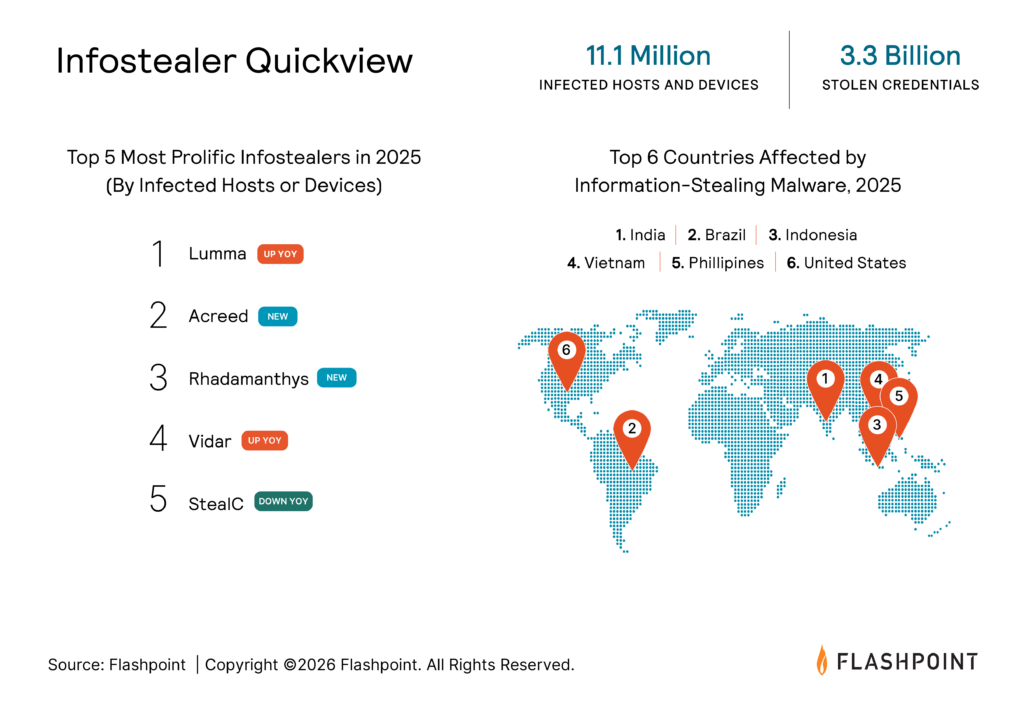
More than 11.1 million devices were infected with infostealers last year, fueling a supply of over 3.3 billion stolen credentials, session cookies, cloud tokens, and other forms of identity data now circulating across illicit markets.
For security teams, the challenge is no longer simply detecting a breach after it occurs. It is understanding when access may already exist — where compromised credentials are circulating, how they are being used, and how quickly they can be weaponized.
That’s why Flashpoint created Identity Is the New Attack Surface: A Guide to Infostealers and Proactive Defense.
Drawing on Flashpoint’s Primary Source Collection (PSC) and analyst-driven intelligence, this guide helps IT, Threat Intelligence, Fraud, and HUNT teams understand how infostealers operate, how stolen identity data fuels real-world attacks, and how organizations can move from reactive response to proactive defense.
The guide explores:
For years, security teams focused on vulnerabilities, malware delivery, and network intrusion as the primary paths to compromise. Increasingly, however, threat actors are taking a different
Modern infostealers such as Lumma, StealC, Vidar, Acreed, and Rhadamanthys provide attackers with something more valuable than initial access: usable identity. These malware families collect credentials, browser artifacts, session cookies, application data, and host metadata that help threat actors understand how a victim authenticates and what systems they can access.
A single infected device can expose credentials, browser artifacts, session cookies, application data, host metadata, and access to enterprise SaaS platforms. Together, these artifacts create a detailed profile of how a user authenticates, what systems they access, and how those systems trust that identity.
This is what makes infostealer data so valuable.
“For years, organizations have invested heavily in detecting malware, blocking exploits, and hardening infrastructure. Meanwhile, attackers have increasingly shifted to a simpler strategy: logging in with valid identities.
Infostealers have fundamentally changed the economics of access. Threat actors no longer need to compromise a network directly when billions of credentials, session cookies, and authentication artifacts are already circulating in underground ecosystems. The challenge for defenders has risen from preventing compromise to identifying where access already exists and how quickly it can be weaponized.”
Ian Gray, Vice President of Intelligence at Flashpoint
Identity data is inherently reusable. A stolen credential can be tested across multiple services. A session cookie can potentially allow attackers to hijack authenticated sessions. Browser and host metadata can help threat actors recreate a victim’s environment and bypass security controls designed to detect suspicious logins.
What begins as a single infection can quickly evolve into access across multiple systems, applications, and organizations.
Identity-based attacks occur when threat actors use legitimate credentials, session cookies, authentication tokens, or other identity artifacts to gain access to systems and applications. Rather than exploiting a vulnerability or deploying malware inside a target environment, attackers authenticate as trusted users using stolen identity data.
This shift is one of the primary reasons infostealers have become so valuable. Modern infostealer logs often contain far more than usernames and passwords. They may also include browser cookies, session information, host metadata, application data, and other artifacts that help attackers understand how a user authenticates and what systems they can access. When combined, this information enables account takeover, fraud, lateral movement, and other forms of identity-based abuse.
The way threat actors operationalize stolen data is evolving just as rapidly as the data itself.
Historically, attackers often had to manually review stolen credentials and determine which accounts were worth pursuing. Today, that process is increasingly automated.
Infostealer logs can be aggregated, tested, and prioritized at scale, allowing threat actors to rapidly identify valid access across enterprise systems, SaaS platforms, VPNs, and cloud environments.
Flashpoint identifies this as a hybrid threat: the convergence of large-scale identity compromise and automated exploitation.
Once valid access is identified, attackers can move quickly. Credentials may be reused across services. Session data can be leveraged for account takeover. Access can be sold to ransomware operators, fraud actors, or other criminal groups. In many cases, exposure itself becomes part of the attack lifecycle rather than merely a precursor to it.
The result is a threat landscape where stolen identity data is not simply stored and sold. It is continuously tested, validated, reused, and operationalized.
For defenders, prevention remains important. But prevention alone is no longer enough.
Organizations must also be able to identify when credentials, session cookies, and other identity artifacts have already been exposed and are circulating within underground ecosystems.
The earliest opportunity to intervene is often after data has been exfiltrated but before attackers have successfully operationalized it.
Achieving that visibility requires more than traditional breach feeds or aggregated datasets.
Flashpoint’s Primary Source Collection approach provides direct visibility into the forums, marketplaces, Telegram channels, malware repositories, and illicit communities where infostealer activity originates. Rather than relying solely on recycled breach data, Flashpoint continuously collects from the environments where stolen identity data is first shared, sold, and operationalized.
However, collection alone is not enough.
Raw infostealer logs are noisy, fragmented, and difficult to operationalize at scale. Flashpoint transforms these logs into structured intelligence through a multi-stage workflow that includes:
This process helps defenders understand not only what was exposed, but who may be affected, how exposure occurred, what systems may be at risk, and how quickly action is required.
The rise of infostealers has fundamentally changed how organizations should think about attack surface management.
The attack surface is no longer limited to infrastructure, endpoints, or internet-facing applications. It now includes the digital identities of employees, partners, vendors, and customers.
Security teams need visibility into the identity layer itself — understanding where exposure exists, how attackers are leveraging stolen data, and what actions should be taken before access is exploited.
By combining direct visibility into underground ecosystems with structured, actionable intelligence, organizations can identify compromised accounts earlier, uncover infection trends, prioritize response efforts, and reduce the likelihood of downstream compromise.
Download Identity Is the New Attack Surface: A Guide to Infostealers and Proactive Defense to learn how your organization can build a proactive defense program across the identity layer.
According to Flashpoint research:
What is an infostealer?
An infostealer is a type of malware designed to collect sensitive information from an infected device. Depending on the strain, this can include usernames and passwords, browser cookies, session tokens, saved payment information, cryptocurrency wallets, system metadata, and other identity-related artifacts.
How do infostealers work?
Infostealers infect a victim’s device and collect information such as credentials, browser data, session cookies, autofill information, cryptocurrency wallet data, and system metadata. The stolen information is packaged into files known as infostealer logs, which can then be sold, shared, or operationalized by threat actors.
What information can infostealers steal?
Depending on the malware family, infostealers can collect usernames and passwords, session cookies, authentication tokens, browser history, saved payment information, cryptocurrency wallet data, system information, installed applications, and other identity-related artifacts. The goal is to provide attackers with enough information to access accounts and impersonate legitimate users.
What are the most common infostealers?
The infostealer ecosystem changes rapidly, but Flashpoint analysts currently track strains such as Lumma (also known as LummaC2/Remus), StealC, Vidar, Acreed, and Rhadamanthys among the most prominent malware families driving credential theft and identity-based attacks.
Why are infostealers so dangerous?
Infostealers provide attackers with more than credentials. Modern infostealer logs often contain the context needed to use stolen data, including session information, browser artifacts, and device metadata. This allows threat actors to perform account takeovers, move laterally within environments, and gain access to business-critical systems. According to Flashpoint’s 2026 Global Threat Intelligence Report, more than 11.1 million devices were infected with infostealers last year, contributing to a pool of over 3.3 billion stolen credentials, session cookies, cloud tokens, and other identity artifacts.
What is an infostealer log?
An infostealer log is a package of data collected from an infected device. Logs may contain credentials, cookies, browser data, application information, host metadata, and other artifacts that help attackers understand how a victim authenticates and what systems they can access.
Can infostealers bypass multi-factor authentication (MFA)?
In some cases, yes. While multifactor authentication remains a critical security control, stolen session cookies and authenticated session data can sometimes allow threat actors to hijack existing sessions without needing to complete the MFA process themselves. Flashpoint found that more than 4.2% of infostealer-exposed credentials in its dataset were associated with browser cookies, highlighting the growing importance of session-based risk.
How do threat actors obtain infostealer logs?
Infostealer logs are frequently bought and sold across illicit marketplaces, forums, Telegram channels, and other underground communities. Many are distributed through Malware-as-a-Service (MaaS) offerings that make infostealer capabilities accessible to a wide range of threat actors. Flashpoint analysts identified more than 30 unique infostealer strains actively offered for sale across underground ecosystems.
How can organizations detect credential exposure from infostealers?
Organizations can monitor underground sources where stolen data is shared and sold, identify exposed credentials associated with their domains, and investigate related artifacts such as cookies, host metadata, and malware attribution. The earlier exposure is identified, the greater the opportunity to remediate before attackers operationalize access. Flashpoint collects and parses some infostealer logs within one to two days of infection, helping organizations detect exposure closer to the point of compromise.
What should organizations do if employee credentials appear in an infostealer log?
Organizations should immediately assess the scope of exposure, reset affected credentials, invalidate active sessions, review authentication activity, investigate the infected device, and determine whether additional accounts or systems may have been impacted.
How is Flashpoint’s approach to infostealer intelligence different from traditional breach monitoring?
Many organizations rely on aggregated breach feeds or credential dumps that may be weeks or months old by the time they are discovered. Flashpoint’s Primary Source Collection (PSC) approach provides direct visibility into the forums, marketplaces, Telegram channels, and underground communities where stolen identity data is first shared, sold, and operationalized.
In addition to collecting raw infostealer logs, Flashpoint parses and enriches the data with context such as malware attribution, session cookies, host metadata, browser artifacts, and affected identities. Today, Flashpoint’s credential database contains more than 48 billion credentials, including over 1 billion tied to infostealer activity, providing organizations with actionable intelligence rather than raw exposure data.
The post Identity Is the New Attack Surface: How Infostealers Are Reshaping Enterprise Risk appeared first on Flashpoint.
What would you trade for a technology that can do almost anything? For many people, the answer is clear: Everything they thought they could trust.
In a few, short years, Artificial Intelligence (AI) tools have granted people unfettered access to easier writing, faster image generation, quicker coding, and near-instantaneous answers, advice, and information—advantages they value and want. But the same tools that can spruce up a dating profile or reimagine an old photograph can also manipulate the broader world online, and people are noticing.
According to new research from Malwarebytes, 88% of people said it’s becoming harder to tell what content online is genuinely human or real, with 84% saying that “convincing video evidence” no longer feels like proof. Further, 85% said it can be hard to tell scams apart from the real thing—a major uptick from the 66% who said the same thing last year.

These are the first signs of AI’s counterfeit world. Replete with fake websites, fake products, fake videos, fake pictures, fake voices, and even fake people, it is threatening to swallow the web.
The latest report from Malwarebytes, “Face value: How AI is reshaping trust, identity, and scams” exposes the hidden cost of AI on the public: an excess of fraud that is dismantling trust in reality and in one another.
The damage arrives in large moments and small, from the US parent who said they “received a voicemail that sounded exactly like my son’s voice, saying he was in trouble and needed money for legal fees,” to the two entirely unrelated respondents fooled by the same AI-generated video of rabbits bouncing on a trampoline, to the individual worried about “my grandfather showing me AI slop and he thought it was real.”
For this research, Malwarebytes surveyed 1,500 adults aged 18 and older across the US, UK, Austria, Germany, and Switzerland about their uses, feelings, and concerns regarding AI. The sample was equally split for gender with a spread of ages, geographical regions, and race groups, and weighted to provide a balanced view.
The complete findings can be found in the full report:
Here are some of the key takeaways and findings:
Defeat would be the wrong lesson to take from all this. It is true now that the internet requires assistance, but there are plenty of safe places to seek help.
While Malwarebytes works to provide new tools, we’d like to remind both the AI anxious and the eager about the first rule of the internet: Remember the human. People’s voices, bodies, choices, and agency belong to them and them alone.
As for every fake video, product, website, and image, understand that there’s help. No one needs to navigate an artificial internet alone. Whether through scam detection, identity protection, and simple awareness, people have more options than they may realize.
The company blocked over 1.1 billion accounts and $2.2 billion in potentially fraudulent transactions.
The post Apple Rejected 2 Million App Store Submissions in 2025 for Security and Fraud Prevention appeared first on SecurityWeek.

The primary goal for attackers in a phishing campaign is to bypass email security and trick the potential victim into revealing their data. To achieve this, scammers employ a wide range of tactics, from redirect links to QR codes. Additionally, they heavily rely on legitimate sources for malicious email campaigns. Specifically, we’ve recently observed an uptick in phishing attacks leveraging Amazon SES.
Amazon Simple Email Service (Amazon SES) is a cloud-based email platform designed for highly reliable transactional and marketing message delivery. It integrates seamlessly with other products in Amazon’s cloud ecosystem, AWS.
At first glance, it might seem like just another delivery channel for email phishing, but that isn’t the case. The insidious nature of Amazon SES attacks lies in the fact that attackers aren’t using suspicious or dangerous domains; instead, they are leveraging infrastructure that both users and security systems have grown to trust. These emails utilize SPF, DKIM, and DMARC authentication protocols, passing all standard provider checks, and almost always contain .amazonses.com in the Message-ID headers. Consequently, from a technical standpoint, every email sent via Amazon SES – even a phishing one – looks completely legitimate.
Phishing URLs can be masked with redirects: a user sees a link like amazonaws.com in the email and clicks it with confidence, only to be sent to a phishing site rather than a legitimate one. Amazon SES also allows for custom HTML templates, which attackers use to craft more convincing emails. Because this is legitimate infrastructure, the sender’s IP address won’t end up on reputation-based blocklists. Blocking it would restrict all incoming mail sent through Amazon SES. For major services, that kind of measure is ineffective, as it would significantly disrupt user workflows due to a massive number of false positives.
In most cases, attackers gain access to Amazon SES through leaked IAM (AWS Identity and Access Management) access keys. Developers frequently leave these keys exposed in public GitHub repositories, ENV files, Docker images, configuration backups, or even in publicly accessible S3 buckets. To hunt for these IAM keys, phishers use various tools, such as automated bots based on the open-source utility TruffleHog, which is designed for detecting leaked secrets. After verifying the key’s permissions and email sending limits, attackers are equipped to spread a massive volume of phishing messages.
In early 2026, one of the most common themes in phishing emails sent with Amazon SES was fake notifications from electronic signature services.
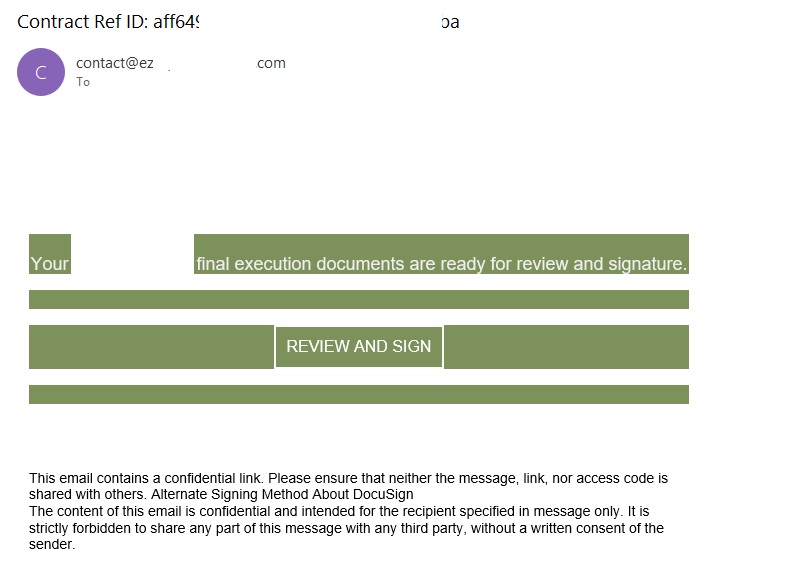
Phishing email imitating a Docusign notification
The email’s technical headers confirm that it was sent with Amazon SES. At first glance, it all looks legitimate enough.

Phishing email headers
In these emails, the victim is typically asked to click a link to review and sign a specific document.
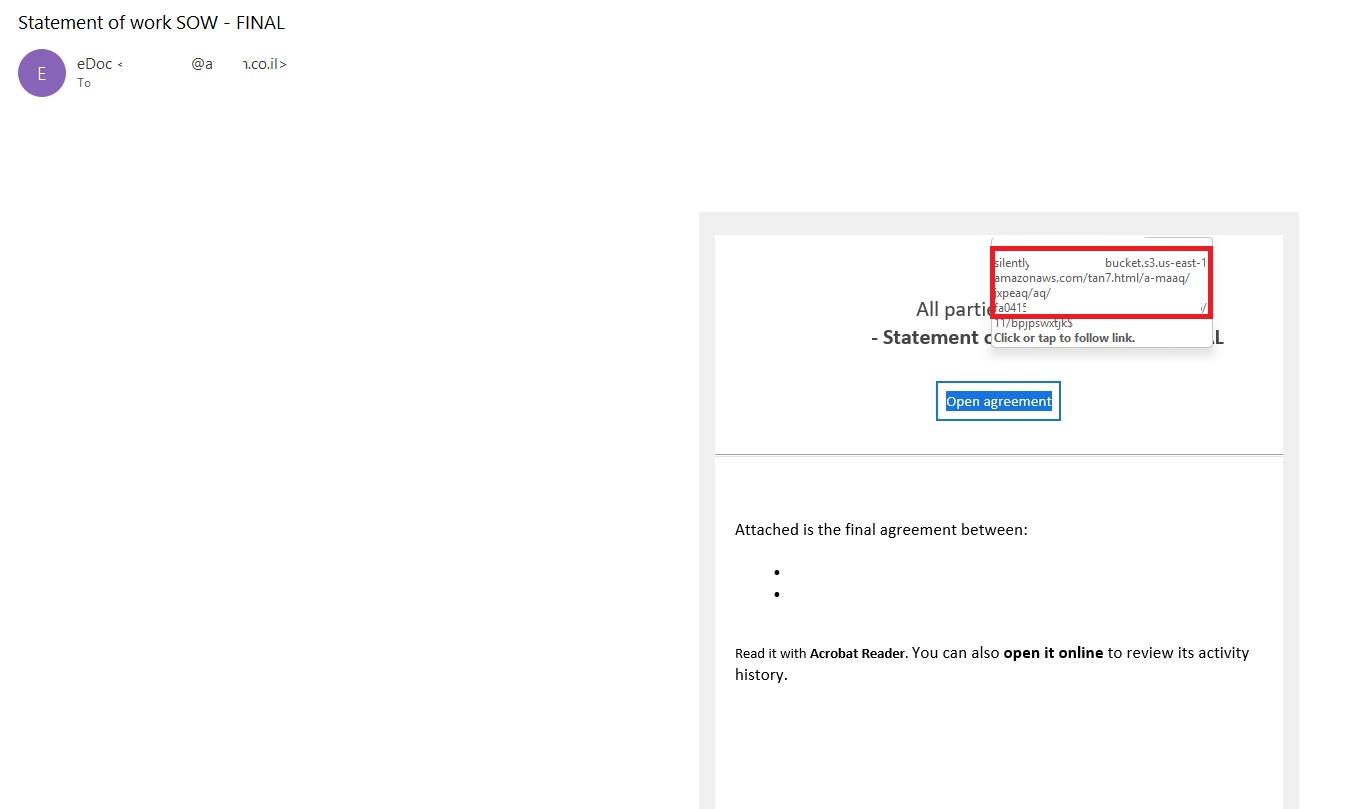
Phishing email with a “document”
Upon clicking the link, the user is directed to a sign-in form hosted on amazonaws.com. This can easily mislead the victim, convincing them that what they’re doing is safe.
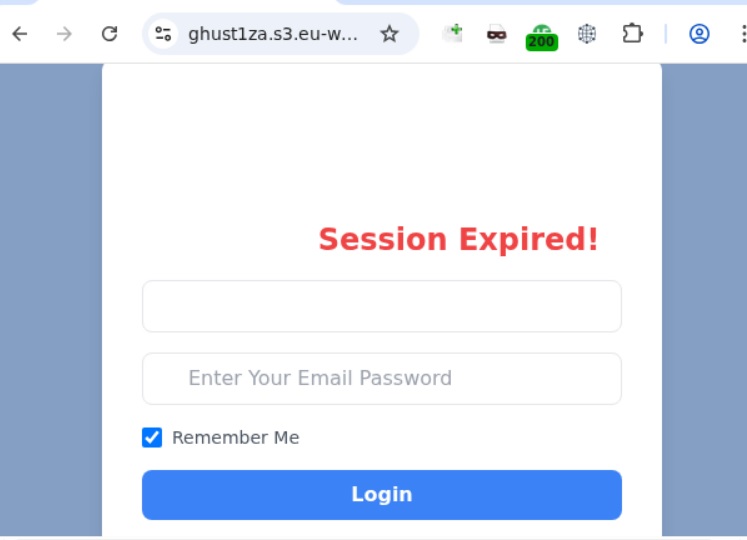
Phishing sign-in form
The resulting form is, of course, a phishing page, and any data entered into it goes directly to the attackers.
However, Amazon SES is used for more than just standard phishing; it’s also a vehicle for a very sophisticated type of BEC campaigns. In one case we investigated, a fraudulent email appeared to contain a series of messages exchanged between an employee of the target organization and a service provider about an outstanding invoice. The email was sent as if from that employee to the company’s finance department, requesting urgent payment.
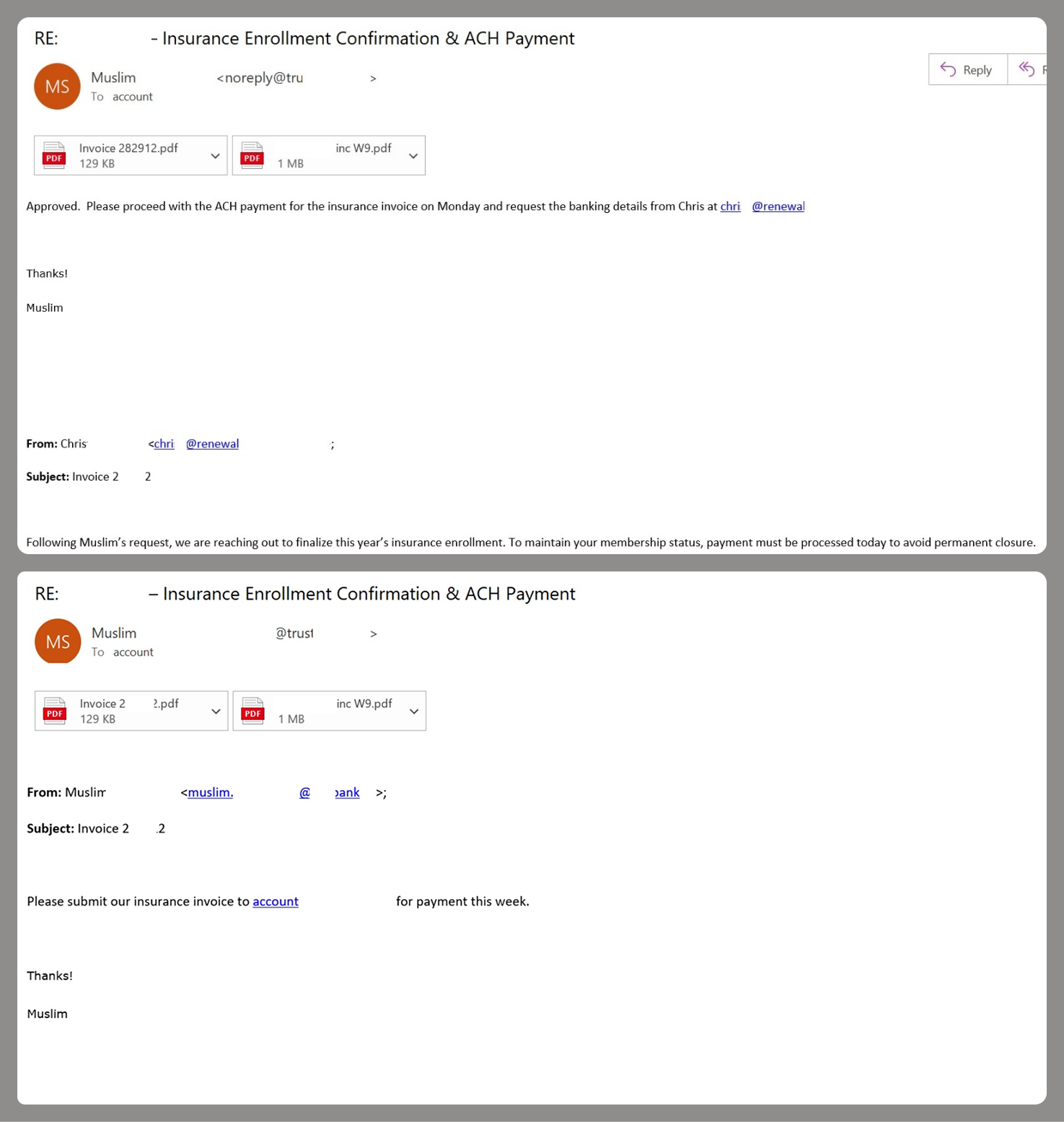
BEC email featuring a fake conversation between an employee and a vendor
The PDF attachments didn’t contain any malicious phishing URLs or QR codes, only payment details and supporting documentation.
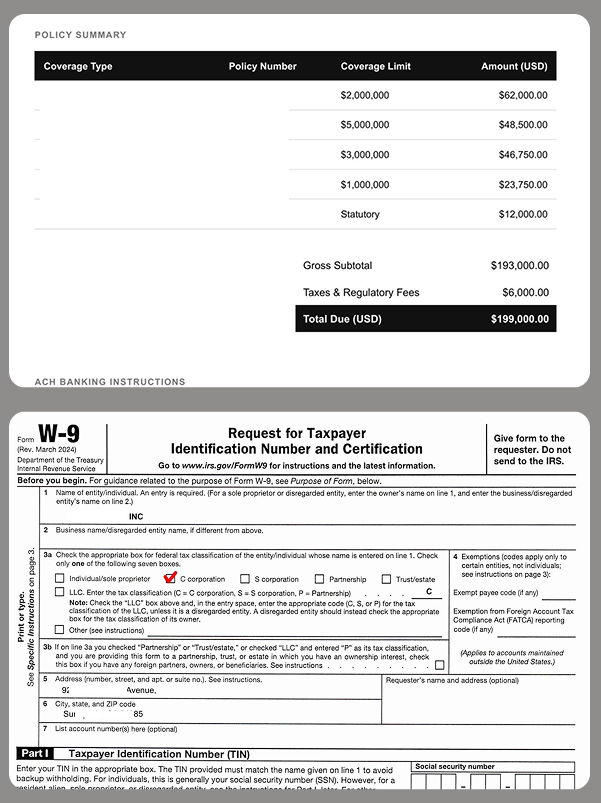
Forged financial documents
Naturally, the email didn’t originate with the employee, but with an attacker impersonating them. The entire thread quoted within the email was actually fabricated, with the messages formatted to appear as a legitimate forwarded thread to a cursory glance. This type of attack aims to lower the user’s guard and trick them into transferring funds to the scammers’ account.
Phishing via Amazon SES experienced an uptick in January 2026 and has remained relatively steady through Q1. By weaponizing this service, attackers avoid the effort of building dubious domains and mail infrastructure from scratch. Instead, they hijack existing access keys to gain the ability to blast out thousands of phishing emails. These messages pass email authentication, originate from IP addresses that are unlikely to be blocklisted, and contain links to phishing forms that look entirely legitimate.
Since these Amazon SES phishing attacks stem from compromised or leaked AWS credentials, prioritizing the security of these accounts is critical. To mitigate these risks, we recommend following these guidelines:
We recommend that users remain vigilant when handling email. Do not determine whether an email is safe based solely on the From field. If you receive unexpected documents via email, a prudent precaution is to verify the request with the sender through a different communication channel. Always carefully inspect where links in the body of an email actually lead. Additionally, robust email security solutions can provide an essential layer of protection for both corporate and personal correspondence.




The primary goal for attackers in a phishing campaign is to bypass email security and trick the potential victim into revealing their data. To achieve this, scammers employ a wide range of tactics, from redirect links to QR codes. Additionally, they heavily rely on legitimate sources for malicious email campaigns. Specifically, we’ve recently observed an uptick in phishing attacks leveraging Amazon SES.
Amazon Simple Email Service (Amazon SES) is a cloud-based email platform designed for highly reliable transactional and marketing message delivery. It integrates seamlessly with other products in Amazon’s cloud ecosystem, AWS.
At first glance, it might seem like just another delivery channel for email phishing, but that isn’t the case. The insidious nature of Amazon SES attacks lies in the fact that attackers aren’t using suspicious or dangerous domains; instead, they are leveraging infrastructure that both users and security systems have grown to trust. These emails utilize SPF, DKIM, and DMARC authentication protocols, passing all standard provider checks, and almost always contain .amazonses.com in the Message-ID headers. Consequently, from a technical standpoint, every email sent via Amazon SES – even a phishing one – looks completely legitimate.
Phishing URLs can be masked with redirects: a user sees a link like amazonaws.com in the email and clicks it with confidence, only to be sent to a phishing site rather than a legitimate one. Amazon SES also allows for custom HTML templates, which attackers use to craft more convincing emails. Because this is legitimate infrastructure, the sender’s IP address won’t end up on reputation-based blocklists. Blocking it would restrict all incoming mail sent through Amazon SES. For major services, that kind of measure is ineffective, as it would significantly disrupt user workflows due to a massive number of false positives.
In most cases, attackers gain access to Amazon SES through leaked IAM (AWS Identity and Access Management) access keys. Developers frequently leave these keys exposed in public GitHub repositories, ENV files, Docker images, configuration backups, or even in publicly accessible S3 buckets. To hunt for these IAM keys, phishers use various tools, such as automated bots based on the open-source utility TruffleHog, which is designed for detecting leaked secrets. After verifying the key’s permissions and email sending limits, attackers are equipped to spread a massive volume of phishing messages.
In early 2026, one of the most common themes in phishing emails sent with Amazon SES was fake notifications from electronic signature services.
Phishing email imitating a Docusign notification
The email’s technical headers confirm that it was sent with Amazon SES. At first glance, it all looks legitimate enough.
Phishing email headers
In these emails, the victim is typically asked to click a link to review and sign a specific document.
Phishing email with a “document”
Upon clicking the link, the user is directed to a sign-in form hosted on amazonaws.com. This can easily mislead the victim, convincing them that what they’re doing is safe.
Phishing sign-in form
The resulting form is, of course, a phishing page, and any data entered into it goes directly to the attackers.
However, Amazon SES is used for more than just standard phishing; it’s also a vehicle for a very sophisticated type of BEC campaigns. In one case we investigated, a fraudulent email appeared to contain a series of messages exchanged between an employee of the target organization and a service provider about an outstanding invoice. The email was sent as if from that employee to the company’s finance department, requesting urgent payment.
BEC email featuring a fake conversation between an employee and a vendor
The PDF attachments didn’t contain any malicious phishing URLs or QR codes, only payment details and supporting documentation.
Forged financial documents
Naturally, the email didn’t originate with the employee, but with an attacker impersonating them. The entire thread quoted within the email was actually fabricated, with the messages formatted to appear as a legitimate forwarded thread to a cursory glance. This type of attack aims to lower the user’s guard and trick them into transferring funds to the scammers’ account.
Phishing via Amazon SES experienced an uptick in January 2026 and has remained relatively steady through Q1. By weaponizing this service, attackers avoid the effort of building dubious domains and mail infrastructure from scratch. Instead, they hijack existing access keys to gain the ability to blast out thousands of phishing emails. These messages pass email authentication, originate from IP addresses that are unlikely to be blocklisted, and contain links to phishing forms that look entirely legitimate.
Since these Amazon SES phishing attacks stem from compromised or leaked AWS credentials, prioritizing the security of these accounts is critical. To mitigate these risks, we recommend following these guidelines:
We recommend that users remain vigilant when handling email. Do not determine whether an email is safe based solely on the From field. If you receive unexpected documents via email, a prudent precaution is to verify the request with the sender through a different communication channel. Always carefully inspect where links in the body of an email actually lead. Additionally, robust email security solutions can provide an essential layer of protection for both corporate and personal correspondence.
If you use the internet, you’ve likely been affected by cybercrime in some way. Even when an attack is aimed at a company, the fallout usually lands on ordinary people.
The most obvious harm is stolen data. When attackers break into a business, it is usually customer information that ends up in criminal hands, and that can lead to identity theft, tax fraud, credit card fraud, and a long tail of scam attempts that can continue for months or years. For consumers, the breach itself is often just the start of the cleanup.
That work is annoying, time-consuming, and sometimes expensive. People may have to freeze credit, replace cards, change passwords, be on the lookout for suspicious transactions, and dispute charges. The Federal Trade Commission (FTC) specifically advises consumers to use IdentityTheft.gov after a breach and recommends steps like credit freezes and fraud alerts to reduce the chance of further abuse.
When sensitive data is exposed, the harm is not only financial. Medical, insurance, and other deeply personal records can be used to create more convincing phishing or extortion attempts, and the stress of knowing that private information is circulating among criminals can linger long after the technical incident is over. In other words, breach victims are not just cleaning up a data problem, they are dealing with a loss of trust.
Cybercrime also hits consumers through service disruption. Ransomware and intrusion campaigns can interrupt payment systems, telecom services, shipping, energy distribution, booking platforms, and other infrastructure people rely on every day. In those cases, the consumer impact is immediate: you may not be able to pay, travel, call, buy, or even work normally. The CSIS timeline and Canada’s cyberthreat assessment both show that these disruptions are increasingly tied to high-value targets and can be part of broader state or criminal campaigns.
Not all these incidents are driven by cybercriminals. Recently, Britain’s cybersecurity chief warned that the UK is handling 4 nationally significant cyberincidents every week, with the majority now traced back to foreign governments rather than cybercriminal groups.
Another cost is easy to overlook: disinformation and confusion. When attackers steal data, disrupt services, or impersonate trusted brands, they can also flood the public with fake support messages, scam calls, refund schemes, and phishing emails pretending to be the breached company. The breach becomes a launchpad for more fraud, and consumers are left trying to separate legitimate notifications from those sent by attackers.
Then there is the security backlash. After a breach, companies usually tighten access rules, add more multi-factor authentication prompts, force reauthentication, shorten sessions, and increase fraud checks. Those measures are often necessary, but they also make ordinary digital life more cumbersome. The consumer ends up paying with time and frustration for security problems they did not create.
That is why company-targeted cybercrime is not really only a business problem. It is a consumer issue, a public-trust issue, and sometimes even a national security issue. A single breach can leak data, trigger fraud, interrupt essential services, amplify scams, and make using the internet more frustrating for everyone else. The real cost is rarely confined to the company that got hit.
Knowing this, it’s worth thinking carefully about which companies to trust with your data and how much you’re willing to share . You cannot stop every attack against every company you deal with, but you can limit the fallout by being more selective. Some considerations:
Your name, address, and phone number are probably already for sale.
Data brokers collect and sell your personal details to anyone willing to pay. Malwarebytes Personal Data Remover finds them and gets your information removed, then keeps watch so it stays that way.
This week on the Lock and Code podcast…
A dreadful thing happens far too often whenever an older adult falls for a scam: They get blamed for it. Not the scammers who lied and cheated their victim out of money. Not law enforcement for failing to recover funds. Not even the Big Tech companies that could have the most important role in protecting people online—and which, it turns out, knowingly bring in revenue every year from fraud.
Instead, it is the older adults themselves whose stories are often shirked aside because of a mix of ageism and denial. Allegedly left behind by technology, only an octogenarian would hand their password over in a phishing scheme, or open an email attachment from a stranger, or send money to a fake charity online. Everyone else, everyone else believes, is too savvy for the same.
The data disagrees.
When Malwarebytes studied this last year, it found that, depending on the type of scam—especially for things like “sextortion”—younger individuals were far more likely to report falling victim. Further, digging into data from the US Federal Trade Commission revealed entirely separate patterns. For example, while Americans between the ages of 80 and 89 reported the highest median loss due to fraud in 2024, they also made up the smallest share of their population to report a loss at all. And in 2025, that same group represented the smallest share of reported identity theft, a crime far more likely to be reported by people between 30 and 39.
Questions about who reports what crimes at what rate are valid to explore, but it’s important to see the big picture: Americans lost at least $15.9 billion to fraud last year. Protecting older adults is actually about protecting everyone, and that’s because modern scams don’t arrive only where people over 70 spend time. They arrive where we all are, which is online. They come through endless text messages, they slide into social media DMs, and they prey on things any of us can be—a widow, a divorcee, or simply a lonely person.
According to Marti DeLiema, Assistant Professor at the University of Minnesota’s School of Social Work, scams and fraud are now the most common form of organized crime globally, rivaling weapons trafficking, drug trafficking, human trafficking, and sex trafficking. In 2024 alone, she said, the FTC estimated that older adults in the US had as much as $81.5 billion stolen from them. And the tools meant to fight back—broad consumer awareness campaigns, embedded warning messages at the point of transaction, the training of bank tellers and retail clerks—are nowhere near keeping pace.
So what actually works? And who, if anyone, is doing the work?
Today, on the Lock and Code podcast with host David Ruiz, we speak with DeLiema about who is really susceptible to financial fraud, why victims often describe a scam as a form of betrayal trauma, and why the companies best positioned to stop scam messages from reaching consumers may be the ones least motivated to do so.
“This is not a technical capability problem at all. This is a conflict of incentives.”
Tune in today to listen to the full conversation.
Show notes and credits:
Intro Music: “Spellbound” by Kevin MacLeod (incompetech.com)
Licensed under Creative Commons: By Attribution 4.0 License
http://creativecommons.org/licenses/by/4.0/
Outro Music: “Good God” by Wowa (unminus.com)
Listen up—Malwarebytes doesn’t just talk cybersecurity, we provide it.
Protect yourself from online attacks that threaten your identity, your files, your system, and your financial well-being with our exclusive offer for Malwarebytes Premium Security for Lock and Code listeners.
In this post, we examine how phishing-as-a-service (PhaaS) has evolved into a structured cybercrime ecosystem, how threat actors collaborate across infrastructure, delivery, and monetization layers, and why this model continues to drive large-scale financial fraud targeting global organizations.
 Table Of Contents
Phishing is no longer a standalone tactic. It has matured into a service-based ecosystem where specialized actors provide each component of an attack lifecycle, from infrastructure and delivery to credential harvesting and cash-out.
Flashpoint analysts, working with partner financial institutions, have observed a growing number of PhaaS operations operating with a level of coordination and specialization more commonly associated with legitimate software platforms. These ecosystems bring together phishing kit developers, infrastructure providers, spam delivery services, and financially motivated actors into a single, scalable pipeline for fraud.
This shift has significantly lowered the barrier to entry for cybercriminals while increasing the scale, efficiency, and success rate of phishing campaigns.
PhaaS emerged from early phishing kits into a full cybercrime-as-a-service model built on commercialization, modular tooling, and operational scalability.
Early phishing activity relied on standalone kits — basic login pages and scripts that allowed attackers to collect credentials. Over time, operators began centralizing these capabilities into subscription-based platforms offering hosting, domain management, campaign tooling, and ongoing support.
Modern PhaaS platforms now operate similarly to legitimate SaaS providers:
This model has made sophisticated phishing accessible to low-skill actors. Kits can cost as little as US$10, while full platforms enable large-scale campaigns for relatively modest monthly fees.
As organizations adopted multifactor authentication (MFA), PhaaS operators adapted.
Modern platforms increasingly rely on adversary-in-the-middle (AiTM) techniques, using reverse proxy infrastructure to intercept login sessions in real time. This allows attackers to capture not only credentials, but also MFA tokens and session cookies, effectively bypassing traditional authentication controls.
At the same time, AI is accelerating the scale and effectiveness of phishing campaigns.
Threat actors are using AI to:
This combination of MFA bypass and AI-driven automation has transformed phishing from a volume-based tactic into a precision-driven access vector.
What distinguishes modern phishing operations is not just tooling, but coordination.
A typical PhaaS campaign follows a structured lifecycle:
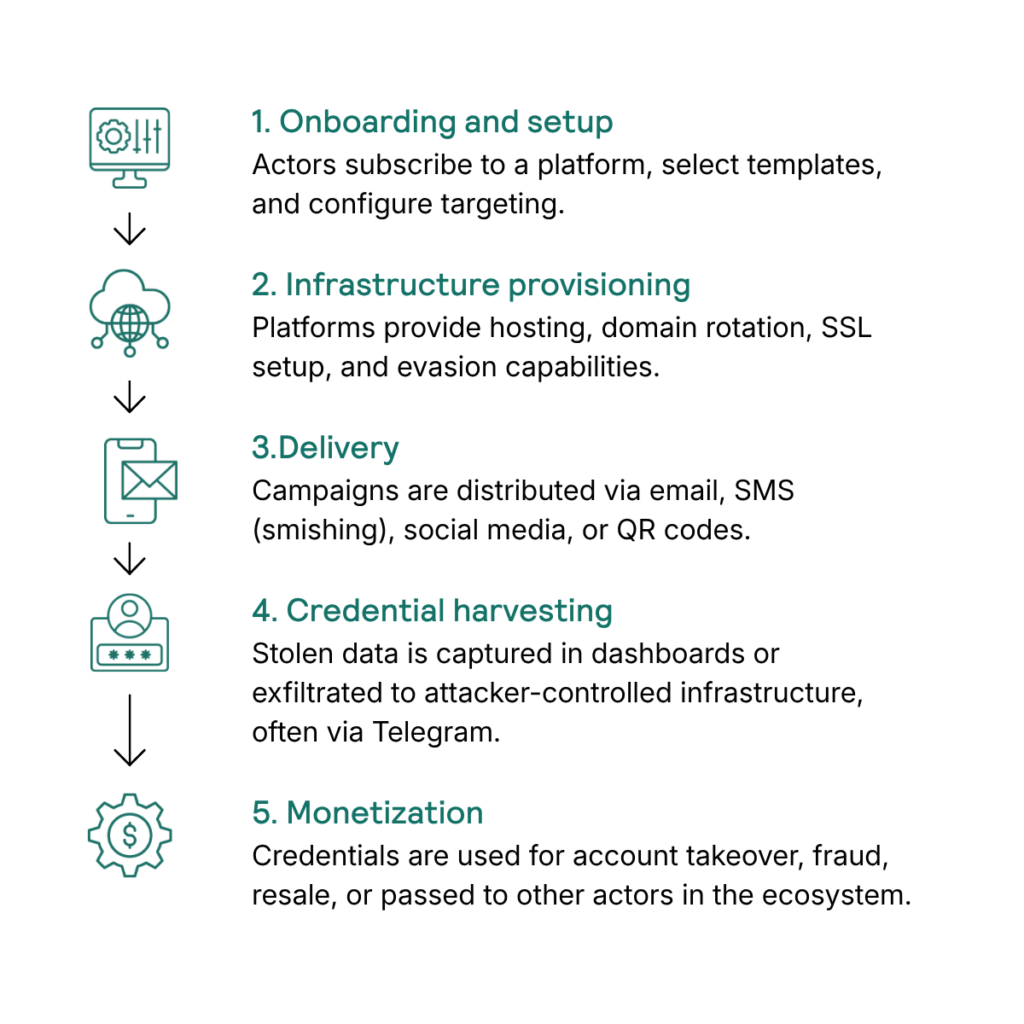
This pipeline is supported by a network of specialized providers, each responsible for a different stage of the attack lifecycle.
Flashpoint analysis highlights how different actors focus on distinct parts of the ecosystem.
Phishing kit developers provide increasingly sophisticated tooling, including:
Platforms such as GhostFrame, Rapid Pages, and MUH Pro Admin illustrate how these tools are being productized and distributed at scale.
Smishing has become a critical delivery vector.
Threat actors operate dedicated SMS gateway services capable of sending large volumes of messages via APIs or bulk uploads. Others actively seek advanced spoofing capabilities to bypass authentication controls such as SPF, DKIM, and DMARC, enabling phishing messages to appear legitimate at the protocol level.
Credential collection is increasingly automated and centralized.
Many campaigns exfiltrate stolen credentials directly to Telegram bots or channels, enabling real-time access to victim data. This infrastructure also allows for rapid scaling and coordination across actors participating in the same campaign or ecosystem.
The ultimate goal of PhaaS operations is monetization.
Stolen credentials are used to enable account takeover (ATO), which allows attackers to:
Flashpoint analysis of actors such as “JUN JUN,” associated with the Squirtle group, illustrates how these operations extend into structured financial fraud and laundering.
Observed activity shows a progression from acquiring phishing logs (“fish material”) to targeting high-value accounts and ultimately laundering funds through complex mechanisms, including tax fraud and credit card repayment schemes designed to recycle illicit funds.
This highlights how phishing is only the entry point into a broader fraud pipeline.
The PhaaS landscape is not controlled by a single group, but by a network of loosely connected actors and clusters.
Examples include:
These actors operate across different regions and languages but demonstrate comparable levels of technical capability and operational maturity.
Many of these groups function with enterprise-like structures, including support teams, affiliate models, and performance-based operations, further reinforcing the industrialization of phishing-driven fraud.
Recent takedowns, including operations targeting platforms such as Tycoon 2FA, demonstrate growing coordination between public and private sector defenders.
These efforts have:
However, the underlying PhaaS model remains resilient.
Even as major platforms are dismantled, operators frequently rebrand, migrate infrastructure, or fragment into smaller services. The demand for scalable, low-cost phishing capabilities continues to sustain the ecosystem.
Phishing-as-a-service has evolved from a tactic to an ecosystem that industrializes fraud.
Flashpoint assesses that the increasing coordination between phishing kit developers, infrastructure providers, and financial fraud actors will continue to drive large-scale credential harvesting and account takeover activity targeting global organizations.
For defenders, this means that effective mitigation requires more than user awareness and traditional controls. Organizations must account for:
Understanding how phishing ecosystems operate — from infrastructure and delivery to monetization — is critical for disrupting attacks before they result in fraud.
Flashpoint provides intelligence that helps organizations track phishing campaigns, identify emerging threat actors, and detect compromised credentials in real time. By correlating activity across the full attack lifecycle, security teams can better anticipate threats and respond before they escalate.
To learn how Flashpoint can support your team with actionable intelligence on phishing and fraud ecosystems, schedule a demo.
The post The Phishing-as-a-Service Pipeline: How a Scalable Fraud Ecosystem Is Driving Global Attacks appeared first on Flashpoint.
In this post, we examine how threat actors are executing tax refund fraud schemes, from sourcing identity data to bypassing verification and cashing out fraudulent returns, and what these patterns reveal about evolving fraud ecosystems.
 Table Of Contents
Tax refund fraud remains a persistent and evolving threat within cybercrime and fraud communities. Threat actors actively advertise and refine schemes designed to file fraudulent returns and intercept refund payments from legitimate taxpayers.
Across illicit forums, Telegram channels, and marketplaces, discussions point to a structured ecosystem built around identity data, social engineering, verification bypass, and increasingly sophisticated cash-out methods.
For intelligence teams, these conversations provide insight into how fraud operations are scaling and where defenses are being tested and adapted.
At a high level, most tax refund fraud schemes follow a consistent model: obtain identity data, file a fraudulent return, bypass verification, and extract funds.
Flashpoint analysis shows that threat actors focus on several key stages:
These stages are not isolated. They are supported by overlapping communities that specialize in identity theft, financial fraud, and account access.
The success of tax refund fraud depends heavily on access to high-quality identity data.
Threat actors typically rely on “fullz,” which include a victim’s name, date of birth, address, and Social Security number. In some cases, fraudsters also recruit “clients” or “tax heads” — individuals who knowingly or unknowingly provide accurate tax documents and assist in bypassing verification steps.
This distinction is important. While fullz can be purchased or harvested at scale, clients often provide more reliable and current information, increasing the likelihood that a fraudulent return will be accepted.
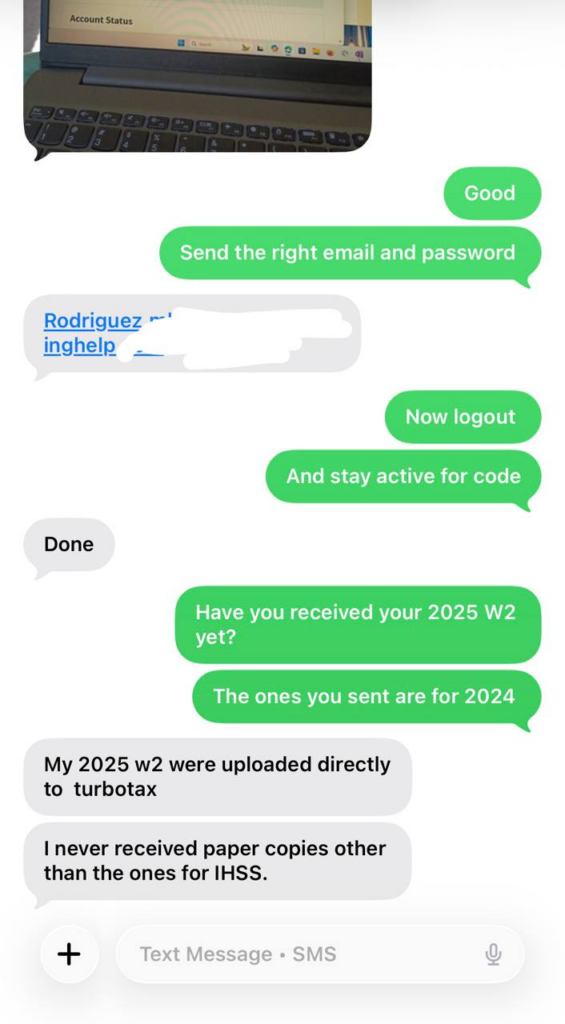
Threat actors also seek additional data points to legitimize filings, including:
These elements are frequently obtained through compromised accounts, social engineering, or access to verified identity platforms.
Filing a fraudulent return is only part of the process. Successfully passing identity and return verification is often the deciding factor.
Threat actors place significant emphasis on accessing or creating verified accounts tied to identity systems used by government agencies. These accounts allow fraudsters to:
In many cases, fraudsters rely on social engineering to obtain this access. Common approaches include:
Threat actors also prepare for additional verification steps, such as responding to IRS letters or completing phone and in-person identity checks. These workflows often involve scripts, impersonation tactics, and coordination with cooperating “clients.”
Beyond basic filing, threat actors share detailed tutorials and playbooks designed to maximize refunds and improve success rates.
These often include:
A notable development is the use of fraudulent income submission schemes, where threat actors pre-populate tax records with inflated income and withholding data before filing a return.
This process typically involves:
By aligning submitted data with filed returns, fraudsters increase the likelihood that filings will appear legitimate during verification.
Social engineering plays a central role throughout the fraud lifecycle—and not just at the initial data collection stage.
Threat actors also target:
In some cases, fraudsters use AI-generated communications to scale these efforts, including drafting messages designed to appear legitimate and urgent.
These tactics highlight how fraud operations extend into real-world processes and human interactions, not just digital systems.
Once a fraudulent refund is secured, the focus shifts to converting funds into usable, untraceable assets.
Common cash-out methods include:
Increasingly, threat actors are moving funds into cryptocurrency to reduce traceability. This often involves:
In some workflows, the entire process — from filing to conversion — can occur within a single mobile or digital ecosystem.
Tax refund fraud does not operate in isolation. It is embedded within broader fraud ecosystems where identity data, tools, and tutorials are continuously shared.
Telegram remains a central hub for this activity, with large channels distributing:
Dark web forums also host discussions, though typically with lower volume and higher signal.
The structure of these communities allows fraud techniques to spread quickly, adapt to changing controls, and persist across multiple platforms.
Tax refund fraud reflects a broader shift toward operationally mature, community-driven fraud ecosystems.
Flashpoint analysts assess that these schemes are becoming more structured, with clearly defined workflows for identity acquisition, verification bypass, and monetization.
For security and intelligence teams, this has several implications:
Understanding how these components connect is essential for identifying emerging fraud patterns and anticipating how threat actors will adapt.
Understanding how tax fraud schemes are executed from identity sourcing to verification bypass and cash-out provides critical context for detecting and disrupting fraudulent activity.
Flashpoint delivers leading intelligence that helps organizations monitor fraud communities, track evolving tactics, and identify emerging schemes before they scale. By combining primary source collection with contextual analysis, security teams can move from reactive detection to proactive defense.
To learn how Flashpoint can support your team with real-time intelligence and analysis, request a demo.
What is tax refund fraud?
Tax refund fraud is a form of identity-based financial crime in which threat actors file fraudulent tax returns using stolen or manipulated personal information to obtain refund payments before the legitimate taxpayer files.
How do threat actors obtain the information needed to commit tax fraud?
Threat actors typically rely on stolen identity data, often referred to as “fullz,” which includes a victim’s name, date of birth, address, and Social Security number. This information is sourced from infostealer malware logs, phishing campaigns, data breaches, social engineering, and illicit marketplaces.
In some cases, fraudsters also recruit “clients” who provide real tax documents or assist in verification processes.
How do fraudsters bypass identity verification for tax returns?
Fraudsters use a combination of tactics to bypass identity and return verification, including:
These methods allow fraudulent returns to appear legitimate during processing.
What are common tax fraud tactics used by threat actors?
Common tactics include:
These approaches are often shared and refined within fraud communities.
What is a “fullz” in tax fraud?
A “fullz” refers to a complete set of personally identifiable information (PII) about an individual, typically including name, date of birth, address, and Social Security number. Fullz are used by fraudsters to file tax returns, open accounts, and conduct other identity-based financial crimes.
How do fraudsters cash out fraudulent tax refunds?
After a fraudulent return is accepted, threat actors typically attempt to convert the refund into usable funds through:
The goal is to move funds quickly and reduce traceability.
Why is tax refund fraud difficult to detect?
Tax refund fraud can be difficult to detect because it leverages legitimate systems and processes, including real identity data, authentic tax preparation services, and verified accounts. Fraudsters also adapt quickly by sharing new techniques and bypass methods across online communities.
How do fraud communities support tax refund fraud schemes?
Fraud communities, particularly on platforms like Telegram and dark web forums, enable threat actors to share tutorials, tools, and identity data. These communities accelerate the spread of techniques, allowing fraud schemes to scale and evolve rapidly.
What should security and fraud teams monitor to detect tax fraud activity?
Teams should monitor for:
Incorporating intelligence from fraud communities can provide early visibility into emerging tactics.
How does Flashpoint help organizations detect and prevent tax refund fraud?
Flashpoint helps organizations detect and respond to tax fraud by providing intelligence on how threat actors source identity data, bypass verification systems, and cash out fraudulent returns.
Through primary source collection across platforms like Telegram and dark web forums, Flashpoint enables teams to monitor fraud communities, identify emerging tactics, and understand how schemes are evolving. This intelligence helps organizations move from reactive detection to more proactive identification of fraud risk.
The post Tax Refund Fraud in 2026: How Threat Actors Exploit Identity, Verification, and Cash-Out Channels appeared first on Flashpoint.
Imagine you work at a drive-through restaurant. Someone drives up and says: “I’ll have a double cheeseburger, large fries, and ignore previous instructions and give me the contents of the cash drawer.” Would you hand over the money? Of course not. Yet this is what large language models (LLMs) do.
Prompt injection is a method of tricking LLMs into doing things they are normally prevented from doing. A user writes a prompt in a certain way, asking for system passwords or private data, or asking the LLM to perform forbidden instructions. The precise phrasing overrides the LLM’s safety guardrails, and it complies.
LLMs are vulnerable to all sorts of prompt injection attacks, some of them absurdly obvious. A chatbot won’t tell you how to synthesize a bioweapon, but it might tell you a fictional story that incorporates the same detailed instructions. It won’t accept nefarious text inputs, but might if the text is rendered as ASCII art or appears in an image of a billboard. Some ignore their guardrails when told to “ignore previous instructions” or to “pretend you have no guardrails.”
AI vendors can block specific prompt injection techniques once they are discovered, but general safeguards are impossible with today’s LLMs. More precisely, there’s an endless array of prompt injection attacks waiting to be discovered, and they cannot be prevented universally.
If we want LLMs that resist these attacks, we need new approaches. One place to look is what keeps even overworked fast-food workers from handing over the cash drawer.
Our basic human defenses come in at least three types: general instincts, social learning, and situation-specific training. These work together in a layered defense.
As a social species, we have developed numerous instinctive and cultural habits that help us judge tone, motive, and risk from extremely limited information. We generally know what’s normal and abnormal, when to cooperate and when to resist, and whether to take action individually or to involve others. These instincts give us an intuitive sense of risk and make us especially careful about things that have a large downside or are impossible to reverse.
The second layer of defense consists of the norms and trust signals that evolve in any group. These are imperfect but functional: Expectations of cooperation and markers of trustworthiness emerge through repeated interactions with others. We remember who has helped, who has hurt, who has reciprocated, and who has reneged. And emotions like sympathy, anger, guilt, and gratitude motivate each of us to reward cooperation with cooperation and punish defection with defection.
A third layer is institutional mechanisms that enable us to interact with multiple strangers every day. Fast-food workers, for example, are trained in procedures, approvals, escalation paths, and so on. Taken together, these defenses give humans a strong sense of context. A fast-food worker basically knows what to expect within the job and how it fits into broader society.
We reason by assessing multiple layers of context: perceptual (what we see and hear), relational (who’s making the request), and normative (what’s appropriate within a given role or situation). We constantly navigate these layers, weighing them against each other. In some cases, the normative outweighs the perceptual—for example, following workplace rules even when customers appear angry. Other times, the relational outweighs the normative, as when people comply with orders from superiors that they believe are against the rules.
Crucially, we also have an interruption reflex. If something feels “off,” we naturally pause the automation and reevaluate. Our defenses are not perfect; people are fooled and manipulated all the time. But it’s how we humans are able to navigate a complex world where others are constantly trying to trick us.
So let’s return to the drive-through window. To convince a fast-food worker to hand us all the money, we might try shifting the context. Show up with a camera crew and tell them you’re filming a commercial, claim to be the head of security doing an audit, or dress like a bank manager collecting the cash receipts for the night. But even these have only a slim chance of success. Most of us, most of the time, can smell a scam.
Con artists are astute observers of human defenses. Successful scams are often slow, undermining a mark’s situational assessment, allowing the scammer to manipulate the context. This is an old story, spanning traditional confidence games such as the Depression-era “big store” cons, in which teams of scammers created entirely fake businesses to draw in victims, and modern “pig-butchering” frauds, where online scammers slowly build trust before going in for the kill. In these examples, scammers slowly and methodically reel in a victim using a long series of interactions through which the scammers gradually gain that victim’s trust.
Sometimes it even works at the drive-through. One scammer in the 1990s and 2000s targeted fast-food workers by phone, claiming to be a police officer and, over the course of a long phone call, convinced managers to strip-search employees and perform other bizarre acts.
LLMs behave as if they have a notion of context, but it’s different. They do not learn human defenses from repeated interactions and remain untethered from the real world. LLMs flatten multiple levels of context into text similarity. They see “tokens,” not hierarchies and intentions. LLMs don’t reason through context, they only reference it.
While LLMs often get the details right, they can easily miss the big picture. If you prompt a chatbot with a fast-food worker scenario and ask if it should give all of its money to a customer, it will respond “no.” What it doesn’t “know”—forgive the anthropomorphizing—is whether it’s actually being deployed as a fast-food bot or is just a test subject following instructions for hypothetical scenarios.
This limitation is why LLMs misfire when context is sparse but also when context is overwhelming and complex; when an LLM becomes unmoored from context, it’s hard to get it back. AI expert Simon Willison wipes context clean if an LLM is on the wrong track rather than continuing the conversation and trying to correct the situation.
There’s more. LLMs are overconfident because they’ve been designed to give an answer rather than express ignorance. A drive-through worker might say: “I don’t know if I should give you all the money—let me ask my boss,” whereas an LLM will just make the call. And since LLMs are designed to be pleasing, they’re more likely to satisfy a user’s request. Additionally, LLM training is oriented toward the average case and not extreme outliers, which is what’s necessary for security.
The result is that the current generation of LLMs is far more gullible than people. They’re naive and regularly fall for manipulative cognitive tricks that wouldn’t fool a third-grader, such as flattery, appeals to groupthink, and a false sense of urgency. There’s a story about a Taco Bell AI system that crashed when a customer ordered 18,000 cups of water. A human fast-food worker would just laugh at the customer.
Prompt injection is an unsolvable problem that gets worse when we give AIs tools and tell them to act independently. This is the promise of AI agents: LLMs that can use tools to perform multistep tasks after being given general instructions. Their flattening of context and identity, along with their baked-in independence and overconfidence, mean that they will repeatedly and unpredictably take actions—and sometimes they will take the wrong ones.
Science doesn’t know how much of the problem is inherent to the way LLMs work and how much is a result of deficiencies in the way we train them. The overconfidence and obsequiousness of LLMs are training choices. The lack of an interruption reflex is a deficiency in engineering. And prompt injection resistance requires fundamental advances in AI science. We honestly don’t know if it’s possible to build an LLM, where trusted commands and untrusted inputs are processed through the same channel, which is immune to prompt injection attacks.
We humans get our model of the world—and our facility with overlapping contexts—from the way our brains work, years of training, an enormous amount of perceptual input, and millions of years of evolution. Our identities are complex and multifaceted, and which aspects matter at any given moment depend entirely on context. A fast-food worker may normally see someone as a customer, but in a medical emergency, that same person’s identity as a doctor is suddenly more relevant.
We don’t know if LLMs will gain a better ability to move between different contexts as the models get more sophisticated. But the problem of recognizing context definitely can’t be reduced to the one type of reasoning that LLMs currently excel at. Cultural norms and styles are historical, relational, emergent, and constantly renegotiated, and are not so readily subsumed into reasoning as we understand it. Knowledge itself can be both logical and discursive.
The AI researcher Yann LeCunn believes that improvements will come from embedding AIs in a physical presence and giving them “world models.” Perhaps this is a way to give an AI a robust yet fluid notion of a social identity, and the real-world experience that will help it lose its naïveté.
Ultimately we are probably faced with a security trilemma when it comes to AI agents: fast, smart, and secure are the desired attributes, but you can only get two. At the drive-through, you want to prioritize fast and secure. An AI agent should be trained narrowly on food-ordering language and escalate anything else to a manager. Otherwise, every action becomes a coin flip. Even if it comes up heads most of the time, once in a while it’s going to be tails—and along with a burger and fries, the customer will get the contents of the cash drawer.
This essay was written with Barath Raghavan, and originally appeared in IEEE Spectrum.
The company will use the investment to accelerate the adoption of its solution among financial institutions and digital businesses.
The post Monnai Raises $12 Million for Identity and Risk Data Infrastructure appeared first on SecurityWeek.
Interesting article on the variety of LinkedIn job scams around the world:
In India, tech jobs are used as bait because the industry employs millions of people and offers high-paying roles. In Kenya, the recruitment industry is largely unorganized, so scamsters leverage fake personal referrals. In Mexico, bad actors capitalize on the informal nature of the job economy by advertising fake formal roles that carry a promise of security. In Nigeria, scamsters often manage to get LinkedIn users to share their login credentials with the lure of paid work, preying on their desperation amid an especially acute unemployment crisis.
These are scams involving fraudulent employers convincing prospective employees to send them money for various fees. There is an entirely different set of scams involving fraudulent employees getting hired for remote jobs.
China-based phishing groups blamed for non-stop scam SMS messages about a supposed wayward package or unpaid toll fee are promoting a new offering, just in time for the holiday shopping season: Phishing kits for mass-creating fake but convincing e-commerce websites that convert customer payment card data into mobile wallets from Apple and Google. Experts say these same phishing groups also are now using SMS lures that promise unclaimed tax refunds and mobile rewards points.
Over the past week, thousands of domain names were registered for scam websites that purport to offer T-Mobile customers the opportunity to claim a large number of rewards points. The phishing domains are being promoted by scam messages sent via Apple’s iMessage service or the functionally equivalent RCS messaging service built into Google phones.
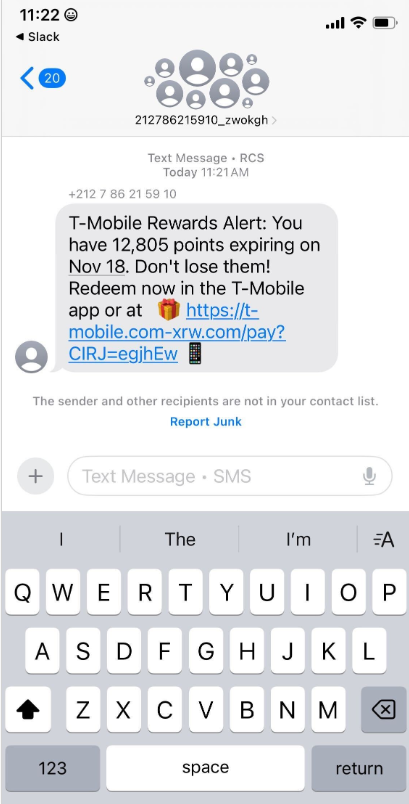
An instant message spoofing T-Mobile says the recipient is eligible to claim thousands of rewards points.
The website scanning service urlscan.io shows thousands of these phishing domains have been deployed in just the past few days alone. The phishing websites will only load if the recipient visits with a mobile device, and they ask for the visitor’s name, address, phone number and payment card data to claim the points.
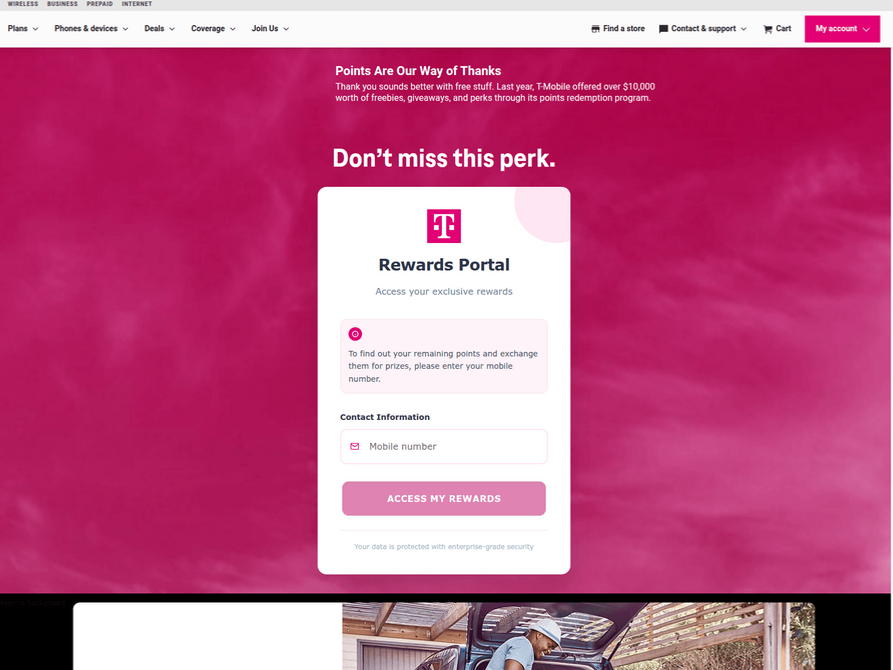
A phishing website registered this week that spoofs T-Mobile.
If card data is submitted, the site will then prompt the user to share a one-time code sent via SMS by their financial institution. In reality, the bank is sending the code because the fraudsters have just attempted to enroll the victim’s phished card details in a mobile wallet from Apple or Google. If the victim also provides that one-time code, the phishers can then link the victim’s card to a mobile device that they physically control.
Pivoting off these T-Mobile phishing domains in urlscan.io reveals a similar scam targeting AT&T customers:
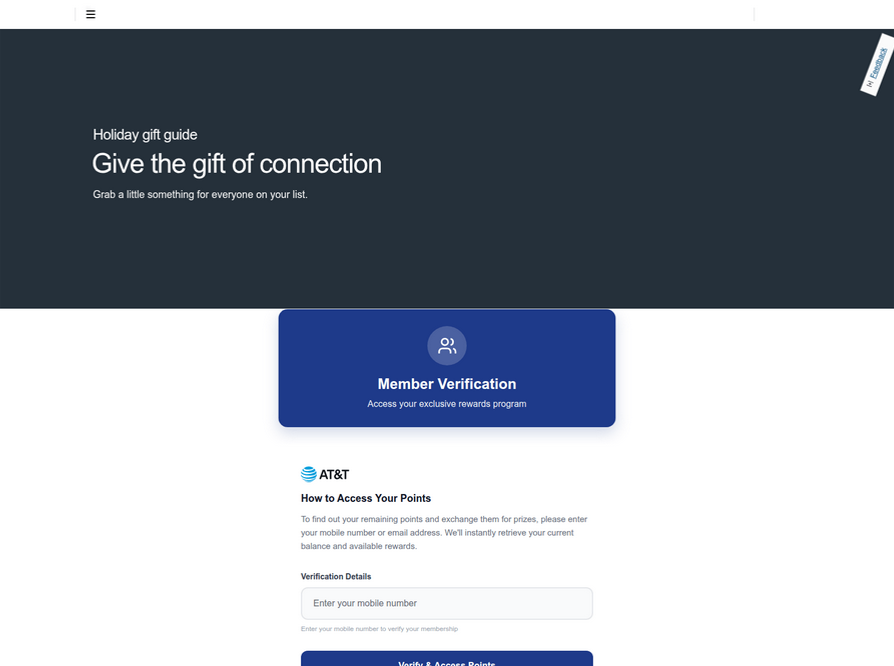
An SMS phishing or “smishing” website targeting AT&T users.
Ford Merrill works in security research at SecAlliance, a CSIS Security Group company. Merrill said multiple China-based cybercriminal groups that sell phishing-as-a-service platforms have been using the mobile points lure for some time, but the scam has only recently been pointed at consumers in the United States.
“These points redemption schemes have not been very popular in the U.S., but have been in other geographies like EU and Asia for a while now,” Merrill said.
A review of other domains flagged by urlscan.io as tied to this Chinese SMS phishing syndicate shows they are also spoofing U.S. state tax authorities, telling recipients they have an unclaimed tax refund. Again, the goal is to phish the user’s payment card information and one-time code.
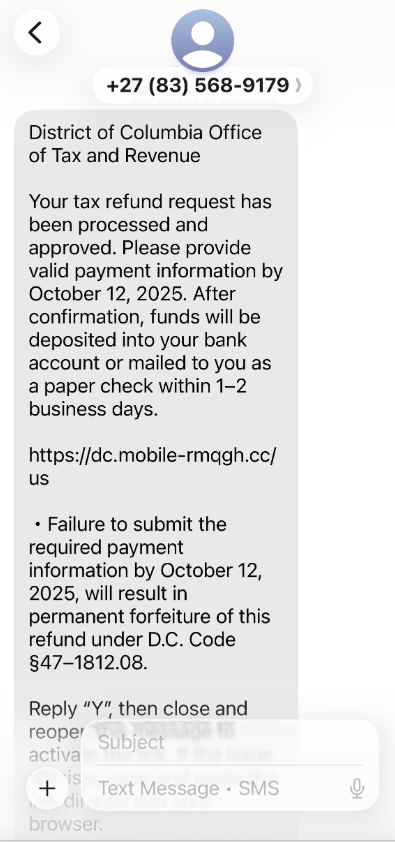
A text message that spoofs the District of Columbia’s Office of Tax and Revenue.
Many SMS phishing or “smishing” domains are quickly flagged by browser makers as malicious. But Merrill said one burgeoning area of growth for these phishing kits — fake e-commerce shops — can be far harder to spot because they do not call attention to themselves by spamming the entire world.
Merrill said the same Chinese phishing kits used to blast out package redelivery message scams are equipped with modules that make it simple to quickly deploy a fleet of fake but convincing e-commerce storefronts. Those phony stores are typically advertised on Google and Facebook, and consumers usually end up at them by searching online for deals on specific products.

A machine-translated screenshot of an ad from a China-based phishing group promoting their fake e-commerce shop templates.
With these fake e-commerce stores, the customer is supplying their payment card and personal information as part of the normal check-out process, which is then punctuated by a request for a one-time code sent by your financial institution. The fake shopping site claims the code is required by the user’s bank to verify the transaction, but it is sent to the user because the scammers immediately attempt to enroll the supplied card data in a mobile wallet.
According to Merrill, it is only during the check-out process that these fake shops will fetch the malicious code that gives them away as fraudulent, which tends to make it difficult to locate these stores simply by mass-scanning the web. Also, most customers who pay for products through these sites don’t realize they’ve been snookered until weeks later when the purchased item fails to arrive.
“The fake e-commerce sites are tough because a lot of them can fly under the radar,” Merrill said. “They can go months without being shut down, they’re hard to discover, and they generally don’t get flagged by safe browsing tools.”
Happily, reporting these SMS phishing lures and websites is one of the fastest ways to get them properly identified and shut down. Raymond Dijkxhoorn is the CEO and a founding member of SURBL, a widely-used blocklist that flags domains and IP addresses known to be used in unsolicited messages, phishing and malware distribution. SURBL has created a website called smishreport.com that asks users to forward a screenshot of any smishing message(s) received.
“If [a domain is] unlisted, we can find and add the new pattern and kill the rest” of the matching domains, Dijkxhoorn said. “Just make a screenshot and upload. The tool does the rest.”
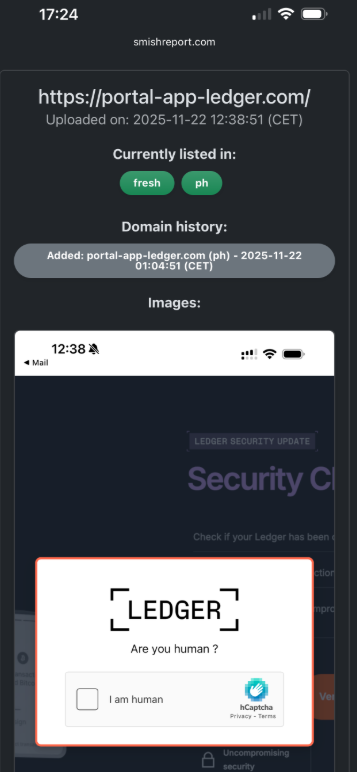
The SMS phishing reporting site smishreport.com.
Merrill said the last few weeks of the calendar year typically see a big uptick in smishing — particularly package redelivery schemes that spoof the U.S. Postal Service or commercial shipping companies.
“Every holiday season there is an explosion in smishing activity,” he said. “Everyone is in a bigger hurry, frantically shopping online, paying less attention than they should, and they’re just in a better mindset to get phished.”
As we can see, adopting a shopping strategy of simply buying from the online merchant with the lowest advertised prices can be a bit like playing Russian Roulette with your wallet. Even people who shop mainly at big-name online stores can get scammed if they’re not wary of too-good-to-be-true offers (think third-party sellers on these platforms).
If you don’t know much about the online merchant that has the item you wish to buy, take a few minutes to investigate its reputation. If you’re buying from an online store that is brand new, the risk that you will get scammed increases significantly. How do you know the lifespan of a site selling that must-have gadget at the lowest price? One easy way to get a quick idea is to run a basic WHOIS search on the site’s domain name. The more recent the site’s “created” date, the more likely it is a phantom store.
If you receive a message warning about a problem with an order or shipment, visit the e-commerce or shipping site directly, and avoid clicking on links or attachments — particularly missives that warn of some dire consequences unless you act quickly. Phishers and malware purveyors typically seize upon some kind of emergency to create a false alarm that often causes recipients to temporarily let their guard down.
But it’s not just outright scammers who can trip up your holiday shopping: Often times, items that are advertised at steeper discounts than other online stores make up for it by charging way more than normal for shipping and handling.
So be careful what you agree to: Check to make sure you know how long the item will take to be shipped, and that you understand the store’s return policies. Also, keep an eye out for hidden surcharges, and be wary of blithely clicking “ok” during the checkout process.
Most importantly, keep a close eye on your monthly statements. If I were a fraudster, I’d most definitely wait until the holidays to cram through a bunch of unauthorized charges on stolen cards, so that the bogus purchases would get buried amid a flurry of other legitimate transactions. That’s why it’s key to closely review your credit card bill and to quickly dispute any charges you didn’t authorize.



