Reading view

Hackers steal sensitive data from UK Department for Education and police

Details of parents and staff, including email addresses and phone numbers, are among data taken by cybercriminals

The Department for Education and a police database have been targeted by a cyber-attack, exposing more than 740,000 pieces of data.

Details of government officials, senior school leaders, university staff, police officers and members of the public have been taken by hackers.

Continue reading...

© Photograph: Dave Hunt/AAP

© Photograph: Dave Hunt/AAP

© Photograph: Dave Hunt/AAP

  •  

Why Delaying WordPress Updates Increases Security Risks

Why Delaying WordPress Updates Increases Security Risks

WordPress updates help close known vulnerabilities before automated attacks can find and exploit them. Once a patch is released, attackers often move quickly to scan for sites that have not yet updated.

It’s easy to put off updates when everything seems to be working. But once a vulnerability is public, attackers do not need to single out your site. Automated bots scan thousands of sites for outdated WordPress core, plugins, themes, and server setups.

Continue reading Why Delaying WordPress Updates Increases Security Risks at Sucuri Blog.

  •  

Primed for Malware: Stop Selling Compromised Android Devices

Time and time again, researchers have found numerous compromised Android devices for sale at large online retailers like Amazon. When these devices get individually reported, we have seen some noted efforts to take them down. But this is a systemic problem and Amazon and other major online retailers must make a corresponding systemic and intentional effort to stop these devices from entering people’s homes and ultimately their networks.

As a refresher: Last year, Google wrote that one major campaign, deemed BADBOX, affected 10 million uncertified devices that were running Android’s open-source software (Android Open Source Project or AOSP). These devices span from TVs and streaming devices to digital picture frames. Even now, someone can go on Amazon and Walmart and buy one of these devices. Not all of them come from Amazon and Walmart, but it’s fair to assume since they have the lion’s share of the market.

Most well-known Android-based devices don’t come with just “stock Android.” The operating system is usually Android plus additional features that the manufacturer wanted. These custom versions of Android often come with pre-installed applications that range from useful to innocuous bloatware to actual malware. Many Android OEMs (original equipment manufacturers) pre-install apps that may not be visibly represented by an icon in your list of installed apps. This obscurity makes the issue particularly hard for users to identify any potential threats.

Since the initial BADBOX analysis, there have been more reports of large campaigns and clusters of different devices participating in malicious activities that utilize people’s home networks to engage in illegal activity. Task forces in the private sector have made an effort to take down these existing Command and Control structures, but these actors may pivot and evolve to flood the market with more devices. 

Online retailers can stop this cycle. A multi-billion dollar company like Amazon should offer more resources, like their anti-fraud efforts, given that these products may have facilitated conditions for large scale attacks and illegal activity. It would also be helpful if they communicated malware-related take downs in a more visible way to consumers who are seeking very similar devices with shared characteristics.

Identifying these devices can be tricky, but it’s not impossible because they tend to follow a pattern. For example, the FBI warned consumers this year to avoid TV streaming devices that claim to provide free sports, tv shows, and movies, a common tactic used by the makers of these malware-filled Android devices that leverages people’s exhaustion from spending money on countless streaming services. We detailed what sorts of indicators to look for on a device you’ve purchased.

But it’s not just the storefronts. There are other parts of this ecosystem that need to improve too, like increased engagement in firmware transparency and the actual manufacturers of the devices themselves being held accountable for these malware laced products.

On Prime Day, we urge retailers like Amazon to better empower users with information they need to make safe and smart decisions.

  •  

WordPress Site Down? Here’s How to Get Back Online

WordPress Site Down? Here’s How to Get Back Online

If your WordPress site goes offline, every minute costs you lost sales, missed leads, and a dent in visitor trust. Search engines may start flagging errors, and customers see a blank page instead of your business. In that moment, the pressure is real:

What broke, and how do you get back online before the damage adds up?

The good news is that most WordPress outages are fixable. In most cases, your site isn’t lost, it’s blocked by something like a plugin conflict, server hiccup, database error, expired domain, SSL problem, sudden traffic spike, or malware infection.

Continue reading WordPress Site Down? Here’s How to Get Back Online at Sucuri Blog.

  •  

What to Do When a Third-Party Data Breach Puts Your Website at Risk

What to Do When a Third-Party Data Breach Puts Your Website at Risk

Data breach notification letters have become a familiar routine. They usually start with “We value your privacy” and offer a year of free credit monitoring. But the most important part is often hidden in the middle:

A list of what actually got out.

A leaked email address is not a leaked admin password. A hashed credential is not a session token. There is no universal post-breach checklist. The right response depends on the data exposed, so read the notice carefully and match your response to the level of exposure.

Continue reading What to Do When a Third-Party Data Breach Puts Your Website at Risk at Sucuri Blog.

  •  

Canvas hack: is it ever a good idea to pay a ransom, and what happens to the data?

Businesses are advised against paying – but many are prepared to deal to protect users’ privacy

After a week of outages, hundreds of millions of students’ data stolen, delayed assignment due dates and school login pages being defaced by hackers, the US tech firm Instructure – which operates the education platform Canvas, used by education providers worldwide – announced it had “reached an agreement with the unauthorised actor” behind the ransomware attack.

Experts read the careful language as a sign that a ransom has been paid. The company has not confirmed this.

Continue reading...

© Photograph: Boonchai Wedmakawand/Getty Images

© Photograph: Boonchai Wedmakawand/Getty Images

© Photograph: Boonchai Wedmakawand/Getty Images

  •  

Canvas System Is Online After a Cyberattack Disrupted Thousands of Schools

Tens of thousands of students studying for final exams around the world have regained access to a key online learning system after a cyberattack had earlier knocked it offline.

The post Canvas System Is Online After a Cyberattack Disrupted Thousands of Schools appeared first on SecurityWeek.

  •  

DNSSEC: The Extra Security Layer That Can Break Your Padlock

DNSSEC: The Extra Security Layer That Can Break Your Padlock

Turning on DNSSEC makes your domain more secure — but if it’s misconfigured, newer certificate validation rules can stop SSL renewals in their tracks.

Hey there,

You know that satisfying click when you finally turn on DNSSEC? It feels like adding a shiny new deadbolt to your domain’s front door. You’re doing the responsible thing: locking down your DNS against spoofing and hijacks, and making the internet just a bit safer.

Continue reading DNSSEC: The Extra Security Layer That Can Break Your Padlock at Sucuri Blog.

  •  

What is online gambling spam and what can I do about it?

What is online gambling spam and what can I do about it?

Online gambling spam thrives on dreams of easy money and high stakes. Beating the house at an exotic casino. Splitting sevens. Going all in on the flop. A baccarat dealer calling La grande! For most people, though, the reality falls far short of Monte Carlo and an Aston Martin.

So they turn to online gambling. And bad actors harness that allure to create their scams. They think they’re buying credits at a hot new online casino.

Continue reading What is online gambling spam and what can I do about it? at Sucuri Blog.

  •  

My Website Is Hosting a Phishing Page – Now What?

My Website Is Hosting a Phishing Page – Now What?

Most phishing advice is written for the person staring at a suspicious email. This guide is for the other kind of victim: The website owner whose legitimate site has been quietly turned into the attacker’s weapon.

You didn’t send the message or build the fake login page. You just woke up to a browser warning, a suspended hosting account, or a polite note from someone’s security team asking why your domain is requesting Apple ID credentials.

Continue reading My Website Is Hosting a Phishing Page – Now What? at Sucuri Blog.

  •  

WordPress DDoS Protection: How to Keep Your Site Online

WordPress DDoS Protection: How to Keep Your Site Online

WordPress powers over 40% of the web, which makes it one of the most attractive targets for Distributed Denial of Service (DDoS) attacks. If your site goes down for an hour, you lose revenue, search rankings, and visitor trust. If it goes down repeatedly, you lose much more.

A DDoS attack floods your website with fake traffic until it slows to a crawl or crashes entirely. Unlike hacks that steal data, DDoS attacks are about disruption.

Continue reading WordPress DDoS Protection: How to Keep Your Site Online at Sucuri Blog.

  •  

How Push Notifications Can Betray Your Privacy (and What to Do About It)

Update April 22, 2026. Apple has reportedly addressed part of the issue with the notification database in iOS 26.4.2 and 18.7.8, released today. With this update, notifications marked for deletion should no longer be stored in the notification database.

A phone’s push notifications can contain a significant amount of information about you, your communications, and what you do throughout the day. They’re important enough to government investigations that Apple and Google now both require a judge’s order to hand details about push notifications over to law enforcement, and even with that requirement Apple shares data on hundreds of users. More recently, we also learned from a 404 Media report that law enforcement forensic extraction tools can unearth the text from deleted notifications, including those from secure messaging tools, like Signal. The good news is that you can mitigate some of this risk. 

There are two points where notifications may betray your privacy: when they’re transmitted over cloud servers and once they land on the device. Let’s start with the cloud. It might seem like push notifications come directly from an app, but they are typically routed through either Apple or Google’s servers first (depending on if you use iOS or Android). According to a letter sent to the Department of Justice by Senator Wyden, the content of those notifications may be visible to Apple and Google, and at the very least the companies collect some metadata about what apps send a notification and when. App providers have to make the decision to hide the content from Apple and Google and implement that functionality; Signal is one app that does this. 

Then, once the notifications land on your phone, depending on your settings, the notification content may be visible on your lock screen without needing to unlock the device. This can be dangerous if you lose your device, someone steals it, or it’s confiscated by law enforcement. 

You may clear notifications after looking at them. But it turns out the content notifications get recorded in your device’s internal storage, which then makes them susceptible to recovery with certain types of forensic tools. Notification content may even persist after the app is deleted, if the OS doesn’t fully purge the app’s notification data. 

We still have a lot of unanswered questions about how the notification databases work on devices. We do not know how long notifications are stored, or whether they’re backed up to the cloud, in which case the cloud provider could get backdoor access to the content of messages if the backups are enabled and not end-to-end encrypted. This may also make backups vulnerable to law enforcement demands for data. 

Which is all to say that there are myriad ways that law enforcement can access the content or metadata of push notifications. Let’s fix that.

Consider the Strongest Notification Protections for Your Secure Messaging Apps

Secure chat tools are designed to keep the content of the messages safe inside the app. So, for secure chat apps like WhatsApp and Signal, that means the company that makes those apps cannot see the content of your messages, and they’re only accessible on your and your recipients’ devices. Once messages land on a device, it’s still important to consider some privacy precautions, particularly with notifications. 

Signal
Signal offers three levels of information to include in notifications, all which are pretty self explanatory:

  • Name, Content, and Actions (Name and message on Android) shows the entirety of a message as well as who sent it (on iPhone you can also slide to reply, mark as read, or call back). 
  • Name only only shows the name of the sender. 
  • No Name or Content (No name or message on Android) will only show that you have a message from Signal, not who sent it or what it’s about. 

To change your settings:

  • On iPhone: Tap your profile picture, then Settings > Notifications > Show.
  • On Android: Tap your profile picture, then Notifications > Show

WhatsApp
WhatsApp only has one option for this, and it’s currently limited to iPhone, but you can at least tell the app not to include the content of a message in the notification:

  • Open WhatsApp for iPhone, tap the “You” bar, then Notifications, and disable the Show preview option.

Check your other apps to see if they offer similar settings.

Limit Your Notifications Device-Wide

Since Apple and Google manage push notifications for their respective devices, they also have some visibility into certain data. Push notification data can include certain types of metadata, like which app sent a notification and when, as well as the account ID associated with the phone. In some cases, Apple and Google may have access to unencrypted content, including the content of the text in a notification or other information from the app itself. 

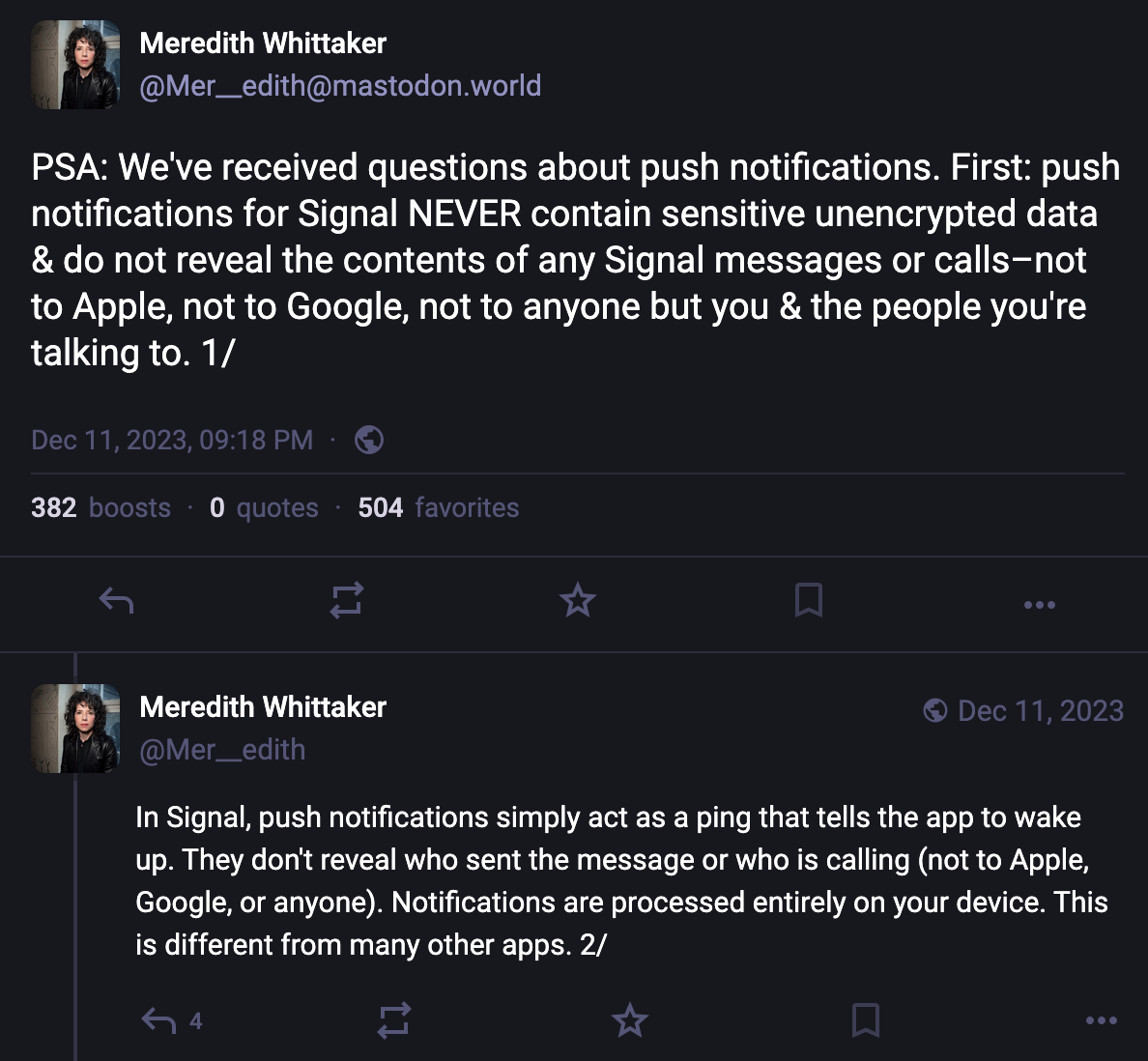
For most app notifications, there’s no simple way to easily figure out what metadata might be gleaned from a notification, or if the notification is unencrypted or not. But some app developers have described details along these lines. For example, Signal president Meredith Whittaker explained on social media how the Signal app handles notifications entirely on-device. Searching online for an app name along with “notification privacy,” “notification encryption” or “notification metadata” may help answer your questions, or you may need to dig around in support forums for the app.

 push notifications for Signal NEVER contain sensitive unencrypted data & do not reveal the contents of any Signal messages or calls-not to Apple, not to Google, not to anyone but you & the people you're talking to. 1/ In Signal, push notifications simply act as a ping that tells the app to wake up. They don't reveal who sent the message or who is calling (not to Apple, Google, or anyone). Notifications are processed entirely on your device. This

It’s also good to reconsider whether any app should be sending you notifications to begin with. Aside from a potential decrease in the number of distractions you endure throughout the day, or the level of chaos on display on your lockscreen, limiting the apps that can send notifications and what content is visible in them can improve your privacy with respect to the sorts of metadata that may be gathered by the companies, as well as any content that may be viewable if someone has physically accessed your device.

To check and change your settings on iPhone

  • Open Settings > Notifications.
  • On the Show Previews option, you can choose whether to show the content of notifications on the lock screen, “Always,” which doesn’t require unlocking the device, “When Unlocked,” which does, and “Never,” which means notifications won’t have any details, just that you have a notification in an app. 
  • Alternatively, you can scroll down and change these settings per app. Just tap the app name, then the Show Previews menu, and choose how you’d like them to appear. Or, if you’ve decided you don’t want notifications from that app at all, uncheck the Allow Notifications option.

To check and change your settings on Android
The core version of Android relies on app developers to develop specific settings more than controlling them on a platform-wide level.

  • Open Settings > Notifications > App notifications to disable notifications from any app completely. Some apps may also offer internal notification options for specific types of notices, like new messages, that you can control in the app itself. Tap an app name, then tap the Addition settings in the app option to potentially customize it more.
  • You can also experiment with the sensitive content setting. This is up to the developer to set properly, but when done so, most notifications will require at least unlocking the device to see them. Open Settings > Notifications > Notifications on lock screen and disable “Show sensitive content.”

Control What Notifications AI Tools Can Access

In an attempt to make notifications easier to skim, both Android and iOS offer optional ways to get notification summaries using their AI tools that summarize the content of notifications. On an individual app level, WhatsApp offers this as well. Some of these summarization tools, like Apple’s, run on the device, while others, like WhatsApp’s, do not. This can all be a lot to keep track of, and sending data off device may create some level of risk for some messages.

Since this is a bit more complicated, we have another blog post that walks through the steps to take to protect messaging from accidentally ending up in AI tools built into Apple and Google's devices. For WhatsApp specifically, we have a blog detailing when you might want to turn on the app’s “Advanced Chat Privacy” feature, which can disable summaries for both yourself and others in the chat.

Balancing security, privacy, and usability with something like push notifications is a complicated task. At the very least, Apple and Google should better ensure that the content of these notifications isn’t transmitted over their servers in plain text. The companies need to also make sure that device operating systems don’t back up the notification database to the cloud, and when an app is deleted, that all notification data is purged.

We appreciate that apps like Signal allow you to control what’s visible with notifications on a per-app basis, and we’d like to see this level of granularity of choices in other secure messaging tools, like WhatsApp. Likewise, more apps should handle push notifications similarly to the way Signal does, where a ping is sent to wake up the app to check for messages, and the content of that message is never sent across servers.

  •  

Why 2FA SMS is a Bad Idea in 2026

Why 2FA SMS is a Bad Idea in 2026

What is 2FA?

Two-factor authentication (2FA) offers a second layer of security to help protect an account from brute force, phishing, and social engineering attacks.

2FA requires an extra step for a user to prove their identity, which reduces the chance of a bad actor gaining access to their account or data. And since notifications are sent to verify the initial authentication via username and passwords, it also gives users and business the ability to monitor for potential indicators of a compromise.

Continue reading Why 2FA SMS is a Bad Idea in 2026 at Sucuri Blog.

  •  

How to Fix “Not Secure” Warnings and SSL Issues in WordPress (8 Steps)

How to Fix “Not Secure” Warnings and SSL Issues in WordPress (8 Steps)

If you own a WordPress website and ever encountered the “Not Secure” warning, you might have worried that visitors would perceive your site as spam or fraudulent. Not only does this warning impact user trust, but it can also create technical search issues when both HTTP and HTTPS versions of your pages remain accessible or when redirects, canonicals, and sitemaps point to different URL versions. Browsers show the visible security warning, while search engines rely on permanent redirects, canonical URLs, and updated sitemaps to understand your preferred HTTPS pages.

Continue reading How to Fix “Not Secure” Warnings and SSL Issues in WordPress (8 Steps) at Sucuri Blog.

  •  

Web Shells: Types, Mitigation & Removal

Web Shells: Types, Mitigation & Removal

Web shells are malicious scripts that give attackers persistent access to compromised web servers, enabling them to execute commands and control the server remotely. These scripts exploit vulnerabilities like SQL injection, remote file inclusion (RFI), and cross-site scripting (XSS) to gain entry.

Once deployed, web shells allow attackers to manipulate the server, leading to data theft, website defacement, or serving as a launchpad for further attacks. They are especially dangerous because they are also a post-compromise access mechanism (backdoor) rather than a standalone infection.

Continue reading Web Shells: Types, Mitigation & Removal at Sucuri Blog.

  •  

Ransomware attacks on schools and colleges | Kaspersky official blog

Back when ransomware was just a startup industry, the primary goal of the attackers was simple: encrypt data, then extort a ransom in exchange for decrypting it. Because of this, cybercriminals mostly targeted commercial enterprises — companies that valued their data enough to justify a hefty payout. Schools and colleges were generally left alone — hackers assumed educators didn’t have the kind of data worth paying a ransom for.

But times have changed, and so has the ransomware groups’ business model. The focus has shifted from payment for decryption, to extortion in exchange for non-disclosure of stolen data. Now, the “incentive” to pay isn’t just about restoring the company’s normal operations, but rather avoiding regulatory trouble, potential lawsuits, and reputational damage. And it’s this shift that’s put educational institutions in the crosshairs.

In this post, we discuss several cases of ransomware attacks on educational organizations, why they took place, and how to keep cybercriminals out of the classroom.

Attacks on educational institutions in 2025–2026

In February 2026, the Sapienza University of Rome, one of Europe’s oldest and largest higher education institutions, suffered a ransomware attack. Internal systems were down for three days. According to sources familiar with the incident, the cybercriminals sent the university’s administration a link leading to a ransom demand. Upon clicking the link, a countdown timer started on the site that opened — counting down from  72 hours: the time the attackers demands needed to be met. As of now, there’s still no word on whether the university administration paid up or not.

Unfortunately, this case isn’t an exception. At the very end of 2025, attackers targeted another Italian educational institution — a vocational training center in the small city of Treviso. Things aren’t looking much better in the UK, either: in the same year, Blacon High School was hit by ransomware. Its administration had to shut its doors for two days to restore its IT systems, assess the scale of the incident, and prevent the attack from spreading further through the network.

In fact, a UK government study suggests these incidents are just part of a broader trend. According to its 2025 data, cyberincidents hit 60% of secondary schools, 85% of colleges, and 91% of universities. Across the pond, American researchers also noted that in the first quarter of 2025, ransomware attacks in the global education sector surged by 69% year on year. Clearly, the trend is global.

Why schools and universities are becoming easy targets

The core of the problem is that modern educational organizations are rapidly incorporating digital services into their operations. A typical school or university infrastructure now manages a dizzying array of services:

  • Electronic gradebooks and registers
  • Distance learning platforms
  • Admission systems and databases for storing applicants’ personal data
  • Cloud storage for educational materials
  • Internal staff and student portals
  • Email for faculty, students, and the administration to communicate

While these systems make education more convenient and manageable, they also drastically expand the attack surface. Every new service and every additional user account is a potential doorway for a phishing campaign, access compromise, or a personal data leak.

According to a UK study, the primary vector for these attacks is basic phishing. But that’s not all that surprising: since the education sector was off the cybercriminals’ radar for so long, cybersecurity training for both staff and students was hardly a priority. As a result, even the most seasoned professors can find themselves falling for a fake email purportedly sent by the “dean” or the “school principal”.

But it’s not just the faculty. Students themselves often unwittingly act as mules for malware. In many institutions, students still frequently hand in assignments on USB flash drives. These drives travel across various home or public devices, picking up malicious digital hitchhikers along the way. All it takes is one infected USB drive plugged into a campus workstation to give an attacker a foothold in the internal network.

It’s worth noting that while USB drives aren’t as ubiquitous as they were a decade ago, they remain a staple in the educational environment. Dismissing the threats they carry isn’t a good idea.

How to ensure the cybersecurity of educational infrastructure

Let’s face it: training every literature and biology teacher to spot phishing emails is now easy, quick task. Similarly, the educational system isn’t going to cut down on USB usage overnight.

Fortunately, a robust security solution (such as Kaspersky Small Office Security) can do the heavy lifting for you. It’s ideal for schools and colleges that need set-it-and-forget-it protection without a steep learning curve. Plus, it’s affordable even for institutions operating on a tight budget, and doesn’t require constant management.

At the same time, Kaspersky Small Office Security addresses all the threats we’ve discussed above: it blocks clicks on phishing links, automatically scans USB drives the moment they’re plugged in, and prevents suspicious files from executing on devices connected to the school’s network.

  •  

Building an AI-Ready America: Teaching in the AI age

On Tuesday, February 23rd, Microsoft Senior Director of Education and Workforce Policy Allyson Knox testified before the House Education & Workforce Subcommittee on Early Childhood, Elementary, and Secondary Education. To view the proceedings, visit the committee’s website.

STATEMENT OF ALLYSON KNOX

SENIOR DIRECTOR OF EDUCATION AND WORKFORCE POLICY

MICROSOFT CORPORATION

BEFORE THE

EDUCATION AND WORKFORCE COMMITTEE

SUBCOMMITTEE ON EARLY CHILDHOOD, ELEMENTARY, AND SECONDARY EDUCATION

UNITED STATES HOUSE OF REPRESENTATIVES

“BUILDING AN AI-READY AMERICA: TEACHING IN THE AI AGE”

TUESDAY, FEBRUARY 24, 2026

WASHINGTON, D.C.

Good afternoon and thank you, Chairman Kiley, Ranking Member Bonamici, Members of the Subcommittee for inviting me to testify today. My name is Allyson Knox. I am Senior Director of Education and Workforce Policy at Microsoft, and I am pleased to have this opportunity to discuss issues related to artificial intelligence and its impact on teachers.

Today, I will share insights we have gathered from teachers about their experiences, challenges, and needs as they integrate AI in education; outline the steps Microsoft and other organizations are taking to facilitate this transition; and recommend legislative approaches to help policymakers strengthen these efforts. These legislative approaches include supporting professional development for teachers; encouraging public-private partnerships; promoting AI literacy; providing guidance on responsible AI use; and supporting innovation.

I would like to begin by quoting from Microsoft’s vice-chair and president, Brad Smith, in his recent foreword to Degrees of Change: What AI Means for Education and the Next Generation[i]:

“Generative AI has become the fastest-spreading technology in human history, adopted at a pace that even the most seasoned technologists could scarcely imagine. This speed is breathtaking, but it also compels us to pause and ask, “Are we ready for what comes next?” AI’s promise is extraordinary. It can help solve problems that have challenged humanity for decades—improving health outcomes, advancing education, and unlocking new opportunities for economic growth. But, like every transformative technology before it, AI brings new questions and new responsibilities.”

This thought-provoking quote is apt for today’s conversation on how AI is impacting teachers. The speed of AI adoption in our nation’s schools and classrooms is indeed breathtaking. Just three years ago, AI had barely made a mark in education. However, our 2025 Study on AI in Education found that 80% of U.S. K-12 teachers have used AI in their roles or for school-related purposes at least once or twice and one-fifth report daily use of AI. Additionally, 58% of K-12 teachers think AI usage at their school/district will increase in the next year.[ii]

What we are hearing from teachers on the impact of AI:

The breadth of adoption has been profound. We have heard directly from teachers who are using AI to streamline lesson planning, curriculum development, and personalize student learning in ways that were unimaginable a few years ago.[iii] AI is also reducing the time it takes to carry out administrative tasks, allowing more time for teachers to focus on their students.

Despite these benefits, we know teachers face challenges when it comes to AI in the classroom. We found roughly one in three teachers lack confidence in using AI effectively and responsibly. Many teachers also express concerns about how AI can exacerbate cheating and are worried about issues such as data privacy and student safety.

Teachers know AI is here to stay, and based upon countless surveys, forums, and focus groups, teachers are ready to tackle these challenges and ask for support in three main areas:

  1. AI literacy – Teachers want the skills, knowledge, and support to build AI literacy and critical thinking in their students;
  2. AI guardrails – Teachers want students to use AI responsibly and safely; and
  3. AI tools – Teachers want classroom-ready AI tools and opportunities to provide feedback that improve them.

I’m excited to share a few ways Microsoft, along with many of our partners, are committed to providing teachers with the support they are requesting.

1.AI literacy – Teachers want the skills, knowledge, and support to build AI literacy and critical thinking in their students

At the core of this support is listening to and learning from teachers and understanding what they want and need to become AI literate themselves and teach AI literacy to their students. These conversations have resulted in exciting initiatives, including the recent launch of the Microsoft Elevate for teachers program, part of the company’s broader commitment[iii] to help schools and educators build skills, expand opportunities, and ensure everyone benefits from AI.

Microsoft Elevate for Educators

The Microsoft Elevate for Educators program equips educators and school leaders with access to one of the world’s largest and most connected peer educator networks and offers free professional development resources. It will provide free access to a new industry-recognized credential for educators, developed in partnership with one of the leading national nonprofit focused on technology and innovation (ISTE+ASCD).[vi] This partnership is aligned to the AI Literacy Framework, which is intended to help educators gain confidence and expertise in integrating AI into their teaching and learning. As part of this work, we also support ISTE+ASCD in advancing AI in teacher preparation programs.

National Academy for AI Instruction

Along with OpenAI and Anthropic, we are supporting the National Academy for AI Instruction, through a partnership with the American Federation of Teachers and the United Federation of Teachers. The Academy describes itself as a national training hub designed by educators – shaping the future of AI in public education, grounded in safety and people-first technology, and improving student learning. From everything we have heard from teachers, this is exactly the type of support they need to promote AI literacy. The Academy also focuses on building critical thinking skills for students and educators.

Rob Weil, who heads up the Academy, recently shared an update on their work with me. He noted through direct engagement with teachers, they listen to what the primary concerns teachers have around using AI in the classroom are, and then work with them to design trainings that are directly responsive to their concerns and meet them where they are – including using whatever technology they are already using in their classroom.

Their goal is to train 400,000 teachers over the next 5 years. The Academy is centered around a “train the trainer” model, building capacity to provide AI literacy to teachers at scale – providing the potential of millions of teachers to benefit from this initiative. Weil noted that interest and participation in the Academy has been taking off, largely due to word of mouth. This month, 1,000 teachers showed up for a virtual session, and another in-person session was overprescribed had to turn away a hundred interested teachers.

Why the interest? Teachers want to learn from their peers and trusted partners; they also want to ensure they are using AI effectively and safely. Weil explained that one of the most popular aspects of the training is centered around the Academy’s Commonsense Guardrails for Using Advanced Technology in Schools,[v] which helps empower teachers to address the challenges they are facing in implementing AI. Some teachers describe AI as the wild-wild west, and this guide has helped provide a roadmap for understanding how to navigate bringing this technology into the classroom.

The trainings also provide real-world, hands-on experiences with using technology which teachers themselves are bringing to the table. At the trainings, teachers are asked what they could use the most help with and then have time to experiment with different tools to do things like start a draft of a lesson plan or an outline for a rubric – allowing them more time and flexibility to incorporate their expertise. In addition, the Academy creates opportunities for educators to influence the development of AI for schools.

Support for Special Education Teachers

We also recognize the potential that AI holds to support students with disabilities – and the need to ensure special education teachers have the support and resources to fully unlock this technology.

Recently, we launched a course to support educators in exploring how Microsoft AI tools can be thoughtfully used in special education environments to reduce administrative demands, strengthen accessibility, and support clear communication with families. Throughout the learning path, responsible use of AI, privacy, and transparency are emphasized so educators can determine when and how AI fits into their practice in ways that align with student needs and professional values.

After our engagements, we tailored our trainings to special education teachers by incorporating their direct feedback. Key topics included privacy with sensitive medical information and using AI to assist parents and caregivers in IEP meetings. We emphasized clear communication, parental inclusion, and ensuring parents understand the meeting’s goals and how best to support their children.

Finally, special education involves a collaborative team beyond just teachers, and we’ve revised our approach to address the needs of occupational therapists, physical therapists, and all other members involved in special education.

Support for Teachers in Rural America

We have found there’s a significant gap in daily AI usage by urban teachers versus their rural and suburban counterparts (39% vs. 24%).[iv] This gap underscores why ensuring AI tools, resources, and professional development are attuned to the needs of rural teachers is critical.

For the last five years, we’ve been working with the National Future Farmers of America (FFA) and agricultural science teachers to develop FarmBeats for Students and ensure it is responsive to agricultural science teachers’ needs. We engaged in an iterative process with them – collaboratively designing and building curriculum and training with agricultural science teachers from the very beginning of development.

FarmBeats for Students brings AI to agricultural education through a hands-on educational program that brings precision agriculture directly into the classroom. The program consists of an affordable hardware kit and a free curriculum aligned with rigorous educational standards. Activities give students direct experience with topics like digital sensors, data analysis, and AI.

We brought FarmBeats for Students to the National FFA convention and held a series of workshops with teachers across the country. They experimented with the kits and provided input to ensure this technology was directly responsive to what they wanted to see in the classroom.

In addition to our partnership with the National FFA, Microsoft helps meet the needs of rural teachers by deploying the online content referenced above through Elevate, as well as supporting community-based organizations that help facilitate activities and events which promote AI literacy in rural communities.

AI Literacy Frameworks, Standards, and Guidance

Teachers want frameworks that help them integrate AI into their classrooms. We are pleased there is bipartisan interest in establishing strong frameworks around AI and education, especially highlighting the need for widespread AI literacy. Microsoft has provided support, guidance, and input to organizations and initiatives such as Code.org and TeachAI who work to develop and promote frameworks, guidance, and standards.

Microsoft encourages state and local policymakers to review and leverage these resources as they incorporate AI in education:

  • The TeachAI Foundational Policies[vii]: This resource, endorsed by dozens of policy organizations and associations, provides practical guidance for national, state, and local leaders to harness AI’s benefits in teaching and learning while mitigating risks. The policies focus on five priorities—fostering leadership, promoting AI literacy, providing clear guidance, building educator capacity, and supporting responsible innovation—to ensure AI strengthens education systems and prepares learners for an AI‑enabled workforce.
  • The TeachAI AI Guidance for Schools Toolkit[viii]: The Toolkit helps education authorities, school leaders, and educators develop clear, responsible guidance for using AI in K–12 education, balancing potential benefits with risks such as privacy, bias, and academic integrity. It provides a practical framework, principles, sample policies, and communication templates to support safe and human‑centered AI adoption across school systems. The Toolkit has been used by the majority of states in constructing guidance for schools.
  • The AI Literacy Framework[ix]: The AI Literacy Framework defines the knowledge, skills, and attitudes students and educators need to understand, use, and critically evaluate AI in education. It is organized around four core domains—Engaging with AI, Creating with AI, Managing AI, and Designing AI—and emphasizes critical thinking, ethics, and human judgment alongside technical understanding. It also emphasizes the foundational computer science concepts that prepare students to not just use AI but understand how AI works and its societal impacts. The framework is designed to be interdisciplinary, practical, and durable, helping schools integrate AI literacy into curriculum, professional learning, and policy in age‑appropriate ways.

2.AI guardrails – Teachers want students to use AI responsibly and safely

We have heard from teachers that one of the greatest hesitations they have with AI is around safety for students. This includes ensuring AI tools used in the classroom protect student privacy, don’t collect their information, and are safe from a mental health perspective.

Some of the strategies teachers use to promote safety are a significant focus in the professional development referenced earlier. In addition, the frameworks include key components to help teachers understand responsible AI use.

Microsoft takes our responsibility as a developer and deployer of AI technology very seriously. Paramount to deploying this technology in classrooms is ensuring it is responsible. Microsoft has identified six principles that we believe should guide AI development and use.

  • Fairness: AI systems should treat all people fairly.
  • Reliability and Safety: AI systems should perform reliably and safely.
  • Privacy and Security: AI systems should be secure and respect privacy.
  • Inclusiveness: AI systems should empower everyone and engage all people.
  • Transparency: AI systems should be understandable.
  • Accountability: People should be accountable for AI systems.

These principles are the foundation for other tools and resources we share with teachers to provide guidelines for them to deploy AI in the classroom.

As another example of our commitment to safety, earlier this month, on Safer Internet Day, we launched our new Microsoft Education Security Toolkit,[x] which provides educators and IT teams with practical guidance tailored to the realities of modern education.

3. AI tools Teachers want classroom-ready AI tools and opportunities to provide feedback that improve them

Teachers often lack the right AI tools tailored to their needs for boosting student achievement. It’s essential to develop AI solutions based on teacher input rather than just delivering generic options. Microsoft strives to meet this responsibility by designing tools and partnerships that address educators’ needs. We believe this approach creates a critical feedback loop that will allow us to constantly evolve our tools to maximize their benefit in the classroom over time.

In fact, at Microsoft, our engineering teams collaborate closely with educators and students to advance the development of AI tools for classroom use. We partner with teacher organizations and directly engage with the disability community to better understand instructional requirements and design technology that enhance student learning outcomes.  Some examples include:

Reading Progress

One of the tools we offer to teachers is called Reading Progress, which helps teachers analyze students’ fluency and generates reading passages and comprehension questions.

From the beginning of development, we worked with individual teachers through our Educator Insiders program and with entire schools or districts through our Technology Adoption Preview, where educators test prototypes of our products and provide feedback.

For example, teachers asked for a tool that could generate tailored passages to meet the needs of their students. We incorporated that feedback and now, teachers can get as specific as saying they want a passage generated about sports that is for a third-grade reading level and includes specific words their class is learning.

Teachers also told us they wanted reading comprehension questions generated faster and better. With AI, it’s easy to do this in a high-quality way.

Teachers report increased comprehension, higher reading fluency, and higher scores, especially for struggling or reluctant readers.

Teach for America (TFA)

Microsoft has been a proud supporter of TFA’s efforts to improve the education system and expand opportunities for children across the U.S. It has been great to see all of the ways in which TFA has worked to equip their teachers with AI fluency in order to help them integrate this technology into the classroom.

TFA recently completed a cloud migration to Microsoft Azure, unlocking countless avenues to improve program design and delivery, direct the most possible funds toward its mission to ensure all kids have access to an excellent education, and evolve to offer the best learning options inside and outside the classroom.

Where do we go from here

What is both exciting and daunting about AI is that while we can take lessons learned from previous technological transformations in the classroom, much of the book has not been written on AI adoption. Meaning tech companies, teachers, government, and other stakeholders have the opportunity to shape where AI goes in education and beyond.

I want to conclude my remarks today with policy recommendations for the Committee to consider:

  • Support professional development for teachers to effectively teach about AI and responsibly integrate AI tools in the classroom.
    • At the Federal level, this means providing priorities for competitive grant programs, such as those recently proposed by the U.S. Department of Education.
  • Encourage public-private partnerships.
    • Incentivize and prioritize Federal funds and grants that support partnerships between technology companies and educational programs, including apprenticeship and credentialed organizations, to develop up to-date AI curriculum.
  • Promote AI literacy across the U.S.
    • Integrate AI skills and concepts, including their foundational principles, social impacts, and ethical concerns, into existing curriculum and instruction.
  • Provide guidance.
    • Equip schools with guidance on the safe, effective, and responsible use of AI, including considerations related to student privacy, data security, accessibility, transparency, and appropriate human oversight.
  • Invest in innovation.
    • Support research and evaluation to better understand the impacts of AI in education, including its effects on teaching and learning and student outcomes, and to identify effective, scalable practices that mitigate the digital divide.


[i] Smith, Brad. “Foreword.” Degrees of Change: What AI Means for Education and the Next Generation, by Juan M. Lavista Ferres, John Wiley & Sons, 2026.
[ii] See Microsoft 2025 AI in Education Survey Details, August 2025
[iii] See Microsoft 2025 AI in Education Survey Details, August 2025
[iv] See Microsoft Elevate: Putting people first, July 2025
[v] See Commonsense Guardrails for Using Advanced Technology in Schools, March 2025
[vi] See Microsoft 2025 AI in Education Survey Details, August 2025
[vii] See TeachAI Foundational Policies
[viii] See TeachAI AI Guidance for Schools Toolkit
[ix] See AI Literacy Framework
[x] See Microsoft Education Security Toolkit, February 2026

[1] ISTE (International Society for Technology in Education) + ASCD (Association for Supervision and Curriculum Development)


The post Building an AI-Ready America: Teaching in the AI age appeared first on Microsoft On the Issues.

  •  

Beyond Login Screens: Why Access Control Matters

Beyond Login Screens: Why Access Control Matters

As breach costs go up and attackers focus on common web features like dashboards, admin panels, customer portals, and APIs, weak access control quickly leads to lost data, broken trust, and costly incidents. The worst part is that many failures are not rare technical flaws but simple mistakes, such as missing permission checks, roles with too much power, or predictable IDs in URLs.

This post aims to help you control who can access different parts of your website and explain why it matters. 

Continue reading Beyond Login Screens: Why Access Control Matters at Sucuri Blog.

  •  
❌