❌

Normal view

Vulnerability & Patch Roundup β€” October 2026

31 October 2026 at 20:19
Vulnerability & Patch Roundup β€” October 2026

If you operate a website, you’re already aware that a single unpatched vulnerability can render your site inaccessible, compromise your reputation, or necessitate extensive remediation following an attack. Most security breaches we observe originate from automated attacks that exploit known software vulnerabilities, often the same ones that have been previously reported and disclosed.

To assist in maintaining your security posture, we have compiled this month’s summary of essential security updates and vulnerability patches pertinent to the WordPress ecosystem.

Continue reading Vulnerability & Patch Roundup β€” October 2026 at Sucuri Blog.

Vulnerability & Patch Roundup β€” September 2026

1 October 2026 at 06:30
Vulnerability & Patch Roundup β€” September 2026

If you operate a website, you’re already aware that a single unpatched vulnerability can render your site inaccessible, compromise your reputation, or necessitate extensive remediation following an attack. Most security breaches we observe originate from automated attacks that exploit known software vulnerabilities, often the same ones that have been previously reported and disclosed.

To assist in maintaining your security posture, we have compiled this month’s summary of essential security updates and vulnerability patches pertinent to the WordPress ecosystem.

Continue reading Vulnerability & Patch Roundup β€” September 2026 at Sucuri Blog.

SC WordPress Malware: A Self-Healing Mesh of Loaders, Drop-Ins, and a Blockchain-Controlled Backdoor

1 October 2026 at 02:57
SC WordPress Malware: A Self-Healing Mesh of Loaders, Drop-Ins, and a Blockchain-Controlled Backdoor

Overview

During recent website cleanup work, we analyzed a WordPress compromise where the same backdoor kept returning within seconds of every removal, no matter how carefully the visible files were deleted. Throughout this article, we’ll refer to this family of malware as SC, named after the β€œSC_” markers found in the injected content.

What makes SC worth documenting is how it survives. The payload lives in at least eight places at once, spread across files, the database, and shared memory, and every one of those places can rebuild all the others.

Continue reading SC WordPress Malware: A Self-Healing Mesh of Loaders, Drop-Ins, and a Blockchain-Controlled Backdoor at Sucuri Blog.

WordPress Security Plugins: How to Choose the Right One

By: Sucuri
5 September 2026 at 05:01
WordPress Security Plugins: How to Choose the Right One

In short, WordPress security plugins are tools you add to your site to strengthen your settings, scan for malware, watch for file changes, and block suspicious activity from within WordPress. Most sites should use one, along with a firewall that filters traffic before WordPress even loads. Look for layered protection, good detection, clear handling of false alarms, minimal impact on performance, and real human support.

If you manage a WordPress site, you have probably searched for β€œbest WordPress security plugin” at some point.

Continue reading WordPress Security Plugins: How to Choose the Right One at Sucuri Blog.

Vulnerability & Patch Roundup β€” August 2026

1 September 2026 at 02:00
Vulnerability & Patch Roundup β€” August 2026

If you operate a website, you’re already aware that a single unpatched vulnerability can render your site inaccessible, compromise your reputation, or necessitate extensive remediation following an attack. Most security breaches we observe originate from automated attacks that exploit known software vulnerabilities, often the same ones that have been previously reported and disclosed.

To assist in maintaining your security posture, we have compiled this month’s summary of essential security updates and vulnerability patches pertinent to the WordPress ecosystem.

Continue reading Vulnerability & Patch Roundup β€” August 2026 at Sucuri Blog.

Vulnerability & Patch Roundup β€” July 2026

1 August 2026 at 01:28
Vulnerability & Patch Roundup β€” July 2026

Running a website means a single unpatched vulnerability can take it offline, harm your reputation, or require cleanup. Most compromises begin with automated attacks exploiting known software flaws, usually reported and disclosed already.

To keep you protected from these threats, we’ve compiled this month’s key security updates and vulnerability patches for the WordPress ecosystem.

If you’re already using theΒ Sucuri Firewall, you’re protected. These vulnerabilities are virtually patched for all clients.

Continue reading Vulnerability & Patch Roundup β€” July 2026 at Sucuri Blog.

Why Delaying WordPress Updates Increases Security Risks

By: Sucuri
14 July 2026 at 23:34
Why Delaying WordPress Updates Increases Security Risks

WordPress updates help close known vulnerabilities before automated attacks can find and exploit them. Once a patch is released, attackers often move quickly to scan for sites that have not yet updated.

It’s easy to put off updates when everything seems to be working. But once a vulnerability is public, attackers do not need to single out your site. Automated bots scan thousands of sites for outdated WordPress core, plugins, themes, and server setups.

Continue reading Why Delaying WordPress Updates Increases Security Risks at Sucuri Blog.

Vulnerability & Patch Roundup β€” June 2026

2 July 2026 at 08:15
Vulnerability & Patch Roundup β€” June 2026

Running a website means a single unpatched vulnerability can take it offline, harm your reputation, or require cleanup. Most compromises begin with automated attacks exploiting known software flaws, usually reported and disclosed already.

To keep you protected from these threats, we’ve compiled this month’s key security updates and vulnerability patches for the WordPress ecosystem.

If you’re already using the Sucuri Firewall, you’re protected. These vulnerabilities are virtually patched for all clients.

Continue reading Vulnerability & Patch Roundup β€” June 2026 at Sucuri Blog.

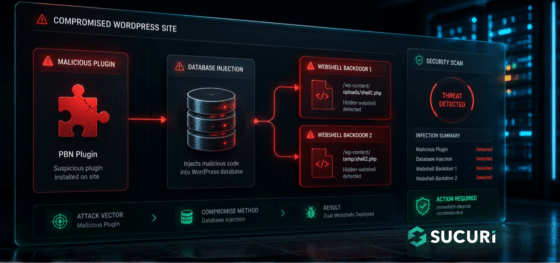
WordPress PBN Plugin Drops Dual Webshells via Database Injection

16 June 2026 at 19:58
WordPress PBN Plugin Drops Dual Webshells via Database Injection

During a recent incident response engagement, our team uncovered a multi-stage WordPress infection that goes beyond the usual file-based malware. The attacker combined a fake plugin, a remote command-and-control server, and two PHP web shells stored directly inside the WordPress database.

The campaign is operated by a Turkish-speaking threat actor and is built around a classic SEO monetization scheme: hidden backlink injection for a Private Blog Network (PBN), most likely tied to the gambling and adult affiliate niche.

Continue reading WordPress PBN Plugin Drops Dual Webshells via Database Injection at Sucuri Blog.

Vulnerability & Patch Roundup β€” May 2026

1 June 2026 at 03:08
Vulnerability & Patch Roundup β€” May 2026

If you run a website, you know that a single unpatched vulnerability can take your site offline, damage your reputation, or leave you cleaning up after an attack. Most compromises we see start with automated attacks targeting known software flaws, often the same ones that have already been reported and disclosed.

To help you stay ahead of these threats, we’ve put together this month’s roundup of critical security updates and vulnerability patches affecting the WordPress ecosystem.

Continue reading Vulnerability & Patch Roundup β€” May 2026 at Sucuri Blog.

WordPress Site Down? Here’s How to Get Back Online

22 May 2026 at 02:05
WordPress Site Down? Here’s How to Get Back Online

If your WordPress site goes offline, every minute costs you lost sales, missed leads, and a dent in visitor trust. Search engines may start flagging errors, and customers see a blank page instead of your business. In that moment, the pressure is real:

What broke, and how do you get back online before the damage adds up?

The good news is that most WordPress outages are fixable. In most cases, your site isn’t lost, it’s blocked by something like a plugin conflict, server hiccup, database error, expired domain, SSL problem, sudden traffic spike, or malware infection.

Continue reading WordPress Site Down? Here’s How to Get Back Online at Sucuri Blog.

Vulnerability & Patch Roundup β€” April 2026

Vulnerability & Patch Roundup β€” April 2026

Vulnerability reports and responsible disclosures are essential for website security awareness and education. Automated attacks targeting known software vulnerabilities are one of the leading causes of website compromises.

To help educate website owners about potential threats to their environments, we’ve compiled a list of important security updates and vulnerability patches for the WordPress ecosystem this past month.

The vulnerabilities listed below are virtually patched by the Sucuri Firewall and existing clients are protected.

Continue reading Vulnerability & Patch Roundup β€” April 2026 at Sucuri Blog.

Vulnerability & Patch Roundup β€” March 2026

1 April 2026 at 22:54
Vulnerability & Patch Roundup β€” March 2026

Vulnerability reports and responsible disclosures are essential for website security awareness and education. Automated attacks targeting known software vulnerabilities are one of the leading causes of website compromises.

To help educate website owners about potential threats to their environments, we’ve compiled a list of important security updates and vulnerability patches for the WordPress ecosystem this past month.

The vulnerabilities listed below are virtually patched by the Sucuri Firewall and existing clients are protected.

Continue reading Vulnerability & Patch Roundup β€” March 2026 at Sucuri Blog.

The Security Risks of Using Nulled WordPress Plugins

By: Sucuri
30 March 2026 at 23:10
The Security Risks of Using Nulled WordPress Plugins

Every year, thousands of WordPress sites get compromised, and a surprising number of those infections trace back to a single decision: installing a nulled plugin.

Nulled plugins promise premium features for little or no money. The problem is that the β€œsavings” often come attached to malware, broken update paths, SEO damage, and legal headaches that cost far more than a legitimate license ever would. It might seem like a harmless shortcut, but it’s one that can unravel everything you’ve built online.

Continue reading The Security Risks of Using Nulled WordPress Plugins at Sucuri Blog.

Vulnerability & Patch Roundup β€” February 2026

28 February 2026 at 20:30
Vulnerability & Patch Roundup β€” February 2026

Vulnerability reports and responsible disclosures are essential for website security awareness and education. Automated attacks targeting known software vulnerabilities are one of the leading causes of website compromises.

To help educate website owners about potential threats to their environments, we’ve compiled a list of important security updates and vulnerability patches for the WordPress ecosystem this past month.

The vulnerabilities listed below are virtually patched by the Sucuri Firewall and existing clients are protected.

Continue reading Vulnerability & Patch Roundup β€” February 2026 at Sucuri Blog.

Vulnerability & Patch Roundup β€” January 2026

1 February 2026 at 02:12
Vulnerability & Patch Roundup β€” January 2026

Vulnerability reports and responsible disclosures are essential for website security awareness and education. Automated attacks targeting known software vulnerabilities are one of the leading causes of website compromises.

To help educate website owners about potential threats to their environments, we’ve compiled a list of important security updates and vulnerability patches for the WordPress ecosystem this past month.

The vulnerabilities listed below are virtually patched by the Sucuri Firewall and existing clients are protected.

Continue reading Vulnerability & Patch Roundup β€” January 2026 at Sucuri Blog.

Shadow Directories: A Unique Method to Hijack WordPress Permalinks

30 January 2026 at 23:09
Shadow Directories: A Unique Method to Hijack WordPress Permalinks

Last month, while working on a WordPress cleanup case, a customer reached out with a strange complaint: their website looked completely normal to them and their visitors, but Google search results were showing something very different.

Instead of normal titles and descriptions, Google was displaying casino and gambling-related content. We have been seeing rising cases of spam on WordPress websites. What made this even more confusing was where the spam was appearing.

Continue reading Shadow Directories: A Unique Method to Hijack WordPress Permalinks at Sucuri Blog.

Malware Intercepts Googlebot via IP-Verified Conditional Logic

14 January 2026 at 00:48
Malware Intercepts Googlebot via IP-Verified Conditional Logic

Some attackers are increasingly moving away from simple redirects in favor of more β€œselective” methods of payload delivery. This approach filters out regular human visitors, allowing attackers to serve malicious content to search engine crawlers while remaining invisible to the website owner.

What did we find?

During a malware investigation, we identified a selective content injection attack inside the main index.php file of a WordPress website.

Instead of always loading WordPress normally, this modified file checks who is visiting the site.

Continue reading Malware Intercepts Googlebot via IP-Verified Conditional Logic at Sucuri Blog.

Fake Browser Updates Targeting WordPress Administrators via Malicious Plugin

8 January 2026 at 02:54
Fake Browser Updates Targeting WordPress Administrators via Malicious Plugin

We recently investigated a case involving a WordPress website where a customer reported persistent fake pop-up notifications appearing on their site. The warnings were urging them to update their browser (Chrome or Firefox), even though their software was already fully up-to-date.

What made this case particularly unique was the targeting. The fake alerts were not visible to regular visitors on the public-facing site. They only appeared when the site owner was logged into the wp-admin dashboard.

Continue reading Fake Browser Updates Targeting WordPress Administrators via Malicious Plugin at Sucuri Blog.

Vulnerability & Patch Roundup β€” December 2025

1 January 2026 at 01:46
Vulnerability & Patch Roundup β€” December 2025

Vulnerability reports and responsible disclosures are essential for website security awareness and education. Automated attacks targeting known software vulnerabilities are one of the leading causes of website compromises.

To help educate website owners about potential threats to their environments, we’ve compiled a list of important security updates and vulnerability patches for the WordPress ecosystem this past month.

The vulnerabilities listed below are virtually patched by the Sucuri Firewall and existing clients are protected.

Continue reading Vulnerability & Patch Roundup β€” December 2025 at Sucuri Blog.

❌