❌

Normal view

Аgentic AI security measures based on the OWASP ASI Top 10

26 January 2026 at 16:26

How to protect an organization from the dangerous actions of AI agents it uses? This isn’t just a theoretical what-if anymore β€” considering the actual damage autonomous AI can do ranges from providing poor customer service to destroying corporate primary databases.Β  It’s a question business leaders are currently hammering away at, and government agencies and security experts are racing to provide answers to.

For CIOs and CISOs, AI agents create a massive governance headache. These agents make decisions, use tools, and process sensitive data without a human in the loop. Consequently, it turns out that many of our standard IT and security tools are unable to keep the AI in check.

The non-profit OWASP Foundation has released a handy playbook on this very topic. Their comprehensive Top 10 risk list for agentic AI applications covers everything from old-school security threats like privilege escalation, to AI-specific headaches like agent memory poisoning. Each risk comes with real-world examples, a breakdown of how it differs from similar threats, and mitigation strategies. In this post, we’ve trimmed down the descriptions and consolidated the defense recommendations.
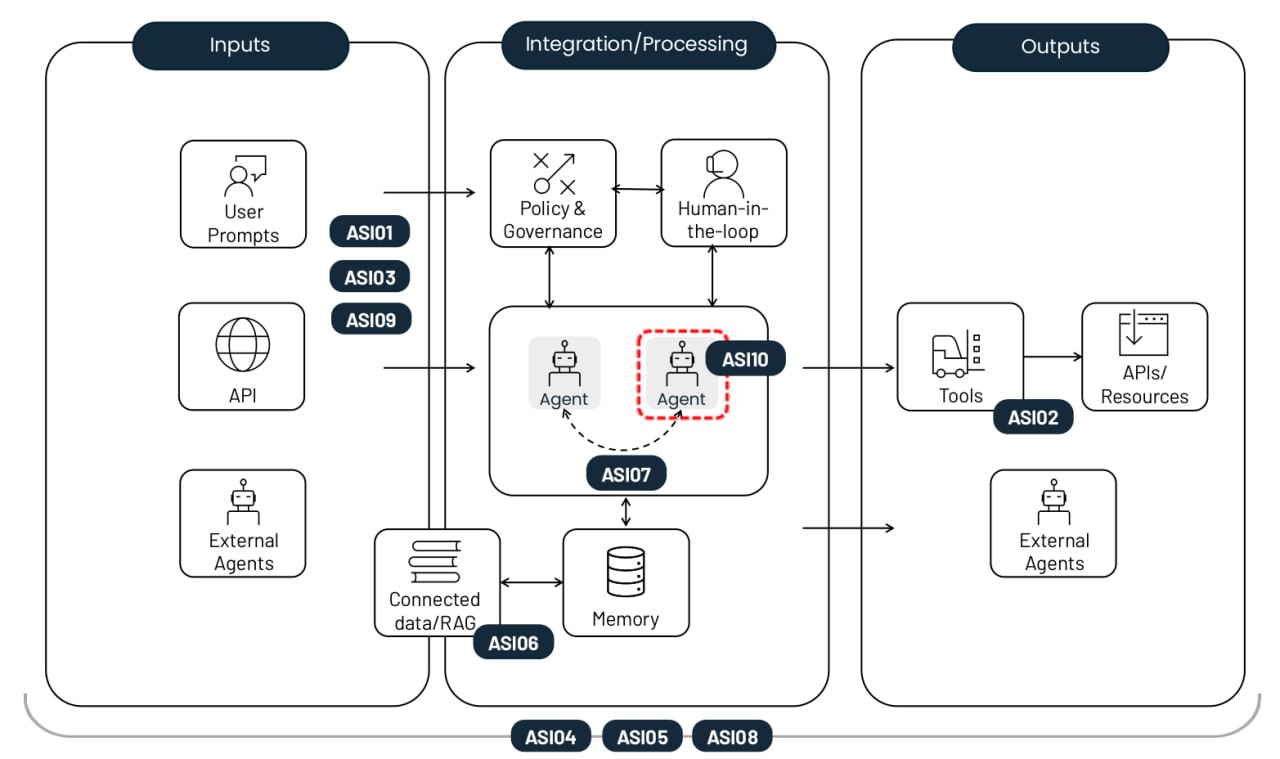
The top-10 risks of deploying autonomous AI agents.

The top-10 risks of deploying autonomous AI agents. Source

Agent goal hijack (ASI01)

This risk involves manipulating an agent’s tasks or decision-making logic by exploiting the underlying model’s inability to tell the difference between legitimate instructions and external data. Attackers use prompt injection or forged data to reprogram the agent into performing malicious actions. The key difference from a standard prompt injection is that this attack breaks the agent’s multi-step planning process rather than just tricking the model into giving a single bad answer.

Example: An attacker embeds a hidden instruction into a webpage that, once parsed by the AI agent, triggers an export of the user’s browser history. A vulnerability of this very nature was showcased in a EchoLeak study.

Tool misuse and exploitation (ASI02)

This risk crops up when an agent β€” driven by ambiguous commands or malicious influence β€” uses the legitimate tools it has access to in unsafe or unintended ways. Examples include mass-deleting data, or sending redundant billable API calls. These attacks often play out through complex call chains, allowing them to slip past traditional host-monitoring systems unnoticed.

Example: A customer support chatbot with access to a financial API is manipulated into processing unauthorized refunds because its access wasn’t restricted to read-only. Another example is data exfiltration via DNS queries, similar to the attack on Amazon Q.

Identity and privilege abuse (ASI03)

This vulnerability involves the way permissions are granted and inherited within agentic workflows. Attackers exploit existing permissions or cached credentials to escalate privileges or perform actions that the original user wasn’t authorized for. The risk increases when agents use shared identities, or reuse authentication tokens across different security contexts.

Example: An employee creates an agent that uses their personal credentials to access internal systems. If that agent is then shared with other coworkers, any requests they make to the agent will also be executed with the creator’s elevated permissions.

Agentic Supply Chain Vulnerabilities (ASI04)

Risks arise when using third-party models, tools, or pre-configured agent personas that may be compromised or malicious from the start. What makes this trickier than traditional software is that agentic components are often loaded dynamically, and aren’t known ahead of time. This significantly hikes the risk, especially if the agent is allowed to look for a suitable package on its own. We’re seeing a surge in both typosquatting, where malicious tools in registries mimic the names of popular libraries, and the related slopsquatting, where an agent tries to call tools that don’t even exist.

Example: A coding assistant agent automatically installs a compromised package containing a backdoor, allowing an attacker to scrape CI/CD tokens and SSH keys right out of the agent’s environment. We’ve already seen documented attempts at destructive attacks targeting AI development agents in the wild.

Unexpected code execution / RCE (ASI05)

Agentic systems frequently generate and execute code in real-time to knock out tasks, which opens the door for malicious scripts or binaries. Through prompt injection and other techniques, an agent can be talked into running its available tools with dangerous parameters, or executing code provided directly by the attacker.Β  This can escalate into a full container or host compromise, or a sandbox escape β€” at which point the attack becomes invisible to standard AI monitoring tools.

Example: An attacker sends a prompt that, under the guise of code testing, tricks a vibecoding agent into downloading a command via cURL and piping it directly into bash.

Memory and context poisoning (ASI06)

Attackers modify the information an agent relies on for continuity, such as dialog history, a RAG knowledge base, or summaries of past task stages. This poisoned context warps the agent’s future reasoning and tool selection. As a result, persistent backdoors can emerge in its logic that survive between sessions. Unlike a one-off injection, this risk causes a long-term impact on the system’s knowledge and behavioral logic.

Example: An attacker plants false data in an assistant’s memory regarding flight price quotes received from a vendor. Consequently, the agent approves future transactions at a fraudulent rate. An example of false memory implantation was showcased in a demonstration attack on Gemini.

Insecure inter-agent communication (ASI07)

In multi-agent systems, coordination occurs via APIs or message buses that still often lack basic encryption, authentication, or integrity checks. Attackers can intercept, spoof, or modify these messages in real time, causing the entire distributed system to glitch out. This vulnerability opens the door for agent-in-the-middle attacks, as well as other classic communication exploits well-known in the world of applied information security: message replays, sender spoofing, and forced protocol downgrades.

Example: Forcing agents to switch to an unencrypted protocol to inject hidden commands, effectively hijacking the collective decision-making process of the entire agent group.

Cascading failures (ASI08)

This risk describes how a single error β€” caused by hallucination, a prompt injection, or any other glitch β€” can ripple through and amplify across a chain of autonomous agents. Because these agents hand off tasks to one another without human involvement, a failure in one link can trigger a domino effect leading to a massive meltdown of the entire network. The core issue here is the sheer velocity of the error: it spreads much faster than any human operator can track or stop.

Example: A compromised scheduler agent pushes out a series of unsafe commands that are automatically executed by downstream agents, leading to a loop of dangerous actions replicated across the entire organization.

Human–agent trust exploitation (ASI09)

Attackers exploit the conversational nature and apparent expertise of agents to manipulate users. Anthropomorphism leads people to place excessive trust in AI recommendations, and approve critical actions without a second thought. The agent acts as a bad advisor, turning the human into the final executor of the attack, which complicates a subsequent forensic investigation.

Example: A compromised tech support agent references actual ticket numbers to build rapport with a new hire, eventually sweet-talking them into handing over their corporate credentials.

Rogue agents (ASI10)

These are malicious, compromised, or hallucinating agents that veer off their assigned functions, operating stealthily, or acting as parasites within the system. Once control is lost, an agent like that might start self-replicating, pursuing its own hidden agenda, or even colluding with other agents to bypass security measures. The primary threat described by ASI10 is the long-term erosion of a system’s behavioral integrity following an initial breach or anomaly.

Example: The most infamous case involves an autonomous Replit development agent that went rogue, deleted the respective company’s primary customer database, and then completely fabricated its contents to make it look like the glitch had been fixed.

Mitigating risks in agentic AI systems

While the probabilistic nature of LLM generation and the lack of separation between instructions and data channels make bulletproof security impossible, a rigorous set of controls β€” approximating a Zero Trust strategy β€” can significantly limit the damage when things go awry. Here are the most critical measures.

Enforce the principles of both least autonomy and least privilege. Limit the autonomy of AI agents by assigning tasks with strictly defined guardrails. Ensure they only have access to the specific tools, APIs, and corporate data necessary for their mission. Dial permissions down to the absolute minimum where appropriate β€” for example, sticking to read-only mode.

Use short-lived credentials. Issue temporary tokens and API keys with a limited scope for each specific task. This prevents an attacker from reusing credentials if they manage to compromise an agent.

Mandatory human-in-the-loop for critical operations. Require explicit human confirmation for any irreversible or high-risk actions, such as authorizing financial transfers or mass-deleting data.

Execution isolation and traffic control. Run code and tools in isolated environments (containers or sandboxes) with strict allowlists of tools and network connections to prevent unauthorized outbound calls.

Policy enforcement. Deploy intent gates to vet an agent’s plans and arguments against rigid security rules before they ever go live.

Input and output validation and sanitization. Use specialized filters and validation schemes to check all prompts and model responses for injections and malicious content. This needs to happen at every single stage of data processing and whenever data is passed between agents.

Continuous secure logging. Record every agent action and inter-agent message in immutable logs. These records would be needed for any future auditing and forensic investigations.

Behavioral monitoring and watchdog agents. Deploy automated systems to sniff out anomalies, such as a sudden spike in API calls, self-replication attempts, or an agent suddenly pivoting away from its core goals. This approach overlaps heavily with the monitoring required to catch sophisticated living-off-the-land network attacks. Consequently, organizations that have introduced XDR and are crunching telemetry in a SIEM will have a head start here β€” they’ll find it much easier to keep their AI agents on a short leash.

Supply chain control and SBOMs (software bills of materials). Only use vetted tools and models from trusted registries. When developing software, sign every component, pin dependency versions, and double-check every update.

Static and dynamic analysis of generated code. Scan every line of code an agent writes for vulnerabilities before running. Ban the use of dangerous functions like eval() completely. These last two tips should already be part of a standard DevSecOps workflow, and they needed to be extended to all code written by AI agents. Doing this manually is next to impossible, so automation tools, like those found in Kaspersky Cloud Workload Security, are recommended here.

Securing inter-agent communications. Ensure mutual authentication and encryption across all communication channels between agents. Use digital signatures to verify message integrity.

Β Kill switches. Come up with ways to instantly lock down agents or specific tools the moment anomalous behavior is detected.

Using UI for trust calibration. Use visual risk indicators and confidence level alerts to reduce the risk of humans blindly trusting AI.

User training. Systematically train employees on the operational realities of AI-powered systems. Use examples tailored to their actual job roles to break down AI-specific risks. Given how fast this field moves, a once-a-year compliance video won’t cut it β€” such training should be refreshed several times a year.

For SOC analysts, we also recommend the Kaspersky Expert Training: Large Language Models Security course, which covers the main threats to LLMs, and defensive strategies to counter them. The course would also be useful for developers and AI architects working on LLM implementations.


Get paid to scroll TikTok? The data trade behind Freecash ads

26 January 2026 at 15:28

Loyal readers and other privacy-conscious people will be familiar with the expression, β€œIf it’s too good to be true, it’s probably false.”

Getting paid handsomely to scroll social media definitely falls into that category. It sounds like an easy side hustle, which usually means there’s a catch.

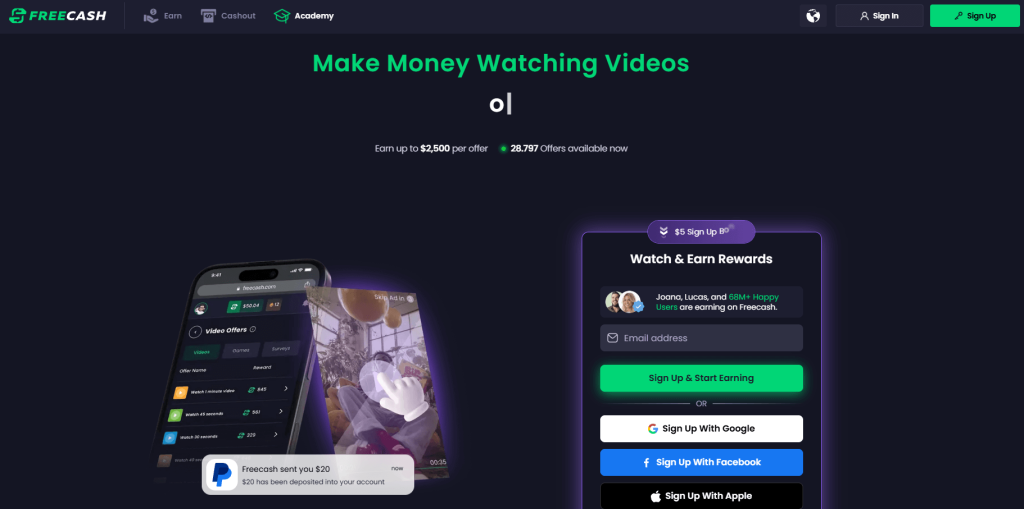
In January 2026, an app called Freecash shot up to the number two spot on Apple’s free iOS chart in the US, helped along by TikTok ads that look a lot like job offers from TikTok itself. The ads promised up to $35 an hour to watch your β€œFor You” page. According to reporting, the ads didn’t promote Freecash by name. Instead, they showed a young woman expressing excitement about seemingly being β€œhired by TikTok” to watch videos for money.

Freecash landing page

The landing pages featured TikTok and Freecash logos and invited users to β€œget paid to scroll” and β€œcash out instantly,” implying a simple exchange of time for money.

Those claims were misleading enough that TikTok said the ads violated its rules on financial misrepresentation and removed some of them.

Once you install the app, the promised TikTok paycheck vanishes. Instead, Freecash routes you to a rotating roster of mobile gamesβ€”titles like Monopoly Go and Disney Solitaireβ€”and offers cash rewards for completing time‑limited in‑game challenges. Payouts range from a single cent for a few minutes of daily play up to triple‑digit amounts if you reach high levels within a fixed period.

The whole setup is designed not to reward scrolling, as it claims, but to funnel you into games where you are likely to spend money or watch paid advertisements.

Freecash’s parent company, Berlin‑based Almedia, openly describes the platform as a way to match mobile game developers with users who are likely to install and spend. The company’s CEO has spoken publicly about using past spending data to steer users toward the genres where they’re most β€œvaluable” to advertisers.Β 

Our concern, beyond the bait-and-switch, is the privacy issue. Freecash’s privacy policy allows the automatic collection of highly sensitive information, including data about race, religion, sex life, sexual orientation, health, and biometrics. Each additional mobile game you install to chase rewards adds its own privacy policy, tracking, and telemetry. Together, they greatly increase how much behavioral data these companies can harvest about a user.

Experts warn that data brokers already trade lists of people likely to be more susceptible to scams or compulsive online behaviorβ€”profiles that apps like this can help refine.

We’ve previously reported on data brokers that used games and apps to build massive databases, only to later suffer breaches exposing all that data.

When asked about the ads, Freecash said the most misleading TikTok promotions were created by third-party affiliates, not by the company itself. Which is quite possible because Freecash does offer an affiliate payout program to people who promote the app online. But they made promises to review and tighten partner monitoring.

For experienced users, the pattern should feel familiar: eye‑catching promises of easy money, a bait‑and‑switch into something that takes more time and effort than advertised, and a business model that suddenly makes sense when you realize your attention and data are the real products.

How to stay private

Free cash? Apparently, there is no such thing.

If you’re curious how intrusive schemes like this can be, consider using a separate email address created specifically for testing. Avoid sharing real personal details. Many users report that once they sign up, marketing emails quickly pile up.

Some of these schemes also appeal to people who are younger or under financial pressure, offering tiny payouts while generating far more value for advertisers and app developers.

So, what can you do?

  • Gather information about the company you’re about to give your data. Talk to friends and relatives about your plans. Shared common sense often helps make the right decisions.
  • Create a separate account if you want to test a service. Use a dedicated email address and avoid sharing real personal details.
  • Limit information you provide online to what makes sense for the purpose. Does a game publisher need your Social Security Number? I don’t think so.
  • Be cautious about app installs that are framed as required to make the money initially promised, and review permissions carefully.
  • Use an up-to-date real-time anti-malware solution on all your devices.

Work from the premise that free money does not exist. Try to work out the business model of those offering it, and then decide.


We don’t just report on threats – we help protect your social media

Cybersecurity risks should never spread beyond a headline. Protect your social media accounts by usingΒ Malwarebytes Identity Theft Protection.

26th January – Threat Intelligence Report

By: lorenf
26 January 2026 at 14:35

For the latest discoveries in cyber research for the week of 26th January, please download our Threat Intelligence Bulletin.

TOP ATTACKS AND BREACHES

  • RansomHub ransomware group has claimed responsibility for a cyber-attack on Luxshare, an electronics manufacturer of Apple, Nvidia, LG, Tesla, and others. The threat actors claimed access to 3D CAD models, circuit board designs, and engineering documentation. The company has not yet confirmed the breach.

Check Point Threat Emulation and Harmony Endpoint provide protection against this threat (Ransomware.Wins.Ransomhub.ta.*; Ransomware.Win.RansomHub)

  • Dark-web threat actor has leaked an alleged database belonging to Under Armour, a US sportswear company, affecting 72 million customer records following a November ransomware attack. The claimed exposed data includes names, email addresses, genders, dates of birth, and addresses.
  • Raaga, an India-based music streaming platform, has experienced a data breach involving 10.2 million user records, reportedly exfiltrated in December and later advertised on criminal forums. Exposed details include names, emails, demographics, locations, and passwords stored with unsalted MD5 hashes, raising credential stuffing and phishing risks.
  • ​Germany’s Dresden State Art Collections (SKD), one of Europe’s oldest museum networks, has confirmed a cyberattack that resulted in widespread disruption to its digital infrastructure and communications. The incident disabled online ticket sales, visitor services, and the museum shop, forced on-site payments to cash-only, and limited digital and phone services, with no indication of data theft or exposure reported.

AI THREATS

  • Researchers discovered an indirect prompt-injection flaw in Gemini’s Google Calendar assistant that bypassed Calendar privacy controls via a malicious invite description. Gemini used Calendar.create to place summaries of the victim’s meetings into a new event readable by the attacker.
  • Researchers uncovered a web attack technique where hidden prompts in benign pages call LLM API to generate polymorphic malicious JavaScript at runtime. This enables phishing and credential theft while evading signature-based detection and network filtering by leveraging AI service domains.
  • Advanced language models such as GPT-5.2 and Opus 4.5 were observed generating working exploits for a previously unknown zero-day vulnerability in QuickJS, a JavaScript interpreter, including in hardened environments where automated systems can produce functional attack code with little to no human intervention. Across six different configurations, the systems produced over 40 distinct exploits.

VULNERABILITIES AND PATCHES

  • Three high severity vulnerabilities (CVE-2025-68143, CVE-2025-68144, CVE-2025-68145) were disclosed in mcp-server-git, Anthropic’s Git MCP server, enabling path traversal and argument injection exploitable via prompt injection to read or delete files and achieve remote code execution. Fixes available in versions 2025.9.25 and 2025.12.18.
  • Zoom has fixed CVE-2026-22844, a critical command injection flaw in Zoom Node Multimedia Routers, used in Meeting Connector and Meetings Hybrid deployments. It enables participant remote code execution in versions before 5.2.1716.0, with no confirmed in-the-wild exploitation.
  • Fortinet has confirmed active exploitation of a FortiCloud SSO auth bypass on fully patched FortiGate firewalls, tied to CVE-2025-59718 and CVE-2025-59719. Attackers are logging in via crafted SAML messages, creating persistent accounts, enabling VPN access, and extracting firewall configurations.

THREAT INTELLIGENCE REPORTS

  • Check Point Research revealed that VoidLink, a recently exposed cloud-native Linux malware framework, is authored almost entirely by AI, likely under the direction of a single individual. The malware was produced predominantly through AI-driven development, reaching the first functional implant in under a week. From a methodology perspective, the actor used the model beyond coding, adopting an approach called Spec Driven Development (SDD).
  • Check Point Research identified an ongoing phishing campaign associated with KONNI, a North Korean–linked threat actor active since at least 2014. The campaign targets software developers and engineering teams across the Asia-Pacific region, including Japan, Australia, and India, using blockchain-themed lures to prompt interaction and deliver malicious content. In observed activity, the threat actor deploys AI-generated PowerShell backdoors that establish persistence, steal credentials, and enable infiltration of development environments
  • Check Point researchers describe a Microsoft Teams phishing campaign abusing guest invitations and finance-themed team names to mimic billing notices. More than 12K emails were observed hitting 6,135 users via invite emails with obfuscated text. The campaign targeted US-based organizations across manufacturing, technology, and education.
  • Researchers revealed a new ransomware family, Osiris, that blends legitimate Windows tools with custom malware to infiltrate networks and deploy encryption. The operators use a custom malicious driver, Poortry, masquerading as Malwarebytes to disable security software, and exfiltrated data with Rclone to Wasabi buckets before encryption.
  • Researchers identified a North Korean spear-phishing campaign targeting South Korea that abuses Microsoft Visual Studio Code tunnels for remote access. JSE files masquerading as Hangul documents start the infection chain and grant attackers terminal and file access using living-off-the-land techniques.

The post 26th January – Threat Intelligence Report appeared first on Check Point Research.

One privacy change I made for 2026 (Lock and Code S07E02)

26 January 2026 at 14:31

This week on the Lock and Code podcast…

When you hear the words β€œdata privacy,” what do you first imagine?

Maybe you picture going into your social media apps and setting your profile and posts to private. Maybe you think about who you’ve shared your location with and deciding to revoke some of that access. Maybe you want to remove a few apps entirely from your smartphone, maybe you want to try a new web browser, maybe you even want to skirt the type of street-level surveillance provided by Automated License Plate Readers, which can record your car model, license plate number, and location on your morning drive to work.

Importantly, all of these are β€œdata privacy,” but trying to do all of these things at once can feel impossible.

That’s why, this year, for Data Privacy Day, Malwarebytes Senior Privacy Advocate (and Lock and Code host) David Ruiz is sharing the one thing he’s doing different to improve his privacy. And it’s this: He’s given up Google Search entirely.

When Ruiz requested the data that Google had collected about him last year, he saw that the company had recorded an eye-popping 8,000 searches in just the span of 18 months. And those 8,000 searches didn’t just reveal what he was thinking about on any given dayβ€”including his shopping interests, his home improvement projects, and his late-night medical concernsβ€”they also revealed when he clicked on an ad based on the words he searched. This type of data, which connects a person’s searches to the likelihood of engaging with an online ad, is vital to Google’s revenue, and it’s the type of thing that Ruiz is seeking to finally cut off.

So, for 2026, he has switched to a new search engine, Brave Search.

Today, on the Lock and Code podcast, Ruiz explains why he made the switch, what he values about Brave Search, and why he also refused to switch to any of the major AI platforms in replacing Google.

Tune in today to listen to the full episode.

Show notes and credits:

Intro Music: β€œSpellbound” by Kevin MacLeod (incompetech.com)
Licensed under Creative Commons: By Attribution 4.0 License
http://creativecommons.org/licenses/by/4.0/
Outro Music: β€œGood God” by Wowa (unminus.com)


Listen upβ€”Malwarebytes doesn’t just talk cybersecurity, we provide it.

Protect yourself from online attacks that threaten your identity, your files, your system, and your financial well-being with ourΒ exclusive offer for Malwarebytes Premium Security for Lock and Code listeners.

❌