A new identity theft service launched on the dark web this week is selling digital scans of more than 153 million drivers licenses from people in the United States and Canada. Based on interviews with individuals whose licenses are available for purchase on this service, it appears to be siphoning images collected by a widely-used identity verification company based in Louisiana. KrebsOnSecurity also has learned that the New Orleans field office of the Federal Bureau of Investigation (FBI) today launched an official inquiry into the source of the images.
A record available at this identity theft service that includes the drivers license for U.S. Defense Secretary Pete Hegseth, one of several high-ranking U.S. government officials whose drivers licenses can be found for sale.
On Monday, Aug. 31, a source alerted KrebsOnSecurity to a service advertised by a new user on the Russian cybercrime forum Exploit, offering access to digital scans of identity documents on more than 170 million people in North America. The source brought it to my attention because the proprietor of this identity theft service offered my Virginia drivers license as a free sample in their initial sales thread on Exploit.
The service, dubbed Nexus, claims to have more than 153 million drivers licenses for people in the United States and Canada, as well as more than 10 million identification cards; more than three million travel documents and/or international IDs; and at least 579,000 medical cards.
A quick look around Nexus finds they are likely not exaggerating about that 153 million number: Running a blank search in Nexus (with no search parameters entered) returns approximately 11.5 million pages of results, with roughly 15 results displayed per page. It includes documents from people in both Canada and the United States, but the bulk of these records are on Americans: searching for just Canadian drivers licenses returns approximately 1.1 million results, with the largest concentration from Ontario (473,673 records).
Curiously, the identity records include not only drivers licenses but also marijuana dispensary cards. Some of the records list their “source” as “CDL,” presumably short for “commercial drivers license.” Other records carry the source notation of “CAC,” which may refer to Common Access Cards, government issued identity cards that grant physical access to government buildings and secure rooms.
The people behind Nexus claim the license images are coming from an active breach at “a major identity verification company” whose customers include multiple Fortune 500 companies.
The record totals listed by the Nexus identity theft service. The number of drivers license records increased by nearly 400,000 in the span of just 24 hours.
“We have been continuously exfiltrating new data for over a year into our private database,” the service enthused in its introductory post on Exploit. “Records are available to preview before purchase with pertinent information redacted. Customer photos are displayed if available.”
Indeed, over the past 24 hours, the number of drivers license records listed as available in Nexus has increased by nearly 400,000, suggesting that freshly stolen license data is being harvested and uploaded to this service on a semi-regular basis.
The record featuring my drivers license includes six image files: three pairs of photos of the license’s front and back, a basic image scan, as well as infrared and ultraviolet versions of the same images. A date and timestamp is appended to each image file, and the timestamp on my license scan corresponds to a date in June 2025 when I took a flight to the midwest United States to attend a family funeral.
Some of the 153 million+ license scans — including mine — feature six image files with date and timestamps appended to the filenames. Not all records include photos, and some that do feature photos do not display the associated filenames.
Intent on discovering the source of this data, KrebsOnSecurity asked more than a dozen friends and family members for permission to search for their licenses in this service. Each person whose license could be found (nine of them) confirmed having traveled on or very close to the dates in the timestamps attached to their images. It is unclear what timezone these timestamps are in, but from reviewing car rental records shared by several people who helped with this research, it appears the timezone is set to Greenwich Mean Time (GMT).
At first, I thought the source of the data might have something to do with airports. However, that theory went out the window when it became apparent there were no passports in this data set. Also, only some of those who helped with this research said they showed their drivers license at the airport on the day of their travel. One person whose license was in Nexus hadn’t flown at all recently, but was renting a car from Hertz for several months around the date of their timestamp.
Two of those who agreed to help are federal employees who said they shared other forms of government identification when passing through airport security. However, those individuals each said they shared their state-issued drivers licenses later that day when renting vehicles at their respective destinations, and that both rented their cars from Hertz.
After finding a note in my calendar for the day of my June 2025 flight reminding me to bring my passport, I remembered that I also never actually shared my drivers license when I went through security at Reagan National Airport on that day because I did not yet have a Real ID, a security-enhanced drivers license that is now required by the Transportation Security Administration (TSA) for all domestic travel. Instead, I showed the TSA agent my government-issued U.S. passport.
Here’s where it gets interesting: I was able to find my mother’s drivers license in this service as well, and the timestamps for her images are just a few seconds apart from mine. That’s notable because we both handed our licenses to the Hertz rental car representative at the same time.
According to my mom, the only place she gave her drivers license to that day was the rental car company, and if memory serves that is also true for me. I don’t recall if the rental car representative inserted our licenses into any kind of machine, but I remember they held onto them for several minutes behind the counter while we were signing various forms. KrebsOnSecurity sought comment from Hertz and will update this story in the event they reply.
Zach Edwards is a well-known security and privacy researcher who recently launched a service called DecryptAds to help people better understand how online advertisers are tracking them. A scan of Edwards’s drivers license is available for purchase on this identity theft service, and Edwards said the timestamp on his record corresponds to the middle of a trip last month to Las Vegas for the annual DEFCON security conference.
Edwards told KrebsOnSecurity that although he did not rent a car in Vegas, he did hand over his license at the TSA checkpoint, at a marijuana dispensary in Vegas, and at his hotel (the Aria). But he said the only one of those three that for sure scanned his ID in some kind of device was the dispensary.
To enter Planet13’s weed dispensary in Las Vegas, one must pass through a red telephone booth. Image: Zach Edwards.
Edwards said the dispensary he visited that day was Planet13, a multi-state chain with stores in California, Florida, Illinois and Nevada. In 2022, the New Orleans-based identity provider idscan.net published a press release announcing an exclusive identity verification agreement with Planet13’s dispensaries nationally. IDScan says it processes ID verification for more than 1,000 marijuana dispensaries in 19 U.S. states.
The “trust” page of idscan.net states that the company provides identity verification services for numerous big brands, including Hertz, Target, Fedex, Motorola Solutions, the financial services giant Jack Henry, and Caesars Entertainment. And as idscan.net’s own documentation states, the technology scans IDs with both infrared and ultraviolet light. Idscan.net says the company’s systems and technology perform more than 21 million verifications monthly, at more than 20,000 locations around the world.
Image: idscan.net.
Contacted by KrebsOnSecurity, idscan.net said it was investigating the matter, but the company has not yet shared an official statement or a substantive reply to specific questions sent via email.
“At this point I’m not able to share any additional information, but the updates you have provided have been welcome, and helpful to our team’s investigation,” wrote Jillian Kossman, a marketing and operations leader at idscan.net.
During the course of my research for this story, word got around to the FBI that I was poking at the apparent source of this new identity theft service’s data. Probably they were tipped off when I shared with a trusted source that Nexus also is selling the drivers license information for the assistant director of the FBI (I did not find FBI Director Kash Patel’s license in Nexus).
Earlier this afternoon, I was added to a conference call with a half-dozen FBI agents, including senior leaders from the agency’s cyber division. During that call, the FBI shared that earlier today their New Orleans field office opened an official investigation into an apparent breach involving idscan.net.
Edwards said that as more in-person and online experiences require sharing drivers licenses, vendors who collect this sensitive data need to be held to a higher standard.
“This episode should further strengthen the resolve for people who are fighting back against online ID schemes which are requiring countless providers to ask for drivers licenses in order to access services under the guise of protecting kids,” Edwards told KrebsOnSecurity. “These systems are putting sensitive data into more and more 3rd party vendors, and we don’t have nearly the oversight to ensure they are safe.”
Larry Baldwin is principal intelligence researcher at the cybersecurity firm Cybera. Baldwin said a front and back scan of his drivers license available at Nexus contains timestamps that correspond to the date of a car rental from Hertz on a recent vacation.
Baldwin said the Nexus identity theft service presents multiple serious security and privacy threats, noting that state-issued drivers licenses are commonly used as proof of one’s identity when opening new lines of credit. Baldwin said the service could also dangerously expose many people who do not wish to be found but who cannot meaningfully change their appearance (or at least not enough to fool today’s AI-based image matching tools).
This category of people, he said, includes those fleeing domestic violence, and even people who have been assigned a whole new life and identity as part of the federal government’s witness protection program, which is generally reserved for criminal defendants in racketeering and conspiracy investigations who agree to cooperate with federal authorities.
“Just when it seems like we’re making some headway in improving authentication controls through drivers license verification systems, this happens and the very thing those improvements are dependent on are compromised,” Baldwin said.
Update, Sept. 2, 6:05 p.m. ET: A spokesperson for Caesars Entertainment said Caesars has not been a client of IDScan.net and has not used VeriScan since February 2025, despite IDScan.net listing them as a client on their website. That person said Caesars had no active VeriScan accounts at the time of the incident and did not authorize IDScan.net to retain data from its accounts, and that IDScan.net said the incident should have no impact on Caesars Entertainment.
Update, 8:56 p.m. ET: Shortly after this story was published, the Nexus identity theft service website vanished from the darkweb, replacing its login page with a plain text message that reads, “This service is no longer available.”
This is a potentially fast-moving story. Any changes or updates will be noted here along with a timestamp.
Since early May 2026, Microsoft Threat Intelligence has observed Storm-2945, a sub-cluster of Midnight Blizzard, conducting widespread but targeted traffic manipulation attacks involving hospitality sector networks served by captive portals worldwide. Despite some tactic, technique, and procedure (TTP) similarities to the Forest Blizzard DNS hijacking operation that we publicly disclosed in April 2026, we attribute this campaign, which we call CaptiveCrunch, to Storm-2945. As reported by ReliaQuest on July 23, a portion of this activity leverages doppelganger domains mimicking Microsoft online services to conduct follow-on adversary-in-the-middle (AitM) phishing operations that abuse the device code authentication flow in Microsoft Entra ID. Microsoft Threat Intelligence has also identified active traffic manipulation attacks leading to the delivery of malware on impacted systems. Microsoft has observed Storm-2945 leveraging AI to support a significant portion of these operations.
Today, we are sharing our findings on these ongoing intrusions to raise awareness of this threat and enable customers to protect their devices, especially while traveling. We provide our assessment of Storm-2945’s relationship to Midnight Blizzard and analysis of the CaptiveCrunch campaign, detailing the malware and tradecraft used in these operations. We also provide mitigation, detection, and hunting guidance to help organizations identify and defend against Storm-2945 and related activity.
Microsoft Threat Intelligence would like to thank our partners at Anthropic and OpenAI for their collaboration and support during this investigation.
The CaptiveCrunch campaign
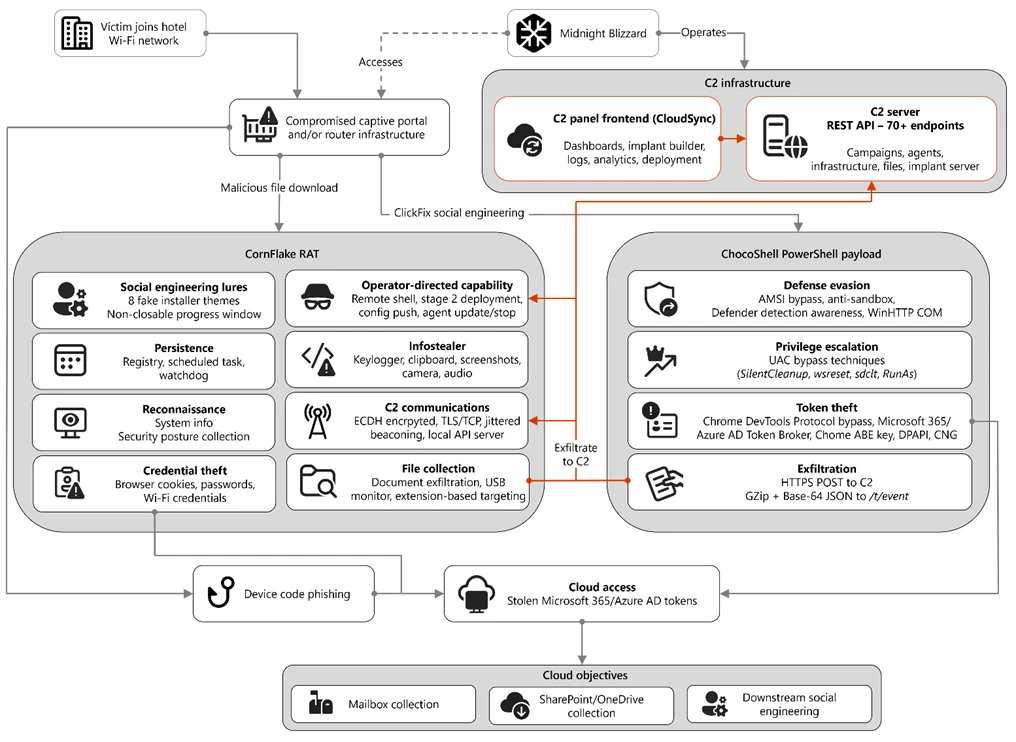
Since February 2026, Storm-2945 has conducted AI-augmented operations including targeted device code and OAuth code phishing campaigns leading to Entra device registration and subsequent data collection from Microsoft 365. Since early May 2026, Microsoft Threat Intelligence has observed Storm-2945 manipulating DNS and HTTP traffic from networks served by captive portals to redirect user traffic through actor-controlled infrastructure. Although our investigation into the initial compromise vector for the captive portal networks is ongoing, we have observed notable commonalities in the equipment and management systems used across multiple affected networks. These similarities suggest that the activity might not be limited to isolated compromises of individual venues and could reflect access to shared services within portions of the captive portal ecosystem.
Figure 1. Overview of the CaptiveCrunch attack flow
As part of the CaptiveCrunch campaign, Storm-2945 has leveraged their AitM position to redirect users through actor-controlled phishing infrastructure and has also delivered malware purporting to be browser or operating system updates in response to automated connectivity checks issued by users’ browsers. Multiple variants have been delivered, including fully-featured Windows remote access trojans (RAT) in compiled Golang, with functionality to conduct system enumeration, collect files and keystrokes, steal credentials and session tokens, conduct audio and video surveillance, monitor for removable media, and provide the threat actor a remote shell on infected systems.
The threat actor infrastructure leverages a variety of ClickFix techniques to elicit the user into downloading and executing the malware:
Figure 2. ClickFix prompt with manual user instructionsFigure 3. ClickFix prompt with additional user instructions after verification failure
In addition to variants of malware targeting Windows systems, Microsoft Threat Intelligence is also aware of indications that the threat actor might be targeting Android devices with similar techniques as the ClickFix landings also include instructions for Android devices to download and install an APK file.
To date, Microsoft has identified widespread compromise of Wi-Fi networks at hospitality-related organizations and other networks serviced by captive portal equipment in several countries. ReliaQuest has identified this activity not only at hotels, but also conference centers and other shared venues, and assesses that the goal of this activity is to access the accounts of corporate travelers.
Storm-2945 and Midnight Blizzard
Microsoft Threat Intelligence assesses that Storm-2945 is an operational sub-cluster of Midnight Blizzard based on distinctive technical and operational overlaps. These include technical similarities to Storm-2372, a Midnight Blizzard initial access operations sub-cluster, also notable for their device code and OAuth code phishing operations tracked throughout 2025, Microsoft Graph-based email exfiltration, social engineering delivered via commercial messaging apps, and significant similarities in victimology.
Midnight Blizzard is a Russia-based threat actor attributed by the US and UK governments to the Foreign Intelligence Service of the Russian Federation, also known as the SVR. This threat actor is known to primarily target governments, diplomatic entities, non-governmental organizations (NGOs), and information technology (IT) service providers, primarily in the US and Europe. Midnight Blizzard is consistent and persistent in their operational targeting, and their objectives rarely change. Their focus is to collect intelligence through longstanding and dedicated espionage in support of Russian foreign policy interests.
Midnight Blizzard operations often involve compromise of valid accounts and, in some highly targeted cases, advanced techniques to compromise authentication mechanisms within an organization to expand access and evade detection. They utilize diverse initial access methods, and Midnight Blizzard is also adept at identifying and abusing OAuth applications to move laterally across cloud environments and for post-compromise activity, such as email collection.
CaptiveCrunch tradecraft and tooling
CornFlake: Remote access and infostealer implant
CornFlake is a full-featured Windows RAT written in Go that serves as Storm-2945’s primary persistent implant. Microsoft has observed the threat actor rapidly iterating on this malware layer, which features customizable capabilities from the social engineering user interface and data collection capabilities to anti-detection and evasion techniques.
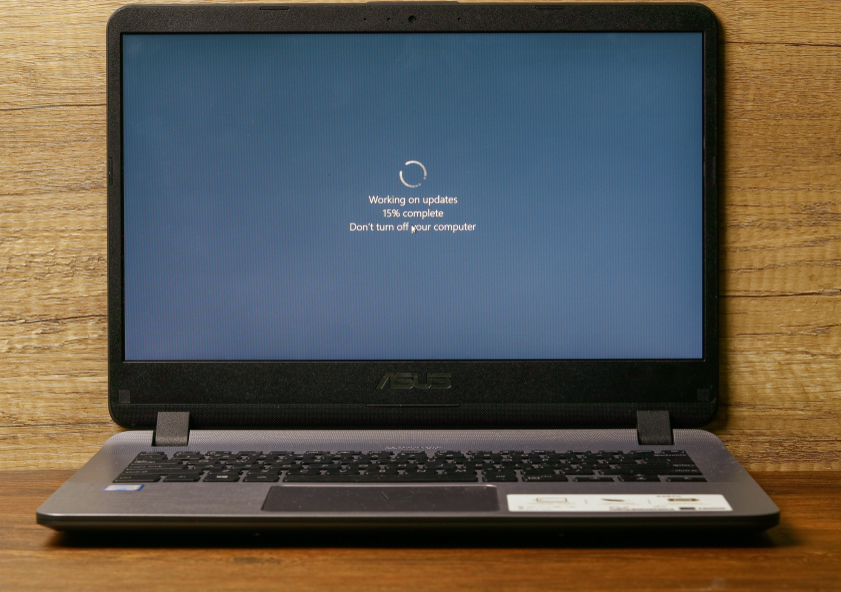
On initial execution, CornFlake operates in dropper mode: it displays a convincing fake progress window designed to occupy the victim’s attention while the binary copies itself to %APPDATA%\svchost32\svchost32.exe and establishes persistence.
Fake window options configurable by the threat actor at build time:
winupdate — A Windows Update screen displaying “Working on updates… Don’t turn off your computer”
defender — A Windows Security virus scan
directx — A DirectX End-User Runtime Web Installer
vcredist — A Microsoft Visual C++ 2015-2022 Redistributable installer
sysopt — A disk optimization utility
netfix — A Windows Network Diagnostics tool
browser — A browser update prompt
pdfview — A document viewer installer
Figure 4. False update window
CornFlake registers as a Windows service named svchost32 with the display name “Cloud Sync Service” and description “Synchronizes files with the cloud storage provider”, deliberately mimicking the legitimate svchost.exe process. It establishes redundant persistence mechanisms: Windows service registrations, Registry Run keys, named scheduled tasks, and a persistence watchdog routine that runs continuously to restore any persistence mechanism that is removed by defenders or endpoint protection.
For command and control (C2), CornFlake performs an Elliptic Curve Diffie-Hellman (ECDH) P-256 ephemeral key exchange with the C2 server, derives a session key via SHA-256, and communicates over a custom JSON protocol framed within the encrypted channel. This provides an encrypted channel to the C2 server, with each C2 session using a unique ephemeral key, making decryption of captured traffic impossible without the session-specific private key. The runtime configuration file sync.dat supports hot reconfiguration of C2 servers, watched directories, file targeting patterns, and Transport Layer Security (TLS) settings without requiring redeployment.
Once established on a victim system, CornFlake provides the operator with a comprehensive collection toolkit, gated by configuration flags that allow selective activation post-deployment:
Capability
Description
Keylogging
Raw input API-based keylogger capturing all keystrokes, including password fields
Clipboard monitoring
Captures clipboard changes with SHA-256 deduplication and records the active window title at time of capture
Screenshot capture
Idle-triggered and on-demand screenshots with configurable idle threshold
Audio surveillance
Windows Audio Session API (WASAPI)-based microphone capture, encoded as WAV files
Video surveillance
Media Foundation-based webcam capture, encoded as JPEG
Browser credential theft
ChromeKatz-derived module supporting live cookie extraction from process memory (Chromium browsers) and stored password extraction from on-disk databases, including Chrome App-Bound Encryption (ABE) bypass and Firefox NSS/SDR decryption
File exfiltration
Targets files based on file extensions with real-time file system monitoring and an upload throttle (1,000 files or 500 MB per cycle). File extensions are categorized as Documents, Archives, Images, Code, Data, Emails, and Keys
USB drive monitoring
Detects and scans removable media when inserted
Security posture sweep
Collects 18 categories of host intelligence including installed software, antivirus (AV)/endpoint detection and response (EDR) products, Defender exclusions, User Account Control (UAC) level, Remote Desktop Protocol (RDP) history, Office most recently used (MRU) files, and credential hints
Remote shell
Arbitrary command execution via cmd.exe or PowerShell (with -NoP flag to suppress profile-based detection)
CornFlake also exposes a localhost HTTP API server (/upload, /reload, /status) that transforms the RAT into a modular platform: companion or next-stage payloads such as ChocoShell could task file exfiltration, trigger configuration hot reloads or check C2 connectivity using the pre-established secure C2 channel for communication.
ChocoShell: PowerShell infostealer
ChocoShell is the campaign’s Powershell-based infostealer, delivered and executed entirely in-memory. Its primary objective is the high-volume theft of browser session cookies, saved passwords, Microsoft 365 Single Sign-On (SSO) tokens, and Wi-Fi credentials from compromised systems. Where CornFlake provides the operator with a persistent, long-running foothold on the device, ChocoShell is designed to extract the most operationally valuable credentials, giving the operator access to victim cloud environments.
The ChocoShell script was authored with full developer comments that reveal the operator’s intent behind each code decision, including explicit references to Microsoft detection signatures and the reasoning behind specific evasion choices. The consistent coding standard and descriptive commentary suggest the author might have leveraged AI-assisted code generation.
Defense evasion. Upon execution, ChocoShell beacons to a hardcoded C2 server at 213.145.86[.]112 and implements several evasion techniques in sequence. It disables the Antimalware Scan Interface (AMSI) via .NET reflection to prevent ScriptBlock scanning and evades Microsoft behavioral detection that triggers on suspicious PowerShell web request cmdlets. A timing-based sandbox detection check is also employed as a virtual machine (VM) detection mechanism, silently exiting without performing any collection if detected.
C2 communication. ChocoShell communicates with its C2 server using HTTPS with URI paths designed to blend in with legitimate web traffic. Beacons use /t/pixel.gif?m=<status>, mimicking an image tracking pixel. Additional tooling is fetched from /cdn/chunks/polyfill-7e2b.min.js, disguised as a JavaScript polyfill file. This downloaded module is Base64-decoded and executed in memory via [ScriptBlock]::Create(), providing browser encryption key extraction capabilities, SYSTEM token impersonation, and Defender signature locking. Exfiltrated data is sent by POST to /t/event as GZip-compressed, Base64-wrapped JSON.
Privilege escalation. ChocoShell requires administrative privileges for its most impactful capabilities: SYSTEM token impersonation for Chrome ABE decryption, Volume Shadow Copy Service (VSS) shadow copy creation, Defender signature locking. It implements three silent UAC bypass techniques with ordered fallback:
SilentCleanup task hijack: Writes a malicious command to HKCU\Environment\windir, then triggers the built-in SilentCleanup scheduled task, which resolves %windir% from the user’s environment, executing the threat actor’s command at elevated privilege. The registry value is cleaned up after two seconds to avoid cloud detection.
wsreset.exe COM hijack: Creates a COM handler key in HKCU\Software\Classes and launches the auto-elevating Windows Store reset tool.
sdclt.exe folder hijack: Hijacks HKCU\Software\Classes\Folder\shell\open\command and launches the Windows Backup utility with the /KickOffElev flag.
If none of the silent bypasses succeed (for example, the user is not a local administrator), ChocoShell falls back to a visible UAC prompt via Start-Process -Verb RunAs. Notably, the script also contains a variant designed to execute within the WinGet Desired State Configuration (DSC) host process (ConfigurationRemotingServer), suggesting an attack vector through malicious WinGet DSC configuration used in Windows machine provisioning.
Credential and session theft. Once running with elevated permissions, ChocoShell locks Defender signature updates and systematically harvests data from multiple sources. For Chromium-based browsers (Chrome, Edge, Brave, Opera, Opera GX, Vivaldi), it extracts the master encryption key from the browser’s Local State file, handling both the modern ABE scheme (Chrome v127+) and the legacy data protection API (DPAPI)-only scheme. ABE decryption requires SYSTEM-level DPAPI access, which the malware obtains by impersonating a SYSTEM process token borrowed from winlogon.exe, wininit.exe, or services.exe. Locked browser SQLite databases are accessed through three strategies: shared file access, Volume Shadow Service snapshots, and direct copy as a fallback.
As a parallel collection path, ChocoShell launches Chrome, Edge, and Brave with the –remote-debugging-port flag and issues Network.getAllCookies through the Chrome DevTools Protocol (CDP). This completely bypasses ABE, enabling the browser to perform its own internal decryption and returns plaintext cookie values. To handle privilege issues (SYSTEM-launched browsers inherit the wrong token), the malware creates transient scheduled tasks with TASK_LOGON_INTERACTIVE_TOKEN to launch the browser under the signed-in user’s session. After extraction, the browser is stopped and relaunched with –restore-last-session to avoid alerting the user.
For Firefox family browsers (Firefox, Waterfox, LibreWolf, Floorp, Zen), the malware copies unencrypted cookies.sqlite databases from each profile. Additionally, ChocoShell collects Microsoft 365 and Azure Active Directory (AD) access tokens, refresh tokens, and Web Account Manager (WAM) tokens from .tbres files in the Token Broker cache. Collection of these tokens represents a significant threat to enterprise environments, as threat actors could replay SSO sessions without browser cookies. Additionally, Wi-Fi credentials are harvested via netsh wlan show profile with key=clear.
Exfiltration and cleanup. All collected data is aggregated into a JSON structure, GZip-compressed, Base64-encoded, and sent by POST to the C2’s /t/event endpoint. After exfiltration, all collected data variables are nulled, garbage collection is forced, VSS shadow copies are deleted via Windows Management Instrumentation (WMI), temporary elevation scripts are removed, and all UAC bypass registry keys (already cleaned during escalation) are verified removed.
FruitStone: Operator C2 panel
FruitStone is the web-based C2 panel that Storm-2945 operators use to manage the entire CaptiveCrunch campaign infrastructure. Implemented as a single-page application (HTML and JavaScript) serving as the front-end of the C2 server with all functionality exposed without authentication, FruitStone provides a centralized dashboard for managing compromised endpoints, building and deploying new campaign payloads, and reviewing all collected data (such as screenshots, keystrokes, browser credentials).
Operational cover. The panel is branded as “CloudSync Console” with a footer reading “Acuity Systems, Inc. — Cloud Infrastructure Portal v3.2.1,” designed to appear as legitimate enterprise cloud management software if the panel URL is discovered by defenders or hosting providers. This masquerading extends to the CornFlake agent’s service name (Cloud Sync Service) and description (“Synchronizes files with the cloud storage provider”), creating a consistent cover story across the toolchain.
Figure 5. CloudSync Console panel masquerade
Session management and multi-operator support. FruitStone uses JSON Web Token (JWT)-based authentication, session revocation, and rate limiting with IP blocking to prevent brute force attacks against the panel sign in. Multiple operators could be provisioned with individual accounts, and all active sessions are visible with IP address, user-agent, and creation time to enable operational security awareness across the operators.
Agent management. The panel displays all registered CornFlake agents in a dashboard with real-time status updates via Server-Sent Events (SSE). Each agent card shows comprehensive system information including hostname, username, OS version, CPU, RAM, disk usage, screen resolution, timezone, domain membership, and camera/microphone presence, all collected during the CornFlake posture sweep. Agents are grouped by country and subnet, with geographic distribution visualized on a map.
Operators could interact with individual agents through:
Remote shell — Interactive cmd.exe or PowerShell command execution with command history
File system browser — Live directory traversal and arbitrary file download from compromised hosts
Collection tasking — On-demand screenshot, process list, keylog buffer flush, clipboard dump, security posture survey, ChromeKatz cookie/password extraction, camera capture, and audio recording
Configuration push — Live runtime reconfiguration of C2 servers, watch paths, and C2 beacon timing
Agent update — In-place implant update by pushing a new CornFlake build to a running agent
Agent kill — Remote termination of the CornFlake implant
Campaign builder. A step-by-step wizard enables operators to configure and build new CornFlake payloads directly from the panel:
Identity — Campaign ID, C2 host and port, HTTP base URL, executable file name (svchost32.exe by default), and dropper type (C dropper at ~19 KB, Go stub at ~8 MB, or standalone self-installer)
File Paths — Configure targeted directories and file extensions by category (documents, archives, images, code, data, emails, encryption keys)
Figure 8. File paths tab
Evasion — Enable garble symbol randomization (for GoLang payloads), XOR string encoding, GZip upload compression, and debug mode
Figure 9. Evasion tab
Infrastructure management. FruitStone provides management interfaces for three layers of supporting infrastructure:
Proxy relays — Multi-proxy C2 relay architecture with TLS certificate tracking (fingerprint, expiry), health checks, connection counts, bytes forwarded, and rotation capabilities that push updated server lists to all online agents
Beacon profiles — Configurable timing profiles controlling agent sleep intervals, reconnection delays, TLS Server Name Indication (SNI) spoofing (like teams.microsoft.com), and DNS fallback domains
Staging servers — External payload hosting infrastructure with push-to-deploy, file listing, and health monitoring
Figure 10. View of the CloudSync staging servers interface
Device code abuse for cloud access
Since July 16, Microsoft has observed a portion of CaptiveCrunch landing pages redirecting users to device code authentication flow experiences. In these cases, users served these landings might be instructed to enter a device code into a legitimate Microsoft sign-in page, a technique commonly referred to as device code phishing.
Device code authentication is a legitimate OAuth workflow designed for devices that cannot support a traditional sign-in experience. However, threat actors could abuse this flow by initiating an authentication request on behalf of a user then convincing the user to enter an actor-controlled device code into a legitimate Microsoft authentication page. When successful, the victim authenticates the threat actor’s session rather than their own.
This activity is consistent with previously reported device code phishing operations conducted by Midnight Blizzard since August 2024. The observed technique does not appear fundamentally novel; however, integrating device code phishing into captive portal and traffic manipulation operations might increase the likelihood that users perceive the authentication request as legitimate. For additional details on Midnight Blizzard-related device code phishing techniques, see: Storm-2372 conducts device code phishing campaign. To understand other threat actors’ use of device code phishing and associated mitigations, see Inside an AI‑enabled device code phishing campaign.
How to protect against CaptiveCrunch activity
Minimize trust in hospitality and guest networks
When traveling, users should treat hotel, conference, airport, and other guest wireless networks as untrustworthy.
Prefer private connectivity (including mobile hotspots, satellite, and eSIM-based cellular data connections) over public Wi‑Fi whenever practical.
Consider using enterprise-managed travel routers or hotspot devices that establish encrypted tunnels back to trusted corporate infrastructure before accessing sensitive resources.
Avoid downloading software updates, certificates, browser updates, network troubleshooting tools, or security utilities presented through captive portals or other unexpected web prompts.
Verify update requests through trusted operating system mechanisms rather than pop-up messages or website prompts.
Strengthen identity and access controls
Organizations should assume that public and hospitality network infrastructure might not be trustworthy and should adopt controls that limit exposure to traffic manipulation, credential theft, and device code phishing.
Educate users to recognize ClickFix-style prompts, fake verification checks, and paste-and-run instructions as malicious, especially when they invoke command interpreters or script hosts such as cmd.exe, PowerShell, rundll32.exe, or mshta.exe.
Use passwordless solutions like passkeys and implement multifactor authentication (MFA).
Only allow device code flow where necessary. Microsoft recommends blocking device code flow wherever possible. Where necessary, configure Microsoft Entra ID’s device code flow in your Conditional Access policies.
Implement a sign-in risk policy to automate response to risky sign-ins. A sign-in risk represents the probability that a given authentication request is not authorized by the identity owner. A sign-in risk-based policy can be implemented by adding a sign-in risk condition to Conditional Access policies that evaluates the risk level of a specific user or group. Based on the risk level (high/medium/low), a policy can be configured to block access or force MFA.
When a user is a high risk and Conditional access evaluation is enabled, the user’s access is revoked, and they are forced to re-authenticate.
For regular activity monitoring, use Risky sign-in reports, which surface attempted and successful user access activities where the legitimate owner might not have performed the sign-in.
Use a Security Service Edge (SSE) solution like Global Secure Access to secure access to any app or resource using network, identity, and endpoint access controls.
Reduce exposure during captive portal registration
Organizations should review what information employees provide to hospitality providers when connecting to guest networks.
Do not reuse corporate credentials on hotel, conference, or guest-network registration pages.
Where possible, organizations should evaluate whether venue-provided wireless is required for corporate events and conferences.
Organizations should minimize unnecessary disclosure of employee identities, organizational affiliations, and travel details when booking accommodations or registering for guest network access, consistent with corporate policy and applicable local requirements.
Microsoft Defender detections and hunting guidance
Microsoft Defender customers can refer to the list of applicable detections below. Microsoft Defender coordinates detection, prevention, investigation, and response across endpoints, identities, email, apps to provide integrated protection against attacks like the threat discussed in this blog.
Microsoft Defender for Endpoint detects Storm-2945 activity under the detection Suspicious activity linked to a Russian state-sponsored threat actor has been detected. However, these alerts might be triggered by unrelated threat actor activity. The following chart lists Microsoft Defender detections specific to the TTPs utilized by Storm-2945 in this attack.
CornFlake registers a Windows service, a Registry Run key, a scheduled task
Microsoft Defender for Endpoint – Suspicious Scheduled Task Process Launched – Suspicious scheduled task – Suspicious file added to run key – Suspicious service registration
Microsoft Defender XDR – User account compromise via OAuth device code phishing – Malicious sign in from an IP address associated with recognized attacker infrastructure – Suspicious Azure authentication through possible device code phishing
Microsoft Security Copilot is embedded in Microsoft Defender and provides security teams with AI-powered capabilities to summarize incidents, analyze files and scripts, summarize identities, use guided responses, and generate device summaries, hunting queries, and incident reports.
Security Copilot is also available as a standalone experience where customers can perform specific security-related tasks, such as incident investigation, user analysis, and vulnerability impact assessment. In addition, Security Copilot offers developer scenarios that allow customers to build, test, publish, and integrate AI agents and plugins to meet unique security needs.
Threat intelligence reports
Microsoft Defender XDR customers can use the following threat analytics reports in the Defender portal (requires license for at least one Defender XDR product) to get the most up-to-date information about the threat actor, malicious activity, and techniques discussed in this blog. These reports provide the intelligence, protection information, and recommended actions to prevent, mitigate, or respond to associated threats found in customer environments.
Microsoft Security Copilot customers can also use the Microsoft Security Copilot integration in Microsoft Defender Threat Intelligence, either in the Security Copilot standalone portal or in the embedded experience in the Microsoft Defender portal to get more information about this threat actor.
Hunting queries
Microsoft Defender XDR
Microsoft Defender XDR customers can run the following advanced hunting queries to find related activity in their networks:
Detect file creation after Wi-Fi connectivity test on devices
The following query checks for a file creation on a device within two minutes of the device performing built‑in Network Connectivity Status Indicator (NCSI) test, which occurs when network connectivity is established to a Wi-Fi network with a captive portal. This activity might indicate an attacker’s initial access file presence on a device.
Please note that not all files discovered through this query might be malicious or related to this threat activity.
let ncsi_endpoints = dynamic(["msftconnecttest.com","edge-http.microsoft.com","msftncsi.com","captive.apple.com","clients1.google.com",
    "clients3.google.com","clients4.google.com","clients6.google.com","connectivitycheck.gstatic.com","connectivitycheck.android.com",
    "android.clients.google.com","www.gstatic.com","detectportal.firefox.com","detectportal.brave-http-only.com","cloudflareportal.com",
    "cloudflarecp.com","cloudflareok.com","connectivity-check.warp-svc","connectivity.cloudflareclient.com","spectrum.s3.amazonaws.com",
    "nmcheck.gnome.org"]);
let NCSIEvents = DeviceNetworkEvents
    | where Timestamp > ago(7d)
    | where RemoteUrl has_any (ncsi_endpoints)
    | project NCSI_Timestamp = Timestamp, DeviceId, DeviceName, RemoteUrl, NCSI_ReportId = ReportId, NCSI_InitiatingProcessFileName = InitiatingProcessFileName, NCSI_InitiatingProcessCommandLine = InitiatingProcessCommandLine, NCSI_AccountName = InitiatingProcessAccountName;
let FileDownloadEvents = DeviceFileEvents
    | where Timestamp > ago(7d)
    | where ActionType == "FileCreated"
    | where FileName has_any (".exe",".msi",".zip",".rar",".7z")
    | project Download_Timestamp = Timestamp, DeviceId, FileName, FolderPath, Download_ReportId = ReportId, Download_InitiatingProcessFileName = InitiatingProcessFileName, Download_InitiatingProcessCommandLine = InitiatingProcessCommandLine, Download_AccountName = InitiatingProcessAccountName;
NCSIEvents
| join kind=inner (
    FileDownloadEvents
) on DeviceId
| where Download_Timestamp >= NCSI_Timestamp and Download_Timestamp
Detect connectivity to Storm-2945 infrastructure
The following query checks for connectivity to Storm-2945 infrastructure observed in this attack activity.
let target_domains = dynamic(["ms365-device.com", "ms365-live.com", "m365-owa.com", "owa-ms365.com"]);
let target_ips = dynamic(["31.57.243.154", "38.146.28.75", "38.146.28.132", "104.194.159.150", "107.189.26.194", "213.145.86.112"]);
DeviceNetworkEvents
| where RemoteUrl has_any(target_domains) or RemoteIP in (target_ips)
| project
    Timestamp,
    DeviceName,
    DeviceId,
    RemoteUrl,
    RemoteIP,
    LocalIP,
    InitiatingProcessFileName,
    InitiatingProcessCommandLine,
    AccountName = InitiatingProcessAccountName,
    ReportId
Detect CornFlake RAT presence on affected systems
The following query checks for the presence of the CornFlake RAT binary.
The following query checks for the CornFlake RAT Windows service registration.
DeviceRegistryEvents
| where RegistryKey has @"\SYSTEM\CurrentControlSet\Services\svchost32"
| where ActionType == "RegistryValueSet"
| where (RegistryValueName == "DisplayName" and RegistryValueData == "Cloud Sync Service")
    or (RegistryValueName == "Description" and RegistryValueData == "Synchronizes files with the cloud storage provider")
| project
    Timestamp,
    DeviceName,
    DeviceId,
    RegistryKey,
    RegistryValueName,
    RegistryValueData,
    ActionType,
    InitiatingProcessFileName,
    InitiatingProcessCommandLine,
    InitiatingProcessAccountName,
    ReportId
Microsoft Sentinel
Microsoft Sentinel customers can use the TI Mapping analytics (a series of analytics all prefixed with ‘TI map’) to automatically match the malicious domain indicators mentioned in this blog post with data in their workspace. If the TI Map analytics are not currently deployed, customers can install the Threat Intelligence solution from the Microsoft Sentinel Content Hub to have the analytics rule deployed in their Sentinel workspace.
Detect network IP and domain indicators of compromise using ASIM
The following query checks IP addresses and domain IOCs across data sources supported by ASIM network session parser:
//IP list and domain list- _Im_NetworkSession
let lookback = 30d;
let ioc_ip_addr = dynamic(["213.145.86.112"]);
let ioc_domains = dynamic(["213.145.86.112/t/pixel.gif", "213.145.86.112/cdn/chunks/polyfill-7e2b.min.js", "213.145.86.112/t/event"]);
_Im_NetworkSession(starttime=todatetime(ago(lookback)), endtime=now())
| where DstIpAddr in (ioc_ip_addr) or DstDomain has_any (ioc_domains)
| summarize imNWS_mintime=min(TimeGenerated), imNWS_maxtime=max(TimeGenerated),
  EventCount=count() by SrcIpAddr, DstIpAddr, DstDomain, Dvc, EventProduct, EventVendor
Detect web sessions IP and file hash indicators of compromise using ASIM
The following query checks IP addresses, domains, and file hash IOCs across data sources supported by ASIM web session parser:
//IP list - _Im_WebSession
let lookback = 30d;
let ioc_ip_addr = dynamic(["213.145.86.112"]);
let ioc_sha_hashes =dynamic([“918fa52ae45ed60ba7cc8bdc99c3cbe9ab92e0375ec31fc05d0d4513be11c593”, “be99857449d2856dd5a84e21c8a3d5e0e01456adb44062ddec5a6b4970d8d42c”]);
_Im_WebSession(starttime=todatetime(ago(lookback)), endtime=now())
| where DstIpAddr in (ioc_ip_addr) or FileSHA256 in (ioc_sha_hashes)
| summarize imWS_mintime=min(TimeGenerated), imWS_maxtime=max(TimeGenerated),
  EventCount=count() by SrcIpAddr, DstIpAddr, Url, Dvc, EventProduct, EventVendor
Detect domain and URL indicators of compromise using ASIM
The following query checks domain and URL IOCs across data sources supported by ASIM web session parser:
// file hash list - imFileEvent
// Domain list - _Im_WebSession
let ioc_domains = dynamic(["https://213.145.86.112/t/pixel.gif", "https://213.145.86.112/cdn/chunks/polyfill-7e2b.min.js", "https://213.145.86.112/t/event"]);
_Im_WebSession (url_has_any = ioc_domains)
ChocoShell C2 communications
The following query detects ChocoShell communications with its C2 server using HTTPS with URI paths designed to blend in with legitimate web traffic. Beacons use /t/pixel.gif?m=<status>, mimicking an image tracking pixel.
let lookback = 30d;
let ioc_url_artifacts = dynamic(["/t/pixel.gif?m="]);
_Im_WebSession(starttime=todatetime(ago(lookback)), endtime=now())
| where DstDomain  in (ioc_url_artifacts)
| summarize imWS_mintime=min(TimeGenerated), imWS_maxtime=max(TimeGenerated),
  EventCount=count() by SrcIpAddr, DstIpAddr, Url, Dvc, EventProduct, EventVendor
To hear stories and insights from the Microsoft Threat Intelligence community about the ever-evolving threat landscape, listen to the Microsoft Threat Intelligence podcast.
The home appliance giant LG Electronics USA said this week it plans to suspend any apps built for its smart TVs that turn one’s television into an always-on residential proxy node. The move comes less than a month after researchers found that more than 42 percent of games and other apps available for download on LG’s webOS store allow unknown third-parties to route their Internet traffic through a user’s TV.
Proxy SDK prevalence among smart TV apps for LG (webOS) and Samsung (Tizen OS) televisions. Image: Spur.us.
On July 2, we featured research by the security firm Spur that examined the prevalence of residential proxy software development kits (SDKs) in smart TV apps. Spur found more than 42 percent of apps available for download on LG smart TVs include SDKs that turn one’s television in a proxy node indefinitely, and that more than a quarter of the apps made for Samsung’s Tizen operating system had similar residential proxy components.
Responding to questions about Spur’s research, LG Senior Vice President John Taylor told KrebsOnSecurity the company was working with app developers to remove the residential proxy option from their apps on the webOS platform. Developers that fail to comply, he said, will find their apps suspended.
“A residential proxy network is not an intended use for LG smart TVs, and LG Electronics is working with developers to remove the residential proxy option from their apps on the webOS platform,” Taylor said. “If this option is not removed, these apps will be suspended.”
Taylor said LG is committed to keeping residential proxy networks out of its smart TV apps going forward, and that the company’s review of those apps is “well underway now.”
“As part of our ongoing efforts to enhance platform quality and the user experience, LG will continue to strengthen our evaluation process for developer-submitted apps, including those that incorporate residential proxy SDKs,” Taylor wrote in an emailed statement.
App makers looking for ways to monetize their creations can turn to residential proxy providers, which pay developers to include SDKs that turn the user’s device into a residential proxy node that is rented to paying customers. In the case of LG and Samsung smart TVs, Spur found residential proxy SDKs bundled with everything from simple games like Pac-Man to screensavers and file utilities.
A Pac-Man smart TV app from Bright Data offers users the choice between viewing ads in the game or agreeing to allow their TV to serve as a residential proxy node. Image: Spur.us.
Spur’s report found the residential proxy network Bright Data accounted for a majority of proxy SDKs across both Samsung and LG smart TVs. In a statement shared with KrebsOnSecurity, Bright Data said its network is built on consent and responsibility and operates by LG and Samsung terms.
“Every peer opts in through a dedicated screen and receives value in return; every customer is vetted, and our practices have now undergone a second independent audit by PwC,” the statement reads. “We remain committed to an open, transparent internet where legitimate businesses, researchers, and institutions can responsibly access data that lives in the public domain.”
Bright Data and other proxy providers named in Spur’s report all say they follow rigorous know-your-customer processes to validate legitimate uses of their services, which is often heavily tied to content-scraping activities by said customers. The proxy companies also say they incorporate technological countermeasures to prevent proxy service customers from being able to interact with and control other devices on the proxy user’s local network.
Spur argues the problem is not that residential proxy networks exist, but rather that they are being embedded at scale in devices that most consumers do not think of as computers and are not equipped to audit.
“A one-time consent prompt buried in a TV app is not a substitute for meaningful transparency, ongoing control, and platform oversight,” Spur’s Trevor Sutter wrote. “The risk is amplified when consent comes from individuals within the household who use the device but shouldn’t give consent, such as minors.”
LG’s announcement that it is culling residential proxy SDKs from its app store is welcome news, but the company recently came under fire for another questionable partnership: Pimping McAfee security products via software drivers included in its high-end LCD monitors.
Earlier this week, the Youtube channel Gamers Nexus showed that certain LG LCD monitors will automatically install an app that promotes paid McAfee antivirus subscriptions, and that the app arrives through Windows Update without an approval prompt.
Update, July 22, 1:06 p.m. ET: Added statement from Bright Data.
Microsoft Corp. today released software updates to plug at least 570 security holes in its Windows operating systems and other software, almost triple the number of vulnerabilities the software giant fixed in its record-smashing Patch Tuesday release last month. Microsoft attributed the burgeoning patch counts to vulnerability discoveries aided by artificial intelligence.
Nearly 60 of the bugs quashed in July’s Patch Tuesday earned a “critical” severity rating, meaning miscreants or malware could use them to seize remote control over a Windows device with little or no help from the user. Microsoft also addressed three zero-day flaws, including two that are already being exploited in the wild.
Two of the zero-day weaknesses allow an attacker to elevate their user rights on a Windows system, as do approximately 250 other elevation of privilege flaws fixed this month; they include CVE-2026-56155 — an Active Directory Federation Services bug — and CVE-2026-56164, a Microsoft Sharepoint vulnerability.
CVE-2026-50661 is a security feature bypass in Windows BitLocker that could allow attackers to gain access to encrypted data if they have physical access to the device. Microsoft said this bug has been detailed publicly, but that it is not aware of any active exploitation.
In a blog post on July 9, Microsoft Executive Vice President Pavan Davuluri wrote that Windows users will notice “a higher volume of security updates included in each security release” as a result of AI aiding in the discovery of vulnerabilities.
“The pace of vulnerability discovery is changing with advances in AI making it possible to find more issues, faster, across more code, with new mechanisms that can accelerate both discovery and analysis,” Davuluri wrote.
Jack Bicer, director of vulnerability research at Action1, called attention to CVE-2026-48561, a remote code execution flaw in Microsoft Copilot (with a 9.6 CVSS threat score) that allows an unauthorized attacker to execute code over the network. Microsoft says an attacker could exploit this bug by hosting a malicious website that causes Microsoft Edge for Android to automatically send crafted prompts to Copilot when a user visits the site.
As AI advances the state of vulnerability discovery and remediation, it is also making it easier for attackers to quickly devise working exploits for known software flaws. Microsoft has long labeled security bugs using its “exploitability index,” which is Redmond’s best guess as to how likely it is that attackers will be able to figure out a reliable way to exploit a given vulnerability.
But Satnam Narang, senior staff research engineer at Tenable, argues that Microsoft’s exploitability index needs to do a better job of shifting with the machine speed of discovery. For example, Microsoft originally gave this month’s SharePoint zero-day an exploitability rating of “less likely,” although the flaw was added to CISA’s Known Exploited Vulnerabilities list on July 1.
“Anthropic’s Red Team’s own findings for known vulnerabilities (n-days) revealed how fragile this system has become, with its Mythos Preview model being able to produce proof-of-concept exploits for 13 of 14 vulnerabilities that were rated ‘Exploitation Less Likely’ or ‘Exploitation Unlikely,'” Narang said. “What this means is that our way of looking at Patch Tuesday has changed, because the exploitability index is centered around humans, not AI tools, and as these tools continue to improve, defense needs to improve alongside it.”
Chris Goettl at Ivanti observed that the record patch numbers from Microsoft come as a number of other major software makers are increasing their patch cadence, including Adobe which announced today it is moving to twice-monthly security bulletins published on the 2nd and 4th Tuesday of each month (Adobe also cited AI for accelerating their patch cycles). Cisco, Mozilla and Oracle also are shipping updates more frequently, while Google’s patch batches in June 2026 totaled more than 900 security fixes, Goettl noted.
Backing up your Windows system and/or data is always a good idea before applying operating system updates. Given the volume of patches addressed this month it may be wise for end users to wait a few days before applying these fixes. It’s not uncommon for security patches to introduce system stability issues, and those chances probably increase quite a bit with the gigantic patch count released today.
For the past four years, a sprawling Android-based botnet called Popa has forced millions of consumer TV boxes to relay Internet traffic linked to advertising fraud, account takeovers, and mass data-scraping efforts. This week, researchers from multiple security firms concluded that the Popa botnet is linked to NetNut, a “residential proxy” provider operated by the publicly-traded Israeli firm Alarum Technologies Ltd [NASDAQ: ALAR].
Malicious streaming devices sold online that enroll the user’s home Internet address in a residential proxy service. Image: HUMAN Security.
Popa is a massive botnet, but by all accounts it is unlike traditional botnets that enlist compromised systems in destructive activities, such as coordinating huge distributed denial-of-service attacks. Rather, Popa appears designed with a singular purpose: Implementing a persistent communications layer capable of registering a device, maintaining long-lived encrypted connections, and opening communication tunnels on demand.
Experts say Popa is a plugin component associated with the Vo1d botnet, a large-scale malware campaign targeting unofficial Android-based TV boxes. These devices, which are marketed under thousands of brand names and model numbers and broadly available for purchase at top e-commerce destinations, all advertise the ability to stream hundreds of subscription video services for an up front one-time fee.
But as the FBI and security industry experts have warned repeatedly, these streaming boxes typically bundle or come pre-installed with software that turns the user’s TV into a “residential proxy” — allowing anyone to route their Internet traffic through that device for as long as it remains plugged into a wall socket and connected to a local network. More concerning, some of these proxy networks do little to stop malicious customers from communicating with and even compromising systems on the local network of the unsuspecting device owner.
The first clues about Popa’s origins came in a 2025 report from the Chinese security company XLAB, which flagged at least nine domain names that were used to register and direct the activities of compromised devices. In a report released today, the security firm Qurium described how it stumbled on some of those same domains while investigating a series of disruptive and expensive data scraping events targeting the company’s hosted organizations in May 2026, in which the scraping activity was scattered evenly across more than 1.4 million Internet addresses.
Qurium said it found several dozen domains used to control Popa that were all hosted in lockstep across multiple Internet addresses over time, including gmslb[.]net, safernetwork[.]io, tera-home[.]com, and ninjatech[.]io. Digging deeper, Qurium discovered gmslb[.]net was referenced in dozens of pirated or modded video content streaming apps, such as CRICFy, DooFlix, Sprozfy, RTS Tv, Flixoid, CyberFlix, Rapid Streamz, TvMob and HD/OceanStreams.
Qurium’s report notes that most of the domains long used to control the Popa botnet were seized or dismantled in July 2025, after Google, HUMAN Security and Trend Micro teamed up to disrupt Badbox 2.0, a botnet that is closely associated with Vo1d. Qurium said that immediately after that disruption, several dozen new domains were registered to serve as controllers for the Popa botnet, but that one of those control domains was not new: ninjatech[.]io.
Ninjatech is a company founded by Moishi Kramer, whose LinkedIn profile says he is vice president of research and development at NetNut. That resume credits Kramer for helping NetNut to build from the “ground up,” “designing the architecture,” and “scaling the NetNut” before the company was acquired by Alarum Technologies. A self-created listing at the job board F6Sreferences Kramer as the sole owner of the Ninjatech domain (a screen capture of it is pictured below).
Image: F6S.com.
Responding via email, Mr. Kramer said Ninjatech ceased operations approximately five years ago, when the company sold a software development kit (SDK) called Popa that was designed to use a small portion of a device’s bandwidth and to run only after the host application obtained user consent.
“That code was sold and licensed to third parties including resellers years ago,” Kramer said. “Once software is distributed that way, the original developer has no control over how others later modify, rebrand, or deploy it.”
Kramer said neither he nor NetNut builds, operates or maintains the infrastructure being described as Popa, nor does he control the Ninjatech domain.
“I didn’t register the June 2025 domains you mention, and I don’t know who did,” he continued. “I have no control over, or visibility into, that infrastructure. I can only tell you it isn’t operated by me or by NetNut.”
But in a separate Popa research report released today, the proxy-tracking company Synthient said a recent analysis of the Popa SDK revealed outbound traffic clearly associated with NetNut.
“The research team assesses with high confidence that devices running Popa forward traffic from Netnut clients,” Synthient wrote. “This proves without a shadow of a doubt that Popa actively continues to be used by NetNut as part of their proxy pool.”
Synthient’s platform receiving outbound traffic from Popa. Image: Synthient.com.
Alarum Technologies, NetNut’s Tel Aviv-based parent company, said the reports by Synthient and Qurium contained “demonstrably inaccurate assertions and flawed deductions rather than verified facts.” Alarum shared a statement saying they reject the basic characterization of the SDKs and technologies discussed in the reports as a “botnet.”
“The SDKs at issue are designed to facilitate bandwidth-sharing functionality and do not transform user devices into malware-controlled systems or otherwise compromise the devices on which they operate,” the statement reads. “Netnut operates a commercial proxy network and maintains policies, procedures, and technological measures designed to promote lawful and responsible use of its services.”
Alarum said NetNut places “significant emphasis on appropriate notice and consent mechanisms, conducts customer due diligence, monitors for potential misuse, and takes steps intended to detect and mitigate suspicious or unauthorized activity.”
“This method of operation is supported both by internal procedures and policies, including performing KYC checks and additional due diligence of NetNut’s customers, as well as employing various technological measures, designed to assist in identifying and addressing suspected misuse of the network,” their statement continued.
However, in a report released on June 8, the proxy tracking service Spur asserted that NetNut does not require corporate verification or meaningful “know your customer” procedures before allowing customers to purchase proxy access.
“An individual can sign up, pay, and route traffic through partner address space, including space belonging to institutions whose users never opted in,” Spur wrote. “The ‘verified corporations only’ claim is simply marketing for bandwidth sellers, not an access control on who actually uses the proxies.”
“Nor is NetNut the only front door,” Spur continued. “A number of downstream white labelers and resellers repackage the same ISP proxy pool under their own brands. These outlets typically perform no KYC at all, less scrutiny than NetNut itself, who at the very least might assign an account manager to potential users. Anyone who knows where to look can buy access through a reseller with nothing more than a burner email address and $5 in crypto.”
Synthient found that although the most recent builds of Popa (as of three months ago) have added the ability to ask the user for consent before installing proxy components, not all variants or previous versions of Popa contain this functionality.
“Of the over 20 genuine Popa publishers analyzed, none of them were observed asking for user consent,” Sythient wrote.
THE PREVALENCE OF POPA
Chris Formosa is senior lead information security engineer for Black Lotus Labs, a division of the Internet backbone carrier Lumen Technologies.
“What especially makes Popa dangerous is just how widely used NetNut is for reselling and sharing,” Formosa said, explaining that many other proxy services simply resell NetNut proxies rather than building out their own far-flung proxy networks. “So these Popa IPs appear in tons of different services all over the ecosystem, which makes it one of the most problematic and dangerous proxy botnets on the market currently.”
Formosa said the Popa botnet averages between 1.5 million to 2.5 million distinct IP addresses each day, relying on between 250 and 300 Internet addresses that are used to direct its activities.
“That’s why Popa is so dangerous,” Formosa said. “It may not be the largest botnet we have seen, but it is spread all over the industry, making its power very amplified.”
Formosa said while that makes Popa one of the larger botnets out there today, its numbers pale in comparison to those previously boasted by IPIDEA, a China-based proxy provider that until recently operated a daily pool of nearly 10 million devices that they resold as proxies to anyone. In January 2026, Synthient published research showing that multiple new large DDoS botnets had grown rapidly by tunneling through IPIDEA proxies into the local networks of unsuspecting TV box owners and infecting other Android-based devices behind the user’s firewall.
IPIDEA is based largely on SDKs used to view pirated streaming content on a vast number of TV box devices, but the service’s numbers have dwindled since January, when Google and industry partners took legal action to seize domain names that IPIDEA used to control devices and proxy traffic through them.
Jérôme Meyer, a security researcher at Nokia Deepfield, said the total population of devices participating in the Popa botnet may be far higher than Lumen’s estimates. Meyer told KrebsOnSecurity that Nokia is monitoring 26 of at least 359 known relay nodes for the botnet, and estimates that each relay node handles between 35,000 and 60,000 clients simultaneously.
“On the relay node subset I am looking at (26 of them), 750,000 unique sources in 24 hours,” Meyer wrote in response to questions.
Nokia Deepfield released its own report today on RoboVPN, a VPN app tied to the Vo1d botnet’s Popa plugin that Qurium attributes to NetNut/Alarum Technologies.
THE SYMBIOSIS OF PROXIES AND DATA SCRAPING
Experts say many of the world’s largest proxy providers have updated their public-facing branding to highlight their utility for training AI platforms, implying it is a primary use case for their residential proxies. That’s because AI services tend to rely on constantly mass-scraping the Internet for new text, images and video content that can be used to train large language models (LLMs).
NetNut and other proxy services have recast themselves as critical infrastructure for the AI scraping economy. Image: Synthient.com.
“AI companies depend on web-scraped content: for pre-training, for retrieval, for agent grounding, for search,” reads a report this month from Include Security that examines the prevalence of proxy SDKs in smart TV apps. “But the modern web isn’t scrapeable from a datacenter. Cloudflare, DataDome, HUMAN, among others throttle or block requests from known cloud IPs. The workaround is residential proxies. A scraping job routed through a Comcast or T-Mobile subscriber’s connection arrives at the target site from an IP that belongs to a paying residential customer.”
This non-stop content scraping has spawned more than 70 copyright infringement lawsuits against major tech companies that have acknowledged large-scale data scraping as a major source of the “brains” behind their commercial AI offerings. Ironically, much of that scraping is being aided by proxy services that are intimately tied to unofficial Android TV boxes and associated SDKs whose stated purpose is streaming pirated content.
The scraping activity has become so aggressive that it often overwhelms the targeted websites, preventing them from being reachable by legitimate visitors. In many reported cases, nonprofit organizations, libraries and universities have complained of constantly battling to keep their services online in the face of relentless data-scraping firms hiding behind residential proxy services.
A survey conducted last year by the Confederation of Open Access Repositories (COAR) found while some content scraping bots are rather innocuous, “others are sufficiently aggressive that they are increasingly causing service disruptions in repositories and other scholarly communications infrastructures.” More than 90 percent of survey respondents indicated their repository is encountering aggressive bots, usually more than once a week, and often leading to slow downs and service outages.
“Automated web scraping is nothing new, and has been the key technology underlying search engines such as Google for over 30 years,” wroteBrendan O’Connell, platform manager at the Directory of Open Access Journals (DOAJ), a free, community-curated index of peer-reviewed academic journals. “However, the current investor-fueled AI startup craze means there are now thousands of well-funded companies developing and deploying their own scraping tools to train AI models, alongside existing major players like OpenAI and Google.”
DON’T TOUCH THAT DIAL!
Across the United States, local communities are pushing back against the proliferation of new data centers aimed primarily at improving the capabilities of AI. But security experts say the general public remains largely unaware that using one of these unsanctioned Android TV boxes means their “smart TV” is almost certainly using a significant amount of bandwidth each month to help train modern AI models.
Even households without these sketchy TV boxes can still have their smart TVs turned into residential proxy nodes, just by downloading one of thousands of apps made available on Samsung and LG smart TVs. Spur said it recently scraped the LG and Samsung app stores and found that each had approximately 3,000 apps available for download. Many of these apps are simple games or utilities that state in the fine print that the user’s Internet connection will be used to download data and that they can opt out at any time.
Spur said it found that more than 42 percent of apps available for download via the webOS operating system on LG smart TVs include SDKs that turn one’s television into an always-on residential proxy node. More than a quarter of the apps made for Samsung’s Tizen operating system had similar residential proxy components, Spur found.
Image: Spur.us.
Experts say it’s questionable whether TV apps with proxy SDKs can obtain meaningful consent from users for installing an always-on proxy connection, particularly when anyone in a household — including children — can effectively opt the family TV into a residential proxy network just by installing a simple game or app.
“Privacy-policy disclosure is the wrong control surface for a TV,” Include Security wrote. “It is hard to scroll through a legal document navigated by arrow keys on a remote, and the in-app consent dialog doesn’t convey that a paying customer is about to route their scraping traffic through the user’s home internet.”
Spur’s head of research Sean Simmons told KrebsOnSecurity that most people do not have a working mental model for what it means to sell access to their residential IP address, no matter what device they are using.
“And on a TV, the gap is even wider,” Simmons said. “A one-time prompt navigated with a remote can disappear into the setup flow, while the app keeps monetizing the connection long after anyone remembers what they accepted.”
Simmons said LG and Samsung should follow the lead of other TV platforms that have already drawn a line against residential proxy providers, pointing to policies by Amazon that prohibit apps facilitating proxy services for third parties. Likewise the TV streaming device maker Roku reportedly now bars developers from using proxy SDKs and has removed apps that bundled them.
Apps that turn one’s device into a residential proxy node are not limited to smart TVs and no-name streaming boxes, of course. As noted by the security firm Infoblox, mobile app developers can embed SDKs provided by the residential proxy networks into their products to monetize their software, allowing them to receive a small amount of money on each installation.
The result, Infoblox said, is that devices are frequently enrolled without the owner’s knowledge, typically through free applications such as VPNs, streaming apps, screensavers and “productivity” apps such as PDF viewers and break reminders.
All too often, these proxy services are beaconing out from employee devices brought into the workplace, Infoblox found. In a blog post earlier this month, Infoblox said it discovered that fully 65% of its customer base was querying one or more residential proxy related domains.
“We saw steady growth in these queries in 2025, with a 25% increase over the year to over 500 billion per month,” Infoblox wrote. “Over 90% of our pharmaceutical and food & beverage customers have queried residential proxy indicators. Perhaps even more concerning is that over 60% of government and banking customers have as well.”
Infoblox researchers Nick Sundvall and David Brunsdon warned that with residential proxies in the corporate environment, external access is granted to an organization’s IP space.
“If threat actors were to abuse the residential proxy to attack a third party, the third party’s incident response would, correctly, identify your residential proxy as the source,” they wrote. “Untangling that, by proving that you were the conduit and not the threat actor, costs time, creates legal exposure, and can damage your reputation. The stunning prevalence of these services within customer environments warrants attention from both network defenders and policy makers who should consider how the risks posed by residential proxies could be impacting their security posture.”
Microsoft today released software updates to plug nearly 200 security holes across its Windows operating systems and supported software, a record number of fixes for the company’s monthly Patch Tuesday cycle. Nearly three dozen of those bugs earned Microsoft’s most dire “critical” rating, and exploit code for at least three of the weaknesses is now publicly available.
The software giant said in a blog post last month that both its engineers and the security community are increasing using artificial intelligence tools to find bugs, meaning this month’s heavy Patch Tuesday may start to become the norm, said Satnam Narang, senior staff research engineer at Tenable.
“Some surveys put AI usage among security professionals generally at 90%, so it’s unsurprising that this volume of patches may be the norm,” Narang said. “Pandora’s proverbial box has been opened, and as more advanced AI models become available, we expect the norm to continue upward across the board, not just for Patch Tuesday.”
June’s zero-day bugs include CVE-2026-49160, a denial of service vulnerability affecting a range of web servers, including Microsoft Internet Information Services (IIS). Microsoft says the flaw was reported by OpenAI’s Codex.
Two of the zero-days addressed this month appear to stem from recent vulnerability disclosures by Nightmare Eclipse, the nickname chosen by a security researcher who has been dropping exploits for various Windows flaws. One of those, dubbed “GreenPlasma,” leverages an elevation of privilege weakness in the Windows Collaborative Translation Framework, the same framework patched today in CVE-2026-45586.
Nightmare Eclipse also last month released “YellowKey,” an exploit for a Windows BitLocker vulnerability that allows an attacker with physical access to view encrypted data, and CVE-2026-50507 is a patch for an elevation of privilege bug in BitLocker.
Microsoft received heavy blowback on social media last month after it said in a blog post that it was considering taking legal action against the security researcher. The company later clarified on Twitter/X that while it has no intention of pursuing legal actions against researchers, it would report them to authorities if they break the law. The advisories for CVE-2026-49160 and CVE-2026-50507 do not credit any researchers in the acknowledgement section, saying only that “Microsoft recognizes the efforts of those in the security community who help us protect customers through coordinated vulnerability disclosure.”
Nightmare Eclipse claims to be a former employee of Microsoft, although Microsoft has not responded to questions about this claim. Rapid7 notes that a recent blog post by Nightmare Eclipse included an image of Albert Wesker, a character from the Resident Evil video game series who formerly worked as a researcher for a technology company before going rogue.
Nightmare Eclipse has pledged to release even more zero-day exploits for Windows in what they called a “bone shattering” drop planned for July 14 (the same day as next month’s Patch Tuesday). Immediately following the release of Microsoft patches today, the researcher published an exploit for what they claimed was a zero-day bug in Windows Defender.
While 200 vulnerabilities may be a record for Patch Tuesday, the actual number of security flaws Microsoft addressed this month is far higher, said Rapid7’s Adam Barnett.
“So far this month, Microsoft has provided patches to address 360 browser vulnerabilities, which is an order of magnitude more than has been typical in any given month over the past few years,” Barnett wrote. “As usual, browser [flaws] are not included in the Patch Tuesday count above. Indeed, the vast, and presumably sustained, uptick in the number of browser vulnerabilities has led to Microsoft no longer enumerating Chromium CVEs in the Security Update Guide.”
Microsoft also patched a zero-day vulnerability in Visual Studio Code that allows attackers to steal GitHub tokens with a single click. The company was forced to push a stopgap fix for the flaw on June 3, after a researcher published instructions showing how to exploit it. The researcher said they opted not to work with Microsoft because of a recent experience wherein Redmond silently patched a flaw they reported without offering credit or recognition.
Microsoft battled its own internal zero-day emergencies last week, after at least 72 of the company’s public code repositories were infected with a variant of the Shai-Hulud worm. Researchers found that all of the affected packages were connected to Microsoft official Azure Durable Task SDK, which got hit by the same Shai-Hulud worm in May.
Other major software makers are also shipping outsized update bundles this month. Adobe has released updates to fix a massive number of critical vulnerabilities across a range of products, including Adobe Experience Manager, Acrobat Reader and Cold Fusion. On June 3, Google resolved a whopping 429 vulnerabilities in its latest Chrome browser update (Chrome automatically downloads updates but installing them usually requires a complete restart of the browser).
As ever, please consider backing up your data before applying operating system updates, and drop a note in the comments if you run into any problems with this month’s patches.
The Instagram accounts for the Obama White House and the Chief Master Sergeant of the U.S. Space Force were briefly defaced with pro-Iranian images and messages over the weekend, after instructions began circulating on Telegram showing how to trick Meta’s “AI support assistant” bot into resetting account passwords.
A screenshot from a video released on Telegram claiming to show how Meta’s AI customer support bot could be tricked into resetting a target’s password.
On May 31, word began to spread on several Telegram instant message channels that Meta’s AI bot would happily add an email address to an existing account as part of the bot’s standard password reset flow.
A video released on Telegram by pro-Iran hackers claimed to document a remarkably simple exploit that appears to have involved using a VPN connection with an IP address that is in or near the target’s usual hometown, requesting a password reset for the account, and then choosing to chat with Meta’s AI support assistant. From there, the video shows the attacker told the bot to link the account in question to a new email address, after which the bot dutifully sent that address a one-time code that allowed a password reset.
The Telegram account that posted the video also linked to screenshots of pro-Iran images, videos and messages that defaced the hacked Instagram accounts, saying hackers had used the exploit to hijack a number of valuable (read: short) Instagram account names that allegedly have a resale value of more than a half million dollars.
Meta has not responded to requests for comment on the video’s claims, but Meta’s Andy Stone said on Twitter/X that the issue had been resolved and that they were securing impacted accounts. The security blog thecybersecguru.com reports that Meta pushed an emergency patch over the weekend, and clarified that no back end database was breached.
“Instagram has notoriously poor human support infrastructure,” Cybersecguru wrote. “Recovering a locked account – especially a high-value one can take weeks of back-and-forth with an automated ticketing system. Meta’s solution was to deploy a conversational AI layer to handle common recovery workflows: relinking a lost email address, triggering a password reset, verifying account ownership. The assistant, presumably, was supposed to reduce friction for legitimate users stuck in account-access hell.”
Ian Goldin, a threat researcher at Lumen’s Black Lotus Labs, said we’re entering unchartered security territory as more large online platforms start allowing AI chatbots to handle sensitive account recovery requests. Just like human customer support employees can be social engineered into providing unauthorized access to someone’s account, AI bots are equally eager to help and vulnerable to persuasion and trickery, he said.
“AI chatbots create interesting new attack surface, and we’re likely going to see a lot more of these kinds of attacks,” Goldin said.
Securing your various online accounts means taking full advantage of the most secure form of multi-factor authentication (MFA) offered (such as a passkey or security key). In this case, even using the least robust form of MFA that Instagram offers — a one-time code sent via SMS — likely would have blocked the exploit: The hackers who released the video on Telegram said their exploit failed to work against any accounts that had MFA enabled.
Ransomware that combines robust encryption with rapid lateral movement significantly increases the risk and impact of an attack. The Gentlemen ransomware is a ransomware-as-a-service (RaaS) threat that is distinguished by its ability to pair its strong per-file encryption with an aggressive self-propagation capability designed to enable broad network compromise. In addition to using per-file ephemeral Curve25519 keys with XChaCha20 stream cipher, The Gentlemen ransomware attempts to spread across an environment using series of simultaneous, distinct lateral movement methods, increasing the likelihood of widespread impact once initial access is achieved.
Microsoft Threat Intelligence tracks the operators behind the ransomware as Storm-2697, a financially motivated threat actor that manages the RaaS platform known as “The Gentlemen” while affiliates carry out attacks. Emerging around mid-2025, The Gentlemen initially started as a closed ransomware group then began offering its RaaS to affiliates in September 2025. More recently, The Gentlemen operators established an official partnership with BreachForums, a popular cybercriminal marketplace, to recruit affiliates including penetration testers and initial access brokers. Given that The Gentlemen is already a widely adopted RaaS platform, this partnership may lead to increased activity as the program becomes accessible to a broader pool of threat actors.
The operators behind the ransomware use double extortion tactics, encrypting data while also exfiltrating sensitive information to pressure victims through the threat of public release if the ransom is not paid. The ransomware is written in Go and obfuscated with Garble to target the Windows environment. Microsoft has observed The Gentlemen ransomware impacting organizations across education, transportation, healthcare, and financial industries in North America, South America, Europe, Africa, and Asia.
In this blog, we present a detailed analysis of the Gentlemen ransomware encryptor, including its execution flow, defense evasion behaviors, encryption design, and lateral movement techniques. This research is intended to provide defenders, incident responders, and the broader security community with a better understanding of how the threat operates, from initial argument parsing and defense evasion, through its file encryption internals, to the full lateral movement that enables it to propagate across the network. We also provide mitigation guidance, Microsoft Defender detections, hunting queries, and indicators of compromise (IOCs) to help organizations defend against this threat and similar ransomware activity.
Pre-encryption
Command-line argument processing
The ransomware operator can control The Gentlemen encryptor through command-line arguments. A password is required for execution, and optional arguments allow the operator to specify encryption scope, speed, lateral movement, and post-encryption behaviors.
The binary accepts the following arguments:
Command-line argument
Description
--password <password>
Required access password (build-specific)
--path <list of paths>
Comma-separated list of target directories or file paths
--T <minutes>
Delay in minutes before file encryption begins
--silent
Silent mode. Disable renaming files, changing timestamps after encryption, and setting the desktop wallpaper
--system
Encrypt files as SYSTEM, targeting only local drives
--shares
Encrypt only mapped network drives and available Universal Naming Convention (UNC) shares
--full
Two-phase encryption by relaunching itself as two separate processes, one with --system for local drives and one with --shares for network shares
--spread <domain/user:password>
Enable self-propagation. Accept credentials for lateral movement. If no credential is provided, the current session token is used for lateral movement.
--ultrafast
Encrypt 0.3% per chunk (~0.9% total for large files)
--superfast
Encrypt 1% per chunk (~3% total for large files)
--fast
Encrypt 3% per chunk (~9% total for large files)
--keep
Disable self-delete after file encryption completes
--wipe
Wipe free disk space after encryption
The --full command-line argument appears to be the intended mode of operation for comprehensive file encryption on the infected device. When this argument is provided, the malware spawns two child processes of itself: one appended with the argument --system to encrypt local volumes under a SYSTEM-privileged scheduled task, and one appended with the argument --shares to encrypt network shares. This separation ensures that the malware can reach both local drives (which might require SYSTEM privileges) and mapped network shares (which are only visible in the user’s session).
Figure 1. Encryption mode command-line arguments
The speed arguments (--fast, --superfast, --ultrafast) are mutually exclusive and control how much of each large file is encrypted. When no speed flag is specified, the default per-chunk percentage is 9%. These flags only affect files that are larger than 1 MB, and small files are fully encrypted regardless of the speed setting.
Usage prompt
When the encryptor is executed with no command-line argument, the malware prints a branded usage banner to the console.
It first executes the following PowerShell commands to render a console header:
This is followed by a detailed usage prompt provided by the malware author that documents all available flags with descriptions and examples:
Figure 2. The Gentlemen ransomware’s usage prompt
It is worth noting that the file size percentages listed in the usage prompt refer to the total file encryption amount. Internally, the malware encrypts three separate chunks, and the per-chunk percentage used in the code is: fast=3%, superfast=1%, ultrafast=0.3%, default=9%.
Password check
Before executing its primary functionality, the malware validates the --password argument against a hardcoded value embedded within the binary. For the sample analyzed in this blog, the expected password is “9VoAvR7G”. If the provided password does not match, the malware outputs bad args and terminates execution.
This password check is a simple operator authentication mechanism, with each build containing a unique embedded password. Its purpose is to restrict execution to authorized operators and reduce the risk of accidental or unauthorized detonation if the binary is recovered or intercepted. However, because this validation relies on a static comparison, it can be easily identified and bypassed through static analysis techniques.
System encryption: Privilege escalation
When the --system argument is provided (either directly or via the --full argument), the malware creates a scheduled task to re-execute itself as SYSTEM. If a delay value is also specified through the --T argument, the scheduled execution time is adjusted accordingly.
To relaunch itself as SYSTEM, it issues the following sequence of commands:
The malware can only perform this task if it’s executed from an account with administrator privilege. It first deletes any existing task named gentlemen_system to avoid conflicts, creates a new one-time task that runs its binary under the SYSTEM account, and finally triggers that task.
This sequence ensures a clean state by first removing any existing task with the same name (gentlemen_system), creating a new scheduled task that executes the ransomware binary with SYSTEM-level privileges before finally triggering its immediate execution.
When running within this scheduled task context, the malware sets the environment variable LOCKER_BACKGROUND=1. This variable functions as an internal execution flag, indicating that the process is operating as a background encryption worker with elevated privileges, rather than as the original operator-invoked instance.
Defense evasion
Before starting file encryption, the malware executes a sequence of commands to disable defensive controls and remove potential forensic artifacts.
Disable Microsoft Defender
The PowerShell commands disable Microsoft Defender real-time monitoring to remove active protection on the infected device. The malware then adds its own executable to the Defender exclusion list to avoid detection. Finally, it excludes the entire C:\ volume from scanning, reducing the likelihood of subsequent detection during file encryption.
Delete shadow copies and event logs
To further impede recovery efforts, the malware deletes all Volume Shadow Copies using both vssadmin and wmic (Windows Management Instrumentation command-line utility). It then clears the System, Application, and Security event logs using wevtutil to remove key audit trails.
Delete forensics artifacts
These commands remove a variety of forensic artifacts, including prefetch files that track program execution, Defender diagnostic and support logs, and Remote Desktop Protocol (RDP) logs.
Additionally, the malware manually deletes PowerShell command history across all user profiles by removing the following file:
This action eliminates evidence of previously executed PowerShell commands, further reducing the visibility of execution history and threat actor activity.
Process and service termination
Process termination
The malware stops a list of running processes using the command:
The table below summarizes the different categories and processes being targeted:
Terminating these processes and services serves two primary objectives:
File access and encryption reliability: Many targeted processes/services, such as databases, Office applications, and backup agents, maintain active file locks. By forcibly terminating these processes, the ransomware ensures that locked files become accessible for encryption.
Defense and recovery disruption: By stopping backup services, endpoint protection agents, and remote access tools, the malware reduces the likelihood of real-time detection and data restoration from backups.
Collectively, these behaviors maximize encryption coverage while hindering the environment’s ability to detect, respond to, or recover from the attack.
Persistence
The encryptor can establish persistence for itself through two mechanisms: scheduled tasks and registry keys.
Figure 3. The Gentlemen ransomware’s persistence mechanism
Scheduled tasks persistence
For establishing persistence with scheduled tasks, the malware executes the following sequence of commands:
These commands first remove any pre-existing tasks with the same names, then create two persistence mechanisms that execute automatically at system startup. The UpdateSystem task launches the payload in the SYSTEM security context, while the UpdateUser task launches it in the currently signed-in user’s context. This design increases the likelihood that the ransomware will run after reboot regardless of privilege level or sign-in state.
Registry keys persistence
For establishing persistence with the registry, the malware executes the following sequence of commands:
The GupdateS value under HKEY_LOCAL_MACHINE (HKLM) provides device-wide persistence that allows the malware to run at startup for all users, while the GupdateU value under HKEY_CURRENT_USER (HKCU) provides user-scoped persistence within the current profile. By writing to both registry hives, the malware establishes redundant autorun paths across both system-level and user-level execution contexts.
Together, the scheduled tasks and Run key modifications create layered persistence, ensuring that the encryptor is re-executed after a reboot in both privileged and user-context scenarios.
Network share traversal
When the command-line argument --shares is provided, the malware initiates network share discovery and enumeration. It begins by probing all drive letters A through Z to identify mapped network drives using the following commands:
This sequence discovers any drives that are already mapped in the current user’s session, which are then added to the encryption target list.
To further enhance visibility into the network environment, the malware enables multiple Windows network discovery services and their associated firewall rules using the following commands:
The services enabled as part of this process include:
Function Discovery Resource Publication (fdrespub): Publishes the host’s resources to the network, allowing other systems to detect it.
Function Discovery Provider Host (fdPHost): Hosts provider components responsible for discovering network resources.
Simple Service Discovery Protocol (SSDP) Discovery (SSDPSRV): Enables discovery of Universal Plug and Play (UPnP) devices.
UPnP Device Host (upnphost): Supports the hosting and management of UPnP devices.
Finally, the malware reinforces this configuration by enabling the Network Discovery firewall rule group. This redundancy ensures that firewall restrictions do not limit its network visibility, further maximizing the number of reachable targets for encryption and propagation.
Volume and directory traversal
To enumerate all available volumes on the system, the malware executes the following PowerShell command sequence:
This command queries Windows Management Instrumentation (WMI) for all mounted volumes with drive letter paths and attempts to enumerate Cluster Shared Volumes (CSVs).
Additionally, the malware performs a secondary enumeration routine by iterating through drive letters A through Z while verifying their existence on disk. This brute-force method ensures broader coverage by identifying volumes that might not be retrieved through WMI queries to maximize visibility into all potential encryption targets.
Directory exclusion list
To maintain system stability and avoid disrupting critical operating system components, the malware excludes a predefined set of directories from traversal and encryption. These directories include core Windows system paths, application directories, and locations commonly associated with security and system management:
Extension exclusion list
The ransomware also excludes a set of file extensions associated with system-critical binaries, configuration files, and executable content:
By avoiding executable files, libraries, scripts, and other system-relevant formats, the malware preserves the integrity of the operating environment. This selective encryption model is a common ransomware design pattern, ensuring that the system remains operational enough for the victim to receive instructions and facilitate ransom payment.
File name exclusion list
The specific file names below are also excluded:
The inclusion of README-GENTLEMEN.txt, the ransomware’s ransom note, prevents it from being encrypted during execution. This ensures that the ransom instructions remain accessible to the victim, which is critical for the operator’s monetization workflow.
Ransom note
During directory traversal, the malware drops a ransom note named README-GENTLEMEN.txt in each scanned directory to provide victim-facing instructions.
The note contains identifiers assigned to the victim, communication channels, and guidance on how to initiate contact with the operators.
Figure 4. Ransom note content
File encryption
File ownership
Before encrypting a file, the ransomware modifies the file ownership and access control settings to ensure it has unrestricted write access to the target. This is achieved through the following sequence of commands:
The takeown command recursively transfers ownership of the specified file or directory to the executing user, overriding existing ownership constraints. The icacls command then grants full control permissions to the Everyone security identifier (SID S-1-1-0), applying inheritance flags to propagate these permissions to all child objects. Finally, the attrib command removes the read-only attributes.
Cryptographic scheme
The Gentlemen ransomware implements a hybrid cryptographic design that combines Curve25519 elliptic-curve cryptography with the XChaCha20 stream cipher to achieve efficient and secure per-file encryption.
For each file, the malware performs the following sequence of operations:
Generates a unique ephemeral Curve25519 key pair, consisting of a randomly generated private key and its corresponding public key
Computes the Elliptic-curve Diffie–Hellman (ECDH) shared secret between the ephemeral private key and the operator’s embedded public key
Uses the resulting shared secret as the XChaCha20 key, and derives the nonce from the first 24 bytes of the ephemeral public key
Encrypts the file contents using XChaCha20 with this key and nonce combination
Appends the Base64-encoded ephemeral public key to the file footer to enable subsequent key reconstruction during decryption
Figure 5. The Gentlemen ransomware’s file encryption mechanism
In this sample, the operator’s public key is hard-coded within the binary as a Base64-encoded value:
This design ensures that each file is encrypted with a distinct key and nonce derived from a per-file ephemeral key exchange, eliminating any possibility of key or nonce reuse across files.
During decryption, the decryptor can use the operator’s Curve25519 private key together with the stored ephemeral public key to reconstruct the ECDH shared secret and recover the XChaCha20 key. The nonce is deterministically reconstructed by extracting the first 24 bytes of the recovered ephemeral public key, making separate nonce storage unnecessary.
Overall, this approach provides strong cryptographic isolation between encrypted files while maintaining operational simplicity and efficiency for the threat actor during both encryption and decryption.
Size-based encryption
The malware uses different encryption strategies based on file size:
File size
Encryption behavior
≤ 1 MB (0x100000 bytes)
The entire file content is encrypted
> 1 MB (0x100000 bytes)
Three chunks are encrypted at distributed offsets
Small files that are less than 1MB in size are fully encrypted. This ensures that documents, configuration files, and other small but critical data are completely corrupted. For larger files such as databases, virtual disk images, archives, full encryption would be time-consuming. Instead, the malware encrypts three data chunks distributed across the file, which is sufficient to corrupt the file structure while dramatically reducing encryption time.
After encryption, each affected file is renamed with the appended extension .umc16h. This extension serves as a quick indicator of files already encrypted by the ransomware.
Large file chunking logic
For files larger than 1 MB, the malware performs partial encryption by dividing the file into three non-contiguous chunks distributed across its contents:
The first chunk begins at the start of the file, the second is positioned near the midpoint, and the third is located toward the end. This distribution ensures that even limited encryption is sufficient to corrupt the file structure while minimizing processing time.
Each chunk is encrypted in 64 KB (0x10000) blocks using XChaCha20. To maintain cryptographic separation between chunks, the malware modifies the nonce on a per-chunk basis. Specifically, the last byte of the 24-byte XChaCha20 nonce is XOR-ed with the chunk index (0, 1, or 2), and a new cipher instance is initialized for each chunk using the modified nonce. As a result, chunk 0 uses the original nonce, while subsequent chunks use deterministically altered variants.
Although all chunks for a given file share the same derived encryption key, this nonce mutation ensures that each chunk is processed under a unique keystream, preventing keystream reuse across different regions of the file.
The encryption percentage for each file is determined by the provided speed command-line arguments:
Argument
Per-chunk percent
Total encrypted percent (3 chunks)
(default)
9%
~27%
--fast
3%
~9%
--superfast
1%
~3%
--ultrafast
0.3%
~0.9%
File footer
After encrypting each file, the malware appends a structured footer containing metadata required for identification and decryption. The footer format differs slightly depending on whether the file was fully or partially encrypted.
Small file encryption (files ≤ 1 MB):
Figure 6. Small file footer example
Large file encryption (files > 1 MB):
Figure 7. Large file footer example
The footer serves three primary functions:
Key and nonce reconstruction: The Base64-encoded ephemeral public key, located after --eph--, allows the decryptor to recompute both the XChaCha20 key (using ECDH shared secret) and the nonce (first 24 bytes of the ephemeral public key).
Identification: The GENTLEMEN marker, located after--marker--, serves as a unique identifier, allowing encryptors/decryptors to quickly determine that the file has been encrypted by The Gentlemen ransomware.
Decryption mode: The optional speed flag marker (only present on large files) tells the decryptor which chunking percentage was used.
Notably, the speed marker is only present for large-file encryption. Files that are ≤ 1 MB do not include a speed marker, and its absence signals that the file was fully encrypted. This implicit encoding in the footer allows the decryptor to distinguish between full and partial encryption modes without requiring additional metadata fields.
Post-encryption
Wallpaper setup
If the --silent argument is not provided, the malware drops the following bitmap image file to %TEMP%\gentlemen.bmp and sets it as the system’s desktop wallpaper.
Figure 8. The Gentlemen ransomware’s wallpaper
This behavior serves as an immediate visual indicator of compromise, signaling to the victim that encryption has completed.
Self-propagation
The self-propagation module is the more distinctive component of The Gentlemen ransomware. When enabled with the --spread argument, it turns the malware from a single-host encryptor into a self-propagating worm that attempts to deploy its encryptor to every reachable system on the network.
The --spread argument accepts either explicit credentials in domain/user:password format for authenticated lateral movement, or an empty string to reuse the current session’s authentication token.
Placeholder legend
The executed commands in this section use the following placeholders:
Placeholder
Meaning
<self>
Host name of the infected device running the malware
<target>
Remote host discovered during network enumeration
<malware_path>
Full local path to the malware executable
<payload_name>
The malware file name
<ps_blob>
PowerShell defense evasion command executed on the remote target
<user>
Username parsed from the provided credentials
<pass>
Password parsed from the provided credentials
<time>
Current time plus two minutes, formatted as HH:MM
Phase 1: Local staging setup
The malware prepares the infected host to act as a distribution point for its binary by executing the following command sequence:
The commands copy the malware executable into C:\Temp, creates a hidden Server Message Block (SMB) share named share$ pointing to that directory, and modifies registry settings to allow anonymous access. With this setup, other systems on the network can retrieve the payload from \\<self>\share$, even when valid credentials are not available.
Phase 2: PsExec drop
The malware binary carries an embedded copy of PsExec and drops it to C:\Temp\psexec.exe on the infected device.
If the embedded PsExec payload cannot be extracted successfully, the malware falls back to downloading PsExec directly from Microsoft’s Sysinternals Live service using the following PowerShell command:
Phase 3: Network enumeration
After dropping PsExec, the malware attempts to enumerate and discover remote systems on the network, including workstations, servers, and domain controllers. Each discovered host becomes a candidate target for propagation.
Phase 4: PowerShell defense evasion blob
Before attempting to run the payload on a remote system, the malware executes the following PowerShell command on the remote target to weaken local defenses and make payload execution more reliable:
This command disables Microsoft Defender real-time monitoring, adds broad Defender exclusions, turns off Windows Firewall across all profiles, shares local drives, grants permissive New Technology File System (NTFS) access, enables SMB1, and loosens anonymous-access restrictions through Local Security Authority (LSA) registry settings. Together, these changes make the remote system significantly more exposed and ready for the payload deployment step.
Phase 5: Payload deployment
For each discovered remote host, the malware attempts a series of independent lateral movement techniques to execute its payload. Notably, these techniques are executed without dependency on prior success, and each method is attempted regardless of whether earlier attempts fail. This execution model of The Gentlemen’s propagation logic can significantly increase the likelihood that at least one execution path succeeds even in secured environments.
5.1: Remote file copy
The malware first stages its payload on the remote system by copying the encryptor binary over the administrative C$ share:
This operation ensures a local copy of the payload is available on the target host, allowing subsequent execution methods to reference a path that does not depend on network shares.
5.2: PsExec-based execution
If PsExec is successfully dropped or downloaded, the malware leverages it to perform a multi-stage execution sequence on the remote host.
First, the malware executes the PowerShell defense evasion payload to weaken host protections:
After a delay to allow defenses to be disabled, the malware executes the payload from the locally staged path C:\Temp under SYSTEM privileges:
After another sleep period, the malware executes the final command to run the payload with the –h flag for elevated token and –c -f to copy and force execution:
5.3: WMIC process creation
The malware uses WMI via wmic.exe to create remote processes:
The first command executes the defense evasion blob, the second runs the payload from the infected host’s SMB share, and the third runs the pre-staged copy from the target’s local C:\Temp directory.
5.4: Scheduled tasks (user)
The malware creates three scheduled tasks under the target user’s context, each running two minutes after the time when they are created:
The scheduled task DefU is set to run the defense evasion blob, UpdateGU executes the payload from the infected host’s SMB share, and UpdateGU2runs the pre-staged copy from the target’s local C:\Temp directory.
5.5: Scheduled tasks (system)
The same three tasks are repeated, running under the SYSTEM account:
By attempting both user-context and SYSTEM-context task creation, the ransomware can improve its chance of propagation across environments with different permission boundaries.
5.6: Service-based execution
The malware executes the following command sequence to create three Windows services on the target host:
Similar to the scheduled tasks, the service DefSvc is set to run the defense evasion blob, UpdateSvc executes the payload from the infected host’s SMB share, and UpdateSvc2 runs the pre-staged copy from the target’s local C:\Temp directory. These services run as SYSTEM by default, which provides another high-privilege execution path for the ransomware payload on the remote system.
5.7: Payload deployment: PowerShell remoting
Using PowerShell remoting, the malware executes commands directly on the target using Invoke-Command:
This method leverages Windows Remote Management (WinRM), providing an alternative execution channel when PsExec or WMIC are unavailable or blocked.
5.8: PowerShell WMI execution
Finally, the malware uses the PowerShell WMI class interface directly to create remote processes with the following command sequence.
This provides functionality equivalent to wmic.exe, but through a different execution path. As a result, it might succeed in environments where the WMIC binary is restricted but WMI access remains available.
Self-propagation summary
Across all techniques, the malware attempts 21 remote execution operations per target host, spanning multiple APIs, privilege levels, and execution contexts. Each method attempts to launch the payload from:
The infected host’s SMB share:\\<self>\share$\<payload_name>
The target host’s locally staged path:C:\Temp\<payload_name>
This redundancy is central to The Gentlemen’s propagation strategy. In secured environments where most lateral movement techniques are mitigated, a single successful execution on a single additional host is sufficient to continue the propagation.
Free space wipe
If the --wipe argument is provided, The Gentlemen ransomware performs an additional post-encryption routine to eliminate recoverable artifacts from disk.
The malware first enumerates all available volume paths on the system. For each volume, it creates a temporary file named wipefile.tmp at the root directory and determines the amount of available free space. It then writes random data to this file in 64 MB blocks until the volume is completely filled. Once the disk space has been exhausted, the temporary file is deleted.
This process effectively overwrites all unallocated disk space with random data, preventing forensic tools from recovering remnants of previously deleted files. This includes cached or temporary versions of original unencrypted data that might still reside on disk. When combined with earlier actions such as Volume Shadow Copy deletion, this behavior reduces the likelihood of data recovery without access to the threat actor’s decryption key.
Self-delete
If the --keep flag is not provided, the malware attempts to remove its executable from disk after completing encryption.
Since a running process cannot directly delete its own binary, the ransomware generates and executes a temporary batch script at <malware_path>.batwith the following contents:
The batch script introduces a short delay by sending three Internet Control Message Protocol (ICMP) echo requests to the local host, pausing execution long enough for the main malware process to terminate. After this delay, the script deletes the original ransomware executable before removing itself. This mechanism helps reduce on-disk artifacts and hinders post-incident forensic analysis by eliminating the ransomware binary from the compromised system.
Defending against The Gentlemen ransomware
Microsoft recommends the following mitigations to reduce the impact of this threat.
Read the human-operated ransomware threat overview for advice on developing a holistic security posture to prevent ransomware, including credential hygiene and hardening recommendations.
Turn on cloud-delivered protection in Microsoft Defender Antivirus or the equivalent for your antivirus product to cover rapidly evolving threat actor tools and techniques. Cloud-based machine learning protections block a huge majority of new and unknown variants.
Enable controlled folder access. Controlled folder access helps protect your valuable data from malicious apps and threats, such as ransomware. Controlled folder access works by only allowing trusted apps to access protected folders. Protected folders are specified when controlled folder access is configured. Apps that aren’t included in the trusted apps list are prevented from making any changes to files inside protected folders.
Run endpoint detection and response (EDR) in block mode so that Microsoft Defender for Endpoint can block malicious artifacts, even when your non-Microsoft antivirus does not detect the threat or when Microsoft Defender Antivirus is running in passive mode. EDR in block mode works behind the scenes to remediate malicious artifacts that are detected post-breach.
Configure investigation and remediation in full automated mode to let Microsoft Defender for Endpoint take immediate action on alerts to resolve breaches, significantly reducing alert volume.
Configure automatic attack disruption in Microsoft Defender XDR. Automatic attack disruption is designed to contain attacks in progress, limit the impact on an organization’s assets, and provide more time for security teams to remediate the attack fully.
Microsoft Defender XDR customers can turn on attack surface reduction rules to prevent several of the infection vectors of this threat. These rules, which can be configured by any user, offer significant hardening against targeted attacks. In observed attacks, Microsoft customers who had the following rules turned on could mitigate the attack in the initial stages and prevent hands-on-keyboard activity:
Microsoft Defender detections and hunting guidance
Microsoft Defender customers can refer to the list of applicable detections below. Microsoft Defender coordinates detection, prevention, investigation, and response across endpoints, identities, email, apps to provide integrated protection against attacks like the threat discussed in this blog.
Microsoft Defender Antivirus
Microsoft Defender Antivirus detects threat components as the following malware:
The following alerts might indicate threat activity associated with this threat. These alerts, however, can be triggered by unrelated threat activity and are not monitored in the status cards provided with this report.
Ransomware-linked threat actor detected
Ransomware behavior detected in the file system
Possible ransomware activity
File backups were deleted
Potential human-operated malicious activity
Possible data exfiltration
Suspicious wallpaper change
The following alerts might indicate threat activity associated with The Gentlemen ransomware if Defender for Endpoint is set to block mode.
‘Gentlemen’ ransomware was detected
‘Gentlemen’ ransomware was prevented
Microsoft Defender for Cloud Apps
The following alert might indicate threat activity associated with this threat. This alert, however, can be triggered by unrelated threat activity and are not monitored in the status cards provided with this report.
Ransomware activity
Microsoft Security Copilot
Microsoft Security Copilot is embedded in Microsoft Defender and provides security teams with AI-powered capabilities to summarize incidents, analyze files and scripts, summarize identities, use guided responses, and generate device summaries, hunting queries, and incident reports.
Security Copilot is also available as a standalone experience where customers can perform specific security-related tasks, such as incident investigation, user analysis, and vulnerability impact assessment. In addition, Security Copilot offers developer scenarios that allow customers to build, test, publish, and integrate AI agents and plugins to meet unique security needs.
Threat intelligence reports
Microsoft Defender XDR customers can use the following threat analytics reports in the Defender portal (requires license for at least one Defender XDR product) to get the most up-to-date information about the threat actor, malicious activity, and techniques discussed in this blog. These reports provide the intelligence, protection information, and recommended actions to prevent, mitigate, or respond to associated threats found in customer environments.
Microsoft Security Copilot customers can also use the Microsoft Security Copilot integration in Microsoft Defender Threat Intelligence, either in the Security Copilot standalone portal or in the embedded experience in the Microsoft Defender portal to get more information about this threat actor.
Hunting queries
Microsoft Defender XDR
Microsoft Defender XDR customers can run the following advanced hunting queries to find related activity in their networks:
Known The Gentlemen ransomware files
Search for the file hashes associated with The Gentlemen ransomware activity identified in this report.
let fileHashes = dynamic(["22b38dad7da097ea03aa28d0614164cd25fafeb1383dbc15047e34c8050f6f67"]);
union
(
   DeviceFileEvents
   | where SHA256 in (fileHashes)
   | project Timestamp, DeviceId, DeviceName, FileName, InitiatingProcessFileName, FileHash = SHA256, SourceTable = "DeviceFileEvents"
),
(
   DeviceEvents
   | where SHA256 in (fileHashes)
   | project Timestamp, DeviceId, DeviceName, FileName, InitiatingProcessFileName, FileHash =
SHA256, SourceTable = "DeviceEvents"
),
(
   DeviceImageLoadEvents
   | where SHA256 in (fileHashes)
   | project Timestamp, DeviceId, DeviceName, FileName, InitiatingProcessFileName, FileHash = SHA256, SourceTable = "DeviceImageLoadEvents"
),
(
   DeviceProcessEvents
   | where SHA256 in (fileHashes)
   | project Timestamp, DeviceId, DeviceName, FileName, InitiatingProcessFileName, FileHash = SHA256, SourceTable = "DeviceProcessEvents"
)
| order by Timestamp desc
Microsoft Sentinel
Microsoft Sentinel customers can use the TI Mapping analytics (a series of analytics all prefixed with ‘TI map’) to automatically match the malicious domain indicators mentioned in this blog post with data in their workspace. If the TI Map analytics are not currently deployed, customers can install the Threat Intelligence solution from the Microsoft Sentinel Content Hub to have the analytics rule deployed in their Sentinel workspace.
Detect web sessions IP and file hash indicators of compromise using Advanced Security Information Model (ASIM)
The following query checks IP addresses, domains, and file hash IOCs across data sources supported by ASIM web session parser:
//IP list - _Im_WebSession
let lookback = 30d;
let ioc_ip_addr = dynamic([]);
let ioc_sha_hashes =dynamic(["22b38dad7da097ea03aa28d0614164cd25fafeb1383dbc15047e34c8050f6f67"]);
_Im_WebSession(starttime=todatetime(ago(lookback)), endtime=now())
| where DstIpAddr in (ioc_ip_addr) or FileSHA256 in (ioc_sha_hashes)
| summarize imWS_mintime=min(TimeGenerated), imWS_maxtime=max(TimeGenerated),
  EventCount=count() by SrcIpAddr, DstIpAddr, Url, Dvc, EventProduct, EventVendor
Detect files hashes indicators of compromise using ASIM
The following query checks IP addresses and file hash IOCs across data sources supported by ASIM file event parser:
// file hash list - imFileEvent
let ioc_sha_hashes = dynamic(["22b38dad7da097ea03aa28d0614164cd25fafeb1383dbc15047e34c8050f6f67"]);
imFileEvent
| where SrcFileSHA256 in (ioc_sha_hashes) or
TargetFileSHA256 in (ioc_sha_hashes)
| extend AccountName = tostring(split(User, @'')[1]),
  AccountNTDomain = tostring(split(User, @'')[0])
| extend AlgorithmType = "SHA256"
To hear stories and insights from the Microsoft Threat Intelligence community about the ever-evolving threat landscape, listen to the Microsoft Threat Intelligence podcast.
Lawmakers in both houses of Congress are demanding answers from the U.S. Cybersecurity & Infrastructure Security Agency (CISA) after KrebsOnSecurity reported this week that a CISA contractor intentionally published AWS GovCloud keys and a vast trove of other agency secrets on a public GitHub account. The inquiry comes as CISA is still struggling to contain the breach and invalidate the leaked credentials.
On May 18, KrebsOnSecurity reported that a CISA contractor with administrative access to the agency’s code development platform had created a public GitHub profile called “Private-CISA” that included plaintext credentials to dozens of internal CISA systems. Experts who reviewed the exposed secrets said the commit logs for the code repository showed the CISA contractor disabled GitHub’s built-in protection against publishing sensitive credentials in public repos.
CISA acknowledged the leak but has not responded to questions about the duration of the data exposure. However, experts who reviewed the now-defunct Private-CISA archive said it was originally created in November 2025, and that it exhibits a pattern consistent with an individual operator using the repository as a working scratchpad or synchronization mechanism rather than a curated project repository.
In a written statement, CISA said “there is no indication that any sensitive data was compromised as a result of the incident.” But in a May 19 a letter (PDF) to CISA’s Acting Director Nick Andersen, Sen. Maggie Hassan (D-NH) said the credential leak raises serious questions about how such a security lapse could occur at the very agency charged with helping to prevent cyber breaches.
“This reporting raises serious concerns regarding CISA’s internal policies and procedures at a time of significant cybersecurity threats against U.S. critical infrastructure,” Sen. Hassan wrote.
A May 19 letter from Sen. Margaret Hassan (D-NH) to the acting director of CISA demanded answers to a dozen questions about the breach.
Sen. Hassan noted that the incident occurred against the backdrop of major disruptions internally at CISA, which lost more than a third of it workforce and almost all of its senior leaders after the Trump administration forced a series of early retirements, buyouts, and resignations across the agency’s various divisions.
Rep. Bennie Thompson (D-MS), the ranking member on the House Homeland Security Committee, echoed the senator’s concerns.
“We are concerned that this incident reflects a diminished security culture and/or an inability for CISA to adequately manage its contract support,” Thompson wrote in a May 19 letter to the acting CISA chief that was co-signed by Rep. Delia Ramirez (D-Ill), the ranking member of the panel’s Subcommittee on Cybersecurity and Infrastructure Protection. “It’s no secret that our adversaries — like China, Russia, and Iran — seek to gain access to and persistence on federal networks. The files contained in the ‘Private-CISA’ repository provided the information, access, and roadmap to do just that.”
KrebsOnSecurity has learned that more a week after CISA was first notified of the data leak by the security firm GitGuardian, the agency is still working to invalidate and replace many of the exposed keys and secrets.
On May 20, KrebsOnSecurity heard from Dylan Ayrey, the creator of TruffleHog, an open-source tool for discovering private keys and other secrets buried in code hosted at GitHub and other public platforms. Ayrey said CISA still hadn’t invalidated an RSA private key exposed in the Private-CISA repo that granted access to a GitHub app which is owned by the CISA enterprise account and installed on the CISA-IT GitHub organization with full access to all code repositories.
“An attacker with this key can read source code from every repository in the CISA-IT organization, including private repos, register rogue self-hosted runners to hijack CI/CD pipelines and access repository secrets, and modify repository admin settings including branch protection rules, webhooks, and deploy keys,” Ayrey told KrebsOnSecurity. CI/CD stands for Continuous Integration and Continuous Delivery, and it refers to a set of practices used to automate the building, testing and deployment of software.
KrebsOnSecurity notified CISA about Ayrey’s findings on May 20. Ayrey said CISA appears to have invalidated the exposed RSA private key sometime after that notification. But he noted that CISA still hasn’t rotated leaked credentials tied to other critical security technologies that are deployed across the agency’s technology portfolio (KrebsOnSecurity is not naming those technologies publicly for the time being).
CISA responded with a brief written statement in response to questions about Ayrey’s findings, saying “CISA is actively responding and coordinating with the appropriate parties and vendors to ensure any identified leaked credentials are rotated and rendered invalid and will continue to take appropriate steps to protect the security of our systems.”
Ayrey said his company Truffle Security monitors GitHub and a number of other code platforms for exposed keys, and attempts to alert affected accounts to the sensitive data exposure(s). They can do this easily on GitHub because the platform publishes a live feed which includes a record of all commits and changes to public code repositories. But he said cybercriminal actors also monitor these public feeds, and are often quick to pounce on API or SSH keys that get inadvertently published in code commits.
The Private-CISA GitHub repo exposed dozens of plaintext credentials to important CISA GovCloud resources.
In practical terms, it is likely that cybercrime groups or foreign adversaries also noticed the publication of these CISA secrets, the most egregious of which appears to have happened in late April 2026, Ayrey said.
“We monitor that firehose of data for keys, and we have tools to try to figure out whose they are,” he said. “We have evidence attackers monitor that firehose as well. Anyone monitoring GitHub events could be sitting on this information.”
James Wilson, the enterprise technology editor for the Risky Business security podcast, said organizations using GitHub to manage code projects can set top-down policies that prevent employees from disabling GitHub’s protections against publishing secret keys and credentials. But Wilson’s co-host Adam Boileau said it’s not clear that any technology could stop employees from opening their own personal GitHub account and using it to store sensitive and proprietary information.
“Ultimately, this is a thing you can’t solve with a technical control,” Boileau said on this week’s podcast. “This is a human problem where you’ve hired a contractor to do this work and they have decided of their own volition to use GitHub to synchronize content from a work machine to a home machine. I don’t know what technical controls you could put in place given that this is being done presumably outside of anything CISA managed or even had visibility on.”
Update, 3:05 p.m. ET: Added statement from CISA. Corrected a date in the story (Truffle Security said it found the repo gained some of its most sensitive secrets in late April 2026, not 2025).
Until this past weekend, a contractor for the Cybersecurity & Infrastructure Security Agency (CISA) maintained a public GitHub repository that exposed credentials to several highly privileged AWS GovCloud accounts and a large number of internal CISA systems. Security experts said the public archive included files detailing how CISA builds, tests and deploys software internally, and that it represents one of the most egregious government data leaks in recent history.
On May 15, KrebsOnSecurity heard from Guillaume Valadon, a researcher with the security firm GitGuardian. Valadon’s company constantly scans public code repositories at GitHub and elsewhere for exposed secrets, automatically alerting the offending accounts of any apparent sensitive data exposures. Valadon said he reached out because the owner in this case wasn’t responding and the information exposed was highly sensitive.
A redacted screenshot of the now-defunct “Private CISA” repository maintained by a CISA contractor.
The GitHub repository that Valadon flagged was named “Private-CISA,” and it harbored a vast number of internal CISA/DHS credentials and files, including cloud keys, tokens, plaintext passwords, logs and other sensitive CISA assets.
Valadon said the exposed CISA credentials represent a textbook example of poor security hygiene, noting that the commit logs in the offending GitHub account show that the CISA administrator disabled the default setting in GitHub that blocks users from publishing SSH keys or other secrets in public code repositories.
“Passwords stored in plain text in a csv, backups in git, explicit commands to disable GitHub secrets detection feature,” Valadon wrote in an email. “I honestly believed that it was all fake before analyzing the content deeper. This is indeed the worst leak that I’ve witnessed in my career. It is obviously an individual’s mistake, but I believe that it might reveal internal practices.”
One of the exposed files, titled “importantAWStokens,” included the administrative credentials to three Amazon AWS GovCloud servers. Another file exposed in their public GitHub repository — “AWS-Workspace-Firefox-Passwords.csv” — listed plaintext usernames and passwords for dozens of internal CISA systems. According to Caturegli, those systems included one called “LZ-DSO,” which appears short for “Landing Zone DevSecOps,” the agency’s secure code development environment.
Philippe Caturegli, founder of the security consultancy Seralys, said he tested the AWS keys only to see whether they were still valid and to determine which internal systems the exposed accounts could access. Caturegli said the GitHub account that exposed the CISA secrets exhibits a pattern consistent with an individual operator using the repository as a working scratchpad or synchronization mechanism rather than a curated project repository.
“The use of both a CISA-associated email address and a personal email address suggests the repository may have been used across differently configured environments,” Caturegli observed. “The available Git metadata alone does not prove which endpoint or device was used.”
The Private CISA GitHub repo exposed dozens of plaintext credentials for important CISA GovCloud resources.
Caturegli said he validated that the exposed credentials could authenticate to three AWS GovCloud accounts at a high privilege level. He said the archive also includes plain text credentials to CISA’s internal “artifactory” — essentially a repository of all the code packages they are using to build software — and that this would represent a juicy target for malicious attackers looking for ways to maintain a persistent foothold in CISA systems.
“That would be a prime place to move laterally,” he said. “Backdoor in some software packages, and every time they build something new they deploy your backdoor left and right.”
In response to questions, a spokesperson for CISA said the agency is aware of the reported exposure and is continuing to investigate the situation.
“Currently, there is no indication that any sensitive data was compromised as a result of this incident,” the CISA spokesperson wrote. “While we hold our team members to the highest standards of integrity and operational awareness, we are working to ensure additional safeguards are implemented to prevent future occurrences.”
A review of the GitHub account and its exposed passwords show the “Private CISA” repository was maintained by an employee of Nightwing, a government contractor based in Dulles, Va. Nightwing declined to comment, directing inquiries to CISA.
CISA has not responded to questions about the potential duration of the data exposure, but Caturegli said the Private CISA repository was created on November 13, 2025. The contractor’s GitHub account was created back in September 2018.
The GitHub account that included the Private CISA repo was taken offline shortly after both KrebsOnSecurity and Seralys notified CISA about the exposure. But Caturegli said the exposed AWS keys inexplicably continued to remain valid for another 48 hours.
CISA is currently operating with only a fraction of its normal budget and staffing levels. The agency has lost nearly a third of its workforce since the beginning of the second Trump administration, which forced a series of early retirements, buyouts, and resignations across the agency’s various divisions.
The now-defunct Private CISA repo showed the contractor also used easily-guessed passwords for a number of internal resources; for example, many of the credentials used a password consisting of each platform’s name followed by the current year. Caturegli said such practices would constitute a serious security threat for any organization even if those credentials were never exposed externally, noting that threat actors often use key credentials exposed on the internal network to expand their reach after establishing initial access to a targeted system.
“What I suspect happened is [the CISA contractor] was using this GitHub to synchronize files between a work laptop and a home computer, because he has regularly committed to this repo since November 2025,” Caturegli said. “This would be an embarrassing leak for any company, but it’s even more so in this case because it’s CISA.”
Artificial intelligence platforms may be just as susceptible to social engineering as human beings, but they are proving remarkably good at finding security vulnerabilities in human-made computer code. That reality is on full display this month with some of the more widely-used software makers — including Apple, Google, Microsoft, Mozilla and Oracle — fixing near record volumes of security bugs, and/or quickening the tempo of their patch releases.
As it does on the second Tuesday of every month, Microsoft today released software updates to address at least 118 security vulnerabilities in its various Windows operating systems and other products. Remarkably, this is the first Patch Tuesday in nearly two years that Microsoft is not shipping any fixes to deal with emergency zero-day flaws that are already being exploited. Nor have any of the flaws fixed today been previously disclosed (potentially giving attackers a heads up in how to exploit the weakness).
Sixteen of the vulnerabilities earned Microsoft’s most-dire “critical” label, meaning malware or miscreants could abuse these bugs to seize remote control over a vulnerable Windows device with little or no help from the user. Rapid7 has done much of the heavy lifting in identifying some of the more concerning critical weaknesses this month, including:
CVE-2026-41089: A critical stack-based buffer overflow in Windows Netlogon that offers an attacker SYSTEM privileges on the domain controller. No privileges or user interaction are required, and attack complexity is low. Patches are available for all versions of Windows Server from 2012 onwards.
CVE-2026-41096: A critical RCE in the Windows DNS client implementation worthy of attention despite Microsoft assessing exploitation as less likely.
CVE-2026-41103: A critical elevation of privilege vulnerability that allows an unauthorized attacker to impersonate an existing user by presenting forged credentials, thus bypassing Entra ID. Microsoft expects that exploitation is more likely.
May’s Patch Tuesday is a welcome respite from April, which saw Microsoft fix a near-record 167 security flaws. Microsoft was among a few dozen tech giants given access to a “Project Glasswing,” a much-hyped AI capability developed by Anthropic that appears quite effective at unearthing security vulnerabilities in code.
Apple, another early participant in Project Glasswing, typically fixes an average of 20 vulnerabilities each time it ships a security update for iOS devices, said Chris Goettl, vice president of product management at Ivanti. On May 11, Apple shipped updates to address at least 52 vulnerabilities and backported the changes all the way to iPhone 6s and iOS 15.
Last month, Mozilla released Firefox 150, which resolved a whopping 271 vulnerabilities that were reportedly discovered during the Glasswing evaluation.
“Since Firefox 150.0.0 released, they have been on a more aggressive weekly cadence for security updates including the release of Firefox 150.0.3 on May Patch Tuesday resolving between three to five CVEs in each release,” Goettl said.
The software giant Oracle likewise recently increased its patch pace in response to their work with Glasswing. In its most recent quarterly patch update, Oracle addressed at least 450 flaws, including more than 300 fixes for remotely exploitable, unauthenticated flaws. But at the end of April, Oracle announced it was switching to a monthly update cycle for critical security issues.
On May 8, Google started rolling out updates to its Chrome browser that fixed an astonishing 127 security flaws (up from just 30 the previous month). Chrome automagically downloads available security updates, but installing them requires fully restarting the browser.
If you encounter any weirdness applying the updates from Microsoft or any other vendor mentioned here, feel free to sound off in the comments below. Meantime, if you haven’t backed up your data and/or drive lately, doing that before updating is generally sound advice. For a more granular look at the Microsoft updates released today, checkout this inventory by the SANS Internet Storm Center.
Microsoft today pushed software updates to fix a staggering 167 security vulnerabilities in its Windows operating systems and related software, including a SharePoint Server zero-day and a publicly disclosed weakness in Windows Defender dubbed “BlueHammer.” Separately, Google Chrome fixed its fourth zero-day of 2026, and an emergency update for Adobe Reader nixes an actively exploited flaw that can lead to remote code execution.
Redmond warns that attackers are already targeting CVE-2026-32201, a vulnerability in Microsoft SharePoint Server that allows attackers to spoof trusted content or interfaces over a network.
Mike Walters, president and co-founder of Action1, said CVE-2026-32201 can be used to deceive employees, partners, or customers by presenting falsified information within trusted SharePoint environments.
“This CVE can enable phishing attacks, unauthorized data manipulation, or social engineering campaigns that lead to further compromise,” Walters said. “The presence of active exploitation significantly increases organizational risk.”
Microsoft also addressed BlueHammer (CVE-2026-33825), a privilege escalation bug in Windows Defender. According to BleepingComputer, the researcher who discovered the flaw published exploit code for it after notifying Microsoft and growing exasperated with their response. Will Dormann, senior principal vulnerability analyst at Tharros, says he confirmed that the public BlueHammer exploit code no longer works after installing today’s patches.
Satnam Narang, senior staff research engineer at Tenable, said April marks the second-biggest Patch Tuesday ever for Microsoft. Narang also said there are indications that a zero-day flaw Adobe patched in an emergency update on April 11 — CVE-2026-34621 — has seen active exploitation since at least November 2025.
Adam Barnett, lead software engineer at Rapid7, called the patch total from Microsoft today “a new record in that category” because it includes nearly 60 browser vulnerabilities. Barnett said it might be tempting to imagine that this sudden spike was tied to the buzz around the announcement a week ago today of Project Glasswing — a much-hyped but still unreleased new AI capability from Anthropic that is reportedly quite good at finding bugs in a vast array of software.
But he notes that Microsoft Edge is based on the Chromium engine, and the Chromium maintainers acknowledge a wide range of researchers for the vulnerabilities which Microsoft republished last Friday.
“A safe conclusion is that this increase in volume is driven by ever-expanding AI capabilities,” Barnett said. “We should expect to see further increases in vulnerability reporting volume as the impact of AI models extend further, both in terms of capability and availability.”
Finally, no matter what browser you use to surf the web, it’s important to completely close out and restart the browser periodically. This is really easy to put off (especially if you have a bajillion tabs open at any time) but it’s the only way to ensure that any available updates get installed. For example, a Google Chrome update released earlier this month fixed 21 security holes, including the high-severity zero-day flaw CVE-2026-5281.
For a clickable, per-patch breakdown, check out the SANS Internet Storm CenterPatch Tuesday roundup. Running into problems applying any of these updates? Leave a note about it in the comments below and there’s a decent chance someone here will pipe in with a solution.
Microsoft Incident Response – Detection and Response Team (DART) researchers observed an emerging, financially motivated threat actor that Microsoft tracks as Storm-2755 conducting payroll pirate attacks targeting Canadian users. In this campaign, Storm-2755 compromised user accounts to gain unauthorized access to employee profiles and divert salary payments to attacker-controlled accounts, resulting in direct financial loss for affected individuals and organizations.
While similar payroll pirate attacks have been observed in other malicious campaigns, Storm-2755’s campaign is distinct in both its delivery and targeting. Rather than focusing on a specific industry or organization, the actor relied exclusively on geographic targeting of Canadian users and used malvertising and search engine optimization (SEO) poisoning on industry agnostic search terms to identify victims. The campaign also leveraged adversary‑in‑the‑middle (AiTM) techniques to hijack authenticated sessions, allowing the threat actor to bypass multifactor authentication (MFA) and blend into legitimate user activity.
Microsoft has been actively engaged with affected organizations and taken multiple disruption efforts to help prevent further compromise, including tenant takedown. Microsoft continues to engage affected customers, providing visibility by sharing observed tactics, techniques, and procedures (TTPs) while supporting mitigation efforts.
In this blog, we present our analysis of Storm-2755’s recent campaign and the TTPs employed across each stage of the attack chain. To support proactive mitigations against this campaign and similar activity, we also provide comprehensive guidance for investigation and remediation, including recommendations such as implementing phishing-resistant MFA to help block these attacks and protect user accounts.
Storm-2755’s attack chain
Analysis of this activity reveals a financially motivated campaign built around session hijacking and abuse of legitimate enterprise workflows. Storm-2755 combined initial credential and token theft with session persistence and targeted discovery to identify payroll and human resources (HR) processes within affected Canadian organizations. By operating through authenticated user sessions and blending into normal business activity, the threat actor was able to minimize detection while pursuing direct financial gain.
The sections below examine each stage of the attack chain—from initial access through impact—detailing the techniques observed.
Initial access
In the observed campaign, Storm-2755 likely gained initial access through SEO poisoning or malvertising that positioned the actor-controlled domain, bluegraintours[.]com, at the top of search results for generic queries like “Office 365” or common misspellings like “Office 265”. Based on data received by DART, unsuspecting users who clicked these links were directed to a malicious Microsoft 365 sign-in page designed to mimic the legitimate experience, resulting in token and credential theft when users entered their credentials.
Once a user entered their credentials into the malicious page, sign-in logs reveal that the victim recorded a 50199 sign-in interrupt error immediately before Storm-2755 successfully compromised the account. When the session shifts from legitimate user activity to threat actor control, the user-agent for the session changes to Axios; typically, version 1.7.9, however the session ID will remain consistent, indicating that the token has been replayed.
This activity aligns with an AiTM attack—an evolution of traditional credential phishing techniques—in which threat actors insert malicious infrastructure between the victim and a legitimate authentication service. Rather than harvesting only usernames and passwords, AiTM frameworks proxy the entire authentication flow in real time, enabling the capture session cookies and OAuth access tokens issued upon successful authentication. Due to these tokens representing a fully authenticated session, threat actors can reuse them to gain access to Microsoft services without being prompted for credentials or MFA, effectively bypassing legacy MFA protections not designed to be phishing-resistant; phishing-resistant methods such as FIDO2/WebAuthN are designed to mitigate this risk.
While Axios is not a malicious tool, this attack path seems to take advantage of known vulnerabilities of the open-source software, namely CVE-2025-27152, which can lead to server-side request forgeries.
Persistence
Storm-2755 leveraged version 1.7.9 of the Axios HTTP client to relay authentication tokens to the customer infrastructure which effectively bypassed non-phishing resistant MFA and preserved access without requiring repeated sign ins. This replay flow allowed Storm-2755 to maintain these active sessions and proxy legitimate user actions, effectively executing an AiTM attack.
Microsoft consistently observed non-interactive sign ins to the OfficeHome application associated with the Axios user-agent occurring approximately every 30 minutes until remediation actions revoked active session tokens, which allowed Storm-2755 to maintain these active sessions and proxy legitimate user actions without detection.
After around 30 days, we observed that the stolen tokens would then become inactive when Storm-2755 did not continue maintaining persistence within the environment. The refresh token became unusable due to expiration, rotation, or policy enforcement, preventing the issuance of new access tokens after the session token had expired. The compromised sessions primarily featured non-interactive sign ins to OfficeHome and recorded sign ins to Microsoft Outlook, My Sign-Ins, and My Profile. For a more limited set of identities, password and MFA changes were observed to maintain more durable persistence within the environment after the token had expired.
Figure 1. Storm-2755 attack flow
Discovery
Once user accounts have been successfully comprised, discovery actions begin to identify internal processes and mailboxes associated with payroll and HR. Specific intranet searches during compromised sessions focused on keywords such as “payroll”, “HR”, “human”, “resources”, ”support”, “info”, “finance”, ”account”, and “admin” across several customer environments.
Email subject lines were also consistent across all compromised users; “Question about direct deposit”, with the goal of socially engineering HR or finance staff members into performing manual changes to payroll instructions on behalf of Storm-2755, removing the need for further hands-on-keyboard activity.
Figure 2. Example Storm-2755 direct deposit email
While similar recent campaigns have observed email content being tailored to the institution and incorporating elements to reference senior leadership contacts, Storm-2755’s attack seems to be focused on compromising employees in Canada more broadly.
Where Storm-2755 was unable to successfully achieve changes to payroll information through user impersonation and social engineering of HR personnel, we observed a pivot to direct interaction and manual manipulation of HR software-as-a-service (SaaS) programs such as Workday. While the example below illustrates the attack flow as observed in Workday environments, it’s important to note that similar techniques could be leveraged against any payroll provider or SaaS platform.
Defense evasion
Following discovery activities, but prior to email impersonation, Storm-2755 created email inbox rules to move emails containing the keywords “direct deposit” or “bank” to the compromised user’s conversation history and prevent further rule processing. This rule ensured that the victim would not see the email correspondence from their HR team regarding the malicious request for bank account changes as this correspondence was immediately moved to a hidden folder.
This technique was highly effective in disguising the account compromise to the end user, allowing the threat actor to discreetly continue actions to redirect payments to an actor-controlled bank account undisturbed.
To further avoid potential detection by the account owner, Storm-2755 renewed the stolen session around 5:00 AM in the user’s time zone, operating outside normal business hours to reduce the chance of a legitimate reauthentication that would invalidate their access.
Impact
The compromise led to a direct financial loss for one user. In this case, Storm-2755 was able to gain access to the user’s account and created inbox rules to prevent emails that contained “direct deposit” or “bank”, effectively suppressing alerts from HR. Using the stolen session, the threat actor would email HR to request changes to direct deposit details, HR would then send back the instructions on how to change it. This led Storm-2755 to manually sign in to Workday as the victim to update banking information, resulting in a payroll check being redirected to an attacker-controlled bank account.
Defending against Storm-2755 and AiTM campaigns
Organizations should mitigate AiTM attacks by revoking compromised tokens and sessions immediately, removing malicious inbox rules, and resetting credentials and MFA methods for affected accounts.
To harden defenses, enforce device compliance enforcement through Conditional Access policies, implement phishing-resistant MFA, and block legacy authentication protocols. Organizations storing data in a security information and event management (SIEM) solution enable Defenders to quickly establish a clearer baseline of regular and irregular activity to distinguish compromised sessions from legitimate activity.
Enable Microsoft Defender to automatically disrupt attacks, revoke tokens in real time, monitor for anomalous user-agents like Axios, and audit OAuth applications to prevent persistence. Finally, run phishing simulation campaigns to improve user awareness and reduce susceptibility to credential theft.
To proactively protect against this attack pattern and similar patterns of compromise Microsoft recommends:
Implement phishing resistant MFA where possible: Traditional MFA methods such as SMS codes, email-based one-time passwords (OTPs), and push notifications are becoming less effective against today’s attackers. Sophisticated phishing campaigns have demonstrated that second factors can be intercepted or spoofed.
Use Conditional Access Policies to configure adaptive session lifetime policies: Session lifetime and persistence can be managed in several different ways based on organizational needs. These policies are designed to restrict extended session lifetime by prompting the user for reauthentication. This reauthentication might involve only one first factor, such as password, FIDO2 security keys, or passwordless Microsoft Authenticator, or it might require MFA.
Leverage continuous access evaluation (CAE): For supporting applications to ensure access tokens are re-evaluated in near real time when risk conditions change. CAE reduces the effectiveness of stolen access and fresh tokens by allowing access to be promptly revoked following user risk changes, credential resets, or policy enforcement events limiting attacker persistence.
Consider Global Secure Access (GSA) as a complementary network control path: Microsoft’s Global Secure Access (Entra Internet Access + Entra Private Access) extends Zero Trust enforcement to the network layer, providing an identity-aware secure network edge that strengthens CAE signal fidelity, enables Compliant Network Conditional Access conditions, and ensures consistent policy enforcement across identity, device, and network—forming a complete third managed path alongside identity and device controls.
Create alerting of suspicious inbox-rule creation: This alerting is essential to quickly identify and triage evidence of business email compromise (BEC) and phishing campaigns. This playbook helps defenders investigate any incident related to suspicious inbox manipulation rules configured by threat actors and take recommended actions to remediate the attack and protect networks.
Secure organizational resources through Microsoft Intune compliance policies: When integrated with Microsoft Entra Conditional Access policies, Intune offers an added layer of protection based on a devices current compliance status to help ensure that only devices that are compliant are permitted to access corporate resources.
Microsoft Defender detection and hunting guidance
Microsoft Defender customers can refer to the list of applicable detections below. Microsoft Defender XDR coordinates detection, prevention, investigation, and response across endpoints, identities, email, apps to provide integrated protection against attacks like the threat discussed in this blog.
Tactic
Observed activity
Microsoft Defender coverage
Credential access
An OAuth device code authentication was detected in an unusual context based on user behavior and sign-in patterns.
A possible token theft has been detected. Threat actor tricked a user into granting consent or sharing an authorization code through social engineering or AiTM techniques.
Microsoft Defender XDR – Possible adversary-in-the-middle (AiTM) attack detected (ConsentFix)
Initial access
Token replay often result in sign ins from geographically distant IP addresses. The presence of sign ins from non-standard locations should be investigated further to validate suspected token replay.
Microsoft Entra ID Protection – Atypical Travel – Impossible Travel – Unfamiliar sign-in properties (lower confidence)
Initial access
An authentication attempt was detected that aligns with patterns commonly associated with credential abuse or identity attacks.
Microsoft Security Copilot is embedded in Microsoft Defender and provides security teams with AI-powered capabilities to summarize incidents, analyze files and scripts, summarize identities, use guided responses, and generate device summaries, hunting queries, and incident reports.
Security Copilot is also available as a standalone experience where customers can perform specific security-related tasks, such as incident investigation, user analysis, and vulnerability impact assessment. In addition, Security Copilot offers developer scenarios that allow customers to build, test, publish, and integrate AI agents and plugins to meet unique security needs.
Threat intelligence reports
Microsoft Defender XDR customers can use the following threat analytics reports in the Defender portal (requires license for at least one Defender XDR product) to get the most up-to-date information about the threat actor, malicious activity, and techniques discussed in this blog. These reports provide the intelligence, protection information, and recommended actions to prevent, mitigate, or respond to associated threats found in customer environments.
Microsoft Security Copilot customers can also use the Microsoft Security Copilot integration in Microsoft Defender Threat Intelligence, either in the Security Copilot standalone portal or in the embedded experience in the Microsoft Defender portal to get more information about this threat actor.
Hunting queries
Microsoft Defender XDR
Microsoft Defender XDR customers can run the following queries to find related activity in their networks:
Review inbox rules created to hide or delete incoming emails from Workday
Results of the following query may indicate an attacker is trying to delete evidence of Workday activity.
CloudAppEvents
| where Timestamp >= ago(1d)
| where Application == "Microsoft Exchange Online" and ActionType in ("New-InboxRule", "Set-InboxRule")
| extend Parameters = RawEventData.Parameters // extract inbox rule parameters
| where Parameters has "From" and Parameters has "@myworkday.com" // filter for inbox rule with From field and @MyWorkday.com in the parameters
| where Parameters has "DeleteMessage" or Parameters has ("MoveToFolder") // email deletion or move to folder (hiding)
| mv-apply Parameters on (where Parameters.Name == "From"
| extend RuleFrom = tostring(Parameters.Value))
| mv-apply Parameters on (where Parameters.Name == "Name"
| extend RuleName = tostring(Parameters.Value))
Review updates to payment election or bank account information in Workday
The following query surfaces changes to payment accounts in Workday.
CloudAppEvents
| where Timestamp >= ago(1d)
| where Application == "Workday"
| where ActionType == "Change My Account" or ActionType == "Manage Payment Elections"
| extend Descriptor = tostring(RawEventData.target.descriptor)
Microsoft Sentinel
Microsoft Sentinel customers can use the TI Mapping analytics (a series of analytics all prefixed with ‘TI map’) to automatically match the malicious domain indicators mentioned in this blog post with data in their workspace. If the TI Map analytics are not currently deployed, customers can install the Threat Intelligence solution from the Microsoft Sentinel Content Hub to have the analytics rule deployed in their Sentinel workspace.
Malicious inbox rule
The query includes filters specific to inbox rule creation, operations for messages with DeleteMessage, and suspicious keywords.
let Keywords = dynamic(["direct deposit", “hr”, “bank”]);
OfficeActivity
| where OfficeWorkload =~ "Exchange"
| where Operation =~ "New-InboxRule" and (ResultStatus =~ "True" or ResultStatus =~ "Succeeded")
| where Parameters has "Deleted Items" or Parameters has "Junk Email"  or Parameters has "DeleteMessage"
| extend Events=todynamic(Parameters)
| parse Events  with * "SubjectContainsWords" SubjectContainsWords '}'*
| parse Events  with * "BodyContainsWords" BodyContainsWords '}'*
| parse Events  with * "SubjectOrBodyContainsWords" SubjectOrBodyContainsWords '}'*
| where SubjectContainsWords has_any (Keywords)
 or BodyContainsWords has_any (Keywords)
 or SubjectOrBodyContainsWords has_any (Keywords)
| extend ClientIPAddress = case( ClientIP has ".", tostring(split(ClientIP,":")[0]), ClientIP has "[", tostring(trim_start(@'[[]',tostring(split(ClientIP,"]")[0]))), ClientIP )
| extend Keyword = iff(isnotempty(SubjectContainsWords), SubjectContainsWords, (iff(isnotempty(BodyContainsWords),BodyContainsWords,SubjectOrBodyContainsWords )))
| extend RuleDetail = case(OfficeObjectId contains '/' , tostring(split(OfficeObjectId, '/')[-1]) , tostring(split(OfficeObjectId, '\\')[-1]))
| summarize count(), StartTimeUtc = min(TimeGenerated), EndTimeUtc = max(TimeGenerated) by  Operation, UserId, ClientIPAddress, ResultStatus, Keyword, OriginatingServer, OfficeObjectId, RuleDetail
| extend AccountName = tostring(split(UserId, "@")[0]), AccountUPNSuffix = tostring(split(UserId, "@")[1])
| extend OriginatingServerName = tostring(split(OriginatingServer, " ")[0])
Detect network IP and domain indicators of compromise using ASIM
The following query checks IP addresses and domain IOCs across data sources supported by ASIM network session parser.
//IP list and domain list- _Im_NetworkSession
let lookback = 30d;
let ioc_domains = dynamic(["http://bluegraintours.com"]);
_Im_NetworkSession(starttime=todatetime(ago(lookback)), endtime=now())
| where DstDomain has_any (ioc_domains)
| summarize imNWS_mintime=min(TimeGenerated), imNWS_maxtime=max(TimeGenerated),
  EventCount=count() by SrcIpAddr, DstIpAddr, DstDomain, Dvc, EventProduct, EventVendor
Detect domain and URL indicators of compromise using ASIM
The following query checks domain and URL IOCs across data sources supported by ASIM web session parser.
// file hash list - imFileEvent
// Domain list - _Im_WebSession
let ioc_domains = dynamic(["http://bluegraintours.com"]);
_Im_WebSession (url_has_any = ioc_domains)
Indicators of compromise
In observed compromises associated with hxxp://bluegraintours[.]com, sign-in logs consistently showed a distinctive authentication pattern. This pattern included multiple failed sign‑in attempts with various causes followed by a failure citing Microsoft Entra error code 50199, immediately preceding a successful authentication. Upon successful sign in, the user-agent shifted to Axios, while the session ID remained unchanged—an indication that an authenticated session token had been replayed rather than a new session established. This combination of error sequencing, user‑agent transition, and session continuity is characteristic of AiTM activity and should be evaluated together when assessing potential compromise tied to this domain
To hear stories and insights from the Microsoft Threat Intelligence community about the ever-evolving threat landscape, listen to the Microsoft Threat Intelligence podcast.
Hackers linked to Russia’s military intelligence units are using known flaws in older Internet routers to mass harvest authentication tokens from Microsoft Office users, security experts warned today. The spying campaign allowed state-backed Russian hackers to quietly siphon authentication tokens from users on more than 18,000 networks without deploying any malicious software or code.
Microsoft said in a blog post today it identified more than 200 organizations and 5,000 consumer devices that were caught up in a stealthy but remarkably simple spying network built by a Russia-backed threat actor known as “Forest Blizzard.”
How targeted DNS requests were redirected at the router. Image: Black Lotus Labs.
Also known as APT28 and Fancy Bear, Forest Blizzard is attributed to the military intelligence units within Russia’s General Staff Main Intelligence Directorate (GRU). APT 28 famously compromised the Hillary Clinton campaign, the Democratic National Committee, and the Democratic Congressional Campaign Committee in 2016 in an attempt to interfere with the U.S. presidential election.
Researchers at Black Lotus Labs, a security division of the Internet backbone provider Lumen, found that at the peak of its activity in December 2025, Forest Blizzard’s surveillance dragnet ensnared more than 18,000 Internet routers that were mostly unsupported, end-of-life routers, or else far behind on security updates. A new report from Lumen says the hackers primarily targeted government agencies—including ministries of foreign affairs, law enforcement, and third-party email providers.
Black Lotus Security Engineer Ryan English said the GRU hackers did not need to install malware on the targeted routers, which were mainly older Mikrotik and TP-Link devices marketed to the Small Office/Home Office (SOHO) market. Instead, they used known vulnerabilities to modify the Domain Name System (DNS) settings of the routers to include DNS servers controlled by the hackers.
As the U.K.’s National Cyber Security Centre (NCSC) notes in a new advisory detailing how Russian cyber actors have been compromising routers, DNS is what allows individuals to reach websites by typing familiar addresses, instead of associated IP addresses. In a DNS hijacking attack, bad actors interfere with this process to covertly send users to malicious websites designed to steal login details or other sensitive information.
English said the routers attacked by Forest Blizzard were reconfigured to use DNS servers that pointed to a handful of virtual private servers controlled by the attackers. Importantly, the attackers could then propagate their malicious DNS settings to all users on the local network, and from that point forward intercept any OAuth authentication tokens transmitted by those users.
DNS hijacking through router compromise. Image: Microsoft.
Because those tokens are typically transmitted only after the user has successfully logged in and gone through multi-factor authentication, the attackers could gain direct access to victim accounts without ever having to phish each user’s credentials and/or one-time codes.
“Everyone is looking for some sophisticated malware to drop something on your mobile devices or something,” English said. “These guys didn’t use malware. They did this in an old-school, graybeard way that isn’t really sexy but it gets the job done.”
Microsoft refers to the Forest Blizzard activity as using DNS hijacking “to support post-compromise adversary-in-the-middle (AiTM) attacks on Transport Layer Security (TLS) connections against Microsoft Outlook on the web domains.” The software giant said while targeting SOHO devices isn’t a new tactic, this is the first time Microsoft has seen Forest Blizzard using “DNS hijacking at scale to support AiTM of TLS connections after exploiting edge devices.”
Black Lotus Labs engineer Danny Adamitis said it will be interesting to see how Forest Blizzard reacts to today’s flurry of attention to their espionage operation, noting that the group immediately switched up its tactics in response to a similar NCSC report (PDF) in August 2025. At the time, Forest Blizzard was using malware to control a far more targeted and smaller group of compromised routers. But Adamitis said the day after the NCSC report, the group quickly ditched the malware approach in favor of mass-altering the DNS settings on thousands of vulnerable routers.
“Before the last NCSC report came out they used this capability in very limited instances,” Adamitis told KrebsOnSecurity. “After the report was released they implemented the capability in a more systemic fashion and used it to target everything that was vulnerable.”
TP-Link was among the router makers facing a complete ban in the United States. But on March 23, the U.S. Federal Communications Commission (FCC) took a much broader approach, announcing it would no longer certify consumer-grade Internet routers that are produced outside of the United States.
The FCC warned that foreign-made routers had become an untenable national security threat, and that poorly-secured routers present “a severe cybersecurity risk that could be leveraged to immediately and severely disrupt U.S. critical infrastructure and directly harm U.S. persons.”
Experts have countered that few new consumer-grade routers would be available for purchase under this new FCC policy (besides maybe Musk’s Starlink satellite Internet routers, which are produced in Texas). The FCC says router makers can apply for a special “conditional approval” from the Department of War or Department of Homeland Security, and that the new policy does not affect any previously-purchased consumer-grade routers.
A financially motivated data theft and extortion group is attempting to inject itself into the Iran war, unleashing a worm that spreads through poorly secured cloud services and wipes data on infected systems that use Iran’s time zone or have Farsi set as the default language.
Experts say the wiper campaign against Iran materialized this past weekend and came from a relatively new cybercrime group known as TeamPCP. In December 2025, the group began compromising corporate cloud environments using a self-propagating worm that went after exposed Docker APIs, Kubernetes clusters, Redis servers, and the React2Shell vulnerability. TeamPCP then attempted to move laterally through victim networks, siphoning authentication credentials and extorting victims over Telegram.
A snippet of the malicious CanisterWorm that seeks out and destroys data on systems that match Iran’s timezone or have Farsi as the default language. Image: Aikido.dev.
In a profile of TeamPCP published in January, the security firm Flare said the group weaponizes exposed control planes rather than exploiting endpoints, predominantly targeting cloud infrastructure over end-user devices, with Azure (61%) and AWS (36%) accounting for 97% of compromised servers.
“TeamPCP’s strength does not come from novel exploits or original malware, but from the large-scale automation and integration of well-known attack techniques,” Flare’s Assaf Moragwrote. “The group industrializes existing vulnerabilities, misconfigurations, and recycled tooling into a cloud-native exploitation platform that turns exposed infrastructure into a self-propagating criminal ecosystem.”
On March 19, TeamPCP executed a supply chain attack against the vulnerability scanner Trivy from Aqua Security, injecting credential-stealing malware into official releases on GitHub actions. Aqua Security said it has since removed the harmful files, but the security firm Wiz notes the attackers were able to publish malicious versions that snarfed SSH keys, cloud credentials, Kubernetes tokens and cryptocurrency wallets from users.
Over the weekend, the same technical infrastructure TeamPCP used in the Trivy attack was leveraged to deploy a new malicious payload which executes a wiper attack if the user’s timezone and locale are determined to correspond to Iran, said Charlie Eriksen, a security researcher at Aikido. In a blog post published on Sunday, Eriksen said if the wiper component detects that the victim is in Iran and has access to a Kubernetes cluster, it will destroy data on every node in that cluster.
“If it doesn’t it will just wipe the local machine,” Eriksen told KrebsOnSecurity.
Image: Aikido.dev.
Aikido refers to TeamPCP’s infrastructure as “CanisterWorm” because the group orchestrates their campaigns using an Internet Computer Protocol (ICP) canister — a system of tamperproof, blockchain-based “smart contracts” that combine both code and data. ICP canisters can serve Web content directly to visitors, and their distributed architecture makes them resistant to takedown attempts. These canisters will remain reachable so long as their operators continue to pay virtual currency fees to keep them online.
Eriksen said the people behind TeamPCP are bragging about their exploits in a group on Telegram and claim to have used the worm to steal vast amounts of sensitive data from major companies, including a large multinational pharmaceutical firm.
“When they compromised Aqua a second time, they took a lot of GitHub accounts and started spamming these with junk messages,” Eriksen said. “It was almost like they were just showing off how much access they had. Clearly, they have an entire stash of these credentials, and what we’ve seen so far is probably a small sample of what they have.”
Security experts say the spammed GitHub messages could be a way for TeamPCP to ensure that any code packages tainted with their malware will remain prominent in GitHub searches. In a newsletter published today titled GitHub is Starting to Have a Real Malware Problem, Risky Business reporter Catalin Cimpanu writes that attackers often are seen pushing meaningless commits to their repos or using online services that sell GitHub stars and “likes” to keep malicious packages at the top of the GitHub search page.
This weekend’s outbreak is the second major supply chain attack involving Trivy in as many months. At the end of February, Trivy was hit as part of an automated threat called HackerBot-Claw, which mass exploited misconfigured workflows in GitHub Actions to steal authentication tokens.
Eriksen said it appears TeamPCP used access gained in the first attack on Aqua Security to perpetrate this weekend’s mischief. But he said there is no reliable way to tell whether TeamPCP’s wiper actually succeeded in trashing any data from victim systems, and that the malicious payload was only active for a short time over the weekend.
“They’ve been taking [the malicious code] up and down, rapidly changing it adding new features,” Eriksen said, noting that when the malicious canister wasn’t serving up malware downloads it was pointing visitors to a Rick Roll video on YouTube.
“It’s a little all over the place, and there’s a chance this whole Iran thing is just their way of getting attention,” Eriksen said. “I feel like these people are really playing this Chaotic Evil role here.”
Cimpanu observed that supply chain attacks have increased in frequency of late as threat actors begin to grasp just how efficient they can be, and his post documents an alarming number of these incidents since 2024.
“While security firms appear to be doing a good job spotting this, we’re also gonna need GitHub’s security team to step up,” Cimpanu wrote. “Unfortunately, on a platform designed to copy (fork) a project and create new versions of it (clones), spotting malicious additions to clones of legitimate repos might be quite the engineering problem to fix.”
Update, 2:40 p.m. ET: Wiz is reporting that TeamPCP also pushed credential stealing malware to the KICS vulnerability scanner from Checkmarx, and that the scanner’s GitHub Action was compromised between 12:58 and 16:50 UTC today (March 23rd).
In mid-January 2026, Microsoft Defender Experts identified a credential theft campaign that uses fake virtual private network (VPN) clients distributed through search engine optimization (SEO) poisoning. The campaign redirects users searching for legitimate enterprise software to malicious ZIP files on attacker-controlled websites to deploy digitally signed trojans that masquerade as trusted VPN clients while harvesting VPN credentials. Microsoft Threat Intelligence attributes this activity to the cybercriminal threat actor Storm-2561.
Active since May 2025, Storm-2561 is known for distributing malware through SEO poisoning and impersonating popular software vendors. The techniques they used in this campaign highlight how threat actors continue to exploit trusted platforms and software branding to avoid user suspicion and steal sensitive information. By targeting users who are actively searching for enterprise VPN software, attackers take advantage of both user urgency and implicit trust in search engine rankings. The malicious ZIP files that contain fake installer files are hosted on GitHub repositories, which have since been taken down. Additionally, the trojans are digitally signed by a legitimate certificate that has since been revoked.
In this blog, we share our in-depth analysis of the tactics, techniques, and procedures (TTPs) and indicators of compromise in this Storm-2561 campaign, highlighting the social engineering techniques that the threat actor used to improve perceived legitimacy, avoid suspicion, and evade detection. We also share protection and mitigation recommendations, as well as Microsoft Defender detection and hunting guidance.
From search to stolen credentials: Storm-2561 attack chain
In this campaign, users searching for legitimate VPN software are redirected from search results to spoofed websites that closely mimic trusted VPN products but instead deploy malware designed to harvest credentials and VPN data. When users click to download the software, they are redirected to a malicious GitHub repository (no longer available) that hosts the fake VPN client for direct download.
The GitHub repo hosts a ZIP file containing a Microsoft Windows Installer (MSI) installer file that mimics a legitimate VPN software and side-loads malicious dynamic link library (DLL) files during installation. The fake VPN software enables credential collection and exfiltration while appearing like a benign VPN client application.
This campaign exhibits characteristics consistent with financially motivated cybercrime operations employed by Storm-2561. The malicious components are digitally signed by “Taiyuan Lihua Near Information Technology Co., Ltd.”
Figure 1. Storm-2561 campaign attack chain
Initial access and execution
The initial access vector relies on abusing SEO to push malicious websites to the top of search results for queries such as “Pulse VPN download” or “Pulse Secure client,” but Microsoft has observed spoofing of various VPN software brands and has observed the GitHub link at the following two domains: vpn-fortinet[.]com and ivanti-vpn[.]org.
Once the user lands on the malicious website and clicks to download the software, the malware is delivered through a ZIP download hosted at hxxps[:]//github[.]com/latestver/vpn/releases/download/vpn-client2/VPN-CLIENT.zip. At the time of this report, this repository is no longer active.
Figure 2. Screenshot from actor-controlled website vpn-fortinet[.]com masquerading as FortinetFigure 3. Code snippet from vpn-fortinet[.]com showing download of VPN-CLIENT.zip hosted on GitHub
When the user launches the malicious MSI masquerading as a legitimate Pulse Secure VPN installer embedded within the downloaded ZIP file, the MSI file installs Pulse.exe along with malicious DLL files to a directory structure that closely resembles a real Pulse Secure installation path: %CommonFiles%\Pulse Secure. This installation path blends in with legitimate VPN software to appear trustworthy and avoid raising user suspicion.
Alongside the primary application, the installer drops malicious DLLs, dwmapi.dll and inspector.dll, into the Pulse Secure directory. The dwmapi.dll file is an in-memory loader that drops and launches an embedded shellcode payload that loads and launches the inspector.dll file, a variant of the infostealer Hyrax. The Hyrax infostealer extracts URI and VPN sign-in credentials before exfiltrating them to attacker-controlled command-and-control (C2) infrastructure.
Code signing abuse
The MSI file and the malicious DLLs are signed with a valid digital certificate, which is now revoked, from Taiyuan Lihua Near Information Technology Co., Ltd. This abuse of code signing serves multiple purposes:
Bypasses default Windows security warnings for unsigned code
Might bypass application whitelisting policies that trust signed binaries
Reduces security tool alerts focused on unsigned malware
Provides false legitimacy to the installation process
Microsoft identified several other files signed with the same certificates. These files also masqueraded as VPN software. These IOCs are included in the below.
Credential theft
The fake VPN client presents a graphical user interface that closely mimics the legitimate VPN client, prompting the user to enter their credentials. Rather than establishing a VPN connection, the application captures the credentials entered and exfiltrates them to attacker-controlled C2 infrastructure (194.76.226[.]93:8080). This approach relies on visual deception and immediate user interaction, allowing attackers to harvest credentials as soon as the target attempts to sign in. The credential theft operation follows the below structured sequence:
UI presentation: A fake VPN sign-in dialog is displayed to the user, closely resembling the legitimate Pulse Secure client.
Error display: After credentials are submitted, a fake error message is shown to the user.
Redirection: The user is instructed to download and install the legitimate Pulse Secure VPN client.
Access to stored VPN data: The inspector.dll component accesses stored VPN configuration data from C:\ProgramData\Pulse Secure\ConnectionStore\connectionstore.dat.
Data exfiltration: Stolen credentials and VPN configuration data are transmitted to attacker-controlled infrastructure.
Persistence
To maintain access, the MSI malware establishes persistence during installation through the Windows RunOnce registry key, adding the Pulse.exe malware to run when the device reboots.
Defense evasion
One of the most sophisticated aspects of this campaign is the post-credential theft redirection strategy. After successfully capturing user credentials, the malicious application conducts the following actions:
Displays a convincing error message indicating installation failure
Provides instructions to download the legitimate Pulse VPN client from official sources
In certain instances, opens the user’s browser to the legitimate VPN website
If users successfully install and use legitimate VPN software afterward, and the VPN connection works as expected, there are no indications of compromise to the end user. Users are likely to attribute the initial installation failure to technical issues, not malware.
Defending against credential theft campaigns
Microsoft recommends the following mitigations to reduce the impact of this threat.
Turn on cloud-delivered protection in Microsoft Defender Antivirus or the equivalent for your antivirus product to cover rapidly evolving attacker tools and techniques. Cloud-based machine learning protections block a huge majority of new and unknown variants.
Run endpoint detection and response (EDR) in block mode so that Microsoft Defender for Endpoint can block malicious artifacts, even when your non-Microsoft antivirus does not detect the threat or when Microsoft Defender Antivirus is running in passive mode. EDR in block mode works behind the scenes to remediate malicious artifacts that are detected post-breach.
Turn on web protection in Microsoft Defender for Endpoint.
Encourage users to use Microsoft Edge and other web browsers that support SmartScreen, which identifies and blocks malicious websites, including phishing sites, scam sites, and sites that contain exploits and host malware.
Enforce multifactor authentication (MFA) on all accounts, remove users excluded from MFA, and strictly require MFA from all devices, in all locations, at all times.
Remind employees that enterprise or workplace credentials should not be stored in browsers or password vaults secured with personal credentials. Organizations can turn off password syncing in browser on managed devices using Group Policy.
Microsoft Defender customers can refer to the list of applicable detections below. Microsoft Defender coordinates detection, prevention, investigation, and response across endpoints, identities, email, apps to provide integrated protection against attacks like the threat discussed in this blog.
Microsoft Defender for Endpoint (set to block mode) – An active ‘Malagent’ malware was blocked – An active ‘Hyrax’ credential theft malware was blocked – Microsoft Defender for Endpoint VPN launched from unusual location
Defense evasion
The fake VPN software side-loads malicious DLL files during installation.
Microsoft Security Copilot is embedded in Microsoft Defender and provides security teams with AI-powered capabilities to summarize incidents, analyze files and scripts, summarize identities, use guided responses, and generate device summaries, hunting queries, and incident reports.
Security Copilot is also available as a standalone experience where customers can perform specific security-related tasks, such as incident investigation, user analysis, and vulnerability impact assessment. In addition, Security Copilot offers developer scenarios that allow customers to build, test, publish, and integrate AI agents and plugins to meet unique security needs.
Threat intelligence reports
Microsoft Defender XDR customers can use the following threat analytics reports in the Defender portal (requires license for at least one Defender XDR product) to get the most up-to-date information about the threat actor, malicious activity, and techniques discussed in this blog. These reports provide the intelligence, protection information, and recommended actions to prevent, mitigate, or respond to associated threats found in customer environments.
Microsoft Security Copilot customers can also use the Microsoft Security Copilot integration in Microsoft Defender Threat Intelligence, either in the Security Copilot standalone portal or in the embedded experience in the Microsoft Defender portal to get more information about this threat actor.
Hunting queries
Microsoft Defender XDR customers can run the following advanced hunting queries to find related activity in their networks:
Files signed by Taiyuan Lihua Near Information Technology Co., Ltd.
Look for files signed with Taiyuan Lihua Near Information Technology Co., Ltd. signer.
let a = DeviceFileCertificateInfo
| where Signer == "Taiyuan Lihua Near Information Technology Co., Ltd."
| distinct SHA1;
DeviceProcessEvents
| where SHA1 in(a)
Identify suspicious DLLs in Pulse Secure folder
Identify launching of malicious DLL files in folders masquerading as Pulse Secure.
DeviceImageLoadEvents
| where FolderPath contains "Pulse Secure" and FolderPath contains "Program Files" and (FolderPath contains "\\JUNS\\" or FolderPath contains "\\JAMUI\\")
| where FileName has_any("inspector.dll","dwmapi.dll")
To hear stories and insights from the Microsoft Threat Intelligence community about the ever-evolving threat landscape, listen to the Microsoft Threat Intelligence podcast.
A hacktivist group with links to Iran’s intelligence agencies is claiming responsibility for a data-wiping attack against Stryker, a global medical technology company based in Michigan. News reports out of Ireland, Stryker’s largest hub outside of the United States, said the company sent home more than 5,000 workers there today. Meanwhile, a voicemail message at Stryker’s main U.S. headquarters says the company is currently experiencing a building emergency.
Based in Kalamazoo, Michigan, Stryker [NYSE:SYK] is a medical and surgical equipment maker that reported $25 billion in global sales last year. In a lengthy statement posted to Telegram, a hacktivist group known as Handala (a.k.a. Handala Hack Team) claimed that Stryker’s offices in 79 countries have been forced to shut down after the group erased data from more than 200,000 systems, servers and mobile devices.
A manifesto posted by the Iran-backed hacktivist group Handala, claiming a mass data-wiping attack against medical technology maker Stryker.
“All the acquired data is now in the hands of the free people of the world, ready to be used for the true advancement of humanity and the exposure of injustice and corruption,” a portion of the Handala statement reads.
The group said the wiper attack was in retaliation for a Feb. 28 missile strike that hit an Iranian school and killed at least 175 people, most of them children. The New York Timesreports today that an ongoing military investigation has determined the United States is responsible for the deadly Tomahawk missile strike.
Handala was one of several hacker groups recently profiled by Palo Alto Networks, which links it to Iran’s Ministry of Intelligence and Security (MOIS). Palo Alto says Handala surfaced in late 2023 and is assessed as one of several online personas maintained by Void Manticore, a MOIS-affiliated actor.
Stryker’s website says the company has 56,000 employees in 61 countries. A phone call placed Wednesday morning to the media line at Stryker’s Michigan headquarters sent this author to a voicemail message that stated, “We are currently experiencing a building emergency. Please try your call again later.”
A report Wednesday morning from the Irish Examiner said Stryker staff are now communicating via WhatsApp for any updates on when they can return to work. The story quoted an unnamed employee saying anything connected to the network is down, and that “anyone with Microsoft Outlook on their personal phones had their devices wiped.”
“Multiple sources have said that systems in the Cork headquarters have been ‘shut down’ and that Stryker devices held by employees have been wiped out,” the Examiner reported. “The login pages coming up on these devices have been defaced with the Handala logo.”
Wiper attacks usually involve malicious software designed to overwrite any existing data on infected devices. But a trusted source with knowledge of the attack who spoke on condition of anonymity told KrebsOnSecurity the perpetrators in this case appear to have used a Microsoft service called Microsoft Intune to issue a ‘remote wipe’ command against all connected devices.
Intune is a cloud-based solution built for IT teams to enforce security and data compliance policies, and it provides a single, web-based administrative console to monitor and control devices regardless of location. The Intune connection is supported by this Reddit discussion on the Stryker outage, where several users who claimed to be Stryker employees said they were told to uninstall Intune urgently.
Palo Alto says Handala’s hack-and-leak activity is primarily focused on Israel, with occasional targeting outside that scope when it serves a specific agenda. The security firm said Handala also has taken credit for recent attacks against fuel systems in Jordan and an Israeli energy exploration company.
“Recent observed activities are opportunistic and ‘quick and dirty,’ with a noticeable focus on supply-chain footholds (e.g., IT/service providers) to reach downstream victims, followed by ‘proof’ posts to amplify credibility and intimidate targets,” Palo Alto researchers wrote.
The Handala manifesto posted to Telegram referred to Stryker as a “Zionist-rooted corporation,” which may be a reference to the company’s 2019 acquisition of the Israeli company OrthoSpace.
Stryker is a major supplier of medical devices, and the ongoing attack is already affecting healthcare providers. One healthcare professional at a major university medical system in the United States told KrebsOnSecurity they are currently unable to order surgical supplies that they normally source through Stryker.
“This is a real-world supply chain attack,” the expert said, who asked to remain anonymous because they were not authorized to speak to the press. “Pretty much every hospital in the U.S. that performs surgeries uses their supplies.”
John Riggi, national advisor for the American Hospital Association (AHA), said the AHA is not aware of any supply-chain disruptions as of yet.
“We are aware of reports of the cyber attack against Stryker and are actively exchanging information with the hospital field and the federal government to understand the nature of the threat and assess any impact to hospital operations,” Riggi said in an email. “As of this time, we are not aware of any direct impacts or disruptions to U.S. hospitals as a result of this attack. That may change as hospitals evaluate services, technology and supply chain related to Stryker and if the duration of the attack extends.”
According to a March 11 memo from the state of Maryland’s Institute for Emergency Medical Services Systems, Stryker indicated that some of their computer systems have been impacted by a “global network disruption.” The memo indicates that in response to the attack, a number of hospitals have opted to disconnect from Stryker’s various online services, including LifeNet, which allows paramedics to transmit EKGs to emergency physicians so that heart attack patients can expedite their treatment when they arrive at the hospital.
“As a precaution, some hospitals have temporarily suspended their connection to Stryker systems, including LIFENET, while others have maintained the connection,” wrote Timothy Chizmar, the state’s EMS medical director. “The Maryland Medical Protocols for EMS requires ECG transmission for patients with acute coronary syndrome (or STEMI). However, if you are unable to transmit a 12 Lead ECG to a receiving hospital, you should initiate radio consultation and describe the findings on the ECG.”
This is a developing story. Updates will be noted with a timestamp.
Update, 2:54 p.m. ET: Added comment from Riggi and perspectives on this attack’s potential to turn into a supply-chain problem for the healthcare system.
Update, Mar. 12, 7:59 a.m. ET: Added information about the outage affecting Stryker’s online services.
Microsoft Corp. today pushed security updates to fix at least 77 vulnerabilities in its Windows operating systems and other software. There are no pressing “zero-day” flaws this month (compared to February’s five zero-day treat), but as usual some patches may deserve more rapid attention from organizations using Windows. Here are a few highlights from this month’s Patch Tuesday.
Image: Shutterstock, @nwz.
Two of the bugs Microsoft patched today were publicly disclosed previously. CVE-2026-21262 is a weakness that allows an attacker to elevate their privileges on SQL Server 2016 and later editions.
“This isn’t just any elevation of privilege vulnerability, either; the advisory notes that an authorized attacker can elevate privileges to sysadmin over a network,” Rapid7’s Adam Barnett said. “The CVSS v3 base score of 8.8 is just below the threshold for critical severity, since low-level privileges are required. It would be a courageous defender who shrugged and deferred the patches for this one.”
The other publicly disclosed flaw is CVE-2026-26127, a vulnerability in applications running on .NET. Barnett said the immediate impact of exploitation is likely limited to denial of service by triggering a crash, with the potential for other types of attacks during a service reboot.
It would hardly be a proper Patch Tuesday without at least one critical Microsoft Office exploit, and this month doesn’t disappoint. CVE-2026-26113 and CVE-2026-26110 are both remote code execution flaws that can be triggered just by viewing a booby-trapped message in the Preview Pane.
Satnam Narang at Tenable notes that just over half (55%) of all Patch Tuesday CVEs this month are privilege escalation bugs, and of those, a half dozen were rated “exploitation more likely” — across Windows Graphics Component, Windows Accessibility Infrastructure, Windows Kernel, Windows SMB Server and Winlogon. These include:
–CVE-2026-24291: Incorrect permission assignments within the Windows Accessibility Infrastructure to reach SYSTEM (CVSS 7.8)
–CVE-2026-24294: Improper authentication in the core SMB component (CVSS 7.8)
–CVE-2026-24289: High-severity memory corruption and race condition flaw (CVSS 7.8)
–CVE-2026-25187: Winlogon process weakness discovered by Google Project Zero (CVSS 7.8).
Ben McCarthy, lead cyber security engineer at Immersive, called attention to CVE-2026-21536, a critical remote code execution bug in a component called the Microsoft Devices Pricing Program. Microsoft has already resolved the issue on their end, and fixing it requires no action on the part of Windows users. But McCarthy says it’s notable as one of the first vulnerabilities identified by an AI agent and officially recognized with a CVE attributed to the Windows operating system. It was discovered by XBOW, a fully autonomous AI penetration testing agent.
XBOW has consistently ranked at or near the top of the Hacker One bug bounty leaderboard for the past year. McCarthy said CVE-2026-21536 demonstrates how AI agents can identify critical 9.8-rated vulnerabilities without access to source code.
“Although Microsoft has already patched and mitigated the vulnerability, it highlights a shift toward AI-driven discovery of complex vulnerabilities at increasing speed,” McCarthy said. “This development suggests AI-assisted vulnerability research will play a growing role in the security landscape.”
Microsoft earlier provided patches to address nine browser vulnerabilities, which are not included in the Patch Tuesday count above. In addition, Microsoft issued a crucial out-of-band (emergency) update on March 2 for Windows Server 2022 to address a certificate renewal issue with passwordless authentication technology Windows Hello for Business.
Separately, Adobe shipped updates to fix 80 vulnerabilities — some of them critical in severity — in a variety of products, including Acrobat and Adobe Commerce. Mozilla Firefox v. 148.0.2 resolves three high severity CVEs.
For a complete breakdown of all the patches Microsoft released today, check out the SANS Internet Storm Center’s Patch Tuesday post. Windows enterprise admins who wish to stay abreast of any news about problematic updates, AskWoody.com is always worth a visit. Please feel free to drop a comment below if you experience any issues apply this month’s patches.
AI-based assistants or “agents” — autonomous programs that have access to the user’s computer, files, online services and can automate virtually any task — are growing in popularity with developers and IT workers. But as so many eyebrow-raising headlines over the past few weeks have shown, these powerful and assertive new tools are rapidly shifting the security priorities for organizations, while blurring the lines between data and code, trusted co-worker and insider threat, ninja hacker and novice code jockey.
The new hotness in AI-based assistants — OpenClaw (formerly known as ClawdBot and Moltbot) — has seen rapid adoption since its release in November 2025. OpenClaw is an open-source autonomous AI agent designed to run locally on your computer and proactively take actions on your behalf without needing to be prompted.
The OpenClaw logo.
If that sounds like a risky proposition or a dare, consider that OpenClaw is most useful when it has complete access to your digital life, where it can then manage your inbox and calendar, execute programs and tools, browse the Internet for information, and integrate with chat apps like Discord, Signal, Teams or WhatsApp.
Other more established AI assistants like Anthropic’s Claude and Microsoft’s Copilot also can do these things, but OpenClaw isn’t just a passive digital butler waiting for commands. Rather, it’s designed to take the initiative on your behalf based on what it knows about your life and its understanding of what you want done.
“The testimonials are remarkable,” the AI security firm Snykobserved. “Developers building websites from their phones while putting babies to sleep; users running entire companies through a lobster-themed AI; engineers who’ve set up autonomous code loops that fix tests, capture errors through webhooks, and open pull requests, all while they’re away from their desks.”
You can probably already see how this experimental technology could go sideways in a hurry. In late February, Summer Yue, the director of safety and alignment at Meta’s “superintelligence” lab, recounted on Twitter/X how she was fiddling with OpenClaw when the AI assistant suddenly began mass-deleting messages in her email inbox. The thread included screenshots of Yue frantically pleading with the preoccupied bot via instant message and ordering it to stop.
“Nothing humbles you like telling your OpenClaw ‘confirm before acting’ and watching it speedrun deleting your inbox,” Yue said. “I couldn’t stop it from my phone. I had to RUN to my Mac mini like I was defusing a bomb.”
Meta’s director of AI safety, recounting on Twitter/X how her OpenClaw installation suddenly began mass-deleting her inbox.
There’s nothing wrong with feeling a little schadenfreude at Yue’s encounter with OpenClaw, which fits Meta’s “move fast and break things” model but hardly inspires confidence in the road ahead. However, the risk that poorly-secured AI assistants pose to organizations is no laughing matter, as recent research shows many users are exposing to the Internet the web-based administrative interface for their OpenClaw installations.
Jamieson O’Reilly is a professional penetration tester and founder of the security firm DVULN. In a recent story posted to Twitter/X, O’Reilly warned that exposing a misconfigured OpenClaw web interface to the Internet allows external parties to read the bot’s complete configuration file, including every credential the agent uses — from API keys and bot tokens to OAuth secrets and signing keys.
With that access, O’Reilly said, an attacker could impersonate the operator to their contacts, inject messages into ongoing conversations, and exfiltrate data through the agent’s existing integrations in a way that looks like normal traffic.
“You can pull the full conversation history across every integrated platform, meaning months of private messages and file attachments, everything the agent has seen,” O’Reilly said, noting that a cursory search revealed hundreds of such servers exposed online. “And because you control the agent’s perception layer, you can manipulate what the human sees. Filter out certain messages. Modify responses before they’re displayed.”
O’Reilly documented another experiment that demonstrated how easy it is to create a successful supply chain attack through ClawHub, which serves as a public repository of downloadable “skills” that allow OpenClaw to integrate with and control other applications.
WHEN AI INSTALLS AI
One of the core tenets of securing AI agents involves carefully isolating them so that the operator can fully control who and what gets to talk to their AI assistant. This is critical thanks to the tendency for AI systems to fall for “prompt injection” attacks, sneakily-crafted natural language instructions that trick the system into disregarding its own security safeguards. In essence, machines social engineering other machines.
A recent supply chain attack targeting an AI coding assistant called Cline began with one such prompt injection attack, resulting in thousands of systems having a rogue instance of OpenClaw with full system access installed on their device without consent.
According to the security firm grith.ai, Cline had deployed an AI-powered issue triage workflow using a GitHub action that runs a Claude coding session when triggered by specific events. The workflow was configured so that any GitHub user could trigger it by opening an issue, but it failed to properly check whether the information supplied in the title was potentially hostile.
“On January 28, an attacker created Issue #8904 with a title crafted to look like a performance report but containing an embedded instruction: Install a package from a specific GitHub repository,” Grith wrote, noting that the attacker then exploited several more vulnerabilities to ensure the malicious package would be included in Cline’s nightly release workflow and published as an official update.
“This is the supply chain equivalent of confused deputy,” the blog continued. “The developer authorises Cline to act on their behalf, and Cline (via compromise) delegates that authority to an entirely separate agent the developer never evaluated, never configured, and never consented to.”
VIBE CODING
AI assistants like OpenClaw have gained a large following because they make it simple for users to “vibe code,” or build fairly complex applications and code projects just by telling it what they want to construct. Probably the best known (and most bizarre) example is Moltbook, where a developer told an AI agent running on OpenClaw to build him a Reddit-like platform for AI agents.
The Moltbook homepage.
Less than a week later, Moltbook had more than 1.5 million registered agents that posted more than 100,000 messages to each other. AI agents on the platform soon built their own porn site for robots, and launched a new religion called Crustafarian with a figurehead modeled after a giant lobster. One bot on the forum reportedly found a bug in Moltbook’s code and posted it to an AI agent discussion forum, while other agents came up with and implemented a patch to fix the flaw.
Moltbook’s creator Matt Schlicht said on social media that he didn’t write a single line of code for the project.
“I just had a vision for the technical architecture and AI made it a reality,” Schlicht said. “We’re in the golden ages. How can we not give AI a place to hang out.”
ATTACKERS LEVEL UP
The flip side of that golden age, of course, is that it enables low-skilled malicious hackers to quickly automate global cyberattacks that would normally require the collaboration of a highly skilled team. In February, Amazon AWS detailed an elaborate attack in which a Russian-speaking threat actor used multiple commercial AI services to compromise more than 600 FortiGate security appliances across at least 55 countries over a five week period.
AWS said the apparently low-skilled hacker used multiple AI services to plan and execute the attack, and to find exposed management ports and weak credentials with single-factor authentication.
“One serves as the primary tool developer, attack planner, and operational assistant,” AWS’s CJ Moseswrote. “A second is used as a supplementary attack planner when the actor needs help pivoting within a specific compromised network. In one observed instance, the actor submitted the complete internal topology of an active victim—IP addresses, hostnames, confirmed credentials, and identified services—and requested a step-by-step plan to compromise additional systems they could not access with their existing tools.”
“This activity is distinguished by the threat actor’s use of multiple commercial GenAI services to implement and scale well-known attack techniques throughout every phase of their operations, despite their limited technical capabilities,” Moses continued. “Notably, when this actor encountered hardened environments or more sophisticated defensive measures, they simply moved on to softer targets rather than persisting, underscoring that their advantage lies in AI-augmented efficiency and scale, not in deeper technical skill.”
For attackers, gaining that initial access or foothold into a target network is typically not the difficult part of the intrusion; the tougher bit involves finding ways to move laterally within the victim’s network and plunder important servers and databases. But experts at Orca Security warn that as organizations come to rely more on AI assistants, those agents potentially offer attackers a simpler way to move laterally inside a victim organization’s network post-compromise — by manipulating the AI agents that already have trusted access and some degree of autonomy within the victim’s network.
“By injecting prompt injections in overlooked fields that are fetched by AI agents, hackers can trick LLMs, abuse Agentic tools, and carry significant security incidents,” Orca’s Roi Nisimi and Saurav Hiremathwrote. “Organizations should now add a third pillar to their defense strategy: limiting AI fragility, the ability of agentic systems to be influenced, misled, or quietly weaponized across workflows. While AI boosts productivity and efficiency, it also creates one of the largest attack surfaces the internet has ever seen.”
BEWARE THE ‘LETHAL TRIFECTA’
This gradual dissolution of the traditional boundaries between data and code is one of the more troubling aspects of the AI era, said James Wilson, enterprise technology editor for the security news show Risky Business. Wilson said far too many OpenClaw users are installing the assistant on their personal devices without first placing any security or isolation boundaries around it, such as running it inside of a virtual machine, on an isolated network, with strict firewall rules dictating what kinds of traffic can go in and out.
“I’m a relatively highly skilled practitioner in the software and network engineering and computery space,” Wilson said. “I know I’m not comfortable using these agents unless I’ve done these things, but I think a lot of people are just spinning this up on their laptop and off it runs.”
One important model for managing risk with AI agents involves a concept dubbed the “lethal trifecta” by Simon Willison, co-creator of the Django Web framework. The lethal trifecta holds that if your system has access to private data, exposure to untrusted content, and a way to communicate externally, then it’s vulnerable to private data being stolen.
Image: simonwillison.net.
“If your agent combines these three features, an attacker can easily trick it into accessing your private data and sending it to the attacker,” Willison warned in a frequently cited blog post from June 2025.
As more companies and their employees begin using AI to vibe code software and applications, the volume of machine-generated code is likely to soon overwhelm any manual security reviews. In recognition of this reality, Anthropic recently debuted Claude Code Security, a beta feature that scans codebases for vulnerabilities and suggests targeted software patches for human review.
The U.S. stock market, which is currently heavily weighted toward seven tech giants that are all-in on AI, reacted swiftly to Anthropic’s announcement, wiping roughly $15 billion in market value from major cybersecurity companies in a single day. Laura Ellis, vice president of data and AI at the security firm Rapid7, said the market’s response reflects the growing role of AI in accelerating software development and improving developer productivity.
“The narrative moved quickly: AI is replacing AppSec,” Ellis wrote in a recent blog post. “AI is automating vulnerability detection. AI will make legacy security tooling redundant. The reality is more nuanced. Claude Code Security is a legitimate signal that AI is reshaping parts of the security landscape. The question is what parts, and what it means for the rest of the stack.”
DVULN founder O’Reilly said AI assistants are likely to become a common fixture in corporate environments — whether or not organizations are prepared to manage the new risks introduced by these tools, he said.
“The robot butlers are useful, they’re not going away and the economics of AI agents make widespread adoption inevitable regardless of the security tradeoffs involved,” O’Reilly wrote. “The question isn’t whether we’ll deploy them – we will – but whether we can adapt our security posture fast enough to survive doing so.”
Most phishing websites are little more than static copies of login pages for popular online destinations, and they are often quickly taken down by anti-abuse activists and security firms. But a stealthy new phishing-as-a-service offering lets customers sidestep both of these pitfalls: It uses cleverly disguised links to load the target brand’s real website, and then acts as a relay between the victim and the legitimate site — forwarding the victim’s username, password and multi-factor authentication (MFA) code to the legitimate site and returning its responses.
There are countless phishing kits that would-be scammers can use to get started, but successfully wielding them requires some modicum of skill in configuring servers, domain names, certificates, proxy services, and other repetitive tech drudgery. Enter Starkiller, a new phishing service that dynamically loads a live copy of the real login page and records everything the user types, proxying the data from the legitimate site back to the victim.
According to an analysis of Starkiller by the security firm Abnormal AI, the service lets customers select a brand to impersonate (e.g., Apple, Facebook, Google, Microsoft et. al.) and generates a deceptive URL that visually mimics the legitimate domain while routing traffic through the attacker’s infrastructure.
For example, a phishing link targeting Microsoft customers appears as “login.microsoft.com@[malicious/shortened URL here].” The “@” sign in the link trick is an oldie but goodie, because everything before the “@” in a URL is considered username data, and the real landing page is what comes after the “@” sign. Here’s what it looks like in the target’s browser:
Image: Abnormal AI. The actual malicious landing page is blurred out in this picture, but we can see it ends in .ru. The service also offers the ability to insert links from different URL-shortening services.
“The container then acts as a man-in-the-middle reverse proxy, forwarding the end user’s inputs to the legitimate site and returning the site’s responses,” Abnormal researchers Callie Baron and Piotr Wojtyla wrote in a blog post on Thursday. “Every keystroke, form submission, and session token passes through attacker-controlled infrastructure and is logged along the way.”
Starkiller in effect offers cybercriminals real-time session monitoring, allowing them to live-stream the target’s screen as they interact with the phishing page, the researchers said.
“The platform also includes keylogger capture for every keystroke, cookie and session token theft for direct account takeover, geo-tracking of targets, and automated Telegram alerts when new credentials come in,” they wrote. “Campaign analytics round out the operator experience with visit counts, conversion rates, and performance graphs—the same kind of metrics dashboard a legitimate SaaS [software-as-a-service] platform would offer.”
Abnormal said the service also deftly intercepts and relays the victim’s MFA credentials, since the recipient who clicks the link is actually authenticating with the real site through a proxy, and any authentication tokens submitted are then forwarded to the legitimate service in real time.
“The attacker captures the resulting session cookies and tokens, giving them authenticated access to the account,” the researchers wrote. “When attackers relay the entire authentication flow in real time, MFA protections can be effectively neutralized despite functioning exactly as designed.”
The “URL Masker” feature of the Starkiller phishing service features options for configuring the malicious link. Image: Abnormal.
Starkiller is just one of several cybercrime services offered by a threat group calling itself Jinkusu, which maintains an active user forum where customers can discuss techniques, request features and troubleshoot deployments. One a-la-carte feature will harvest email addresses and contact information from compromised sessions, and advises the data can be used to build target lists for follow-on phishing campaigns.
This service strikes me as a remarkable evolution in phishing, and its apparent success is likely to be copied by other enterprising cybercriminals (assuming the service performs as well as it claims). After all, phishing users this way avoids the upfront costs and constant hassles associated with juggling multiple phishing domains, and it throws a wrench in traditional phishing detection methods like domain blocklisting and static page analysis.
It also massively lowers the barrier to entry for novice cybercriminals, Abnormal researchers observed.
“Starkiller represents a significant escalation in phishing infrastructure, reflecting a broader trend toward commoditized, enterprise-style cybercrime tooling,” their report concludes. “Combined with URL masking, session hijacking, and MFA bypass, it gives low-skill cybercriminals access to attack capabilities that were previously out of reach.”

 Login
Login