
Normal view

AI brands as bait: How threat actors are using the AI hype in social engineering

As threat actors operationalize AI to accelerate attacks, they are also leveraging the wider global interest around AI itself as a social engineering lure. In recent months, Microsoft Threat Intelligence has observed a growing number of campaigns that impersonate the branding of popular AI platforms such as ChatGPT, Microsoft Copilot, DeepSeek, and Anthropic’s Claude as lures. These campaigns, which don’t represent compromise of services, span phishing, malvertising, and search engine optimization (SEO)-driven attacks that ultimately lead to credential theft, financial fraud, or malware infection.

Threat actors are quick to capitalize on highly anticipated launches or emerging trends, leveraging trusted branding and exploiting user curiosity to improve the success rates of their campaigns. Despite the AI-themed lures, however, these campaigns combine longstanding tactics, such as urgency-driven messaging, abuse of trusted services, and multi-stage redirection chains that require user interaction to evade detection.

While traditional lures like invoices, payment notifications, or delivery alerts remain effective and continue to be widely used, AI-themed lures reflect a shift in social engineering that is likely to persist as a long-term tactic used by threat actors, from cybercriminal groups to nation states. Notably, Microsoft Threat Intelligence has observed the initial access broker Storm-3075 employing AI-themed malvertising to deliver payloads, including malware signed by the malware-signing-as-a-service (MSaaS) offering attributed to the financially motivated threat actor Fox Tempest, on behalf of multiple downstream actors.

This blog details several of the campaigns observed by Microsoft Threat Intelligence in the past few months that used AI brands and references as lures, and provides guidance to help users and organizations detect, mitigate, and respond to these threats. Importantly, Microsoft believes that the activity noted in this blog is purely abuse of AI brand names as lures, not reflecting a compromise of any referenced vendor. As threat actors scale their operations with AI, organizations should leverage AI-powered security capabilities to enhance visibility, automate detection, and accelerate response across email, identity, and endpoint surfaces.

ChatGPT-themed lure leads to phishing kit collecting credit card data

On May 5, 2026, Microsoft detected a ChatGPT-themed phishing attack that delivered malicious URLs leading to phishing pages that collected credit card and personal information such as names and addresses. This phishing activity, which consisted of 4,500 emails sent to targets in South Africa (97%), was part of a broader campaign using similar themes and infrastructure. We also observed this campaign delivering as much as 100,000 emails on a single day to targets in Switzerland, Austria, and South Africa affecting a broad range of industries, including higher education and professional services.

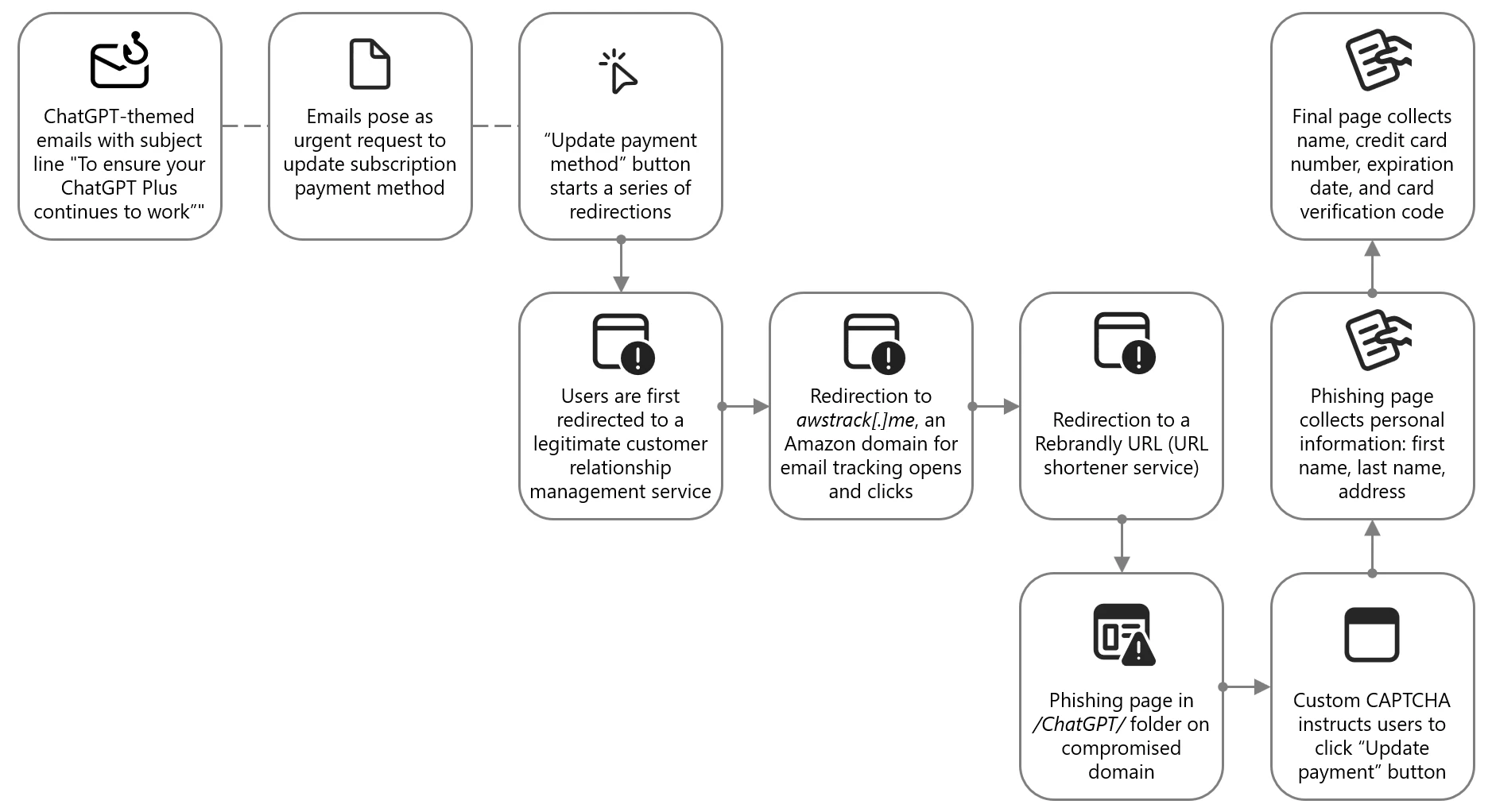
The emails used the sender display name ChatGPT and the subject “To ensure your ChatGPT Plus continues to work – please update your payment method”. The emails posed as an urgent request to update the ChatGPT Plus subscription payment method. They warned the recipient that if a new payment method was not provided within seven days, the account would be downgraded to a free plan. A ChatGPT logo was prominently displayed at the top of the email body.

Diagram showing attack chain of ChatGPT-themed phishing campaign
Figure 1. Attack chain of ChatGPT-themed lure leading to phishing kit

The phishing email contained a clickable Update payment method button, which did not directly send users to the attacker-controlled site. Instead, users were redirected through a series of legitimate and abused redirector hops. This is a common technique used by threat actors to exploit the reputation of trusted domains and bypass email filters, evade detection, and track victim engagement.

Screenshot of ChatGPT-themed email
Figure 2. Snippet of the top portion of the email impersonating ChatGPT and enticing users to click on the link

Targets were first directed to grupoconstat[.]bitrix24[.]com[.]br (a legitimate customer relationship management (CRM) service), which redirected to awstrack[.]me (an Amazon domain used for tracking email opens and clicks), which in turn redirected to a Rebrandly URL (a legitimate but often abused URL shortener service). Targets were finally sent to a likely legitimate but compromised domain legendarytrendsbay[.]shop where the threat actor had placed the phishing page in the /ChatGPT/ folder.

The landing page did not immediately display the phishing content. It first required visitors to pass a custom CAPTCHA, which was a simple Update payment button. If they clicked this button, users were sent to the next page where personal information, including first name, last name, and address was collected. The final page then collected the name, credit card number, expiration date, and card verification code.

Screenshot of phishing landing page collecting name and address
Figure 3. Phishing landing page collecting name and address
Screenshot of phishing landing page collecting credit card information
Figure 4. Phishing landing page collecting credit card information

Claude-themed phishing campaign collected credentials and access tokens

From April 20 to 22, 2026, Microsoft observed a phishing campaign impersonating Anthropic-branded services to target users with account-related lures tied to the Claude AI platform. The campaign sent phishing emails to targets across more than 2,000 organizations, primarily in the United States (62%), the United Kingdom (18%), and India (9%). While this campaign impacted a broad range of industries, it was most notably focused on information technology (56%), other business entities (21%), and financial services (8%).

The campaign used enforcement-themed messaging claiming that the recipient’s account was in violation of acceptable use policies and required immediate action. The emails impersonated Anthropic’s popular AI service Claude using the display names Anthropic Teams and Anthropic PBC, masquerading as legitimate account-related communications. Subject lines followed a consistent structure of “Claude Appeal Request” combined with date elements.

Attack chain diagram of Claude-themed phishing campaing
Figure 5. Attack chain of Claude-themed phishing campaign leading to AiTM

The email body was delivered as HTML and included Anthropic and Claude branding. The message informed recipients that their account was violating “AUP (Account Usage Policy)” and that Anthropic had “initiated an appeal procedure”. The message instructed recipients to review the attached material to access their appeal and indicated that Claude features would be limited pending review.

Screenshot of Claude-themed phishing campaign
Figure 6. Email impersonating Anthropic’s Claude, prompting users to open the attachment

The email attachment was a PDF named Fill and Sign Claude Appeal Form.pdf, which was designed to resemble an official process tied to Claude account enforcement. The document presented an appeal workflow, prompting users to copy an appeal ID and click the “Claude Appeal” link, which initiated the credential harvesting process.

Screenshot of PDF attachment used in Claude-themed phishing campaign
Figure 7. PDF attachment providing instructions on how recipients can appeal the supposed Account Usage Policy (AUP) violation

When clicked, the link embedded in the PDF directed users to an attacker-controlled domain, dash.awaydouble[.]org. The initial landing page displayed a Cloudflare verification prompt, presented as confirming the user was arriving from a “legitimate session”. This step likely served as a gating mechanism to impede automated analysis and sandbox detonation.

Screenshot of CAPTCHA used in Claude-themed phishing campaign
Figure 8. CAPTCHA-gated landing page with Claude branding

Users who completed the verification were redirected to another Claude-themed landing page hosted on servicing.pureplantcravings[.]com. This page was named “Account Appeal Notice” and contained “Account Security & Compliance” message informing users that their account had been flagged for repeated violations of usage policies. The page provided a reference date and a one-time access code, prompting users to copy the code and continue.

Screenshot of landing page of Claude-themed phishing campaign
Figure 9. Intermediate landing page displaying the Claude logo, referencing the usage policy violation and providing an access code

Clicking “Continue” redirected users to the final page, which was not available at the time of analysis. Source code revealed conditional redirect logic that routed users to one of two final landing pages, depending on whether the site was accessed through mobile device or a desktop system.

Screenshot of code for redirect logic
Figure 10. Redirect logic identified in landing page source code, differentiating between mobile device and desktop systems

While the final redirect destination was no longer active at the time of analysis, infrastructure overlap, including shared intermediate domains and consistent redirect logic, strongly suggested that users were ultimately presented with a Microsoft sign-in experience. This final stage is consistent with adversary-in-the-middle (AiTM) tactics designed to intercept authentication tokens and facilitate account compromise.

“Awesome AI Windows Plugin” malvertising deploys Vidar stealer

Since at least early 2026, Microsoft Threat Intelligence has observed malvertising campaigns that use AI-themed terms such as “Awesome AI Windows Plugin” and “Flux Pro AI” in social engineering lures in malicious popups, in malware executable names, and GitHub repository and folder names throughout the attack chain. These campaigns are notable for their scale and velocity, moving from launch to mass impact within hours and infecting tens to hundreds of thousands of endpoints. The malware delivered in these campaigns is frequently code-signed, lending an additional layer of perceived trust to both the operating system and the user.

Microsoft attributes this malvertising activity to an initial access broker and malware distributor tracked as Storm-3075. We assess that Storm-3075 delivers final payloads on behalf of multiple downstream actors. While the example campaign described in this section delivered Vidar Stealer, we have also observed this campaign distributing Lumma Stealer, Hijack Loader, and Oyster.

Figure 11. Attack chain for “Awesome AI Windows plugin” malvertising leading to Vidar

On March 13, 2026, a single campaign run targeted over 66,000 devices. Microsoft has revoked the related signing certificate and GitHub has taken down the associated repository, helping to prevent tens of thousands of additional infections. Given the nature of the attack source, majority of impacted devices were likely consumer rather than enterprise endpoints. Telemetry showed global distribution, with the top affected countries being Japan, South Africa, the United States, and France.

Analysis of the redirection chain determined that the attack likely originated from free movie streaming sites. Infections on such sites typically begin when users interact with embedded movie players or click popups. Malvertising embedded in such sites can redirect users to a range of unwanted content, including malware. In this campaign, users were redirected to a page advertising a download for an “Awesome AI Windows plugin”, a fictitious product name. The plugin purported to help users watch free, high-quality videos, a lure aligned with the context of users already streaming free or pirated content.

Screenshot of malvertising redirecting to download
Figure 12. Screenshot of malvertising redirecting users to a purported download for an “Awesome AI Windows plugin”

Clicking the download button retrieved an executable named ProFluxeFlowAi-win-Setup.exe, which the user then had to manually launch. The file name mimicked a legitimate product with a similar name, Flux Pro AI, which supports text, image, and video creation. This lure reinforced the perceived legitimacy of the executable within the streaming of free movies context. The executable itself was hosted on GitHub in a repository named shippingtechnologymovie under a folder named AI-techVideos, both tailored to the AI video helper narrative.

Screenshot of Malware hosted on GitHub
Figure 13. Malware hosted on a GitHub repository “shippingtechnologymovie”, in a folder “AI-techVideos”

The malware executable was signed with a fraudulently obtained Microsoft-issued code-signing certificate obtained through Artifact Signing (certificate thumbprint: 4f5c5b3ef45cfff7721754487a86aeff9a2e6e32). Microsoft attributes the signing service used by the threat actor to Fox Tempest, a financially motivated threat actor operating a malware-signing-as-a-service (MSaaS) offering used by other threat actors. Microsoft has revoked over one thousand code signing certificates attributed to Fox Tempest. In May 2026, Microsoft’s Digital Crimes Unit (DCU), in partnership with Resecurity, facilitated a disruption of Fox Tempest infrastructure and access model.   

Signing malware through such a service is expensive; however, for a threat actor targeting tens or hundreds of thousands of infections, the cost can be justified by the additional level of trust signed binaries imply to both the operating system and the user. Signed malware also tends to exhibit lower detection rates early in the infection lifecycle, extending the window of effective distribution.

Another notable feature of the malware is that, immediately after launch, it displays a window with a “Continue” checkmark and does not proceed until the box is clicked. This extra user interaction step is uncommon. We assess that this technique is intended to hide the malicious functionality from sandboxes and automated analysis environments that cannot dynamically perform the click. Until the user clicks “Continue,” the malware performs no suspicious activity on the operating system. This technique is functionally analogous to the CAPTCHAs frequently seen in phishing attacks.

Figure 14. CAPTCHA-like “Continue” check mark displayed to the users if they launch the malware, requiring them to click before the malware continues executing.

Once the user clicks “Continue”, the executable drops and runs a malicious Python-based downloader. Both the Python interpreter and the downloader script are saved in the \AppData\Local\ folder as pythonw.exe and LICENSE.txt, respectively. The malicious script runs shellcode that loads the next-stage malware from the command-and-control (C2) domain brokeapt[.]com. The final payload observed in this campaign was Vidar infostealer.

Fake DeepSeek V4 installers on GitHub delivered Vidar Stealer

In April 2026, Microsoft identified a social engineering campaignsocial-engineering campaign that leveraged interest in the newly released DeepSeek V4 by impersonating it through a fraudulent GitHub repository and organization. The campaign abused GitHub’s release-asset infrastructure to deliver information-stealing malware such as Vidar stealer. Search engines increased the exposure of the malicious repository, exacerbated by the fact that DeepSeek did not publish an official V4 repository on GitHub.

Our investigation shows the DeepSeek lure is one identity in a broader rotating brand-abuse ecosystem that recycles whichever AI tool is trending into a fresh malware download experience. After discovering this activity, Microsoft shared the details with GitHub, and GitHub has since taken down the malicious organization, repository, and operator account.

Timeline and attack chain diagram of Fake DeepSeek V4 campaign
Figure 15. Fake DeepSeek V4 campaign timeline and attack chain

On April 24, 2026, within hours of DeepSeek officially previewing its new V4 frontier model, a threat actor initiated the attack chain that can be summarized as:

  1. Resource development on GitHub, all within roughly 45 minutes: A new GitHub organization (DeepSeek-V4), a single repository (deepseek-V4), and a release tag (deepseek-V4). The repository was decorated with stolen DeepSeek branding, real benchmark data, and SEO-optimized topics.
  2. Search-driven discovery: Users found the repository through GitHub repository search, search engines, social sharing, and AI-assisted search results pointing to the lure page. The repository’s llms.txt and topic taxonomy were designed to be discovered by both classical search engines and large-language-model-powered search; observed top-rank results on search engines are consistent with that design, though we did not observe paid advertising and therefore do not assess this as malvertising.
  3. Archive download from GitHub’s release-asset CDN: The release page hosted two archives, deepseek-v4-pro_x64.7z and deepseek-v4-flash_x64.7z.
  4. User extraction: Users needed to extract the executable from the archive using common Windows archive tools.
  5. Payload execution: The archives contained a heavyweight Win32 PE that masqueraded as the DeepSeek installer. At least one confirmed victim endpoint revealed the extracted payload landed at: C:\Users\<user>\Downloads\Programs\IA DeepSeek-V4\deepseek-v4-flash_x64.exe.
  6. Active payload rotation: The threat actor actively rotated archive content while preserving file names and the release page. We observed at least three distinct archive hash generations in three days.

Microsoft Defender telemetry observed the first victim download approximately four hours later. The threat actor’s operational tempo on April 24, 2026, is consistent with a prepared, rehearsed workflow. The repository was designed to be convincing at a glance. It accumulated 91 stars and 27 forks within four days, though the proportion of organic versus inflated engagement is not independently confirmed. The attacker invested in several credibility-building elements:

  • Stolen branding: The repository’s README and assets folder embedded the legitimate DeepSeek whale logo, copied from the real deepseek-ai/DeepSeek-V2 repository.
  • Real benchmark data as lure: The release notes displayed authentic DeepSeek V4 benchmark scores against Claude Opus 4.6, GPT-5.4, and Gemini 3.1 Pro, copied from the official release announcement.
  • Action-oriented SEO topics: The repository was tagged with deepseek-v4, deepseek-v4-download, deepseek-v4-downloader, deepseek-v4-install, and deepseek-v4-installer, which are queries users are expected to use when intent-shopping for an installer.
  • LLM-aware discoverability: A top-level llms.txt file repeated the same SEO copy in a format aimed at AI-assisted search engines.

On closer inspection, the staging gives the operation away: the repository contained only a README, LICENSE, llms.txt, and stub assets/ and inference/ directories with no real model code; all nine commits were made in a single burst on April 24, 2026 by a single author; the README claimed an MIT license while repository metadata specified Apache 2.0.

Screenshot of fake DeekSeek repository
Figure 16. The malicious DeepSeek-V4/deepseek-V4 repository contains stolen DeepSeek logo, SEO tags targeting install and download queries, sole-contributor “graphrtest” burner account, and 91 stars accumulated in four days.
Screenshot of fake release page for the DeepSeek campaign
Figure 17. The fake release page had real DeepSeek V4 benchmark chart used as a credibility lure, two 102 MB .7z archives, hashes rotated three times in three days.

Once the lure was live, search engines increased the exposure of the malicious repository. We tested the queries an interested user would naturally try when looking for DeepSeek V4 on GitHub or the open web. In a snapshot captured on April 28, 2026, the results were as follows (search results are volatile and may differ at the time of reading):

PlatformQueryResult
GitHubDeepSeek-V4 installer1 result — the malicious repository (only result on GitHub)
GitHubDeepSeek V4 install1 result — the malicious repository (only result on GitHub)
GitHubDeepSeek V4The malicious repository ranked #2 of 169 results
BingDeepseek v4 weights githubThe malicious repository ranked #1, above the official Hugging Face page
GoogleDeepSeek v4 weights githubThe malicious repository and two of its forks occupied three of the top four positions, including a top result with rich sitelinks

The 7z archives hosted on GitHub contained a loader executable such as SHA-256: 5455341ed1bbe75a664fca2dd0794c508e1874f75360253a7ff5bc119bc92d80. The loader was observed downloading and installing Vidar stealer and potentially additional malware.

Lastly, Microsoft observed that the DeepSeek-themed payloads share infrastructure with a much larger rotating fake-AI / fake-tool ecosystem. The same shared loader hash (SHA-256 5455341…) appeared under file names impersonating GPT-5.5, Claude Code, Kimi, Seedance, Gemma, GrokCLI, Manus AI, FraudGPT, and others (see table below). Public research from Trend Micro, Zscaler ThreatLabz, and Huntress describe the same broader ecosystem, with TradeAI.exe, OpenClaw_x64.7z, WormGPT_x64.7z, and DeepSeekAI_agent_x64.7z appearing as sibling lures and the downstream payload set documented as Vidar plus GhostSocks.

Lure nameFake GitHub organization (observed or sibling pattern)
deepseek-v4-pro_x64.exe, deepseek-v4-flash_x64.exeDeepSeek-V4
Manus_AI_Desktop_x64.exeManusAI-agent
seedance_x64.exebytedance-seedance
gpt-5.5-Pro_x64.exe, gpt-5.5-Thinking_x64.exeVarious burner organizations
Kimi-Swarm-Station_x64.exeVarious burner organizations
fraudGPT_x64.exeVarious burner organizations
GrokCLI_x64.exe, gemma-4-omni_x64.exe, LTX-2.3_x64.exeVarious burner organizations

Mitigation and protection guidance

To defend against social engineering campaigns that leverage AI brands as lures, Microsoft recommends the following mitigation measures:

  • Configure automatic attack disruption in Microsoft Defender XDR. Automatic attack disruption is designed to contain attacks in progress, limit the impact on an organization’s assets, and provide more time for security teams to remediate the attack fully.
  • Enforce multifactor authentication (MFA) on all accounts, remove users excluded from MFA, and strictly require MFA from all devices in all locations at all times.
  • Use the Microsoft Authenticator app for passkeys and MFA, and complement MFA with conditional access policies, where sign-in requests are evaluated using additional identity-driven signals.
  • Conditional access policies can also be scoped to strengthen privileged accounts with phishing resistant MFA.
  • Enable Zero-hour auto purge (ZAP) in Office 365 to quarantine sent mail in response to newly acquired threat intelligence and retroactively neutralize malicious phishing, spam, or malware messages that have already been delivered to mailboxes.
  • Configure Microsoft Defender for Office 365 Safe Links to recheck links on click. Safe Links provides URL scanning and rewriting of inbound email messages in mail flow and time-of-click verification of URLs and links in email messages, other Microsoft Office applications such as Teams, and other locations such as SharePoint Online. Safe Links scanning occurs in addition to the regular anti-spam and anti-malware protection in inbound email messages in Microsoft Exchange Online Protection (EOP). Safe Links scanning can help protect your organization from malicious links that are used in phishing and other attacks.
  • Invest in advanced anti-phishing solutions that monitor and scan incoming emails and visited websites. For example, organizations can leverage web browsers like Microsoft Edge that automatically identify and block malicious websites, including those used in this phishing campaign, and solutions that detect and block malicious emails, links, and files.
  • Encourage users to use Microsoft Edge and other web browsers that support Microsoft Defender SmartScreen, which identifies and blocks malicious websites, including phishing sites, scam sites, and sites that host malware.
  • Enable network protection to prevent applications or users from accessing malicious domains and other malicious content on the internet.

Microsoft Defender detections

Microsoft Defender customers can refer to the list of applicable detections below. Microsoft Defender coordinates detection, prevention, investigation, and response across endpoints, identities, email, apps to provide integrated protection against attacks like the threat discussed in this blog.

Tactic Observed activity Microsoft Defender coverage 
Initial accessPhishing emailsMicrosoft Defender for Office 365
– A potentially malicious URL click was detected
– Email messages containing malicious URL removed after delivery
– Email messages removed after delivery
– A user clicked through to a potentially malicious URL
– Suspicious email sending patterns detected Email reported by user as malware or phish
PersistenceThreat actors distribute malware Threat actors sign in with stolen valid entitiesMicrosoft Defender for Antivirus
– Trojan:Win32/Vidar
– Trojan:Win32/Malgent
– Trojan:Win32/Malcert   

Microsoft Defender for Endpoint
– ‘Malcert’ malware was prevented
– ‘Vidar’ malware was prevented   

Microsoft Entra ID Protection
– Anomalous Token
– Unfamiliar sign-in properties
– Unfamiliar sign-in properties for session cookies   

Microsoft Defender for Cloud Apps
– Impossible travel activity

Microsoft Security Copilot

Microsoft Security Copilot is embedded in Microsoft Defender and provides security teams with AI-powered capabilities to summarize incidents, analyze files and scripts, summarize identities, use guided responses, and generate device summaries, hunting queries, and incident reports.

Customers can also deploy AI agents, including the following Microsoft Security Copilot agents, to perform security tasks efficiently:

Security Copilot is also available as a standalone experience where customers can perform specific security-related tasks, such as incident investigation, user analysis, and vulnerability impact assessment. In addition, Security Copilot offers developer scenarios that allow customers to build, test, publish, and integrate AI agents and plugins to meet unique security needs.

Threat intelligence reports

Microsoft Defender XDR customers can use the following threat analytics reports in the Defender portal (requires license for at least one Defender XDR product) to get the most up-to-date information about the threat actor, malicious activity, and techniques discussed in this blog. These reports provide the intelligence, protection information, and recommended actions to prevent, mitigate, or respond to associated threats found in customer environments.

Microsoft Security Copilot customers can also use the Microsoft Security Copilot integration in Microsoft Defender Threat Intelligence, either in the Security Copilot standalone portal or in the embedded experience in the Microsoft Defender portal to get more information about this threat actor.

Indicators of compromise

IndicatorTypeDescriptionFirst seenLast seen
791efb555eefb7215e96659a1353a97416743b66bdd72705493129c64057d40eSHA-256  File hash for attachment Fill and Sign Claude Appeal Form.pdf2026-04-20  2026-04-20  
hxxp://dash.awaydouble[.]org/0v2authURLURL inside the PDF attachment2026-04-202026-04-20
 hxxps://github[.]com/shippingtechnologymovie/AI-techVideos/releases/download/13123/ProFluxeFlowAi-win-Setup.exeURLFraudulent GitHub repository (taken down) hosting malware executable2026-03-132026-03-14
c7c5072df9f83f4c440a5c3bb4be1d5f6c67bbf78f196406ca20d27b43b975b8SHA-256File hash for ProFluxeFlowAi-win-Setup.exe2026-03-132026-03-14
4f5c5b3ef45cfff7721754487a86aeff9a2e6e32SignerSha-1Certificate2026-03-132026-03-14
brokeapt[.]comDomainAttacker-controlled C2 domain for Python loader2026-03-102026-05-20
pan.ssffaa19[.]xyzDomainVidar C22026-03-132026-03-14
pan.rongtv[.]xyzDomainVidar C22026-03-132026-03-14
 hxxps://github[.]com/DeepSeek-V4/deepseek-V4/releases/download/deepseek-V4/deepseek-v4-pro_x64.7zURLFraudulent GitHub repository (taken down) hosting malware executable2026-04-242026-04-28
0a26238f6c516de5885457c93042531aa59bc206a9537cebf5267cedc6c68531SHA-256deepseek-v4-pro_x64.7z (v1)2026-04-242026-05-18
8610d4fb0ec5b525071c2aaec4df0f8fcbb3673aba58a7e1959fc44e83c0e2caSHA-256  deepseek-v4-flash_x64.7z (v1)2026-04-242026-04-28
99231deb373997364381d1eb513d2d42231d418c3a2db9007c5af9bd56ab9371SHA-256  deepseek-v4-flash_x64.7z (v2)2026-04-262026-04-28
25270cc429ada8028b5b33220ed412c47907ecceea7377d608fac5af01bed56aSHA-256  deepseek-v4-pro_x64.7z (v2)2026-04-262026-04-28
56d722b0331bf0aaa86bb37483486c6dff6ad9427fc473ed7c3226c21a9bdd23SHA-256  DeepSeek-specific extracted PE (deepseek-v4-pro_x64.exe, deepseek-v4-flash_x64.exe, VectorEngine.exe)2026-04-262026-04-28
5455341ed1bbe75a664fca2dd0794c508e1874f75360253a7ff5bc119bc92d80SHA-256  Shared loader, observed under multiple AI-brand lure names2026-04-122026-05-21

Learn more

For the latest security research from the Microsoft Threat Intelligence community, check out the Microsoft Threat Intelligence Blog.

To get notified about new publications and to join discussions on social media, follow us on LinkedIn, X (formerly Twitter), and Bluesky.

To hear stories and insights from the Microsoft Threat Intelligence community about the ever-evolving threat landscape, listen to the Microsoft Threat Intelligence podcast.

The post AI brands as bait: How threat actors are using the AI hype in social engineering appeared first on Microsoft Security Blog.

Breaking the code: Multi-stage ‘code of conduct’ phishing campaign leads to AiTM token compromise

Phishing campaigns continue to improve sophistication and refinement in blending social engineering, delivery and hosting infrastructure, and authentication abuse to remain effective against evolving security controls. A large-scale credential theft campaign observed by Microsoft Defender Research exemplifies this trend, using code of conduct-themed lures, a multi-step attack chain, and legitimate email services to distribute fully authenticated messages from attacker-controlled domains.

The campaign targeted tens of thousands of users, primarily in the United States, and directed them through several stages of CAPTCHA and intermediate staging pages designed to reinforce legitimacy while filtering out automated defenses. The lures in this campaign used polished, enterprise-style HTML templates with structured layouts and preemptive authenticity statements, making them appear more credible than typical phishing emails and increasing their plausibility as legitimate internal communications. Because the messages contained concerning accusations and repeated time-bound action prompts, the campaign created a sense of urgency and pressure to act.  

Email threat landscape

Q1 2026 trends and insights ›

The attack chain ultimately led to a legitimate sign-in experience that was part of an adversary‑in‑the‑middle (AiTM) phishing flow, which allowed the attackers to proxy the authentication session and capture authentication tokens that could provide immediate account access. Unlike traditional credential harvesting, AiTM attacks intercept authentication traffic in real time, bypassing non-phishing-resistant multifactor authentication (MFA).

In this blog, we’re sharing our analysis of this campaign’s lures, infrastructure, and techniques. Organizations can defend against financial fraud initiated through phishing emails by educating users about phishing lures, investing in advanced anti-phishing solutions like Microsoft Defender for Office 365 and configuring essential email security settings, and encouraging users to employ web browsers that support SmartScreen. Organizations can also enable network protection, which lets Windows use SmartScreen as a host-based web proxy.

Multi-step social engineering campaign leading to credential theft

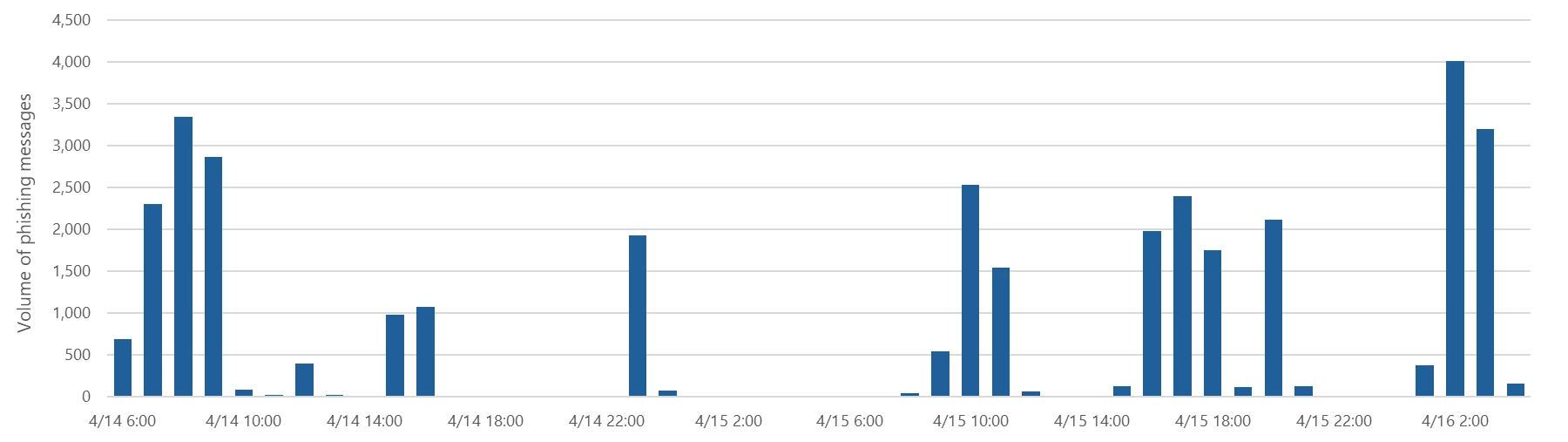
Between April 14 and 16, 2026, the Microsoft Defender Research team observed a series of sophisticated phishing campaigns targeting more than 35,000 users across over 13,000 organizations in 26 countries, with majority of targets located in the United States (92%). The campaign did not focus on a single vertical but instead impacted a broad range of industries, most notably Healthcare & life sciences (19%), Financial services (18%), Professional services (11%), and Technology & software (11%). Messages were distributed in multiple distinct waves between 06:51 UTC on April 14 and 03:54 UTC on April 16. 

Bar graph showing volume of messages sent by hour between April 14 and 16, 2026
Figure 1. Timeline of campaign messages sent by hour
Pie charts showing the breakdown of campaign recipients by country and industry.
Figure 2. Campaign recipients by country and industry

Emails in this campaign posed as internal compliance or regulatory communications, using display names such as “Internal Regulatory COC”, “Workforce Communications”, and “Team Conduct Report”. Subject lines included “Internal case log issued under conduct policy” and “Reminder: employer opened a non-compliance case log”.

Message bodies claimed that a “code of conduct review” had been initiated, referenced organization-specific names embedded within the text, and instructed recipients to “open the personalized attachment” to review case materials. At the top of each message, a notice stated that the message had been “issued through an authorized internal channel” and that links and attachments had been “reviewed and approved for secure access”, reinforcing the email’s purported legitimacy. To further support the confidentiality of the supposed review, the end of each message contained a green banner stating that the contents had been encrypted using Paubox, a legitimate service associated with HIPAA-compliant communications.

Screenshot of sample phishing email
Figure 3. Sample phishing email

Analysis of the sending infrastructure indicated that the campaign emails were sent using a legitime email delivery service, likely originating from a cloud-hosted Windows virtual machine. The messages were sent from multiple sender addresses using domains that are likely attacker-controlled.

Each campaign email included a PDF attachment with filenames such as Awareness Case Log File – Tuesday 14th, April 2026.pdf and Disciplinary Action – Employee Device Handling Case.pdf. The attachment provided additional context about the supposed conduct review, including a summary of the review process and instructions for accessing supporting documentation. Recipients were directed to click a “Review Case Materials” link within the PDF, which initiated the credential harvesting flow.

Screenshot of PDF attachment used in the campaign
Figure 4. PDF attachment

When clicked, users were initially directed to one of two attacker-controlled domains (for example, acceptable-use-policy-calendly[.]de or compliance-protectionoutlook[.]de). These landing pages displayed a Cloudflare CAPTCHA, presented as a mechanism to validate that the user was coming “from a valid session”. This CAPTCHA likely served as a gating mechanism to impede automated analysis and sandbox detonation. 

Screenshot of captcha challenge.
Figure 5. CAPTCHA challenge

After completing the CAPTCHA, users were redirected to an intermediate site designed to prepare them for the final stage of the attack. This page informed users that the requested documentation was encrypted and required account authentication. While this stage of the attack has several hallmarks of device code phishing, we were only able to confirm the AITM portion of the attack chain.

Screenshot of intermediate site asking users to click review & sign button
Figure 6. Intermediate site asking users to click “Review & Sign”

After clicking the provided “Review & Sign” button, users were presented with a sign-in prompt requesting their email address.

Screenshot of prompt directing users to enter email address
Figure 7. Prompt directing users to enter their email address

After submission, users were required to complete a second CAPTCHA involving image selection.

Screenshot of second captcha challenge
Figure 8. Second CAPTCHA challenge

Once these steps were completed, users were shown a message indicating that verification was successful and that their “case” was being prepared.

Screenshot of message telling users that verification completed successfully
Figure 9. Message telling users that “Verification completed successfully”

Following these steps, users were redirected to a third site hosting the final stage of the attack. Analysis of the underlying code indicates that the final destination varied depending on whether the user accessed the workflow from a mobile device or a desktop system.

Screenshot of code used to redirect users based on platform, whether mobile or dekstop
Figure 10. Code used to redirect users based on platform

On the final page, users were informed that all materials related to their code of conduct review had been “securely logged”, “time-stamped”, and “maintained within the organization’s centralized compliance tracking system”. They were then prompted to schedule a time to discuss the case, which required signing in to their account.

screenshot of final page instructing users to sign in
Figure 11. Final page instructed users to sign in

Selecting the “Sign in with Microsoft” option redirected users to a Microsoft authentication page, initiating an AiTM session hijacking flow designed to capture authentication tokens and compromise user accounts.

Mitigation and protection guidance

Microsoft recommends the following mitigations to reduce the impact of this threat. Check the recommendations card for the deployment status of monitored mitigations.

  • Review the recommended settings for Exchange Online Protection and Microsoft Defender for Office 365 to ensure your organization has established essential defenses and knows how to monitor and respond to threat activity.
  • Invest in user awareness training and phishing simulations. Attack simulation training in Microsoft Defender for Office 365, which also includes simulating phishing messages in Microsoft Teams, is one approach to running realistic attack scenarios in your organization.
  • Enable Zero-hour auto purge (ZAP) in Defender for Office 365 to quarantine sent mail in response to newly acquired threat intelligence and retroactively neutralize malicious phishing, spam, or malware messages that have already been delivered to mailboxes.
  • Responders could also manually check for and purge unwanted emails containing URLs and/or Subject fields that are similar, but not identical, to those of known bad messages. Investigate malicious email that was delivered in Microsoft 365 and use Threat Explorer to find and delete phishing emails.
  • Turn on Safe Links and Safe Attachments in Microsoft Defender for Office 365.
  • Enable network protection in Microsoft Defender for Endpoint.
  • Encourage users to use Microsoft Edge and other web browsers that support Microsoft Defender SmartScreen, which identifies and blocks malicious websites, including phishing sites, scam sites, and sites that host malware.
  • Enable password-less authentication methods (for example, Windows Hello, FIDO keys, or Microsoft Authenticator) for accounts that support password-less. For accounts that still require passwords, use authenticator apps like Microsoft Authenticator for multifactor authentication (MFA). Refer to this article for the different authentication methods and features.
  • Configure automatic attack disruption in Microsoft Defender XDR. Automatic attack disruption is designed to contain attacks in progress, limit the impact on an organization’s assets, and provide more time for security teams to remediate the attack fully.

Microsoft Defender detections

Microsoft Defender customers can refer to the list of applicable detections below. Microsoft Defender coordinates detection, prevention, investigation, and response across endpoints, identities, email, apps to provide integrated protection against attacks like the threat discussed in this blog.

Tactic Observed activity Microsoft Defender coverage 
Initial accessPhishing emailsMicrosoft Defender for Office 365
– A potentially malicious URL click was detected
– A user clicked through to a potentially malicious URL
– Suspicious email sending patterns detected
– Email messages containing malicious URL removed after delivery
– Email messages removed after delivery
– Email reported by user as malware or phish
PersistenceThreat actors sign in with stolen valid entitiesMicrosoft Entra ID Protection
– Anomalous Token
– Unfamiliar sign-in properties
– Unfamiliar sign-in properties for session cookies  

Microsoft Defender for Cloud Apps
– Impossible travel activity

Microsoft Security Copilot

Microsoft Security Copilot is embedded in Microsoft Defender and provides security teams with AI-powered capabilities to summarize incidents, analyze files and scripts, summarize identities, use guided responses, and generate device summaries, hunting queries, and incident reports.

Customers can also deploy AI agents, including the following Microsoft Security Copilot agents, to perform security tasks efficiently:

Security Copilot is also available as a standalone experience where customers can perform specific security-related tasks, such as incident investigation, user analysis, and vulnerability impact assessment. In addition, Security Copilot offers developer scenarios that allow customers to build, test, publish, and integrate AI agents and plugins to meet unique security needs.

Threat intelligence reports

Microsoft Defender XDR customers can use the following threat analytics reports in the Defender portal (requires license for at least one Defender XDR product) to get the most up-to-date information about the threat actor, malicious activity, and techniques discussed in this blog. These reports provide the intelligence, protection information, and recommended actions to prevent, mitigate, or respond to associated threats found in customer environments.

Microsoft Security Copilot customers can also use the Microsoft Security Copilot integration in Microsoft Defender Threat Intelligence, either in the Security Copilot standalone portal or in the embedded experience in the Microsoft Defender portal to get more information about this threat actor.

Hunting queries

Microsoft Defender XDR customers can run the following advanced hunting queries to find related activity in their networks:

Campaign emails by sender address

The following query identifies emails associated with this campaign using a message’s sending email address.

EmailEvents
| where SenderMailFromAddress in (" cocpostmaster@cocinternal.com "," nationaladmin@gadellinet.com ","
nationalintegrity@harteprn.com”,” m365premiumcommunications@cocinternal.com”,” documentviewer@na.businesshellosign.de”)

Indicators of compromise

IndicatorTypeDescriptionFirst seenLast seen
compliance-protectionoutlook[.]deDomainDomain hosting malicious campaign content2026-04-142026-04-16
acceptable-use-policy-calendly[.]deDomainDomain hosting malicious campaign content2026-04-142026-04-16
cocinternal[.]comDomainDomain hosting sender email address2026-04-142026-04-16
Gadellinet[.]comDomainDomain hosting sender email address2026-04-142026-04-16
Harteprn[.]comDomainDomain hosting sender email address2026-04-142026-04-16
Cocpostmaster[@]cocinternal.comEmail addressEmail address used to send campaign emails2026-04-142026-04-16
Nationaladmin[@]gadellinet.comEmail addressEmail address used to send campaign emails2026-04-142026-04-16
Nationalintegrity[@]harteprn.comEmail addressEmail address used to send campaign emails2026-04-142026-04-16
M365premiumcommunications[@]cocinternal.comEmail addressEmail address used to send campaign emails2026-04-142026-04-16
Documentviewer[@]na.businesshellosign.deEmail addressEmail address used to send campaign emails2026-04-142026-04-16
Awareness Case Log File – Monday 13th, April 2026.pdfFilenameName of PDF attachment containing phishing link2026-04-142026-04-14
Awareness Case Log File – Tuesday 14th, April 2026.pdfFilenameName of PDF attachment containing phishing link2026-04-152026-04-15
Awareness Case Log File – Wednesday 15th, April 2026.pdfFilenameName of PDF attachment containing phishing link2026-04-162026-04-16
5DB1ECBBB2C90C51D81BDA138D4300B90EA5EB2885CCE1BD921D692214AECBC6SHA-256File hash of campaign PDF attachment2026-04-14  2026-04-16  
B5A3346082AC566B4494E6175F1CD9873B64ABE6C902DB49BD4E8088876C9EADSHA-256File hash of campaign PDF attachment2026-04-142026-04-16
11420D6D693BF8B19195E6B98FEDD03B9BCBC770B6988BC64CB788BFABE1A49DSHA-256File hash of campaign PDF attachment2026-04-142026-04-16

Learn more

For the latest security research from the Microsoft Threat Intelligence community, check out the Microsoft Threat Intelligence Blog.

To get notified about new publications and to join discussions on social media, follow us on LinkedIn, X (formerly Twitter), and Bluesky.

To hear stories and insights from the Microsoft Threat Intelligence community about the ever-evolving threat landscape, listen to the Microsoft Threat Intelligence podcast.

The post Breaking the code: Multi-stage ‘code of conduct’ phishing campaign leads to AiTM token compromise appeared first on Microsoft Security Blog.
Email threat landscape: Q1 2026 trends and insights

During the first quarter of 2026 (January-March), Microsoft Threat Intelligence detected approximately 8.3 billion email-based phishing threats, with monthly volumes declining slightly from 2.9 billion in January to 2.6 billion in March. By the end of the quarter, QR code phishing emerged as the fastest-growing attack vector, more than doubling over the period, while CAPTCHA-gated phishing evolved rapidly across payload types. Overall, 78% of email threats were link-based, while malicious payloads accounted for 19% of attacks in January—boosted by large HTML and ZIP campaigns—before settling at 13% in both February and March. Credential phishing remained the dominant objective behind malicious payloads throughout the quarter. This shift toward link-based delivery, combined with the payload trends, suggests that threat actors increasingly preferred hosted credential phishing infrastructure over locally-rendered payloads as the quarter progressed.

These trends reflect how threat actors continue to iterate on both scale and delivery techniques to improve effectiveness. At the same time, disruption efforts can meaningfully impact this activity. Following Microsoft’s Digital Crime Unit-led action against the Tycoon2FA phishing-as-a-service (PhaaS) platform in early March, associated email volume declined 15% over the remainder of the month, alongside a significant reduction in access to active phishing pages, limiting the platform’s immediate effectiveness. While Tycoon2FA has since adapted by shifting hosting providers and domain registration patterns, these changes reflect partial recovery rather than full restoration of previous capabilities. Alongside these shifts, business email compromise (BEC) activity remained prevalent, totaling approximately 10.7 million attacks in the quarter, largely driven by low-effort, generic outreach messages. At the same time, Microsoft Defender Research observed early indications of emerging techniques such as device code phishing—sometimes enabled by offerings like EvilTokens—which, while not yet at the scale of the trends discussed below, reflect continued innovation in credential theft methods.

This blog provides a view of email threat activity across the first quarter of 2026, highlighting key trends in phishing techniques, payload delivery, and threat actor behavior observed by Microsoft Threat Intelligence. We examine shifts in QR code phishing, CAPTCHA evasion tactics, malicious payloads, and BEC activity, analyze how disruption efforts and infrastructure changes influenced threat actor operations, and provide recommendations and Microsoft Defender detections to help mitigate these threats. By bringing these trends together, this blog can help defenders understand how email-based attacks are evolving and where to focus detection, mitigation, and user protection strategies.

Tycoon2FA disruption impact

Since its emergence in August 2023, Tycoon2FA has rapidly become one of the most widespread PhaaS platforms, leveraging adversary-in-the-middle (AiTM) techniques to attempt to defeat non-phishing-resistant multifactor authentication (MFA) defenses. The group behind the PhaaS platform (tracked by Microsoft Threat Intelligence as Storm-1747) leases malicious infrastructure and sells phishing kits that impersonate various enterprise application sign-in pages and incorporate evasion tactics, such as fake CAPTCHA pages.

The quarter began with Tycoon2FA in a period of reduced activity. January volumes represented a 54% decline from December 2025, marking the second consecutive month of sharp decreases. While post-holiday seasonal effects may have contributed to this decrease in volume, some of the reduction might also have been the result of Microsoft’s Digital Crimes Unit disruption of RedVDS, a service used by many Tycoon2FA customers to distribute malicious email campaigns.

After surging 44% in February, phishing attacks pointing to Tycoon2FA fell 15% in March driven largely by the effects of a coordinated disruption operation. In early March 2026, Microsoft’s Digital Crimes Unit, in coordination with Europol and industry partners, took action to disrupt Tycoon2FA’s infrastructure and operations, significantly impairing the platform’s hosting capabilities. While Tycoon2FA-linked messages continued to circulate after the disruption, almost one-third of March’s total volume was concentrated in a three-day period early in the month; daily volumes for the remainder of March were notably lower than historical averages, and targets’ ability to reach active phishing pages was substantially reduced.

Line graph displays monthly phishing email volume from November to March for Tycoon2FA, showing a sharp decline from about 23 million in November to around 9 million in January, followed by a slight increase and stabilization near 11 million in February and March.
Figure 1. Tycoon2FA monthly malicious messages volume (November 2025 – March 2026)

Tycoon2FA’s infrastructure composition evolved multiple times during the first three months of 2026. In January, Tycoon2FA domains started shifting toward newer generic top-level domains (TLDs) such as .DIGITAL, .BUSINESS, .CONTRACTORS, .CEO, and .COMPANY, moving away from previous commonly used TLDs or second-level domains like .SA.COM, .RU, and .ES. This trend became even more well-established in February. Following the March disruption, however, Microsoft Threat Intelligence observed a notable increase in Tycoon2FA domains with .RU registrations, with more than 41% of all Tycoon2FA domains using a .RU TLD since the last week of March.

Line chart showing percentage trends of Tycoon2FA TLDs and 2LDs from November 2025 to March 2026, with six categories: SA.COM, RU, ES, DIGITAL, DE, and DEV. SA.COM starts highest near 22% and declines to about 6%, while RU rises sharply from 13% to 23% in March, with other categories remaining below 7% throughout.
Figure 2. Top TLDs and second-level domains (2LDs) associated with Tycoon2FA infrastructure (November 2025 – March 2026)

Additionally, toward the end of March, we saw Tycoon2FA moving away from Cloudflare as a hosting service and now hosts most of its domains across a variety of alternative platforms, suggesting the group is attempting to find replacement services that offer comparable anti-analysis protections.  

QR code phishing attacks

In recent years, QR codes have rapidly emerged as a preferred tool among phishing threat actors seeking to bypass traditional email defenses. By embedding malicious URLs within image-based QR codes in the body of an email or within the contents of an attachment, threat actors attempt to exploit the limitations of text-based scanning engines and redirect victims to phishing sites on unmanaged mobile devices.

The most significant shift in Q1 2026 was the rapid escalation of QR code phishing, with attack volumes increasing from 7.6 million in January to 18.7 million in March, a 146% increase over the quarter. After an initial 35% decline in January (continuing a late-2025 downtrend), volumes reversed course dramatically, growing 59% in February and another 55% in March. By the end of the quarter, QR code phishing had reached its highest monthly volume in at least a year.

Line graph showing weekly volume of QR-code phishing attacks from November 2025 to March 2026, with phishing email counts fluctuating and peaking in March 2026.
Figure 3. Trend of QR code phishing attacks by weekly volume (November 2025 – March 2026)

PDF attachments were the dominant delivery method throughout the quarter, growing from 65% of QR code attacks in January to 70% in March. While the overall volume of DOC/DOCX payloads containing malicious QR codes steadily increased each month, their share of overall delivery payloads decreased from 31% in January to 24% in March. A notable late-quarter development was the emergence of QR codes embedded directly in email bodies, which surged 336% in March. While still a small share of total volume (5%), this approach eliminates the need for an attachment altogether and highlights a shift in threat actor delivery methods that defenders should continue to monitor.

CAPTCHA tactics

Threat actors use CAPTCHA pages to delay detection and increase user interaction. These pages function as a visual decoy, giving the appearance of a legitimate security check while concealing a transition to malicious content. By forcing users to engage with the CAPTCHA before accessing the payload, threat actors reduce the likelihood of automated scanning tools identifying the threat and increase the chances of successful credential harvesting or malware delivery. Additionally, fake CAPTCHAs are used in ClickFix attacks to trick users into copying and executing malicious commands under the guise of human verification, allowing malware to bypass conventional security controls.

After declining in both January (-45%) and February (-8%), CAPTCHA-gated phishing volumes exploded in March, more than doubling (+125%) to 11.9 million attacks, the highest volume observed over the last year.

Line chart showing CAPTCHA-gated phishing volume between November 2025 and March 2026. The chart highlights a peak around December, a decline through January and February, followed by a sharp increase in March to over 12 million attacks.
Figure 4. CAPTCHA-gated phishing volume (November 2025 – March 2026)

The most notable aspect of Q1 CAPTCHA trends was the rapid rotation of delivery methods, as threat actors appeared to actively experiment with which payload formats most effectively evade email defenses:

  • HTML attachments started the year as the most common method to deliver CAPTCHA-gated phishing (37% in January), but dropped 34% in February, hitting its lowest monthly volume since August 2025. Although their volume more than doubled in March, hitting an annual monthly high, HTML files were still only the second-most common delivery method to close the quarter.
  • SVG files, which had seen consecutive months of decreasing volumes, grew by 49% in February at the same time nearly every other delivery payload type decreased. Because of this, it was the most common delivery method for the month, which had not happened since November 2025. This one-month spike reversed itself in March, however, and the number of SVG files delivering CAPTCHA-gated phish fell by 57%, accounting for just 7% of delivery payloads.
  • PDF files saw a meteoric rise in volume during the first quarter of the year. After seeing steady month-over-month declines since July 2025, and hitting an annual monthly low point in January 2026, the number of PDF attachments leading to CAPTCHA-gated phishing sites more than quadrupled in March (+356%). Not only did it retake its spot as the most common delivery method for these attacks since last July, but it eclipsed its annual high by more than 37%.
  • DOC/DOCX files, which didn’t make up more than 9% of CAPTCHA-gated phishing payloads over the previous nine months, increased almost five times (+373%) in March to account for 15% of payloads.
  • Email-embedded URLs, which had once delivered more than half of CAPTCHA-gated phish at the end of August 2025, hit an eight-month low after falling 85% between December and February. While their volume nearly doubled in March, they remained well below late-2025 levels.
Line graph comparing monthly data usage for five file types. XLS shows a sharp increase in March, PDF declines steadily, HTML peaks in December, and DOC/DOCX and URL remain relatively low with slight fluctuations.
Figure 5. Monthly CAPTCHA-gated phishing volume by distribution method (Q1 2026)

Another notable shift in CAPTCHA-gated phishing attacks was the erosion of Tycoon2FA’s impact on the landscape. At the end of 2025, more than three-quarters of CAPTCHA-gated phishing sites were hosted on Tycoon2FA infrastructure. This share decreased significantly over the course of the first three months of 2026, falling to just 41% in March. This broadening of CAPTCHA-gated phishing sites being used by an increasing number of threat actors and phishing kits, combined with the overall surge in volume, indicates that this technique is becoming a more entrenched component of the phishing playbook rather than a specialty of a small number of tools.

Three-day campaign delivers CAPTCHA-gated phishing content using malicious SVG attachments

Between February 23 and February 25, 2026, a large, sustained campaign sent more than 1.2 million messages to users at more than 53,000 organizations in 23 countries. Messages in the campaign included a number of different themes, including an important 401K update, a credit hold warning, a question about a received payment, a payment request for a past due invoice, and a voice message notification.

Many of the messages contained a fake confidentiality disclaimer to enhance the credibility of the messages and provide a proactive excuse about why a recipient may have mistakenly received an email that may not be applicable to them.

A screenshot of an email confidentiality notice warning recipients against sharing the message with third parties without sender consent. The text emphasizes the message's intended recipient, prohibits unauthorized distribution, and clarifies that the email does not constitute a legally binding agreement.
Figure 6. Example fake confidentiality message used in February 23-25 phishing campaign

Attached to each message was an SVG file that was named to appropriately match the theme of the email. All the file names included a Base64-encoded version of the recipient’s email address. Example of file names used in the campaign include the following:

  • <Recipient Email Domain>_statements_inv_<Base64-encoded Email Address>.svg
  • 401K_copy_<Recipient Name>_<Base64-encoded Email Address>_241.svg
  • Check_2408_Payment_Copy_<Recipient First Name>_<Base64-encoded Email Address>_241.svg
  • INV#_1709612175_<Base64-encoded Email Address>.svg
  • Listen_(<Base64-encoded Email Address>).svg
  • PLAY_AUDIO_MESSAGE__<Recipient Name>_<Base64-encoded Email Address>_241.svg

If an attached SVG file was opened, the user’s browser would open locally and fetch content from one of the three following hostnames:

  • bouleversement.niovapahrm[.]com
  • haematogenesis.hvishay[.]com
  • ubiquitarianism.drilto[.]com

Initially, the user would be shown a “security check” CAPTCHA. Once the CAPTCHA had been successfully completed, the user would then be shown a fake sign-in page used to compromise their account credentials.

Malicious payloads

Credential phishing tightened its grip on the malicious payload landscape across Q1, growing from 89% of all payload-based attacks in January to 95% in February before settling at 94% in March. These credential phishing payloads either linked users to phishing pages or locally loaded spoofed sign-in screens on a user’s device. Traditional malware delivery continued its long-term decline, representing just 5–6% of payloads by the end of the quarter.

Pie chart showing distribution of malicious payloads: HTML (31%), PDF (28%), SVG (19%), DOC/DOCX (12%), and URL (10%).
Figure 7. Malicious payloads by file type (Q1 2026)

The most striking payload trend was the volatility across file types, driven by large campaigns that created dramatic week-to-week swings:

  • HTML attachments started Q1 as the leading file type (37% of payloads in January), fell to an annual low in February (-57%), then nearly tripled in March (+175%). This volatility was largely campaign-driven, with concentrated activity in the first half of January and the third week of March.
  • Malicious PDFs followed a steady upward trajectory, increasing 38% in February and another 50% in March to reach their highest monthly volume in over a year. By March, PDFs accounted for 29% of payloads, up from 19% in January.
  • ZIP/GZIP attachments were similarly volatile by nearly doubling in January (+94%), dropping 38% in February, then surging 79% in March. Threat actors commonly use ZIP files to circumvent Mark of the Web (MOTW) protections.
  • SVG files emerged briefly in February as a notable delivery method (with a 50% volume increase) before declining 32% in March, mirroring the pattern seen in CAPTCHA-gated phishing.
Line graph showing daily usage trends of five file formats (DOC/DOCX, HTML, PDF, SVG, and ZIP). HTML files exhibit the highest and most frequent spikes, reaching over 2 million, while other formats maintain lower, more stable usage with occasional peaks.
Figure 8. Daily malicious payload file type (Q1 2026)

Large-scale HTML phishing campaign hosts content on multiple PhaaS infrastructures

On March 17, 2026, Microsoft Threat Intelligence observed a massive phishing campaign that drove a significant surge in malicious HTML attachments during the month. The campaign involved more than 1.5 million confirmed malicious messages sent to over 179,000 organizations across 43 countries, accounting for approximately 7% of all malicious HTML attachments observed in March.

All messages in this campaign were likely sent using the same tool or service, which exhibited several distinct and highly consistent characteristics. Most notably, sender addresses across the campaign featured excessively long, keyword‑stuffed usernames that embedded URLs, tracking identifiers, and service references. These usernames were crafted to resemble legitimate transactional, billing, or document‑related notification senders. Examples of observed sender usernames include:

  • eReceipt_Payment_Alert_Noreply-/m939k6d7.r.us-west-2.awstrack.me/L0/%2F%2Fspectrumbusiness.net%2Fbilling%2F/2/010101989f2c1f29-ab5789bd-1426-4800-ae7d-877ea7f61d24-000000/LHnBIXX0VmCLVoXwNWtt23hGCdc=439/us02web.zoom.nl/j/81163775943?pwd=bLoo4JaWavsiTAuLWNoRsmbmALwjLB.1-qq8m2tzd
  • Center-=AAP1eU7NKykAABXNznVa8w___listenerId=AAP1eU7NKykAABXNznVa8w___aw_0_device.player_name=Chrome___aw_0_ivt.result=unknown___cbs=9901711___aw_0_azn.zposition=%5B%22undefined%22%5D___us_privacy=___aw_0_app.name=Second+Screen___externalClickUrl=otdk-takaki-h
  • DocExchange_Noreply-m939k6d7.r.us_west_2.awstrack.me/L0/%2F%2Fspectrumbusiness.net%2Fbilling%2F/2/010101989f2c1f29ab5789bd14264800ae7d877ea7f61d24000000/LHnBIXX0VmCLVoXwNWtt23hGCdc=439/us02web.zoom.nl/j/81163775943?pwd=bLoo4JaWavsiTAuLWNoRsmbmALwjLB.1-angie

The emails themselves contained little to no message body content. While subject lines varied, they consistently impersonated routine business and workflow notifications, including payment and remittance alerts (for example, Automated Clearing House (ACH), Electronic Funds Transfer (EFT), wire), invoice or aging statements, and e‑signature or document delivery requests. These subjects relied on urgency, approval language, and transactional framing to prompt recipients to review, sign, or access an attached document.

Each message included an HTML attachment with a file name aligned to the email’s theme. When opened, the HTML file launched locally on the recipient’s device and immediately redirected the user to an initial external staging page. This page performed basic screening and then redirected the user to a secondary landing page hosting the phishing content. On the final landing page, users were presented with a CAPTCHA challenge before being directed to a fraudulent sign‑in page designed to harvest account credentials.

Interestingly, although messages in this campaign shared common tooling, structure, and delivery characteristics, the infrastructure hosting the final phishing payload was linked to multiple different PhaaS providers. Most observed phishing endpoints were associated with Tycoon2FA, while additional activity was linked to Kratos (formerly Sneaky2FA) and EvilTokens infrastructure.

Business email compromise

Microsoft defines business email compromise (BEC) as a text-based attack targeting enterprise users that impersonates a trusted entity for the purpose of persuading a recipient into initiating a fraudulent financial transaction or sending the threat actor sensitive documents. These attacks fluctuated across Q1, totaling approximately 10.7 million attacks: rising 24% in January, dipping 8% in February, then surging 26% in March.

Line chart displays monthly BEC attack volume data for five months, with attacks starting high in November, dip in December, rise through January and February, and peak sharply in March to over 4 million attacks.
Figure 9. Monthly BEC attack volume (November 2025 – March 2026)

The composition of BEC attacks remained consistent throughout Q1. Generic outreach messages (like “Are you at your desk?”) accounted for 82–84% of initial contact emails each month, while explicit requests for specific financial transactions or documents represented just 9–10%. This pattern underscores that BEC operators overwhelmingly favor establishing a conversational rapport before making fraudulent requests, rather than leading with direct financial asks.

Within the smaller subset of explicit financial requests, two sub-categories showed notable movement. Payroll update requests grew 15% in February, reaching their highest volume in eight months, potentially reflecting tax season-related social engineering. Gift card requests fell 37% in February to their lowest level since July before rebounding sharply in March (+108%), though they still represented less than 3% of overall BEC messages. These fluctuations suggest that BEC operators adjust their specific financial pretexts seasonally while maintaining a consistent overall approach.

Pie chart displays BEC email content distribution for Q1 2026. Generic outreach contact dominates at 83.1%, followed by generic task request at 7.0%, payroll update at 4.2%, invoice payment at 3.1%, gift card request at 2.2%, and other at 0.4%, with each segment color-coded and labeled.
Figure 10. Initial BEC email content by type (Q1 2026)

Defending against email threats

Microsoft recommends the following mitigations to reduce the impact of this threat.

  • Review the recommended settings for Exchange Online Protection and Microsoft Defender for Office 365 to ensure your organization has established essential defenses and knows how to monitor and respond to threat activity.
  • Invest in user awareness training and phishing simulations. Attack simulation training in Microsoft Defender for Office 365, which also includes simulating phishing messages in Microsoft Teams, is one approach to running realistic attack scenarios in your organization.
  • Enable Zero-hour auto purge (ZAP) in Defender for Office 365 to quarantine sent mail in response to newly acquired threat intelligence and retroactively neutralize malicious phishing, spam, or malware messages that have already been delivered to mailboxes.
  • Responders could also manually check for and purge unwanted emails containing URLs and/or Subject fields that are similar, but not identical, to those of known bad messages. Investigate malicious email that was delivered in Microsoft 365 and use Threat Explorer to find and delete phishing emails.
  • Turn on Safe Links and Safe Attachments in Microsoft Defender for Office 365.
  • Enable network protection in Microsoft Defender for Endpoint.
  • Encourage users to use Microsoft Edge and other web browsers that support Microsoft Defender SmartScreen, which identifies and blocks malicious websites, including phishing sites, scam sites, and sites that host malware.
  • Enable password-less authentication methods (for example, Windows Hello, FIDO keys, or Microsoft Authenticator) for accounts that support password-less. For accounts that still require passwords, use authenticator apps like Microsoft Authenticator for MFA. Refer to this article for the different authentication methods and features.
  • Configure automatic attack disruption in Microsoft Defender XDR. Automatic attack disruption is designed to contain attacks in progress, limit the impact on an organization’s assets, and provide more time for security teams to remediate the attack fully.

Microsoft Defender detections

Microsoft Defender customers can refer to the list of applicable detections below. Microsoft Defender coordinates detection, prevention, investigation, and response across endpoints, identities, email, apps to provide integrated protection against attacks like the threat discussed in this blog.

Microsoft Defender for Endpoint

The following alert might indicate threat activity associated with this threat. The alert, however, can be triggered by unrelated threat activity.

  • Suspicious activity likely indicative of a connection to an adversary-in-the-middle (AiTM) phishing site

Microsoft Defender for Office 365

The following alerts might indicate threat activity associated with this threat. These alerts, however, can be triggered by unrelated threat activity.

  • A potentially malicious URL click was detected
  • A user clicked through to a potentially malicious URL
  • Suspicious email sending patterns detected
  • Email messages containing malicious URL removed after delivery
  • Email messages removed after delivery
  • Email reported by user as malware or phish

Microsoft Security Copilot

Microsoft Security Copilot is embedded in Microsoft Defender and provides security teams with AI-powered capabilities to summarize incidents, analyze files and scripts, summarize identities, use guided responses, and generate device summaries, hunting queries, and incident reports.

Customers can also deploy AI agents, including the following Microsoft Security Copilot agents, to perform security tasks efficiently:

Security Copilot is also available as a standalone experience where customers can perform specific security-related tasks, such as incident investigation, user analysis, and vulnerability impact assessment. In addition, Security Copilot offers developer scenarios that allow customers to build, test, publish, and integrate AI agents and plugins to meet unique security needs.

Threat intelligence reports

Microsoft Defender XDR customers can use the following Threat Analytics reports in the Defender portal (requires license for at least one Defender XDR product) to get the most up-to-date information about the threat actor, malicious activity, and techniques discussed in this blog. These reports provide intelligence, protection information, and recommended actions to prevent, mitigate, or respond to associated threats found in customer environments.

Microsoft Defender XDR threat analytics

Microsoft Security Copilot customers can also use the Microsoft Security Copilot integration in Microsoft Defender Threat Intelligence, either in the Security Copilot standalone portal or in the embedded experience in the Microsoft Defender portal to get more information about this threat actor.

Learn more

For the latest security research from the Microsoft Threat Intelligence community, check out the Microsoft Threat Intelligence Blog.

To get notified about new publications and to join discussions on social media, follow us on LinkedIn, X (formerly Twitter), and Bluesky.

To hear stories and insights from the Microsoft Threat Intelligence community about the ever-evolving threat landscape, listen to the Microsoft Threat Intelligence podcast.

The post Email threat landscape: Q1 2026 trends and insights appeared first on Microsoft Security Blog.
Investigating Storm-2755: “Payroll pirate” attacks targeting Canadian employees

Microsoft Incident Response – Detection and Response Team (DART) researchers observed an emerging, financially motivated threat actor that Microsoft tracks as Storm-2755 conducting payroll pirate attacks targeting Canadian users. In this campaign, Storm-2755 compromised user accounts to gain unauthorized access to employee profiles and divert salary payments to attacker-controlled accounts, resulting in direct financial loss for affected individuals and organizations. 

While similar payroll pirate attacks have been observed in other malicious campaigns, Storm-2755’s campaign is distinct in both its delivery and targeting. Rather than focusing on a specific industry or organization, the actor relied exclusively on geographic targeting of Canadian users and used malvertising and search engine optimization (SEO) poisoning on industry agnostic search terms to identify victims. The campaign also leveraged adversary‑in‑the‑middle (AiTM) techniques to hijack authenticated sessions, allowing the threat actor to bypass multifactor authentication (MFA) and blend into legitimate user activity.

Microsoft has been actively engaged with affected organizations and taken multiple disruption efforts to help prevent further compromise, including tenant takedown. Microsoft continues to engage affected customers, providing visibility by sharing observed tactics, techniques, and procedures (TTPs) while supporting mitigation efforts.

In this blog, we present our analysis of Storm-2755’s recent campaign and the TTPs employed across each stage of the attack chain. To support proactive mitigations against this campaign and similar activity, we also provide comprehensive guidance for investigation and remediation, including recommendations such as implementing phishing-resistant MFA to help block these attacks and protect user accounts.

Storm-2755’s attack chain

Analysis of this activity reveals a financially motivated campaign built around session hijacking and abuse of legitimate enterprise workflows. Storm-2755 combined initial credential and token theft with session persistence and targeted discovery to identify payroll and human resources (HR) processes within affected Canadian organizations. By operating through authenticated user sessions and blending into normal business activity, the threat actor was able to minimize detection while pursuing direct financial gain.

The sections below examine each stage of the attack chain—from initial access through impact—detailing the techniques observed.

Initial access

In the observed campaign, Storm-2755 likely gained initial access through SEO poisoning or malvertising that positioned the actor-controlled domain, bluegraintours[.]com, at the top of search results for generic queries like “Office 365” or common misspellings like “Office 265”. Based on data received by DART, unsuspecting users who clicked these links were directed to a malicious Microsoft 365 sign-in page designed to mimic the legitimate experience, resulting in token and credential theft when users entered their credentials.

Once a user entered their credentials into the malicious page, sign-in logs reveal that the victim recorded a 50199 sign-in interrupt error immediately before Storm-2755 successfully compromised the account. When the session shifts from legitimate user activity to threat actor control, the user-agent for the session changes to Axios; typically, version 1.7.9, however the session ID will remain consistent, indicating that the token has been replayed.

This activity aligns with an AiTM attack—an evolution of traditional credential phishing techniques—in which threat actors insert malicious infrastructure between the victim and a legitimate authentication service. Rather than harvesting only usernames and passwords, AiTM frameworks proxy the entire authentication flow in real time, enabling the capture session cookies and OAuth access tokens issued upon successful authentication. Due to these tokens representing a fully authenticated session, threat actors can reuse them to gain access to Microsoft services without being prompted for credentials or MFA, effectively bypassing legacy MFA protections not designed to be phishing-resistant; phishing-resistant methods such as FIDO2/WebAuthN are designed to mitigate this risk.

While Axios is not a malicious tool, this attack path seems to take advantage of known vulnerabilities of the open-source software, namely CVE-2025-27152, which can lead to server-side request forgeries.

Persistence

Storm-2755 leveraged version 1.7.9 of the Axios HTTP client to relay authentication tokens to the customer infrastructure which effectively bypassed non-phishing resistant MFA and preserved access without requiring repeated sign ins. This replay flow allowed Storm-2755 to maintain these active sessions and proxy legitimate user actions, effectively executing an AiTM attack.

Microsoft consistently observed non-interactive sign ins to the OfficeHome application associated with the Axios user-agent occurring approximately every 30 minutes until remediation actions revoked active session tokens, which allowed Storm-2755 to maintain these active sessions and proxy legitimate user actions without detection.

After around 30 days, we observed that the stolen tokens would then become inactive when Storm-2755 did not continue maintaining persistence within the environment. The refresh token became unusable due to expiration, rotation, or policy enforcement, preventing the issuance of new access tokens after the session token had expired. The compromised sessions primarily featured non-interactive sign ins to OfficeHome and recorded sign ins to Microsoft Outlook, My Sign-Ins, and My Profile. For a more limited set of identities, password and MFA changes were observed to maintain more durable persistence within the environment after the token had expired.

A user is lured to an actor-controlled authentication page via SEO poisoning or malvertising and unknowingly submits credentials, enabling the threat actor to replay the stolen session token for impersonation. The actor then maintains persistence through scheduled token replay and conducts follow-on activity such as creating inbox rules or requesting changes in direct deposits until session revocation occurs.
Figure 1. Storm-2755 attack flow

Discovery

Once user accounts have been successfully comprised, discovery actions begin to identify internal processes and mailboxes associated with payroll and HR. Specific intranet searches during compromised sessions focused on keywords such as “payroll”, “HR”, “human”, “resources”, ”support”, “info”, “finance”, ”account”, and “admin” across several customer environments.

Email subject lines were also consistent across all compromised users; “Question about direct deposit”, with the goal of socially engineering HR or finance staff members into performing manual changes to payroll instructions on behalf of Storm-2755, removing the need for further hands-on-keyboard activity.

An example email with several questions regarding direct deposit payments, such as where to send the void cheque, whether the payment can go to a new account, and requesting confirmation of the next payment date.
Figure 2. Example Storm-2755 direct deposit email

While similar recent campaigns have observed email content being tailored to the institution and incorporating elements to reference senior leadership contacts, Storm-2755’s attack seems to be focused on compromising employees in Canada more broadly. 

Where Storm-2755 was unable to successfully achieve changes to payroll information through user impersonation and social engineering of HR personnel, we observed a pivot to direct interaction and manual manipulation of HR software-as-a-service (SaaS) programs such as Workday. While the example below illustrates the attack flow as observed in Workday environments, it’s important to note that similar techniques could be leveraged against any payroll provider or SaaS platform.

Defense evasion

Following discovery activities, but prior to email impersonation, Storm-2755 created email inbox rules to move emails containing the keywords “direct deposit” or “bank” to the compromised user’s conversation history and prevent further rule processing. This rule ensured that the victim would not see the email correspondence from their HR team regarding the malicious request for bank account changes as this correspondence was immediately moved to a hidden folder.

This technique was highly effective in disguising the account compromise to the end user, allowing the threat actor to discreetly continue actions to redirect payments to an actor-controlled bank account undisturbed.

To further avoid potential detection by the account owner, Storm-2755 renewed the stolen session around 5:00 AM in the user’s time zone, operating outside normal business hours to reduce the chance of a legitimate reauthentication that would invalidate their access.

Impact

The compromise led to a direct financial loss for one user. In this case, Storm-2755 was able to gain access to the user’s account and created inbox rules to prevent emails that contained “direct deposit” or “bank”, effectively suppressing alerts from HR. Using the stolen session, the threat actor would email HR to request changes to direct deposit details, HR would then send back the instructions on how to change it. This led Storm-2755 to manually sign in to Workday as the victim to update banking information, resulting in a payroll check being redirected to an attacker-controlled bank account.

Defending against Storm-2755 and AiTM campaigns

Organizations should mitigate AiTM attacks by revoking compromised tokens and sessions immediately, removing malicious inbox rules, and resetting credentials and MFA methods for affected accounts.

To harden defenses, enforce device compliance enforcement through Conditional Access policies, implement phishing-resistant MFA, and block legacy authentication protocols. Organizations storing data in a security information and event management (SIEM) solution enable Defenders to quickly establish a clearer baseline of regular and irregular activity to distinguish compromised sessions from legitimate activity.

Enable Microsoft Defender to automatically disrupt attacks, revoke tokens in real time, monitor for anomalous user-agents like Axios, and audit OAuth applications to prevent persistence. Finally, run phishing simulation campaigns to improve user awareness and reduce susceptibility to credential theft.

To proactively protect against this attack pattern and similar patterns of compromise Microsoft recommends:

  1. Implement phishing resistant MFA where possible: Traditional MFA methods such as SMS codes, email-based one-time passwords (OTPs), and push notifications are becoming less effective against today’s attackers. Sophisticated phishing campaigns have demonstrated that second factors can be intercepted or spoofed.
  2. Use Conditional Access Policies to configure adaptive session lifetime policies: Session lifetime and persistence can be managed in several different ways based on organizational needs. These policies are designed to restrict extended session lifetime by prompting the user for reauthentication. This reauthentication might involve only one first factor, such as password, FIDO2 security keys, or passwordless Microsoft Authenticator, or it might require MFA.
  3. Leverage continuous access evaluation (CAE): For supporting applications to ensure access tokens are re-evaluated in near real time when risk conditions change. CAE reduces the effectiveness of stolen access and fresh tokens by allowing access to be promptly revoked following user risk changes, credential resets, or policy enforcement events limiting attacker persistence.
    1. Consider Global Secure Access (GSA) as a complementary network control path: Microsoft’s Global Secure Access (Entra Internet Access + Entra Private Access) extends Zero Trust enforcement to the network layer, providing an identity-aware secure network edge that strengthens CAE signal fidelity, enables Compliant Network Conditional Access conditions, and ensures consistent policy enforcement across identity, device, and network—forming a complete third managed path alongside identity and device controls.
  4. Create alerting of suspicious inbox-rule creation: This alerting is essential to quickly identify and triage evidence of business email compromise (BEC) and phishing campaigns. This playbook helps defenders investigate any incident related to suspicious inbox manipulation rules configured by threat actors and take recommended actions to remediate the attack and protect networks.
  5. Secure organizational resources through Microsoft Intune compliance policies: When integrated with Microsoft Entra Conditional Access policies, Intune offers an added layer of protection based on a devices current compliance status to help ensure that only devices that are compliant are permitted to access corporate resources.

Microsoft Defender detection and hunting guidance

Microsoft Defender customers can refer to the list of applicable detections below. Microsoft Defender XDR coordinates detection, prevention, investigation, and response across endpoints, identities, email, apps to provide integrated protection against attacks like the threat discussed in this blog.

Tactic Observed activity Microsoft Defender coverage 
Credential accessAn OAuth device code authentication was detected in an unusual context based on user behavior and sign-in patterns.Microsoft Defender XDR
– Anomalous OAuth device code authentication activity
Credential accessA possible token theft has been detected. Threat actor tricked a user into granting consent or sharing an authorization code through social engineering or AiTM techniques. Microsoft Defender XDR
– Possible adversary-in-the-middle (AiTM) attack detected (ConsentFix)
Initial accessToken replay often result in sign ins from geographically distant IP addresses. The presence of sign ins from non-standard locations should be investigated further to validate suspected token replay.  Microsoft Entra ID Protection
– Atypical Travel
– Impossible Travel
– Unfamiliar sign-in properties (lower confidence)
Initial accessAn authentication attempt was detected that aligns with patterns commonly associated with credential abuse or identity attacks.Microsoft Defender XDR
– Potential Credential Abuse in Entra ID Authentication  
Initial accessA successful sign in using an uncommon user-agent and a potentially malicious IP address was detected in Microsoft Entra.Microsoft Defender XDR
– Suspicious Sign-In from Unusual User Agent and IP Address
PersistenceA user was suspiciously registered or joined into a new device to Entra, originating from an IP address identified by Microsoft Threat Intelligence.Microsoft Defender XDR
– Suspicious Entra device join or registration

Microsoft Security Copilot

Microsoft Security Copilot is embedded in Microsoft Defender and provides security teams with AI-powered capabilities to summarize incidents, analyze files and scripts, summarize identities, use guided responses, and generate device summaries, hunting queries, and incident reports.  

Customers can also deploy AI agents, including the following Microsoft Security Copilot agents, to perform security tasks efficiently: 

Security Copilot is also available as a standalone experience where customers can perform specific security-related tasks, such as incident investigation, user analysis, and vulnerability impact assessment. In addition, Security Copilot offers developer scenarios that allow customers to build, test, publish, and integrate AI agents and plugins to meet unique security needs. 

Threat intelligence reports

Microsoft Defender XDR customers can use the following threat analytics reports in the Defender portal (requires license for at least one Defender XDR product) to get the most up-to-date information about the threat actor, malicious activity, and techniques discussed in this blog. These reports provide the intelligence, protection information, and recommended actions to prevent, mitigate, or respond to associated threats found in customer environments. 

Microsoft Defender XDR threat analytics

Microsoft Security Copilot customers can also use the Microsoft Security Copilot integration in Microsoft Defender Threat Intelligence, either in the Security Copilot standalone portal or in the embedded experience in the Microsoft Defender portal to get more information about this threat actor.

Hunting queries

Microsoft Defender XDR

Microsoft Defender XDR customers can run the following queries to find related activity in their networks:

Review inbox rules created to hide or delete incoming emails from Workday

Results of the following query may indicate an attacker is trying to delete evidence of Workday activity.

CloudAppEvents 
| where Timestamp >= ago(1d)
| where Application == "Microsoft Exchange Online" and ActionType in ("New-InboxRule", "Set-InboxRule")  
| extend Parameters = RawEventData.Parameters // extract inbox rule parameters
| where Parameters has "From" and Parameters has "@myworkday.com" // filter for inbox rule with From field and @MyWorkday.com in the parameters
| where Parameters has "DeleteMessage" or Parameters has ("MoveToFolder") // email deletion or move to folder (hiding)
| mv-apply Parameters on (where Parameters.Name == "From"
| extend RuleFrom = tostring(Parameters.Value))
| mv-apply Parameters on (where Parameters.Name == "Name" 
| extend RuleName = tostring(Parameters.Value))

Review updates to payment election or bank account information in Workday

The following query surfaces changes to payment accounts in Workday.

CloudAppEvents 
| where Timestamp >= ago(1d)
| where Application == "Workday"
| where ActionType == "Change My Account" or ActionType == "Manage Payment Elections"
| extend Descriptor = tostring(RawEventData.target.descriptor)

Microsoft Sentinel

Microsoft Sentinel customers can use the TI Mapping analytics (a series of analytics all prefixed with ‘TI map’) to automatically match the malicious domain indicators mentioned in this blog post with data in their workspace. If the TI Map analytics are not currently deployed, customers can install the Threat Intelligence solution from the Microsoft Sentinel Content Hub to have the analytics rule deployed in their Sentinel workspace.

Malicious inbox rule

The query includes filters specific to inbox rule creation, operations for messages with DeleteMessage, and suspicious keywords.

let Keywords = dynamic(["direct deposit", “hr”, “bank”]);
OfficeActivity
| where OfficeWorkload =~ "Exchange" 
| where Operation =~ "New-InboxRule" and (ResultStatus =~ "True" or ResultStatus =~ "Succeeded")
| where Parameters has "Deleted Items" or Parameters has "Junk Email"  or Parameters has "DeleteMessage"
| extend Events=todynamic(Parameters)
| parse Events  with * "SubjectContainsWords" SubjectContainsWords '}'*
| parse Events  with * "BodyContainsWords" BodyContainsWords '}'*
| parse Events  with * "SubjectOrBodyContainsWords" SubjectOrBodyContainsWords '}'*
| where SubjectContainsWords has_any (Keywords)
 or BodyContainsWords has_any (Keywords)
 or SubjectOrBodyContainsWords has_any (Keywords)
| extend ClientIPAddress = case( ClientIP has ".", tostring(split(ClientIP,":")[0]), ClientIP has "[", tostring(trim_start(@'[[]',tostring(split(ClientIP,"]")[0]))), ClientIP )
| extend Keyword = iff(isnotempty(SubjectContainsWords), SubjectContainsWords, (iff(isnotempty(BodyContainsWords),BodyContainsWords,SubjectOrBodyContainsWords )))
| extend RuleDetail = case(OfficeObjectId contains '/' , tostring(split(OfficeObjectId, '/')[-1]) , tostring(split(OfficeObjectId, '\\')[-1]))
| summarize count(), StartTimeUtc = min(TimeGenerated), EndTimeUtc = max(TimeGenerated) by  Operation, UserId, ClientIPAddress, ResultStatus, Keyword, OriginatingServer, OfficeObjectId, RuleDetail
| extend AccountName = tostring(split(UserId, "@")[0]), AccountUPNSuffix = tostring(split(UserId, "@")[1])
| extend OriginatingServerName = tostring(split(OriginatingServer, " ")[0])

Detect network IP and domain indicators of compromise using ASIM

The following query checks IP addresses and domain IOCs across data sources supported by ASIM network session parser.

//IP list and domain list- _Im_NetworkSession
let lookback = 30d;
let ioc_domains = dynamic(["http://bluegraintours.com"]);
_Im_NetworkSession(starttime=todatetime(ago(lookback)), endtime=now())
| where DstDomain has_any (ioc_domains)
| summarize imNWS_mintime=min(TimeGenerated), imNWS_maxtime=max(TimeGenerated),
  EventCount=count() by SrcIpAddr, DstIpAddr, DstDomain, Dvc, EventProduct, EventVendor

Detect domain and URL indicators of compromise using ASIM

The following query checks domain and URL IOCs across data sources supported by ASIM web session parser.

// file hash list - imFileEvent
// Domain list - _Im_WebSession
let ioc_domains = dynamic(["http://bluegraintours.com"]);
_Im_WebSession (url_has_any = ioc_domains)

Indicators of compromise

In observed compromises associated with hxxp://bluegraintours[.]com, sign-in logs consistently showed a distinctive authentication pattern. This pattern included multiple failed sign‑in attempts with various causes followed by a failure citing Microsoft Entra error code 50199, immediately preceding a successful authentication. Upon successful sign in, the user-agent shifted to Axios, while the session ID remained unchanged—an indication that an authenticated session token had been replayed rather than a new session established. This combination of error sequencing, user‑agent transition, and session continuity is characteristic of AiTM activity and should be evaluated together when assessing potential compromise tied to this domain

IndicatorTypeDescription
hxxp://bluegraintours[.]comURLMalicious website created to steal user tokens
axios/1.7.9User-agent stringUser agent string utilized during AiTM attack

Acknowledgments

Learn more

For the latest security research from the Microsoft Threat Intelligence community, check out the Microsoft Threat Intelligence Blog.

To get notified about new publications and to join discussions on social media, follow us on LinkedIn, X (formerly Twitter), and Bluesky.

To hear stories and insights from the Microsoft Threat Intelligence community about the ever-evolving threat landscape, listen to the Microsoft Threat Intelligence podcast.

The post Investigating Storm-2755: “Payroll pirate” attacks targeting Canadian employees appeared first on Microsoft Security Blog.

Inside Tycoon2FA: How a leading AiTM phishing kit operated at scale

Following its emergence in August 2023, Tycoon2FA rapidly became one of the most widespread phishing-as-a-service (PhaaS) platforms, enabling campaigns responsible for tens of millions of phishing messages reaching over 500,000 organizations each month worldwide. The phishing kit—developed, supported, and advertised by the threat actor tracked by Microsoft Threat Intelligence as Storm-1747—provided adversary-in-the-middle (AiTM) capabilities that allowed even less skilled threat actors to bypass multifactor authentication (MFA), significantly lowering the barrier to conducting account compromise at scale.

Campaigns leveraging Tycoon2FA have appeared across nearly all sectors including education, healthcare, finance, non-profit, and government. Its rise in popularity among cybercriminals likely stemmed from disruptions of other popular phishing services like Caffeine and RaccoonO365. In collaboration with Europol and industry partners, Microsoft’s Digital Crimes Unit (DCU) facilitated a disruption of Tycoon2FA’s infrastructure and operations.

Column chart showing monthly volume of Tycoon2FA-realted phishing messages from October 2025 to January 2026
Figure 1. Monthly volume of Tycoon2FA-related phishing messages

Tycoon2FA’s platform enabled threat actors to impersonate trusted brands by mimicking sign-in pages for services like Microsoft 365, OneDrive, Outlook, SharePoint, and Gmail. It also allowed threat actors using its service to establish persistence and to access sensitive information even after passwords are reset, unless active sessions and tokens were explicitly revoked. This worked by intercepting session cookies generated during the authentication process, simultaneously capturing user credentials. The MFA codes were subsequently relayed through Tycoon2FA’s proxy servers to the authenticating service.

To evade detection, Tycoon2FA used techniques like anti-bot screening, browser fingerprinting, heavy code obfuscation, self-hosted CAPTCHAs, custom JavaScript, and dynamic decoy pages. Targets are often lured through phishing emails containing attachments like .svg, .pdf, .html, or .docx files, often embedded with QR codes or JavaScript.

This blog provides a comprehensive up-to-date analysis of Tycoon2FA’s progression and scale. We share specific examples of the Tycoon2FA service panel, including a detailed analysis of Tycoon2FA infrastructure. Defending against Tycoon2FA and similar AiTM phishing threats requires a layered approach that blends technical controls with user awareness. This blog also provides Microsoft Defender detection and hunting guidance, as well as resources on how to set up mail flow rules, enforce spoof protections, and configure third-party connectors to prevent spoofed phishing messages from reaching user inboxes.

Operational overview of Tycoon2FA

Tycoon2FA customer panel

Tycoon2FA phishing services were advertised and sold to cybercriminals on applications like Telegram and Signal. Phish kits were observed to start at $120 USD for access to the panel for 10 days and $350 for access to the panel for a month, but these prices could vary.

Tycoon2FA is operated through a web‑based administration panel provided on a per user basis that centrally integrates all functionality provided by the Tycoon 2FA PhaaS platform. The panel serves as a single dashboard for configuring, tracking, and refining campaigns. While it does not include built‑in mailer capabilities, the panel provides the core components needed to support phishing campaigns. This includes pre‑built templates, attachment files for common lure formats, domain and hosting configuration, redirect logic, and victim tracking. This design makes the platform accessible to less technically skilled actors while still offering sufficient flexibility for more experienced operators.

Screenshot of Tycoon2FA admin panel-sign-in screen
Figure 2. Tycoon2FA admin panel sign-in screen

After signing in, Tycoon2FA customers are presented with a dashboard used to configure, monitor, and manage phishing campaigns. Campaign operators can configure a broad set of campaign parameters that control how phishing content is delivered and presented to targets. Key settings include lure template selection and branding customization, redirection routing, MFA interception behavior, CAPTCHA appearance and logic, attachment generation, and exfiltration configuration. Campaign operators can choose from highly configurable landing pages and sign-in themes that impersonate widely trusted services such as Microsoft 365, Outlook, SharePoint, OneDrive, and Google, increasing the perceived legitimacy of attacks.

Screenshot of phishing page them selection and configuration settings in the Tycoon2FA admin panel
Figure 3. Phishing page theme selection and configuration settings

Campaign operators can also configure how the malicious content is delivered through attachments. Options include generating EML files, PDFs, and QR codes, offering multiple ways to package and distribute phishing lures.

Screenshot of malicious attachment options in the Tycoon2FA admin panel
Figure 4. Malicious attachment options

The panel also allows operators to manage redirect chains and routing logic, including the use of intermediate pages and decoy destinations. Support for automated subdomain rotation and intermediary Cloudflare Workers-based URLs enables campaigns to adapt quickly as infrastructure is identified or blocked. The following is a visual example of redirect and routing options, including intermediate pages and decoy destinations used within a phishing campaign.

Screenshot of redirect chain and routing configuration settings in the Tycoon2FA admin panel
Figure 5. Redirect chain and routing configuration

Once configured, these settings control the appearance and behavior of the phishing pages delivered to targets. The following examples show how selected themes (Microsoft 365 and Outlook) are rendered as legitimate-looking sign-in pages presented to targets.

Screenshot of a Tycoon2FA phishing page
Figure 6. Sample Tycoon2FA phishing pages

Beyond campaign configuration, the panel provides detailed visibility into victim interaction and authentication outcomes. Operators can track valid and invalid sign-in attempts, MFA usage, and session cookie capture, with victim data organized by attributes such as targeted service, browser, location, and authentication status. Captured credentials and session cookies can be viewed or downloaded directly within the panel and/or forwarded to Telegram for near‑real‑time monitoring. The following image shows a summary view of victim account outcomes for threat actors to review and track.

Screenshot of Tycoon2FA panel dashboard
Figure 7. Tycoon2FA panel dashboard

Captured session information including account attributes, browsers and location metadata, and authentication artifacts are exfiltrated through Telegram bot.

Screenshot of exfiltrated session information through Telegram
Figure 8. Exfiltrated session information

In addition to configuration and campaign management features, the panel includes a section for announcements and updates related to the service. These updates reflect regular maintenance and ongoing changes, indicating that the service continues to evolve.

Screenshot of announcement and update info in the Tycoon2FA admin panel
Figure 9. Tycoon2FA announcement and update panel

By combining centralized configuration, real-time visibility, and regular platform updates, the service enables scalable AiTM phishing operations that can adapt quickly to defensive measures. This balance of usability, adaptability, and sustained development has contributed to Tycoon2FA’s adoption across a wide range of campaigns.

Tycoon2FA infrastructure

Tycoon2FA’s infrastructure has shifted from static, high-entropy domains to a fast-moving ecosystem with diverse top-level domains (TLDs) and short-lived (often 24-72 hours) fully qualified domain names (FQDNs), with the majority hosted on Cloudflare. A key change is the move toward a broader mix of TLDs. Early tracking showed heavier use of regional TLDs like .es and .ru, but recent campaigns increasingly rotated across inexpensive generic TLDs that require little to no identity verification. Examples include .space, .email, .solutions, .live, .today, and .calendar, as well as second-level domains such as .sa[.]com, .in[.]net, and .com[.]de.

Tycoon2FA generated large numbers of subdomains for individual phishing campaigns, used them briefly, then dropped them and spun up new ones. Parent root domains might remain registered for weeks or months, but nearly all campaign-specific FQDNs were temporary. The rapid turnover complicated detection efforts, such as building reliable blocklists or relying on reputation-based defenses.

Subdomain patterns have also shifted toward more readable formats. Instead of high entropy or algorithmically generated strings, like those used in July 2025, newly observed subdomains used recognizable words tied to common workflows or services, like those observed in December 2025.

July 2025 campaign URL structure examples:

  • hxxps://qonnfp.wnrathttb[.]ru/Fe2yiyoKvg3YTfV!/$EMAIL_ADDRESS
  • hxxps://piwf.ariitdc[.]es/kv2gVMHLZ@dNeXt/$EMAIL_ADDRESS
  • hxxps://q9y3.efwzxgd[.]es/MEaap8nZG5A@c8T/*EMAIL_ADDRESS
  • hxxps://kzagniw[.]es/LI6vGlx7@1wPztdy

December 2025 campaign URL structure examples:

  • hxxps://immutable.nathacha[.]digital/T@uWhi6jqZQH7/#?EMAIL_ADDRESS
  • hxxps://mock.zuyistoo[.]today/pry1r75TisN5S@8yDDQI/$EMAIL_ADDRESS
  • hxxps://astro.thorousha[.]ru/vojd4e50fw4o!g/$ENCODED EMAIL_ADDRESS
  • hxxps://branch.cricomai[.]sa[.]com/b@GrBOPttIrJA/*EMAIL_ADDRESS
  • hxxps://mysql.vecedoo[.]online/JB5ow79@fKst02/#EMAIL_ADDRESS
  • hxxps://backend.vmfuiojitnlb[.]es/CGyP9!CbhSU22YT2/

Some subdomains resembled everyday processes or tech terms like cloud, desktop, application, and survey, while others echoed developer or admin vocabulary like python, terminal, xml, and faq. Software as a service (SaaS) brand names have appeared in subdomains as well, such as docker, zendesk, azure, microsoft, sharepoint, onedrive, and nordvpn. This shift was likely used to reduce user suspicion and to evade detection models that rely on entropy or string irregularity.

Tycoon2FA’s success stemmed from closely mimicking legitimate authentication processes while covertly intercepting both user credentials and session tokens, granting attackers full access to targeted accounts. Tycoon2FA operators could bypass nearly all commonly deployed MFA methods, including SMS codes, one-time passcodes, and push notifications. The attack chain was typical yet highly effective and started with phishing the user through email, followed by a multilayer redirect chain, then a spoofed sign-in page with AiTM relay, and authentication relay culminating in token theft.

Tycoon2FA phishing emails

In observed campaigns, threat actors gained initial access through phishing emails that used either embedded links or malicious attachments. Most of Tycoon2FA’s lures fell into four categories:

  • PDF or DOC/DOCX attachments with QR codes
  • SVG files containing embedded redirect logic
  • HTML attachments with short messages
  • Redirect links that appear to come from trusted services

Email lures were crafted from ready-made templates that impersonated trusted business applications like Microsoft 365, Azure, Okta, OneDrive, Docusign, and SharePoint. These templates spanned themes from generic notifications (like voicemail and shared document access) to targeted workflows (like human resources (HR) updates, corporate documents, and financial statements). In addition to spoofing trusted brands, phishing emails often leveraged compromised accounts with existing threads to increase legitimacy.

While Tycoon2FA supplied hosting infrastructures, along with various phishing and landing page related templates, email distribution was not provided by the service.

Defense evasion

From a defense standpoint, Tycoon2FA stood out for its continuously updated evasion and attack techniques. A defining feature was the use of constantly changing custom CAPTCHA pages that regenerated frequently and varied across campaigns. As a result, static signatures and narrowly scoped detection logic became less effective over time. Before credentials were entered, targets encounter the custom CAPTCHA challenge, which was designed to block automated scanners and ensure real users reach the phishing content. These challenges often used randomized HTML5 canvas elements, making them hard to bypass with automation. While Cloudflare Turnstile was once the primary CAPTCHA, Tycoon2FA shifted to using a rotating set of custom CAPTCHA challenges. The CAPTCHA acted as a gate in the flow, legitimizing the process and nudging the target to continue.

Screenshots of CAPTCHA pages observed on Tycoon2FA domains
Figure 10. Custom CAPTCHA pages observed on Tycoon2FA domains

After the CAPTCHA challenge, the user was shown a dynamically generated sign-in portal that mirrored the targeted service’s branding and authentication flow, most often Microsoft or Gmail. The page might even include company branding to enhance legitimacy. When the user submitted credentials, Tycoon2FA immediately relayed them to the real service, triggering the genuine MFA challenge. The phishing page then displayed the same MFA prompt (for example, number matching or code entry). Once the user completed MFA, the attacker captured the session cookie and gained real-time access without needing further authentication, even if the password was changed later. These pages were created with heavily obfuscated and randomized JavaScript and HTML, designed to evade signature-based detection and other security tools.

The phishing kit also disrupted analysis through obfuscation and dynamic code generation, including nonfunctional dead code, to defeat consistent fingerprinting. When the campaign infrastructure encountered an unexpected or invalid server response (for example, a geolocation outside the allowed targeting zone), the kit replaced phishing content with a decoy page or a benign redirect to avoid exposing the live credential phishing site.

Tycoon2FA further complicated investigation by actively checking for analysis of environments or browser automation and adjusting page behavior if detected. These evasive measures included:

  • Intercepting user input
    • Keystroke monitoring
    • Blocking copy/paste and right click functions
  • Detecting or blocking automated inspection
    • Automation tools (for example, PhantomJS, Burp Suite)
    • Disabling common developer tool shortcuts
  • Validating and filtering incoming traffic
    • Browser fingerprinting
    • Datacenter IP filtering
    • Geolocation restrictions
    • Suspicious user agent profiling
  • Increased obfuscation
    • Encoded content (Base64, Base91)
    • Fragmented or concatenated strings
    • Invisible Unicode characters
    • Layered URL/URI encoding
    • Dead or nonfunctional script

If analysis was suspected at any point, the kit redirected to a legitimate decoy site or threw a 404 error.

Complementing these anti-analysis measures, Tycoon2FA used increasingly complex redirect logic. Instead of sending victims directly to the phishing page, it chained multiple intermediate hosts, such as Azure Blob Storage, Firebase, Wix, TikTok, or Google resources, to lend legitimacy to the redirect path. Recent changes combined these redirect chains with encoded Uniform Resource Identifier (URI) strings that obscured full URL paths and landing points, frustrating both static URL extraction and detonation attempts. Stacked together, these tactics made Tycoon2FA a resilient, fast-moving system that evaded both automated and manual detection efforts.

Credential theft and account access

Captured credentials and session tokens were exfiltrated over encrypted channels, often via Telegram bots. Attackers could then access sensitive data and establish persistence by modifying mailbox rules, registering new authenticator apps, or launching follow-on phishing campaigns from compromised accounts. The following diagram breaks down the AiTM process.

Diagram showing adversary in the middle attack chain
Figure 11. AiTM authentication process

Tycoon2FA illustrated the evolution of phishing kits in response to rising enterprise defenses, adapting its lures, infrastructure, and evasion techniques to stay ahead of detection. As organizations increasingly adopt MFA, attackers are shifting to tools that target the authentication process itself instead of attempting to circumvent it. Coupled with affordability, scalability, and ease of use, Tycoon2FA posed a persistent and significant threat to both consumer and enterprise accounts, especially those that rely on MFA as a primary safeguard.

Mitigation and protection guidance

Mitigating threats from phishing actors begins with securing user identity by eliminating traditional credentials and adopting passwordless, phishing-resistant MFA methods such as FIDO2 security keys, Windows Hello for Business, and Microsoft Authenticator passkeys.

Microsoft Threat Intelligence recommends enforcing phishing-resistant MFA for privileged roles in Microsoft Entra ID to significantly reduce the risk of account compromise. Learn how to require phishing-resistant MFA for admin roles and plan a passwordless deployment.

Passwordless authentication improves security as well as enhances user experience and reduces IT overhead. Explore Microsoft’s overview of passwordless authentication and authentication strength guidance to understand how to align your organization’s policies with best practices. For broader strategies on defending against identity-based attacks, refer to Microsoft’s blog on evolving identity attack techniques.

If Microsoft Defender alerts indicate suspicious activity or confirmed compromised account or a system, it’s essential to act quickly and thoroughly. The following are recommended remediation steps for each affected identity:

  1. Reset credentials – Immediately reset the account’s password and revoke any active sessions or tokens. This ensures that any stolen credentials can no longer be used.
  2. Re-register or remove MFA devices – Review users’ MFA devices, specifically those recently added or updated.
  3. Revert unauthorized payroll or financial changes – If the attacker modified payroll or financial configurations, such as direct deposit details, revert them to their original state and notify the appropriate internal teams.
  4. Remove malicious inbox rules – Attackers often create inbox rules to hide their activity or forward sensitive data. Review and delete any suspicious or unauthorized rules.
  5. Verify MFA reconfiguration – Confirm that the user has successfully reconfigured MFA and that the new setup uses secure, phishing-resistant methods.

To defend against the wide range of phishing threats, Microsoft Threat Intelligence recommends the following mitigation steps:

  • Review our recommended settings for Exchange Online Protection and Microsoft Defender for Office 365.
  • Configure Microsoft Defender for Office 365 to recheck links on click. Safe Links provides URL scanning and rewriting of inbound email messages in mail flow, and time-of-click verification of URLs and links in email messages, other Microsoft 365 applications such as Teams, and other locations such as SharePoint Online. Safe Links scanning occurs in addition to the regular anti-spam and anti-malware protection in inbound email messages in Microsoft Exchange Online Protection (EOP). Safe Links scanning can help protect your organization from malicious links used in phishing and other attacks.
  • Turn on Zero-hour auto purge (ZAP) in Defender for Office 365 to quarantine sent mail in response to newly-acquired threat intelligence and retroactively neutralize malicious phishing, spam, or malware messages that have already been delivered to mailboxes.
  • Turn on Safe Links and Safe Attachments in Microsoft Defender for Office 365.
  • Enable network protection in Microsoft Defender for Endpoint.
  • Encourage users to use Microsoft Edge and other web browsers that support Microsoft Defender SmartScreen, which identifies and blocks malicious websites, including phishing sites, scam sites, and sites that host malware.
  • Turn on cloud-delivered protection in Microsoft Defender Antivirus or the equivalent for your antivirus product to cover rapidly evolving attack tools and techniques. Cloud-based machine learning protections block a majority of new and unknown variants
  • Use the Attack Simulator in Microsoft Defender for Office 365 to run realistic, yet safe, simulated phishing and password attack campaigns. Run spear-phishing (credential harvest) simulations to train end-users against clicking URLs in unsolicited messages and disclosing credentials.
  • Configure automatic attack disruption in Microsoft Defender XDR. Automatic attack disruption is designed to contain attacks in progress, limit the impact on an organization’s assets, and provide more time for security teams to remediate the attack fully.
  • Configure Microsoft Entra with increased security.
  • Pilot and deploy phishing-resistant authentication methods for users.
  • Implement Entra ID Conditional Access authentication strength to require phishing-resistant authentication for employees and external users for critical apps.

Microsoft Defender detections

Microsoft Defender customers can refer to the list of applicable detections below. Microsoft Defender coordinates detection, prevention, investigation, and response across endpoints, identities, email, apps to provide integrated protection against attacks like the threat discussed in this blog.

Customers with provisioned access can also use Microsoft Security Copilot in Microsoft Defender to investigate and respond to incidents, hunt for threats, and protect their organization with relevant threat intelligence.

The following alerts might indicate threat activity associated with this threat. These alerts, however, can be triggered by unrelated threat activity and are not monitored in the status cards provided with this report.

Tactic Observed activity Microsoft Defender coverage 
Initial accessThreat actor gains access to account through phishingMicrosoft Defender for Office 365
– A potentially malicious URL click was detected
– Email messages containing malicious file removed after delivery
– Email messages containing malicious URL removed after delivery
– Email messages from a campaign removed after delivery.
– Email messages removed after delivery
– Email reported by user as malware or phish
– A user clicked through to a potentially malicious URL
– Suspicious email sending patterns detected

Microsoft Defender XDR
– User compromised in AiTM phishing attack
– Authentication request from AiTM-related phishing page
– Risky sign-in after clicking a possible AiTM phishing URL
– Successful network connection to IP associated with an AiTM phishing kit
– Successful network connection to a known AiTM phishing kit
– Suspicious network connection to a known AiTM phishing kit
– Possible compromise of user credentials through an AiTM phishing attack
– Potential user compromise via AiTM phishing attack
– AiTM phishing attack results in user account compromise
– Possible AiTM attempt based on suspicious sign-in attributes
– User signed in to a known AiTM phishing page
Defense evasionThreat actors create an inbox rule post-compromiseMicrosoft Defender for Cloud Apps
– Possible BEC-related inbox rule
– Suspicious inbox manipulation rule
Credential access, CollectionThreat actors use AiTM to support follow-on behaviorsMicrosoft Defender for Endpoint
– Suspicious activity likely indicative of a connection to an adversary-in-the-middle (AiTM) phishing site

Additionally, using Microsoft Defender for Cloud Apps connectors, Microsoft Defender XDR raises AiTM-related alerts in multiple scenarios. For Microsoft Entra ID customers using Microsoft Edge, attempts by attackers to replay session cookies to access cloud applications are detected by Microsoft Defender XDR through Defender for Cloud Apps connectors for Microsoft Office 365 and Azure. In such scenarios, Microsoft Defender XDR raises the following alerts:

  • Stolen session cookie was used
  • User compromised through session cookie hijack

Microsoft Defender XDR raises the following alerts by combining Microsoft Defender for Office 365 URL click and Microsoft Entra ID Protection risky sign-ins signal.

  • Possible AiTM phishing attempt
  • Risky sign-in attempt after clicking a possible AiTM phishing URL

Microsoft Security Copilot

Microsoft Security Copilot is embedded in Microsoft Defender and provides security teams with AI-powered capabilities to summarize incidents, analyze files and scripts, summarize identities, use guided responses, and generate device summaries, hunting queries, and incident reports.

Customers can also deploy AI agents, including the following Microsoft Security Copilot agents, to perform security tasks efficiently:

Security Copilot is also available as a standalone experience where customers can perform specific security-related tasks, such as incident investigation, user analysis, and vulnerability impact assessment. In addition, Security Copilot offers developer scenarios that allow customers to build, test, publish, and integrate AI agents and plugins to meet unique security needs.

Threat intelligence reports

Microsoft Defender XDR customers can use the following threat analytics reports in the Defender portal (requires license for at least one Defender XDR product) to get the most up-to-date information about the threat actor, malicious activity, and techniques discussed in this blog. These reports provide intelligence, protection information, and recommended actions to prevent, mitigate, or respond to associated threats found in customer environments:

Microsoft Security Copilot customers can also use the Microsoft Security Copilot integration in Microsoft Defender Threat Intelligence, either in the Security Copilot standalone portal or in the embedded experience in the Microsoft Defender portal to get more information about this threat actor.

Advanced hunting

Microsoft Defender customers can run the following advanced hunting queries to find activity associated with Tycoon2FA.

Suspicious sign-in attempts

Find identities potentially compromised by AiTM attacks:

AADSignInEventsBeta
| where Timestamp > ago(7d)
| where IsManaged != 1
| where IsCompliant != 1
//Filtering only for medium and high risk sign-in
| where RiskLevelDuringSignIn in (50, 100)
| where ClientAppUsed == "Browser"
| where isempty(DeviceTrustType)
| where isnotempty(State) or isnotempty(Country) or isnotempty(City)
| where isnotempty(IPAddress)
| where isnotempty(AccountObjectId)
| where isempty(DeviceName)
| where isempty(AadDeviceId)
| project Timestamp,IPAddress, AccountObjectId, ApplicationId, SessionId, RiskLevelDuringSignIn, Browser

Suspicious URL clicks from emails

Look for any suspicious URL clicks from emails by a user before their risky sign-in:

UrlClickEvents
| where Timestamp between (start .. end) //Timestamp around time proximity of Risky signin by user
| where AccountUpn has "&quot; and ActionType has &quot;ClickAllowed&quot;
| project Timestamp,Url,NetworkMessageId

References

Learn more

For the latest security research from the Microsoft Threat Intelligence community, check out the Microsoft Threat Intelligence Blog.

To get notified about new publications and to join discussions on social media, follow us on LinkedIn, X (formerly Twitter), and Bluesky.

To hear stories and insights from the Microsoft Threat Intelligence community about the ever-evolving threat landscape, listen to the Microsoft Threat Intelligence podcast.

The post Inside Tycoon2FA: How a leading AiTM phishing kit operated at scale appeared first on Microsoft Security Blog.
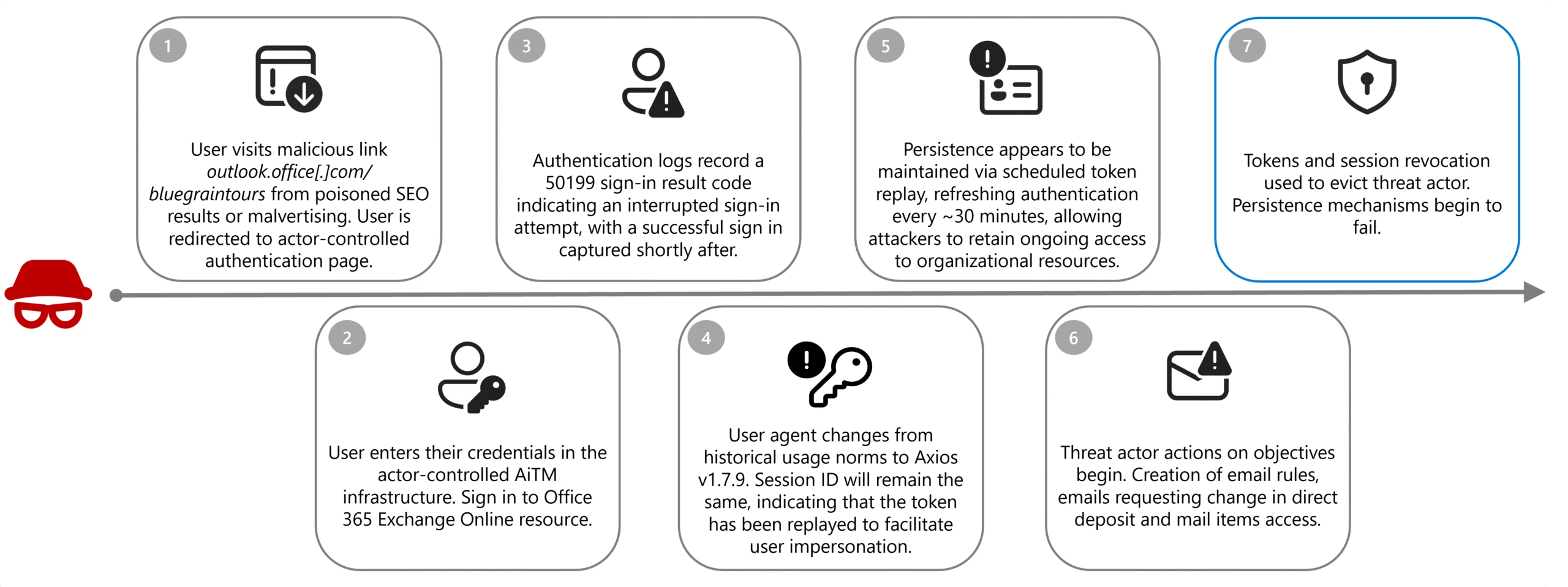
❌