Artificial intelligence is accelerating discovery across the life sciences. From drug development to materials science, AI is helping researchers move faster and solve problems once thought intractable. This convergence of AI and biology holds extraordinary promise for human health, economic growth, and scientific leadership.
At the same time, advances in AI technologies are introducing new risks, like re-engineered toxins and pathogens. As these tools become more capable and widely accessible, they can lower barriers not only to scientific discovery, but also to accidental harm and deliberate misuse. For example, recent research has shown that specialized AI tools for protein design can be used to re-engineer toxins in ways that may preserve harmful function while evading some existing synthesis safeguards. That work revealed vulnerabilities in screening systems designed for an earlier technological era—and also showed that those systems can be strengthened through coordinated action across industry, government, and the scientific community.
Rising biosecurity concerns are not a reason to slow innovation, but they are a reason to strengthen our defenses. History shows that powerful general-purpose technologies become more accessible—as with advances in networking and computing—effective governance depends on developing technical and policy safeguards early, before misuse outpaces controls and oversight. The convergence of AI and biology presents a similar challenge: we must preserve the openness that fuels discovery while modernizing protections for a new era of capability.
This blog examines how advances across the AI-biology ecosystem are reshaping both opportunity and risk. It explains why nucleic acid synthesis screening has emerged as a critical control point, and how government, industry, and the scientific community can work together to strengthen biosecurity without slowing innovation.
AI andbiotechnology at thefrontier
To better understand the trajectory of AI capabilities in the biosciences—and the associated policy and risk landscape—it is useful to distinguish among four related types of advances. Each matter on its own, but effective policy will need to account for how these advances increasingly interact and reinforce one another.
Generalist models. Advances in general-purpose AI models, such as ChatGPT, Gemini, Claude, and others, are expanding the range and sophistication of what these systems can understand, reason through, plan, and generate across domains. As they become more powerful, they raise baseline capabilities and lower barriers to sophisticated technical work.
Specialized biological design tools. Computer scientists and biologists continue to develop specialist AI code bases aimed at performing computation in support of increasingly sophisticated biological tasks. These tools, typically open-sourced and shared widely, include programs that compute protein structure from amino–acid sequences and design proteins with specific structures and properties.
Laboratory automation. Advances in computer vision, robotics, and experimental workflows are bringing new efficiencies to laboratory work. Over time, these systems may allow researchers to generate, test, and refine biological designs at greater scale and speed.
Agentic systems. Agentic programming environments and run–times (including increasingly powerful AI-based engineering tools, e.g., Claude code) are making it easier to combine generalist AI models, specialist libraries, and laboratory workflows into coordinated pipelines. This may allow less experienced actors to move more readily from computational design to real-world synthesis, including through nucleic acid synthesis services or automated laboratory systems.
While each category can be analyzed separately, the most consequential developments arise from how these capabilities increasingly interact. Improvements in generalist models can make specialized biological tools easier to use; those tools make it easier to engineer biology; automated laboratories provide non-experts with access to sophisticated laboratory workflows; and agentic programming tools can connect these elements into integrated design, analysis, and synthesis workflows. Together, these advances are forming a converging “capability stack”—one that can accelerate innovation but lead to a more complex policy and risk landscape.
Why nucleic acid synthesis screening matters
These developments make clear that effective governance must focus not only on frontier models but also expand to consider multiple practical control points.
One of the most effective near‑term defenses against biological misuse is nucleic acid synthesis screening. Synthetic DNA providers sit at a critical checkpoint in the biotechnology ecosystem. They are often the place where theoretical biological designs are translated into physical reality. Screening DNA orders and verifying customers helps ensure that powerful tools are used for legitimate purposes and not diverted toward harm.
Today, however, most DNA synthesis screening remains voluntary and unevenly applied. Standards vary across providers, and there is no universal requirement that all orders be screened to the same level. As AI‑enabled design tools grow more powerful, these gaps become more consequential.
Strengthening nucleic acid synthesis screening is a pragmatic and targeted response. It does not regulate ideas or restrict legitimate research. Instead, it focuses on responsible access to sensitive capabilities, reinforcing a line of defense that already exists but must now be modernized. The necessity and viability of such modernization was demonstrated by the Paraphrase Project, led by Microsoft. By stress-testing existing screening systems against AI-designed biological sequences, the project showed both where safeguards could fail and how they could be improved. The effort followed a familiar model from cybersecurity: responsible disclosure, red teaming, and rapid deployment of fixes. It highlights how biosecurity tools, like software, must evolve continuously to keep pace with changing threats.
Bipartisan momentum and durable government action
The importance of biosecurity in the age of AI has been recognized across administrations and parties. On May 5, 2025, the Trump Administration released an Executive Order on Improving the Safety and Security of Biological Research, emphasizing the importance of nucleic acid synthesis screening and calling for broader biosecurity oversight. That action built on work that began in 2024, when the White House Office of Science and Technology Policy set out a federal framework emphasizing comprehensive screening, customer verification, and the development of technical standards in partnership with industry.
Leaders in Congress are now building on this foundation. Earlier this year, Senators Cotton and Klobuchar introduced the Biosecurity Modernization and Innovation Act, known as S. 3741. The bill reflects a bipartisan commitment to strengthening U.S. biosecurity while sustaining scientific leadership and innovation. It would establish mandatory screening requirements (extending beyond current requirements for screening for federally funded research), conformity assessments, and enforcement mechanisms, while also advancing practical implementation through technical assistance and a biotechnology governance sandbox to promote exploratory efforts. The bill also directs OSTP to conduct a 90-day assessment of biosecurity authorities and develop a plan to consolidate oversight to improve efficiency and effectiveness.
Taken together, these efforts reflect a durable consensus: safeguarding biotechnology in the AI era is a national security priority.
Responsible innovation in practice
Supporting innovation while reducing risk will require a balanced approach grounded in continuous monitoring of emerging capabilities, investment in technical safeguards, and thoughtful policy development.
Nucleic acid synthesis screening is not a comprehensive solution, but it is an essential one. Strengthening it now—through bipartisan legislation, thoughtful regulation, and continued public‑private collaboration—would represent the type of balanced, durable action that this moment requires.
The Biosecurity Modernization and Innovation Act would help advance that goal by pairing stronger screening requirements with practical implementation tools and oversight mechanisms. Microsoft strongly supports efforts like this that build on our longstanding work with researchers, synthesis providers, and other partners to strengthen safeguards while sustaining innovation.
The United States has an opportunity to continue to lead by pairing innovation with responsible stewardship. If we get this balance right, we can reap the rewards of AI-enabled biotechnology while guarding against its risks—for this generation and the next.
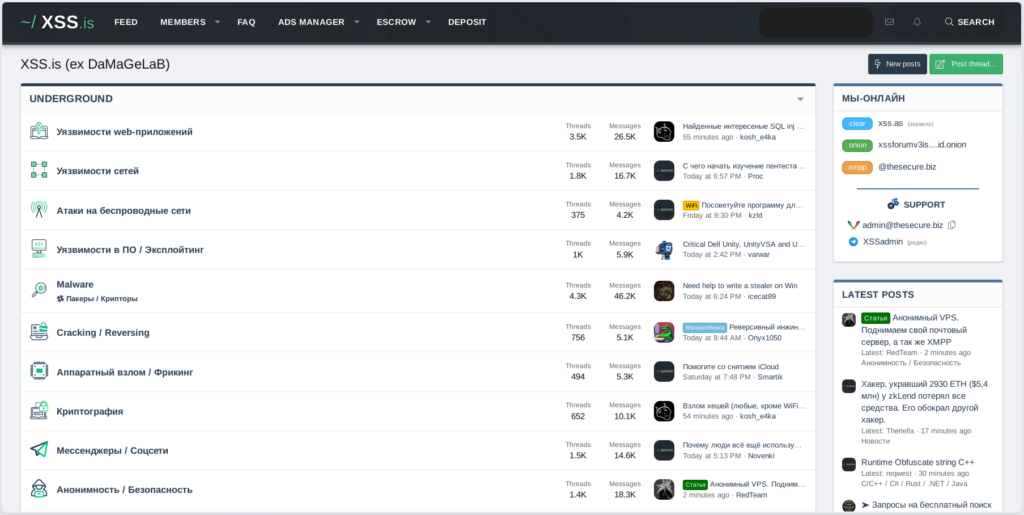
For more than two decades, XSS was the gathering ground for the Russian-speaking cybercriminal underground. Evolving from its former name, DaMaGeLaB, XSS evolved from a mid-tier message board into a top-tier hacking forum.
XSS is home to vendors of various crime types, including loaders, phishing, scamming, carding, malware development, distributed denial-of-service (DDoS) bots, and related services. It also facilitates the trade of illicit goods and services, while simultaneously serving as a networking and recruitment hub for threat actors.
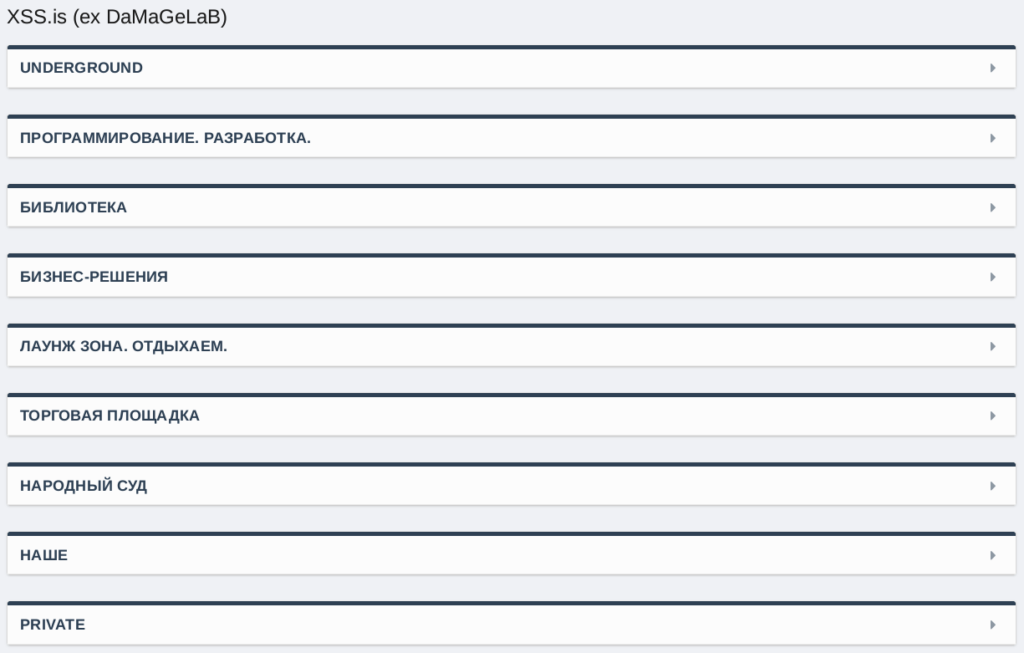
XSS forum content falls within the following main sections:
“Programming, Development”: Includes posts and articles about programming languages and administration.
“Library”: Includes news articles, databases, and discussions around software and tools. Users also post about vulnerabilities and exploits.
“Business Decisions”: Users discuss different investments, the sale of digital goods, trading, start-ups of fraudulent businesses, and news about cryptocurrencies.
“Lounge Zone, Resting”: Content involves lifestyle discussions, hobbies, and cybercriminal community rumors and scandals.
“Trading Platform”: Users sell and look to buy network access, malware, counterfeit documents, and advertise their services. This is where users hire and look for work or partners.
“People’s Court”: Used for complaints and arbitration and contains lists of phishing forums and scammers.
“Ours”: Contains information about the XSS project, discussions on issues, suggestions, and initiatives for forum improvement.
“Private: Underground”: Closed section for only forum members.
XSS forum main sections (Source: XSS)
XSS Disruption: July 2025 Takedown
On July 23, 2025, law enforcement organizations reportedly seized XSS as part of a multinational operation with Ukrainian authorities, French police, and Europol. Alongside the domain seizure, French authorities reported the arrest of XSS’s longtime administrator in Ukraine.
This arrest triggered an immediate chain reaction that has had lasting effects on the Russian-speaking underground—with the XSS ecosystem splintering into several competing factions.
The Current State of the Russian-Speaking Underground
While the original XSS architecture was severely disrupted, the surrounding Russian-speaking cybercriminal ecosystem remains intensely active. However, instead of a centralized hub, the XSS ecosystem is spread out through competing environments that emerged directly from the fallout of the takedown.
DamageLib
Launched by the legacy moderators of XSS, DamageLib represents a structural pivot away from standard illicit forums. Concluding that the old XSS site was compromised by law enforcement, the moderators launched a new model that completely abandons commerce—shutting down all buying, selling, and auctions entirely—-to eliminate user tracking and surveillance. Instead, it focuses strictly on technical materials and tutorials.
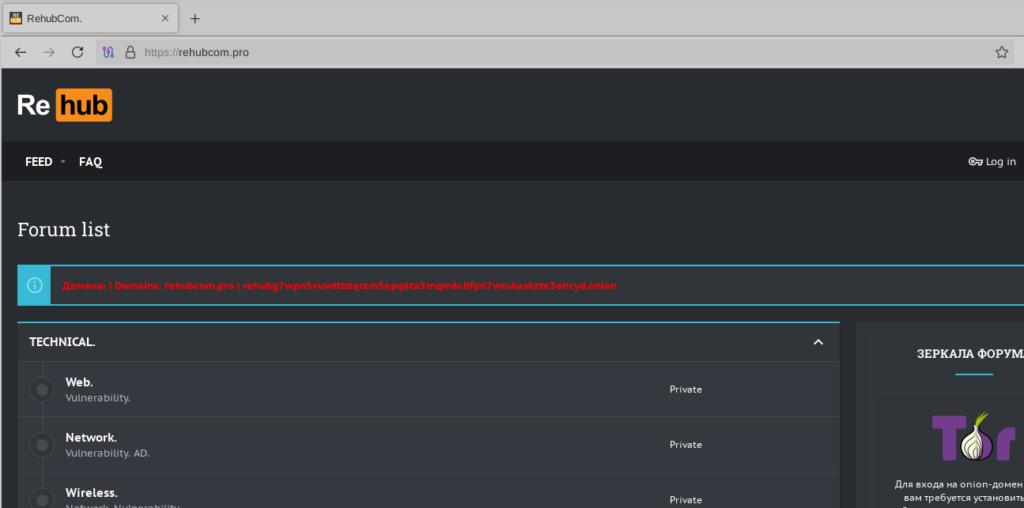
Rehub
Recognizing that displaced cybercriminals still required a commercial venue to trade, a former XSS moderator launched Rehub quickly after the emergence of DamageLib. Rehub immediately integrated a commercial platform, successfully recruiting prominent threat actors into its moderation team to establish underground credibility.
The forum is still in its development stage, with its content being populated, and an active member base being built.
XSS[.pro]
In early August 2025, an unknown entity launched an alleged resurrection of the forum on a new domain [.pro], utilizing old backups that preserved legacy user data, threads, and forum deposits. However, this new version has been met with significant distrust from Exploit and DamageLib, believing the [.pro] domain to be a honeypot controlled by law enforcement.
XSSF Forum
Started by a pro-Russian Telegram hacking group, this community actively targets EU and Ukrainian digital infrastructure. According to user discussions on DamageLib, this forum is not related to XSS. In addition, Flashpoint analysts note that targeting Ukrainian infrastructure directly contradicts its original community rules. The authenticity of this forum and its ownership has not been verified.
Monitor a Fractured Underground Using Flashpoint
While law enforcement achieved a significant victory over XSS, they did not eliminate the Russian-speaking cybercriminal underground. Instead, they broke the foundational trust mechanics that had kept it centralized for twenty years.
This has left the Russian-speaking underground in a deeply fractured state that is still intensely active and highly adaptive. For defenders and analysts, this threat has not diminished—it has diversified. Tracking this ecosystem no longer means watching a single centralized community, but rather actively mapping out the live migrations, shifting rules, and behavioral patterns across these splintered groups.
Request a demo to learn how Flashpoint helps security teams aggregate intelligence from these scattered factions into a single source of truth, empowering your organization to proactively monitor and intercept emerging threats.
The Mini Shai-Hulud Worm and the New Era of CI/CD Exploitation
In this post we break down the technical mechanics of TeamPCP’s recent campaign, the impact on the developer ecosystem, and the urgent steps needed to secure software supply chains.
The developer ecosystem recently faced one of its most significant architectural threats to date, with the threat actor group TeamPCP unleashing Mini Shai-Hulud—a self propagating worm and multi-ecosystem threat. Potentially affecting millions of developers and thousands of companies, Mini Shai-Hulud has fundamentally compromised the trust layer of modern CI/CD pipelines.
The operational tempo of Mini Shai-Hulud has accelerated with every campaign. What began as opportunistic credential theft has now evolved into a high-speed, automated operation that can compromise hundreds of packages in under thirty minutes. From the exfiltration of approximately 3,800 internal GitHub repositories to the poisoning of critical libraries like TanStack and AntV, TeamPCP’s campaign has been incredibly effective in exploiting developer tooling and identity infrastructure.
What is Mini Shai-Hulud?
Mini Shai-Hulud is deployed as a 498 KB obfuscated script executed using the Bun JavaScript runtime. The deliberate choice of Bun, rather than Node.js, is a tactical evasion technique as most endpoint detection and response (EDR) platforms and security information and event management (SIEM) solutions have behavioral rules tuned to Node.js execution patterns.
How Mini Shai-Hulud Works
The worm propagates by stealing npm and GitHub authentication (OIDC) tokens from developer environments, then using those credentials to publish malicious versions of packages the compromised user maintains. To accomplish this, the worm scrapes runner process memory to extract short-lived identity tokens, which it then exchanges for per-package npm trusted-publisher tokens without requiring any long-lived npm secrets.
Credential Exfiltration and Command-and-Control
Mini Shai-Hulud targets credentials across 130 file paths, including npm tokens, GitHub personal access tokens, AWS, GCP, and Azure configuration files, Kubernetes kubeconfig files, Docker credentials, HashiCorp Vault tokens, 1Password and Bitwarden CLI vaults, SSH private keys, and Bitcoin wallet files.
Exfiltration occurs across multiple channels: the Session Protocol network, the GitHub Git Data API using dynamically created Dune-themed repositories on victim accounts, HTTPS to the threat actor-controlled domain, and an api for GitHub Actions workflow exfiltration.
The worm uses a dead-drop command-and-control (C2) architecture via GitHub’s public commit search API. An installed daemon (kitty-monitor, deployed as a systemd service on Linux or a LaunchAgent on macOS) polls GitHub for commits containing the string “firedalazer,” parses RSA-PSS-signed command payloads from matching commits, and executes them. This technique leverages GitHub as a trusted relay, making C2 traffic difficult to block without disrupting legitimate GitHub usage.
The worm then uses a persistence mechanism as a dead-man’s switch: a GitHub personal access token named “IfYouRevokeThisTokenItWillWipeTheComputerOfTheOwner” is created on compromised developer machines. If an operator revokes this token without first disabling the persistence mechanism, the worm destroys all home directory data on the compromised device.
AI Agent Hijacking
Beyond standard persistence mechanisms, Mini Shai-Hulud targets AI coding agents. The SafeDep analysis documents that the worm modifies Claude Code’s settings .json to insert a SessionStart hook, enabling the worm to be reinstated with full LLM API privileges even if the infected npm packages are later removed, or the npm cache is cleared. A similar technique targets Visual Studio Code’s tasks.json file using the “runOn”: “folderOpen” trigger, and Codex configuration files are also targeted.
These AI agent hijacking techniques represent a novel attack surface: by persisting within trusted AI tool configurations, the malware can exfiltrate all code and secrets processed by those tools during future development sessions.
Four Waves of Supply Chain Attacks
Flashpoint has observed at least four documented waves of TeamPCP npm and PyPI supply chain attacks in 2026, leveraging Mini Shai-Hulud to compromise developer tooling ecosystems and steal credentials, cloud keys, and source code across tens of thousands of organizations.
The following timeline tracks the escalation of TeamPCP and the Mini Shai-Hulud waves throughout 2026:
Wave 1: Initial SAP Packages (April 2026)
The first documented wave of Mini Shai-Hulud attacks targeted a small number of SAP-ecosystem npm packages in April 2026. While TeamPCP had already proven their CI/CD attack capabilities in March 2026 by compromising Aqua Security’s Trivy scanner and Checkmarx KICS via GitHub Actions, this initial wave served primarily as a proof-of-concept for the self-propagation mechanism and a reconnaissance phase for TeamPCP’s access broker network. Further, these attacks demonstrated the group’s ability to compromise widely used security tooling—a development that significantly undermines defenders’ ability to trust automated CI/CD pipeline scanning results.
Wave 2: TanStack, Mistral AI, and Guardrails AI (May 2026)
Leveraging a GitHub Actions cache-poisoning technique, TeamPCP published malicious versions of 42 TanStack packages across 84 releases, impacting a project with over 518 million cumulative downloads.
The attack also compromised Mistral AI and Guardrails AI, extending the attack surface to the AI developer tools ecosystem. Forged commit authorship was used to blend the attacker’s commits into AI-assisted development environments where Claude Code is commonly deployed.
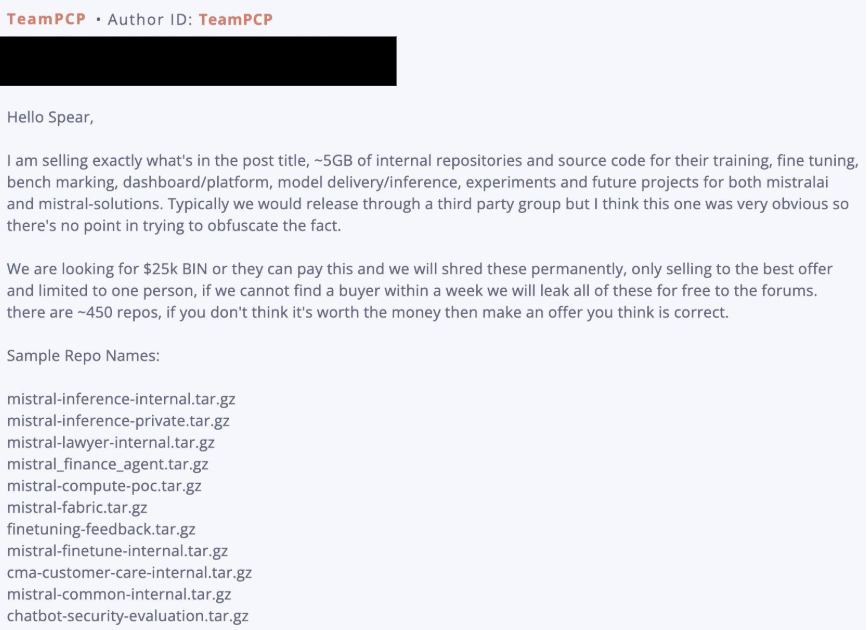
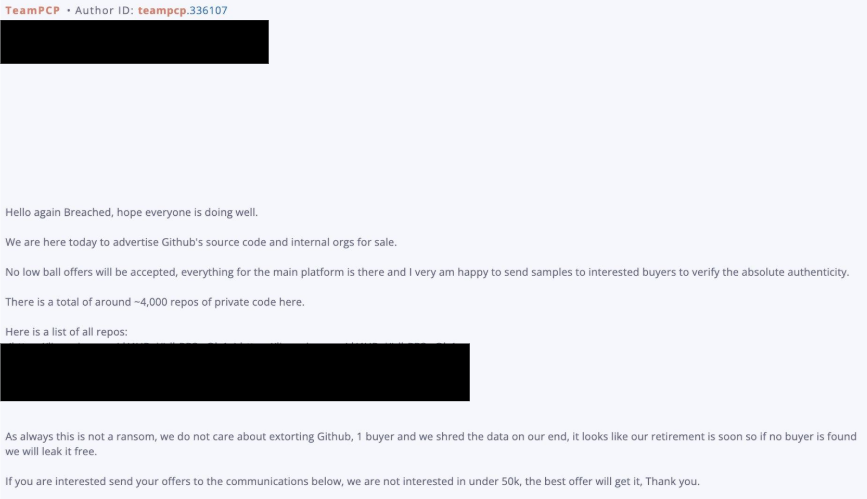
TeamPCP simultaneously listed Mistral AI source code for sale on BreachForums, claiming possession of approximately 5 GB of data across 450 internal Mistral repositories.
TeamPCP BreachForums posts advertising Mistral AI internal source code and repositories for sale, May 2026. (Source: Flashpoint)
Wave 3: AntV Ecosystem (May 2026)
Targeting AntV enterprise data visualization ecosystem, TeamPCP compromised the atool npm account, which held publishing rights across a broad catalog of AntV packages. In 22 minutes, 637 malicious versions were published across 323 packages—a scale and speed that overwhelmed standard security monitoring pipelines.
Each infected package contained the Mini Shai-Hulud worm, which, upon execution, created up to 2,500 compromised repositories on victim accounts within hours.
Wave 4: Co-Ownership of BreachForums and GitHub Breach
In the most recent wave, TeamPCP announced its assumption of co-ownership of BreachForums, the largest English-language cybercriminal forum currently active. This development significantly elevates TeamPCP’s standing and operational reach. As co-owners, the group stated it would manage platform operations, handle dispute resolution, staff and vet moderation personnel, and host monetary contests for the community. The announcement positions TeamPCP as both an active threat actor and a platform-level infrastructure operator, with the ability to shape forum policies, curate the availability of criminal tooling, and influence the broader access broker and ransomware ecosystem.
Additionally, by poisoning a GitHub employee’s development environment, TeamPCP exfiltrated approximately 3,800 internal GitHub repositories. Within the stolen data were highly sensitive codebases such as:
copilot-api and copilot-token-service
actions-runtime
billing-platform
enterprise-crypto
authentication
codeql-core
detection-engineering
csirt
azure-config
TeamPCP BreachForums posts advertising GitHub internal source code for sale. (Source: Flashpoint)
Recommended Immediate Actions
Critically, the theft of internal source code from one of the world’s most widely used code hosting platforms creates incredible downstream risk for organizations that depend on GitHub Copilot and GitHub Actions for their own software development pipelines. Organizations running AI coding agents such as Claude Code and VS Code with extensions in their CI/CD pipelines face heightened exposure. Security teams should treat AI agent configuration files as sensitive assets subject to integrity monitoring and change-control policies.
If your organization uses npm, PyPi, or AI-assisted development tools, Flashpoint recommends the following immediate steps:
Audit and remove: Immediately audit CI/CD environments and remove all infected versions of AntV, TanStack, Mistral AI, and Bitwarden CLI packages.
Rotate credentials: Rotate all cloud credentials (AWS, GCP, Azure) and npm tokens.
Disable persistence first: Before revoking suspicious GitHub tokens, ensure the kitty-monitor daemon is disabled to avoid triggering the “dead-man’s switch” wiper.
Lock down IDEs: Restrict the installation of VS Code extensions to an approved allow-list and monitor for unauthorized changes to settings.json or tasks.json.
Block C2 infrastructure: Block all traffic to identified TeamPCP C2 domains.
Track TeamPCP and Defend against Mini Shai-Hulud Using Flashpoint
Flashpoint assesses with high confidence that TeamPCP will continue to scale its supply-chain attacks against npm, PyPI, and developer tooling ecosystems. The group’s shift from direct execution to orchestrating a broader ecosystem via BreachForums signals a maturation into a platform-layer criminal operation. While TeamPCP has hinted that the group may be approaching “retirement” due to law enforcement pressure, this should be treated with caution. Whether a misdirection or a genuine exit plan, the open-sourcing of Shai-Hulud means the tradecraft is available to the wider cybercriminal community.
Organizations should reference the OpenSSF npm Best Practices guidance for a practical baseline in hardening their package consumption posture. Flashpoint customers can gain access to known Indicators of Compromise (IOCs) and MITRE ATT&CK Mapping for Mini Shai-Hulud by logging into Flashpoint Ignite. To learn more about how Flashpoint tracks threat actor groups like TeamPCP and protects the software supply chain, request a demo.
More than 30 percent of the US working-age population is using AI, an increase of three percentage points from the end of 2025. But what does that number mean, and what lessons should we take from it? Today Microsoft released a new report that offers an in-depth look at AI adoption across the United States, allowing for the first time a state- and county-level review. This data and the trends it shows are important.
On a national basis, the US leads the world in AI innovation but ranks just 21st in global AI adoption. Part of the reason for this gap is a clear and uneven pattern of AI adoption across the country. We are also seeing a significant divide between urban and rural counties in AI usage. Usage averages 32.9 percent in metropolitan counties, compared with 16.2 percent in rural areas. In other words, metropolitan usage is about double what we see across rural America.
The study also shows that another powerful driver of AI diffusion is the presence of colleges and universities. Counties with higher shares of residents aged 18 to 24 have significantly higher AI usage rates—28.6 percent compared with 20.3 percent in other counties. And while college students are some of the most vocal about the risks of AI, they are also helping lead adoption. In counties with college towns like Williamsburg, Virginia, and Story, Iowa, we see usage rates that rival the highest in the world.
When intimate images are shared without consent—whether real or AI-generated—the harm is immediate, deeply personal, and often long-lasting. It can affect someone’s sense of safety, dignity, and control, both online and offline. Protecting people from harms like non-consensual intimate imagery (NCII) has long been a priority for Microsoft. And as technology advances, our response continues to evolve to tackle very real challenges like the proliferation of highly realistic synthetic imagery. With the US Take It Down Act coming into force this month, establishing new federal protections against the spread of NCII, it’s important to share how we’re evolving our approach: making it easier to report harm, taking new steps to detect known NCII, and enabling more effective enforcement across our services.
Expanding protections across Microsoft services
Our goal is to make it simpler forindividuals, or their representatives, to report violativecontent to Microsoft. We have strengthened our global reporting processes for NCII with a more intuitive form, with clear options to describe harm, including both real and AI‑generated images. These changes are designed to ease the burden for people in a distressing moment and enable faster, more effective action by our teams. Microsoft’s NCII policy is applied consistently across real and synthetic content, recognizing that the harm to individualsis the same, regardless of how an image was created. To report content on Microsoftservices,hit “Report A Concern”or in the product where you encounterthe content.
We also want to proactively detect and prevent the spread of known NCII byworking with StopNCII.org,areporting platform that enables individuals to create a digital “fingerprint,” or hash, of their images. Two years ago, weprovided StopNCII.org witha new version of PhotoDNA that enables victims to create a hashwithout an image ever leaving their device. This can then be used by StopNCII.org partners to detect and remove matching NCII content across platforms, allowing industry to work together to prevent re-sharingand protect individuals’ privacy. We have been piloting the use of these hashes in Bing since September 2024.
We have now expanded our use of validated StopNCII.org hashes across Microsoft consumer services, including Teams Free, OneDrive, and Xbox. We will implement these changes carefully to advance effectiveness and accuracy—accelerating removals, automating where appropriate, maintaining human review for reported cases, and providing clear, accessible paths for users to appeal decisions.
Enhancing our collective response to this harm
No single company can address NCII alone. It requires coordination across industry, governments, and civil society. Microsoft will continue working with partners to improve shared tools and approaches that help prevent this content from spreading. We will also continue to advocate for clear, effective policies that protect victims, support innovation, and strengthen accountability across the ecosystem.
We will also continue to advocate for policies that support efforts to advance laws that prevent and deter image-based abuse. Microsoft advocated in support of the US Take It Down Act and welcomes the European Union’s work to strengthen protections against “nudification” apps, alongside global efforts to criminalize this misuse of technology. We are closely tracking Ofcom’s recent announcement that new measures will be required under the UK Online Safety Act to address illegal NCII harms. We believe our proactive work in this area will help us maintain trust with survivors, users, and regulators, among others.
Speed, clarity, and trust matter for people affected by intimate image abuse. When someone reaches out for help, we will strive to respond quickly, respectfully, and effectively. Our goal, though, is to invest in technologies and partnerships that reduce the likelihood of harm. We have joined forces with Childnet, a UK NGO that aims to safeguard children online, and created educational materials to prevent the misuse of AI to create intimate imagery among teens. These materials have now been released in the UK, as well as localized with partners in Singapore, South Korea, and Japan.
I am proud to learn from our digital safety team, which is carefully charting our path, and from the many industry and community leaders contributing to this work. This is an evolving challenge. We are committed to the journey, grounded by the voices of experts and survivors.
Every day, we decide what software to trust in seconds guided by simple labels such as “verified,” “secure,” and “safe to install.” The problem is that those signs can be manipulated.
Today, Microsoft unsealed a legal case in the US District Court for the Southern District of New York targeting a cybercrime service known as Fox Tempest, which, since May 2025, has enabled cybercriminals to disguise malware as legitimate software. The malware-signing-as-a-service (MSaaS) worked by fraudulently accessing and abusing code signing tools, such as Microsoft’s Artifact Signing, a system designed to verify that software is legitimate and hasn’t been tampered with. Cybercriminals used the service to deliver malware and enable ransomware and other attacks, infecting thousands of machines and compromising networks worldwide.
For the first time, Microsoft is taking public action against a powerful, but often unseen, enabler within the cybercrime ecosystem, targeting how cybercriminals prepare and employ techniques to optimize their rate of success. To disrupt the service, we seized Fox Tempest’s website signspace[.]cloud, took offline hundreds of the virtual machines running the operation, and blocked access to a site hosting the underlying code. This action builds upon persistent internal efforts to revoke fraudulently obtained code‑signing certificates and enhance our defenses and employ new security features to detect and thwart such malicious activity. It’s already having an impact: cybercriminals are complaining about challenges accessing the current service.
Our impact extends beyond one actor. The lawsuit targets Fox Tempest’s infrastructure and also names Vanilla Tempest as a co-conspirator, a prominent ransomware group that used the service to deploy malware like Oyster, Lumma Stealer, and Vidar, and ransomware, including Rhysida, in multiple recent cyberattacks. Vanilla Tempest has targeted schools, hospitals, and other critical organizations worldwide, while Rhysida, a highly evolved ransomware variant that both encrypts files and steals data, often used for double extortion, has been used by various actors in numerous high-profile attacks globally, including to steal and leak internal documents from the British Library and to disrupt operations at Seattle-Tacoma International Airport. Microsoft’s investigation further linked Fox Tempest to various additional ransomware affiliates and families, including INC, Qilin, Akira, and others.
More broadly, this case points to how cybercrime is changing. What once required a single group to carry out an attack from start to finish is now broken into a modular ecosystem where services are bought and sold and work interchangeably with one another. Some services are inexpensive and widely used. Others, like Fox Tempest, are highly specialized and expensive because they remove friction or bypass obstacles that make attacks fail, making them both more reliable and harder to detect. As seen with Fox Tempest, when these services are combined with AI-powered tactics, attacks can scale more easily, reaching more people and becoming more convincing.
This kind of abuse isn’t new, but it is evolving
Illicit code-signing certificates have been sold and trafficked for more than a decade. That includes its use by nation-state actors to target critical infrastructure organizations in Europe. What’s changed is how this activity is marketed, packaged, and sold as a service, along with the scale at which it is now used across ransomware campaigns. Instead of buying certificates one-by-one, criminals upload their malware to a service that signs it for them.
What also makes this model notable is the level of investment. Unlike lower-cost services like RedVDS, a cybercriminal infrastructure provider that costs as little as $24 per month, which Microsoft disrupted earlier this year, Fox Tempest shows that more sophisticated actors are willing to pay thousands of dollars for advanced capabilities that make attacks easier to carry out, harder to detect, and more likely to succeed.
How Fox Tempest sold “legitimacy” at scale
Fox Tempest’s business model was straightforward: sell fraudulent code-signing capability, let others package malware, and enable attacks downstream. The model has generated millions in proceeds, demonstrating significant financial profit.
Behind the scenes, the operators built access at scale. Using fabricated identities and impersonating legitimate organizations, they created hundreds of fraudulent Microsoft accounts to obtain real code-signing credentials in volume. Customers who paid for Fox Tempest’s services could then upload malicious files via an online portal for them to be signed using Fox Tempest-controlled certificates. Cybercriminals paid thousands of dollars for the service, reflecting how valuable this capability was.
Fox Tempest’s pricing model form and Telegram channel where you could purchase the service. The more you pay, the quicker you get access to the service.
Once signed, their malware appeared legitimate. Attackers then distributed the signed malware through tactics such as search manipulation and malicious ads, where users are more likely to trust what they encounter. AI then helped generate and refine these campaigns to reach a broader audience.
How code-signed malware appears in search results.Fake Microsoft Teams download page and delivery mechanism for disguised code-signed malware
That changed the odds. Malicious software that should have been blocked or flagged by antivirus and other safeguards was more likely to be opened, allowed to run, or pass security checks—essentially allowing malware to hide in plain sight. Instead of forcing their way in, attackers could slip through the front door by masquerading as a welcomed guest.
An overview of malware‑signing‑as‑a‑service.
As Microsoft disabled fraudulent accounts, revoked fraudulently obtained certificates and introduced enhanced protections, the Fox Tempest operators continually adapted. In February 2026, they ultimately shifted to networks of third-party-hosted virtual machines to maintain and scale operations. That kind of rapid change is part of the model: these services evolve quickly in response to pressure and friction. In fact, Microsoft has observed further adaptations in response to our layered disruption efforts, with Fox Tempest attempting to shift operations and customers to another code-signing service.
Fox Tempest’s response to the disruptive efforts—translated from Russian by a third-party partner
In addition to seizing the core infrastructure behind the operation and degrading its ability to function at scale, we have taken further steps to prevent similar abuse, removing fraudulent accounts, strengthening verification, and limiting how this type of access can be reused. More technical details on the operation and the steps we’re taking to prevent similar abuse are available in this Microsoft Threat Intelligence blog.
Cutting off a critical enabler of cybercrime
This action wasn’t about stopping one actor. It sought to strategically neutralize a vital service that many attackers, particularly ransomware groups, rely on. When legitimate code signing services are weaponized, everything downstream gets easier: malware looks legitimate, security warnings are less likely to trigger, and attacks are more likely to succeed. Degrading that capability adds friction and forces a reset. The success rates of attacks decrease, and attackers have to rebuild, find new ways in, and accept more risk with each attempt—driving up both the cost and the time required to operate.
Importantly, disruption actions don’t happen in isolation and are never one-and- done. Collaboration is critical, as different organizations and sectors have visibility into different parts of the cybercrime ecosystem. In this case, we are working closely with cybersecurity company Resecurity, whose insights help us better understand how Fox Tempest operates. We are also collaborating closely with Europol’s European Cybercrime Centre (EC3) and the Federal Bureau of Investigation (FBI). As we’ve seen in previous efforts, we expect actors to try to rebuild. Collectively, we will continue to take action and keep the pressure on. That also means strengthening the code signing ecosystem through intelligence sharing and partnering with other code signing services, so it’s harder for malicious actors to regain that ground in the first place.
When attackers can make malicious software look legitimate, it undermines how people and systems decide what’s safe. Disrupting that capability is key to raising the cost of cybercrime. As threats evolve, the Microsoft Digital Crimes Unit will continue working with partners across industry and law enforcement to persistently identify and cut off the services that enable them.
For more than a decade, the Microsoft Digital Crimes Unit (DCU) has persistently disrupted cybercrime and nation-state threats targeting people, organizations, and critical infrastructure. Explore major disruptions—and the ongoing cases and operations behind them here: Disrupting cyberthreats since 2008 | Microsoft

 Login
Login

 Table Of Contents