❌

Normal view

Disrupting the service economy behind transnational cybercrime operations

14 October 2026 at 15:00

Most people have opened their messages to find a suspicious alert urgently telling them that a package cannot be delivered, a toll remains unpaid, a bank account needs attention, or a tax bill is overdue. The details may change, but the goal is the same: to get someone to click, share personal information, or pay. 

These messages are relentless. Delete and block one, and another takes its place. Ignore them, and more will follow. Fall for one, and the floodgates open. What appears to be a simple scam message is often the visible end of a much larger transnational cybercriminal operation. 

When Microsoft and Japan’s National Police Agency (NPA) followed a wave of fraud and scam activity targeting people and businesses in Japan, they expected to find individual campaigns. Instead, they found themselves inside a sprawling Chinese-language cybercrime marketplace where criminals could buy accounts, hosting services and tools used to create fake websites and online identities. The investigation expanded globally, involving the Japan Cybercrime Control Center (JC3), Resecurity, Cloudflare, Oracle, Proofpoint and TRM Labs to uncover the businesses sustaining this criminal ecosystem. 

Today, Microsoft and Health-ISAC, a global non-profit that helps health sector organizations share cyber threat information and collaborate to improve operational resilience, are moving to dismantle three components of this criminal marketplace: YAM Store, CoGUI and Iron Man.  

Since January 2026, YAM Store, CoGUI and Iron Man have collectively enabled more than one billion malicious messages targeting over 75,000 organizations worldwide, including more than 750 million messages geared toward Microsoft customers alone. These messages have been used to target consumers, healthcare organizations, financial institutions, and other businesses in more than 150 countries, generating tens of millions of dollars for their operators.   

Tracing the businesses behind the scams

The investigation began in late 2025 after Japan’s NPA alerted Microsoft to malicious messaging campaigns targeting people in Japan. NPA continued providing intelligence and investigative support as the partners traced those campaigns back to the businesses supplying criminals around the world. 

The trail led investigators deep into a Chinese-language cybercrime ecosystem that was difficult for non-native-speaking investigators to penetrate. There, they gained access to CoGUI, which supplied criminals with ready-made websites and messages impersonating companies, financial institutions, government agencies, and other trusted organizations. Instead of creating fraudulent websites themselves, criminals could quickly deploy pages designed to steal passwords, payment information, and other personal data.  

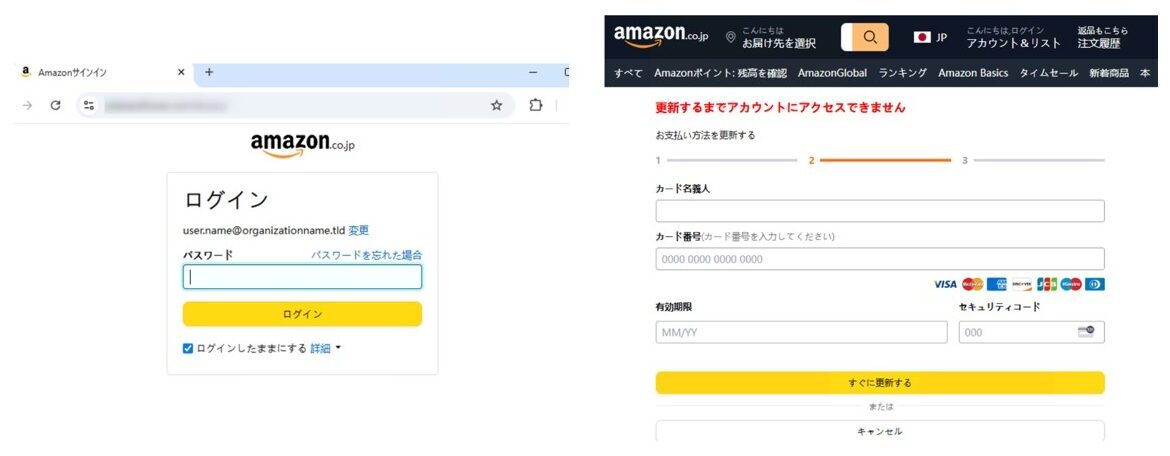
Two side-by-side screenshots of Amazon Japan webpages. The left shows an Amazon.co.jp login page with email and password fields. The right shows a payment method update page with fields for cardholder name, card number, expiration date, and security code, along with a yellow “Update now” button.
A fraudulent Amazon lookalike from CoGUI designed to steal login and payment information from Japanese-speaking users

As Microsoft’s investigation expanded, intelligence from JC3 helped confirm the scale of the activity affecting Japanese organizations and their customers. Drawing on information collected across its network of more than 130 member organizations, JC3 connected what appeared to be separate incidents to a broader pattern of scams targeting Japanese companies and financial institutions, including efforts to defraud consumers and to steal credentials and other sensitive information.  

One name that kept appearing throughout the investigation was YAM Store. YAM Store operated much like an online shop. Customers could browse products, compare prices and purchase fraudulent Microsoft and Google accounts and other ready-made tools used to carry out scams, including credential theft. Controlled purchases conducted by Microsoft helped confirm how it worked. 
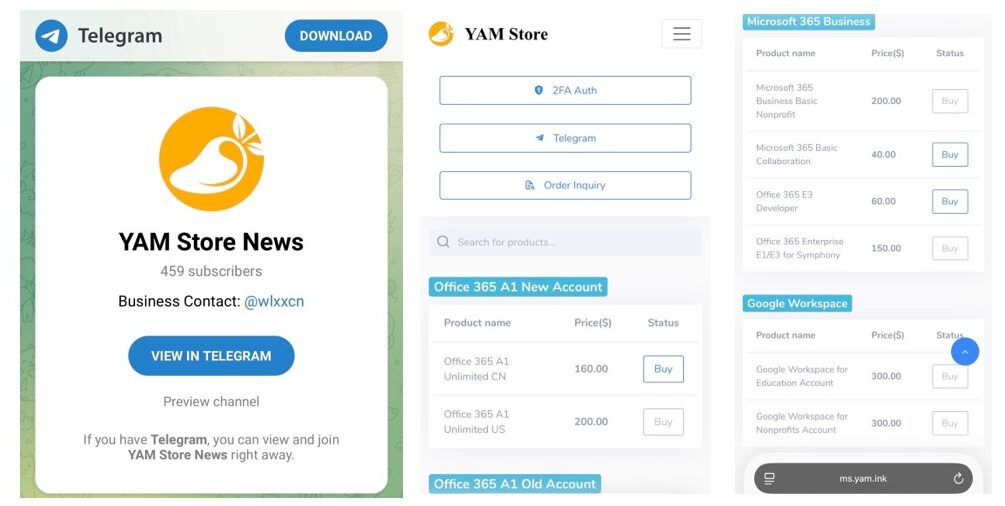
Three screenshots showing the YAM Store online marketplace. The left shows a Telegram preview for “YAM Store News” with 459 subscribers and a business contact. The center and right show YAM Store product listings offering Office 365, Microsoft 365 Business, and Google Workspace accounts at various prices, with “Buy” buttons.

In some cases, operators acquired internet domains that legitimate organizations had allowed to expire, often targeting certain sectors, such as non-profits and education, with specialized product offerings. They then rebuilt the websites to make those organizations appear active, allowing them to fraudulently obtain Microsoft 365 accounts that could later be sold through YAM Store.  

Screenshot of the Jewish Choice charity website. A blue banner reads “Supporting Health & Wellbeing in the Orthodox Jewish Community,” with text describing free, confidential support services for addiction issues and overall health, plus a “Get Help Today” button. The page also shows navigation links and an “About Jewish Choice” section.
A rebuilt nonprofit website used to create fraudulent Microsoft 365 accounts that could later be sold through YAM Store

Ready-made tools

YAM Store provided criminal infrastructure that was frequently paired with tools and services such as CoGUI. As investigators dug deeper, they found that the marketplace was already evolving. CoGUI had become one of the most widely used offerings in the ecosystem, particularly targeting victims in Japan and the United States but by mid-2026 it was increasingly being replaced by a newer offering known as Iron Man. 

Iron Man expanded the model by giving criminals access to thousands of ready-made templates designed to impersonate trusted organizations. Criminals could then quickly deploy email, text and web content tailored to specific brands, industries and countries.  

Through test purchases and work with Resecurity, investigators gained access to Iron Man and identified more than 2,300 templates impersonating banks, retailers, healthcare providers, transportation authorities, police departments, government agencies, and other organizations across more than 150 countries worldwide. Some were designed for government impersonation scams, using the appearance of official authority to pressure victims into making payments or disclosing sensitive personal information. Others impersonated organizations across industries, countries, and languages, from banks and airlines to telecommunications companies, retailers, and parcel delivery services.  

Examples of these impersonation templates are below. Importantly, the presence of an organization or government entity in these templates does not indicate that its systems were compromised. 

Six side-by-side screenshots of webpages in different languages and countries: a French DPD delivery status page, a German vehicle service payment notice, a Dutch tax refund application page, a Polish housing subsidy page, an Australian ANZ rewards points redemption page, and a Brazilian traffic fines consultation page.

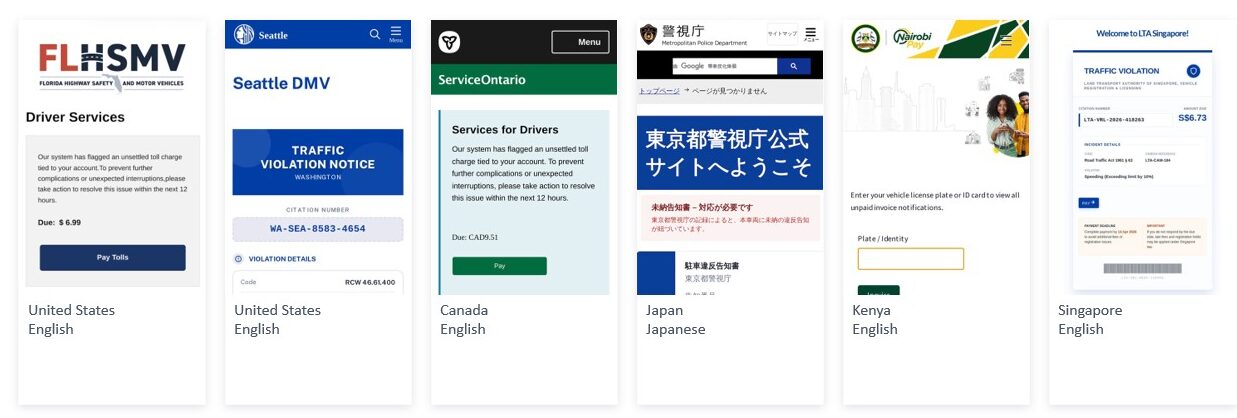
Six side-by-side screenshots of traffic and driver-service webpages from different countries. The examples include Florida and Seattle traffic violation notices in the United States, an Ontario toll notice in Canada, a Japanese Metropolitan Police Department page, a Nairobi Pay vehicle notice page in Kenya, and a Singapore traffic violation notice with a payment amount.

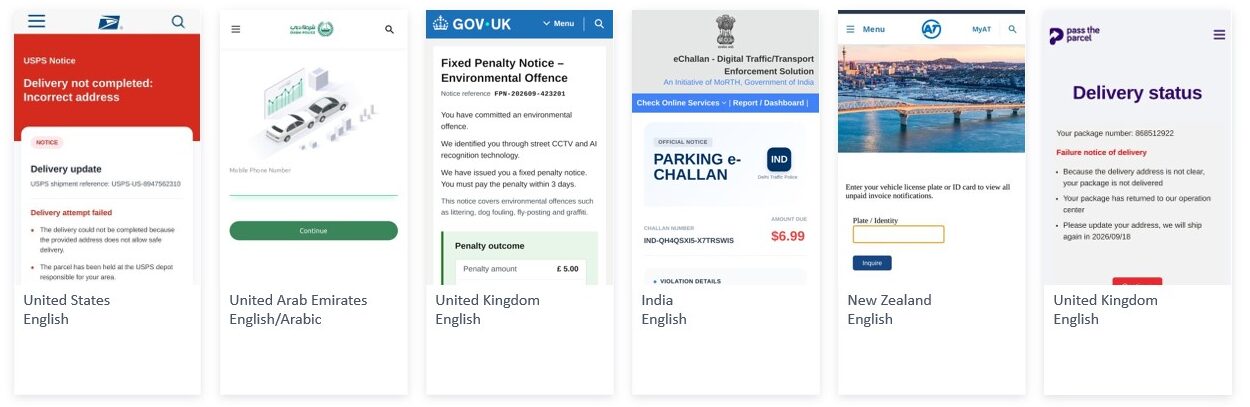
Six mobile webpage examples from the United States, United Arab Emirates, United Kingdom, India, and New Zealand showing delivery notices, traffic or environmental penalties, parking charges, and requests to enter personal or vehicle information.
Examples of Iron Man templates impersonating brands and government organizations around the world
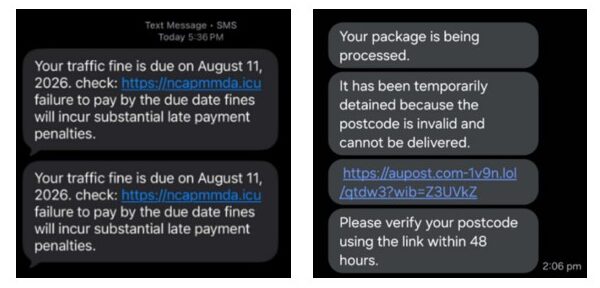
Two screenshots of suspicious text messages containing links. The left message claims a traffic fine is due and warns of late-payment penalties. The right message says a package has been detained because of an invalid postcode and asks the recipient to verify the postcode through a link within 48 hours.
Examples of Iron Man SMS templates impersonating traffic authorities in the Philippines and Australia Post, a package delivery service

A blog from Microsoft Threat Intelligence shares more details on the network, as well as steps customers can take to protect themselves.  

Putting the pieces together

No single organization saw the full picture. Japan’s NPA played a critical role throughout the investigation, providing intelligence, investigative support and collaboration that helped uncover how the operation worked. JC3 helped establish the scale of the activity affecting Japanese organizations and consumers. Health-ISAC provided insight into impacts affecting healthcare organizations, while Resecurity, Cloudflare, Oracle, Proofpoint and TRM Labs contributed intelligence and investigative support.  

Working together, and with the assistance of AI tools, we connected accounts, websites, and infrastructure that initially appeared unrelated, helping expose the broader criminal marketplace behind them. Microsoft also worked closely and shared intelligence with U.S. Secret Service and international law enforcement partners.

Alert page stating that a website domain has been seized by Microsoft, featuring the Microsoft logo and logos from collaborating organizations, including Japan’s National Police Agency, JC3, Health-ISAC, Resecurity, Proofpoint, Cloudflare, Oracle, TRM, Pillsbury, and law enforcement. Small text at the bottom references legal action and cybersecurity protections.

This investigation also reflects a broader trend highlighted in this year’s Microsoft Digital Defense Report: modern fraud increasingly relies on businesses and services that make it easier for criminals to reach more victims. It took two-way information sharing across industries and international borders to uncover how these deeply interconnected services worked together. 

Going after the suppliers

With an order from the United States District Court for the Southern District of Florida, Microsoft and Health-ISAC seized and redirected domains that were part of the underlying infrastructure powering YAM Store, CoGUI and Iron Man. Microsoft has already disabled more than 20,000 accounts connected to YAM Store and continues to dismantle the operation by removing infrastructure hosted on its services and blocking more than 100,000 domains used for impersonation and fraud.   

What began with scam activity targeting people and organizations in Japan led investigators to an underground service economy supplying criminals around the world. YAM Store, CoGUI and Iron Man are only part of that larger criminal network, but disrupting them makes it harder for criminals to obtain the accounts, tools and infrastructure they rely on. 

The scam message is often the only part victims see. The businesses behind it are what make it possible. 

The post Disrupting the service economy behind transnational cybercrime operations appeared first on Microsoft On the Issues.

Disrupting EvilTokens: The AI Chatbot Built for Cybercrime

Microsoft has disrupted EvilTokens, a powerful cybercrime platform that used AI at every step of the attack chain—from compromising email accounts to designing intricate roadmaps for financial fraud and scams. While EvilTokens helped cybercriminals access email accounts, at the center of the service was an AI-style chatbot that could analyze a victim’s inbox and help criminals identify trusted relationships, payment authorizations, and sensitive responsibilities, as well as other circumstances where fraud was most likely to succeed. The platform could even recommend fraud strategies, including drafting messages that impersonated trusted contacts to help criminals trick victims into taking action. 

In short, AI was not simply helping attackers write more convincing messages. It helped them decide who to target, who to impersonate, and how to most effectively exploit the relationship to extract as much money as possible.   

Within months of launching in February 2026, EvilTokens had been linked to more than 12,000 compromised email inboxes across over 10,000 organizations worldwide, showing how quickly the service gained traction. Microsoft observed the highest concentrations of victim activity in the United States, Canada, the United Kingdom, Australia, India, and France. Affected organizations ranged from wholesale distribution and construction to financial services, real estate, higher education, and healthcare. Working with partners, Microsoft seized 50 websites used to operate the service and disabled more than 150 additional domains tied to its supporting infrastructure. In the United Kingdom, the Metropolitan Police Service’s cybercrime team arrested two men on suspicion of offenses connected with the alleged operation of EvilTokens.  

But the significance of EvilTokens extends beyond its rapid growth and global reach. It offers an early warning of what happens when cybercriminals combine stolen access with AI capable of understanding how an organization works. 

From account access to financial fraud

EvilTokens helped criminals gain access to email accounts by tricking victims into entering an authentication code on Microsoft’s legitimate sign-in page. By completing the normal authentication sign-in process, victims unknowingly gave criminals access to their email accounts without revealing their passwords. That access could persist even after a password reset if the associated sessions and tokens were not also revoked. Microsoft Threat Intelligence provides additional technical details about the operation, how device-code attacks work, and steps customers can take to protect themselves here. 

Screenshot of an Outlook inbox showing an email about upcoming group events, with “AI Analysis” and “Summary” features highlighted in red.

Screenshot of an AI analysis interface identifying potential targets, opportunity levels, attack vectors, and financial opportunities based on scanned organizational emails.
EvilTokens AI analysis of compromised inbox and suggested follow- up prompts.

Once inside an account, criminals have traditionally needed time and experience to sift through thousands of messages, identify decision-makers, understand payment processes, and find opportunities for fraud. 

EvilTokens began automating that work. Its AI tools could summarize and translate emails, surface financial conversations, map organizational roles, identify trusted relationships, and recommend potential targets. Preset prompts offered to find wire-transfer discussions, identify the organization’s “money movers,” locate vendor invoices, and determine the best people to impersonate.

Sold through Telegram for a $1,500 initiation fee and a recurring $500 subscription, EvilTokens combined account compromise, mailbox analysis, target selection, and fraud preparation in a single service. Capabilities that once required experience across identity attacks, cloud systems, social engineering, and financial fraud were available through a ready-made interface.

Three screenshots of the EvilTokens Store Bot, including a DeviceCapture logo and messages advertising Microsoft 365 token capture and inbox access capabilities.
EvilTokens store on Telegram.
Screenshot of the EvilTokens “Essential Tools” dashboard displaying tools for token capture, browser access, traffic redirection, email automation, SMTP delivery, and email validation.
EvilTokens “Essential Tools” optimized for cybercrime.

AI lowered the barriers at both ends

Investigators found evidence that large portions of EvilTokens had been “vibe coded,” with AI helping its creators build the platform itself. They also determined that EvilTokens drew on capabilities from multiple AI models. 

The result was more than a collection of attack tools. EvilTokens packaged much of the fraud process into a commercially run service, complete with subscription pricing, customer support, management dashboards, and tools designed to move customers from account access toward financial exploitation.

Disrupting the platform

No single organization could disrupt EvilTokens alone. The service relied on hosting providers, cloud services, AI tools, financial services, and other online resources that cybercriminals repurposed to support fraud at scale. 

The disruption combined civil legal action with coordinated operational work across industry and law enforcement. Because healthcare organizations were among those targeted, Health-ISAC—a global non–profit that helps health sector organizations share cyber threat information and collaborate to improve operational resilience—joined Microsoft’s legal action as a co-plaintiff.

With authorization from the U.S. District Court for the Eastern District of Virginia, Microsoft and Health-ISAC worked with Cloudflare, Coinbase, OpenAI, Railway, SpyCloud, The Shadowserver Foundation, and TRM Labs to act against key parts of the platform. Microsoft also notified affected customers, helped remediate compromised accounts, and shared intelligence to support further defensive and investigative action.

The operation also demonstrated the value of rapid cooperation between private-sector investigators and law enforcement. Microsoft worked closely with specialist officers from the Metropolitan Police Service’s cybercrime team, sharing intelligence that enabled officers to take operational action in the United Kingdom. On September 11, 2026, officers arrested two men, aged 32 and 38, and seized digital devices and other items for examination. Both men have been released on police bail subject to conditions while the investigation continues. 

Screenshot of a Microsoft domain seizure notice featuring Microsoft and partner logos, including Cloudflare, Coinbase, Health-ISAC, Metropolitan Police, OpenAI, and others.
Seizure notice displayed after Microsoft and its partners disrupted infrastructure used by EvilTokens.

While EvilTokens used AI to identify targets and prioritize fraud opportunities, Microsoft investigators used reverse engineering and AI-powered tools to analyze evidence, accelerate the investigation, and identify the infrastructure supporting the service. The case shows how AI is changing not only how cybercriminals operate, but also how defenders investigate and disrupt them. 

This action marks the Microsoft Digital Crimes Unit’s (DCU) 40th court-authorized disruption spanning nearly two decades of targeting cyber threat actors, malicious tools, and supporting infrastructure. It is also DCU’s first action against an end-to-end AI-enabled cybercrime service. 

What EvilTokens reveals about cybercrime’s next phase

The infrastructure supporting EvilTokens has been disrupted, but the model it demonstrated will not disappear with it. As Microsoft notes in its 2026 Responsible AI Transparency Report, increasingly capable and accessible AI is being used to scale fraud, impersonation, and other forms of online abuse. EvilTokens offers an early example of how those capabilities can be combined with compromised accounts to accelerate financial fraud. 

For organizations, the lesson is: assume that once an inbox is compromised, criminals may understand its contents in minutes, not days. Strong identity protections and monitoring remain essential, but organizations should also independently verify requests to change payment information, redirect funds, or approve unusual transactions through a trusted second channel.


The post Disrupting EvilTokens: The AI Chatbot Built for Cybercrime appeared first on Microsoft On the Issues.

Scaling cybercrime disruption through innovation and AI

24 June 2026 at 14:30

Microsoft is taking a new approach to fighting cybercrime, targeting the cyberattack supply chain, not just individual services. In a case unsealed today, we are simultaneously targeting two widely used cybercrime tools, Amadey and StealC, after AI-assisted analysis revealed they rely on the same infrastructure.

This action goes after the cybercrime “assembly line,” where coordinated tools drive ransomware, financial fraud, and disruptions to public services. Amadey and StealC are often used alongside each other: Amadey helps attackers gain access to devices, while StealC steals passwords and sensitive information. Together, they form a critical link in the chain. In the first two weeks of May alone, Amadey and StealC were linked to more than 140,000 infected computers globally, highlighting how widely they are used.

Working with Europol and industry partners, we targeted both tools at once. The goal: break the chain. Since the start of the operation, Microsoft has identified more than 18,000 victim computers, severed criminal control of those devices, and is working with telecommunications providers to help protect affected customers globally.

When multiple parts of an operation are disrupted together, attacks are harder to launch, scale, and recover from. The result: fewer disrupted services, fewer opportunities for cybercriminals to profit, and more friction when they try to rebuild.

It’s no longer enough to go after threats one by one. We need to interrupt how the attacks are put together. 

What’s different about this action   

Microsoft has long used civil legal action to disrupt cybercriminal infrastructure and pioneered the innovative use of existing laws, including the Racketeer Influenced and Corrupt Organizations Act (RICO), a US law designed to target organized crime.

What’s new is how we’re combining AI analysis with an expanded use of that law.

Amadey and StealC were developed by separate cybercriminals, but they relied on the same infrastructure. To understand how they worked, investigators used AI, including Copilot, to quickly analyze the malware, asking questions in plain English instead of manually combing through complex code. That helped surface key details, uncover hidden data, and test findings in a fraction of the time, turning what would have taken hours or days into minutes and enabling the team to spot connections faster.

Those insights allowed the legal team to treat both malware families as part of a single conspiracy. Instead of going after each tool separately, as we have done in the past, we used RICO to charge multiple complicit enablers involved across the operation. In total, Microsoft’s Digital Crimes Unit disrupted over 200 command-and-control servers—the systems criminals use to control infected devices, steal data, and keep attacks running.

By targeting tools together, we can disrupt the cybercrime chain more efficiently and more effectively, in a way that better reflects how these networks actually operate today.

Cybercrime now runs like an assembly line 

Cybercrime is no longer a series of isolated attacks—it’s a coordinated system.

Specialized tools handle each step: one gains access, another steals credentials, and others sell or exploit that access for fraud, ransomware, espionage, or other nefarious purposes. Different actors may be involved at each stage, but together they turn access into profit, quickly and at scale.

How cybercrime tools are built to be modular

That structure also creates a point of vulnerability. The people behind these cybercriminal tools may never interact directly, but their tools are designed to work together. If those connections can be identified, multiple stages of an attack can be disrupted at once.

How these attacks play out in the real world 

Most people will never hear the names Amadey or StealC, but they feel the effects. A hospital locked out of critical systems. A city unable to deliver essential services. A small business losing access to accounts overnight. A retiree who lost their life savings.

These attacks don’t happen all at once. They unfold step by step: attackers get in, passwords are stolen, access is reused or sold, and sometimes repurposed for more targeted operations. For example, Microsoft has observed Russian-affiliated actor Secret Blizzard leveraging Amadey infections to deploy custom malware against targets in Ukraine.

By targeting multiple points in that chain at once, we reduce the chance that a single compromise turns into widespread harm. Put simply: fewer attacks succeed and fewer people feel the impact when they do.

No one organization can do this alone 

Actions like this underscore a fundamental reality: we’re successful when we collaborate. No single organization, whether government or industry, has full visibility into how cyber threats operate across borders and sectors. What makes this effort effective is the combination of perspectives and data.

Microsoft had been tracking Amadey due to its impact on customers, working with cybersecurity partners ESET, BitSight, Lumen, and Mitsui Bussan Secure Directions (MBSD) to better understand how it operated. At the same time, Europol’s European Cybercrime Centre (EC3), together with European law enforcement partners including Germany’s Federal Criminal Police Office and the Dutch and Danish National Police, was investigating StealC as part of Operation Endgame, alongside IBM X-Force and Proofpoint.

Bringing those efforts together expanded our collective datasets and made it possible to identify the connections between the two tools and act on them quickly. That shared understanding enabled a coordinated response that went further than any single organization could achieve alone.


This shows why partnerships matter. Industry shares technical insight, government brings visibility, and we need trusted ways to exchange that information. Only by working from the same picture can we stay ahead of attackers, disrupting not just individual tools but also the systems that make cybercrime possible.

Creating sustained pressure on cybercrime  

This work doesn’t end with a single action. Cybercriminals adapt quickly, which is why we continue tracking how these operations evolve and working with partners to disrupt them.

Microsoft’s court-authorized disruption in this case is paired with ongoing efforts to track how cybercriminals rebuild, identify new infrastructure, and work with partners to disrupt the services they rely on to operate. It also includes incorporating the findings from this disruption into initiatives like Microsoft’s Statutory Automated Disruption program, which helps accelerate the removal of malicious domains and infrastructure.

The goal is not just to stop one operation but to slow the system itself—making attacks harder to launch, scale, and recover from. By combining AI-driven insight, legal action, and strong partnerships, we can continue to raise the cost of cybercrime and reduce its impact.

For more than a decade, Microsoft’s Digital Crimes Unit (DCU) has worked to disrupt cybercrime and nation-state threats, filing around 40 cases since 2008 and partnering with law enforcement to take down criminal networks. Learn more about the team’s efforts here.


The post Scaling cybercrime disruption through innovation and AI appeared first on Microsoft On the Issues.

Disrupting Fox Tempest: A cybercrime service that turned “verified” software into a pathway for ransomware 

19 May 2026 at 17:03

Every day, we decide what software to trust in seconds guided by simple labels such as “verified,” “secure,” and “safe to install.” The problem is that those signs can be manipulated.

Today, Microsoft unsealed a legal case in the US District Court for the Southern District of New York targeting a cybercrime service known as Fox Tempest, which, since May 2025, has enabled cybercriminals to disguise malware as legitimate software. The malware-signing-as-a-service (MSaaS) worked by fraudulently accessing and abusing code signing tools, such as Microsoft’s Artifact Signing, a system designed to verify that software is legitimate and hasn’t been tampered with. Cybercriminals used the service to deliver malware and enable ransomware and other attacks, infecting thousands of machines and compromising networks worldwide.

For the first time, Microsoft is taking public action against a powerful, but often unseen, enabler within the cybercrime ecosystem, targeting how cybercriminals prepare and employ techniques to optimize their rate of success. To disrupt the service, we seized Fox Tempest’s website signspace[.]cloud, took offline hundreds of the virtual machines running the operation, and blocked access to a site hosting the underlying code. This action builds upon persistent internal efforts to revoke fraudulently obtained code‑signing certificates and enhance our defenses and employ new security features to detect and thwart such malicious activity. It’s already having an impact: cybercriminals are complaining about challenges accessing the current service.

Our impact extends beyond one actor. The lawsuit targets Fox Tempest’s infrastructure and also names Vanilla Tempest as a co-conspirator, a prominent ransomware group that used the service to deploy malware like Oyster, Lumma Stealer, and Vidar, and ransomware, including  Rhysida, in multiple recent cyberattacks. Vanilla Tempest has targeted schools, hospitals, and other critical organizations worldwide, while Rhysida, a highly evolved ransomware variant that both encrypts files and steals data, often used for double extortion, has been used by various actors in numerous high-profile attacks globally, including to steal and leak internal documents from the British Library and to disrupt operations at Seattle-Tacoma International Airport. Microsoft’s investigation further linked Fox Tempest to various additional ransomware affiliates and families, including INC, Qilin, Akira, and  others.

More broadly, this case points to how cybercrime is changing.  What once required a single group to carry out an attack from start to finish is now broken into a modular ecosystem where services are bought and sold and work interchangeably with one another. Some services are inexpensive and widely used. Others, like Fox Tempest, are highly specialized and expensive because they remove friction or bypass obstacles that make attacks fail, making them both more reliable and harder to detect. As seen with Fox Tempest, when these services are combined with AI-powered tactics, attacks can scale more easily, reaching more people and becoming more convincing.

This kind of abuse isn’t new, but it is evolving

Illicit code-signing certificates have been  sold and trafficked for more than a decade. That includes its use by nation-state actors to target critical infrastructure organizations in Europe. What’s changed is how this activity is marketed, packaged, and sold as a service, along with the scale at which it is now used across ransomware campaigns. Instead of buying certificates one-by-one, criminals upload their malware to a service that signs it for them.

What also makes this model notable is the level of investment. Unlike lower-cost services like RedVDS, a cybercriminal infrastructure provider that costs as little as $24 per  month, which Microsoft disrupted earlier this year, Fox Tempest shows that more sophisticated actors are willing to pay thousands of dollars for advanced capabilities that make attacks easier to carry out, harder to detect, and more likely to succeed.

How Fox Tempest sold “legitimacy” at scale

Fox Tempest’s business model was straightforward: sell fraudulent code-signing capability, let others package malware, and enable attacks downstream. The model has generated millions in proceeds, demonstrating significant financial profit.

Behind the scenes, the operators built access at scale. Using fabricated identities and impersonating legitimate organizations, they created hundreds of fraudulent Microsoft accounts to obtain real code-signing credentials in volume. Customers who paid for Fox Tempest’s services could then upload malicious files via an online portal for them to  be signed using Fox Tempest-controlled certificates. Cybercriminals paid thousands of dollars for the service, reflecting how valuable this capability was.

Fox Tempest’s pricing model form and Telegram channel where you could purchase the service. The more you pay, the quicker you get access to the service.

Once signed, their malware appeared legitimate. Attackers then distributed the signed malware through tactics such as search manipulation and malicious ads, where users are more likely to trust what they encounter.  AI then helped generate and refine these campaigns  to reach a broader audience.

How code-signed malware appears in search results.
Fake Microsoft Teams download page and delivery mechanism for disguised code-signed malware

That changed the odds. Malicious software that should have been blocked or flagged by antivirus and other safeguards was more likely to be opened, allowed to run, or pass security checks—essentially allowing malware to hide in plain sight. Instead of forcing their way in, attackers could slip through the front door by masquerading as a welcomed guest.

An overview of malware‑signing‑as‑a‑service.

As Microsoft disabled fraudulent accounts, revoked fraudulently obtained certificates and introduced enhanced protections, the Fox Tempest operators continually adapted. In February 2026, they ultimately shifted to networks of third-party-hosted virtual machines to maintain and scale operations. That kind of rapid change is part of the model: these services evolve quickly in response to pressure and friction. In fact, Microsoft has observed further adaptations in response to our layered disruption efforts, with Fox Tempest attempting to shift operations and customers to another code-signing service.

Fox Tempest’s response to the disruptive efforts—translated from Russian by a third-party partner

In addition to seizing the core infrastructure behind the operation and degrading its ability to function at scale, we have taken further steps to prevent similar abuse, removing fraudulent accounts, strengthening verification, and limiting how this type of access can be reused. More technical details on the operation and the steps we’re taking to prevent similar abuse are available in this Microsoft Threat Intelligence blog.

Cutting off a critical enabler of cybercrime

This action wasn’t about stopping one actor. It sought to strategically neutralize a vital service that many attackers, particularly ransomware groups, rely on. When legitimate code signing services are weaponized, everything downstream gets easier: malware looks legitimate, security warnings are less likely to trigger, and attacks are more likely to succeed. Degrading that capability adds friction and forces a reset. The success rates of attacks decrease, and attackers have to rebuild, find new ways in, and accept more risk with each attempt—driving up both the cost and the time required to operate.

Importantly, disruption actions don’t happen in isolation and are never one-and- done. Collaboration is critical, as different organizations and sectors have visibility into different parts of the cybercrime ecosystem. In this case, we are working closely with cybersecurity company Resecurity, whose insights help us better understand how Fox Tempest operates. We are also collaborating closely with Europol’s European Cybercrime Centre (EC3) and the Federal Bureau of Investigation (FBI). As we’ve seen in previous efforts, we expect actors to try to rebuild. Collectively, we will continue to take action and keep the pressure on. That also means strengthening the code signing ecosystem through intelligence sharing and partnering with other code signing services, so it’s harder for malicious actors to regain that ground in the first place.

When attackers can make malicious software look legitimate, it undermines how people and systems decide what’s safe. Disrupting that capability is key to raising the cost of cybercrime. As threats evolve, the Microsoft Digital Crimes Unit will continue working with partners across industry and law enforcement to persistently identify and cut off the services that enable them.

For more than a decade, the Microsoft Digital Crimes Unit (DCU) has persistently disrupted cybercrime and nation-state threats targeting people, organizations, and critical infrastructure. Explore major disruptions—and the ongoing cases and operations behind them here: Disrupting cyberthreats since 2008 | Microsoft

The post Disrupting Fox Tempest: A cybercrime service that turned “verified” software into a pathway for ransomware  appeared first on Microsoft On the Issues.

❌