Reading view

Securing the UK’s Digital Future

Our Commitment to Data Autonomy and National Resilience

The United Kingdom has established itself as a leading global cyber power. Over the last decade, Palo Alto Networks has been proud to work alongside British institutions to protect the digital borders of a highly innovative economy. As UK organisations navigate an evolving threat landscape and adopt transformative technologies, like AI, the need for security partners who understand British operational realities has never been greater.

The Path to Digital Autonomy, Resilience and Control

Organisations today require more than a technology provider. They need a partner that understands the specific legal frameworks and strategic priorities of the British landscape. We are reaffirming our deep commitment to the UK, safeguarding British data as a core part of national resilience, even as both technology and cyber adversaries evolve.

The targeting of UK infrastructure is a daily operational reality. According to our Unit 42 2026 Global Incident Response Report, attackers are moving at unprecedented speed, with exfiltration speeds for the fastest attacks quadrupling in 2025. Identity weaknesses played a material role in almost 90% of Unit 42® investigations, as attackers increasingly exploit stolen credentials and fragmented identity systems to escalate privileges and move laterally. These threats span across all sectors, from NHS patient data to local government systems and energy networks.

UK organisations need partners who understand their unique requirements. While our broader European commitments provide a strong foundation, we recognise that the UK requires a dedicated focus across data protection, critical infrastructure security and public-private collaboration. This includes a deep-rooted local presence, aligning our operations with national standards of protection to support British ingenuity and ambition.

Control Over Your Data

Genuine data control requires two things: understanding exactly how and under which laws your information is handled and having the technical capabilities to enforce that control.

For UK customers, we provide the capability to host data within UK-based infrastructure, ensuring that critical data can be stored in regions that align with UK data protection requirements. Additionally, for applicable products and services, we offer Bring Your Own Encryption Keys (BYOK) capabilities, giving you direct control over the encryption protecting your data.

Our agreements are built to comply with UK GDPR requirements and include the necessary protections for any cross-border data transfers. But beyond contractual obligations, we operate on a fundamental principle: Your data serves only the purpose for which you’ve engaged us.

How we handle different data categories:

1. Customer and Personal Data Are Processed Only to Serve You

We process your Customer Data and Personal Data exclusively to deliver the services you have purchased. This includes the content of your communications and files uploaded for support. The purpose is singular: delivering the security and protection you’ve contracted us to provide.

2. Systems Data Is Used to Enhance Functionality and Collective Defence

To provide effective security, our products generate Systems Data, which includes technical logs, performance metrics and threat indicators. This information serves three main purposes: ensuring the day-to-day functionality of your services, enabling our teams to provide expert technical support and troubleshooting, and powering our global threat research capabilities.

When a new threat is detected against a specific UK sector, our entire network receives updated protection within minutes. This allows British organisations to benefit from global threat intelligence. We handle Systems Data in ways that preserve your operational privacy, ensuring the intelligence value comes from understanding threat patterns, not identifying individual organisations.

For detailed technical information on how we categorise and handle data, see our Customer Data, Personal Data and Systems Data whitepapers.

Transparency in Practice

We publish a biannual Transparency Report detailing all government and law enforcement data requests we receive. This isn’t simply about compliance. It’s about providing UK organisations with verifiable evidence of how we handle requests, enabling informed risk assessment and governance oversight. For more information, please visit the Privacy Section in our Trust Center.

Securing Critical National Infrastructure

The UK’s 13 sectors of Critical National Infrastructure represent the backbone of society. These sectors require security solutions built with an understanding of their unique threat models, from the specific requirements of an NHS trust to the challenges facing an energy provider.

We currently serve hundreds of UK public sector organisations across government, health and critical infrastructure sectors, which include the UK Government, UK Home Office and the Ministry of Justice.

Operational Resilience

For the UK’s most critical services, operational resilience is paramount. Our security platforms are designed for high availability and reliability, helping organisations maintain continuous protection even during disruptions.

Trust and Transparency

Palo Alto Networks is deeply integrated into the UK’s security ecosystem, ensuring our solutions exceed national benchmarks for resilience and transparency.

We hold Cyber Essentials Plus certification and align with the NCSC Cloud Security Principles, providing assurance to customers that we adhere to the highest security protocols to protect their most critical assets. As a Software Security Ambassador and a committed supporter of the NCSC Telecom Vendor Assessment, we are committed to enhancing the security of the UK’s telecommunications and software supply chains.

Beyond compliance, our Unit 42 team serves as an NCSC-assured Cyber Incident Response (CIR) Enhanced Level provider, offering specialised incident support to help UK organisations navigate and recover from the most complex incidents. For customers with specific requirements, particularly in defence and national security, we can provide support from personnel in countries with compatible security standards and legal frameworks. We are committed to the Telecommunications Security Act (TSA) Code of Practice, supporting the resilience of the UK’s public telecommunications networks.

Strengthening Local Expertise with National Impact

Our investment in the UK extends across our people, infrastructure and local expertise. Operating from our London hub, we remain deeply connected to the communities we serve and make a direct and indirect contribution to the UK economy. Our UK-based teams span engineering, threat research, professional services, policy and security strategy, and have a deep understanding of the UK market and the requirements of our customers. We also partner with NCSC CyberFirst and others on developing the next generation of cyber talent, and our Cyber Academy Program partners with universities and colleges all over the UK to train the next generation of cyber defenders.

A Partnership Built on Trust and Verifiable Commitments

The UK’s digital autonomy increasingly depends on its ability to secure both cyber infrastructure and the emerging AI economy. This requires partnerships that serve the UK’s long-term national interests, grounded in trusted institutions, local expertise and transparency that enables commitments to be verified, not simply asserted.

We recognise that the UK’s cyber landscape is shaped by its legal framework, strategic priorities and threat environment. From protecting critical infrastructure to enabling the secure adoption of AI, organisations across the UK need to trust their security partner to deliver on their commitments. Palo Alto Networks is committed to maintaining and increasing that trust through verifiable action, transparency, accountability and an enduring partnership.

To learn more about our comprehensive commitment to digital trust, privacy and security, visit the Palo Alto Networks Trust Center.

The post Securing the UK’s Digital Future appeared first on Palo Alto Networks Blog.

  •  

The Language of Emojis in Threat Intelligence: How Adversaries Signal, Obfuscate, and Coordinate Online

Blogs

Blog

The Language of Emojis in Threat Intelligence: How Adversaries Signal, Obfuscate, and Coordinate Online

In this post, we examine how threat actors use emojis across illicit communities, how these symbols function as a form of coded language, and why understanding this form of communication is increasingly critical for threat intelligence teams.

SHARE THIS:
Default Author Image
April 6, 2026

As threat actor activity continues to shift toward informal, fast-moving communication platforms such as Telegram and Discord, the way adversaries communicate is evolving. Emojis, often dismissed as casual or nontechnical, have become a meaningful part of that evolution.

Across illicit forums, messaging apps, and closed communities, emojis are used not just for expression, but for signaling intent, categorizing activity, and, in some cases, obscuring meaning from outsiders. For analysts, this introduces an additional layer of context that can influence how communications are interpreted, prioritized, and actioned.

Emojis as a Functional Layer of Communication

Within threat actor communities, emoji usage is often structured and repeatable.

Rather than replacing language entirely, emojis act as a functional overlay — reinforcing key concepts, highlighting important information, and accelerating communication in high-volume environments.

This is especially common in:

  • Telegram fraud channels
  • Phishing and carding communities
  • Service marketplaces and access broker groups

In these environments, speed and clarity matter. Emojis allow actors to quickly scan messages, identify relevant content, and engage without parsing long text-based posts.

Common Emoji Categories and What They Signal

Flashpoint analysis of illicit communities shows that emoji usage tends to cluster around a set of recurring categories. While meanings can vary slightly by group, several patterns appear consistently.

Financial Activity and Monetization

Emojis related to money are among the most frequently used.

Common examples include:

  • 💰 / 💸 — Profit, successful fraud, or payouts
  • 💳 — Credit cards, carding activity, or stolen payment data
  • 🏦 — Banks or financial institutions
  • 🪙 — Cryptocurrency-related activity

These symbols often appear in sales posts, fraud logs, or success claims, helping actors quickly identify opportunities tied to financial gain.

Access, Credentials, and Compromise

Another cluster of emoji usage centers on access and account compromise, where symbols are used to signal the availability of credentials, successful intrusions, or control over compromised systems.

Examples include:

  • 🔑 — Credentials or account access
  • 🔓 — Successful breach or unlocked account
  • 📥 / 📤 — Data exfiltration or transfer
  • 🗂 — Databases or collections of stolen data

In many cases, these emojis are used in combination with minimal text, allowing actors to advertise access or share results without detailed descriptions.

Tools, Automation, and Services

Emojis are also used to signal tooling and service offerings.

Examples include:

  • 🤖 — Bots, automation tools, or malware
  • ⚙ — Configuration, setup, or infrastructure
  • 🧰 — Toolkits or bundled services
  • 📡 — Infrastructure, communication channels, or delivery mechanisms

These are commonly seen in phishing-as-a-service, SMS gateway services, and malware distribution communities.

Targets and Geography

Threat actors frequently use emojis to represent targets or regions.

Examples include:

  • 🏢 — Corporate or enterprise targets
  • 🎯 — Targeting or “hits”
  • 📍 — Specific targets, drop locations, or points of interest
  • 🌐 — Global campaigns
  • Country flags — Specific geographic targeting

This allows actors to signal targeting scope quickly, particularly in multilingual or international groups.

Urgency, Success, and Status

Some emojis are used to communicate momentum or importance.

Examples include:

  • 🔥 — High-value or trending activity
  • ✅ — Verified success or working method
  • 🚨 — Urgent update or active campaign
  • 📈 — Growth or increased results

These signals are particularly important in fast-moving channels where actors compete for attention.

Emojis as a Tool for Obfuscation

Beyond signaling, emojis are also used to evade detection.

Threat actors may substitute emojis for keywords associated with:

  • Fraud techniques
  • Financial activity
  • Specific platforms or services

For example, replacing “credit card” with 💳 or “bank” with 🏦 can help bypass basic keyword filters or reduce visibility in automated moderation systems.

When combined with slang, abbreviations, and multilingual phrasing, this creates a layered form of obfuscation that complicates large-scale monitoring efforts.

Building Identity and Reputation Through Emoji Patterns

Emoji usage is not just functional. It can also be behavioral.

Over time, actors often develop recognizable patterns in how they use emojis:

  • Consistent combinations in sales posts
  • Repeated formatting styles
  • Unique ways of structuring messages

These patterns can serve as lightweight identifiers, helping analysts:

  • Track the same actor across different channels
  • Identify reposted or syndicated content
  • Link activity between platforms

In ecosystems where aliases frequently change, these subtle patterns can provide additional attribution signals.

Cross-Language Communication in Global Threat Ecosystems

Illicit communities are inherently global, spanning multiple languages and regions.

Emojis provide a shared visual layer that allows actors to communicate core concepts without relying entirely on text. This is particularly valuable in:

  • Large Telegram channels with international membership
  • Cross-border fraud operations
  • Decentralized marketplaces

For example, a combination of 💳 + 💰 + 🌍 can communicate “global carding opportunity” without requiring a shared language.

This ability to compress meaning into visual shorthand helps scale operations and coordination across diverse actor networks.

Context Still Determines Meaning

Despite these patterns, emoji usage is not universal or fixed.

The same emoji can carry different meanings depending on:

  • The platform (Telegram vs. Discord vs. forums)
  • The specific community
  • The surrounding text and context

For example, 🔥 may indicate “high value” in one group, but simply “active discussion” in another.

For analysts, this reinforces the need to treat emojis as contextual signals, not standalone indicators. Accurate interpretation depends on understanding the broader communication environment.

What This Means for Threat Intelligence Teams

Emoji usage reflects a broader shift in how threat actors communicate toward faster, more visual, and more adaptive forms of interaction.

Flashpoint assesses that incorporating emoji analysis into intelligence workflows can enhance:

  • Detection of emerging campaigns
  • Identification of high-value activity
  • Attribution and actor tracking
  • Interpretation of intent and sentiment

While emojis alone are not decisive indicators, they provide an additional layer of signal that can strengthen overall analysis.

Supporting Security Teams with Threat Intelligence

Understanding how threat actors communicate down to the symbols they use provides critical context for identifying and interpreting emerging threats.

Flashpoint delivers intelligence that helps organizations monitor illicit communities, track evolving communication patterns, and translate raw data into actionable insights. Within the Flashpoint platform, analysts can search across environments like Flashpoint Ignite and Echosec using emojis alongside keywords—enabling more precise discovery of relevant conversations, signals, and emerging activity that might otherwise be missed.

This approach allows teams to capture nuance in how threat actors communicate, improving detection, attribution, and overall situational awareness.

To learn how Flashpoint can support your team with real-time intelligence and analysis, request a demo.

Begin your free trial today.

The post The Language of Emojis in Threat Intelligence: How Adversaries Signal, Obfuscate, and Coordinate Online appeared first on Flashpoint.

  •  

Introducing the Landing Zone Accelerator on AWS Universal Configuration and LZA Compliance Workbook

November 20, 2025: Original publication date of this post. This post has been updated to reference the most recent version of the LZA Compliance Workbook published to AWS Artifact in March 2026.


We’re pleased to announce the availability of the latest sample security baseline from Landing Zone Accelerator on AWS (LZA)—the Universal Configuration. Developed from years of field experience with highly regulated customers including governments across the world, and in consultation with AWS Partners and industry experts, the Universal Configuration was built to help you implement security and compliance at scale for on your regulated workloads. By setting a high bar with the latest AWS security best practices, the Universal Configuration can help address technical control requirements from compliance frameworks across different geographic regions and industry verticals. The Universal Configuration’s multi-account security architecture provides a foundation to host your diverse workload requirements today along with providing the ability to explore the generative AI and agentic AI solutions that will shape your organization in the future. It can also replace months of complex planning and design by deploying a comprehensive security and compliance-driven environment based on AWS Well-Architected principles in a matter of hours.

As organizations grow, they typically pursue or must adhere to new security compliance certifications. LZA and the Universal Configuration help organizations of all sizes and phases in their security and compliance journey. The speed of deployment, step-by-step documentation, and compliance resources can reduce traditional assessment and authorization timelines by months and result in more predictable and successful audit outcomes. This enables more freedom to invest resources to grow the business instead of choosing between security and compliance tradeoffs.

The Universal Configuration helps organizations:

  • Automate the deployment of a secure multi-account AWS environment
    • Foundational security controls based on AWS Well-Architected best practices
    • Apply consistent and predictable security controls post-deployment
    • Enable and integrate with native AWS security, identity, and compliance services
  • Implement controls across system layers
    • Organization-wide security architecture
    • Perimeter and resource-specific preventative, proactive, and detective controls
    • Support for multi-AWS Region resilience, disaster recovery, and active failover
  • Establish a foundation for security and compliance readiness
    • Built-in AWS security best practices and technical implementation statements
    • Map LZA capabilities across global and industry-specific compliance frameworks
    • Deploy hundreds of controls hours instead of months

The LZA Compliance Workbook

The LZA engine has been a trusted tool for quickly deploying secure multi-account AWS environments for over 4 years. It is also cost effective because you pay only for the AWS services used to operate your environment. The Universal Configuration is the first sample configuration accompanied by the LZA Compliance Workbook available on AWS Artifact. It is a first-of-its-kind resource with detailed control mappings showing how the Universal Configuration can support different industries and regions, helping you address requirements from frameworks listed below.

  • NIST 800-53 Rev5
  • C5: 2020 (Germany)
  • HIPAA
  • SOC 2
  • CMMC Level 2
  • ISO/IEC 27001 Annex A
  • US Dept of War CCI
  • NERC-CIP
  • NIST 800-171
  • NATO D-32 Appendix B
  • NIST CSF 2.0
  • CIS Critical Controls v8

The LZA Compliance Workbook is regularly maintained to reflect the latest Universal Configuration baseline and will include additional compliance mappings in future releases. The workbook contains detailed security configuration descriptions based on the Universal Configuration deployment files, along with control requirement mappings and implementation statements that translate its security capabilities into a compliance-friendly format. By combining AWS security best practices with global compliance expertise, the Universal Configuration delivers predicable security outcomes while also helping you meet regional and industry requirements.

Getting started

To get started with the Landing Zone Accelerator on AWS Universal Configuration, the LZA Implementation Guide walks you through the steps, use cases, and considerations when deploying with LZA. You can download the LZA Compliance Workbook from AWS Artifact today and configure notifications to receive emails when future versions are released. You can view the deployment files and additional technical implementation guidance on the GitHub Universal Configuration sample and documentation page. Additionally, visit the AWS Partner Network (APN) for help with audit and advisory initiatives, cloud migrations, deploying the LZA Universal Configuration, and other services. You can visit the AWS Partner Finder tool and search by solution for Landing Zone Accelerator for the latest LZA Partner offerings.

If you have feedback about this post, submit comments in the Comments section below.

Kevin Donohue

Kevin Donohue

Kevin is a Senior Security Compliance Engineer at AWS, where he builds solutions and resources to help AWS customers achieve their security and compliance goals. Prior to joining the Landing Zone Accelerator team in AWS Professional Services in 2024, Kevin began his tenure with AWS Security in 2019 specializing in FedRAMP compliance and the shared responsibility model.

Christine Screnci

Christine Screnci

Christine is a Principal Technical Product Manager at AWS, where she specializes in developing and scaling enterprise-level solutions. Christine began her tenure with AWS in 2016 working with Worldwide Public Sector customers to improve the migration and modernization journey through globally scaled solutions. She is passionate about hypothesis-driven development and experimentation to improve customer experiences with AWS technologies.

Bhavish Khatri

Bhavish is a Senior Delivery Engineer at AWS, where he builds enterprise-scale solutions to help large organizations achieve their compliance goals. Bhavish started at AWS in 2018, specializing in multi-account AWS deployments and focusing on LZA and the Universal Configuration solution. He helps organizations build secure, scalable cloud environments that align with global compliance frameworks and regulatory requirements across diverse sectors.

  •  

Closing the Gap by Enhancing Visibility and Mitigating Risks

In the race to digitise public services, the UK’s digital estate has grown into a vast, borderless ecosystem that manual audits can no longer track. For UK Government departments, local authorities and NHS trusts, it is a sprawling, shifting landscape of cloud workloads, legacy infrastructure, shadow IT and third-party supplier connections.

This complexity creates blind spots that modern threats exploit. Recognising this vulnerability, the UK Government is moving toward a secure-by-design digital infrastructure, with the 2026 Government Cyber Action Plan (GCAP) setting a high bar for resilience. A central theme of the GCAP is the urgent need for the government to have better visibility of cyber security and resilience risk. Fundamentally, organisations cannot secure what they cannot see. As the GCAP explicitly states, the Government will use “data sources from across the government to truly understand government-wide and departmental cyber risks.”

The Challenge: Visibility in a “Landscape”

Many public sector organisations rely on a complex web of spreadsheets, data calls, legacy tools and manually curated lists to create an inventory of their internet-connected assets. But attackers do not look at an organisation's internal lists; they scan the internet for what they have forgotten to secure. Whether it is an unpatched server from a legacy project or a misconfigured database in a department, these "unknown unknowns" are the primary entry points for attackers.

The Strategic Mission: Empowering the Public Sector and Critical Industries

Palo Alto Networks Cortex Xpanse® is an active external attack surface management (EASM) solution that provides an outside-in view of organisations' entire digital footprint. It helps leaders meet national resilience goals:

  • Comprehensive, Continuous Visibility: Xpanse scans the global internet space continuously and identifies every asset associated with an organisation, without requiring software agents to be installed on your systems.
  • Accelerate Response: Leveraging automation, the solution streamlines response processes and enhances collaboration across dispersed teams from the sharing of findings to tracking actions and remediation.
  • Supply Chain Integrity: Inline with the new Cyber Security and Resilience Bill (bringing managed service providers and critical third parties into scope), Xpanse allows organisations to assess the internet-facing security posture of third-party partners and suppliers, ensuring a weak link elsewhere doesn't compromise the broader mission.
  • Alignment with GovAssure: Xpanse provides a consolidated risk profile and inventory for all internet-facing and cloud assets required for GovAssure assessments, turning a manual, months-long audit process into a continuous, data-driven cycle.
  • Investment prioritisation: Xpanse provides that much needed visibility to help executive committees and boards prioritise investment decisions on legacy IT and technical debt.

Aligning to National Cybersecurity Centre (NCSC) Guidance

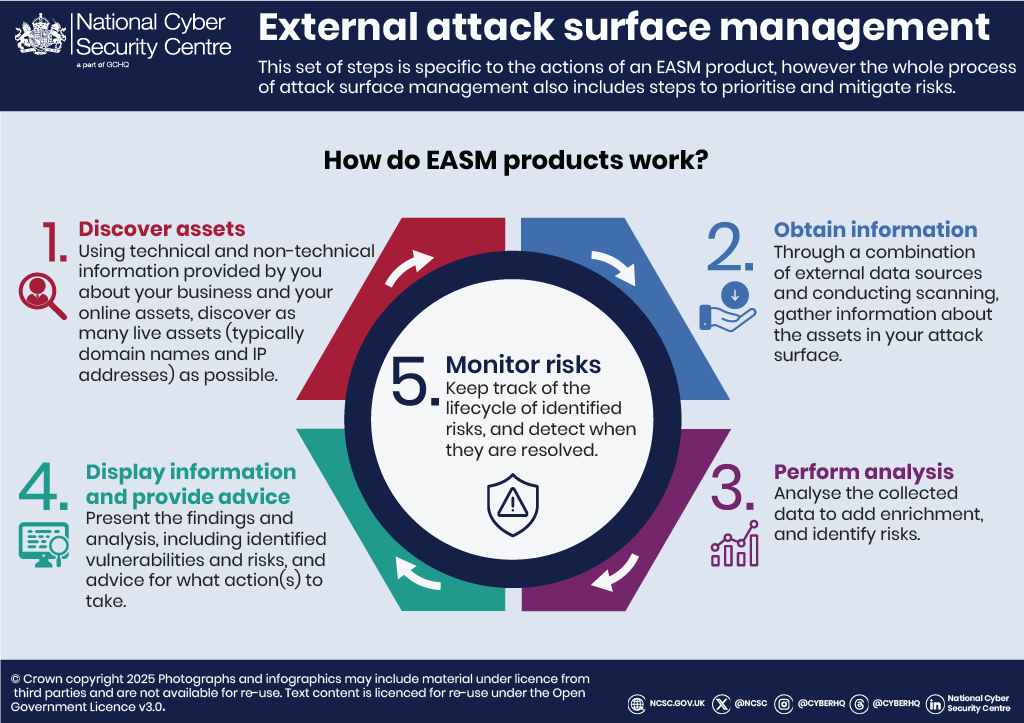
How external attack surface management products work.

Palo Alto Networks Cortex Xpanse aligns with the National Cyber Security Centre (NCSC) external attack surface management (EASM) buyer's guide by providing automated discovery, continuous monitoring and risk prioritisation of internet-facing assets. It replaces manual, point-in-time audits with a proactive, agentless solution. By automating the discovery of all internet-accessible assets (including shadow IT and unmanaged cloud operations) the platform fulfills the NCSC’s core requirement for continuous global monitoring and rapid attribution. This data-driven approach allows for the automated prioritisation of critical exposures, such as RDP, and integrates seamlessly with multiple third-party automation and visualisation tools, including Cortex XSOAR® and XSIAM, to accelerate remediation with national incident response standards.

In fact, with Palo Alto Networks deployment of Cortex Xpanse, we were able to achieve a 95% reduction in external vulnerability management spending across more than 700,000 cloud instances, while improving coverage and outcomes.

Palo Alto Networks Cortex Xpanse Capabilities
  • Discover Assets: Leveraging organisations' known asset inventory and other data points, Xpanse performs continual, automated discovery of all internet-accessible assets, effectively eliminating blind spots created by shadow IT and unmanaged cloud operations.
  • Obtain Information: Always-on, continuous monitoring of an organisation's entire attack surface through daily scans of the global IP address space, ensuring that newly exposed services are identified quickly and accurately.
  • Perform Analysis: Xpanse automates and prioritises alerts on all identified risks by severity, enabling organisations to optimise resolution and risk management, allowing teams to properly allocate resources and focus on the most critical risks to the organisation.
  • Display Information and Provide Advice: Leveraging a unified view of the internet facing and cloud-based estate, Xpanse provides specific resolver guidance for every identified issue, supporting and monitoring automated resolution through multiple native integrations.
  • Monitor Risk: Always on, discreet continual monitoring provides an independent real time status of the digital estate. Leveraging the threat intelligence capabilities of Palo Alto Networks, Xpanse is uniquely positioned to provide rapid coverage for newly discovered vulnerabilities, exploits or misconfigurations.

Securing the public sector requires a move from manual, point in time assessments to data-driven intelligence. Cortex Xpanse provides the foundations to remove blind spots, secure the supply chain and prevent unknown vulnerabilities in the face of sophisticated threats.

For further information and case studies, visit the links below, or schedule a demo.

  • Palo Alto Networks: Slash false positives, remediation time budget with Cortex attack surface management.
  • U.S. Pentagon: Palo Alto Networks Cortex Xpanse supercharge the Cyber Defences for the Department of Defense.
  • Accenture: Secure rapid growth with Cortex Xpanse.

The post Closing the Gap by Enhancing Visibility and Mitigating Risks appeared first on Palo Alto Networks Blog.

  •  

Google Cloud Authenticator: The Hidden Mechanisms of Passwordless Authentication

Explore Google’s synced passkey architecture. Unit 42 details its mechanisms, key management, and secure communication in passwordless systems."

The post Google Cloud Authenticator: The Hidden Mechanisms of Passwordless Authentication appeared first on Unit 42.

  •  

Microsoft Authenticator could leak login codes—update your app now

A vulnerability in Microsoft Authenticator for both iOS and Android (CVE-2026-26123) could leak your one-time sign-in codes or authentication deep links to a malicious app on the same device. 

Deep links are predefined URIs (Uniform Resource Identifiers) that allow direct access to an activity in a web or mobile application when clicked. In simple terms, they are specifically constructed links used to open an app and complete actions like signing in.

Microsoft Authenticator is a mobile app that generates time-based one-time codes and handles sign-in links and QR-based logins for Microsoft and other accounts. It is widely used for multi-factor authentication (MFA) on personal phones, including BYOD (Bring Your Own Device) devices that protect access to corporate and production services.

This vulnerability affects users who have Microsoft Authenticator installed on an iOS or Android device. For the vulnerability to be exploited, the user would first need to install a malicious app on their device and then accidentally choose that app to handle a sign‑in deep link.

If that happens, the malicious app receives the one-time code or sign-in information and can potentially use it to authenticate as the victim.​

If successful, an attacker could:

  • Complete login flows to services that trust your Microsoft Authenticator codes.
  • Access the information and services available to the compromised account (email, files, cloud apps, or production systems in a BYOD context).​
  • Potentially pivot to additional accounts if those are also protected by codes delivered via Authenticator on the same device.

How to stay safe

The fix for CVE-2026-26123 is already included in current releases, so installing updates is the most effective mitigation.

  • On iOS: Open the App Store. Tap the My Account button or your photo at the top of the screen. Scroll down to see pending updates and release notes. Tap Update next to an app to update only that app, or tap Update All.
  • On Android: Open the Google Play Store app. At the top right, tap the profile icon. Tap Manage apps & device. Under “Updates available,” tap See details. Next to the app you want to update, tap Update. To update all your apps at the same time, tap Update all.

Note: If your device manufacturer has implemented a different method to apply app updates, the steps may vary slightly.

If you are temporarily unable to update the app, avoid installing new apps that request to handle authentication links, QR-based sign-ins, or web-to-app sign-in flows.

When scanning QR codes or tapping sign-in links, verify that the handler is Microsoft Authenticator or another trusted app, and not an unknown, recently installed, or otherwise suspicious app.​

Where possible, use alternative MFA options you already trust (such as built-in authentication in your password manager or platform-specific solutions like Apple’s password features) until you can apply the update.

Use anti-malware protection for your mobile devices that can help detect malicious apps.


We don’t just report on phone security—we provide it

Cybersecurity risks should never spread beyond a headline. Keep threats off your mobile devices by downloading Malwarebytes for iOS, and Malwarebytes for Android today.

  •  

Sextortion “I recorded you” emails reuse passwords found in disposable inboxes

Our malware removal support team recently flagged a new wave of sextortion emails, with the subject line: “You pervert, I recorded you!”

If the message sounds familiar, that’s because it’s a variation of the long-running “Hello pervert” scam.

The email claims the target’s device has been infected by a “drive-by exploit,” which supposedly gave the extortionist full access to the device. To add credibility, the scammer includes a password that actually belongs to the target.

Here’s one of the emails:

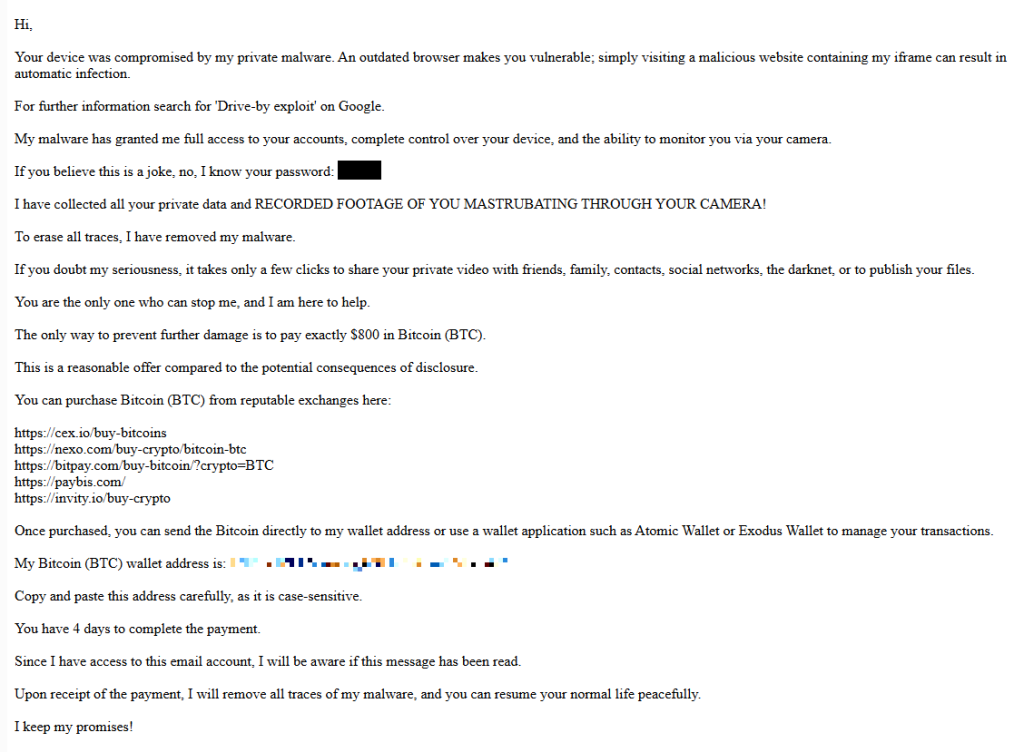
screenshot of sextortion email

Your device was compromised by my private malware. An outdated browser makes you vulnerable; simply visiting a malicious website containing my iframe can result in automatic infection.
For further information search for ‘Drive-by exploit’ on Google.
My malware has granted me full access to your accounts, complete control over your device, and the ability to monitor you via your camera.
If you believe this is a joke, no, I know your password: {an actual password}
I have collected all your private data and RECORDED FOOTAGE OF YOU MASTRUBATING THROUGH YOUR CAMERA!
To erase all traces, I have removed my malware.
If you doubt my seriousness, it takes only a few clicks to share your private video with friends, family, contacts, social networks, the darknet, or to publish your files.
You are the only one who can stop me, and I am here to help.
The only way to prevent further damage is to pay exactly $800 in Bitcoin (BTC).
This is a reasonable offer compared to the potential consequences of disclosure.
You can purchase Bitcoin (BTC) from reputable exchanges here:
{list of crypto-currency exchanges}
Once purchased, you can send the Bitcoin directly to my wallet address or use a wallet application such as Atomic Wallet or Exodus Wallet to manage your transactions.
My Bitcoin (BTC) wallet address is: {bitcoin wallet which has received 1 payment at the time of writing}
Copy and paste this address carefully, as it is case-sensitive.
You have 4 days to complete the payment.
Since I have access to this email account, I will be aware if this message has been read.
Upon receipt of the payment, I will remove all traces of my malware, and you can resume your normal life peacefully.
I keep my promises!

The message is a bit contradictory. Early on, the sender claims they have already removed the malware to “erase all traces,” but later promises to remove it after receiving payment.

Where the password comes from

I found that one particular sender using the name Jenny Green and the Gmail address JennyGreen64868@gmail.com sent many of these emails to people that use the FakeMailGenerator service.

FakeMailGenerator is a free disposable email service that gives users a temporary, receive‑only inbox they can use instead of their real address, mainly to get around email confirmations or avoid spam.

As mentioned, the addresses are receive‑only, meaning they cannot legitimately send mail and the mailbox is not tied to a specific person. On top of that, there is no login. Anyone who knows the address (or guesses the inbox URL) can see the same inbox.

My guess is that the scammer searched these public inboxes for passwords and then reused those passwords in their sextortion emails.

So users of FakeMailGenerator and similar services should consider this a warning. Your inbox may be publicly accessible, show up in search results, and you may receive a lot more than what you signed up for. Definitely don’t use services like this for anything sensitive.

How to stay safe

Knowing these scams exist is the first step to avoiding them. Sextortion emails rely on panic and embarrassment to push people into paying quickly. Here are a few simple steps to protect yourself:

  • Don’t rush. Scammers rely on fear and urgency. Take a moment to think before reacting.
  • Don’t reply to the email. Responding tells the attacker that someone is reading messages at that address, which may lead to more scams.
  • Change your password if it appears in the email. If you still use that password anywhere, update it.
  • Use a password manager. If you’re having trouble generating or storing a strong password, have a look at a password manager.
  • Don’t open unsolicited attachments. Especially when the sender address is suspicious or even your own.
  • Don’t use disposable inboxes for important accounts. The mail in that inbox might be available for anyone to find.
  • For peace of mind, turn your webcam off or buy a webcam cover so you can cover it when you’re not using the webcam.

Pro tip: Malwarebytes Scam Guard immediately recognized this for what it is: a sextortion scam.


What do cybercriminals know about you?

Use Malwarebytes’ free Digital Footprint scan to see whether your personal information has been exposed online.

  •  

Sextortion “I recorded you” emails reuse passwords found in disposable inboxes

Our malware removal support team recently flagged a new wave of sextortion emails, with the subject line: “You pervert, I recorded you!”

If the message sounds familiar, that’s because it’s a variation of the long-running “Hello pervert” scam.

The email claims the target’s device has been infected by a “drive-by exploit,” which supposedly gave the extortionist full access to the device. To add credibility, the scammer includes a password that actually belongs to the target.

Here’s one of the emails:

screenshot of sextortion email

Your device was compromised by my private malware. An outdated browser makes you vulnerable; simply visiting a malicious website containing my iframe can result in automatic infection.
For further information search for ‘Drive-by exploit’ on Google.
My malware has granted me full access to your accounts, complete control over your device, and the ability to monitor you via your camera.
If you believe this is a joke, no, I know your password: {an actual password}
I have collected all your private data and RECORDED FOOTAGE OF YOU MASTRUBATING THROUGH YOUR CAMERA!
To erase all traces, I have removed my malware.
If you doubt my seriousness, it takes only a few clicks to share your private video with friends, family, contacts, social networks, the darknet, or to publish your files.
You are the only one who can stop me, and I am here to help.
The only way to prevent further damage is to pay exactly $800 in Bitcoin (BTC).
This is a reasonable offer compared to the potential consequences of disclosure.
You can purchase Bitcoin (BTC) from reputable exchanges here:
{list of crypto-currency exchanges}
Once purchased, you can send the Bitcoin directly to my wallet address or use a wallet application such as Atomic Wallet or Exodus Wallet to manage your transactions.
My Bitcoin (BTC) wallet address is: {bitcoin wallet which has received 1 payment at the time of writing}
Copy and paste this address carefully, as it is case-sensitive.
You have 4 days to complete the payment.
Since I have access to this email account, I will be aware if this message has been read.
Upon receipt of the payment, I will remove all traces of my malware, and you can resume your normal life peacefully.
I keep my promises!

The message is a bit contradictory. Early on, the sender claims they have already removed the malware to “erase all traces,” but later promises to remove it after receiving payment.

Where the password comes from

I found that one particular sender using the name Jenny Green and the Gmail address JennyGreen64868@gmail.com sent many of these emails to people that use the FakeMailGenerator service.

FakeMailGenerator is a free disposable email service that gives users a temporary, receive‑only inbox they can use instead of their real address, mainly to get around email confirmations or avoid spam.

As mentioned, the addresses are receive‑only, meaning they cannot legitimately send mail and the mailbox is not tied to a specific person. On top of that, there is no login. Anyone who knows the address (or guesses the inbox URL) can see the same inbox.

My guess is that the scammer searched these public inboxes for passwords and then reused those passwords in their sextortion emails.

So users of FakeMailGenerator and similar services should consider this a warning. Your inbox may be publicly accessible, show up in search results, and you may receive a lot more than what you signed up for. Definitely don’t use services like this for anything sensitive.

How to stay safe

Knowing these scams exist is the first step to avoiding them. Sextortion emails rely on panic and embarrassment to push people into paying quickly. Here are a few simple steps to protect yourself:

  • Don’t rush. Scammers rely on fear and urgency. Take a moment to think before reacting.
  • Don’t reply to the email. Responding tells the attacker that someone is reading messages at that address, which may lead to more scams.
  • Change your password if it appears in the email. If you still use that password anywhere, update it.
  • Use a password manager. If you’re having trouble generating or storing a strong password, have a look at a password manager.
  • Don’t open unsolicited attachments. Especially when the sender address is suspicious or even your own.
  • Don’t use disposable inboxes for important accounts. The mail in that inbox might be available for anyone to find.
  • For peace of mind, turn your webcam off or buy a webcam cover so you can cover it when you’re not using the webcam.

Pro tip: Malwarebytes Scam Guard immediately recognized this for what it is: a sextortion scam.


What do cybercriminals know about you?

Use Malwarebytes’ free Digital Footprint scan to see whether your personal information has been exposed online.

  •  

How the National Cyber Strategy Secures Our Digital Way of Life

A Pivotal Moment for National Security

As the digital landscape undergoes profound shifts, the recently released National Cyber Strategy provides the essential foundation for enduring American leadership. By prioritizing the disruption of hostile actors, future-proofing networks, accelerating quantum readiness, and securing the AI frontier, the strategy provides the strategic clarity necessary to protect our digital way of life from sophisticated adversaries. Palo Alto Networks commends National Cyber Director Sean Cairncross for his leadership and looks forward to working with the administration to operationalize this strategy.

Each pillar of the strategy galvanizes meaningful action to advance our collective defense:

Shape Adversary Behavior (Pillar 1)

This signals a decisive shift toward the proactive disruption of malicious actors. The Trump Administration has made clear that the U.S. Government should impose real costs on adversaries to change their behavior. While the private sector is already executing discrete disruptions against malicious actors, coordination has historically been fragmented. The strategy identifies that increased collaboration with private sector entities, who possess unique insight into adversary behavior, can in turn enable more impactful deterrence.

Promote Common Sense Regulation (Pillar 2)

The strategy appropriately recognizes that complexity is the enemy of security. A focus on measurable improvements in cyber outcomes (versus check-the-box compliance exercises) collectively makes us all safer. While much attention is rightfully paid toward harmonizing incident reporting requirements, which Palo Alto Networks wholeheartedly supports, let’s not stop there. The federal government can lead by example by consolidating and streamlining federal government software compliance certifications. For example, there should be logical reciprocity between FedRAMP High and DoW IL-5 certifications.

Modernize and Secure Federal Government Networks (Pillar 3)

In addition to the necessary attention on AI-powered cyber defense, cloud security and zero trust network architecture, Palo Alto Networks applauds the discrete focus on quantum-safe security ahead of “Q-Day,” the point where quantum computing capabilities will compromise legacy public key encryption that has underpinned cybersecurity for decades. As Federal CISO Mike Duffy recently stated, "Modernization without considering PQC readiness or cryptographic agility is really creating technical debt in the future, something that we don’t want to see ever.”

To address this challenge, Palo Alto Networks provides a structured quantum-safe framework organized into four stages:

  • Continuous Discovery – Automating ecosystem ingestion to identify cryptographic dependencies.
  • Risk Assessment & Prioritization – Evaluating vulnerabilities to establish a data-driven remediation roadmap.
  • Comprehensive Remediation – Executing the transition to post-quantum algorithms across the architecture.
  • Governance & Crypto-Hygiene – Maintaining long-term visibility and management.

The bottom line is that 2035 is too late. Quantum readiness must accelerate today, and this strategy will set a critical North Star to drive the necessary urgency.

Secure Critical Infrastructure (Pillar 4)

Critical infrastructure resilience is central to our homeland security, economic security, public health and safety. Unfortunately, critical infrastructure entities are increasingly under assault from emboldened cyber adversaries.

In fact, Palo Alto Networks research shows some form of operational disruption in up to 86% of major cyber incidents. Our 2026 Global Incident Response Report underscores another sobering reality: These entities are under assault from all angles. In 87% of cyber incidents, attacks targeted multiple attack surfaces, which spanned the network, cloud, endpoints and identity.

Recognizing that you can’t secure what you can’t see, we need a national-level effort to identify, prioritize and harden the critical infrastructure that the American people depend upon. This strategy puts an important marker in the ground to revitalize those efforts.

Sustain Superiority in Critical and Emerging Technologies (Pillar 5)

Palo Alto Networks was pleased to see the strategy reinforces the core tenets of the AI Action Plan, emphasizing that "secure-by-design" principles for AI technologies are non-negotiable and that AI adoption and AI security can and must be inexorably linked.

Enterprises should be able to deploy AI confidently without fear of data leakage, model tampering or rogue AI agents. However, despite our research showing an 88% success rate of “jailbreaking” techniques against widely deployed AI models, only 6% of organizations currently have an AI security strategy. It’s time to flip this paradigm and put defenders back in the driver’s seat in this AI-first moment.

To support this emerging consensus around the importance of promoting AI security, we developed the Secure AI by Design Policy Roadmap. This framework provides a four-part construct to evaluate the evolving dimensions of threats to AI systems. Palo Alto Networks is also proud to make its comprehensive AI security suite, Prisma® AIRS™, available to all federal agencies at substantial discounts through GSA’s OneGov Initiative.

Build Talent and Capacity (Pillar 6)

Recognizing America’s cyber workforce as a “strategic asset,” the strategy calls for a pragmatic and accessible pipeline for developing talent. The explicit recognition that we should take advantage of existing avenues across government, industry and academia is important. For example, Palo Alto Networks is proud of the impact of its Cybersecurity Academy – that provides free, NIST Framework-aligned curricula covering essential domains, such as cybersecurity fundamentals, enterprise and network security, cloud security, security operations and the AI/cybersecurity nexus.

Resources like this, and those for other entities, can form the basis of a renewed focus on cyber talent development.

Turning Strategic Vision Into Action

Palo Alto Networks views itself as more than a cybersecurity vendor. We see ourselves as an integrated national security partner of the federal government at a moment when defending our digital way of life demands all of us working together. To that end, we are ready to do our part to turn strategic vision into action.

This strategy should be applauded. Let’s roll up our sleeves and get to work.

The post How the National Cyber Strategy Secures Our Digital Way of Life appeared first on Palo Alto Networks Blog.

  •  

2025 PiTuKri ISAE 3000 Type II attestation report available with 183 services in scope

Amazon Web Services (AWS) is pleased to announce the issuance of the Criteria to Assess the Information Security of Cloud Services (PiTuKri) Type II attestation report with 183 services in scope.

The Finnish Transport and Communications Agency (Traficom) Cyber Security Centre published PiTuKri, which consists of 52 criteria that provide guidance across 11 domains for assessing the security of cloud service providers.

An independent third-party audit firm issued the report to assure customers that the AWS control environment is appropriately designed and operating effectively to demonstrate adherence with PiTuKri requirements. This attestation demonstrates the AWS commitment to meet security expectations for cloud service providers set by Traficom.

The latest report covers a 12-month period from October 1, 2024 to September 30, 2025. AWS has added the following five services to the current PiTuKri scope:

Customers can find the PiTuKri ISAE 3000 report on AWS Artifact. AWS Artifact is a self-service portal for on-demand access to AWS compliance reports. Sign in to AWS Artifact in the AWS Management Console, or learn more at Getting Started with AWS Artifact.

Security and compliance is a shared responsibility between AWS and the customer. When customers move their computer systems and data to the cloud, security responsibilities are shared between the customer and the cloud service provider. For more information, see the AWS Shared Security Responsibility Model.

To learn more about our compliance and security programs, see AWS Compliance Programs. As always, we value your feedback and questions; reach out to the AWS Compliance team through the Contact Us page.

If you have feedback about this post, submit comments in the Comments section below

Tariro Dongo Tariro Dongo
Tari is a Security Assurance Program Manager at AWS, based in London. Tari is responsible for third-party and customer audits, attestations, certifications, and assessments across EMEA. Previously, Tari worked in security assurance and technology risk in the big four and financial services industry over the last 15 years.
  •  

The Human Element: Turning Threat Actor OPSEC Fails into Investigative Breakthroughs

Blogs

Blog

The Human Element: Turning Threat Actor OPSEC Fails into Investigative Breakthroughs

In this post, we explore how the psychological traps of operational security can unmask even the most sophisticated actors.

SHARE THIS:
Default Author Image
February 13, 2026
Table Of Contents

The threat intelligence landscape is often dominated with talks of sophisticated TTPs (tactics, tools, and procedures), zero-day vulnerabilities, and ransomware. While these technical threats are formidable, they are still managed by human beings, and it is the human element that often provides the most critical breakthroughs in attributing these attacks and de-anonymizing the threat actors behind them.

In our latest webinar, “OPSEC Fails: The Secret Weapon for People-Centric OSINT”,  Flashpoint was joined by Joshua Richards, founder of OSINT Praxis. Josh shared an intriguing case study where an attacker’s digital breadcrumbs led to a life-saving intervention. 

Here is how OSINT techniques, leveraged by Flashpoint’s expansive data capabilities, can dismantle illegal threat actor campaigns by turning a technical investigation into a human one.

Leveraging OPSEC as a Mindset

In a technical context, OPSEC is a risk management process that identifies seemingly innocuous pieces of information that, when gathered by an adversary, could be pieced together to reveal a larger, sensitive picture.

In the webinar, we break down the OPSEC mindset into three core pillars that every practitioner, and threat actor, must navigate. When these pillars fail, the investigation begins.

  • Analyzing the Signature: Every human has a digital signature, such as the way they type (stylometry), the times they are active, and the tools they prefer.
  • Identity Masking & Persona Management: This involves ensuring that your investigative identity has zero overlap with your real life. A common failure includes using the same browser for personal use and investigative research, which allows cookies to bridge the two identities.
  • Traffic Obfuscation: Even with a VPN, certain behaviors such as posting on a dark web forum and then using that same connection to check personal banking can expose an IP address, linking it to a practitioner or threat actor.

“Effective OPSEC isn’t about the tools you use; it’s about what breadcrumbs you are leaving behind that hackers, investigation subjects, or literally anyone could find about you.”

Joshua Richards, founder of Osint Praxis

Leveraging the Mindset for CTI

Understanding the OPSEC mindset allows security teams to think like the target. When we know the psychological traps attackers fall in, we know exactly where to look for their mistakes.

AssumptionThe Mindset TrapThe Investigative Reality
Insignificant“I’m not a high-value target; no one is looking for me.”Automated Aggression: Hackers use scripts to scan millions of accounts. You aren’t “chosen”; you are “discovered” via automation.
Invisible“I don’t have a LinkedIn or X account, so I don’t have a footprint.”Shadow Data: Public birth records, property taxes, and historical data breaches create a footprint you didn’t even build yourself.
Invincible“I have 2FA and complex passwords; I’m unhackable.”Session Hijacking: Infostealer malware steals “session tokens” (cookies). This allows an actor to be you in a browser without ever needing your 2FA code.

During the webinar, Joshua shares a masterclass in how leveraging these concepts can turn a vague dark web threat into a real-world arrest. Check out the on-demand webinar to see exactly how the investigation started on Torum, a dark web forum, and ended with an arrest that saved the lives of two individuals.

Turn the Tables Using Flashpoint

The insights shared in this session powerfully illustrate that even the most dangerous threat actors are rarely as anonymous as they believe. Their downfall isn’t usually a failure of their technical prowess, but a failure of their mindset. By understanding these OSINT techniques, intelligence practitioners can transform a sea of digital noise into a clear path toward attribution.

The most effective way to dismantle threats is to bridge the gap between technical indicators and human behavior. Whether your teams are conducting high-stakes OSINT or protecting your own organization’s digital footprint, every breadcrumb counts. By leveraging Flashpoint’s expansive threat intelligence collections and real-time data, you can stay one step ahead of adversaries. Request a demo to learn more.

Request a demo today.

The post The Human Element: Turning Threat Actor OPSEC Fails into Investigative Breakthroughs appeared first on Flashpoint.

  •  

When Security Becomes an Afterthought

Why AI's Biggest Risk Isn't Technical

This article is based on a conversation with Nikesh Arora on the 100th episode of the Threat Vector podcast.

David Moulton interviews Nikesh Arora
David Moulton interviews Nikesh Arora on the Threat Vector podcast.

"Most technologists think about technology, not about cybersecurity," Nikesh Arora says. "Cybersecurity is kind of like insurance. Let's go make great things happen, and let's make sure on the way we purchase insurance."

Coming from the CEO of the world's largest cybersecurity company, it's the quiet part said out loud, and it explains why AI deployment is racing ahead while security scrambles to keep up.

Earlier this year, Arora spoke with a CIO entirely focused on AI deployment challenges: building viable products, training models, measuring customer impact. Security never came up once. "If you're still going through the motion, trying to understand, ‘Can I actually make this thing work?’ You're not worried about security," Arora notes. The logic is brutal but consistent: Why secure something that might not even function?

In the Threat Vector podcast’s 100th episode milestone, Arora speaks with host David Moulton:

  • Why the gap between innovation and security keeps widening.
  • How to read inflection points before they're obvious.
  • What separates organizations that prepare from those that scramble.

The Gap That Keeps Growing

The disconnect isn't new. It's the same psychology that makes airport security feel like overhead – necessary friction that slows down what should be seamless. But with AI, the gap is widening at an unprecedented pace.

Consider the infrastructure buildup happening right now. Nvidia has become a $4 trillion company selling chips that can't stay in stock. Hundreds of billions of dollars are flowing into AI-computer infrastructure. Cloud providers are buying out entire methane gas companies to power their data centers.

Yet organizations are treating AI security as something to bolt on later. That same CIO told Arora: "We worked on some stuff ourselves, and we're just jerry-rigging some things to make sure this happens securely."

Arora's response:

Jerry rig, production, and security don't work together as three terms.

Reading Signals Before They're Obvious

Arora has watched enough technology cycles to recognize the pattern. "You start seeing signs early, and then you look around, you don't see enough impact. You say, okay, maybe this is going to be just a passing shower. But you don't realize that over time this thing's getting more and more momentum."

The signs around AI are adding up:

  • Individual behavior has shifted.
    Arora went from never talking to ChatGPT or Gemini to conducting 10-15 conversations daily. During a recent Tokyo trip, he used Gemini as his primary navigation tool, asking it to rank sumo wrestling shows for his kids rather than "trying to go read 14 websites and figure out what makes sense."
  • The spend is massive and accelerating.
    Not just chips, entire energy infrastructures are being rebuilt to support AI compute needs.
  • Consumer and enterprise adoption are both surging.
    From coding assistants to business analysis, use cases are expanding faster than security models can adapt.

"This thing's going to change our life fundamentally," Arora tells Moulton. "We're not seeing it at scale in our customers just yet. That doesn't mean we can sit back and wait."

Arora understands the risks involved in being late to new technology.

You have to not just anticipate where the trend is going. You have to prepare your organization and the resources to get there. Otherwise, the risk is that Silicon Valley will go fund those people who are thinking purely about the new world... and one of them's going to hit. Then you'll be two years behind with no organization, no resources deployed against it.

The Bets That Paid Off

When Arora joined Palo Alto Networks seven and a half years ago, he wrote two words on a piece of paper: cloud and AI. The company was a firewall business. Those two inflection points would require fundamental transformation, and, just as with AI now, being late was not an option.

If you don't get the network transformation right, 80% of our business will falter.

That insight drove a strategic bet on moving from point products to platform thinking, consolidating security tools rather than adding to the sprawl.

The platform approach wasn't about vendor consolidation for its own sake. It was about correlation. Unit 42® data shows that 70% of incidents now span three or more attack surfaces. When attacks move across endpoints, networks, cloud services and applications simultaneously, fragmented security creates gaps that attackers exploit ruthlessly.

Today we have coverage for 80 plus percent of the industry, which means our customers can come talk to us about a myriad of problems, and we can actually cross-correlate across all the different things we do.

With AI deployments touching every part of the technology stack, that cross-correlation becomes essential. Data flows between training environments and production systems. Models access APIs across cloud and on premises infrastructure. Applications consume AI services from multiple providers. Security that can't see and correlate across that entire landscape will miss the threats that matter most.

First Principles Over Tradition

What drives Arora's ability to spot inflection points isn't just pattern recognition, it's his refusal to accept how things have always been done.

His pet peeve: "Somebody said, well, this is how we've traditionally done it." The response reveals his approach: "You use the word traditional. I use the historical context saying, yeah, sure, they used to dig fields with picks and shovels, and now they use tractors."

This thinking drove Palo Alto Networks to reimagine SOC performance. The industry accepted four days as the normal time to detect and remediate security incidents. Arora called that unacceptable. "We need to get it to be real time."

The result was a fundamentally different architecture that analyzes data as it arrives rather than waiting for problems to appear, enabling 1-minute detection and response instead of four days.

Traditionally, SOCs would analyze the problem when the problem appeared. We said forget it. We're going to analyze everything to see if there's a problem. That architecture fundamentally transformed what we do compared to everybody else in the market.

The same first-principles approach needs to apply to AI security. Organizations can't simply extend existing security models and hope they work.

What Comes Next

With ransomware attacks now completing in as little as 25 minutes (100 times faster than just three years ago, according to Unit 42 research) reactive security simply can't keep pace. Organizations need security that thinks and responds at machine speed, built into AI deployments from day one.

"AI has become the biggest inflection point in current technology," Arora observes. Organizations are too busy deploying to worry about security. That's human nature. But it's also the moment when security teams need to stay in lockstep.

The question isn't whether to secure AI, it's whether security will be designed in or bolted on. The former takes strategic thinking now. The latter takes crisis management later.

Our job at Palo Alto and our industry is to make sure as they go build these experimental ideas into real production capability that we're staying in lockstep with them and saying, ‘Oh, by the way, here's something that can secure what you just built in a way that is not gonna get you into trouble.’

Listen to the full conversation between Nikesh Arora and David Moulton, senior director of thought leadership for Cortex® and Unit 42, on the 100th episode of Threat Vector.

The post When Security Becomes an Afterthought appeared first on Palo Alto Networks Blog.

  •  

Kimwolf Botnet Swamps Anonymity Network I2P

For the past week, the massive “Internet of Things” (IoT) botnet known as Kimwolf has been disrupting The Invisible Internet Project (I2P), a decentralized, encrypted communications network designed to anonymize and secure online communications. I2P users started reporting disruptions in the network around the same time the Kimwolf botmasters began relying on it to evade takedown attempts against the botnet’s control servers.

Kimwolf is a botnet that surfaced in late 2025 and quickly infected millions of systems, turning poorly secured IoT devices like TV streaming boxes, digital picture frames and routers into relays for malicious traffic and abnormally large distributed denial-of-service (DDoS) attacks.

I2P is a decentralized, privacy-focused network that allows people to communicate and share information anonymously.

“It works by routing data through multiple encrypted layers across volunteer-operated nodes, hiding both the sender’s and receiver’s locations,” the I2P website explains. “The result is a secure, censorship-resistant network designed for private websites, messaging, and data sharing.”

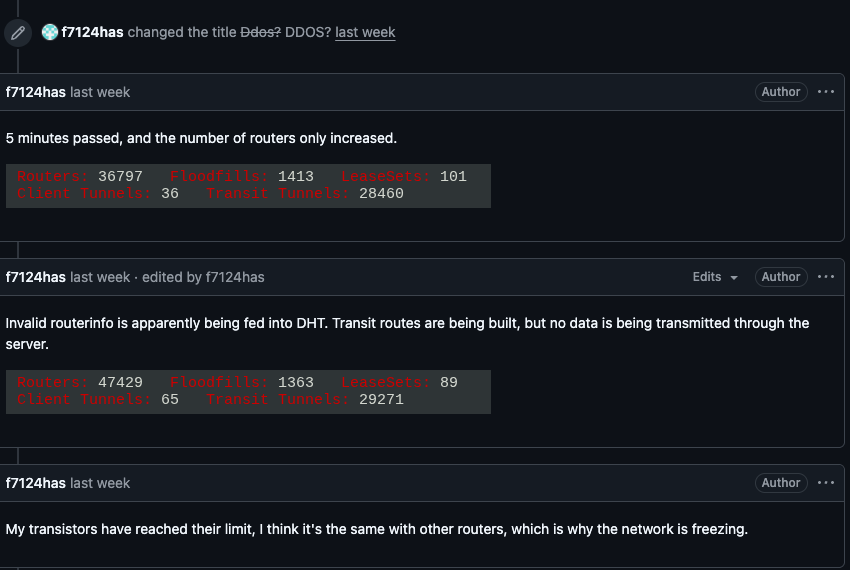
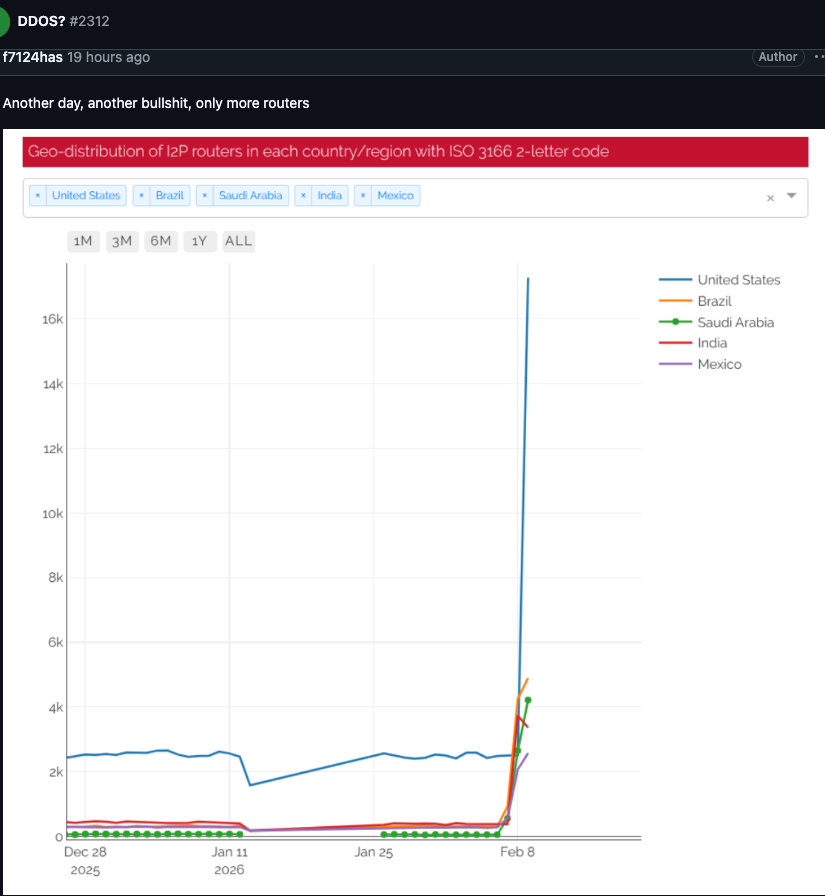
On February 3, I2P users began complaining on the organization’s GitHub page about tens of thousands of routers suddenly overwhelming the network, preventing existing users from communicating with legitimate nodes. Users reported a rapidly increasing number of new routers joining the network that were unable to transmit data, and that the mass influx of new systems had overwhelmed the network to the point where users could no longer connect.

I2P users complaining about service disruptions from a rapidly increasing number of routers suddenly swamping the network.

When one I2P user asked whether the network was under attack, another user replied, “Looks like it. My physical router freezes when the number of connections exceeds 60,000.”

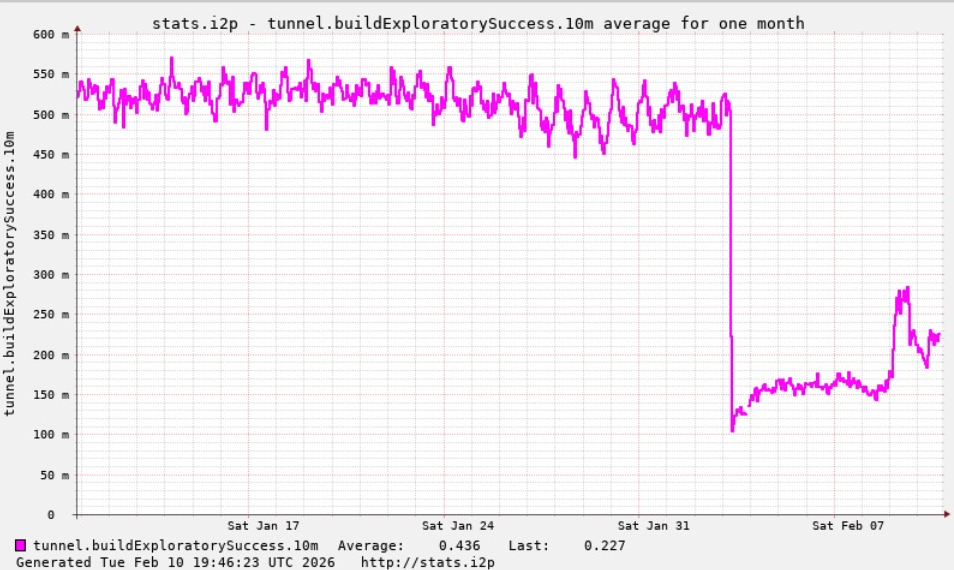
A graph shared by I2P developers showing a marked drop in successful connections on the I2P network around the time the Kimwolf botnet started trying to use the network for fallback communications.

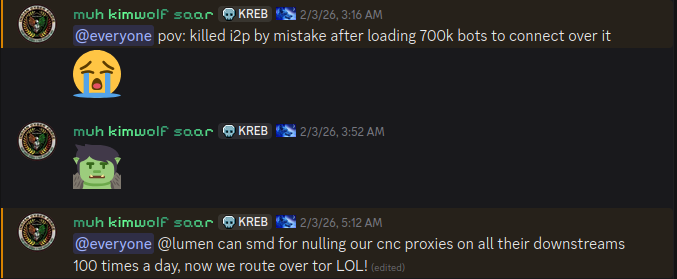
The same day that I2P users began noticing the outages, the individuals in control of Kimwolf posted to their Discord channel that they had accidentally disrupted I2P after attempting to join 700,000 Kimwolf-infected bots as nodes on the network.

The Kimwolf botmaster openly discusses what they are doing with the botnet in a Discord channel with my name on it.

Although Kimwolf is known as a potent weapon for launching DDoS attacks, the outages caused this week by some portion of the botnet attempting to join I2P are what’s known as a “Sybil attack,” a threat in peer-to-peer networks where a single entity can disrupt the system by creating, controlling, and operating a large number of fake, pseudonymous identities.

Indeed, the number of Kimwolf-infected routers that tried to join I2P this past week was many times the network’s normal size. I2P’s Wikipedia page says the network consists of roughly 55,000 computers distributed throughout the world, with each participant acting as both a router (to relay traffic) and a client.

However, Lance James, founder of the New York City based cybersecurity consultancy Unit 221B and the original founder of I2P, told KrebsOnSecurity the entire I2P network now consists of between 15,000 and 20,000 devices on any given day.

An I2P user posted this graph on Feb. 10, showing tens of thousands of routers — mostly from the United States — suddenly attempting to join the network.

Benjamin Brundage is founder of Synthient, a startup that tracks proxy services and was the first to document Kimwolf’s unique spreading techniques. Brundage said the Kimwolf operator(s) have been trying to build a command and control network that can’t easily be taken down by security companies and network operators that are working together to combat the spread of the botnet.

Brundage said the people in control of Kimwolf have been experimenting with using I2P and a similar anonymity network — Tor — as a backup command and control network, although there have been no reports of widespread disruptions in the Tor network recently.

“I don’t think their goal is to take I2P down,” he said. “It’s more they’re looking for an alternative to keep the botnet stable in the face of takedown attempts.”

The Kimwolf botnet created challenges for Cloudflare late last year when it began instructing millions of infected devices to use Cloudflare’s domain name system (DNS) settings, causing control domains associated with Kimwolf to repeatedly usurp AmazonAppleGoogle and Microsoft in Cloudflare’s public ranking of the most frequently requested websites.

James said the I2P network is still operating at about half of its normal capacity, and that a new release is rolling out which should bring some stability improvements over the next week for users.

Meanwhile, Brundage said the good news is Kimwolf’s overlords appear to have quite recently alienated some of their more competent developers and operators, leading to a rookie mistake this past week that caused the botnet’s overall numbers to drop by more than 600,000 infected systems.

“It seems like they’re just testing stuff, like running experiments in production,” he said. “But the botnet’s numbers are dropping significantly now, and they don’t seem to know what they’re doing.”

  •  

Empowering the RAF Association with Next-Generation Cyber Resilience

Palo Alto Networks is proud to enter a strategic partnership with the RAF Association.

For over 90 years, the Royal Air Forces Association (RAFA) has championed a simple yet profound belief: No member of the RAF community should ever be left without the help they need. Serving personnel, veterans and their families, the RAF Association provides crucial welfare support, responding to increasingly complex needs in an era of operational changes and challenges, including persistent global deployment.

Delivering on their mission today requires not only compassion and expertise but also resilient digital foundations. To strengthen and future-proof its operations, RAFA has entered into a strategic partnership with Palo Alto Networks. Together, we are modernising the Association's cyber security posture through a secure-by-design, zero trust architecture to enhance organisational resilience, secure sensitive beneficiary data, and improve operational agility. This helps ensure they can focus on their mission of support, not security management.

As Nick Bunting OBE, Secretary General at the RAF Association, puts it:

Cybersecurity is essential to safeguarding the trust people place in our organisation. This transformation will give us greater protection for our data and systems, ensuring that our services remain dependable and that our organisation is secure, resilient and ready for the future. Strong digital security is not just a technical requirement, it is a fundamental part of how we uphold our duty of care to every individual who relies on us.

RAFA and Palo Alto Networks team.
RAF Association & Palo Alto Networks Team (left to right): Gareth Turner, Tom Brookes, Nick Bunting OBE, Phil Sherwin, Ali Redfern, Darren Bisbey, Alistair Wildman

Securing the Mission

The RAF Association operates in a distributed environment comprising headquarters’ functions, remote caseworkers, and more than 20 RAFAKidz nursery sites, supported by a growing portfolio of cloud-based services. In this context, cybersecurity is not simply an IT concern. It is a safeguarding imperative.

Disruption to systems or a compromise of sensitive beneficiary data could directly impact RAFA’s ability to deliver services and maintain the trust of the communities it supports. By consolidating fragmented legacy tools into a unified platform, this partnership ensures the Association’s digital evolution aligns security controls with GDPR obligations and safeguarding requirements.

Digital Resilience with a Unified Platform for Visibility and Control

To support RAFA's lean IT operational model, this transformation will move them away from fragmented legacy tools toward a unified platform approach. The deployment of Prisma® SASE (secure access service edge) and Cortex XDR® will provide RAFA with consistent visibility and control across users, devices, applications and data, regardless of location. This consolidation replaces complexity with clarity, allowing the organisation to inspect traffic for threats in real-time. Security policies are now enforced continuously, threats are detected and contained faster, and access to critical systems is governed by zero trust principles without compromising the user experience.

As Phil Sherwin, Chief Information Officer, at the RAF Association states:

Our data is one of our most valuable assets and the protection of that data, as we continue to provide life-changing support to members of the RAF community, is our most important priority. This partnership will move us into the next generation of security tools that adopt zero trust principles and is a crucial step on our journey to providing a layered approach to data protection.

One of the most critical aspects of this modernisation is supporting RAFA’s diverse workforce, particularly within the RAFAKidz nursery sites. These environments rely on nondesk-based staff using iPads and mobile devices to get their critical work done.

Using zero touch provisioning and the Prisma Browser™, we are enabling secure, seamless connectivity for unmanaged devices. This ensures that nursery staff can access necessary SaaS applications safely without complex login hurdles or manual configuration, improving their agility and allowing them to focus on caring for children rather than troubleshooting technology.

Creating Operational Advantage by Scaling Operations with AI and Automation

As a charity, RAFA has a responsibility to ensure resources are used efficiently. A critical goal of this partnership is to improve productivity and allow the organisation to scale its services without increasing the IT burden.

By adopting Strata™ Cloud Manager with AIOps (artificial intelligence for IT operations), RAFA is shifting from reactive security operations to proactive, automated management. Machine learning helps identify configuration risks and performance issues before they affect users, while standardized policies enable the secure, consistent onboarding of new sites. This shift is projected to significantly reduce operational overhead, enabling RAFA to scale its support network cost-effectively. This shift is projected to reduce operational overhead by 40–50%.

A Resilient Future

This partnership is about more than deploying technology. It is about ensuring RAFA remains resilient, trusted and capable of supporting the RAF community for decades to come.

As Darren Bisbey, Head of Group Information Security for the RAF Association, puts it:

We live in an era where digital threats are accelerating in both scale and sophistication, creating unprecedented challenges for organisations. Our partnership with Palo Alto is a statement of intent, reflecting our unwavering commitment to building the most secure environments possible for our data.

At Palo Alto Networks, we are honored to support RAFA in this journey, providing the digital armour and operational advantage necessary to protect those who serve and have served.

As Alistair Wildman, Palo Alto Networks CEO for Northern Europe states:

For over 90 years, RAFA has been a lifeline for the RAF community; it is our privilege to ensure that legacy endures in a digital-first world. By embracing a unified, AI-driven platform, RAFA is moving beyond complex, fragmented security to a posture that is Secure by Design. This partnership allows them to navigate today’s threat landscape with confidence, ensuring their resources remain focused where they belong: on the families who need them.


Key Takeaways

  1. Digital Resilience – Strategic Shift to Zero Trust Architecture: RAFA is modernizing its cybersecurity posture by implementing a comprehensive zero trust architecture. This transition involves moving from fragmented legacy tools to a unified platform approach, deploying Prisma® SASE and Cortex XDR for 360-degree visibility and complete control over access and traffic.
  2. Interoperability – Secure, Seamless Access for Diverse Workforce: The partnership ensures operational agility by simplifying security for nondesk-based staff, particularly at the RAFAKidz nursery sites. Solutions like Zero-Touch Provisioning and the Prisma Access Browser enable secure, seamless connectivity for unmanaged devices, allowing nursery staff to focus on their critical work without complex login or configuration issues.
  3. Creating Operational Advantage – Efficiency and Scalability through AI and Automation: RAFA is leveraging technology to scale services efficiently and reduce operational overhead. By using Strata Cloud Manager with AIOps (Artificial Intelligence for IT Operations), the organization can shift to proactive management and automating remediation, which is projected to reduce operational overhead by 40–50%.

The post Empowering the RAF Association with Next-Generation Cyber Resilience appeared first on Palo Alto Networks Blog.

  •  

How China’s “Walled Garden” is Redefining the Cyber Threat Landscape

Blogs

Blog

How China’s “Walled Garden” is Redefining the Cyber Threat Landscape

In our latest webinar, Flashpoint unpacks the architecture of the Chinese threat actor cyber ecosystem—a parallel offensive stack fueled by government mandates and commercialized hacker-for-hire industry.

SHARE THIS:
Default Author Image
January 30, 2026

For years, the global cybersecurity community has operated under the assumption that technical information was a matter of public record. Security research has always been openly discussed and shared through a culture of global transparency. Today, that reality has fundamentally shifted. Flashpoint is witnessing a growing opacity—a “Walled Garden”—around Chinese data. As a result, the competence of Chinese threat actors and APTs has reached an industrialized scale.

In Flashpoint’s recent on-demand webinar, “Mapping the Adversary: Inside the Chinese Pentesting Ecosystem,” our analysts explain how China’s state policies surrounding zero-day vulnerability research have effectively shut out the cyber communities that once provided a window into Chinese tradecraft. However, they haven’t disappeared. Rather, they have been absorbed by the state to develop a mature, self-sustaining offensive stack capable of targeting global infrastructure.

Understanding the Walled Garden: The Shift from Disclosure to Nationalization

The “Walled Garden” is a direct result of a Chinese regulatory turning point in 2021: the Regulations on the Management of Security Vulnerabilities (RMSV). While the gradual walling off of China’s data is the cumulative result of years of implementing regulatory and policy strategies, the 2021 RMSV marks a critical turning point that effectively nationalized China’s vulnerability research capabilities. Under the RMSV, any individual or organization in China that discovers a new flaw must report it to the Ministry of Industry and Information Technology (MIIT) within 48 hours. Crucially, researchers are prohibited from sharing technical details with third parties—especially foreign entities—or selling them before a patch is issued.

It is important to note that this mandate is not limited to Chinese-based software or hardware; it applies to any vulnerability discovered, as long as the discoverer is a Chinese-based organization or national. This effectively treats software vulnerabilities as a national strategic resource for China. By centralizing this data, the Chinese government ensures it has an early window into zero-day exploits before the global defensive community. 

For defenders, this means that by the time a vulnerability is public, there is a high probability it has already been analyzed and potentially weaponized within China’s state-aligned apparatus.

The Indigenous Kill Chain: Reconnaissance Beyond Shodan

Flashpoint analysts have observed that within this Walled Garden, traditional Western reconnaissance tools are losing their effectiveness. Chinese threat actors are utilizing an indigenous suite of cyberspace search engines that create a dangerous information asymmetry, allowing them to peer at defender infrastructure while shielding their own domestic base from Western scrutiny.

While Shodan remains the go-to resource for security teams, Flashpoint has seen Chinese threat actors favor three IoT search engines that offer them a massive home-field advantage:

  • FOFA: Specializes in deep fingerprinting for middleware and Chinese-specific signatures, often indexing dorks for new vulnerabilities weeks before they appear in the West.
  • Zoomai: Built for high-speed automation, offering APIs that integrate with AI systems to move from discovery to verified target in minutes.
  • 360 Quake: Provides granular, real-time mapping through a CLI with an AI engine for complex asset portraits.

In the full session, we demonstrate exactly how Chinese operators use these tools to fuse reconnaissance and exploitation into a single, automated step—a capability most Western EDRs aren’t yet tuned to detect.

Building a State-Aligned Offensive Stack

Leveraging their knowledge of vulnerabilities and zero-day exploits, the illicit Chinese ecosystem is building tools designed to dismantle the specific technologies that power global corporate data centers and business hubs.

In the webinar, our analysts explain purpose-built cyber weapons designed to hunt VMware vCenter servers that support one-click shell uploads via vulnerabilities like Log4Shell. Beyond the initial exploit, Flashpoint highlights the rising use of Behinder (Ice Scorpion)—a sophisticated web shell management tool. Behinder has become a staple for Chinese operators because it encrypts command-and-control (C2) traffic, allowing attackers to evade conventional inspection and deep packet analytics.

Strengthen Your Defenses Against the Chinese Offensive Stack with Flashpoint

By understanding this “Walled Garden” architecture, defenders can move beyond generic signatures and begin to hunt for the specific TTPs—such as high-entropy C2 traffic and proprietary Chinese scanning patterns—that define the modern Chinese threat actor.

How can Flashpoint help? Flashpoint’s cyber threat intelligence platform cuts through the generic feed overload and delivers unrivaled primary-source data, AI-powered analysis, and expert human context.

Watch the on-demand webinar to learn more, or request a demo today.

Request a demo today.

The post How China’s “Walled Garden” is Redefining the Cyber Threat Landscape appeared first on Flashpoint.

  •  

2026 Public Sector Cyber Outlook: Identity, AI and the Fight for Trust

The early weeks of 2026 have already made one thing clear: Government cybersecurity is in a new phase, shaped not by incremental change, but by the rapid integration of AI into core public-sector missions. AI systems are now embedded in critical infrastructure, federal service delivery, research environments, as well as state and local operations. At the same time, nation-state adversaries are leveraging AI to accelerate intrusion, scale deception and manipulate trusted systems in ways not possible even a year ago.

As Senior Vice President of Public Sector at Palo Alto Networks, I see a decisive shift underway. Defending the public sector in 2026 means navigating a world where security depends on verifying identity, securing data and governing AI-driven systems that act without human intervention. Success now hinges on architectures that assume automation, operations that prioritize coordination, and governance frameworks capable of managing AI at mission scale.

Here are the developments that will define the year ahead.

Federal Government

1. AI-Native Security Must Become Integral to Federal Operations

AI in federal environments is no longer an experiment. Agencies are now designing workflows, SOC missions and cloud architectures around AI-driven detection and response. The emphasis is shifting from supplementing human analysts to building systems that maintain visibility, correlate threats, and respond autonomously when human capacity is limited. This builds on what we forecasted last year, when federal cybersecurity teams began using AI to replace manual workflows and drive down detection and response times.

The shift will be practical. Federal teams must plan to deploy AI systems that correlate logs, identify behavioral anomalies, prioritize threats, and suppress noise before analysts ever see an alert. Manual, ticket-based workflows will no longer meet federal timelines for investigation or reporting, particularly as adversaries automate more phases of attack.

2. Identity Emerges as the Central Federal Security Challenge

The biggest shift in 2026 will be the collapse between “identity” and “attack surface.” Deepfake technologies now operate in real time. AI-generated voices and video can impersonate senior leaders at a level undetectable by traditional controls. Machine identities continue to proliferate; they will outnumber human identities this year. And autonomous agents can initiate high-impact actions without human oversight. This reflects a broader crisis of authenticity now reshaping how enterprises defend identity itself.

Identity abuse will no longer be limited to credential theft. This turns identity into a systemic risk. One compromised identity (human, machine or agent) can cascade through automated systems with little friction. Federal programs will need to prioritize continuous identity verification, stronger proofing and governance frameworks that validate the legitimacy of both human and AI-driven activity.

3. AI Systems Must Be Secure-by-Design

Stemming from the clear mandate in the AI Action Plan (and subsequent work by NIST to develop an AI/Cyber Profile on top of the existing Cybersecurity Framework) agencies will steadily integrate AI security into their deployment of AI technologies.

This imperative is critical as AI systems are susceptible to novel threats. Data poisoning of training sets, manipulated inputs and hidden instructions in untrusted datasets compromise the intelligence that agencies rely on for analysis, planning and mission support. To support the security of this AI-first moment, Palo Alto Networks was proud to make its AI security platform, Prisma® AIRS™, available through the GSA OneGov initiative.

4. Nation-State Operations Expand Through AI Automation

Adversaries will use AI to compress the time between reconnaissance, exploitation and lateral movement. We expect rapidly increasing the use of AI to chain vulnerabilities, tailor social engineering campaigns, and generated malware variants that adapt in real time.

The focus will broaden beyond IT networks. AI will be used to disrupt OT systems and target sensitive research environments. Foreign intelligence services will weaponize AI to blur the line between intrusion and information operations, producing hybrid campaigns that attack both systems and the legitimacy of institutions.

5. Autonomous SOC Capabilities Become Essential

Federal SOCs will evolve from human-centered command centers to hybrid operations where autonomous agents run major components of the detection and response mission. These agents will triage alerts, enforce containment, and initiate predefined responses.

This evolution comes with risk. AI agents with broad authority can be misused or manipulated if not properly governed. Agencies will need safeguards to track agent behavior, enforce least privilege on agents, and prevent misuse through runtime monitoring and “AI firewall” controls designed to stop malicious prompts and unauthorized actions. The same pressures are shaping enterprise security, where controls like AI firewalls and circuit breaker mechanisms are becoming standard practice. Automation will only strengthen federal security if paired with rigorous oversight and continuous validation of agent activity.

6. Shared and Federated SOC Structures Gain Momentum

As threats scale, agencies will increasingly operate through shared or federated security structures. Instead of isolated SOCs, agencies will adopt analytics layers capable of correlating activity across departments and exchanging findings in real time.

This shift will reduce redundancy and provide faster insight into nation-state campaigns that cross federal boundaries. Early adopters will establish shared analytic and response frameworks that allow agencies to coordinate without sacrificing mission-specific control. Civilian agencies will lead early adoption with broader participation across defense and national security stakeholders expected later in the year.

7. The Post-Quantum Deadline Becomes Immediate

In 2026, post-quantum cryptography planning will move to implementation. Accelerated advances in quantum computing and AI-based cryptanalysis will push agencies to transition from pilot efforts to mandated modernization.

Agencies will focus on discovering where vulnerable algorithms are used, replacing outdated libraries, and implementing crypto-agility so systems can evolve without major redesigns. Systems with unpatchable cryptographic components will be flagged for full replacement, forcing agencies to reconcile years of accumulated “crypto debt.”

8. Data Trust and Cloud Workload Protection Become Priority Missions

The rise of AI workloads will force agencies to rethink how they protect data. Infrastructure controls alone cannot detect when training data has been manipulated or when model outputs no longer reflect real-world conditions.

Agencies will unify developer and security workflows and use tools like Data Security Posture Management and AI security posture management (AI-SPM) to track data lineage and enforce protections at runtime. Enterprises are addressing the same issue by bringing development and security teams together under shared data governance models. Ensuring model trustworthiness will become a mission-support requirement, not just a security objective.

9. Platform Consolidation Becomes Necessary

Fragmented tools cannot support the visibility and oversight required for AI governance. Executives will push for platform consolidation to unify network, identity, cloud, endpoint and AI security. Integrated platforms will gain favor because they enable consistent policy enforcement and a single operational picture across increasingly automated environments.

State, Local and Educational Institutions

1. AI Adoption Splits SLED into Distinct Tiers

In 2026, disparities in funding and technical capacity will widen. Some states will deploy AI across security operations, citizen services and identity verification. Others will struggle to maintain legacy systems.

Well-resourced jurisdictions will reduce response times and improve resilience. Underfunded ones will remain exposed to ransomware and disruption. Without targeted modernization efforts, a national divide in SLED cybersecurity maturity will deepen.

2. Regional Models Become the Practical Path Forward

Silos are no longer sustainable. SLED organizations will rely on shared SOCs, regional threat intelligence hubs and coordinated incident response agreements. States will formalize partnerships to share expertise, reduce costs and defend interconnected systems. This evolution represents the maturation of the “team sport” mentality we predicted in 2025. These models reflect operational reality: Compromised data or infrastructure in one jurisdiction often creates immediate risk for its neighbors.

3. Higher Education Redesigns Its Security Baseline

Universities will classify cybersecurity alongside energy, research infrastructure and physical security as essential institutional functions. Secure browser adoption, stronger vendor oversight and centralized identity governance will become the norm.

AI research environments will receive increased scrutiny, and universities participating in federally funded research will face stricter compliance requirements to prevent data poisoning and model manipulation. Institutions with large research portfolios will prioritize securing lab environments where AI models are trained and evaluated.

4. K–12 Systems Enter a New Phase of Security Oversight

States will introduce new security mandates for K–12 environments, covering MFA, network segmentation, secure browsers, identity verification and foundational zero trust principles. AI-enabled ransomware will remain a threat. Smaller districts will adopt managed services or regional support structures as they confront growing operational and compliance demands. Districts that modernize identity controls and browser security will significantly reduce their exposure compared to those reliant on legacy tools. Building on the regulatory momentum we predicted in 2025, K–12 institutions will continue moving from defensive posture to proactive security adoption.

5. Local Governments Face Escalating AI-Driven Ransomware

Municipal governments remain high-value targets due to limited staffing and aging infrastructure. AI gives threat actors the ability to automate reconnaissance, craft targeted phishing messages, and identify vulnerabilities with little effort.

Attacks timed to public safety incidents or weather emergencies will increase, meaning local governments will need stronger identity controls, automated endpoint protection and access to managed detection and response. Operational continuity will depend on reducing time-to-detect and time-to-contain, capabilities that smaller municipalities cannot achieve without external support.

6. Managed Services and Platform Consolidation Become Standard

As technical demands grow, SLED organizations will move toward managed SOC models and consolidated vendor ecosystems. Platforms that integrate data protection, threat detection, identity governance and AI oversight will gain traction. Point tools without interoperability will decline. Budget-constrained environments will favor comprehensive platforms that reduce operational burden and simplify compliance.

7. Identity and Data Trust Become Central SLED Priorities

SLED organizations manage sensitive student records, election data and social services information. These environments are increasingly strained by the rapid growth of machine identities and AI-driven applications.

Synthetic identities and AI-generated credentials will be used to infiltrate systems with limited oversight. Continuous identity verification, data lineage tracking and posture management will become essential to prevent fraud, service disruption and data manipulation. Identity assurance and data integrity will become the foundation of public trust at the state and local level.

The post 2026 Public Sector Cyber Outlook: Identity, AI and the Fight for Trust appeared first on Palo Alto Networks Blog.

  •  

The Top Threat Actor Groups Targeting the Financial Sector

Blogs

Blog

The Top Threat Actor Groups Targeting the Financial Sector

In this post, we identify and analyze the top threat actors that have been actively targeting the financial sector between 2024 and 2026.

SHARE THIS:
Default Author Image
January 6, 2026

Between 2024 and 2026, Flashpoint analysts have observed the financial sector as a top target of threat actors, with 406 publicly disclosed victims falling prey to ransomware attacks alone—representing seven percent of all ransomware victim listings during that period.

However, ransomware is just one piece of the complex threat actor puzzle. The financial sector is also grappling with threats stemming from sophisticated Advanced Persistent Threat (APT) groups, the risks associated with third-party compromises, the illicit trade in initial access credentials, the ever-present danger of insider threats, and the emerging challenge of deepfake and impersonation fraud.

Why Finance?

The financial sector has long been one of the most attractive targets for threat actors, consistently ranking among the most targeted industries globally.

These institutions manage massive volumes of sensitive data—from high-value financial transactions and confidential customer information to vast sums of capital, making them especially lucrative for threat actors seeking financial gain. Additionally, the urgency and criticality of financial operations increases the chances that victim organizations will succumb to extortion and ransom demands.

Even beyond direct financial incentives, the financial sector remains an attractive target due to its deep interconnectivity with other industries.This means that malicious actors may simply target financial institutions to gain information about another target organization, as a single data breach can have far-reaching and cascading consequences for involved partners and third parties.

The Threat Actors Targeting the Financial Sector

To understand the complexities of the financial threat landscape, organizations need a comprehensive understanding of the key players involved. The following threat actors represent some of the most prominent and active groups targeting the financial sector between April 2024 and April 2025:

RansomHub

Despite being a relatively new Ransomware-as-a-Service (RaaS) group that emerged in February 2024, RansomHub quickly rose to prominence, becoming the second-most active ransomware group in 2024. Notably, they claimed 38 victims in the financial sector between April 2024 and April 2025. Their known TTPs include phishing and exploiting vulnerabilities. RansomHub is also known to heavily target the healthcare sector.

Akira

Active since March 2023, Akira has demonstrated increasingly sophisticated tactics and has targeted a significant number of victims across various sectors. Between April 2024 and April 2025, they targeted 34 organizations within the financial sector. Evidence suggests a potential link to the defunct Conti ransomware group. Akira commonly gains initial access through compromised credentials, Virtual Private Network (VPN) vulnerabilities, and Remote Desktop Protocol (RDP). They employ a double extortion model, exfiltrating data before encryption.

LockBit Ransomware

A long-standing and highly prolific RaaS group operating since at least September 2019, LockBit continued to be a major threat to the financial sector, claiming 29 publicly disclosed victims between April 2024 and April 2025. LockBit utilizes various initial access methods, including phishing, exploitation of known vulnerabilities, and compromised remote services.

Most notably, in June 2024, LockBit claimed it gained access to the US Federal Reserve, stating that they exfiltrated 33 TB of data. However, Flashpoint analysts found that the data posted on the Federal Reserve listing appears to belong to another victim, Evolve Bank & Trust.

FIN7

This financially motivated threat actor group, originating from Eastern Europe and active since at least 2015, focuses on stealing payment card data. They employ social engineering tactics and create elaborate infrastructure to achieve their goals, reportedly generating over $1 billion USD in revenue between 2015 and 2021. Their targets within the financial sector include interbank transfer systems (SWIFT, SAP), ATM infrastructure, and point-of-sale (POS) terminals. Initial access is often gained through phishing and exploiting public-facing applications.

Scattering Spider

Emerging in 2022, Scattered Spider has quickly become known for its rapid exploitation of compromised environments, particularly targeting financial services, cryptocurrency services, and more. They are notorious for using SMS phishing and fake Okta single sign-on pages to steal credentials and move laterally within networks. Their primary motivation is financial gain.

Lazarus Group

This advanced persistent threat (APT) group, backed by the North Korean government, has demonstrated a broad range of targets, including cryptocurrency exchanges and financial institutions. Their campaigns are driven by financial profit, cyberespionage, and sabotage. Lazarus Group employs sophisticated spear-phishing emails, malware disguised in image files, and watering-hole attacks to gain initial access.

Top Attack Vectors Facing the Financial Sector

Between April 2024 and April 2025, our analysts observed 6,406 posts pertaining to financial sector access listings within Flashpoint’s forum collections. How are these prolific threat actor groups gaining a foothold into financial data and systems? Examining Flashpoint intelligence, malicious actors are capitalizing on third-party compromises, initial access brokers, insider threats, amongst other attack vectors:

Third-Party Compromise

Ransomware attacks targeting third-party vendors can have a direct and significant impact on financial institutions through data exposure and compromised credentials. The Clop ransomware gang’s exploitation of the MOVEit vulnerability in December 2024 serves as a stark reminder of this risk.

Initial Access Brokers (IABs)

Initial Access Brokers specialize in gaining initial access to networks and selling these access credentials to other threat groups, including ransomware operators. Their tactics include phishing, the use of information-stealing malware, and exploiting RDP credentials, posing a significant risk to financial entities. Between April 2024 and April 2025, analysts observed 6,406 posts pertaining to financial sector access listings within Flashpoint’s forum collections.

Insider Threat

Malicious insiders, whether recruited or acting independently, can provide direct access to sensitive data and systems within financial institutions. Telegram has emerged as a prominent platform for advertising and recruiting insider services targeting the financial sector.

Deepfake and Impersonation

The increasing sophistication and accessibility of AI tools are enabling new forms of fraud. Deepfakes can bypass traditional security measures by creating convincing audio and video impersonations. While still evolving, this threat vector, along with other impersonation tactics like BEC and vishing, presents a growing concern for the financial sector. Within the past year, analysts observed 1,238 posts across fraud-related Telegram channels discussing impersonation of individuals working for financial institutions.

Defend Against Financial Threats Using Flashpoint

The financial sector remains a high-value target, facing a persistent and evolving array of threats. Understanding the tactics, techniques, and procedures (TTPs) of these top threat actors, as well as the broader threat landscape, is crucial for financial institutions to develop and implement effective security strategies.

Flashpoint is proud to offer a dedicated threat intelligence solution for banks and financial institutions. Our platform combines comprehensive data collection, AI-powered analysis, and expert human insight to deliver actionable intelligence, safeguarding your critical assets and operations. Request a demo today to see how our intelligence can empower your security team.

Request a demo today.

  •  

Securing the AI Frontier

Why the GSA OneGov Agreement Is a Game-Changer for Federal Cybersecurity

The mission to modernize government IT is accelerating at lightning speed, largely thanks to the transformative power of artificial intelligence (AI). Federal agencies are strategically leveraging AI to boost efficiency, enhance citizen services, and strengthen national security – a vision fully supported by the administration’s AI Action Plan.

At Palo Alto Networks, we are all-in on helping agencies deploy AI bravely and securely. Because the challenge isn't just about using AI for cyberdefense, but also about defending AI itself. We appreciate the U.S. General Services Administration (GSA) recognizing the critical need for scalable, efficient solutions.

That is precisely why the GSA OneGov Initiative is a massive, game-changing step forward. We are proud to be the first pure-play cybersecurity vendor to secure a OneGov agreement with the GSA. This strategic alliance simplifies and standardizes the process for agencies to access our world-class, AI-powered security platform, ensuring security is foundational to this crucial modernization mission.

The Wake-Up Call: The Silent Threat of AI Agent Corruption

If you needed a clear sign that AI has fundamentally shifted the cybersecurity landscape, our own Unit 42 research provides it. The new reality isn't just about hackers using AI in their attacks; it’s also about how internal AI provides another attack surface for threat actors.

The most insidious new threat we've observed is AI Agent Smuggling, where malicious attackers use AI agents to exploit other agents. Our Unit 42 research highlights two major vectors:

  • Indirect Prompt Injection: A security risk in LLMs where a user crafts input containing deceptive instructions to manipulate the model’s behavior, which can lead to unauthorized data access or unintended actions.
  • Agent Session Smuggling: Exploit vulnerabilities in agent-to-agent communication, injecting malicious instructions into a conversation, hiding them among otherwise benign client requests and server responses.

This confirms our core belief as stated in a recent secure AI by Design blog: The AI ecosystem (the models, data and infrastructure) is now a complex, expanding attack surface that traditional perimeter defenses were simply not designed to protect.

As I’ve said before, “If you’re deploying AI, you must deploy AI security.”

Secure AI by Design: A Strategic Alliance with GSA

The GSA’s OneGov Initiative aims to streamline procurement and drive down costs by leveraging the purchasing power of the entire federal government. This is more than an agreement; it’s a direct response to the call for a "secure-by-design" approach to federal AI adoption. This agreement simplifies and standardizes the process for agencies to access our world-class, AI-powered security platform, ensuring that security is foundational, not an afterthought. It provides industry leading AI security tools into the hands of our cyber defenders today.

Under the Hood: Technical Capabilities for the AI Ecosystem

To counter the autonomous threats we’re seeing, we provide a platform that protects the entire AI lifecycle, from the developer's keyboard to the data center.

1. Runtime Protection for AI Workloads

Securing the AI supply chain requires visibility across every stage, especially during runtime when models are processing sensitive data.

  • Prisma® AIRS™ delivers comprehensive security for the entire AI lifecycle, in one unified platform. It allows organizations to deploy traditional apps as well as AI applications, models and agents with confidence by reducing risk from misuse, data loss and sophisticated AI-driven threats. Prisma AIRS provides a clear, connected view of assets in multicloud environments, so teams can eliminate silos, accelerate responses, as well as scale cloud and AI apps securely.
  • Our Cloud-Native Application Protection Platform (CNAPP) has achieved the FedRAMP High designation, making it the preferred Code to Cloud™ solution to secure the entire application lifecycle from development to runtime. Our industry-leading CNAPP eliminates silos to deliver comprehensive visibility and best-in-class protection across multicloud environments.

2. Protecting Users and Data at the Edge

Even the most advanced AI defenses are undermined if users accessing applications and data are left vulnerable outside corporate security boundaries. The explosive growth of generative AI tools and the unseen behavior of AI agents are amplifying data exposure risks.

  • Prisma SASE (secure access service edge) secures all users, apps, devices and data, no matter where they are and no matter where applications reside.
    • Prisma Access (FedRAMP High Authorized) and Prisma Browser™ (FedRAMP-Moderate Authorized) integrate security capabilities, like zero trust network access (ZTNA), secure web gateway (SWG) and cloud access security broker (CASB), to provide a unified policy framework and a consistent user experience.
  • This approach helps agencies outpace the speed of AI-driven threats, safeguarding critical data and simplifying operations for a frictionless user experience. It ensures that the human element interacting with the AI is protected by the most stringent security controls available.

Deploy AI Bravely

The GSA OneGov agreement is a pivotal moment that provides federal agencies with the cost-effective, streamlined access they need to deploy AI with confidence. By leveraging our unified, AI-powered platform, government organizations can stop reacting to threats and start building secure-by-design AI environments. We are committed to remaining a key partner in this strategic initiative and helping the government achieve its mission outcomes safely.

For more information and access to promotional offers for new contracts signed on or before January 31, 2028, federal agencies can visit the GSA OneGov website.

The post Securing the AI Frontier appeared first on Palo Alto Networks Blog.

  •  

Bridging Cybersecurity and AI

Modernizing Vulnerability Sharing for a New Class of Threats

In cybersecurity, vulnerability information sharing frameworks have long assumed that conventional threats exploit flaws in software or systems, and they can be resolved with patches or configuration updates. AI and machine learning (ML) models upend that premise as adversarial attacks, like poisoning and evasion, target the unique way AI models process information. Consequently, the risks for AI systems include tactics like model poisoning (from evasion attacks) in datasets and training, which are not conventional software vulnerabilities. These new vulnerabilities fall outside the scope of traditional cybersecurity taxonomies like the Common Vulnerabilities and Exposures (CVE) Program.

There is a need to bridge the gap between the existing cybersecurity vulnerability sharing structure and burgeoning efforts to catalog security risks to AI systems. Provisions in the White House AI Action Plan, which Palo Alto Networks supports, call for the creation of an AI Information Sharing and Analysis Center (AI-ISAC), reinforcing the importance of addressing that disconnect. This integration is essential, as leveraging the existing, widely adopted cybersecurity infrastructure will be the fastest path to ensuring these new standards are accepted and operationalized.

Established Construct for Vulnerability Management and Disclosure

The global cybersecurity community relies on a mature infrastructure for sharing standardized vulnerability intelligence. Central to this ecosystem is the CVE List, established in 1999 as the authoritative catalog of cybersecurity vulnerabilities. Through CVE IDs and a network of CVE Numbering Authorities (CNAs), this framework enables consistent vulnerability documentation and disclosure.

Similarly, the Common Vulnerability Scoring System (CVSS) provides standardized severity assessments, allowing security teams to prioritize responses. Together with resources like the National Vulnerability Database (NVD) and CISA’s KEV Catalog catalog, these tools form the backbone of global vulnerability management, information sharing and coordinated disclosure.

Why AI Breaks the Traditional Model

While this infrastructure has served the cybersecurity community effectively for over two decades, it was designed around traditional threat models that AI systems substantially upend. Attacks on AI systems represent a critical departure from traditional cybersecurity threats as they operate insidiously, subtly corrupting core reasoning processes, causing persistent, systemic failures, some of which only become evident over time. Most traditional cybersecurity tools are not equipped to recognize those breakdowns because they assume deterministic behavior and rules-based logic. AI systems defy those assumptions because AI is probabilistic, not deterministic. Consequently, attacks on AI models may remain hidden for extended periods.

Unlike traditional cybersecurity threats that target code, adversarial AI attacks target the underlying data and algorithms that govern how AI systems learn, reason and make decisions. Consider the following predominant adversarial attack methodologies on machine learning:

  • Poisoning attacks inject malicious data into training datasets, corrupting the model's learning process and creating deliberate vulnerabilities or degraded performance.
  • Inference-related attacks exploit model outputs to extract sensitive information or learn about its training data. This includes model inversion, which reconstructs sensitive data from the model's outputs, as well as membership inference, which identifies whether specific data points were used in training.

The expansion of existing security frameworks and programs is necessary to cover the enumeration, disclosure and downstream management of security risks to AI systems.

Advancing AI Security Through the AI Action Plan

In July, the Administration unveiled the AI Action Plan, an innovation-first framework balancing AI advancement with security imperatives. The Plan prioritizes Secure-by-Design AI technologies and applications, strengthened critical infrastructure cybersecurity and protection of commercial and government AI innovations.

Notably, it recommends establishing an AI Information Sharing and Analysis Center (AI-ISAC) to facilitate threat intelligence sharing across U.S. critical infrastructure sectors and encourages sharing known AI vulnerabilities, “tak[ing] advantage of existing cyber vulnerability sharing mechanisms.” These provisions affirm that AI security underpins American leadership in the field and, where possible, should be built upon existing frameworks.

Redefining Boundaries for AI Threats

To position the CVE Program for the AI-driven future, Palo Alto Networks is engaging directly with industry and program stakeholders to chart the path forward. Traditionally, the CVE Program serves as an ecosystem-wide central warning system. It provides a unified source of truths for security risks. A security risk catalog and identification system are needed for AI systems, as they currently fall outside the traditional scope of the CVE Program that has focused exclusively on vulnerabilities rather than on malicious components. The historical aperture of the current CVE Program excludes harmful artifacts, such as backdoored AI models or poisoned datasets, which represent fundamentally different attack vectors, in turn creating security blind spots.

Securing AI’s Promise

The United States leads in AI innovation and must equally lead in securing it. As momentum builds behind the AI Action Plan and the establishment of the AI-ISAC, we have a critical window to shape information sharing frameworks of the future. The goal is to ensure that cybersecurity and AI security infrastructure advance in unison with the technology itself. Integrating new AI vulnerability standards into trusted frameworks like the CVE Program aligns with industry focus and needs. Through proactive, coordinated action, we can unlock AI’s full promise while safeguarding the models that are embedded in the critical systems on which our nation depends.

The post Bridging Cybersecurity and AI appeared first on Palo Alto Networks Blog.

  •  
❌