Thermo Fisher Scientific has patched a flaw in select Applied Biosystems human identification software that could allow data files to be altered before analysis software loads them.
The vendor's July 31 security bulletin says nearly undetectable changes to .fsa and .hid outputs could occur if laboratory controls are circumvented.
Thermo Fisher tracks the issue as CVE-2026-17583 and rates it
AI is becoming both an attack tool and a high-value target, with attacks by AI-enabled adversaries rising 89 percent in 2025, according to CrowdStrike. The security firm's annual Threat Hunting Report details criminal gangs and nation states using AI throughout the attack chain. Attackers are also targeting organizations' AI infrastructure and poisoning popular software packages to compromise their users. "AI is both the weapon and the target," CrowdStrike counter adversary division senior VP Adam Meyers told reporters. "AI is a high-value attack surface, and it's being used by more and more threat actors." These attacks include LLMjacking, in which criminals steal corporate credentials to access frontier-model APIs, and cost harvesting – deliberately inflating a victim's AI usage to run up its bill. In one campaign, CrowdStrike documented a token thief sending about 200,000 API requests in just two minutes. The security vendor's threat hunting team now tracks AI agent-triggered leads at 2.5x the rate of human-triggered threats, and Meyers said this increased volume remains true across both government-backed goons and financially motivated criminals. CrowdStrike tracks more than 290 adversary groups, having added about ten this year. Of the 290, a North Korean crew it tracks as Famous Chollima – a sub-unit operating under the Lazarus Group umbrella and best known for its fake IT worker scams – "demonstrated the most advanced AI usage" over the second half of 2025 and first half of 2026, according to the report. This government-backed crew created "entire fake companies with AI-generated websites, GitHub accounts, and email infrastructure to support insider threat operations," the authors wrote. AI supply-chain compromise was the second most common MITRE ATLAS technique used by attackers to gain initial access, and Famous Chollima's campaign targeting AI-focused development environments "was one of the most sophisticated examples of this technique in practice," the report noted. This included a supply-chain attack in January and February targeting cryptocurrency and blockchain companies. In these attacks, the Norks published trojanized repositories, primarily hosted on GitHub, that contained legitimate-looking project files alongside hidden, malicious scripts. When developers opened these repos, malicious scripts automatically executed commands that gave Famous Chollima access to their environments. "AIs themselves are being targeted through that supply chain and through the CI/CD pipelines that they're dependent on," Meyers said. Threat hunters suspect another Lazarus Group offshoot, tracked as Stardust Chollima or Sapphire Sleet, was behind the March Axios supply chain attack. Last week, Amazon attributed four npm compromises over the past 18 months to the same North Korean crew. Meanwhile, a financially motivated crew tracked by CrowdStrike as Altered Spider and elsewhere as TeamPCP targeted developers' AI tools, compromising more than 300 software dependencies in one day. It harvested credentials and secrets before pivoting into cloud environments for theft and extortion. Altered Spider "hits the endpoint in seconds and within minutes, they're inside of the cloud," Meyers said. "It gives you a sense of how quickly they can move throughout that environment, and this is all tied again to software supply chains." Patching window slams shut CrowdStrike argues that AI is helping attackers exploit newly disclosed vulnerabilities at machine speed. From January to June, 88 percent of the exploitation observed by CrowdStrike using public proof-of-concept (PoC) code occurred within 48 hours of the code's release. The company said China-linked groups such as Vault Panda and Genesis Panda moved even faster, launching attacks within 24 hours of disclosure. "Vulnerabilities are weaponized through the use of AI," Meyers said. "This is creating a rich ecosystem of vulnerabilities for attackers to use against various systems, and what this really means is that the 30-day patch window, which frankly, was aspirational, is completely obsolete. We're down to 24-hour, 48-hour patch cycles, and organizations are really struggling under that." Meanwhile, as anyone who follows Microsoft's Patch Tuesday – or any other software vendors' vulnerability disclosures over the past few months – knows, AI is also really good at finding bugs in code. This means more CVEs and more patching for sysadmins racing to fix flaws before miscreants reverse-engineer the updates and develop exploits. "In 2025, there were something like 48,200 CVEs that were registered," Meyers said. "We're already, as of last week, at 43,000 for this year. We're not even into August yet, and we're already coming very close to the number from last year." June alone saw more than 7,600 software bugs reported and tracked through CVEs, he added. "The vulnerability ecosystem is going to be the big story for the next couple of months." ®
N-able said attackers exploited an authentication bypass in N-central to gain remote administrative access and reach the customer systems managed through those servers.
Its first fix was incomplete. CVE-2026-18577 affects N-central builds prior to 2026.3.1.7. N-able shipped build 2026.3.1.7 on August 2 as the first unaffected version.
N-central is the remote monitoring and management platform
Three high-severity security flaws have been disclosed in Hugging Face's Diffusers library that could allow crafted model repositories to stealthily execute arbitrary code on machines that load it, opening the artificial intelligence (AI) supply chain to security risk.
"These vulnerabilities are bypassing trust_remote_code, the safeguard designed to stop unreviewed code from running in the
An attacker drained 1,196 Bitcoin addresses in 41 minutes on July 30, taking 1,082.65 BTC worth about $70.2 million at the time. Galaxy Research mapped the sweep and tied it to a firmware flaw in Coldcard, the Bitcoin-only hardware wallet made by Canadian firm Coinkite.
A March 2021 firmware integration error routed seed generation to a deterministic software pseudorandom number generator (PRNG
Attackers modified a JavaScript file served by advertising technology company Adform, turning it into a browser-side tool that rewrites cryptocurrency wallet addresses.
Adform detected the incident on July 27, 2026, removed the malicious code, notified affected clients, and reported it to authorities.
Anyone who visited a site carrying the affected script on July 27 and copied a Bitcoin,
Adobe has released security updates to address a maximum-severity security flaw in Campaign Classic (ACC), its enterprise-focused marketing automation platform, that could result in arbitrary code execution.
The vulnerability, tracked as CVE-2026-48449, carries a severity score of 10.0 on the CVSS scoring system.
It has been described as a case of incorrect authorization that could result in
A fake browser update served over hijacked hotel Wi-Fi has been used to deliver CornFlake, a remote access trojan (RAT) that can capture webcam images, microphone audio, and keystrokes, Microsoft said in its latest report.
Researchers track the operation as CaptiveCrunch and attribute it to Storm-2945. It assesses Storm-2945 to be an operational sub-cluster of Midnight Blizzard, also known as
Running a website means a single unpatched vulnerability can take it offline, harm your reputation, or require cleanup. Most compromises begin with automated attacks exploiting known software flaws, usually reported and disclosed already.
To keep you protected from these threats, we’ve compiled this month’s key security updates and vulnerability patches for the WordPress ecosystem.
If you’re already using the Sucuri Firewall, you’re protected. These vulnerabilities are virtually patched for all clients.
One of the technological breakthroughs was the onboard use of a spinning wheel confocal microscope, nicknamed the Squid, which uses lasers to scan microscopic details of how organisms are put together. “That opens up a whole new world of exploring. We could see cells interacting with each other, exchanging material and building skeletons. And we could do that live on the ship, when usually it takes a couple of weeks of staining and mounting to see anything,” Osborn said.
The expedition discovered thirty-one new marine species in two weeks. The article doesn’t say if any of them were new species of squid.
As usual, you can also use this squid post to talk about the security stories in the news that I haven’t covered.
Proponents of the bill may argue that the recent amendments represent a compromise, but a close look at the text shows no major changes. As the bill moves forward in the Senate, we must continue to urge lawmakers to vote NO.
Under the newly amended Section 22683, platforms are prohibited from offering "addictive features" to users under 16. A platform can allow a minor to keep an account only if it strips away these features, which include what the bill calls "addictive feeds," auto-play, and anything else the Attorney General designates in future rulemaking.
However, the bill defines "addictive feeds" so broadly that it covers virtually every functional recommendation algorithm. The bill applies this label to any presentation of user-generated content recommended "in whole or in part, on information provided by the user." That includes basic inputs like who a user follows, what posts they like, or their self-expressed interests. By calling these basic tools and features “addictive," the bill also makes broad conclusions about the unsettled science behind social media use, youth, and addiction.
Because almost every major social media service uses automated feeds to deliver content, the end result of AB 1709 remains the same: young people under 16 will be denied access to major social media services as they currently exist.
Even if a platform attempts to comply by stripping away recommendation systems for minors, this still violates the First Amendment. Recommendation systems are the primary tools that users rely on to find speech and disseminate their own. Forcing young people onto a stripped-down, dysfunctional version of social media burdens their constitutional right to access information and participate in public discourse.
AB 1709 Still Forces Invasive Age Verification
The amendments do not eliminate the privacy threats posed by age gating. Although the bill references the age-signaling framework in AB 1043, Section 22684 explicitly states that a covered platform "shall verify the age of a user” and makes platforms liable every time a person under 16 makes it through an age check.
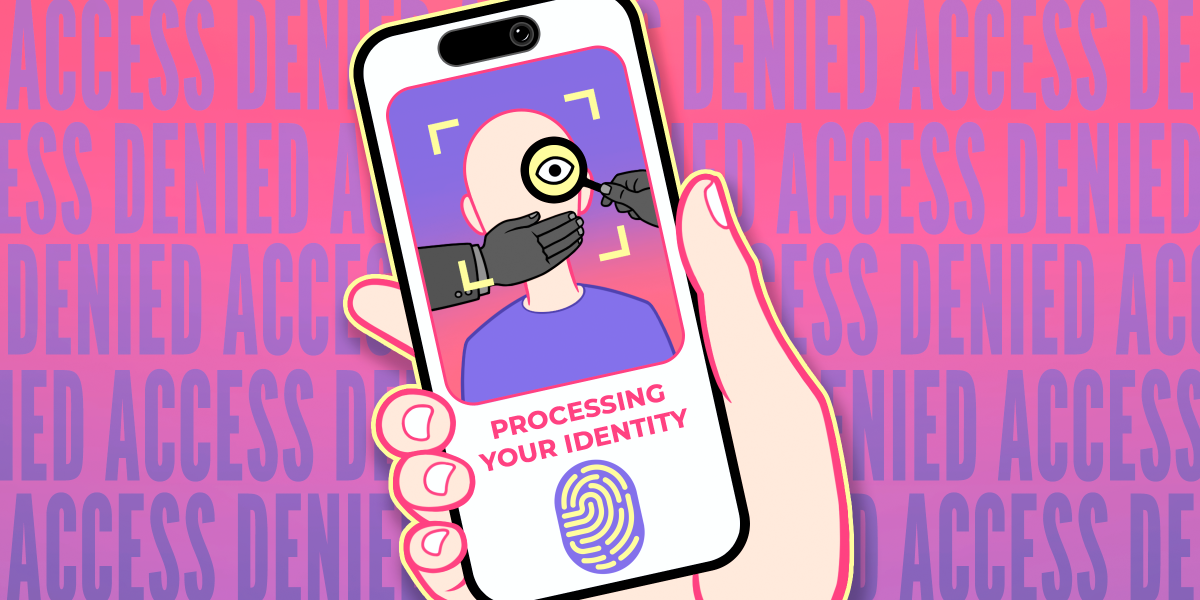
Because AB 1043 does not actually specify how verification should occur without requiring additional proof, AB 1709 will, in practice, force platforms to implement the strictest forms of age verification. To comply, platforms will likely require users to upload government-issued IDs or submit to biometric scanning. Forcing users to turn over their personal information will create massive honeypots of sensitive personal data, destroying online anonymity and exposing users of all ages to security breaches. And relying on biometric systems to verify users’ ages is problematic because the systems have historically had high error rates estimating ages across race and gender lines.
The amendments to AB 1709 also introduce legal confusion, creating provisions that conflict with already enacted legislation like SB 976. Rather than providing clarity or protecting young people, AB 1709 creates a tangled regulatory scheme that sacrifices constitutional rights for political grandstanding.
Denying minors access to digital forums—or stripping those forums of the basic tools needed to navigate them—is censorship. California should not set a national precedent of cutting young people off from digital lifelines, communities, and speech.
We need to keep the pressure on as AB 1709 moves through the Senate. Contact your state senator today and tell them that minor tweaks to a bad bill do not make it good policy.
The Senate Commerce Committee is set to consider S. 737, the SCREEN Act, a sweeping age-verification bill that would require online services to verify users’ ages before they can access any sexually explicit content. If this bill passes, it will force millions of adult internet users to give up their anonymity, privacy, and security before they access lawful speech.
Unlike many state-age verification laws—which have been harmful in their own right—the SCREEN Act has no requirement that a significant portion of the website consist of sexually explicit content that is harmful to minors. The bill requires nearly any service hosting even a single piece of sexually explicit content to verify the ages of its users. The result is that the bill would apply not only to adult content sites like PornHub or OnlyFans, but also streaming services like Netflix, and social media platforms like Reddit, Discord, or Bluesky, if they host any adult content.
The SCREEN Act does not merely require users to attest they are adults. It specifically states that “requiring a user to confirm that the user is not a minor shall not be sufficient.” In practice, that means platforms would have to verify users’ ages using methods tied to their real identities. Providing proof of age online is dramatically different, and far more invasive, than showing your ID at the door to a bartender or bouncer. In the physical world, the bouncer at the door looks at your ID card, confirms you’re old enough, and gives it back to you. Under the SCREEN Act, the “bouncer” will be a digital age-verification service that captures your personal information and saves it to a database for an unspecified amount of time.
The consequences of the bill won’t be limited to minors. If websites and apps are expected to reliably identify teenagers, adults will be asked to prove they are adults.
Even worse, the SCREEN Act is a privacy and data security nightmare. One provision of the bill requires services to take reasonable steps to protect the data collected and to not maintain for longer than is necessary. But these are terribly weak protections that impose no meaningful collection, use, or retention limits on services collecting people’s private information.
In other words, the third parties tasked with verifying a user’s age on a platform could sweep up a lot of personal info they don’t actually need and then could use that information for any number of purposes, so long as they deem their actions reasonable. Companies would then be allowed to keep the information users have been compelled to turn over for as long as possible, raising security and privacy issues along the way.
The SCREEN Act Attacks Your Right To Use VPNs
The SCREEN Act also targets virtual private network (VPN) users and providers. The bill requires covered websites to verify users' ages based on their IP addresses unless the service can determine that the user is outside the United States, and specifically requires age verification on traffic coming from known VPN addresses. In practice, this discourages the use of VPNs and proxy servers, which millions of people rely on for legitimate purposes such as protecting personal privacy, securing public Wi-Fi connections, safeguarding journalists and activists, and preventing data tracking.
VPNs mask your real location by routing your internet traffic through a server somewhere else. When you visit a website through a VPN, that website only sees the VPN server's IP address, not your actual location. It's like sending a letter through a P.O. box so the recipient doesn't know where you really live. VPNs are a privacy and security tool used by millions of internet users every day, and their use should not be treated as suspect. It is particularly galling that the SCREEN Act forces users who intentionally take steps to protect their privacy to identify themselves.
The SCREEN Act creates onerous age-verification rules that will block adults from accessing lawful speech, curtail their ability to be anonymous, and jeopardize the data security and privacy of all internet users.

 Login
Login