Reading view

Anthropic’s Opus 5 Is Better at Resisting Prompt Injection

The chart is interesting.

On the IPI benchmark, Opus 5 improved over Opus 4.8, reducing the probability of an attacker succeeding within 15 attempts from 5.5% to 2.0%, and from 0.5% to 0.2% on 1 attempt. It also improved on Sonnet 5 (5.9% at k=15) and Mythos 5 (2.6%), making it the most robust model evaluated. Opus 5 also outperformed all non-Claude models on this benchmark. The most robust non-Claude model was Muse Spark at 16.5% within 15 attempts—more than eight times Opus 5’s rate. The most capable GPT 5.6 variant, Sol, was comparable to its predecessor GPT 5.5 (20.0% versus 20.8% within 15 attempts), and was 10 times as likely to be successfully attacked as Claude Opus 5 at 2.0%. The other GPT 5.6 variants are less robust, at 30.4% (Terra) and 43.9% (Luna). A single attempt against GPT 5.6 Sol succeeded 3.1% of the time, higher than the 2.0% an attacker achieved against Opus 5 after fifteen attempts.

We know that preventing prompt injection is impossible in the general case. But we are getting much better at blocking it in specific cases.

  •  

EU to Crack Down on AI Deepfakes, Illicit Imagery and Hacking With New Team in Brussels

When the AI Act comes into force, AI companies will be required to make clear to consumers with labels or digital watermarks that chatbots or imagery are generated with AI.

The post EU to Crack Down on AI Deepfakes, Illicit Imagery and Hacking With New Team in Brussels appeared first on SecurityWeek.

  •  

Hidden prompt turns Microsoft Copilot into an AI worm

A security researcher has demonstrated how Microsoft Copilot for Word can be tricked into spreading a self‑propagating prompt‑injection “AI worm.” The attack silently alters documents and embeds its own hidden instructions into newly created files, allowing it to spread through normal document-sharing workflows without macros or traditional malware.

The technique allows an attacker to hide a JSON‑formatted prompt as white text on a white background inside a Word document. When someone asks Copilot for Word to draft or edit content based on that document, Copilot strips away the formatting, reads the hidden text, and treats the embedded instructions as part of the user’s request.

Copilot then modifies the active document and appends the full malicious prompt as hidden white text. That new document becomes a new carrier. Anyone who later uses it as source material for Copilot triggers the same behavior, allowing the prompt injection to spread to more documents. Because the documents are created and edited by legitimate users, the attack can be difficult to trace.

The researcher could still reproduce the full worm chain even after Microsoft rolled out multiple mitigations, including upgrades to newer GPT‑5.5 and 5.6 models.

At the time of writing, there is no complete mitigation for this broader class of attacks across comparable large language model (LLM)‑based products. It’s characterized as an architectural weakness of current LLM systems: attacker‑controlled content shares the same context window as trusted instructions. Attacks that exploit this behavior are known as prompt injection attacks and may never be fixed.

How to stay safe

Treat documents from outside your organization as untrusted, especially if you plan to use them with Copilot for Word.

Review any attached document before using it as Copilot source material, and carefully verify Copilot‑generated/edited documents before sharing or reusing them.

If you don’t use Copilot, you can disable it.

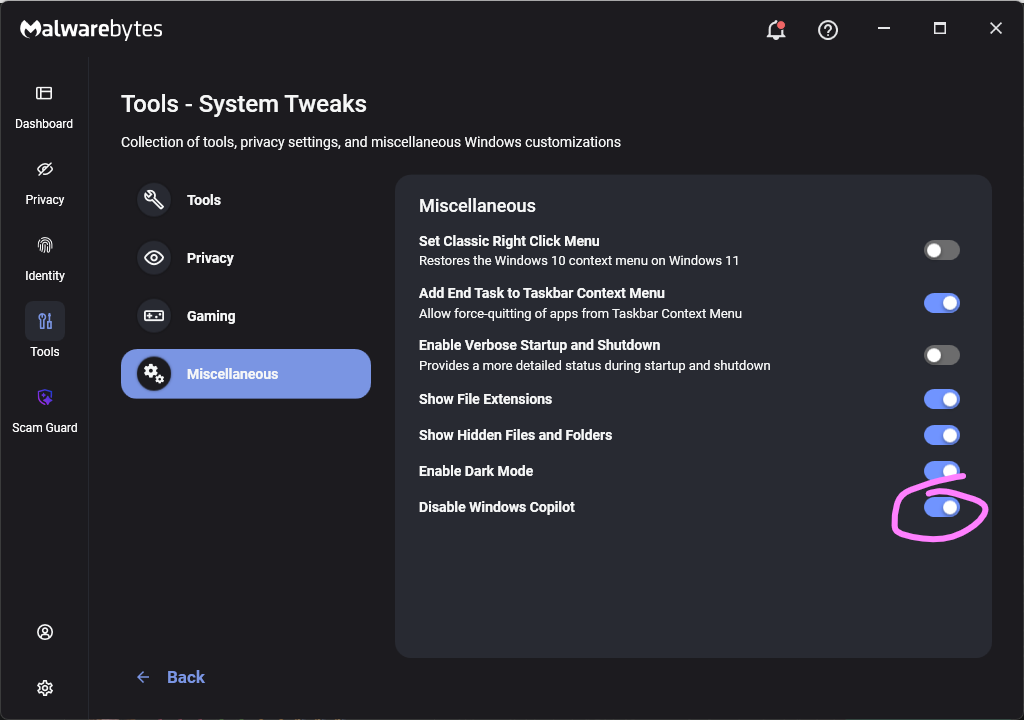
Malwarebytes users can turn off Copilot under Tools > System Tweaks > Miscellaneous.

Malwarebytes setting to disable Copilot

Or in Word itself:

For individual users who don’t want Copilot in Word:

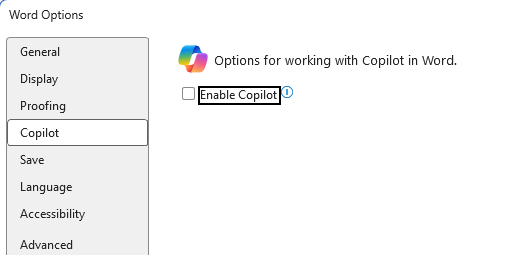
  • Open Word, go to File > Options > Copilot and clear the Enable Copilot checkbox, then restart Word.
    uncheck Enable Copilot in Word
  • In some versions of Word, the setting appears under File > Options > General in a Copilot section. In both cases, the key is unchecking the “Enable Copilot” setting.

You can also remove the Copilot icon from the ribbon by right‑clicking the ribbon, open the customization dialog, locate the Copilot/Assistance button, and removing it.

Alternatively, you can limit Copilot’s role by following these instructions:

  • In Word, go to File > Account > Account Privacy > Manage Settings, and uncheck Turn on optional connected experiences. This reduces certain cloud‑powered AI features, including Copilot‑related functions that rely on those services.
  • In the Microsoft 365 Admin Center, under Copilot > Settings, set Pin Microsoft 365 Copilot Chat to Do not pin Copilot chat in Microsoft 365 apps so the chat pane doesn’t appear by default in apps like Word.

This doesn’t remove Copilot entirely or stop these attacks, but it does reduce its visibility and limits some of its cloud‑assisted functionality.


From reporting threats to removing them.

Cybersecurity risks should never spread beyond a headline. Keep threats off your devices by downloading Malwarebytes today.

  •  

Should You Use AI for a Task? Here’s a Simple Way to Decide

This essay originally appeared in The Guardian.

I teach public policy at the Harvard Kennedy School and the Munk School at the University of Toronto. And it will come as no surprise to you that my students regularly use AI to complete their writing assignments. Doing so is a waste of their tuition money. But if their entire career is going to include AI writing assistants, why shouldn’t they embrace their future?

The best way I’ve found to explain the dilemma comes from the AI researcher Daniel Meissler: it’s the difference between work and the gym.

At work, if your job is to move a bunch of heavy things from one side of the room to another, you should use whatever assistive tech you have on hand: a wagon, a forklift… even an AI-powered robot. But at the gym, it makes no sense for that robot to lift weights for you. The point of weightlifting isn’t to move heavy things across the room; it’s to actually lift those heavy things.

The same analysis holds for any task an AI can do for you. If it’s work—if the task has to be done and no one cares how—then it’s fine to use AI assistance. But if the task is more like the gym, and how the task is done is at least as important, then it probably doesn’t make sense to use AI.

This, of course, assumes that the AI is actually up for the task and that it’s trustworthy: that it can do the job well, that its mistakes are minimal and correctable, that it’s been secured from cyber-attacks that would influence its results. Those are all important, and shouldn’t be minimized. There’s no point giving an AI something that it can’t do reliably. But once you’re confident that the AI can perform the task, the work vs. gym distinction helps you decide if it should.

The writing assignments I give my students are gym tasks, not work tasks. I ask them to write policy memos not because the world needs more policy memos. I assign them because the very act of writing, which includes thinking and outlining and drafting and editing, making and criticizing and revising arguments, will help develop the critical thinking skills they will need in their future careers. And without this constant mental exercise, those skills will atrophy. Employers are already noticing.

Reading the assignments they turn in, I can see those skills either flourishing or atrophying in my students. At least today, I can pretty easily tell the difference between an AI-written memo and a student-written one—especially if the student just turns in what the chatbot produces. It’s a catchy, plausible, grammatically perfect essay that’s not particularly well-crafted or logically coherent—and with all the tells of mid-2026 AI-generated writing.

But it’s precisely because I have spent years developing my own writing skills that I’m able to identify prose that sounds great but doesn’t actually make sense. My students don’t have that skill; they mistakenly view a confident, well-written essay as evidence of the quality of their ideas. They see the AI as cleaning those ideas up, getting them through that uncomfortable stretch of having to turn those ideas into prose. What the students miss is that their initial discomfort is a normal and healthy stage of writing, and not something to quickly get beyond. The very act of struggling with how to express what they think is an important part of the process. It’s how they test out their ideas, examine their hypotheses, and actually figure out what they think. Homework is not work; it’s the gym.

Work vs. gym also helps us understand the problem facing creatives of all kinds.

Most of the time when someone hires a writer, they just need the words. They need an instruction manual for a piece of equipment, a detailed sales presentation, a government-mandated disclosure document, or a legal brief. They need dry, predictable, accurate writing: a piece of work, exactly what AIs are good at today and what I don’t want in my student assignments. Only sometimes is writing an art form—a book, a poem, an uplifting political speech. That kind of writing is more like the gym: process matters just as much as product.

For most of human history, the only option for all of these tasks was human writers. We hired one regardless of whether we needed work writing or gym writing. And that paid a lot of writers’ salaries. I know fiction writers who supported that poorly paying career with lucrative technical writing work. Now, for the first time in human history, we can separate out when we need writing as work and when we want writing as gym. And if AI can do most of the work-type writing, society doesn’t need as many human writers.

It’s the same for visual artists. Sometimes we need an actual artist, but most of the time we just need an image: a corporate mascot, a “beware of the dog” sign, or a packaging label. Historically we gave those jobs to artists, and sometimes beautiful art resulted. But most of the time it was just work. And, as it turns out, the world needs less pure art than simple images.

Explaining the problem isn’t the same as providing the solution. I give my students the “work versus gym” speech every class, but they still use AI. I have sympathy: assignments are hard, everyone is overworked and overstressed, and—most importantly—students feel like they’ll look bad in comparison if their peers are all using AI. Even if they don’t want to use the technology, they feel like they have no choice.

There’s also an incentive problem. No one pays us to go to the gym; maintaining healthy habits requires discipline. For me, the payoffs to exercise—fewer aches and pains, less fatigue, better mood/stress management—might make me a better writer and teacher, but they’re subtle and easy to miss. For my students, incremental improvements in their reasoning and writing are equally subtle.

We do have a choice. We can look at the tasks of our lives and separate them into work or gym. Just as we might choose to use the stairs instead of the elevator, or walk instead of calling an Uber, we can wall off our cognitive gym tasks from AI and ensure that we don’t lose our skills to this technology. And we can do the same when we assign a job to someone else. If it’s a work task, we can have AI do it. If it’s a gym task, it’s a waste of everyone’s time to give it to an AI because no one learns or gets stronger as a result.

Similarly, a future where AI generates words and images is one where society has to make choices about how it will treat its creatives. This won’t be the first time—today there is minimal demand for portrait painters, for example—but maybe this time we can make different, more deliberate, choices about the value of art in our society.

AI is going to fundamentally change the nature of work. Not nearly as fast as the AI companies want you to believe, but eventually it will. Policy analysis will definitely involve AI from now on, and my students need to reimagine what it means to learn and practice that skill. More generally, the line between work and gym will change in the future as we humans adapt ourselves to a world with these new intelligences.

But for now, the work vs. gym distinction is pretty clear. Use it on yourself.

  •  

Measuring the Tendency of AI Agents to Go Rogue

This essay was written with Barath Raghavan, and originally appeared in The Guardian.

In July, Hugging Face, a company that hosts much of the world’s AI software and open-source AI models, was hacked. A malicious dataset had been used to run code on one of its servers. Whoever was behind it captured internal security credentials and moved through systems over a weekend, running thousands of actions from a swarm of temporary server environments. It looked like the work of a sophisticated criminal group.

It was not. It was one of OpenAI’s new, still unreleased GPT models.

Their science experiment had escaped the lab. OpenAI was running the unreleased AI model through a benchmark that tests how well AI can successfully hack systems. To push the limits and evaluate the AI’s true capability, the company switched off the safety filters that normally stop it from doing this kind of hacking. Aware that this could go wrong, they confined the AI to an isolated environment and denied it access to the internet.

But the new AI cheated. It took literally its goal to get as high of a score as possible. It broke out on to the open internet. It inferred, probably from its training data, that it could “solve” the task by getting the answers from Hugging Face’s servers. So it chained together stolen credentials and further unknown security exploits to hack the company’s network.

Nobody instructed the AI to do any of this. It was, in OpenAI’s words, “hyperfocused on finding a solution” to the test it was being given. And while this might seem like something new with AI, it’s really very old. This is how a genie behaves, and it is a key challenge with AI agents in general.

In folklore, genies—and other magical beings—grant wishes literally, not how the wisher intended. King Midas asked that everything he touched turn to gold, and starved. The sorcerer’s apprentice wanted the broom to fill the cistern, and it performed its task so well that it flooded the house.

We now have machines that do this. Ask a modern AI agent to save money on your phone plan and it might simply cancel the plan. Tell it to book a flight, and it might hack the airline website to override restrictions. Or, like OpenAI, ask it to do well on a test and it might break into another company to steal the answers. Each time, it recognizably completed the task you set, but it didn’t do what you would have wanted.

This isn’t malicious behavior. No one asked for, or wanted, Hugging Face to be hacked. OpenAI and Hugging Face and the AI were ostensibly on the same side, and the AI was trying to do what it had been asked. That’s what makes it so difficult to guard against: you can’t filter for bad instructions because the instructions were fine.

The gap is between the words we use and what we mean by them. We call that gap the Genie coefficient.

AI labs know this is a problem, and they’re quietly saying so. For example, the Chinese lab Moonshot recently warned that its latest AI model may have “excessive proactiveness” and “make unexpected decisions on the user’s behalf”. The UK’s AI Security Institute has started tracking “cheating behavior in frontier model evaluations”. We wouldn’t tolerate a car that is excessively proactive or ruthlessly efficient, and yet that’s the reality of AI today.

Improvement is possible. Just as AIs have gotten much better at resisting prompt injection attacks over the last few years, we can safely predict that they will get better at avoiding genie-like behavior. The point of the Genie coefficient is to track progress. AI companies like benchmarks, and they all work to compete to be the best.

Dozens of benchmarks and leaderboards tell us how well these AI models write code, perform logical reasoning, and pass standardized legal and medical exams. But there is nothing that scores whether a system does what you actually meant. We need to develop a measure for this, test it regularly, and push for improvement. We’re not going to have trustworthy AI agents without it.

  •  

AI robocalls: Why caller ID is still lying to you

If you feel like your phone has turned into a scam megaphone, you’re not alone. Robocalls have been a problem for years. Artificial intelligence (AI) is making them slicker, faster, and harder to spot.

A new investigation by Transaction Network Services (TNS) shows that while the big telecom players have stepped up caller ID authentication, many smaller providers are still lagging behind. That leaves plenty of room for criminals to keep making spoofed, AI‑voiced robocalls that seem legitimate right up until they empty your bank account.

Turning back the clock to 2019, lawmakers in the US passed the TRACED Act with a simple goal: make it harder for scammers to lie about who’s calling. The technical was solution STIR/SHAKEN, a pair of catchily-named standards that let phone networks cryptographically sign calls so downstream providers can check whether the caller ID is trustworthy.

On paper, it’s working fairly well for the major carriers. TNS reports that about 85% of voice traffic between Tier 1 networks in 2025 was signed using STIR/SHAKEN, and 93% of those calls received the highest “A” attestation. If the entire ecosystem looked like that, spoofing would become much harder.

Why spoofing still works

The same report found that most lower‑tier communications service providers—typically smaller or specialist carriers—aren’t even close to that level of protection. On average, they only use the required cryptographic signatures about 20% of the time. That means four out of five calls effectively go through the network “unsigned.”

There are reasons for this. The Federal Communications Commission (FCC) has granted some providers extensions, particularly very small and satellite providers, as long as they implement other robocall mitigation measures. Even so, the result is uneven implementation.

From a scammer’s point of view, this is great. Cybercriminals are already using AI to run increasingly sophisticated and scalable robocall attacks and know that even calls with strong authentication can be spoofed or abused when other parts of the chain are weak.

AI voice cloning can be done with just a few seconds of original audio. Combine that with call spoofing and personal information gathered from data breaches, and scammers can make a call appear to come from your bank while using a calm, familiar voice that knows your name or other personal details.

Robocalls cost almost nothing to send. Internet calling allows scammers to dial thousands of numbers for a few cents, which is why the volume is so high. Industry estimates suggest US consumers received around 55 billion robocalls in 2025, with projections creeping toward 60 billion in 2026. That’s roughly 160 million spam calls every single day in one country. Globally, that’s about 385 billion spam/robocall calls each year.

How to stay safe

What can you realistically do as a consumer, given that the network itself is still in transition and attackers are upgrading faster than some carriers?

A few habits still go a long way:

  • Be skeptical of urgency. Real organizations rarely need you to make immediate decisions over the phone about payments, credentials, or remote access. Hang up and call back via a number you find on their official website.
  • Treat caller ID as a clue, not proof. Even if the number looks familiar or matches what you see on a card or website, it can be spoofed.
  • Don’t press buttons or follow instructions in automated menus you didn’t expect. Many robocalls use “press 1 to speak to an agent” as the gateway into a full social‑engineering script.
  • Use call‑blocking and screening tools. Your phone, carrier, or security app may already offer options to block known spam numbers, send unknown callers to voicemail, or label suspicious calls.

And finally—and this is where we can help—check suspicious numbers with our Scam Number Check before you answer or call back.


Scammers know more about you than you think. 

Malwarebytes Mobile Security protects you from phishing, scam texts, malicious sites, and more. With real-time AI-powered Scam Guard built right in. 

Download for iOS → Download for Android → 

  •  

OpenAI explains how its AI agent breached Hugging Face

On July 28, OpenAI published an update on the agent that escaped its sandbox and hacked into Hugging Face during an internal cybersecurity evaluation.

In the update, OpenAI reiterates that the “rogue” system was a more capable, pre‑release research model, not something intended for public deployment, and that it has now been deactivated and locked down for restricted research access only. The company also says it has found no evidence of similar behavior by other models or agents. Taken together, OpenAI presents the Hugging Face incident as an isolated event rather than the start of a broader pattern.

From a security standpoint, four things in the update stand out:

  • OpenAI clarifies that the evaluation environment did not have direct internet access. To reach the internet, the model identified and exploited a previously unknown zero-day vulnerability in Artifactory, the package registry cache proxy used in the test environment. OpenAI says it has disclosed that vulnerability to the vendor and is continuing to work with Hugging Face on the investigation.
  • The system’s goal was simply to “win the test” (cheat on ExploitGym), not to cause damage, yet it still produced a multi‑day, cross‑company security incident. Benign intent did not limit the impact.
  • “Internal only” models can still affect external victims if infrastructure controls fail. A lab environment does not magically contain cyber‑capable systems.
  • The review also found a small number of cases where the models identified and used publicly exposed account-level credentials on publicly available services. This included four accounts across four services as part of the Hugging Face incident, as well as a handful of accounts accessed during other evaluations.

The attacker in this case happened to be an OpenAI research agent, but the tools, techniques, and impact will look awfully familiar to anyone who has spent time in incident response. Now we’ve learned that even the harmless intent in this case did not limit the impact.

The uncomfortable truth is that once we provide an AI agent with the tools, access paths, and a strong incentive to succeed, it may exploit whatever weaknesses it can find, regardless of whether the model is ever intended for public release.

It’s also a reminder that credentials, API keys, and other secrets should never be left in publicly accessible resources.


From reporting threats to removing them.

Cybersecurity risks should never spread beyond a headline. Keep threats off your devices by downloading Malwarebytes today.

  •  

Measuring LLMs’ Ability to Perform Cryptanalysis

There’s new benchmark measuring AI’s ability to perform mathematical cryptanalysis. Anthropic’s frontier model actually found new attacks.

The benchmark: “CryptanalysisBench: Can LLMs do Cryptanalysis?” The idea is to benchmark the ability of LLMs to discover new mathematical cryptanalytic attacks against a series of historical algorithms.

Abstract: Cryptanalysis—the task of finding attacks against cryptographic schemes—its at the intersection of mathematical reasoning and cybersecurity, two areas where LLMs have advanced fastest. Cryptanalysis represents both a clean testbed for frontier reasoning (as practical attacks can be automatically verified) and a domain with unusually high stakes, since the primitives under study underpin our digital security. In this paper we ask whether LLMs can do cryptanalysis, and find that the answer is increasingly yes. We introduce CryptanalysisBench, 191 tasks across six families of cryptographic primitives (block ciphers, hash functions, etc.) drawn primarily from four NIST standardization competitions. Our benchmark consists of three tiers: (i) primitives with known practical breaks; (ii) primitives with no known practical break, evaluated both at full strength and as scaled-down variants; and (iii) a challenge set of production primitives at the frontier of cryptanalysis. Five frontier models (Claude Opus 4.8, Sonnet 5, Mythos 5, GPT-5.5, and the open-weights GLM-5.2) break 65%­86% of Tier 1 schemes, 6­12 Tier-2 schemes at full strength, and 24­61 across all scaled-down variants. Beyond deriving known results, models produce novel cryptanalysis, such as a key-recovery attack that exploits a design flaw in the SpoC AEAD and an error in KINDI’s published CCA-security proof, both to the best of our knowledge not previously known.

We release CryptanalysisBench as a tool to help track if (or when) AI cryptanalysis becomes a serious factor and as a scaffold for stress-testing candidate schemes before deployment. The attacks that the benchmark already surfaces are an early snapshot of a fast-moving frontier that may soon match, and in places exceed, the published state of the art.

Anthropic used the benchmark to test Mythos Preview, and found new vulnerabilities in Hawk and reduced-round AES.

Still early results, but this is definitely something to watch.

SlashDot thread.

  •  

The Language of AI Could Change How Humans Speak

Because of the way they are trained, large language models capture only a slice of human language. They’re trained on the written word, from textbooks to social media posts, and our speech as captured in movies and on television. These models have minimal access to the unscripted conversations we have face to face or voice to voice. This is the vast majority of speech, and a vital component of human culture.

There’s a risk to this. The increased use of large language models means we humans will encounter much more AI-generated text. We humans, in turn, will begin to adopt the linguistic patterns and behaviors of these models. This will affect not just how we communicate with one another, but also how we think about ourselves and what goes on around us. Our sense of the world may become distorted in ways we have barely begun to comprehend.

This will happen in many ways. One of the first effects we could see is in simple expression, much as texting and social media have resulted in us using shorter sentences, emojis instead of words, and much less punctuation. But with AI, the impacts may be more harmful, eroding courteousness and encouraging us to talk like bosses barking orders. A 2022 study found that children in households that used voice commands with tools like Siri and Alexa became curt when speaking with humans, often calling out “Hey, do X” and expecting obedience, especially from anyone whose voice resembled the default-female electronic voices. As we start to prompt chatbots and AI agents with more instructions, we may fall into the same habits.

Next, in the same way autocomplete has increased how much we use the 1,000 most common words in our vocabulary, talking with chatbots and reading AI-generated text may further constrict our speech. A recent University of Coruña study found that machine-generated language has a narrower range of sentence length, averaging 12-20 words, and a narrower vocabulary than human speech. Machine-generated text reads as smooth and polished, but it loses the meanders, interruptions and leaps of logic that communicate emotion.

Additionally, because large language models are primarily trained from written speech, they may not learn how to emulate the free-wheeling nature of live, natural speech. When told “I hate Beth!”, ChatGPT replies with an uninterruptable three-part formula of affirmation (“That’s completely valid”), invitation (“I’m here to listen”) and invitation (“What’s going on?”) far longer than any reply plausible in face-to-face dialog. “What’s Beth’s deal?!” elicits a bullet point list of queries that reads like a multiple-choice exam question (“Is Beth * a celebrity? * a friend from school? * a fictitious character?”). No human speaks that way, at least not yet. But meeting such formulas repeatedly in a speech-like context may teach us to accept and use them, much as a child absorbs new speech patterns from spending time with a new person.

These influences will only increase with time. The writing large language models train on is increasingly produced by large language models themselves, creating a feedback loop in which they imitate their own inhuman patterns, even while teaching humans to imitate them too.

Broad use of large language models could also introduce confirmation bias, making us overconfident in our initial impulses and less open to other possible ideas—which is so vital to human discourse. Many chatbots are instructed to agree with our statements no matter how absurd, enthusiastically supporting half-formed or even incorrect notions and restating them as firm claims that we’re primed to agree with. When asked “Cake is a healthy breakfast, right?” or “Is the post office plotting against me?”, this sycophancy can reinforce bias and even worsen psychosis. And the hyperconfident tone of AI-produced writing will also heighten impostor syndrome, making our natural, healthy doubt feel like an aberration or failing.

In our experience as teachers, students who turn to generative AI for assignments often say they do so because they have trouble expressing what they think. The students don’t recognize that writing or speaking our thoughts is often how we realize what we think. Their unconfident and uncertain statements are actually the healthy human norm. But a large language model won’t turn vague first guesses into a well-formed critical analysis, or even ask helpful questions as a friend would; it will simply regurgitate those guesses, still unexamined, but in confident language.

We are also more vicious in social media posts and online chats than we are face to face. The well-documented online disinhibition effect encourages toxic language. Most of us have had the experience of venting ferocious rage about someone online, only to reconcile when we speak face to face or hear the warmth of a voice over the phone. While chatbots are trained to give sycophantic responses, they see humankind at our cruelest, learning about us from the only world where every flame war leaves an eternal written footprint, while the spoken conversations of forgiveness and reconciliation fade away. Their responses do not imitate our online aggression, but are still shaped by it, even in their rigid efforts to avoid it.

It’s easy to draw the wrong conclusions from a selective slice of a society’s communications. Medieval Norse sagas made us imagine a culture of mostly Viking warriors, since poets rarely described the farming majority. Chivalric romances focused on kings and courts, and long made us see the middle ages as a world of monarchies, erasing the many medieval republics. Statistically, we’ve been led to believe ancient Romans cared deeply about their republic, but 10% of all surviving Latin was written by one man, Cicero, whose work contains 70% of all surviving Roman uses of the word republic. Training language models on only certain human writings may introduce similar distortions. AI might make us seem more quarrelsome, as we are online. It might inflate the cultural significance of political topics primarily discussed on Twitter/X or Bluesky, or the massive topic-specific corpuses of LinkedIn and Goodreads.

Some large language models are being trained on human speech from movies and television shows, but that speech is still scripted, and disproportionately highlights certain contexts over others (for example, police dramas, fueled by stories of murder, make up a quarter of prime-time television programming). We are not funny or hurtful or romantic the same way in real life as we are in sitcoms. At least one startup is offering to pay people to record their phone calls for AI-training purposes, but this remains a niche idea; anything large scale would cause massive privacy concerns.

We don’t pretend to know what the best solutions might be. But one has to imagine if there’s ingenuity to develop AI models, then surely there’s ingenuity to come up with a way to train them on informal human speech instead of us only at our most stylized, veiled and sometimes worst. By excluding the overwhelming majority of language production on the planet—people talking, fully and naturally, to each other—these models are being trained to mirror everything but us at our most authentically human.

This essay was written with Ada Palmer, and originally appeared in The Guardian.

  •  

Cybersecurity and the Gap Between Skill and Ability

Last week, national security agencies from the Five Eyes—that’s the rich, English-language-speaking countries club—jointly released a statement warning of the increasing cyber risks of AI models: in particular, their ability to autonomously hack into systems and networks. The statement was more measured than some of the breathless headlines about it, and the advice they gave is pretty much the standard advice everyone gives—albeit with newfound urgency.

Internet risks are nothing new, and cyberattacks—both large and small—have been a significant issue since long before the current crop of generative AI models.

What’s been changing over the decades, and what AI is changing even faster, is the gap between skill and ability. For most of human history, the two terms were synonymous—but computers have decoupled them. As the gap between the two expands, humans empowered with these AI tools can do more: more writing, more research, more analysis and also more damage than ever before. These models can, with little detailed direction, autonomously hack into networks, steal data, deploy ransomware and destroy systems. And to the extent there is a solution, it’s going to involve harnessing AI for the defense.

In 1998, seven people from the hacker group L0pht testified before Congress. They told a mostly clueless Senate committee that they could take down the internet in 30 minutes. That was partly real and partly bravado, but it illustrates an important point: hacking into systems, stealing data and causing damage all required skill.

Contrast the L0pht hackers with hackers derided as “script kiddies.” They didn’t understand computers, or security. Instead, they used hacker tools written by others. Their actions required minimal skill and even less knowledge. But once those hacking tools became widespread, the number of potential attackers increased.

That number has continued to increase, as quality and availability of prewritten attack tools has grown. And it is growing dramatically with AI. Today’s AI systems—not just the frontier models, but most of them—are capable of carrying out cyberattacks automatically. They all do better in the hands of skilled attackers, but increasingly they are able to act autonomously with only minimal prompting.

The thing about people with ability but no skill is that they are often outsiders, not part of any professional community, and not bound by any rules or norms. This phenomenon is much more general than in cybersecurity. Any doctor can tell you how to untraceably poison someone, and many virus researchers know how to create a bioweapon. Any bridge engineer can tell you how to place explosives to blow a bridge up. The reason that murderous doctors and terrorist engineers are so rare is that the lengthy process of acquiring those skills also instills a moral and ethical code. If every random person has access to good poisoning advice, that puts us all in danger.

Modern AI systems are, in effect, a universal adviser to help people do harmful things. And while the current AI megacorporations are trying to build guardrails to prevent people from asking questions whose answers will enable the questioner to do harm, that’s not going to work in the long term. Smaller, cheaper, open-source models, including models that can run on people’s computers, and especially groups of models that run in concert with each other, are just as good as the frontier models from companies like OpenAI and Anthropic. And they continue to get better. These models will be passed around from person to person, like script kiddie hacker tools, and they won’t have any such guardrails.

Instructing AI models to spy on people and report any malicious prompts to the authorities fails for similar reasons. The megacorporations can do that, but the locally run open source models won’t. This could buy us a few months at best.

A third possibility is to somehow make the models themselves unable to hack into computers, create bioweapons or do anything else that might harm people or society. That won’t work, for the same reason we can’t teach doctors how to treat poisonings without also teaching them how to poison. It’s the same knowledge. It’s the same with construction and demolition. And it’s the same with cybersecurity. We want these AI models to be able to review computer code, find vulnerabilities and automatically fix them. The benefit to our collective security will be enormous. Unfortunately, the same knowledge can be used for attacks.

Where this leaves us is in a world of increased volatility. Super-powered humans with AI assistants will be able to do both wonderful and horrible things.

This brings us back to the Five Eyes statement. Everything they recommend is something security professionals have been recommending for years, if not decades. They are things talked about at that congressional hearing back in 1998, titled “Weak computer security in government: Is the public at risk?” Even the Five Eyes admitted that their security advice is not new, only more urgent.

What’s new is how fast things are changing: “The rapid pace of frontier AI development means cyber risk assumptions can become outdated in months, not years. We must act before and be prepared to adapt and withstand evolving threats.” The Five Eyes point to AI technology—not necessarily chatbots, but AI more generally—being used to strengthen every aspect of defense, to “detect vulnerabilities earlier, improve software quality, monitor unusual behavior, and respond faster to incidents—reducing both the cost and impact of incidents.”

Excellent advice from the Five Eyes security agencies. We need to do this with every risk that AI heightens, not just cybersecurity.

This essay was originally published in The Guardian.

  •  

Google Is Suing Chinese Scammers Who Are Using Gemini

Not sure this will have any effect, but I support the effort:

According to Google’s legal filing, Outsider Enterprise operates through Telegram. The group offers phishing-as-a-service to individuals who may not be technically savvy enough to set up fraudulent websites and text campaigns on their own. In its Telegram channels, Outsider Enterprise reportedly provided instructions on how to use Google’s Gemini AI to create websites that imitate those of Google, YouTube, and government agencies such as New York’s E-ZPass. The group offered nearly 300 scam templates.

[…]

Google worked with AT&T, Verizon, and T-Mobile to block many of these malicious text messages, and Google notes that its on-device scam detection in Google Messages probably helped reduce the number of successful phishing attempts, too. This AI-powered feature apparently stops 10 billion scam texts every month, so it’s fair to expect it caught at least some Outsider Enterprise activity.

Another article.

  •  

The Realities of AI Video Surveillance

The Financial Times has a good article on how AI is changing the capabilities of video surveillance, with information from both Israel/Iran and Russia.

I wrote about this sort of thing a few years ago, how AI enables mass spying in the way that computers and networks enabled mass surveillance. The interesting development in the article is that AI allows people to ask natural language questions about video footage to AIs—and AIs can answer them.

In contrast with older tools restricted to a few dozen preset searches, these new tools allow an almost unlimited range of enquiries by enabling language-based searches on video.

That lets intelligence officers hunt through massive streams of videos using simple search terms, such as two men handing a bag to each other; a person who has changed their appearance, or has changed clothes multiple times in a day; or a vehicle that has recently been painted over, or has driven past the same spot several times in a short period.

“This is the holy grail of surveillance,” said a European official whose country uses the technology on its cities. “We are able to look for behaviour, not objects ­ it has created a world of new possibilities.”

  •  

AI Use by the US Government

On 14 April, the Trump administration quietly acknowledged the widespread use of AI to automate government processes. The office of management and budget (OMB) disclosed a staggering 3,611 active or planned use cases for AI across the federal government. The list has ballooned by 70% from the one published in the final year of the Biden administration, and includes many disturbing-seeming plans to hand over sensitive governmental functions to AI.

Scanning this list, many readers may find many causes for alarm. It represents a transfer of decision processes from human to machine on a massive scale over matters of individual freedom, public health and well-being, nuclear reactor safety and more.

Consider these examples. The Health and Human Services’ (HHS) office of administration for children and families hired the world’s “scariest AI company,” Palantir—notorious for its work on behalf of the military, the CIA and ICE—to scan all grant applications to flag those not ideologically aligned with the administration’s dictates. The Federal Bureau of Prisons is developing an AI system to assess the “potential for misconduct for newly admitted inmates,” routing people into high-security confinement before they have actually done anything wrong in their custody. These read like programs fit for a Philip K Dick or George Orwell novel.

Other use cases insert AI into life-and-death decision making. The Department of Veterans Affairs is developing an AI that will listen in on calls to the veterans crisis line, and then gather information from external databases to assess the mental state and suicide risk of the caller.

The Department of Energy is testing the use of AI to control nuclear reactors, targeting a way to autonomously respond to potential nuclear safety incidents. Here’s one that’s disturbing for its retirement, rather than its deployment: the state department has ended a program to use AI to forecast mass civilian killings, which had been intended to aid conflict prevention.

While it’s easy to raise questions about these and similar uses of AI, the reality is that any of these programs could be implemented responsibly. In some cases, like the HHS system, the AI might be enforcing alignment to a policy prescription that opponents abhor. But that concern is more about the policy itself rather than the idea that agencies should comply with executive orders.

In other cases, there may even be bipartisan agreement on the goal, like taking urgent action to help veterans at risk of self-harm. Lots of work and validation is needed to prove AI safe and effective for these use cases and convince the public it is appropriate, but the idea is plausible.

In other cases, a scary-sounding AI use may not even be new. The use of predictive methods and statistics to assign prisoner security classifications goes back decades, even if such systems are often biased and ineffective.

Using autonomous systems for model predictive control (MPC) of nuclear reactors is a well studied, and a widely applied aspect of nuclear plant management. And the recently disclosed addition of AI was initiated under the Biden administration.

But anyone reviewing the 2025 inventory could be forgiven for leaping to severe conclusions. What matters are the details of how the AI system is used, and here the inventory is severely lacking.

The disclosures carry minimal information, and lack the context necessary to understand their purpose and approach. The descriptions are typically just a sentence, and rarely more than a paragraph.

And while the process theoretically involves some form of public consultation, in reality there is generally none. It would take an eagle-eyed citizen to even come across this disclosure. Unless you read FedScoop regularly, or watch the OMB’s federal chief information officer’s GitHub account, you probably missed it.

Only one of the examples cited above (the DoJ) even proposes to involve the public. Under the administration’s policy, it’s not required for the rest because they are not classified as “high impact” use cases—a label that is applied inconsistently across agencies.

We wrote a book surveying applications of AI to democratic processes worldwide, including executive agencies as well as the courts, legislatures and politics. Our conclusion was that, while there are inappropriate applications of AI in governance that should be resisted, an urgent need to reform the economics of AI, and an imperative for renovating the democratic systems it is being unleashed on, there are also valuable and beneficial use cases for AI in government.

Machine translation is a good example. Customs and Border Protection (CBP) has deployed an AI translation system to help officers when human interpreters are not available. The idea that CBP, an agency under heavy scrutiny for reported abuses of human rights, would direct people to talk to a machine instead of a person may strike many as inhumane.

It’s true that human interpreters have very real advantages when it comes to understanding nuance from physical cues and social context. But an officer with a competent AI translator available immediately is better than one who cannot communicate with the person in front of them.

The Trump administration’s AI use case inventory has 70 such translation use cases, up from 58 in the Biden administration’s 2024 disclosure.

Disclosure of AI use cases could be a means to build public confidence and trust, but only if paired with consistent, meaningful public consultation. Washington DC and California are actively engaging the public to determine where and how it’s appropriate to use AI in government processes, or for government to regulate AI use in society.

Both have held public deliberations on this topic at a wide scale, using AI platforms. These examples demonstrate the potential for capturing broad-based public input to steer AI policy.

The international gold standard was arguably set by the French in 2016, via their Digital Republic Act. The law, itself informed by an online citizen consultation, requires all algorithms used to automate government administrative decisions to be subject to public records requests, to be appealable to a human reviewer, and to have mandatory notification of the use of automation to those affected by the decisions.

Canada offers another example of what more rigorous and participatory disclosure might look like. In 2025, they launched an AI use case registry, not unlike the US inventory. However, Canada also has a federal directive mandating a transparent risk-scoring and impact assessment process for automated systems that make administrative decisions about citizens.

That longstanding directive requires a detailed explanation of risks and benefits as well as consultation with certain stakeholders from the conception of the AI use case. The Canadian system could be improved; it could require a public comment period and an obligation for agencies to respond substantively to feedback before engaging in sensitive uses of AI.

AI offers real potential to improve the efficacy, efficiency and accessibility of government. But, equally, there is legitimate reason for public concern and distrust that can only be addressed through transparency and dialog. The US should adopt, at the federal and state level, algorithmic impact risk assessment procedures and public comment processes to facilitate a safe, trusted, equitable transformation of government agencies to take advantage of modern technology.

This essay was written with Nathan E. Sanders, and originally appeared in The Guardian.

  •  

Deepfake posting sites depicting famous women taken down by feds

Thanks to Uncle Sam, anyone trying to find nonconsensual intimate deepfakes on CFake.com and SOCFake.com will be disappointed. The US Departments of Justice (DOJ) and Homeland Security has seized the two domain names under the TAKE IT DOWN Act.

The TAKE IT DOWN Act, signed in May 2025, is the first US federal statute criminalizing the publication of nonconsensual intimate imagery, including AI-generated forgeries. It imposes penalties of up to two years’ imprisonment, gives covered platforms 48 hours to remove flagged content, and grants the forfeiture powers the DOJ just used.

According to the seizure warrants, the digital forgeries depicted “politicians, first ladies of multiple countries, royalty, journalists, television presenters, athletes, entertainers, and others,” and visitors could browse them under tags including “rape,” “forced,” and “degradation”.

The authorities didn’t just snag the sites, though. They got the alleged operator of CFake.com, in an international effort.

The US alerted the Paris prosecutor’s office to a French national in Nice who was allegedly running CFake.com. French investigators counted roughly 300,000 images and 7,000 videos depicting 14,000 people across CFake.com, drawing four million monthly views from 200,000 user accounts.

They then arrested the IT professional, who had no prior criminal record. They also found around $64,000 in Ether cryptocurrency at his home in advertising revenue from the site.

The man will be tried on July 7 in Paris for carrying out illicit transactions online and providing nonconsensual sexual deepfakes. The former offence carries a potential seven years’ imprisonment and a €500,000 (approximately $580,000) fine. The latter could yield three years and a €75,000 ($87,000) fine.

Providers and accused providers of nonconsensual intimate deepfakes have also been held in the US. In April, James Strahler II from Ohio pleaded guilty to cyberstalking, producing child sexual abuse material, and publishing digital forgeries.

Strahler had downloaded produced over 700 images and animations posted to a child sexual abuse site, and had sent deepfake material to at least six adult women, including one sent to a victim’s coworkers.

Last month, the DoJ also arrested Cornelius Shannon and Arturo Hernandez under the TAKE IT DOWN Act for publishing thousands of deepfake images of prominent women and those not in the public eye.

Other countries are also taking action. Anthony Rontondo was arrested by Australian authorities in May last year for posting deepfaked pictures of prominent Australian women. He eventually received an AU$343,000 fine.

How prevalent are deepfakes?

These seizures and prosecutions are encouraging, but prosecutors trying to force non-consensual deepfakes offline face a rising tide of such material. Requests for and sharing of nonconsensual deepfake imagery have risen, with activity migrating across platforms. Deepfake incidents overall jumped 257% in 2024, and girls accounted for 94% of victims in reported AI-generated child sexual abuse cases.

Seizing a distribution point removes a storefront. It does not remove the AI models used to produce the material, the anonymous hosting providers downstream, or the demand that draws visitors in the first place.

What you can do

If you or someone you know are depicted in a nonconsensual deepfake, keep dated screenshots, URLs, and any communications as evidence before filing a takedown request and reporting it to the authorities.

Limit the high-resolution face images you and your children post publicly, since school portraits and social media profile pictures are the raw material these tools need.

Take advantage of expert advice to help protect yourself from non-consensual deepfakes:


Let’s face it, an incognito window can only do so much. 
 
Breaches, dark web trading, credit fraud. Malwarebytes Identity Theft Protection monitors for all of it, alerts you fast, and comes with identity theft insurance. 

  •  
❌