
Reading view

Microsoft’s biggest-ever Patch Tuesday fixes 206 bugs, including 3 zero-days

This month’s Patch Tuesday fixes 206 security flaws in Microsoft software, making it the biggest Patch Tuesday release ever.

The update includes 32 critical vulnerabilities, as well as three publicly disclosed zero-days. Microsoft classifies these as zero-days because information about the vulnerabilities became public before patches were available. None are known to have been actively exploited by attackers.

The huge number of fixed vulnerabilities makes this the largest Patch Tuesday since Microsoft launched the program in October 2003. The company introduced the monthly update schedule after the Blaster worm caused disruption in the early days of Windows.

How to apply patches and check if you’re protected

These updates fix security problems and keep your Windows PC protected. Here’s how to make sure you’re up to date:

1. Open Settings

  • Click the Start button (the Windows logo at the bottom left of your screen).
  • Click on Settings (it looks like a little gear).

2. Go to Windows Update

  • In the Settings window, select Windows Update (usually at the bottom of the menu on the left).

3. Check for updates

  • Click the button that says Check for updates.
  • Windows will search for the latest Patch Tuesday updates.
  • If you have selected to get the latest updates as soon as they’re available, you may see this under More options.
    In which case you may see a Restart required message. Restart your system and the update will complete.
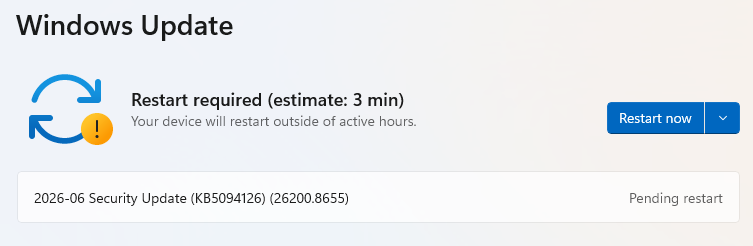
    restart required
  • If not, continue with the steps below.

4. Download and install

  • If updates are found, they’ll start downloading automatically. Once complete, you’ll see a button that says Install or Restart now.
  • Click Install if needed and follow any prompts. Your computer will usually need a restart to finish the update. If it does, click Restart now.

5. Double-check you’re up to date

  • After restarting, go back to Windows Update and check again. If it says You’re up to date, you’re all set!
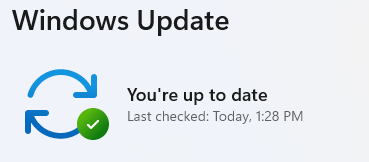
Windows up to date

Technical details

One publicly disclosed vulnerability is important to mention. This flaw in Windows BitLocker is tracked as CVE-2026-50507 (CVSS score: 6.8 out of 10) and its description states:

“a protection mechanism failure in Windows BitLocker allows an unauthorized attacker to bypass a security feature with a physical attack.”

BitLocker is a built-in Windows security feature that encrypts your entire hard drive, securing your data from unauthorized access if your device is lost or stolen. However, this vulnerability could allow an attacker with physical access to bypass BitLocker Device Encryption and gain access to encrypted data.

Another is CVE-2026-49160 (CVSS score: 7.5 out of 10) in HTTP.sys. This vulnerability can be exploited to launch a remote denial-of-service attack against major web servers using a technique called HTTP/2 Bomb.

The third to discuss is CVE-2026-45586 (CVSS score: 7.8 out of 10) in the Windows Collaborative Translation Framework (CTFMON). An attacker who successfully exploited this vulnerability could gain SYSTEM privileges. These elevation of privilege (EoP) vulnerabilities are especially valuable to attackers because they can be combined with other flaws to gain full control of a compromised system.


We don’t just report on threats—we remove them

Cybersecurity risks should never spread beyond a headline. Keep threats off your devices by downloading Malwarebytes today.

  •  

May 2026 Patch Tuesday: no zero-days but plenty to fix

This month’s Patch Tuesday remedies 137 security vulnerabilities, including 31 marked critical by Microsoft, with no zero-days actively exploited in the wild.

Microsoft defines a zero-day as “a flaw in software for which no official patch or security update is available yet.” This month, Microsoft has not observed any included vulnerability being exploited in production environments.

Still, this release is far from low-risk. A large chunk of the critical bugs allow remote code execution (RCE) across Windows services, Office, Azure, SharePoint, and graphics components. That means attackers who trick a user into opening a malicious document or lure them into connecting to a malicious service could gain full control of a system.

Two vulnerabilities to prioritize

From that list, we selected two that look like they could cause some trouble.

First is CVE-2026-40361, which has a CVSS score of 8.4 out of 10. It’s described as a critical use-after-free vulnerability in Microsoft Word that could allow an attacker to execute code locally on the affected system.

Use-after-free is a class of vulnerability caused by incorrect use of dynamic memory during a program’s operation. If, after freeing a memory location, a program does not clear the pointer to that memory, an attacker may be able to use the error to manipulate the program.

So, if an attacker convinces a user to open a malicious Word document, or even previews the file, they could execute arbitrary code with the privileges of the current user. That’s often enough to install malware, steal credentials, or move laterally through a network.

Second is CVE-2026-35421 (CVSS score 7.8 out of 10). This is a critical heap-based buffer overflow in Windows Graphics Device Interface (GDI). A buffer overflow occurs when an area of memory within a software application reaches its address boundary and writes into an adjacent memory region. Microsoft notes:

“For this vulnerability to be exploited, a user would need to open or otherwise process a specially crafted Enhanced Metafile (EMF) file using Microsoft Paint. This action is necessary to trigger the affected graphics functionality in the Windows component.”


Real-time protection. Zero effort. 


How to apply fixes and check if you’re protected

These updates fix security problems and keep your Windows PC protected. Here’s how to make sure you’re up to date:

1. Open Settings

  • Click the Start button (the Windows logo at the bottom left of your screen).
  • Click on Settings (it looks like a little gear).

2. Go to Windows Update

  • In the Settings window, select Windows Update (usually at the bottom of the menu on the left).

3. Check for updates

  • Click the button that says Check for updates.
  • Windows will search for the latest Patch Tuesday updates.
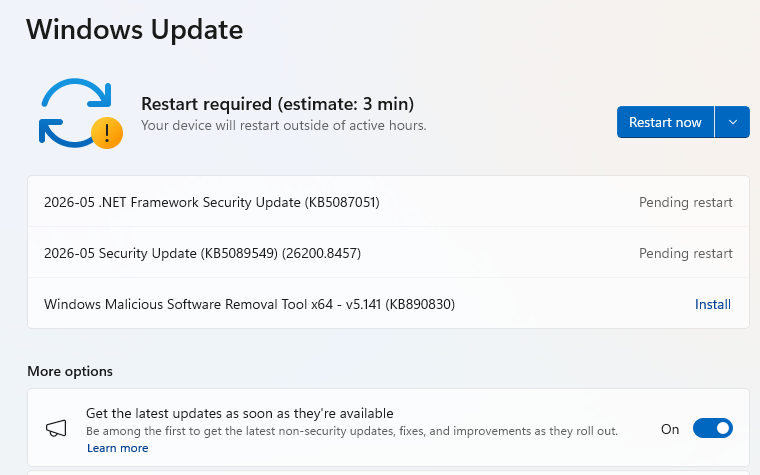
  • If you have selected to get the latest updates as soon as they’re available, you may see this under More options.
  • In which case you may see a Restart required message. Restart your system and the update will complete.
    May restart required
  • If not, continue with the steps below.

4. Download and Install If updates are found, they’ll start downloading automatically. Once complete, you’ll see a button that says Install or Restart now.

  • Click Install if needed and follow any prompts. Your computer will usually need a restart to finish the update. If it does, click Restart now.

5. Double-check you’re up to date

  • After restarting, go back to Windows Update and check again. If it says You’re up to date, you’re all set!
Windows is up to date

We don’t just report on threats—we remove them

Cybersecurity risks should never spread beyond a headline. Keep threats off your devices by downloading Malwarebytes today.
  •  

March 2026 Patch Tuesday fixes two zero-day vulnerabilities

Microsoft releases important security updates on the second Tuesday of every month, known as Patch Tuesday. This month’s update fixes 79 Microsoft CVEs including two zero-day vulnerabilities.

Microsoft defines a zero-day as “a flaw in software for which no official patch or security update is available yet.” So, since the patch is now available, those two are no longer zero-days. There is also no reason to believe they were ever actively exploited.

But let’s have a look at the possible consequences if you don’t install the update.

The vulnerability tracked as CVE-2026-21262 (CVSS score 8.8 out of 10) is a bug in Microsoft SQL Server that lets a logged-in user quietly climb the privilege ladder and potentially become a full database administrator (sysadmin). With that level of control, they can read, change, or delete data, create new accounts, and tamper with database configurations or jobs. Where SQL Server is supposed to check what each user is allowed to do, in this case it can be tricked into granting more power than intended.

There is no user interaction required once the attacker has that foothold: exploitation can happen over the network using crafted SQL requests that abuse the flawed permission checks. In a typical real‑world scenario, this bug would be the second act in an attack chain: first get in with low privileges, then use CVE-2026-21262 to quietly promote yourself to database king and start rewriting the script.

CVE-2026-26127 (CVSS score 7.5 out of 10) is a bug in Microsoft’s .NET platform that lets an attacker remotely crash .NET applications, effectively taking them offline for a while. The flaw lives in Microsoft .NET 9.0 and 10.0, across Windows, macOS, and Linux, in the .NET runtime or libraries, not in a specific app. In other words, it’s a bug in the engine that runs .NET code, so any app created with affected .NET versions could be at risk until patched.

The main outcome is denial of service: an attacker can cause targeted .NET processes to crash or become unstable, leading to downtime or degraded performance. For a public‑facing web API, a payment service, or any line‑of‑business app built on .NET, this can mean real‑world outages and angry users while services are repeatedly knocked over.

Vulnerabilities affecting Microsoft Office users are two remote code execution flaws in Microsoft Office (CVE-2026-26110 and CVE-2026-26113) which can both be exploited via the preview pane, and a Microsoft Excel information disclosure flaw (CVE-2026-26144), which could be used to exfiltrate data via Microsoft Copilot. Office vulnerabilities appear regularly in Patch Tuesday releases, and in this case none have been reported as actively exploited.

How to apply fixes and check if you’re protected

These updates fix security problems and keep your Windows PC protected. Here’s how to make sure you’re up to date:

1. Open Settings

  • Click the Start button (the Windows logo at the bottom left of your screen).
  • Click on Settings (it looks like a little gear).

2. Go to Windows Update

  • In the Settings window, select Windows Update (usually at the bottom of the menu on the left).

3. Check for updates

  • Click the button that says Check for updates.
  • Windows will search for the latest Patch Tuesday updates.
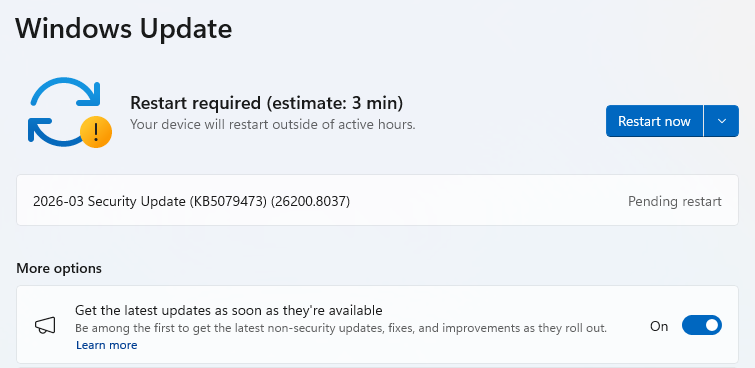
  • If you have selected to get the latest updates as soon as they’re available, you may see this under More options.
  • In which case you may see a Restart required message. Restart your system and the update will complete.
    Restart now to apply patches
  • If not, continue with the steps below.

4. Download and Install

  • If updates are found, they’ll start downloading right away. Once complete, you’ll see a button that says Install or Restart now.
  • Click Install if needed and follow any prompts. Your computer will usually need a restart to finish the update. If it does, click Restart now.
    Windows up to date

5. Double-check you’re up to date

  • After restarting, go back to Windows Update and check again. If it says You’re up to date, you’re all set!

We don’t just report on threats—we remove them

Cybersecurity risks should never spread beyond a headline. Keep threats off your devices by downloading Malwarebytes today.
  •  

Chipmaker Patch Tuesday: Over 80 Vulnerabilities Addressed by Intel and AMD

More than two dozen advisories have been published by the chip giants for vulnerabilities found recently in their products.

The post Chipmaker Patch Tuesday: Over 80 Vulnerabilities Addressed by Intel and AMD appeared first on SecurityWeek.

  •  
❌