❌

Normal view

Weak keys in eMudhra CA certificates: the risks and how to respond | Kaspersky official blog

28 October 2026 at 17:41

Certificates both protect TLS connections and digitally sign applications, and forged ones turn up in real-world attacks from time to time. We’ve seen forged or stolen certificates abused by the DarkHotel APT and the Flame malware, and in 2011 we saw attack attempts after the certificate authority Comodo was compromised. Pulling off this trick usually takes serious expertise. But attacking eMudhra certificates in 2026 doesn’t take much effort at all. An attacker just has to guess a number from 1 to 255. Private keys for intermediate certificate authorities are normally gigantic numbers. But in this case, eight of them were the following: 4, 56, 66, 115, 155, 156, 230, and 237. They could be guessed using the public keys (available in public certificates) in under a second. As a result, a hypothetical attacker could issue certificates for anything by signing them with one of the compromised private keys.

Six of these keys were meant for issuing TLS certificates, and the other two were for code signing. All eight intermediate certificate authorities (CAs) were also cross-signed by the Sectigo CA. This means clients with different trust chains could trust a forged certificate.

The major browsers have already blocked the dangerous certificate chains. But IT and security teams still need to assess and remediate the risk in many other systems across their organizations. Scripts for scheduled data-processing, corporate NGFWs, monitoring servers, applications with built-in certificate stores, and devices that don’t get regular updates may accept forged certificates and be vulnerable to man-in-the-middle (MitM) attacks. The keys needed for this are already built into publicly available interception tools.

Timeline of the eMudhra certificate authority incident

The problematic keys came from a batch of 24 intermediate CAs that eMudhra created on April 30, 2025. Instead of cryptographically random values for a 384-bit elliptic curve, eight of the keys turned out to be small numbers. According to eMudhra’s own description, a “key wrap/unwrap step” during key generation created a second, weak set of keys. Because keys are created and stored in a dedicated device called a hardware security module (HSM), a weak key is hard to notice on its own. It’s still unclear what error caused the keys to be generated twice and the weak set to be used; the investigation is ongoing.

In May 2025, the Sectigo CA signed all eight intermediate certificates. Then, on October 17, 2026, an independent researcher notified the security teams at Mozilla, Google, and Apple, as well as the CA itself, that the keys were recoverable. On October 20, Mozilla publicly disclosed the incident. This means that for almost a year and a half the keys could have been recovered and certificates forged.

On October 22, eMudhra announced that it was exiting the global SSL/TLS certificate business.

What an attacker can do

Using the vulnerable intermediate CAs, an attacker can sign a forged certificate for someone else’s domain. Clients that still trust that chain and have no other safeguards will take the forgery for the real server.

A certificate alone isn’t enough to intercept HTTPS traffic. The attacker also needs a way to tamper with the victim’s traffic or redirect the connection. That’s possible, for example, in a compromised office network, on a Wi-Fi access point the attacker controls, or by interfering with routing and DNS. And all of this does happen in the wild, as the DarkHotel attacks, among others, have shown.

There’s one more danger: two of the keys can be used for code signing. In theory, that would let an attacker deliver malware that appears to come from a trusted vendor and doesn’t trigger scary OS warnings during installation.

Was it exploited?

Experts from various companies who analyzed the after-effects of the incident haven’t found any malicious attacks that used these certificates. eMudhra and CERT-In have also reported finding no abuse. The Chrome team found no certificates from the six CAs in public Certificate Transparency logs.

This means that systems where browsers check certificates through Certificate Transparency (CT) were most likely not attacked. But many devices and applications — especially servers and IoT devices, don’t check CT at all, so we can’t say anything about them. Today, malicious actors no longer need to write their own hacking tools to pull off an attack like this. Version 12.3 of mitmproxy — a popular tool among security researchers — already has built-in support for compromised keys.

Where the risk has been eliminated, and where that isn’t guaranteed

Major platforms quickly revoked the compromised certificates. As early as October 17, Chrome did so through CRLSets, and Firefox — through OneCRL. On October 18, eMudhra itself revoked the certificates, citing “CA Compromise”. Apple took action on October 19, and the Sectigo CA also revoked the cross-signed copies. Microsoft revoked the certificates on October 20. Depending on the settings of a specific application and OS, revocation may have taken effect even without an application update, since blocklists are often updated separately.

At the same time, a more radical measure is under way: withdrawing trust from the root CA. Chrome has announced the planned removal of “emSign ECC Root CA – G3” from the browser. Certificates issued under the “emSign Root CA – G1” root, and the root itself, aren’t affected. According to eMudhra’s estimate, about 30 000 certificates will need to be migrated.

But certificate revocation only works where the client can find out about the revocation to then be able to actually act upon it. Many applications check the signature, server name, and certificate validity period, but don’t retrieve or update blocklists. Here are the typical cases:

Outdated and LTS systems. LTS (long-term support) status alone doesn’t mean a system is vulnerable. By definition, a system with this status receives support. But old containers, frozen OS images, and systems that are no longer updated can keep trusting revoked CAs for a long time. It all depends on updates to ca-certificates and TLS libraries, and the settings of the specific application.

Automated systems and servers. On emudhra.we-have-a-problem.com — a site created by enthusiasts where you can check any client software for misplaced trust — curl and Zabbix dominate the list of the most vulnerable systems. For HTTP checks, Zabbix usually uses libcurl and the certificate store configured for it. Similar behavior is also documented in the built-in curl in macOS. At the OS level and in Safari, the certificate is revoked, but curl reads a plain /etc/ssl/cert.pem file, and that’s precisely where the fix has to be made. This is a good example: even when system-level trust and revocation mechanisms work, individual applications — including ones that ship with the OS by default — can remain vulnerable.

Python, Ruby, Go, Java, and containers. An application may use its own set of root CAs, which isn’t updated along with the OS. Endor Labs found more than 25 popular packages that contain the affected root.

Slack, GitHub Desktop, and other apps built on the Electron framework. These apps ship with their own Electron/Chromium, so updating a separately installed Chrome doesn’t update Slack. The certificate revocations are already in the new Electron version, but now every developer has to rebuild and distribute their app, and every user has to install the update. That said, not every Electron app is necessarily vulnerable. The outcome depends on the version, how the app updates its blocklists, and which network stack it uses.

Mobile browsers and IoT devices. Mobile Chrome, Firefox, and Safari get certificate revocation data as quickly as their desktop counterparts do. With the stock browsers from smartphone makers, this isn’t the case. In a published test, Samsung Browser 31.0.0.64 accepted all six test chains from emSign while rejecting the ones from Sectigo. For HarmonyOS 6 and 7, researchers found the affected CAs in Huawei’s published list of root CAs, and those CAs can’t be revoked manually.

For unsupported devices, home appliances, and old firmware, a certificate store update may never be released. In those cases, the problem could linger for years.

Impact on TLS inspection in a corporate network

When an NGFW or web gateway inspects encrypted traffic, it maintains two connections: one with the client and the other with the external server. The client receives a certificate signed by the corporate CA, while the gateway itself verifies the authenticity of the external server.

If the gateway accepts a forged eMudhra certificate, even an updated browser on an employee’s computer won’t see the dangerous chain. Instead, it will receive the familiar corporate certificate. In this scenario, the security tool itself hides the problem from the client. That said, carrying out such an attack would also require intercepting traffic.

To fix the validation policy and certificate lists on the inspection device itself, follow the vendor’s instructions — if the vendor has published any, that is.

At Cisco, the status of the issue is documented in detail for all products. Most of them are still listed as “under investigation”, but mitigation measures are recommended for vulnerable devices.

Sophos and Check Point promise device software updates and, in the meantime, advise removing the certificates manually. Neither company has published a security advisory, but employees of each posted recommendations on its support forum.

For Fortinet devices, instructions for checking and removing emSign certificates can be found here. Palo Alto offered only general advice instead of specifics for its own products.

Of course, a properly configured gateway can indeed temporarily protect outdated client devices that trust the dangerous certificates.

To check specific devices, services, containers, and virtual machines, you can use a dedicated website. One possible scenario for proactively hunting for threats that exploit or have previously exploited weak keys is described here.


123 Reg discloses 'AI cyberattack' on customer data, suspects China nexus

28 October 2026 at 12:45
UK domain registrar 123 Reg (no relation – Ed) says it was the victim of an “AI-driven cyberattack” that exposed customer data. Customers began receiving their notification emails this week, informing them that their contact information, "related customer relationship data," company VAT numbers, and "product information from an application programming interface (API)" were compromised. A company spokesperson elaborated, saying this means that names, phone numbers, countries, language and currency preferences, account creation dates, the products on the account, and marketing preferences were affected. 123 Reg described the September 18 intrusion as "the first known AI-driven cyberattack against our company," and told The Register that early signs point toward a China-nexus attacker. "Our investigation identified IP addresses that we assessed to be the core attacker infrastructure, which were hosted in China and Singapore, indicating a strong Chinese nexus," the spokesperson said.  "Our investigation further identified AI cyberattack 'skills' hosted on Chinese infrastructure, including copies of skills open sourced by Anthropic and several other AI exploitation frameworks and scripts." They went on to say that many of the artefacts left behind led 123 Reg to suspect that a Chinese state-sponsored group, known for abusing Claude Code in attacks against at least 30 organizations, could be behind the break-in. There is also a suspicion that the same group that hit a number of South Korea’s financial institutions using open-source Chinese AI tool ARTEX, was behind the attack on 123 Reg too. "The TA's mirror of 'anthropic_skills,' and the account naming conventions found on the Chinese servers are consistent with preparation of this class of AI-augmented operation," the spokesperson told us.  "In addition, on October 7, 2026, CrowdStrike published CSA-261162, describing an unknown, likely Chinese-speaking actor that targeted several South Korean financial organizations starting in late September 2026, which is the same period during which we were attacked. "That actor used ARTEX, an open-source Chinese-developed agentic penetration-testing tool released in July 2026, which was also observed to be used in the attack that targeted us." The GoDaddy-owned registrar reported the attack to law enforcement agencies, brought in outside cybersecurity support, and notified the FTC, as well as the data protection authorities in the UK and EU. The company spokesperson added that it worked with Singapore-based ISPs to shut down the attacker's servers in the region, which helped disrupt the attack, in addition to "other actions by us and industry partners." 123 Reg's email to customers stated the attacker's activity "was limited to reading" customer data, although the spokesperson told us "it's possible they created copies of the information," and that this is what prompted the notification. The registrar urged customers to stay alert to the potential misuse of their data, and to treat communications appearing to come from the company with caution. "If you receive a message or call and aren't sure it's from 123 Reg, go directly to our website and log in," the email said. "We will never contact you to request your password, payment details, or verification codes by email, text, or phone. "We also strongly recommend turning on two-step verification (2SV), which helps keep your account protected even if someone tricks you into sharing your password. You can find instructions for setting up 2SV in your 123 Reg account. "We apologize for any inconvenience this may have caused." ®

Chrome and Firefox updates fix serious security flaws. Install them now

28 October 2026 at 12:13

On October 27, Google issued a new Stable channel update for Chrome.

Most users are on Chrome’s Stable channel. The desktop update brings Chrome to versions 156.0.8078.73/.74 for Windows and Mac and 156.0.8078.73 for Linux. The update includes 52 security fixes, including four rated Critical.

On the same day, Mozilla issued Security Advisory 2026-118, which fixes 167 vulnerabilities. Firefox 159 also introduces several new features.

Both updates will roll out over the coming days and weeks.

How to update Chrome

The easiest option is to allow Chrome to update automatically. But you can end up lagging behind on updates if you never close your browser or if something goes wrong, such as an extension preventing the update.

If you don’t want to wait for the rollout to reach you, manually updating is easy. Open About Google Chrome from Chrome’s settings or Help menu. Chrome will check for updates. If one is available, click Relaunch to apply it.

Chrome version 156.0.8078.74 is up to date

You can find an explanation of the version numbering system and step-by-step instructions in our guide: How to update Chrome on every operating system.

How to update Firefox

To update Firefox, open the browser and click the menu button at the right side of the Firefox toolbar, then go to Help and select About Firefox. The About Mozilla Firefox window will open.

Firefox will automatically check for updates. If one is available, it will be downloaded. Once done, you’ll be prompted to click Relaunch. After Firefox restarts, it will be up to date.

After the update, the version should be 159.0 or later

Technical details

These Chrome and Firefox updates address a familiar problem: browser code mishandling memory while processing web content. Both releases fix use-after-free vulnerabilities, including flaws in page layout, JavaScript processing, and SVG graphics.

A use-after-free vulnerability occurs when a program attempts to access a memory location after it has been freed. That can cause crashes or, in some cases, allow an attacker to run their own code.

There’s another connection between these updates: both Google and Mozilla credit OpenAI Codex Security with finding bugs fixed in these releases. AI can help security teams examine browser code for weaknesses, alongside human code reviews and automated tests that check how software handles unexpected inputs.

Mozilla’s collaboration with Anthropic shows how AI-discovered findings can lead to fixes: researchers validated vulnerabilities before reporting them, giving Mozilla’s team reproducible bugs to investigate, repair, and deliver to users.


Browse like no one’s watching. 

Malwarebytes Privacy VPN encrypts your connection and never logs what you do, so the next story you read doesn’t have to feel personal. Try it free → 

Chrome and Firefox updates fix serious security flaws. Install them now

28 October 2026 at 12:13

On October 27, Google issued a new Stable channel update for Chrome.

Most users are on Chrome’s Stable channel. The desktop update brings Chrome to versions 156.0.8078.73/.74 for Windows and Mac and 156.0.8078.73 for Linux. The update includes 52 security fixes, including four rated Critical.

On the same day, Mozilla issued Security Advisory 2026-118, which fixes 167 vulnerabilities. Firefox 159 also introduces several new features.

Both updates will roll out over the coming days and weeks.

How to update Chrome

The easiest option is to allow Chrome to update automatically. But you can end up lagging behind on updates if you never close your browser or if something goes wrong, such as an extension preventing the update.

If you don’t want to wait for the rollout to reach you, manually updating is easy. Open About Google Chrome from Chrome’s settings or Help menu. Chrome will check for updates. If one is available, click Relaunch to apply it.

Chrome version 156.0.8078.74 is up to date

You can find an explanation of the version numbering system and step-by-step instructions in our guide: How to update Chrome on every operating system.

How to update Firefox

To update Firefox, open the browser and click the menu button at the right side of the Firefox toolbar, then go to Help and select About Firefox. The About Mozilla Firefox window will open.

Firefox will automatically check for updates. If one is available, it will be downloaded. Once done, you’ll be prompted to click Relaunch. After Firefox restarts, it will be up to date.

After the update, the version should be 159.0 or later

Technical details

These Chrome and Firefox updates address a familiar problem: browser code mishandling memory while processing web content. Both releases fix use-after-free vulnerabilities, including flaws in page layout, JavaScript processing, and SVG graphics.

A use-after-free vulnerability occurs when a program attempts to access a memory location after it has been freed. That can cause crashes or, in some cases, allow an attacker to run their own code.

There’s another connection between these updates: both Google and Mozilla credit OpenAI Codex Security with finding bugs fixed in these releases. AI can help security teams examine browser code for weaknesses, alongside human code reviews and automated tests that check how software handles unexpected inputs.

Mozilla’s collaboration with Anthropic shows how AI-discovered findings can lead to fixes: researchers validated vulnerabilities before reporting them, giving Mozilla’s team reproducible bugs to investigate, repair, and deliver to users.


Browse like no one’s watching. 

Malwarebytes Privacy VPN encrypts your connection and never logs what you do, so the next story you read doesn’t have to feel personal. Try it free → 

Millions of security cameras at risk: DoS vulnerability in Intelbras devices

28 October 2026 at 11:00

Background

Network-connected surveillance cameras are now widespread in both home and enterprise environments, so securing them is essential to safeguarding physical spaces and sensitive assets. As these devices continue to gain new features and network connectivity capabilities, vulnerabilities in their implementation can have significant security implications.

During our research, we discovered a denial-of-service vulnerability that affects Intelbras IP cameras systems. The flaw resides in a firmware update endpoint that is accessible without authentication and allows anyone with access to the local Wi-Fi network to knock cameras offline. A single request disrupts the camera for only about a minute, but sending periodic requests keeps the device offline indefinitely. We reported the issue to Intelbras, monitored the remediation process, validated the fix in the new firmware, and will now demonstrate the exploitation procedure step-by-step.

Following our notification, Intelbras patched the vulnerability and released updated firmware (R.260804) along with update instructions. A candidate ID of CAN-2026-2035970 has been assigned by MITRE following submission, pending the final CVE assignment. Additionally, the Intelbras team recently informed us that MITRE has classified the vulnerability as Medium, assigning it a score of 5.1 under the CVSS 4.0 framework. The issue discussed in this article is no longer present in the latest firmware version.

Firmware

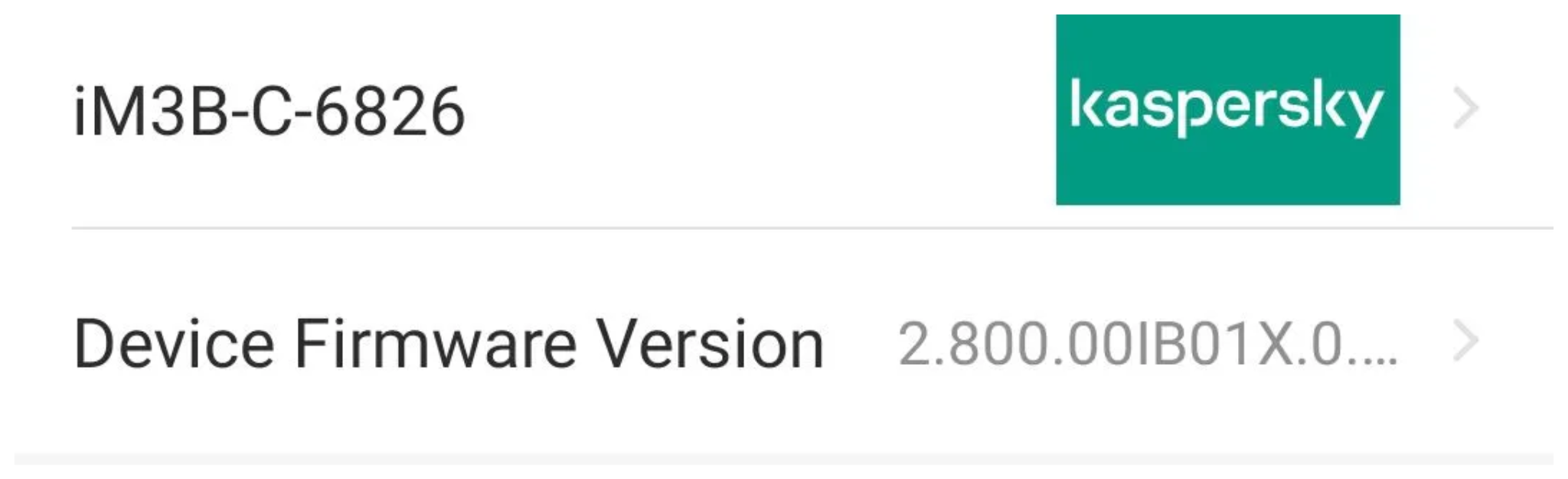
Intelbras provides firmware files on its official website. While users can manually install these updates via an SD card, the cameras also natively support firmware upgrades over the local network via their web interface and mobile app. We obtained the firmware version v240927 for the iM3B-C (IM3 C) camera, which was the latest available version at the time of our research. According to Intelbras, the same firmware is also compatible with the iMX C, iM4 C, iM5 SC, iME 360 C, and iM7+ FC models. Below, we can view the firmware version and the camera model used as an example.

To provide context, we will explain how the camera’s authentication mechanism works and why it is relevant to accessing the camera’s endpoints. The main firmware component is an ARM binary named sonia, responsible for controlling the kernel drivers used by the camera hardware, authentication, and livestream recording, among other things.

How authentication works

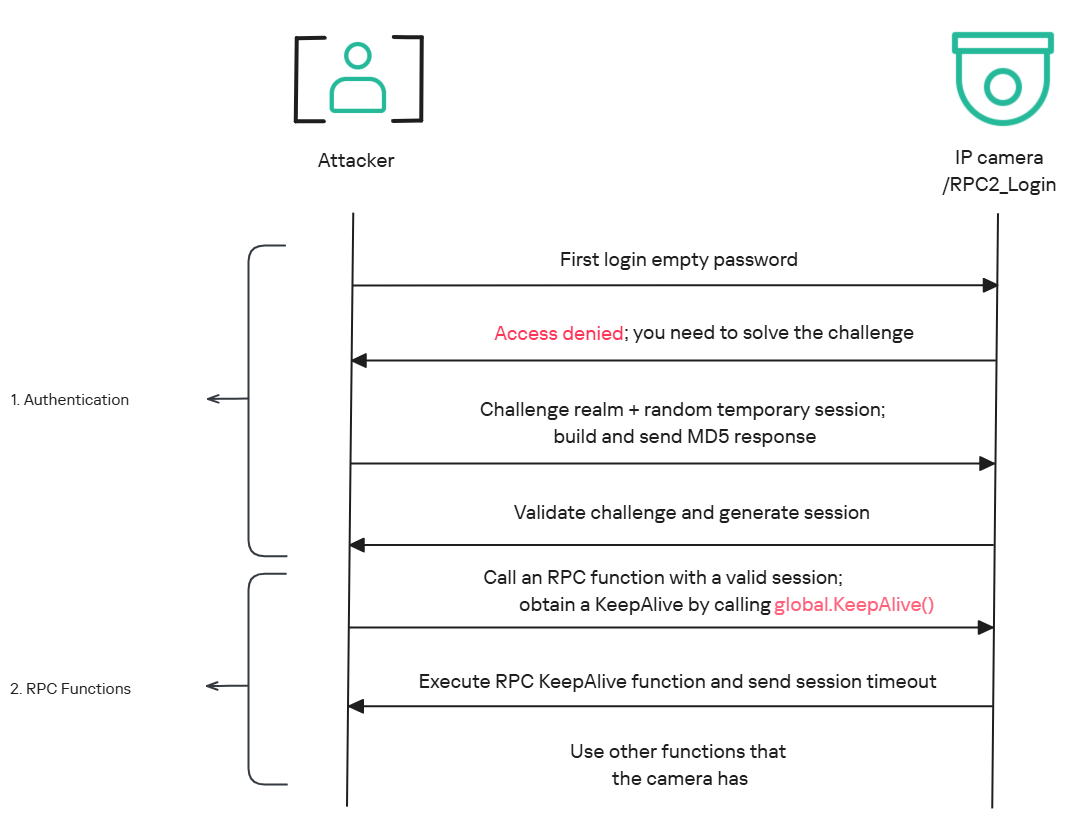
The global.login RPC method handles authentication at the /RPC2_Login endpoint. First, the client, such as the mobile app or a custom script, sends the username and an empty password. The camera responds with an authentication challenge (a set of values to verify the password without transmitting it). This response returns a temporary session, the encryption type in the encryption field, a random value, and a realm (authentication scope). At this stage, a false response is normal and does not indicate a failed login, as the authentication process is not yet complete.

Next, the client calculates the response password from the authentication challenge. It first generates an MD5 (username:realm:original_password) hash as the base. It then calculates a second MD5 (username:random:first_md5) hash,  where first_md5 is the result of the previous step. To complete the authentication, the client sends this final result back to /RPC2_Login in a second global.login call, passing the username, calculated password, and temporary session ID.

If the login is accepted, the camera returns true and a new, authenticated session. This session must be used for all subsequent RPC calls, including the camera’s other endpoints, for example, the one that reboots the device or those that expose sensitive information.

Affected endpoint

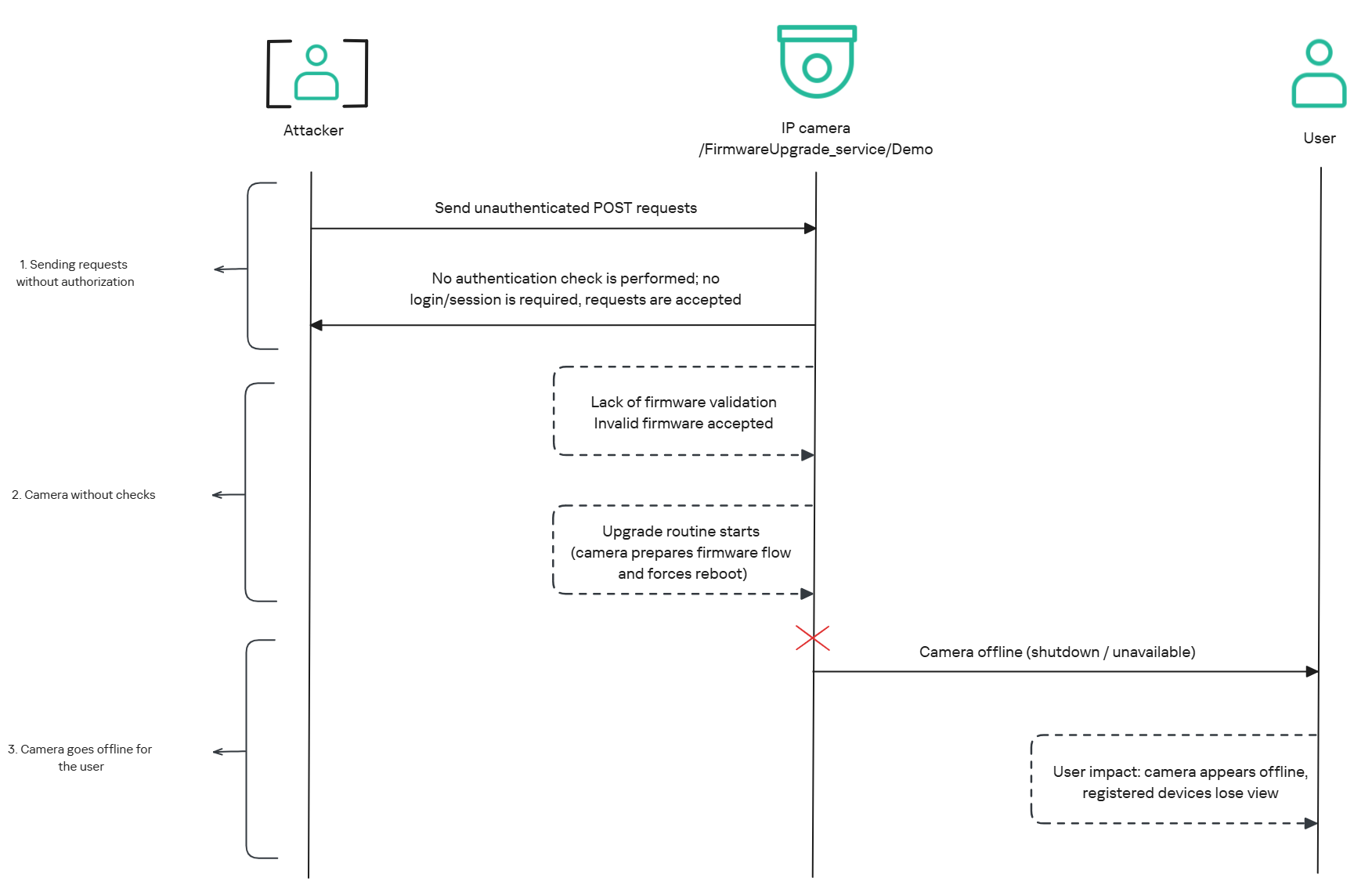
The affected endpoint is the firmware upgrade route http://<ip_address>/firmwareUpgrade_service/Demo, which lacks authentication checks; furthermore, it fails to verify whether the firmware is actually valid before initiating the upgrade process. This creates a serious issue because the upgrade requires the camera to reboot, and that is precisely when the problem occurs: the camera enters reboot mode and eventually shuts down, appearing offline to the user and anyone who has the camera registered on their device.

PoC: vulnerability exploitation

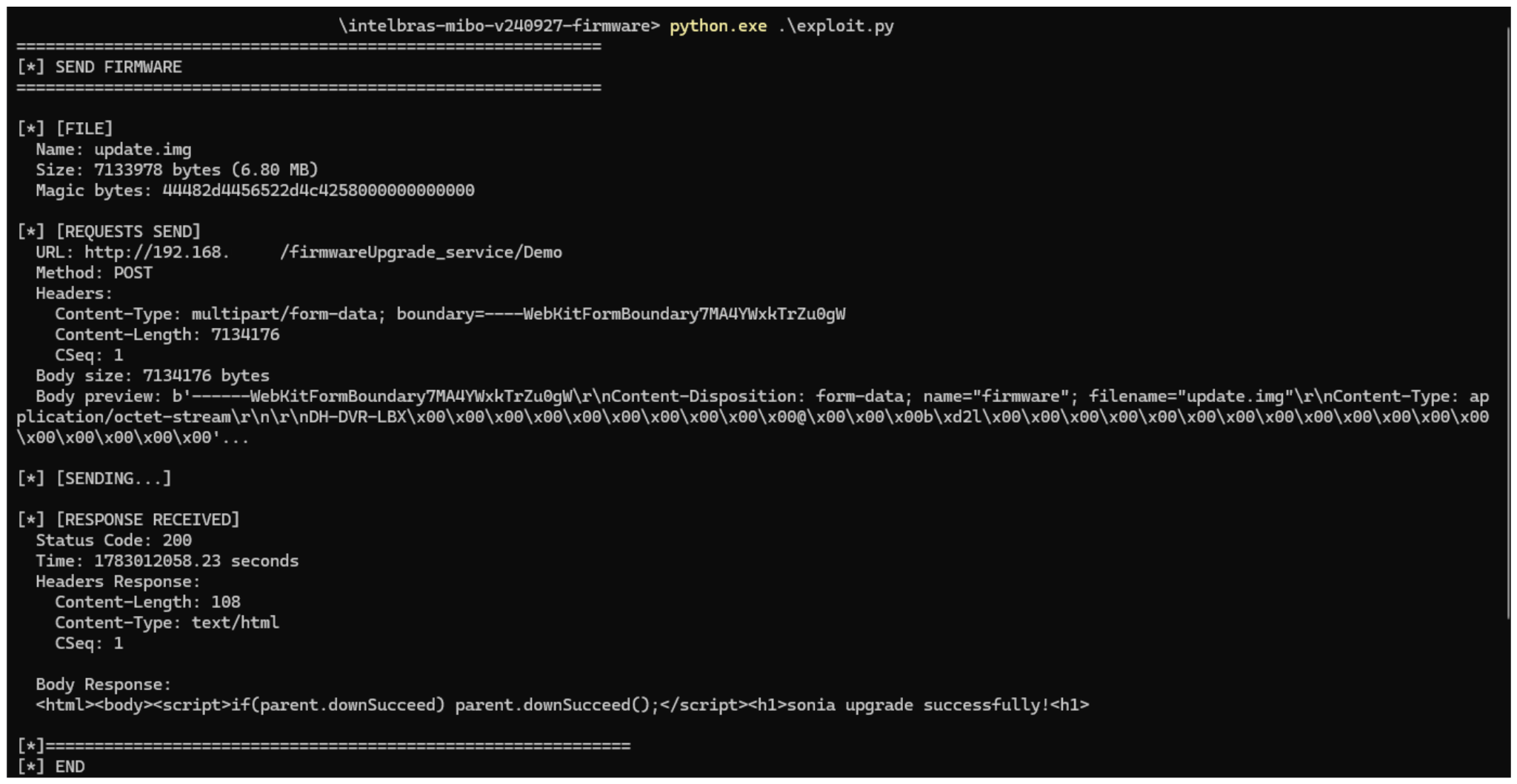
Now that we have outlined how the vulnerability works, we will use a Python script on an iM3B-C camera to exploit it for demonstration purposes. The exploit contacts the camera’s endpoint to upload firmware. Below, we can see sonia creating the endpoint responsible for the firmware upgrade.

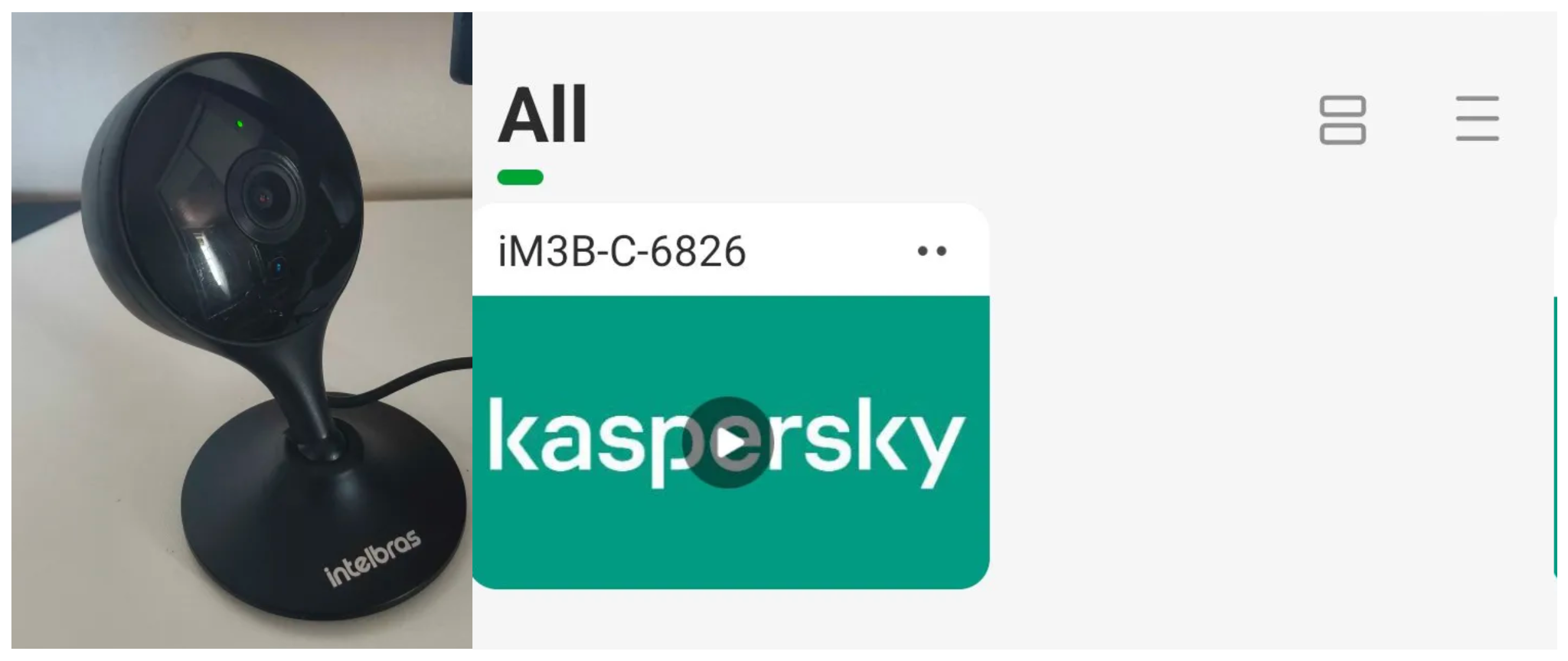
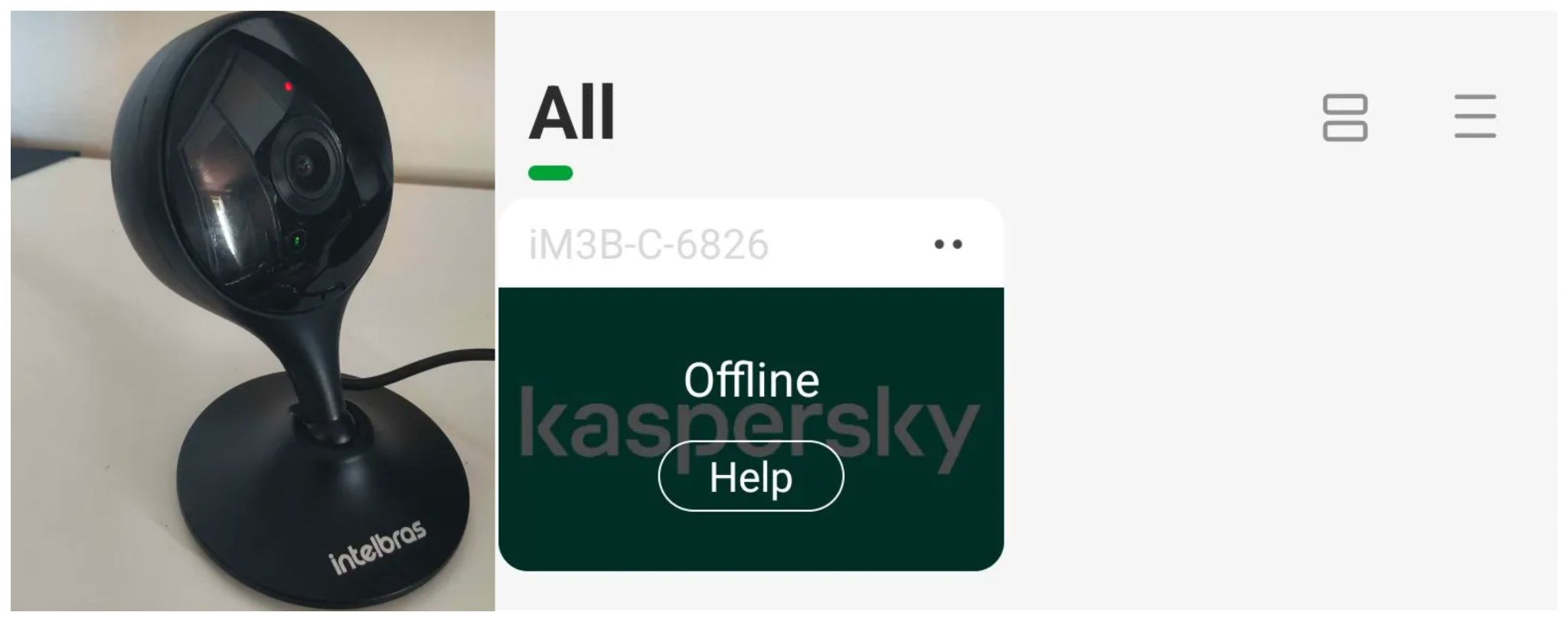
Next, the exploit will hit the endpoint and cause the camera to reboot. Consequently, mobile phones running the Intelbras app will lose connection with the registered device. Below, we can see the camera operating normally: the green light is on and the app is showing it is available for viewing.

The camera is online

The camera is online

After the exploit executes, we can see the effects: the camera goes offline and loses connection to the registered devices.

The camera is offline

The camera is offline

The exploit is quite simple: it sends an HTTP POST request with the firmware, which causes the camera to accept the request and initiate the reboot process. It does not matter whether the firmware is original; the reboot process will start regardless.

New firmware version

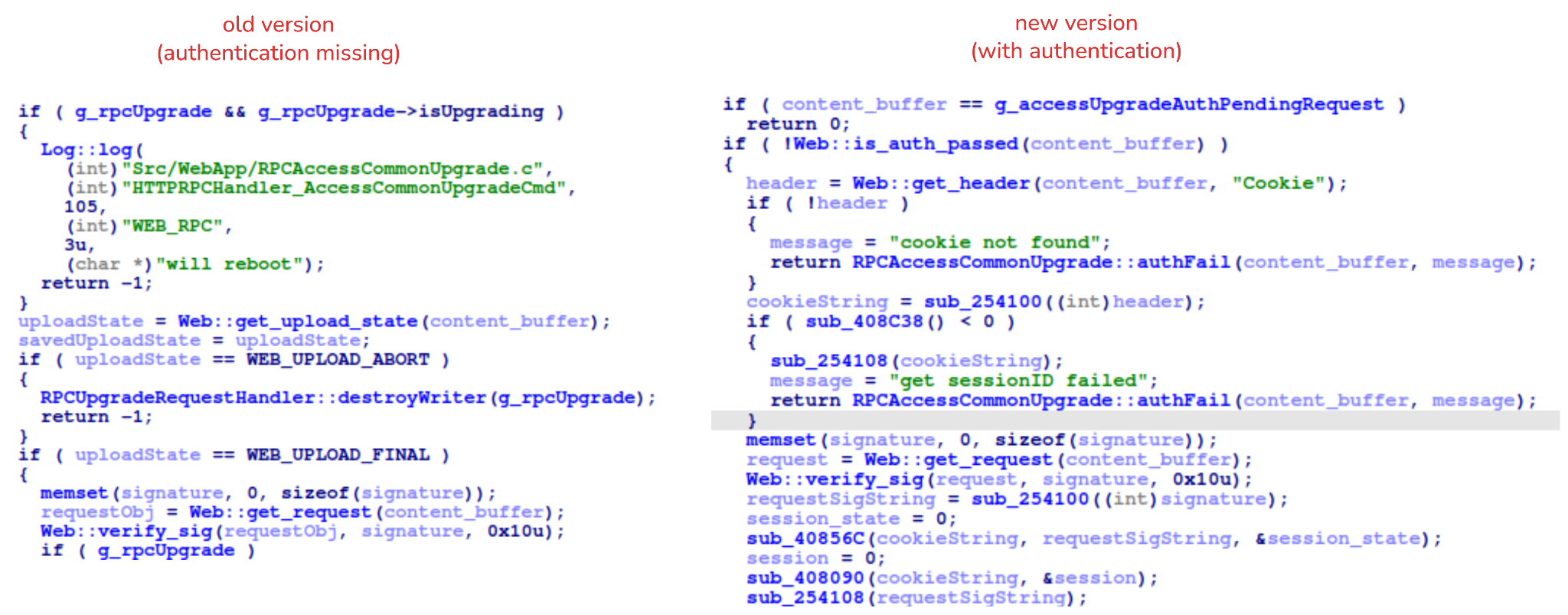
After we notified Intelbras about this flaw in the endpoint implementation, the company contacted the OEM vendor. As a result, a new firmware version was released that requires authentication to initiate an update through this endpoint.

Below, we can compare the new firmware, which validates cookies and session data, with the old firmware, which performed no authentication checks and proceeded directly to the update routine.

Real risk

An attacker can remotely trigger the camera firmware upgrade and reboot process without authenticating or supplying a valid firmware image. This may cause the device to go offline, which results in a denial-of-service condition preventing legitimate users from accessing live monitoring or managing the camera.

The potential impact is significant due to the number of affected users. The Intelbras Mibo Smart app, which the company provides to connect and manage the devices mentioned in this report, has over 4,000,000 downloads. Brazil represents the largest user base, followed by Paraguay, Ecuador, Colombia, Argentina, Chile, Peru, Bolivia, Uruguay, and Venezuela. As a result, exploitation of this issue affects a large number of users.

Takeaways

This is a medium-severity vulnerability that Intelbras is already aware of. The issue has been addressed in a newer firmware release (R.260804 along with update instructions), which mitigates this attack vector. Because the vulnerability directly affects the availability and normal operation of the affected cameras, it is highly recommended that users verify the firmware version currently installed on their devices and update to the latest available version as soon as possible. Keeping the firmware up to date is an essential security practice, especially for internet-connected surveillance devices, as outdated versions may remain exposed to known vulnerabilities.

Millions of security cameras at risk: DoS vulnerability in Intelbras devices

28 October 2026 at 11:00

Background

Network-connected surveillance cameras are now widespread in both home and enterprise environments, so securing them is essential to safeguarding physical spaces and sensitive assets. As these devices continue to gain new features and network connectivity capabilities, vulnerabilities in their implementation can have significant security implications.

During our research, we discovered a denial-of-service vulnerability that affects Intelbras IP cameras systems. The flaw resides in a firmware update endpoint that is accessible without authentication and allows anyone with access to the local Wi-Fi network to knock cameras offline. A single request disrupts the camera for only about a minute, but sending periodic requests keeps the device offline indefinitely. We reported the issue to Intelbras, monitored the remediation process, validated the fix in the new firmware, and will now demonstrate the exploitation procedure step-by-step.

Following our notification, Intelbras patched the vulnerability and released updated firmware (R.260804) along with update instructions. A candidate ID of CAN-2026-2035970 has been assigned by MITRE following submission, pending the final CVE assignment. Additionally, the Intelbras team recently informed us that MITRE has classified the vulnerability as Medium, assigning it a score of 5.1 under the CVSS 4.0 framework. The issue discussed in this article is no longer present in the latest firmware version.

Firmware

Intelbras provides firmware files on its official website. While users can manually install these updates via an SD card, the cameras also natively support firmware upgrades over the local network via their web interface and mobile app. We obtained the firmware version v240927 for the iM3B-C camera, which was the latest available version at the time of our research. According to Intelbras, the same firmware is also compatible with the iMX C, iM4 C, iM5 SC, iME 360 C, and iM7+ FC models. Below, we can view the firmware version and the camera model used as an example.

To provide context, we will explain how the camera’s authentication mechanism works and why it is relevant to accessing the camera’s endpoints. The main firmware component is an ARM binary named sonia, responsible for controlling the kernel drivers used by the camera hardware, authentication, and livestream recording, among other things.

How authentication works

The global.login RPC method handles authentication at the /RPC2_Login endpoint. First, the client, such as the mobile app or a custom script, sends the username and an empty password. The camera responds with an authentication challenge (a set of values to verify the password without transmitting it). This response returns a temporary session, the encryption type in the encryption field, a random value, and a realm (authentication scope). At this stage, a false response is normal and does not indicate a failed login, as the authentication process is not yet complete.

Next, the client calculates the response password from the authentication challenge. It first generates an MD5 (username:realm:original_password) hash as the base. It then calculates a second MD5 (username:random:first_md5) hash,  where first_md5 is the result of the previous step. To complete the authentication, the client sends this final result back to /RPC2_Login in a second global.login call, passing the username, calculated password, and temporary session ID.

If the login is accepted, the camera returns true and a new, authenticated session. This session must be used for all subsequent RPC calls, including the camera’s other endpoints, for example, the one that reboots the device or those that expose sensitive information.

Affected endpoint

The affected endpoint is the firmware upgrade route http://<ip_address>/firmwareUpgrade_service/Demo, which lacks authentication checks; furthermore, it fails to verify whether the firmware is actually valid before initiating the upgrade process. This creates a serious issue because the upgrade requires the camera to reboot, and that is precisely when the problem occurs: the camera enters reboot mode and eventually shuts down, appearing offline to the user and anyone who has the camera registered on their device.

PoC: vulnerability exploitation

Now that we have outlined how the vulnerability works, we will use a Python script on an iM3B-C camera to exploit it for demonstration purposes. The exploit contacts the camera’s endpoint to upload firmware. Below, we can see sonia creating the endpoint responsible for the firmware upgrade.

Next, the exploit will hit the endpoint and cause the camera to reboot. Consequently, mobile phones running the Intelbras app will lose connection with the registered device. Below, we can see the camera operating normally: the green light is on and the app is showing it is available for viewing.

The camera is online

The camera is online

After the exploit executes, we can see the effects: the camera goes offline and loses connection to the registered devices.

The camera is offline

The camera is offline

The exploit is quite simple: it sends an HTTP POST request with the firmware, which causes the camera to accept the request and initiate the reboot process. It does not matter whether the firmware is original; the reboot process will start regardless.

New firmware version

After we notified Intelbras about this flaw in the endpoint implementation, the company contacted the OEM vendor. As a result, a new firmware version was released that requires authentication to initiate an update through this endpoint.

Below, we can compare the new firmware, which validates cookies and session data, with the old firmware, which performed no authentication checks and proceeded directly to the update routine.

Real risk

An attacker can remotely trigger the camera firmware upgrade and reboot process without authenticating or supplying a valid firmware image. This may cause the device to go offline, which results in a denial-of-service condition preventing legitimate users from accessing live monitoring or managing the camera.

The potential impact is significant due to the number of affected users. The Intelbras Mibo Smart app, which the company provides to connect and manage the devices mentioned in this report, has over 4,000,000 downloads. Brazil represents the largest user base, followed by Paraguay, Ecuador, Colombia, Argentina, Chile, Peru, Bolivia, Uruguay, and Venezuela. As a result, exploitation of this issue affects a large number of users.

Takeaways

This is a medium-severity vulnerability that Intelbras is already aware of. The issue has been addressed in a newer firmware release (R.260804 along with update instructions), which mitigates this attack vector. Because the vulnerability directly affects the availability and normal operation of the affected cameras, it is highly recommended that users verify the firmware version currently installed on their devices and update to the latest available version as soon as possible. Keeping the firmware up to date is an essential security practice, especially for internet-connected surveillance devices, as outdated versions may remain exposed to known vulnerabilities.

Day 2 of canceled classes at University of New Mexico after Health Sciences Center cyberattack

27 October 2026 at 17:15
The University of New Mexico is canceling classes across the medicine, nursing, and pharmacy faculties for a second day amid continued efforts to recover from a "cybersecurity event." The attack targeted the Health Sciences Center on Monday, the Uni revealed, forcing it to shut down systems, cancel appointments and clinics at UNM Health hospitals, and divert ambulances to healthcare facilities in nearby Albuquerque and Santa Fe. Hospital appointments and clinics return to normal today, although nonessential UNM Health Sciences Center staff are being asked to remain at home. "The University of New Mexico Health Sciences Center (HSC), which includes the UNM Health clinical delivery system, experienced a cybersecurity event Monday, Oct. 26, 2026," the university said in a statement on Monday evening. "HSC information technology security teams immediately took steps to contain the event and protect the network. They also notified state and federal law enforcement and engaged external partners to assist with the investigation. "Leadership activated an Emergency Operations Center to coordinate the response and provide guidance to HSC employees, students, and UNM Health system frontline providers." The university announced the attack at 1430 local time, immediately cancelling all remaining clinics and classes, dismissing everyone other than critical and clinical staff, and urging patients not to attend HSC facilities. It has not commented on the nature of the cyberattack, although that hasn’t stopped researchers from speculating about ransomware’s involvement. Rumors were fuelled by the newly assembled BYOD ransomware group claiming responsibility for the attack on Monday afternoon. It's important to note that just because a purported ransomware group took credit for the attack, it does not mean they actually were responsible, nor does it mean they deployed a ransomware/locker payload as part of the attack. However, the group's take on the digital raid is that it compromised 36,000 machines, "both [Active Directory] forests," two Oracle databases, the personal data belonging to every student and employee, as well as internal emails and data from other systems. As Reg readers know, a cybercriminal's word is never one to be trusted. Yet BYOD's claims about breaching Trump Mobile's customer database appear to have held up It was a bold debut, even for a ransomware crew: BYOD’s first named victim was the US president's smartphone biz, with data allegedly leaked for all 3,615 customers. A rival group, EndZone, claimed a similar breach a week earlier, and some experts suggested the two could be one and the same. In May, the Trump Mobile was found leaking thousands of people's data via a poorly secured website. The Trump Organization did not respond to our requests for more information in either of these cases. A UNM spokesperson declined to answer our additional questions, directing us back to its public statement. ®

CISA confirms PHP2Shell under attack as researchers clock successful exploits

27 October 2026 at 15:45
The US government's cybersecurity watchdog has confirmed attackers are exploiting both critical PHP2Shell vulnerabilities, giving federal agencies three days to patch the bugs that have wreaked havoc across the web over the past week. CISA added CVE-2026-109618 and CVE-2026-109619 to its Known Exploited Vulnerabilities (KEV) catalog on Monday, setting an October 29 deadline for federal civilian agencies to address the flaws. The move marks a shift from last week, when the agency warned of the danger posed by PHP2Shell but said it had not yet observed successful exploitation in the wild. Both bugs are rated 9.2 on the CVSS scale and can be exploited without authentication to run code on vulnerable PHP servers. That's bad news given how much of the web still relies on PHP, and just how many sites could be left exposed. Patches landed on October 21, but attackers had already beaten the maintainers to it. AWS spotted attempts to exploit the flaws as early as October 17, four days before the bugs were publicly disclosed. CISA's confirmation comes amid growing evidence that attackers are doing more than simply knocking on the door. On October 24, Perplexity security researcher Adel Karimi recorded 35 successful shell executions across three honeypots running PHP 8.4.26 under Apache mod_php. The attacks came from two IP addresses and used memory exhaustion and disclosure to achieve remote code execution. The attackers then tried to contact external servers using PHP, curl, and wget, although no additional malware was successfully downloaded. Karimi's findings were consistent with exploitation of CVE-2026-109618, but he found no evidence that the second PHP2Shell flaw was involved. He also warned that the honeypots used a favorable single-worker configuration, so the results don't necessarily reflect how reliably the exploit works against production servers. Still, attackers appear to be giving it a good go. Delft University's Threat Intelligence Lab has tracked more than 50,000 PHP2Shell exploitation requests from over 600 IP addresses across 70 countries. Of those, 171 addresses went beyond probing for vulnerable servers and started sending exploit code or malware droppers. CISA's confirmation also comes after some of the earlier reports of successful PHP2Shell attacks turned out to be rather premature. Sophos walked back its initial assessment after determining that the activity it observed amounted to scanning and failed attempts, while Palo Alto Networks withdrew claims linking the vulnerabilities to an intrusion at a European government agency. CISA has not disclosed which organizations have been compromised or provided details of the attacks behind its decision to add the flaws to KEV. The listing confirms that the agency considers both vulnerabilities actively exploited, but it does not confirm how many production systems have been successfully breached. For federal agencies, the clock is now ticking. CISA is also urging organizations outside the federal government to prioritize the fixes, although the deadline does not apply to them. Admins should update to PHP 8.5.12, 8.4.27, 8.3.36, or 8.2.35, depending on their release branch. Those running older, unsupported versions face the added headache of upgrading or obtaining vendor-supported fixes, while systems that cannot be secured should be taken offline until the risk is addressed. And with CISA now officially acknowledging exploitation, anyone still waiting for more proof before patching may be waiting a little too long. ®

Attack on email hosting provider for German far right party AfD exposed 345k accounts

27 October 2026 at 12:49
The cyberattack on Alternative for Germany (AfD), the country’s most prominent far-right political party, exposed hundreds of thousands of confidential emails and attachments, as well as more than 345,000 unique email addresses. Have I Been Pwned confirmed the scale of the breach for the first time today, after AfD officially disclosed the September attack on its hosting provider last week. AfD said in its statement that “only a few email accounts were illegally copied,” but admitted a large amount of the data was taken from them, resulting in an extensive data breach. The emails were added to what the party described as “an activist website,” which summarised the email chains into searchable topics and has led to the publication of various revelations, such as a party co-leader’s opinions on colleagues’ “deeply problematic” racial discourse. Per a report from investigative journalist Lilith Wittmann, citing conversations with the cybercriminals responsible for the hack-and-leak job and party sources, the attack was first spotted on September 9 and started with a compromise of a poorly protected WordPress site. The same report claimed the criminals gained persistent access to the servers operated by the hosting provider, identified as AfD-owned Alternita Dienstleistungs GmbH, and exfiltrated more than a terabyte of data. No official sources have verified the hackers’ claims about how the attack unfolded. The Register contacted Alternita Dienstleistungs for its take. AfD said the owners of the affected email accounts have been notified, and that it reported the attack to security authorities. “We are deeply concerned by what has happened,” the party said in an October 20 statement. “Such a digital attack is illegal and a criminal offense. Furthermore, it is an attack on the German party system and thus on democracy. “We are extremely worried that, apparently, the content of the stolen documents was analyzed using a very rudimentary AI. This analysis focused on keywords, not the context. The alleged scandals published so far do not stand up to scrutiny – a fact that, thankfully, is being confirmed by a growing number of commentators on social media.” Among the AI-generated summaries compiled by the “activist site” are chains supposedly expressing views related to Holocaust denial, racist and antisemitic rants, the 9/11 disaster, forged documents, and more. Der Spiegel sifted through the raw files and reported that party leader Alice Weidel seemingly knew about illegal donations related to the 2017 federal elections weeks before she previously said she did. The AfD's position is that the AI summaries of the emails are not to be trusted, but it has not specifically commented on the veracity of the raw email files available for download via torrent. It did not immediately respond to our request for input, but has told reporters previously that it will not comment on whether the emails, or the stories that have been written based on them, are to be trusted. ®

Popcorn Time’s forgotten updater left millions of devices exposed to hijacking

26 October 2026 at 14:48

You may have forgotten about Popcorn Time. Unfortunately, its updater didn’t forget about your device.

Security researchers have intervened to disable an abandoned update mechanism in Time4Popcorn, a version of the once-popular streaming app. If left running in the background, the updater could have allowed attackers to take control of Windows and Mac computers, even if their owners hadn’t opened the app in years.

Eye Security estimates that the vulnerable updater was present on millions of devices worldwide, including 2.5–3 million Windows computers and around 250,000–350,000 Macs.

Popcorn Time made watching movies and TV shows through BitTorrent look more like browsing Netflix. Rather than making users find torrent files and open them in a separate client, it wrapped the process in a familiar streaming-style interface.

Amid concerns about copyright infringement and its possible consequences, the original developers abandoned it shortly after its launch in 2014. But because its source code was publicly available, other developers could pick it up and create their own versions, known as forks.

One of those was Time4Popcorn, which was also distributed under the name “Popcorn Time.” That shared branding matters because people may have installed the affected software without ever seeing the Time4Popcorn name.

The problem at hand

Time4Popcorn was eventually abandoned too. But its update infrastructure was left behind, and at some point the domains associated with the software became available for others to register.

In other words, the people maintaining the software had gone away. The software’s ability to accept instructions had not. Time4Popcorn’s updater used unencrypted HTTP connections and accepted executable updates without checking digital signatures to verify their authenticity. So, someone who controlled an update domain or was able to tamper with the unencrypted traffic could supply their own program instead.

That combination created a remote code execution vulnerability, tracked as CVE-2026-30612, which could let an attacker run malicious software on a device. An attacker wouldn’t need to persuade someone to watch a movie or click a suspicious attachment. The forgotten updater could do the work for them.

Although Android was affected too, users had an extra layer of protection. Its updater checked for updates when the application was opened, but installing an attacker-supplied APK required the user to approve the installation. It was not the same silent, background takeover route researchers found on Windows and macOS.

What the researchers did

Eye Security registered an abandoned update domain and used the vulnerable mechanism to distribute an update that disabled the updater itself. On Windows, it stopped and disabled the service; on macOS, it prevented the update process from starting. The researchers say their intervention did not delete users’ files or collect host data.

By March 2026, Eye Security reported more than two million downloads of its updater-disabling fix, and update requests to its domains had fallen by 98%. Later that month, it transferred the 15 domains it controlled to the nonprofit Shadowserver Foundation.

Researchers could not remotely disable the Android updater in the same way. And the desktop application still contained other weaknesses, including an obsolete Chrome engine dating from 2014 and disabled sandbox protections, which normally help contain malicious code.

What users should do

If you used Popcorn Time years ago, check the devices on which you installed it. Don’t assume that no longer using an application means its background components have stopped running.

  • Check your list of installed applications for Popcorn Time or Time4Popcorn. Pay particular attention to older Windows PCs, Macs, and Android devices where you may have forgotten about installing it. The affected fork was distributed under both names.
  • Remove the old application. There is no vendor security update for the abandoned Time4Popcorn software. Disabling the updater addresses one vulnerability, not the application’s other security weaknesses.
  • On Windows and macOS, check that the background updater is no longer running. Eye Security identifies the Windows component as Updater.exe, normally inside a Popcorn Time folder under Program Files or Program Files (x86), running through a service called Update Service. On macOS, the component is /Library/PrivilegedHelperTools/PT.updd, with a launch daemon at /Library/LaunchDaemons/PT.updd.plist. Its advisory provides instructions for disabling these components if needed.
  • On Android, uninstall the affected app rather than accepting an update prompt from it. The updater is part of the main application and cannot easily be disabled separately.
  • Use an up-to-date, real-time anti-malware solution to detect and block any attempts to install malware on your devices.

As we saw recently, cybercriminals can use software updates to distribute malware. Remove abandoned apps and check for any background updaters they leave behind.


From reporting threats to removing them.

Cybersecurity risks should never spread beyond a headline. Keep threats off your devices by downloading Malwarebytes today.

Popcorn Time’s forgotten updater left millions of devices exposed to hijacking

26 October 2026 at 14:48

You may have forgotten about Popcorn Time. Unfortunately, its updater didn’t forget about your device.

Security researchers have intervened to disable an abandoned update mechanism in Time4Popcorn, a version of the once-popular streaming app. If left running in the background, the updater could have allowed attackers to take control of Windows and Mac computers, even if their owners hadn’t opened the app in years.

Eye Security estimates that the vulnerable updater was present on millions of devices worldwide, including 2.5–3 million Windows computers and around 250,000–350,000 Macs.

Popcorn Time made watching movies and TV shows through BitTorrent look more like browsing Netflix. Rather than making users find torrent files and open them in a separate client, it wrapped the process in a familiar streaming-style interface.

Amid concerns about copyright infringement and its possible consequences, the original developers abandoned it shortly after its launch in 2014. But because its source code was publicly available, other developers could pick it up and create their own versions, known as forks.

One of those was Time4Popcorn, which was also distributed under the name “Popcorn Time.” That shared branding matters because people may have installed the affected software without ever seeing the Time4Popcorn name.

The problem at hand

Time4Popcorn was eventually abandoned too. But its update infrastructure was left behind, and at some point the domains associated with the software became available for others to register.

In other words, the people maintaining the software had gone away. The software’s ability to accept instructions had not. Time4Popcorn’s updater used unencrypted HTTP connections and accepted executable updates without checking digital signatures to verify their authenticity. So, someone who controlled an update domain or was able to tamper with the unencrypted traffic could supply their own program instead.

That combination created a remote code execution vulnerability, tracked as CVE-2026-30612, which could let an attacker run malicious software on a device. An attacker wouldn’t need to persuade someone to watch a movie or click a suspicious attachment. The forgotten updater could do the work for them.

Although Android was affected too, users had an extra layer of protection. Its updater checked for updates when the application was opened, but installing an attacker-supplied APK required the user to approve the installation. It was not the same silent, background takeover route researchers found on Windows and macOS.

What the researchers did

Eye Security registered an abandoned update domain and used the vulnerable mechanism to distribute an update that disabled the updater itself. On Windows, it stopped and disabled the service; on macOS, it prevented the update process from starting. The researchers say their intervention did not delete users’ files or collect host data.

By March 2026, Eye Security reported more than two million downloads of its updater-disabling fix, and update requests to its domains had fallen by 98%. Later that month, it transferred the 15 domains it controlled to the nonprofit Shadowserver Foundation.

Researchers could not remotely disable the Android updater in the same way. And the desktop application still contained other weaknesses, including an obsolete Chrome engine dating from 2014 and disabled sandbox protections, which normally help contain malicious code.

What users should do

If you used Popcorn Time years ago, check the devices on which you installed it. Don’t assume that no longer using an application means its background components have stopped running.

  • Check your list of installed applications for Popcorn Time or Time4Popcorn. Pay particular attention to older Windows PCs, Macs, and Android devices where you may have forgotten about installing it. The affected fork was distributed under both names.
  • Remove the old application. There is no vendor security update for the abandoned Time4Popcorn software. Disabling the updater addresses one vulnerability, not the application’s other security weaknesses.
  • On Windows and macOS, check that the background updater is no longer running. Eye Security identifies the Windows component as Updater.exe, normally inside a Popcorn Time folder under Program Files or Program Files (x86), running through a service called Update Service. On macOS, the component is /Library/PrivilegedHelperTools/PT.updd, with a launch daemon at /Library/LaunchDaemons/PT.updd.plist. Its advisory provides instructions for disabling these components if needed.
  • On Android, uninstall the affected app rather than accepting an update prompt from it. The updater is part of the main application and cannot easily be disabled separately.
  • Use an up-to-date, real-time anti-malware solution to detect and block any attempts to install malware on your devices.

As we saw recently, cybercriminals can use software updates to distribute malware. Remove abandoned apps and check for any background updaters they leave behind.


From reporting threats to removing them.

Cybersecurity risks should never spread beyond a headline. Keep threats off your devices by downloading Malwarebytes today.

Nationaal Cyber Security Centrum meldt dat PHP-lek bijna zeker is uitgebuit

22 October 2026 at 23:19
Eerder deze week lagen veel websites plat door zwakke punten in programmeertaal PHP, waaronder overheidswebsites. Nu geeft het Nationaal Cyber Security Centrum aan dat het signalen krijgt dat er ook daadwerkelijk misbruik van het lek is gemaakt.

How new PHP vulnerabilities threaten home users | Kaspersky official blog

22 October 2026 at 22:39

Yesterday, two critical vulnerabilities were disclosed in PHP, the scripting language used by many websites and online services: CVE-2026-109618 and CVE-2026-109619. Attackers can exploit them to remotely execute commands on any server running PHP, with no authentication required. The exploit has been dubbed PHP2Shell.

The PHP security team announced an upcoming emergency update on October 20 and released patches fixing the vulnerabilities the following day.

We’ve already covered the technical details of these vulnerabilities and explained what companies and server administrators should do. You may have safely skipped that news because you don’t run any servers — but unfortunately, the issue is not limited to businesses.

Nearly 70% of websites run on PHP, including services we use every day: wikis, online stores, smart devices with web interfaces, home network-attached storage (NAS), smart-home controllers, and much more.

Today, we explain how these vulnerabilities could affect you personally and what you can do to reduce the risks.

How the vulnerabilities can affect home users

Account and personal-data theft

The vulnerability allows an attacker to steal authentication tokens from server memory. These tokens essentially act like electronic passes — telling a website that the user has already signed in. As a result, an attacker may be able to access someone else’s account without entering a password or two-factor authentication code, putting messages, documents, delivery addresses, order histories, and other confidential information at risk.

Loss of files on home devices

If you have network-attached storage (NAS) or a video surveillance system at home that uses a vulnerable PHP version, it may also be at risk. Depending on what level of access they gain, attackers could potentially copy, delete or encrypt files they can access.

Malware infection

If an attacker gains access to a vulnerable website, they can use it in virtually any way they want: trick visitors into downloading a malicious file or clicking on a phishing link, display dangerous instructions, replace payment forms or login pages with malicious ones — the list goes on and on. As a result, someone visiting a legitimate website could not only lose access to their account, but also lose money or accidentally infect their device with malware.

Below are examples of services directly affected by the vulnerabilities.

Which services are affected by the PHP vulnerabilities

Jeedom

Jeedom is a smart-home platform that lets users control lighting, sensors, heating, blinds and home IoT devices. Attackers could abuse this in many ways: they could disable the alarm, track when the homeowner is away, access video from the door intercom, and more.

The developers confirmed that the new vulnerability affects their application, and have already released an emergency update — Jeedom 4.6.2. Users need to run the update twice for it to work. The developers say a fully fixed version for home users will be released in the coming days.

Websites we use every day

As mentioned above, PHP is used by roughly 70% of websites. This doesn’t mean every one of them is vulnerable: it depends on the PHP version in use and whether the site owners have already updated it. Many government websites in Europe have already suspended operations because of the new vulnerability.

Unfortunately, a website may still be vulnerable even if it appears to be working normally. An attacker could potentially take control of any legitimate website whose server hasn’t been patched yet. They could fake payment or login pages, host malicious files, or persuade users to download an “urgent update” that is actually malware.

Ordinary users have no reliable way to check whether such instructions or files are safe, so be sure to use reliable anti-phishing and antivirus protection. If you suspect that your data may have been stolen, check the active sessions in your account settings. If you spot suspicious activity or devices you don’t recognize, sign out of all active sessions and change your password. Use a password manager — it can generate a truly strong, unique password that you won’t have to memorize yourself.

Computer games

Bad news for gamers: some video games whose servers use PHP are also at risk. If you don’t want attackers to get hold of your accounts, be sure to update the passwords for your gaming platforms, stores and accounts.

To buy time for updates, some developers temporarily took their services offline. Final Fantasy XIV, Pokemon Champions, games from Bandai Namco Entertainment, Uma Musume: Pretty Derby, Granblue Fantasy, Shadowverse: Worlds Beyond, and many others went into emergency maintenance. Nintendo Switch Online and the GOG and Steam stores were also affected.

Unfortunately, there’ve also been more drastic consequences. Yesterday, the developers of World Quest announced that the game would shut down permanently after 15 years: it relied on outdated infrastructure that would have been extremely difficult and costly to fix. For the same reason, the mobile game Please Save My Pandemonium! shut down after more than ten years of operation.

Home network-attached storage (NAS)

“Home clouds” have become popular in recent years for good reason: many users prefer to keep backups of their data at home rather than online. A number of companies make NAS devices, and at least three — QNAP, Synology and ASUSTOR — have said the vulnerabilities affect their products. An update has also been released for Unraid, an operating system for home servers, network storage and media servers.

QNAP

The manufacturer confirmed that the vulnerabilities affect several versions of its NAS operating systems — QTS and QuTS hero — as well as applications including QuMagie, Note Station 3 and certain versions of QVR Surveillance. A successful attack could put photos, documents, notes and camera recordings at risk.

At the time of publication of this blogpost, QNAP is still preparing updates, so the main priority is to temporarily disconnect NAS from the internet. QNAP recommends disabling port forwarding on the router — to prevent NAS from automatically opening ports — and allowing access to the management panel only from the home network or through a VPN.

Synology

Both vulnerabilities have been officially confirmed in PHP packages 7.3, 7.4, and 8.0–8.4, as well as in Mail Station and Synology Calendar. Fixes have already been released for PHP, starting from version 7.4, as well as for Mail Station and Synology Calendar. PHP 7.3 won’t be fixed. The company separately notes that the PHP component built into its operating system cannot be reached from outside the device, so the risk of attack is very low.

ASUSTOR

ASUSTOR also officially confirmed both vulnerabilities, and immediately removed PHP 7, 7.3, 7.4, and 8.1 packages from App Central. The company recommends immediately backing up your data, removing older PHP packages, and using PHP 8.3 or 8.4.

Unraid

In today’s operating-system update, PHP was upgraded to version 8.4.27 with fixes for the vulnerabilities. The developers recommend that all users update to Unraid 7.3.4. Containers with their own PHP installation must be updated separately: the new PHP version in the operating system doesn’t replace PHP inside containers.

At the time of publication, we haven’t found public confirmation from other major manufacturers (such as TerraMaster, UGREEN, Buffalo, or Western Digital) that their devices are affected by these vulnerabilities — only user discussions on forums.

But the fact that only some NAS manufacturers have confirmed the problem so far doesn’t guarantee that your devices are safe — especially if they’re fairly old or come from a lesser-known or defunct manufacturer. In that case, first disconnect the devices from the internet while keeping them accessible only on the local network, and then investigate whether they’re vulnerable.

Nextcloud cloud storage

Nextcloud is a free, open-source platform for creating your own cloud storage, serving as an alternative to Google Drive, Dropbox, and Microsoft OneDrive. It lets you store and synchronize files across devices, share them with other users, and work with documents, photos, calendars and contacts. The data can be stored on your own server or NAS rather than on a third-party company’s servers.

If you store important data in Nextcloud, check how your cloud instance is configured. If you use Nextcloud All-in-One, update to version 14.4.1 where the vulnerability has already been fixed.

If your Nextcloud installation is configured differently, you need to update PHP yourself on the device or server.

How to protect your devices and data

  • Use phishing and malware protection. Our security solution automatically blocks phishing pages and malware, even when attackers place them on legitimate websites.
  • Keep an eye on updates. If you have network-attached storage, a smart-home system, a home server, a media server, or any other device with a web interface, first check the manufacturer’s website and install all available updates. If no update is available yet, temporarily disable internet access to the device.
  • Use strong passwords. Most people reuse the same password, or variations of it, across multiple websites. If an attacker finds one of those passwords on a vulnerable server, they may be able to compromise your other accounts as well. We recommend generating and storing strong, unique passwords in Kaspersky Password Manager so you don’t have to remember your credentials yourself. Be sure to enable two-factor authentication on all important accounts — ideally using one-time codes generated by the same password manager.
  • Keep an offline backup of important files. Don’t rely on cloud storage alone — make sure you keep a backup of all important documents on both a hard drive and an external device. For more information on how to make backups properly, see our article The internet remembers not quite everything.

What other risks can your home devices face? Read our articles:

Hackers pile on PHP2Shell as AWS reveals attacks began before disclosure

22 October 2026 at 14:15
Attackers are hammering servers with millions of attempts to exploit the critical PHP2Shell vulnerabilities, with Amazon revealing that someone was already going after the flaws four days before they were publicly disclosed. Cloudflare says it has recorded a staggering increase in attacks targeting the two vulnerabilities, tracked as CVE-2026-109618 and CVE-2026-109619, since details began circulating earlier this week. According to Cloudflare CEO Matthew Prince, the company spotted thousands of exploitation attempts in the 10 hours before the vulnerabilities were publicly announced. That figure jumped to tens of thousands within 45 minutes of disclosure, hundreds of thousands within two hours, and has since climbed into the millions. And the attackers aren't simply recycling the same exploit. Cloudflare said it has seen miscreants tweaking their payloads in an attempt to sneak past its web application firewall (WAF) protections, apparently using feedback from blocked requests to work out what might get through. Security outfit Hadrian also sounded the alarm on October 21, reporting that PHP2Shell was being "exploited in the wild at scale." "Most of the attacks we observe abuse PHP's session upload-progress path, and we expect more exploit paths to appear before and after the fix ships," the company warned. More worrying, some attackers appear to have started before the vulnerabilities were even public knowledge. Amazon Threat Intelligence says it detected an attempt to exploit PHP2Shell on October 17, four days before patches were released. The activity was picked up by MadPot, Amazon's network of honeypots designed to lure attackers and record what they get up to. "While the vulnerability was under embargo, the targeting of a honeypot from an anonymized IP address suggests the activity was conducted by a threat actor, though it remains unclear how the actor acquired exploit information prior to disclosure," Amazon said. The retail and cloud giant said it detected multiple proof-of-concept exploits on October 21, with the earliest appearing around 0200 UTC, some 12 hours before the patches were released. Over the following six hours, further attempts arrived from different anonymized infrastructure, using a variety of payloads. Amazon reckons this points to multiple attackers rather than a single group. Whether any of those attempts would have worked against real-world systems remains unclear. The findings add another layer to an already messy disclosure. As The Register reported on Wednesday, the PHP Foundation has accused supply-chain security vendor Chainguard of putting websites at risk by publishing patched PHP builds before the agreed disclosure deadline. However, Amazon's October 17 detection suggests at least one cybercrim was already trying to exploit the bugs days before that incident. The vulnerabilities themselves are particularly nasty. Both carry a critical 9.2 severity rating and affect PHP's handling of memory, potentially allowing unauthenticated attackers to execute malicious code on vulnerable servers. Unlike flaws in individual plugins or applications, these bugs affect the PHP runtime itself, putting a potentially enormous number of websites at risk regardless of which content management system they use. Cloudflare says it has deployed WAF protections across its free and paid plans, although it has stressed that these are no substitute for patching. With attackers already trying their luck before the fixes were available, admins may have more than just a patching backlog to worry about. Amazon is advising organizations to investigate suspicious activity dating back to at least October 17, rather than assuming their systems were safe until the vulnerabilities became public. ®

Auto tech startup claims it traced hack attempt back to rival's IP address

21 October 2026 at 00:00
An automotive tech startup claims that its IT systems were attacked by individuals trying to steal its driving model, and that those attacks came from an IP address associated with a rival in the space. The tech startup, IQ.Lvbs, described the alleged security incident in a recent blog post. On October 3, IQ.Lvbs introduced the private beta of NovaSpark, the first model for the company's IQ.Pilot app, in the Comma.ai Discord channel. They put it in that channel because the model requires the use of Comma.ai's camera hardware, which is built for self-driving vehicles. From there, things got weird. "From October 7 to 14, we faced repeated attempts to steal NovaSpark, access users’ devices and private driving files, and exploit our sign-in system," the IQ.Lvbs blog post claims. "The first requests came from an IP assigned to Comma.ai Inc." In addition, on October 8 – shortly after the alleged attacks began – somebody banned IQ.Lvbs' team from the Comma.ai Discord channel. Posts on the IQ.Pilot Discord channel indicate that individuals doing private beta testing for IQ.Lvbs have also been banned from that channel. One of the three people involved in IQ.Lvbs, a UI/UX designer who asked to be identified only as "Cat," speculated to The Register about the reasons for the alleged hack and Discord ban. "Our model, NovaSpark, is a good deal ahead of Comma's latest small and large models, which directly threatens their core business of making AI models good enough to sell their hardware," he said. "Comma for the most part has been stagnant in their models' improvement and that was a main driver for us making NovaSpark." An October 7, 2026 Discord message from user Torq_boi, said to be Harald Schäfer, Comma.ai’s CTO, implies NovaSpark was distilled from Comma.ai's Rebellious Hope model. “I’m glad people are training models and experimenting with this stuff," the post starts. "But don’t lie to people about what you’re doing, and saying it’s not a finetune of existing comma models when it is. That’s not cool.” IQ.Lvbs disputes that assertion and says it did the work on its own. "The claim that NovaSpark is Rebellious Hope with a short fine-tune and an unchanged policy does not survive scrutiny, and we’re not sure how Comma came to that conclusion, especially considering that they do not possess NovaSpark’s model weights or ONNX," the biz said. In the log data IQ.Lvbs published to support its claims, the company flags the username haraschax as one of those associated with Comma.ai IP addresses. Schäfer uses that username on GitHub. Comma.ai and Schäfer did not respond to requests for comment sent to several different addresses. The Discord user Torq_boi in the Comma.ai channel did not respond to a DM seeking comment. Comma.ai is currently being investigated [PDF] by the National Highway Traffic Safety Administration to assess whether its driving automation tech contributed to five crashes and three deaths. IQ.Lvbs says it's considering legal action over the alleged hack. "We are currently reviewing our legal options and looking into involving the authorities," said Cat. ®

Palo Alto's firewall OS has been under attack from multiple ransomware groups since June

20 October 2026 at 19:33
Multiple ransomware groups, including Qilin and Inc, have been exploiting a high-severity authentication bypass bug in Palo Alto Networks' PAN-OS, with Unit 42 investigating attacks since early June across numerous industries, such as finance, healthcare, and manufacturing. CVE-2026-0257 affects PAN-OS GlobalProtect portals and gateways, potentially allowing attackers to bypass security restrictions and establish an unauthorized VPN connection. The security vendor first disclosed and patched the bug on May 13 and initially assigned it a medium-severity rating, saying it was aware of attempts to exploit it but had not observed any malicious exploitation. That assessment quickly changed, and by the end of the month, Rapid7 researchers said they observed successful exploitation across multiple customer environments dating back to at least May 17. On Monday, Palo Alto Networks’ consulting and incident response biz, Unit 42, said ransomware crews including Qilin and Inc continue to batter the CVE. “Attackers are leveraging this vulnerability to gain an initial foothold into corporate networks, subsequently bypassing multi-factor authentication (MFA) controls to establish a VPN session,” said Andy Piazza, a senior director of threat intelligence at Unit 42. After gaining initial access, the criminals move laterally across the networks using Remote Desktop Protocol and Server Message Block (SMB), dropping additional malware for credential harvesting and data theft before ultimately deploying ransomware, Piazza warned. In its ongoing investigations, Unit 42 has spotted the ransomware criminals infecting “numerous industries, including education, financial services, healthcare, high tech, hospitality, manufacturing, professional and legal services, government, transportation and logistics, utilities and energy, and wholesale and retail." Palo Alto Networks did not respond to The Register’s inquiries about the attacks, including how many organizations have been infected. Additionally, ReliaQuest intel analysts warned that “multiple threat groups,” including Settra ransomware operators, are also exploiting the bug to gain initial access to corporate networks via unauthorized VPN sessions. “The most significant evolution in tactics, techniques and procedures (TTPs) following successful exploitation of CVE-2026-0257 is the direct pivot to the virtualization layer,” Piazza wrote. “In one notable case, attackers moved from the compromised VPN gateway to the vCenter management appliance. From there, they disabled security controls on ESXi hypervisors (execInstalledOnly) and used a custom tool to perform offline credential dumping directly against a domain controller's virtual disk (VMDK).” This allows the miscreants to bypass in-guest endpoint detection and response products, and represents “a highly sophisticated method” of stealing domain-wide credentials, he added. Unit 42 has also spotted criminals chaining this exploit for initial access with other vulnerabilities such as CVE-2023-27532, which targets Veeam backup infrastructure. So if you haven’t already patched vulnerable PAN-OS software, do so now - and investigate whether attackers have already gained access to your network. Check Unit 42’s indicators of compromise to assist with threat-hunting activities.®

'Password1' and a forgotten test account land Welsh outfits in hot water

20 October 2026 at 15:35
A test account protected by "Password1" helped an intruder steal personal data relating to 3,300 people, mostly children, in a ransomware attack that has drawn regulatory rebukes for two Welsh organizations. The Information Commission's Office (ICO) issued reprimands rather than fines to Ogi Networks Limited (ONL) and the Local Government Data Unit – Wales, also known as Data Cymru. According to the ICO, altnet ONL provided server and connectivity infrastructure, licensing, and support to Data Cymru, which helps public bodies across Wales make effective use of data. On November 1, 2024, Data Cymru suffered a ransomware attack after a miscreant exploited a test account called Test2 to infiltrate its network and encrypt 182.7 GB of data housed in a file server and an internal database server. "Before deploying the ransomware, the threat actor exfiltrated 42 GB of data from a primary domain controller, a file server and an SQL server," the ICO said on Tuesday in its reprimand of ONL [PDF]. ONL told the ICO it created the test account on January 13, 2012, during its initial project for Data Cymru. "ONL confirmed that the creation of the 'Test2' account was likely intended to test user account access before migrating 'real' users to its services," the ICO said. "When it was created, the 'Test2' account was given the password of 'Password1'." The ICO cited Bitwarden's password strength tool, which rated "Password1" as "very weak" and estimated a cracking time of less than a second. "The local administrator accounts on the three impacted systems all had the same password. This meant that once one system had been breached, the local account hashes could be collected and used by the threat actor to authenticate access to other systems on the Data Cymru network," the regulator added. "ONL confirmed that it did not carry out any reviews of local administrator accounts following their initial deployment. This meant these accounts remained active, regardless of whether they were used, and continued to use the same default passwords set at the time of their creation in January 2012, as part of ONL's initial project with Data Cymru, for more than 12.5 years." The data watchdog reprimanded ONL under Article 32 of the UK GDPR because it failed to put in place "appropriate technical and organisational measures" to ensure processing systems and services were safe, and it didn't regularly assess or evaluate those measures. It found ONL had no auditing procedures to review user accounts within Data Cymru's Active Directory. The ICO's separate reprimand of Data Cymru [PDF] also detailed failures in its security arrangements. "Password1 is not an appropriate password, it is a wide-open door to nefarious actors," said ICO head of investigations David Doodson. "This incident shows how a single weak password, attached to an account that was no longer needed, can leave the door open to a serious cyber-attack that can affect thousands. "The responsibility for these failures did not sit with one organisation alone. ONL created the test account whilst Data Cymru retained overall control of its network, including the ability to instruct ONL to create or remove accounts. Neither had put in place sufficiently clear and effective measures to ensure that old accounts were routinely identified and removed." ®

Overheidsdiensten komen weer langzaam online na beveiligingslek in PHP

21 October 2026 at 20:27
Verschillende overheidswebsites, ziekenhuizen en andere online diensten zijn weer bereikbaar nadat een beveiligingslek in programmeertaal PHP is aangepakt. Onder meer MijnOverheid, Rijkswaterstaat en de websites van verschillende ziekenhuizen zijn weer online. Toch is nog niet alles hersteld. DigiD is voorlopig nog onbereikbaar en sommige websites kampen met ontbrekende functionaliteiten.

❌