The records describe a force-generation mechanism for several General Staff components, including the GRU, Main Operational Directorate, and 8th Directorate, which is associated with protected communications, cryptography, and information security.
[…]
The reporting also linked a 2024 Department No. 4 graduate, Aleksei Kondrashov, to Military Unit 74455, widely known as Sandworm.
That unit has been associated with destructive cyber activity against Ukraine and other targets, including the 2017 NotPetya attack.
The reports do not establish that every listed graduate participated in a named operation; assignments should therefore be described as reported unit placements, not proof of individual operational involvement.
The Bauman material reframes Russia’s cyber capability as an institutional system, not merely a collection of well-known threat groups.
It suggests that Moscow has formalized a recurring pathway from university recruitment to military service, where students receive supervised technical and ideological preparation before entering intelligence, cyber, and security roles.
For defenders, the leak reinforces the need to track Russian operations as a combined threat: espionage, destructive activity, military reconnaissance, technical surveillance, and influence campaigns may draw on related personnel pipelines and overlapping doctrine.
The exposure of Department No. 4 also provides researchers with a clearer lens for understanding how the GRU sustains cyber capacity beyond the familiar APT28 and Sandworm brand names.
The Evolution of Hacktivism in Hybrid Warfare: Modern Tactics and Real-World Impact
In this post we examine how modern hacktivism has evolved into a tool of global hybrid warfare, analyzing crowdsourced attack tactics, media-driven propaganda, and real-world impacts across Ukraine, the Middle East, European Union, and NATO nations.
Hacktivism used to be perceived as digital graffiti, with lone-wolf threat actors defacing government websites or temporarily crashing banking portals to make a political point. However, Flashpoint is tracking a fundamental shift in how these groups operate.
Modern hacktivism is evolving into a disciplined component of global hybrid warfare, capable of bridging digital disruptions with tangible real-world impact. Today, these operations blur the line between volunteer activism and coordinated state interest, leveraging crowdsourced infrastructure to disrupt critical utilities, manipulate media narratives, and target public infrastructure on a global scale. Unpacking these modern hacktivist collectives reveals what their tactics look like in practice and their far-reaching consequences across dozens of nations.
What is Hacktivism?
Hacktivism is the use of cyberattacks to promote or advance a particular political or social cause, leveraging a wide range of tactics such as website defacement, distributed denial-of-service (DDoS) attacks, and data breaches. Modern hacktivist collectives serve as the loud, high-visibility arm of cyber conflict—frequently aligning with state geopolitical interests, as seen most prominently in recent pro-Russian operations and Iranian-aligned cyber campaigns.
These pro-Russian hacktivist groups, such as NoName057 and Killnet, alongside pro-Iranian collectives and proxy ecosystems like Handala Hack, often react to the news cycle and target countries designated by state media or ideological narratives as enemies. As such, modern hacktivist campaigns are opportunistic and tied to global events—from the escalation in the Middle East following military operations like Operation Epic Fury, to the Milan-Cortina Winter Olympics and new aid packages to Ukraine. These groups’ justification narratives typically mirror state messaging.
Modern Tactics: Gamifying Cyber Warfare
In tracking modern hacktivist groups, Flashpoint analysts identified a new method these groups are utilizing to convert ordinary devices into tools for hybrid warfare—the gamification of cyberattacks. Flashpoint has observed groups like NoName057 turning DDoS attacks into community-based “patriotic online games,” such as their “DDoSia Project,” with participants earning military-style ranks and cryptocurrency rewards for overloading the websites of government institutions, banks, and various infrastructure across various countries.
This model has enabled the scaling of operations by utilizing a large, low-skilled participant base rather than having to rely on sophisticated technical tradecraft. The model’s decentralized structure and ideological appeal continue to pose a significant challenge for international law enforcement.
The Propaganda Engine: Media Amplification and Validation
Beyond technical disruptions, publicity is the primary currency of modern hacktivism. Hacktivist groups demonstrate a consistent pattern of media-seeking behavior and self-promotion, likely intended to amplify their perceived impact and reinforce notoriety within the broader cyber threat landscape. Many of these groups repeatedly repost media coverage and news articles referencing themselves.
This serves as a curated self-promotion mechanism, allowing the group to selectively showcase external validation of its operations, including coverage from mainstream and security-focused outlets, to its followers. This behavior aligns with a broader trend observed with especially pro-Russian hacktivist collectives, in which media visibility is treated as a measure of operational success independent of verified technical impact. It also serves as a deliberate tactic for engagement and recruitment that reinforces “patriotic” branding and sustains participant morale and visibility.
Beyond Propaganda: Aligning Cyber Disruption with Military Objectives
In some cases, the digital targeting of hacktivist collectives is more aligned with kinetic objectives, rather than public perception or propaganda initiatives. This is especially true for Iranian-aligned hacktivists and proxy groups who are more deeply intertwined with military operations in the Middle East. These groups have expanded their operations from website disruptions into claims of large-scale data wipers, extortion, and cyberattacks targeting key infrastructure across the Gulf.
The Far Reach of Modern Hacktivism
Major geopolitical flashpoints in the Middle East have triggered waves of hacktivist activity that has spread across North America, with threat actors targeting supply chains, financial infrastructure, and operational technology and control systems.
Simultaneously, pro-Russian hacktivist groups, particularly NoName057, have been extremely prolific within the last year—carrying out two major illicit campaigns heavily targeting Ukraine, which then spilled over to more than 30 nations globally. The following breakdown contains statistics and targeting dynamics of pro-Russian hacktivist groups observed between July 2025 and 2026:
Country-level targeting derived from Flashpoint intelligence. (Source: Flashpoint, graphic generated by Claude)
The Continuous Campaign Against Ukraine
Ukraine has been the primary target for pro-Russian hacktivist groups who seek to damage Ukrainian infrastructure and morale. Anti-Ukrainian content is constantly distributed through dedicated per-language channels, making it the most linguistically developed target spanning six languages. Involved channels each post near-identical translated content within minutes to hours of the Russian original, down to the same image file with identical SHA1 hashes, which suggests a sustained propaganda distribution operation.
This has resulted in alleged data breaches impacting Ukrainian General Staff, military enlistment offices, medical, and morgue databases to push a casualty-count narrative. It also has resulted in the defacement or disruption of websites of regional capitals and administrative centers, energy plants, water and power-adjacent infrastructure, and many more.
Spilling Over: Impact Across EU and NATO Allies
However, Ukraine is not the sole casualty of modern hacktivism. Recent pro-Russian hacktivist campaigns have spread to other EU nations and NATO members. Germany, the United Kingdom, and Spain have been observed to be priority targets, with threat actors targeting public transportation, federal and security agencies, municipal government and utilities, financial markets, and other infrastructure. In some cases, hacktivist campaigns manifest in the real-world, with physical sticker drives on municipal streets, alongside doxxing operations releasing alleged personal data and automated scans hijacking exposed CCTV camera systems across Europe.
Physical sticker campaigns (NoName057) in Spain identified by Flashpoint
Defend Against the New Wave of Hacktivism Using Flashpoint
As hacktivist operations continue to blur the boundary between digital disruption and real-world interference, organizations can no longer view DDoS attacks or low-level intrusions as simple background noise. Protecting critical assets requires proactive visibility into threat actor networks, early detection of targeting narratives, and primary source threat intelligence.
Request a demo today to see how Flashpoint provides actionable intelligence to help security teams, government agencies, and infrastructure providers identify, monitor, and mitigate emerging hacktivist campaigns before they impact operations.
Anna Turley gives Reform leader 24 hours to report Russian hacking claim in ‘public and national interest’
The Labour chair has given Nigel Farage 24 hours to report to security services the claim that his phone was hacked by Russia-linked actors or the party will do it for him.
In a letter to the Reform UK leader, Anna Turley said it was “in the public and national interest” to ensure that a suspected overseas hack of a senior politician’s phone by a hostile state was properly investigated.
Ciaran Martin says Reform UK leader’s allegation over Guardian report on £5m gift ‘entirely unsubstantiated’
Nigel Farage’s claim that a Russian hack was behind a Guardian report on the £5m gift he received from a crypto billionaire has been described as “without any merit” by a former head of the National Cyber Security Centre.
Ciaran Martin, founding chief executive of the agency, which is part of GCHQ, said Farage’s allegation, if true, would have major implications for UK policy towards Russia but that the Reform UK leader had yet to provide “a shred of evidence”.
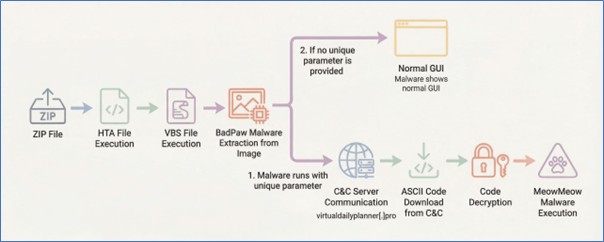
ClearSky Team has identified a targeted Russian cyber campaign against Ukraine utilizing two novel malware strains, BadPaw and MeowMeow.
The attack chain initiates with a phishing email containing a link to a ZIP archive. Once extracted, an initial HTA file displays a lure document written in Ukrainian concerning border crossing appeals to deceive the victim. Simultaneously, the infection triggers the download of BadPaw, a .NET-based loader. Upon establishing command-and-control (C2) communication, the loader deploys MeowMeow, a sophisticated backdoor.
To hinder analysis and reverse engineering, both strains are obfuscated using the .NET Reactor packer, signaling a deliberate effort by the threat actors to maintain persistence and evade detection. To ensure persistence and evade discovery, both malware strains incorporate sophisticated defense mechanisms.
The campaign employs strict Parameter Validation; the malicious components remain dormant, running only “dummy” code with a benign GUI, unless executed with specific, predefined parameters. Furthermore, the MeowMeow backdoor features advanced environmental awareness. It actively scans for virtual machines and common analysis tools such as Wireshark, ProcMon, and Fiddler, immediately terminating its execution if a sandbox or researcher environment is detected.
ClearSky attributes this campaign with high confidence to a Russian state-aligned threat actor and with low confidence to the specific group APT28 (Fancy Bear). This assessment is based on a three-pronged analysis:
Targeting & Victimology: The focus on Ukrainian entities, combined with the
geopolitical nature of the lure, aligns with Russian strategic objectives. Linguistic Artifacts: The presence of Russian-language strings within the code suggests a development environment native to the region.
Tactical Overlap: The multi-stage infection chain, the use of .NET-based loaders, and the specific obfuscation techniques mirror established tradecraft observed in previous Russian cyber operations.
Russia's current isolation from the Olympics may lead to increased cyberthreats targeting the 2026 Winter Games. We discuss the potential threat picture.
Russian state has tolerated parallel probiv market for its convenience but now Ukrainian spies are exploiting it
Russia is scrambling to rein in the country’s sprawling illicit market for leaked personal data, a shadowy ecosystem long exploited by investigative journalists, police and criminal groups.
For more than a decade, Russia’s so-called probiv market – a term derived from the verb “to pierce” or “to punch into a search bar” – has operated as a parallel information economy built on a network of corrupt officials, traffic police, bank employees and low-level security staff willing to sell access to restricted government or corporate databases.
CSRI finds China and Russia may be coordinating ‘grey zone’ tactics against vulnerable western infrastructure
China and Russia are stepping up sabotage operations targeting undersea cables and the UK is unprepared to meet the mounting threat, according to new analysis.
A report by the China Strategic Risks Institute (CSRI) analysed 12 incidents in which national authorities had investigated alleged undersea cable sabotage between January 2021 and April 2025. Of the 10 cases in which a suspect vessel was identified, eight were directly linked to China or Russia through flag-state registration or company ownership.
Arrest warrants issued for ringleaders after investigation by police in Europe and North America
European and North American cybercrime investigators say they have dismantled the heart of a malware operation directed by Russian criminals after a global operation involving British, Canadian, Danish, Dutch, French, German and US police.
International arrest warrants have been issued for 20 suspects, most of them living in Russia, by European investigators while indictments were unsealed in the US against 16 individuals.
A new zero-day vulnerability, CVE-2024-43451, was discovered by ClearSky Cyber Security in June 2024. This vulnerability affects Windows systems and is being actively exploited in attacks against Ukrainian entities.
The vulnerability activates URL files containing malicious code through seemingly innocuous actions:
A single right-click on the file (all Windows versions).
Deleting the file (Windows 10/11).
Dragging the file to another folder (Windows 10/11 and some Windows 7/8/8.1 configurations).
The malicious URL files were disguised as academic certificates and were initially observed being distributed from a compromised official Ukrainian government website.
Exploitation Process:
The attack begins with a phishing email sent from a compromised Ukrainian government server. The email prompts the recipient to renew their academic certificate. The email contains a malicious URL file. When the user interacts with the URL file by right-clicking, deleting, or moving it, the vulnerability is triggered. This action establishes a connection with the attacker’s server and downloads further malicious files, including SparkRAT malware.
SparkRAT is an open-source remote access trojan that allows the attacker to gain control of the victim’s system. The attackers also employed techniques to maintain persistence on the infected system, ensuring their access even after a reboot.
Attribution:
CERT-UA linked this campaign to the threat actor UAC-0194, suspected to be Russian. ClearSky also noted similarities with previous campaigns by other threat actors, suggesting the use of a common toolkit or technique.
Remediation:
Microsoft released a security patch for this vulnerability on November 12, 2024. Users are strongly advised to update their Windows systems to mitigate the risk posed by CVE-2024-43451.
ClearSky Cyber Security and SentinelLabs have discovered a new wave of Russian information warfare campaign named Doppelgänger NG. “Doppelgänger” (meaning spirit double, an exact but usually invisible replica) is a global information warfare campaign publishing false information on hundreds of fake websites and social media channels. Our research revealed that “Doppelgänger NG” is again fully operational in 2024, using new infrastructure. Furthermore, we found a link between the “Doppelgänger NG” Campaign and the Russian cyber espionage group APT28.
Key findings:
New infrastructure used by “Doppelgänger NG”.
We discovered a potential link between APT28 to “Doppelgänger NG” campaign.
The “Doppelgänger NG” campaign has expanded its victims list, including new targets in the US, Germany, Israel, and France.
The “Doppelgänger NG” network contains more than 150 domains, including news feeds relevant to five countries (United State, Israel, France, Germany, Ukraine).

 Login
Login