Half a million Britons signed up to help cure cancer. Their data ended up for sale on Alibaba.
The UK Biobank charity informed the British government of an incident concerning the medical data belonging to 500,000 British citizens being offered for sale on the Chinese e-commerce website Alibaba.
The National Data Guardian, Dr Nicola Byrne, said in a statement:
“People who generously share their health data to benefit others through medical research rightly expect it to be kept safe and for there to be accountability when things go wrong.”
Officials said the researchers downloaded the data under a legitimate contract, but its appearance on Alibaba shows how “approved” access can still turn into public exposure.
UK Biobank holds more than 15 million biological samples and detailed health records from volunteers recruited between 2006 and 2010, and researchers worldwide use it to study cancer, dementia, diabetes, and other chronic diseases.
UK Biobank normally signs contracts with vetted universities and private companies before it lets them access the data, but investigators traced the Alibaba listings to three research institutions. UK Biobank revoked their access and paused new data access while it strengthens security controls.
At least one listing reportedly contained data on all 500,000 volunteers, and Alibaba and Chinese authorities removed the adverts before anyone could confirm a sale.
The dataset comes from UK Biobank’s long‑running research cohort and includes genetic sequences, blood samples, medical imaging, and detailed lifestyle information used for global health research.
UK Biobank emphasizes that the data was “de‑identified,” meaning it didn’t include names, addresses, or NHS numbers. But it still contained granular demographics, such as gender, age, birth month/year, socioeconomic indicators, lifestyle details, and health measures. We have repeatedly seen that such data can be re‑linked to individuals by cross‑referencing with other public or commercial records.
Why China cares
US intelligence, policy reports, and academic work paint a consistent picture: China treats large, diverse human genomic and health datasets as a strategic resource for both economic and security reasons.
The US National Counterintelligence and Security Center (NCSC) explicitly states that the People’s Republic of China views bulk healthcare and genomic data as a “strategic commodity” to drive its biotech, AI, and precision medicine industries, and has invested billions in national genomics and precision‑medicine initiatives.
Large datasets from non‑Chinese populations are particularly valuable for building AI models and improving the global commercial competitiveness of Chinese pharma and biotech.
From an attacker’s or foreign intelligence perspective, UK Biobank is a “crown jewel” asset: It’s curated, high‑quality, population‑scale, and much more useful than random breach dumps. And because genetic data is immutable (unlike a password, it cannot be replaced), any compromise has very long‑term intelligence usefulness.
Last year, the Guardian reported that one in five successful UK Biobank access applications came from Chinese entities, including BGI, China’s flagship genomics company that was later placed on the US Entity List over concerns about its role in surveillance of minority populations.
China is not just stockpiling DNA for curiosity’s sake. It is building a global genomic map that covers adversaries as well as its own citizens.
Your genome data
There have been major concerns about genetic data ending up in the wrong hands, and for good reason. But I’m not going to say that volunteering your medical data for research is bad. Researchers often put the data to good use to help others.
But there are some good questions to ask before doing so.
Who runs the project and where is it based? Prefer non‑profit or academic biobanks with clear public‑interest mandates and strong oversight, rather than opaque commercial data brokers.
How do they store the collected data? Ask specifically about genomic data, raw sequencing files, links to medical records, and whether data is encrypted at rest and in transit.
Who can access the data and under what controls? Look for a formal access committee, strict contracts, and technical controls like secure analysis environments and limited export options, not “download CSV and walk away” models like the one that enabled the UK Biobank incident.
Are foreign entities allowed to access or copy the data? In light of US and UK government warnings about Chinese access to Western genomic data, it’s reasonable to ask whether data can be accessed, processed, or stored in jurisdictions with different security expectations.
How do they handle re‑identification risk? As we’ve discussed, “de‑identified” is not a magic word. Privacy experts and US intelligence have warned that health and genomic data can often be re‑identified when combined with other datasets.
If data containing your DNA is in someone else’s hands, you can’t put it back, but you can demand better governance, push institutions to treat genomic data as national‑security‑grade sensitive.
It also requires more skepticism of highly targeted scams. Attackers can use large combined datasets to craft convincing spear‑phishing or health‑related scams, for example, contacting you about a specific condition you or a family member has. Treat unsolicited health or DNA‑related emails, calls, and apps with extra suspicion.
What do cybercriminals know about you?
Use Malwarebytes’ free Digital Footprint scan to see whether your personal information has been exposed online.
If you use the internet, you’ve likely been affected by cybercrime in some way. Even when an attack is aimed at a company, the fallout usually lands on ordinary people.
The most obvious harm is stolen data. When attackers break into a business, it is usually customer information that ends up in criminal hands, and that can lead to identity theft, tax fraud, credit card fraud, and a long tail of scam attempts that can continue for months or years. For consumers, the breach itself is often just the start of the cleanup.
That work is annoying, time-consuming, and sometimes expensive. People may have to freeze credit, replace cards, change passwords, be on the lookout for suspicious transactions, and dispute charges. The Federal Trade Commission (FTC) specifically advises consumers to use IdentityTheft.gov after a breach and recommends steps like credit freezes and fraud alerts to reduce the chance of further abuse.
When sensitive data is exposed, the harm is not only financial. Medical, insurance, and other deeply personal records can be used to create more convincing phishing or extortion attempts, and the stress of knowing that private information is circulating among criminals can linger long after the technical incident is over. In other words, breach victims are not just cleaning up a data problem, they are dealing with a loss of trust.
Breaches happen every day. Don’t be the last to know.
Cybercrime also hits consumers through service disruption. Ransomware and intrusion campaigns can interrupt payment systems, telecom services, shipping, energy distribution, booking platforms, and other infrastructure people rely on every day. In those cases, the consumer impact is immediate: you may not be able to pay, travel, call, buy, or even work normally. The CSIS timeline and Canada’s cyberthreat assessment both show that these disruptions are increasingly tied to high-value targets and can be part of broader state or criminal campaigns.
Not all these incidents are driven by cybercriminals. Recently, Britain’s cybersecurity chief warned that the UK is handling 4 nationally significant cyberincidents every week, with the majority now traced back to foreign governments rather than cybercriminal groups.
Another cost is easy to overlook: disinformation and confusion. When attackers steal data, disrupt services, or impersonate trusted brands, they can also flood the public with fake support messages, scam calls, refund schemes, and phishing emails pretending to be the breached company. The breach becomes a launchpad for more fraud, and consumers are left trying to separate legitimate notifications from those sent by attackers.
Then there is the security backlash. After a breach, companies usually tighten access rules, add more multi-factor authentication prompts, force reauthentication, shorten sessions, and increase fraud checks. Those measures are often necessary, but they also make ordinary digital life more cumbersome. The consumer ends up paying with time and frustration for security problems they did not create.
That is why company-targeted cybercrime is not really only a business problem. It is a consumer issue, a public-trust issue, and sometimes even a national security issue. A single breach can leak data, trigger fraud, interrupt essential services, amplify scams, and make using the internet more frustrating for everyone else. The real cost is rarely confined to the company that got hit.
Knowing this, it’s worth thinking carefully about which companies to trust with your data and how much you’re willing to share . You cannot stop every attack against every company you deal with, but you can limit the fallout by being more selective. Some considerations:
Do they need all the information they are asking for?
Would it hurt anything if you leave some fields blank or give less specific answers?
Has this company been breached in the past, and how did they handle it?
How long will they store the data you provide?
Can you easily have your data removed at your request?
Your name, address, and phone number are probably already for sale.
Data brokers collect and sell your personal details to anyone willing to pay. Malwarebytes Personal Data Remover finds them and gets your information removed, then keeps watch so it stays that way.
Apple has released a software update that deals with an issue that could allow deleted notifications to be retrieved. Something that, in at least one reported case, was used by law enforcement during forensic analysis.
Apple fixed the issue in iOS and iPadOS versions 18.7.8 and 26.4.2 (check availability for your device at those links). The update deals with a singular security vulnerability, tracked as CVE-2026-28950.
Although the description is brief—“a logging issue was addressed with improved data redaction”—the impact points us in the right direction.
“Notifications marked for deletion could be unexpectedly retained on the device.”
This suggests that Apple’s bug was that iOS kept copies of notification content in an internal database for longer than intended, even after the messages “disappeared” or the app was uninstalled. In a case reported by 404 Media, law enforcement was able to recover those notifications using standard forensic tools once they had access to the unlocked device. The example in that reported case involved Signal.
“The FBI was able to forensically extract copies of incoming Signal messages from a defendant’s iPhone, even after the app was deleted, because copies of the content were saved in the device’s push notification database.”
Before we go into the update process, you may want to know that you can mute or hide notifications in Signal, which also protects them from prying eyes. In Signal, open your Settings and tap on Notifications. You can adjust several settings there. For example, I have mine set so I only see the name of the sender.
Install the update
For iOS and iPadOS users, you can check if you’re using the latest software version by going to Settings > General > Software Update. It’s also worth turning on Automatic Updates if you haven’t already. You can do that on the same screen.
Update settings on iPad
Scammers know more about you than you think.
Malwarebytes Mobile Security protects you from phishing, scam texts, malicious sites, and more. With real-time AI-powered Scam Guard built right in.
On April 21, Alabama Attorney General Steve Marshall announced a $12.2 million settlement with the child-focused online gaming platform. The State of West Virginia also settled for $11 million the same day. Those came a week after Nevada Attorney General Aaron Ford got the company to hand over $12 million.
Their problem with Roblox is clear from the settlement documents: they believe it hasn’t been adequately protecting children from predators on its platform.
What Roblox has to change
As part of Alabama’s settlement, Roblox must now run age checks on everyone via facial age estimation or a government ID starting May 1. That applies to both new and existing accounts. The company must now also monitor account behavior to catch users who lied about their age.
Adults and under-16s won’t be able to talk with each other at all unless they’re on a “trusted friend” list, added via QR code or a phone-contact import, and users that don’t undergo age verification can’t chat to anyone.
Communication involving any minor cannot be encrypted, so law enforcement can read it during investigations. West Virginia’s settlement also insists that Roblox alert minors the first time they enter a private chat, so children understand how to communicate safely.
Roblox already stopped people from chatting without age verification as of January this year, but under new measures it will start restricting access to games for those that don’t undergo the process. Starting in June, the platform will split into three tiers: Roblox Kids for ages 5–8 will forbid any chats at all, and will only allow access to games labeled ‘minimal’ or ‘mild’ on its maturity scale. Those who don’t complete age verification will also have these restrictions. The other two account levels are Roblox Select for 9–15 year-olds, and standard accounts for those 16 and up.
Plenty more lawsuits to come
Three settlements in eight days totaling more than $35 million must hurt, but it’s just the beginning. Texas, Florida, Louisiana, Iowa, Nebraska, Kentucky, and Tennessee are all pursuing similar claims: that Roblox exposed children to risk and then misled parents about its safeguards.
In February, LA County sued Roblox, accusing the platform of choosing profit over safety and leaving kids exposed to grooming and explicit content.
Roblox is also separately dealing with nearly 80 federal lawsuits filed by families in California alone. And Australia’s eSafety Commissioner has also issued legally-enforceable transparency notices to Roblox and other tech companies. These force them to detail what they’re doing to protect children. Those notices are backed by fines of A$825,000 a day (that’s about US$590,783) for non-compliance.
Where the money will go
The $12.2 million from Alabama’s settlement funds school resource officers through the state’s Safe School Initiative. Nevada’s is earmarked for the Boys & Girls Club and “nondigital activities,” plus a law-enforcement liaison and an online-safety awareness campaign. West Virginia will invest $500,000 in safety education workshops for parents and children, create a $1.5 million three-year public safety campaign, and spend $2.4 million on a dedicated internet safety specialist for six years.
Stay alert
There’s a predictable rhythm to how big tech companies face down state attorneys general. First comes pushback, then rhetoric about shared values, and then they start handing over cash.
It is a step forward that Roblox is agreeing to new safeguards, but questions remain.
In its own lawsuit against Roblox launched last month, Nebraska complained that the company’s existing age-check technology was inadequate. From the complaint:
“Rather than meaningfully protecting children, the system has repeatedly misclassified users’ ages, placing adults in child chat groups and minors in adult categories, while age-verified accounts for young children have already been traded on third-party marketplaces, undermining any purported safety benefits.”
What happens when the age-estimation AI guesses wrong on a 14-year-old who looks 17, or when a “trusted friend” QR code gets passed around a group chat somewhere it shouldn’t?
The company’s Persona age-check tool has also turned out to do more than check ages: researchers say they found an exposed frontend showing the system was also running facial recognition against watchlists.
Settlements address past concerns, but they don’t guarantee future safety. Parents must still do the work to ensure that they know what their kids are signing up for and who else they might be playing with.
During our threat hunting, we found a campaign using the same malware loader from our previous research to deliver a different threat: Needle Stealer, data-stealing malware designed to quietly harvest sensitive information from infected devices, including browser data, login sessions, and cryptocurrency wallets.
In this case, attackers used a website promoting a tool called TradingClaw (tradingclaw[.]pro), which claims to be an AI-powered assistant for TradingView.
TradingView is a legitimate platform used by traders to analyze financial markets, but this fake TradingClaw site is not part of TradingView, nor is it related to the legitimate startup tradingclaw.chat. Instead, it’s being used here as a lure to trick people into downloading malware.
What is Needle Stealer?
Needle is a modular infostealer written in Golang. In simple terms, that means it’s built in pieces, so attackers can turn features on or off depending on what they want to steal.
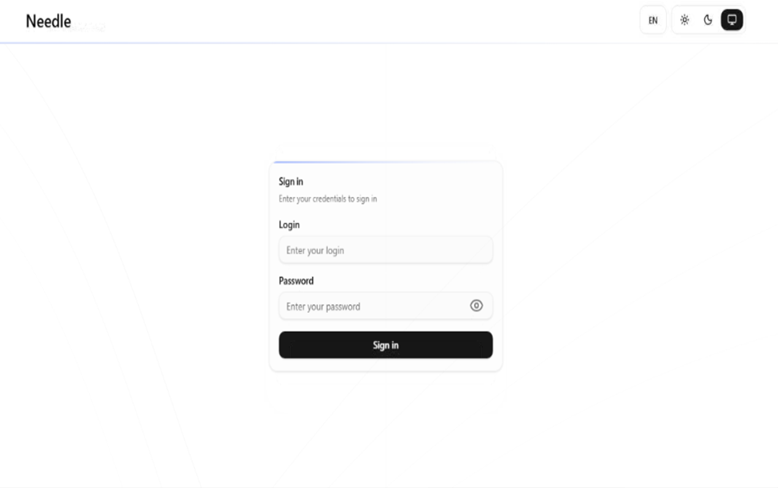
According to its control panel, Needle includes:
Needle Core: The main component, with features like form grabbing (capturing data you enter into websites) and clipboard hijacking
Desktop wallet spoofer: Targets cryptocurrency wallet apps like Ledger, Trezor, and Exodus
Browser wallet spoofer: Targets browser-based wallets like MetaMask and Coinbase, including attempts to extract seed phrases
The panel also shows a “coming soon” feature to generate fake Google or Cloudflare-style pages, suggesting the attackers plan to expand into more advanced phishing techniques.
Needle Stealer panel
In this article, we analyze the distribution of the stealer through a fake website related to an AI service called TradingClaw. We have detected that the same stealer is also distributed by other malware such as Amadey and GCleaner.
Analysis of the TradingClaw campaign
In this campaign, the malware is distributed through a fake website advertising TradingClaw as an AI trading tool.
Malicious TradingClaw website
The site itself behaves selectively. In some cases, visitors are shown the fake TradingClaw page, while in others they are redirected to a different site (studypages[.]com). This kind of filtering is commonly used by attackers to avoid detection and only show the malicious content to intended targets. Search engines, for example, see the Studypages version:
Google results shows the Studypages fake page
If a user proceeds, they are prompted to download a ZIP file. This file contains the first stage of the infection chain.
Like in the previous campaign, the attack relies on a technique called DLL hijacking. In simple terms, this means the malware disguises itself as a legitimate file that a trusted program will load automatically. When the program runs, it unknowingly executes the malicious code instead.
In this case, the DLL loader (named iviewers.dll) is executed first. It then loads a second-stage DLL, which ultimately injects the Needle Stealer into a legitimate Windows process (RegAsm.exe) using a technique known as process hollowing.
Needle Stealer injected in RegAsm.exe process
The stealer is developed in Golang, and most of the functions are implemented in the “ext” package.
Part of the “exe” package
What the malware does
Once installed, the Needle core module can:
Take screenshots of the infected system
Steal browser data, including history, cookies, and saved information
Extract data from apps like Telegram and FTP clients
Collect files such as .txt documents and wallet data
Steal cryptocurrency wallet information
One of the more concerning features is its ability to install malicious browser extensions.
Malicious browser extensions
The stealer also supports the distribution of malicious browser extensions, giving attackers a powerful way to take control of the victim’s browser.
We identified multiple variations of these extensions, each with slightly different file structures and components. Behind the scenes, the malware uses built-in Golang features to unpack a hidden ZIP archive (often named base.zip or meta.zip) that contains the extension files, along with a configuration file (cfg.json).
This configuration file is key. It tells the malware where to send stolen data (the command-and-control server), which malicious extension to install, and which features to enable.
The stealer extension is dropped in a random folder in the path %LOCALAPPDATA%\Packages\Extensions. The folder contains three main files popup.js, content.js, and background.js.
The malicious extension dropped
The extensions analyzed have Google-related names.
The fake malicious extension on Edge Browser
What the malicious extensions can do
The extension gives attackers near full control over the browser, with capabilities that go far beyond typical malware.
It can:
Connect to a remote server using a built-in API key and regularly check in for instructions. It can also switch to backup domains if the main server goes offline.
Generate a unique ID to track the infected user over time.
Collect full browsing history and send it to a remote server (/upload).
Monitor what you’re doing in real time, including which sites you visit, and apply attacker-controlled redirect rules. This allows it to silently send you to different websites or alter what you see on a page, including injecting or hiding content.
Intercept downloads, cancel legitimate files, and replace them with malicious ones from attacker-controlled servers.
Inject scripts directly into web pages, enabling further data theft or manipulation.
Display fake browser notifications with attacker-controlled text and images.
How it communicates with attackers
The stealer and its extension communicate with command-and-control (C2) servers using several API endpoints. These are essentially different “channels” used for specific tasks:
/backup-domains/active—retrieves backup servers to stay connected if the main one is blocked
/upload—sends stolen data back to the attackers
/extension—receives instructions for redirects, downloads, and notifications
/scripts—downloads malicious code to inject into web pages
How to stay safe
Scammers are increasingly using AI-themed tools to make fake websites look legitimate. In this case, a supposed “AI trading assistant” was used to trick people into installing malware.
To reduce your risk:
Download software only from official websites. If a tool claims to work with a well-known platform, check the platform’s official site to confirm it’s real.
Check who created the file before running it. Look at the publisher name and avoid anything that looks unfamiliar or inconsistent.
Review your browser extensions regularly. Remove anything you don’t recognize, especially extensions you didn’t knowingly install.
What to do if you think you’ve been affected
If you think you may have downloaded this infostealer:
Check EDR and firewall logs for communications with the C2s listed in the IOCs part.
From a different, clean device, sign out of every active session on your important accounts: Google, Microsoft 365, any banking portal, GitHub, Discord, Telegram, Steam, and your crypto exchange. Change all passwords and enable 2FA for accounts you have accessed from this machine.
Check the folder %LOCALAPPDATA%\Packages\Extensions and suspicious browser extensions.
If you have cryptocurrency wallets on the machine, move the funds from a clean device immediately. This is what these operators monetize first.
Claims like that are bound to create two sides, so we searched for an official rebuttal by Anthropic. But we couldn’t find one. It would surprise me very much if they’d be unaware of the claim, since there’s been some noise about it.
Users on Mastodon, Reddit, and LinkedIn are confirming the researcher’s findings and discussing the subject, so it’s hard to imagine Anthropic missed it.
Let’s look at the claims first.
While looking into another matter, the researcher discovered a Native Messaging host manifest on his Mac that he did not knowingly install. On Chrome and other Chromium-based browsers, extensions can exchange messages with native applications if they register a native messaging host that can communicate with the extension.
By testing on a clean machine, Hanff discovered that Installing Claude Desktop for macOS drops a Native Messaging host manifest into multiple Chromium profiles (Chrome, Edge, Brave, Arc, Vivaldi, Opera, Chromium), even including for browsers that are not actually installed yet.
The Native Messaging host manifest tells a Chromium‑based browser which local executable to invoke when an extension calls a native host, and those hosts run outside the browser sandbox with current users permissions. Hanff therefore describes this as a “backdoor.” The manifest pre‑authorizes three Chrome extension IDs, so any extension with those IDs can call the helper via connectNative, giving it access to browser automation features.
Another objection is that Claude makes simple deletion futile since the manifest will be recreated the next time the user launches Claude Desktop.
It’s important here to point out that his article is about Claude Desktop, the Electron-based macOS application with bundle identifier com.anthropic.claudefordesktop, distributed as Claude.app. It is not about Claude Code, Anthropic’s command line developer tool. Claude Code is autonomous (“agentic”), allowing you to hand over a task, and it handles the planning and execution until done. So, for Claude Code, it would absolutely make sense to enable communication with browsers, provided they are present on the target system.
So, we have an application that writes into other apps’ profile/support directories (the browsers’ configuration area) and can act as the user, with capabilities like using the logged‑in browser session, DOM inspection, data extraction, form filling, and session recording. This expands the attack surface of every machine this manifest is dropped on, without asking for consent.
Anthropic’s own launch blog on “Claude for Chrome,” which discusses Anthropic’s internal red‑team experiments, explicitly mentions prompt injection as a key risk and reports attack success rates of 23.6% (no mitigations) and 11.2% (with mitigations). Hanff cites this to argue that a pre‑positioned bridge is a non‑trivial risk.
How bad is it?
Native Messaging is a standard Chromium mechanism. Nothing here is an unknown or exotic technique per se. Chrome’s own documentation explains that Native Messaging hosts run at user privilege and are invoked by browser extensions through a manifest file. And as the researcher pointed out, the bridge does nothing. But it could potentially be abused.
I don’t think it’s fair to say that Claude Desktop installs spyware, but it does open a system up by expanding the attack surface.
Anthropic already had a separate, documented Native Messaging manifest for Claude Code that users sometimes manually copied into other Chromium browsers; the new behavior is that Claude Desktop now drops a Claude‑Desktop‑related manifest into multiple browser paths automatically.
It requires a combination of extension and host. Only combined with a matching browser extension, this bridge enables the user-like capabilities we listed earlier.
What we don’t know yet
Anthropic hasn’t published a detailed technical privacy spec for the Claude Desktop–browser bridge, so we don’t know exactly what data flows when the Chrome integration is used, beyond the general capabilities described in their documentation (session access, DOM reading, etc.).
The detailed analysis and most replication so far are on macOS. We’re in the dark about behavior on Windows and Linux, and the same is true across different browser install paths. That behavior has also not been comprehensively documented in public write‑ups.
I did reach out to Anthropic asking for a response. If and when we get an official response from Anthropic, I’ll add it here, so stay tuned.
Conclusion
Anthropic likely wanted “Claude in Chrome”‑style capabilities across Chromium‑based browsers, but that doesn’t excuse doing it silently and preinstalling the manifest into profile directories for multiple browsers, including ones that are not yet installed.
There are better ways to implement changes like these, and users should at least be made aware of them so they can weigh the advantages against the potential risks.
Stop threats before they can do any harm.
Malwarebytes Browser Guard blocks phishing pages and malicious sites automatically. Free, one click to install. Add it to your browser →
Somebody went looking for Google’s new Antigravity coding tool this week, clicked download, ran the installer, and got exactly what they thought they were getting. Antigravity installed cleanly. A shortcut appeared on the desktop. The application opened and worked. Nothing looked or felt wrong.
But behind the scenes, that installer can give your accounts, your data, and even your machine to an attacker, without breaking anything the user can see.
In this article, we’ll break down the technical details of the campaign, how it works under the hood, and what to do if you think you’ve installed it.
The download that actually gave you what you wanted
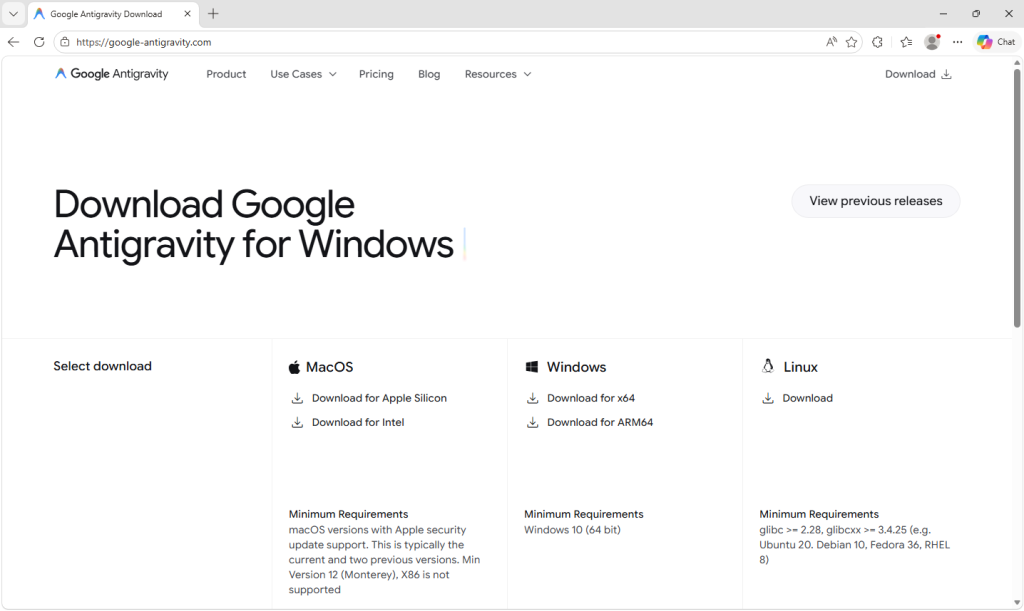
Google Antigravity launched in November 2025 and has been one of the most searched-for developer tools on the web ever since. The real product lives at antigravity.google. Hardly anyone new to the product has the real URL memorized, so when a user reached a hyphenated lookalike (what we call a typosquat domain) at google-antigravity[.]com it was convincing enough at a glance.
So they went on to download the file, called Antigravity_v1.22.2.0.exe.
The installer isn’t simply named to look like the real one from Google. It’s 138 MB: large enough to carry the entire Antigravity application, its Electron runtime, its Vulkan graphics libraries, its updater, all of it. Because that is what is actually inside.
The attacker didn’t build a convincing fake; they took the genuine Antigravity installer, added one additional step to run their PowerShell script during setup, and repackaged the result. The malicious step is one extra line in a sequence that runs dozens of legitimate ones. Here’s what the Setup looked like:
How do we know it’s one line? Because you can see it.
The MSI’s custom-action table (the list of every step the installer takes during install) contains 11 rows that are standard, boilerplate entries the installer tool generates automatically: extract files, check the Windows version, elevate to admin, write a log, clean up afterwards. Each of those has a name that starts with AI_ followed by a description of what it does. And then, sitting at the bottom of the same list, there is one more row, named wefasgsdfg — a keyboard mash the attacker typed in when the installer tool prompted them for a name, and the one that runs their PowerShell script.
Antigravity installs properly into C:\Program Files (x86)\Google LLC\Antigravity\. A Start Menu entry appears, a desktop shortcut is placed, and everything works. The user opens the app, tries it, closes it, and goes on with their day. It all seems fine, because they actually installed the thing they wanted to install. The malicious part is happening quietly, in a folder they’ll never open.
Two small scripts, and a phone call
Somewhere in the middle of the install, the MSI runs a small helper script that drops two PowerShell files into the user’s temporary folder: scr5020.ps1 and pss5032.ps1. The filenames look like specifics but aren’t: the four characters after each prefix are generated fresh every time the installer runs.
What stays constant is the prefix: scr for the user script, pss for the PowerShell wrapper, because those come from the installer tool’s standard naming pattern for custom-action scripts.
Of the two files, the second is an unaltered Advanced Installer utility. It’s genuinely innocent and present in many real products. The first was added by the attacker, and it has one job: open an HTTPS connection to https://opus-dsn[.]com/login/, download whatever code the server sends back, and run it. To blend in, it spoofs a Microsoft referrer header and routes through the system’s default web proxy, so it inherits whatever corporate proxy configuration and authentication IT has set up, without the user noticing. It also saves and restores the parent PowerShell’s TLS setting, leaving that one global unchanged after it exits. That’s the entire script.
Researchers call this pattern a downloader cradle, and its advantage to the attacker is flexibility. The real payload lives on their server, not inside the installer out in the wild, so they can swap it out, change targeting, or turn the operation off without touching the file users are downloading.
In this case, the cradle did exactly what it was built to do and no more: a DNS query for opus-dsn[.]com, a single TCP connection on port 443 to 89[.]124[.]96[.]27 with a quiet HTTPS GET to /login/, and then the PowerShell process exited.
Nothing else happened. No second-stage script was fetched. No file was dropped. No scheduled task was created. No changes were made to Windows Defender. Most automated security tools would shrug and move on.
But the malware hadn’t failed. It had introduced itself to the attacker’s server and asked for code to run next—and whether the answer comes back is a decision the operator gets to make later, on their own time, one victim at a time. You cannot tell, from the victim’s side, what was returned. For analysis, we retrieved what the server sends when the answer is yes.
What arrives when the answer is yes
When the server decides a target is worth attacking, the follow-on script does its work in three movements.
First, it makes Defender look the other way. It calls Add-MpPreference (with the cmdlet name split by a backtick, a small obfuscation to dodge naïve string-matching detections) to exclude %ProgramData% and %APPDATA% from scanning, exclude .exe, .msi, and .dll files from scanning, and exclude PowerShell, regasm.exe, rundll32.exe,msedge.exe, and chrome.exe from scanning. Only after that does it phone home—collecting a profile of the machine (Windows version, Active Directory domain, installed antivirus product), RSA-encrypting it with a public key embedded in the script, and sending it to opus-dsn[.]com inside a utm_content query parameter that looks, in any access log, like ordinary marketing tracking. This is the profile the operator uses to decide whether this particular machine is worth the next stage.
Second, it widens the gap. A second Add-MpPreference block extends the exclusion list to include the .png file extension and the conhost.exe process—the exact two additions the next stage will need. It then writes AmsiEnable=0 into HKLM\Software\Policies\Microsoft\Windows Script\Settings, disabling Windows’ Antimalware Scan Interface—the layer that normally lets Defender read scripts before they execute. After this point, the malicious activity is being conducted in folders, with file types, and through processes that Defender has been instructed to ignore.
Third, it stages persistence. It downloads a file called secret.png from https://captr.b-cdn[.]net/secret.png (a BunnyCDN URL that looks at a glance like any other content-delivery link) and saves it to C:\ProgramData\MicrosoftEdgeUpdate.png, a path chosen to sit beside Microsoft’s real browser-update folders. The file is not an image. It is an AES-256-CBC ciphertext (key and IV both derived via PBKDF2 with 10,000 iterations from a hardcoded passphrase) wrapping a .NET assembly. A scheduled task is then registered with the name MicrosoftEdgeUpdateTaskMachineCore{JBNEN-NQVNZJ-KJAN323-111}, which is all but indistinguishable at a glance from the real Microsoft Edge update task and set to fire at every logon, running unprivileged so it never produces a UAC prompt. The action it executes is conhost.exe --headless launching a hidden PowerShell, which decrypts the fake PNG in memory and reflectively loads the resulting .NET assembly into its own address space. Nothing lands on disk as an ordinary executable. All that persists is the encrypted image, in a folder Defender has been asked to ignore.
And then a second payload, that doesn’t persist at all. The script doesn’t stop there. After registering and starting the scheduled task, it sends a second beacon to confirm install, then runs an entirely separate block that downloads a second encrypted file (GGn.xml) from the same BunnyCDN host, decrypts it with a different, hardcoded AES key, and reflectively loads that assembly into the running PowerShell process too. The first payload survives reboots; this one runs once, in memory, and is gone. Two .NET assemblies, one campaign, on the victim.
What the payload is built to do
The decrypted assembly is a .NET stealer. We can characterize it from its own class and method names, which describe its job in plain English: it scans browsers, messaging apps, gaming platforms, FTP clients, and crypto wallets, collecting data labeled Logins, Cookies, Autofills, and FtpConnections.
In practice, that means every Chromium- and Firefox-based browser on the machine (Chrome, Edge, Brave, and others) gets stripped of saved passwords, autofill data (including saved credit cards), and the cookies that keep users signed in. Discord tokens, Telegram sessions, Steam logins, FTP credentials, and cryptocurrency wallet files are taken as well.
(Most of the exact target paths are obfuscated and only decrypted at runtime, so the specific apps aren’t all visible from a static analysis, but the categories of theft are clear from the class names.)
Session cookies are the part that should alarm most people, because they work faster than anything else. A stolen login cookie lets an attacker walk straight into a Gmail inbox or banking portal without needing a password or triggering two-factor authentication. As far as the website is concerned, the user is already signed in. The gap between infection and account takeover can be minutes.
Beyond data theft, the malware also imports Windows APIs used for clipboard hijacking and keystroke logging, tools that can capture what you type or swap a cryptocurrency wallet address at the exact moment you send funds.
It also includes the building blocks for “hidden desktop” tradecraft: creating a second, invisible Windows desktop that the attacker can capture and potentially control. In its most advanced form, this lets an attacker operate inside that hidden environment—logging in to accounts, approving transactions, or sending messages—while the victim’s real screen shows nothing unusual. For the duration of the infection, the attacker is, effectively, a second presence on the computer.
A new tool, a new lookalike, the same trap
The reason this campaign matters beyond the single installer is that its shape isn’t new. It’s a refined version of a pattern we’ve been watching for months: new AI products launch with huge attention, and within weeks, lookalike domains and trojanized installers appear alongside them. Antigravity is the latest example, but it won’t be the last.
The incentive for attackers is obvious. Every high-profile AI launch creates a surge of users who want to try it immediately, before they’ve had time to memorize the real URL, or might fail to double-check it against trusted sources.
What makes this style of campaign hard to spot is that most victims never know they were targeted. Those who escaped, because the operator chose not to escalate on their machine, have no reason to think anything happened.
The ones who didn’t escape usually find out later: a password reset they didn’t request, a friend asking about a strange message, or a bank balance that suddenly looks wrong. By then, the decision to target them was made days earlier.
What to do if you may have been affected
If you or anyone who shares your computer recently installed something calling itself Google Antigravity from anywhere other than antigravity.google, start by checking the network indicators. Look in firewall logs, EDR alerts, or your router logs for connections to opus-dsn[.]com, captr.b-cdn[.]net, or 89[.]124[.]96[.]27. A single connection from a PowerShell process is enough to confirm the check-in happened.
From a different, clean device, sign out of every active session on your important accounts: Google, Microsoft 365, any banking portal, GitHub, Discord, Telegram, Steam, and your crypto exchange. Most services have a “sign out everywhere” option under security settings.
Change passwords on those accounts, starting with your email. If your email is compromised, an attacker can reset almost anything else.
Rotate any API keys, SSH keys, or cloud credentials that were on the affected computer, not just the passwords attached to them.
If you have cryptocurrency wallets on the machine, move the funds from a clean device immediately. This is what these operators monetize first.
Watch your bank and credit card statements for unfamiliar charges, and consider placing a fraud alert with your bank.
Wipe and reinstall Windows. A machine that has run this class of malware should not be trusted.
If the machine is a work laptop, tell your IT or security team today. The beacon collects the machine’s Active Directory domain, so on a domain-joined corporate laptop, the attacker now knows which company’s network this victim belongs to, which means this isn’t just a personal problem.
Scammers have found a way to abuse legitimate Apple account notification emails to trick targets into calling fake tech support numbers.
According to a report from BleepingComputer, scammers create an Apple account and insert a phishing message into the personal information fields, then modify the account so that Apple sends a genuine security alert about the change to the target.
BleepingComputer was able to replicate the attack.
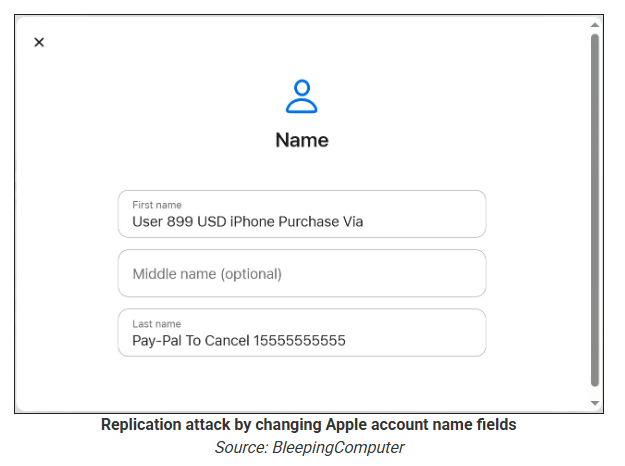
The attacker creates an Apple ID they control, then stuffs the phishing message into the personal information fields (first name, last name, possibly address), splitting it across fields because they will not fit into just one.
To launch the phish, the attacker changes something benign on their specially created Apple account, such as shipping information, which causes Apple’s systems to send a “Your Apple account was updated” security email.
While the original alert is addressed to the attacker’s iCloud email, they are then able to redistribute it to a wider victim list, for example through a mailing list.
In the copy the targets receive, the email headers still show a legitimate Apple sender, and the presence of the attacker’s iCloud address can even make it look like “someone else” has gained access to the account.
Because Apple includes those user-supplied fields in the security email, the phishing text is delivered inside a legitimate message sent from Apple’s own infrastructure.
This method, called call-back phishing, filters out suspicious users, so the scammers can focus on the people who fell for the first part.
The emails come from a legitimate source, sail through every security filter because of that, and look convincing enough to scare the receiver into thinking someone spent $899 from their PayPal account.
But the structure of the email does not make sense.
“Dear User” is immediately followed by the scam message where your name should have been. The header says it’s about account information rather than a purchase. And the iCloud account does not belong to the recipient. So, once you know how it’s done, they’re not impossible to spot. Which is why we wrote this blog.
And when in doubt, you can always ask Malwarebytes Scam Guard.
Scam Guard identified the screenshot as a scam and guides users through the next steps.
Scams like these work, because many users still view phone calls as more trustworthy than email, especially if the email itself passed all the usual technical authenticity checks and they initiated the call themselves.
How to stay safe
Tech support scammers will try to convince callers to install some kind of remote desktop application to steal data from your computer, or ask for financial details so they can steal your money.
To stay safe from these scammers:
Be wary of unexpected alerts about high‑value purchases you do not recognize. They are suspicious even if they come from a real domain.
Never call a number sent to you by unsolicited means or even found in sponsored search results.
Carefully read emails and text messages, even if they come form trustworthy addresses. Does the email make sense from a structural and linguistic point of view?
If someone claiming to be support for a legitimate company asks for remote access or payment details during a call, hang up and contact the company through official channels.
Use Malwarebytes Scam Guard to analyze any kind of message that alarms you or urges you to take immediate action.
Something feel off? Check it before you click.
Malwarebytes Scam Guard helps you analyze suspicious links, texts, and screenshots instantly.
Some of the apps on your phone want your contacts. Most don’t need them all, but have been happily slurping up the lot for years. Google has decided to do something about that with the next version of Android.
Android 17 (currently in preview) is introducing a new Contact Picker that lets users grant apps access to specific contacts rather than the entire list.
Previously, any app that needed a single phone number had to request READ_CONTACTS. That’s a permission that handed over every name, email, and number. It’s the digital equivalent of handing someone your entire Rolodex because they asked for one business card.
An app that can harvest your entire contact list can map your social network, identify your family members, and potentially hand that data to whoever’s buying. So whenever you click “yes” to “show us all your contacts” it isn’t just your privacy you’re playing with.
From Android 17 onward, apps will need to be more specific about what contact data they access. Phone number? Fine. Email address? Sure. Your cousin’s mailing address? Not unless the app has a reason.
Google’s updated Play policy will require apps to use the Contact Picker or the Android Sharesheet as the main way to access contacts. READ_CONTACTS will be reserved for apps that genuinely can’t function without it.
Location sharing gets the privacy treatment
Location permissions are also set to become more granular and privacy-friendly in Android 17.
Previously, apps could ask for your precise or general location, and you could allow it just once, any time you’re using the app, or not at all. The new button adds nuance by letting app developers ask for your location in the moment, tied to a specific action, like finding a local cafe.
There will also be a persistent indicator to let you know when an app is using your location, similar to the alerts for camera or microphone access. And you’ll be able to find out which apps are tracking you as well.
Google blocked 8.3 billion bad ads in 2025
The tighter permissions management in Android 17 is a big deal for privacy advocates, because overly broad access is how data brokers build detailed profiles about you.
Those profiles can then be used for aggressive or invasive advertising, including scams.
Google timed these privacy announcements alongside its latest Ad Safety report, which says it blocked 8.3 billion policy-violating ads and suspended 24.9 million advertiser accounts in the last year.
The 8.3 billion figure is up from 2024, when Google blocked 5.1 billion ads. The increase suggests that the problem is getting worse, or that Google is getting better at catching it. Scam ads are a big part of that. In 2024, Google blocked 415 million scam-related ads. In 2025, that number grew to 602 million.
Lest we forget
We’ll give Google credit for trying to tackle this problem from both ends—limiting data collection and cracking down on the kinds of ads that use that data maliciously. But there’s still a sense that it’s not doing quite enough.
Yes, the Android 17 permission changes are good for users, but granular contact access should have been the default years ago. Apple has been doing it for 18 months in iOS 18, and even that was years too late, in our opinion.
And while Google says it caught over 99% of violations before users ever saw them, 1% of an insanely large number is still insanely large.
The ads that still get through are damaging. In December, we reported on sponsored search results pointing to malicious AI chats that instructed people to install infostealer malware. Why does Google run ads that look like search results? Because its business model is driven by advertising revenue. At least it’s making it easier to hide them now.
A dreadful thing happens far too often whenever an older adult falls for a scam: They get blamed for it. Not the scammers who lied and cheated their victim out of money. Not law enforcement for failing to recover funds. Not even the Big Tech companies that could have the most important role in protecting people online—and which, it turns out, knowingly bring in revenue every year from fraud.
Instead, it is the older adults themselves whose stories are often shirked aside because of a mix of ageism and denial. Allegedly left behind by technology, only an octogenarian would hand their password over in a phishing scheme, or open an email attachment from a stranger, or send money to a fake charity online. Everyone else, everyone else believes, is too savvy for the same.
The data disagrees.
When Malwarebytes studied this last year, it found that, depending on the type of scam—especially for things like “sextortion”—younger individuals were far more likely to report falling victim. Further, digging into data from the US Federal Trade Commission revealed entirely separate patterns. For example, while Americans between the ages of 80 and 89 reported the highest median loss due to fraud in 2024, they also made up the smallest share of their population to report a loss at all. And in 2025, that same group represented the smallest share of reported identity theft, a crime far more likely to be reported by people between 30 and 39.
Questions about who reports what crimes at what rate are valid to explore, but it’s important to see the big picture: Americans lost at least $15.9 billion to fraud last year. Protecting older adults is actually about protecting everyone, and that’s because modern scams don’t arrive only where people over 70 spend time. They arrive where we all are, which is online. They come through endless text messages, they slide into social media DMs, and they prey on things any of us can be—a widow, a divorcee, or simply a lonely person.
According to Marti DeLiema, Assistant Professor at the University of Minnesota’s School of Social Work, scams and fraud are now the most common form of organized crime globally, rivaling weapons trafficking, drug trafficking, human trafficking, and sex trafficking. In 2024 alone, she said, the FTC estimated that older adults in the US had as much as $81.5 billion stolen from them. And the tools meant to fight back—broad consumer awareness campaigns, embedded warning messages at the point of transaction, the training of bank tellers and retail clerks—are nowhere near keeping pace.
So what actually works? And who, if anyone, is doing the work?
Today, on the Lock and Code podcast with host David Ruiz, we speak with DeLiema about who is really susceptible to financial fraud, why victims often describe a scam as a form of betrayal trauma, and why the companies best positioned to stop scam messages from reaching consumers may be the ones least motivated to do so.
“This is not a technical capability problem at all. This is a conflict of incentives.”
Anthropic’s most capable model to date, Claude Mythos Preview (aka Mythos), has been described as a “step change” in AI performance, especially on cybersecurity tasks.
Anthropic tried to keep Mythos a secret until a few weeks ago, when a data leak revealed the existence of what the company said was its most powerful artificial intelligence to date. The models is seen as both a powerful defensive tool, and, potentially, a serious offensive cyberweapon.
For that reason, the company is sharply limiting access and signaling it does not plan to release it broadly to the market right now. Its reported ability to autonomously find and even chain software vulnerabilities at scale sit at the core of both the hype and the danger.
Imagine a tool that can independently find new vulnerabilities in software, systems, and platforms, then turn them into exploits, even if that requires chaining them with other vulnerabilities.
In the wrong hands, that could be a major threat to our cyber safety. So Anthropic has limited access to a small number of organizations worldwide, including major tech firms and a select group of government or security bodies. The NSA is reportedly already using Mythos Preview, apparently to stress‑test and harden sensitive systems, despite the Pentagon labelling Anthropic as a supply chain risk.
Mythos can discover vulnerabilities across large codebases more quickly and reliably than existing tools, and can look for multiple flaws in one system and combine them into multi‑step exploit chains to complete a compromise (for example, going from a simple web bug to a full domain takeover). It would take a bug bounty hunter months to find another vulnerability, let alone one chainable with the one(s) already discovered. Accomplishing that before the first one would be highly unlikely.
In practical terms, that could mean faster attacks, more complex breaches, and less time for companies to fix weaknesses before they’re exploited.
Anthropic itself has highlighted that Mythos can work with minimal supervision for extended periods, meaning it could run systematic attack campaigns at a scale no human team could accomplish.
AI lowers the skill floor for offensive operations. Less-skilled actors could get access to very effective tools, significantly increasing the number of advanced attacks.
Techniques like fuzzing, dictionary attacks, and other brute force methods become much more effective when sped up by automation. AI-assisted iteration can provide an attacker with a lot more tries before an attack gets noticed.
But the most concerning conclusion was that the offensive side is iterating faster in the current phase of AI development, and security teams are generally later adopters of AI tooling than their adversaries.
As we know, AI in cybersecurity works both ways. It helps us defend against new threats, but it can also be used to create them. Which is why, in the wrong hands, Mythos can turn out to be a formidable adversary.
The goal stays the same, but the way to get there is paved by tools like Mythos. From the attacker’s seat, nothing about the destination is new. The novelty is that Mythos now automates the map, the vehicle, and most of the driving.
We don’t just report on threats—we remove them
Cybersecurity risks should never spread beyond a headline. Keep threats off your devices by downloading Malwarebytes today.
When we read about this new malware tactic, or that novel social engineering approach, it’s easy to forget that there are scammers out there making a living from ancient methods.
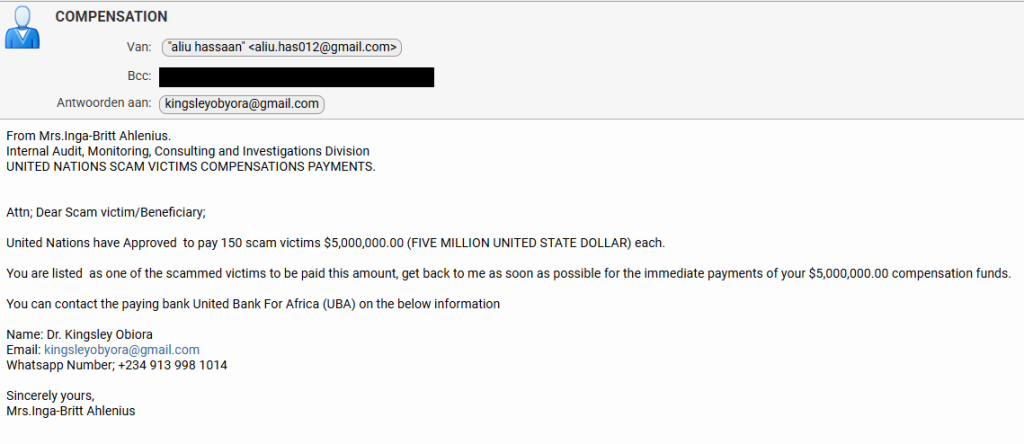
Recently, one of our researchers received this variation on the good old Nigerian advance-fee scam.
From: Mrs.Inga-Britt Ahlenius. Internal Audit, Monitoring, Consulting and Investigations Division UNITED NATIONS SCAM VICTIMS COMPENSATIONS PAYMENTS.
Attn; Dear Scam victim/Beneficiary;
United Nations have Approved to pay 150 scam victims $5,000,000.00 (FIVE MILLION UNITED STATE DOLLAR) each.
You are listed as one of the scammed victims to be paid this amount, get back to me as soon as possible for the immediate payments of your $5,000,000.00 compensation funds.
You can contact the paying bank United Bank For Africa (UBA) on the below information
The scammers got a few details right. Anyone looking up the names in the email will find that they exist and are associated with the mentioned organizations.
Inga–Britt Monica Stigsdotter Ahlenius is a Swedish auditor, public servant and former Under-Secretary-General for the United Nations.
The name “Inga‑Britt Ahlenius” has been reused across many such 419‑style advance‑fee scams, sometimes claiming she is a UN fund monitoring agent or under‑secretary general distributing tens of millions in “compensation” or “unclaimed funds.”
Kingsley Obiora is a Nigerian economist who served as the Deputy Governor of Economic Policy at the Central Bank of Nigeria from 2020 to 2023. Which lends a degree of credibility to the Nigerian country code (+234) in the number they want us to contact by WhatsApp.
So, we decided to put our “friend” Tess to work once again. Loyal readers will remember how Tess almost fell for a task scammer. So maybe she’s eligible for that five-million-dollar compensation.
They came right to the point. We’d have to pay a courier fee to get our $5 million dollar ATM card. And I’m pretty sure that if we agreed to pay that, additional costs would swiftly follow. Once you’ve invested a bit of money, you’re likely to keep going since you don’t want to lose what you’ve already paid.
So, I offered to pick up the ATM card in person. Always wanted to see Nigeria.
For a while I thought they saw through my bluff. Maybe I shouldn’t have disclosed just yet that I work for Malwarebytes. But it quickly became clear they trusted me about as much as I trusted them.
I’ll play along as long as I can, but after giving me the physical address of the UBA bank in Lagos, Nigeria, they started to make it more difficult to pick up the ATM card in person.
A week is not a long time to arrange a trip to Nigeria, so I tried to get an idea of how much the “courier” would set me back before they gave up on me.
I didn’t expect it to be that much, to be honest. Maybe they thought they could raise the price since I contemplated to pick it up in person. Or they just wanted to get rid of me. You’d expect them to charge maybe €75 for the courier and then come up with €200 for stamp duty and €600 for insurance later on.
Consequences are real
It’s easy to laugh at talk of five‑million‑dollar ATM cards, but campaigns like this still make money. Behind every “Dear Scam victim/Beneficiary” is someone who is lonely, in debt, or simply overwhelmed by official‑sounding language. Once they’ve paid the first “courier fee,” the sunk‑cost effect kicks in, and it becomes harder and harder to walk away.
This is especially true for people who have already been victims of scams, who are clearly the target here.
How to stay safe
Tess’ efforts have helped us highlight the red flags in this type of scam:
Receiving news of a huge payout out of the blue should definitely trigger the “too good to be true” alarm bells.
For important communications, free webmail and WhatsApp are rarely the official contact channels.
Scammers apply pressure to act quickly and ask you to pay a fee before you receive anything.
They often use vague job titles and ask you to keep things quiet.
Odd language and capitalization can be a clue, although AI is making these less common.
Any one of these signs is a reason to stop and delete the email. Together, they spell out a classic advance‑fee scam.
For Tess this was a safe experiment: no money lost, just a few evenings spent sparring with a “UN compensation officer” on WhatsApp. For the people these criminals really want to reach, the stakes are much higher.
If you, or someone you care about, ever receives a message promising life‑changing money in exchange for a small courier fee or processing charge, treat it as a warning sign, not a windfall.
Close the tab, delete the message, and, if in doubt, ask a trusted friend or advisor before you act.
The easiest way to recognize a golden‑oldie scam is still the simplest: if it sounds too good to be true, it probably isn’t true.
Something feel off? Check it before you click.
Malwarebytes Scam Guard helps you analyze suspicious links, texts, and screenshots instantly.
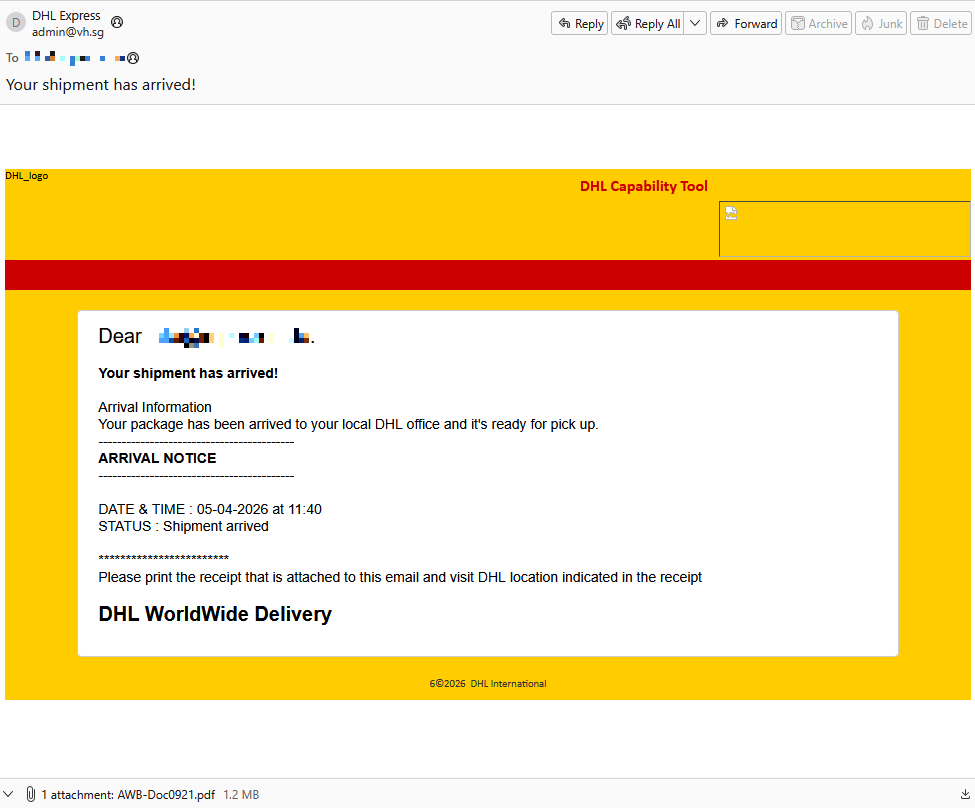
An attachment in an email impersonating DHL about a shipment contains a link to a preconfigured SimpleHelp remote access tool—an ideal starting point for attackers to explore a network, steal data, and drop additional malware.
A German industrial spare parts and equipment supplier received an email pretending to be from DHL, claiming a shipment had arrived.
Given their line of business, I imagine they get this type of email all the time. But a few details stood out:
The sender’s email address did not belong to DHL,
the receiver address was the general info@ for the company,
the images in the email were hosted on ecp.yusercontent.com,
and, most importantly, there was attachment.
While the remote content is hosted on a legitimate Yahoo webpage commonly used to serve images and other content in Yahoo Mail, this is not something DHL typically uses.
The attachment, a PDF file called AWB-Doc0921.pdf is just a blurred image with a Microsoft-branded button that prompts the victim to “Continue” to access a secure file.
In reality, clicking the button downloads a file called AWB-Doc0921.scr from the domain longhungphatlogistics[.]vn, a domain belonging to a Vietnamese logistics company that was likely compromised to host malware.
Malwarebytes blocks longhungphatlogistics[.]vn
A .scr file is a Windows file, which is an executable (.exe) file used to launch screensavers. They are often used to hide malicious code because Windows trusts them, allowing them to bypass some security layers.
In this case, the file is a modified installer of a remote access tool signed by SimpleHelp.
UAC prompt for the signed installer
SimpleHelp is a remote support and remote monitoring and management (RMM) platform. It allows remote desktop control, file transfer, diagnostics, and unattended access. In the wrong hands, that’s effectively a support-style backdoor. Attackers can use it for reconnaissance, credential theft, lateral movement, defense evasion, and staging further malware, including ransomware. We’ve seen SimpleHelp abused in this way before.
This is basically a beaconing model. Once installed, the system connects out to the attacker’s server, which is more likely to be allowed through NAT and firewalls than inbound connections. Because the user initiated the install, the attacker gets immediate visibility of the system and can reconnect later whenever the service is running. In the case of a phish, that means the lure only has to get the victim to execute the file once. After that, the attacker’s console can show the new machine as a manageable asset.
For what seems to be a non-targeted attack, the campaign shows a decent level of sophistication by using legitimate components to trick targets into running the remote access tool.
How to stay safe
The good news: once you know what to look for, these attacks are much easier to spot and block. The bad news: they’re cheap, scalable, and will continue to circulate.
So, the next time a “PDF” prompts you to download a file, pause to think about what might be hiding under the hood.
Beyond avoiding unsolicited attachments, here are a few ways to stay safe:
Only access your accounts through official apps or by typing the official website directly into your browser.
Check file extensions carefully. Even if a file installs a legitimate tool, it may not be safe to run it.
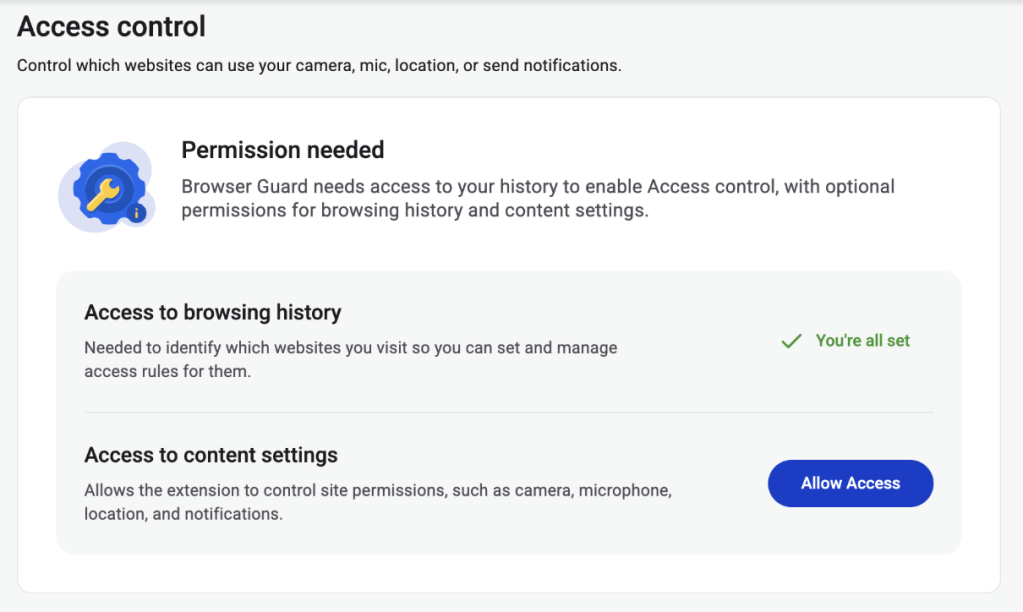
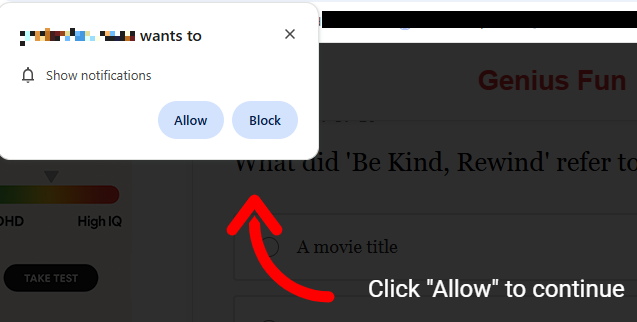
Have you ever been on a website when a pop-up suddenly asked for access to your camera, microphone, location, or notifications? Whether you clicked “allow,” dismissed it, or just wondered why it appeared, those permission requests aren’t always harmless. Some sites can abuse those permissions.
With Access Control, a new feature in Browser Guard, you decide exactly which websites can access your device and stop the rest. That means you choose which websites can:
Use your camera
Use your microphone
Access your location
Send you notifications
Further, not only can you control which websites have access to your devices, but you can also block websites or even require those specific sites to request permission every single time they try to gain access to your machines. You can always allow trusted sites to access your camera or location while blocking everything else.
Access Control is now available for Malwarebytes subscribers using Chrome and Edge browsers on a Windows device.
How to use Access Control
We designed Access Control to be both powerful and simple because we know every moment you spend getting set up is another moment you’re left unprotected.
How to use Access Control:
Install/Open Browser Guard: Click the Malwarebytes icon in your browser’s header
Access Dashboard: Click the Dashboard tab at the bottom of the extension panel.
Navigate to Access Control: On the left sidebar of the web page, select Access Control.
Manage Permissions: See visited websites, click “Allow” to enable or disable Malwarebytes’ ability to see visited sites.
Access Control requires some access to your browsing to protect you online
Access Control lets you choose individual sites to block and allow
This feature is rolling out in beta first, so you might see improvements and updates as we refine it. Currently, the feature works across Chrome and Edge, but will roll out to other browsers soon.
Access Control is another step toward making privacy simple and accessible. Not a subscriber yet? Check out Malwarebytes’ plans today to unlock this feature and more.
We don’t just report on threats—we remove them
Cybersecurity risks should never spread beyond a headline. Keep threats off your devices by downloading Malwarebytes today.
The threat of losing your photos is a powerful lure, so scammers are now using it to steal personal and financial details.
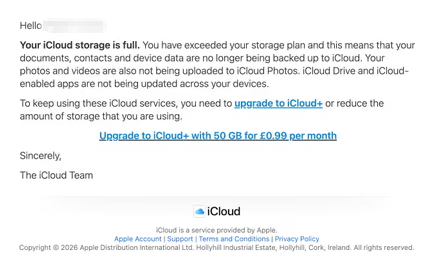
The Guardian warns about an iCloud-themed campaign that start with a few “your iCloud storage is full’ messages, then escalates to threats. If you don’t respond or take action, the emails claim your data will be wiped on a specific date.
US Consumer Affairs has urged users not to click any links and to contact Apple directly if they receive such messages.
The deadline in the emails is never far away, usually just two days. No scammer ever wants you to think things through before you act, so there is always time pressure.
We’ve seen these emails in English and Spanish. Oddly, the monthly rate is set at 99 pence or 99 euro cents respectively.
The 0.99 seems to be the magic number. In reality, scammers don’t care about the payment. What they want is for you fill out the form on their phishing site.
Email saying you must upgrade to iCloud+ or lose your photos
The screenshot above is just one of many examples. There are plenty of variations, but they all follow the same them: make a small payment to stop the files in your iCloud storage from being deleted.
The websites these emails link to also vary, but they all ask for personal and payment details to complete that payment.
How to stay safe
It’s worth remembering that Apple does notify users when their iCloud storage is nearing capacity, but those alerts appear within your device settings or as official system notifications. They don’t come through unsolicited text messages or emails with external links. If you need to check your storage, go directly to Settings on your device and review your iCloud usage.
So, to stay safe:
Always access your account through our official website.
Never share your password with anyone.
Never click on links in unsolicited emails without verifying with a trusted source.
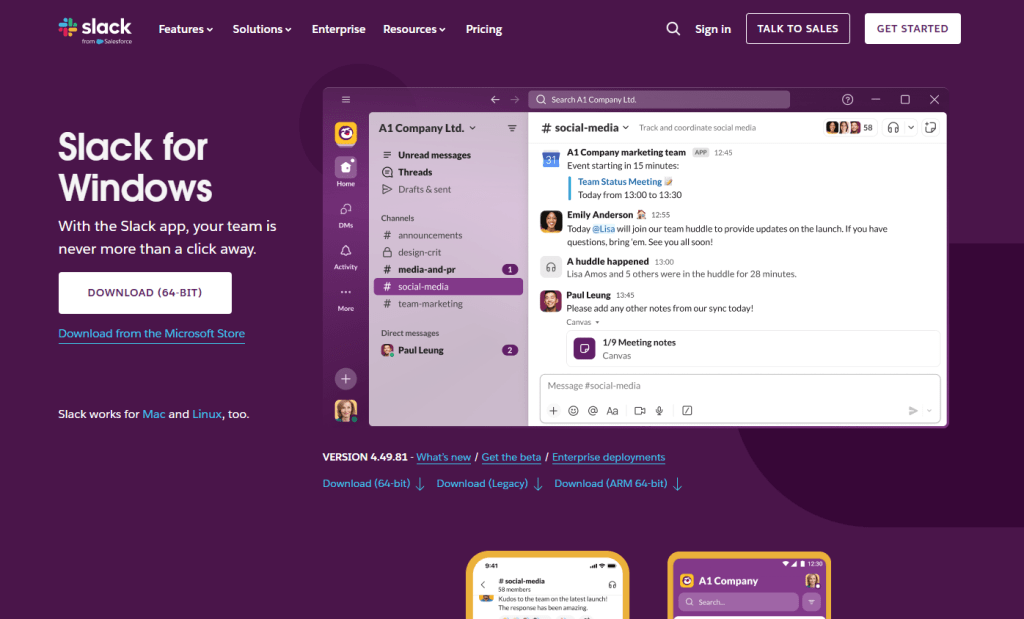
A trojanized Slack download from a typosquatting website is giving attackers something most users wouldn’t even know to look for: a hidden desktop running on their machine.
The installer looks legitimate and even launches a working copy of Slack. But in the background, it can create an invisible session where attackers can browse, access accounts, and interact with your system without anything appearing on your screen. To be clear, this campaign has nothing to do with Slack, the company, and we’ve let them know what we found.
Slack has tens of millions of daily active users across more than 200,000 paying organisations in over 150 countries, including 77 of the Fortune 100. So a trojanized installer is not just a threat to the individual who runs it, but also to corporate networks, SSO-linked accounts, and internal communications.
Everyone trusts the logo
Fake Slack website
Slack is one of those apps that people install without a second thought. It sits alongside Chrome and Zoom in the pantheon of software that workers download on day one of a new job, often from a quick Google search rather than a bookmarked link. That’s what makes it such a compelling lure. The brand is instantly recognisable, the installer is something millions of people have run before, and the whole experience of watching it set up feels completely ordinary.
The attackers behind this campaign registered the domain slacks[.]pro (note the extra “s” and the .pro top-level domain instead of .com). The site’s source code includes a JavaScript click handler that intercepts every click on the page and redirects the browser to a download hosted on a separate domain, debtclean-ua[.]sbs. The only clicks excluded are the cookie consent buttons; everything else triggers the download. This is not a true drive-by that exploits the browser silently, but it’s close enough: it requires just one click from a distracted user.
What arrives on the victim’s desktop is a file named slack-4-49-81.exe, a name that mirrors Slack’s real version numbering closely enough that most people wouldn’t hesitate.
JavaScript click handler
This isn’t an obscure tactic. In August 2024, we documented a near-identical campaign using fraudulent Google Ads to redirect Slack searches to a malicious download page. Those attacks delivered SecTopRAT, a remote access Trojan with stealer capabilities.
These campaigns keep coming back because the formula works: attackers take a trusted brand, register a convincing domain, and count on the fact that most people do not scrutinise a URL when they’re just trying to get set up for work.
A real install and a hidden loader, running side by side
Here’s what makes this particular sample clever: it doesn’t just pretend to install Slack. It actually installs a working copy of the application while simultaneously running a malware loader in the background. The victim sees a legitimate splash screen, watches Slack appear in their taskbar, and has no reason to suspect anything went wrong.
Within seconds of being launched, slack-4-49-81.exe writes two temporary files to the user’s %TEMP% folder. The first, slack.tmp, is the decoy: a self-extracting Squirrel installer package. Squirrel is a legitimate, open-source update framework built into dozens of Electron apps including the real Slack, Discord, and Microsoft Teams. The dropper bundles a genuine copy of Squirrel’s Update.exe alongside a NuGet package called slack-4.49.81-full.nupkg, a branded splash image (background.gif), and a release manifest. When slack.tmp runs, it unpacks all of this into %LOCALAPPDATA%\SquirrelTemp, launches Update.exe with a standard --install flag, and from that point on, the Slack installation proceeds exactly as it would if the user had downloaded the app from slack.com. Slack opens, looks right, and works.
The second file, svc.tmp, arrives seconds later. This is the loader: a separate ~519KB executable embedded inside the 150MB installer and extracted into %TEMP% alongside the decoy. It is unsigned, identifies itself in its portable executable (PE) metadata as Windows Component Update Service by Microsoft Corporation, and has no relationship to the Squirrel framework or the Slack application being installed next to it. Almost immediately it creates a small file called loader_log.txt in the temp folder, confirming the loader stage has started, and attempts to contact a command-and-control (C2) server at 94.232.46.16 on TCP port 8081.
Meanwhile, the Squirrel installation completes and writes a registry Run key to survive reboots: value name com.squirrel.slack.slack under HKCU\SOFTWARE\Microsoft\Windows\CurrentVersion\Run. This is the exact key name and path that a legitimate Slack installation creates. An IT admin scrolling through autostart entries would see what looks like a normal Slack install and keep moving.
Inside the loader: what static analysis reveals
To understand what the loader is engineered to do once it has a C2 channel, we examined the binary directly. Its PE version information claims to be a Windows Component Update Service (internal name WinSvcUpd.exe), published by Microsoft Corporation, version 1.4.2.0. None of this is true. It’s a false flag designed to survive a glance in a process list or task manager.
The binary is a 64-bit Windows executable compiled with MSVC. Its seven PE sections carry randomised names, like .7ssik, .d1npl, .m6zef, rather than the standard .text and .rdata produced by normal compilers, consistent with the use of a custom builder or crypter tool. Its import table is deliberately minimal: 90 functions from KERNEL32.dll and nothing else. There are no static imports for networking, registry access, or process manipulation. Instead, it resolves those APIs at runtime using GetProcAddress and LoadLibraryExW, a standard technique that hides the binary’s real capabilities from import-table analysis.
PE sections
What makes this sample unusual for a loader is how talkative it is internally. The binary is laced with debug strings that lay out its entire architecture, organised into labelled subsystems. These strings were never meant for the victim to see. They are developer diagnostics left in the build, and they tell us exactly what this tool was designed to do.
Strings prefixed [P1] describe the first phase: the loader downloads a payload from its C2 ([P1] Downloading payload...). The download itself uses WinHTTP, resolved at runtime. The debug strings [HTTP] Connect, [HTTP] Send, and [HTTP] Recv trace the full request cycle, while [HTTP] winhttp unavailable reveals the fallback path if the library cannot be loaded. It stores the payload in shared memory via Windows file-mapping APIs ([P1] Payload in shared memory), and launches a second copy of itself as Phase 2 ([P1] Phase-2 launched). Phase 2 reads the payload from shared memory ([P2] Payload copied from shared memory) and decrypts it. The strings [CRYPT] Decrypting... and [CRYPT] MZ OK confirm the payload arrives encrypted and is validated as a Windows executable after decryption. The decrypted DLL is written to disk under a filename matching the pattern wmiprvse_*.tmp, designed to blend in with temporary files created by the legitimate Windows WMI Provider Host.
The loader is then designed to call a specific exported function from the decrypted DLL: HvncRun. The strings [LOAD] Calling HvncRun... and --- HvncClient log --- identify the payload as an HVNC client, a Hidden Virtual Network Computing tool. HVNC differs from a conventional remote access Trojan in a critical way: it creates a completely separate, invisible desktop session on the victim’s machine. The attacker can open browsers, access banking portals, and interact with authenticated sessions without anything appearing on the user’s visible screen. It’s a tool primarily associated with financial fraud operations.
To run the HVNC payload covertly, the loader is equipped to inject the DLL into explorer.exe using a technique known as section-based injection. The strings [INJ] === Section-based injection into explorer.exe === and [INJ] Remote thread created in explorer.exe! describe a sequence in which the loader creates a shared memory section via NtCreateSection, maps it into both its own process and the Windows shell, writes shellcode and the DLL path into the shared region, and starts a remote thread via NtCreateThreadEx. This is a harder-to-detect variant of process injection than the classic WriteProcessMemory approach, because it avoids writing directly into the target’s memory space. If the NT APIs are unavailable, the loader falls back to writing the DLL to disk and loading it directly ([INJ] Required NT APIs not available, falling back to DropAndLoad).
The binary includes active anti-analysis defences. The string [AA] Debugger/sandbox detected indicates it checks for observation and alters its behaviour accordingly. It has the tools to do so: IsDebuggerPresent and GetTickCount appear in the import table, commonly used for debugger detection and timing-based sandbox evasion, though both are also standard CRT imports in any MSVC-compiled binary. The debug string is the stronger signal that these APIs are used intentionally.
What this means for someone who ran it
If you downloaded Slack from anywhere other than slack.com recently, particularly from a domain ending in .pro, or one that auto-downloaded a file when you clicked anywhere on the page, take it seriously.
The loader attempts to reach its C2 server before the Slack window finishes loading. It is engineered to use that connection (if established) to download and decrypt an HVNC payload and inject it into explorer.exe to operate from within the Windows shell itself. The Squirrel installation writes the same Run key that a legitimate Slack install would, so the autostart entry is indistinguishable from a clean machine. Meanwhile, the loader only needs to succeed once: if it downloads the HVNC payload and injects it into explorer.exe during the initial execution, the attacker has a foothold that lasts until the next reboot. Whether additional persistence for the payload exists depends on the C2 operator’s next moves.
How to stay safe
This campaign is a case study in how much engineering effort goes into looking ordinary. One code path installs real software through a legitimate framework. The other runs a multi-phase loader with dynamic API resolution, encrypted payload delivery, process injection into the Windows shell, and anti-analysis defences, all packed into a binary that identifies itself as a Microsoft service. The decoy hides what’s going on, while the loader gives the attacker a foothold.
Bookmark the real download pages for the software you use. If you find yourself Googling “Slack download” and clicking the first result that looks right, you’re exactly the person this campaign was built to catch.
Only download Slack from the official site. Go directly to slack.com or use a trusted bookmark. Avoid clicking ads or unfamiliar links.
Check the URL carefully. Look for subtle changes like extra letters or unusual domains (for example, “.pro” instead of “.com”).
Be wary of sites that trigger downloads on click. If a page starts downloading a file when you click anywhere, close it.
Verify the installer before running it. Right-click the file, check its properties, and look for a valid digital signature.
Use real-time security protection. A security tool can block known malicious domains and catch suspicious behavior during installation.
Watch for unusual behavior after installing software. Unexpected network activity, slowdowns, or unknown processes are worth investigating.
If something feels off, act quickly. Disconnect from the internet, run a full scan, and change your passwords from a clean device, especially for email, banking, and work accounts.
What to do if you may have been affected
Disconnect from the network immediately to sever any active C2 session.
Change all passwords for accounts you have accessed from this machine. Do this from a different, clean device. Prioritise email, banking, and SSO accounts.
If this was a work machine, notify your IT or security team immediately.
Travel companies love telling you your data is safe. Booking.com just reminded everyone why that’s a hard promise to keep.
The Amsterdam-based booking giant began notifying customers on April 13 that “unauthorized third parties” had accessed guest reservation data. The compromised information includes booking details, names, email addresses, physical addresses, and phone numbers—essentially everything you’d need to convincingly impersonate a hotel contacting a guest.
The criminals appear to have accessed the data by compromising Booking.com’s hotel partners. A Microsoft report blames the ClickFix phishing technique, which gets victims (in this case, hotel employees) to install malware disguised a computer “fix.”
Microsoft blames a criminal group called Storm-1865 for the caper, and caught it running exactly this kind of campaign against hotel workers across across North America, Oceania, South and Southeast Asia, and Europe, deploying nasty malware like XWorm and VenomRAT through fake CAPTCHA pages.
Booking.com’s customer notification warned that the exposed data could be used for phishing and said it would never ask for sensitive information or bank transfers.
But scammers have a proven playbook for turning stolen booking data into cash. They can hijack a reservation by impersonating a hotel, message guests demanding a further payment, or credit card details for “payment verification.” The stolen data gives them everything they need to convince the hotel customer they’re legit.
This has happened to Booking.com partners and customers before. In 2018, criminals phished hotel employees and accessed data belonging to Booking.com customers. Scammers also conducted a voice phishing campaign later that year that targeted 40 hotels in the UAE. Over 4,000 customers’ data was stolen, including credit card data from 300 people. Booking.com was late reporting the breach to the Dutch privacy regulator, which imposed a €475,000 fine (around $560,000) in 2021.
The travel industry’s recurring breach problem
Breaches like these are a pattern in the travel business. In January 2026, Eurail disclosed a breach that spilled passport numbers, addresses, and, for some travelers, photocopies of IDs and health data. KLM and Air France had customer data swiped in August 2025. Hertz, Dollar, and Thrifty were all caught in the Cl0p gang’s exploitation of Cleo file transfer software, with criminals pilfering drivers’ licenses and credit card data.
What’s interesting about all of these incidents is that like the Booking.com data heist, all involve compromise of third parties rather than the travel operations themselves. The travel industry sits on enormous troves of passport numbers, payment cards, and itineraries. And its security posture of sprawling supply chains, franchised operations, and third-party platforms makes it a soft target.
What you can do
How many customers were affected? Booking.com isn’t saying. For a platform with over 100 million active mobile app users and 500 million monthly website visits, that silence is concerning.
If you’ve used Booking.com recently, here’s the practical guide to protection. Don’t trust messages asking you to “verify” payment details, even if they arrive through the platform itself.
Here is Booking.com’s own advice about these scams, issued before this latest incident:
“If there is no pre-payment policy or deposit requirement outlined, but you’re asked to pay in advance to secure your booking, it is likely a scam.”
Check your booking confirmation email for what you actually owe and when. If anything seems off, contact the property directly, rather than through a link someone sends you. And watch your bank statements. The scammers who exploit this kind of data don’t always strike immediately.
Something feel off? Check it before you click.
Malwarebytes Scam Guard helps you analyze suspicious links, texts, and screenshots instantly.
Pushpaganda is the name researchers have given to an AI-assisted ad fraud, social engineering, and scareware operation targeting mobile users.
For most people, Pushpaganda starts as something that looks completely normal. For example, a recommended article in your Google Discover feed (the personalized news stream on your phone) or one of the suggested stories you see when you open a new Chrome tab. The operators behind this campaign use AI‑generated articles and images, plus aggressive SEO or paid placement, to get their content surfaced in those feeds so it feels like any other story about money, tech, or politics.
The topics are classic clickbait. You might see a card about a new tax refund, a government payout, a bank deposit, or some too‑good‑to‑be‑true gadget like a $100 phone with a “300MP camera.” On a small mobile screen, with a matching thumbnail and a headline tailored to your region, that’s exactly the kind of thing many people would reasonably tap.
Having tapped, you land on an attacker-controlled site that looks like a regular article page but wastes no time throwing up a browser prompt asking to send you notifications. Many users have been trained by years of pop-ups to click “Allow” just to get it out of the way, especially if the page claims you need to click “Allow” to continue reading or see the offer.
Some pages will falsely claim you have to click Allow to continue reading
Unfortunately, with that single tap, the site now has permission to push messages straight to your Android or desktop, where they sit alongside emails, chats, and real alerts from banks or government apps. Because the notifications don’t behave like traditional pop‑ups and can bypass normal ad‑blocking, many people don’t realize they’ve effectively subscribed to a scam channel.
The result is a stream of alarming notifications that seem to come out of nowhere and have little to do with the original site you visited, so the link between the site and the notifications is usually lost on the victims. Clicking those notifications rarely leads to what they promise. Instead, you’re pushed to another domain in the same network, which may ask for even more permissions, personal data, or try to funnel you into financial scams. Over time, this can expose you to fake investment schemes, fraudulent “tech support” numbers, or pages pushing questionable subscriptions.
All of this costs you time and attention, and sometimes money. At best, you end up with a polluted notification tray full of fake alerts that make it harder to spot something genuinely important. At worst, you follow one scare message too far, hand over personal details or payment information, and become the victim of fraud, identity theft, or aggressive subscription traps. And even if you never click again, your browser is still quietly loading pages and ads you never asked for.
How to stay safe from Pushpaganda
Treat “Allow notifications” prompts as potential traps, especially on sites you’ve never heard of that you reached via a feed or a search result. And even more so if they come with additional, misleading, instructions.
Besides that you should:
Be skeptical of sensational cards in your Discover feed that promise sudden cash, miracle devices, or dramatic political revelations.
Don’t trust buttons that scream “Apply now,” “Claim now,” or “Join WhatsApp” on pages that already feel pushy or poorly written.
Keep your browser, operating system (OS), and other important software up to date.
Use a security app that can block malicious websites and scam pages before they load.
Scammers know more about you than you think.
Malwarebytes Mobile Security protects you from phishing, scam texts, malicious sites, and more. With real-time AI-powered Scam Guard built right in.
A convincing phishing campaign is going after YouTube creators, and if it works, attackers don’t just steal your Google login. They can take over your entire Google account, including Gmail, your files, and payments, then hijack your YouTube channel and use your audience to run scams.
The lure is a fake copyright strike notification that’s so convincing even security-aware users could fall for it. The attack site pulls in your real channel data, such as your profile picture, subscriber count, and latest video, to build a personalized scare page. It funnels you toward a sign-in page designed to steal your Google account.
The operation runs like a franchise: multiple attackers share the same platform, each running their own campaigns against different creators.
Why your YouTube channel is worth more than you think
For full-time creators, a YouTube channel isn’t just a hobby, it’s a business. It generates revenue through ads, sponsorships, and merchandise. And it all sits behind a single Google login that also controls your Gmail, Google Drive, and payment details.
That’s what makes creators such attractive targets. Attackers who hijack a channel often rebrand it within minutes, typically to impersonate a cryptocurrency company, and use the existing audience to livestream scams. The original creator gets locked out and watches their years of work being used to defraud their own subscribers.
A copyright strike is the perfect bait because it exploits the one thing creators fear most: losing their channel overnight.
“Check your Youtube copyright status instantly”
The campaign runs from a site called dmca-notification[.]info. The browser tab reads “Youtube | Copyright strikes,” and the page itself looks clean and professional, complete with YouTube logo, search bar, and helpful instructions.
It invites you to enter your channel name, @handle, or video link to check your copyright status. Nothing about it stands out as immediately suspicious.
Each phishing link includes the target’s channel handle directly in the URL, so the page already knows who you are before you type anything.
The source code contains a tracking flag called suppressTelegramVisit, which changes how visits are logged depending on whether an affiliate parameter is present. This suggests the operators may be coordinating traffic through Telegram, although the kit could be distributed through any platform.
Your own videos, used against you
Once the page has your channel name, it fetches real data from YouTube: your avatar, subscriber count, video count, and your most recent upload (including its title, thumbnail, and view count). That information is then used to build a fake copyright complaint.
You see your own branding alongside a claim that a specific segment of your latest video has been flagged for copyright infringement. The timestamps are dynamically generated for each victim based on the video’s length, making each notice look unique and legitimate. It’s similar to receiving a fake legal notice that includes your real home address. The personal details make it harder to dismiss as spam.
“Respond within three days or face enforcement actions”
The page piles on the pressure. A warning tells you that deleting the video won’t remove the strike. A red notice threatens that if you don’t respond within three days, your channel will face enforcement actions. The proposed fix is simple: sign in with Google to verify you’re the channel owner, and the claim will be resolved within 24 hours.
Every element on the page is designed to push you toward the “Login via Google” button before you stop to think.
The sign-in page that steals your account
When you click that button, the site contacts its own backend server to fetch the address of an external phishing page, one that the attacker can swap out to a new domain at any time.
In observed traffic, the request to /api/get-active-domain returned the domain blacklivesmattergood4[.]com, which was then loaded inside a full-screen overlay on top of the copyright notice page.
What appears next is a classic Browser-in-the-Browser attack: a fake Chrome pop-up rendered entirely in HTML and CSS. It includes a title bar reading “Sign in – Google Accounts – Google Chrome,” a padlock icon, and a URL that looks like accounts.google.com. None of it is real. They’re all just graphics. The only real address bar is the one at the top of your actual browser, which still shows dmca-notification[.]info.
Inside the fake window sits a convincing replica of Google’s sign-in page. It looks exactly like the real thing, but every keystroke goes to the attacker.
Traffic capture also showed attempts to contact additional domains—dopozj[.]net, ec40pr[.]net, and xddlov[.]net—which returned 502 errors at the time of capture. These may be backup infrastructure or credential relay servers that were offline.
The rotating-domain approach is what makes this campaign resilient. The phishing domain is fetched in real time with no caching, allowing attackers to rotate infrastructure quickly. If one domain is taken down, the next victim is sent to a new one.
Once credentials are entered, the overlay closes and the victim is returned to the copyright notice page with no confirmation or error . It gives the attacker time to use the stolen credentials before the victim realizes anything happened.
Big channels get a free pass (on purpose)
One interesting detail: the kit checks whether the target channel has more than three million subscribers. If it does, the entire phishing flow is skipped. Instead of the copyright strike warning and login button, the page shows a benign message: “Your channel is in good standing. No further action is needed.”
This is almost certainly an evasion tactic. Very large channels are more likely to have dedicated security teams, relationships with YouTube’s trust and safety staff, or the visibility to trigger a rapid takedown if they publicly report the scam. By automatically exempting them, the kit reduces the risk of drawing attention from exactly the people most capable of getting the operation shut down.
Not just one scammer
The source code reveals that this isn’t a single phishing page run by one person. The kit includes an affiliate tracking system where each attacker gets their own ID embedded in the phishing links they send out. A central backend tracks which operator delivered which victim and how far each target got through the funnel. Our traffic capture confirms this: the phishing link included a referral ID (ref=huyznaetdmca), the default affiliate tag, which appears to be a transliteration of a Russian phrase. Brand names like Google and YouTube are also written with lookalike Cyrillic characters in the source code to evade automated security scanners.
In short, this is phishing-as-a-service: a shared platform that multiple attackers can use to run campaigns against YouTube creators at scale.
How to protect yourself
This campaign is a reminder that phishing has moved far beyond badly spelled emails from a Nigerian prince. Today’s phishing kits are professionally engineered platforms with rotating infrastructure, real-time personalization, and franchise-style distribution.
For YouTube creators, the key rule is simple: copyright strikes only appear in YouTube Studio.
If you get a warning anywhere else, treat it as suspicious.
Be wary of urgency. Real copyright processes don’t rush you into action
Go directly to studio.youtube.com or through trusted channels to check your status
Never sign in through a link in an email or message
Spot a fake browser window
Try dragging it: A real window moves freely. A fake one is stuck inside the page
Minimize your browser: A real pop-up stays open. A fake one disappears
Check the URL: If you can’t interact with it, it’s just an image
Even if everything looks right, always check the actual address bar before entering your username and password.
If you’ve already entered your details, act quickly:
Change your Google password immediately
Revoke active sessions in your account security settings
Check your YouTube channel for unauthorized changes
Indicators of Compromise (IOCs)
Domain
dmca-notification[.]info (primary phishing site)
blacklivesmattergood4[.]com (credential harvesting domain — active at time of capture)
dopozj[.]net (associated infrastructure — 502 at time of capture)
ec40pr[.]net (associated infrastructure — 502 at time of capture)
xddlov[.]net (associated infrastructure — 502 at time of capture)
Something feel off? Check it before you click.
Malwarebytes Scam Guard helps you analyze suspicious links, texts, and screenshots instantly.

 Login
Login