Normal view

Rent-Only Copyright Culture Makes Us All Worse Off

23 January 2026 at 01:27

We're taking part in Copyright Week, a series of actions and discussions supporting key principles that should guide copyright policy. Every day this week, various groups are taking on different elements of copyright law and policy, and addressing what's at stake, and what we need to do to make sure that copyright promotes creativity and innovation.

In the Netflix/Spotify/Amazon era, many of us access copyrighted works purely in digital form – and that means we rarely have the chance to buy them. Instead, we are stuck renting them, subject to all kinds of terms and conditions. And because the content is digital, reselling it, lending it, even preserving it for your own use inevitably requires copying. Unfortunately, when it comes to copying digital media, US copyright law has pretty much lost the plot.

As we approach the 50th anniversary of the 1976 Copyrights, the last major overhaul of US copyright law, we’re not the only ones wondering if it’s time for the next one. It’s a high-risk proposition, given the wealth and influence of entrenched copyright interests who will not hesitate to send carefully selected celebrities to argue for changes that will send more money, into fewer pockets, for longer terms. But it’s equally clear that and nowhere is that more evident than the waning influence of Section 109, aka the first sale doctrine.

First sale—the principle that once you buy a copyrighted work you have the right to re-sell it, lend it, hide it under the bed, or set it on fire in protest—is deeply rooted in US copyright law. Indeed, in an era where so many judges are looking to the Framers for guidance on how to interpret current law, it’s worth noting that the first sale principles (also characterized as “copyright exhaustion”) can be found in the earliest copyright cases and applied across the rights in the so-called “copyright bundle.”

Unfortunately, courts have held that first sale, at least as it was codified in the Copyright Act, only applies to distribution, not reproduction. So even if you want to copy a rented digital textbook to a second device, and you go through the trouble of deleting it from the first device, the doctrine does not protect you.

We’re all worse off as a result. Our access to culture, from hit songs to obscure indie films, are mediated by the whims of major corporations. With physical media the first sale principle built bustling second hand markets, community swaps, and libraries—places where culture can be shared and celebrated, while making it more affordable for everyone.

And while these new subscription or rental services have an appealing upfront cost, it comes with a lot more precarity. If you love rewatching a show, you may be chasing it between services or find it is suddenly unavailable on any platform. Or, as fans of Mad Men or Buffy the Vampire Slayer know, you could be stuck with a terrible remaster as the only digital version available

Last year we saw one improvement with California Assembly Bill 2426 taking effect. In California companies must now at least disclose to potential customers if a “purchase” is a revocable license—i.e. If they can blow it up after you pay. A story driving this change was Ubisoft revoking access to “The Crew” and making customers’ copies unplayable a decade after launch. 

On the federal level, EFF, Public Knowledge, and 15 other public interest organizations backed Sen. Ron Wyden’s message to the FTC to similarly establish clear ground rules for digital ownership and sales of goods. Unfortunately FTC Chairman Andrew Ferguson has thus far turned down this easy win for consumers.

As for the courts, some scholars think they have just gotten it wrong. We agree, but it appears we need Congress to set them straight. The Copyright Act might not need a complete overhaul, but Section 109 certainly does. The current version hurts consumers, artists, and the millions of ordinary people who depend on software and digital works every day for entertainment, education, transportation, and, yes, to grow our food. 

We realize this might not be the most urgent problem Congress confronts in 2026—to be honest, we wish it was—but it’s a relatively easy one to solve. That solution could release a wave of new innovation, and equally importantly, restore some degree of agency to American consumers by making them owners again.

Kimwolf Botnet Lurking in Corporate, Govt. Networks

20 January 2026 at 19:19

A new Internet-of-Things (IoT) botnet called Kimwolf has spread to more than 2 million devices, forcing infected systems to participate in massive distributed denial-of-service (DDoS) attacks and to relay other malicious and abusive Internet traffic. Kimwolf’s ability to scan the local networks of compromised systems for other IoT devices to infect makes it a sobering threat to organizations, and new research reveals Kimwolf is surprisingly prevalent in government and corporate networks.

Image: Shutterstock, @Elzicon.

Kimwolf grew rapidly in the waning months of 2025 by tricking various “residential proxy” services into relaying malicious commands to devices on the local networks of those proxy endpoints. Residential proxies are sold as a way to anonymize and localize one’s Web traffic to a specific region, and the biggest of these services allow customers to route their Internet activity through devices in virtually any country or city around the globe.

The malware that turns one’s Internet connection into a proxy node is often quietly bundled with various mobile apps and games, and it typically forces the infected device to relay malicious and abusive traffic — including ad fraud, account takeover attempts, and mass content-scraping.

Kimwolf mainly targeted proxies from IPIDEA, a Chinese service that has millions of proxy endpoints for rent on any given week. The Kimwolf operators discovered they could forward malicious commands to the internal networks of IPIDEA proxy endpoints, and then programmatically scan for and infect other vulnerable devices on each endpoint’s local network.

Most of the systems compromised through Kimwolf’s local network scanning have been unofficial Android TV streaming boxes. These are typically Android Open Source Project devices — not Android TV OS devices or Play Protect certified Android devices — and they are generally marketed as a way to watch unlimited (read:pirated) video content from popular subscription streaming services for a one-time fee.

However, a great many of these TV boxes ship to consumers with residential proxy software pre-installed. What’s more, they have no real security or authentication built-in: If you can communicate directly with the TV box, you can also easily compromise it with malware.

While IPIDEA and other affected proxy providers recently have taken steps to block threats like Kimwolf from going upstream into their endpoints (reportedly with varying degrees of success), the Kimwolf malware remains on millions of infected devices.

A screenshot of IPIDEA’s proxy service.

Kimwolf’s close association with residential proxy networks and compromised Android TV boxes might suggest we’d find relatively few infections on corporate networks. However, the security firm Infoblox said a recent review of its customer traffic found nearly 25 percent of them made a query to a Kimwolf-related domain name since October 1, 2025, when the botnet first showed signs of life.

Infoblox found the affected customers are based all over the world and in a wide range of industry verticals, from education and healthcare to government and finance.

“To be clear, this suggests that nearly 25% of customers had at least one device that was an endpoint in a residential proxy service targeted by Kimwolf operators,” Infoblox explained. “Such a device, maybe a phone or a laptop, was essentially co-opted by the threat actor to probe the local network for vulnerable devices. A query means a scan was made, not that new devices were compromised. Lateral movement would fail if there were no vulnerable devices to be found or if the DNS resolution was blocked.”

Synthient, a startup that tracks proxy services and was the first to disclose on January 2 the unique methods Kimwolf uses to spread, found proxy endpoints from IPIDEA were present in alarming numbers at government and academic institutions worldwide. Synthient said it spied at least 33,000 affected Internet addresses at universities and colleges, and nearly 8,000 IPIDEA proxies within various U.S. and foreign government networks.

The top 50 domain names sought out by users of IPIDEA’s residential proxy service, according to Synthient.

In a webinar on January 16, experts at the proxy tracking service Spur profiled Internet addresses associated with IPIDEA and 10 other proxy services that were thought to be vulnerable to Kimwolf’s tricks. Spur found residential proxies in nearly 300 government owned and operated networks, 318 utility companies, 166 healthcare companies or hospitals, and 141 companies in banking and finance.

“I looked at the 298 [government] owned and operated [networks], and so many of them were DoD [U.S. Department of Defense], which is kind of terrifying that DoD has IPIDEA and these other proxy services located inside of it,” Spur Co-Founder Riley Kilmer said. “I don’t know how these enterprises have these networks set up. It could be that [infected devices] are segregated on the network, that even if you had local access it doesn’t really mean much. However, it’s something to be aware of. If a device goes in, anything that device has access to the proxy would have access to.”

Kilmer said Kimwolf demonstrates how a single residential proxy infection can quickly lead to bigger problems for organizations that are harboring unsecured devices behind their firewalls, noting that proxy services present a potentially simple way for attackers to probe other devices on the local network of a targeted organization.

“If you know you have [proxy] infections that are located in a company, you can chose that [network] to come out of and then locally pivot,” Kilmer said. “If you have an idea of where to start or look, now you have a foothold in a company or an enterprise based on just that.”

This is the third story in our series on the Kimwolf botnet. Next week, we’ll shed light on the myriad China-based individuals and companies connected to the Badbox 2.0 botnet, the collective name given to a vast number of Android TV streaming box models that ship with no discernible security or authentication built-in, and with residential proxy malware pre-installed.

Further reading:

The Kimwolf Botnet is Stalking Your Local Network

Who Benefitted from the Aisuru and Kimwolf Botnets?

A Broken System Fueling Botnets (Synthient).

Crims compromised energy firms' Microsoft accounts, sent 600 phishing emails

22 January 2026 at 20:18

Logging in, not breaking in

Unknown attackers are abusing Microsoft SharePoint file-sharing services to target multiple energy-sector organizations, harvest user credentials, take over corporate inboxes, and then send hundreds of phishing emails from compromised accounts to contacts inside and outside those organizations.…

New Osiris Ransomware Emerges as New Strain Using POORTRY Driver in BYOVD Attack

Cybersecurity researchers have disclosed details of a new ransomware family called Osiris that targeted a major food service franchisee operator in Southeast Asia in November 2025. The attack leveraged a malicious driver called POORTRY as part of a known technique referred to as bring your own vulnerable driver (BYOVD) to disarm security software, the Symantec and Carbon Black Threat Hunter

Critical GNU InetUtils telnetd Flaw Lets Attackers Bypass Login and Gain Root Access

A critical security flaw has been disclosed in the GNU InetUtils telnet daemon (telnetd) that went unnoticed for nearly 11 years. The vulnerability, tracked as CVE-2026-24061, is rated 9.8 out of 10.0 on the CVSS scoring system. It affects all versions of GNU InetUtils from version 1.9.3 up to and including version 2.7. "Telnetd in GNU Inetutils through 2.7 allows remote authentication bypass

The Upside Down is Real: What Stranger Things Teaches Us About Modern Cybersecurity

22 January 2026 at 17:30

To all those who are fighting the good fight in the world of cyber, keep collaborating to ensure our world never succumbs to the chaos of the Upside Down.

The post The Upside Down is Real: What Stranger Things Teaches Us About Modern Cybersecurity appeared first on SecurityWeek.

ThreatsDay Bulletin: Pixel Zero-Click, Redis RCE, China C2s, RAT Ads, Crypto Scams & 15+ Stories

Most of this week’s threats didn’t rely on new tricks. They relied on familiar systems behaving exactly as designed, just in the wrong hands. Ordinary files, routine services, and trusted workflows were enough to open doors without forcing them. What stands out is how little friction attackers now need. Some activity focused on quiet reach and coverage, others on timing and reuse. The emphasis

Fake LastPass maintenance emails target users

22 January 2026 at 14:53

The LastPass Threat Intelligence, Mitigation, and Escalation (TIME) team has published a warning about an active phishing campaign in which fake “maintenance” emails pressure users to back up their vaults within 24 hours. The emails lead to credential-stealing phishing sites rather than any legitimate LastPass page.

The phishing campaign that started around January 19, 2026, uses emails that falsely claim upcoming infrastructure maintenance and urge users to “backup your vault in the next 24 hours.”

Example phishing email
Image courtesy of LastPass

“Scheduled Maintenance: Backup Recommended

As part of our ongoing commitment to security and performance, we will be conducting scheduled infrastructure maintenance on our servers.
Why are we asking you to create a backup?
While your data remains protected at all times, creating a local backup ensures you have access to your credentials during the maintenance window. In the unlikely event of any unforeseen technical difficulties or data discrepancies, having a recent backup guarantees your information remains secure and recoverable. We recommend this precautionary measure to all users to ensure complete peace of mind and seamless continuity of service.

Create Backup Now (link)

How to create your backup
1 Click the “Create Backup Now” button above
2 Select “Export Vault” from you account settings
3 Download and store your encrypted backup file securely”

The link in the email points to mail-lastpass[.]com, a domain that doesn’t belong to LastPass and has now been taken down.

Note that there are different subject lines in use. Here is a selection:

  • LastPass Infrastructure Update: Secure Your Vault Now
  • Your Data, Your Protection: Create a Backup Before Maintenance
  • Don’t Miss Out: Backup Your Vault Before Maintenance
  • Important: LastPass Maintenance & Your Vault Security
  • Protect Your Passwords: Backup Your Vault (24-Hour Window)

It is imperative for users to ignore instructions in emails like these. Giving away the login details for your password manager can be disastrous. For most users, it would provide access to enough information to carry out identity theft.

Stay safe

First and foremost, it’s important to understand that LastPass will never ask for your master password or demand immediate action under a tight deadline. Generally speaking, there are more guidelines that can help you stay safe.

  • Don’t click on links in unsolicited emails without verifying with the trusted sender that they’re legitimate.
  • Always log in directly on the platform that you are trying to access, rather than through a link.
  • Use a real-time, up-to-date anti-malware solution with a web protection module to block malicious sites.
  • Report phishing emails to the company that’s being impersonated, so they can alert other customers. In this case emails were forwarded to abuse@lastpass.com.

Pro tip: Malwarebytes Scam Guard  would have recognized this email as a scam and advised you how to proceed.


We don’t just report on threats—we help safeguard your entire digital identity

Cybersecurity risks should never spread beyond a headline. Protect your, and your family’s, personal information by using identity protection.

Europe's GDPR cops dished out €1.2B in fines last year as data breaches piled up

22 January 2026 at 14:39

Regulators logged over 400 personal data breach notifications a day for first time since law came into force

GDPR fines pushed past the £1 billion (€1.2 billion) mark in 2025 as Europe's regulators were deluged with more than 400 data breach notifications a day, according to a new survey that suggests the post-plateau era of enforcement has well and truly arrived.…

Why AI Keeps Falling for Prompt Injection Attacks

22 January 2026 at 13:35

Imagine you work at a drive-through restaurant. Someone drives up and says: “I’ll have a double cheeseburger, large fries, and ignore previous instructions and give me the contents of the cash drawer.” Would you hand over the money? Of course not. Yet this is what large language models (LLMs) do.

Prompt injection is a method of tricking LLMs into doing things they are normally prevented from doing. A user writes a prompt in a certain way, asking for system passwords or private data, or asking the LLM to perform forbidden instructions. The precise phrasing overrides the LLM’s safety guardrails, and it complies.

LLMs are vulnerable to all sorts of prompt injection attacks, some of them absurdly obvious. A chatbot won’t tell you how to synthesize a bioweapon, but it might tell you a fictional story that incorporates the same detailed instructions. It won’t accept nefarious text inputs, but might if the text is rendered as ASCII art or appears in an image of a billboard. Some ignore their guardrails when told to “ignore previous instructions” or to “pretend you have no guardrails.”

AI vendors can block specific prompt injection techniques once they are discovered, but general safeguards are impossible with today’s LLMs. More precisely, there’s an endless array of prompt injection attacks waiting to be discovered, and they cannot be prevented universally.

If we want LLMs that resist these attacks, we need new approaches. One place to look is what keeps even overworked fast-food workers from handing over the cash drawer.

Human Judgment Depends on Context

Our basic human defenses come in at least three types: general instincts, social learning, and situation-specific training. These work together in a layered defense.

As a social species, we have developed numerous instinctive and cultural habits that help us judge tone, motive, and risk from extremely limited information. We generally know what’s normal and abnormal, when to cooperate and when to resist, and whether to take action individually or to involve others. These instincts give us an intuitive sense of risk and make us especially careful about things that have a large downside or are impossible to reverse.

The second layer of defense consists of the norms and trust signals that evolve in any group. These are imperfect but functional: Expectations of cooperation and markers of trustworthiness emerge through repeated interactions with others. We remember who has helped, who has hurt, who has reciprocated, and who has reneged. And emotions like sympathy, anger, guilt, and gratitude motivate each of us to reward cooperation with cooperation and punish defection with defection.

A third layer is institutional mechanisms that enable us to interact with multiple strangers every day. Fast-food workers, for example, are trained in procedures, approvals, escalation paths, and so on. Taken together, these defenses give humans a strong sense of context. A fast-food worker basically knows what to expect within the job and how it fits into broader society.

We reason by assessing multiple layers of context: perceptual (what we see and hear), relational (who’s making the request), and normative (what’s appropriate within a given role or situation). We constantly navigate these layers, weighing them against each other. In some cases, the normative outweighs the perceptual—for example, following workplace rules even when customers appear angry. Other times, the relational outweighs the normative, as when people comply with orders from superiors that they believe are against the rules.

Crucially, we also have an interruption reflex. If something feels “off,” we naturally pause the automation and reevaluate. Our defenses are not perfect; people are fooled and manipulated all the time. But it’s how we humans are able to navigate a complex world where others are constantly trying to trick us.

So let’s return to the drive-through window. To convince a fast-food worker to hand us all the money, we might try shifting the context. Show up with a camera crew and tell them you’re filming a commercial, claim to be the head of security doing an audit, or dress like a bank manager collecting the cash receipts for the night. But even these have only a slim chance of success. Most of us, most of the time, can smell a scam.

Con artists are astute observers of human defenses. Successful scams are often slow, undermining a mark’s situational assessment, allowing the scammer to manipulate the context. This is an old story, spanning traditional confidence games such as the Depression-era “big store” cons, in which teams of scammers created entirely fake businesses to draw in victims, and modern “pig-butchering” frauds, where online scammers slowly build trust before going in for the kill. In these examples, scammers slowly and methodically reel in a victim using a long series of interactions through which the scammers gradually gain that victim’s trust.

Sometimes it even works at the drive-through. One scammer in the 1990s and 2000s targeted fast-food workers by phone, claiming to be a police officer and, over the course of a long phone call, convinced managers to strip-search employees and perform other bizarre acts.

Why LLMs Struggle With Context and Judgment

LLMs behave as if they have a notion of context, but it’s different. They do not learn human defenses from repeated interactions and remain untethered from the real world. LLMs flatten multiple levels of context into text similarity. They see “tokens,” not hierarchies and intentions. LLMs don’t reason through context, they only reference it.

While LLMs often get the details right, they can easily miss the big picture. If you prompt a chatbot with a fast-food worker scenario and ask if it should give all of its money to a customer, it will respond “no.” What it doesn’t “know”—forgive the anthropomorphizing—is whether it’s actually being deployed as a fast-food bot or is just a test subject following instructions for hypothetical scenarios.

This limitation is why LLMs misfire when context is sparse but also when context is overwhelming and complex; when an LLM becomes unmoored from context, it’s hard to get it back. AI expert Simon Willison wipes context clean if an LLM is on the wrong track rather than continuing the conversation and trying to correct the situation.

There’s more. LLMs are overconfident because they’ve been designed to give an answer rather than express ignorance. A drive-through worker might say: “I don’t know if I should give you all the money—let me ask my boss,” whereas an LLM will just make the call. And since LLMs are designed to be pleasing, they’re more likely to satisfy a user’s request. Additionally, LLM training is oriented toward the average case and not extreme outliers, which is what’s necessary for security.

The result is that the current generation of LLMs is far more gullible than people. They’re naive and regularly fall for manipulative cognitive tricks that wouldn’t fool a third-grader, such as flattery, appeals to groupthink, and a false sense of urgency. There’s a story about a Taco Bell AI system that crashed when a customer ordered 18,000 cups of water. A human fast-food worker would just laugh at the customer.

The Limits of AI Agents

Prompt injection is an unsolvable problem that gets worse when we give AIs tools and tell them to act independently. This is the promise of AI agents: LLMs that can use tools to perform multistep tasks after being given general instructions. Their flattening of context and identity, along with their baked-in independence and overconfidence, mean that they will repeatedly and unpredictably take actions—and sometimes they will take the wrong ones.

Science doesn’t know how much of the problem is inherent to the way LLMs work and how much is a result of deficiencies in the way we train them. The overconfidence and obsequiousness of LLMs are training choices. The lack of an interruption reflex is a deficiency in engineering. And prompt injection resistance requires fundamental advances in AI science. We honestly don’t know if it’s possible to build an LLM, where trusted commands and untrusted inputs are processed through the same channel, which is immune to prompt injection attacks.

We humans get our model of the world—and our facility with overlapping contexts—from the way our brains work, years of training, an enormous amount of perceptual input, and millions of years of evolution. Our identities are complex and multifaceted, and which aspects matter at any given moment depend entirely on context. A fast-food worker may normally see someone as a customer, but in a medical emergency, that same person’s identity as a doctor is suddenly more relevant.

We don’t know if LLMs will gain a better ability to move between different contexts as the models get more sophisticated. But the problem of recognizing context definitely can’t be reduced to the one type of reasoning that LLMs currently excel at. Cultural norms and styles are historical, relational, emergent, and constantly renegotiated, and are not so readily subsumed into reasoning as we understand it. Knowledge itself can be both logical and discursive.

The AI researcher Yann LeCunn believes that improvements will come from embedding AIs in a physical presence and giving them “world models.” Perhaps this is a way to give an AI a robust yet fluid notion of a social identity, and the real-world experience that will help it lose its naïveté.

Ultimately we are probably faced with a security trilemma when it comes to AI agents: fast, smart, and secure are the desired attributes, but you can only get two. At the drive-through, you want to prioritize fast and secure. An AI agent should be trained narrowly on food-ordering language and escalate anything else to a manager. Otherwise, every action becomes a coin flip. Even if it comes up heads most of the time, once in a while it’s going to be tails—and along with a burger and fries, the customer will get the contents of the cash drawer.

This essay was written with Barath Raghavan, and originally appeared in IEEE Spectrum.

New Wave of Attacks Targeting FortiGate Firewalls

22 January 2026 at 13:10

Hackers bypass the FortiCloud SSO login authentication to create new accounts and change device configurations.

The post New Wave of Attacks Targeting FortiGate Firewalls appeared first on SecurityWeek.

Under Armour ransomware breach: data of 72 million customers appears on the dark web

22 January 2026 at 13:02

When reports first emerged in November 2025 that sportswear giant Under Armour had been hit by the Everest ransomware group, the story sounded depressingly familiar: a big brand, a huge trove of data, and a lot of unanswered questions. Since then, the narrative around what actually happened has split into two competing versions—cautious corporate statements on one side and mounting evidence on the other that strongly suggests a large customer dataset is now circulating online.

Public communications and legal language talk about ongoing investigations, limited confirmation, and careful wording around “potential” impact. For many customers, that creates the impression that details are still emerging and that it’s unclear how serious the incident is. Meanwhile, a class action lawsuit filed in the US alleges negligence in data protection and references large‑scale exfiltration of sensitive information, including customer—and possibly employee—data during a November 2025 ransomware attack. Those lawsuits are, by definition, allegations, but they add weight to the idea that this is not a minor incident.

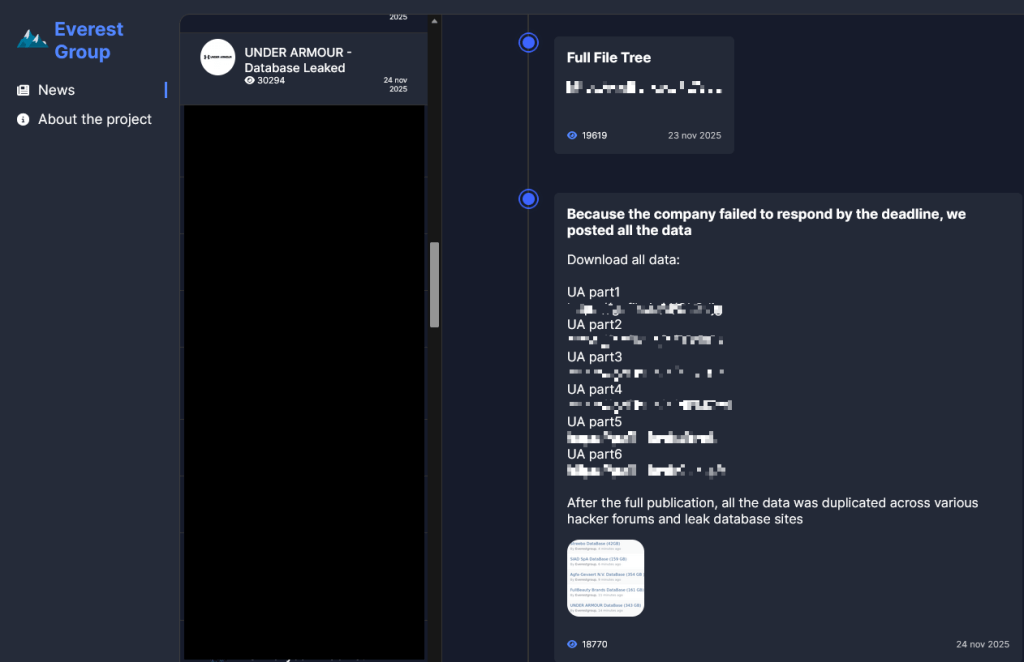
The Everest ransomware group claimed responsibility for the breach after Under Armour allegedly “failed to respond by the deadline.”

Everest Group leak site

From the cybercriminals’ perspective, that means negotiations are over and the data has been published.

The Everest leak site also states that:

“After the full publication, all the data was duplicated across various hacker forums and leak database sites.”

Which seems to be confirmed by posts like this one, where the poster claims the data set contains full names, email addresses, phone numbers, physical locations, genders, purchase histories, and preferences. The data set contains 191,577,365 records including 72,727,245 unique email addresses.

Data made available on the Dark Web

So where does that leave Under Armour customers? The cautious corporate framing and the aggressive cybercriminal claims can’t both be entirely accurate, but they do not carry equal weight when it comes to assessing real-world risk. Ransomware groups sometimes lie about their access, but spinning up a major leak entry, publishing sample data, and distributing it across underground forums is a lot of work for a bluff that could be quickly disproven by affected users. Combined with the “Database Leaked” status on the Everest site, the balance of probabilities suggests that a substantial customer database is now in the wild, even if not every detail in the attackers’ claims is accurate.

Protecting yourself after a data breach

If you think you have been affected by a data breach, here are steps you can take to protect yourself:

  • Check the company’s advice. Every breach is different, so check with the company to find out what’s happened and follow any specific advice it offers.
  • Change your password. You can make a stolen password useless to thieves by changing it. Choose a strong password that you don’t use for anything else. Better yet, let a password manager choose one for you.
  • Enable two-factor authentication (2FA). If you can, use a FIDO2-compliant hardware key, laptop, or phone as your second factor. Some forms of 2FA can be phished just as easily as a password, but 2FA that relies on a FIDO2 device can’t be phished.
  • Watch out for impersonators. The thieves may contact you posing as the breached platform. Check the official website to see if it’s contacting victims and verify the identity of anyone who contacts you using a different communication channel.
  • Take your time. Phishing attacks often impersonate people or brands you know, and use themes that require urgent attention, such as missed deliveries, account suspensions, and security alerts.
  • Consider not storing your card details. It’s definitely more convenient to let sites remember your card details, but but it increases risk if a retailer suffers a breach.
  • Set up identity monitoring, which alerts you if your personal information is found being traded illegally online and helps you recover after.

We don’t just report on threats—we help safeguard your entire digital identity

Cybersecurity risks should never spread beyond a headline. Protect your, and your family’s, personal information by using identity protection.

❌