This scenario simultaneously tests identity confirmation tooling (SSPR, MFA, Conditional Access), how users act under pressure, and the organization's ability to detect and follow-up on social engineering attacks.
Loyal readers and other privacy-conscious people will be familiar with the expression, “If it’s too good to be true, it’s probably false.”
Getting paid handsomely to scroll social media definitely falls into that category. It sounds like an easy side hustle, which usually means there’s a catch.
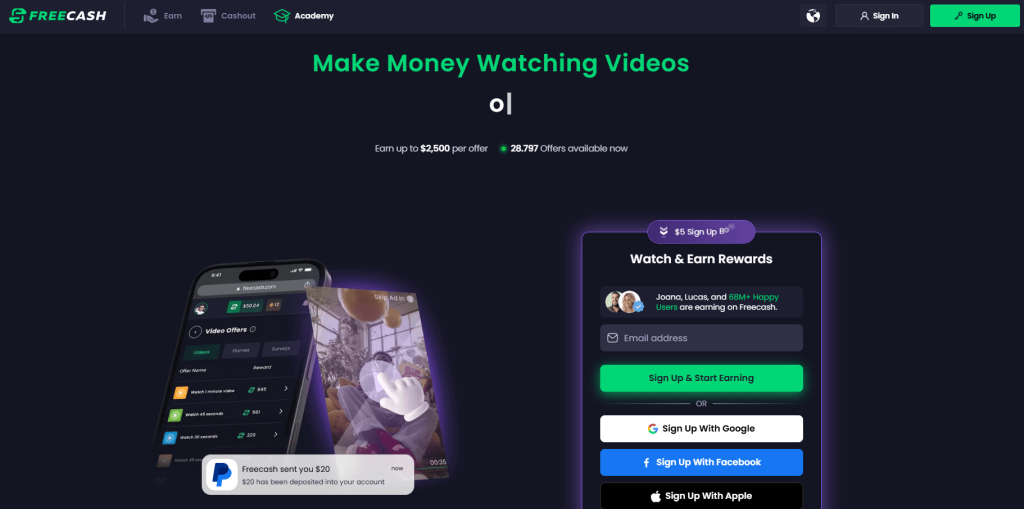
In January 2026, an app called Freecash shot up to the number two spot on Apple’s free iOS chart in the US, helped along by TikTok ads that look a lot like job offers from TikTok itself. The ads promised up to $35 an hour to watch your “For You” page. According to reporting, the ads didn’t promote Freecash by name. Instead, they showed a young woman expressing excitement about seemingly being “hired by TikTok” to watch videos for money.
The landing pages featured TikTok and Freecash logos and invited users to “get paid to scroll” and “cash out instantly,” implying a simple exchange of time for money.
Those claims were misleading enough that TikTok said the ads violated its rules on financial misrepresentation and removed some of them.
Once you install the app, the promised TikTok paycheck vanishes. Instead, Freecash routes you to a rotating roster of mobile games—titles like Monopoly Go and Disney Solitaire—and offers cash rewards for completing time‑limited in‑game challenges. Payouts range from a single cent for a few minutes of daily play up to triple‑digit amounts if you reach high levels within a fixed period.
The whole setup is designed not to reward scrolling, as it claims, but to funnel you into games where you are likely to spend money or watch paid advertisements.
Freecash’s parent company, Berlin‑based Almedia, openly describes the platform as a way to match mobile game developers with users who are likely to install and spend. The company’s CEO has spoken publicly about using past spending data to steer users toward the genres where they’re most “valuable” to advertisers.
Our concern, beyond the bait-and-switch, is the privacy issue. Freecash’s privacy policy allows the automatic collection of highly sensitive information, including data about race, religion, sex life, sexual orientation, health, and biometrics. Each additional mobile game you install to chase rewards adds its own privacy policy, tracking, and telemetry. Together, they greatly increase how much behavioral data these companies can harvest about a user.
Experts warn that data brokers already trade lists of people likely to be more susceptible to scams or compulsive online behavior—profiles that apps like this can help refine.
We’ve previously reported on data brokers that used games and apps to build massive databases, only to later suffer breaches exposing all that data.
When asked about the ads, Freecash said the most misleading TikTok promotions were created by third-party affiliates, not by the company itself. Which is quite possible because Freecash does offer an affiliate payout program to people who promote the app online. But they made promises to review and tighten partner monitoring.
For experienced users, the pattern should feel familiar: eye‑catching promises of easy money, a bait‑and‑switch into something that takes more time and effort than advertised, and a business model that suddenly makes sense when you realize your attention and data are the real products.
If you’re curious how intrusive schemes like this can be, consider using a separate email address created specifically for testing. Avoid sharing real personal details. Many users report that once they sign up, marketing emails quickly pile up.
Some of these schemes also appeal to people who are younger or under financial pressure, offering tiny payouts while generating far more value for advertisers and app developers.
So, what can you do?
Gather information about the company you’re about to give your data. Talk to friends and relatives about your plans. Shared common sense often helps make the right decisions.
Create a separate account if you want to test a service. Use a dedicated email address and avoid sharing real personal details.
Limit information you provide online to what makes sense for the purpose. Does a game publisher need your Social Security Number? I don’t think so.
Be cautious about app installs that are framed as required to make the money initially promised, and review permissions carefully.
For the latest discoveries in cyber research for the week of 26th January, please download our Threat Intelligence Bulletin.
TOP ATTACKS AND BREACHES
RansomHub ransomware group has claimed responsibility for a cyber-attack on Luxshare, an electronics manufacturer of Apple, Nvidia, LG, Tesla, and others. The threat actors claimed access to 3D CAD models, circuit board designs, and engineering documentation. The company has not yet confirmed the breach.
Check Point Threat Emulation and Harmony Endpoint provide protection against this threat (Ransomware.Wins.Ransomhub.ta.*; Ransomware.Win.RansomHub)
Dark-web threat actor has leaked an alleged database belonging to Under Armour, a US sportswear company, affecting 72 million customer records following a November ransomware attack. The claimed exposed data includes names, email addresses, genders, dates of birth, and addresses.
Raaga, an India-based music streaming platform, has experienced a data breach involving 10.2 million user records, reportedly exfiltrated in December and later advertised on criminal forums. Exposed details include names, emails, demographics, locations, and passwords stored with unsalted MD5 hashes, raising credential stuffing and phishing risks.
Germany’s Dresden State Art Collections (SKD), one of Europe’s oldest museum networks, has confirmed a cyberattack that resulted in widespread disruption to its digital infrastructure and communications. The incident disabled online ticket sales, visitor services, and the museum shop, forced on-site payments to cash-only, and limited digital and phone services, with no indication of data theft or exposure reported.
AI THREATS
Researchers discovered an indirect prompt-injection flaw in Gemini’s Google Calendar assistant that bypassed Calendar privacy controls via a malicious invite description. Gemini used Calendar.create to place summaries of the victim’s meetings into a new event readable by the attacker.
Researchers uncovered a web attack technique where hidden prompts in benign pages call LLM API to generate polymorphic malicious JavaScript at runtime. This enables phishing and credential theft while evading signature-based detection and network filtering by leveraging AI service domains.
Advanced language models such as GPT-5.2 and Opus 4.5 were observed generating working exploits for a previously unknown zero-day vulnerability in QuickJS, a JavaScript interpreter, including in hardened environments where automated systems can produce functional attack code with little to no human intervention. Across six different configurations, the systems produced over 40 distinct exploits.
VULNERABILITIES AND PATCHES
Three high severity vulnerabilities (CVE-2025-68143, CVE-2025-68144, CVE-2025-68145) were disclosed in mcp-server-git, Anthropic’s Git MCP server, enabling path traversal and argument injection exploitable via prompt injection to read or delete files and achieve remote code execution. Fixes available in versions 2025.9.25 and 2025.12.18.
Zoom has fixed CVE-2026-22844, a critical command injection flaw in Zoom Node Multimedia Routers, used in Meeting Connector and Meetings Hybrid deployments. It enables participant remote code execution in versions before 5.2.1716.0, with no confirmed in-the-wild exploitation.
Fortinet has confirmed active exploitation of a FortiCloud SSO auth bypass on fully patched FortiGate firewalls, tied to CVE-2025-59718 and CVE-2025-59719. Attackers are logging in via crafted SAML messages, creating persistent accounts, enabling VPN access, and extracting firewall configurations.
THREAT INTELLIGENCE REPORTS
Check Point Research revealed that VoidLink, a recently exposed cloud-native Linux malware framework, is authored almost entirely by AI, likely under the direction of a single individual. The malware was produced predominantly through AI-driven development, reaching the first functional implant in under a week. From a methodology perspective, the actor used the model beyond coding, adopting an approach called Spec Driven Development (SDD).
Check Point Research identified an ongoing phishing campaign associated with KONNI, a North Korean–linked threat actor active since at least 2014. The campaign targets software developers and engineering teams across the Asia-Pacific region, including Japan, Australia, and India, using blockchain-themed lures to prompt interaction and deliver malicious content. In observed activity, the threat actor deploys AI-generated PowerShell backdoors that establish persistence, steal credentials, and enable infiltration of development environments
Check Point researchers describe a Microsoft Teams phishing campaign abusing guest invitations and finance-themed team names to mimic billing notices. More than 12K emails were observed hitting 6,135 users via invite emails with obfuscated text. The campaign targeted US-based organizations across manufacturing, technology, and education.
Researchers revealed a new ransomware family, Osiris, that blends legitimate Windows tools with custom malware to infiltrate networks and deploy encryption. The operators use a custom malicious driver, Poortry, masquerading as Malwarebytes to disable security software, and exfiltrated data with Rclone to Wasabi buckets before encryption.
Researchers identified a North Korean spear-phishing campaign targeting South Korea that abuses Microsoft Visual Studio Code tunnels for remote access. JSE files masquerading as Hangul documents start the infection chain and grant attackers terminal and file access using living-off-the-land techniques.
When you hear the words “data privacy,” what do you first imagine?
Maybe you picture going into your social media apps and setting your profile and posts to private. Maybe you think about who you’ve shared your location with and deciding to revoke some of that access. Maybe you want to remove a few apps entirely from your smartphone, maybe you want to try a new web browser, maybe you even want to skirt the type of street-level surveillance provided by Automated License Plate Readers, which can record your car model, license plate number, and location on your morning drive to work.
Importantly, all of these are “data privacy,” but trying to do all of these things at once can feel impossible.
That’s why, this year, for Data Privacy Day, Malwarebytes Senior Privacy Advocate (and Lock and Code host) David Ruiz is sharing the one thing he’s doing different to improve his privacy. And it’s this: He’s given up Google Search entirely.
When Ruiz requested the data that Google had collected about him last year, he saw that the company had recorded an eye-popping 8,000 searches in just the span of 18 months. And those 8,000 searches didn’t just reveal what he was thinking about on any given day—including his shopping interests, his home improvement projects, and his late-night medical concerns—they also revealed when he clicked on an ad based on the words he searched. This type of data, which connects a person’s searches to the likelihood of engaging with an online ad, is vital to Google’s revenue, and it’s the type of thing that Ruiz is seeking to finally cut off.
So, for 2026, he has switched to a new search engine, Brave Search.
Today, on the Lock and Code podcast, Ruiz explains why he made the switch, what he values about Brave Search, and why he also refused to switch to any of the major AI platforms in replacing Google.
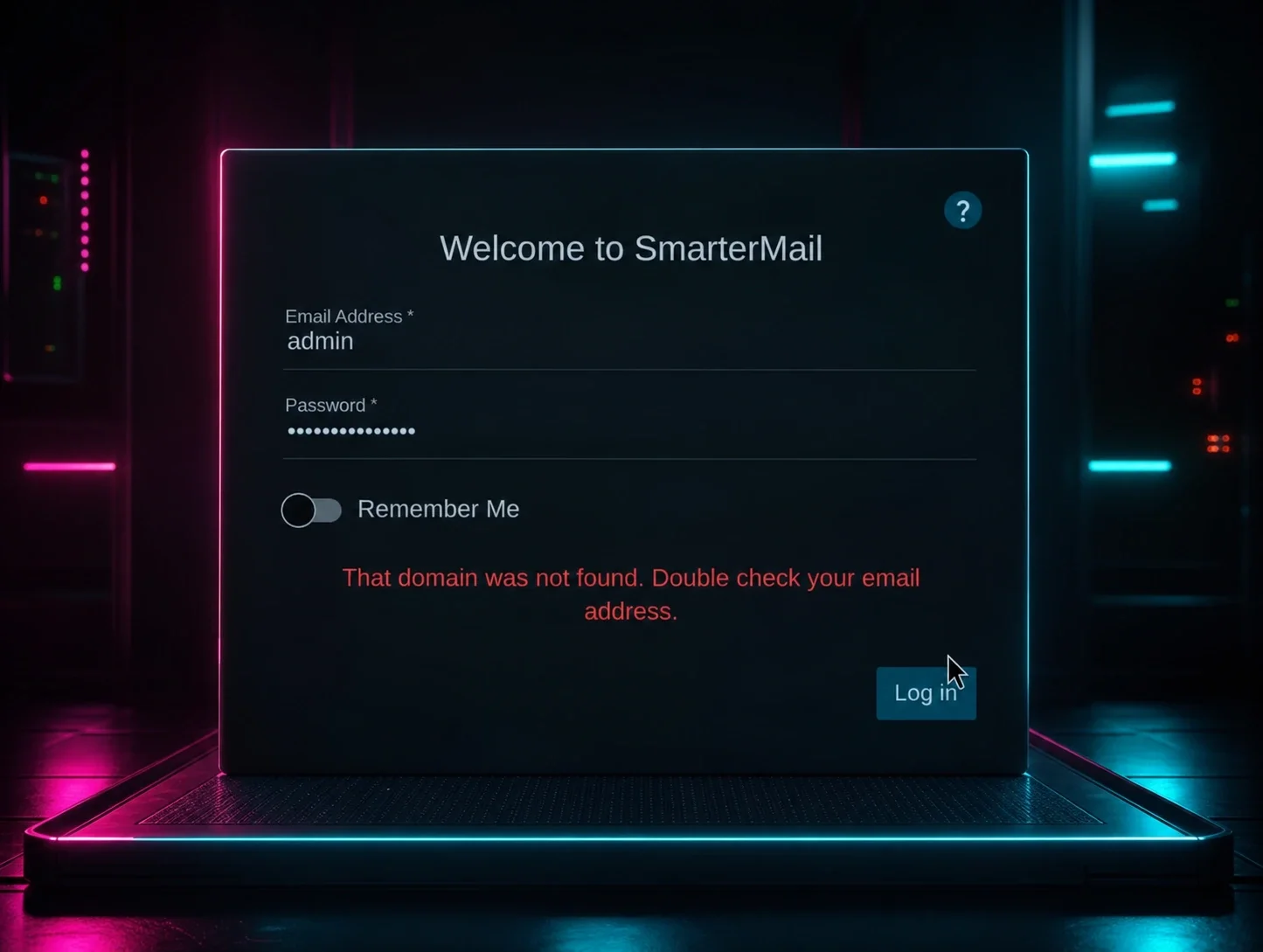
SmarterMail versions prior to Build 9511 are vulnerable to privileged account takeover and remote code execution. Learn more about the latest Huntress DE&TH Team’s findings.

 Login