
Normal view

Automating post-quantum cryptography readiness using AWS Config

14 May 2026 at 18:18

Migrating your TLS endpoints to Post-quantum cryptography (PQC) starts with understanding your current TLS endpoint inventory and posture. This post introduces the PQC Readiness Scanner — an automated tool that inventories your Application Load Balancer (ALB), Network Load Balancer (NLB), and Amazon API Gateway endpoints and continuously monitors their TLS configurations for PQC readiness. The scanner classifies each endpoint into a three-tier framework that helps prioritize and plan PQC migration.

As quantum computing advances, you need to migrate to quantum-resistant cryptography to protect your data long-term. The PQC Readiness Scanner helps you identify which endpoints to migrate first and tracks your progress across accounts. For web traffic, PQC key exchange algorithms are negotiated only within TLS 1.3. This means quantum-resistant connections require endpoints that support TLS 1.3 and PQC key exchange.

Under the AWS Shared Responsibility Model, AWS secures the infrastructure and enables PQC support across its services. Customers are responsible for configuring their resources to use PQC-capable TLS policies. For AWS-terminated TLS connections—such as those on Application Load Balancer (ALB), Network Load Balancer (NLB), Amazon API Gateway, and Amazon CloudFront—customers choose the security policy (an AWS-managed configuration defining supported TLS protocol versions and cipher suites for a listener) that determines TLS version and cipher suite, key exchange, and authentication algorithm support.

The automated PQC Readiness Scanner for AWS-terminated TLS endpoints is built using AWS Config conformance packs. A conformance pack is a collection of AWS Config rules and remediation actions that can be deployed as a single entity in an account and a Region or across an organization in AWS Organizations.

Solution overview

The PQC Readiness Scanner deploys AWS Config rules using a conformance pack to evaluate the security policy on each endpoint. Based on the evaluation, each resource is classified into a three-tier readiness framework that prioritizes migration actions needed to achieve PQ-ready TLS.

The PQC Readiness Scanner performs two checks per resource:

  1. Does the endpoint use a PQ-ready security policy?
  2. Does the endpoint support legacy TLS 1.0 or 1.1?

Each check returns COMPLIANT or NON_COMPLIANT status with specific policy recommendations.

PQC requires endpoints to support TLS 1.3 and use PQC key exchange algorithms. The three-tier framework helps you interpret findings and prioritize fixes. The goal is to have TLS 1.3 with PQC key exchange enabled on the endpoints. However, achieving this requires maintaining backward compatibility with clients.

Tier

Readiness level

TLS protocols

PQC status

Migration priority

Tier 1

PQ-ready (strongest posture)

TLS 1.3 only with PQC key exchange

PQ-ready

None

Tier 2

PQ-ready (backward compatible)

TLS 1.2 and 1.3 with PQC key exchange

PQ-ready

Low

Tier 3

Not PQ-ready

No PQC key exchange

Not PQ-ready

High

How to prioritize your migrations

  • Tier 1 represents the strongest security using only TLS 1.3 with PQC key exchange. These resources already meet the target state.
  • Tier 2 represents a backward-compatible PQ-ready configuration. Endpoints support both TLS 1.2 and TLS 1.3, with PQC key exchange negotiated on TLS 1.3 connections. Migration priority is low because these resources already provide quantum-resistant protection for clients that support TLS 1.3, while maintaining TLS 1.2 compatibility for legacy clients. Migrate to Tier 1 when client-side analysis confirms that the connecting clients support TLS 1.3 with PQC key exchange.
  • Tier 3 covers resources that aren’t PQ-ready. This includes endpoints without TLS 1.3 support, endpoints with TLS 1.3 but without PQC key exchange policies. These resources require immediate attention.

Assessment scope

The scanner evaluates the following AWS edge services that terminate TLS connections on behalf of your applications.

  • Edge services:
    • Application Load Balancer (ALB), Network Load Balancer (NLB) listeners with HTTPS, TLS, and TCP SSL protocols are evaluated.
    • API Gateway REST APIs are evaluated for AWS Regional and private endpoints along with API Gateway HTTP APIs (v2) and WebSocket APIs (v2).
  • Excluded edge services:
    • CloudFront distributions are excluded from the PQC readiness scope because TLS 1.3 with hybrid post-quantum key exchange is automatically enabled across existing CloudFront TLS security policies for viewer-to-edge connections. No customer action is required for inbound (viewer-facing) PQC on CloudFront.
  • Recommended approach for Classic load balancer:
    • For Classic Load Balancers, AWS recommends migrating to ALB or NLB. Classic Load Balancers don’t support TLS 1.3 or PQC key exchange and can’t be made PQ-ready.

How the solution works

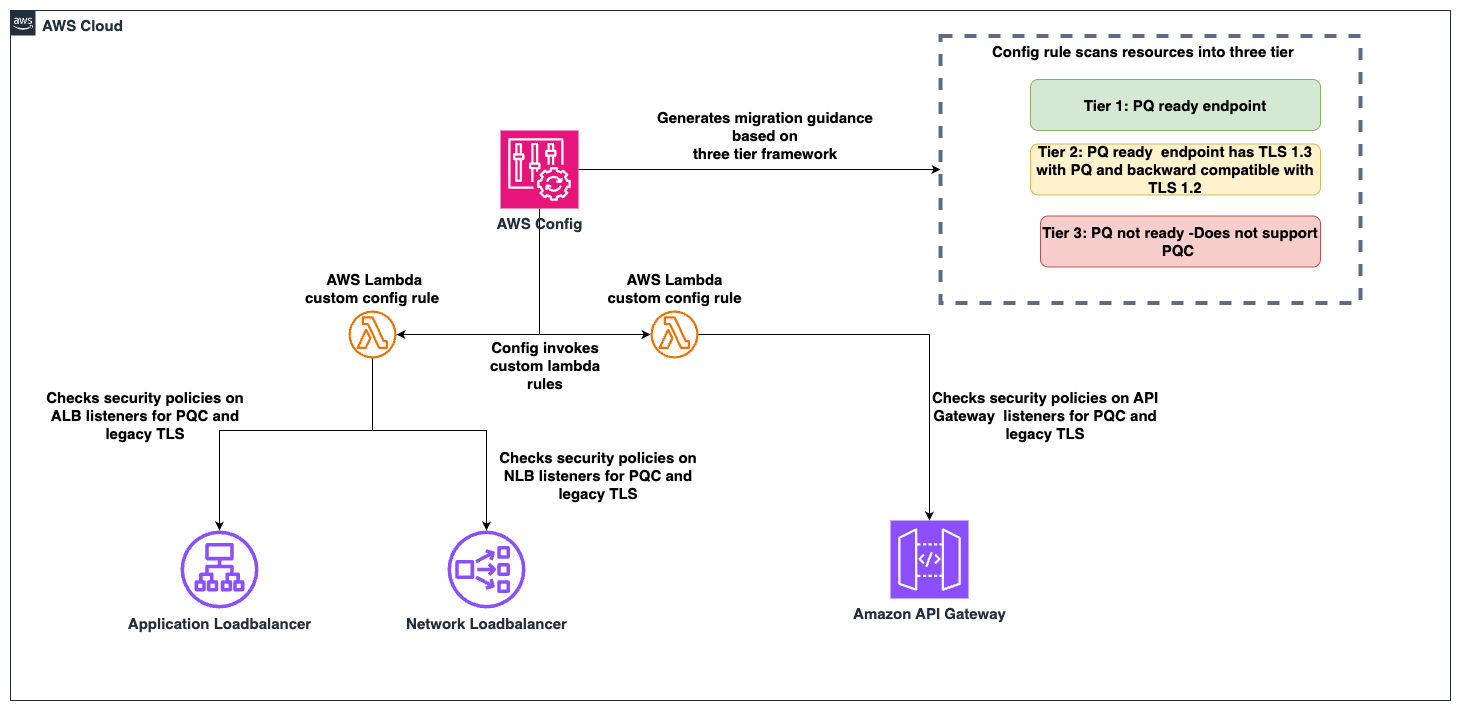
AWS Config enables continuous monitoring and evaluation. Conformance packs enable organization-wide deployment. AWS Lambda is a serverless compute service that runs code to perform security policy evaluation based on the AWS Config rules. AWS Serverless Application Model (AWS SAM) is an open source framework used for deploying the AWS Lambda functions.

Figure 1: PQC readiness solution architecture

Figure 1: PQC readiness solution architecture

The PQC Readiness Scanner conformance pack implements four custom AWS Config rules powered by two Lambda functions:

Rule

What it checks

Non-compliant result

ELB PQ-ready

Load balancer listeners use security policies that support TLS 1.3 with PQC key exchange algorithms

Policy doesn’t include PQC support, the resource is marked with a recommended upgrade policy

ELB legacy TLS

Load balancer listeners allow TLS 1.0 or 1.1 connections

Legacy protocols are configured, the resource is flagged.

API Gateway PQ-ready

API Gateway endpoints use security policies that support TLS 1.3 with PQC key exchange algorithms

Policy doesn’t include PQC support, the resource is marked with a recommended upgrade policy

API Gateway legacy TLS

API Gateway endpoints allow TLS 1.0 or 1.1

Legacy protocols are configured, the resource is flagged.

Prerequisites

Before deploying the solution, you need:

  • AWS Command Line Interface (AWS CLI) configured with appropriate permissions
    aws configure
    aws sts get-caller-identity  # Verify

  • Python 3.12 installed. The Lambda runtime requires this version.
    python3 --version  # Should show 3.12.x

  • AWS SAM CLI installed (Installation Guide)
    pip install aws-sam-cli
    
    # Verify
    sam --version

  • AWS Config enabled in your target AWS Region.
    • Configure it to record (This step is not needed if your accounts are recording all resources by default)
      • AWS::ElasticLoadBalancingV2::LoadBalancer
      • AWS::ApiGateway::RestApi
      • AWS::ApiGatewayV2::Api resource types.
    • Enable via AWS Config Console → Recorder → Recording Strategy → Select specific resource types (Follow the steps in manual setup for AWS Config recording strategy for specific resource types)

Steps to deploy the PQC Readiness Scanner

Deploy the PQC Readiness Config Scanner in three phases. Complete deployment commands and configuration details are available in the GitHub repository. The Lambda functions must be deployed first because the conformance pack references their ARNs as parameters. See the GitHub repository for details.

Deploy to single account:

  1. Clone and Build:
    git clone https://github.com/aws-samples/sample-PQC-Readiness-using-AWS-Config.git
    
    cd sample-PQC-Readiness-using-AWS-Config/installation
    
    sam build

  2. Deploy to One or More Regions:
    # Make script executable (first time only)
    chmod +x deploy-per-regions.sh
    
    # Deploy to a single region
    ./deploy-per-regions.sh us-east-1
    
    # Deploy to multiple regions
    ./deploy-per-regions.sh us-east-1 us-west-2 eu-west-1

    Type y and continue if you have enabled AWS Config recording for these resources or its by default recording all resources.

    Figure 2: Type y and continue if you have enabled AWS Config recording for these resources or its by default recording all resources.

  3. The script automatically:
    • Deploys Lambda functions via SAM
    • Deploys conformance pack (creates Config rules)
    • Verifies deployment success
    • Provides clear status messages

The deployment creates two Lambda functions that perform PQ-ready and legacy TLS checks. It provisions IAM roles with least-privilege permissions for ELB, ALB, NLB, and API Gateway describe operations. Lambda permissions allow AWS Config to invoke the functions.

Example screen-print of how a successful deployment looks like.

Figure 3: Example screen-print of what a successful deployment looks like.

Multi-account deployment (Organizations):

For organization-wide deployment across multiple AWS accounts, use CloudFormation StackSets to deploy Lambda functions to each account.

Important Constraint: AWS Config CUSTOM_LAMBDA rules require the Lambda function to exist in the same account as the Config rule. You cannot use a centralized Lambda in one account to evaluate resources in other accounts.

Prerequisite: Shared S3 Bucket

Before packaging, create an S3 bucket accessible by each target account in your organization. This bucket will host the Lambda deployment artifacts that CloudFormation StackSets pulls into each member account.

# Create the shared S3 bucket (run from management/central account)
aws s3 mb s3://<your-org-shared-bucket> --region us-east-1

Grant read access to the target accounts using one of the following options:

aws s3api put-bucket-policy \
  --bucket <your-org-shared-bucket> \
  --policy '{
    "Statement": [
      {
        "Sid": "BucketOwnerFullAccess",
        "Effect": "Allow",
        "Principal": {
          "AWS": "arn:aws:iam::<bucket-owner-account-id>:root"
        },
        "Action": "s3:*",
        "Resource": [
          "arn:aws:s3:::<your-org-shared-bucket>",
          "arn:aws:s3:::<your-org-shared-bucket>/*"
        ]
      },
      {
        "Sid": "CrossAccountReadAccess",
        "Effect": "Allow",
        "Principal": {
          "AWS": [
            "arn:aws:iam::<account-id-1>:root",
            "arn:aws:iam::<account-id-2>:root"
          ]
        },
        "Action": ["s3:GetObject", "s3:ListBucket"],
        "Resource": [
          "arn:aws:s3:::<your-org-shared-bucket>",
          "arn:aws:s3:::<your-org-shared-bucket>/*"
        ]
      }
    ]
  }'

Replace <account IDs> with the AWS account IDs where StackSets will deploy the Lambda functions.

Note: The bucket must be in the same region as the StackSet deployment regions. For multi-region deployments, create one bucket per region and run sam package separately for each.

Step 1: Build and Upload Lambda Packages to S3

Run the packaging script from the installation/ directory:

cd installation

# Make script executable (first time only)
chmod +x deploy-stacksets.sh

# Build, package, upload to S3, and generate resolved template
./deploy-stacksets.sh <your-org-shared-bucket>

This script automatically:

  • Builds Lambda functions using SAM
  • Creates ZIP packages
  • Uploads ZIPs to the shared S3 bucket
  • Generates packaged-template.yaml with S3 values baked in (no parameters needed at deploy time)
Sample script output of successful upload of the lambda packages to S3 bucket

Figure 4: Sample script output of successful upload of the lambda packages to S3 bucket

Step 2: Deploy Lambda Functions via StackSets

Run the following from the management account (or delegated admin account):

# Create StackSet (--region sets the StackSet "home region" where it is managed)
aws cloudformation create-stack-set \
  --stack-set-name pqc-readiness-lambda-functions \
  --template-body file://packaged-template.yaml \
  --capabilities CAPABILITY_IAM \
  --permission-model SERVICE_MANAGED \
  --auto-deployment Enabled=true,RetainStacksOnAccountRemoval=false \
  --region us-east-1

# Deploy stack instances to member accounts
# --regions = target regions where Lambda functions are deployed in member accounts
# --region  = must match the StackSet home region above
aws cloudformation create-stack-instances \
  --stack-set-name pqc-readiness-lambda-functions \
  --deployment-targets OrganizationalUnitIds=ou-xxxx-xxxxxxxx \
  --regions us-east-1 \
  --region us-east-1

Important — StackSet home region vs deployment regions:

  • --region (on each CLI command) = the StackSet home region where the StackSet resource lives. Subsequent operations (describe, update, delete) must specify this same region.
  • --regions (on create-stack-instances) = the deployment target region(s) where stack instances are created in member accounts.
  • These are independent values. Specify --region explicitly to avoid accidental deployment to your CLI’s default region.

Note: SERVICE_MANAGED StackSets must be created from the management or delegated admin account. The management account itself is excluded from stack instance deployments — use deploy-per-regions.sh separately if you need the scanner in the management account.

Step 3: Deploy Organization Conformance Pack

aws configservice put-organization-conformance-pack \
  --organization-conformance-pack-name pqc-legacy-tls-compliance \
  --template-body file://conformance-packs/pqc-legacy-tls-conformance-pack.yaml

This creates Config rules in each member account that reference their local Lambda functions.

    Migration guidance and prioritization

    The three-tier system provides PQC migration priorities:

    High priority – Tier 3 (not PQ-ready):

    • Target: Resources without PQC support. This includes endpoints not using PQ-ready security policies, endpoints that still allow TLS 1.0 or 1.1.
    • Action: Upgrade to a PQ-ready policy containing PQ in its name, such as those ending with -PQ-2025-09 (see Elastic Load Balancing security policies documentation for the full list).
    • Important: Before upgrading to a PQ-ready policy, audit your client TLS versions. PQ-ready policies require TLS 1.3 support; legacy clients that only support TLS 1.2 or earlier will fail to negotiate a connection. Start with a Tier 2 backward-compatible policy (which supports both TLS 1.2 and 1.3 with PQC), monitor connection logs for TLS negotiation failures, and only move to a Tier 1 TLS 1.3-only policy after confirming that your clients support TLS 1.3 with PQC key exchange.
    • Risk: Endpoints don’t support post-quantum cryptography for data in transit. Legacy TLS protocols are vulnerable to current cryptographic attacks.

    Low priority – Tier 2 (PQ-ready, backward compatible):

    • Target: Resources using TLS 1.3 + PQ-ready policies that also support TLS 1.2 for backward compatibility.
    • Action: Consider TLS 1.3-only policies when client compatibility analysis confirms connecting clients support TLS 1.3.
    • Risk: Minimal. These resources already support PQ-TLS with TLS 1.3 connections. TLS 1.2 and earlier fallback maintains backward compatibility, which might indicate some clients aren’t negotiating in PQ-TLS. Remediation is to monitor logs, identify the volume of these connections and clients and plan migration for these clients to use TLS 1.3 with PQ-TLS.

    No action – Tier 1 (PQ-ready, optimal):

    • Target: Resources using TLS 1.3 only with PQC key exchange: These resources meet the target state. No migration needed.

    Viewing the results

    In each member account, navigate to AWS Config Console in the deployed region.

    Conformance Pack View

    Go to AWS Config → Conformance packs and look for:

    OrgConformsPack-pqc-legacy-tls-compliance-

    Note: Organization conformance packs are prefixed with OrgConformsPack- and have a random suffix appended (e.g., OrgConformsPack-pqc-legacy-tls-compliance-gyv22je0).

    PQC Conformance Pack Compliance Score is the percentage of the number of compliant rule-resource

    Figure 5: PQC Conformance Pack Compliance Score is the percentage of the number of compliant rule-resource

    Click the conformance pack to see an overall compliance summary across all 4 rules.

    Individual Rules View

    Go to AWS Config → Rules and find 4 rules with prefix pqc-:

    • pqc-elb-pqc-compliance-conformance-pack-
    • pqc-elb-legacy-tls-conformance-pack-
    • pqc-apigateway-pqc-compliance-conformance-pack-
    • pqc-apigateway-legacy-tls-conformance-pack-

    Click any rule to view:

    • Compliant vs non-compliant resource counts
    • Detailed annotations for each resource
    • Resource ARNs and current security policy configurations
    Visibility into Config rules status inside the conformance pack

    Figure 6: Visibility into Config rules status inside the conformance pack

    Sample image of the config rule findings and annotation describing the migeration guidance based on 3-tier classification.

    Figure 7: Sample image of the config rule findings and annotation describing the migration guidance based on 3-tier classification.

    Conclusion

    After deploying the PQC Readiness Scanner, you gain visibility into TLS posture across AWS edge services, which reduces manual configuration reviews. The tier system provides specific upgrade recommendations so teams can understand next steps without cryptographic expertise. The scanner automatically detects configuration changes to help new deployments maintain readiness standards. Built-in AWS Config reporting supports audit requirements and demonstrates measurable progress toward PQC readiness.

    Deploy the PQC Readiness Scanner and review your results with PQC Readiness Scanner. Start migration with high priority Tier 3 resources and monitor progress across your accounts using AWS Config aggregators.

    Additional resources

    If you have feedback about this post, submit comments in the Comments section below. If you have questions about this post, start a new thread on AWS Config re:Post or contact AWS Support.

    Pravin Nair

    Pravin Nair

    Pravin is a Senior Security Solutions Architect specializing in data protection and privacy at AWS. He partners with customers to architect secure, scalable cloud solutions that address complex security challenges across encryption, infrastructure protection, and privacy engineering. His expertise spans encryption at rest and in transit, infrastructure security, privacy-based architectures, and emerging security domains including generative AI security and post-quantum cryptography.

    Introducing Palo Alto Networks Quantum-Safe Security

    Accelerating the Migration to the Post-Quantum Era

    The promise of quantum computing brings an unprecedented paradox. While it will unlock revolutionary breakthroughs in science, materials discovery and medicine, it simultaneously poses an existential threat to the mathematical foundations of modern cybersecurity.

    For decades, the global economy has relied on public key cryptography to safeguard everything from personal privacy to national security. This cryptography is built on mathematical problems that are computationally infeasible for classical computers to solve but that quantum computers can solve efficiently, rendering today’s cryptographic protocols obsolete.

    Using Shor’s algorithm, a sufficiently powerful quantum computer could factor the large prime numbers that underpin public key cryptography, in minutes. These are tasks that would take today’s most advanced supercomputers a millennium to crack. This capability would effectively turn our strongest digital defenses into open doors, creating a period of vulnerability leading up to Q-Day – the day today’s encryption is broken.

    The Migration Crisis: Why Traditional Strategies Fail

    For CISOs and technical leaders, the transition to post-quantum cryptography (PQC) is not a simple patch-and-deploy exercise. It is a multiyear transformation that requires updating cryptography across every device, application, certificate and infrastructure component in the enterprise.

    Most enterprises today are constrained by cryptographic debt – years of accumulated, undocumented and deprecated encryption protocols buried deep within legacy applications, third-party software libraries and unmanaged IoT devices. This creates a vast and largely invisible attack surface that traditional vulnerability scanners were never designed to detect.

    The challenge is compounded by the absence of a unified source of truth. Existing tools offer a fragmented "outside-in" view of the environment. They may identify devices on the network, but they lack visibility into cryptographic libraries embedded within live traffic. Without a real-time Cryptographic Bill of Materials (CBOM), security teams are forced to rely on manual, point-in-time audits that become outdated almost immediately. Spreadsheets cannot scale to this problem.

    This visibility gap makes it impossible to prioritize remediation, leaving sensitive data exposed to harvest now, decrypt later (HNDL) attacks. In these attacks, adversaries intercept and store encrypted data today with the intent of unlocking it once quantum computing capabilities mature.

    Operationally, traditional migration approaches are equally unworthy. Manually updating cryptography across thousands of global endpoints and branch offices often requires disruptive rip and replace strategies that threaten uptime and demand specialized expertise that is in extremely short supply. Organizations need a way to bridge today’s classical infrastructure with a quantum-resilient future without disrupting business operations or exhausting IT resources.

    At Palo Alto Networks, we believe global enterprises cannot afford to wait. Our new Quantum-Safe Security solution is designed to remove these operational roadblocks by making cryptographic discovery, risk assessment and transition both continuous and actionable. We empower enterprises to gain real-time visibility into cryptographic risk and begin building agentic resilience at enterprise scale by integrating with existing security and infrastructure systems, including security information and event management (SIEM), load balancers, endpoint detection and response (EDR), as well as Application Vulnerability Management (AVM) tools.

    The Four Stages of Cryptographic Inventory & Remediation

    Palo Alto Networks Quantum-Safe Security is built around four foundational stages.

    1. Continuous Discovery through Ecosystem Ingestion

    Visibility is the first line of defense, but in a complex enterprise, true visibility requires more than a periodic scan. It requires continuous, high-fidelity ingestion of cryptographic intelligence across the environment.

    Our solution acts as a central nervous system for your cryptographic posture, ingesting telemetry and logs directly from PAN-OS NGFW and Prisma® Access, enriched with data from a broad ecosystem of third-party security solutions, simplifying Day 0 onboarding. By leveraging your existing network infrastructure as sensors, we provide a comprehensive view of the cryptographic behavior of all assets without the operational friction of deploying new software.

    To eliminate blind spots, we go beyond our own telemetry to ingest critical information from your existing systems you rely on. This includes syncing with configuration management database (CMDB) and asset management platforms to align cryptographic data with business inventories, integrating with EDR and access control solutions to monitor endpoint behavior, and aggregating data from network clouds and log platforms. The result is a unified intelligence layer that reflects how cryptography is actually used across the enterprise.

    By synthesizing these data streams, we deliver a multidimensional view of cryptographic exposure:

    • Discovery – Identification of every application, user device, infrastructure component and IoT device.
    • Behavior – Analysis of traffic metadata, including protocols, key exchange mechanisms, encryption algorithms, hashes, certificates and tunnels.
    • Context – Precise attribution of hardware models, cryptographic libraries (such as deprecated OpenSSL versions), and browser versions in use.

    Quantum-safe Security dashboard screenshot.

    2. Risk Assessment & Prioritization

    Not all data is created equal, and a successful migration requires a surgical focus on where the exposure is most acute. Our Quantum Safe Security solution quantifies risk by correlating cryptographic strength with business criticality, providing a clear, prioritized view of current risk and where remediation matters most.

    Assets are categorized into strategic zones, starting with immediate exposure risks caused by deprecated protocols that are vulnerable to classical exploitation today. From there, the solution addresses long-term harvest now, decrypt later threats. As threat models evolve, the risk engine is designed to expand to emerging vectors like identity and authentication integrity, anticipating risks such as “Trust Now, Forge Later" attacks that could undermine digital trust at scale.

    At the same time, the solution validates and tracks quantum-secure assets that have successfully transitioned to post-quantum or hybrid-PQC algorithms. By correlating this intelligence with business criticality and data shelf-life, security leaders can make informed decisions. For example, a crown jewel asset containing data that must remain confidential for a decade or more, is flagged as a high HNDL risk today and elevated to the top of the migration queue.

    Quantum-safe security dashboard overview.

    3. Comprehensive Remediation

    Moving from a vulnerable state to quantum resilience is a structured journey. Our comprehensive remediation framework guides organizations through three critical stages, supported by automated workflows and prioritized recommendations at every step.

    • Current State to Quantum Ready: The first stage focuses on infrastructure modernization. Using continuous discovery insights, the solution provides hardware and software recommendations required to support next-generation cryptographic protocols. An asset reaches a Quantum Ready state once it has the underlying hardware and OS capabilities to support post-quantum algorithms, even if those protocols are not yet activated.
    • Quantum Ready to Quantum-Safe: Transitioning to a Quantum-safe state requires activation and configuration of post-quantum defenses. Our solution provides data configuration and certificate compliance guidance to enable PQC/Hybrid-PQC algorithms to be correctly implemented across the estate.
    • Virtual Patching via Cipher Translation: For all current and especially legacy systems or IoT devices that cannot be upgraded, we provide an accelerated path to quantum-safety. Through Cipher Translation, the infrastructure acts as a proxy, providing agentic remediation that reencrypts vulnerable traffic into quantum-safe standards (such as ML-KEM) in real-time at the network edge. This approach instantly moves legacy assets from a high-risk current state to a Quantum-safe posture without a single line of code change. Chain of hardware recommendations, software recommendations, data configuration, certificate compliance, cipher translation.

    4. Governance: Continuous Crypto-Hygiene & Global Compliance

    Quantum readiness is not a one-time event; it is a strategic enterprise transformation that requires continuous oversight to prevent the re-emergence of vulnerabilities. Our governance framework provides the guardrails for your migration through two critical layers of management:

    Continuous Crypto-Hygiene & Ongoing Management: Maintaining high-fidelity visibility is essential to preventing the accumulation of "crypto-debt." Our solution automates real-time mapping of all cryptographic dependencies, ensuring your CBOM remains dynamic and accurate as your environment evolves. Furthermore, we introduce Active Drift Detection, which automatically detects and can even block the use of weak or noncompliant ciphers in real-time, preventing developers or third-party services from accidentally introducing insecure protocols.

    Global Crypto-Compliance Enforcement & Reporting: As regulatory pressure from governments (like the US Commercial National Security Algorithm Suite 2.0) mounts, organizations must demonstrate measurable progress. Our solution will provide Automated Framework Auditing, offering continuous, native mapping of your environment against global standards, including NIST, FIPS 140-3, and DORA.

    Architecting a Quantum-Resilient Enterprise

    The transition to quantum-safe security is far more than a technical upgrade. It represents a fundamental shift in how organizations protect the longevity and integrity of their digital assets. Achieving quantum resilience is a multiyear effort that requires both advanced technology and strategic partnership.

    That's why Palo Alto Networks has established Integrated Quantum Practices, bringing together technology, partners and professional services to help organizations navigate the complexity of this transition with confidence. By combining deep cryptographic visibility with intelligent, agentic remediation, organizations can systematically retire their cryptographic debt and build resilience into their security architecture over time.

    This proactive approach does more than mitigate emerging risk. It establishes a foundation of digital trust that is resilient against the threats of tomorrow, enabling your most sensitive intellectual property to remain secure for its entire shelf life, even as cryptographic standards evolve.

    Secure Your First-Mover Advantage: The Quantum Readiness Assessment

    Don’t let the complexity of the quantum transition stall your organization’s progress. Begin your path to resilience with a Quantum Readiness Assessment, a focused engagement to clarify current exposure and identify the most critical areas for action. To go deeper, watch the Quantum-Safe Summit on demand for expert perspectives on cryptographic risk and quantum readiness.

    The Palo Alto Networks Quantum-Safe Security solution is expected to be generally available to customers on January 30, 2026, with additional integration enhancements planned for April 2026.

    Forward-Looking Statements

    This blog contains forward-looking statements that involve risks, uncertainties and assumptions, including, without limitation, statements regarding the benefits, impact or performance or potential benefits, impact or performance of our products and technologies or future products and technologies. These forward-looking statements are not guarantees of future performance, and there are a significant number of factors that could cause actual results to differ materially from statements made in this [blog. We identify certain important risks and uncertainties that could affect our results and performance in our most recent Annual Report on Form 10-K, our most recent Quarterly Report on Form 10-Q, and our other filings with the U.S. Securities and Exchange Commission from time-to-time, each of which are available on our website at investors.paloaltonetworks.com and on the SEC's website at www.sec.gov. All forward-looking statements in this blog are based on information available to us as of the date hereof, and we do not assume any obligation to update the forward-looking statements provided to reflect events that occur or circumstances that exist after the date on which they were made.

    The post Introducing Palo Alto Networks Quantum-Safe Security appeared first on Palo Alto Networks Blog.

    Microsoft TechSpark partners with TitletownTech and the New Jersey AI Hub to accelerate scientific discovery

    30 October 2025 at 13:00

    AI has introduced a transformative era in scientific discovery. In the hands of researchers, innovators, and startups, it is accelerating breakthroughs from advancing medical research to powering new manufacturing capabilities and energy transitions.  

    For Microsoft, the real promise of AI emerges when we bring our powerful tools together with problem solvers in local communities. For the past eight years, Microsoft has been sharing knowledge and collaborating with communities to unlock opportunity through Microsoft TechSpark, an economic development, skilling, and community-building program across the US. Since its inception, TechSpark has helped create more than 4,500 jobs and contributed more than $700 million in community funding to support local initiatives. 

    Today, we’re announcing a new milestone in our TechSpark program: a pioneering partnership with leading innovation centers—TitletownTech, in partnership with the University of Wisconsin-Madison, and the New Jersey (NJ) AI Hub, in partnership with Princeton University. Together, we’re launching a new model for scientific collaboration that combines the agility of a startup, the expertise of a university, and the technology of a global company.  

    Through this partnership, Microsoft will provide the Microsoft Discovery platform to TitletownTech and NJ AI Hub and access to the latest advancements in AI and high-performance computing that promise to accelerate scientific discovery. We believe this kind of alliance is essential to ensure that breakthroughs in science and solutions to global challenges are not confined to a few but shared broadly for the benefit of all.

    new model for scientific discovery 

    Researchers and innovators from these organizations will have an opportunity to access Microsoft Discovery, an advanced agentic AI platform designed to accelerate scientific breakthroughs. They will also benefit from the expertise of the Microsoft Discovery and Quantum team, under the leadership of Jason Zander. Currently available only in private preview, this opportunity enables researchers to leverage state-of-the-art AI and high-performance computing to collaborate with a team of specialized AI agents combined with a graph-based knowledge engine to drive scientific outcomes with speed, scale, and accuracy. 

    Through Microsoft Discovery, researchers can speed up scientific discovery by analyzing vast amounts of data, simulating experiments, and uncovering new materials and solutions more efficiently. The platform facilitates effective collaboration, bringing together teams of specialized AI agents and human experts for continuous, iterative investigation. This dynamic environment helps organizations refine their knowledge, learn from their results, and innovate in ways that were previously unimaginable. 

    What makes this partnership unique is its focus on real breakthroughs in chemistry, life sciences, advanced manufacturing, and AI-driven innovation. Building on years of TechSpark collaboration, this initiative is not just another corporate research and development center or a one-off research grant. Instead, we are creating a shared undertaking, deeply rooted in engagement with local communities and aligned around the promise of AI. By blending the strengths of top research universities with the cutting-edge infrastructure of the NJ AI Hub and TitletownTech Labs and Microsoft’s role as an industry convener, we hope to set the stage for transformative progress. 

    Collaborating for real-world impact 

    While we are still in the early days of what’s possible, we are dedicated to discovering what can be achieved when our institutions work together to accelerate science and innovation.  

    This technology could be a game-changer for environmental challenges like plastic waste. For example, Microsoft Discovery can enable modeling of complex chemical reactions, unlocking new pathways for catalyst design in recycling systems. This would enable more efficient, selective, and controlled recycling processes, fewer costly lab experiments, and faster innovation. In the future, advances like these could empower researchers to turn plastic waste into valuable resources. 

    In Microsoft’s own labs, the integration of high-performance computing and AI into Microsoft Discovery is already unlocking new scenarios. For instance, our researchers used Discovery’s advanced AI systems and HPC capabilities to discover a novel sustainable coolant prototype for datacenter immersion cooling—moving from digital discovery to synthesis in just four months. 

    Looking ahead 

    We are putting the Microsoft Discovery platform into the hands of innovators, like those at TitletownTech and the NJ AI Hub, to fuel innovation and demonstrate real-world impact. 

    In the coming weeks, we will work to enable access to Microsoft Discovery for these labs under the private preview, and as we roll out the Discovery platform availability to the public, we will continue to work with these partners and other researchers and universities to ensure we expand opportunity for scientific discovery through AI.  

    It’s only with a strong ecosystem that we’ll be able to realize the full potential of Microsoft Discovery, and it’s why we’re working with these partners and others to bring first-party advancements together with leading industry tools and domain expertise. 

    With this new chapter for our TechSpark partners, we reaffirm our commitment to championing innovation and discovery alongside the brilliant local innovators across Wisconsin and New Jersey. Together, we look forward to shaping the future of science for everyone.

    The post Microsoft TechSpark partners with TitletownTech and the New Jersey AI Hub to accelerate scientific discovery appeared first on Microsoft On the Issues.

    ❌