France is accelerating its transition to post-quantum encryption:
France’s cybersecurity agency ANSSI said on Tuesday it would stop certifying security products that lack quantum-resistant encryption, a move that will force government bodies and critical operators to shift away from older systems.
Samih Souissi, ANSSI’s chief of staff, said at the France Quantum conference that the agency would halt such certifications from 2027, and that businesses should be buying only quantum-safe products by 2030.
ANSSI approval is required for use in French government agencies and critical infrastructure, making the policy a de facto phase-out of older encryption.
Interesting research on a new class of weak RSA keys: keys with lots of zeros. It turns out that these keys are out in the wild.
The badkeys project is an open-source service that checks public keys for known vulnerabilities. While developing this tool, Hanno collected a massive number of real-world keys from public sources, including Certificate Transparency logs, internet-wide TLS and SSH scans, PGP keys, and many others. By searching this dataset for unexpectedly sparse RSA moduli, we uncovered a large number of keys in the wild with the patterns in Figure 1.
Both patterns include several regularly spaced blocks of all zeros interleaved with seemingly random data. Pattern 1 appears in CT logs for certificates issued to several large organizations, including Yahoo and Verizon, and on some devices running NetApp software. Fortunately, these certificates have already expired, but we still shared our findings with these companies. We wanted to learn more about which product could be responsible for generating these keys, but we did not hear back. Pattern 2 appears on SSH hosts running the CompleteFTP software from EnterpriseDT. The underlying vulnerability affects RSA keys generated using versions 10.0.012.0.0 (Dec 2016Mar 2019) and DSA keys generated with v10.0.023.0.4 (Dec 2016Dec 2023).
These vulnerabilities affect a small minority of hosts on the internet, but the more interesting takeaway is that independent cryptographic implementations failed in similar ways. More implementations may include the same bugs, and so it’s worth tailoring cryptanalytic algorithms for this particular type of failure.
The article doesn’t speculate, but I will. This could be a deliberately designed backdoor, of the sort I wrote about back in 2013. I could imagine some government agency figuring out how to break this class of RSA keys, and then convincing different providers to hand them out to users.
As part of their 20th Anniversary celebration, Dark Reading asked five cybersecurity industry leaders who wrote blogs or columns for them over the years to select their favorite piece and share their reflections on the topic today. This is my section.
Renowned technologist and author Bruce Schneier contributed a column on June 20, 2010, warning about cryptography’s inability to secure modern networks, a point he says he has been trying to argue since 2000.
“For a while now, I’ve pointed out that cryptography is singularly ill-suited to solve the major network security problems of today: denial-of-service attacks, website defacement, theft of credit card numbers, identity theft, viruses and worms, DNS attacks, network penetration, and so on.
“Recently, I talked to a former NSA employee at a conference. He told me that back in the 1990s, he had a copy of my book Applied Cryptography by his desk, as did many other cryptographers working at Ft. Meade. People were allowed to refer to it, but they were not allowed to cite it.
“The 1990s were an important decade for cryptography. This was before the internet went mass market, when cryptography was just emerging from a niche academic discipline to a mainstream engineering one. There wasn’t much that programmers could read. The NSA used my book for the same reason it became a bestseller: because it collected all the academic cryptography of the time in one place and made it understandable to people who weren’t mathematicians. They feared it for exactly the same reason.
“I’ve been thinking about that conversation as I revisit a 2010 essay I wrote for Dark Reading, ‘The Failure of Cryptography to Secure Modern Networks.’ Cryptography has inherent mathematical properties that greatly favor the defender. Adding a single bit to the length of a key adds only a slight amount of work for the defender but doubles the amount of work the attacker has to do. Doubling the key length doubles the amount of work the defender has to do (if that—I’m being approximate here) but increases the attacker’s workload exponentially. For many years, we have exploited that mathematical imbalance.
“Computer security is much more balanced. There’ll be a new attack, and a new defense, and a new attack, and a new defense. It’s an arms race between attacker and defender. And it’s a very fast arms race. New vulnerabilities are discovered all the time. The balance can tip from defender to attacker overnight, and back again the night after. Computer security defenses are inherently very fragile.
“That isn’t a new idea. I said much the same thing in the preface to my 2000 book, Secrets and Lies:
“‘Cryptography is a branch of mathematics. And like all mathematics, it involves numbers, equations, and logic. Security, real security that you or I might find useful in our lives, involves people: things people know, relationships between people, people and how they relate to machines. Digital security involves computers: complex, unstable, buggy computers.’
“I especially like how I phrased it in 2016: ‘Cryptography is harder than it looks, primarily because it looks like math. Both algorithms and protocols can be precisely defined and analyzed. This isn’t easy, and there’s a lot of insecure crypto out there, but we cryptographers have gotten pretty good at getting this part right. However, math has no agency; it can’t actually secure anything. For cryptography to work, it needs to be written in software, embedded in a larger software system, managed by an operating system, run on hardware, connected to a network, and configured and operated by users. Each of these steps brings with it difficulties and vulnerabilities.’
“It’s a lesson we have all learned over the decades. Cryptography is still necessary for cybersecurity—although I wouldn’t have used that word back then—but is not sufficient. There are particular attack and forms of mass surveillance that cryptography prevents. But as computers have infused throughout our lives, and networks have connected all those computers, those aspects of cybersecurity have become increasingly important, and vulnerable.
“Today, the cybersecurity world is changing yet again, this time due to the capabilities of artificial intelligence. AI isn’t advancing cryptography, but it’s changing cybersecurity. AI has demonstrated a superhuman ability to find vulnerabilities in software and to write exploits. A similar ability to write patches is probably coming. This has profound implications for both attackers and defenders, and it is unclear who will win the particular arms race in a world of what I call instant software.”
As outlined in the AWS post-quantum cryptography (PQC) migration plan, addressing the risk of harvest now, decrypt later (HNDL) attack is an important part of your post-quantum plan. Upgrading the client-side of your workloads to support quantum-resistant confidentiality is an important aspect of your side of the PQC shared responsibility model. Timelines to plan and execute your PQC upgrades vary by region and by industry and will depend on your own business risk profile. To learn more, see the AWS PQC frequently asked questions.
AWS Secrets Manager uses SSL/TLS to communicate with AWS resources, currently supporting TLS 1.2 and 1.3 in all AWS Regions. The service supports using TLS 1.3 with hybrid post-quantum key exchange for clients that support this capability. The hybrid post-quantum approach establishes TLS connections by combining traditional cryptography (such as X25519) with post-quantum algorithms (ML-KEM), and helps to protect your secrets against both current classical attacks and future quantum computer threats. Regardless of how your workload accesses Secrets Manager, this client-side software upgrade is the only action you need to take to address risk to secrets from HNDL. Your secrets at rest are already encrypted using keys managed by AWS Key Management Service (AWS KMS). Properly implemented symmetric encryption is considered quantum-resistant; asymmetric cryptography faces quantum threats. To learn more, watch AWS re:Inforce 2025 – Post-Quantum Cryptography Demystified.
To reduce builder effort for client-side upgrades, we’re pleased to announce the following Secrets Manager clients now enable and prefer post-quantum TLS when initiating connections to Secrets Manager: Secrets Manager Agent (v2.0.0 or later), the AWS Lambda extension (v19 or later) and the Secrets Manager CSI Driver (v2.0.0 or later). For SDK-based clients, hybrid post-quantum key exchange is available in supported AWS SDKs. Enablement requirements vary by language, version, and operating system. See the following table for your SDK client.
This launch is part of the ongoing commitment AWS has made to migrate systems to post-quantum cryptography and making it straightforward for our customers to do the same. See Post-Quantum Cryptography to learn more.
The following table summarizes the behavior for each client. When the client is upgraded to support hybrid post-quantum key exchange, the Secrets Manager service endpoint automatically selects it during the TLS handshake. Upgrading to the versions listed in the table is the only action you need to take for your workload to begin using hybrid post-quantum key exchange when calling Secrets Manager APIs.
The AWS SDK for Python (boto3) uses the OS-provided OpenSSL for TLS. Hybrid PQ key exchange in TLS requires running on a system with OpenSSL 3.5 or later installed.
The Secrets Manager caching libraries are built on the AWS SDKs and inherit their TLS behavior. Note for Java: The JDBC driver flag and Java Caching flag must be set to enable Hybrid PQ key exchange in TLS.
If you’re using the Secrets Manager Agent, the Lambda extension, or the CSI Driver, upgrade to the listed version to use hybrid post-quantum key exchange in TLS as the default. Customers using the AWS SDK for Rust, Go, or Node.js at the versions listed in the table are already upgraded and no additional action is required. The SDK will select the hybrid post-quantum key exchange for API calls. For customers using the AWS SDK for Python, hybrid post-quantum key exchange in TLS requires OpenSSL 3.5 or later to be present on the host system. Guidance on verifying and enabling this is available in the AWS Secrets Manager documentation. For customers using the AWS SDK for Java v2, hybrid post-quantum key exchange in TLS requires using the AWS CRT HTTP client. The postQuantumTlsEnabled(true) must be set on the CRT client to enable hybrid post-quantum key exchange in TLS.
After your client versions meet the requirements listed in the table, you can verify that your connections are actively using hybrid post-quantum key exchange.
How to verify your connection uses hybrid post-quantum key exchange
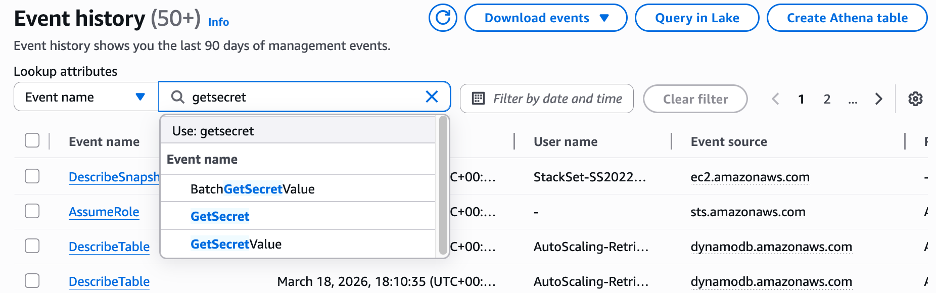
With hybrid post-quantum key exchange using ML-KEM now enabled by default for Secrets Manager clients (see the preceding table), most customers will not need ongoing monitoring to verify correct behavior or detect regressions. However, security teams and compliance officers might want to confirm that their Secrets Manager API calls are negotiating the hybrid key exchange. On the server side, you can confirm hybrid post-quantum key exchange in TLS by using AWS CloudTrail. On the client side, you can inspect TLS handshake details using a utility like Wireshark or by using developer tools built into major web browsers.
Verification is a two-step process: first, fetch a secret using your Secrets Manager client to generate a GetSecretValue API call, then confirm in AWS CloudTrail that the call negotiated hybrid post-quantum key exchange.
Fetch your secret using your Secrets Manager client
The following examples show how to retrieve your secret using the Secrets Manager Agent, Lambda extension, and CSI Driver—each of which will automatically negotiate hybrid post-quantum key exchange when calling the GetSecretValue API.
To verify hybrid post-quantum TLS with Secrets Manager Agent on EC2 instance: Install the agent on your Amazon Elastic Compute Cloud (Amazon EC2) instance and use it as a client to fetch your secret.
Use the agent to fetch your secret. curl -H “X-Aws-Parameters-Secrets-Token: $(</tmp/awssmatoken)” localhost:2773/secretsmanager/get?secretId=<YOUR-SECRET-ARN>
Wait for about 5 minutes for CloudTrail to deliver the logs.
To verify hybrid post-quantum TLS with Lambda extension: Use the AWS parameters and Secrets Manager Lambda extension to create a Lambda function that will consume your secrets from Secrets Manager using direct API calls.
Confirm hybrid post-quantum key exchange using CloudTrail
CloudTrail logs include a tlsDetails field for Secrets Manager API calls. When hybrid post-quantum key exchange in TLS is active, the keyExchange field in tlsDetails will show X25519MLKEM768. Each CloudTrail record includes a tlsDetails field that contains the cipher suite and, where available, the key exchange group negotiated during the TLS handshake.
If the keyExchange field shows X25519MLKEM768, then hybrid post-quantum key exchange in TLS is active. If it shows a traditional algorithm such as X25519, the client is not advertising ML-KEM support, and you should check the client version and configuration.
Troubleshooting
If your Secrets Manager API calls aren’t negotiating X25519MLKEM768 after updating your clients, check your SDK version, OpenSSL version (Python), and firewall or proxy configuration as shown in the Client Hybrid Post-Quantum Key Exchange Requirements section near the beginning of this post.
What’s next
This launch is one step in a broader migration. AWS is continuing to roll out ML-KEM support across AWS service HTTPS endpoints as part of Workstream 2 of the AWS PQC Migration Plan, with a target of full coverage across public AWS endpoints.
Support for CRYSTALS-Kyber, the pre-standardization predecessor to ML-KEM, is phasing out across AWS endpoints in 2026. Customers on older SDK versions that advertise only CRYSTALS-Kyber support will fall back gracefully to traditional TLS rather than negotiate the deprecated algorithm. To avoid this fallback, upgrade to the SDK versions listed in this post.
The journey of PQC migration extends beyond confidentiality of data in transit. To stay informed about the latest developments in the AWS PQC journey and your side of shared responsibility, follow the AWS Post-Quantum Cryptography page.
Conclusion
AWS Secrets Manager now enables hybrid post-quantum key exchange using ML-KEM by default to help protect your secrets and support your compliance efforts. This update requires no code changes or configuration updates for customers using the latest client versions.
This post covered how AWS Secrets Manager uses hybrid post-quantum cryptography to secure TLS connections, which clients support this capability, and how to verify that your connections are protected against harvest now, decrypt later attacks.
To benefit from this announcement today:
Upgrade your Secrets Manager client (Agent, Lambda extension, or CSI Driver) to the latest available versions to enable hybrid post-quantum key exchange using ML-KEM
If your workload uses the AWS SDK instead of a caching client, upgrade your AWS SDK and underlying dependencies to the minimum versions listed in this post
Verify hybrid post-quantum key exchange in TLS is active by checking the keyExchange field in CloudTrail tlsDetails for your Secrets Manager API calls
Test end-to-end hybrid post-quantum key exchange TLS connectivity in your environment, including network paths that traverse corporate firewalls or proxies
AWS will continue rolling out post-quantum cryptography support. For information about the broader migration effort, see the AWS PQC Migration Plan. Keep an updated cryptographic inventory of your broader environment to identify other uses of traditional public-key cryptography that will require migration. The CISA Quantum-Readiness guidance and the AWS PQC Migration Plan are good starting points.
Accelerating the Migration to the Post-Quantum Era
The promise of quantum computing brings an unprecedented paradox. While it will unlock revolutionary breakthroughs in science, materials discovery and medicine, it simultaneously poses an existential threat to the mathematical foundations of modern cybersecurity.
For decades, the global economy has relied on public key cryptography to safeguard everything from personal privacy to national security. This cryptography is built on mathematical problems that are computationally infeasible for classical computers to solve but that quantum computers can solve efficiently, rendering today’s cryptographic protocols obsolete.
Using Shor’s algorithm, a sufficiently powerful quantum computer could factor the large prime numbers that underpin public key cryptography, in minutes. These are tasks that would take today’s most advanced supercomputers a millennium to crack. This capability would effectively turn our strongest digital defenses into open doors, creating a period of vulnerability leading up to Q-Day – the day today’s encryption is broken.
The Migration Crisis: Why Traditional Strategies Fail
For CISOs and technical leaders, the transition to post-quantum cryptography (PQC) is not a simple patch-and-deploy exercise. It is a multiyear transformation that requires updating cryptography across every device, application, certificate and infrastructure component in the enterprise.
Most enterprises today are constrained by cryptographic debt – years of accumulated, undocumented and deprecated encryption protocols buried deep within legacy applications, third-party software libraries and unmanaged IoT devices. This creates a vast and largely invisible attack surface that traditional vulnerability scanners were never designed to detect.
The challenge is compounded by the absence of a unified source of truth. Existing tools offer a fragmented "outside-in" view of the environment. They may identify devices on the network, but they lack visibility into cryptographic libraries embedded within live traffic. Without a real-time Cryptographic Bill of Materials (CBOM), security teams are forced to rely on manual, point-in-time audits that become outdated almost immediately. Spreadsheets cannot scale to this problem.
This visibility gap makes it impossible to prioritize remediation, leaving sensitive data exposed to harvest now, decrypt later (HNDL) attacks. In these attacks, adversaries intercept and store encrypted data today with the intent of unlocking it once quantum computing capabilities mature.
Operationally, traditional migration approaches are equally unworthy. Manually updating cryptography across thousands of global endpoints and branch offices often requires disruptive rip and replace strategies that threaten uptime and demand specialized expertise that is in extremely short supply. Organizations need a way to bridge today’s classical infrastructure with a quantum-resilient future without disrupting business operations or exhausting IT resources.
At Palo Alto Networks, we believe global enterprises cannot afford to wait. Our new Quantum-Safe Security solution is designed to remove these operational roadblocks by making cryptographic discovery, risk assessment and transition both continuous and actionable. We empower enterprises to gain real-time visibility into cryptographic risk and begin building agentic resilience at enterprise scale by integrating with existing security and infrastructure systems, including security information and event management (SIEM), load balancers, endpoint detection and response (EDR), as well as Application Vulnerability Management (AVM) tools.
The Four Stages of Cryptographic Inventory & Remediation
Palo Alto Networks Quantum-Safe Security is built around four foundational stages.
1. Continuous Discovery through Ecosystem Ingestion
Visibility is the first line of defense, but in a complex enterprise, true visibility requires more than a periodic scan. It requires continuous, high-fidelity ingestion of cryptographic intelligence across the environment.
Our solution acts as a central nervous system for your cryptographic posture, ingesting telemetry and logs directly from PAN-OS NGFW and Prisma® Access, enriched with data from a broad ecosystem of third-party security solutions, simplifying Day 0 onboarding. By leveraging your existing network infrastructure as sensors, we provide a comprehensive view of the cryptographic behavior of all assets without the operational friction of deploying new software.
To eliminate blind spots, we go beyond our own telemetry to ingest critical information from your existing systems you rely on. This includes syncing with configuration management database (CMDB) and asset management platforms to align cryptographic data with business inventories, integrating with EDR and access control solutions to monitor endpoint behavior, and aggregating data from network clouds and log platforms. The result is a unified intelligence layer that reflects how cryptography is actually used across the enterprise.
By synthesizing these data streams, we deliver a multidimensional view of cryptographic exposure:
Discovery – Identification of every application, user device, infrastructure component and IoT device.
Behavior – Analysis of traffic metadata, including protocols, key exchangemechanisms, encryption algorithms, hashes, certificates and tunnels.
Context – Precise attribution of hardware models, cryptographic libraries (such as deprecated OpenSSL versions), and browser versions in use.
2. Risk Assessment & Prioritization
Not all data is created equal, and a successful migration requires a surgical focus on where the exposure is most acute. Our Quantum Safe Security solution quantifies risk by correlating cryptographic strength with business criticality, providing a clear, prioritized view of current risk and where remediation matters most.
Assets are categorized into strategic zones, starting with immediate exposure risks caused by deprecated protocols that are vulnerable to classical exploitation today. From there, the solution addresses long-term harvest now, decrypt later threats. As threat models evolve, the risk engine is designed to expand to emerging vectors like identity and authentication integrity, anticipating risks such as “Trust Now, Forge Later" attacks that could undermine digital trust at scale.
At the same time, the solution validates and tracks quantum-secure assets that have successfully transitioned to post-quantum or hybrid-PQC algorithms. By correlating this intelligence with business criticality and data shelf-life, security leaders can make informed decisions. For example, a crown jewel asset containing data that must remain confidential for a decade or more, is flagged as a high HNDL risk today and elevated to the top of the migration queue.
3. Comprehensive Remediation
Moving from a vulnerable state to quantum resilience is a structured journey. Our comprehensive remediation framework guides organizations through three critical stages, supported by automated workflows and prioritized recommendations at every step.
Current State to Quantum Ready: The first stage focuses on infrastructure modernization. Usingcontinuous discovery insights, the solution provides hardware and software recommendations required to support next-generation cryptographic protocols. An asset reaches a Quantum Ready state once it has the underlying hardware and OS capabilities to support post-quantum algorithms, even if those protocols are not yet activated.
Quantum Ready to Quantum-Safe: Transitioning to a Quantum-safe state requires activation and configuration of post-quantum defenses. Our solution provides data configuration and certificate compliance guidance to enable PQC/Hybrid-PQC algorithms to be correctly implemented across the estate.
Virtual Patching via Cipher Translation: For all current and especially legacy systems or IoT devices that cannot be upgraded, we provide an accelerated path to quantum-safety. Through Cipher Translation, the infrastructure acts as a proxy, providing agentic remediation that reencrypts vulnerable traffic into quantum-safe standards (such as ML-KEM) in real-time at the network edge. This approach instantly moves legacy assets from a high-risk current state to a Quantum-safe posture without a single line of code change.
4. Governance: Continuous Crypto-Hygiene & Global Compliance
Quantum readiness is not a one-time event; it is a strategic enterprise transformation that requires continuous oversight to prevent the re-emergence of vulnerabilities. Our governance framework provides the guardrails for your migration through two critical layers of management:
Continuous Crypto-Hygiene & Ongoing Management: Maintaining high-fidelity visibility is essential to preventing the accumulation of "crypto-debt." Our solution automates real-time mapping of all cryptographic dependencies, ensuring your CBOM remains dynamic and accurate as your environment evolves. Furthermore, we introduce Active Drift Detection, which automatically detects and can even block the use of weak or noncompliant ciphers in real-time, preventing developers or third-party services from accidentally introducing insecure protocols.
Global Crypto-Compliance Enforcement & Reporting: As regulatory pressure from governments (like the US Commercial National Security Algorithm Suite 2.0) mounts, organizations must demonstrate measurable progress. Our solution will provide Automated Framework Auditing, offering continuous, native mapping of your environment against global standards, including NIST, FIPS 140-3, and DORA.
Architecting a Quantum-Resilient Enterprise
The transition to quantum-safe security is far more than a technical upgrade. It represents a fundamental shift in how organizations protect the longevity and integrity of their digital assets. Achieving quantum resilience is a multiyear effort that requires both advanced technology and strategic partnership.
That's why Palo Alto Networks has established Integrated Quantum Practices, bringing together technology, partners and professional services to help organizations navigate the complexity of this transition with confidence. By combining deep cryptographic visibility with intelligent, agentic remediation, organizations can systematically retire their cryptographic debt and build resilience into their security architecture over time.
This proactive approach does more than mitigate emerging risk. It establishes a foundation of digital trust that is resilient against the threats of tomorrow, enabling your most sensitive intellectual property to remain secure for its entire shelf life, even as cryptographic standards evolve.
Secure Your First-Mover Advantage: The Quantum Readiness Assessment
Don’t let the complexity of the quantum transition stall your organization’s progress. Begin your path to resilience with a Quantum Readiness Assessment, a focused engagement to clarify current exposure and identify the most critical areas for action. To go deeper, watch the Quantum-Safe Summit on demand for expert perspectives on cryptographic risk and quantum readiness.
The Palo Alto Networks Quantum-Safe Security solution is expected to be generally available to customers on January 30, 2026, with additional integration enhancements planned for April 2026.
Forward-Looking Statements
This blog contains forward-looking statements that involve risks, uncertainties and assumptions, including, without limitation, statements regarding the benefits, impact or performance or potential benefits, impact or performance of our products and technologies or future products and technologies. These forward-looking statements are not guarantees of future performance, and there are a significant number of factors that could cause actual results to differ materially from statements made in this [blog. We identify certain important risks and uncertainties that could affect our results and performance in our most recent Annual Report on Form 10-K, our most recent Quarterly Report on Form 10-Q, and our other filings with the U.S. Securities and Exchange Commission from time-to-time, each of which are available on our website at investors.paloaltonetworks.com and on the SEC's website at www.sec.gov. All forward-looking statements in this blog are based on information available to us as of the date hereof, and we do not assume any obligation to update the forward-looking statements provided to reflect events that occur or circumstances that exist after the date on which they were made.
by moth Hard-coded cryptographic secrets? In my commercially purchased, closed-source software? It’s more likely than you think. Like, a lot more likely. This blog post details a true story of […]
Lawrence Hoffman // So Microsoft is open sourcing PowerShell and putting it on Linux. Realistically Linux already has a full suite of administrative tools and some very powerful scripting languages […]