Microsoft again asked Entra ID administrators to migrate users to phishing-resistant methods to avoid sign-in disruptions before it retires SMS and voice authentication in February 2027. [...]
Launching the expanded AI Classroom Toolkit with Cyberlite during Global Media and Information Literacy Week
AI is opening new pathways to information, giving people faster access to answers, ideas, and knowledge. At the same time, it’s making it harder to know whether the content we see is authentic.
Companies that build AI have a responsibility to make it reliable and trustworthy, and that responsibility doesn’t shift to the people who use it. But AI is already shaping how people search, learn, and encounter information. Helping people navigate that reality means building media and AI literacy (MAIL): the judgment to decide whether and how to use AI and what information to trust. These skills are as foundational as AI safety, and educators are asking for help teaching them.
That’s why, during Global Media and Information Literacy Week, we’re launching the expanded AI Classroom Toolkit: Unlocking Generative AI Safely and Responsibly, created with the online safety organization Cyberlite. It’s part of Microsoft’s broader commitment to make sure AI strengthens human thinking rather than replaces it. It also reflects Microsoft’s focus on education and empowerment, a core pillar of our Safe Participation Framework.
What’s new in the AI Classroom Toolkit
The expanded toolkit adds a deeper focus on critical thinking, verification, and media and AI literacy, helping students judge AI outputs and make informed decisions about what to trust online. Together with the original modules, it’s now a single, classroom-ready resource that covers the core of AI safety and literacy. Realistic, scenario-based lessons and activities help students practice these skills in situations they may encounter online:
The Climate Campaign: Gina enters an online challenge to make a campaign for a cause she cares about and finds that some winning entries use AI to show events that never happened. Students sort a feed of real and AI-made posts and practice lateral reading. The lesson: whether a post was made with AI doesn’t decide whether it’s trustworthy. What it claims, and who is behind it, does.
The Helpful Bot: Alex creates an AI help bot inside his online game, then catches it inventing details and collecting players’ personal information. Students learn why AI can get things wrong, how to trace claims to reliable sources, and why they’re responsible for AI-generated content they act on or share.
What Kind of AI User Are You?: An interactive quiz, hosted by Cyberlite, helps students identify their AI habits, strengths, and potential blind spots, and gives them an AI Type to reflect on and discuss.
“When we created the first Classroom Toolkit: Unlocking Generative AI Safely and Responsibly with Microsoft in 2023, most of the conversation was about using AI safely. Today, the questions young people ask about AI have grown sharper and more personal, like what to believe online or how far to trust a chatbot’s answer,” said Michelle Yao, cofounder of Cyberlite.
The toolkit also reflects what young people in our co-design sessions with Cyberlite told us: they want to learn by doing, through games, real-life scenarios, and peer discussion. Teachers don’t need to be AI experts, and students don’t need an AI tool in hand to start.
That approach builds on the reach and results of the original toolkit. Since 2023, the first version has reached educators in 10 countries and 11 languages, including through government and partner learning platforms. In South Korea, 93% of participating educators reported improved knowledge and understanding of ethical issues, privacy, and bias related to AI.
“Our hope is that every student leaves a little surer of their own judgment, and that everyone feels more confident deciding how AI fits into their lives,” said Yao.
Literacy works alongside product design and policy
Education is one part of the equation. Our commitment to media and AI literacy also shows up in how we design products and the policies we support.
Last month, we set out five principles for AI in education, including “AI designed to support students’ learning, not replace their thinking.” We alsocommitted to enforceable privacy, safety, and transparency protections for qualifying educational AI products in US school districts. These protections help schools and families understand how these tools work and the controls available to them.
Media and AI literacy is now a global priority
The Organisation for Economic Co-operation and Development has released a framework for a MAIL assessment beginning in 2029. As part of its Programme for International Student Assessment (PISA), it will examine how students reflect on, analyze, and evaluate information, including AI-generated information. This week in New Delhi, UNESCO is also launching an AI extension of its “Think Critically, Click Wisely” global curriculum, which Microsoft advised on.
This growing global focus makes the need for support urgent—educators want help, and many aren’t getting it. In Microsoft’s 2026 AI in Education report, 53% of educators and 77% of students say they haven’t had AI training.
Closing this skills gap matters beyond the classroom. Healthy societies depend on a shared basis of facts, informed public debate, and confident civic participation. As authenticity gets harder to judge, there’s a risk that people start doubting everything, creating what the Digital Inquiry Group calls a “dangerous declaration of permanent uncertainty.” MAIL offers a way through. It builds the confidence to decide what to trust.
Media and AI literacy for every age
Across Microsoft, we’re helping people build these skills wherever they learn and find information:
In classrooms: Students debate whether to accept, question, or rework an AI tool’s answers in an AI and Critical Thinking lesson from The Economist Educational Foundation, supported by Microsoft. Available alongside other media literacy lessons in Microsoft Learning Zone, the lesson has reached students in 116 countries.
Through play: Millions of players have checked sources, spotted bias, and cracked cases of AI misuse in Minecraft Education’s The Investigators and Reed Smart: AI Detective.
For content creators: UNESCO, with Microsoft’s support, is developing resources to help creator associations train their members in MAIL and is testing them with creators in Nairobi this week.
For voters: Check. Recheck. Vote. helps people apply AI literacy to election information.
In our products: Search Progress, built with input from the Digital Inquiry Group, turns research assignments into source-checking practice in Microsoft Teams for Education.
What’s next
Through Microsoft Elevate for Educators and local partners, we’ll bring the AI Classroom Toolkit to new audiences, with more languages and localized content rolling out through 2027. We’ll keep evolving it as technology and educators’ needs change.
AI will keep changing how people find information and the content they encounter. Our goal is to help people meet that change with confident, informed judgment about the AI they use and the information they trust so they can fully take part in civic and democratic life.
Microsoft has released out-of-band (OOB) Windows updates to remove trust in certificates tied to compromised eMudhra certificate authority keys, protecting systems that do not receive automatic certificate trust updates. [...]
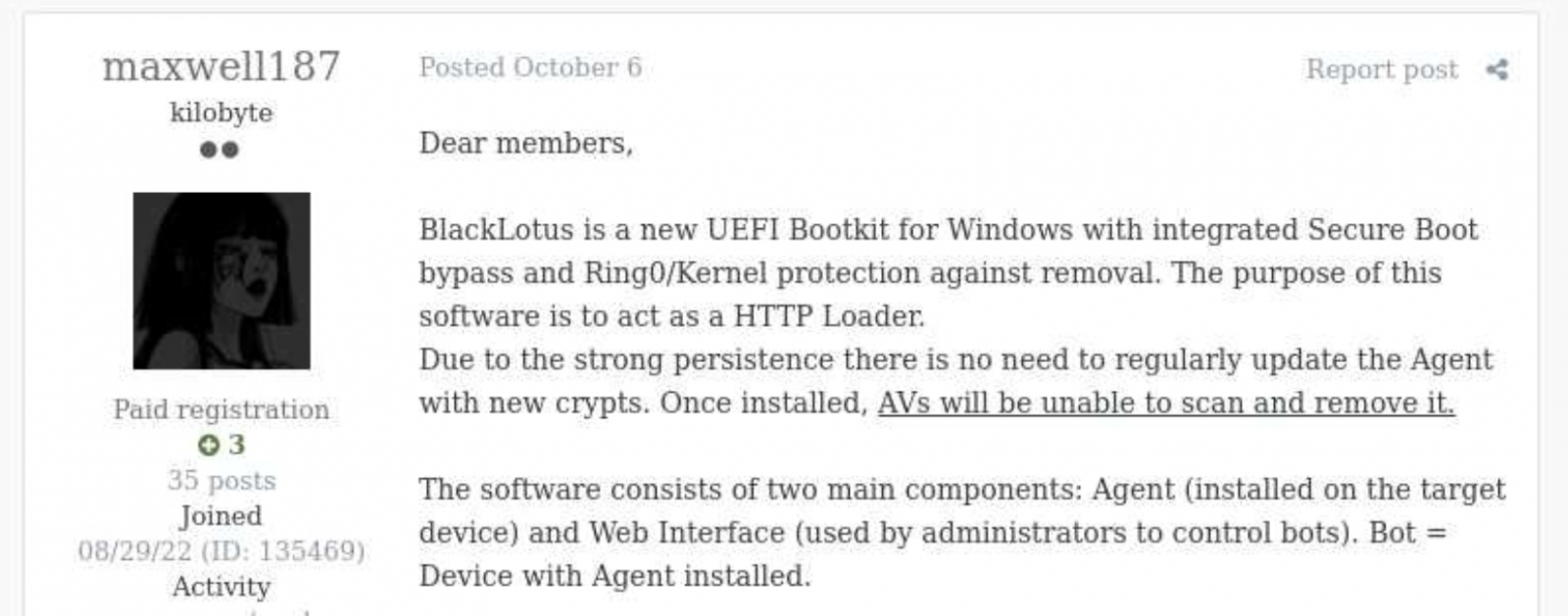
Back in October 2022, Kaspersky GReAT was looking into a peculiar advertisement on a hacking forum. A cybercriminal had been advertising a UEFI bootkit, dubbed BlackLotus, that could bypass Secure Boot, for $5,000. Given the low price for such powerful capabilities, the cybersecurity community initially took this advertisement with a grain of salt. As no BlackLotus samples were found in the wild, no one could at the time verify the claims made in the forum post.
BlackLotus advertisement
However, about half a year later, in March 2023, ESET confirmed that the BlackLotus advertisement was genuine. The researchers tracked down samples of this bootkit and confirmed that it can indeed bypass Secure Boot through a vulnerability called Baton Drop (CVE-2022-21894). As this vulnerability was still exploitable in 2023, Microsoft had to release multiple security updates to address it.
Since the release of these updates, the BlackLotus bootkit has gone quiet — no publicly known attacks have used it. Yet in early 2026, we discovered a malware sample similar to BlackLotus that was used in an APT campaign in Central Asia. In this report, we share our findings, including new payloads and possible attribution of this campaign.
The return of the infamous bootkit
In early 2026 we identified a complex APT attack targeting diplomatic agencies in Central Asian countries — namely Tajikistan, Uzbekistan, and Turkmenistan. This attack involved a UEFI bootkit that we dubbed BlackX. Having examined it, we found it to be similar to BlackLotus.
Attackers have been deploying BlackX after compromising the victim machine networks and obtaining administrator privileges. To install the bootkit, we observed them dropping the following files:
inst.exe, an installer executable
PVMDIJGKAX2, an RC4-encrypted extensionless file containing files and strings required for the installation
The installer was launched with the command line C:\ProgramData\Intel\inst.exe PVMDIJGKAX2 Q46F6MDLI3RX2KV1. The last argument here is the RC4 key used for decryption.
Curiously, the file inst.exe does not contain any malicious strings or embedded blobs. All the files needed to install the malicious payload are inside PVMDIJGKAX2, which makes it harder for incident responders to retrieve the bootkit components.
The installer package drops a set of files to both system and UEFI partitions, designed to exploit the Baton Drop vulnerability. We noted that the implementation of the exploit is remarkably similar to the one used in the BlackLotus malware. As with BlackLotus, the goal of the exploit is to install custom Machine Owner Keys (MOK), which allows loading arbitrary EFI files on the target machines to manipulate Secure Boot.
While the vulnerability exploitation chain was implemented very similarly to BlackLotus, we spotted differences between the exploits in BlackLotus and BlackX. That said, the source code of the BlackLotus bootkit has never been published online. This could mean that the attackers behind BlackX either reverse-engineered the BlackLotus bootkit or purchased its source code from cybercriminals. Either way, this is an interesting observation, as we rarely see APT actors borrow ideas or code from cybercrime actors.
Payload launched by the bootkit
The UEFI payload delivered during the Baton Drop exploitation has a classic bootkit goal — to inject a malicious driver into the Windows kernel. This driver differs from the one deployed by BlackLotus and is signed with a certificate belonging to an organization named 温江区明宇网络技术服务工作室 (English: Wenjiang District Mingyu Network Technology Service Studio). At the time of writing, this certificate (serial number: 0bcdf5e0da32d68900b8b7638459d072) has been revoked by its issuer.
The driver aims to tamper with security solutions installed on the machine. For example, it disables process, thread, and registry callbacks related to security solutions. It also tampers with ETW providers so that security solutions cannot access their output. Curiously, some of the tampering procedures are designed to run only if Kaspersky or Avast solutions are installed on the infected machine. However, during dynamic analysis of this driver, we found that these procedures are useless — they fail to interfere with Kaspersky products in any way.
The driver also protects the bootkit’s files from tampering. It intercepts kernel requests to open these files and returns a handle to calc.exe instead of a malicious file handle.
User-mode second-stage payloads
Apart from tampering with security solutions, the driver also deploys a user-mode payload. We observed two such payloads, used for cyberespionage, in the wild. One of them is a RAT that can load further-stage .NET payloads. This RAT uses cloud storage for C2 server communications — we observed its versions using Google Drive, OneDrive, and Yandex.Disk. Having connected to a cloud storage service, this RAT iterates over files available there and interprets them depending on the file suffix. Below is a list of supported suffixes:
File suffix
Description
Type
0X01
A .NET file. The task is to parse it and run the method TEST.Class1.RunCMD(argument_array) from the module
Input
0X02
Result of the call TEST.Class1.RunCMD(argument_array)
Output
0X03
Task to upload a file to the drive
Input
0X04
Uploaded file
Output
0X05
Task to download a file to an infected machine
Input
0X06
File download status
Output
SSSR
Contains initial system info
Output
We also observed another payload delivered through the bootkit, which we dubbed OxiDLLRunner. It is a malicious DLL obfuscated with OLLVM. It is loaded by the legitimate file googleupdate.exe (original filename: jcef_helper.exe, MD5: AF8A983B9ADA07EAE1259BF2953ABD40), which is also delivered by the bootkit. The DLL decrypts the contents of the file v8_context_snapshot.bin, which resides in the same folder, and then jumps to the beginning of the decrypted content. The decrypted data starts with shellcode followed by a PE file, which is a Rust payload designed to communicate with the www[.]archivetj[.]com C2 server. During communication, this payload is supposed to receive DLL files exporting a function named create_plugin, which are then executed in separate threads.
Attribution
Based on the following facts, we have attributed this attack to the APT41 threat actor with medium confidence:
In June 2026, ESET published a blog post on attacks by the FishMonger threat actor, which the community assumes to be related to APT41. This post describes a kernel implant with a PDB path starting with C:\Users\xdd\Desktop. While describing the campaign, the post also suggests the possible use of an unspecified UEFI bootkit component, which might exploit CVE‑2023‑24932. We observed the identifier “xdd” used multiple times in the BlackX bootkit payloads, so we assess that BlackX is the UEFI bootkit referenced in the ESET blog post;
The payloads deployed by BlackX are loaded using a legitimate executable abused via DLL sideloading, and an encrypted file — this pattern is common among Chinese-speaking threat actors;
The OxiDLLRunner file has been obfuscated with OLLVM, an obfuscator commonly used by Chinese-speaking actors.
Why did the target organizations get infected?
During our initial analysis of BlackX, we thought that attackers succeeded in deploying it due to the negligence of the target organizations. Baton Drop, the vulnerability used to deploy BlackX, was disclosed back in 2023 and was patched, so we first thought that the infected machines lacked the relevant updates. However, our investigation proved this wrong — the targeted machines were fully patched.
Instead, we found out that the problem was with the patch itself. As it turned out, the patch for the Baton Drop vulnerability is designed to revoke the “Windows Production PCA 2011” certificate used to sign vulnerable UEFI components. However, this revocation does not happen automatically upon patch installation — the user has to trigger it manually. This is done with the following steps:
A registry flag is set inside HKEY_LOCAL_MACHINE\SYSTEM\CurrentControlSet\Control\Secureboot;
A scheduled task named Secure-Boot-Update is created.
This patch is designed to be applied manually — for instance, applying it automatically could break dual-boot systems relying on the “Windows Production PCA 2011” certificate to load. At the same time, this patch deployment practice creates a problem — as it is extremely unusual for a system administrator to take extra steps after installing an update. Usually, when applying patches, system administrators take no further action unless an installation failure occurs. These instructions for activating the patch are buried deep on the Microsoft website, and we assess that they are quite hard for an average IT administrator to notice.
Curiously, Microsoft’s plan for deploying the Baton Drop patches mentions an “Enforcement Phase” that involves revoking the “Windows Production PCA 2011” certificate automatically, without user interaction. At the time of publishing this post, this stage has not been implemented. On October 19, 2026, this certificate expired, but this does not prevent the vulnerable binaries from loading unless the certificate is blocklisted.
It is likely that the threat actor behind this campaign took into account that few organizations realized the importance of manually activating the Baton Drop patch. As such, we believe they decided to invest time in understanding how BlackLotus works and creating a copycat of this bootkit.
Conclusion
Patch management is important for every organization, as updates from vendors help protect software and hardware against known vulnerabilities. However, sometimes installed patches fail to protect against the flaws they address. The BlackLotus story we described is not the only such example — for instance, in 2025 Microsoft released an update against the ToolShell vulnerability that also had to be applied manually.
However, modern security solutions are designed to account for such cases when installed patches fail to protect against security flaws for one reason or another. For instance, the Exploit Prevention component available in Kaspersky products prevents exploits from running if the patch is not applied, or if it is a zero-day vulnerability with no available patch. It is thus crucial to equip all machines in an organization with security solutions and constantly monitor the alerts they raise.
Back in October 2022, Kaspersky GReAT was looking into a peculiar advertisement on a hacking forum. A cybercriminal had been advertising a UEFI bootkit, dubbed BlackLotus, that could bypass Secure Boot, for $5,000. Given the low price for such powerful capabilities, the cybersecurity community initially took this advertisement with a grain of salt. As no BlackLotus samples were found in the wild, no one could at the time verify the claims made in the forum post.
BlackLotus advertisement
However, about half a year later, in March 2023, ESET confirmed that the BlackLotus advertisement was genuine. The researchers tracked down samples of this bootkit and confirmed that it can indeed bypass Secure Boot through a vulnerability called Baton Drop (CVE-2022-21894). As this vulnerability was still exploitable in 2023, Microsoft had to release multiple security updates to address it.
Since the release of these updates, the BlackLotus bootkit has gone quiet — no publicly known attacks have used it. Yet in early 2026, we discovered a malware sample similar to BlackLotus that was used in an APT campaign in Central Asia. In this report, we share our findings, including new payloads and possible attribution of this campaign.
The return of the infamous bootkit
In early 2026 we identified a complex APT attack targeting diplomatic agencies in Central Asian countries — namely Tajikistan, Uzbekistan, and Turkmenistan. This attack involved a UEFI bootkit that we dubbed BlackX. Having examined it, we found it to be similar to BlackLotus.
Attackers have been deploying BlackX after compromising the victim machine networks and obtaining administrator privileges. To install the bootkit, we observed them dropping the following files:
inst.exe, an installer executable
PVMDIJGKAX2, an RC4-encrypted extensionless file containing files and strings required for the installation
The installer was launched with the command line C:\ProgramData\Intel\inst.exe PVMDIJGKAX2 Q46F6MDLI3RX2KV1. The last argument here is the RC4 key used for decryption.
Curiously, the file inst.exe does not contain any malicious strings or embedded blobs. All the files needed to install the malicious payload are inside PVMDIJGKAX2, which makes it harder for incident responders to retrieve the bootkit components.
The installer package drops a set of files to both system and UEFI partitions, designed to exploit the Baton Drop vulnerability. We noted that the implementation of the exploit is remarkably similar to the one used in the BlackLotus malware. As with BlackLotus, the goal of the exploit is to install custom Machine Owner Keys (MOK), which allows loading arbitrary EFI files on the target machines to manipulate Secure Boot.
While the vulnerability exploitation chain was implemented very similarly to BlackLotus, we spotted differences between the exploits in BlackLotus and BlackX. That said, the source code of the BlackLotus bootkit has never been published online. This could mean that the attackers behind BlackX either reverse-engineered the BlackLotus bootkit or purchased its source code from cybercriminals. Either way, this is an interesting observation, as we rarely see APT actors borrow ideas or code from cybercrime actors.
Payload launched by the bootkit
The UEFI payload delivered during the Baton Drop exploitation has a classic bootkit goal — to inject a malicious driver into the Windows kernel. This driver differs from the one deployed by BlackLotus and is signed with a certificate belonging to an organization named 温江区明宇网络技术服务工作室 (English: Wenjiang District Mingyu Network Technology Service Studio). At the time of writing, this certificate (serial number: 0bcdf5e0da32d68900b8b7638459d072) has been revoked by its issuer.
The driver aims to tamper with security solutions installed on the machine. For example, it disables process, thread, and registry callbacks related to security solutions. It also tampers with ETW providers so that security solutions cannot access their output. Curiously, some of the tampering procedures are designed to run only if Kaspersky or Avast solutions are installed on the infected machine. However, during dynamic analysis of this driver, we found that these procedures are useless — they fail to interfere with Kaspersky products in any way.
The driver also protects the bootkit’s files from tampering. It intercepts kernel requests to open these files and returns a handle to calc.exe instead of a malicious file handle.
User-mode second-stage payloads
Apart from tampering with security solutions, the driver also deploys a user-mode payload. We observed two such payloads, used for cyberespionage, in the wild. One of them is a RAT that can load further-stage .NET payloads. This RAT uses cloud storage for C2 server communications — we observed its versions using Google Drive, OneDrive, and Yandex.Disk. Having connected to a cloud storage service, this RAT iterates over files available there and interprets them depending on the file suffix. Below is a list of supported suffixes:
File suffix
Description
Type
0X01
A .NET file. The task is to parse it and run the method TEST.Class1.RunCMD(argument_array) from the module
Input
0X02
Result of the call TEST.Class1.RunCMD(argument_array)
Output
0X03
Task to upload a file to the drive
Input
0X04
Uploaded file
Output
0X05
Task to download a file to an infected machine
Input
0X06
File download status
Output
SSSR
Contains initial system info
Output
We also observed another payload delivered through the bootkit, which we dubbed OxiDLLRunner. It is a malicious DLL obfuscated with OLLVM. It is loaded by the legitimate file googleupdate.exe (original filename: jcef_helper.exe, MD5: AF8A983B9ADA07EAE1259BF2953ABD40), which is also delivered by the bootkit. The DLL decrypts the contents of the file v8_context_snapshot.bin, which resides in the same folder, and then jumps to the beginning of the decrypted content. The decrypted data starts with shellcode followed by a PE file, which is a Rust payload designed to communicate with the www[.]archivetj[.]com C2 server. During communication, this payload is supposed to receive DLL files exporting a function named create_plugin, which are then executed in separate threads.
Attribution
Based on the following facts, we have attributed this attack to the APT41 threat actor with medium confidence:
In June 2026, ESET published a blog post on attacks by the FishMonger threat actor, which the community assumes to be related to APT41. This post describes a kernel implant with a PDB path starting with C:\Users\xdd\Desktop. While describing the campaign, the post also suggests the possible use of an unspecified UEFI bootkit component, which might exploit CVE‑2023‑24932. We observed the identifier “xdd” used multiple times in the BlackX bootkit payloads, so we assess that BlackX is the UEFI bootkit referenced in the ESET blog post;
The payloads deployed by BlackX are loaded using a legitimate executable abused via DLL sideloading, and an encrypted file — this pattern is common among Chinese-speaking threat actors;
The OxiDLLRunner file has been obfuscated with OLLVM, an obfuscator commonly used by Chinese-speaking actors.
Why did the target organizations get infected?
During our initial analysis of BlackX, we thought that attackers succeeded in deploying it due to the negligence of the target organizations. Baton Drop, the vulnerability used to deploy BlackX, was disclosed back in 2023 and was patched, so we first thought that the infected machines lacked the relevant updates. However, our investigation proved this wrong — the targeted machines were fully patched.
Instead, we found out that the problem was with the patch itself. As it turned out, the patch for the Baton Drop vulnerability is designed to revoke the “Windows Production PCA 2011” certificate used to sign vulnerable UEFI components. However, this revocation does not happen automatically upon patch installation — the user has to trigger it manually. This is done with the following steps:
A registry flag is set inside HKEY_LOCAL_MACHINE\SYSTEM\CurrentControlSet\Control\Secureboot;
A scheduled task named Secure-Boot-Update is created.
This patch is designed to be applied manually — for instance, applying it automatically could break dual-boot systems relying on the “Windows Production PCA 2011” certificate to load. At the same time, this patch deployment practice creates a problem — as it is extremely unusual for a system administrator to take extra steps after installing an update. Usually, when applying patches, system administrators take no further action unless an installation failure occurs. These instructions for activating the patch are buried deep on the Microsoft website, and we assess that they are quite hard for an average IT administrator to notice.
Curiously, Microsoft’s plan for deploying the Baton Drop patches mentions an “Enforcement Phase” that involves revoking the “Windows Production PCA 2011” certificate automatically, without user interaction. At the time of publishing this post, this stage has not been implemented. On October 19, 2026, this certificate expired, but this does not prevent the vulnerable binaries from loading unless the certificate is blocklisted.
It is likely that the threat actor behind this campaign took into account that few organizations realized the importance of manually activating the Baton Drop patch. As such, we believe they decided to invest time in understanding how BlackLotus works and creating a copycat of this bootkit.
Conclusion
Patch management is important for every organization, as updates from vendors help protect software and hardware against known vulnerabilities. However, sometimes installed patches fail to protect against the flaws they address. The BlackLotus story we described is not the only such example — for instance, in 2025 Microsoft released an update against the ToolShell vulnerability that also had to be applied manually.
However, modern security solutions are designed to account for such cases when installed patches fail to protect against security flaws for one reason or another. For instance, the Exploit Prevention component available in Kaspersky products prevents exploits from running if the patch is not applied, or if it is a zero-day vulnerability with no available patch. It is thus crucial to equip all machines in an organization with security solutions and constantly monitor the alerts they raise.
Microsoft’s October Patch Tuesday update stands out for two reasons. First, the total number of patches has reached four digits for the first time. Second, to help companies better understand the details of the vulnerabilities, Microsoft has decided to group them into risk cohorts. A cohort brings together vulnerabilities that are exploited under the same conditions and affect the same systems. They replace neither the severity rating, nor the individual bulletins for each CVE. While they’re unlikely to be suitable for comprehensive patch prioritization, they will help quickly assess which part of an infrastructure is currently most at risk.
Statistics corner
Of the 1,414 vulnerabilities addressed in the October Patch Tuesday release, 1,102 directly affect the Windows operating system, 134 — Microsoft Office, 36 — SharePoint Server, 22 — SQL Server, and seven — Exchange Server. The vast majority — 677 — lead to privilege escalation, 317 to remote code execution, 40 to security bypass, and 73 to denial of service (DoS).
There are 86 critical vulnerabilities on the list, of which 68 lead to RCE, 14 to privilege escalation, three to spoofing, and one to data leakage. In addition, two vulnerabilities were disclosed before being patched, and one is being exploited in real-world attacks.
CVE-2026-96951 — vulnerability in Windows Shell
The only zero-day vulnerability patched in the October update that attackers are already exploiting in real-world attacks is CVE-2026-96951 in Windows Shell (CVSS severity score: 8.8). Details on how it’s being exploited aren’t yet known; however, according to Microsoft’s description, it involves command injection that allows bypassing a security feature when accessing the system over a network. Microsoft credits experts at both Fujitsu and Anthropic for discovering the vulnerability, so it was likely found using neural networks.
CVE-2026-108398 and CVE-2026-92707: vulnerabilities disclosed before patches were released
Information about these two vulnerabilities was made public before the October update was released. In theory, this could mean that attackers attempted to exploit them ahead of time. These are:
CVE-2026-108398 — a vulnerability in the .NET Framework that allows bypassing WDAC protection;
CVE-2026-92707 — a vulnerability in the third-party MessagePack-CSharp serialization component, leading to a denial of service (DoS).
However, according to the security bulletins, neither has been observed in actual attacks yet.
What else to pay attention to
Several vulnerabilities patched by the latest update combine potentially serious consequences with relatively simple exploitation. Particular attention should be paid to three flaws that could potentially lead to arbitrary code execution:
Microsoft isn’t the only company that releases regular update packages for newly discovered vulnerabilities.
In its October update, Adobe fixed 174 defects in its products, including critical vulnerabilities (CVSS 10) in ColdFusion and Commerce/Magento. These systems are typically accessible from an external network, making them particularly attractive to attackers.
SAP’s October security bulletin lists 20 vulnerabilities, including CVE-2026-89111 — an SSRF vulnerability in the Cloud SDK for Python. This vulnerability, rated CVSS 10, allows attackers to steal OAuth tokens.
How to keep your company safe?
Recently, thanks to neural networks, the number of vulnerabilities detected and patched has been regularly breaking records. To avoid getting overwhelmed by the flood of patches, we recommend using an automated platform for tracking and assessing vulnerabilities . It helps not only identify and fix vulnerabilities, it also prioritizes them based on actual risks and automates the remediation process.
Microsoft today issued updates to fix more than 1,400 security vulnerabilities in its Windows operating systems and other software. Today’s epic patch batch dwarfs September’s record of nearly 1,000 fixes, which was already about ten times the normal monthly patch load from Redmond.
Just one of the weaknesses patched this week is considered a “zero day,” or already exploited in the wild. CVE-2026-96951 is a security feature bypass in the Windows Shell that affects Windows 10 and 11 systems, as well as some Server versions.
Windows 10 users might be wondering if they can still expect security updates after this month. Microsoft had been slated to stop shipping updates for Windows 10 systems in October 2025, but ended up adding another year of free updates after considerable pushback. A few months ago, Microsoft quietly extended that support for another year (until October 2027).
At least 78 of the flaws fixed this month are rated “critical,” meaning they could be exploited with little or no action by the user, and most of those critical bugs allow an attacker to execute code of their choice on the vulnerable system.
While Microsoft said there are no signs anyone is exploiting it yet, a security feature bypass in the .NET Framework (CVE-2026-108398) was publicly disclosed prior to today, potentially giving attackers advance time to work out how to exploit the bug.
Satnam Narang at Tenable said the number of flaws fixed this month far surpasses the previous record-setting year 2020, when Microsoft patched 1,261 CVEs.
“We’ve now crossed the 4,000 CVE mark with two months left to go,” he said.
Microsoft credits large language models for the high volume of bug discovery, and presumably AI gets credit for many of the patches used to fix these flaw. Meanwhile, security experts have been warning that these unusually large patch volleys from Microsoft are placing extra strain on corporate security teams, which often have to test individual updates before deploying them across a network to ensure the fixes don’t cause problems for other software.
Tyler Reguly, associate director of security research and development at Fortra, notes that just 26 Microsoft vulnerabilities appeared in the “Known Exploited Vulnerabilities” (KEV) catalog maintained by the U.S. Cybersecurity & Infrastructure Security Agency (CISA) so far this year, and security teams would do well to prioritize patching those 26 vulnerabilities first.
“Security leaders should focus on exploitable risk, and ask whether their teams have the clarity, capacity and support to act,” Reguly said.
Which vulnerabilities deserve the most scrutiny in your organization? The folks at Cisco Talos have a useful roundup of the more noteworthy flaws that Microsoft fixed today, and of course the SANS Internet Storm Center has a reliable roundup that indexes vulnerabilities by severity, CVE number and affected software.

 Login