From August 3, 2026, Google will use IP addresses from UK, EEA and Switzerland users for ad measurement and personalization. It lands as the ICO weighs new consent rules, and years after Google itself called using such signals to identify devices "wrong." [...]
We’ve been thinking deeply about enterprise security. The operating model that served us for the past decade (collect telemetry, store it, query it, build dashboards to watch it) is no longer keeping pace. We need to shift to the new world: telemetry, context, reasoning, and actions. An approach that produces outcomes. The latest cybersecurity frontier models further made this shift urgent. Models like Claude Mythos can now find software vulnerabilities and reason through complex attack paths at machine-speed, leading to an exponentially increasing backlog of vulnerabilities.
Introducing AWS Continuum for code vulnerabilities
Today, we’re announcing AWS Continuum for code vulnerabilities, now available in gated preview. Continuum for code vulnerabilities addresses the full lifecycle of a code vulnerability at machine speed: from discovery through actions. It reasons over your environment, confirms what is real, and drives toward resolution. It’s model agnostic, using multiple frontier models where each performs best, and is built to incorporate the latest and most capable models as they emerge.
Continuum is built on lessons learned from running security across AWS and Amazon.com. Securing businesses that operate in different industries required a system that understands business context rather than applying generic rules uniformly.
How it works
Continuum for code vulnerabilities reasons over your full environment. This context includes structured data already living in Amazon Web Service (AWS) (your infrastructure, permissions, network topology, code) and the unstructured data that captures how your organization operates and your risk profile (your documents, communications, business priorities).
Continuum for code vulnerabilities operates in four continuous phases.
Discovery: Security teams tackle a backlog of vulnerabilities, and many are already using frontier models to find more. Continuum starts by ingesting that existing backlog and performing its own vulnerability scan of your environment. This creates a more comprehensive view of vulnerabilities and the associated attack paths.
Prioritization: Continuum uses context to evaluate, enrich, and prioritize every finding. Is the affected component deployed, is it reachable, is it in a production path, and what would the business impact be if exploited? The result is an evidence-backed list of priorities, allowing Continuum and your team to focus on what’s most important.
Validation: Continuum validates findings to surface false positives before they waste your team’s time. It contextualizes vulnerabilities against your environment. It then constructs working exploit examples in a sandboxed environment that provide concrete, reproducible evidence of the issue.
Mitigation and remediation: Continuum assesses existing defenses around a validated issue, including blocking and compensating controls along with detection mechanisms. It then draws on its understanding of the codebase, context, and findings to recommend mitigation or remediation of the vulnerability with a network change, policy change, or code patch. The patch recommendation is validated using the same system that confirmed the vulnerability. It also provides blast radius visibility and rollback paths where feasible.
This is just the beginning. We’re starting with code (1st and 3rd party) and then expanding to other aspects of security.
Trust is graduated
Continuum starts in learn mode with a human in the loop. Every recommendation includes the reasoning behind it. As you gain confidence, you can graduate Continuum to enforce mode, enabling remediation that can be increasingly automated based on categories and risk profiles you define.
Continuum capabilities
In addition to Continuum for code vulnerabilities, Continuum includes capabilities you might already know. The AWS Security Agent penetration testing and code scanning functionality is now part of Continuum as Continuum pen testing and Continuum code scanning (Preview). We’re also launching Continuum threat modeling in preview, which automatically generates comprehensive threat models from design documents or source code and outputs results in STRIDE format. These capabilities serve as detection and analysis sources that feed into the broader Continuum loop of discovery, prioritization, validation, and remediation.
Getting started
We’re working with customers across financial services, automotive, and technology to shape AWS Continuum. Customer feedback confirms the direction: security teams want tools that earn trust and take action.
AWS Continuum for code vulnerabilities is available in gated preview. Sign up to request access at AWS Continuum.
If you have feedback about this post, submit comments in the Comments section below.
A newly discovered data leak dubbed "FortiBleed" has exposed what appears to be a collection of Fortinet and FortiGate VPN credentials for 73,932 firewall URLs at organizations worldwide. [...]
Europe, like much of the world, is living through a period of heightened geopolitical uncertainty in which sanctions risk, legal divergence, and cyber disruption have moved from abstract concerns to board-level variables. Digital sovereignty is shifting from aspiration to operational requirement, driven by resilience expectations, critical service dependency, and rising geopolitical and cyber risk. Definitions of sovereignty vary, ranging from blanket data localization edicts to industrial policy to national security, but the absence of an agreed definition should not be mistaken for an absence of intent. Sovereignty is already shaping procurement, regulatory compliance, and technology strategy. From my years working at the intersection of government and the technology industry, I have seen how quickly digital policy can harden into operational constraints. I have also seen how easily "sovereignty" becomes a stand-in for broader concerns: dependency, geopolitics, and the fear that critical services may not remain available during a crisis Two issues are at play. First, policymakers are right that over-dependency on foreign technology can become a national resilience problem. Cloud market concentration is a case in point: last year across Europe, the three leading cloud providers accounted for around 70 percent of the market, while European providers' collective share remained around 15 percent. Concentration is not, by itself, a security failure, but it is a strategic dependency that can become acute when legal regimes diverge, access is contested, or a geopolitical shock tightens the room to maneuver. It also amplifies the "ripple effect": disruption at a small number of providers can cascade across thousands of organizations and supply chains. Second, business leaders are right to worry that blunt sovereignty initiatives raise costs and regulatory complexity. A hard localization mandate or a "sovereign-only stack" duplicates infrastructure, slows modernization, and in practice keeps organizations tied to legacy systems longer than planned while limiting access to leading technologies. The same tension is shaping Europe's competitiveness debate. Former Italian prime minister Mario Draghi has argued that security is a precondition for sustainable growth and that deep dependencies can leave Europe vulnerable to coercion as geopolitical volatility increases. The question is not whether sovereignty matters but how to pursue it without turning it into a counterproductive procurement ideology. From policy to platform choice A recent decision by the French government to restrict certain foreign-made video conferencing tools in favor of a homegrown alternative illustrates the direction of travel across the EU. Whether one agrees with the decision or not, it signals something larger: sovereignty is becoming a set of practical constraints that can reshape technology choices quickly. Many organizations are responding with a third, damaging outcome: delay. In a recent Zscaler-commissioned survey, 73 percent of respondents said digital sovereignty concerns had caused them to delay or cancel transformation initiatives. That "pause dynamic" is dangerous because it prolongs exposure to legacy risk, weakens cyber readiness, and leaves organizations less able to absorb disruption from ransomware, supply chain compromise, systemic outages, or sudden changes in cross-border rules at a time when the threat landscape is shifting faster than ever. If Europe wants sovereignty that strengthens resilience rather than undermines it, political and business leaders need a framework that is practical, measurable, compatible with open markets, and informed by the technology sector's expertise. Here is one: control, choice, and continuity. An outcome-based framework Sovereignty begins with what an organization can control in practice: who can access data, who can administer systems, whether a vendor can see customer content, where logs are stored, how keys are managed, what subcontractors can see, and how policies can be enforced. Control is not about isolation; it is about enforceable governance and reducing hidden dependency. Sovereignty also requires choice: credible options when assumptions break. Too many organizations discover too late that their "vendor strategy" is really a dependency strategy, with few realistic alternatives. Choice is not achieved by buying two of everything. It is achieved through architecture and contracts that keep an organization mobile and avoid vendor lock-in: portability for data and configurations; full transparency on who they rely on, where access sits, and which jurisdictions and subcontractors are in the chain; and pre-agreed exit paths that can be executed under time pressure. It also requires leaders to prevent the sovereignty debate from becoming an excuse to stop transformation. Every program facing sovereignty constraints should be forced through a decision path: redesign, mitigation, or exit on a timeline. The third C is continuity: keeping critical services running during any kind of disruption. If sovereignty is meant to reduce strategic vulnerability, continuity is where it either becomes real or becomes theater. Continuity is measurable through recovery time objectives, tested failover, supplier-failure drills, and exercises for jurisdiction-change scenarios. Across Europe, the urgency is reinforced by the threat environment. Zscaler ThreatLabz data shows rising numbers of damaging ransomware attacks year over year across the region: Spain (+116 percent), Germany (+74 percent), Belgium (+73 percent), Italy (+53 percent), and France (+34 percent) among others. Separate research on resilience found that 52 percent of IT executives believe their current security measures are insufficient to defend against existing or emerging threats such as agent-based AI and quantum computing. The UK's National Cyber Security Centre, meanwhile, reported a 130 percent rise in "nationally significant" incidents over the past year. AI is accelerating these risks. It already gives "bad actors" new capabilities to increase the speed, scale, and sophistication of their attacks. The question is not whether disruption happens, but whether systems can withstand it. Mandate outcomes, not vendors Business leaders argue that sovereignty will raise costs, increase compliance friction, and shrink access to leading technology. That is often true. Policymakers' concerns are also legitimate: strategic dependency can undermine national security and resilience. The mistake is writing sovereignty rules that dictate which vendors to buy rather than what controls buyers must have to keep services running during shocks. The most useful sovereignty requirements are outcome-based: enforceable control over access and data, credible choice through portability and exit, proven continuity through testing and recovery. They create room for organizations to use global platforms safely while meeting local requirements, without freezing modernization. If sovereignty is now an operating requirement, every stakeholder has a role. Boards should define what "sovereign enough" means for their organization, then require regular reporting and testing, with incentives tied to resilience outcomes. CEOs and COOs should treat sovereignty as continuity, fund the modernization that reduces brittle legacy dependency, and force decisions on blocked programs. CIOs and CISOs should map and minimize third-party access, implement localization and multi-region resilience where required, and build plans for supplier failure and jurisdiction-change scenarios. Regulators should clarify definitions, harmonize requirements where possible, and create compliance pathways with transition periods that reward modernization rather than incentivize delay. The approach must be risk-based and agreed in consultation with industry. Scaling control, choice and continuity To make control, choice and continuity achievable at scale, two additional disciplines are required: collaboration and compliance. Collaboration keeps sovereignty compatible with openness through interoperability, shared incident readiness, transparent subcontracting, and trusted vendor partnerships that reduce concentration risk instead of merely relocating it. Solutions must be tailored for local demands and drive investment in local ecosystems. Compliance makes sovereignty measurable through clear definitions, auditable evidence, and regulatory approaches that focus on operational controls so that organizations are pushed to modernize rather than to delay. Sovereignty on European terms should be judged by outcomes rather than rhetoric: whether organizations can govern access, keep options open, recover quickly when incidents happen, and continue delivering critical services when dependencies fail. Done well, digital sovereignty becomes a catalyst for resilience, innovation, growth and competitiveness; done bluntly, it becomes a brake on the very transformation it is meant to protect. Contributed by Zscaler.
Account takeovers are rising as attackers bypass traditional defenses through phishing, session hijacking, and MFA fatigue. Specops Software explores how device trust and continuous verification help reduce account takeover risk. [...]
Cisco has updated a February security advisory, adding another product to the list of those affected by the maximum-severity CVE-2026-20127. Switchzilla made a small amendment to the original advisory on Tuesday evening, noting that Cisco Catalyst SD-WAN Validator, formerly vBond, was also among the boxes attackers could pop open. Readers may remember the fuss over CVE-2026-20127 (10.0) a few months ago. The make-me-admin improper authentication flaw prompted a Five Eyes alert since attackers could essentially gain persistent root access to all vulnerable instances. In other words, it's a far-from-ideal situation that could could create espionage opportunities, given the prevalence of Cisco's SD-WAN offerings in Western networks. Cisco said at the time that attackers could exploit CVE-2026-20127 to gain admin rights, access NETCONF, and reconfigure the SD-WAN fabric, before exploiting CVE-2022-20775 (7.8), a path traversal flaw discovered in September 2022, to gain root access. Cisco Talos, the company's threat intel arm, posited that the bug could have been exploited for as long as three years by the time it was discovered. Talos attributed the exploitation activity to a group it tracks as UAT-8616, whose activity dates back to at least 2023, according to its researchers' estimates. No one has formally attributed UAT-8616 to a specific country or group of individuals, but experts say that it is a highly sophisticated outfit that has a history of targeting critical infrastructure sectors. Ollie Whitehouse, NCSC-UK's CTO, said at the time: "Our new alert makes clear that organizations using Cisco Catalyst SD-WAN products should urgently investigate their exposure to network compromise and hunt for malicious activity, making use of the new threat hunting advice produced with our international partners to identify evidence of compromise. "UK organizations are strongly advised to report compromises to the NCSC, and to apply vendor updates and hardening guidance as soon as practicable to reduce the risk of exploitation." The Register asked Cisco for more information, but it did not immediately respond. Customers should not have to make any new changes, provided that they upgraded their software to a fixed version across all systems when the advisory was first published in February, not just SD-WAN Controller and SD-WAN Manager. The update comes weeks after Cisco disclosed another zero-day affecting Catalyst SD-WAN, suggesting that it had been exploited for at least a week at the time. Tracked as CVE-2026-20245, it marked the sixth SD-WAN flaw disclosed this year, and the second to be exploited as a zero-day in as many months. ®
India has banned Telegram until June 22 after the app was used to circulate leaked exam papers. CEO Pavel Durov accuses telecom Reliance of BGP hijacking that disrupted the app as far away as the UAE. Here's what happened, and how to get around the block with an MTProto proxy. [...]
AI security is getting attention because AI has stopped being a side experiment. It is now part of how work gets done. Employees use copilots to write, research, code, and analyze. Product teams are adding AI into customer experiences. Developers are building applications on top of foundation models. Business teams are experimenting with agents that can read email, summarize documents, query data, and trigger workflows. That is a very different world from the one many AI review processes were designed for. An AI system can pass a benchmark and still fail in production. It can behave safely in a clean test environment and then encounter real […]
The U.S. Cybersecurity and Infrastructure Security Agency (CISA) has ordered federal agencies to patch a maximum-severity flaw in the Widget Factory Joomla Content Editor (JCE) plugin that is being actively exploited in the wild. [...]
Kodak has confirmed that it's working with external cybersecurity experts to investigate a security breach after hackers gained access to some of the company's data. [...]
Threat actors are abusing Steam Workshop, Valve's community hub for downloading game-related content, to push various malware hidden in wallpaper packages. [...]
Three critical flaws in Fortinet’s sandbox that allow remote attackers to bypass authentication, escalate privileges, and execute malicious code are under active exploitation, according to threat intelligence firm Defused. Fortinet patched two of the three flaws, CVE-2026-39813 and CVE-2026-39808, in April and the third, CVE-2026-25089 last week. All three bugs received 9.1 CVSS ratings, and, at the time, the vendor said that there were no reports of active exploitation. CVE-2026-39813 is a path traversal bug in the FortiSandbox JRPC API that allows an authentication bypass using specially crafted HTTP requests. It affects FortiSandbox 4.4.0 through 4.4.8 and 5.0.0 through 5.0.5. Patch to 4.4.9+ or 5.0.6+, depending on the branch, to fix the flaw. Fortinet security analyst Loic Pantano found this one. CVE-2026-39808 is an OS command injection flaw in FortiSandbox that allows unauthenticated attackers to execute unauthorized code or commands via HTTP requests. It affects versions 4.4.0 through 4.4.8, and upgrading to FortiSandbox 4.4.9 or above patches the hole. Fortinet credited KPMG Spain researcher Samuel de Lucas Maroto with finding and reporting this bug. Finally, CVE-2026-25089 is another OS command vulnerability in FortiSandbox, FortiSandbox Cloud and FortiSandbox PaaS WEB UI that allows unauthenticated attackers to execute unauthorized commands using specifically crafted HTTP requests. FortiSandbox 4.4.0 through 4.4.8 and 5.0.0 through 5.0.5, FortiSandbox Cloud 5.0.4 through 5.0.5, and FortiSandbox PaaS 5.0.4 through 5.0.5 are vulnerable. Upgrading to a fixed version patches the hole. Fortinet did not respond to The Register’s inquiries about these three CVEs and if the vendor had also observed any attacks against them. According to Defused, the exploitation began over the weekend. “We are observing exploitation of multiple Fortinet FortiSandbox vulnerabilities during the past 24 hours,” the threat-intel firm said in a LinkedIn post on Monday. “Per our research a working exploit for CVE-2026-25089 has not yet been publicly disclosed,” the company added, noting that the exploit for this flaw appeared to be vibe coded and may be faulty. We do know that all manner of miscreants love to abuse Fortinet flaws, so if you haven’t already, patch now. Earlier this month, Check Point VP of research Lotem Finkelstein warned that ransomware crims had exploited a critical authentication bypass vulnerability affecting Fortinet's Remote Access VPN and Mobile Access deployments, and said that the same crew was also likely abusing other VPN-related vulnerabilities in Fortinet products. ®
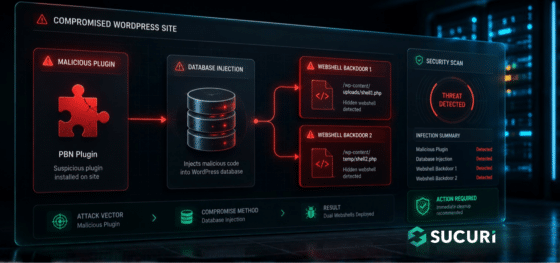
During a recent incident response engagement, our team uncovered a multi-stage WordPress infection that goes beyond the usual file-based malware. The attacker combined a fake plugin, a remote command-and-control server, and two PHP web shells stored directly inside the WordPress database.
The campaign is operated by a Turkish-speaking threat actor and is built around a classic SEO monetization scheme: hidden backlink injection for a Private Blog Network (PBN), most likely tied to the gambling and adult affiliate niche.
In this blog post you’ll learn how to detect and prevent subdomain takeover – a tactic where threat actors exploit dangling DNS records to redirect traffic to attacker-controlled resources. We’ll explain the issue, how the situation arises, and how you can use various AWS features and services to help mitigate the impact of this tactic.
Under the shared responsibility model, securing configurations in the cloud is your responsibility. AWS supports you through strong defaults, guidance in the Security Pillar of the Well-Architected Framework, and security services to help you meet that responsibility. The AWS Customer Incident Response Team (AWS CIRT) also monitors for new and trending tactics that threat actors use to exploit specific customer configurations, so that you can make informed design decisions and improve your response plans.
AWS CIRT has observed threat actors actively scanning for public DNS CNAME records that point to resources that no longer exist, looking for subdomain takeover opportunities.
Note: The subdomain takeover tactic does not leverage vulnerabilities of AWS services. It exploits a dangling DNS record to redirect traffic to an attacker-controlled resource.
Quick DNS Primer
CNAME Records: A CNAME (Canonical Name) record is a DNS entry that points one domain name to another. For example, api.example.com can be configured to point to api.example.s3-website-us-east-1.amazonaws.com. This feature of DNS enables users to configure a memorable, human-friendly domain name while the actual resource lives at a longer, machine-generated AWS hostname. A security issue emerges when the target resource is deleted but the CNAME record pointing to it remains – creating a “dangling” record.
Dangling Records: When a resource (like an S3 bucket) is deleted but the DNS record pointing to it is left behind, that DNS record becomes “dangling”, pointing to a resource that no longer exists. For resources in globally shared namespaces, threat actors can potentially reclaim the name of your deleted resource and serve malicious content through your DNS record.
What is subdomain takeover?
A subdomain is a prefix added to a domain that allows you to organize access to your resources. A subdomain takeover occurs when you delete the underlying resource and a threat actor creates a new resource with the same name to take advantage of the DNS records still pointing to it.
A subdomain takeover is possible when a CNAME record points to an AWS resource that uses a globally shared DNS namespace where the resource name can be chosen by any AWS customer. The following AWS resources meet these criteria:
Amazon S3 (global namespace): Bucket names like mybucket.s3.amazonaws.com are globally unique and can be claimed by any account if the bucket is deleted. Note: S3 buckets created with account regional namespaces (launched March 2026) are scoped to your account and are not subject to this issue.
Amazon CloudFront: Distribution domain names like d111111abcdef8.cloudfront.net are assigned by AWS and cannot be chosen by an attacker. However, if you delete a distribution and another customer creates one that happens to receive the same domain name, a dangling CNAME could resolve to their content.
AWS Elastic Beanstalk: Environment names like myapp.elasticbeanstalk.com are globally unique and can be claimed by any account if the environment is terminated.
Resources like Amazon VPC, Amazon EC2 instances, or private hosted zones are not subject to this tactic because they do not expose globally claimable DNS namespaces.
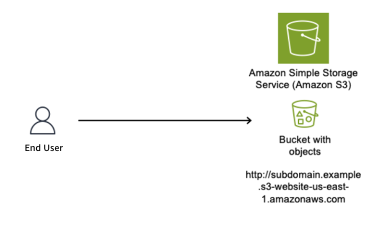
You create a DNS CNAME record pointing to your S3 website endpoint. The subdomain subdomain.example.com now resolves to subdomain.example.s3-website-us-east-1.amazonaws.com, which serves content from the S3 bucket named subdomain.example. If your team deletes the bucket and forgets to delete the DNS record, users that navigate to the site will see an error stating that the bucket doesn’t exist. However, at this point, if a threat actor sees this error and moves in to claim the bucket name, they will be able to set up their own site that users will see when they navigate to the subdomain.example.com site.
Figure 1 shows an S3 bucket named subdomain.example (a globally unique bucket name) configured to host a static website, with the S3 website endpoint subdomain.example.s3-website-us-east-1.amazonaws.com.
Figure 1: S3 bucket configured as a static website
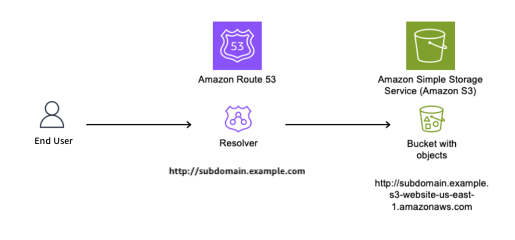
As shown in Figure 2, we use Amazon Route 53 to create a CNAME record to resolve to our Amazon domain name; to give users a friendly name and so they do not have to remember the long S3 website name in URLs.
Figure 2: DNS Resolver configured with CNAME record pointing to origin bucket
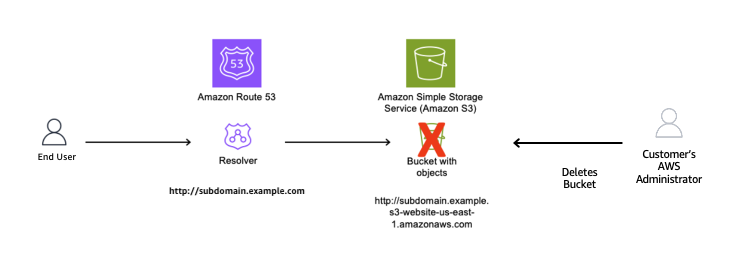
The customer’s AWS administrator decides to stop serving content from the S3 bucket and deletes it, as shown in Figure 3.
Figure 3: Resource deleted without removing the CNAME record
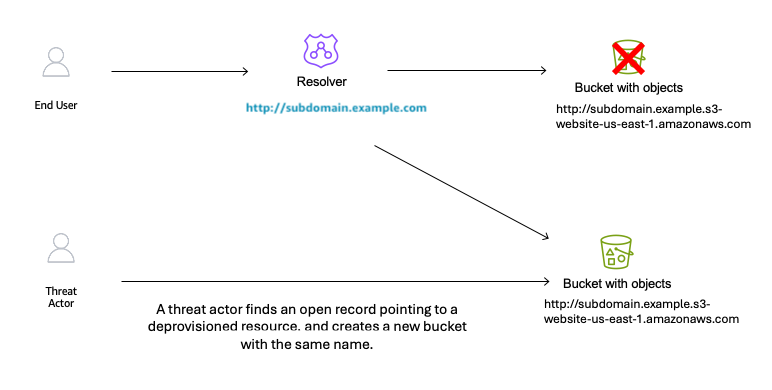
With the S3 bucket deleted and the CNAME record still in place, the DNS record is now dangling. A threat actor identifies this situation and creates a new S3 bucket with the same global name subdomain.example in an AWS account that the threat actor controls, as shown in Figure 4. The threat actor can now serve content from this new bucket, including potentially malicious content. End users remain unaware of this switch and continue to access subdomain.example.com, trusting the content because it appears to originate from a URL they recognize.
Figure 4: Subdomain takeover happens
Potential impacts of a sub-domain takeover
Consider these potential impacts:
Reputation risk: There is a potential risk to your organization’s reputation, because you don’t control the content being served from the threat actor’s site that your DNS record points to.
Potential exposure to phishing campaigns: Users within your organization might have the subdomain bookmarked in their browser, not knowing the resource is no longer available, then unsuspectingly navigate to the site that now hosts malware or is used to phish user credentials.
Blocking: If the subdomain is flagged by security vendors for malicious activity, it could impact your business operations.
Financial loss: Subdomain takeover incidents can result in a financial impact due to the potential disruption to service delivery as you deal with the event.
Proactive detection
AWS Config for proactive detection
For proactive detection, you can use AWS Config to continuously monitor your Route 53 CNAME records and verify that the target resources exist in your account.
Prerequisite: This approach requires AWS Config recorder to be enabled for the resource types you want to monitor (S3 buckets, CloudFront distributions, Elastic Beanstalk environments). If Config isn’t recording a resource type, it won’t appear in the inventory check. For more information, see Setting up AWS Config with the console.
Why use AWS Config inventory instead of DNS resolution checks?
A common approach is to check whether a CNAME resolves to a valid endpoint. However, this method has a critical flaw: if an attacker has already claimed the resource, DNS resolution will succeed – to their resource, not yours. You would have no indication that you don’t own what’s responding.
By querying AWS Config’s recorded configuration items, you’re checking whether the resource exists in your account inventory, not just whether something responds at that DNS name. This approach correctly identifies dangling CNAMEs even after a takeover has occurred.
Implementation approach:
Account-level vs. organization-level scope
The reference implementation queries AWS Config inventory within a single account. This means that if a CNAME record in Account A points to a resource that legitimately exists in Account B within the same AWS organization, the rule will flag it as NON_COMPLIANT.
For organizations that share resources across accounts, you can modify the solution to use an AWS Config Aggregator, which queries resource inventory across all accounts in your organization. This is similar to how IAM Access Analyzer supports both account-level and organization-level scopes. To use this approach, you need an organization-level Config Aggregator already configured, and the Lambda function’s IAM role needs the config:SelectAggregateResourceConfig permission.
We recommend starting with account-level scope for simplicity, then expanding to organization-level if your environment includes cross-account resource sharing.
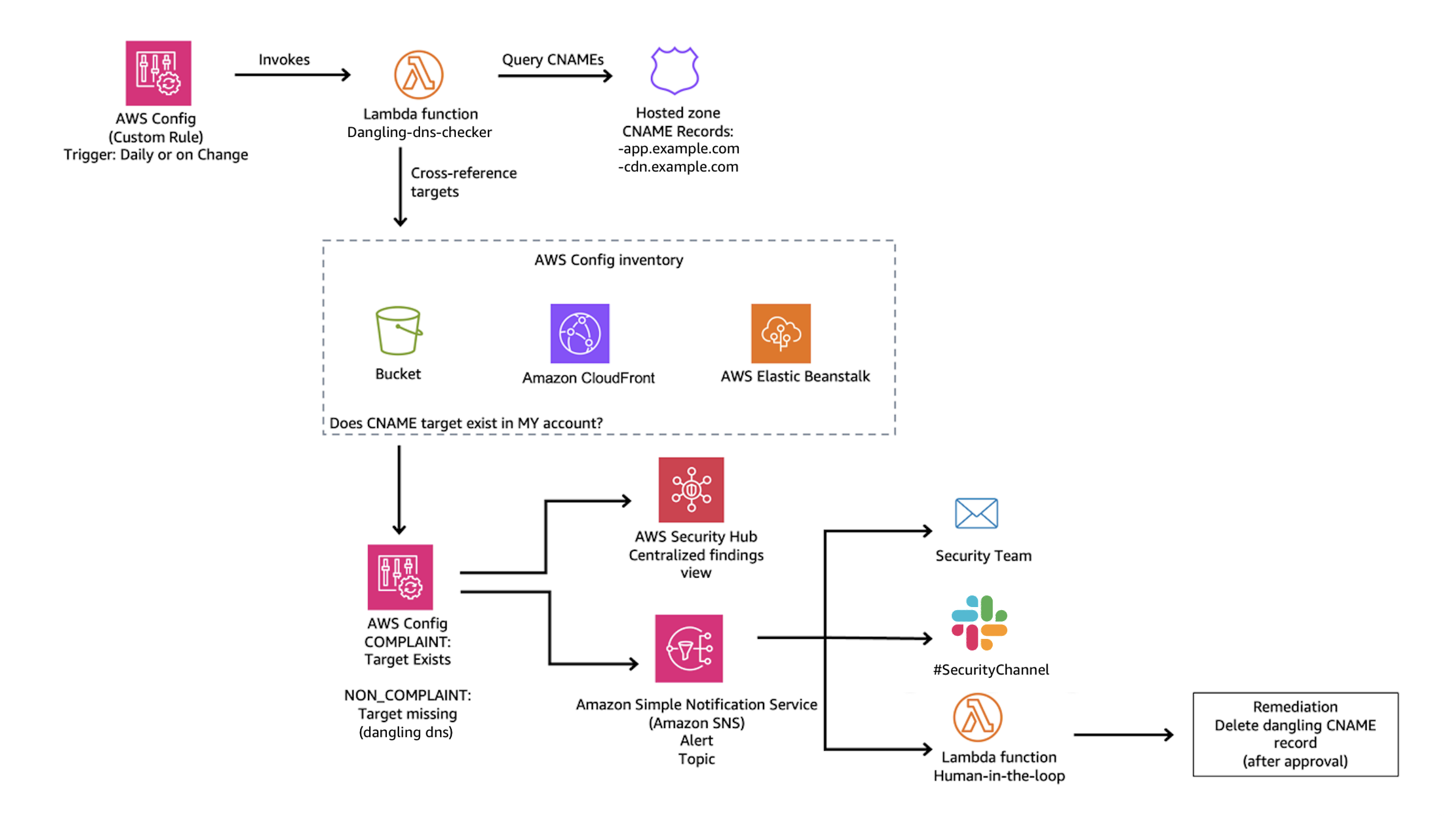
The main idea is to create a custom AWS Config rule that queries your Route 53 hosted zones for CNAME records, then parses each CNAME target to determine whether it points to a known AWS resource pattern such as S3, CloudFront, or Elastic Beanstalk. For each match, the rule cross-references the target against your AWS Config inventory to verify that the resource actually exists in your account. If the resource isn’t found, the rule marks the CNAME record as NON_COMPLIANT, surfacing it for review.
The Config rule should focus on known AWS resource patterns:
Note: CNAME records pointing to external third-party services are outside the scope of this detection mechanism, as those resources won’t appear in your AWS Config inventory.
NON_COMPLIANT findings from your Config rule can be routed to AWS Security Hub for centralized visibility, or trigger SNS notifications to alert your security team.
Figure 5: Dangling DNS Detection Solution
Reference implementation:
We’ve published a complete implementation of this detection approach as an open-source solution. The solution deploys a Lambda function that discovers CNAME records across all your Route 53 hosted zones and uses pattern matching to identify targets pointing to S3, CloudFront, and Elastic Beanstalk. It then queries your AWS Config inventory to verify whether each target resource still exists in your account. When a dangling record is detected, the solution generates a HIGH severity finding in Security Hub and can optionally send SNS notifications to alert your security team. A CloudWatch metrics dashboard is also included for ongoing compliance tracking.
Deployment:
# Clone the repository
git clone https://github.com/aws-samples/sample-dangling-dns-detection
cd sample-dangling-dns-detection

# Build the Lambda deployment package
./scripts/package.sh

# Upload to S3
aws s3 cp dist/dangling-dns-detection.zip s3://YOUR_BUCKET/

# Deploy the CloudFormation stack
aws cloudformation deploy \
  --template-file infrastructure/template.yaml \
  --stack-name dangling-dns-detection \
  --parameter-overrides \
      LambdaCodeS3Bucket=YOUR_BUCKET \
      EvaluationFrequency=TwentyFour_Hours \
  --capabilities CAPABILITY_NAMED_IAM
The stack creates an AWS Config custom rule that runs on your specified schedule (default: every 24 hours), evaluating all CNAME records and reporting compliance status.
Mitigating the effects
Mitigating subdomain takeover requires both preventive procedures and responsive capabilities.
Prevention: Standard operating procedure
The most effective mitigation is a standard operating procedure for resource deprovisioning that ensures DNS records are removed before the underlying resource:
Within your DNS zone, delete the CNAME record that points to the fully qualified domain name (FQDN) of the resource that you plan to deprovision.
Wait for the DNS TTL to expire before deleting the resource. DNS resolvers cache records for the duration of the TTL (for example, a TTL of 3600 means resolvers may serve the old record for up to one hour). If you delete the resource before the TTL expires, a threat actor could claim the resource name while cached CNAME entries are still directing traffic to it.
Deprovision the resource that you no longer want to use.
Run a DNS check of the CNAME record that you removed to verify that the resource is no longer resolving.
Key principle: Always delete DNS first, wait for the TTL to expire, then delete the resource. This order eliminates the window where a dangling record could be exploited.
Prevention: S3 account regional namespaces
As mentioned earlier, AWS introduced account regional namespaces for Amazon S3 general purpose buckets in March 2026. While this is a meaningful step toward mitigating the S3-specific takeover vector, there are important operational limitations to be aware of:
Existing buckets are unaffected. Buckets already created in the global namespace cannot be migrated to an account regional namespace. The bucket names remain globally unique and claimable by anyone if the bucket is deleted.
Global namespace is still the default. When creating a new bucket through the console, CLI, or SDK, the global namespace remains the default selection. Users who aren’t aware of the new option will continue creating globally-scoped buckets.
Existing IaC templates require updates. Existing infrastructure-as-code templates (CloudFormation, CDK, Terraform) that don’t explicitly opt in to the account regional namespace will continue provisioning buckets in the global namespace. For CloudFormation, this means setting the BucketNamespace property to account-regional. For other IaC tools, consult their documentation for the equivalent configuration. Organizations need to audit and update their templates to opt in.
For these reasons, the dangling DNS detection approach described in this post remains critical – particularly for organizations with existing S3 infrastructure, and for CloudFront, and Elastic Beanstalk resources where no equivalent namespace scoping exists.
Response: Notification and remediation
When a dangling DNS record is detected, the reference solution described in the Detection section automatically creates a HIGH severity finding in AWS Security Hub and reports the CNAME record as NON_COMPLIANT in AWS Config. If you provide an SNS topic ARN during deployment, the solution also sends notifications to alert your security or operations team via email, Slack, or other channels. For production environments, consider a human-in-the-loop workflow where these notifications are reviewed by a team member who approves the DNS record deletion before it’s executed. This prevents accidental deletion of legitimate records during transient issues.
The reference solution also includes a CloudWatch dashboard for tracking compliance status and evaluation metrics over time, giving your team ongoing visibility into DNS health across your hosted zones.
Note: Fully automated remediation (auto-deleting DNS records) carries risk – a false positive could disrupt legitimate services. We recommend starting with detection and notification, then evaluating automation based on your detection accuracy and operational maturity.
Conclusion
Subdomain takeover is a preventable misconfiguration that can have significant impact on your organization. A layered defense approach provides the best protection:
Prevention: Implement a standard operating procedure that deletes DNS records before deprovisioning the underlying resource.
Detection: Use AWS Config custom rules to proactively identify CNAME records pointing to resources that no longer exist in your account.
Response: Configure notifications through SNS or Security Hub so your team can respond quickly when dangling records are detected.
Monitoring: Maintain ongoing visibility through CloudWatch dashboards to track DNS health and compliance status.
The key insight is that good DNS hygiene – knowing when your CNAME records point to a nonexistent resource – is your first line of defense. Automated detection through AWS Config provides a safety net when operational procedures fail. And if you detect an issue, having a playbook ready to enact your response can lower the impact and your mean time to recovery.
If you have feedback about this post, submit comments in the Comments section below.
Opening a new social media account in the UK will soon mean proving you're over 16 with an ID upload or a facial age scan, under a government ban on under-16s taking effect in spring 2027. Security experts warn the age checks are easy to circumvent and create new data-breach risks. [...]
GhostTree uses recursive NTFS junctions to generate vast numbers of valid Windows file paths. Varonis explains how the technique could cause Microsoft Defender folder scans to never complete, leaving malware undetected. [...]
The U.S. Federal Trade Commission (FTC) warned that Americans lost $3.5 billion to imposter scams in 2025, with reported losses nearly tripling since 2020. [...]

 Login
Login