Reading view

‘Scattered Spider’ Member ‘Tylerb’ Pleads Guilty

A 24-year-old British national and senior member of the cybercrime group “Scattered Spider” has pleaded guilty to wire fraud conspiracy and aggravated identity theft. Tyler Robert Buchanan admitted his role in a series of text-message phishing attacks in the summer of 2022 that allowed the group to hack into at least a dozen major technology companies and steal tens of millions of dollars worth of cryptocurrency from investors.

Buchanan’s hacker handle “Tylerb” once graced a leaderboard in the English-language criminal hacking scene that tracked the most accomplished cyber thieves. Now in U.S. custody and awaiting sentencing, the Dundee, Scotland native is facing the possibility of more than 20 years in prison.

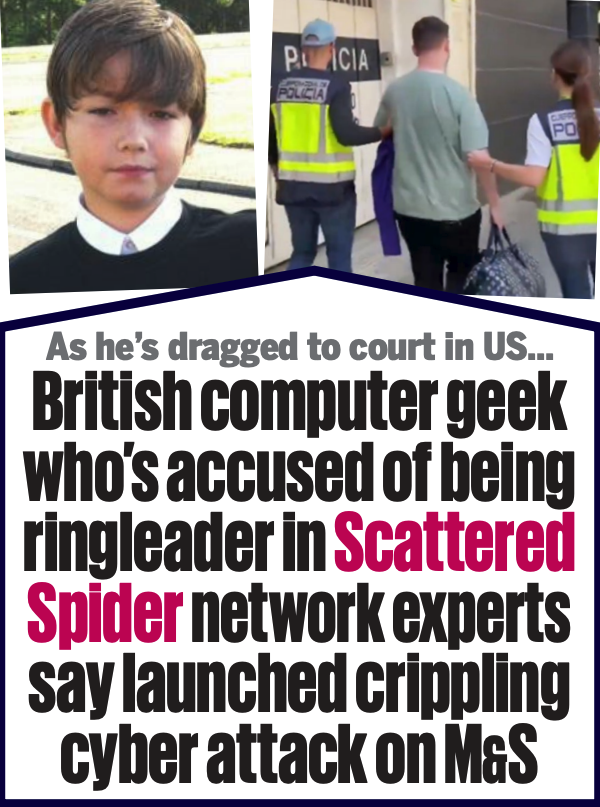
A screenshot of two photos of Buchanan that appeared in a Daily Mail story dated May 3, 2025.

Two photos published in a Daily Mail story dated May 3, 2025 show Buchanan as a child (left) and as an adult being detained by airport authorities in Spain. “M&S” in this screenshot refers to Marks & Spencer, a major U.K. retail chain that suffered a ransomware attack last year at the hands of Scattered Spider.

Scattered Spider is the name given to a prolific English-speaking cybercrime group known for using social engineering tactics to break into companies and steal data for ransom, often impersonating employees or contractors to deceive IT help desks into granting access.

As part of his guilty plea, Buchanan admitted conspiring with other Scattered Spider members to launch tens of thousands of SMS-based phishing attacks in 2022 that led to intrusions at a number of technology companies, including Twilio, LastPass, DoorDash, and Mailchimp.

The group then used data stolen in those breaches to carry out SIM-swapping attacks that siphoned funds from individual cryptocurrency investors. In an unauthorized SIM-swap, crooks transfer the target’s phone number to a device they control and intercept any text messages or phone calls to the victim’s device — such as one-time passcodes for authentication and password reset links sent via SMS. The U.S. Justice Department said Buchanan admitted to stealing at least $8 million in virtual currency from individual victims throughout the United States.

FBI investigators tied Buchanan to the 2022 SMS phishing attacks after discovering the same username and email address was used to register numerous phishing domains seen in the campaign. The domain registrar NameCheap found that less than a month before the phishing spree, the account that registered those domains logged in from an Internet address in the U.K. FBI investigators said the Scottish police told them the address was leased to Buchanan throughout 2022.

As first reported by KrebsOnSecurity, Buchanan fled the United Kingdom in February 2023, after a rival cybercrime gang hired thugs to invade his home, assault his mother, and threaten to burn him with a blowtorch unless he gave up the keys to his cryptocurrency wallet. That same year, U.K. investigators found a device at Buchanan’s Scotland residence that included data stolen from SMS phishing victims and seed phrases from cryptocurrency theft victims.

Buchanan was arrested by Spanish authorities in June 2024 while trying to board a flight to Italy. He was extradited to the United States and has remained in U.S. federal custody since April 2025.

Buchanan is the second known Scattered Spider member to plead guilty. Noah Michael Urban, 21, of Palm Coast, Fla., was sentenced to 10 years in federal prison last year and ordered to pay $13 million in restitution. Three other alleged co-conspirators — Ahmed Hossam Eldin Elbadawy, 24, a.k.a. “AD,” of College Station, Texas; Evans Onyeaka Osiebo, 21, of Dallas, Texas; and Joel Martin Evans, 26, a.k.a. “joeleoli,” of Jacksonville, North Carolina – still face criminal charges.

Two other alleged Scattered Spider members will soon be tried in the United Kingdom. Owen Flowers, 18, and Thalha Jubair, 20, are facing charges related to the hacking and extortion of several large U.K. retailers, the London transit system, and healthcare providers in the United States. Both have pleaded not guilty, and their trial is slated to begin in June.

Investigators say the Scattered Spider suspects are part of a sprawling cybercriminal community online known as “The Com,” wherein hackers from different cliques boast publicly on Telegram and Discord about high-profile cyber thefts that almost invariably begin with social engineering — tricking people over the phone, email or SMS into giving away credentials that allow remote access to corporate internal networks.

One of the more popular SIM-swapping channels on Telegram has long maintained a leaderboard of the most rapacious SIM-swappers, indexed by their supposed conquests in stealing cryptocurrency. That leaderboard previously listed Buchanan’s hacker alias Tylerb at #65 (out of 100 hackers), with Urban’s moniker “Sosa” coming in at #24.

Buchanan’s sentencing hearing is scheduled for August 21, 2026. According to the Justice Department, he faces a statutory maximum sentence of 22 years in federal prison. However, any sentence the judge hands down in this case may be significantly tempered by a number of mitigating factors in the U.S. Sentencing Guidelines, including the defendant’s age, criminal history, time already served in U.S. custody, and the degree to which they cooperated with federal authorities.

  •  

Navigating 2026’s Converged Threats: Insights from Flashpoint’s Global Threat Intelligence Report

Blogs

Blog

Navigating 2026’s Converged Threats: Insights from Flashpoint’s Global Threat Intelligence Report

In this post, we preview the critical findings of the 2026 Global Threat Intelligence Report, highlighting how the collapse of traditional security silos and the rise of autonomous, machine-speed attacks are forcing a total reimagining of modern defense.

SHARE THIS:
Default Author Image
March 11, 2026

The cybersecurity landscape has reached a point of total convergence, where the silos that once separated malware, identity, and infrastructure have collapsed into a single, high-velocity threat engine. Simultaneously, the threat landscape is shifting from human-led attacks to machine-speed operations as a result of agentic AI, which acts as a force multiplier for the modern adversary.

Flashpoint’s 2026 Global Threat Intelligence Report

Flashpoint’s 2026 Global Threat Intelligence Report (GTIR) was developed to anchor security leaders — from threat intelligence and vulnerability management teams to physical security professionals and the CISO’s office — with the data required to navigate this year’s greatest threats, rife with infostealers, vulnerabilities, ransomware, and malicious insiders.

Our report uncovers several staggering metrics that illustrate the industrialization of modern cybercrime:

  • AI-related illicit activity skyrocketed by 1,500% in a single month at the end of 2025.
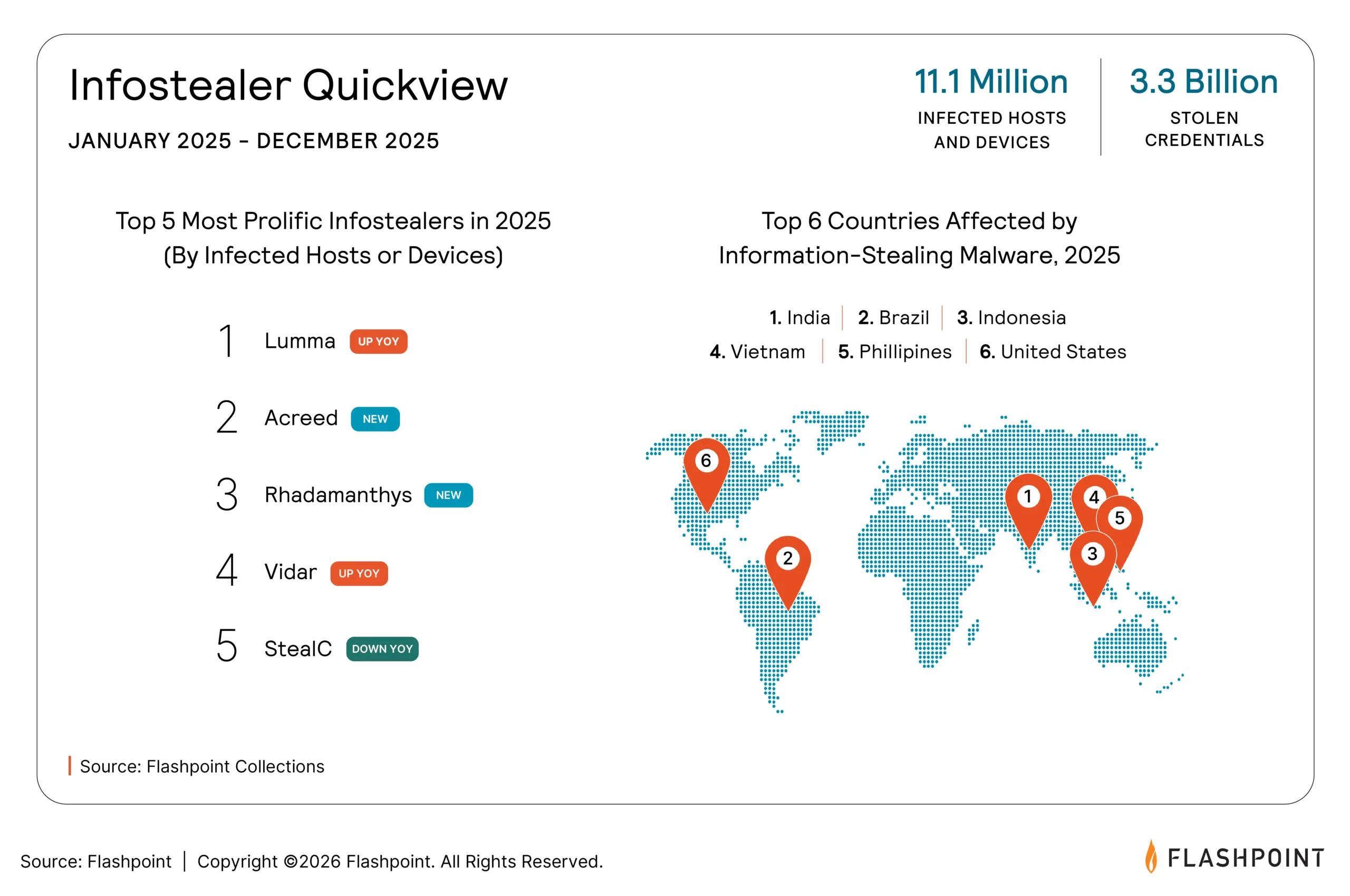
  • 3.3 billion compromised credentials and cloud tokens have turned identity into the primary exploit vector.
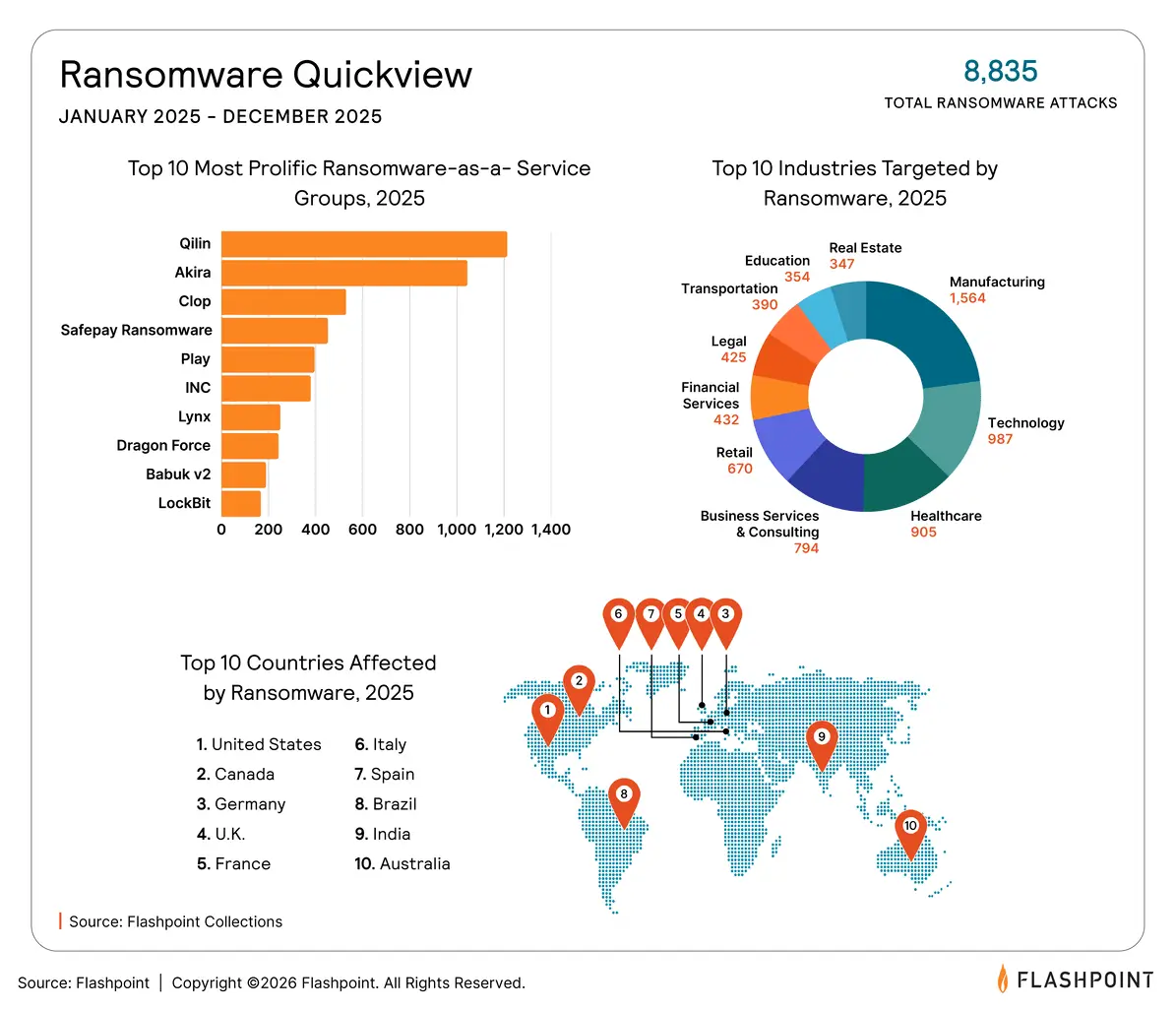
  • From January 2025 to December 2025, ransomware incidents rose by 53%, as attackers pivot from technical encryption to “pure-play” identity extortion.
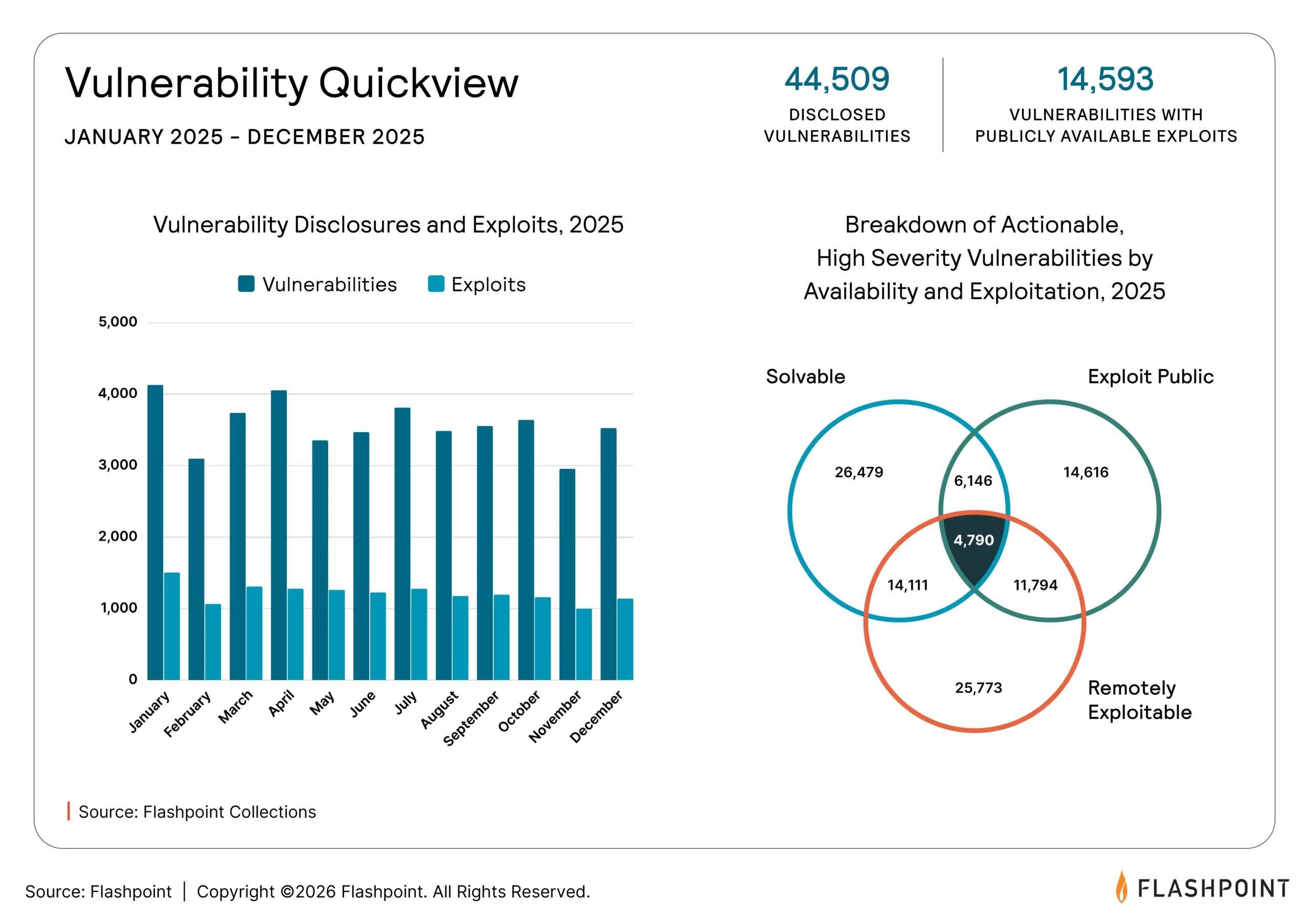
  • Vulnerability disclosures surged by 12% from January 2025 to December 2025, with the window between discovery and mass exploitation effectively vanishing.

These findings are derived from Flashpoint’s Primary Source Collection (PSC), a specialized operating model that collects intelligence directly from original sources, driven by an organization’s unique Priority Intelligence Requirements (PIR). The 2026 Global Threat Intelligence Report leverages this ground-truth data to provide a strategic framework for the year ahead. Download to gain:

  1. A Clear Understanding of the New Convergence Between Identity and AI
    Discover how threat actors are preparing to transition from generative tools to sophisticated agentic frameworks. Learn how 3.3 billion compromised credentials are being weaponized via automated orchestration to bypass legacy defenses and exploit the connective tissue of modern corporate APIs.
  2. Intelligence on the “Franchise Model” of Global Extortion
    Gain deep insight into the professionalized operations of today’s most prolific threat actors. From the industrial efficiency of RaaS groups like RansomHub and Clop to the market dominance of the next generation of infostealer malware, we break down the economics driving today’s cybercrime ecosystem.
  3. A Blueprint for Proactive Defense and Risk Mitigation
    Leverage the latest trends, in-depth analysis, and data-driven insights driven by Primary Source Collection to bolster your security posture by identifying and proactively defending against rising attack vectors.

As attackers automate exploitation of identity, vulnerabilities, and ransomware, defenders who rely on fragmented visibility will fall behind. To keep pace, organizations must ground their decisions in primary-source intelligence that is drawn from adversarial environments, so that decision-makers can get ahead of this accelerating threat cycle.”

Josh Lefkowitz, CEO & Co-Founder at Flashpoint

The Top Threats at a Glance

Our latest report identifies four driving themes shaping the 2026 threat landscape:

2026 Is the Era of Agentic-Based Cyberattacks

Flashpoint identified a 1,500% rise in AI-related illicit discussions between November and December 2025, signaling a rapid transition from criminal curiosity to the active development of malicious frameworks. Built on data pulled from criminal environments and shaped by fraud use cases, these systems scrape data, adjust messaging for specific targets, rotate infrastructure, and learn from failed attempts without the need for constant human involvement.

2026 is the era of agentic-based cyberattacks. We’ve seen a 1,500% increase in AI-related illicit discussions in a single month, signaling increased interest in developing malicious frameworks. The discussions evolve into vibe-coded, AI-supported phishing lures, malware, and cybercrime venues. When iteration becomes cheap through automation, attackers can afford to fail repeatedly until they find a successful foothold.

Ian Gray, Vice President of Cyber Threat Intelligence Operations at Flashpoint

Identity Is the New Exploit

Flashpoint observed over 11.1 million machines infected with infostealers in 2025, fueling a massive inventory of 3.3 billion stolen credentials and cloud tokens. The fundamental mechanics of cybercrime have shifted from breaking in to logging in, as attackers leverage stolen session cookies to behave like legitimate users.

The Patching Window Is Rapidly Closing

Vulnerability disclosures surged by 12% in 2025, with 1 in 3 (33%) vulnerabilities having publicly available exploit code. The strategic gap between discovery and weaponization is increasingly vanishing, as evidenced by mass exploitation of zero-day vulnerabilities in as little as 24 hours after discovery.

Ransomware Is Hacking the Person, Not the Code

As technical defenses against encryption harden, ransomware groups are pivoting to the path of least resistance: human trust. This approach has led to a 53% increase in ransomware, with RaaS groups being responsible for over 87% of all ransomware attacks.

Build Resilience in a Converged Landscape

The findings in the 2026 Global Threat Intelligence Report make one thing clear: incremental improvements to legacy security models are no longer sufficient. As adversaries transition to machine-speed operations, the strategic advantage shifts to organizations that can maintain visibility into the adversarial environments where these attacks are born.

Protecting organizations and communities requires an intelligence-first approach. Download Flashpoint’s 2026 Global Threat Intelligence Report to gain clarity and the data-driven insights needed to safeguard critical assets.

Get Your Copy

The post Navigating 2026’s Converged Threats: Insights from Flashpoint’s Global Threat Intelligence Report appeared first on Flashpoint.

  •  

WhisperPair exposes Bluetooth earbuds and headphones to tracking and eavesdropping

WhisperPair is a set of attacks that lets an attacker hijack many popular Bluetooth audio accessories that use Google Fast Pair and, in some cases, even track their location via Google’s Find Hub network—all without requiring any user interaction.

Researchers at the Belgian University of Leuven revealed a collection of vulnerabilities they found in audio accessories that use Google’s Fast Pair protocol. The affected accessories are sold by 10 different companies: Sony, Jabra, JBL, Marshall, Xiaomi, Nothing, OnePlus, Soundcore, Logitech, and Google itself.

Google Fast Pair is a feature that makes pairing Bluetooth earbuds, headphones and similar accessories with Android devices quick and seamless, and syncs them across a user’s Google account.

The Google Fast Pair Service (GFPS) utilizes Bluetooth Low Energy (BLE) to discover nearby Bluetooth devices. Many big-name audio brands use Fast Pair in their flagship products, so the potential attack surface consists of hundreds of millions of devices.

The weakness lies in the fact that Fast Pair skips checking whether a device is in pairing mode. As a result, a device controlled by an attacker, such as a laptop, can trigger Fast Pair even when the earbuds are sitting in a user’s ear or pocket, then quickly complete a normal Bluetooth pairing and take full control.

What that control enables depends on the capabilities of the hijacked device. This can range from playing disturbing noises to recording audio via built-in microphones.

It gets worse if the attacker is the first to pair the accessory with an Android device. In that case, the attacker’s Owner Account Key–designating their Google account as the legitimate owner’s—to the accessory. If the Fast Pair accessory also supports Google’s Find Hub network, which many people use to locate lost items, the attacker may then be able to track the accessory’s location.

Google classified this vulnerability, tracked under CVE‑2025‑36911, as critical. However, the only real fix is a firmware or software update from the accessory manufacturer, so users need to check with their specific brand and install accessory updates, as updating the phone alone does not fix the issue.

How to stay safe

To find out whether your device is vulnerable, the researchers published a list and recommend keeping all accessories updated. The research team tested 25 commercial devices from 16 manufacturers using 17 different Bluetooth chipsets. They were able to take over the connection and eavesdrop on the microphone on 68% of the tested devices.​

These are the devices the researchers found to be vulnerable, but it’s possible that others are affected as well:

  • Anker soundcore Liberty 4 NC
  • Google Pixel Buds Pro 2​
  • JBL TUNE BEAM​
  • Jabra Elite 8 Active​
  • Marshall MOTIF II A.N.C.​
  • Nothing Ear (a)​
  • OnePlus Nord Buds 3 Pro​
  • Sony WF-1000XM5​
  • Sony WH-1000XM4​
  • Sony WH-1000XM5​
  • Sony WH-1000XM6​
  • Sony WH-CH720N​
  • Xiaomi Redmi Buds 5 Pro​

We don’t just report on phone security—we provide it

Cybersecurity risks should never spread beyond a headline. Keep threats off your mobile devices by downloading Malwarebytes for iOS, and Malwarebytes for Android today.

  •  

WhisperPair exposes Bluetooth earbuds and headphones to tracking and eavesdropping

WhisperPair is a set of attacks that lets an attacker hijack many popular Bluetooth audio accessories that use Google Fast Pair and, in some cases, even track their location via Google’s Find Hub network—all without requiring any user interaction.

Researchers at the Belgian University of Leuven revealed a collection of vulnerabilities they found in audio accessories that use Google’s Fast Pair protocol. The affected accessories are sold by 10 different companies: Sony, Jabra, JBL, Marshall, Xiaomi, Nothing, OnePlus, Soundcore, Logitech, and Google itself.

Google Fast Pair is a feature that makes pairing Bluetooth earbuds, headphones and similar accessories with Android devices quick and seamless, and syncs them across a user’s Google account.

The Google Fast Pair Service (GFPS) utilizes Bluetooth Low Energy (BLE) to discover nearby Bluetooth devices. Many big-name audio brands use Fast Pair in their flagship products, so the potential attack surface consists of hundreds of millions of devices.

The weakness lies in the fact that Fast Pair skips checking whether a device is in pairing mode. As a result, a device controlled by an attacker, such as a laptop, can trigger Fast Pair even when the earbuds are sitting in a user’s ear or pocket, then quickly complete a normal Bluetooth pairing and take full control.

What that control enables depends on the capabilities of the hijacked device. This can range from playing disturbing noises to recording audio via built-in microphones.

It gets worse if the attacker is the first to pair the accessory with an Android device. In that case, the attacker’s Owner Account Key–designating their Google account as the legitimate owner’s—to the accessory. If the Fast Pair accessory also supports Google’s Find Hub network, which many people use to locate lost items, the attacker may then be able to track the accessory’s location.

Google classified this vulnerability, tracked under CVE‑2025‑36911, as critical. However, the only real fix is a firmware or software update from the accessory manufacturer, so users need to check with their specific brand and install accessory updates, as updating the phone alone does not fix the issue.

How to stay safe

To find out whether your device is vulnerable, the researchers published a list and recommend keeping all accessories updated. The research team tested 25 commercial devices from 16 manufacturers using 17 different Bluetooth chipsets. They were able to take over the connection and eavesdrop on the microphone on 68% of the tested devices.​

These are the devices the researchers found to be vulnerable, but it’s possible that others are affected as well:

  • Anker soundcore Liberty 4 NC
  • Google Pixel Buds Pro 2​
  • JBL TUNE BEAM​
  • Jabra Elite 8 Active​
  • Marshall MOTIF II A.N.C.​
  • Nothing Ear (a)​
  • OnePlus Nord Buds 3 Pro​
  • Sony WF-1000XM5​
  • Sony WH-1000XM4​
  • Sony WH-1000XM5​
  • Sony WH-1000XM6​
  • Sony WH-CH720N​
  • Xiaomi Redmi Buds 5 Pro​

We don’t just report on phone security—we provide it

Cybersecurity risks should never spread beyond a headline. Keep threats off your mobile devices by downloading Malwarebytes for iOS, and Malwarebytes for Android today.

  •  

The Curious Case of the Comburglar

By Troy Wojewoda During a recent Breach Assessment engagement, BHIS discovered a highly stealthy and persistent intrusion technique utilized by a threat actor to maintain Command-and-Control (C2) within the client’s […]

The post The Curious Case of the Comburglar appeared first on Black Hills Information Security, Inc..

  •  

Decrypting Full Disk Encryption with Dissect

Author: Guus Beckers

Back in 2022 Fox-IT decided to open source its proprietary incident response tooling known as Dissect. Since then it has been adopted by many different companies in their regular workflow. For those of you who are not yet familiar with Dissect, it is an incident response framework built with incident response engagements of any scale in mind. It allows you to extract artifacts from a variety of data formats and export them to a format of your choosing. Ever since Dissect has been open sourced a large number of individuals and institutions have contributed to the Dissect framework, culminating in the first Dissect partner day earlier in 2024.  

One of the most popular requests has been the capability to use Dissect in combination with common disk encryption methods like Microsoft’s BitLocker or its Linux equivalent LUKS. Internally at Fox-IT we were able to already use these capabilities. With the release of Dissect version 3.17 these capabilities are now also available to the community at large.  

Of course, a blog post is not complete without a demo. In this scenario a data acquisition has been performed against a disk protected with BitLocker. We are interested in a specific file located on the user’s desktop. During this scenario, a virtual machine was created with VMware Fusion which uses the .vmwarevm file format. Dissect can parse this format thanks to its associated loader.

First, we use Dissect to examine the disk properties:  

$ target-info "Windows 11 x64.vmwarevm" -v                                                                                                                                               
2024-11-27T11:57:18.474060Z [error    ] Failed to open an encrypted volume <Volume name='Basic data partition' size=67921509888 fs=None> with volume manager bitlocker: Failed to unlock BDE volume [dissect.target.volume] 
2024-11-27T11:57:18.634092Z [warning  ] <Target Windows 11 x64.vmwarevm>: Can't identify filesystem: <Volume name='Microsoft reserved partition' size=16776704 fs=None> [dissect.target.target] 
2024-11-27T11:57:19.416120Z [warning  ] <Target Windows 11 x64.vmwarevm>: Failed to find OS plugin, falling back to default [dissect.target.target] 
<Target Windows 11 x64.vmwarevm> 
 
 
Disks 
- <Disk type="VmdkContainer" size="68719476736"> 
 
 
Volumes 
- <Volume name="Basic data partition" size="104857088" fs="FatFilesystem"> 
- <Volume name="Microsoft reserved partition" size="16776704" fs="NoneType"> 
- <Volume name="Basic data partition" size="67921509888" fs="NoneType"> 
- <Volume name="part_fd7c00000" size="673185280" fs="NtfsFilesystem"> 
 
 
Hostname       : None 
Domain         : None 
Ips            : 
Os family      : default 
Os version     : None 
Architecture   : None 
Language       : 
Timezone       : None 
Install date   : 1970-01-01T00:00:00.000000+00:00 
Last activity  : None 

It seems the disk is encrypted, now we can use the latest version of BitLocker to decrypt the information.  Dissect supports three different types of decryption capabilities. An analyst can either use the user’s passphrase, the recovery key or can use a BitLocker file. Please check the updated documentation on the Dissect Docs page for more information.  For now we have created a keychain CSV file with the following information:  

$ cat keychain.csv 
bitlocker,recovery_key,,395791-328042-677721-279895-554466-214599-232023-709148 

We can use Dissect’s commands like target-info to check if the keychain works: 

$ target-info "Windows 11 x64.vmwarevm" -K keychain.csv                                                                                                                                     
2024-11-27T10:18:01.698079Z [warning  ] <Target Windows 11 x64.vmwarevm>: Can't identify filesystem: <Volume name='Microsoft reserved partition' size=16776704 fs=None> [dissect.target.target] 
2024-11-27T10:18:02.731474Z [warning  ] <Target Windows 11 x64.vmwarevm>: Empty hive: sysvol/windows/SECURITY [dissect.target.target] 
2024-11-27T10:18:02.737980Z [warning  ] <Target Windows 11 x64.vmwarevm>: Empty hive: sysvol/windows/SYSTEM [dissect.target.target] 
<Target Windows 11 x64.vmwarevm> 
 
 
Disks 
- <Disk type="VmdkContainer" size="68719476736"> 
 
 
Volumes 
- <Volume name="Basic data partition" size="104857088" fs="FatFilesystem"> 
- <Volume name="Microsoft reserved partition" size="16776704" fs="NoneType"> 
- <Volume name="Basic data partition" size="67921509888" fs="NoneType"> 
- <Volume name="part_fd7c00000" size="673185280" fs="NtfsFilesystem"> 
- <Volume name="Basic data partition" size="67921509888" fs="NtfsFilesystem"> 
 
 
Hostname       : SECRETDATAVM 
Domain         : None 
Ips            : 192.168.212.129 
Os family      : windows 
Os version     : Windows 11 Pro (NT 10.0) 26100.2314 
Architecture   : amd64-win64 
Language       : en_GB, en_NL, en_US 
Timezone       : Europe/Berlin 
Install date   : 2024-11-27T17:34:07.000000+00:00 
Last activity  : 2024-11-27T17:33:31.670376+00:00 

Alternatively, we can pass the recovery key value directly like this: 

$ target-info "Windows 11 x64.vmwarevm" -Kv 395791-328042-677721-279895-554466-214599-232023-709148 -v

Now we can browse through the decrypted filesystem and view the file on the user’s desktop: 

$ target-shell "Windows 11 x64.vmwarevm" -Kv 395791-328042-677721-279895-554466-214599-232023-709148 -q
                                                                                       
SECRETDATAVM:/$ cat c:/Users/Staff/Desktop/SuperSecretFile.txt 
Lorem ipsum dolor sit amet, consectetur adipiscing elit, sed do eiusmod tempor incididunt ut labore et dolore magna aliqua. Ut enim ad minim veniam, quis nostrud exercitation ullamco laboris nisi ut aliquip ex ea commodo consequat. Duis aute irure dolor in reprehenderit in voluptate velit esse cillum dolore eu fugiat nulla pariatur. Excepteur sint occaecat cupidatat non proident, sunt in culpa qui officia deserunt mollit anim id est laborum.

As you can imagine this also works with Linux in the exact same manner.  This time we use a LUKS passphrase in conjunction with Dissect:

$ target-info "Ubuntu 64-bit 24.04.1.vmwarevm" -Kv glad-design-paper-airplane                                                                                                                          
2024-11-27T11:48:07.224355Z [warning  ] Failed to decode raw key as hex, ignoring: glad-design-paper-airplane [dissect.target.helpers.keychain] 
2024-11-27T11:48:08.910029Z [warning  ] <Target Ubuntu 64-bit 24.04.1.vmwarevm>: Can't identify filesystem: <Volume name='part_00100000' size=1048064 fs=None> [dissect.target.target] 
2024-11-27T11:48:09.826056Z [warning  ] <Target Ubuntu 64-bit 24.04.1.vmwarevm>: Unsupported mount device: /dev/disk/by-id/dm-uuid-LVM-YZiSLhoYFljS62k2vIjl3IcTwSkd0QguADKOf0a8t9am1jNdm9J1zerrDU7SWWFd / [dissect.target.target] 
<Target Ubuntu 64-bit 24.04.1.vmwarevm> 
2024-11-27T11:48:13.916382Z [warning  ] No timestamp found in one of the lines in /var/log/syslog! [dissect.target.helpers.utils] 
2024-11-27T11:48:13.925913Z [warning  ] Timestamp '27 2024 12:40:57' does not match format '%b %d %H:%M:%S', skipping line. [dissect.target.helpers.utils] 
2024-11-27T11:48:13.936096Z [warning  ] Timestamp 'Nov 2024 11:40:35' does not match format '%b %d %H:%M:%S', skipping line. [dissect.target.helpers.utils] 
2024-11-27T11:48:13.936416Z [warning  ] Timestamp 'Nov 2024 11:40:35' does not match format '%b %d %H:%M:%S', skipping line. [dissect.target.helpers.utils] 
2024-11-27T11:48:13.944841Z [warning  ] Timestamp 'Nov 2024 11:40:15' does not match format '%b %d %H:%M:%S', skipping line. [dissect.target.helpers.utils] 
2024-11-27T11:48:13.950083Z [warning  ] Timestamp 'Nov 2024 11:40:11' does not match format '%b %d %H:%M:%S', skipping line. [dissect.target.helpers.utils] 
2024-11-27T11:48:13.985809Z [warning  ] Timestamp 'Nov 2024 11:40:04' does not match format '%b %d %H:%M:%S', skipping line. [dissect.target.helpers.utils] 
2024-11-27T11:48:14.037897Z [warning  ] <Target Ubuntu 64-bit 24.04.1.vmwarevm>: Could not match cloud-init log line in file: /var/log/cloud-init.log [dissect.target.target] 
2024-11-27T11:48:14.037992Z [warning  ] <Target Ubuntu 64-bit 24.04.1.vmwarevm>: Could not match cloud-init log line in file: /var/log/cloud-init.log [dissect.target.target] 
2024-11-27T11:48:14.038056Z [warning  ] <Target Ubuntu 64-bit 24.04.1.vmwarevm>: Could not match cloud-init log line in file: /var/log/cloud-init.log [dissect.target.target] 
 
Disks 
- <Disk type="VmdkContainer" size="21474836480"> 
 
Volumes 
- <Volume name="part_00100000" size="1048064" fs="NoneType"> 
- <Volume name="part_00200000" size="1902116352" fs="ExtFilesystem"> 
- <Volume name="part_71800000" size="19569573376" fs="NoneType"> 
- <Volume name="part_71800000" size="19552796160" fs="NoneType"> 
- <Volume name="ubuntu--vg-ubuntu--lv" size="19549650944" fs="ExtFilesystem">
 
Hostname       : personnel-VMware-Virtual-Platform 
Domain         : None 
Ips            : 
Os family      : linux 
Os version     : Ubuntu 24.04.1 LTS (Noble Numbat) 
Architecture   : x86_64-linux 
Language       : en_US, en_US 
Timezone       : Europe/Amsterdam 
Install date   : 2024-11-27T11:33:29.665213+00:00 
Last activity  : 2024-11-27T11:45:34.821181+00:00 

We can use the same technique to extract another file from the Ubuntu desktop: 

$ target-shell "Ubuntu 64-bit 24.04.1.vmwarevm" -K keychain.csv -v                                                                                                                           
2024-11-27T11:59:52.227142Z [info     ] Registered key Key(key_type=<KeyType.PASSPHRASE: 'passphrase'>, value='glad-design-paper-airplane', provider='luks', identifier=None, is_wildcard=False) [dissect.target.helpers.keychain] 
2024-11-27T11:59:52.227562Z [info     ] Registered key Key(key_type=<KeyType.RECOVERY_KEY: 'recovery_key'>, value='395791-328042-677721-279895-554466-214599-232023-709148', provider='bitlocker', identifier=None, is_wildcard=False) [dissect.target.helpers.keychain] 
2024-11-27T11:59:53.719915Z [info     ] Volume <Volume name='part_71800000' size=19569573376 fs=None> unlocked with Key(key_type=<KeyType.PASSPHRASE: 'passphrase'>, value='glad-design-paper-airplane', provider='luks', identifier=None, is_wildcard=False) (keyslot: 0) [dissect.target.volumes.luks] 
2024-11-27T11:59:53.922164Z [warning  ] <Target Ubuntu 64-bit 24.04.1.vmwarevm>: Can't identify filesystem: <Volume name='part_00100000' size=1048064 fs=None> [dissect.target.target] 
2024-11-27T11:59:54.733524Z [info     ] <Target Ubuntu 64-bit 24.04.1.vmwarevm>: Found compatible OS plugin: DebianPlugin [dissect.target.target] 
2024-11-27T11:59:54.770648Z [info     ] <Target Ubuntu 64-bit 24.04.1.vmwarevm>: Found compatible OS plugin: LinuxPlugin [dissect.target.target] 
2024-11-27T11:59:54.791479Z [info     ] <Target Ubuntu 64-bit 24.04.1.vmwarevm>: Found compatible OS plugin: UnixPlugin [dissect.target.target] 
2024-11-27T11:59:54.802888Z [warning  ] <Target Ubuntu 64-bit 24.04.1.vmwarevm>: Unsupported mount device: /dev/disk/by-id/dm-uuid-LVM-YZiSLhoYFljS62k2vIjl3IcTwSkd0QguADKOf0a8t9am1jNdm9J1zerrDU7SWWFd / [dissect.target.target] 

personnel-VMware-Virtual-Platform:/$ cat /home/personnel/Desktop/secretLinuxfile 
"Lorem ipsum dolor sit amet, consectetur adipiscing elit, sed do eiusmod tempor incididunt ut labore et dolore magna aliqua. Ut enim ad minim veniam, quis nostrud exercitation ullamco laboris nisi ut aliquip ex ea commodo consequat. Duis aute irure dolor in reprehenderit in voluptate velit esse cillum dolore eu fugiat nulla pariatur. Excepteur sint occaecat cupidatat non proident, sunt in culpa qui officia deserunt mollit anim id est laborum."

Last but not least, Dissect also contains the fve-dd utility.  fve-dd can be used to decrypt an entire disk which allows a wider range of external tools to be used. fve-dd works on any supported Dissect containers. The individual VMDK files can be extracted from the .vmwarevm container:

$ ls                                                                                                                                                                                           
Virtual Disk-s001.vmdk Virtual Disk-s002.vmdk Virtual Disk-s003.vmdk Virtual Disk-s004.vmdk Virtual Disk-s005.vmdk Virtual Disk-s006.vmdk Virtual Disk.vmdk

Now the disk can be decrypted using fve-dd. The decryption can take some time depending on the size of the disk:

$ fve-dd -p glad-design-paper-airplane -o decrypted.dd "Virtual Disk.vmdk" -v

Dissect and other tools can be used on the decrypted disk:

$ target-info decrypted.dd                                                                                                                                                                     
[…]

Disks
- <Disk type="RawContainer" size="21458059264">

Volumes
- <Volume name="part_00100000" size="1048064" fs="NoneType">
- <Volume name="part_00200000" size="1902116352" fs="ExtFilesystem">
- <Volume name="part_71800000" size="19569573376" fs="NoneType">
- <Volume name="ubuntu--vg-ubuntu--lv" size="19549650944" fs="ExtFilesystem">

Hostname       : personnel-VMware-Virtual-Platform
Domain         : None
Ips            :
Os family      : linux
Os version     : Ubuntu 24.04.1 LTS (Noble Numbat)
Architecture   : x86_64-linux
Language       : en_US, en_US
Timezone       : Europe/Amsterdam
Install date   : 2024-11-27T11:33:29.665213+00:00
Last activity  : 2024-11-27T11:45:34.821181+00:00

Have fun with the latest version of Dissect!  

  •  

Welcome to Shark Week: A Guide for Getting Started with Wireshark and TShark

Troy Wojewoda // In honor of Shark Week1, I decided to write this blog to demonstrate various techniques I’ve found useful when analyzing network traffic with Wireshark, as well as […]

The post Welcome to Shark Week: A Guide for Getting Started with Wireshark and TShark appeared first on Black Hills Information Security, Inc..

  •  

Who’s Bootin’? Dissecting the Master Boot Record

Hal Denton // Have you ever been given an encrypted hard drive to perform forensic analysis on? What could go wrong? Probably the first thought rolling through your mind is […]

The post Who’s Bootin’? Dissecting the Master Boot Record appeared first on Black Hills Information Security, Inc..

  •  

Webcast: Attack Tactics 7 – The Logs You Are Looking For

Slides for this webcast can be found here: https://www.blackhillsinfosec.com/wp-content/uploads/2020/09/SLIDES_AttackTactics7LogsYouAreLookingFor.pdf So we went through an attack in the BHIS Webcast, “Attack Tactics 5! Zero to Hero Attack.” Then we went through […]

The post Webcast: Attack Tactics 7 – The Logs You Are Looking For appeared first on Black Hills Information Security, Inc..

  •  
  •  
❌