❌

Reading view

In an age of AI, deciding what to trust is a foundational skill. Here’s how we’re helping educators teach it.

Launching the expanded AI Classroom Toolkit with Cyberlite during Global Media and Information Literacy Week 

AI is opening new pathways to information, giving people faster access to answers, ideas, and knowledge. At the same time, it’s making it harder to know whether the content we see is authentic. 

Companies that build AI have a responsibility to make it reliable and trustworthy, and that responsibility doesn’t shift to the people who use it. But AI is already shaping how people search, learn, and encounter information. Helping people navigate that reality means building media and AI literacy (MAIL): the judgment to decide whether and how to use AI and what information to trust. These skills are as foundational as AI safety, and educators are asking for help teaching them. 

That’s why, during Global Media and Information Literacy Week, we’re launching the expanded AI Classroom Toolkit: Unlocking Generative AI Safely and Responsibly, created with the online safety organization Cyberlite. It’s part of Microsoft’s broader commitment to make sure AI strengthens human thinking rather than replaces it. It also reflects Microsoft’s focus on education and empowerment, a core pillar of our Safe Participation Framework. 

Title slide: "Classroom Toolkit – Unlocking Generative AI Safely and Responsibly, 2026 Edition," with Microsoft and Cyberlite logos.

What’s new in the AI Classroom Toolkit

The expanded toolkit adds a deeper focus on critical thinking, verification, and media and AI literacy, helping students judge AI outputs and make informed decisions about what to trust online. Together with the original modules, it’s now a single, classroom-ready resource that covers the core of AI safety and literacy. Realistic, scenario-based lessons and activities help students practice these skills in situations they may encounter online: 

  • The Climate Campaign: Gina enters an online challenge to make a campaign for a cause she cares about and finds that some winning entries use AI to show events that never happened. Students sort a feed of real and AI-made posts and practice lateral reading. The lesson: whether a post was made with AI doesn’t decide whether it’s trustworthy. What it claims, and who is behind it, does. 
  • The Helpful Bot: Alex creates an AI help bot inside his online game, then catches it inventing details and collecting players’ personal information. Students learn why AI can get things wrong, how to trace claims to reliable sources, and why they’re responsible for AI-generated content they act on or share. 
  • What Kind of AI User Are You?: An interactive quiz, hosted by Cyberlite, helps students identify their AI habits, strengths, and potential blind spots, and gives them an AI Type to reflect on and discuss. 

“When we created the first Classroom Toolkit: Unlocking Generative AI Safely and Responsibly with Microsoft in 2023, most of the conversation was about using AI safely. Today, the questions young people ask about AI have grown sharper and more personal, like what to believe online or how far to trust a chatbot’s answer,” said Michelle Yao, cofounder of Cyberlite. 

The toolkit also reflects what young people in our co-design sessions with Cyberlite told us: they want to learn by doing, through games, real-life scenarios, and peer discussion. Teachers don’t need to be AI experts, and students don’t need an AI tool in hand to start. 

That approach builds on the reach and results of the original toolkit. Since 2023, the first version has reached educators in 10 countries and 11 languages, including through government and partner learning platforms. In South Korea, 93% of participating educators reported improved knowledge and understanding of ethical issues, privacy, and bias related to AI. 

“Our hope is that every student leaves a little surer of their own judgment, and that everyone feels more confident deciding how AI fits into their lives,” said Yao. 

Section 2 title slide: "Gina's Fight for the Ocean," with an illustration of a young woman wearing a "Skip Straws" T-shirt.

Literacy works alongside product design and policy

Education is one part of the equation. Our commitment to media and AI literacy also shows up in how we design products and the policies we support.  

Last month, we set out five principles for AI in education, including “AI designed to support students’ learning, not replace their thinking.” We also committed to enforceable privacy, safety, and transparency protections for qualifying educational AI products in US school districts. These protections help schools and families understand how these tools work and the controls available to them. 

Media and AI literacy is now a global priority

The Organisation for Economic Co-operation and Development has released a framework for a MAIL assessment beginning in 2029. As part of its Programme for International Student Assessment (PISA), it will examine how students reflect on, analyze, and evaluate information, including AI-generated information. This week in New Delhi, UNESCO is also launching an AI extension of its “Think Critically, Click Wisely” global curriculum, which Microsoft advised on. 

This growing global focus makes the need for support urgent—educators want help, and many aren’t getting it. In Microsoft’s 2026 AI in Education report, 53% of educators and 77% of students say they haven’t had AI training.  

Closing this skills gap matters beyond the classroom. Healthy societies depend on a shared basis of facts, informed public debate, and confident civic participation. As authenticity gets harder to judge, there’s a risk that people start doubting everything, creating what the Digital Inquiry Group calls a “dangerous declaration of permanent uncertainty.” MAIL offers a way through. It builds the confidence to decide what to trust. 

Media and AI literacy for every age

Across Microsoft, we’re helping people build these skills wherever they learn and find information: 

  • In classrooms: Students debate whether to accept, question, or rework an AI tool’s answers in an AI and Critical Thinking lesson from The Economist Educational Foundation, supported by Microsoft. Available alongside other media literacy lessons in Microsoft Learning Zone, the lesson has reached students in 116 countries. 
  • For content creators: UNESCO, with Microsoft’s support, is developing resources to help creator associations train their members in MAIL and is testing them with creators in Nairobi this week.  
  • In our products: Search Progress, built with input from the Digital Inquiry Group, turns research assignments into source-checking practice in Microsoft Teams for Education. 

What’s next 

Through Microsoft Elevate for Educators and local partners, we’ll bring the AI Classroom Toolkit to new audiences, with more languages and localized content rolling out through 2027. We’ll keep evolving it as technology and educators’ needs change. 

Explore the toolkit and supporting resources for educators today.  

AI will keep changing how people find information and the content they encounter. Our goal is to help people meet that change with confident, informed judgment about the AI they use and the information they trust so they can fully take part in civic and democratic life. 

The post In an age of AI, deciding what to trust is a foundational skill. Here’s how we’re helping educators teach it. appeared first on Microsoft On the Issues.

  •  

Disrupting the service economy behind transnational cybercrime operations

Most people have opened their messages to find a suspicious alert urgently telling them that a package cannot be delivered, a toll remains unpaid, a bank account needs attention, or a tax bill is overdue. The details may change, but the goal is the same: to get someone to click, share personal information, or pay. 

These messages are relentless. Delete and block one, and another takes its place. Ignore them, and more will follow. Fall for one, and the floodgates open. What appears to be a simple scam message is often the visible end of a much larger transnational cybercriminal operation. 

When Microsoft and Japan’s National Police Agency (NPA) followed a wave of fraud and scam activity targeting people and businesses in Japan, they expected to find individual campaigns. Instead, they found themselves inside a sprawling Chinese-language cybercrime marketplace where criminals could buy accounts, hosting services and tools used to create fake websites and online identities. The investigation expanded globally, involving the Japan Cybercrime Control Center (JC3), Resecurity, Cloudflare, Oracle, Proofpoint and TRM Labs to uncover the businesses sustaining this criminal ecosystem. 

Today, Microsoft and Health-ISAC, a global non-profit that helps health sector organizations share cyber threat information and collaborate to improve operational resilience, are moving to dismantle three components of this criminal marketplace: YAM Store, CoGUI and Iron Man.  

Since January 2026, YAM Store, CoGUI and Iron Man have collectively enabled more than one billion malicious messages targeting over 75,000 organizations worldwide, including more than 750 million messages geared toward Microsoft customers alone. These messages have been used to target consumers, healthcare organizations, financial institutions, and other businesses in more than 150 countries, generating tens of millions of dollars for their operators.   

Tracing the businesses behind the scams

The investigation began in late 2025 after Japan’s NPA alerted Microsoft to malicious messaging campaigns targeting people in Japan. NPA continued providing intelligence and investigative support as the partners traced those campaigns back to the businesses supplying criminals around the world. 

The trail led investigators deep into a Chinese-language cybercrime ecosystem that was difficult for non-native-speaking investigators to penetrate. There, they gained access to CoGUI, which supplied criminals with ready-made websites and messages impersonating companies, financial institutions, government agencies, and other trusted organizations. Instead of creating fraudulent websites themselves, criminals could quickly deploy pages designed to steal passwords, payment information, and other personal data.  

Two side-by-side screenshots of Amazon Japan webpages. The left shows an Amazon.co.jp login page with email and password fields. The right shows a payment method update page with fields for cardholder name, card number, expiration date, and security code, along with a yellow “Update now” button.
A fraudulent Amazon lookalike from CoGUI designed to steal login and payment information from Japanese-speaking users

As Microsoft’s investigation expanded, intelligence from JC3 helped confirm the scale of the activity affecting Japanese organizations and their customers. Drawing on information collected across its network of more than 130 member organizations, JC3 connected what appeared to be separate incidents to a broader pattern of scams targeting Japanese companies and financial institutions, including efforts to defraud consumers and to steal credentials and other sensitive information.  

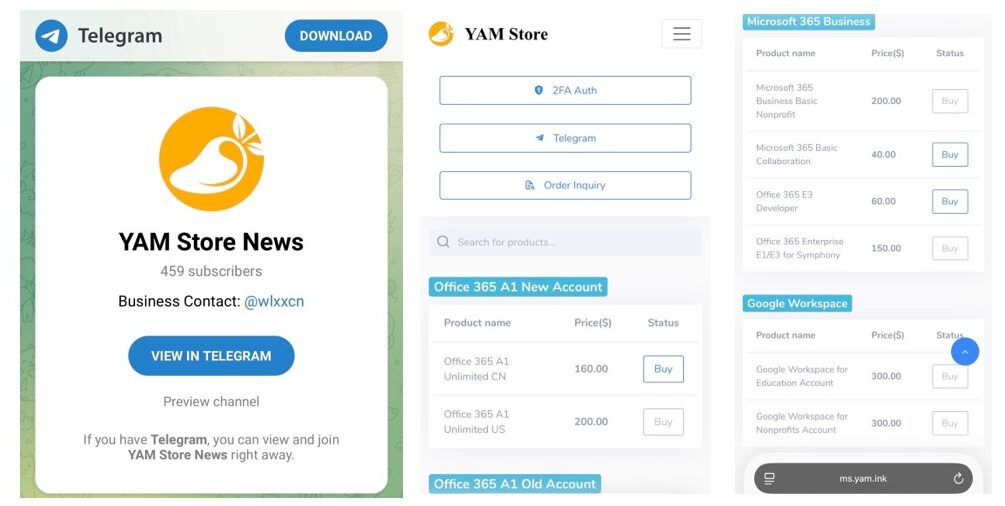
One name that kept appearing throughout the investigation was YAM Store. YAM Store operated much like an online shop. Customers could browse products, compare prices and purchase fraudulent Microsoft and Google accounts and other ready-made tools used to carry out scams, including credential theft. Controlled purchases conducted by Microsoft helped confirm how it worked. 

Three screenshots showing the YAM Store online marketplace. The left shows a Telegram preview for “YAM Store News” with 459 subscribers and a business contact. The center and right show YAM Store product listings offering Office 365, Microsoft 365 Business, and Google Workspace accounts at various prices, with “Buy” buttons.

In some cases, operators acquired internet domains that legitimate organizations had allowed to expire, often targeting certain sectors, such as non-profits and education, with specialized product offerings. They then rebuilt the websites to make those organizations appear active, allowing them to fraudulently obtain Microsoft 365 accounts that could later be sold through YAM Store.  

Screenshot of the Jewish Choice charity website. A blue banner reads “Supporting Health & Wellbeing in the Orthodox Jewish Community,” with text describing free, confidential support services for addiction issues and overall health, plus a “Get Help Today” button. The page also shows navigation links and an “About Jewish Choice” section.
A rebuilt nonprofit website used to create fraudulent Microsoft 365 accounts that could later be sold through YAM Store

Ready-made tools

YAM Store provided criminal infrastructure that was frequently paired with tools and services such as CoGUI. As investigators dug deeper, they found that the marketplace was already evolving. CoGUI had become one of the most widely used offerings in the ecosystem, particularly targeting victims in Japan and the United States but by mid-2026 it was increasingly being replaced by a newer offering known as Iron Man. 

Iron Man expanded the model by giving criminals access to thousands of ready-made templates designed to impersonate trusted organizations. Criminals could then quickly deploy email, text and web content tailored to specific brands, industries and countries.  

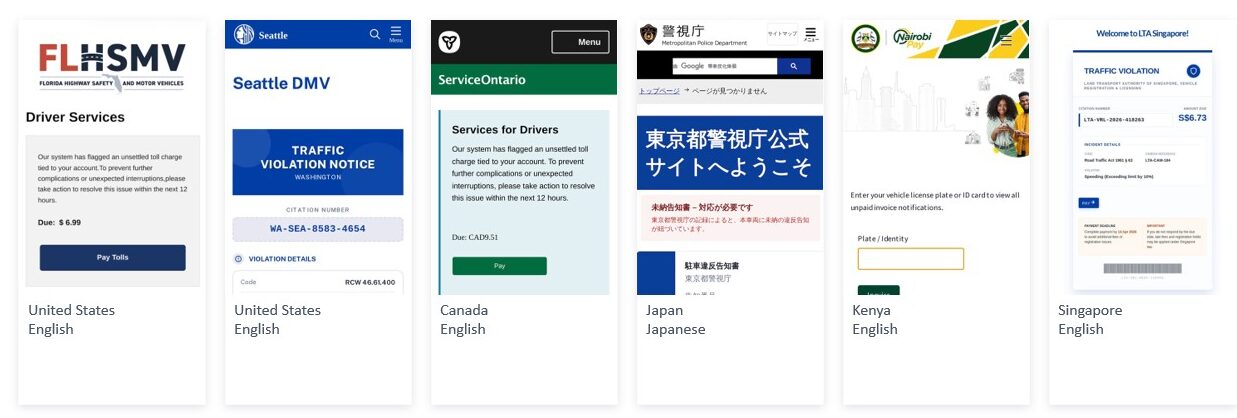
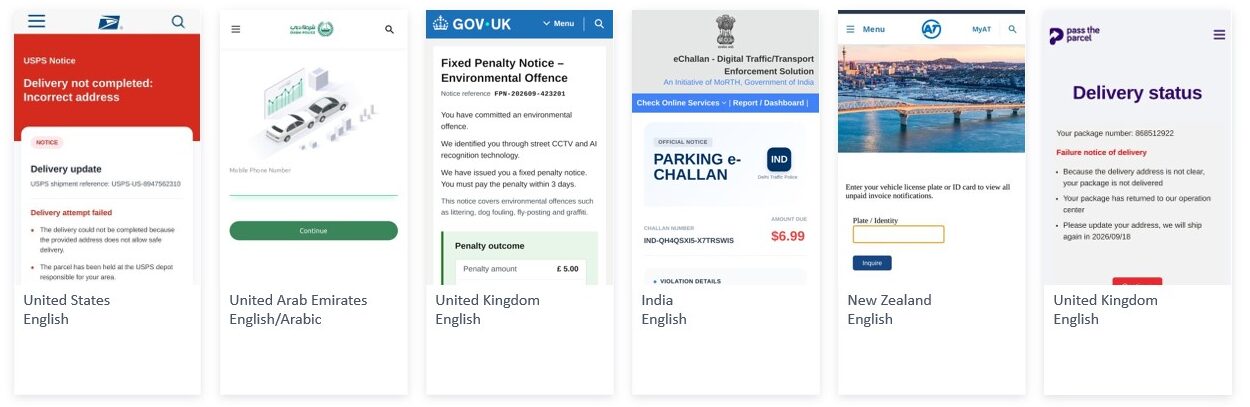
Through test purchases and work with Resecurity, investigators gained access to Iron Man and identified more than 2,300 templates impersonating banks, retailers, healthcare providers, transportation authorities, police departments, government agencies, and other organizations across more than 150 countries worldwide. Some were designed for government impersonation scams, using the appearance of official authority to pressure victims into making payments or disclosing sensitive personal information. Others impersonated organizations across industries, countries, and languages, from banks and airlines to telecommunications companies, retailers, and parcel delivery services.  

Examples of these impersonation templates are below. Importantly, the presence of an organization or government entity in these templates does not indicate that its systems were compromised. 

Six side-by-side screenshots of webpages in different languages and countries: a French DPD delivery status page, a German vehicle service payment notice, a Dutch tax refund application page, a Polish housing subsidy page, an Australian ANZ rewards points redemption page, and a Brazilian traffic fines consultation page.

Six side-by-side screenshots of traffic and driver-service webpages from different countries. The examples include Florida and Seattle traffic violation notices in the United States, an Ontario toll notice in Canada, a Japanese Metropolitan Police Department page, a Nairobi Pay vehicle notice page in Kenya, and a Singapore traffic violation notice with a payment amount.

Six mobile webpage examples from the United States, United Arab Emirates, United Kingdom, India, and New Zealand showing delivery notices, traffic or environmental penalties, parking charges, and requests to enter personal or vehicle information.
Examples of Iron Man templates impersonating brands and government organizations around the world
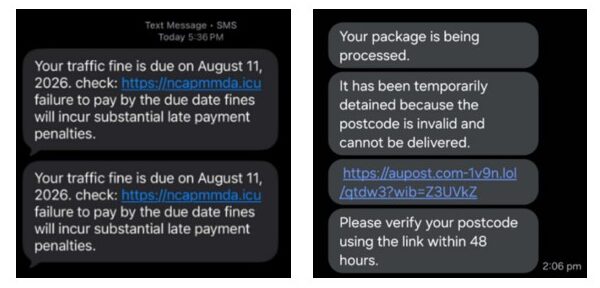
Two screenshots of suspicious text messages containing links. The left message claims a traffic fine is due and warns of late-payment penalties. The right message says a package has been detained because of an invalid postcode and asks the recipient to verify the postcode through a link within 48 hours.
Examples of Iron Man SMS templates impersonating traffic authorities in the Philippines and Australia Post, a package delivery service

A blog from Microsoft Threat Intelligence shares more details on the network, as well as steps customers can take to protect themselves.  

Putting the pieces together

No single organization saw the full picture. Japan’s NPA played a critical role throughout the investigation, providing intelligence, investigative support and collaboration that helped uncover how the operation worked. JC3 helped establish the scale of the activity affecting Japanese organizations and consumers. Health-ISAC provided insight into impacts affecting healthcare organizations, while Resecurity, Cloudflare, Oracle, Proofpoint and TRM Labs contributed intelligence and investigative support.  

Working together, and with the assistance of AI tools, we connected accounts, websites, and infrastructure that initially appeared unrelated, helping expose the broader criminal marketplace behind them. Microsoft also worked closely and shared intelligence with U.S. Secret Service and international law enforcement partners.

Alert page stating that a website domain has been seized by Microsoft, featuring the Microsoft logo and logos from collaborating organizations, including Japan’s National Police Agency, JC3, Health-ISAC, Resecurity, Proofpoint, Cloudflare, Oracle, TRM, Pillsbury, and law enforcement. Small text at the bottom references legal action and cybersecurity protections.

This investigation also reflects a broader trend highlighted in this year’s Microsoft Digital Defense Report: modern fraud increasingly relies on businesses and services that make it easier for criminals to reach more victims. It took two-way information sharing across industries and international borders to uncover how these deeply interconnected services worked together. 

Going after the suppliers

With an order from the United States District Court for the Southern District of Florida, Microsoft and Health-ISAC seized and redirected domains that were part of the underlying infrastructure powering YAM Store, CoGUI and Iron Man. Microsoft has already disabled more than 20,000 accounts connected to YAM Store and continues to dismantle the operation by removing infrastructure hosted on its services and blocking more than 100,000 domains used for impersonation and fraud.   

What began with scam activity targeting people and organizations in Japan led investigators to an underground service economy supplying criminals around the world. YAM Store, CoGUI and Iron Man are only part of that larger criminal network, but disrupting them makes it harder for criminals to obtain the accounts, tools and infrastructure they rely on. 

The scam message is often the only part victims see. The businesses behind it are what make it possible. 

The post Disrupting the service economy behind transnational cybercrime operations appeared first on Microsoft On the Issues.

  •  

Disrupting EvilTokens: The AI Chatbot Built for Cybercrime

Microsoft has disrupted EvilTokens, a powerful cybercrime platform that used AI at every step of the attack chain—from compromising email accounts to designing intricate roadmaps for financial fraud and scams. While EvilTokens helped cybercriminals access email accounts, at the center of the service was an AI-style chatbot that could analyze a victim’s inbox and help criminals identify trusted relationships, payment authorizations, and sensitive responsibilities, as well as other circumstances where fraud was most likely to succeed. The platform could even recommend fraud strategies, including drafting messages that impersonated trusted contacts to help criminals trick victims into taking action. 

In short, AI was not simply helping attackers write more convincing messages. It helped them decide who to target, who to impersonate, and how to most effectively exploit the relationship to extract as much money as possible.   

Within months of launching in February 2026, EvilTokens had been linked to more than 12,000 compromised email inboxes across over 10,000 organizations worldwide, showing how quickly the service gained traction. Microsoft observed the highest concentrations of victim activity in the United States, Canada, the United Kingdom, Australia, India, and France. Affected organizations ranged from wholesale distribution and construction to financial services, real estate, higher education, and healthcare. Working with partners, Microsoft seized 50 websites used to operate the service and disabled more than 150 additional domains tied to its supporting infrastructure. In the United Kingdom, the Metropolitan Police Service’s cybercrime team arrested two men on suspicion of offenses connected with the alleged operation of EvilTokens.  

But the significance of EvilTokens extends beyond its rapid growth and global reach. It offers an early warning of what happens when cybercriminals combine stolen access with AI capable of understanding how an organization works. 

From account access to financial fraud

EvilTokens helped criminals gain access to email accounts by tricking victims into entering an authentication code on Microsoft’s legitimate sign-in page. By completing the normal authentication sign-in process, victims unknowingly gave criminals access to their email accounts without revealing their passwords. That access could persist even after a password reset if the associated sessions and tokens were not also revoked. Microsoft Threat Intelligence provides additional technical details about the operation, how device-code attacks work, and steps customers can take to protect themselves here. 

Screenshot of an Outlook inbox showing an email about upcoming group events, with “AI Analysis” and “Summary” features highlighted in red.

Screenshot of an AI analysis interface identifying potential targets, opportunity levels, attack vectors, and financial opportunities based on scanned organizational emails.
EvilTokens AI analysis of compromised inbox and suggested follow- up prompts.

Once inside an account, criminals have traditionally needed time and experience to sift through thousands of messages, identify decision-makers, understand payment processes, and find opportunities for fraud. 

EvilTokens began automating that work. Its AI tools could summarize and translate emails, surface financial conversations, map organizational roles, identify trusted relationships, and recommend potential targets. Preset prompts offered to find wire-transfer discussions, identify the organization’s “money movers,” locate vendor invoices, and determine the best people to impersonate.

Sold through Telegram for a $1,500 initiation fee and a recurring $500 subscription, EvilTokens combined account compromise, mailbox analysis, target selection, and fraud preparation in a single service. Capabilities that once required experience across identity attacks, cloud systems, social engineering, and financial fraud were available through a ready-made interface.

Three screenshots of the EvilTokens Store Bot, including a DeviceCapture logo and messages advertising Microsoft 365 token capture and inbox access capabilities.
EvilTokens store on Telegram.
Screenshot of the EvilTokens “Essential Tools” dashboard displaying tools for token capture, browser access, traffic redirection, email automation, SMTP delivery, and email validation.
EvilTokens “Essential Tools” optimized for cybercrime.

AI lowered the barriers at both ends

Investigators found evidence that large portions of EvilTokens had been “vibe coded,” with AI helping its creators build the platform itself. They also determined that EvilTokens drew on capabilities from multiple AI models. 

The result was more than a collection of attack tools. EvilTokens packaged much of the fraud process into a commercially run service, complete with subscription pricing, customer support, management dashboards, and tools designed to move customers from account access toward financial exploitation.

Disrupting the platform

No single organization could disrupt EvilTokens alone. The service relied on hosting providers, cloud services, AI tools, financial services, and other online resources that cybercriminals repurposed to support fraud at scale. 

The disruption combined civil legal action with coordinated operational work across industry and law enforcement. Because healthcare organizations were among those targeted, Health-ISAC—a global non–profit that helps health sector organizations share cyber threat information and collaborate to improve operational resilience—joined Microsoft’s legal action as a co-plaintiff.

With authorization from the U.S. District Court for the Eastern District of Virginia, Microsoft and Health-ISAC worked with Cloudflare, Coinbase, OpenAI, Railway, SpyCloud, The Shadowserver Foundation, and TRM Labs to act against key parts of the platform. Microsoft also notified affected customers, helped remediate compromised accounts, and shared intelligence to support further defensive and investigative action.

The operation also demonstrated the value of rapid cooperation between private-sector investigators and law enforcement. Microsoft worked closely with specialist officers from the Metropolitan Police Service’s cybercrime team, sharing intelligence that enabled officers to take operational action in the United Kingdom. On September 11, 2026, officers arrested two men, aged 32 and 38, and seized digital devices and other items for examination. Both men have been released on police bail subject to conditions while the investigation continues. 

Screenshot of a Microsoft domain seizure notice featuring Microsoft and partner logos, including Cloudflare, Coinbase, Health-ISAC, Metropolitan Police, OpenAI, and others.
Seizure notice displayed after Microsoft and its partners disrupted infrastructure used by EvilTokens.

While EvilTokens used AI to identify targets and prioritize fraud opportunities, Microsoft investigators used reverse engineering and AI-powered tools to analyze evidence, accelerate the investigation, and identify the infrastructure supporting the service. The case shows how AI is changing not only how cybercriminals operate, but also how defenders investigate and disrupt them. 

This action marks the Microsoft Digital Crimes Unit’s (DCU) 40th court-authorized disruption spanning nearly two decades of targeting cyber threat actors, malicious tools, and supporting infrastructure. It is also DCU’s first action against an end-to-end AI-enabled cybercrime service. 

What EvilTokens reveals about cybercrime’s next phase

The infrastructure supporting EvilTokens has been disrupted, but the model it demonstrated will not disappear with it. As Microsoft notes in its 2026 Responsible AI Transparency Report, increasingly capable and accessible AI is being used to scale fraud, impersonation, and other forms of online abuse. EvilTokens offers an early example of how those capabilities can be combined with compromised accounts to accelerate financial fraud. 

For organizations, the lesson is: assume that once an inbox is compromised, criminals may understand its contents in minutes, not days. Strong identity protections and monitoring remain essential, but organizations should also independently verify requests to change payment information, redirect funds, or approve unusual transactions through a trusted second channel.


The post Disrupting EvilTokens: The AI Chatbot Built for Cybercrime appeared first on Microsoft On the Issues.
  •  

TikTok, YouTube, and Roblox face scrutiny, but age gates won’t fix child safety

A damaging new report from Ofcom, the UK’s communications regulator, has delivered a stark verdict: TikTok and YouTube’s content feeds are “not safe enough” for children. This isn’t just another regulatory slap on the wrist. Ofcom is putting out a wake-up call for anyone working in cybersecurity, threat intelligence, and online safety.

In its own words:

“Notably, TikTok and YouTube failed to commit to any significant changes to reduce harmful content being served to children, maintaining their feeds are already safe for children.”

On the positive side, Snap, Meta, and Roblox agreed to adopt further safety measures to protect children from online grooming and “stranger danger.”

The BBC reports that an Ofcom survey found 84% of children aged 8 to 12 were still using at least one major service with a minimum age of 13. We reported earlier about how easy it was to fool some of the age verification methods. Researchers using under-13 accounts also reported encountering sexual content and offensive language shortly after entering specific Roblox games.

Speaking of Roblox, The Guardian reports that US advocacy groups have formally requested the Federal Trade Commission (FTC) investigate Roblox for what they call “unfair and deceptive” practices. The complaint focuses on:

  • In-game purchases pressuring children to spend money
  • Chat functionality exposing children to strangers
  • Features designed to maximize engagement, which critics argue may be addictive

Drew Benvie, CEO of Battenhall and founder of youth safety nonprofit Raise, noted:

 “Although Roblox is implementing new age-based safety measures, young players are adept at circumventing these protections.”

The cybersecurity point of view

What keeps cybersecurity researchers up at night is another angle to this problem. Many proposed age assurance solutions require users to hand over government IDs or biometric selfie data. We already talked about this in our blog, Age verification: Child protection or privacy risk?

Age verification systems create massive data collection opportunities that become prime targets for:

  • Data breaches exposing sensitive personally identifiable information (PII)
  • Identity theft facilitated by centralized ID databases
  • Biometric data theft, which cannot be changed like passwords
  • Malware and scams targeting users on less-secure platforms

When restrictions push young users toward smaller or less secure sites, they encounter:

  • No basic safety protections
  • Higher exposure to malware
  • Increased phishing and scam risks
  • Unmoderated harmful content

This is exactly what we see in threat intelligence: As defenders secure one vector, cybercriminals adapt and move elsewhere.

Safer systems beat stricter age gates

Protecting children should focus on building safer digital experiences overall. This is the only viable path forward because:

  • Stronger moderation actually removes harmful content rather than just blocking access
  • Safer recommendation systems prevent algorithmic amplification of harmful content
  • Better platform accountability means companies can’t prioritize engagement over safety
  • Avoiding invasive data collection prevents creating massive honeypots for attackers

As someone who analyzes malware and threats daily, I can tell you: security through obscurity (age gates) doesn’t work. Security through robust system design (moderation, safer algorithms, accountability) does.


Scammers don’t need to hack you. They just need you to click once. 

Malwarebytes Identity Theft Protection catches suspicious activity before it becomes a problem.

  •  

If a fake moustache can fool age checks, is the Online Safety Act working?

A report based on a survey by the UK’s Internet Matters shows that much of the responsibility for managing the online safety of children still falls on families.

The Online Safety Act came into effect in July, 2025, and the report explores what has changed in the online lives of UK families since then.

We discussed in December 2025 whether the privacy risks of age verification outweighed the enhanced child protection. While the report shows some progress, it mostly provides “an early view of how the online landscape is changing, and crucially, where it is not.”

Around half of children say they now see more age-appropriate content, and roughly four in ten parents and children feel the online world has become somewhat safer.

The online world is as much a part of a child’s environment as the physical world is. And blocking the view to parts of that world is not taken lightly. Almost half of children think age checks are easy to bypass. About a third admit to doing so recently, using tactics from fake birthdates and borrowed logins to spoofed faces and, less commonly, VPNs.

“I did catch my son [12] using an eyebrow pencil to draw a moustache on his face, and it verified him as 15 years old.”

Yet 90% of children who noticed improved blocking and reporting saw this as a good thing. Their support for these safety features is pragmatic. They point to:

  • clearer rules
  • restricted contact with strangers
  • limits on high-risk functions

 They also rate these features as helpful in reducing exposure to harmful content and interactions.

But the system is not perfect. In the month after the child protection codes came into force, almost half of children reported some online harm, including violent, hateful, and body image-related content that should be covered by the Act’s protections.

The survey also revealed that age checks are now commonplace. Over half of children said they were asked to verify their age within a recent two-month window, often on major platforms like TikTok, YouTube/Google, and Roblox, on both new and existing accounts.

The technology is improving. Platforms use facial age estimation, government ID, and third-party age assurance apps, and these are usually easy for children to complete.

However, gains in protection come with unresolved and, in some cases, growing concerns around privacy and data use, especially around age verification and AI.

Parents are worried not just about what data is collected for age checks, but whether it will be stored or reused by government or industry. This has fueled calls for central, privacy-protective solutions rather than fragmented data collection across platforms.

Because age assurance systems are both intrusive (in terms of data) and often ineffective (easy workarounds, weak enforcement), the report suggests they may not yet provide a good safety-to-privacy trade-off from a family perspective.

Obviously, the survey also didn’t capture input from adults pretending to be children to gain access to child-only spaces, a risk that parents link directly to predatory behavior.

The authors conclude that the Online Safety Act has started to reshape children’s online environments, making safety features more visible and enabling more age‑appropriate experiences in some areas.

However, the Act has not yet produced a “step change.” Harmful content remains widespread, age‑assurance is patchy and easy to circumvent, and key concerns such as time spent online, AI risks, and persuasive design remain under‑regulated.


Browse like no one’s watching. 

Malwarebytes Privacy VPN encrypts your connection and never logs what you do, so the next story you read doesn’t have to feel personal. Try it free → 

  •  

Working constructively with the UK CMA to support customer choice and cloud competition

Today we are sharing news about important changes we are making in our cloud services offerings in the United Kingdom. These changes address issues the Competition and Markets Authority (CMA) has raised and  reviewed as part of its Cloud Market Investigation Report, announced in July 2025.

In conjunction with the CMA’s extensive review, today’s changes will apply to UK customers using Microsoft Azure. The changes address the CMA’s commitment to ensuring that UK customers can continue to move, deploy, and operate their workloads in the clouds of their choice with confidence, flexibility, and ever-reduced friction. The changes are focused on data egress, switching, and interoperability, and are described in a more detailed fact sheet accompanying this statement. We will implement all these changes promptly. We will also proactively share information about these changes with other regulators around the world.

We recognize that the CMA will continue to review and assess additional issues relating to our products and services, including in the business software market. We are committed to working quickly and constructively to address these issues, including by providing all the information the CMA needs to move forward with its reviews.

The cloud and AI markets continue to change at an unprecedented pace. The cloud market itself remains intensely competitive, with large investments by Amazon, Google, Oracle, and new neo-cloud entrants and, ironically, with Google, a complainant in this review, growing faster in the last quarter of 2025 than Amazon or Microsoft.

Especially in times of such dynamic change, a thorough regulatory review requires rapid access to real-world market data and customer input. This is the only way regulators can act in a targeted and agile manner that brings faster changes to the market while fostering continued innovation and investment. This type of work always requires dialogue on both sides. We appreciate the opportunity we have had for direct and constructive conversations with the CMA and its staff and look forward to an ongoing dialogue in relation to relevant cloud issues in the future.

Microsoft has long been committed to addressing the competition and antitrust issues raised by regulators and enforcement agencies through constructive engagement, transparency, and a willingness to address concerns promptly and in practical ways. We believe this has served our shareholders and customers well, avoiding protracted litigation, legal defeats, and large fines.


The post Working constructively with the UK CMA to support customer choice and cloud competition appeared first on Microsoft On the Issues.
  •  

Building a safer digital future, together

As we mark Safer Internet Day 2026, we’re reflecting on a simple but enduring principle: safety must be designed into online services, not bolted on. Microsoft’s work in this space spans more than two decades—from technology solutions like PhotoDNA to our investments in responsible gaming, public-private partnerships, and empowering users through education. This foundation guides our approach as we help individuals and families navigate a rapidly evolving landscape shaped by new technologies and new risks and as we innovate with next-generation AI offerings. At a moment when 91% of people tell us they worry about harms introduced by AI, our commitment to responsible innovation has never been more important—especially for our youngest users.

Read on for more about our longstanding efforts to create a safer digital environment, plus key findings from our Global Online Safety Survey and new examples of our work to empower families and communities through tools, research, and educational resources—including the latest release in Minecraft Education’s CyberSafe series.  

Ten years of safety research 

2026 marks the tenth year of our annual Global Online Safety Survey research. For a decade, we have invested in surveying teens and adults around the world about their experiences and perceptions of life online—aiming to provide fresh insights to support our collective work. That’s 130,000+ interviews across 37 countries, with the results available on our website. Ten years later, respondents tell us that they feel more connected and more productive, but less safe online.  

This year’s Global Online Safety Survey also highlights the complexity of the digital environment young people now inhabit. Teens’ exposure to risk rose again, with hate speech (35%), scams (29%), and cyberbullying (23%) among the most commonly experienced harms. At the same time, teens demonstrated striking resilience: 72% talked to someone after experiencing a risk, and reporting behavior increased for the second consecutive year. But worries about the misuse of AI continue, underscoring again why safety-by-design for AI is essential, not optional. Find the full results and country-level summaries here. 

Year on year, the research has told a story of evolving online safety risks and of the real-world impact. In 2026, the call to action is more urgent than ever—unless industry can deliver safe and age-appropriate experiences, young people risk losing access to technology. At Microsoft, spanning across our teams from Windows to Xbox, we have sought to continuously evolve our approach and to lead industry in advancing tailored and thoughtful safety solutions.   

Evolving to meet the moment 

Looking ahead, we know we need to continue to build strong guardrails to tackle acute risks and to leverage our experience while being informed by new research, new perspectives, and new technologies. The application process closed yesterday for our first AI Futures Youth Council, to be comprised of teens from across the US and EU. We’re looking forward to bringing those teens together soon for a first meeting to get their direct feedback on the role they want emerging technology to play in their lives and how we can best support their safety.  

Microsoft has partnered with Cyberlite on a second youth-centered initiative to understand how teens aged 13–17 are engaging with AI companions. Through codesign workshops with students in India and Singapore, we’re capturing young people’s own perspectives on the benefits, risks, and emotional dimensions of AI use—insights that will directly inform educational resources for teens, parents, and educators. Early findings from the first workshop in December 2025 show that young people value AI as a judgment free space while also recognizing the tradeoffs: privacy risks, overreliance, and erosion of critical thinking loom larger for them than bad advice.  

We’re also thinking about how we define safety in the next era of Windows, leveraging the Family Safety controls that have been integrated for over a decade. As many countries have raised the local age for digital consent, more parents will have the option to enable parental controls for teens up to the age of 18—leveraging these tools as part of a holistic approach to digital parenting. And to help parents set up and understand Family Safety, we’ve developed a short new guide. 

Safety is also about transparency, empowerment, and education. At Xbox, bringing the joy of gaming to everyone means remaining transparent about the many ways we innovate so players, parents, and caregivers can feel confident that Xbox continues to be a place for positive play. You can read more about our recently published Xbox Transparency Report and the tools and resources available to players on the Xbox Wire blog.  

We’re also excited to announce the latest release in Minecraft Education’s CyberSafe series: CyberSafe: Bad Connection? This series of immersive Minecraft worlds and educational resources is free and helps translate complex risks into fun learning experiences that meet young people in their favorite blocky world. Bad Connection?—the fifth in the series—reflects our commitment to evolving to meet new and challenging risks, with a focus on tackling serious risks related to online recruitment and radicalization. Learn more about how to access this new Minecraft world here.  

The CyberSafe series has reached more than 80 million downloads since 2022 through a partnership between Minecraft Education, Xbox, and Microsoft, helping a generation of young players build the agency, resilience, and digital citizenship they need to navigate an increasingly online world. As part of our commitment to ensure people have the knowledge and skills they need to benefit from technology and stay safe, Microsoft Elevate is empowering educators and students with tools and guidance to build safer, more responsible digital habits, recognizing that AI is transforming how people learn, work, and connect. Our commitment to helping young people access technology safely is also why we’ve partnered with organizations, like the National 4-H Council to prepare young people for an AI-powered world through AI literacy and digital safety curriculum and game-based learning with Minecraft Education. 

As we look ahead, our goal is clear: build technology that is safe by design, guided by evidence, and informed through partnership. The internet has changed profoundly over the past decade, and so too have the expectations of the people who use it. Safer Internet Day is a reminder that progress requires sustained collaboration across industry, civil society, researchers, and families.

—  

Global Online Safety Survey Methodology  

Microsoft has published annual research since 2016 that surveys how people of varying ages use and view online technology. This latest consumer-based report is based on a survey of nearly 15,000 teens (13–17) and adults that was conducted this past summer in 15 countries examining people’s attitudes and perceptions about online safety tools and interactions. Responses to online safety differ depending on the country. Full results can be accessed here.  


The post Building a safer digital future, together appeared first on Microsoft On the Issues.
  •  

‘All brakes are off’: Russia’s attempt to rein in illicit market for leaked data backfires

Russian state has tolerated parallel probiv market for its convenience but now Ukrainian spies are exploiting it

Russia is scrambling to rein in the country’s sprawling illicit market for leaked personal data, a shadowy ecosystem long exploited by investigative journalists, police and criminal groups.

For more than a decade, Russia’s so-called probiv market – a term derived from the verb “to pierce” or “to punch into a search bar” – has operated as a parallel information economy built on a network of corrupt officials, traffic police, bank employees and low-level security staff willing to sell access to restricted government or corporate databases.

Continue reading...

© Photograph: Alexander Zemlianichenko/AP

© Photograph: Alexander Zemlianichenko/AP

© Photograph: Alexander Zemlianichenko/AP

  •  

Uplifting and empowering young people for an AI future

Today, I had the pleasure of joining a range of leaders for timely, impactful discussions on child well-being in the age of AI at the Vatican, building on thoughtful conversations held during the United Nations General Assembly. These issues are top of mind globally, from parents to policymakers to physicians.

At Microsoft, we remain focused on our goal of empowering young people to use technology safely, mindfully, and in pursuit of social, educational, and economic opportunities. That means taking new steps spurred by regulation, such as new age verification measures for our UK Xbox users, as well as adapting our longstanding commitments to responsible AI and child online safety and privacy to build trust in the AI era. Today, we’re sharing new research on youth perspectives, announcing the AI Futures Youth Council to amplify teen voices, and offering policy recommendations to help families navigate the digital world with confidence.

Centering young people’s voices: Announcing the AI Futures Youth Council and new age assurance research

In 2017, Microsoft led the industry with our first Council for Digital Good—a forum where we could hear directly from young people about their experiences and perceptions of online risk. In 2025, with AI reshaping our world—and their future—we again need to center the voices of young people as we think about responsible design for AI and how we set students up for the future. We are actively working with teens from the Asia-Pacific region to develop our first “for teens, by teens” guide to AI chatbots. Today, I’m pleased to announce the upcoming launch of our first “AI Futures Youth Council,” bringing together teens from the US and Europe to have their say on their future. We’ll share more about the application process soon.

We know that a critical precursor to providing young people positive and productive online experiences is understanding which users are young people. Around the globe, the debate over how to achieve age assurance online continues unabated. We have been grateful to work with CIPL and the WeProtect Global Alliance over the last year to explore how to achieve improved age assurance that is consistent with fundamental rights of privacy and access to information. As with any other safety intervention, our goal is to be proportionate and thoughtful where we take new steps, which is why we have focused on gaming in the first instance—reflecting the responsibilities we have to our youngest users and our ongoing commitment to player safety.

To inform our strategy and the broader policy conversation, we partnered with Praesidio Safeguarding to better understand youth perspectives on age assurance approaches across the UK, Ghana, and Indonesia. We are pleased to share that research today. The findings reinforce the importance of transparency, choice, and trust: teens want clear explanations of how their data is used, express concerns about exclusion where formal proof of age is lacking and show varying comfort levels with the use of biometric and behavioral data. Notably, young people value parental involvement but also highlight the need for independence and privacy as they mature. The results also highlight some of the important differences across geographies. For example, teenagers in Ghana often not only share devices with their families but may also share an account—underscoring a need for nuanced global approaches at multiple layers of the technology stack.

These insights underscore our belief that proportionality—matching safeguards to actual risks—is essential to building trust and empowering youth online. They also highlight the need for age assurance models that are inclusive, flexible, and respectful of youth autonomy—especially in global contexts where device and account sharing are common. We remain committed to ongoing dialogue and innovation, ensuring that our solutions evolve alongside the needs and expectations of children, families, and society at large.

Our policy recommendations: Empower young people to use technology safely

We believe technology should empower young people, not put them at risk. Given the diverse range of online services, it is important to remember there is no single “digital seatbelt” to protect and empower young people online.

We therefore offer the following recommendations as policymakers, regulators, and experts continue to discuss these issues, building on our 2024 blog:

  • Avoid blanket access restrictions. Age assurance requirements that block full access to a service—except in limited cases like sites dedicated to age-restricted content (e.g., pornography)—can unintentionally limit child rights, such as access to information. Instead, age assurance should be applied at the service level, target specific design features that pose heightened risks, and enable tailored experiences for children.
  • Focus on the highest risks for impact, such as content and features associated with documented harms to children, and as determined through democratic processes. Providers should take steps to assess and mitigate risks to children on their services, while ensuring documentation requirements or compliance obligations do not inadvertently undermine safety. A risk-based and proportionate approach—grounded in clear criteria and supported by interoperable standards—can also help ensure that age assurance is applied where most needed, without introducing unnecessary friction. Providers of high-risk services should bear the responsibility of age assurance.
  • Strengthen safeguards for AI companions. Recent tragic events have highlighted the need for continued care in developing AI companions, especially where these may be used by young people. At Microsoft, we are building AI services for empowerment and want the right guardrails in place to protect all users but welcome new, commonsense measures such as those enacted in California and Australia to reduce the potential harms related to suicide and self-injury risks, as well as to sexualized or violent content. We will continue to work closely with researchers and experts to understand and mitigate potential risks to young people in this fast-evolving field.
  • Incentivize age-appropriate design. Banning kids from online services isn’t the answer, but what constitutes an “age-appropriate” experience will vary. We have supported a duty of care approach to child safety where the duty can be implemented flexibly, guided by thoughtful and evidence-based regulatory guidance. Ongoing research and expert engagement are needed to understand how to advance child safety and rights on diverse services—not just social media.
  • Protect the privacy and security of all users. Tailoring age assurance requirements will help enable proportionate approaches to data processing. Current proposals for age verification by app stores risk creating significant privacy risks by collecting sensitive information and sharing unnecessary age data with a wide variety of services while also not solving the challenges lawmakers want to address. We continue to support federal privacy legislation in the US and encourage global efforts to develop standards and certifications for age assurance providers. Trusted credential sharing can also increasingly be enabled by emerging digital identity ecosystems—including government-issued IDs and wallet-based models—that preserve mutual privacy between issuers and relying parties.
  • Support, not overwhelm Our Global Online Safety Survey results show that while parents might underestimate the risks teens face online, teens are most likely to turn to a parent for help. Parents should not face a deluge of notifications nor bear the sole responsibility for safety but have access, awareness, and education on family safety tools that can help them make informed choices appropriate for their family and their values.
  • Foster multistakeholder collaboration. We believe it’s essential to elevate the voices and perspectives of young people, as well as for regulators and industry to engage with civil society and partner to advance practical solutions. As child safety regulations come into force, it will also be important to get feedback from affected communities on where regulation may have adverse rights impacts, as well as to understand where harm may have been averted. Public education will be needed to help all users understand why their online experiences might be changing.

We will continue learning, listening, and collaborating, especially with our new Council, and look forward to sharing our insights.


The post Uplifting and empowering young people for an AI future appeared first on Microsoft On the Issues.

  •  

15 Ways to Be a Safer Computer User

Sierra Ward // Editor’s note: Though infosec professionals may see this advice as basic to the point of being obvious, as we visit with people and interact with swaths of other […]

The post 15 Ways to Be a Safer Computer User appeared first on Black Hills Information Security, Inc..

  •  
❌