
Reading view

FBI Seizes NetNut Proxy Platform, Popa Botnet

The Federal Bureau of Investigation (FBI) said today it worked with industry partners to seize hundreds of domains associated with NetNut, a sprawling residential proxy service operated by the publicly-traded Israeli company Alarum Technologies [NASDAQ: ALAR]. The action comes roughly two weeks after KrebsOnSecurity published findings from multiple security firms connecting NetNut to the Popa botnet, a collection of at least two million devices that have been compromised by malicious software with little or no consent from victims.
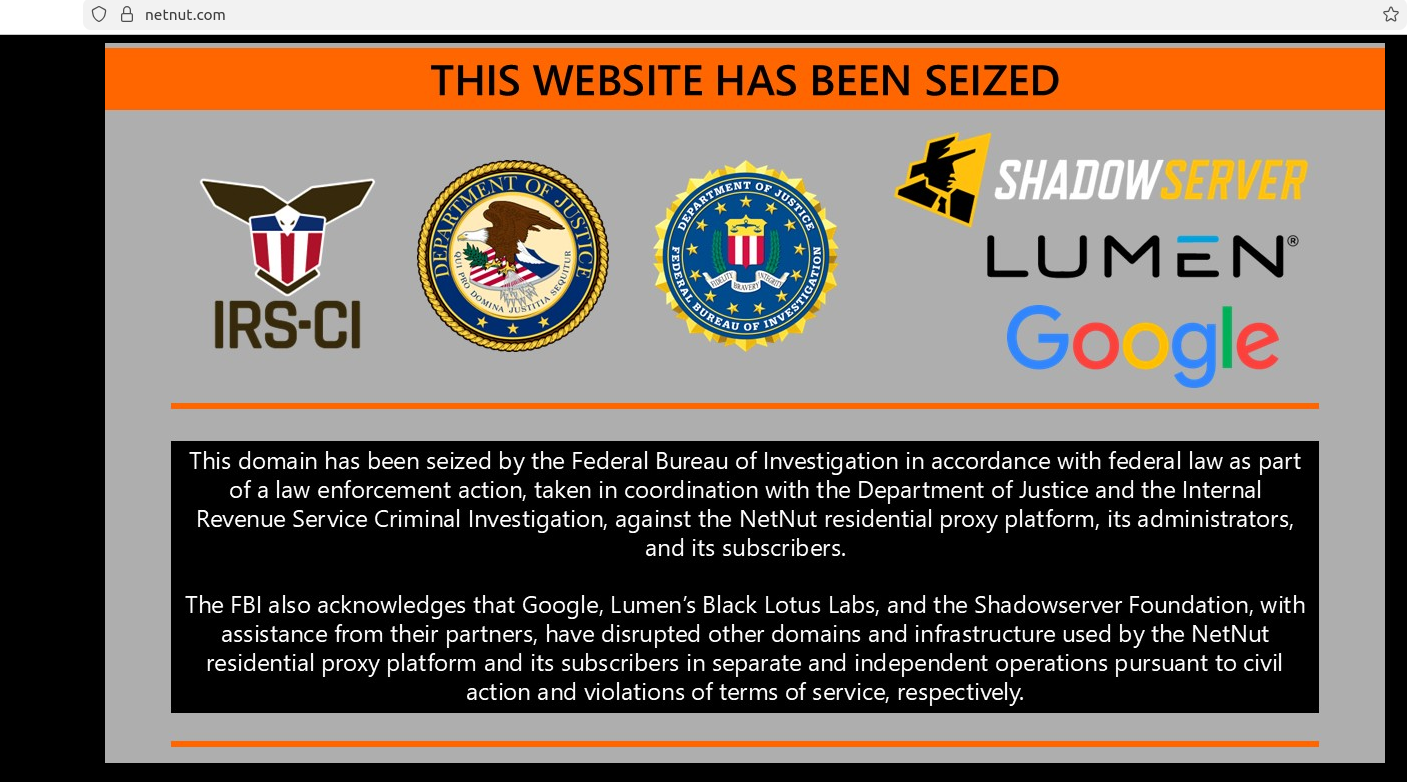
The NetNut homepage today was replaced by this seizure banner from the FBI.

On June 19, three different security firms issued similar findings: That NetNut is a residential proxy network which populates a botnet called Popa, and distributes software for devices commonly found in homes, such as smart TVs and streaming boxes. NetNut’s software turns those systems into always-on residential proxy nodes that are rented to others, who predominantly use them to relay abusive and intrusive Internet traffic, such as mass content scraping, advertising fraud, and account takeover activity.

Earlier today, NetNut’s homepage was replaced with a seizure notice from the FBI and the Internal Revenue Service Criminal Investigation division. The seizure notice thanked Google, Lumen, Shadowserver and other industry partners for their help in dismantling hundreds of domains tied to the Popa botnet, which experts say has long been synonymous with NetNut’s residential proxy infrastructure.

In a blog post published today, the Google Threat Intelligence Group (GTIG) said NetNut’s proxy network is widely resold and white-labeled by a number of third-party proxy providers, and that its services are heavily sought out by cybercriminals seeking to obfuscate the source of their malicious traffic. The GTIG said that in a single week during June 2026, they observed 316 distinct clusters of threat actors using suspected NetNut exit nodes, including cybercriminal and espionage groups.

“These bad actors can use NetNut to mask their origin IP address when accessing victim environments, accessing their own infrastructure, and conducting password spray attacks,” Google’s GTIG wrote. “Furthermore, when a consumer device becomes an exit node, unauthorized network traffic passes through it. This means bad actors can access other private devices on the same home network, effectively exposing them to Internet threats.”

Google said it disabled Google accounts and services used by NetNut for malware command and control, and that it shared technical intelligence on NetNut’s software development kits (SDKs) and backend infrastructure with platform providers, law enforcement and research firms. The company also disabled apps known to bundle NetNut’s various SDKs.

Omer Weiss, legal counsel for NetNut parent Alarum Technologies, said the company was aware of the FBI seizure and cooperating with investigators.

“Alarum takes this matter seriously and will fully cooperate with law enforcement to ensure any misuse of its infrastructure is thoroughly investigated and those responsible are held to account,” Weiss said in a written statement.

Benjamin Brundage is founder of the proxy tracking service Synthient, one of the companies that published evidence last month linking the Popa botnet to NetNut and Alarum Technologies. Brundage said the domain seizures appear to have disrupted both the Popa botnet and the NetNut proxy network that rides on top of it.

Brundage said NetNut’s apparent demise is likely to be a great disadvantage for the cybercrime community, which was already reeling from legal actions by Google earlier this year that seized infrastructure for NetNut’s biggest competitor — IPIDEA.

“I think this takedown is going to have a big impact, because NetNut gained significant popularity after the IPIDEA takedown,” he said. “Also NetNut has been incredibly common among resellers, and they were on par with IPIDEA in terms of their daily traffic, quality, size, price per gigabyte, all of it.”
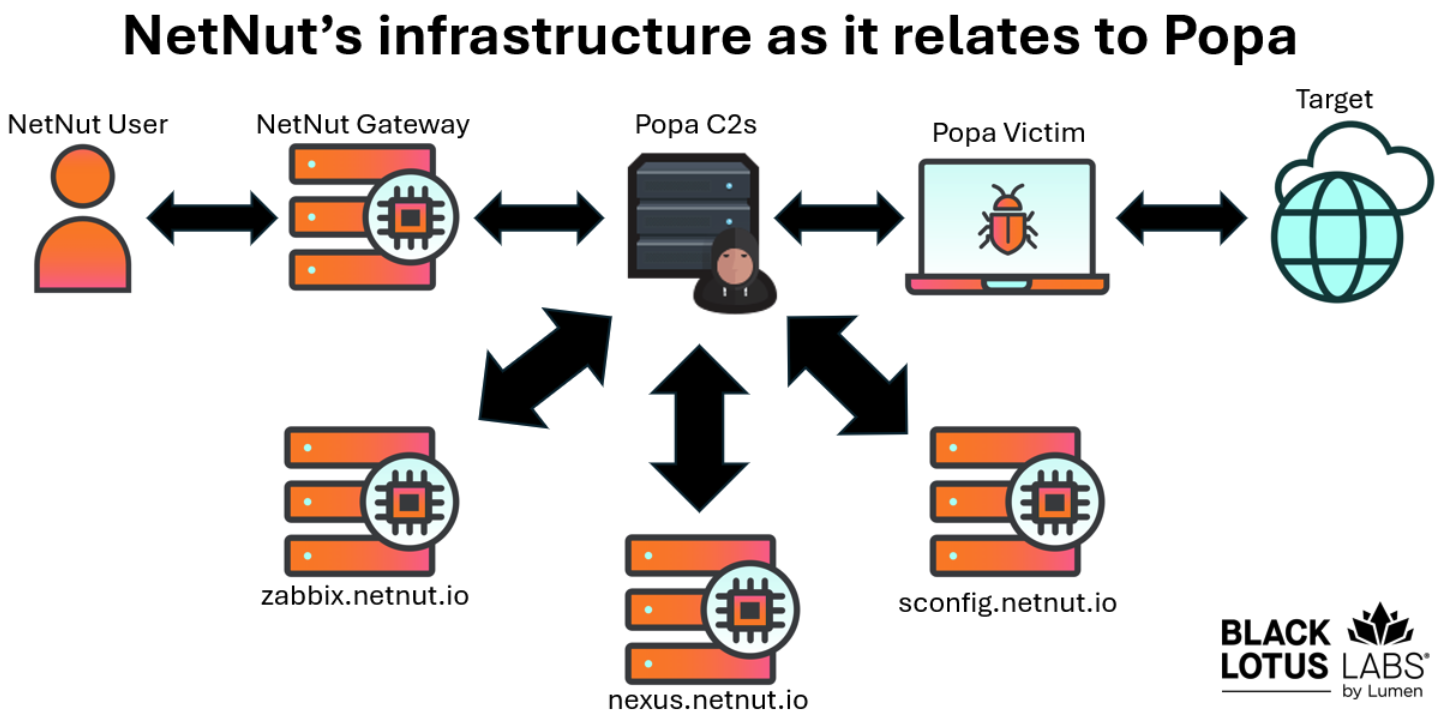
NetNut’s infrastructure, in a nutshell. Image: Black Lotus Labs, Lumen.

The NetNut and Popa botnet takedown may have another added benefit, Brundage said: Lessening the impact of large distributed denial-of-service botnets that have been built on the backs of poorly configured residential proxy services. In January, Synthient revealed how cybercriminals had built the world’s largest DDoS botnet (Kimwolf) by tunneling through IPIDEA proxy connections into the local networks of TV box owners, and infecting other Android-based devices behind the victim’s firewall.

While many of the bigger proxy providers took steps to block this activity, resellers of the major proxy networks have been far slower to respond to the threat, Brundage said.

“In terms of all these TV box devices getting compromised from the proxy network, it will have an impact on the DDoS botnets out there,” he said.

For its part, Google reckons today’s actions have caused “significant degradation to NetNut’s proxy network and its business operations, reducing the available pool of devices for the proxy operator by millions.” But the company warns that proxy networks can rebuild themselves by effectively reselling other proxy services, as IPIDEA has done over the past few months.

“Google has high confidence that many popular residential proxy brands are in fact whitelabeling the NetNut botnet,” the GTIG report concludes. “While we expect this disruption to have a larger ripple effect across the residential proxy ecosystem, observations after the disruption of IPIDEA proved that individual networks can appear resilient. What we have observed is that when faced with the degradation of their own botnet, proxy operators begin buying capacity from their competitors, effectively becoming a reseller. We recognize that creating a lasting disruption in this fluid ecosystem means we must scale our efforts to target the infrastructure of several interconnected providers.”

As KrebsOnSecurity has warned repeatedly, most of the no-name TV streaming boxes for sale on the major e-commerce websites either come pre-installed with residential proxy software, or require the installation of proxy SDKs in order to use the device for its stated purpose (streaming pirated movies, sporting events and TV shows). Google’s advice here is sound: When it comes to TV boxes, stick to name brands from reputable manufacturers, and then be sparing and judicious with any apps you choose to install.

The sketchy TV boxes that are being commandeered by the Popa botnet and other threats all come with or require the user to install unofficial Android operating systems that do not operate within the confines of Google’s Official Play Protect store. Google says consumers can confirm whether or not a device is built with the official Android TV OS and Play Protect certification by following these instructions.

Even people without TV streaming boxes can find their smart TVs enrolled in residential proxy networks, just by installing one of thousands of apps available for download on Samsung and LG smart TVs. In a report released last month, the proxy tracking company Spur found 42 percent of apps available for download via the webOS operating system on LG smart TVs include SDKs that turn one’s television into an always-on residential proxy node. More than a quarter of the apps made for Samsung’s Tizen operating system had similar residential proxy components, Spur found.

Image: Spur.us.

Update, 4:24 p.m. ET: Included a statement shared post-publication from an attorney representing NetNut parent Alarum Technologies.

Update, July 8, 2:34 p.m. ET: The website for Alarum Technologies — alarum[.]io — now also features a seizure notice from the FBI. The company’s stock has taken a beating since the FBI action, and is currently trading at $2.62 a share, a roughly 67 percent decline over the past week.

  •  

FBI Extracts Deleted Signal Messages from iPhone Notification Database

404 Media reports (alternate site):

The FBI was able to forensically extract copies of incoming Signal messages from a defendant’s iPhone, even after the app was deleted, because copies of the content were saved in the device’s push notification database….

The news shows how forensic extraction—­when someone has physical access to a device and is able to run specialized software on it—­can yield sensitive data derived from secure messaging apps in unexpected places. Signal already has a setting that blocks message content from displaying in push notifications; the case highlights why such a feature might be important for some users to turn on.

“We learned that specifically on iPhones, if one’s settings in the Signal app allow for message notifications and previews to show up on the lock screen, [then] the iPhone will internally store those notifications/message previews in the internal memory of the device,” a supporter of the defendants who was taking notes during the trial told 404 Media.

EDITED TO ADD (4/24): Apple has patched this vulnerability.

  •  

FBI, CISA warn of Russian hackers hijacking Signal and WhatsApp accounts

In a Public Service Announcement (PSA) the Federal Bureau of Investigation (FBI) and the Cybersecurity and Infrastructure Security Agency (CISA) warn the public about ongoing Russian-linked phishing campaigns that aim to gain access to messaging accounts.

Earlier this month we wrote about a large‑scale phishing campaign aimed at hijacking Signal and WhatsApp accounts belonging to senior officials, military personnel, civil servants, and journalists.

Now the FBI and CISA have joined European intelligence services in warning that the same tactics are being used in a broader campaign targeting these commercial messaging apps. The goal is not to break end‑to‑end encryption, but to walk straight around it by stealing access to individual accounts.

In our previous article, we focused on warnings from the Dutch intelligence services AIVD and MIVD, which described how Russian state‑backed actors approached high‑value targets via Signal and WhatsApp, posing as “Signal Support”, “Signal Security Bot”, or similar. The PSA demonstrates how the same groups are now running global phishing campaigns against messaging app accounts, with evidence suggesting thousands of compromised accounts worldwide.

It’s important to reiterate that the attackers have not managed to break the apps’ end-to-end encryption. Instead, they are relying on social engineering to get a device added so they can eavesdrop on accounts.

The current targets include current and former US government officials, military staff, political figures, and journalists, but there is nothing to stop the same techniques being reused against businesses and everyday users.

So, while it’s tempting to dismiss this as a problem for diplomats and generals (and the agencies issuing these alerts do mention high‑profile targets first), the techniques scale very easily. Once playbooks like these are public, they tend to be copied by cybercriminals looking for new ways to steal money or accounts.

How to protect your accounts

As the PSA puts it:

“Phishing remains one of the most unsophisticated, yet effective means of cyber compromise, often rendering other protections irrelevant”

This calls asks for basic security measures:

  • Treat unsolicited messages from “Support” inside apps as suspicious by default. Legitimate support for apps like Signal and WhatsApp does not ask you, in a chat message, to send back verification codes, PINs, or passwords.​ If you receive a warning about account problems, do not follow links in the message. Open the app’s settings directly or visit the official website through other means.
  • Never share SMS verification codes or app PINs. SMS codes are there to prove that you control a phone number. Anyone who has the code can pretend to be you. App‑specific PINs or passcodes are there to protect account changes. Giving them away is like handing over the keys to your account. Consider anyone asking for them to be a scammer.
  • Be careful what you discuss and with whom. Both the Dutch and US advisories remind us that even with end‑to‑end encryption, some conversations are too sensitive for commercial chat apps.
  • Use the extra security features these apps offer. Enable options like registration lock, registration PIN and device‑change alerts so that your account cannot be silently re‑registered without an extra secret. Store your PIN in a password manager instead of choosing something easy to guess or reusing a common code, to reduce the chance of social engineering or shoulder‑surfing.
  • Another useful feature is disappearing messages. Short‑timer and disappearing messages reduce how much content is available if an attacker gets into a chat later, or if someone obtains long‑term access to a device or backup. They are not a complete solution, but they can limit the damage.

What to do if you think your account was hijacked

If you suspect an attacker has taken over your messaging account:

  1. Try to re‑register your number in the app immediately to kick out other devices.
  2. Revoke all linked devices and change any app‑specific PINs or lock codes.
  3. Warn your contacts that someone may have impersonated you and ask them to treat recent messages with caution.
  4. Review recent conversations for signs of data theft (for example, shared IDs, documents, or passwords that should now be considered exposed).
  5. Report the incident to the app provider and, where appropriate, to national reporting centers such as the FBI’s Internet Crime Complaint Center (IC3) at ic3.gov or the relevant authority in your country.​

The sooner you act, the smaller the window in which attackers can exploit your account.


We don’t just report on phone security—we provide it

Cybersecurity risks should never spread beyond a headline. Keep threats off your mobile devices by downloading Malwarebytes for iOS, and Malwarebytes for Android today.

  •  

iPhone Lockdown Mode Protects Washington Post Reporter

404Media is reporting that the FBI could not access a reporter’s iPhone because it had Lockdown Mode enabled:

The court record shows what devices and data the FBI was able to ultimately access, and which devices it could not, after raiding the home of the reporter, Hannah Natanson, in January as part of an investigation into leaks of classified information. It also provides rare insight into the apparent effectiveness of Lockdown Mode, or at least how effective it might be before the FBI may try other techniques to access the device.

“Because the iPhone was in Lockdown mode, CART could not extract that device,” the court record reads, referring to the FBI’s Computer Analysis Response Team, a unit focused on performing forensic analyses of seized devices. The document is written by the government, and is opposing the return of Natanson’s devices.

The FBI raided Natanson’s home as part of its investigation into government contractor Aurelio Perez-Lugones, who is charged with, among other things, retention of national defense information. The government believes Perez-Lugones was a source of Natanson’s, and provided her with various pieces of classified information. While executing a search warrant for his mobile phone, investigators reviewed Signal messages between Pere-Lugones and the reporter, the Department of Justice previously said.

  •  

Microsoft is Giving the FBI BitLocker Keys

Microsoft gives the FBI the ability to decrypt BitLocker in response to court orders: about twenty times per year.

It’s possible for users to store those keys on a device they own, but Microsoft also recommends BitLocker users store their keys on its servers for convenience. While that means someone can access their data if they forget their password, or if repeated failed attempts to login lock the device, it also makes them vulnerable to law enforcement subpoenas and warrants.

  •  
❌