❌

Reading view

Five election scams to watch out for

Elections give scammers plenty to work with: urgent deadlines, familiar faces, passionate supporters, and messages asking people to take action.

Some want you to “fix” your voter registration. Others want a donation, an answer to a survey, or payment for merchandise supposedly endorsed by your favorite politician. The details change, but the objective stays the same: get your money, your personal information, or both.

Here are five election-themed scams to watch out for.

Scam 1. “We’ll help you vote”

Not every election-themed lure starts with a threat. Some offer to make voting easier.

“Get your ballot on autopilot,” reads one text message we reviewed. It encourages recipients to join a permanent absentee list so their ballots arrive at home for every election, adding the reassuring words: “Verified. Tracked. Counted.”
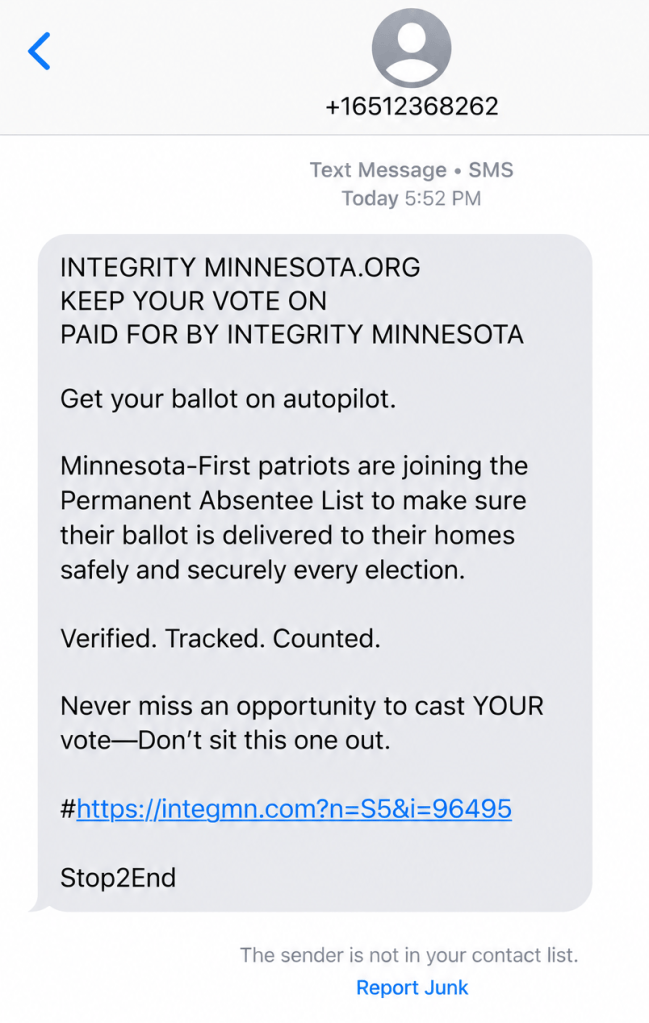
A voting-assistance text message reviewed by Malwarebytes. Reconstructed from the message text.
A voting-assistance text message reviewed by Scam Guard

The message is a scam, though it borrows the language of a real Minnesota voting service. Minnesota does have a permanent absentee voter list, but the link in this text is fraudulent. To check or sign up, go directly to your election authority’s official website.

Other messages take the opposite approach: instead of offering convenience, they warn that you could lose your chance to vote.

A message might say you are not registered to vote, your details are incomplete, or your registration is about to be cancelled. Then it offers a link to sort everything out.

The FBI recently warned about messages that send recipients to fraudulent voter-registration pages. Instead of helping people vote, these sites collect personal information that criminals can use for further fraud.

In Brazil, scammers used a fake WhatsApp account with the Superior Electoral Court’s logo. It claimed to be the court’s “Customer Service Department” (which doesn’t exist) and told people to download an app called “Soluciona Pendência,” roughly translated as “Resolve an outstanding issue.” The message falsely warned that people could lose access to banking or government services.

Scam 2. “Donate now to help your candidate win”

A fundraising appeal arrives just as an election reaches a critical moment. It uses the candidate’s photograph, familiar campaign language, and an urgent request for money.

That does not necessarily mean the campaign sent it.

The FBI warns that scammers impersonate candidates and political fundraising organizations to collect supposed campaign contributions. Victims believe they are supporting a legitimate organization, but the money goes to criminals instead.

Before donating, find the campaign or organization’s official website yourself and check who will receive the payment. Don’t let a countdown, a matching-donation claim, or a message about an impending defeat rush your decision. The Better Business Bureau (BBB) advises researching political fundraising requests and resisting pressure to act immediately.

Scam 3. “Take our political survey and claim your reward”

Not every political poll is suspicious. But a request for your opinion can also be an opening for a scam.

The BBB warns about fraudulent polling calls that promise a prize in exchange for answering questions. After the “survey,” the caller asks for credit card information to cover shipping, taxes, or other costs associated with the supposed reward.

At that point, the questions about candidates have served their purpose: keeping you engaged long enough to introduce a payment request.

Other election-themed messages ask people to complete surveys through links. Treat those links with the same caution you would an unexpected donation or registration request. A familiar political organization’s name does not establish who operates the website.

You can decline an unsolicited poll. You should not need to hand over payment details simply to share your political views or claim a surprise reward.


Link Checker

Unsure where a link goes? We’ll check it.


Scam 4. “Pay this electoral fine” or “Report for election duty”

Few things make a message feel urgent quite like an official-looking demand backed by a possible penalty.

Brazil’s Superior Electoral Court (TSE) has warned about messages falsely claiming people had an unresolved voting issue. The messages link to fake government websites designed to steal personal information or trick people into paying.

Brazil does have legitimate electoral fines, which can be paid through official channels, including Pix. So a fine or Pix request alone doesn’t prove a message is a scam. If a message says you owe money or must perform election duty, check with the relevant authority using contact details from its official website. Don’t use the message’s phone number, link, or QR code.

Scam 5. Your favorite politician “wants you to buy this”

A politician’s name can be used to sell more than a political message.

Criminals use candidates’ names, photographs, logos, and slogans to advertise merchandise that never arrives. What looks like a way to support a candidate becomes an ordinary shopping scam wrapped in campaign branding.

Apply the same skepticism to a “commemorative,” “patriotic,” or supposedly collectible product advertised using a politician’s name. Before buying, ask:

  • Is the seller actually affiliated with the politician or campaign?
  • What, exactly, are you buying?
  • Is there evidence for claims about the product’s quality, usefulness, or future value?
  • What are the total price, refund terms, and any recurring charges?

A product does not become useful, valuable, or a sound investment because an ad places it beside a politician’s photograph. Nor does a photograph prove that the politician endorsed it.

There is also a difference between a product you consider poor value and a fraudulent offer. A product being poor value doesn’t automatically make it a scam. Look for clear deception: a fake endorsement, false claims, hidden fees, or an order that never arrives.

How to stay safe from election scams

You don’t need to work out every detail of a suspicious message before deciding whether to act on it. Verify the message through a route the sender does not control.

  • Go directly to official election websites to check registration, voting requirements, deadlines, and alleged penalties.
  • Verify donation requests independently. Find the campaign or organization yourself and confirm where your money will go.
  • Keep payment details out of unsolicited surveys. A political poll that turns into a request to pay for a prize is a red flag.
  • Check sellers before buying political merchandise. A candidate’s name or logo does not authenticate the shop.
  • Don’t mistake personal details for proof. A message can contain accurate information about you and still be a scam.
  • Keep political choices separate from requests for money or personal information. You can support a cause without responding to an unexpected message.
  • Use real-time web protection to help block known malicious websites.
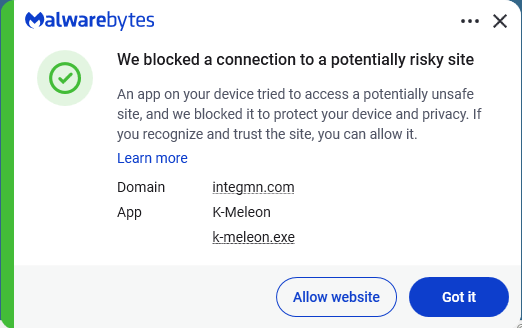
Malwarebytes blocks integmn.com

Pro tip: Unsure whether a message is a scam? Check it with Malwarebytes’ Scam Guard for an assessment and advice on what to do next.


Something feel off? Check it before you click.  

Malwarebytes Scam Guard helps you analyze suspicious links, texts, and screenshots instantly.  

Available with Malwarebytes Premium Security for all your devices, and in the Malwarebytes app for iOS and Android.  

Try it free → 

  •  

Five election scams to watch out for

Elections give scammers plenty to work with: urgent deadlines, familiar faces, passionate supporters, and messages asking people to take action.

Some want you to “fix” your voter registration. Others want a donation, an answer to a survey, or payment for merchandise supposedly endorsed by your favorite politician. The details change, but the objective stays the same: get your money, your personal information, or both.

Here are five election-themed scams to watch out for.

Scam 1. “We’ll help you vote”

Not every election-themed lure starts with a threat. Some offer to make voting easier.

“Get your ballot on autopilot,” reads one text message we reviewed. It encourages recipients to join a permanent absentee list so their ballots arrive at home for every election, adding the reassuring words: “Verified. Tracked. Counted.”

A voting-assistance text message reviewed by Malwarebytes. Reconstructed from the message text.
A voting-assistance text message reviewed by Scam Guard

The message is a scam, though it borrows the language of a real Minnesota voting service. Minnesota does have a permanent absentee voter list, but the link in this text is fraudulent. To check or sign up, go directly to your election authority’s official website.

Other messages take the opposite approach: instead of offering convenience, they warn that you could lose your chance to vote.

A message might say you are not registered to vote, your details are incomplete, or your registration is about to be cancelled. Then it offers a link to sort everything out.

The FBI recently warned about messages that send recipients to fraudulent voter-registration pages. Instead of helping people vote, these sites collect personal information that criminals can use for further fraud.

In Brazil, scammers used a fake WhatsApp account with the Superior Electoral Court’s logo. It claimed to be the court’s “Customer Service Department” (which doesn’t exist) and told people to download an app called “Soluciona Pendência,” roughly translated as “Resolve an outstanding issue.” The message falsely warned that people could lose access to banking or government services.

Scam 2. “Donate now to help your candidate win”

A fundraising appeal arrives just as an election reaches a critical moment. It uses the candidate’s photograph, familiar campaign language, and an urgent request for money.

That does not necessarily mean the campaign sent it.

The FBI warns that scammers impersonate candidates and political fundraising organizations to collect supposed campaign contributions. Victims believe they are supporting a legitimate organization, but the money goes to criminals instead.

Before donating, find the campaign or organization’s official website yourself and check who will receive the payment. Don’t let a countdown, a matching-donation claim, or a message about an impending defeat rush your decision. The Better Business Bureau (BBB) advises researching political fundraising requests and resisting pressure to act immediately.

Scam 3. “Take our political survey and claim your reward”

Not every political poll is suspicious. But a request for your opinion can also be an opening for a scam.

The BBB warns about fraudulent polling calls that promise a prize in exchange for answering questions. After the “survey,” the caller asks for credit card information to cover shipping, taxes, or other costs associated with the supposed reward.

At that point, the questions about candidates have served their purpose: keeping you engaged long enough to introduce a payment request.

Other election-themed messages ask people to complete surveys through links. Treat those links with the same caution you would an unexpected donation or registration request. A familiar political organization’s name does not establish who operates the website.

You can decline an unsolicited poll. You should not need to hand over payment details simply to share your political views or claim a surprise reward.


Link Checker

Unsure where a link goes? We’ll check it.


Scam 4. “Pay this electoral fine” or “Report for election duty”

Few things make a message feel urgent quite like an official-looking demand backed by a possible penalty.

Brazil’s Superior Electoral Court (TSE) has warned about messages falsely claiming people had an unresolved voting issue. The messages link to fake government websites designed to steal personal information or trick people into paying.

Brazil does have legitimate electoral fines, which can be paid through official channels, including Pix. So a fine or Pix request alone doesn’t prove a message is a scam. If a message says you owe money or must perform election duty, check with the relevant authority using contact details from its official website. Don’t use the message’s phone number, link, or QR code.

Scam 5. Your favorite politician “wants you to buy this”

A politician’s name can be used to sell more than a political message.

Criminals use candidates’ names, photographs, logos, and slogans to advertise merchandise that never arrives. What looks like a way to support a candidate becomes an ordinary shopping scam wrapped in campaign branding.

Apply the same skepticism to a “commemorative,” “patriotic,” or supposedly collectible product advertised using a politician’s name. Before buying, ask:

  • Is the seller actually affiliated with the politician or campaign?
  • What, exactly, are you buying?
  • Is there evidence for claims about the product’s quality, usefulness, or future value?
  • What are the total price, refund terms, and any recurring charges?

A product does not become useful, valuable, or a sound investment because an ad places it beside a politician’s photograph. Nor does a photograph prove that the politician endorsed it.

There is also a difference between a product you consider poor value and a fraudulent offer. A product being poor value doesn’t automatically make it a scam. Look for clear deception: a fake endorsement, false claims, hidden fees, or an order that never arrives.

How to stay safe from election scams

You don’t need to work out every detail of a suspicious message before deciding whether to act on it. Verify the message through a route the sender does not control.

  • Go directly to official election websites to check registration, voting requirements, deadlines, and alleged penalties.
  • Verify donation requests independently. Find the campaign or organization yourself and confirm where your money will go.
  • Keep payment details out of unsolicited surveys. A political poll that turns into a request to pay for a prize is a red flag.
  • Check sellers before buying political merchandise. A candidate’s name or logo does not authenticate the shop.
  • Don’t mistake personal details for proof. A message can contain accurate information about you and still be a scam.
  • Keep political choices separate from requests for money or personal information. You can support a cause without responding to an unexpected message.
  • Use real-time web protection to help block known malicious websites.
Malwarebytes blocks integmn.com

Pro tip: Unsure whether a message is a scam? Check it with Malwarebytes’ Scam Guard for an assessment and advice on what to do next.


Something feel off? Check it before you click.  

Malwarebytes Scam Guard helps you analyze suspicious links, texts, and screenshots instantly.  

Available with Malwarebytes Premium Security for all your devices, and in the Malwarebytes app for iOS and Android.  

Try it free → 

  •  

2026 midterm elections: Helping voters navigate election information in the age of AI

As Americans prepare to vote this November, artificial intelligence is changing how many people find and understand election information. 

Some voters are deliberately turning to AI tools with questions about candidates, ballot measures, election procedures, and issues that matter to their communities. Others are encountering AI-generated summaries at the top of search results. In either case, AI is increasingly becoming a front door to election information. 

This shift is happening quickly. More than 30% of the U.S. working-age population now uses AI (Microsoft AI Diffusion Index, Q1 2026; Microsoft, AI Adoption Across the United States). These tools can help people understand complicated topics, compare information, and explore unfamiliar issues. But election information can also present some challenges for AI. It is highly local, changes quickly, and can be incomplete, contested, or stripped of essential context. 

The answer is not to steer voters away from AI, it is to help people use it wisely, particularly when the information may influence aspects of their voting experience, such as how, when, and where they cast their ballot. 

That is why, on National Voter Registration Day, a day when our brands and products come together to encourage civic participation, we’re launching the next phase of our voter education initiative, Check. Recheck. Vote. This year, the campaign will equip voters with practical AI literacy skills for the 2026 election season.  

Check. Recheck. Vote.

We launched Check. Recheck. Vote. in 2024 to help voters recognize the risks posed by deceptive AI-generated content. Deepfakes and other deceptive media remain a serious concern. But in conversations with voters and election organizations, we are also hearing about a broader and more immediate challenge. Millions of people now encounter election information through AI-generated answers, and many are not sure how to determine whether those answers are current, complete, or reliable. 

The updated campaign gives voters three straightforward steps: 

  • Check the sources and citations behind an AI-generated answer. Look for where the information came from, who published it, and when it was last updated. Be cautious when an answer provides no sources. 
  • Recheck important details by visiting the original sources and comparing what other credible sources say. This is especially important for fast-changing or location-specific information. 
  • Vote based on current information from your state or local election website, including official guidance on registration, voting options, deadlines, and polling locations. 

At the center of the campaign is a new 75-second video that shows how an AI-generated answer can appear during an ordinary election-related search, explains where these answers can fall short, and offers simple steps voters can take before relying on them. 

YouTube Video

The campaign website pairs the video with practical guidance and links to authoritative election resources, including state-by-state voting information and tools for educators.  

We are working with the National Association of Secretaries of State (NASS) and the National Association of State Election Directors (NASED) to scale the reach of this campaign across all fifty states and the territories and to point voters to accurate information directly from state and local election officials so they can participate with confidence. 

We believe that civics and voter education start well before a citizen is old enough to vote. That’s why we are also investing in efforts to extend AI voter literacy education in the classroom. The campaign website includes a classroom activity to help students examine how AI may shape the election information they encounter, practice verifying claims, and keep their own judgment at the center of the process. We are also amplifying our impact on this important issue by supporting the News Literacy Project. 

We’re also proud to announce today that, in partnership with iCivics, we are launching Village Square – a new Minecraft Education civic learning experience that helps students explore how communities make decisions and solve shared challenges. The game brings concepts such as dialogue, participation, and collective decision-making to life through immersive gameplay. Village Square gives educators and families an engaging, nonpartisan way to help young people practice listening to different perspectives, weighing trade-offs and working together to build stronger communities. 

Promotional artwork for Minecraft Education: Village Square. A block-style character walks through a bustling Minecraft village marketplace surrounded by villagers and buildings. The Minecraft Education logo appears at the top, with "Village Square" prominently displayed in the center and the iCivics Education logo in the lower-left corner.

Finally, we know that credible local reporting remains essential to informed civic participation, and that reporting is under strain in many communities. 

In Washington state, Microsoft is partnering with the Associated Press Fund for Journalism to expand election coverage for 10 local newsrooms operating 14 news websites. Participating newsrooms receive access to AP election results and race calls, vote tabulations, state-specific maps and graphics, and resources that help local journalists connect national and statewide developments to the communities they serve. 

The newsrooms represent communities from Seattle to Spokane and the Wenatchee Valley. Their work complements the reporting of the Associated Press, helping trusted, fact-based election coverage and results reach communities that might otherwise lack access. 

This investment reflects a broader reality. Voters need more than information. They need reliable sources that can provide context, ask hard questions, correct mistakes, and explain what national developments mean at the local level. 

Microsoft’s Support for the 2026 Midterms

Voters aren’t the only ones navigating this AI moment, so are the people running campaigns and conducting elections, all while facing an increasingly complex cybersecurity landscape. Microsoft has long supported the security and resilience of campaigns and elections. In 2018, we launched AccountGuard to help political campaigns and democracy-focused organizations defend against cyberattacks, and during the 2024 election cycle we joined dozens of other technology companies in the Tech Accord to Combat Deceptive Use of AI in 2024 Elections. Here’s how that commitment continues today: 

Equipping election officials. With The Elections Group, International IDEA, Ready for Tuesday and Arizona State University’s Mechanics of Democracy Lab, we launched the free, open-source AI + Elections Skills Hub: prompts, sample AI agents, and draft policies for responsible adoption. It’s already reached 1,000+ officials across 45 states. 

Strengthening cybersecurity. We’ve deployed Microsoft Sentinel to several state and local election offices for stronger threat detection, and we’re also supporting select election and political stakeholders with MDASH to find and fix software vulnerabilities faster. 

Countering bomb hoaxes. More than 300 emailed bomb hoaxes disrupted polling places in 2024. In response, we’ve started a new Elections Bomb Threats Task Force alongside partners Social Scout, Nisos, and the Committee for Safe and Secure Elections (CSSE) to bring together digital intelligence and law enforcement expertise to track & share trends and reduce disruptions. An initial report on the hoaxes encountered in 2024 will shape our approach for 2026. 

Supporting campaigns. Built with Defending Digital Campaigns, our Secure AI Toolkit for Campaigns has reached 3,000+ campaigns and political stakeholders with practical AI guardrails. Our Campaign Technology team has also trained thousands of candidates, staff, and officials from both parties on responsible AI use and cybersecurity best practices. 

The technology continues to change, but our approach remains consistent: help voters find authoritative information and make informed judgments, help campaigns and election authorities defend against evolving threats, and help the election community adopt technology that strengthens security, accountability, and civic participation. This work is bipartisan by design, and it includes: 

  • Azure for Elections – prioritized support and security for elections-critical cloud workloads 
  • M365 for Campaigns – secure, cost-effective collaboration and email for candidates and campaigns 
  • Deceptive AI in Elections Reporting – malicious deepfakes of candidates and election officials are disallowed on Microsoft platforms, and targeted individuals can report them directly 
  • Content Provenance – Microsoft image generation products affix content provenance to images, with LinkedIn displaying that provenance to users 
  • Civic engagement – continuing our long-standing work to promote civic engagement through our own products and partnerships 

The 2026 election will be the first U.S. federal election in which generative AI is part of the everyday environment for millions of voters as well as those who support the political process. That creates new risks, but it also gives us an opportunity to equip people with skills that will remain valuable well beyond a single election. 

The post 2026 midterm elections: Helping voters navigate election information in the age of AI appeared first on Microsoft On the Issues.

  •  
❌