Reading view

Google Cloud Security Threat Horizons Report #13 (H1 2026) Is Out!

This is my completely informal, uncertified, unreviewed and otherwise completely unofficial blog inspired by my reading of our next Cloud Threat Horizons Report, #13 (full version, no info to enter!) that we just released (the official blog for #1 report, my unofficial blogs for #2, #3, #4, #5, #6, #7, #8, #9, #10, #11 and #12).

My favorite quotes from the report follow below:

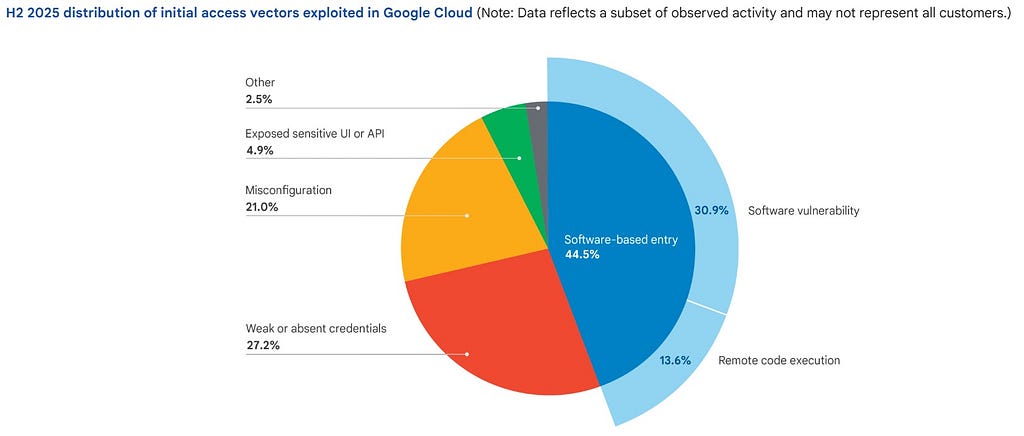
  • [in Google Cloud] “software exploitation overtook credentials as the primary initial access vector for the first time.” and “Threat actors exploited third-party software-based entry (44.5%) more frequently than weak credentials.” [A.C. — some of you may say this is because AI is making more zero days, but a dozen more mundane answers may be correct instead]
THR H1 2026 image 1
  • “While threat actors continued to use brute-force attacks against weak credentials, the increase in RCE represents a pivot toward more automated exploitation of unpatched application-layer vulnerabilities.” [A.C. — to some extent “creds or vulns” debate is rather pointless as the real answer is “both”, and it varies by environment too, see below]
  • “Threat actors continued to transition from traditional phishing to voice-based social engineering (vishing), and credential harvesting from third-party SaaS tokens to facilitate large-scale, silent data exfiltration.” [A.C. — again, this means “AND” not “OR” because classic phishing still works well in many cases, but yes “credential harvesting from third-party SaaS” has become very fruitful too]
  • [overall] Still “Identity compromise underpinned 83% of compromises. [A.C. — so, yes, “creds” still beat “vulns” on many environments]
THR H1 2026 image 2
  • “High-volume data theft operations — executed through compromised but legitimate access channels — remained the primary goal for threat actors, with our metrics showing they targeted data in 73% of cloud-related incidents.” [A.C. — again, not new, but very useful data confirming the running trend. Beware!]
  • “The window between vulnerability disclosure and mass exploitation collapsed by an order of magnitude, from weeks to days.” [A.C. — again, some of you may see the invisible robot hand of an AI here, but, as usual, the reality is more complicated…]
  • “Trend analysis from 2008–2025 indicates cloud services will soon surpass email as the primary data exfiltration pathway.” [A.C. — $32B reasons to finally get serious about it across all clouds?]
  • 45% of intrusions resulted in data theft without immediate extortion attempts at the time of the engagement, and these were often characterized by prolonged dwell times and stealthy persistence.”
  • “The traditional incident response model is no longer viable when dealing with containerized workloads and serverless architectures where data can vanish in seconds.” [A.C. — a very useful reminder here! Cloud is cloudy! Don’t be that guy who thinks that cloud is a rented colo. Cloud is not JUST somebody else’s computer.]
  • “Threat actors used large language models (LLM) to automate credential harvesting and transition from a developer’s local environment to full cloud administration access.” [A.C. — this really should not be news for anybody in 2026, but if it is, HERE IS SOME NEWS: BAD GUYS USE AI!]
  • Thus “Prevent LLM exploitation as an extension of living-off-the-land (LOTL) by treating LLM activity with the same scrutiny as administrative command-line tools.” [A.C. — or, as I say, “with AI agents, every prompt injection is an RCE”]

Now, go and read the CTHR 13 report!

Related posts:


Google Cloud Security Threat Horizons Report #13 (H1 2026) Is Out! was originally published in Anton on Security on Medium, where people are continuing the conversation by highlighting and responding to this story.

  •  

2026 Unit 42 Global Incident Response Report — Attacks Now 4x Faster

AI-Accelerated Attacks, Identity-Enabled Breaches and Expanding Software Supply Chain Exposure Define the 2026 Cyberthreat Landscape

Each year, thousands of organizations experience a cyber incident. An incident can begin with a SOC alert, zero-day vulnerability, ransom demand or widespread business disruption. When the call comes, our global incident responders quickly mobilize to investigate, contain and eradicate the threat.

This year’s Unit 42® 2026 Global Incident Response Report analyzed over 750 major cyber incidents across every major industry in over 50 countries to reveal emerging patterns and lessons for defenders.

The data shows a clear shift in how attacks unfold. Threat actors are moving faster, increasingly leveraging identity and trusted connections, and expanding attacks across multiple attack surfaces. The accelerating speed, scale and complexity of these intrusions mean the window between initial access and business impact is shrinking. Most breaches, however, still succeed due to preventable gaps in visibility and security controls.

Key Findings Show Attacks Are Faster, Broader and Harder to Contain

As adversaries adapt their playbooks, the report highlights several defining trends shaping the 2026 threat landscape:

  • AI Is Compressing the Attack Timeline: In the fastest cases we investigated, attackers needed just 72 minutes to move from initial access to data exfiltration, 4X faster than last year. We’re seeing AI used in reconnaissance, phishing, scripting and operational execution, which enables machine-like speed at scale.
  • Identity Is Now a Primary Attack Vehicle: Identity weaknesses played a material role in nearly 90% of our investigations. More often than not, attackers aren’t breaking in; they’re logging in with stolen credentials and tokens, and then exploiting fragmented identity estates to escalate privileges and move laterally without triggering traditional defenses.
  • Supply Chain Risk Now Drives Operational Disruption: In 23% of incidents, attackers leveraged third-party SaaS applications. By abusing trusted integrations, vendor tools and application dependencies, they bypassed traditional perimeters and expanded the impact well beyond a single system.
  • Attack Complexity Is Growing: We found that 87% of intrusions involved activity across multiple attack surfaces. Rarely does an attack stay in one environment. Instead, we see coordinated activity across endpoints, networks, cloud, SaaS and identity, forcing defenders to monitor across all of them at once.
  • The Browser Is a Primary Battleground: Nearly 48% of incidents included browser-based activity. This reflects how often modern attacks intersect with routine workflows, like email, web access and day-to-day SaaS use, turning normal user behavior into an attack vector.
  • Extortion Is Moving Beyond Encryption: Encryption-based extortion declined 15% from the year before, as more attackers skip encryption and move straight to data theft and disruption. From the attacker’s perspective, it’s faster, quieter and creates immediate pressure without the signals that defenders once relied on to detect ransomware attacks.

Attacks Succeed Because Exposure Still Beats Sophistication

Despite the speed and automation we’re seeing, most of the incidents we respond to don’t start with something radically new. They start with gaps that show up again and again. In many cases, attackers didn’t rely on a sophisticated exploit, but on an overlooked exposure.

  • Environmental Complexity Undermining Defenses: In over 90% of the incidents we investigated, misconfigurations or gaps in security coverage materially enabled the attack. A big driver of that is tool sprawl. Many organizations are running 50 or more security products, making it extremely difficult to deploy controls consistently or clearly understand what their data is telling them.
  • Visibility Gaps Delay Detection: In many engagements, the signals were there. When we look back forensically, the evidence is in the logs. But during the attack, teams had to stitch together data from multiple disconnected sources, slowing detection during the most critical early minutes.
  • Excessive Trust Expands Impact: Once attackers gain a foothold, overly permissive access and unmanaged tokens frequently let them move farther than they should. We repeatedly see identity trust relationships turn a single compromised account into broad lateral movement and privilege escalation.

Attackers are evolving their tools and tactics, but they still win most often from exploited complexity, limited visibility and excessive trust inside modern enterprise environments.

Recommendations for Security Leaders and Defenders

Across more than 750 frontline investigations, three priorities come up again and again in conversations with CISOs and security teams.

  • Reduce Exposure: Many of the attacks we see begin in places teams didn’t realize were exposed – third-party integrations, unmanaged SaaS connections or everyday browser activity. Reducing exposure means securing the full application ecosystem and treating trusted connections with the same scrutiny as core infrastructure.
  • Reduce Area of Impact: Once attackers get in, the difference between a contained incident and a major disruption often comes down to identity. Tightening identity and access management while removing unnecessary trust limits how far an attacker can move and how much damage they can cause.
  • Increase Response Speed: What happens in the first minutes after initial access can determine whether an incident becomes a breach. Security teams need the visibility to see what’s happening across environments and the ability to use AI to detect, identify and prioritize what matters, so the SOC can contain threats at machine speed, faster than the adversary can move.

Conclusion

Every investigation tells a story. How the attacker got in. How quickly they moved. What made the impact worse. Across hundreds of these cases, patterns emerge. Unit 42 operates 24 hours a day, 7 days a week on the frontlines of these incidents, and each year we distill what we learn into practical guidance. The goal of this report is to turn those frontline lessons into decisions that help you close the gaps that attackers still rely on and stop incidents before they become breaches.

Stay informed. Read the 2026 Unit 42 Global Incident Response Report and download the Executive Resource Kit.

The post 2026 Unit 42 Global Incident Response Report — Attacks Now 4x Faster appeared first on Palo Alto Networks Blog.

  •  

Apple Pay phish uses fake support calls to steal payment details

It started with an email that looked boringly familiar: Apple logo, a clean layout, and a subject line designed to make the target’s stomach drop.

The message claimed Apple has stopped a high‑value Apple Pay charge at an Apple Store, complete with a case ID, timestamp, and a warning that the account could be at risk if the target doesn’t respond.​

In some cases, there was even an “appointment” booked on their behalf to “review fraudulent activity,” plus a phone number they should call immediately if the time didn’t work.​ Nothing in the email screams amateur. The display name appears to be Apple, the formatting closely matches real receipts, and the language hits all the right anxiety buttons.

This is how most users are lured in by a recent Apple Pay phishing campaign.

The call that feels like real support

The email warns recipients not to Apple Pay until they’ve spoken to “Apple Billing & Fraud Prevention,” and it provides a phone number to call.​

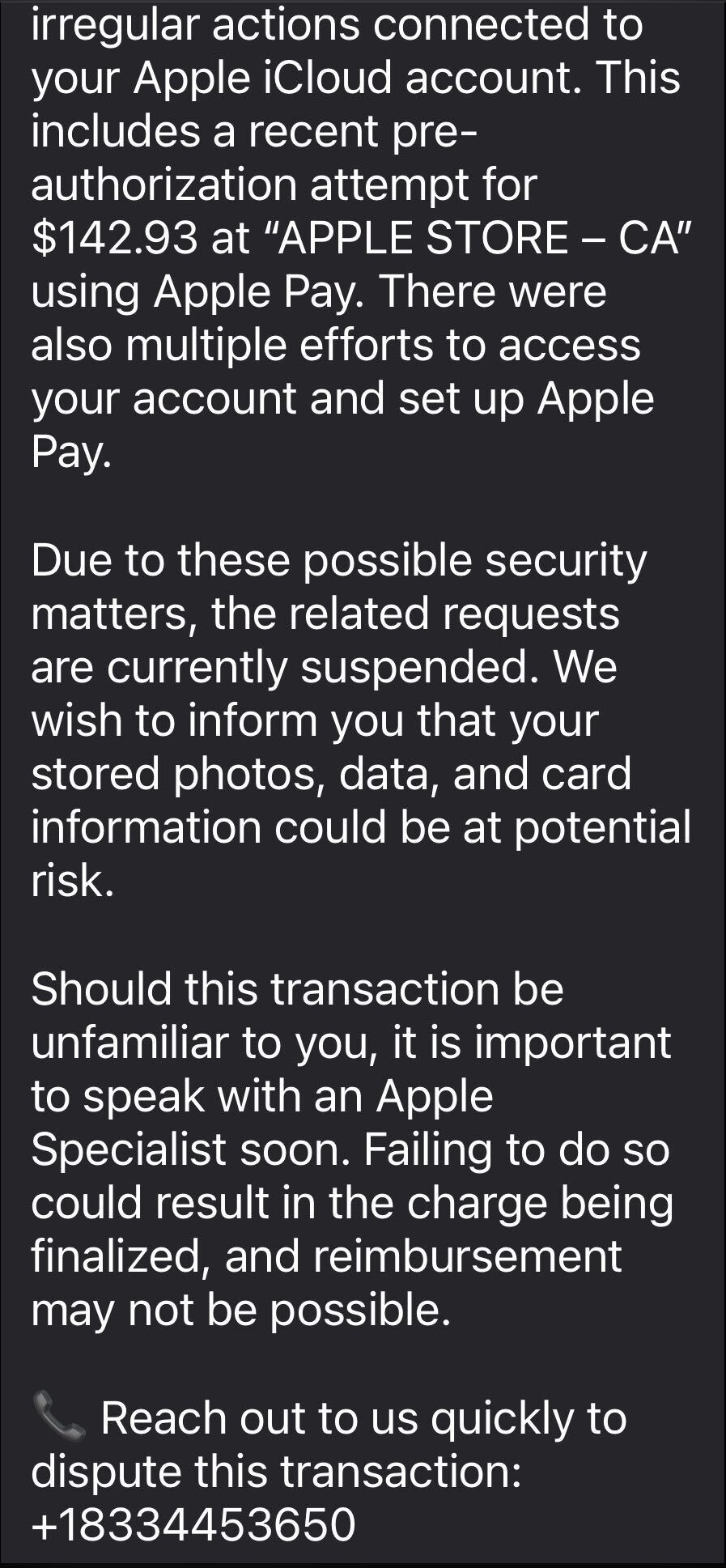
partial example of the phish

After dialing the number, an agent introduces himself as part of Apple’s fraud department and asks for details such as Apple ID verification codes or payment information.

The conversation is carefully scripted to establish trust. The agent explains that criminals attempted to use Apple Pay in a physical Apple Store and that the system “partially blocked” the transaction. To “fully secure” the account, he says, some details need to be verified.

The call starts with harmless‑sounding checks: your name, the last four digits of your phone number, what Apple devices you own, and so on.

Next comes a request to confirm the Apple ID email address. While the victim is looking it up, a real-looking Apple ID verification code arrives by text message.

The agent asks for this code, claiming it’s needed to confirm they’re speaking to the rightful account owner. In reality, the scammer is logging into the account in real time and using the code to bypass two-factor authentication.

Once the account is “confirmed,” the agent walks the victim through checking their bank and Apple Pay cards. They ask questions about bank accounts and suggest “temporarily securing” payment methods so criminals can’t exploit them while the “Apple team” investigates.

The entire support process is designed to steal login codes and payment data. At scale, campaigns like this work because Apple’s brand carries enormous trust, Apple Pay involves real money, and users have been trained to treat fraud alerts as urgent and to cooperate with “support” when they’re scared.

One example submitted to Malwarebytes Scam Guard showed an email claiming an Apple Gift Card purchase for $279.99 and urging the recipient to call a support number (1-812-955-6285).

Another user submitted a screenshot showing a fake “Invoice Receipt – Paid” styled to look like an Apple Store receipt for a 2025 MacBook Air 13-inch laptop with M4 chip priced at $1,157.07 and a phone number (1-805-476-8382) to call about this “unauthorized transaction.”

What you should know

Apple doesn’t set up fraud appointments through email. The company also doesn’t ask users to fix billing problems by calling numbers in unsolicited messages.

Closely inspect the sender’s address. In these cases, the email doesn’t come from an official Apple domain, even if the display name makes it seem legitimate.

Never share two-factor authentication (2FA) codes, SMS codes, or passwords with anyone, even if they claim to be from Apple.

Ignore unsolicited messages urging you to take immediate action. Always think and verify before you engage. Talk to someone you trust if you’re not sure.

Malwarebytes Scam Guard helped several users identify this type of scam. For those without a subscription, you can use Scam Guard in ChatGPT.

If you’ve already engaged with these Apple Pay scammers, it is important to:

  • Change the Apple ID password immediately from Settings or appleid.apple.com, not from any link provided by email or SMS.
  • Check active sessions, sign out of all devices, then sign back in only on devices you recognize and control.
  • Rotate your Apple ID password again if you see any new login alerts, and confirm 2FA is still enabled. If not, turn it on.
  • In Wallet, check every card for unfamiliar Apple Pay transactions and recent in-store or online charges. Monitor bank and credit card statements closely for the next few weeks and dispute any unknown transactions immediately.
  • Check if the primary email account tied to your Apple ID is yours, since control of that email can be used to take over accounts.

We don’t just report on scams—we help detect them

Cybersecurity risks should never spread beyond a headline. If something looks dodgy to you, check if it’s a scam using Malwarebytes Scam Guard, a feature of our mobile protection products. Submit a screenshot, paste suspicious content, or share a text or phone number, and we’ll tell you if it’s a scam or legit. Download Malwarebytes Mobile Security for iOS or Android and try it today!

  •  

Apple Pay phish uses fake support calls to steal payment details

It started with an email that looked boringly familiar: Apple logo, a clean layout, and a subject line designed to make the target’s stomach drop.

The message claimed Apple has stopped a high‑value Apple Pay charge at an Apple Store, complete with a case ID, timestamp, and a warning that the account could be at risk if the target doesn’t respond.​

In some cases, there was even an “appointment” booked on their behalf to “review fraudulent activity,” plus a phone number they should call immediately if the time didn’t work.​ Nothing in the email screams amateur. The display name appears to be Apple, the formatting closely matches real receipts, and the language hits all the right anxiety buttons.

This is how most users are lured in by a recent Apple Pay phishing campaign.

The call that feels like real support

The email warns recipients not to Apple Pay until they’ve spoken to “Apple Billing & Fraud Prevention,” and it provides a phone number to call.​

partial example of the phish

After dialing the number, an agent introduces himself as part of Apple’s fraud department and asks for details such as Apple ID verification codes or payment information.

The conversation is carefully scripted to establish trust. The agent explains that criminals attempted to use Apple Pay in a physical Apple Store and that the system “partially blocked” the transaction. To “fully secure” the account, he says, some details need to be verified.

The call starts with harmless‑sounding checks: your name, the last four digits of your phone number, what Apple devices you own, and so on.

Next comes a request to confirm the Apple ID email address. While the victim is looking it up, a real-looking Apple ID verification code arrives by text message.

The agent asks for this code, claiming it’s needed to confirm they’re speaking to the rightful account owner. In reality, the scammer is logging into the account in real time and using the code to bypass two-factor authentication.

Once the account is “confirmed,” the agent walks the victim through checking their bank and Apple Pay cards. They ask questions about bank accounts and suggest “temporarily securing” payment methods so criminals can’t exploit them while the “Apple team” investigates.

The entire support process is designed to steal login codes and payment data. At scale, campaigns like this work because Apple’s brand carries enormous trust, Apple Pay involves real money, and users have been trained to treat fraud alerts as urgent and to cooperate with “support” when they’re scared.

One example submitted to Malwarebytes Scam Guard showed an email claiming an Apple Gift Card purchase for $279.99 and urging the recipient to call a support number (1-812-955-6285).

Another user submitted a screenshot showing a fake “Invoice Receipt – Paid” styled to look like an Apple Store receipt for a 2025 MacBook Air 13-inch laptop with M4 chip priced at $1,157.07 and a phone number (1-805-476-8382) to call about this “unauthorized transaction.”

What you should know

Apple doesn’t set up fraud appointments through email. The company also doesn’t ask users to fix billing problems by calling numbers in unsolicited messages.

Closely inspect the sender’s address. In these cases, the email doesn’t come from an official Apple domain, even if the display name makes it seem legitimate.

Never share two-factor authentication (2FA) codes, SMS codes, or passwords with anyone, even if they claim to be from Apple.

Ignore unsolicited messages urging you to take immediate action. Always think and verify before you engage. Talk to someone you trust if you’re not sure.

Malwarebytes Scam Guard helped several users identify this type of scam. For those without a subscription, you can use Scam Guard in ChatGPT.

If you’ve already engaged with these Apple Pay scammers, it is important to:

  • Change the Apple ID password immediately from Settings or appleid.apple.com, not from any link provided by email or SMS.
  • Check active sessions, sign out of all devices, then sign back in only on devices you recognize and control.
  • Rotate your Apple ID password again if you see any new login alerts, and confirm 2FA is still enabled. If not, turn it on.
  • In Wallet, check every card for unfamiliar Apple Pay transactions and recent in-store or online charges. Monitor bank and credit card statements closely for the next few weeks and dispute any unknown transactions immediately.
  • Check if the primary email account tied to your Apple ID is yours, since control of that email can be used to take over accounts.

We don’t just report on scams—we help detect them

Cybersecurity risks should never spread beyond a headline. If something looks dodgy to you, check if it’s a scam using Malwarebytes Scam Guard, a feature of our mobile protection products. Submit a screenshot, paste suspicious content, or share a text or phone number, and we’ll tell you if it’s a scam or legit. Download Malwarebytes Mobile Security for iOS or Android and try it today!

  •  

AWS named Leader in the 2025 ISG report for Sovereign Cloud Infrastructure Services (EU)

For the third year in a row, Amazon Web Services (AWS) is named as a Leader in the Information Services Group (ISG) Provider LensTM Quadrant report for Sovereign Cloud Infrastructure Services (EU), published on January 9, 2026. ISG is a leading global technology research, analyst, and advisory firm that serves as a trusted business partner to more than 900 clients. This ISG report evaluates 19 providers of sovereign cloud infrastructure services in the multi-public-cloud environment and examines how they address the key challenges that enterprise clients face in the European Union (EU). ISG defines Leaders as providers who represent innovative strength and competitive stability.

ISG rated AWS ahead of other leading cloud providers on both the competitive strength and portfolio attractiveness axes, with the highest score on portfolio attractiveness. Competitive strength was assessed on multiple factors, including degree of awareness, core competencies, and go-to-market strategy. Portfolio attractiveness was assessed on multiple factors, including scope of portfolio, portfolio quality, strategy and vision, and local characteristics.

According to ISG, “AWS’s infrastructure provides robust resilience and availability, supported by a sovereign-by-design architecture that ensures data residency and regional independence.”

Read the report to:

  • Discover why AWS was named as a Leader with the highest score on portfolio attractiveness by ISG.
  • Gain further understanding on how the AWS Cloud is sovereign-by-design and how it continues to offer more control and more choice without compromising on the full power of AWS.
  • Learn how AWS is delivering on its Digital Sovereignty Pledge and is investing in an ambitious roadmap of capabilities for data residency, granular access restriction, encryption, and resilience.

AWS’s recognition as a Leader in this report for the third consecutive year underscores our commitment to helping European customers and partners meet their digital sovereignty and resilience requirements. We are building on the strong foundation of security and resilience that has underpinned AWS services, including our long-standing commitment to customer control over data residency, our design principal of strong regional isolation, our deep European engineering roots, and our more than a decade of experience operating multiple independent clouds for the most critical and restricted workloads.

Download the full 2025 ISG Provider Lens Quadrant report for Sovereign Cloud Infrastructure Services (EU).

If you have feedback about this post, submit comments in the Comments section below. If you have questions about this post, contact AWS Support.
 

Brittany Bunch Brittany Bunch
Brittany is a Product Marketing Manager on the AWS Security Marketing team based in Atlanta. She focuses on digital sovereignty and brings over a decade of experience in brand marketing, including employer branding at Amazon. Prior to AWS, she led brand marketing initiatives at several large enterprise companies.
  •  

Where Cloud Security Stands Today and Where AI Breaks It

Every year, the cloud is becoming more distributed, automated and tightly wired into the business. Every day, adversaries compress the timeline between compromise and data exfiltration. What once took them 44 days now takes minutes. For the fifth year in a row, Palo Alto Networks State of Cloud Security Report 2025 captures the changes both big and small that security leaders are navigating in the market today. Our report reveals that the rapid adoption of enterprise AI is fueling an unprecedented surge in cloud security risks, driving a massive expansion of the attack surface. We found that 99% of organizations experienced at least one attack on their AI systems within the past year, and the acceleration of GenAI-assisted coding is outstripping security teams' capacity to keep pace. What’s missing isn't just visibility, it’s alignment.

Our research, drawing on insights from more than 2,800 security leaders, surfaces the critical cost of misalignment across teams, tools and workflows. This report provides key benchmarks to help inform the decisions that shape your cloud strategy as we track where teams gain ground, where they struggle, and how the threat landscape, now accelerated by AI, is evolving.

The Cloud Attack Surface Is Expanding with AI

The biggest shift in the cloud landscape is the acceleration of risk driven by AI adoption. As cloud infrastructure expands to host the growing number of AI workloads, it has become a critical target. The introduction of GenAI into development pipelines is also compounding the problem by increasing the volume of insecure code going into production.

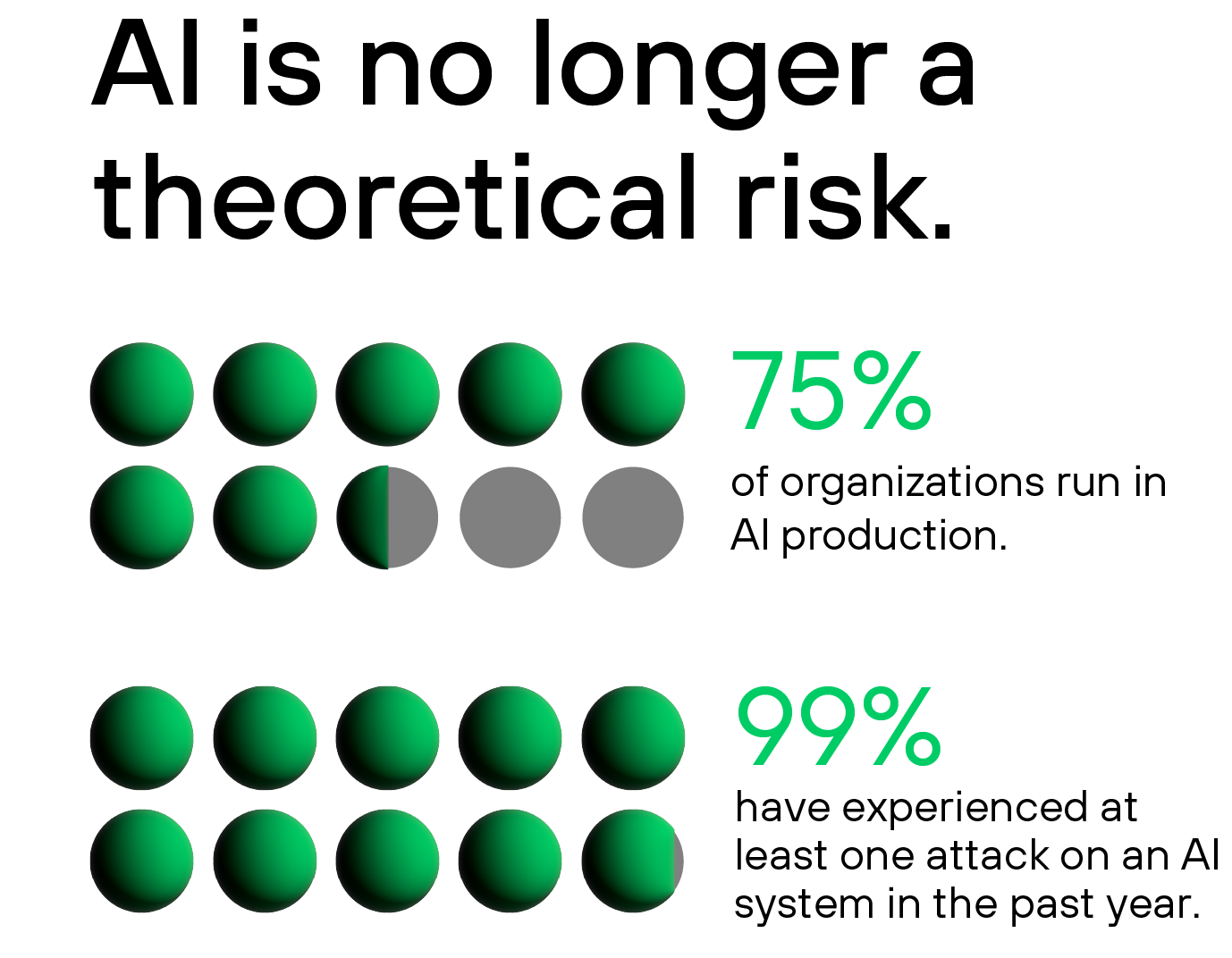
Of those surveyed in the 2025 report, 75% of organizations stated that they are running AI in their production environments today. That level is significant, as it points to the growing adoption and use of AI as businesses are locked in what looks like a modern arms race to bring the latest capabilities and benefits to their organizations and customers. In addition, as stated earlier, our findings confirm that 99% of organizations reported at least one attack on their AI systems within the past year. This number proves that AI needs human guardrails, as well as to be secured to contain the risk of critical data exposure by adversaries.

AI is no longer a theoretical risk – percentages of organizations running AI production and those who've experienced an AI attack.
The prevalence of AI use and attacks on AI.

The AppSec Pipeline Is Not Secure Enough Yet

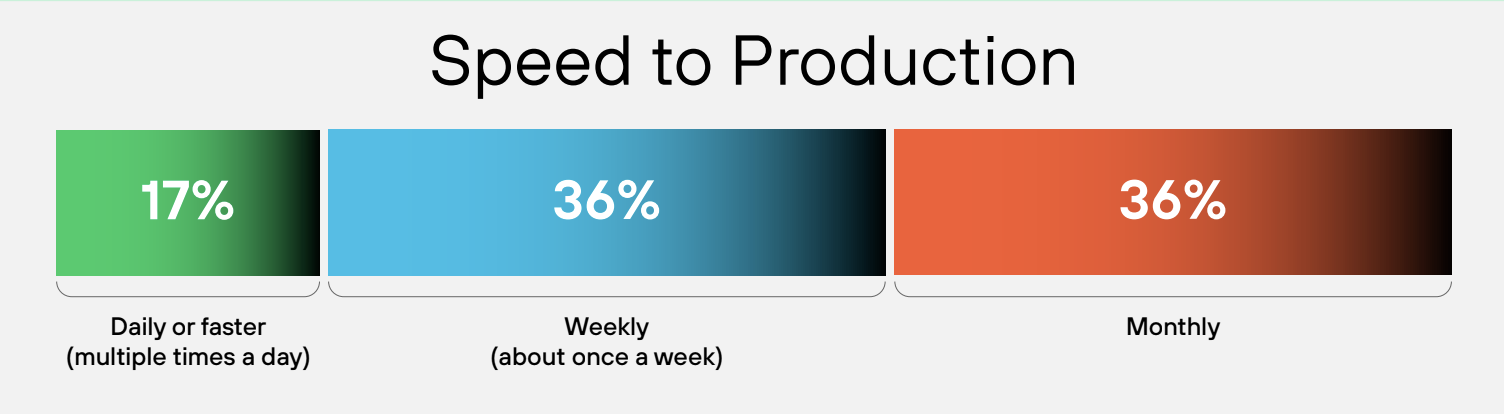
As AI expands the cloud attack surface and has been proven to be a significant target, we can see that code development pipelines are also being stressed by the same forces. An important trend from the 2025 report is the rise of GenAI-assisted coding (vibe coding), used by 99% of respondents. The use of vibe coding is generating insecure code faster than security teams can review it. The acceleration creates a massive risk gap: 52% of teams are shipping code weekly, but only 18% are able to fix vulnerabilities at that same pace. This confirms that traditional, human-led approaches to application security are inadequate, leaving security teams to fight threats with fragmented tools and slow, manual fix cycles.

Speed to production percentages.
The Speed of development across survey respondents.

As the pace of development increases, the disconnect between security assessment and remediation is becoming more apparent too. While teams are making progress by shifting away from outdated vulnerability prioritization methods, they still struggle to integrate security effectively into the development workflow. This introduces a large number of vulnerabilities into production, where 20% of organizations report that an average of 37% of their high or critical issues reach their production environments. Once in production those vulnerabilities linger, as 82% of organizations report it taking longer than a week to deploy code fixes. What is slowing teams down?

The traditional refrain toward implementing prevention that blocks risks from reaching production during rapid code development is still true today. The barriers are clear: 31% cite poor CI/CD integration and another 31% worry about slowing down development. On the positive note, only 17% rely on CVSS scores to prioritize their fixes as teams are now moving more toward context-rich decisions based on exploitability-based triage (32%) and business impact (33%).

The New Frontiers of Cloud Risk

Attackers are rapidly pivoting to exploit the foundational layers of the cloud, with a clear focus on ungoverned interfaces and overprivileged access. The volume and autonomy introduced by AI agents further accelerates this exploitation, turning minor gaps into major incidents.

Attacks on APIs Jump for 41%

APIs are the new primary entry point. Attacks on APIs increased for 41% of organizations in the last year, marking the sharpest rise of any threat category measured. As agentic AI relies heavily on APIs to operate, this explosion in usage has greatly expanded the attack surface. Furthermore, nearly every AI-related threat, including model supply chain tampering, token theft and prompt injection, involves an API boundary. This reinforces the role of ungoverned interfaces in scalable AI compromise, with 47% of AI system breaches involving data exfiltration through assistants or plugins.

Identity Still Remains the Weakest Link

Insufficient access controls remain a leading vector for credential theft and data exfiltration. 53% of organizations cite lenient identity and access management (IAM) practices as a top data security challenge. This problem is compounded by complexity. The number climbs to 57% among organizations running more than six AppSec tools, proving that the discipline required to maintain least privilege is failing to scale with tool sprawl. Data leaves through both legitimate business systems and breach events, making it fundamentally an identity problem.

The top three exfiltration vectors confirm this focus:

  • SaaS sync or export misuse: 63%
  • Overpermissive external sharing: 59%
  • Compromised credentials or tokens: 58%

Lateral Movement Risks Persist

Once an attacker gains a foothold, they can move freely. Twenty-eight percent point to unrestricted network access between cloud workloads as a growing threat, allowing attackers to pivot across environments and turn minor compromises into major incidents.

The Growing Imperative of Cloud & SOC Must Merge

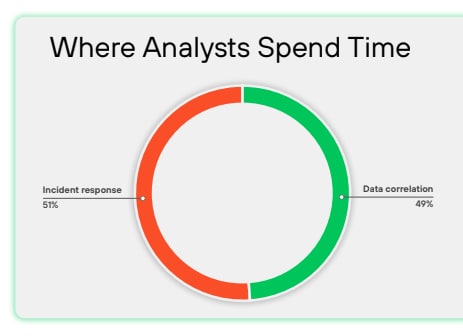
The gap between detection and resolution is where breaches succeed. Today the cloud and SOC divide is proving too slow in the face of machine-speed threats. Structural fragmentation is clearly visible in response times, while 74% of organizations detect threats within 24 hours, 30% take more than a full day to resolve them. A delay like this is caused by disjointed workflows and isolated data sources between cloud and SOC teams, which stall incident response (IR) for 50% of organizations.

Analysts spend 51% of time with incident responses and 49% with data correlation.
How SOC analysts spend their time after an incident.
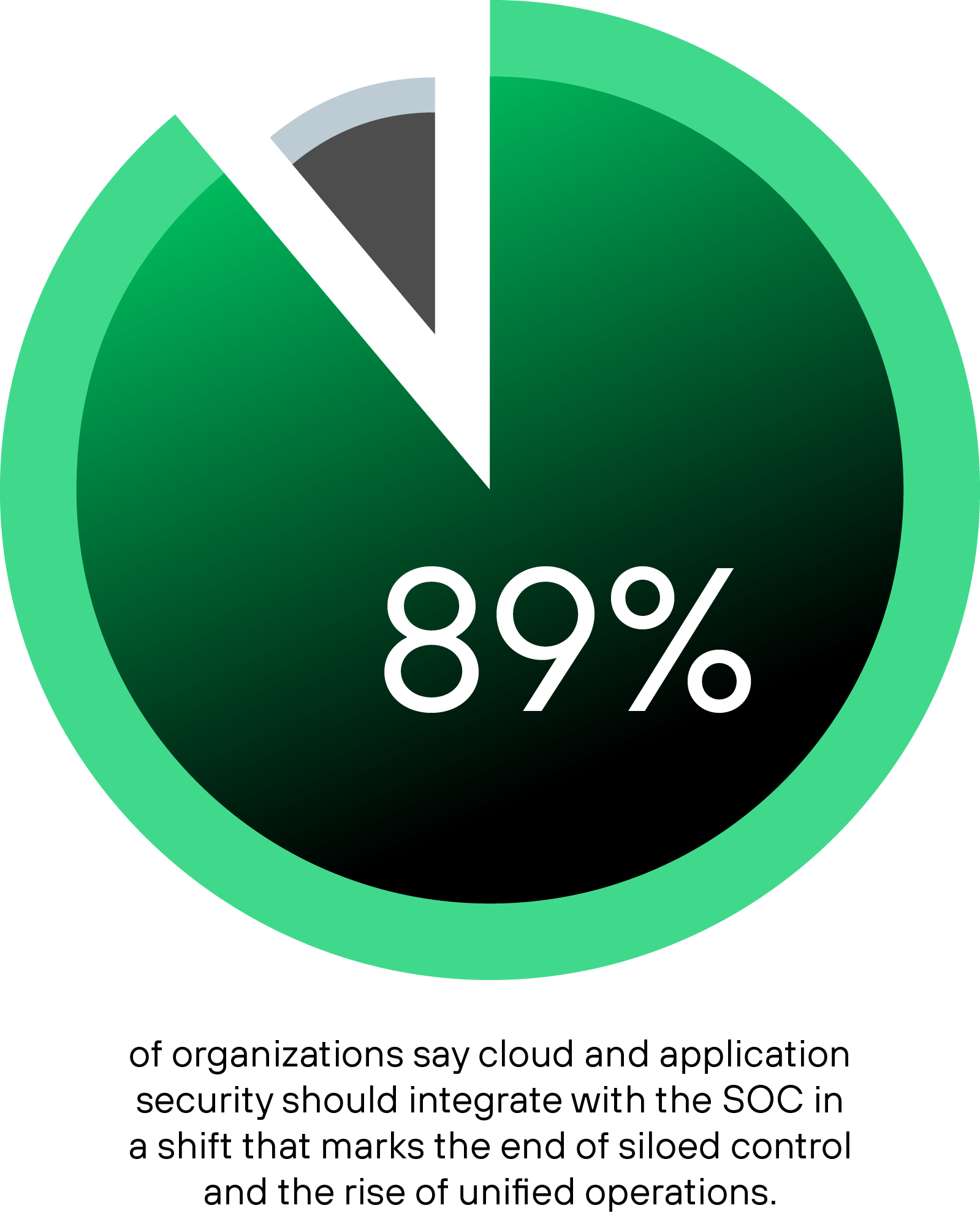
89% of organizations say cloud and application security should integrate with SOC in a shift that marks the end of siloed control and the rise of unified operations.
Respondents calling for cloud and security operations to merge.

The demand for consolidation shows up across the board:

  • 89% of organizations believe cloud security and security operations must fully merge, not just integrate.
  • Organizations currently manage an average of 17 tools from five vendors, creating fragmented data and context gaps.
  • Consequently, 97% of respondents prioritized consolidating their security footprint to address the chaos of tool sprawl.

The model that worked for lift-and-shift can't contain threats that move at machine speed. Organizations are ready to collapse the distance between teams and tools.

About the Report

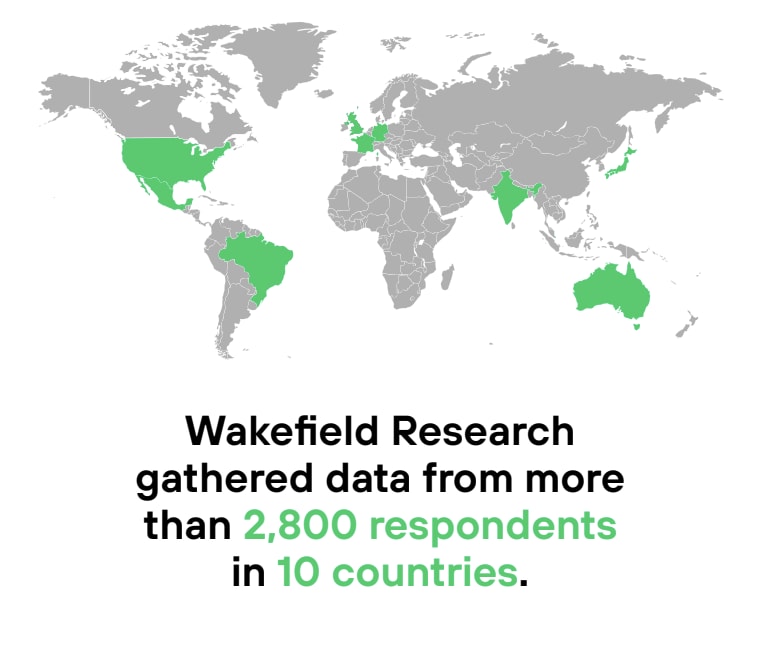
The State of Cloud Security Report 2025 draws from over 2,800 security leaders and practitioners across 10 countries and includes breakouts by region, industry and cloud maturity, along with the full incident data and strategic insights we’ve touched on here.

Wakefield research gathered data from more than 2,800 respondents in 10 countries.
2,8000 survey respondents by country.

Learn More and Transform to an Agentic-First Platform

To stay ahead of adversaries who use AI to launch attacks at machine speed, human-led defense is no longer sufficient. The report emphasizes that organizations must counter with an equivalent evolution: Agentic security, leveraging autonomous agents to deliver cloud security from code to cloud to SOC.

Download the full State of Cloud Security report to see how today’s leaders are closing the gap and what we recommend.

The post Where Cloud Security Stands Today and Where AI Breaks It appeared first on Palo Alto Networks Blog.

  •  

Extortion and ransomware drive over half of cyberattacks

In 80% of the cyber incidents Microsoft’s security teams investigated last year, attackers sought to steal data—a trend driven more by financial gain than intelligence gathering. According to the latest Microsoft Digital Defense Report, written with our Chief Information Security Officer Igor Tsyganskiy, over half of cyberattacks with known motives were driven by extortion or ransomware. That’s at least 52% of incidents fueled by financial gain, while attacks focused solely on espionage made up just 4%. Nation-state threats remain a serious and persistent threat, but most of the immediate attacks organizations face today come from opportunistic criminals looking to make a profit.

Every day, Microsoft processes more than 100 trillion signals, blocks approximately 4.5 million new malware attempts, analyzes 38 million identity risk detections, and screens 5 billion emails for malware and phishing. Advances in automation and readily available off-the-shelf tools have enabled cybercriminals—even those with limited technical expertise—to expand their operations significantly. The use of AI has further added to this trend with cybercriminals accelerating malware development and creating more realistic synthetic content, enhancing the efficiency of activities such as phishing and ransomware attacks. As a result, opportunistic malicious actors now target everyone—big or small—making cybercrime a universal, ever-present threat that spills into our daily lives.

In this environment, organizational leaders must treat cybersecurity as a core strategic priority—not just an IT issue—and build resilience into their technology and operations from the ground up. In our sixth annual Microsoft Digital Defense Report, which covers trends from July 2024 through June 2025, we highlight that legacy security measures are no longer enough; we need modern defenses leveraging AI and strong collaboration across industries and governments to keep pace with the threat. For individuals, simple steps like using strong security tools—especially phishing-resistant multifactor authentication (MFA)—makes a big difference, as MFA can block over 99% of identity-based attacks. Below are some of the key findings.

Critical services are prime targets with a real-world impact

Malicious actors remain focused on attacking critical public services—targets that, when compromised, can have a direct and immediate impact on people’s lives. Hospitals and local governments, for example, are all targets because they store sensitive data or have tight cybersecurity budgets with limited incident response capabilities, often resulting in outdated software. In the past year, cyberattacks on these sectors had real-world consequences, including delayed emergency medical care, disrupted emergency services, canceled school classes, and halted transportation systems.

Ransomware actors in particular focus on these critical sectors because of the targets’ limited options. For example, a hospital must quickly resolve its encrypted systems, or patients could die, potentially leaving no other recourse but to pay. Additionally, governments, hospitals, and research institutions store sensitive data that criminals can steal and monetize through illicit marketplaces on the dark web, fueling downstream criminal activity. Government and industry can collaborate to strengthen cybersecurity in these sectors—particularly for the most vulnerable. These efforts are critical to protecting communities and ensuring continuity of care, education, and emergency response.

Nation-state actors are expanding operations

While cybercriminals are the biggest cyber threat by volume, nation-state actors still target key industries and regions, expanding their focus on espionage and, in some cases, on financial gain. Geopolitical objectives continue to drive a surge in state-sponsored cyber activity, with a notable expansion in targeting communications, research, and academia.

Key insights:

  • China is continuing its broad push across industries to conduct espionage and steal sensitive data. State-affiliated actors are increasingly attacking non-governmental organizations (NGOs) to expand their insights and are using covert networks and vulnerable internet-facing devices to gain entry and avoid detection. They have also become faster at operationalizing newly disclosed vulnerabilities.
  • Iran is going after a wider range of targets than ever before, from the Middle East to North America, as part of broadening espionage operations. Recently, three Iranian state-affiliated actors attacked shipping and logistics firms in Europe and the Persian Gulf to gain ongoing access to sensitive commercial data, raising the possibility that Iran may be pre-positioning to have the ability to interfere with commercial shipping operations.
  • Russia, while still focused on the war in Ukraine, has expanded its targets. For example, Microsoft has observed Russian state-affiliated actors targeting small businesses in countries supporting Ukraine. In fact, outside of Ukraine, the top ten countries most affected by Russian cyber activity all belong to the North Atlantic Treaty Organization (NATO)—a 25% increase compared to last year. Russian actors may view these smaller companies as possibly less resource-intensive pivot points they can use to access larger organizations. These actors are also increasingly leveraging the cybercriminal ecosystem for their attacks.
  • North Korea remains focused on revenue generation and espionage. In a trend that has gained significant attention, thousands of state-affiliated North Korean remote IT workers have applied for jobs with companies around the world, sending their salaries back to the government as remittances. When discovered, some of these workers have turned to extortion as another approach to bringing in money for the regime.

The cyber threats posed by nation-states are becoming more expansive and unpredictable. In addition, the shift by at least some nation-state actors to further leveraging the cybercriminal ecosystem will make attribution even more complicated. This underscores the need for organizations to stay abreast of the threats to their industries and work with both industry peers and governments to confront the threats posed by nation-state actors.

2025 saw an escalation in the use of AI by both attackers and defenders

Over the past year, both attackers and defenders harnessed the power of generative AI. Threat actors are using AI to boost their attacks by automating phishing, scaling social engineering, creating synthetic media, finding vulnerabilities faster, and creating malware that can adapt itself. Nation-state actors, too, have continued to incorporate AI into their cyber influence operations. This activity has picked up in the past six months as actors use the technology to make their efforts more advanced, scalable, and targeted.

For defenders, AI is also proving to be a valuable tool. Microsoft, for example, uses AI to spot threats, close detection gaps, catch phishing attempts, and protect vulnerable users. As both the risks and opportunities of AI rapidly evolve, organizations must prioritize securing their AI tools and training their teams. Everyone—from industry to government—must be proactive to keep pace with increasingly sophisticated attackers and to ensure that defenders keep ahead of adversaries.

Adversaries aren’t breaking in; they’re signing in

Amid the growing sophistication of cyber threats, one statistic stands out: more than 97% of identity attacks are password attacks. In the first half of 2025 alone, identity-based attacks surged by 32%. That means the vast majority of malicious sign-in attempts an organization might receive are via large-scale password guessing attempts. Attackers get usernames and passwords (“credentials”) for these bulk attacks largely from credential leaks.

However, credential leaks aren’t the only place where attackers can obtain credentials. This year, we saw a surge in the use of infostealer malware by cybercriminals. Infostealers can secretly gather credentials and information about your online accounts, like browser session tokens, at scale. Cybercriminals can then buy this stolen information on cybercrime forums, making it easy for anyone to access accounts for purposes such as the delivery of ransomware.

Luckily, the solution to identity compromise is simple. The implementation of phishing-resistant multifactor authentication (MFA) can stop over 99% of this type of attack even if the attacker has the correct username and password combination. To target the malicious supply chain, Microsoft’s Digital Crimes Unit (DCU) is fighting back against the cybercriminal use of infostealers. In May, the DCU disrupted the most popular infostealer—Lumma Stealer—alongside the US Department of Justice and Europol.

Moving forward: Cybersecurity is a shared defensive priority

As threat actors grow more sophisticated, persistent, and opportunistic, organizations must stay vigilant, continually updating their defenses and sharing intelligence. Microsoft remains committed to doing its part to strengthen our products and services via our Secure Future Initiative. We also continue to collaborate with others to track threats, alert targeted customers, and share insights with the broader public when appropriate.

However, security is not only a technical challenge but a governance imperative. Defensive measures alone are not enough to deter nation-state adversaries. Governments must build frameworks that signal credible and proportionate consequences for malicious activity that violates international rules. Encouragingly, governments are increasingly attributing cyberattacks to foreign actors and imposing consequences such as indictments and sanctions. This growing transparency and accountability are important steps toward building collective deterrence. As digital transformation accelerates—amplified by the rise of AI—cyber threats pose risks to economic stability, governance, and personal safety. Addressing these challenges requires not only technical innovation but coordinated societal action.

The post Extortion and ransomware drive over half of cyberattacks appeared first on Microsoft On the Issues.

  •  

DOs and DON’Ts of Pentest Report Writing

Melisa Wachs// The first day of school has started for your school-age kiddos. What better time to run through some of our basic reporting guidelines with y’all? Here is a […]

The post DOs and DON’Ts of Pentest Report Writing appeared first on Black Hills Information Security, Inc..

  •  

That One Time My Parents Were Hacked

Heather Doerges // My mom called the other day. It started out, “Honestly, your father.” Which, isn’t a strange way for her to start a conversation about my dad. “What […]

The post That One Time My Parents Were Hacked appeared first on Black Hills Information Security, Inc..

  •  

A Need For A Change – or – Burning Your Money

Mick Douglas // Take look at this chart from last year’s Verizon Data Breach Report.  It shows who notified the breached party when they were attacked. This graph is a […]

The post A Need For A Change – or – Burning Your Money appeared first on Black Hills Information Security, Inc..

  •  
❌