Reading view

From the Hill: The AI-Cybersecurity Imperative in Financial Services

The transformative potential of artificial intelligence (AI) across industries is undeniable. But realizing AI's true value hinges on three cybersecurity imperatives: Understanding the AI-cybersecurity nexus, harnessing AI to supercharge cyber defense, and embedding security into AI tools from the ground up through Secure AI by Design.

Nowhere is this convergence more urgent than in financial services. Sitting at the center of our global economy, financial institutions face a dual mandate: Embrace AI for cybersecurity and cybersecurity for AI.

I was honored to cover these key principals in my testimony before the House Committee on Financial Services, led by Chairman French Hill. The hearing, entitled “From Principles to Policy: Enabling 21st Century AI Innovation in Financial Services” convened witnesses from Palo Alto Networks, Google, NASDAQ, Zillow and Public Citizen. Together, we examined AI use cases in the financial services and housing sectors, including those specific to cybersecurity. We assessed how existing laws and frameworks apply in the age of AI.

The Defense Advantage Is AI-Powered Security Operations

Attacks have become faster, with the time from compromise to data exfiltration now 100 times faster than four years ago. The financial sector bears disproportionate risk, given the value of its data and interconnected systems, while firms contend with evolving regulatory expectations, talent shortages and the persistent tendency to elevate cybersecurity only after an incident.

Generative and agentic AI intensify these pressures by accelerating every phase of the attack chain, from deepfake-driven fraud to tailored spear phishing campaigns. Our researchers at Unit 42® have found that agentic AI, autonomous systems that can reason and act without human intervention, can compress what was once a multiday ransomware campaign into roughly 25 minutes.

To keep pace, financial institutions must pivot to AI-driven defenses that operate at machine speed.

Security operations centers (SOC) have long been overwhelmed by traditional alerts and fragmented data. Security teams, forced into manual triage across dozens of disparate tools, face an inefficient model that leaves vulnerabilities exposed, burns out analysts and makes it impossible to operate at the speed necessary to outpace modern attacks.

The average enterprise SOC ingests data from 83 security solutions across 29 vendors. In 75% of breaches, logging existed that should have flagged anomalous behavior, but critical signals were buried. With 90% of SOCs still relying on manual processes, adversaries have the clear advantage.

AI-driven SOCs flip this paradigm, acting as a force multiplier to substantially reduce detection and response times. To illustrate the scale of this necessity, consider our own security operations. Palo Alto Networks SOC analyzes over 90 billion events daily. Without AI, this would be an impossible task for human analysts. But by applying AI, we distill that down to a single actionable incident.

Financial institutions migrating to AI-driven SOC platforms are seeing transformative results:

  • One customer reduced the Mean Time to Respond (MTTR) from one day to 14 minutes.
  • Another prevented 22,831 threats and processed 113,271 threat indicators in less than 5 seconds.
  • A large bank saved 180 hours per year by automating security information and event management reporting; 500 hours through automated data collection; 360 hours by automating four Chief Technology Officer playbooks; and 240 hours with automated threat intelligence enrichment.

These improvements are critical to stopping threat actors. But none of this would be possible without AI.

Securing the New AI Attack Surface

As AI adoption grows, it will further expand the attack surface, creating new vectors targeting training data and model environments. AI's rapid growth is outpacing the adoption of security measures designed to protect it. Nearly three-quarters of S&P 500 companies now flag AI as a material risk in their public disclosures, up from just 12% in 2023.

Traditional security tools rely on static rules that miss advanced attacks, like multistep prompt injections or adversarial manipulations. Autonomous AI agents can take unpredictable actions that are difficult to monitor with legacy methods.

Rapid AI adoption has exposed organizations' infrastructure, data, models, applications and agents to unique threats. Unlike traditional cyber exploits that target software vulnerabilities, AI-specific attacks can manipulate the foundation of how an AI system learns and operates.

A Secure AI by Design

Even with an understanding of the risks, many organizations struggle with the lack of clarity on what effective AI security looks like in practice. Recognizing the gap between intent and execution, Palo Alto Networks developed a Secure AI by Design policy roadmap that provides organizations with a comprehensive roadmap that integrates security throughout the entire AI lifecycle.

A proactive stance ensures security is a feature, not an afterthought, crucial for building trust, maintaining compliance and mitigating risks. The approach addresses four imperatives organizations most pressingly face in AI adoption:

1. Secure the use of external AI tools.

2. Secure the underlying AI infrastructure and data.

3. Safely build and deploy AI applications.

4. Monitor and control AI agents.

The Path Forward

For financial institutions, Secure AI by Design must be anchored in enterprise governance. Institutions should maintain risk-tiered AI inventories, enforce strict access controls and implement testing commensurate with risk. Governance structures should enable board oversight and align with established model risk practices.

Policymakers also have a critical role to play in promoting AI-driven security operations, championing voluntary Secure AI by Design frameworks, ensuring policies safeguard innovation, enabling controlled experimentation and strengthening public-private collaboration.

Ultimately, the financial institutions that will thrive will recognize cybersecurity as the foundation that makes innovation possible. By embracing AI-driven defenses and securing AI systems from the ground up, the sector can confidently unlock AI's transformative potential while safeguarding the trust and stability that underpin the global economy.

Read the full testimony to learn more about how cybersecurity can enable AI innovation in financial services.

The post From the Hill: The AI-Cybersecurity Imperative in Financial Services appeared first on Palo Alto Networks Blog.


  •  

Meet digital sovereignty needs with AWS Dedicated Local Zones expanded services

At Amazon Web Services (AWS), we continue to invest in and deliver digital sovereignty solutions to help customers meet their most sensitive workload requirements. To address the regulatory and digital sovereignty needs of public sector and regulated industry customers, we launched AWS Dedicated Local Zones in 2023, with the Government Technology Agency of Singapore (GovTech Singapore) as our first customer.

Today, we’re excited to announce expanded service availability for Dedicated Local Zones, giving customers more choice and control without compromise. In addition to the data residency, sovereignty, and data isolation benefits they already enjoy, the expanded service list gives customers additional options for compute, storage, backup, and recovery.

Dedicated Local Zones are AWS infrastructure fully managed by AWS, built for exclusive use by a customer or community, and placed in a customer-specified location or data center. They help customers across the public sector and regulated industries meet security and compliance requirements for sensitive data and applications through a private infrastructure solution configured to meet their needs. Dedicated Local Zones can be operated by local AWS personnel and offer the same benefits of AWS Local Zones, such as elasticity, scalability, and pay-as-you-go pricing, with added security and governance features.

Since being launched, Dedicated Local Zones have supported a core set of compute, storage, database, containers, and other services and features for local processing. We continue to innovate and expand our offerings based on what we hear from customers to help meet their unique needs.

More choice and control without compromise

The following new services and capabilities deliver greater flexibility for customers to run their most critical workloads while maintaining strict data residency and sovereignty requirements.

New generation instance types

To support complex workloads in AI and high-performance computing, customers can now use newer generation instance types, including Amazon Elastic Compute Cloud (Amazon EC2) generation 7 with accelerated computing capabilities.

AWS storage options

AWS storage options provide two storage classes including Amazon Simple Storage Service (Amazon S3) Express One Zone, which offers high-performance storage for customers’ most frequently accessed data, and Amazon S3 One Zone-Infrequent Access, which is designed for data that is accessed less frequently and is ideal for backups.

Advanced block storage capabilities are delivered through Amazon Elastic Block Store (Amazon EBS) gp3 and io1 volumes, which customers can use to store data within a specific perimeter to support critical data isolation and residency requirements. By using the latest AWS general purpose SSD volumes (gp3), customers can provision performance independently of storage capacity with an up to 20% lower price per gigabyte than existing gp2 volumes. For intensive, latency-sensitive transactional workloads, such as enterprise databases, provisioned IOPS SSD (io1) volumes provide the necessary performance and reliability.

Backup and recovery capabilities

We have added backup and recovery capabilities through Amazon EBS Local Snapshots, which provides robust support for disaster recovery, data migration, and compliance. Customers can create backups within the same geographical boundary as EBS volumes, helping meet data isolation requirements. Customers can also create AWS Identity and Access Management (IAM) policies for their accounts to enable storing snapshots within the Dedicated Local Zone. To automate the creation and retention of local snapshots, customers can use Amazon Data Lifecycle Manager (DLM).

Customers can use local Amazon Machine Images (AMIs) to create and register AMIs while maintaining underlying local EBS snapshots within Dedicated Local Zones, helping achieve adherence to data residency requirements. By creating AMIs from EC2 instances or registering AMIs using locally stored snapshots, customers maintain complete control over their data’s geographical location.

Dedicated Local Zones meet the same high AWS security standards and sovereign-by-design principles that apply to AWS Regions and Local Zones. For instance, the AWS Nitro System provides the foundation with hardware- and software-level security. This is complemented by AWS Key Management Service (AWS KMS) and AWS Certificate Manager (ACM) for encryption management, Amazon Inspector, Amazon GuardDuty, and AWS Shield to help protect workloads, and AWS CloudTrail for audit logging of user and API activity across AWS accounts.

Continued innovation with GovTech Singapore

One of GovTech Singapore’s key focuses is on the nation’s digital government transformation and enhancing the public sector’s engineering capabilities. Our collaboration with GovTech Singapore involved configuring their Dedicated Local Zones with specific services and capabilities to support their workloads and meet stringent regulatory requirements. This architecture addresses data isolation and security requirements and ensures consistency and efficiency across Singapore Government cloud environments.

With the availability of the new AWS services with Dedicated Local Zones, government agencies can simplify operations and meet their digital sovereignty requirements more effectively. For instance, agencies can use Amazon Relational Database Service (Amazon RDS) to create new databases rapidly. Amazon RDS in Dedicated Local Zones helps simplify database management by automating tasks such as provisioning, configuring, backing up, and patching. This collaboration is just one example of how AWS innovates to meet customer needs and configures Dedicated Local Zones based on specific requirements.

Chua Khi Ann, Director of GovTech Singapore’s Government Digital Products division, who oversees the Cloud Programme, shared:
“The deployment of Dedicated Local Zones by our Government on Commercial Cloud (GCC) team, in collaboration with AWS, now enables Singapore government agencies to host systems with confidential data in the cloud. By leveraging cloud-native services like advanced storage and compute, we can achieve better availability, resilience, and security of our systems, while reducing operational costs compared to on-premises infrastructure.”

Get started with Dedicated Local Zones

AWS understands that every customer has unique digital sovereignty needs, and we remain committed to offering customers the most advanced set of sovereignty controls and security features available in the cloud. Dedicated Local Zones are designed to be customizable, resilient, and scalable across different regulatory environments, so that customers can drive ongoing innovation while meeting their specific requirements.

Ready to explore how Dedicated Local Zones can support your organization’s digital sovereignty journey? Visit AWS Dedicated Local Zones to learn more.

TAGS: AWS Digital Sovereignty Pledge, Digital Sovereignty, Security Blog, Sovereign-by-design, Public Sector, Singapore, AWS Dedicated Local Zones

Max Peterson Max Peterson
Max is the Vice President of AWS Sovereign Cloud. He leads efforts to help public sector organizations modernize their missions with the cloud while meeting necessary digital sovereignty requirements. Max previously oversaw broader digital sovereignty efforts at AWS and served as the VP of AWS Worldwide Public Sector with a focus on empowering government, education, healthcare, and nonprofit organizations to drive rapid innovation.
Stéphane Israël Stéphane Israël
Stéphane is the Managing Director of the AWS European Sovereign Cloud and Digital Sovereignty. He is responsible for the management and operations of the AWS European Sovereign Cloud GmbH, including infrastructure, technology, and services, and leads broader worldwide digital sovereignty efforts at AWS. Prior to AWS, he was the CEO of Arianespace, where he oversaw numerous successful space missions, including the launch of the James Webb Space Telescope.
  •  

Exploring the new AWS European Sovereign Cloud: Sovereign Reference Framework

At Amazon Web Services, we’re committed to deeply understanding the evolving needs of both our customers and regulators, and rapidly adapting and innovating to meet them. The upcoming AWS European Sovereign Cloud will be a new independent cloud for Europe, designed to give public sector organizations and customers in highly regulated industries further choice to meet their unique sovereignty requirements. The AWS European Sovereign Cloud expands on the same strong foundation of security, privacy, and compliance controls that apply to other AWS Regions around the globe with additional governance, technical, and operational measures to address stringent European customer and regulatory expectations. Sovereignty is the defining feature of the AWS European Sovereign Cloud and we’re using an independently validated framework to meet our customers’ requirements for sovereignty, while delivering the scalability and functionality you expect from the AWS Cloud.

Today, we’re pleased to share further details about the AWS European Sovereign Cloud: Sovereign Reference Framework (ESC-SRF). This reference framework aligns sovereignty criteria across multiple domains such as governance independence, operational control, data residency and technical isolation. Working backwards from our customers’ sovereign use cases, we aligned controls to each of the criteria and the AWS European Sovereign Cloud is undergoing an independent third-party audit to verify the design and operations of these controls conform to AWS sovereignty commitments. Customers and partners can also leverage the ESC-SRF as a foundation upon which they can build their own complementary sovereignty criteria and controls when using the AWS European Sovereign Cloud.

To clearly explain how the AWS European Sovereign Cloud meets sovereignty expectations, we’re publishing the ESC-SRF in AWS Artifact including the criteria and control mapping. In AWS Artifact, our self-service audit artifact retrieval portal, you have on-demand access to AWS security and compliance documents and AWS agreements. You can now use the ESC-SRF to define best practices for your own use case, map these to controls, and illustrate how you meet and even exceed sovereign needs of your customers.

A transparent and validated sovereignty model

The ESC-SRF has been built from customer feedback, regulatory requirements across the European Union (EU), industry frameworks, AWS contractual commitments, and partner input. ESC-SRF is industry and sector agnostic, as it’s written to address fundamental sovereignty needs and expectations at the foundational layer of our cloud offerings with additional sovereignty-specific requirements and controls that apply exclusively to the AWS European Sovereign Cloud. Each criterion is implemented through sovereign controls that will be independently validated by a third-party auditor.

The framework builds on core AWS security capabilities, including encryption, key management, access governance, AWS Nitro System-based isolation, and internationally recognized compliance certifications. The framework adds sovereign-specific governance, technical, and operational measures such as independent EU corporate structures, dedicated EU trust and certificate services, operations by AWS EU-resident personnel, strict residency for customer data and customer created metadata, separation from all other AWS Regions, and incident response operated within the EU.

These controls are the basis of a dedicated AWS European Sovereign Cloud System and Organization Controls (SOC) 2 attestation. The ESC-SRF establishes a solid foundation for sovereignty of the cloud, so that customers can focus on defining sovereignty measures in the cloud that are tailored to their goals, regulatory needs, and risk posture.

How you can use the ESC-SRF

The ESC-SRF describes how AWS implements and validates sovereignty controls in the AWS European Sovereign Cloud. AWS treats each criterion as binding and its implementation will be validated by an independent third-party auditor in 2026. While most customers don’t operate at the size and scale of AWS, you can use the ESC-SRF as both an assurance model and a reference framework you can adapt to your specific use cases.

From an assurance perspective, it provides end-to-end visibility for each sovereignty criterion through to its technical implementation. We will also provide third-party validation in the AWS European Sovereign Cloud SOC 2 report. Customers can use this report with internal auditors, external assessors, supervisory authorities, and regulators. This can reduce the need for ad-hoc evidence requests and supports customers by providing them with evidence to demonstrate clear and enforceable sovereignty assurances.

From a design perspective, you can refer to the framework when shaping your own sovereignty architecture, selecting configurations, and defining internal controls to meet regulatory, contractual, and mission-specific requirements. Because the ESC-SRF is industry and sector agnostic, you can apply criteria from the framework to suit your own unique needs. Depending on your sovereign use case, not all criteria may apply to your use case sovereign needs. The ESC-SRF can also be used in conjunction with AWS Well-Architected which can help you learn, measure, and build using architectural best practices. Where appropriate you can create your version of the ESC-SRF, map to controls, and have them tested by a third party. To download the ESC-SRF, visit AWS Artifact (login required).

A strong, clear foundation

The publication of the ESC-SRF is part of our ongoing commitment to delivering on the AWS Digital Sovereignty Pledge through transparency and assurances to help customers meet their evolving sovereignty needs with assurances designed, implemented, and validated entirely within the EU. Within the framework, customers can build solutions in the AWS European Sovereign Cloud with confidence and a strong understanding of how they are able to meet their sovereignty goals using AWS.

For more information about the AWS European Sovereign Cloud, visit aws.eu.


If you have feedback about this post, submit comments in the Comments section below.

Andreas Terwellen

Andreas Terwellen

Andreas is a Senior Manager in security audit assurance at AWS, based in Frankfurt, Germany. His team is responsible for third-party and customer audits, attestations, certifications, and assessments across Europe. Previously, he was a CISO in a DAX-listed telecommunications company in Germany. He also worked for various consulting companies managing large teams and programs across multiple industries and sectors.

  •  

Beyond the Malware: Inside the Digital Empire of a North Korean Threat Actor

Blogs

Blog

Beyond the Malware: Inside the Digital Empire of a North Korean Threat Actor

In this post Flashpoint reveals how an infostealer infection on a North Korean threat actor’s machine exposed their digital operational security failures and reliance on AI. Leveraging Flashpoint intelligence, we pivot from a single persona to a network of fake identities and companies targeting the Web3 and crypto industry.

SHARE THIS:
Default Author Image
December 10, 2025

Last week, Hudson Rock published a blog on “Trevor Greer,” a persona tied to a North Korean IT Worker. Flashpoint shared additional insights with our clients back in July, and we’re now making those findings public.

Trevor Greer, a North Korean operative, was identified via an infostealer infection on their own machine. Information-stealing malware, also known as Infostealers or stealers, are malware designed to scrape passwords and cookies from unsuspecting victims. Stealers (like LummaC2 or RedLine) are typically used by cybercriminals to steal login credentials from everyday users to sell on the Dark Web. It is rare to see them infect the machines of a state-sponsored advanced persistent threat group (APT).

However, when adversaries unknowingly infect themselves, they can expose valuable insights into the inner workings of their campaigns. Leveraging Flashpoint intelligence sourced from the leaked logs of “Trevor Greer,” our analysts uncovered a myriad of fake identities and companies used by DPRK APTs.

Finding Trevor Greer

Flashpoint analysts have been tracking the Trevor Greer email address since December 2024 in relation to the “Contagious Interview” campaign, in which threat actors operated as LinkedIn recruiters to target Web3 developers, resulting in the deployment of multiple stealers compromising developer Web3 wallets. Flashpoint also identified the specific persona’s involvement in a campaign in which North Korean threat actors posed as IT freelance workers and applied for jobs at legitimate companies before compromising the organizations internally.

ByBit Compromise

The ByBit compromise in late February 2025 further fueled Flashpoint’s investigations into the Trevor Greer email address. Bybit, a cryptocurrency exchange, suffered a critical incident resulting in North Korean actors extorting US $1.5 billion worth of cryptocurrency. In the aftermath, Silent Push researchers identified the persona “Trevor Greer” associated with the email address trevorgreer9312@gmail[.]com, which registered the domain “Bybit-assessment[.]com” prior to the Bybit compromise.

A later report claimed that the domain “getstockprice[.]com” was involved in the compromise. Despite these domain discrepancies, both investigations attributed the attack to North Korean advanced persistent threat (APT) nexus groups.

Tracing the Infection

Using Flashpoint’s vast intelligence collections, we performed a full investigation of compromised virtual private servers (VPS), revealing the actor’s potential involvement in several other operations, including remote IT work, several self-made blockchain and cryptocurrency exchange companies, and a potential crypto scam dating back to 2022.

Flashpoint analysts also discovered that the Trevor Greer email address was linked to domains infected with information-stealing malware.

What the Logs Revealed

Analysts extracted information about the associated infected host from Trevor Greer, revealing possible tradecraft and tools used. Analysts further identified specific indicators of compromise (IOCs) used in the campaigns mentioned above, as well as email addresses used by the actor for remote work.

The data painted a vivid picture of how these threat actors operate:

Preparation for “Contagious Interviews”

The browser history revealed the actor logging into Willo, a legitimate video interview platform. This suggests the actor was conducting reconnaissance to clone the site for the “Contagious Interview” campaign, where they lured Web3 developers into fake job interviews to deploy malware.

Reliance on AI Tools

The logs exposed the actor’s reliance on AI to bridge the language gap. The operator frequently accessed ChatGPT and Quillbot, likely using them to write convincing emails, build resumes, and generate code for their malware.

Pivoting: One Node to a Network

By analyzing the “Trevor Greer” logs, we were able to pivot to other personas and campaigns involved in the operation.

  • Fake Employment: The logs contained credentials for freelance platforms, such as Upwork and Freelancer, associated with other aliases, including “Kenneth Debolt” and “Fabian Klein.” This confirmed the actor was part of a broader scheme to infiltrate Western companies as remote IT workers.
  • Fake Companies: The data linked the actor to fake corporate entities, such as Block Bounce (blockbounce[.]xyz), a sham crypto trading firm set up to appear legitimate to potential victims. 
  • Developer Personas: The infection data linked the actor to the GitHub account svillalobosdev, which had been active in open source projects to build credibility before the attack.
  • Legitimate Platforms & Tools: Analysts observed the actor using job boards such as Dice and HRapply[.]com, freelance platforms such as Upwork and Freelancer, and direct applications through company Workday sites. To improve their resume, the actor used resumeworded[.]com or cakeresume[.]com. For conversing, the threat actor likely relies on a mix of both GPT and Quilbot, as found in infected host logins, to ensure they sound human. During interviews, analysts determined that they potentially used Speechify. 
  • Deep & Dark Web Resources: The actor also likely purchased Social Security numbers (SSNs) from SSNDOB24[.]com, a site for acquiring Social Security data.

Disrupt Threat Actors Using Flashpoint

The “Trevor Greer” case study illustrates a critical shift in modern threat intelligence. We are no longer limited to analyzing the malware adversaries deploy; sometimes, we can analyze the adversaries themselves.

Using their own tools against them, Flashpoint transformed a faceless state-sponsored entity into a tangible user with bad habits, sloppy OPSEC, and a trail of digital breadcrumbs. Behind every sophisticated APT campaign is a human operator, and sometimes, they click the wrong link too. 

Request a demo today to delve deeper into the tactics, techniques, and procedures of advanced persistent threats and learn how Flashpoint’s intelligence strengthens your defenses.

Request a demo today.

The post Beyond the Malware: Inside the Digital Empire of a North Korean Threat Actor appeared first on Flashpoint.

  •  

Capita fined £14m for data protection failings in 2023 cyber-attack

Hackers stole personal information of 6.6m people but outsourcing firm did not shut device targeted for 58 hours

The outsourcing company Capita has been fined £14m for data protection failings after hackers stole the personal information of 6.6 million people, including staff details and those of its clients’ customers.

John Edwards, the UK information commissioner who levied the fine, said the March 2023 data theft from the group and companies it supported, including 325 pension providers, caused anxiety and stress for those affected.

Continue reading...

© Photograph: Dado Ruvić/Reuters

© Photograph: Dado Ruvić/Reuters

© Photograph: Dado Ruvić/Reuters

  •  

Light at the End of the Dark Web

Join us for this one-hour Black Hills Information Security webcast with Joseph - Security Analyst, as he shares with you what he's discovered and learned about the Dark Web, so you never ever ever have to go there for yourself.

The post Light at the End of the Dark Web appeared first on Black Hills Information Security, Inc..

  •  

How Logging Strategies Can Affect Cyber Investigations w/ Kiersten & James 

This webcast was originally published on September 12, 2024.   In this video, Kirsten Gross and James Marrs discuss how logging strategies can affect cyber investigations, specifically focusing on Windows logs. […]

The post How Logging Strategies Can Affect Cyber Investigations w/ Kiersten & James  appeared first on Black Hills Information Security, Inc..

  •  

How to Combat Check Fraud: Leveraging Intelligence to Prevent Financial Loss

Blogs

Blog

How to Combat Check Fraud: Leveraging Intelligence to Prevent Financial Loss

Criminals increasingly steal checks and sell them on illicit online marketplaces, where check fraud-related services are common. Intelligence is helping the financial sector fight back

SHARE THIS:
Default Author Image
May 18, 2023

Stolen checks and the impact of Covid-19

Checks are one of the most vulnerable legacy payment methods. Check fraud can actively affect the bottom lines (and reputations) of banks, financial services organizations, government entities, and many other organizations that utilize checks. According to the Financial Crimes Enforcement Network (FinCEN), fraud—including check fraud—is “the largest source of illicit proceeds in the US” as well as “one of the most significant money laundering threats to the United States.” 

Targeting the mail

Criminals target the US mail system to steal a variety of checks. In fact, there is a nationwide surge in check fraud schemes targeting the US mail and shipping system, as threat actors continue to steal, alter, and sell checks through illicit means and channels. 

This includes personal checks and tax refund checks to government or government assistance-related checks (Social Security payments, e.g.). Business checks are also a primary target because they are often written for larger amounts and may take longer for the victim to identify fraudulent activity.

In 2022 alone, US banks filed 680,000 check fraud-related suspicious activity reports (SARs). This represents a nearly two-fold increase from 2021 (which itself represents a 23 percent YoY increase from 2020). This surge in check fraud has been exacerbated by Covid-19 Economic Impact Payments (EIPs) under the CARES Act, which presented threat actors with a new avenue to attempt to commit fraud.

Related Reading

This Is What Covid Fraud Looks Like: Targeting Government Relief Funding

Read now

Check fraud: A mini use case 

In order to mitigate and ultimately prevent check-fraud-related risks, it’s crucial for financial intelligence and fraud teams to understand what threat actors seek, how they work, and where they operate. 

This begins, as we detail below, with intelligence into the communities, forums, and marketplaces where check fraud occurs as well as the tools that enable deep understandings, timely insights, and measurable action. 

Below is an intelligence narrative, in three acts, that tells the story of how transactions involving some of the above examples could play out.

Act I: Obtain

Threat actors are known to remove mail from individuals’ mailboxes and parcel lockers using blue box “arrow” master keys. These arrow keys are often stolen from USPS employees, which has led to numerous incidents of harassment, threats, and even violence. Generally, arrow keys are sold within illicit community chats and/or the deep and dark web, often fetching upwards of $3,000 per key.

In general, when it comes to check fraud, threat actors may sell or seek: 

  • Mailbox keys
  • Stolen checks
  • Check alteration services (physical and digital)
  • Synthetic identity provisioning
  • Drop account sharing
  • Counterfeit check creation
  • Writing a check with insufficient funds behind it
  • Insider access
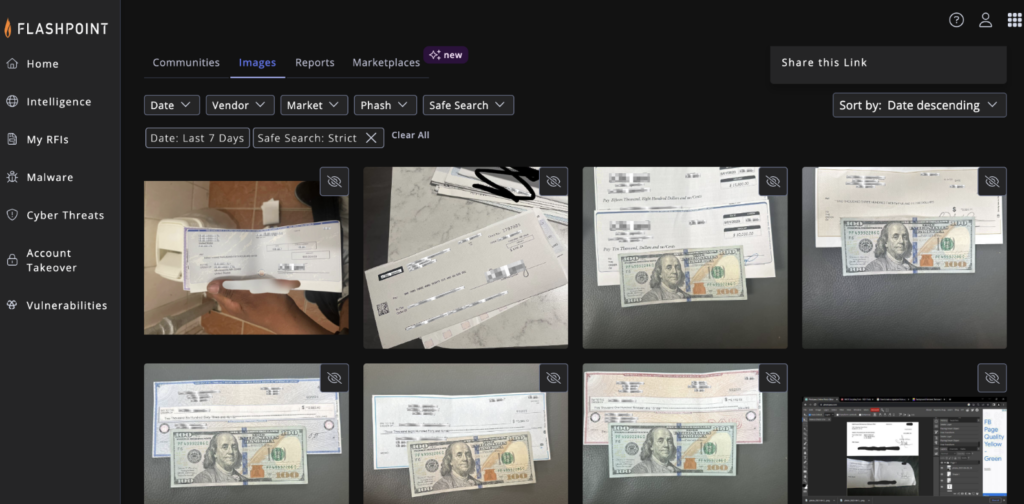
A screenshot of Flashpoint’s Ignite platform, showing the results of an OCR-driven search for stolen checks.

Act II: Alter

Check alteration comes in two forms: “washing” and “cooking.” 

Washing refers to the process of altering a check by chemically removing ink and replacing the newly empty spaces with a different value, recipient name, or another fraud-enabling alteration. 

Cooking involves digitally scanning the check and altering text or values through digital means.

Act III: Monetize

Threat actors will deposit the fraudulent check and rapidly withdraw the funds from an ATM, or sell a stolen or altered check on an illicit marketplace or chat group, and then receive payment, often via cryptocurrency.

Four key elements of actionable check fraud intelligence

Financial institutions should rely on four essential intelligence-led technologies, tools, or capabilities to effectively combat check fraud.

1) Visibility and access to illicit communities and channels

To prevent check fraud, organizations should focus on a few key places. Financially motivated threat actors operate and share information on messaging apps like Telegram and other open-source channels, as well as illicit marketplaces on the deep and dark web. Therefore, it is imperative for financial intelligence and fraud teams to have access to the most relevant check fraud-related threats across the internet. 

Keep in mind, however, that accessing these communities is not always straightforward and, if done frivolously, can compromise an investigation.

2) Timeliness and curated alerting

Intelligence is often only as good as it is relevant. Flashpoint enables security and intelligence practitioners to bubble the most important, mission-critical intelligence through our real-time alerting capability, which allows users to receive notifications for keywords and phrases that relate to their mission, such as check fraud-related lingo and activity. 

Essential Reading

The Flashpoint Guide to Card Fraud for the Financial Services Sector

Read now

In addition to real-time alerts, analysts can rely on curated alerting and saved searches to track topics of long-term interest. Flashpoint Ignite enables analysts to research particular accounts and their recent activity and matches transactions to their respective ATM slips and institution address. This helps to ensure the accuracy of the information found within these communities and marketplaces before raising any alarms, as many scammers post false content. 

This approach is particularly valuable as check fraudsters often share crucial information such as preferred methodologies, social media handles, and geolocations that can aid in identifying malicious activities. In addition, by closely observing newly emerging trends, such as the evolution of pandemic relief fraud to refund fraud to check fraud, analysts can proactively develop robust preventative measures to mitigate risks before these tactics become widespread.

3) Actionable OCR and Video Search

In order to provide “material proof,” cyber threat actors will often tout and post an image of a check in a chat application or marketplace in hopes of increasing the likelihood of a successful transaction. Optical Character Recognition (OCR) technology can capture important information about check fraud attempts, since actors often share images of the fraudulent check or subsequent monetization transactions. OCR alerts are customizable with the financial institution’s name and common phrases used on checks to enhance accuracy.

Images of fraudulent checks provide valuable insights into the fraud attempt, including the check’s unique identifier, the account holder’s name, the bank’s name and address, and the endorsement signature. By analyzing these details, financial institutions and law enforcement agencies can identify patterns and leads that can help them track down the perpetrators and prevent future fraudulent activity.

Related Resource

The Risk-Reducing Power of Flashpoint Video Search

Read now

Moreover, ATM withdrawal slips can offer critical information about the transaction, such as the location of the ATM, the time of the deposit, and the type of account used. This data is useful when taking appropriate measures to prevent similar attempts and protect customers’ assets. With the help of advanced technologies like Flashpoint’s OCR, institutions can quickly extract and analyze this information to generate real-time alerts and take prompt action to prevent monetary losses.

An essential investigative component, Flashpoint’s industry-first video search technology, like its OCR capability, enables fraud and cyber threat intelligence (CTI) teams to surface logos, text, explicit content, and other critical intelligence to enhance investigations.

Combat check fraud with Flashpoint

Flashpoint delivers the intelligence that enables financial institutions to combat check fraud at scale. With timely, actionable, and accurate intelligence, financial institutions can mitigate and prevent financial loss, protect customer assets, and track down perpetrators. Get a free trial today to learn how:

  • A financial services customer detected more than $4M in illicitly marketed assets, including checks and compromised accounts, using Flashpoint’s OCR capabilities. 
  • A customer received 125 actionable alerts in a single month equated to over $15M in potentially averted losses.
  • An automated alert enabled a customer to identify a threat actor’s specific operations, saving them over $5M.

Request a demo today.

  •  

How to Hack Hardware using UART

Raymond Felch // Preface: I began my exploration of reverse-engineering firmware a few weeks back (see “JTAG – Micro-Controller Debugging“), and although I made considerable progress finding and identifying the […]

The post How to Hack Hardware using UART appeared first on Black Hills Information Security, Inc..

  •  

JTAG – Micro-Controller Debugging

Raymond Felch // Being an embedded firmware engineer for most of my career, I quickly became fascinated when I learned about reverse engineering firmware using JTAG.   I decided to […]

The post JTAG – Micro-Controller Debugging appeared first on Black Hills Information Security, Inc..

  •  

How to Find an InfoSec Mentor

BB King // We got an email from a fan today asking how best to find a mentor in information security. Maybe you’re looking for a mentor too. It’s a […]

The post How to Find an InfoSec Mentor appeared first on Black Hills Information Security, Inc..

  •  

Stealing 2FA Tokens on Red Teams with CredSniper

Mike Felch // More and more organizations are rolling out mandatory 2FA enrollment for authentication to external services like GSuite and OWA. While this is great news because it creates […]

The post Stealing 2FA Tokens on Red Teams with CredSniper appeared first on Black Hills Information Security, Inc..

  •  

Fake Steam Desktop Authenticator steals account details


In this blog post, we'll have a quick look at fake versions of Steam Desktop Authenticator (SDA), which is a "desktop implementation of Steam's mobile authenticator app".

Lava from SteamRep brought me to the attention of a fake version of SDA floating around, which may be attempting to steal your Steam credentials.

Indeed, there are some fake versions - we'll discuss two of them briefly.


Fake version #1

The first fake version can be found on steamdesktopauthenticator[.]com. Note that the site is live, and appears at the top of Google Search when searching for "Steam Desktop Authenticator".

Figure 1 - Fake SDA website


When downloading the ZIP file from the website, and unzipping it, we notice the exact same structure as you would when fetching the legitimate package - with one difference: the main executable has been modified.

File details:
Name: Steam Desktop Authenticator.exe
MD5 hash: 872abdc5cf5063098c87d30a8fcd8414
File size: 1,4446 KB
Version: v1.0.9.1

Note that the current and real SDA version is 1.0.8.1, and its original file size is 1,444 KB - 2 bytes of difference can mean a lot. Figures 2 and 3 below show the differences.


Figure 2 - Sending credentials to steamdesktopauthenticator[.]com


Figure 3 - Sending credentials to steamdesktop[.]com


Indeed, it appears it also attempts to upload to another website - while digging a bit further, we can also observe an email address associated with the domains: mark.korolev.1990@bk[.]ru

While I was unable to immediately find a malicious fork with any of these domains, Mark has likely forked the original repository, made the changes - then deleted the fork. Another possibility is that the source was downloaded, and simply modified. However, it is more than likely the former option.


Fake version #2

This fake version was discovered while attempting to locate Mark's fork from the fake version above - here, we have indeed a malicious fork from GitHub, where trades/market actions appear to be intercepted, as shown in Figure 4 below.

Figure 4 - Malicious SDA fork (click to enhance)


Currently, when trying to access the malicious site lightalex[.]ru with a bogus token, a simple "OK" is returned - it is currently unknown whether market modifications would be successful.

Interestingly enough, when digging deeper on this particular domain, which is currently hosted on 91.227.16[.]31, it had hosted other SteamStealer malware before, for example cs-strike[.]ru and csgo-knives[.]net.

The malicious fork has been reported to GitHub.


Disinfection

Neither fake SDA versions reported here appear to implement any persistence, in other words; remove the fake version by deleting it, and perform a scan with your current antivirus and a scan with another, online antivirus, or with Malwarebytes for example.

Additionally, de-authorize all other devices by clicking here and select "Deauthorize all other devices".

Now, change your password for Steam, and enable Steam Guard if you have not yet done so.


Prevention

Prevention advise is the usual, extended advise is provided in a previous blog post here.

You may also want to take a look at SteamRep's Safe Trading Practices here.

Always download any software from the original source - this means the vendor's website, or in this case, the official SDA repository on GitHub:
https://github.com/Jessecar96/SteamDesktopAuthenticator


Conclusion

SteamStealer malware is alive and well, as seen from my January blog post. This is again another form of attempting to scam users, and variations will continue to emerge.

Follow the prevention tips above or here to stay safe.


Indicators


  •  

How to Get USB_Exfiltration Payload Using the Bash Bunny

Jordan Drysdale // This is a super quick write-up on the first very useful payload we tested and confirmed as 100% reliable on all Windows systems (XP-SP3+) with PowerShell enabled. […]

The post How to Get USB_Exfiltration Payload Using the Bash Bunny appeared first on Black Hills Information Security, Inc..

  •  
  •  

Juniper Two Factor VPN & Linux

David Fletcher // On a recent internal penetration test engagement, I was faced with using a Juniper VPN to access the target network. One small problem, Juniper does not formally […]

The post Juniper Two Factor VPN & Linux appeared first on Black Hills Information Security, Inc..

  •  

Lawrence’s List 061316

Editor’s Note: We’ll feature Lawrence’s List every week.  It will include interesting things he’s come across during the week as he’s an avid consumer of internet garbage and follows a […]

The post Lawrence’s List 061316 appeared first on Black Hills Information Security, Inc..

  •  
❌