Analyst note: Proofpoint uses the UNK_ designator to define clusters of activity that are still developing and have not been observed for long enough to receive a numerical TA designation. This report reflects Proofpoint Threat Research’s observations as of the date of publication and does not constitute geopolitical analysis or policy commentary.
What happened
On 28 February 2026, the US and Israel conducted strikes targeting assets inside Iran, in a campaign the US called Operation Epic Fury. According to public sourcing, the attacks targeted Iranian missiles and air defenses, other military infrastructure, and Iranian leadership. Iran responded with retaliatory missile and drone strikes in the region, targeting US embassies and military installations.
As the war continues into its second week, several Iranian hacktivist groups and personas have claimed responsibility for various disruptive operations. Iranian espionage-focused threat groups remain somewhat active despite the Iranian government’s shutdown of the internet immediately following the initial US and Israeli attacks. For instance, on 8 March, Proofpoint observed the Iran-aligned threat actor TA453 (Charming Kitten, Mint Sandstorm, APT42) conduct a credential phishing attempt against a US thinktank target. The email correspondence culminating in this credential phishing attempt commenced prior to the beginning of the conflict, indicating that TA453 is continuing to prioritize intelligence collection against its traditional target set.
While it is unclear how wider Iranian cyber operations will continue, Proofpoint Threat Research has also observed an increase in campaigns from other state-sponsored threat actors targeting Middle East government organizations since the war began. These campaigns were conducted by both known groups and previously unobserved actors, with suspected attribution to China, Belarus, Pakistan, and Hamas. The campaigns heavily relied on aspects of the conflict as topical lure content to engage the targets and often used compromised accounts belonging to government organizations to send phishing emails. Proofpoint assesses that this activity reflects a mixture of threat actors opportunistically using the war as lure content to conduct routine operations and those with an increased focus on intelligence collection targeting Middle Eastern government and diplomatic entities.
Campaign #1: UNK_InnerAmbush
In early March 2026, the suspected China-aligned threat actor UNK_InnerAmbush conducted a phishing campaign targeting Middle Eastern government and diplomatic organizations. The emails were sent from a likely compromised email address "uzbembish@elcat[.]kg" and linked to a Google Drive URL. The initial wave began on March 1, one day after the conflict began. The theme of phishing emails observed in this initial wave was Ayatollah Khamenei’s death with an attempt to share sensitive images from the US “Department of Foreign Affairs”. Later waves purported to share evidence that “Israel prepares to attack Gulf oil and gas infrastructure to frame Iran.”
Figure 1.UNK_InnerAmbush phishing email linking to archive hosted on Google Drive.
The Google Drive URL hosted a password protected ZIP or RAR archive named "Photos from the scene.rar" or "Strike at Gulf oil and gas facilities.zip". These archives contained several Microsoft Shortcut (LNK) files disguised as JPG images, which run a loader executable stored within a hidden subfolder.
A decoy image is shown to the user, and the loader executes a benign signed executable vulnerable to DLL sideloading ("nvdaHelperRemoteLoader.exe"). Upon execution, "nvdaHelperRemoteLoader.exe" loads the malicious loader DLL "nvdaHelperRemote.dll" which decrypts a Cobalt Strike payload from WinHlp.hlp and loads it into memory. The Cobalt Strike payload uses a customized malleable C&C profile and communicates with the C&C domain "support.almersalstore[.]com".
The phishing emails also contained unique tracking pixels hosted on a likely compromised website to track target engagement. These were in the format: "hxxps://deepdive.hypernas[.]com/hypernas/api/page.php?uid= <target-email-address>".
Campaign #2: TA402
In early March 2026, TA402 (Frankenstein, Cruel Jackal) targeted a Middle Eastern government entity with an email credential phishing campaign. The actor used a compromised Ministry of Foreign Affairs of Iraq sender account ("ban.ali@mofa.gov[.]iq") and an attacker-controlled account ("nqandeel04@gmail[.]com") to send the phishing emails. The emails had conflict-themed subjects referencing a potential US ground operation in Iran and a Gulf military alliance to confront Iranian threats.
The emails contained a URL that selectively served either a decoy PDF or a credential harvesting page depending on the target’s IP geolocation.
The actor-controlled site was designed to impersonate Microsoft Outlook Web Application (OWA):
"hxxps[:]//mail[.]iwsmailserver[.]com/owa/auth/logon.aspx?uid=<target_specific_uuid>"
Figure 2. TA402 Outlook Web App (OWA) phish hosted on iwsmailserver[.]com.
If the target enters credentials, the values are sent via HTTP POST to an authentication endpoint on the same host.
Campaign #3: UNK_RobotDreams
On 5 March 2026, a suspected Pakistan-aligned actor Proofpoint calls UNK_RobotDreams sent spearphishing emails to India-based offices of Middle East government organizations. The email was sent from an Outlook freemail address impersonating India's Ministry of External Affairs: "jscop.mea.gov.in@outlook[.]com". The email used the subject “Gulf Security Alert: Iran Retaliation Impacts” referencing the Iran war to increase credibility and urgency.
The emails delivered a PDF attachment containing a blurred decoy and a fake Adobe Reader button.
Figure 3. UNK_RobotDreams PDF attachment leading to executable hosted on defenceprodindia[.]site.
Clicking the button redirected the victim to an actor-controlled URL: "hxxps://defenceprodindia[.]site/server.php?file=Reader_en_install". The URL implemented geofencing and served a decoy PDF to users outside the target region and an EXE payload to intended targets.
The downloaded executable ("Reader_en_install.exe") functioned as a .NET loader that used PowerShell (via "conhost.exe") to retrieve a Rust backdoor from the C&C host "endpoint1-b0ecetbuabcdg9cp[.]z01[.]azurefd[.]net", which was written to a file named "VLCMediaPlayer.exe". The Rust backdoor performed host fingerprinting and communicated with command and control using the same Azure Front Door hosted infrastructure.
This campaign and infrastructure overlapped with public reporting by Bitdefender; however, Proofpoint does not currently track the activity as a named actor.
Campaign #4: UNK_NightOwl
On 2 March 2026, a suspected state-aligned actor that Proofpoint Threat Research calls UNK_NightOwl sent emails from both a likely compromised account and an attacker-owned freemail account to a government ministry in the Middle East. The compromised account appears to belong to the Ministry of Emergency and Disaster Management in Syria ("ali.mo@med.gov[.]sy"), and the freemail account was for a fake organization called War Analyse Ltd ("war.analyse.ltd@outlook[.]com"). The attackers targeted a government ministry in the Middle East and referred to the conflict in the Middle East as a lure topic with the subject “About Escalating Situation.”
The emails included a domain that spoofed Microsoft OneDrive, but the URL led to a Microsoft Outlook Web Application (OWA)-themed credential harvesting page. The URL was target-specific with a client ID showing a fake session error and prompting the target to sign in again: "hxxps://iran.dashboard.1drvms[.]store/errors/sessionerrors/expire?client=<redacted>"
Figure 4. UNK_NightOwl OWA credential phishing site hosted on 1drvms[.]store.
If the user enters credentials and clicks the sign in button, the target is redirected to "hxxps://iran.liveuamap[.]com/", a legitimate open-source platform called Liveuamap with news updates on the Middle East conflict.
Figure 5. Redirection to iran.liveuamap[.]com after target enters credentials.
Proofpoint attributes this campaign to a new cluster called UNK_NightOwl as the observed activity does not align with any currently tracked actors.
Campaign # 5: TA473
Between 3-5 March 2026, the Belarus-aligned threat actor TA473 (Winter Vivern) sent emails to government organizations in Europe and the Middle East. These messages originated from likely compromised infrastructure and purported to be a European Council President spokesperson. The phishing emails contained a HTML attachment titled "european union statement on the situation in iran and the middle east.html". Notably, Proofpoint has not previously observed TA473 targeting Middle Eastern government organizations.
Figure 6. TA473 phishing email spoofing spokesperson for the European Council President.
The HTML file, if opened, displays a decoy image to the user and conducts HTTP request to a URL of the format "hxxps://unityprogressall[.]org/imagecontent/getimgcontent.php?id=<target-email-address>". Proofpoint Threat Research was unable to retrieve any next-stage payloads at the time of analysis. Based on the HTML content, these HTTP requests were likely intended for tracking purposes rather than delivering follow-on malicious payloads.
Campaign #6: TA453
Proofpoint’s tracking of known Iranian actors has surfaced only one campaign so far since the beginning of the war. In late February into early March, Iran-aligned actor TA453 (Charming Kitten, Mint Sandstorm, APT42) used an attacker-owned freemail account "McManus.Michael@hotmail[.]com" spoofing Michael McManus, the head of research at the Henry Jackson Society, to target an individual at a thinktank in the US.
The initial thread had begun prior to the war as part of typical TA453 espionage activity with a benign email invitation sent to a target’s personal account in February. The email exchange then continued with further targets' corporate accounts after the war, suggesting that TA453 is maintaining its intelligence collection efforts during the ongoing conflict.
The email was themed around an invitation to participate in a roundtable on air defense in the Middle East. Part of the benign outreach included a OneDrive link to a benign PDF ("Air Defense Depletion & Deterrence in the Middle East.pdf") with the proposal for the roundtable to support a credible lure.
"hxxps://1drv[.]ms/b/c/cbec61ab8028f986/IQDa9igU3D3BRqiyNtth76AzAbOM6jUpa8apnuRl-zKXKow?e=E8bIfd"
Figure 7. Benign OneDrive link hosting PDF proposal for Henry Jackson Society roundtable.
Once a rapport had been established with the target, the following email in the exchange included a malicious URL disguised as a link to another PDF called "Air Defense Depletion & Deterrence in the Middle East-Event Overview.pdf".
The URL used an attacker-owned domain ("transfergocompany[.]com") that then redirected to a OneDrive-themed credential phishing page hosted on the cloud-hosting service Netlify ("fileportalshare.netlify[.]app") pre-filled with the target’s email.
Figure 8. OneDrive spoofing credential phishing landing page.
Why it matters
As the conflict involving Iran and regional actors continues, the operations of Iranian threat actors remain a mix of traditional espionage and disruptive campaigns in support of war efforts. Proofpoint also observed a range of non-Iranian threat groups targeting Middle Eastern governments with conflict-themed social engineering. While several of these groups incorporated the war-themed lure content in operations that are largely consistent with typical targeting remits, others demonstrated a shift toward intelligence collection against Middle Eastern government and diplomatic entities. This likely reflects an effort to gather regional intelligence on the standing, trajectory, and broader geopolitical implications of the conflict. This suggests the conflict is being used both as a topical social engineering pretext and a driver of collection priorities for a range of state-aligned threat actors.
Indicators of compromise
UNK_InnerAmbush
Indicator
Type
Description
First Seen
uzbembish@elcat[.]kg
Email address
Sender email (likely compromised)
March 2026
fed6ebb87f7388adf527076b07e81dfa432bac4e899b0d7af17b85cc0205ffad
SHA256
Photos from the scene.rar
March 2026
a9de383c6a1b00c9bd5a09ef87440d72ec7fc4bcd781207b3cace2f246788d4d
SHA256
Strike at Gulf oil and gas facilities.zip
March 2026
dfaaaf75147afbd57844382c953ec7ef36f68a9c17c66a47a847279a6b1109c9
SHA256
_1c9fe357-a209-4c71-923f-34acd3d337a5.jpg.lnk
March 2026
4b9661092051839496c04169ccb52b659c0f65cefd14a990e23565a0c0e8eeaf
SHA256
20260301_100324.jpg.lnk
March 2026
d518262dd687a48f273966853f3ed4eb7404eb918b165bb71ff83f75962c0104
SHA256
LaunchWlnApp.exe
March 2026
b58ec14b0119182aef12d153280962ad76c30e3cd67533177d55481704eba705
SHA256
OfficeClickToRun.scr
March 2026
7b6d69a249fe2adf43eefc31cdeca62cf48ab428fcbf199322feeb99d24fb001
SHA256
nvdaHelperRemote.dll
March 2026
a8acb9864e6f64323ed75e69038ca9bfe76f7b1b0d24ec7df8ac07b6dbd641a3
SHA256
nvdaHelperRemote.dll
March 2026
14efa1194cc4c6aa5585d63c032268794364123d41a01121cbd5e56f7c313399
SHA256
WinHlp.hlp
March 2026
support.almersalstore[.]com
Hostname
Cobalt Strike C&C
March 2026
almersalstore[.]com
Domain
Cobalt Strike C&C
March 2026
TA402
Indicator
Type
Description
First Seen
ban.ali@mofa.gov[.]iq
Email address
Sender email (likely compromised)
March 2026
nqandeel04@gmail[.]com
Email address
Sender email
March 2026
hxxps://mail.iwsmailserver[.]com/owa/auth/logon.aspx?uid=<target_specific_uuid>
URL
OWA credential phishing URL format
March 2026
iwsmailserver[.]com
Domain
TA402-controlled domain
March 2026
TA473
Indicator
Type
Description
First Seen
maria.tomasik@denika[.]se
Email address
Sender email (likely compromised infrastructure)
March 2026
hxxps://unityprogressall[.]org/imagecontent/getimgcontent.php?id=<target-email-address>
URL
URL format contacted by HTML attachment
March 2026
unityprogressall[.]org
Domain
TA473-controlled domain
March 2026
72.60.90[.]32
IP address
Hosting IP address for unityprogressall[.]org
March 2026
UNK_NightOwl
Indicator
Type
Description
First Seen
war.analyse.ltd@outlook[.]com
Email address
Sender email
March 2026
ali.mo@med.gov[.]sy
Email address
Sender email (likely compromised)
March 2026
hxxps://iran.dashboard.1drvms[.]store/errors/sessionerrors/expire?client=[redacted]
URL
Credential harvesting page
March 2026
UNK_RobotDreams
Indicator
Type
Description
First Seen
jscop.mea.gov.in@outlook[.]com
Email address
Sender email
March 2026
hxxps://defenceprodindia[.]site/server.php?file=Reader_en_install
URL
Delivery URL
March 2026
defenceprodindia[.]site
Domain
UNK_RobotDreams-controlled domain
March 2026
hxxps://endpoint1-b0ecetbuabcdg9cp.z01.azurefd[.]net:443/download.php?file=cnVzdHVwaW5pdA
URL
Azure Front Door staging URL
March 2026
endpoint1-b0ecetbuabcdg9cp[.]z01[.]azurefd[.]net
Hostname
Azure Front Door staging and C&C hostname
March 2026
9477d9cd1435dc465b4047745e9c71103a114d65ed0d5f02ac3c97ac3f1dbf47
SHA256
gulf_disruption_advisory_march2026.pdf
March 2026
a9f4f4bc12896d0f0d2eeff02dd3e3e1c1406d8a6d22d59aa85f151d806ba390
SHA256
Reader_en_install.exe
March 2026
ea1d98a41ad9343d017fa72f4baeeca0daa688bec6e0508e266c5e37e9d330de
SHA256
VLCMediaPlayer.exe
March 2026
TA453
Indicator
Type
Description
First Seen
McManus.Michael@hotmail[.]com
Email address
Sender email
February 2026
hxxps://1drv[.]ms/b/c/cbec61ab8028f986/IQDa9igU3D3BRqiyNtth76AzAbOM6jUpa8apnuRl-zKXKow?e=E8bIfd
URL
Delivery URL
March 2026
16db04b632668dae081359fc07c97e5a9b79dad61713642e48b494aa6b7828be
PDF
Benign lure PDF
March 2026
transfergocompany[.]com
Domain
TA453-controlled domain
March 2026
Cardwell started her career at Netscape, become a VP of engineering at American Express, CISO at UnitedHealth Group, and now CISO in Residence at Transcend.
The evolution of vulnerability management in the agentic era is characterized by continuous telemetry, contextual prioritization and the ultimate goal of agentic remediation.
Iran-linked actors are increasingly engaging with the cyber crime ecosystem. Their activity suggests a growing reliance on criminal tools, services, and operational models in support of state objectives.
Iranian actors have long used cyber crime and hacktivism as cover for destructive activity, but the trend now suggests direct engagement with the criminal ecosystem.
This dynamic appears most prominently among Ministry of Intelligence and Security (MOIS)-linked actors, particularly Void Manticore (a.k.a “Handala Hack”) and MuddyWater, where repeated overlaps with criminal tools, services, or clusters have been observed.
Such engagement offers a dual advantage: it enhances operational capabilities through access to mature criminal tooling and resilient infrastructure, while complicating attribution and contributing to recurring confusion around Iranian threat activity.
Introduction
For years, Iranian intelligence services have operated through deniable criminal intermediaries in the physical world. A similar pattern is now becoming visible in cyber space, where state objectives are increasingly pursued through criminal tools, services, and operational models. Notably, this dynamic appears with growing frequency in activity associated with actors linked to the Ministry of Intelligence and Security (MOIS).
For a long time, Iranian actors sought to mask state activity behind the appearance of ordinary cyber crime, most often by posing as ransomware operators. The trend we are seeing now goes beyond imitation. Rather than simply adopting criminal and hacktivist personas to complicate attribution, some Iranian actors appear to be associating with the cyber criminal ecosystem itself, leveraging its malware, infrastructure, and affiliate-style mechanisms. This shift matters because it does more than improve deniability; it can also expand operational reach and enhance technical capability.
In this blog, we examine several cases that reflect this evolution, including Iranian-linked use of ransomware branding, commercial infostealers, and overlaps with criminal malware clusters. Taken together, these examples suggest that for some MOIS-associated actors, cyber crime is no longer just a cover story, but an operational resource.
Background – MOIS and Criminal Activity
Long before concern shifted to the digital arena, some of the clearest signs of cooperation between Iran’s intelligence services and criminal actors appeared in plots involving surveillance, kidnappings, shootings, and assassination attempts. In those cases, the value of criminal networks was straightforward: they gave Tehran reach, deniability, and access to people willing to carry out violence at arm’s length.
According to the U.S. Treasury, one of the clearest examples involved the network led by narcotics trafficker Naji Ibrahim Sharifi-Zindashti, which Treasury said operated at the behest of MOIS and targeted dissidents and opposition activists. The FBI has similarly said that an MOIS directorate operated the Zindashti criminal network and its associates against Iranian dissidents in the United States.
Sweden has described a similar pattern. According to Sweden’s Security Service, the Iranian regime has used criminal networks in Sweden to carry out violent acts against states, groups, and individuals it sees as threats; Swedish officials later linked that concern to attacks aimed at Israeli and Jewish targets, including incidents near Israel’s embassy in Stockholm.
Recent activity we have analyzed and associate with MOIS-affiliated cyber actors suggests that the same logic is now being applied in the cyber domain. The emphasis is not only on imitating cyber criminal behavior, but on associating with the cyber criminal ecosystem itself: drawing on its infrastructure, access brokers, marketplaces, and affiliate-style relationships.
Void Manticore (Handala) and Rhadamanthys
Void Manticore, an Iranian threat actor linked to several hack-and-leak personas, is one of the most active groups pursuing strategic objectives through cyber operations. It has leveraged “hacktivistic” personas such as Homeland Justice in attacks against Albania and Handala in operations targeting Israel. While the group is most commonly associated with “hack and leak” operations and disruptive attacks, particularly wiper operations, the emergence of its Handala persona also revealed the use of a commercial infostealer sold on darknet forums: Rhadamanthys.
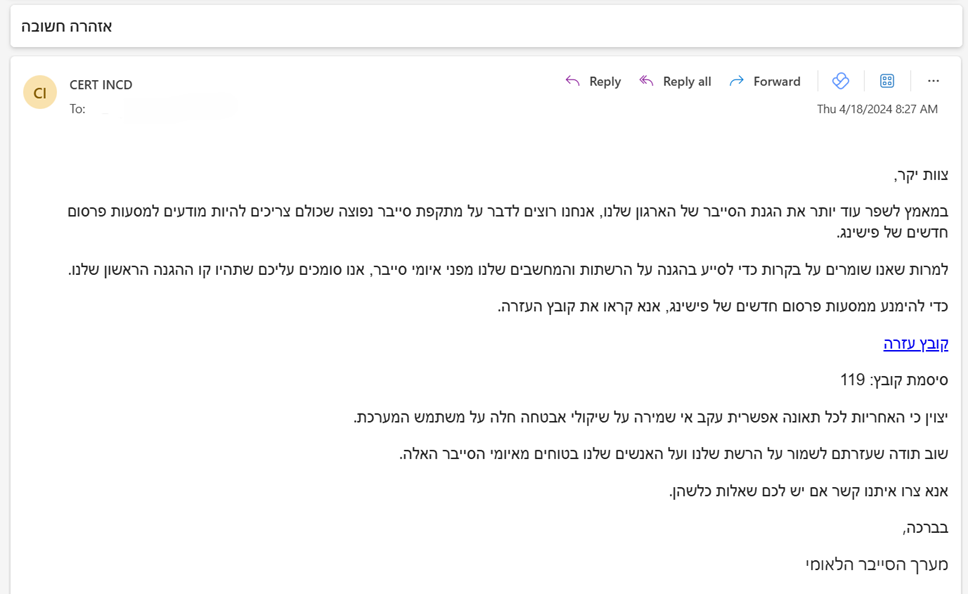
Figure 1 – A Handala email impersonating the Israeli National Cyber Directorate (INCD) delivering Rhadmanthys.
Rhadamanthys is a widely used infostealer employed by a range of threat actors, including both financially motivated groups and state-sponsored operators. It has built a strong reputation due to its complex architecture, active development, and frequent updates. Handala used Rhadamanthys on several occasions, pairing it with one of its custom wipers in phishing lures aimed at Israeli targets, most dominantly impersonating F5 updates.
MuddyWater – Tsundere Botnet and the Castle Loader Connection
MuddyWater, a threat actor that U.S. authorities have linked to Iran’s MOIS, has conducted cyber espionage and other malicious operations focused on the Middle East for years. According to CISA, MuddyWater is a subordinate element within MOIS and has carried out broad campaigns in support of Iranian intelligence objectives, targeting government and private-sector organizations across sectors including telecommunications, defense, and energy.
Recent reports detailing the activity of MuddyWater link its operations to several cyber crime clusters of activity. This appears to work in the actors’ favor: the use of such tools has created significant confusion, leading to misattribution and flawed pivoting, and clustering together activities that are not necessarily related. This demonstrates that the use of criminal software can be effective for obfuscation, and highlights the need for extreme caution when analyzing overlapping clusters.
Figure 2 – Summary of MuddyWater connections to criminal activity.
To address this, we attempted to bring structure to the available evidence, to the best of our ability, and identify which activity is truly associated with MuddyWater.
Tsundere Botnet (a.k.a DinDoor)
The Tsundere Botnet was first uncovered in late 2025 and was later linked to MuddyWater. Large parts of its activity rely on Node.js and JavaScript scripts to execute code on compromised machines. In several instances observed in the wild, when the Node.js engine is detected, the botnet shifts to an alternative execution method using Deno, a runtime for JavaScript and TypeScript. Since Deno-based execution had not previously been associated with Tsundere, researchers linking this activity to MuddyWater designated this variant as DinDoor.
Given that two separate sources linked Tsundere to MuddyWater, one via a VPS and the other through vendor telemetry, it is likely that MuddyWater uses the botnet as part of its operations. Another overlap between DinDoor-related activity and known MuddyWater tradecraft is the use of rclone to access a Wasabi server, which traces back to an IP address previously associated with MuddyWater (18.223.24[.]218, linked to eb5e96e05129e5691f9677be4e396c88).
Castle Loader Connection (a.k.a FakeSet)
Another malware family recently linked to MuddyWater is FakeSet, which, according to our analysis, is a downloader used in recent infection chains delivering CastleLoader. CastleLoader operates as a Malware-as-a-Service offering used by multiple affiliates. Based on our understanding, the reported link between CastleLoader and MuddyWater stems from the use of a set of code-signing certificates, specifically under the Common Names “Amy Cherne” and “Donald Gay”. Certificates with these common names were also used to sign MuddyWater malware (“StageComp”), Tsundere Deno malware (“DinDoor”), and CastleLoader (“FakeSet”) variants.
In our assessment, this does not necessarily indicate that MuddyWater is a CastleLoader affiliate; rather, it suggests that both may have obtained certificates from the same source.
Iranian Qilin Affiliates
In October 2025, Israeli Shamir Medical Center was hit by a major cyber attack that was initially described as a ransomware incident. The attackers claimed to have stolen a large amount of data and demanded a ransom in exchange for not publishing it. Israeli officials said the attack did not affect hospital operations and patient care was not significantly disrupted. Still, some information appears to have been leaked, including limited email correspondence and certain medical data.
Figure 3 – Shamir Medical Center on Qilin Leak Site
At first, the attack was presented as a ransomware incident linked to the Qilin group, but later Israeli assessments pointed much more directly to Iranian actors as the real force behind it. Qilin is known as a ransomware-as-a-service (RaaS) operation, meaning it provides ransomware infrastructure and tooling to outside partners or “affiliates” who actually carry out intrusions. In this case, the emerging picture was that the attackers were likely Iranian-affiliated operators working through the cyber criminal ecosystem, using a criminal ransomware brand and methods associated with the broader extortion market, while serving a strategic Iranian objective.
This attack did not occur in isolation. It appears to be part of a broader, sustained campaign by MOIS and Hezbollah to target Israeli hospitals, a pattern that has been evident since late 2023. The use of Qilin, and participation in its affiliate program, likely serves not only as a layer of cover and plausible deniability, but also as a meaningful operational enabler, especially as earlier attacks appear to have heightened security measures and monitoring by Israeli authorities.
Conclusion
The cases examined in this blog show that, for some Iranian actors, cyber crime is no longer just a cover for state-directed activity. Across these examples, the pattern is not limited to the appearance of criminal behavior, but includes the use of criminal malware, ransomware branding, and affiliate-style ecosystems in support of strategic objectives. This reflects a clear shift from simply imitating cyber criminals to actively leveraging the cyber crime ecosystem.
This shift matters because it delivers clear operational benefits. For MOIS-linked actors in particular, engagement with criminal tools and services enhances capabilities while complicating attribution and fueling confusion around Iranian activity. Taken together, the cases discussed here show that cyber crime has become not just camouflage, but a practical operational resource.
Recently, we uncovered BeatBanker, an Android‑based malware campaign targeting Brazil. It spreads primarily through phishing attacks via a website disguised as the Google Play Store. To achieve their goals, the malicious APKs carry multiple components, including a cryptocurrency miner and a banking Trojan capable of completely hijacking the device and spoofing screens, among other things. In a more recent campaign, the attackers switched from the banker to a known RAT.
This blog post outlines each phase of the malware’s activity on the victim’s handset, explains how it ensures long‑term persistence, and describes its communication with mining pools.
Key findings:
To maintain persistence, the Trojan employs a creative mechanism: it plays an almost inaudible audio file on a loop so it cannot be terminated. This inspired us to name it BeatBanker.
It monitors battery temperature and percentage, and checks whether the user is using the device.
At various stages of the attack, BeatBanker disguises itself as a legitimate application on the Google Play Store and as the Play Store itself.
It deploys a banker in addition to a cryptocurrency miner.
When the user tries to make a USDT transaction, BeatBanker creates overlay pages for Binance and Trust Wallet, covertly replacing the destination address with the threat actor’s transfer address.
New samples now drop BTMOB RAT instead of the banking module.
Initial infection vector
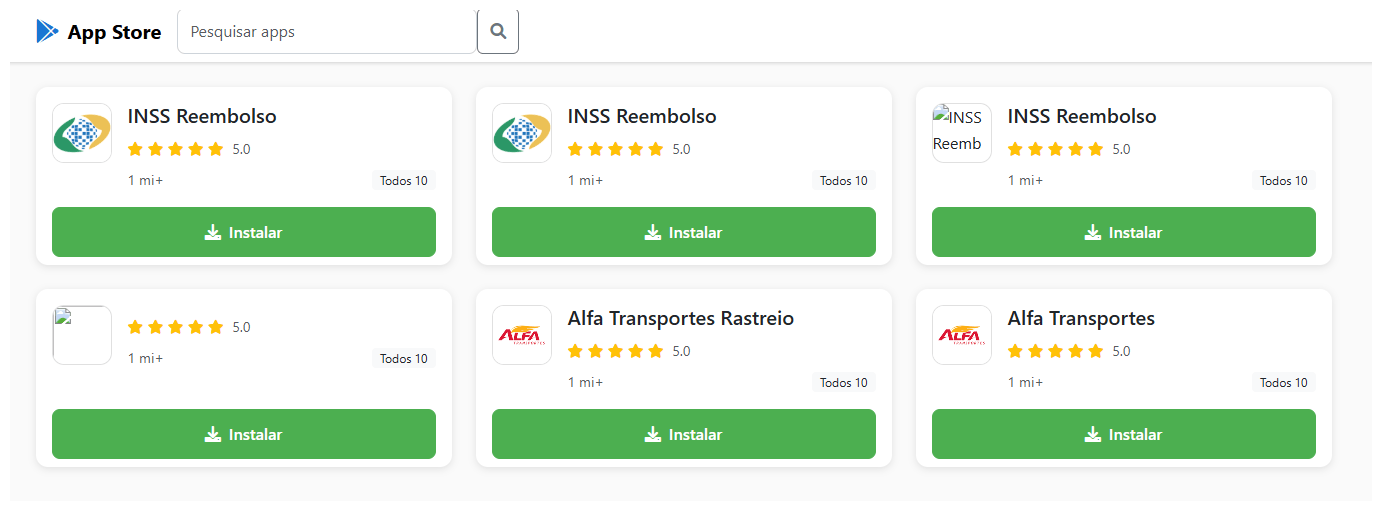
The campaign begins with a counterfeit website, cupomgratisfood[.]shop, that looks exactly like the Google Play Store. This fake app store contains the “INSS Reembolso” app, which is in fact a Trojan. There are also other apps that are most likely Trojans too, but we haven’t obtained them.
The INSS Reembolso app poses as the official mobile portal of Brazil’s Instituto Nacional do Seguro Social (INSS), a government service that citizens can use to perform more than 90 social security tasks, from retirement applications and medical exam scheduling to viewing CNIS (National Registry of Social Information), tax, and payment statements, as well as tracking request statuses. By masquerading as this trusted platform, the fake page tricks users into downloading the malicious APK.
Packing
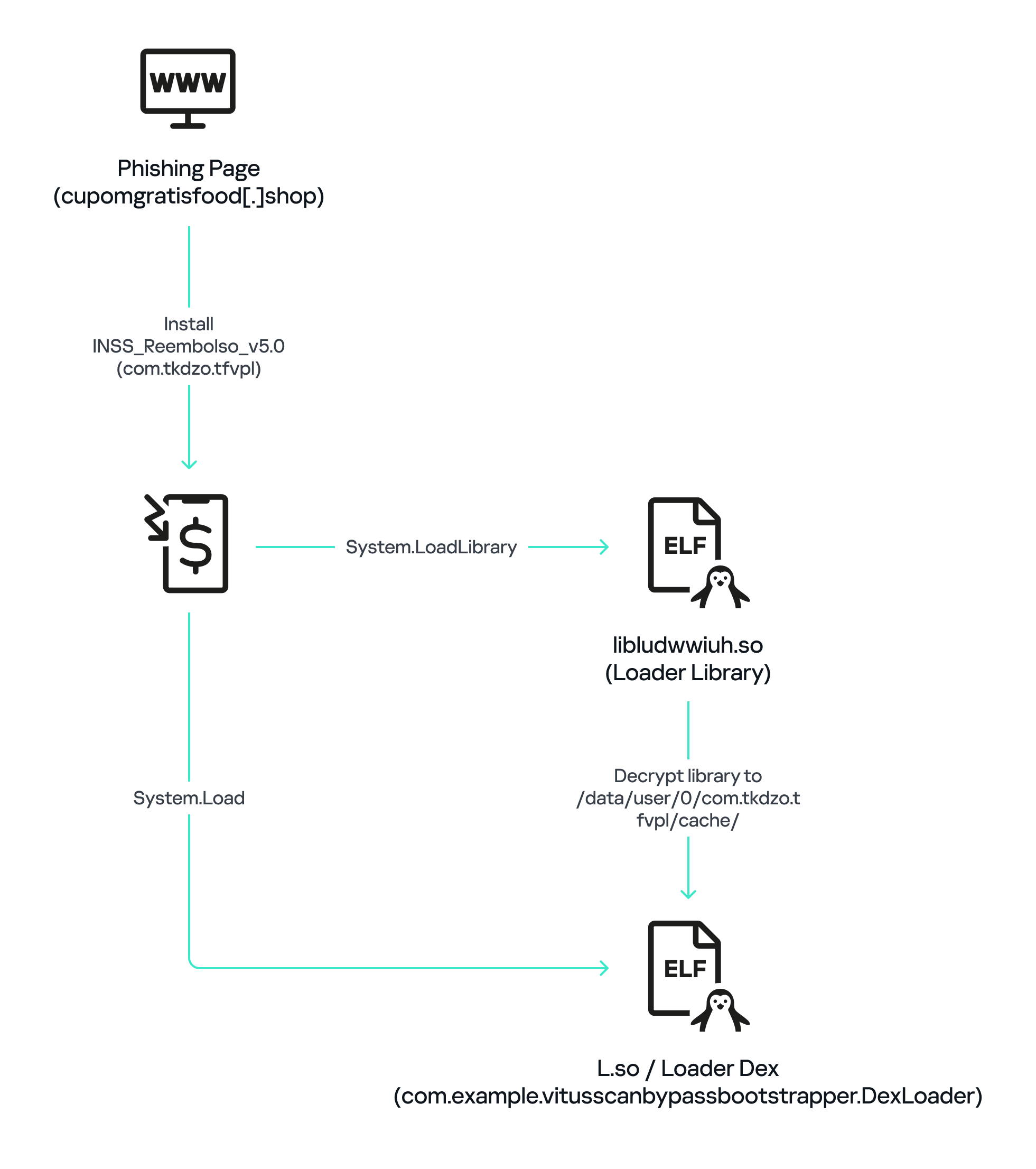
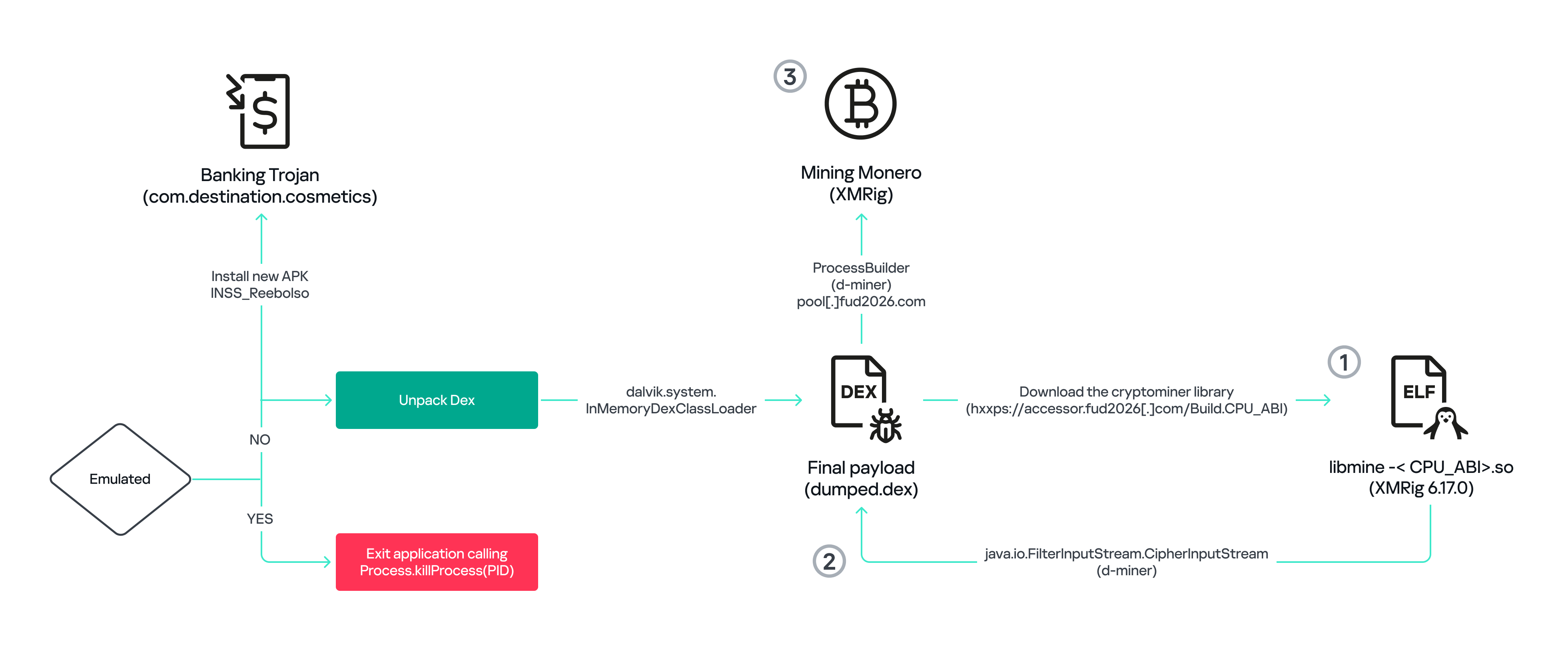
The initial APK file is packed and makes use of a native shared library (ELF) named libludwwiuh.so that is included in the application. Its main task is to decrypt another ELF file that will ultimately load the original DEX file.
First, libludwwiuh.so decrypts an embedded encrypted ELF file and drops it to a temporary location on the device under the name l.so. The same code that loaded the libludwwiuh.so library then loads this file, which uses the Java Native Interface (JNI) to continue execution.
l.so – the DEX loader
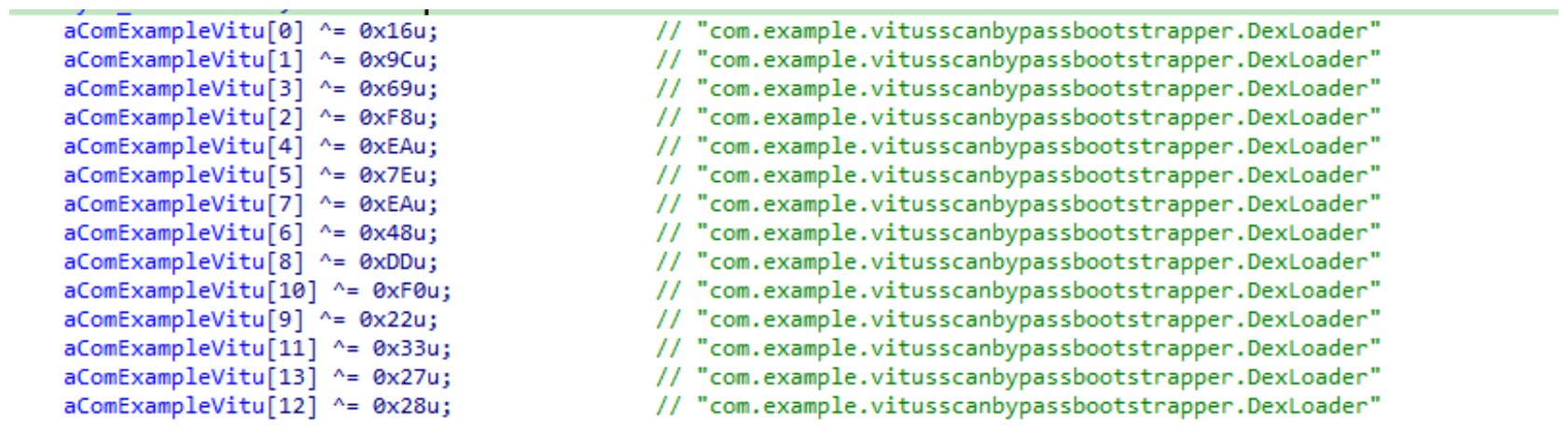
The library does not have calls to its functions; instead, it directly calls the Java methods whose names are encrypted in the stack using XOR (stack strings technique) and restored at runtime:
Initially, the loader makes a request to collect some network information using https://ipapi.is to determine whether the infected device is a mobile device, if a VPN is being used, and to obtain the IP address and other details.
This loader is engineered to bypass mobile antivirus products by utilizing dalvik.system.InMemoryDexClassLoader. It loads malicious DEX code directly into memory, avoiding the creation of any files on the device’s file system. The necessary DEX files can be extracted using dynamic analysis tools like Frida.
Furthermore, the sample incorporates anti-analysis techniques, including runtime checks for emulated or analysis environments. When such an environment is detected (or when specific checks fail, such as verification of the supported CPU_ABI), the malware can immediately terminate its own process by invoking android.os.Process.killProcess(android.os.Process.myPid()), effectively self-destructing to hinder dynamic analysis.
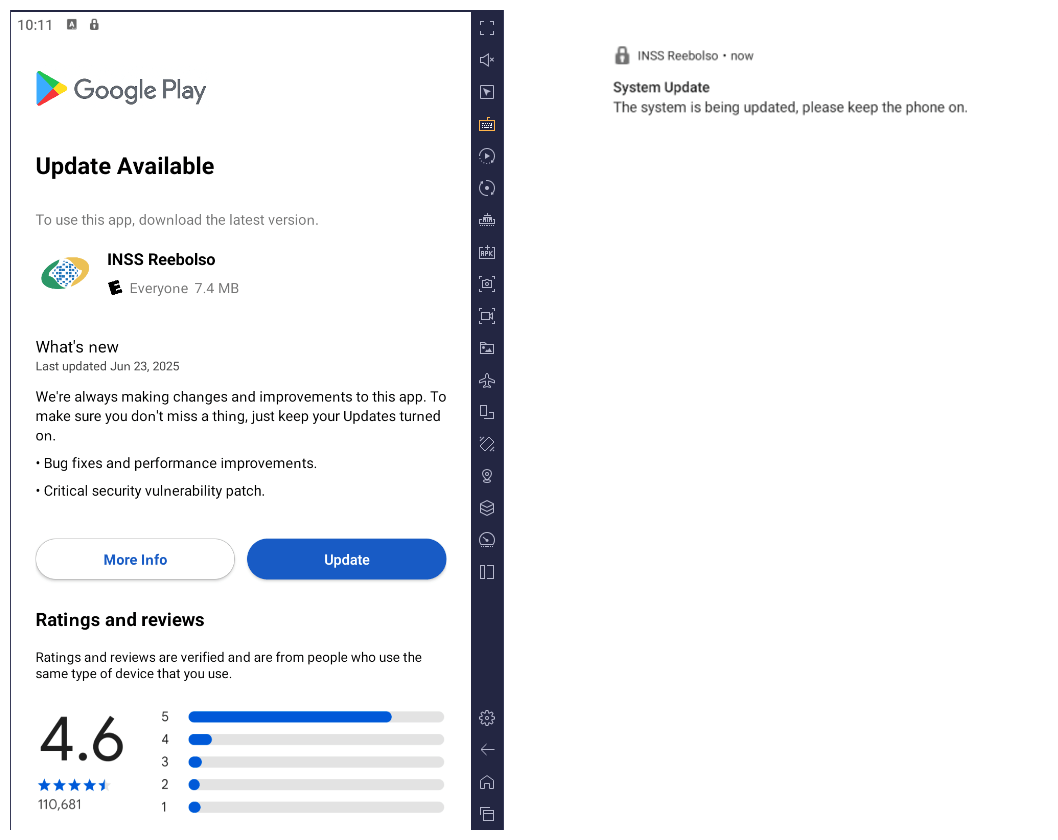
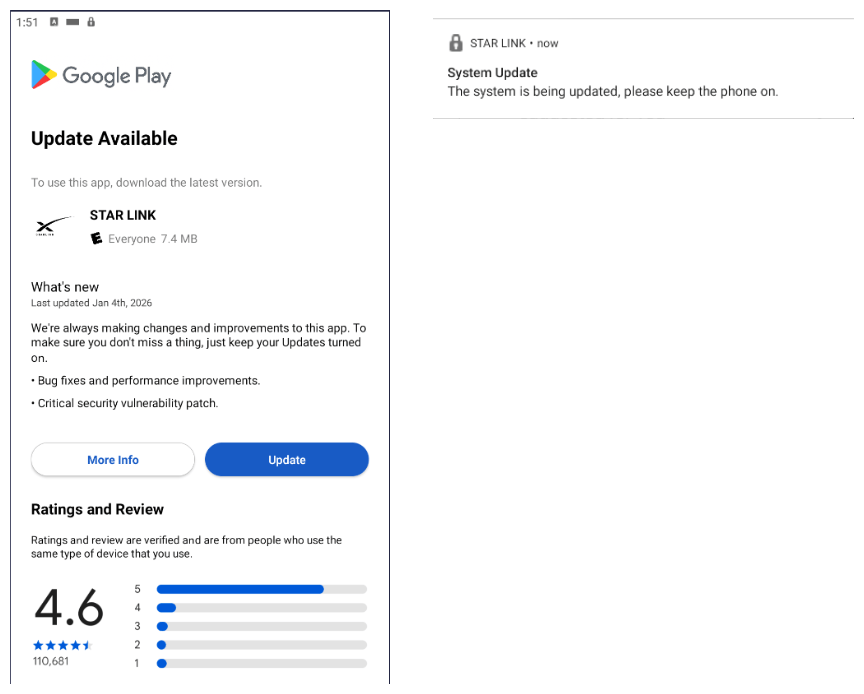
After execution, the malware displays a user interface that mimics the Google Play Store page, showing an update available for the INSS Reembolso app. This is intended to trick victims into granting installation permissions by tapping the “Update” button, which allows the download of additional hidden malicious payloads.
The payload delivery process mimics the application update. The malware uses the REQUEST_INSTALL_PACKAGES permission to install APK files directly into its memory, bypassing Google Play. To ensure persistence, the malware keeps a notification about a system update pinned to the foreground and activates a foreground service with silent media playback, a tactic designed to prevent the operating system from terminating the malicious process.
Crypto mining
When UPDATE is clicked on a fake Play Store screen, the malicious application downloads and executes an ELF file containing a cryptomining payload. It starts by issuing a GET request to the C2 server at either hxxps://accessor.fud2026.com/libmine-<arch>.so or hxxps://fud2026.com/libmine-<arch>.so. The downloaded file is then decrypted using CipherInputStream(), with the decryption key being derived from the SHA-1 hash of the downloaded file’s name, ensuring that each version of the file is encrypted with a unique key. The resulting file is renamed d-miner.
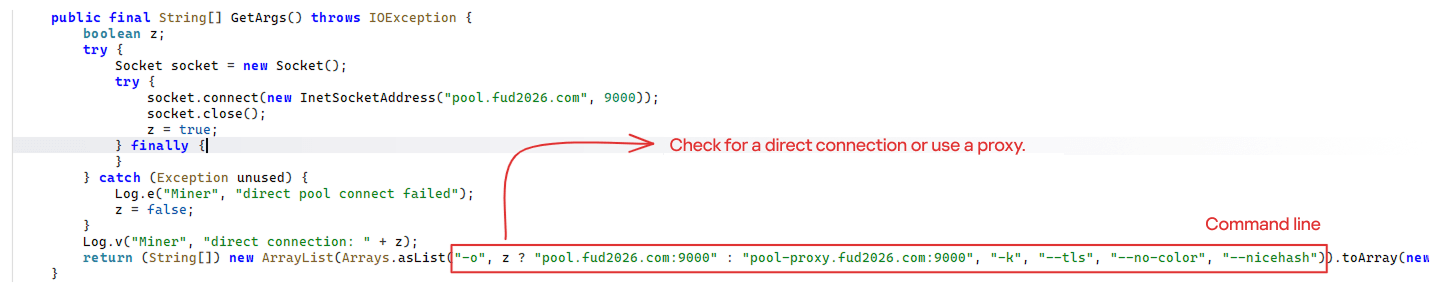
The decrypted payload is an ARM-compiled XMRig 6.17.0 binary. At runtime, it attempts to create a direct TCP connection to pool.fud2026[.]com:9000. If successful, it uses this endpoint; otherwise, it automatically switches to the proxy endpoint pool-proxy.fud2026[.]com:9000. The final command-line arguments passed to XMRig are as follows:
-o pool.fud2026[.]com:9000 or pool-proxy.fud2026[.]com:9000 (selected dynamically)
-k (keepalive)
--tls (encrypted connection)
--no-color (disable colored output)
--nicehash (NiceHash protocol support)
C2 telemetry
The malware uses Google’s legitimate Firebase Cloud Messaging (FCM) as its primary command‑and‑control (C2) channel. In the analyzed sample, each FCM message received triggers a check of the battery status, temperature, installation date, and user presence. A hidden cryptocurrency miner is then started or stopped as needed. These mechanisms ensure that infected devices remain permanently accessible and responsive to the attacker’s instructions, which are sent through the FCM infrastructure. The attacker monitors the following information:
isCharging: indicates whether the phone is charging;
batteryLevel: the exact battery percentage;
isRecentInstallation: indicates whether the application was recently installed (if so, the implant delays malicious actions);
isUserAway: indicates whether the user is away from the device (screen off and inactive);
overheat: indicates whether the device is overheating;
temp: the current battery temperature.
Persistence
The KeepAliveServiceMediaPlayback component ensures continuous operation by initiating uninterrupted playback via MediaPlayer. It keeps the service active in the foreground using a notification and loads a small, continuous audio file. This constant activity prevents the system from suspending or terminating the process due to inactivity.
The identified audio output8.mp3 is five seconds long and plays on a loop. It contains some Chinese words.
Banking module
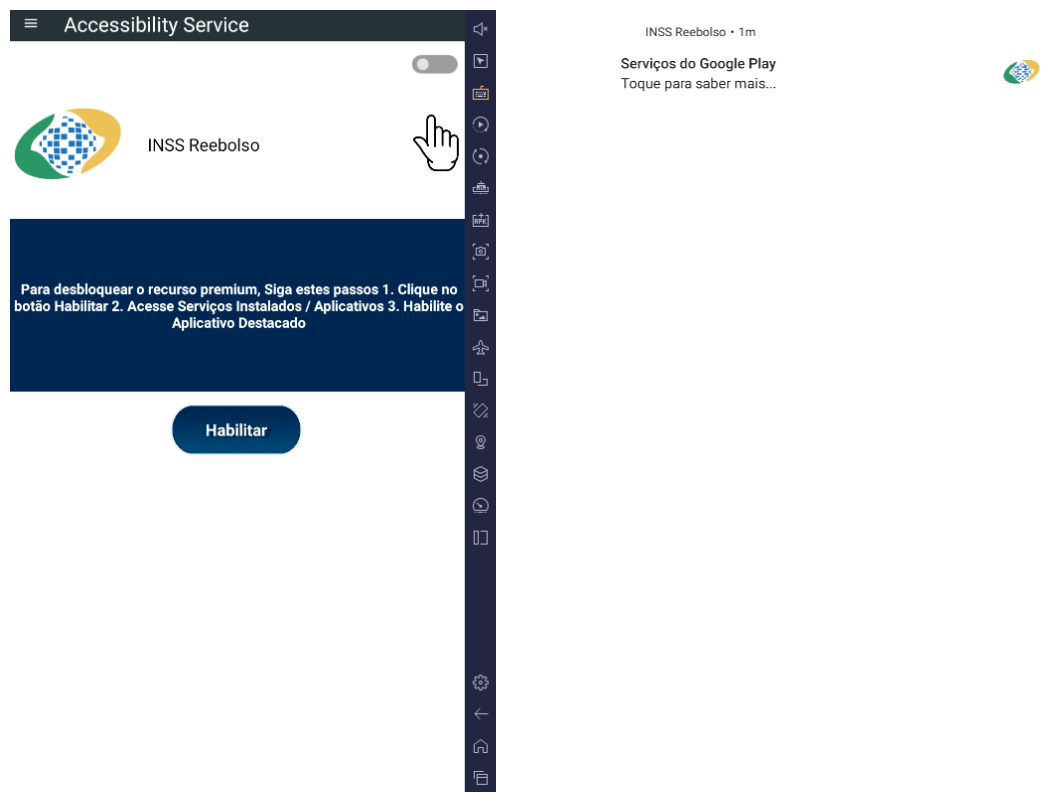
BeatBanker compromises the machine with a cryptocurrency miner and introduces another malicious APK that acts as a banking Trojan. This Trojan uses previously obtained permission to install an additional APK called INSS Reebolso, which is associated with the package com.destination.cosmetics.
Similar to the initial malicious APK, it establishes persistence by creating and displaying a fixed notification in the foreground to hinder removal. Furthermore, BeatBanker attempts to trick the user into granting accessibility permissions to the package.
Leveraging the acquired accessibility permissions, the malware establishes comprehensive control over the device’s user interface.
The Trojan constantly monitors the foreground application. It targets the official Binance application (com.binance.dev) and the Trust Wallet application (com.wallet.crypto.trustapp), focusing on USDT transactions. When a user tries to withdraw USDT, the Trojan instantly overlays the target app’s transaction confirmation screen with a highly realistic page sourced from Base64-encoded HTML stored in the banking module.
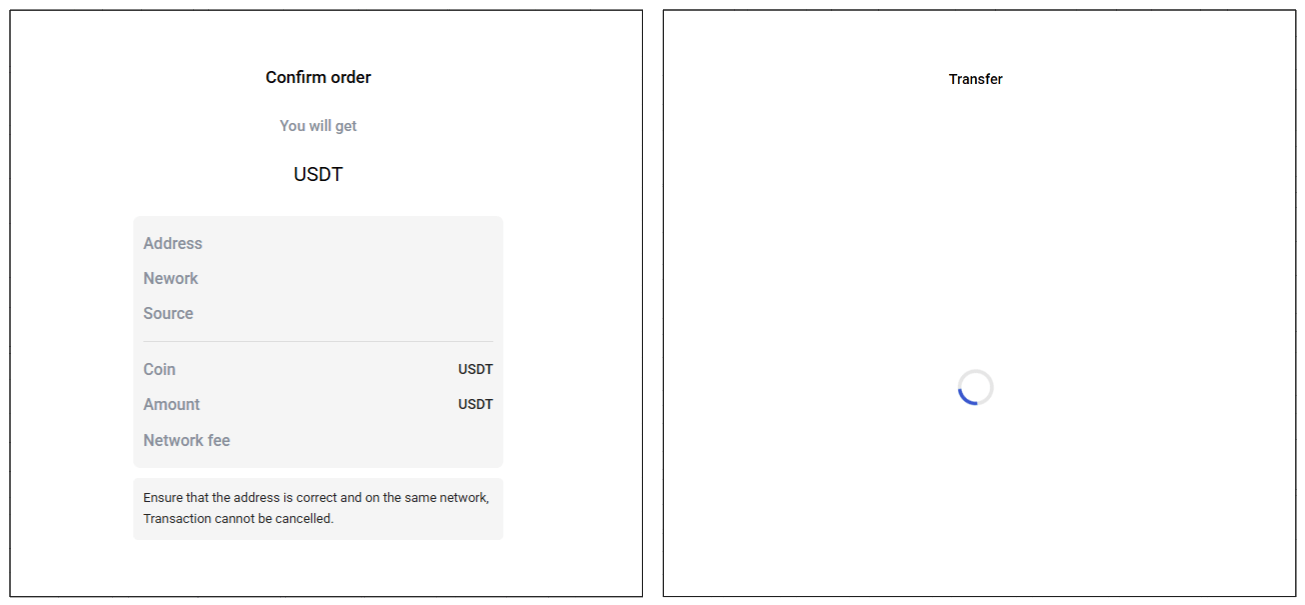
The module captures the original withdrawal address and amount, then surreptitiously substitutes the destination address with an attacker-controlled one using AccessibilityNodeInfo.ACTION_SET_TEXT. The overlay page shows the victim the address they copied (for Binance) or just shows a loading icon (for Trust Wallet), leading them to believe they are remitting funds to the intended wallet when, in fact, the cryptocurrency is transferred to the attacker’s designated address.
Fake overlay pages: Binance (left) and Trust Wallet (right)
Target browsers
BeatBanker’s banking module monitors the following browsers installed on the victim’s device:
Chrome
Firefox
sBrowser
Brave
Opera
DuckDuckGo
Dolphin Browser
Edge
Its aim is to collect the URLs accessed by the victim using the regular expression ^(?:https?://)?(?:[^:/\\\\]+\\\\.)?([^:/\\\\]+\\\\.[^:/\\\\]+). It also offers management functionalities (add, edit, delete, list) for links saved in the device’s default browser, as well as the ability to open links provided by the attacker.
C2 communication
BeatBanker is also designed to receive commands from the C2. These commands aim to collect the victim’s personal information and gain complete control of the device.
Command
Description
0
Starts dynamic loading of the DEX class
Update
Simulates software update and locks the screen
msg:
Displays a Toast message with the provided text
goauth<*>
Opens Google Authenticator (if installed) and enables the AccessService.SendGoogleAuth flag used to monitor and retrieve authentication codes
kill<*>
Sets the protection bypass flag AccessService.bypass to “True”
and sets the initializeService.uninstall flag to “Off”
srec<*>
Starts or stops audio recording (microphone), storing the recorded data in a file with an automatically generated filename. The following path format is used to store the recording: /Config/sys/apps/rc/<timestamp>_0REC<last5digits>.wav
pst<*>
Pastes text from the clipboard (via Accessibility Services)
GRC<*>
Lists all existing audio recording files
gtrc<*>
Sends a specific audio recording file to the C2
lcm<*>
Lists supported front camera resolutions
usdtress<*>
Sets a USDT cryptocurrency address when a transaction is detected
lnk<*>
Opens a link in the browser
EHP<*>
Updates login credentials (host, port, name) and restarts the application
ssms<*>
Sends an SMS message (individually or to all contacts)
CRD<*>
Adds (E>) or removes (D>) packages from the list of blocked/disabled applications
SFD<*>
Deletes files (logs, recordings, tones) or uninstalls itself
adm<>lck<>
Immediately locks the screen using Device Administrator permissions
adm<>wip<>
Performs a complete device data wipe (factory reset)
Aclk<*>
Executes a sequence of automatic taps (auto-clicker) or lists existing macros
KBO<*>lod
Checks the status of the keylogger and virtual keyboard
KBO<*>AKP/AKA
Requests permission to activate a custom virtual keyboard or activates one
Requests Draw Over Other Apps permission (overlay)
RPM<*>INST
Requests permission to install apps from unknown sources (Android 8+)
ussd<*>
Executes a USSD code (e.g., *#06# for IMEI)
Blkt<*>
Sets the text for the lock overlay
BLKV<*>
Enables or disables full-screen lock using WindowManager.LayoutParams.TYPE_APPLICATION_OVERLAY to display a black FrameLayout element over the entire screen
SCRD<> / SCRD2<>
Enables/disables real-time screen text submission to the C2 (screen reading)
Controls VPN and firewall (status, block/allow apps, enable/disable)
noti<*>
Creates persistent and custom notifications
sp<*>
Executes a sequence of swipes/taps (gesture macro)
lodp<*>
Manages saved links in the internal browser (add, edit, delete, list)
scc:
Starts screen capture/streaming
New BeatBanker samples dropping BTMOB
Our recent detection efforts uncovered a campaign leveraging a fraudulent StarLink application that we assess as being a new BeatBanker variant. The infection chain mirrored previous instances, employing identical persistence methods – specifically, looped audio and fixed notifications. Furthermore, this variant included a crypto miner similar to those seen previously. However, rather than deploying the banking module, it was observed distributing the BTMOB remote administration tool.
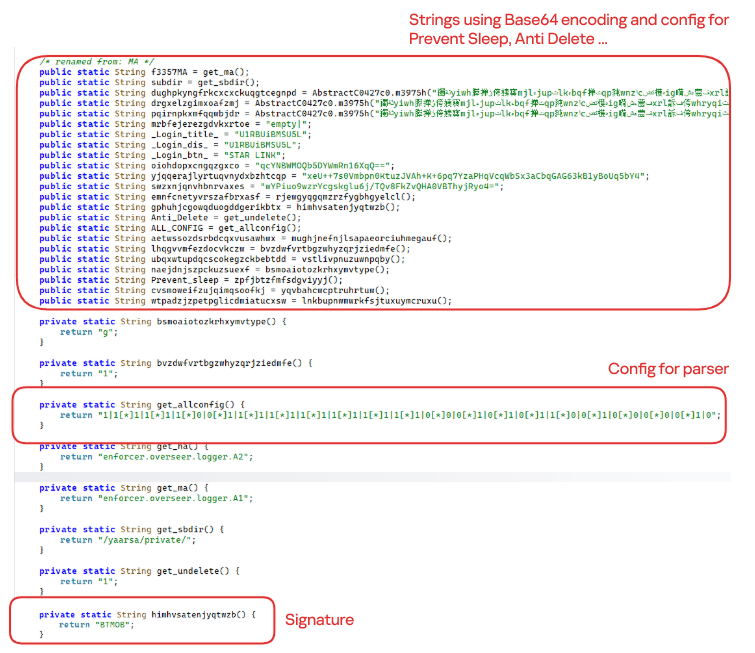
The BTMOB APK is highly obfuscated and contains a class responsible for configuration. Despite this, it’s possible to identify a parser used to define the application’s behavior on the device, as well as persistence features, such as protection against restart, deletion, lock reset, and the ability to perform real-time screen recording.
String decryption
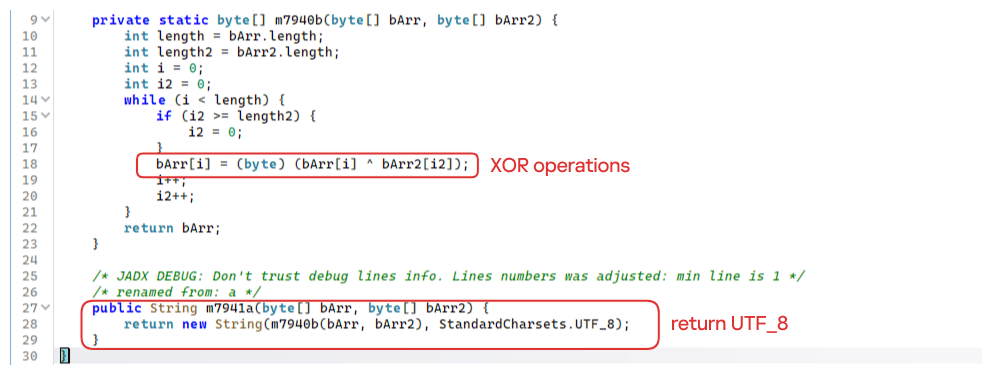
The simple decryption routine uses repetitive XOR between the encrypted data and a short key. It iterates through the encrypted text byte by byte, repeating the key from the beginning whenever it reaches the end. At each position, the sample XORs the encrypted byte with the corresponding byte of the key, overwriting the original. Ultimately, the modified byte array contains the original text, which is then converted to UTF-8 and returned as a string.
Malware-as-a-Service
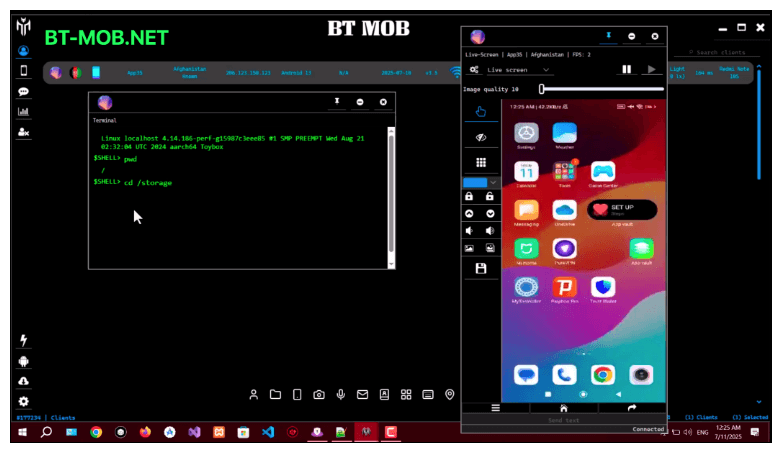
BTMOB is an Android remote administration tool that evolved from the CraxsRAT, CypherRAT, and SpySolr families. It provides full remote control of the victim’s device and is sold in a Malware-as-a-Service (MaaS) model. On July 26, 2025, a threat actor posted a screenshot of the BTMOB RAT in action on GitHub under the username “brmobrats”, along with a link to the website btmob[.]xyz. The website contains information about the BTMOB RAT, including its version history, features, and other relevant details. It also redirects to a Telegram contact. Cyfirma has already linked this account to CraxsRAT and CypherRAT.
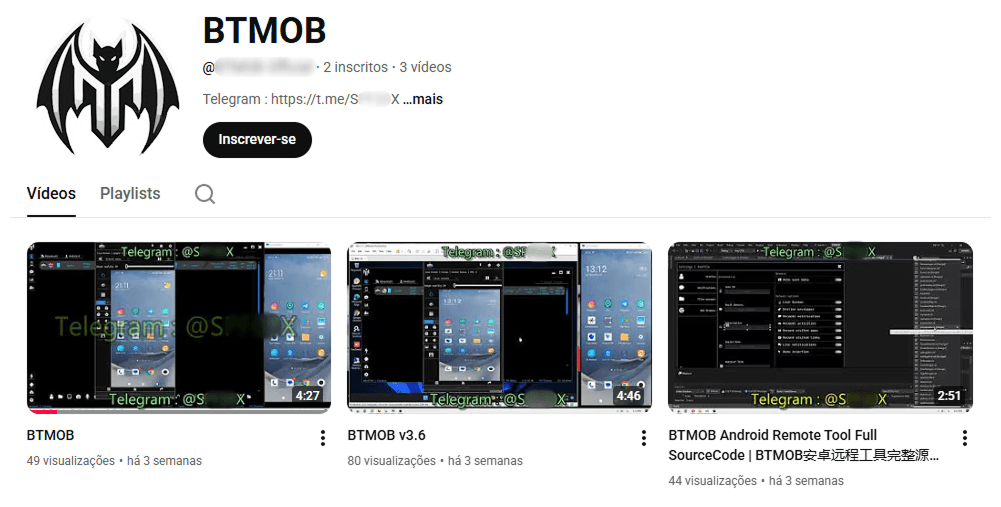
Recently, a YouTube channel was created by a different threat actor that features videos demonstrating how to use the malware and facilitate its sale via Telegram.
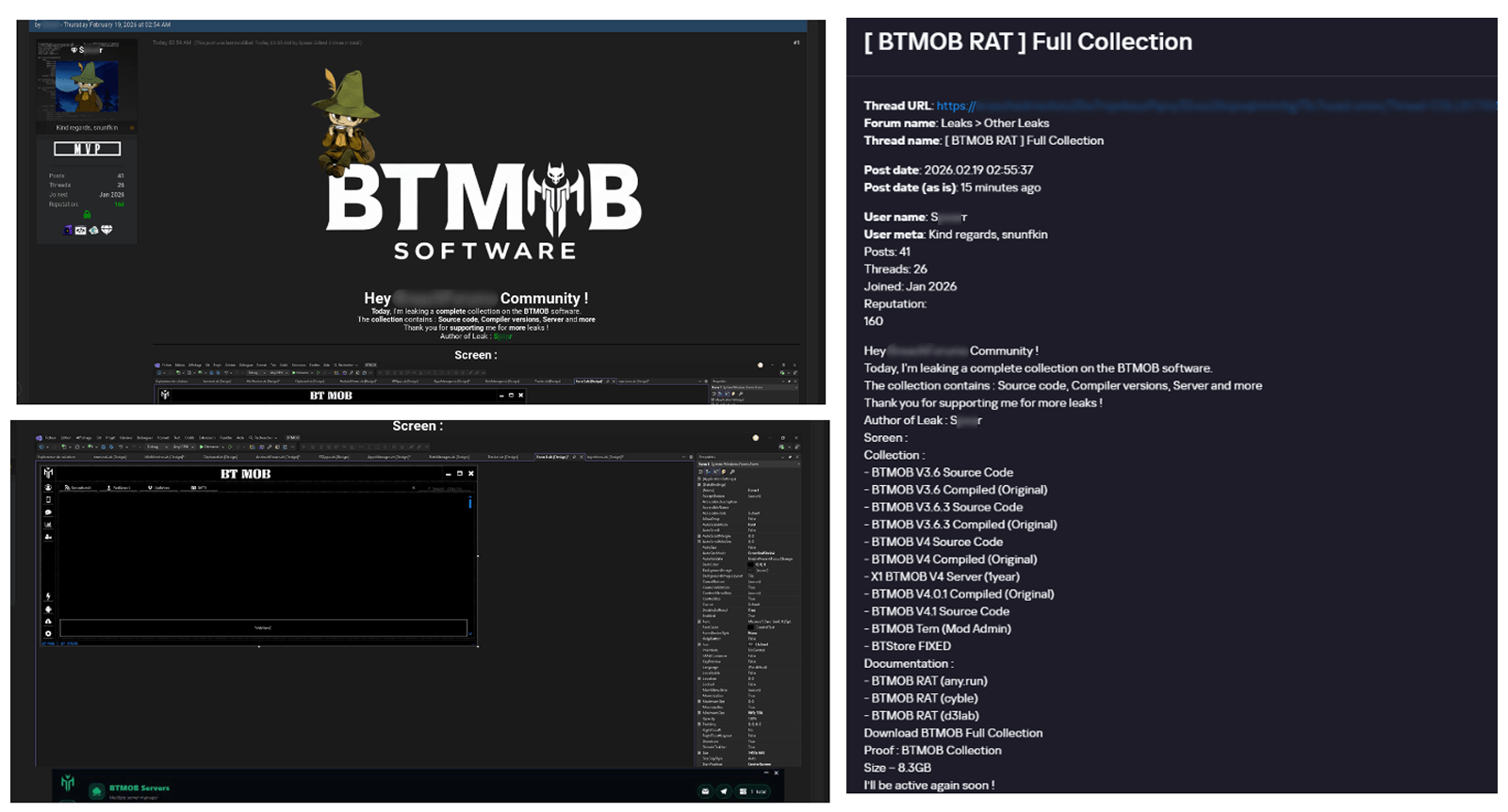
We also saw the distribution and sale of leaked BTMOB source code on some dark web forums. This may suggest that the creator of BeatBanker acquired BTMOB from its original author or the source of the leak and is utilizing it as the final payload, replacing the banking module observed in the INSS Reebolso incident.
In terms of functionality, BTMOB maintains a set of intrusive capabilities, including: automatic granting of permissions, especially on Android 13–15 devices; use of a black FrameLayout overlay to hide system notifications similar to the one observed in the banking module; silent installation; persistent background execution; and mechanisms designed to capture screen lock credentials, including PINs, patterns, and passwords. The malware also provides access to front and rear cameras, captures keystrokes in real time, monitors GPS location, and constantly collects sensitive data. Together, these functionalities provide the operator with comprehensive remote control, persistent access, and extensive surveillance capabilities over compromised devices.
Victims
All variants of BeatBanker – those with the banking module and those with the BTMOB RAT – were detected on victims in Brazil. Some of the samples that deliver BTMOB appear to use WhatsApp to spread, as well as phishing pages.
Conclusion
BeatBanker is an excellent example of how mobile threats are becoming more sophisticated and multi-layered. Initially focused in Brazil, this Trojan operates a dual campaign, acting as a Monero cryptocurrency miner, discreetly draining your device’s battery life while also stealing banking credentials and tampering with cryptocurrency transactions. Moreover, the most recent version goes even further, substituting the banking module with a full-fledged BTMOB RAT.
The attackers have devised inventive tricks to maintain persistence. They keep the process alive by looping an almost inaudible audio track, which prevents the operating system from terminating it and allows BeatBanker to remain active for extended periods.
Furthermore, the threat demonstrates an obsession with staying hidden. It monitors device usage, battery level and temperature. It even uses Google’s legitimate system (FCM) to receive commands. The threat’s banking module is capable of overlaying Binance and Trust Wallet screens and diverting USDT funds to the criminals’ wallets before the victim even notices.
The lesson here is clear: distrust is your best defense. BeatBanker spreads through fake websites that mimic Google Play, disguising itself as trustworthy government applications. To protect yourself against threats like this, it is essential to:
Download apps only from official sources. Always use the Google Play Store or the device vendor’s official app store. Make sure you use the correct app store app, and verify the developer.
Check permissions. Pay attention to the permissions that applications request, especially those related to accessibility and installation of third-party packages.
Keep the system updated. Security updates for Android and your mobile antivirus are essential.
Our solutions detect this threat as HEUR:Trojan-Dropper.AndroidOS.BeatBanker and HEUR:Trojan-Dropper.AndroidOS.Banker.*
Recently, we uncovered BeatBanker, an Android‑based malware campaign targeting Brazil. It spreads primarily through phishing attacks via a website disguised as the Google Play Store. To achieve their goals, the malicious APKs carry multiple components, including a cryptocurrency miner and a banking Trojan capable of completely hijacking the device and spoofing screens, among other things. In a more recent campaign, the attackers switched from the banker to a known RAT.
This blog post outlines each phase of the malware’s activity on the victim’s handset, explains how it ensures long‑term persistence, and describes its communication with mining pools.
Key findings:
To maintain persistence, the Trojan employs a creative mechanism: it plays an almost inaudible audio file on a loop so it cannot be terminated. This inspired us to name it BeatBanker.
It monitors battery temperature and percentage, and checks whether the user is using the device.
At various stages of the attack, BeatBanker disguises itself as a legitimate application on the Google Play Store and as the Play Store itself.
It deploys a banker in addition to a cryptocurrency miner.
When the user tries to make a USDT transaction, BeatBanker creates overlay pages for Binance and Trust Wallet, covertly replacing the destination address with the threat actor’s transfer address.
New samples now drop BTMOB RAT instead of the banking module.
Initial infection vector
The campaign begins with a counterfeit website, cupomgratisfood[.]shop, that looks exactly like the Google Play Store. This fake app store contains the “INSS Reembolso” app, which is in fact a Trojan. There are also other apps that are most likely Trojans too, but we haven’t obtained them.
The INSS Reembolso app poses as the official mobile portal of Brazil’s Instituto Nacional do Seguro Social (INSS), a government service that citizens can use to perform more than 90 social security tasks, from retirement applications and medical exam scheduling to viewing CNIS (National Registry of Social Information), tax, and payment statements, as well as tracking request statuses. By masquerading as this trusted platform, the fake page tricks users into downloading the malicious APK.
Packing
The initial APK file is packed and makes use of a native shared library (ELF) named libludwwiuh.so that is included in the application. Its main task is to decrypt another ELF file that will ultimately load the original DEX file.
First, libludwwiuh.so decrypts an embedded encrypted ELF file and drops it to a temporary location on the device under the name l.so. The same code that loaded the libludwwiuh.so library then loads this file, which uses the Java Native Interface (JNI) to continue execution.
l.so – the DEX loader
The library does not have calls to its functions; instead, it directly calls the Java methods whose names are encrypted in the stack using XOR (stack strings technique) and restored at runtime:
Initially, the loader makes a request to collect some network information using https://ipapi.is to determine whether the infected device is a mobile device, if a VPN is being used, and to obtain the IP address and other details.
This loader is engineered to bypass mobile antivirus products by utilizing dalvik.system.InMemoryDexClassLoader. It loads malicious DEX code directly into memory, avoiding the creation of any files on the device’s file system. The necessary DEX files can be extracted using dynamic analysis tools like Frida.
Furthermore, the sample incorporates anti-analysis techniques, including runtime checks for emulated or analysis environments. When such an environment is detected (or when specific checks fail, such as verification of the supported CPU_ABI), the malware can immediately terminate its own process by invoking android.os.Process.killProcess(android.os.Process.myPid()), effectively self-destructing to hinder dynamic analysis.
After execution, the malware displays a user interface that mimics the Google Play Store page, showing an update available for the INSS Reembolso app. This is intended to trick victims into granting installation permissions by tapping the “Update” button, which allows the download of additional hidden malicious payloads.
The payload delivery process mimics the application update. The malware uses the REQUEST_INSTALL_PACKAGES permission to install APK files directly into its memory, bypassing Google Play. To ensure persistence, the malware keeps a notification about a system update pinned to the foreground and activates a foreground service with silent media playback, a tactic designed to prevent the operating system from terminating the malicious process.
Crypto mining
When UPDATE is clicked on a fake Play Store screen, the malicious application downloads and executes an ELF file containing a cryptomining payload. It starts by issuing a GET request to the C2 server at either hxxps://accessor.fud2026.com/libmine-<arch>.so or hxxps://fud2026.com/libmine-<arch>.so. The downloaded file is then decrypted using CipherInputStream(), with the decryption key being derived from the SHA-1 hash of the downloaded file’s name, ensuring that each version of the file is encrypted with a unique key. The resulting file is renamed d-miner.
The decrypted payload is an ARM-compiled XMRig 6.17.0 binary. At runtime, it attempts to create a direct TCP connection to pool.fud2026[.]com:9000. If successful, it uses this endpoint; otherwise, it automatically switches to the proxy endpoint pool-proxy.fud2026[.]com:9000. The final command-line arguments passed to XMRig are as follows:
-o pool.fud2026[.]com:9000 or pool-proxy.fud2026[.]com:9000 (selected dynamically)
-k (keepalive)
--tls (encrypted connection)
--no-color (disable colored output)
--nicehash (NiceHash protocol support)
C2 telemetry
The malware uses Google’s legitimate Firebase Cloud Messaging (FCM) as its primary command‑and‑control (C2) channel. In the analyzed sample, each FCM message received triggers a check of the battery status, temperature, installation date, and user presence. A hidden cryptocurrency miner is then started or stopped as needed. These mechanisms ensure that infected devices remain permanently accessible and responsive to the attacker’s instructions, which are sent through the FCM infrastructure. The attacker monitors the following information:
isCharging: indicates whether the phone is charging;
batteryLevel: the exact battery percentage;
isRecentInstallation: indicates whether the application was recently installed (if so, the implant delays malicious actions);
isUserAway: indicates whether the user is away from the device (screen off and inactive);
overheat: indicates whether the device is overheating;
temp: the current battery temperature.
Persistence
The KeepAliveServiceMediaPlayback component ensures continuous operation by initiating uninterrupted playback via MediaPlayer. It keeps the service active in the foreground using a notification and loads a small, continuous audio file. This constant activity prevents the system from suspending or terminating the process due to inactivity.
The identified audio output8.mp3 is five seconds long and plays on a loop. It contains some Chinese words.
Banking module
BeatBanker compromises the machine with a cryptocurrency miner and introduces another malicious APK that acts as a banking Trojan. This Trojan uses previously obtained permission to install an additional APK called INSS Reebolso, which is associated with the package com.destination.cosmetics.
Similar to the initial malicious APK, it establishes persistence by creating and displaying a fixed notification in the foreground to hinder removal. Furthermore, BeatBanker attempts to trick the user into granting accessibility permissions to the package.
Leveraging the acquired accessibility permissions, the malware establishes comprehensive control over the device’s user interface.
The Trojan constantly monitors the foreground application. It targets the official Binance application (com.binance.dev) and the Trust Wallet application (com.wallet.crypto.trustapp), focusing on USDT transactions. When a user tries to withdraw USDT, the Trojan instantly overlays the target app’s transaction confirmation screen with a highly realistic page sourced from Base64-encoded HTML stored in the banking module.
The module captures the original withdrawal address and amount, then surreptitiously substitutes the destination address with an attacker-controlled one using AccessibilityNodeInfo.ACTION_SET_TEXT. The overlay page shows the victim the address they copied (for Binance) or just shows a loading icon (for Trust Wallet), leading them to believe they are remitting funds to the intended wallet when, in fact, the cryptocurrency is transferred to the attacker’s designated address.
Fake overlay pages: Binance (left) and Trust Wallet (right)
Target browsers
BeatBanker’s banking module monitors the following browsers installed on the victim’s device:
Chrome
Firefox
sBrowser
Brave
Opera
DuckDuckGo
Dolphin Browser
Edge
Its aim is to collect the URLs accessed by the victim using the regular expression ^(?:https?://)?(?:[^:/\\\\]+\\\\.)?([^:/\\\\]+\\\\.[^:/\\\\]+). It also offers management functionalities (add, edit, delete, list) for links saved in the device’s default browser, as well as the ability to open links provided by the attacker.
C2 communication
BeatBanker is also designed to receive commands from the C2. These commands aim to collect the victim’s personal information and gain complete control of the device.
Command
Description
0
Starts dynamic loading of the DEX class
Update
Simulates software update and locks the screen
msg:
Displays a Toast message with the provided text
goauth<*>
Opens Google Authenticator (if installed) and enables the AccessService.SendGoogleAuth flag used to monitor and retrieve authentication codes
kill<*>
Sets the protection bypass flag AccessService.bypass to “True”
and sets the initializeService.uninstall flag to “Off”
srec<*>
Starts or stops audio recording (microphone), storing the recorded data in a file with an automatically generated filename. The following path format is used to store the recording: /Config/sys/apps/rc/<timestamp>_0REC<last5digits>.wav
pst<*>
Pastes text from the clipboard (via Accessibility Services)
GRC<*>
Lists all existing audio recording files
gtrc<*>
Sends a specific audio recording file to the C2
lcm<*>
Lists supported front camera resolutions
usdtress<*>
Sets a USDT cryptocurrency address when a transaction is detected
lnk<*>
Opens a link in the browser
EHP<*>
Updates login credentials (host, port, name) and restarts the application
ssms<*>
Sends an SMS message (individually or to all contacts)
CRD<*>
Adds (E>) or removes (D>) packages from the list of blocked/disabled applications
SFD<*>
Deletes files (logs, recordings, tones) or uninstalls itself
adm<>lck<>
Immediately locks the screen using Device Administrator permissions
adm<>wip<>
Performs a complete device data wipe (factory reset)
Aclk<*>
Executes a sequence of automatic taps (auto-clicker) or lists existing macros
KBO<*>lod
Checks the status of the keylogger and virtual keyboard
KBO<*>AKP/AKA
Requests permission to activate a custom virtual keyboard or activates one
Requests Draw Over Other Apps permission (overlay)
RPM<*>INST
Requests permission to install apps from unknown sources (Android 8+)
ussd<*>
Executes a USSD code (e.g., *#06# for IMEI)
Blkt<*>
Sets the text for the lock overlay
BLKV<*>
Enables or disables full-screen lock using WindowManager.LayoutParams.TYPE_APPLICATION_OVERLAY to display a black FrameLayout element over the entire screen
SCRD<> / SCRD2<>
Enables/disables real-time screen text submission to the C2 (screen reading)
Controls VPN and firewall (status, block/allow apps, enable/disable)
noti<*>
Creates persistent and custom notifications
sp<*>
Executes a sequence of swipes/taps (gesture macro)
lodp<*>
Manages saved links in the internal browser (add, edit, delete, list)
scc:
Starts screen capture/streaming
New BeatBanker samples dropping BTMOB
Our recent detection efforts uncovered a campaign leveraging a fraudulent StarLink application that we assess as being a new BeatBanker variant. The infection chain mirrored previous instances, employing identical persistence methods – specifically, looped audio and fixed notifications. Furthermore, this variant included a crypto miner similar to those seen previously. However, rather than deploying the banking module, it was observed distributing the BTMOB remote administration tool.
The BTMOB APK is highly obfuscated and contains a class responsible for configuration. Despite this, it’s possible to identify a parser used to define the application’s behavior on the device, as well as persistence features, such as protection against restart, deletion, lock reset, and the ability to perform real-time screen recording.
String decryption
The simple decryption routine uses repetitive XOR between the encrypted data and a short key. It iterates through the encrypted text byte by byte, repeating the key from the beginning whenever it reaches the end. At each position, the sample XORs the encrypted byte with the corresponding byte of the key, overwriting the original. Ultimately, the modified byte array contains the original text, which is then converted to UTF-8 and returned as a string.
Malware-as-a-Service
BTMOB is an Android remote administration tool that evolved from the CraxsRAT, CypherRAT, and SpySolr families. It provides full remote control of the victim’s device and is sold in a Malware-as-a-Service (MaaS) model. On July 26, 2025, a threat actor posted a screenshot of the BTMOB RAT in action on GitHub under the username “brmobrats”, along with a link to the website btmob[.]xyz. The website contains information about the BTMOB RAT, including its version history, features, and other relevant details. It also redirects to a Telegram contact. Cyfirma has already linked this account to CraxsRAT and CypherRAT.
Recently, a YouTube channel was created by a different threat actor that features videos demonstrating how to use the malware and facilitate its sale via Telegram.
We also saw the distribution and sale of leaked BTMOB source code on some dark web forums. This may suggest that the creator of BeatBanker acquired BTMOB from its original author or the source of the leak and is utilizing it as the final payload, replacing the banking module observed in the INSS Reebolso incident.
In terms of functionality, BTMOB maintains a set of intrusive capabilities, including: automatic granting of permissions, especially on Android 13–15 devices; use of a black FrameLayout overlay to hide system notifications similar to the one observed in the banking module; silent installation; persistent background execution; and mechanisms designed to capture screen lock credentials, including PINs, patterns, and passwords. The malware also provides access to front and rear cameras, captures keystrokes in real time, monitors GPS location, and constantly collects sensitive data. Together, these functionalities provide the operator with comprehensive remote control, persistent access, and extensive surveillance capabilities over compromised devices.
Victims
All variants of BeatBanker – those with the banking module and those with the BTMOB RAT – were detected on victims in Brazil. Some of the samples that deliver BTMOB appear to use WhatsApp to spread, as well as phishing pages.
Conclusion
BeatBanker is an excellent example of how mobile threats are becoming more sophisticated and multi-layered. Initially focused in Brazil, this Trojan operates a dual campaign, acting as a Monero cryptocurrency miner, discreetly draining your device’s battery life while also stealing banking credentials and tampering with cryptocurrency transactions. Moreover, the most recent version goes even further, substituting the banking module with a full-fledged BTMOB RAT.
The attackers have devised inventive tricks to maintain persistence. They keep the process alive by looping an almost inaudible audio track, which prevents the operating system from terminating it and allows BeatBanker to remain active for extended periods.
Furthermore, the threat demonstrates an obsession with staying hidden. It monitors device usage, battery level and temperature. It even uses Google’s legitimate system (FCM) to receive commands. The threat’s banking module is capable of overlaying Binance and Trust Wallet screens and diverting USDT funds to the criminals’ wallets before the victim even notices.
The lesson here is clear: distrust is your best defense. BeatBanker spreads through fake websites that mimic Google Play, disguising itself as trustworthy government applications. To protect yourself against threats like this, it is essential to:
Download apps only from official sources. Always use the Google Play Store or the device vendor’s official app store. Make sure you use the correct app store app, and verify the developer.
Check permissions. Pay attention to the permissions that applications request, especially those related to accessibility and installation of third-party packages.
Keep the system updated. Security updates for Android and your mobile antivirus are essential.
Our solutions detect this threat as HEUR:Trojan-Dropper.AndroidOS.BeatBanker and HEUR:Trojan-Dropper.AndroidOS.Banker.*
For the latest discoveries in cyber research for the week of 9th March, please download our Threat Intelligence Bulletin.
TOP ATTACKS AND BREACHES
AkzoNobel, a Netherlands-based global paint manufacturer, has confirmed a cyberattack affecting one of its United States sites. The company said the intrusion was contained, while the Anubis ransomware group claimed it stole 170 GB of data, including employee and financial records.
LexisNexis, a global legal data and analytics provider, has suffered a breach. Attackers claimed they stole 3.9 million records, including about 400,000 user profiles and some government accounts, while the company said the exposed systems mainly held legacy pre-2020 data.
The Wikimedia Foundation, the nonprofit behind Wikipedia, has faced a self-propagating JavaScript worm that vandalized pages and replaced editor scripts across multiple wikis. Engineers briefly restricted editing while cleaning up the incident, with about 3,996 pages modified and roughly 85 users’ personal scripts affected.
TriZetto Provider Solutions, an American healthcare technology company owned by Cognizant, has disclosed a breach affecting more than 3.4 million people. The exposed data includes insurance and medical information, with notifications issued this week after investigators determined the unauthorized access began in 2024.
AI THREATS
Researchers outlined how Pakistan-linked APT36 has used AI coding tools to produce large volumes of low-quality malware aimed at Indian government entities and embassies. The group generated variants in less common programming languages and used legitimate cloud services for command channels, complicating detection and response.
Researchers uncovered AI-themed Chrome and Edge extensions that harvest LLM chat histories and browsing activity. Distributed via the Chrome Web Store, they impersonate legitimate tools and have impacted 900,000 users across 20,000 enterprise environments.
Researchers tracked a campaign abusing interest in OpenClaw, an AI agent, by planting fake installers on GitHub that appeared in Bing search results. The installers delivered Vidar to steal credentials and cryptocurrency wallets and sometimes deployed GhostSocks, turning infected systems into residential proxies.
Researchers demonstrated indirect prompt injection campaigns against AI agents that read web content, cataloging 22 techniques across live sites. Hidden instructions can redirect agents to expose data, perform unauthorized transactions, and run server commands, and the researchers also observed a real-world bypass of an AI ad review system.
VULNERABILITIES AND PATCHES
Google has published patches for CVE-2026-0628, a high-severity vulnerability in Chrome’s Gemini AI panel that allowed malicious extensions to inject code and access cameras and microphones. Researchers showed attackers could also take screenshots, access local files, and launch phishing content inside the panel.
A patch was released for CVE-2026-1492, a critical (9.8 CVSS) privilege escalation flaw in the User Registration & Membership WordPress plugin. The vulnerability lets unauthenticated attackers create administrator accounts and take over sites.
VMware has patched CVE-2026-22719, a high-severity command injection flaw in Aria Operations, its cloud management platform. The vulnerability allows unauthenticated remote code execution during support-assisted migrations and affects versions 8 through 8.18.5 and 9 through 9.0.1, with patches and a workaround script available.
Qualcomm has addressed CVE-2026-21385, a memory corruption vulnerability affecting chipsets used in Android phones, tablets, and IoT devices. The flaw can trigger crashes and potentially allow code execution, and CISA said evidence of active exploitation prompted its addition to the Known Exploited Vulnerabilities catalog.
THREAT INTELLIGENCE REPORTS
Check Point Research have mapped Iran-linked cyber clusters conducting espionage, disruption, and influence operations, including Cotton Sandstorm, Educated Manticore, MuddyWater, Handala, and Agrius. Recent campaigns used impersonation and phishing to steal credentials, remote access tools to persist, and wipers or fake ransomware for impact.
Check Point Research revealed that, amid the ongoing conflict with Iran, IP cameras in Israel, Qatar, Bahrain, Kuwait, the UAE, and Cyprus have been intensively targeted. Notably, these countries have also experienced significant missile activity from Iran. The findings align with the assessment that Iran incorporates compromised cameras into its operational doctrine, using them both to support missile operations and to conduct ongoing battle damage assessment (BDA).
Check Point Research has profiled Silver Dragon, a Chinese-aligned group linked to APT41 that targeted government and enterprise networks across Southeast Asia and Europe. Recent operations used the GearDoor backdoor with SSHcmd and SilverScreen, enabling remote access, covert screen capture, and stealthy control after phishing and server exploitation.
Check Point Harmony Endpoint and Threat Emulation provide protection against these threats
Researchers have uncovered Coruna, an iPhone exploit kit used by Chinese scammers and Russia-linked operators to compromise devices through malicious websites. The toolkit used 23 exploits against iOS and deployed malware that stole cryptocurrency, emails, and photos.
The escalation of geopolitical tensions specifically focused on the Iranian Conflict over the last days of February 2026 has intensified the significant cyber and physical security risks to organizations globally.
With threat activity emanating from advanced Iranian state-sponsored actors, aligned hacktivist collectives, and opportunistic criminal groups, security teams must remain agile, informed, and proactive.
The Iranian Conflict Intelligence Dashboard has been updated to equip defenders with timely, high-fidelity intelligence that specifically reflects the dynamic threat environment shaped by this high-profile regional conflict with a heightened focus on Iran-linked activity.
Key Threat Actor Groups & Campaign Themes Tracked Include:
IRGC-affiliated Cyber Units (e.g., APT33, APT34, APT39, APT42): Tracking activity from primary state-sponsored groups.
Proxies and Ideological Hacktivist Actors: Monitoring activity from groups like CyberAv3ngers, APT IRAN, Handala Hack, Lulzsec, Dark Storm Team, GhostSec, Cyber Islamic Resistance, and others aligned with Iranian strategic interests.
Coordinated Influence and Disinformation Campaigns.
OT and Critical Infrastructure Targeting Efforts, particularly those targeting Israeli and Western assets.
Rather than tracking isolated threats, the –Iranian Conflict Intelligence Dashboard dashboard provides strategic context and operational detail across the broader cyber conflict spectrum, enabling faster detection, response, and mitigation.
Key Benefits:
Conflict-Centric Intelligence Aggregation – Centralized indicators of compromise (IOCs), TTPs, and threat insights related to Iranian-linked campaigns, sourced from open source intelligence (OSINT), premium threat feeds, and internal telemetry.
Live Threat Environment Tracking – Monitors shifts in activity across major adversary groups, cyber incidents, defacements, DDoS campaigns, and geopolitical events fueling escalation.
Accelerated Incident Response – Enriched and correlated intelligence to support triage, prioritization, and response activities during periods of elevated tension or retaliatory operations.
Custom Visualization & Analysis – Interactive dashboards featuring timeline analysis, actor overlap matrices, infrastructure clustering, and geographic threat origination maps.
ThreatConnect Automation Integration – Seamless correlation with existing ThreatConnect adversary profiles, intrusion sets, and signature-based alerts to identify high-risk overlaps with organizational environments.
Leveraging this dashboard allows security teams to anticipate conflict-related threats, understand attacker motivations, and tailor defenses to emerging risks as the Iranian cyber conflict evolves.
Actor and alias mapping, including cross-reference to public and private sector intelligence.
Vulnerabilities linked to recent Iran intelligence activity.
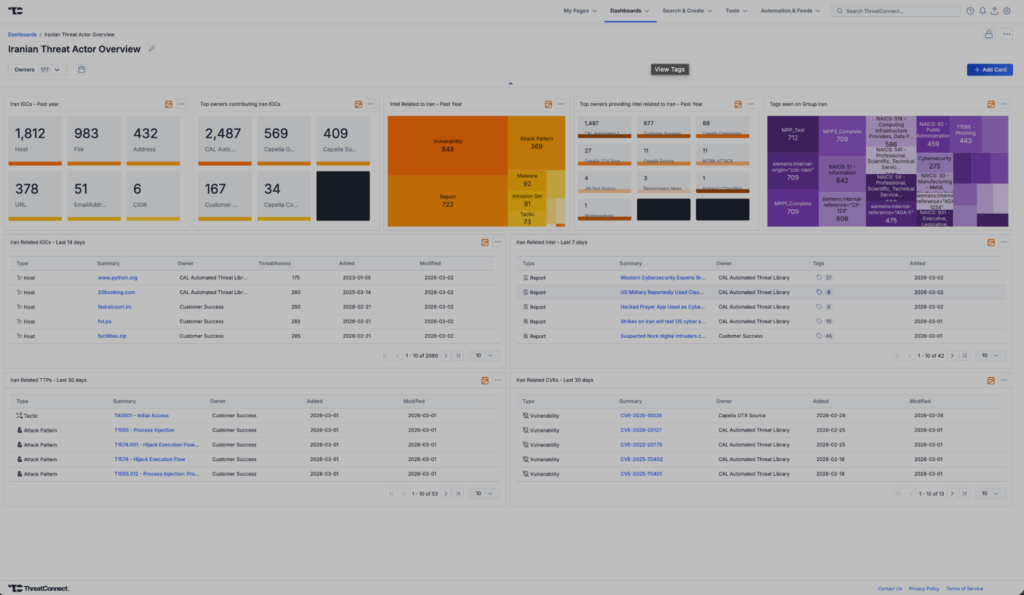
Screen Capture of Iranian Conflict Intelligence Dashboard
Lead Contributor – Adrian Dela Cruz , Customer Success Engineer
To gain access to the Iranian Conflict Intelligence Dashboard, please reach out to your Customer Success team or reach out to us through our contact form.
The dashboard is also available here, and can be added manually to your ThreatConnect instance.
The fourth quarter of 2025 went down as one of the most intense periods on record for high-profile, critical vulnerability disclosures, hitting popular libraries and mainstream applications. Several of these vulnerabilities were picked up by attackers and exploited in the wild almost immediately.
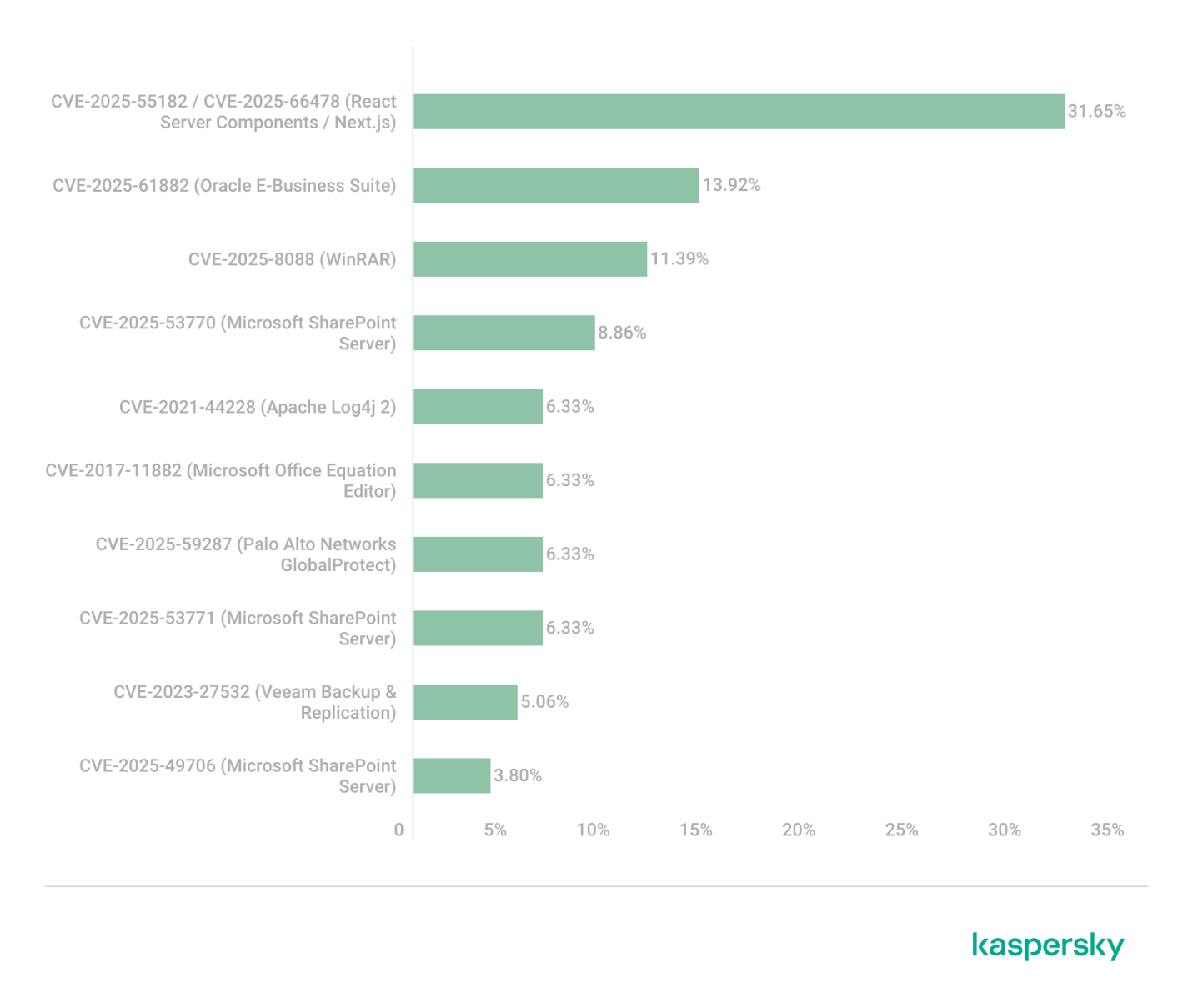
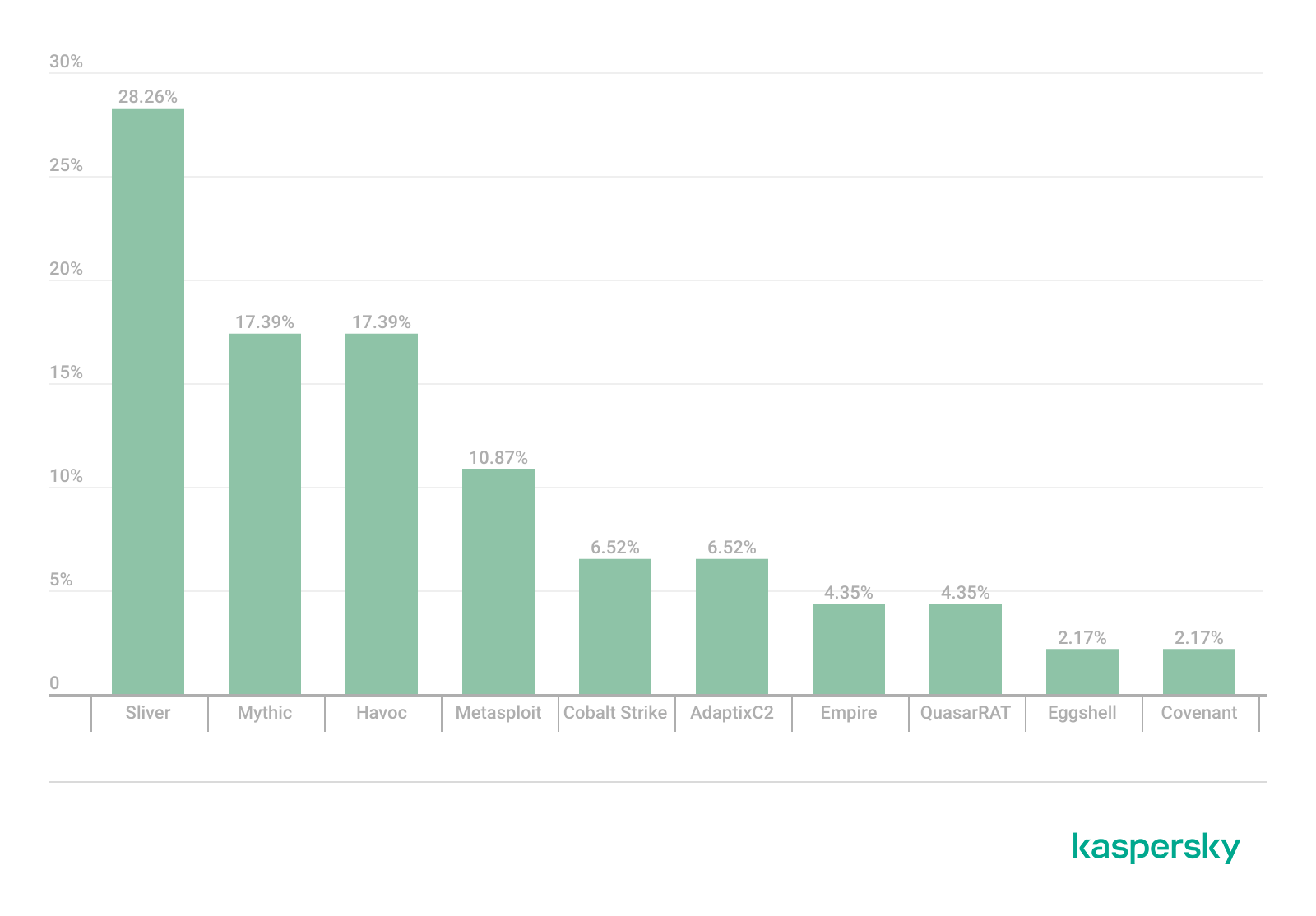
In this report, we dive into the statistics on published vulnerabilities and exploits, as well as the known vulnerabilities leveraged with popular C2 frameworks throughout Q4 2025.
Statistics on registered vulnerabilities
This section contains statistics on registered vulnerabilities. The data is taken from cve.org.
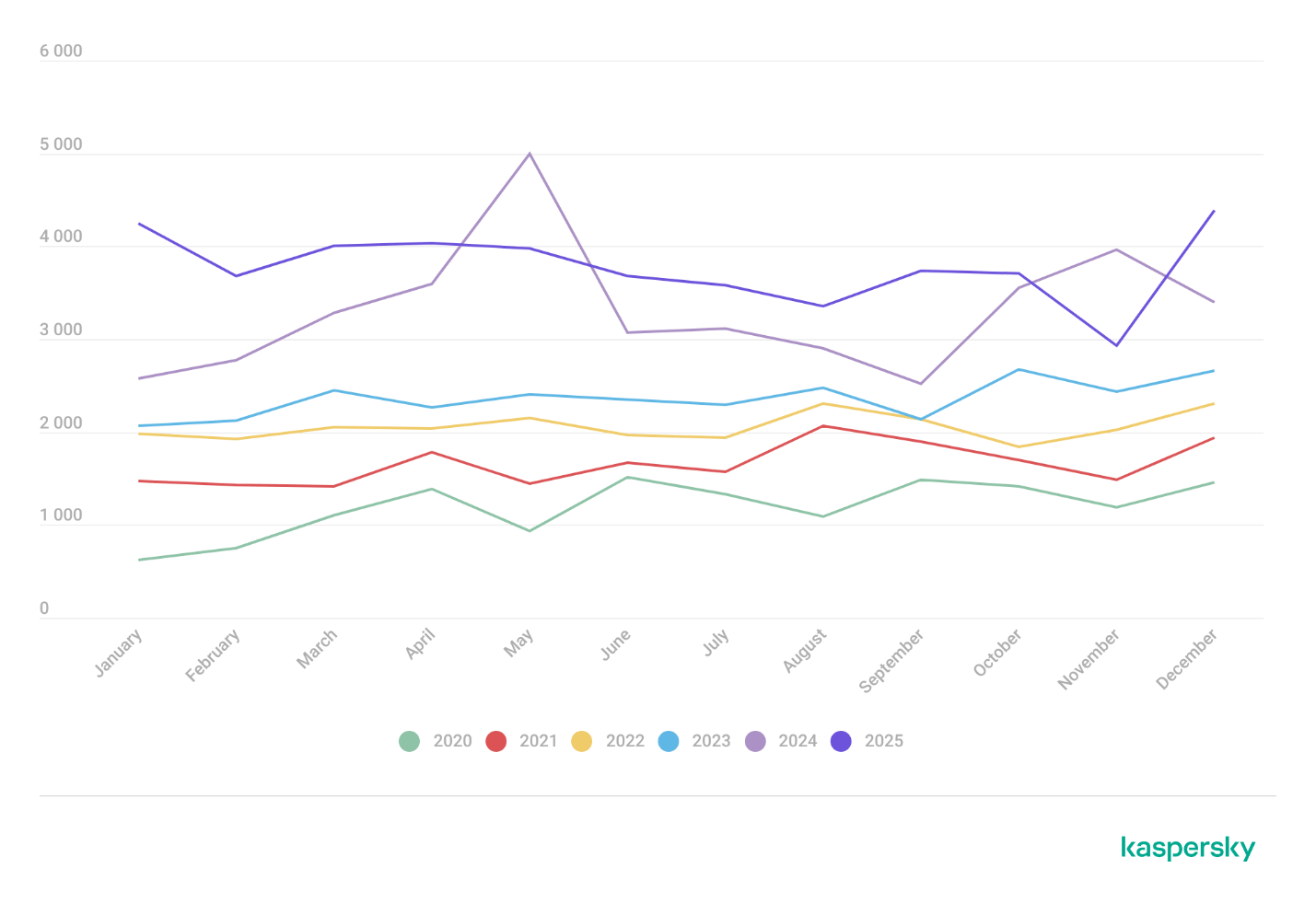
Let’s take a look at the number of registered CVEs for each month over the last five years, up to and including the end of 2025. As predicted in our last report, Q4 saw a higher number of registered vulnerabilities than the same period in 2024, and the year-end totals also cleared the bar set the previous year.
Total published vulnerabilities by month from 2021 through 2025 (download)
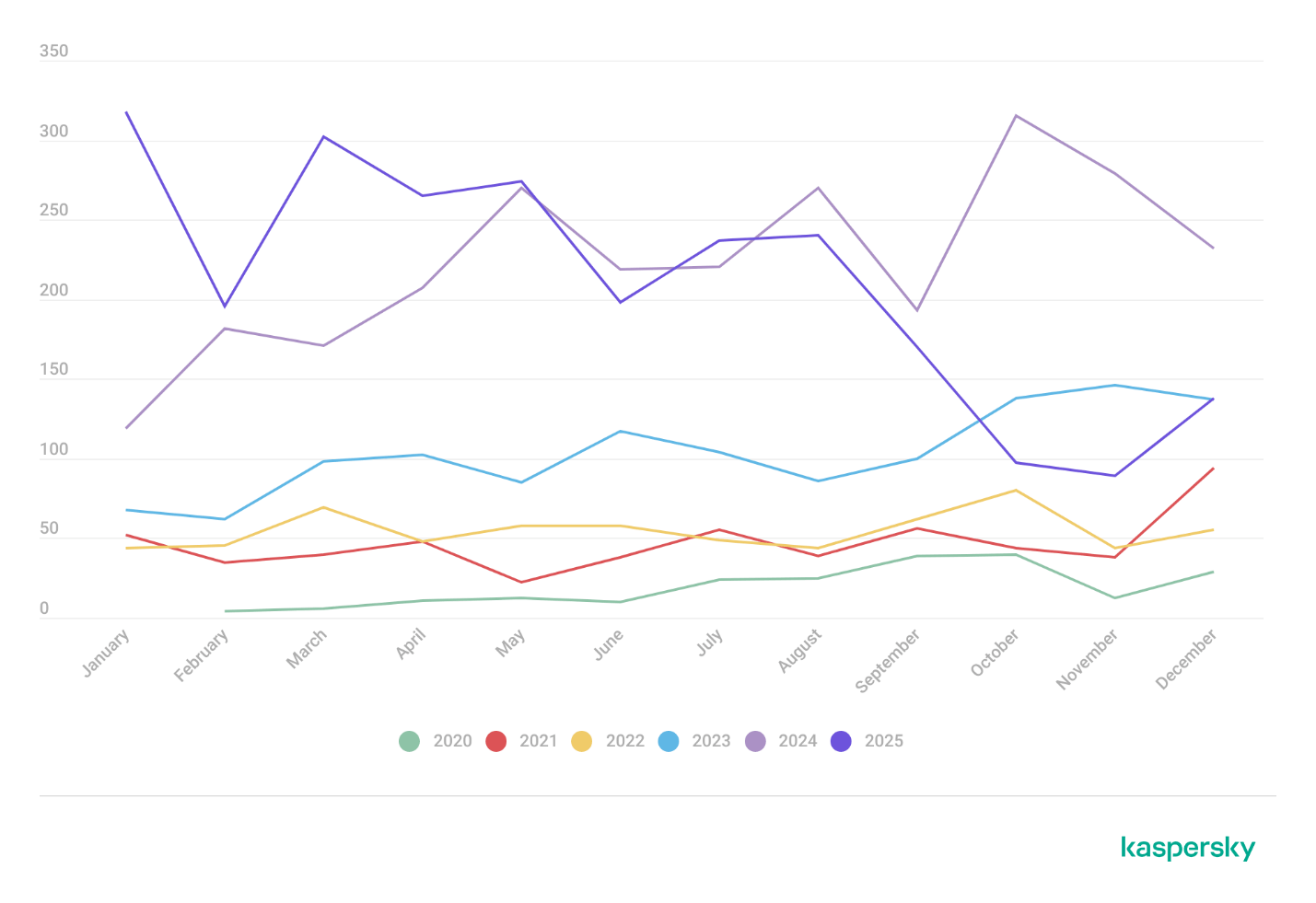
Now, let’s look at the number of new critical vulnerabilities (CVSS > 8.9) for that same period.
Total number of published critical vulnerabilities by month from 2021 to 2025< (download)
The graph shows that the volume of critical vulnerabilities remains quite substantial; however, in the second half of the year, we saw those numbers dip back down to levels seen in 2023. This was due to vulnerability churn: a handful of published security issues were revoked. The widespread adoption of secure development practices and the move toward safer languages also pushed those numbers down, though even that couldn’t stop the overall flood of vulnerabilities.
Exploitation statistics
This section contains statistics on the use of exploits in Q4 2025. The data is based on open sources and our telemetry.
Windows and Linux vulnerability exploitation
In Q4 2025, the most prevalent exploits targeted the exact same vulnerabilities that dominated the threat landscape throughout the rest of the year. These were exploits targeting Microsoft Office products with unpatched security flaws.
Kaspersky solutions detected the most exploits on the Windows platform for the following vulnerabilities:
CVE-2018-0802: a remote code execution vulnerability in Equation Editor.
CVE-2017-11882: another remote code execution vulnerability, also affecting Equation Editor.
CVE-2017-0199: a vulnerability in Microsoft Office and WordPad that allows an attacker to assume control of the system.
The list has remained unchanged for years.
We also see that attackers continue to adapt exploits for directory traversal vulnerabilities (CWE-35) when unpacking archives in WinRAR. They are being heavily leveraged to gain initial access via malicious archives on the Windows operating system:
CVE-2023-38831: a vulnerability stemming from the improper handling of objects within an archive.
CVE-2025-6218 (formerly ZDI-CAN-27198): a vulnerability that enables an attacker to specify a relative path and extract files into an arbitrary directory. This can lead to arbitrary code execution. We covered this vulnerability in detail in our Q2 2025 report.
CVE-2025-8088: a vulnerability we analyzed in our previous report, analogous to CVE-2025-6218. The attackers used NTFS streams to circumvent controls on the directory into which files were being unpacked.
As in the previous quarter, we see a rise in the use of archiver exploits, with fresh vulnerabilities increasingly appearing in attacks.
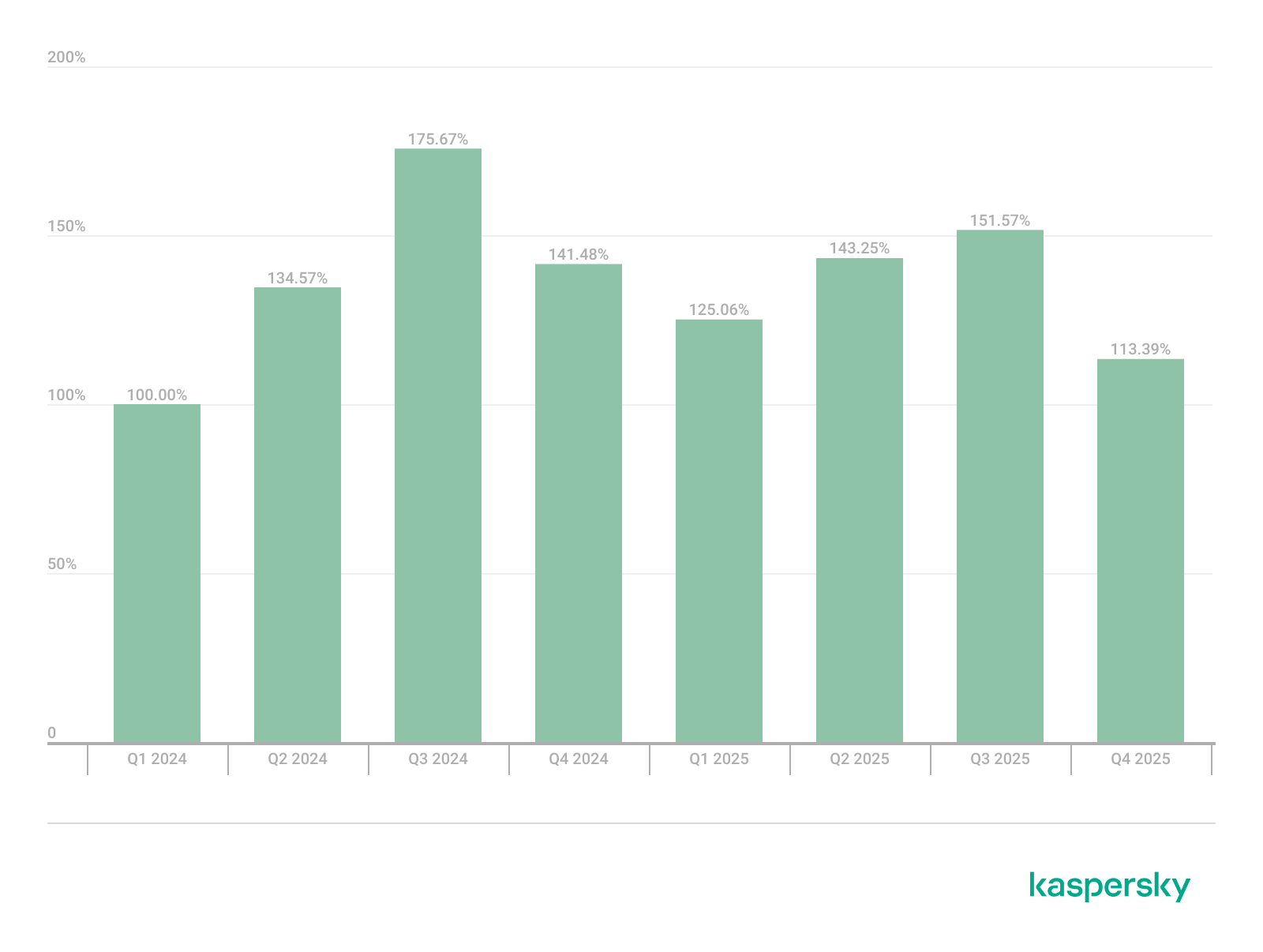
Below are the exploit detection trends for Windows users over the last two years.
Dynamics of the number of Windows users encountering exploits, Q1 2024 – Q4 2025. The number of users who encountered exploits in Q1 2024 is taken as 100% (download)
The vulnerabilities listed here can be used to gain initial access to a vulnerable system. This highlights the critical importance of timely security updates for all affected software.
On Linux-based devices, the most frequently detected exploits targeted the following vulnerabilities:
CVE-2022-0847, also known as Dirty Pipe: a vulnerability that allows privilege escalation and enables attackers to take control of running applications.
CVE-2019-13272: a vulnerability caused by improper handling of privilege inheritance, which can be exploited to achieve privilege escalation.
CVE-2021-22555: a heap overflow vulnerability in the Netfilter kernel subsystem.
CVE-2023-32233: another vulnerability in the Netfilter subsystem that creates a use-after-free condition, allowing for privilege escalation due to the improper handling of network requests.
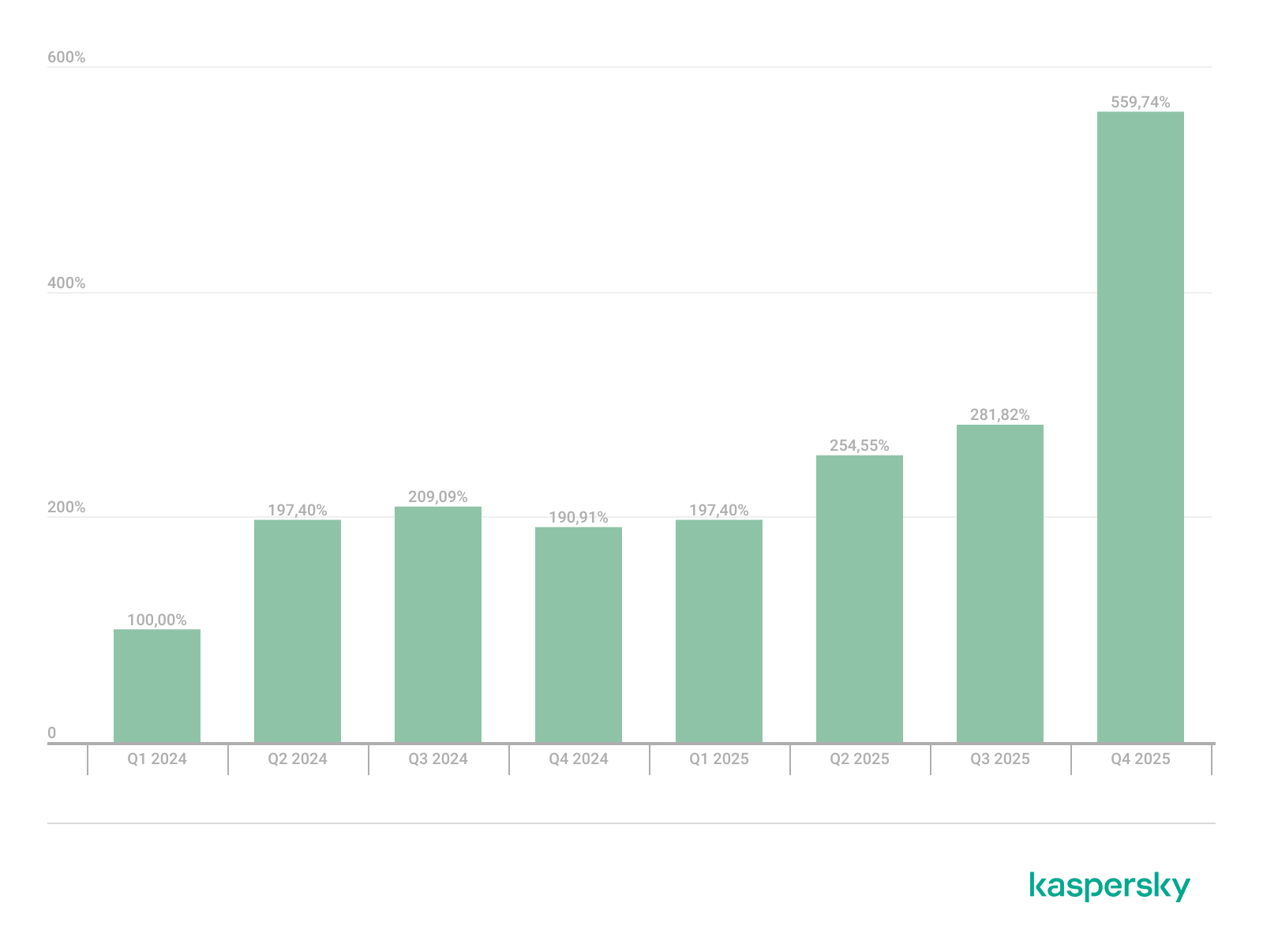
Dynamics of the number of Linux users encountering exploits, Q1 2024 – Q4 2025. The number of users who encountered exploits in Q1 2024 is taken as 100% (download)
We are seeing a massive surge in Linux-based exploit attempts: in Q4, the number of affected users doubled compared to Q3. Our statistics show that the final quarter of the year accounted for more than half of all Linux exploit attacks recorded for the entire year. This surge is primarily driven by the rapidly growing number of Linux-based consumer devices. This trend naturally attracts the attention of threat actors, making the installation of security patches critically important.
Most common published exploits
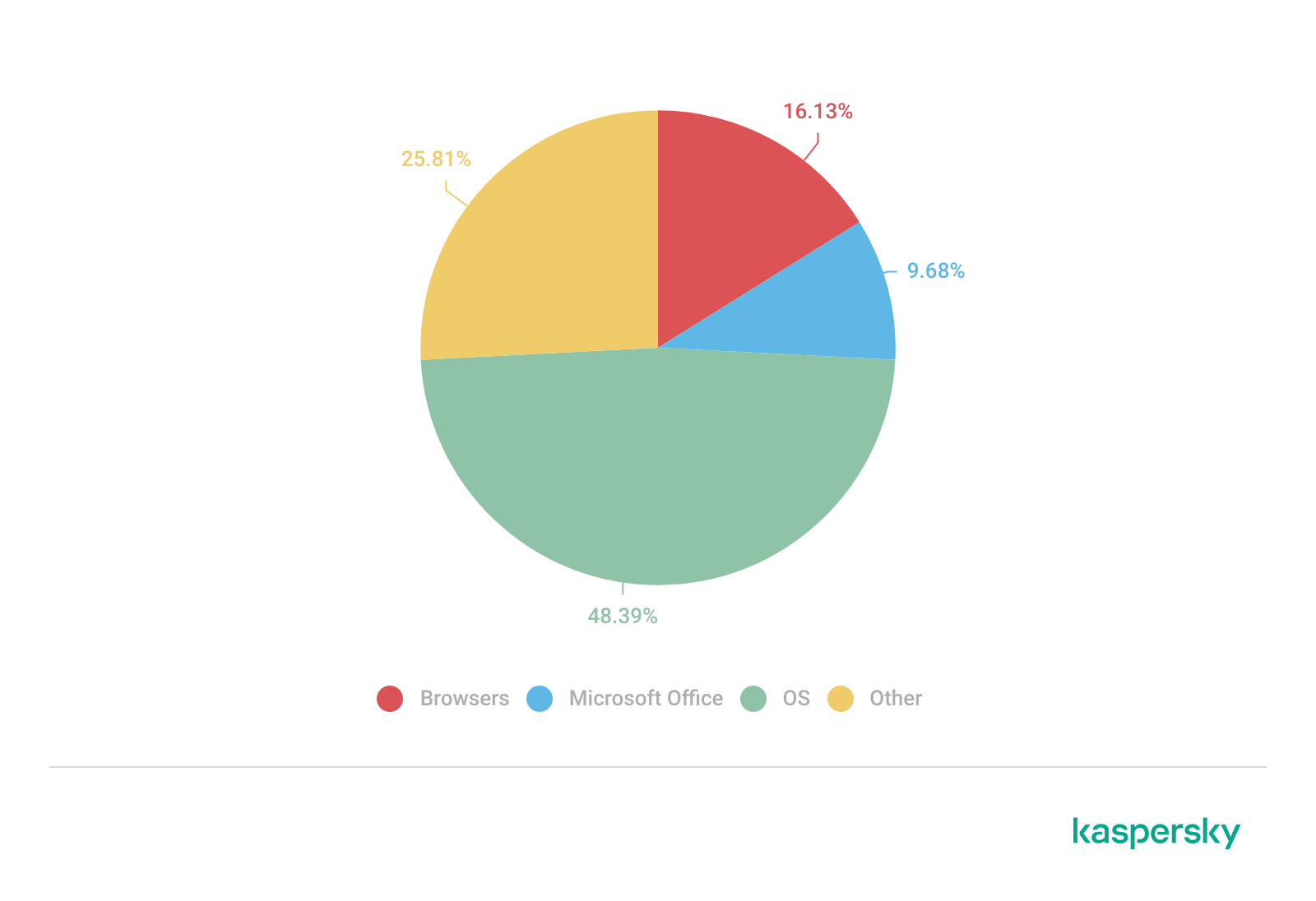
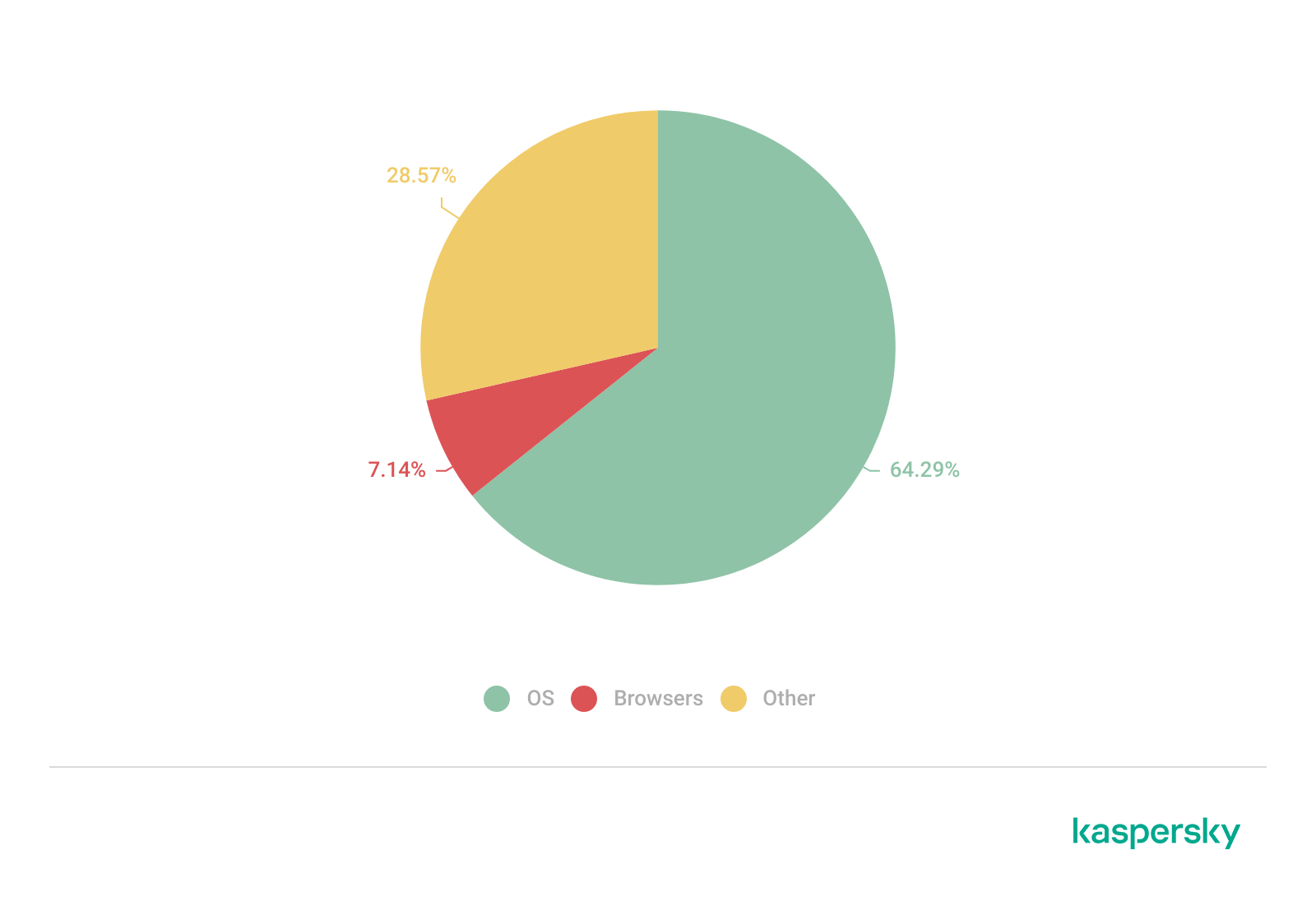
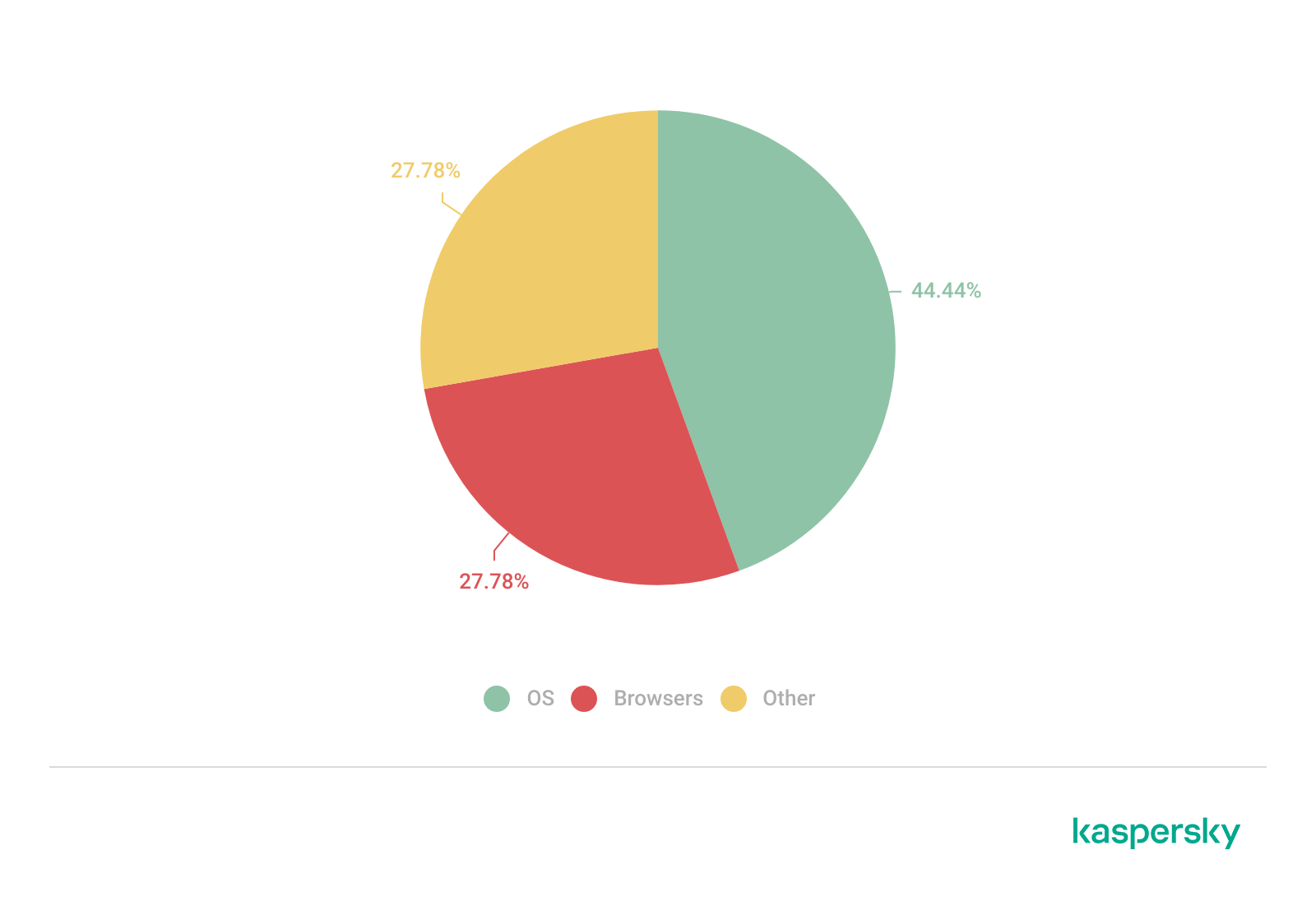
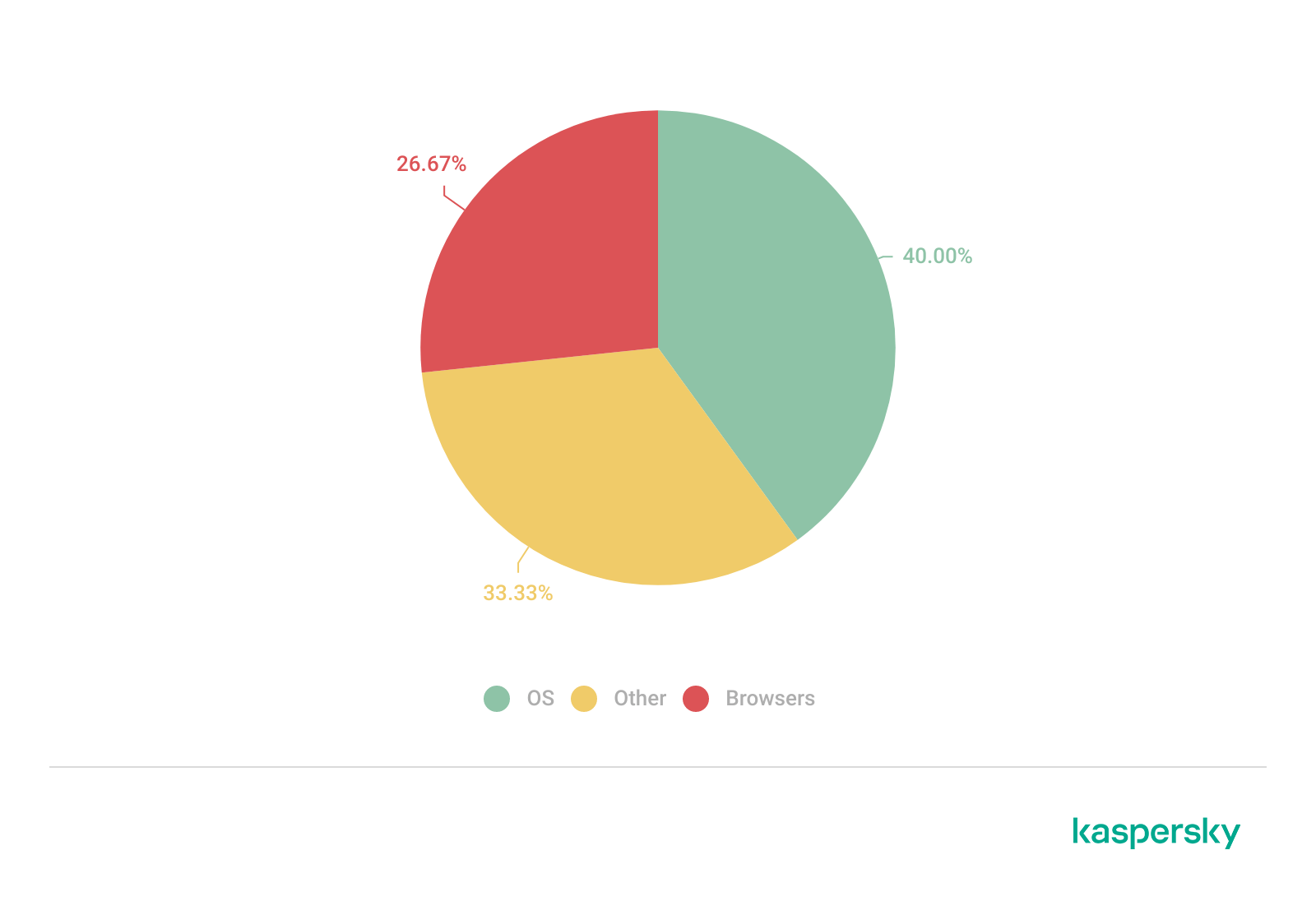
The distribution of published exploits by software type in Q4 2025 largely mirrors the patterns observed in the previous quarter. The majority of exploits we investigate through our monitoring of public research, news, and PoCs continue to target vulnerabilities within operating systems.
Distribution of published exploits by platform, Q1 2025 (download)
Distribution of published exploits by platform, Q2 2025 (download)
Distribution of published exploits by platform, Q3 2025 (download)
Distribution of published exploits by platform, Q4 2025 (download)
In Q4 2025, no public exploits for Microsoft Office products emerged; the bulk of the vulnerabilities were issues discovered in system components. When calculating our statistics, we placed these in the OS category.
Vulnerability exploitation in APT attacks
We analyzed which vulnerabilities were utilized in APT attacks during Q4 2025. The following rankings draw on our telemetry, research, and open-source data.
TOP 10 vulnerabilities exploited in APT attacks, Q4 2025 (download)
In Q4 2025, APT attacks most frequently exploited fresh vulnerabilities published within the last six months. We believe that these CVEs will remain favorites among attackers for a long time, as fixing them may require significant structural changes to the vulnerable applications or the user’s system. Often, replacing or updating the affected components requires a significant amount of resources. Consequently, the probability of an attack through such vulnerabilities may persist. Some of these new vulnerabilities are likely to become frequent tools for lateral movement within user infrastructure, as the corresponding security flaws have been discovered in network services that are accessible without authentication. This heavy exploitation of very recently registered vulnerabilities highlights the ability of threat actors to rapidly implement new techniques and adapt old ones for their attacks. Therefore, we strongly recommend applying the security patches provided by vendors.
C2 frameworks
In this section, we will look at the most popular C2 frameworks used by threat actors and analyze the vulnerabilities whose exploits interacted with C2 agents in APT attacks.
The chart below shows the frequency of known C2 framework usage in attacks against users during Q4 2025, according to open sources.
TOP 10 C2 frameworks used by APTs to compromise user systems in Q4 2025 (download)
Despite the significant footprints it can leave when used in its default configuration, Sliver continues to hold the top spot among the most common C2 frameworks in our Q4 2025 analysis. Mythic and Havoc were second and third, respectively. After reviewing open sources and analyzing malicious C2 agent samples that contained exploits, we found that the following vulnerabilities were used in APT attacks involving the C2 frameworks mentioned above:
CVE-2025-55182: a React2Shell vulnerability in React Server Components that allows an unauthenticated user to send commands directly to the server and execute them from RAM.
CVE-2023-36884: a vulnerability in the Windows Search component that allows the execution of commands on a system, bypassing security mechanisms built into Microsoft Office applications.
CVE-2025-53770: a critical insecure deserialization vulnerability in Microsoft SharePoint that allows an unauthenticated user to execute commands on the server.
CVE-2020-1472, also known as Zerologon, allows for compromising a vulnerable domain controller and executing commands as a privileged user.
CVE-2021-34527, also known as PrintNightmare, exploits flaws in the Windows print spooler subsystem, enabling remote access to a vulnerable OS and high-privilege command execution.
CVE-2025-8088 and CVE-2025-6218 are similar directory-traversal vulnerabilities that allow extracting files from an archive to a predefined path without the archiving utility notifying the user.
The set of vulnerabilities described above suggests that attackers have been using them for initial access and early-stage maneuvers in vulnerable systems to create a springboard for deploying a C2 agent. The list of vulnerabilities includes both zero-days and well-known, established security issues.
Notable vulnerabilities
This section highlights the most noteworthy vulnerabilities that were publicly disclosed in Q4 2025 and have a publicly available description.
React2Shell (CVE-2025-55182): a vulnerability in React Server Components
We typically describe vulnerabilities affecting a specific application. CVE-2025-55182 stood out as an exception, as it was discovered in React, a library primarily used for building web applications. This means that exploiting the vulnerability could potentially disrupt a vast number of applications that rely on the library. The vulnerability itself lies in the interaction mechanism between the client and server components, which is built on sending serialized objects. If an attacker sends serialized data containing malicious functionality, they can execute JavaScript commands directly on the server, bypassing all client-side request validation. Technical details about this vulnerability and an example of how Kaspersky solutions detect it can be found in our article.
CVE-2025-54100: command injection during the execution of curl (Invoke-WebRequest)
This vulnerability represents a data-handling flaw that occurs when retrieving information from a remote server: when executing the curl or Invoke-WebRequest command, Windows launches Internet Explorer in the background. This can lead to a cross-site scripting (XSS) attack.
CVE-2025-11001: a vulnerability in 7-Zip
This vulnerability reinforces the trend of exploiting security flaws found in file archivers. The core of CVE-2025-11001 lies in the incorrect handling of symbolic links. An attacker can craft an archive so that when it is extracted into an arbitrary directory, its contents end up in the location pointed to by a symbolic link. The likelihood of exploiting this vulnerability is significantly reduced because utilizing such functionality requires the user opening the archive to possess system administrator privileges.
This vulnerability was associated with a wave of misleading news reports claiming it was being used in real-world attacks against end users. This misconception stemmed from an error in the security bulletin.
RediShell (CVE-2025-49844): a vulnerability in Redis
The year 2025 saw a surge in high-profile vulnerabilities, several of which were significant enough to earn a unique nickname. This was the case with CVE-2025-49844, also known as RediShell, which was unveiled during a hacking competition. This vulnerability is a use-after-free issue related to how the load command functions within Lua interpreter scripts. To execute the attack, an attacker needs to prepare a malicious script and load it into the interpreter.
As with any named vulnerability, RediShell was immediately weaponized by threat actors and spammers, albeit in a somewhat unconventional manner. Because technical details were initially scarce following its disclosure, the internet was flooded with fake PoC exploits and scanners claiming to test for the vulnerability. In the best-case scenario, these tools were non-functional; in the worst, they infected the system. Notably, these fraudulent projects were frequently generated using LLMs. They followed a standardized template and often cross-referenced source code from other identical fake repositories.
CVE-2025-24990: a vulnerability in the ltmdm64.sys driver
Driver vulnerabilities are often discovered in legitimate third-party applications that have been part of the official OS distribution for a long time. Thus, CVE-2025-24990 has existed within code shipped by Microsoft throughout nearly the entire history of Windows. The vulnerable driver has been shipped since at least Windows 7 as a third-party driver for Agere Modem. According to Microsoft, this driver is no longer supported and, following the discovery of the flaw, was removed from the OS distribution entirely.
The vulnerability itself is straightforward: insecure handling of IOCTL codes leading to a null pointer dereference. Successful exploitation can lead to arbitrary command execution or a system crash resulting in a blue screen of death (BSOD) on modern systems.
CVE-2025-59287: a vulnerability in Windows Server Update Services (WSUS)
CVE-2025-59287 represents a textbook case of insecure deserialization. Exploitation is possible without any form of authentication; due to its ease of use, this vulnerability rapidly gained traction among threat actors. Technical details and detection methodologies for our product suite have been covered in our previous advisories.
Conclusion and advice
In Q4 2025, the rate of vulnerability registration has shown no signs of slowing down. Consequently, consistent monitoring and the timely application of security patches have become more critical than ever. To ensure resilient defense, it is vital to regularly assess and remediate known vulnerabilities while implementing technology designed to mitigate the impact of potential exploits.
Continuous monitoring of infrastructure, including the network perimeter, allows for the timely identification of threats and prevents them from escalating. Effective security also demands tracking the current threat landscape and applying preventative measures to minimize risks associated with system flaws. Kaspersky Next serves as a reliable partner in this process, providing real-time identification and detailed mapping of vulnerabilities within the environment.
Securing the workplace remains a top priority. Protecting corporate devices requires the adoption of solutions capable of blocking malware and preventing it from spreading. Beyond basic measures, organizations should implement adaptive systems that allow for the rapid deployment of security updates and the automation of patch management workflows.
The fourth quarter of 2025 went down as one of the most intense periods on record for high-profile, critical vulnerability disclosures, hitting popular libraries and mainstream applications. Several of these vulnerabilities were picked up by attackers and exploited in the wild almost immediately.
In this report, we dive into the statistics on published vulnerabilities and exploits, as well as the known vulnerabilities leveraged with popular C2 frameworks throughout Q4 2025.
Statistics on registered vulnerabilities
This section contains statistics on registered vulnerabilities. The data is taken from cve.org.
Let’s take a look at the number of registered CVEs for each month over the last five years, up to and including the end of 2025. As predicted in our last report, Q4 saw a higher number of registered vulnerabilities than the same period in 2024, and the year-end totals also cleared the bar set the previous year.
Total published vulnerabilities by month from 2021 through 2025 (download)
Now, let’s look at the number of new critical vulnerabilities (CVSS > 8.9) for that same period.
Total number of published critical vulnerabilities by month from 2021 to 2025< (download)
The graph shows that the volume of critical vulnerabilities remains quite substantial; however, in the second half of the year, we saw those numbers dip back down to levels seen in 2023. This was due to vulnerability churn: a handful of published security issues were revoked. The widespread adoption of secure development practices and the move toward safer languages also pushed those numbers down, though even that couldn’t stop the overall flood of vulnerabilities.
Exploitation statistics
This section contains statistics on the use of exploits in Q4 2025. The data is based on open sources and our telemetry.
Windows and Linux vulnerability exploitation
In Q4 2025, the most prevalent exploits targeted the exact same vulnerabilities that dominated the threat landscape throughout the rest of the year. These were exploits targeting Microsoft Office products with unpatched security flaws.
Kaspersky solutions detected the most exploits on the Windows platform for the following vulnerabilities:
CVE-2018-0802: a remote code execution vulnerability in Equation Editor.
CVE-2017-11882: another remote code execution vulnerability, also affecting Equation Editor.
CVE-2017-0199: a vulnerability in Microsoft Office and WordPad that allows an attacker to assume control of the system.
The list has remained unchanged for years.
We also see that attackers continue to adapt exploits for directory traversal vulnerabilities (CWE-35) when unpacking archives in WinRAR. They are being heavily leveraged to gain initial access via malicious archives on the Windows operating system:
CVE-2023-38831: a vulnerability stemming from the improper handling of objects within an archive.
CVE-2025-6218 (formerly ZDI-CAN-27198): a vulnerability that enables an attacker to specify a relative path and extract files into an arbitrary directory. This can lead to arbitrary code execution. We covered this vulnerability in detail in our Q2 2025 report.
CVE-2025-8088: a vulnerability we analyzed in our previous report, analogous to CVE-2025-6218. The attackers used NTFS streams to circumvent controls on the directory into which files were being unpacked.
As in the previous quarter, we see a rise in the use of archiver exploits, with fresh vulnerabilities increasingly appearing in attacks.
Below are the exploit detection trends for Windows users over the last two years.
Dynamics of the number of Windows users encountering exploits, Q1 2024 – Q4 2025. The number of users who encountered exploits in Q1 2024 is taken as 100% (download)
The vulnerabilities listed here can be used to gain initial access to a vulnerable system. This highlights the critical importance of timely security updates for all affected software.
On Linux-based devices, the most frequently detected exploits targeted the following vulnerabilities:
CVE-2022-0847, also known as Dirty Pipe: a vulnerability that allows privilege escalation and enables attackers to take control of running applications.
CVE-2019-13272: a vulnerability caused by improper handling of privilege inheritance, which can be exploited to achieve privilege escalation.
CVE-2021-22555: a heap overflow vulnerability in the Netfilter kernel subsystem.
CVE-2023-32233: another vulnerability in the Netfilter subsystem that creates a use-after-free condition, allowing for privilege escalation due to the improper handling of network requests.
Dynamics of the number of Linux users encountering exploits, Q1 2024 – Q4 2025. The number of users who encountered exploits in Q1 2024 is taken as 100% (download)
We are seeing a massive surge in Linux-based exploit attempts: in Q4, the number of affected users doubled compared to Q3. Our statistics show that the final quarter of the year accounted for more than half of all Linux exploit attacks recorded for the entire year. This surge is primarily driven by the rapidly growing number of Linux-based consumer devices. This trend naturally attracts the attention of threat actors, making the installation of security patches critically important.
Most common published exploits
The distribution of published exploits by software type in Q4 2025 largely mirrors the patterns observed in the previous quarter. The majority of exploits we investigate through our monitoring of public research, news, and PoCs continue to target vulnerabilities within operating systems.
Distribution of published exploits by platform, Q1 2025 (download)
Distribution of published exploits by platform, Q2 2025 (download)
Distribution of published exploits by platform, Q3 2025 (download)
Distribution of published exploits by platform, Q4 2025 (download)
In Q4 2025, no public exploits for Microsoft Office products emerged; the bulk of the vulnerabilities were issues discovered in system components. When calculating our statistics, we placed these in the OS category.
Vulnerability exploitation in APT attacks
We analyzed which vulnerabilities were utilized in APT attacks during Q4 2025. The following rankings draw on our telemetry, research, and open-source data.
TOP 10 vulnerabilities exploited in APT attacks, Q4 2025 (download)
In Q4 2025, APT attacks most frequently exploited fresh vulnerabilities published within the last six months. We believe that these CVEs will remain favorites among attackers for a long time, as fixing them may require significant structural changes to the vulnerable applications or the user’s system. Often, replacing or updating the affected components requires a significant amount of resources. Consequently, the probability of an attack through such vulnerabilities may persist. Some of these new vulnerabilities are likely to become frequent tools for lateral movement within user infrastructure, as the corresponding security flaws have been discovered in network services that are accessible without authentication. This heavy exploitation of very recently registered vulnerabilities highlights the ability of threat actors to rapidly implement new techniques and adapt old ones for their attacks. Therefore, we strongly recommend applying the security patches provided by vendors.
C2 frameworks
In this section, we will look at the most popular C2 frameworks used by threat actors and analyze the vulnerabilities whose exploits interacted with C2 agents in APT attacks.
The chart below shows the frequency of known C2 framework usage in attacks against users during Q4 2025, according to open sources.
TOP 10 C2 frameworks used by APTs to compromise user systems in Q4 2025 (download)
Despite the significant footprints it can leave when used in its default configuration, Sliver continues to hold the top spot among the most common C2 frameworks in our Q4 2025 analysis. Mythic and Havoc were second and third, respectively. After reviewing open sources and analyzing malicious C2 agent samples that contained exploits, we found that the following vulnerabilities were used in APT attacks involving the C2 frameworks mentioned above:
CVE-2025-55182: a React2Shell vulnerability in React Server Components that allows an unauthenticated user to send commands directly to the server and execute them from RAM.
CVE-2023-36884: a vulnerability in the Windows Search component that allows the execution of commands on a system, bypassing security mechanisms built into Microsoft Office applications.
CVE-2025-53770: a critical insecure deserialization vulnerability in Microsoft SharePoint that allows an unauthenticated user to execute commands on the server.
CVE-2020-1472, also known as Zerologon, allows for compromising a vulnerable domain controller and executing commands as a privileged user.
CVE-2021-34527, also known as PrintNightmare, exploits flaws in the Windows print spooler subsystem, enabling remote access to a vulnerable OS and high-privilege command execution.
CVE-2025-8088 and CVE-2025-6218 are similar directory-traversal vulnerabilities that allow extracting files from an archive to a predefined path without the archiving utility notifying the user.
The set of vulnerabilities described above suggests that attackers have been using them for initial access and early-stage maneuvers in vulnerable systems to create a springboard for deploying a C2 agent. The list of vulnerabilities includes both zero-days and well-known, established security issues.
Notable vulnerabilities
This section highlights the most noteworthy vulnerabilities that were publicly disclosed in Q4 2025 and have a publicly available description.
React2Shell (CVE-2025-55182): a vulnerability in React Server Components
We typically describe vulnerabilities affecting a specific application. CVE-2025-55182 stood out as an exception, as it was discovered in React, a library primarily used for building web applications. This means that exploiting the vulnerability could potentially disrupt a vast number of applications that rely on the library. The vulnerability itself lies in the interaction mechanism between the client and server components, which is built on sending serialized objects. If an attacker sends serialized data containing malicious functionality, they can execute JavaScript commands directly on the server, bypassing all client-side request validation. Technical details about this vulnerability and an example of how Kaspersky solutions detect it can be found in our article.
CVE-2025-54100: command injection during the execution of curl (Invoke-WebRequest)
This vulnerability represents a data-handling flaw that occurs when retrieving information from a remote server: when executing the curl or Invoke-WebRequest command, Windows launches Internet Explorer in the background. This can lead to a cross-site scripting (XSS) attack.
CVE-2025-11001: a vulnerability in 7-Zip
This vulnerability reinforces the trend of exploiting security flaws found in file archivers. The core of CVE-2025-11001 lies in the incorrect handling of symbolic links. An attacker can craft an archive so that when it is extracted into an arbitrary directory, its contents end up in the location pointed to by a symbolic link. The likelihood of exploiting this vulnerability is significantly reduced because utilizing such functionality requires the user opening the archive to possess system administrator privileges.
This vulnerability was associated with a wave of misleading news reports claiming it was being used in real-world attacks against end users. This misconception stemmed from an error in the security bulletin.
RediShell (CVE-2025-49844): a vulnerability in Redis
The year 2025 saw a surge in high-profile vulnerabilities, several of which were significant enough to earn a unique nickname. This was the case with CVE-2025-49844, also known as RediShell, which was unveiled during a hacking competition. This vulnerability is a use-after-free issue related to how the load command functions within Lua interpreter scripts. To execute the attack, an attacker needs to prepare a malicious script and load it into the interpreter.
As with any named vulnerability, RediShell was immediately weaponized by threat actors and spammers, albeit in a somewhat unconventional manner. Because technical details were initially scarce following its disclosure, the internet was flooded with fake PoC exploits and scanners claiming to test for the vulnerability. In the best-case scenario, these tools were non-functional; in the worst, they infected the system. Notably, these fraudulent projects were frequently generated using LLMs. They followed a standardized template and often cross-referenced source code from other identical fake repositories.
CVE-2025-24990: a vulnerability in the ltmdm64.sys driver
Driver vulnerabilities are often discovered in legitimate third-party applications that have been part of the official OS distribution for a long time. Thus, CVE-2025-24990 has existed within code shipped by Microsoft throughout nearly the entire history of Windows. The vulnerable driver has been shipped since at least Windows 7 as a third-party driver for Agere Modem. According to Microsoft, this driver is no longer supported and, following the discovery of the flaw, was removed from the OS distribution entirely.
The vulnerability itself is straightforward: insecure handling of IOCTL codes leading to a null pointer dereference. Successful exploitation can lead to arbitrary command execution or a system crash resulting in a blue screen of death (BSOD) on modern systems.
CVE-2025-59287: a vulnerability in Windows Server Update Services (WSUS)
CVE-2025-59287 represents a textbook case of insecure deserialization. Exploitation is possible without any form of authentication; due to its ease of use, this vulnerability rapidly gained traction among threat actors. Technical details and detection methodologies for our product suite have been covered in our previous advisories.
Conclusion and advice
In Q4 2025, the rate of vulnerability registration has shown no signs of slowing down. Consequently, consistent monitoring and the timely application of security patches have become more critical than ever. To ensure resilient defense, it is vital to regularly assess and remediate known vulnerabilities while implementing technology designed to mitigate the impact of potential exploits.
Continuous monitoring of infrastructure, including the network perimeter, allows for the timely identification of threats and prevents them from escalating. Effective security also demands tracking the current threat landscape and applying preventative measures to minimize risks associated with system flaws. Kaspersky Next serves as a reliable partner in this process, providing real-time identification and detailed mapping of vulnerabilities within the environment.
Securing the workplace remains a top priority. Protecting corporate devices requires the adoption of solutions capable of blocking malware and preventing it from spreading. Beyond basic measures, organizations should implement adaptive systems that allow for the rapid deployment of security updates and the automation of patch management workflows.
Key findings
Tycoon 2FA is one of the most popular phishing-as-a-service (PhaaS) platforms currently used by threat actors, and highest volume adversary-in-the-middle (AiTM) phishing threat in Proofpoint data.
Tycoon 2FA infrastructure was disrupted by public and private partners, including Proofpoint, Microsoft, Europol, Cloudflare, Coinbase, Crowell, eSentire, Health-ISAC, Intel 471, Resecurity, The Shadowserver Foundation, SpyCloud, and TrendAI, and additional European law enforcement partners.
The Tycoon 2FA disruption and associated lawsuit naming the creator will have a significant impact on Tycoon 2FA, related infrastructure, and threat actor activity.
Proofpoint was proud to assist in the law enforcement and private sector investigations into Tycoon 2FA activity and supported Microsoft’s action with data, including malicious domains and information related to Tycoon 2FA campaigns.
Overview
Tycoon 2FA operates as an AitM phishing kit. Its primary function is to harvest usernames, passwords, and Microsoft 365 and Gmail session cookies. Attackers use these cookies to circumvent multifactor authentication (MFA) access controls during subsequent authentication. That allows them to achieve full account takeover (ATO) and gain unauthorized access to a user’s accounts, systems and cloud services—even those that have MFA as an additional security measure.
According to Proofpoint threat data, in 2025, 99% of organizations experienced account takeover attempts, and 67% experienced a successful account takeover. Of these, 59% of taken over accounts had MFA enabled. While not all MFA bypassing ATO campaigns are attributable to Tycoon 2FA, Tycoon 2FA is the highest volume AiTM phishing threat in Proofpoint visibility. Tycoon 2FA threat volumes vary based on actor activity, and in February 2026, Proofpoint observed over three million messages associated with Tycoon 2FA.
Tycoon 2FA infrastructure, including domains and servers, was disrupted in collaboration with private and public partners including Proofpoint, Microsoft, Europol, Cloudflare, Coinbase, Crowell, eSentire, Health-ISAC, Intel 471, Resecurity, The Shadowserver Foundation, SpyCloud, and TrendAI. In coordination with Europol, law enforcement in Latvia, Lithuania, Portugal, Poland, Spain and the United Kingdom carried out a seizure of infrastructure and other operational measures. Microsoft and co-plaintiff Health-ISAC also filed a lawsuit against the alleged Tycoon 2FA creator, Saad Fridi, and unnamed associates. The disruption and associated civil filing in the United States Southern District of New York will have a significant impact on Tycoon 2FA operations and overall threat activity.
Proofpoint supported Microsoft’s action with threat data from our visibility, including malicious domains and information related to Tycoon 2FA campaigns, and provided a declaration for the suit.
In addition to the disruption, the following splash page was displayed on the seized Tycoon 2FA domains:
Figure 1. Tycoon 2FA splash page.
Tycoon 2FA campaign details
Tycoon 2FA relies on attacker-controlled infrastructure to host the phishing webpages. Using a synchronous proxy the platform allows the interception of victims’ entered credentials. The credentials are then relayed to the legitimate service for a transparent, successful login, prompting MFA requests. The resulting session cookies are relayed back to the threat actors.
Tycoon 2FA is sold as a phishing-as-a-service (PhaaS), meaning that threat actors purchase access to the phishing tool and then they can customize it to suit their specific needs. The kit can be used multiple times through the duration of the subscription. Tycoon 2FA is used by multiple different threat actors, and sold by one main individual. It has been sold on Telegram since 2023 and was initially distributed via the “Saad Tycoon Group” channel.
Some Tycoon 2FA users are leveraging “ATO Jumping” whereby the actor compromises an initial email account, uses the compromised sender to broadly distribute Tycoon 2FA URLs, and attempts further account takeover (ATO) activities. Using this technique enables emails to look like they are authentically coming from a victim’s trusted contact, increasing the likelihood of a successful compromise.
Tycoon 2FA infections can lead to a variety of malicious activities including theft of private data including financial information, personally identifiable information, proprietary business information; full account takeover and access to M365 hosts that can be sold to additional threat actors; and potentially lead to follow-on malware compromises including ransomware.
Proofpoint has regularly tracked actors using the Tycoon 2FA phishing kit since 2024. We observe Tycoon 2FA distributed via email campaigns. A campaign is a time-bound set of related activity that is clustered by indicators of compromise (IOCs) such as senders, URLs, attachments, Tycoon 2FA configuration, etc. Tycoon 2FA campaigns vary in terms of scale; some include just a handful of messages; some include millions of messages. Campaign timelines can range from one day to one week.
Tycoon 2FA distribution depends on the criminals’ preferred method of email spam. Emails may contain malicious links, QR codes, SVGs, or attachments with URLs. In all cases, a user is redirected to an actor-controlled URL that displays a unique CAPTCHA resolution that, if solved, will direct to an attacker-controlled site impersonating a Microsoft or Google login portal. In many cases, the threat actor will display a target organization’s Azure Active Directory branding to further the social engineering component and trick a user into thinking they are entering their credentials into a real corporate site.
Figure 2. Email lure observed in late January 2026 with a PDF attachment containing a QR code leading to Tycoon 2FA.
Figure 3. Example CAPTCHA used by Tycoon 2FA, January 2026.
Figure 4. Tycoon 2FA landing page with the target organization’s logo redacted, January 2026.
Tycoon 2FA campaigns are typically opportunistic and target a broad range of organizations and often leverage compromised accounts to spread their phishing kits. Proofpoint has observed Tycoon 2FA distributed via compromised accounts from various industries including legal, real estate, healthcare, government, education, construction, and technology, as well as personal emails such as Gmail addresses.
Tycoon 2FA customers manage their campaigns via a panel provided by the Tycoon 2FA creator. The panel landing pages have changed slightly since 2023, but overall, the general URL structure and landing page functionality has remained the same.
Figure 5. Tycoon panel login screen, February 2026.
The current panel (as of February 2026) also requires a CAPTCHA.
Impact
The majority of tracked Tycoon 2FA campaigns impact North America, mainly the U.S. and Canada, with additional activities targeting many European countries including Germany, Spain, France, and the UK. According to Microsoft, Tycoon 2FA enabled cybercriminals to access almost 100,000 organizations, including schools, hospitals, non-profits, and public institutions.
Based on Proofpoint’s visibility, the following is an example of industries that were targeted in observed Tycoon 2FA campaigns in our threat data, and the percent of campaigns in which they appeared. (Individual campaigns impact multiple different targets).
Vertical
Percent of Tycoon 2FA Campaigns
Aerospace
73%
Business Services
82%
Defense
64%
Education
75%
Energy
78%
Financial Services
84%
Government
79%
Healthcare
83%
Hospitality
76%
Manufacturing
83%
Real Estate
77%
Technology
85%
Utilities
76%
Disruption
On 4 March 2026, Microsoft announced a lawsuit and disruption action against the Tycoon 2FA creator and multiple unnamed associates. Proofpoint supported the civil filing by providing a declaration regarding Tycoon activity, including infrastructure and campaign details. Microsoft seized 330 control panel domains associated with Tycoon 2FA. This action will have a significant impact on operations, disrupting ongoing criminal activity.
Successful account takeovers can cause significant harm to compromised organizations including financial and reputational damage, loss of proprietary data, and potentially lead to follow-on attacks like ransomware that can have destructive and potentially organizational damaging consequences.
Proofpoint’s mission is to provide the best human-centric protection for our customers against advanced threats. Whenever it is possible and appropriate to do so, and as is the case with the Tycoon 2FA disruption, Proofpoint uses its team’s knowledge and skills to help protect a wider audience against widespread malware and phishing threats. Proofpoint was proud to assist in the law enforcement and private sector investigations into Tycoon 2FA activity.
Through its unique vantage point, Proofpoint is able to identify the largest and most consequential malware distribution campaigns, providing the authorities with much-needed insight into the biggest threats to society, affecting the greatest number of people around the world.
Starting from the third quarter of 2025, we have updated our statistical methodology based on the Kaspersky Security Network. These changes affect all sections of the report except for the installation package statistics, which remain unchanged.
To illustrate trends between reporting periods, we have recalculated the previous year’s data; consequently, these figures may differ significantly from previously published numbers. All subsequent reports will be generated using this new methodology, ensuring accurate data comparisons with the findings presented in this article.
Kaspersky Security Network (KSN) is a global network for analyzing anonymized threat intelligence, voluntarily shared by Kaspersky users. The statistics in this report are based on KSN data unless explicitly stated otherwise.
The year in figures
According to Kaspersky Security Network, in 2025:
Over 14 million attacks involving malware, adware or unwanted mobile software were blocked.
Adware remained the most prevalent mobile threat, accounting for 62% of all detections.
Over 815 thousand malicious installation packages were detected, including 255 thousand mobile banking Trojans.
The year’s highlights
In 2025, cybercriminals launched an average of approximately 1.17 million attacks per month against mobile devices using malicious, advertising, or unwanted software. In total, Kaspersky solutions blocked 14,059,465 attacks throughout the year.
Attacks on Kaspersky mobile users in 2025 (download)
Beyond the malware mentioned in previous quarterly reports, 2025 saw the discovery of several other notable Trojans. Among these, in Q4 we uncovered the Keenadu preinstalled backdoor. This malware is integrated into device firmware during the manufacturing stage. The malicious code is injected into libandroid_runtime.so – a core library for the Android Java runtime environment – allowing a copy of the backdoor to enter the address space of every app running on the device. Depending on the specific app, the malware can then perform actions such as inflating ad views, displaying banners on behalf of other apps, or hijacking search queries. The functionality of Keenadu is virtually unlimited, as its malicious modules are downloaded dynamically and can be updated remotely.
Cybersecurity researchers also identified the Kimwolf IoT botnet, which specifically targets Android TV boxes. Infected devices are capable of launching DDoS attacks, operating as reverse proxies, and executing malicious commands via a reverse shell. Subsequent analysis revealed that Kimwolf’s reverse proxy functionality was being leveraged by proxy providers to use compromised home devices as residential proxies.
Another notable discovery in 2025 was the LunaSpy Trojan.
LunaSpy Trojan, distributed under the guise of an antivirus app
Disguised as antivirus software, this spyware exfiltrates browser passwords, messaging app credentials, SMS messages, and call logs. Furthermore, it is capable of recording audio via the device’s microphone and capturing video through the camera. This threat primarily targeted users in Russia.
Mobile threat statistics
815,735 new unique installation packages were observed in 2025, showing a decrease compared to the previous year. While the decline in 2024 was less pronounced, this past year saw the figure drop by nearly one-third.
Detected Android-specific malware and unwanted software installation packages in 2022–2025 (download)
The overall decrease in detected packages is primarily due to a reduction in apps categorized as not-a-virus. Conversely, the number of Trojans has increased significantly, a trend clearly reflected in the distribution data below.
Detected packages by type
Distribution* of detected mobile software by type, 2024–2025 (download)
* The data for the previous year may differ from previously published data due to some verdicts being retrospectively revised.
A significant increase in Trojan-Banker and Trojan-Spy apps was accompanied by a decline in AdWare and RiskTool files. The most prevalent banking Trojans were Mamont (accounting for 49.8% of apps) and Creduz (22.5%). Leading the persistent adware category were MobiDash (39%), Adlo (27%), and HiddenAd (20%).
Share* of users attacked by each type of malware or unwanted software out of all users of Kaspersky mobile solutions attacked in 2024–2025 (download)
* The total may exceed 100% if the same users encountered multiple attack types.
Trojan-Banker malware saw a significant surge in 2025, not only in terms of unique file counts but also in the total number of attacks. Nevertheless, this category ranked fourth overall, trailing far behind the Trojan file category, which was dominated by various modifications of Triada and Fakemoney.
TOP 20 types of mobile malware
Note that the malware rankings below exclude riskware and potentially unwanted apps, such as RiskTool and adware.
Verdict
% 2024*
% 2025*
Difference in p.p.
Change in ranking
Trojan.AndroidOS.Triada.fe
0.04
9.84
+9.80
Trojan.AndroidOS.Triada.gn
2.94
8.14
+5.21
+6
Trojan.AndroidOS.Fakemoney.v
7.46
7.97
+0.51
+1
DangerousObject.Multi.Generic
7.73
5.83
–1.91
–2
Trojan.AndroidOS.Triada.ii
0.00
5.25
+5.25
Trojan-Banker.AndroidOS.Mamont.da
0.10
4.12
+4.02
Trojan.AndroidOS.Triada.ga
10.56
3.75
–6.81
–6
Trojan-Banker.AndroidOS.Mamont.db
0.01
3.53
+3.51
Backdoor.AndroidOS.Triada.z
0.00
2.79
+2.79
Trojan-Banker.AndroidOS.Coper.c
0.81
2.54
+1.72
+35
Trojan-Clicker.AndroidOS.Agent.bh
0.34
2.48
+2.14
+74
Trojan-Dropper.Linux.Agent.gen
1.82
2.37
+0.55
+4
Trojan.AndroidOS.Boogr.gsh
5.41
2.06
–3.35
–8
DangerousObject.AndroidOS.GenericML
2.42
1.97
–0.45
–3
Trojan.AndroidOS.Triada.gs
3.69
1.93
–1.76
–9
Trojan-Downloader.AndroidOS.Agent.no
0.00
1.87
+1.87
Trojan.AndroidOS.Triada.hf
0.00
1.75
+1.75
Trojan-Banker.AndroidOS.Mamont.bc
1.13
1.65
+0.51
+8
Trojan.AndroidOS.Generic.
2.13
1.47
–0.66
–6
Trojan.AndroidOS.Triada.hy
0.00
1.44
+1.44
* Unique users who encountered this malware as a percentage of all attacked users of Kaspersky mobile solutions.
The list is largely dominated by the Triada family, which is distributed via malicious modifications of popular messaging apps. Another infection vector involves tricking victims into installing an official messaging app within a “customized virtual environment” that supposedly offers enhanced configuration options. Fakemoney scam applications, which promise fraudulent investment opportunities or fake payouts, continue to target users frequently, ranking third in our statistics. Meanwhile, the Mamont banking Trojan variants occupy the 6th, 8th, and 18th positions by number of attacks. The Triada backdoor preinstalled in the firmware of certain devices reached the 9th spot.
Region-specific malware
This section describes malware families whose attack campaigns are concentrated within specific countries.
Verdict
Country*
%**
Trojan-Banker.AndroidOS.Coper.a
Türkiye
95.74
Trojan-Dropper.AndroidOS.Hqwar.bj
Türkiye
94.96
Trojan.AndroidOS.Thamera.bb
India
94.71
Trojan-Proxy.AndroidOS.Agent.q
Germany
93.70
Trojan-Banker.AndroidOS.Coper.c
Türkiye
93.42
Trojan-Banker.AndroidOS.Rewardsteal.lv
India
92.44
Trojan-Banker.AndroidOS.Rewardsteal.jp
India
92.31
Trojan-Banker.AndroidOS.Rewardsteal.ib
India
91.91
Trojan-Dropper.AndroidOS.Rewardsteal.h
India
91.45
Trojan-Banker.AndroidOS.Rewardsteal.nk
India
90.98
Trojan-Dropper.AndroidOS.Agent.sm
Türkiye
90.34
Trojan-Dropper.AndroidOS.Rewardsteal.ac
India
89.38
Trojan-Banker.AndroidOS.Rewardsteal.oa
India
89.18
Trojan-Banker.AndroidOS.Rewardsteal.ma
India
88.58
Trojan-Spy.AndroidOS.SmForw.ko
India
88.48
Trojan-Dropper.AndroidOS.Pylcasa.c
Brazil
88.25
Trojan-Dropper.AndroidOS.Hqwar.bf
Türkiye
88.15
Trojan-Banker.AndroidOS.Agent.pp
India
87.85
* Country where the malware was most active. ** Unique users who encountered the malware in the indicated country as a percentage of all users of Kaspersky mobile solutions who were attacked by the same malware.
Türkiye saw the highest concentration of attacks from Coper banking Trojans and their associated Hqwar droppers. In India, Rewardsteal Trojans continued to proliferate, exfiltrating victims’ payment data under the guise of monetary giveaways. Additionally, India saw a resurgence of the Thamera Trojan, which we previously observed frequently attacking users in 2023. This malware hijacks the victim’s device to illicitly register social media accounts.
The Trojan-Proxy.AndroidOS.Agent.q campaign, concentrated in Germany, utilized a compromised third-party application designed for tracking discounts at a major German retail chain. Attackers monetized these infections through unauthorized use of the victims’ devices as residential proxies.
In Brazil, 2025 saw a concentration of Pylcasa Trojan attacks. This malware is primarily used to redirect users to phishing pages or illicit online casino sites.
Mobile banking Trojans
The number of new banking Trojan installation packages surged to 255,090, representing a several-fold increase over previous years.
Mobile banking Trojan installation packages detected by Kaspersky in 2022–2025 (download)
Notably, the total number of attacks involving bankers grew by 1.5 times, maintaining the same growth rate seen in the previous year. Given the sharp spike in the number of unique malicious packages, we can conclude that these attacks yield significant profit for cybercriminals. This is further evidenced by the fact that threat actors continue to diversify their delivery channels and accelerate the production of new variants in an effort to evade detection by security solutions.
TOP 10 mobile bankers
Verdict
% 2024*
% 2025*
Difference in p.p.
Change in ranking
Trojan-Banker.AndroidOS.Mamont.da
0.86
15.65
+14.79
+28
Trojan-Banker.AndroidOS.Mamont.db
0.12
13.41
+13.29
Trojan-Banker.AndroidOS.Coper.c
7.19
9.65
+2.46
+2
Trojan-Banker.AndroidOS.Mamont.bc
10.03
6.26
–3.77
–3
Trojan-Banker.AndroidOS.Mamont.ev
0.00
4.10
+4.10
Trojan-Banker.AndroidOS.Coper.a
9.04
4.00
–5.04
–4
Trojan-Banker.AndroidOS.Mamont.ek
0.00
3.73
+3.73
Trojan-Banker.AndroidOS.Mamont.cb
0.64
3.04
+2.40
+26
Trojan-Banker.AndroidOS.Faketoken.pac
2.17
2.95
+0.77
+5
Trojan-Banker.AndroidOS.Mamont.hi
0.00
2.75
+2.75
* Unique users who encountered this malware as a percentage of all users of Kaspersky mobile solutions who encountered banking threats.
In 2025, we observed a massive surge in activity from Mamont banking Trojans. They accounted for approximately half of all new apps in their category and also were utilized in half of all banking Trojan attacks.
Conclusion
The year 2025 saw a continuing trend toward a decline in total unique unwanted software installation packages. However, we noted a significant year-over-year increase in specific threats – most notably mobile banking Trojans and spyware – even though adware remained the most frequently detected threat overall.
Among the mobile threats detected, we have seen an increased prevalence of preinstalled backdoors, such as Triada and Keenadu. Consistent with last year’s findings, certain mobile malware families continue to proliferate via official app stores. Finally, we have observed a growing interest among threat actors in leveraging compromised devices as proxies.

 Login
Login