❌

Reading view

Resident Evil maker Capcom warns of phishing after 11.7 million records exposed

.kadence-column480618_38f885-ca > .kt-inside-inner-col{padding-top:20px;padding-right:20px;padding-bottom:10px;padding-left:20px;}.kadence-column480618_38f885-ca > .kt-inside-inner-col{column-gap:var(--global-kb-gap-sm, 1rem);}.kadence-column480618_38f885-ca > .kt-inside-inner-col{flex-direction:column;}.kadence-column480618_38f885-ca > .kt-inside-inner-col > .aligncenter{width:100%;}.kadence-column480618_38f885-ca > .kt-inside-inner-col{background-color:#ffe5e5;}.kadence-column480618_38f885-ca > .kt-inside-inner-col:before{opacity:0.3;}.kadence-column480618_38f885-ca{position:relative;}@media all and (max-width: 1024px){.kadence-column480618_38f885-ca > .kt-inside-inner-col{flex-direction:column;justify-content:center;}}@media all and (max-width: 767px){.kadence-column480618_38f885-ca > .kt-inside-inner-col{flex-direction:column;justify-content:center;}}

In this article

  • Capcom’s breach exposed 11.7 million account records.
  • Leaked details could fuel convincing phishing messages.
  • Passwords on 196 accounts were changed without permission.
  • Use CAPCOM ID? Check your account and enable two-factor authentication.

Gamers are being warned to watch their inboxes after someone gained unauthorized access to Capcom’s online membership service.

Capcom, the Japanese video game developer and publisher behind Resident Evil, Monster Hunter, and Street Fighter, disclosed a breach affecting more than 11.7 million CAPCOM ID records worldwide.

The exposed information includes email addresses, account activity details, and IP addresses. A much smaller number of records also contained personal details such as dates of birth.

The company says credit card information was not affected, and it has not confirmed that passwords originally chosen by customers were compromised, but someone changed the passwords on 196 accounts without authorization. Capcom has since reset those passwords.

CAPCOM ID is the company’s unified account system for its websites and services, including online features in certain games. Users can also link it to gaming platform accounts, including PlayStation, Xbox, Steam, Epic Games, and Nintendo accounts.

For players, the exposed information could help scammers make fake Capcom messages more convincing, potentially tricking them into handing over passwords or verification codes.

Capcom discovered the incident on October 19, and says it has addressed the attack method. Games and services remain available, and the company plans to notify affected customers.

The 11.7 million figure refers to affected records, so it may not represent that many individual users. Capcom is still investigating the impact, including how the passwords on 196 accounts were changed without permission and whether any other unauthorized activity occurred on those accounts.

How to stay safe

As with any breach, watch for phishing messages, particularly those using the breach to create urgency. If an email claims your account needs attention, open your browser and go to cid.capcom.com independently to check it. Capcom warns users not to follow URLs or open attachments in suspicious messages.

You can also take these steps:

  • Enable CAPCOM ID’s two-factor authentication: This adds an authenticator-app code to the sign-in process, helping protect your account if someone obtains your password. Set it up from your Account page using a smartphone or tablet. Capcom recommends Google Authenticator or Microsoft Authenticator.
  • Check your account, especially if you received an unexpected password-change notice: Review your registered information and linked platform accounts from your Account page. If you cannot sign in, use Forgot your password? on the login page. See Capcom’s support page for instructions.
  • Use official support channels if you need help: Find the appropriate regional contact in Capcom’s breach notice, rather than trusting contact details in an unexpected message.

Pro tip: Unsure whether a message is a scam? Malwarebytes’ Scam Guard can help you assess it and suggest what to do next.


Something feel off? Check it before you click.  

Malwarebytes Scam Guard helps you analyze suspicious links, texts, and screenshots instantly.  

Available with Malwarebytes Premium Security for all your devices, and in the Malwarebytes app for iOS and Android.  
Try it free → 

  •  

Crime Stoppers chapter freezes tips after breach breaks anonymity promise

A breach exposed personal information in supposedly anonymous crime reports. Now one Crime Stoppers chapter has stopped accepting tips because it cannot guarantee anonymity.

Toronto Crime Stoppers, which works with the community, police, and media to help solve crimes, has paused phone, website, and app submissions while it seeks a safer system.

The breach occurred in March and involved P3 Global Intel, the Texas-based tip-management platform owned by Navigate360. Its software is used by Crime Stoppers programs and other organizations in the US and elsewhere.

An October CBC investigation revealed the Canadian impact: More than 1.5 million tips spanning 25 years were exposed, with over 850,000 containing personal information. That included addresses, phone numbers, email addresses, and some banking details associated with rewards. The exposed details belonged to tipsters, people named in allegations, and others, including police and Crime Stoppers staff.

Following CBC’s reporting, Toronto Crime Stoppers acknowledged that its promise of anonymity had been broken for some users. The organization stopped accepting tips, saying it could no longer guarantee users’ anonymity.

In an October 21 statement, the organization says identifying details are normally removed before tips reach investigators, but some original submissions containing potentially identifying information were stolen from P3.

For affected tipsters, exposure could create a risk of retaliation, intimidation, or extortion. Scammers could also use details of a genuine tip to make an approach more convincing.

Unfortunately, the pause removes a reporting option for people afraid to approach police. Toronto police still accept reports directly, but warn that those channels are not anonymous.

How to stay safe

Toronto Crime Stoppers warned people worried about exposure to watch for impersonators. It says it will never contact them first to request a tip number, password, or other information.

The statement did not describe an individual notification process or offer a way to check whether a particular tip was affected. For anyone wanting to submit a new tip, the organization’s message was clear:

“Until we have a safer way to protect you, please do not send us tips by phone, online, or through the app.”

Anyone in immediate danger should call 911. During the pause, non-emergency reports in Toronto should go directly to Toronto police, with the understanding that those channels are not anonymous.

If you use a different Crime Stoppers program, check its official website for updates and advice about its reporting system.

For more general advice if your information may have been exposed, read our blog “Involved in a data breach? Here’s what you need to know.”


What do cybercriminals know about you?

Use Malwarebytes’ free Digital Footprint scan to see whether your personal information has been exposed online.

  •  

Sextortion scammers are exploiting ShinyHunters data leaks

Sextortion scammers are using email addresses from data leaked by the ShinyHunters hacking group to add some credibility to their feeble attempts to convince people they have embarrassing information about them.

Sextortion emails are messages claiming that the scammer recorded you through your webcam while you watched pornography and now demand payment. They have been around for years and keep evolving with small changes in wording and fake technical detail.

In this campaign, the scammers pretend to be ShinyHunters. What hasn’t changed is the basic truth: there is no malware, no recording, and no credible evidence behind the threat. Despite seeing countless versions of these emails over the years, I’ve yet to encounter one that was backed up by the evidence the sender claimed to have.

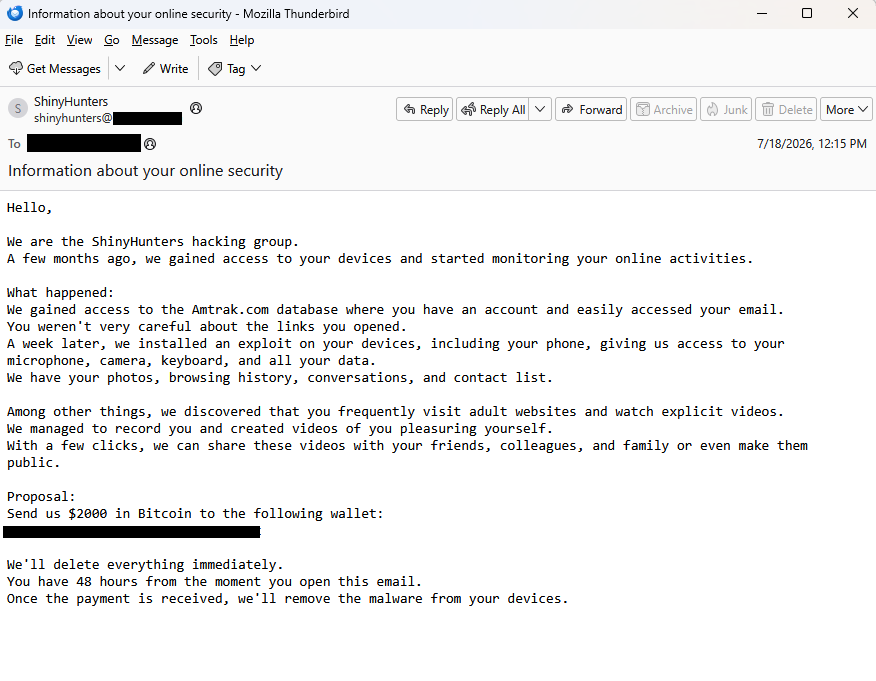
BleepingComputer reports that ShinyHunters data leaks are fueling a $2,000 sextortion email scam and shared the following example:

Example sextortion email from ShinyHunters

“Subject: Information about your online security

Hello,

We are the ShinyHunters hacking group.
A few months ago, we gained access to your devices and started monitoring your online activities.

What happened:
We gained access to the Amtrak.com database where you have an account and easily accessed your email.
You weren’t very careful about the links you opened.
A week later, we installed an exploit on your devices, including your phone, giving us access to your microphone,
camera, keyboard, and all your data.
We have your photos, browsing history, conversations, and contact list.

Among other things, we discovered that you frequently visit adult websites and watch explicit videos.
We managed to record you and created videos of you pleasuring yourself.
With a few clicks, we can share these videos with your friends,
colleagues, and family or even make them public.

Proposal:
Send us $2000 in Bitcoin to the following wallet:
xxxxxxxxxxxxxxxxxxxxxxxxxxxxxxxxx

We’ll delete everything immediately.
You have 48 hours from the moment you open this email.
Once the payment is received, we’ll remove the malware from your devices.”

BleepingComputer states it has seen data from the Amtrak, Hallmark, ADT, Substack, Betterment, CarGurus, Panera Bread, and McGraw Hill breaches used to target victims in this sextortion email campaign.

A California community college also issued a warning after seeing the campaign target people affected by the Canvas data breach.


Digital Footprint Scan

See if your personal data has been exposed.


They confirmed that the targeted email addresses had previously appeared in data leaked by ShinyHunters. They also contacted the group, which denied being behind the sextortion emails.

The increase to a $2,000 demand may suggest the scammers paid someone for the email lists. Although it’s more likely they simply downloaded the leaked data after ShinyHunters published it following failed extortion attempts.

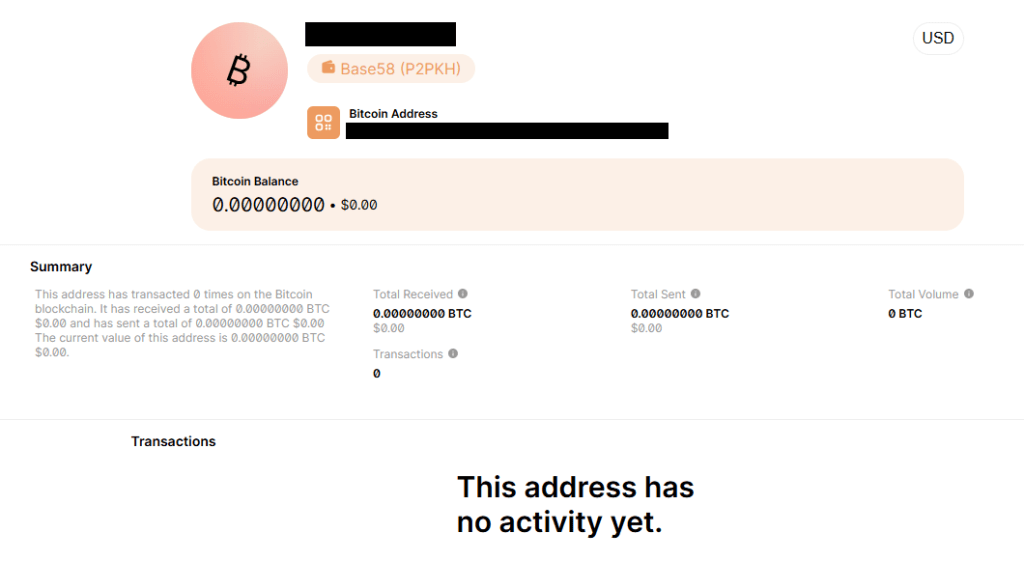
A quick check of the Bitcoin address used in the email shows no activity.

blockchain report of scammer's Bitcoin address
No activity on their Bitcoin address

Let’s keep it that way. With any luck, these dungeon dwellers will eventually give up trying to scare people out of their hard-earned money.

How to react to sextortion emails

Some sextortion emails are badly written, but many have been polished by AI and look convincing. Regardless of how professional they look, they should be treated the same way: as unsubstantiated threats designed to scare victims into paying.

  • First and foremost, never reply to emails of this kind. Responding confirms that someone is actively reading messages sent to that address and may encourage further scam attempts.
  • Don’t let yourself be rushed into action. Scammers rely on the fact that you will not take the time to think this through and subsequently make mistakes. Ask for advice if you’re not sure.
  • An attachment is not proof. Most sextortion emails contain no evidence at all, and attachments are often used to deliver malware or make the threats appear more convincing.
  • If the email includes a password you’ve used before, change it immediately anywhere it’s still in use. Then enable two-factor authentication (2FA) wherever possible. If you’re having trouble keeping track of your passwords, consider using a password manager.
  • Delete the message, report it as spam, and move on.

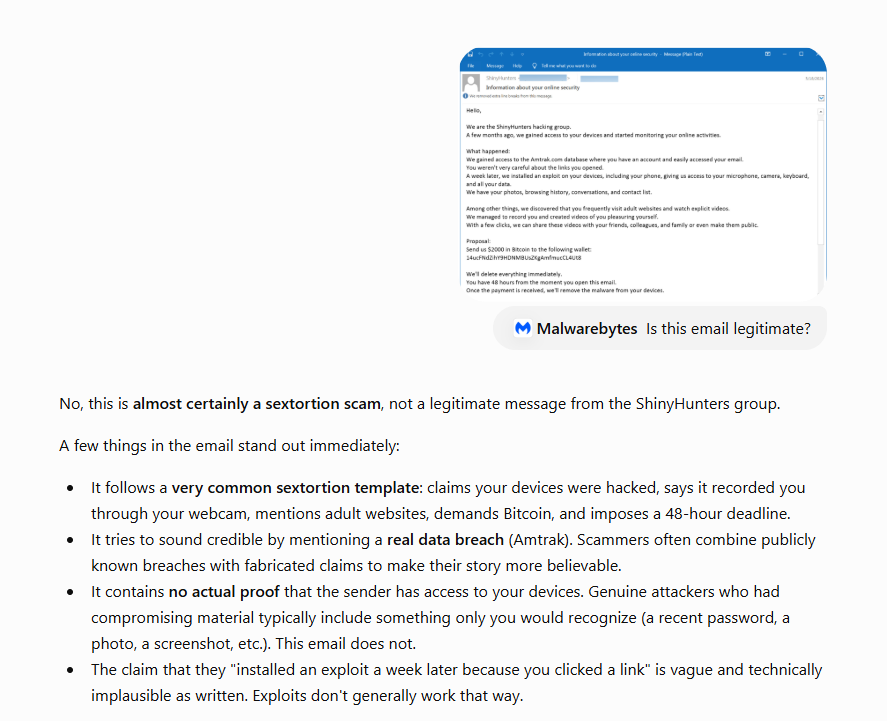
Pro tip: Malwarebytes Scam Guard recognized this email for what it is: sextortion. It can recognize scams and advise you how to proceed.

Scam Guard recognizes this email as a sextortion scam

While these sextortion emails are almost always bluffs, if you’re concerned about webcam spying, Malwarebytes Webcam Monitoring can alert you when applications attempt to access your camera.


Scam or legit? Scam Guard knows.


  •  

What’s your data worth on the dark web? (Lock and Code S07E15)

This week on the Lock and Code podcast…

Twenty years ago, a British mathematician named Clive Humby popularized a phrase that came to describe data’s relationship with the entire global economy: “Data is the new oil.”

Pithy as the phrase sounds, it is undeniably true.

Data steers decisions at businesses of every size. Data created entirely new industries built around its capture. And, for a select number of companies, data has produced billions—if not trillions—of dollars in value.

So how is it that, on the dark web, your stolen identity can be purchased for just 95 cents?

That’s what a Malwarebytes researcher found last month after spending 48 hours inside the dark web to investigate cybercrime. Across a variety of forums and directories, he found subscription plans for malware that steals information once implanted on a device. He found guides for deploying social engineering scams. He found people selling their services to build fake websites that trick people into handing over their usernames and passwords. And he found one of the dark web’s most traded commodities—personal data, packaged together about individual people, to help a cybercriminal commit identity fraud.

These packages are called “fullz.” For victims in the United States, a fullz contains a full name, Social Security Number, date of birth, address, and other personal details. That is enough, on its own, for a cybercriminal to potentially open a bogus line of credit, file a fake tax return, access financial accounts, or obtain medical services under someone else’s name.

As we wrote on Malwarebytes Labs:

“For less than the cost of a cup of coffee, a cybercriminal can buy enough information to devastate someone’s financial life.”

It’s the kind of risk that could scare anyone, especially considering the scale behind it. In just the first six months of 2026, Malwarebytes found more than 7,500 compromised data sets on the dark web containing more than 8.4 billion records.

And yet, even today, cybersecurity professionals still get asked why anyone should bother protecting their data.

The public, understandably, are exhausted. With data breaches happening every week—if not every day—cybersecurity can start to feel pointless. With young people unable to build financial security, they start believing that they have nothing worth stealing. And with Big Tech already collecting our every movement, behavior, click, and concern, people understandably feel powerless to fight any kind of data abuse, be it corporate or criminal.

So today’s episode approaches the question from a different direction. This isn’t about why you should protect yourself—plenty of company websites will tell you that, and most of them rely on fear. This is about why hackers want your data in the first place.

Today, on the Lock and Code podcast, host David Ruiz explains how cybercriminals turn a single repeated password into account takeover, how a screenshot of your house from Google Maps became a tool in extortion emails, and why the most benign information about you—an address, an age, one public photo—is often the most useful data a stranger can buy.

Tune in today to listen to the full episode.

Show notes and credits:

Intro Music: “Spellbound” by Kevin MacLeod (incompetech.com)
Licensed under Creative Commons: By Attribution 4.0 License
http://creativecommons.org/licenses/by/4.0/
Outro Music: “Good God” by Wowa (unminus.com)


Listen up—Malwarebytes doesn’t just talk cybersecurity, we provide it.

Protect yourself from online attacks that threaten your identity, your files, your system, and your financial well-being with our exclusive offer for Malwarebytes Premium for Lock and Code listeners.

  •  

Pornhub tells users to expect sextortion emails after data exposure

After a recent data breach that affected Pornhub Premium members, Pornhub has updated its online statement to warn users about potential direct contact from cybercriminals.

“We are aware that the individuals responsible for this incident have threatened to contact impacted Pornhub Premium users directly. You may therefore receive emails claiming they have your personal information. As a reminder, we will never ask for your password or payment information by email.”

Pornhub is one of the world’s most visited adult video-sharing websites, allowing users to view content anonymously or create accounts to upload and interact with videos.

Pornhub has reported that on November 8, 2025, a security breach at third-party analytics provider Mixpanel exposed “a limited set of analytics events for certain users.” Pornhub stressed that this was not a breach of Pornhub’s own systems, and said that passwords, payment details, and financial information were not exposed.

Mixpanel confirmed it experienced a security incident on November 8, 2025, but disputes that the Pornhub data originated from that breach. The company stated there is:

 “No indication that this data was stolen from Mixpanel during our November 2025 security incident or otherwise.”

Regardless of the source, cybercriminals commonly attempt to monetize stolen user data through direct extortion. At the moment, it is unclear how many users are affected, although available information suggests that only Premium members had their data exposed.

In October, we reported that one in six mobile users are targeted by sextortion scams. Sextortion is a form of online blackmail where criminals threaten to share a person’s private, nude, or sexually explicit images or videos unless the victim complies with their demands—often for more sexual content, sexual favors, or money.

Having your email address included in a dataset of known Pornhub users makes you a likely target for this type of blackmail.

How to stay safe from sextortion

Unless you used a dedicated throwaway email address to sign up for Pornhub Premium, you should be prepared to receive a sextortion-type email. If one arrives:

  • Any message referencing your Pornhub use, searches, or payment should be treated as an attempt to exploit breached or previously leaked data.
  • Never provide passwords or payment information by email. Pornhub has stated it will not ask for these.
  • Do not respond to blackmail emails. Ignore demands, do not pay, and do not reply—responding confirms your address is actively monitored.
  • Save extortion emails, including headers, content, timestamps, and attachments, but do not open links or files. This information can support reports to your email provider, local law enforcement, or cybercrime units.
  • Change your Pornhub password (if your account is still active) and ensure it’s unique and not reused anywhere else.
  • Turn on multi-factor authentication (MFA) for your primary email account and any accounts that could be used for account recovery or identity verification.
  • Review your bank and card statements for unfamiliar charges and report any suspicious transactions at once.
  • If you used a real-name email address for Pornhub, consider moving sensitive subscriptions to a separate, pseudonymous email going forward.

Use STOP, our simple scam response framework to help protect against scams. 

  • S—Slow down: Don’t let urgency or pressure push you into action. Take a breath before responding. Legitimate businesses like your bank or credit card don’t push immediate action.  
  • T—Test them: If you answered the phone and are feeling panicked about the situation, likely involving a family member or friend, ask a question only the real person would know—something that can’t be found online. 
  • O—Opt out: If it feels off, hang up or end the conversation. You can always say the connection dropped. 
  • P—Prove it: Confirm the person is who they say they are by reaching out yourself through a trusted number, website or method you have used before. 

Should you have doubts about the legitimacy of any communications, submit them to Malwarebytes Scam Guard. It will help you determine whether it’s a scam and provide advice on how to act.


We don’t just report on threats—we help safeguard your entire digital identity

Cybersecurity risks should never spread beyond a headline. Protect your, and your family’s, personal information by using identity protection.

  •  
❌