Most phishing advice is written for the person staring at a suspicious email. This guide is for the other kind of victim: The website owner whose legitimate site has been quietly turned into the attacker’s weapon.
You didn’t send the message or build the fake login page. You just woke up to a browser warning, a suspended hosting account, or a polite note from someone’s security team asking why your domain is requesting Apple ID credentials.
California lawmakers are fast-tracking A.B. 1709—a sweeping bill that would ban anyone under 16 from using social media and force every user, regardless of age, to submit sensitive personal information before accessing social platforms.
That means that under A.B. 1709, social media companies will have to enact age gates to prohibit minors from accessing their services. The services may decide that complying with this bill means that Californians have to submit highly sensitive government-issued ID or biometric information to prove they are adults. In the name of “safety,” this bill would destroy online anonymity, expose sensitive personal data to breach and abuse, and replace parental decision-making with state-mandated censorship.
A.B. 1709 has already passed out of the Assembly Privacy and Judiciary Committees with nearly unanimous support. Its next stop is the Assembly Appropriations Committee, followed by a floor vote—likely within the next week.
California Is About to Set a Dangerous Precedent for Online Censorship
By banning access to social media platforms for young people under 16, California is emulating Australia, where early results show exactly what EFF and other critics predicted: overblocking by platforms, leaving youth without support and even adults barred from access; major spikes in VPN use and other workarounds ranging from clever to desperate; and smaller platforms shutting down rather than attempting costly compliance with these sweeping bills.
California should not be racing to replicate those failures. After all, when California leads—especially on tech—other states follow. There is no reason for California to lead the nation into an unconstitutional social media ban that destroys privacy and harms youth.
A.B. 1709 weaponizes legitimate parental concerns by using them to hand over even more censorship and surveillance power to the government. Beneath its shiny “protect the children” rhetoric, this bill is misguided, unconstitutional, and deeply harmful to users of all ages.
A.B. 1709 Recklessly Violates Free Speech Rights
The First Amendment protects the right to speak and access information, regardless of age. But by imposing a blanket ban on social media access, A.B. 1709 would cut off lawful speech for millions of California teenagers, while also forcing all users (adults and kids alike) to verify their ages before speaking or accessing information on social media. This will immensely and unconstitutionally chill Californians’ exercise of their First Amendment.
These mandates ignore longstanding Supreme Court precedent that protects young people’s speech and consistently find these bans unconstitutional. Banning young people entirely from social media is an extreme measure that doesn’t match the actual risks of online engagement. California simply does not have a valid interest in overriding parents’ and young people’s rights to decide for themselves how to use social media.
After all, age-verification technology is far from perfect. A.B. 1709’s reliance on imperfect age-verification technology will disproportionately silence marginalized communities—those whose IDs don’t match their presentation, those with disabilities, trans and gender non-conforming folks, and people of color—who are most likely to be wrongfully denied access by discriminatory systems.
Finally, many people will simply refuse to give up their anonymity in order to access social media. Our right to anonymity has been a cornerstone of free expression since the founding of this country, and a pillar of online safety since the dawn of the internet. This is for good reason: it allows creativity, innovation, and political thought to flourish, and is essential for those who risk retaliation for their speech or associations. A.B. 1709 threatens to destroy it.
AB 1709 Needlessly Jeopardizes Everyone’s Privacy
A.B. 1709’s age-gating mandate also creates massive security risks by incentivizing platforms to force all of their users to hand over immutable biometric data and government IDs to third-party vendors. By creating centralized "honeypots" of sensitive information, the bill invites identity theft and permanent surveillance rather than actual safety. If we don’t trust tech companies with our private information now, we shouldn't pass a law that mandates we give them even more of it.
We’ve already seen repeateddatabreaches involving age- and identity-verification services. Yet A.B. 1709 would require millions more Californians—including the youth this bill claims to protect—to feed their most sensitive data into this growing surveillance ecosystem.
While framed as a safety measure, this bill serves as a blunt instrument of censorship, severing vital lifelines for California’s young people. Besides being unconstitutional, banning young people from the internet is bad public policy. After all, social media sites are not just sources of entertainment; they provide crucial spaces for young people to explore their identities—whether by creating and sharing art, practicing religion, building community, orengaging in civic life.
Social science indicates that moderate internet use is a net positive for teens’ development, and negative outcomes are usually due to either lack of access or excessive use. Social media provides essential spaces for civic engagement, identity exploration, and community building—particularly for LGBTQ+ and marginalized youth who may lack support in their physical environments. By replacing access to political news and healthresources with state-mandated isolation, A.B. 1709 ignores the calls of young people themselves who favor digital literacy and education over restrictive government control.
Young people have been loud and clear that what they want is access and education—not censorship and control. They even drafted their own digital literacy education bill, A.B. 2071, which is currently before the California legislature! Instead of cutting off vital lifelines, we should support education measures that would arm them (and the adults in their lives) with the knowledge they need to explore online spaces safely.
AB 1709 Is Misguided and Won’t Work
In case you needed more reasons to oppose this bill.
A.B. 1709 Replaces Parenting With Government Control. Families know there is no one-size-fits-all solution to parenting. But AB 1709 imposes one anyway, overriding parental decision-making with a blanket censorship prohibition. Parents who want to actively guide their children’s online experiences should be empowered, not relegated to the sidelines by a blunt state mandate.
A.B. 1709 Strengthens Big Tech Instead of Challenging It. Supporters claim that this bill will rein in the major tech companies, but in fact, steep fines and costly compliance regimes disproportionately harm smaller platforms. Where large corporations can afford to absorb legal risk and shell out for expensive verification systems, smaller forums and emerging platforms cannot. We’ve already seen platforms shut down or geoblock entire states in response to age-gating laws. And when the small platforms shutter, where do all of those users—and their valuable data—go? Straight back to the biggest companies.
A.B. 1709 Creates Expensive and Shady Bureaucracy During a Budget Crisis. California is facing a massive deficit, but A.B. 1709 would waste taxpayer dollars to fund a shadowy new "e-Safety Advisory Commission" to enforce this ban and dream up new ways to censor the internet. In addition, lawmakers in support of A.B. 1709 have already admitted that this bill is likely to follow the same path as other recent "child safety" laws that were struck down or blocked in court for First Amendment and privacy reasons. With A.B. 1709, taxpayers are being asked to hand over a blank check for millions in legal fees to defend a law that is unconstitutional on its face.
Californians: Act Now to Kill This Bill
A.B. 1709 is not an inevitability, as some supporters want you to believe. But we need to act now to support our youth and their right to participate in online public life.
Your representatives could vote on A.B. 1709 as soon as next week. If you’re a Californian, email your legislators now and tell them to vote NO on AB 1709.
Clinic students Emily Ko and Zoe Lee at the Technology Law and Policy Clinic at the NYU School of Law were the principal authors of this post.
Courts are not private forums for business disputes. They are public institutions, and their records belong to the public. But too often, courts forget that and allow for massive over-sealing, especially in patent cases.
EFF recently discovered another case of this in the Eastern District of Texas, where key court filings about Wi-Fi technology used by billions of people every day were hidden entirely from public view. The public could not see the parties’ arguments about patent ownership, the plaintiff’s standing in court, or licensing obligations tied to standardized technologies.
EFF Seeks to Uncover Sealed Information in Wilus
The case Wilus Institute of Standards and Technology Inc. v. HP Inc., highlights a recurring transparency problem in patent litigation.
Wilus claims to own standard essential patents (SEPs) related to Wi-Fi 6 — technology embedded in everyday devices. Wilussued Samsung and HP for patent infringement. HP argued that Wilus failed to offer licenses on Fair, Reasonable, and Non-Discriminatory (FRAND) terms, which are required to prevent SEP holders from exploiting their position, by blocking fair access to widely used technologies.
In reviewing the docket, EFF found that many filings were improperly sealed under a lenient protective order without the required, specific justification needed in a proper motion to seal. Because there is a presumption of public access to court filings, litigants must file a motion to seal and demonstrate compelling reasons for secrecy. This typically requires a document-by-document and line-by-line justification.
In the Eastern District of Texas, that standard is often not enforced. Instead, district judges allow litigants to hide information using boilerplate justification in a protective order without explaining why specific documents or specific parts in a document should be hidden.
In Wilus, two sets of documents stood out.
First, Samsung moved to dismiss the case, arguing Wilus may not have validly obtained the patents — raising doubts about whether they had standing to sue at all. Wilus’s opposition to that motion was filed completely under seal, with no redacted public version available at all. That briefing likely addresses the patent assignment agreements that underpin Wilus’s business model — information the public has an interest in, especially in cases involving non-practicing entities (NPEs) like Wilus.
Second, filings related to HP’s supplemental briefing on FRAND obligations were also sealed in full, with no redacted versions available to the public. Whether Wilus is bound by FRAND has implications far beyond this case. Companies subject to FRAND must adhere to reasonable licensing terms, while those that are not can charge significantly higher licensing fees.
In both instances, the public was shut out of arguments that bear directly on how essential technologies are licensed and controlled.
EFF Pushes For Public Access
EFF raised these concerns with Wilus’s counsel and pressed for public access to the sealed records. Wilus ultimately agreed to file redacted versions of several documents now available as Document Numbers 387, 388, and 389.
That result is progress, but it shouldn’t require outside intervention. Public versions of court filings should be the default, not something negotiated after outside pressure.
Even now, these newly filed redacted versions conceal significant portions of the parties’ arguments. The public still cannot fully see how this case about technologies that are used every day is being litigated.
Why Public Access Matters
Sealing court records is designed to be rare. To overcome the presumption of public access, litigants must show compelling reasons for secrecy. That’s because open courts are a distinguishing feature of American democracy. The public, journalists, and policymakers all have the right to observe proceedings and hold both government actors and private litigants accountable.
Some filings do contain trade secrets or commercially sensitive information. But that doesn’t mean litigants should be able to hide information without explaining why. The Eastern District of Texas allows litigants to bypass the requirement to explain why.
EFF confronted this very same issue in its attempt to intervene in another Eastern District of Texas case, Entropic v. Charter. The same pattern appeared again in Wilus: instead of narrowly tailored redactions supported by specific reasoning, filings were withheld wholesale.
Courts Must Enforce the Standard
Courts, not third parties, are responsible for protecting the public’s right of access.
That means enforcing the “compelling reasons” standard, as a matter of course. Parties seeking to seal sensitive information should be required to justify each proposed redaction. The Eastern District of Texas’ current approach falls short. By allowing broad, unsupported sealing through expansive protective orders, it effectively treats judicial records as confidential by default.
Heavy caseloads don’t change the rule. Administrative burden cannot override constitutional and common law rights. Judicial records are presumptively public. Courts, including the Eastern District of Texas, should enforce that presumption.
Other Federal Courts Get It Right
The Eastern District of Texas is an outlier. In the Northern District of California, judges routinely reject overbroad sealing requests. As Judge Chhabria’s Civil Standing Order explains:
[M]otions to seal . . . are almost always without merit. . . . Federal courts are paid for by the public, and the public has the right to inspect court records, subject only to narrow exceptions.
The filing party must make a specific showing explaining why each document that it seeks to seal may justifiably be sealed . . . Generic and vague references to “competitive harm” are almost always insufficient justification for sealing.
This approach reflects the law: sealing must be narrowly tailored and specifically justified.
Court Transparency is Fundamental
At first glance, secrecy in patent litigation may not seem alarming. But it signals a broader erosion of transparency. The widespread use of expansive protective orders in the Eastern District of Texas is a practice that risks spreading if courts do not enforce the law.
These practices allow private parties to obscure information about disputes involving technologies that shape modern life. That undermines a core principle of a free society: transparency regarding the actions of powerful actors.
Courts are not private forums for business disputes. They are public institutions, and their records belong to the public.
So long as these practices continue, EFF will keep advocating for transparency and working to vindicate the public’s right to access court records.
Scientists have finally cracked a long-standing mystery about squid and cuttlefish evolution by analyzing newly sequenced genomes alongside global datasets. The research reveals that these bizarre, intelligent creatures likely originated deep in the ocean over 100 million years ago, surviving mass extinction events by retreating into oxygen-rich deep-sea refuges. For millions of years, their evolution barely changed—until a dramatic post-extinction boom sparked rapid diversification as they moved into new shallow-water habitats.
As usual, you can also use this squid post to talk about the security stories in the news that I haven’t covered.
Customs and Border Protection (CBP) is seeking permission from the California city of San Clemente to install an Anduril Industries surveillance tower on a cliff that would allow for constant monitoring of entire coastal neighborhoods.
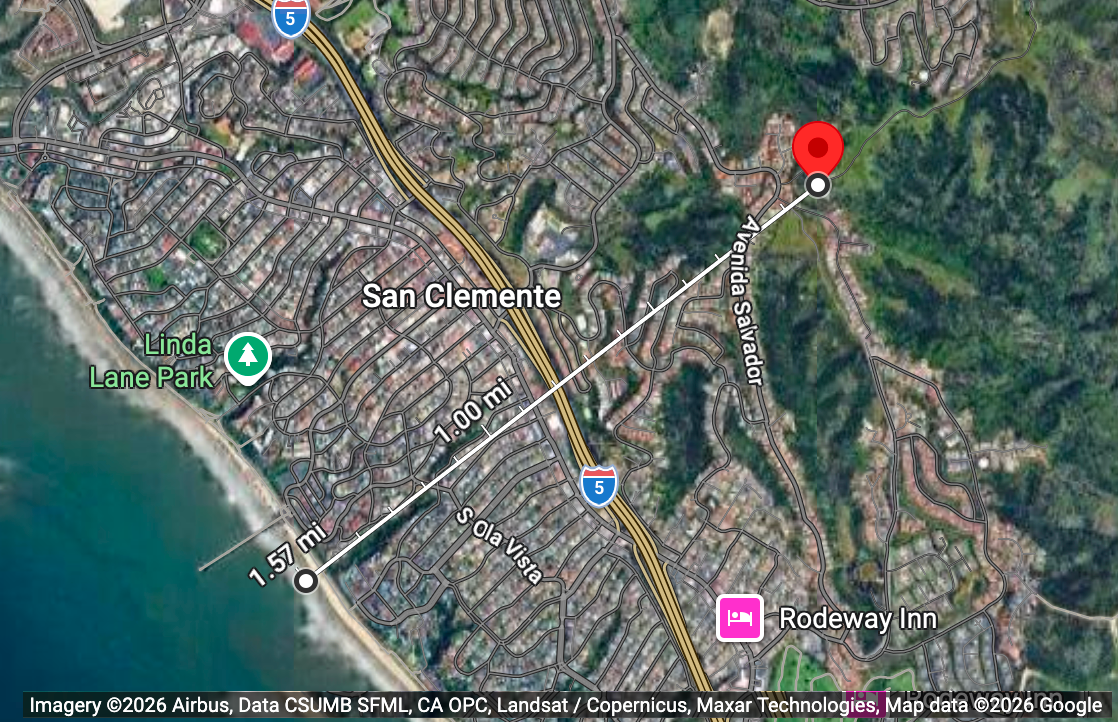
The proposed tower is Anduril's Sentry, part of the Autonomous Surveillance Tower (AST) program. While CBP says it will primarily monitor the coastline for boats carrying migrants, it will actually be installed 1.5 miles inland, overlooking the bulk of the 62,000-resident city. By CBP's own public statement, the system–which combines video, radar, and computer vision–is "constantly scanning" for movement and identifying and tracking objects an AI algorithm decides are of interest. Depending on the model–the photos provided by CBP indicate it is a long range maritime model–the camera could see as far as nine miles, which would cover the entire city and potentially see as far as neighboring Dana Point.
"The AST utilize advanced computer vision algorithms to autonomously detect, identify, and track items of interest (IoI) as they transit through the towers field of view," CBP writes in a privacy threshold analysis. "The system can determine if an IoI is a human, animal, or vehicle without operator intervention. The system then generates and transmits an alert to operators with the location and images of the IoI for adjudication and response."
On April 28, local residents and Oakland Privacy, a privacy- and anti-surveillance-focused citizens’ coalition, are holding a town hall to inform the public about the dangers of this technology. We urge people to attend to better understand what's at stake.
"The planned deployment of an Anduril tower along a heavily used Orange County coastline 75 miles from the border demonstrates that the militarization of the border region is rapidly moving northwards and across the entire state," writes Oakland Privacy.
City officials raised concerns about resident privacy and proposed that a lease agreement include a prohibition on surveilling neighborhoods. CBP rejected that proposal, instead saying that they would configure the tower to "avoid" scanning residential neighborhoods, but the system would remain capable of tracking human beings in residential areas. According to the staff report:
In response to privacy concerns, CBP has stated the system would be configured to avoid scanning residential areas that fall into the scan viewshed, focusing the system on the marine environment. CBP has maintained the purpose of the system is specifically maritime surveillance, and the system would be singularly focused on offshore activities. However, there may be an instance in which there is an active smuggling event, detected by the system at sea, in which the subsequent smuggling event traverses through the residential neighborhoods. In such a case, the system may continue to track and monitor. To restrict this functionality would be contrary to the spirit and intent of the deployment. Therefore, they cannot make such a contractual obligation.
The Anduril towers retain a variety of data, including images and more.
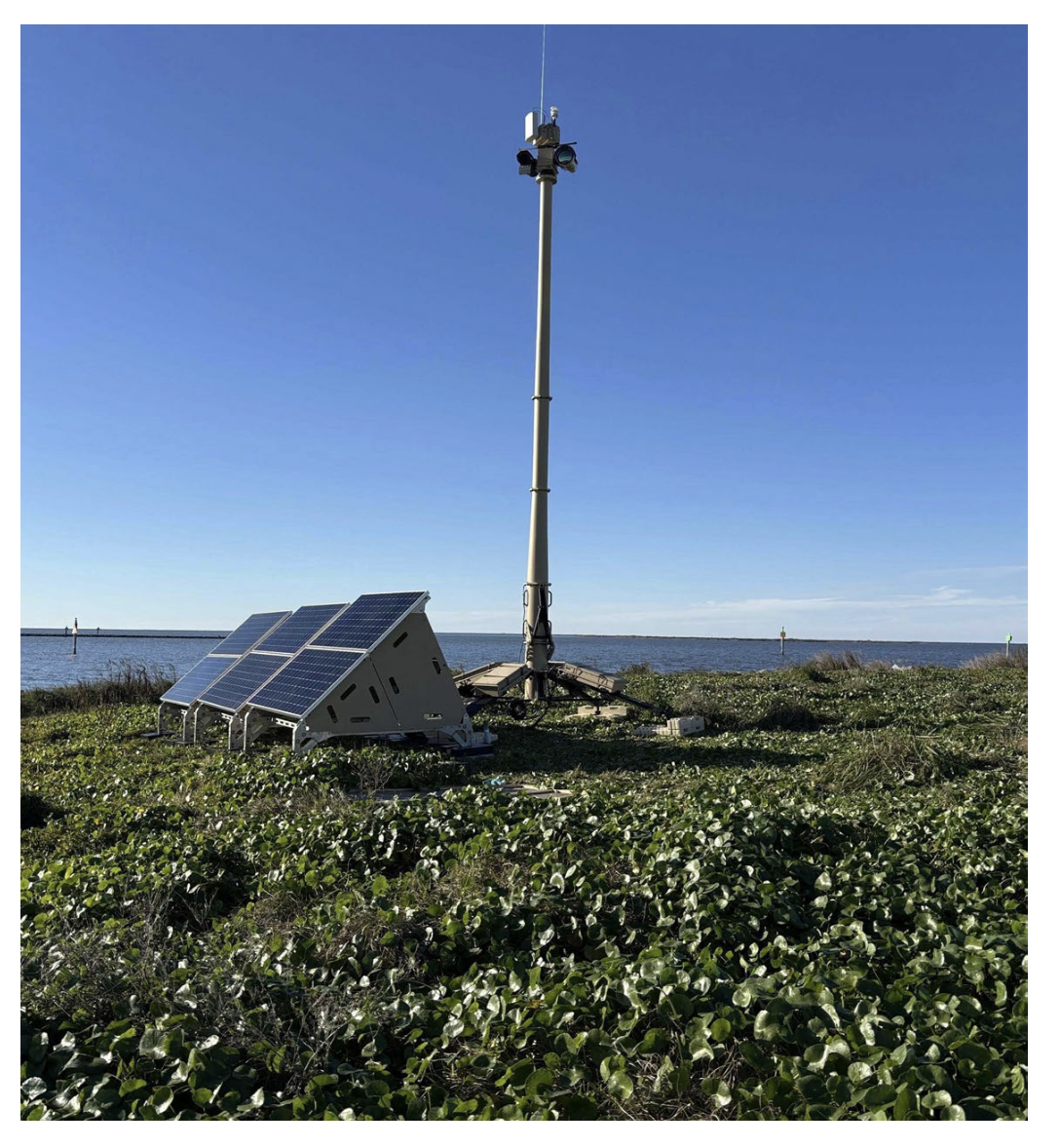
The proposed Anduril surveillance tower. Source: City of San Clemente
"The AST capture and retain imagery which occurs in plan view of the tower sites and is stored as an individual event with a unique event identified allowing replay of the event for further investigation or dismissal based on activity occurring," according to the private threshold analysis.
The document indicates a potential 30-day retention period for imagery, but then contradicts itself to say that data will be held indefinitely to train algorithms: "AST will also be maintaining learning training data, these records should not be deleted." This means that taxpayers would be paying for the privilege of having their data turned into fuel for Anduril's product.
In 2020 CBP said it would work with National Archives and Records Administration (NARA) to develop a retention schedule for training data (i.e., a timeline for deletion). However, when EFF filed a Freedom of Information Act (FOIA) with NARA, the agency said there were no records of these discussions. Likewise, CBP has not provided records in response to the FOIA request EFF filed with them seeking the same records.
Anduril Maritime Sentry in San Diego, where the border fence meets the ocean.
This would not be the first CBP tower placed along the coastline in California. EFF identified one in Del Mar, about 30 miles from the border, and another in San Diego County where the border fence meets the Pacific Ocean. CBP has also applied to place towers–although not necessarily the Anduril model–in or near several other coastal locations: Gaviota State Park, Refugio State Park, Vandenberg Air Force Base, Piedras Blancas and Point Vicente. The California coastline isn’t the only coastline dotted with surveillance towers. The Migrant Rights Network has also documented numerous Anduril towers along the southeast coast of England. Where the San Clemente tower would differ is that there is a substantial population between the tower and the beach, and because it's a 360-degree system, it can watch neighborhoods even further from the coast.
However, this won't be the first time an Anduril tower has been placed next to a community. EFF has documented numerous Anduril towers in public parks along the Rio Grande in Laredo and Roma, Texas. In Mission, Texas, an Anduril tower was placed outside an RV park: the tower could not even see the border without capturing data from the community. Because AI can swivel the cameras 360 degrees, two churches were within the "viewshed" of that tower.
Click here to view EFF's ongoing map of CBP surveillance towers.
Many border surveillance towers are placed on city or county property, requiring a lease to be approved by the local governing body–as is the case with San Clemente. In 2024, EFF and Imperial Valley Equity and Justice organized an effort to fight the renewal of a Border Patrol's lease for a tower next to a public park. The coalition lost narrowly after a recall election ousted two officials who were critical of the lease.
CBP is rapidly increasing the number of towers at the border and beyond, recently announcing the potential to install 1,500 more towers in the next few years–more than tripling what we've documented so far–at a cost of more than $400 million to the public for maintenance alone. This is despite more than 20 years of government reports that have documented how tower-based systems are ineffective and wasteful.
Other noteworthy stories that might have slipped under the radar: Supreme Court hacker sentenced, Lovable exposed user data, Google expands enterprise security.
Dutch journalist Just Vervaart, working for regional media network Omroep Gelderland, followed the directions posted on the Dutch government website and mailed a postcard with a hidden tracker inside. Because of this, they were able to track the ship for about a day, watching it sail from Heraklion, Crete, before it turned towards Cyprus. While it only showed the location of that one vessel, knowing that it was part of a carrier strike group sailing in the Mediterranean could potentially put the entire fleet at risk.
[…]
Navy officials reported that the tracker was discovered within 24 hours of the ship’s arrival, during mail sorting, and was eventually disabled. Because of this incident, the Dutch authorities now ban electronic greeting cards, which, unlike packages, weren’t x-rayed before being brought on the ship.
Windows Interprocess Communication (IPC) is one of the most complex technologies within the Windows operating system. At the core of this ecosystem is the Remote Procedure Call (RPC) mechanism, which can function as a standalone communication channel or as the underlying transport layer for more advanced interprocess communication technologies. Because of its complexity and widespread use, RPC has historically been a rich source of security issues. Over the years, researchers have identified numerous vulnerabilities in services that rely on RPC, ranging from local privilege escalation to full remote code execution.
In this research, I present a new vulnerability in the RPC architecture that enables a novel local privilege escalation technique likely in all Windows versions. This technique enables processes with impersonation privileges to elevate their permissions to SYSTEM level. Although this vulnerability differs fundamentally from the “Potato” exploit family, Microsoft has not issued a patch despite proper disclosure.
I will demonstrate five different exploitation paths that show how privileges can be escalated from various local or network service contexts to SYSTEM or high-privileged users. Some techniques rely on coercion, some require user interaction and some take advantage of background services. As this issue stems from an architectural weakness, the number of potential attack vectors is effectively unlimited; any new process or service that depends on RPC could introduce another possible escalation path. For this reason, I also outline a methodology for identifying such opportunities.
Finally, I examine possible detection strategies, as well as defensive approaches that can help mitigate such attacks.
MSRPC
Microsoft RPC (Remote Procedure Call) is a Windows technology that enables communication between two processes. It enables one process to invoke functions that are implemented in another process, even though they are running in different execution contexts.
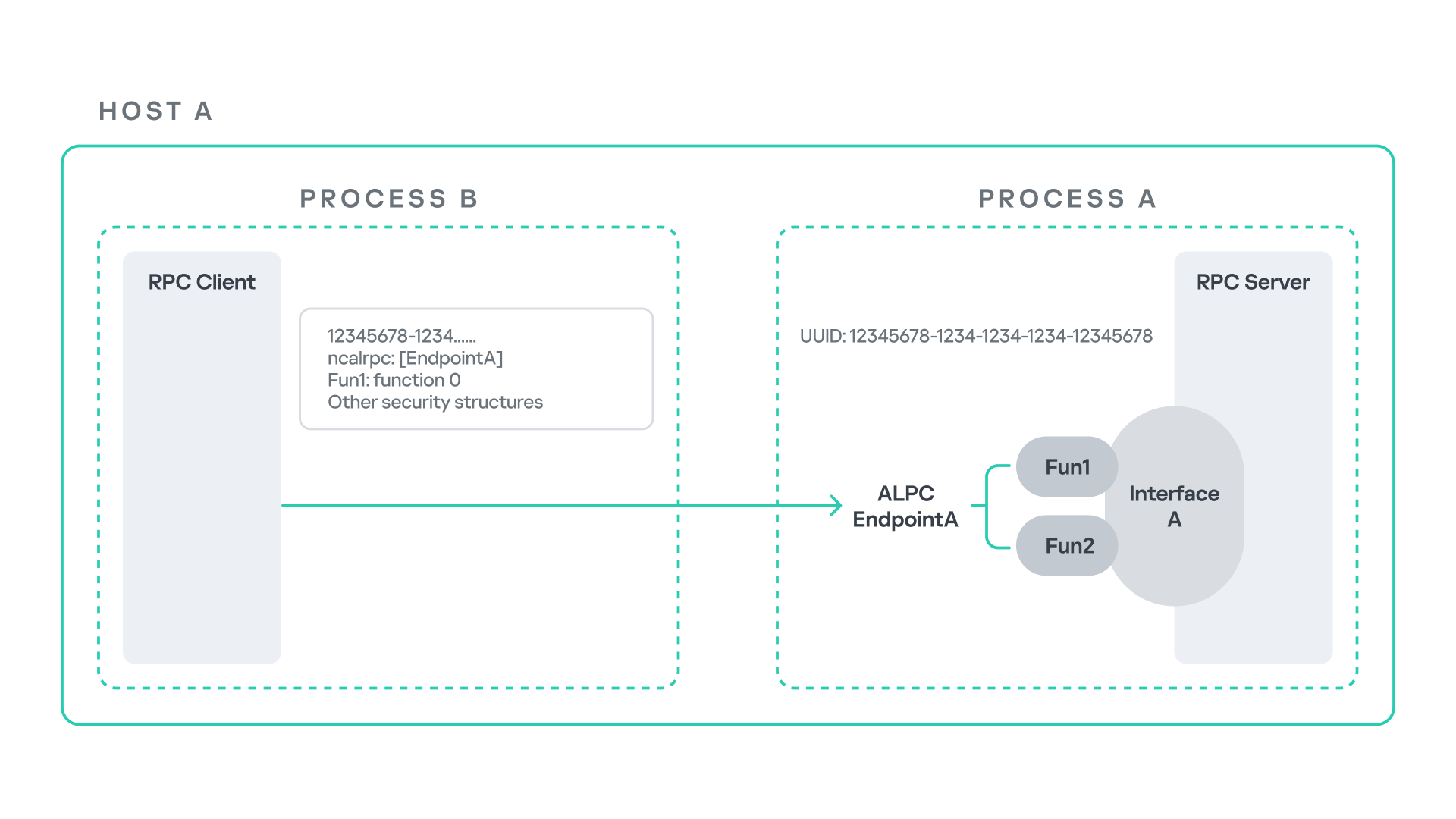
The figure below illustrates this mechanism.
Let us assume that Host A is running two processes: Process A and Process B. Process B needs to execute a function that resides inside Process A. To enable this type of interaction, Windows provides the Remote Procedure Call (RPC) architecture, which follows a client–server model. In this model, Process A acts as the RPC server, exposing its functionality through an interface, in our example, Interface A. Each RPC interface is uniquely identified by a Universally Unique Identifier (UUID), which is represented as a 128-bit value. This identifier enables the operating system to distinguish one interface from another.
The interface defines a set of functions that can be invoked remotely by the RPC client implemented in Process B. In our example, the interface exposes two functions: Fun1 and Fun2.
To communicate with the server, the RPC client must establish a connection through a communication endpoint. An endpoint represents the access point that enables transport between the client and the server. Because RPC supports multiple transport mechanisms, different endpoint types may exist, depending on the underlying transport.
For example:
When TCP is used as the transport layer, the endpoint is a TCP port.
When SMB is used, communication occurs through a named pipe.
When ALPC is used, the endpoint is an ALPC port.
Each transport mechanism is associated with a specific RPC protocol sequence. For instance:
ncacn_ip_tcp is used for RPC over TCP.
ncacn_np is used for RPC over named pipes.
ncalrpc is used for RPC over ALPC.
In this research, I focus specifically on Advanced Local Procedure Call (ALPC) as the RPC transport mechanism. ALPC is a Windows interprocess communication mechanism that predates MSRPC. Today, RPC can leverage ALPC as an efficient transport layer for communication between processes located on the same machine.
For simplicity, an ALPC port can be thought of as a communication channel similar to a file, where processes can send messages by writing to it, and receive messages by reading from it.
When the client wants to invoke a remote function, for example, Fun1, it must construct an RPC request. This request includes several important pieces of information, such as the interface UUID, the protocol sequence, the endpoint, and the function identifier. In RPC, functions are not referenced by name, but by a numerical identifier called the operation number (OPNUM). Depending on the requirements of the call, the request may also contain additional structures, such as security-related information.
Impersonation in Windows
In Windows, impersonation enables a service to temporarily operate using another user’s security context. For example, a service may need to open a file that belongs to a user while performing a specific operation. By impersonating the calling user, the system allows the service to access that file, even if the service itself would not normally have permission to do so. You can read more about impersonation in James Forshaw’s book Windows Security Internals.
This research focuses specifically on RPC impersonation. Instead of describing the interaction as a service and a user, I refer to the participants as a client and a server. In this model, the RPC server may temporarily adopt the identity of the client that initiated the request.
To perform this operation, the RPC server can call the RpcImpersonateClient API, which causes the server thread to execute under the client’s security context.
However, in some situations, a client may not want the server to be able to impersonate its identity. To control this behavior, Windows introduces the concept of an impersonation level. This defines how much authority the client grants the server to act on its behalf.
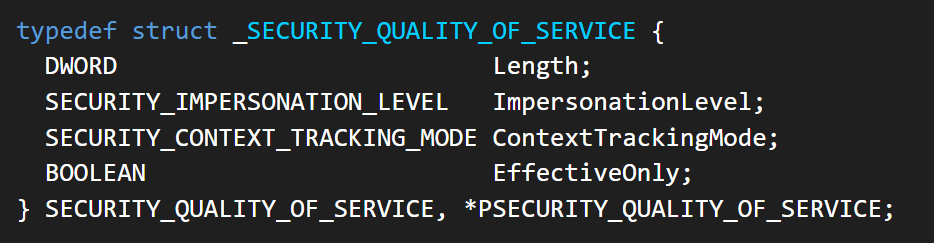
These settings are defined as part of the Security Quality of Service (SQOS) parameters, specified using the SECURITY_QUALITY_OF_SERVICE structure.
As you can see, this structure contains the impersonation level field, which determines the extent to which the server can assume the client’s identity.
Impersonation levels range from Anonymous, where the server cannot impersonate the client at all, to Impersonate and Delegate, which allow the server to act fully on behalf of the client.
At the same time, not every server process is allowed to impersonate a client. If any process could perform impersonation freely, it would pose a serious security risk. To prevent this, Windows requires the server process to possess a specific privilege called SeImpersonatePrivilege. Only processes with this privilege can successfully impersonate a client.
This privilege is granted by default to certain service accounts, such as Local Service and Network Service.
Interaction between Group Policy service and TermService
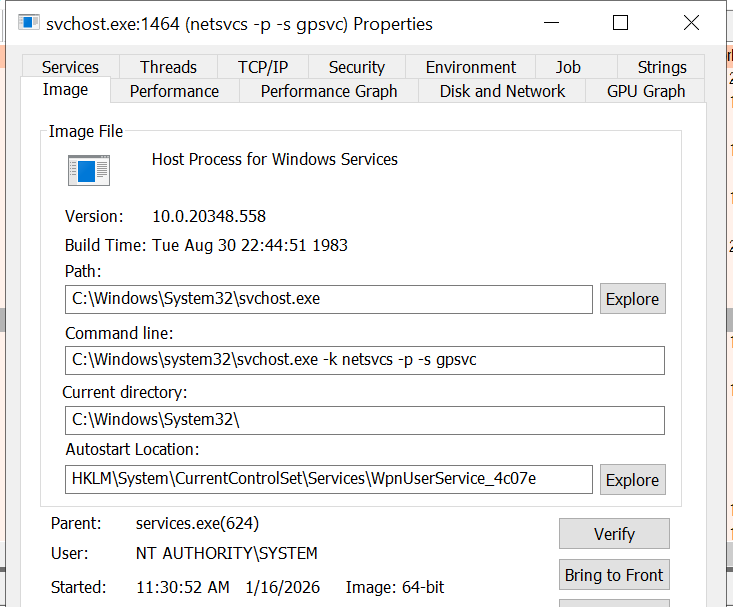
The Group Policy Client service (gpsvc) is a core Windows service responsible for applying and enforcing group policy settings on a system. It runs under the SYSTEM account inside svchost.exe.
When a group policy update is triggered, Windows uses an executable called gpupdate.exe. This tool can be executed with the /force flag to force an immediate refresh of all group policy settings. Internally, this executable communicates with the Group Policy service, which coordinates the update process.
At a certain stage during this operation, the Group Policy service attempts to communicate with TermService (Terminal Service, the Remote Desktop Services service) using RPC.
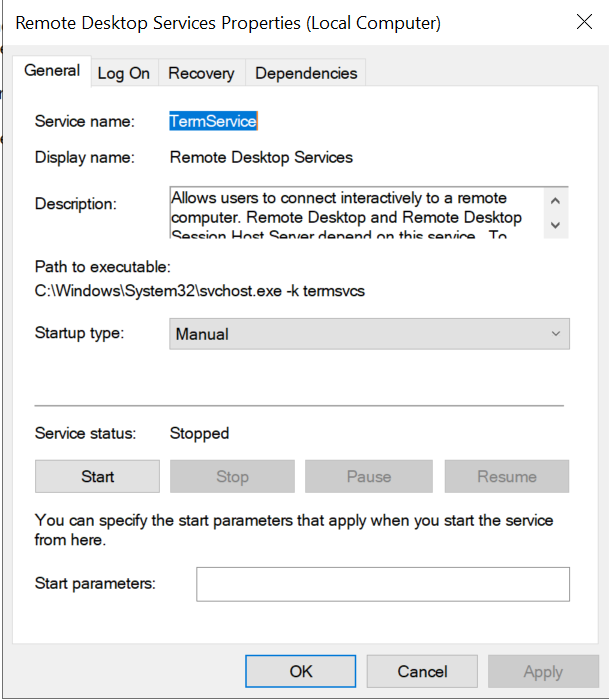
TermService is responsible for providing remote desktop functionality. This service is not running by default and can be enabled manually by the administrator via activation of Remote Desktop access. When this happens, the service exposes an RPC server with multiple interfaces and endpoints. TermService runs under the NT AUTHORITY\Network Service account.
When the command gpupdate /force is executed, the Group Policy service performs an RPC call to the TermService using the following parameters:
UUID: bde95fdf-eee0-45de-9e12-e5a61cd0d4fe.
Endpoint: ncalrpc:[TermSrvApi].
Function: void Proc8(int).
However, because TermService is disabled by default, the RPC call fails and an exception occurs in rpcrt4.dll (the RPC runtime). The returned error is:
0x800706BA (RPC_S_SERVER_UNAVAILABLE, 1722).
This error indicates that the RPC client could not reach the target server.
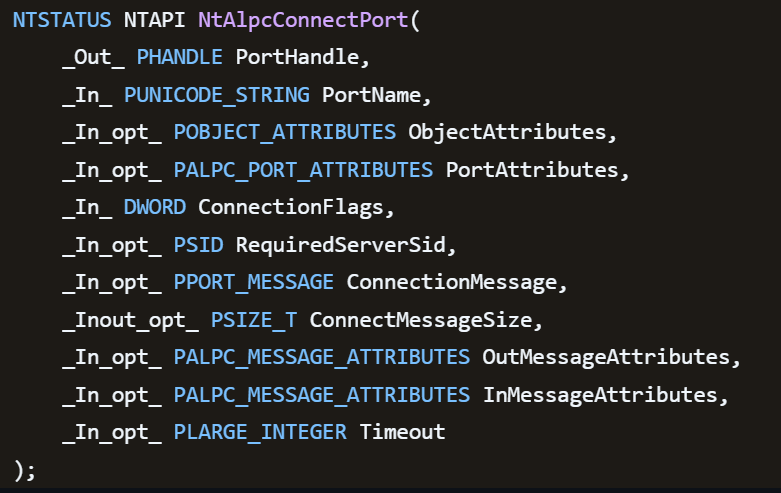
Tracing the failure path further reveals that the root cause originates from a call to NtAlpcConnectPort, which is used by RPC to establish an ALPC connection between processes.
The NtAlpcConnectPort function is responsible for connecting to a specific ALPC port and returning a handle that the client can use for further communication. This function accepts multiple parameters.
The first two parameters include:
A pointer to the returned port handle.
The ALPC port name, represented as an ASCII string.
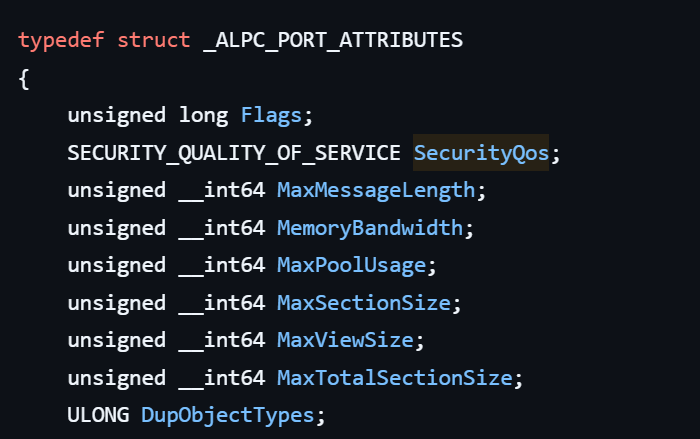
Another important argument is PortAttributes, which is an ALPC_PORT_ATTRIBUTES structure. Inside this structure is the SECURITY_QUALITY_OF_SERVICE structure, which, as mentioned above, defines the impersonation level used for the connection.
The final parameter of interest is RequiredServerSid, which specifies the expected identity of the target server process. This identity is represented using a Security Identifier (SID) structure.
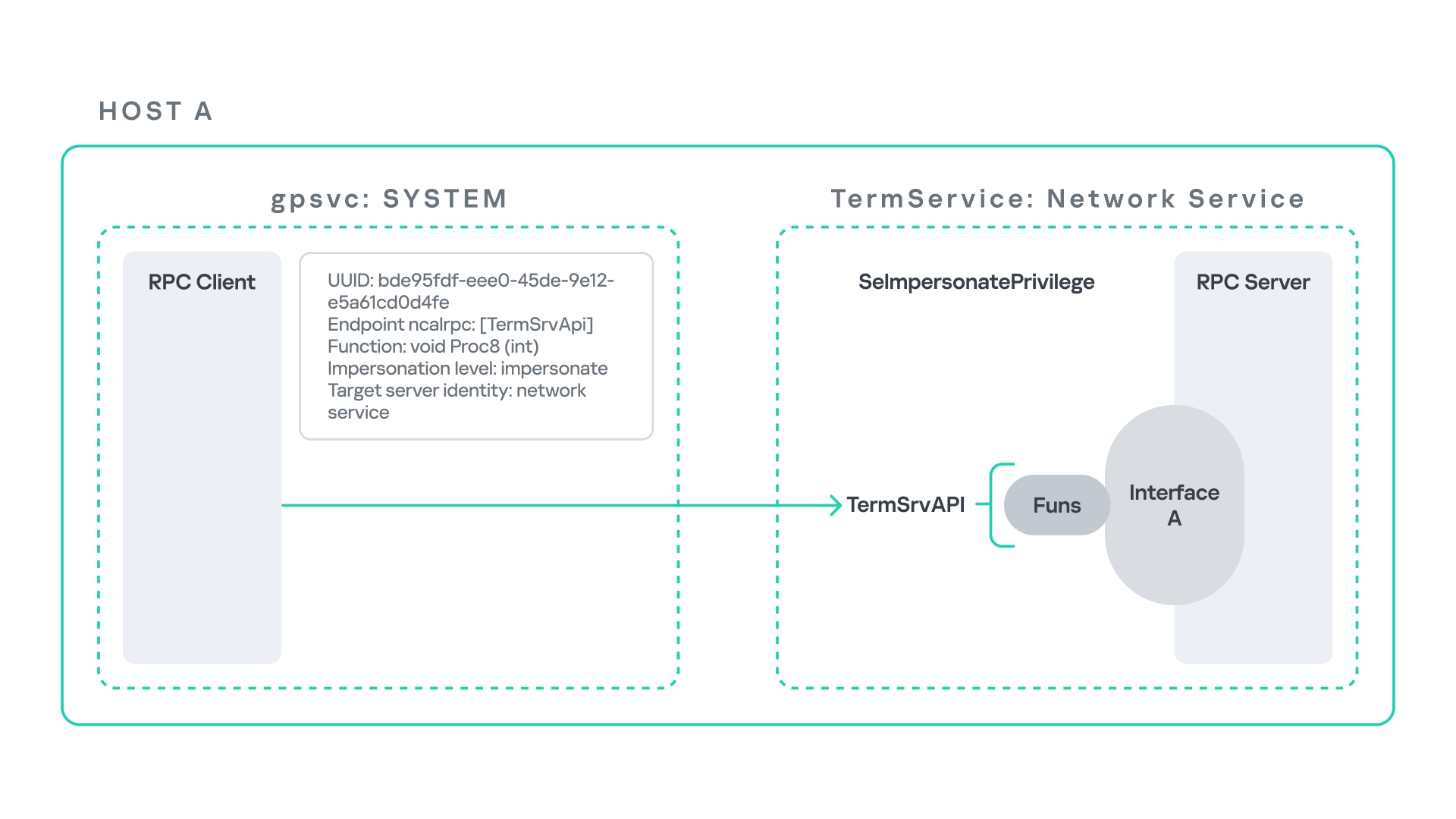
Inspecting this call reveals that the Group Policy service attempts to connect to the RPC server using an impersonation level of Impersonate, expecting the remote server to run under the Network Service account. This behavior makes sense because TermService normally runs under Network Service.
Based on all the information above, the following scheme can be created to illustrate the interaction between TermService and gpsvc.
Up to this point, nothing unusual has occurred. An RPC client attempts to connect to an RPC server that is unavailable, resulting in an exception handled by the RPC runtime.
However, an interesting question arises: What if an attacker compromises a service that runs under the Network Service identity and mimics the exact RPC server exposed by TermService?
Could the attacker deploy a fake RPC server with the same endpoint?
If so, would the RPC runtime allow the client to connect to this illegitimate server?
And if the connection is successful, how could an attacker leverage this behavior?
Coercing the Group Policy service
To better understand the implications of the previously described behavior, let us consider the following attack scenario.
Imagine an attacker has compromised a service running on the system under the Network Service account, for example, an IIS server operating under the Network Service account. With this level of access, the attacker can deploy a malicious RPC server.
The attacker’s RPC server is designed to mimic the RPC interface exposed by the Remote Desktop service (TermService). Specifically, it implements the same RPC interface UUID and exposes the same endpoint name: TermSrvApi. Once deployed, the malicious server listens for RPC requests that would normally be directed to the legitimate RDP service.
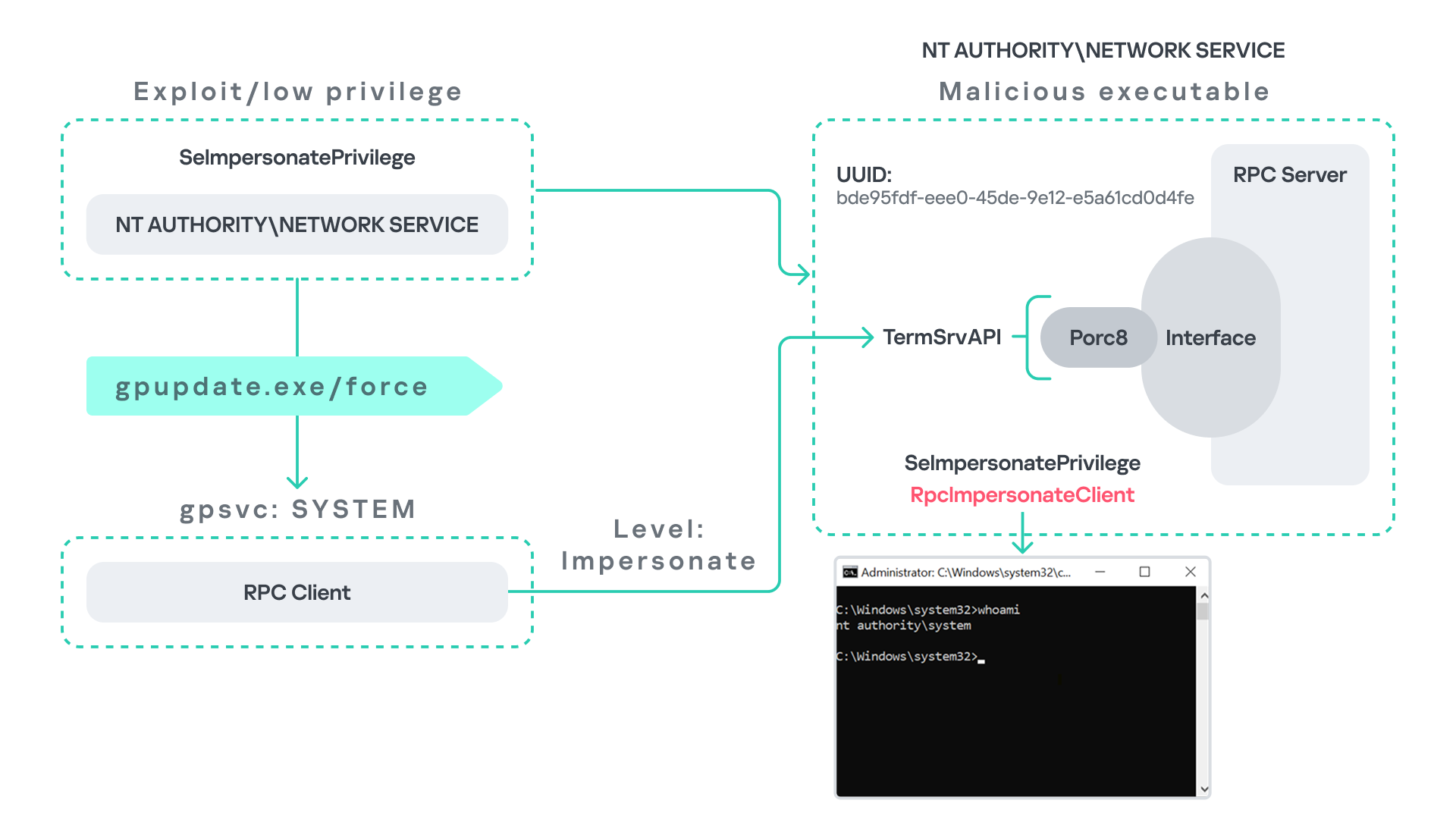
Next, the attacker coerces the Group Policy service by triggering a policy update using gpupdate.exe /force. This causes the Group Policy Client service, which runs under the SYSTEM account, to perform the previously described RPC call. As observed earlier, this RPC call uses a high impersonation level (Impersonate).
When the attacker’s fake RPC server receives the request, it calls RpcImpersonateClient. This enables the server thread to impersonate the security context of the calling client, which, in this case, is SYSTEM.
As a result, the attacker can elevate privileges from Network Service to SYSTEM. In our proof-of-concept implementation, the exploit demonstrates privilege escalation by spawning a SYSTEM-level command prompt.
When this attack scenario was first discussed, it was purely theoretical. However, after implementing the malicious RPC server, the experiment confirmed that Windows allowed the server to be deployed and started successfully, and that the RPC runtime permitted the client to connect to the malicious endpoint. This made it possible to reliably escalate privileges from Network Service to SYSTEM using this technique. For this attack to succeed, though, at least one group policy must be applied on the system.
RPC architecture flow
Further investigation revealed that many Windows services attempt to communicate with TermService using RPC. These RPC calls often originate from winsta.dll, which acts as the RPC client component.
Windows processes invoke APIs exposed by winsta.dll; these APIs rely internally on RPC communication with TermService. This pattern is common in Windows; many system DLLs use RPC behind the scenes when their exported APIs are called.
However, it appears that the RPC runtime (rpcrt4.dll) does not provide a mechanism to verify the legitimacy of RPC servers. Moreover, Windows allows another process to deploy an RPC server that exposes the same endpoint as a legitimate service.
As a result, this architectural design introduces a large attack surface because RPC is heavily used across numerous system DLLs. Applications that invoke seemingly benign APIs may unintentionally trigger privileged RPC interactions. Under certain conditions, these interactions could be abused to achieve local privilege escalation without the user’s knowledge.
Identifying RPC calls to unavailable servers
As the issue appears to stem from an architectural weakness, a systematic approach is needed to identify RPC clients attempting to communicate with servers that are unavailable. First, I need a platform capable of monitoring RPC activity and extracting relevant information from each RPC request.
Specifically, I need to capture key RPC metadata, including:
Interface UUID, endpoint, and OPNUM.
Impersonation level and RPC status code.
Client process privilege level, process name, and module path.
This information is critical because it enables me to reconstruct the RPC interaction, mimic the expected RPC server, and determine how the call is triggered.
The platform that provides this capability is Event Tracing for Windows (ETW). ETW is a built-in Windows logging framework that captures both kernel-mode and user-mode events in real time.
Windows provides a tool called logman to collect ETW data. It enables us to create trace sessions, select event providers, and configure the verbosity level of the tracing process. The collected tracing data is stored in an .etl file, which can later be analyzed using tools such as Event Viewer or other ETW analysis utilities.
ETW provides deep visibility into RPC activity without requiring modifications to applications. Through ETW, it is possible to capture detailed RPC information, such as:
RPC bindings
Endpoints
Interface UUIDs
Authentication details
Call flow and timing
RPC status codes
However, I’m not interested in every RPC event. My focus is on RPC call failures, specifically those that return the status RPC_S_SERVER_UNAVAILABLE.
For an event to be relevant to this research, the exception must meet two conditions:
It must originate from a high-privileged process because impersonating such a process may allow an attacker to escalate privileges to a more powerful security context.
The RPC call must use a high impersonation level, enabling the server to fully impersonate the client once the connection is established.
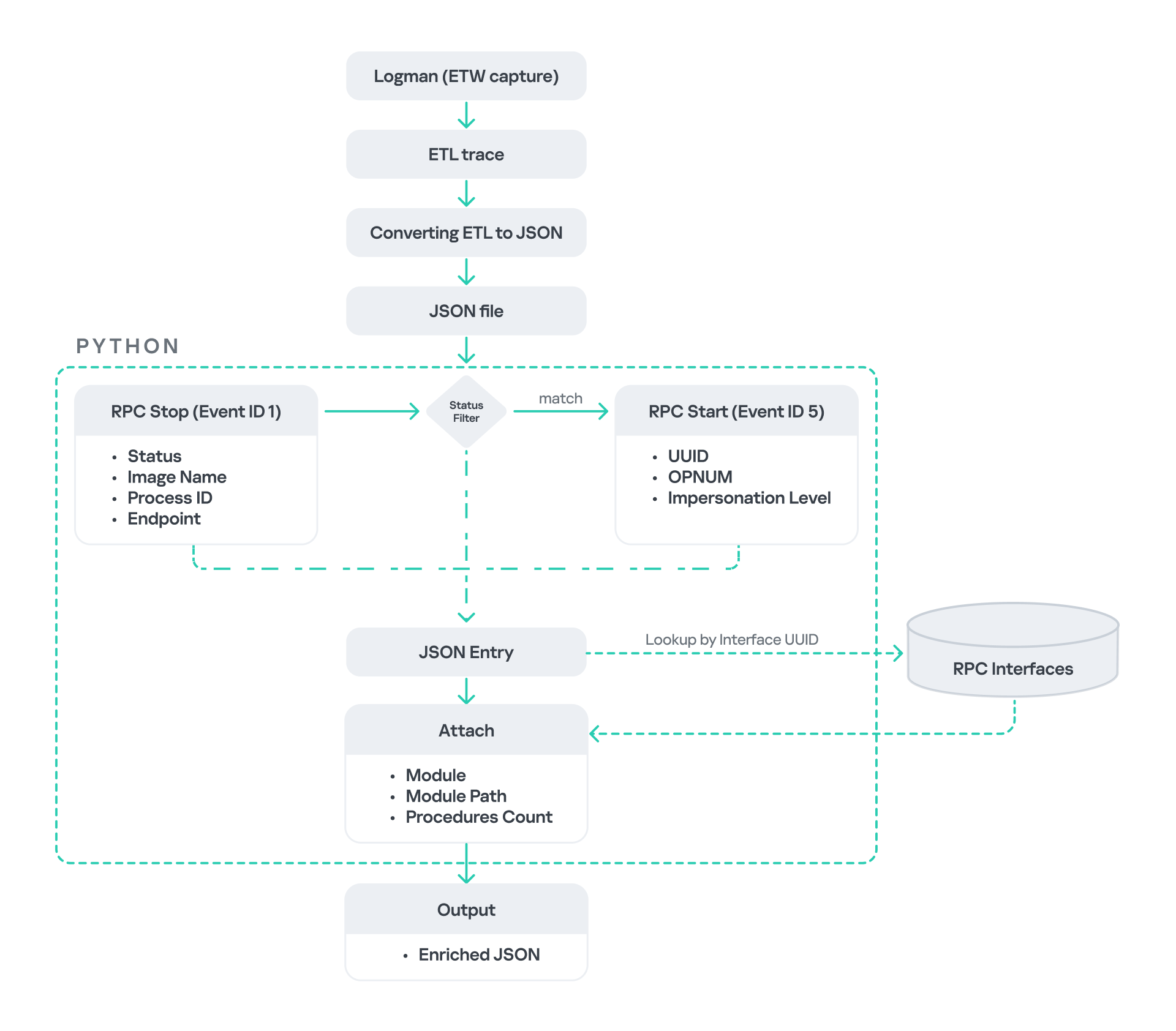
I cannot rely solely on the raw ETW output to implement this framework because it contains thousands of events, making manual filtering with standard tools inefficient. Therefore, I need to automate this process. The workflow shown below enables me to efficiently filter and extract only those events that are relevant to this analysis.
After generating the logs as an .etl file, I convert them to JSON format using tools such as etw2json. JSON is a much easier format to process programmatically. In this case, I use a Python script to filter and extract the relevant information.
The filtering process begins with a search for Event ID 1, which corresponds to an RPC stop event. This event indicates that the RPC client has completed the call and the result is available. From this event, I can extract useful information, such as:
Status code
Client process name
Client process ID
Endpoint
After extracting the status code, I filter for the specific value RPC_S_SERVER_UNAVAILABLE, which indicates that the target server was unreachable during an RPC call. These events represent the scenarios that are of interest.
However, Event ID 1 does not contain all of the required RPC metadata. To obtain the missing information, it is correlated with Event ID 5, which represents the RPC start event. This event is generated when the client initiates the RPC call.
By matching the metadata between Event ID 1 and Event ID 5, I can recover the missing details, including:
Interface UUID
OPNUM
Impersonation level
After correlating and filtering these events, a JSON entry is obtained that is almost ready for analysis. At this stage, the data can be enriched further by adding context that will be helpful when reversing or analyzing the RPC server implementation. For example, the following can be identified:
The DLL where the RPC interface is implemented
The location of that DLL
The number of procedures exposed by the interface
To retrieve this information, I match the UUID with an external RPC interface database. In this case, I used the RPC database, which contains a comprehensive list of RPC interfaces and their corresponding DLL implementations.
At the end of this process, a complete JSON dataset is obtained that can be used for further analysis.
One important observation is that the RPC calls I am looking for may only occur when specific system actions are triggered. Additionally, the resulting exceptions may vary from one system to another depending on which services are enabled or disabled. Therefore, I need a reliable way to generate these RPC exceptions.
In this research, I used several approaches to trigger such events:
Monitoring RPC activity during system startup
I observed RPC activity while the system booted. During startup, many services initialize and perform various RPC calls, which increases the chances of capturing calls to unavailable servers.
Triggering administrative operations I developed PowerShell scripts that perform common administrative tasks, such as updating Group Policy, changing network settings, or creating new users. These operations often trigger RPC communication and may generate exceptions.
Disabling services intentionally
After observing that Remote Desktop was disabled by default, I extended this idea by disabling additional services one by one and repeating the previous steps. This approach can reveal RPC clients that attempt to connect to services that are no longer available.
Additional privilege escalation paths
After running the logging and monitoring framework described earlier, I identified four additional scenarios that can lead to privilege escalation. The following sections introduce each case and explain how escalation can be achieved.
User interaction: From Edge to RDP
Microsoft Edge (msedge.exe) comes preinstalled on Windows systems. During startup, Edge triggers an RPC call to TermService. This RPC call is performed with a high impersonation level.
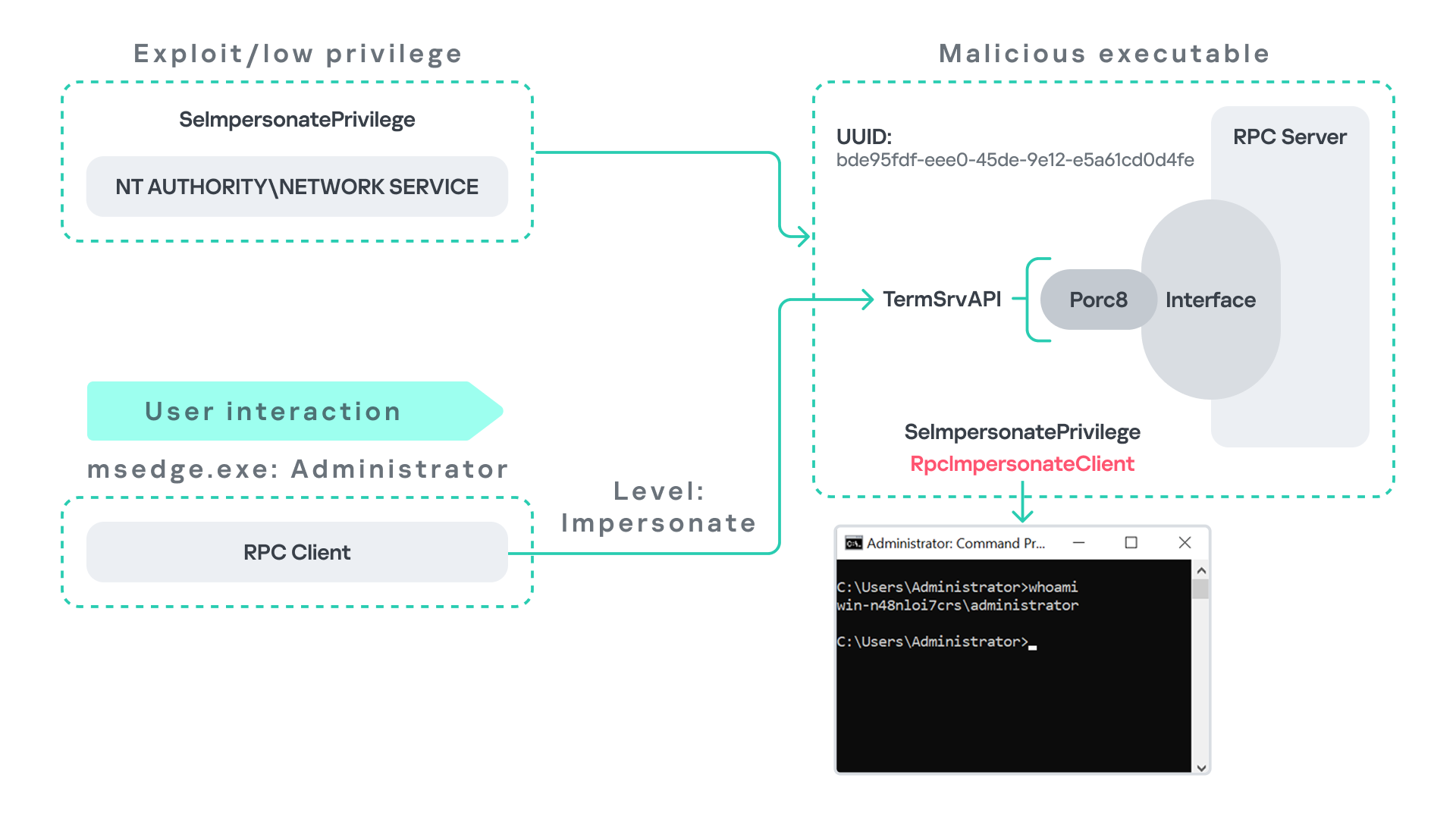
As previously discussed, Terminal Service is disabled by default. Because of this, the expected RPC server is unavailable, creating an opportunity for the attack scenario illustrated below.
The attack follows the same initial assumption as before: the attacker has already compromised a process running under the Network Service account. From there, they deploy the same malicious RPC server that mimics the legitimate TermService RPC interface.
However, unlike the previous scenario where the attacker coerced the Group Policy service, no coercion is required this time. Instead, the attacker simply waits for a high-privileged user, such as an administrator, to launch msedge.exe.
When Edge starts, it triggers the RPC client to attempt communication with the expected TermService RPC interface. Because the legitimate server is not running, the request is received by the attacker’s fake RPC server. Since the RPC call is made with a high impersonation level, the malicious server can call RpcImpersonateClient to impersonate the client process.
As a result, the attacker is able to impersonate the administrator-level client and escalate privileges from Network Service to Administrator.
Background services: From WDI to RDP
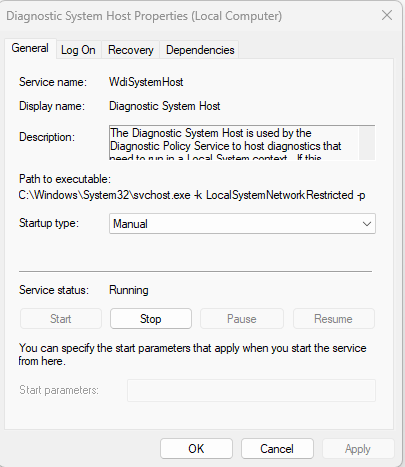
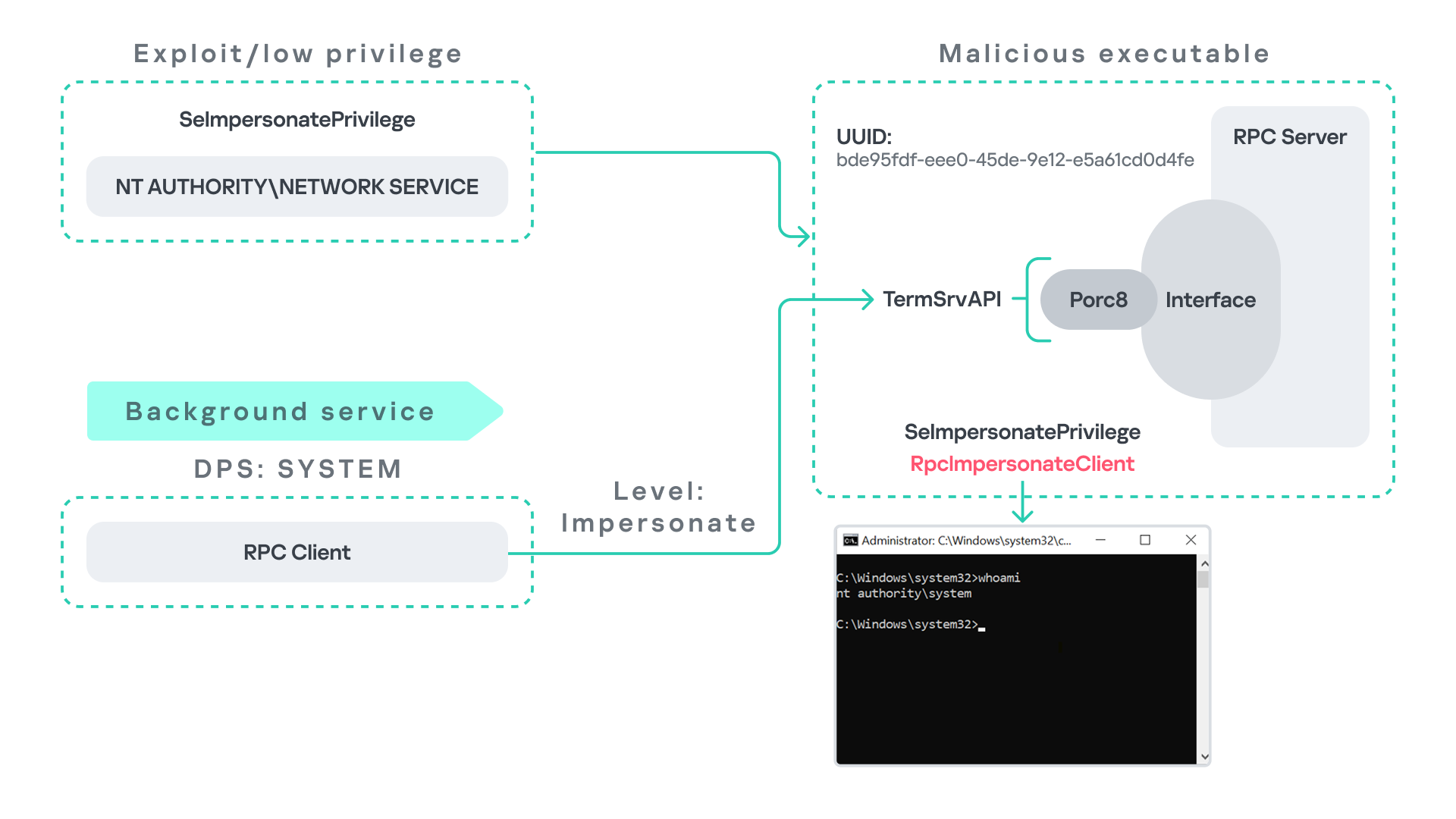
Some background Windows services periodically attempt to make RPC calls to the RDP service without user interaction. One such service is the WdiSystemHost service. The Diagnostic System Host Service (WDI) is a built-in Windows service that runs system diagnostics and performs troubleshooting tasks. This service runs under the SYSTEM account.
During normal operation, WDI periodically performs background RPC calls to the Remote Desktop service (TermService) using a high impersonation level. These RPC interactions occur automatically every 5–15 minutes and do not require any user input.
This behavior can be abused in a similar manner to the previous attack scenarios, as illustrated in the figure below.
In this case, however, no user interaction or coercion is required. After deploying a malicious RPC server that mimics the expected TermService RPC interface, the attacker only needs to wait for the WDI service to perform its periodic RPC call. Because the request is made with a high impersonation level, the malicious server can invoke RpcImpersonateClient and impersonate the calling process. This enables the attacker to escalate privileges to SYSTEM.
Abusing the Local Service account: From ipconfig to DHCP
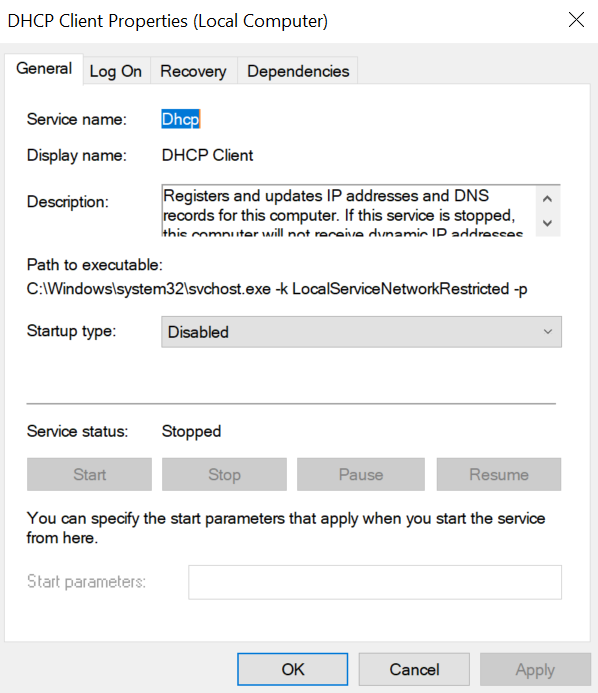
Another scenario involves the DHCP Client service, which manages DHCP client operations on Windows systems. This service runs under the Local Service account and is enabled by default.
The DHCP Client service exposes an RPC server with multiple interfaces and endpoints. These interfaces are frequently invoked by various system DLLs, often using a high impersonation level.
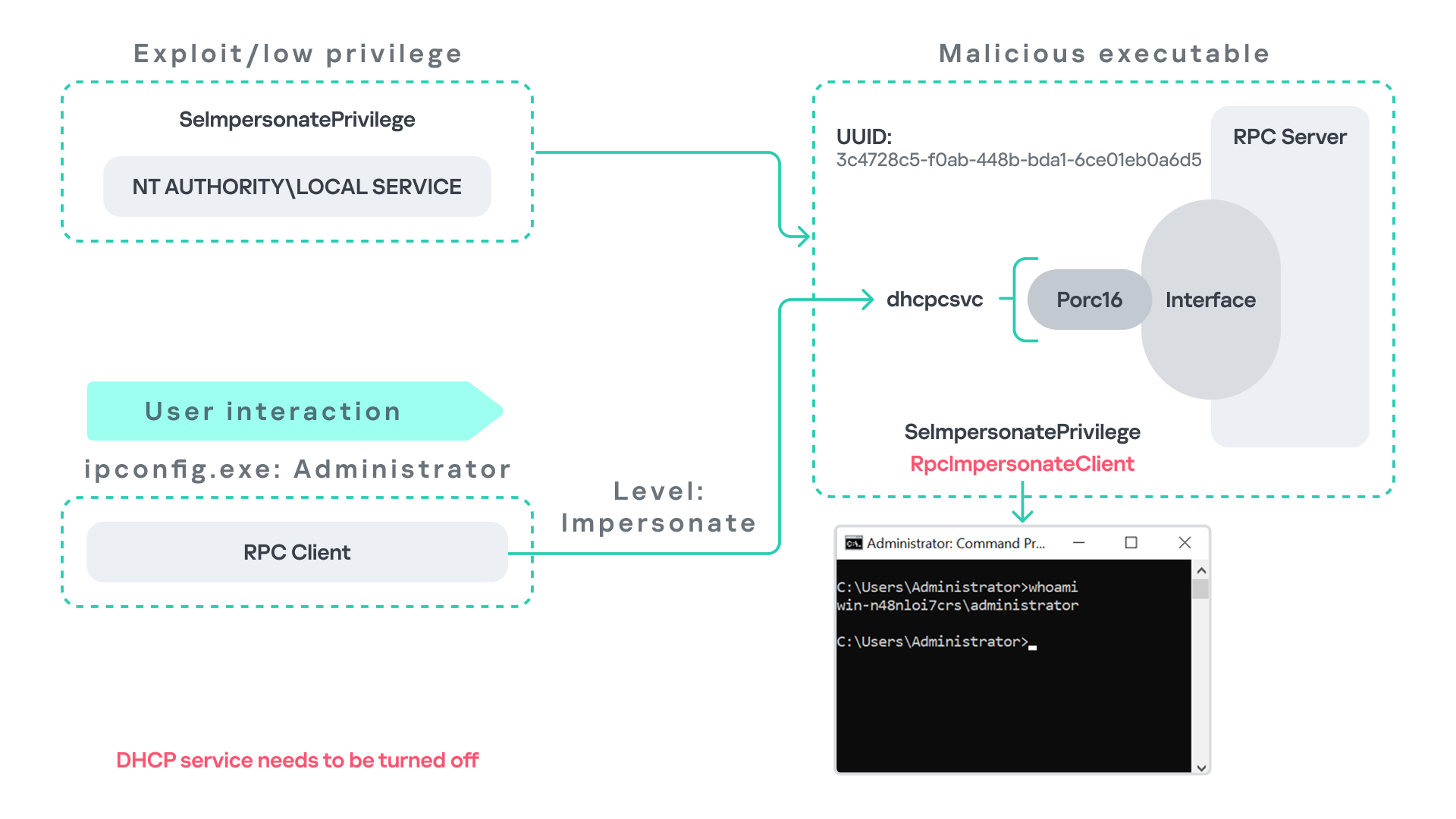
In this scenario, instead of compromising a process running under Network Service, it is assumed the attacker has compromised a process running under the Local Service account. I also assume that the DHCP Client service is disabled, meaning the legitimate RPC server is unavailable.
As the figure below illustrates, the attacker can leverage this situation to escalate privileges.
After gaining control of a Local Service process, the attacker deploys a malicious RPC server that mimics the legitimate RPC server normally exposed by the DHCP Client service. Once the malicious server is running, the attacker waits for a high-privileged user, such as an administrator, to execute ipconfig.exe.
When ipconfig is run, it internally triggers an RPC request to the DHCP Client service. Since the legitimate RPC server is not running, the request is received by the attacker’s fake RPC server. Because the RPC call is performed with a high impersonation level, the malicious server can call RpcImpersonateClient to impersonate the client.
As a result, the attacker can escalate privileges from the Local Service account to the Administrator account.
Abusing Time
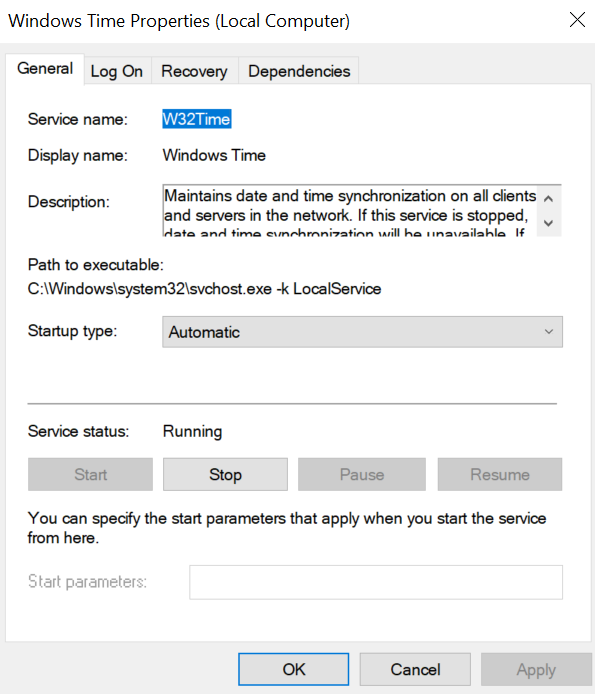
The Windows Time service (W32Time) is responsible for maintaining date and time synchronization across systems in a Windows environment. This service is enabled by default and runs under the Local Service account.
The service exposes an RPC server with two endpoints:
\PIPE\W32TIME_ALT
\RPC Control\W32TIME_ALT
The executable C:\Windows\System32\w32tm.exe interacts with the Windows Time service through RPC. However, before connecting to the valid RPC endpoints exposed by the service, the executable first attempts to access the nonexistent named pipe: \PIPE\W32TIME. This named pipe is not exposed by the legitimate W32Time service. However, if this endpoint were available, w32tm.exe would attempt to connect to it.
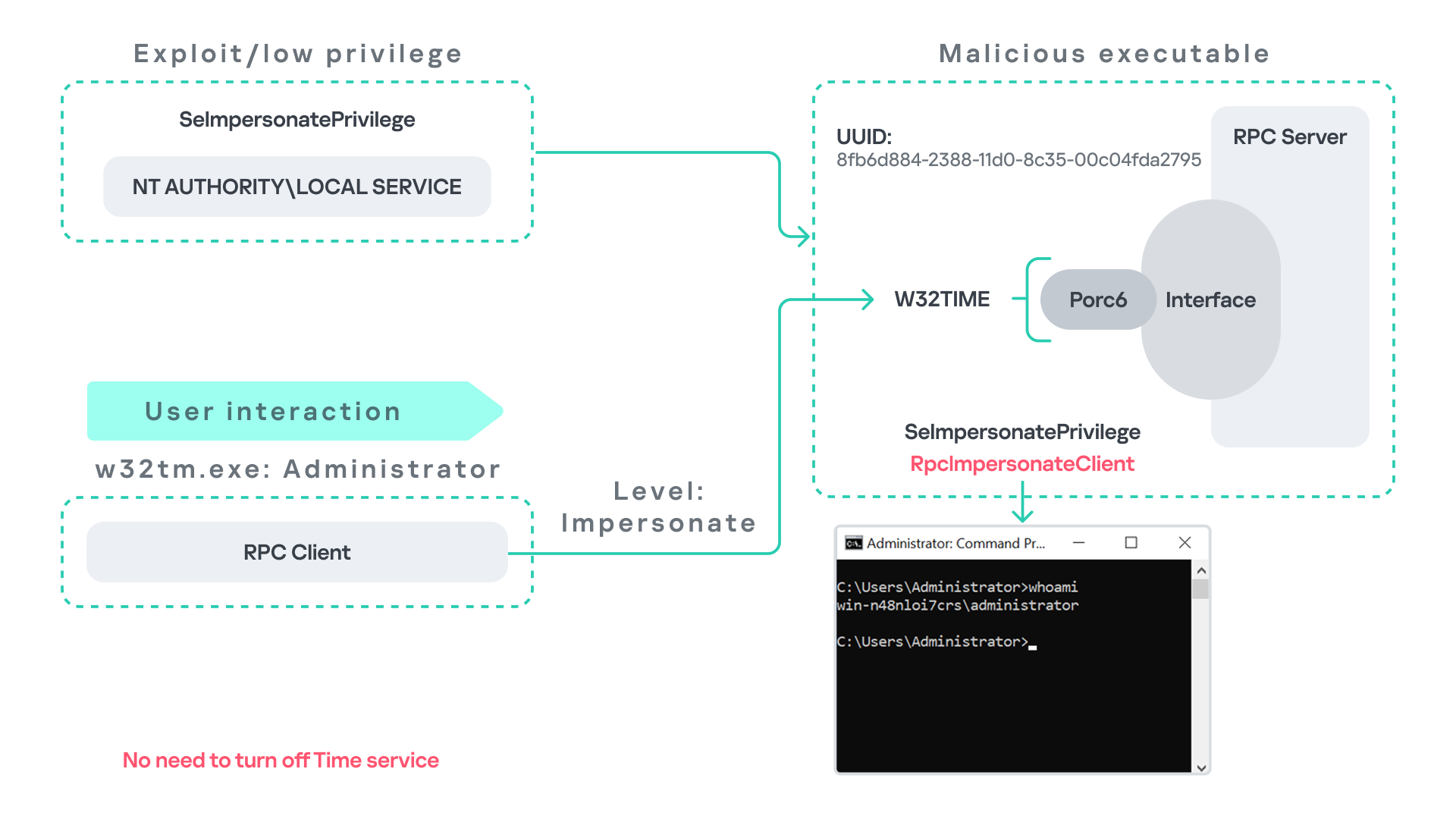
An attacker can abuse this behavior by deploying a malicious RPC server that mimics the legitimate RPC interface of the Windows Time service. Rather than exposing the legitimate endpoints, the attacker’s server exposes the nonexistent endpoint \PIPE\W32TIME, as shown in the figure below.
As in the previous scenarios, it is assumed the attacker has already compromised a process running under the Local Service account. The attacker then deploys a fake RPC server that implements the same RPC interface as the Windows Time service, but which exposes the alternative endpoint used by w32tm.exe.
Once the malicious server is running, the attacker simply waits for a high-privileged user, such as an administrator, to execute w32tm.exe. When the executable runs, it attempts to connect to the endpoint \PIPE\W32TIME. Because the attacker’s fake server exposes this endpoint, the RPC request is directed to the malicious server.
Since the RPC call is performed with a high impersonation level, the malicious server can impersonate the calling client. As a result, the attacker can escalate privileges from the Local Service account to the Administrator account.
In this scenario, it is important to note that the legitimate Windows Time service does not need to be disabled. Because the executable attempts to connect to a nonexistent endpoint, it is sufficient for the attacker to expose that endpoint through the malicious RPC server.
Vulnerability disclosure
After discovering the vulnerability, Kaspersky Security Services prepared a 10-page technical report describing the issue and the various aforementioned exploitation scenarios. The report was submitted to the Microsoft Security Response Center (MSRC) to report the vulnerability and request a fix.
Twenty days later, Microsoft responded, indicating that they did not classify the vulnerability as high severity. According to their assessment, the issue was classified as moderate severity and would therefore not be patched immediately. No CVE would be assigned, and the case would be closed without further tracking.
Microsoft explained that the moderate severity classification was due to the requirement that the originating process had to already possess the SeImpersonatePrivilege privilege. Since this privilege was typically required for the attack to succeed, Microsoft determined that the issue did not require immediate remediation.
Kaspersky Security Services respect Microsoft’s assessment and only published the research after the embargo period ends. In line with the coordinated vulnerability disclosure policy, Kaspersky Security Services will refrain from publishing detailed instructions that could enable or accelerate mass exploitation.
The disclosure timeline is shown below:
2025-09-19: Vulnerability reported to Microsoft Security Response Center (Case 101749).
2025-10-10: MSRC response – the case was assessed as moderate severity, not eligible for a bounty, no CVE was issued, and the case was closed without further tracking.
2026-04-24: expected whitepaper publication date.
Detection and defense
As discussed above, this vulnerability is related to an architectural design behavior. Fully preventing it would require Microsoft to release a patch that addresses the underlying issue.
Nevertheless, organizations can still take steps to detect and mitigate potential abuse. ETW-based monitoring within the framework described above enables defenders to identify RPC exceptions in their environment, especially when RPC clients attempt to connect to unavailable servers.
I have provide the tools used in the previously described framework so that organizations can check their environment for such behavior. You can find all of them in the research repository.
By monitoring these events, administrators can identify situations where legitimate RPC servers are expected but not running. In some cases, the attack surface may be reduced by enabling the corresponding services, ensuring that the legitimate RPC server is available. This can hinder attackers from deploying malicious RPC servers that imitate legitimate endpoints.
It is also good practice to reduce the use of the SeImpersonatePrivilege privilege in processes where it is not required. Some system processes need this privilege for normal operations. However, granting it to custom processes is generally not considered good security practice.
Conclusion
All the exploits described in this research were tested on Windows Server 2022 and Windows Server 2025 with the latest available updates prior to the submission date. The proof-of-concept implementations can be found in the research repository. However, it is highly likely that this issue may also be exploitable on other Windows versions.
Because the vulnerability stems from an architectural design issue, there may be additional attack scenarios beyond those presented in this research. The exact exploitation paths may vary from one system to another depending on factors such as installed software, the DLLs involved in RPC communication, and the availability of corresponding RPC servers.
WordPress powers over 40% of the web, which makes it one of the most attractive targets for Distributed Denial of Service (DDoS) attacks. If your site goes down for an hour, you lose revenue, search rankings, and visitor trust. If it goes down repeatedly, you lose much more.
A DDoS attack floods your website with fake traffic until it slows to a crawl or crashes entirely. Unlike hacks that steal data, DDoS attacks are about disruption.
EFF filed an amicus brief for the second time in the U.S. Court of Appeals for the Ninth Circuit, arguing that allowing cases against the Apple, Google, and Facebook app stores to proceed could lead to greater censorship of users’ online speech.
Our brief argues that the app stores should not lose Section 230 immunity for hosting “social casino” apps just because they process payments for virtual chips within those apps. Otherwise, all platforms that facilitate financial transactions for online content—beyond app stores and the apps and games they distribute—would be forced to censor user content to mitigate their legal exposure.
Social casino apps are online games where users can buy virtual chips with real money but can’t ever cash out their winnings. The three cases against Apple, Google, and Facebook were brought by plaintiffs who spent large sums of money on virtual chips and even became addicted to these games. The plaintiffs argue that social casino apps violate various state gambling laws.
At issue on appeal is the part of Section 230 that provides immunity to online platforms when they are sued for harmful content created by others—in this case, the social casino apps that plaintiffs downloaded from the various app stores and the virtual chips they bought within the apps.
Section 230 is the foundational law that has, since 1996, created legal breathing room for internet intermediaries (and their users) to publish third-party content. Online speech is largely mediated by these private companies, allowing all of us to speak, access information, and engage in commerce online, without requiring that we have loads of money or technical skills.
The lower court hearing the case ruled that the companies do not have Section 230 immunity because they allow the social casino apps to use the platforms’ payment processing services for the in-app purchasing of virtual chips.
However, in our brief we urged the Ninth Circuit to reverse the district court and hold that Section 230 does apply to the app stores, even when they process payments for virtual chips within the social casino apps. The app stores would undeniably have Section 230 immunity if sued for simply hosting the allegedly illegal social casino apps in their respective stores. Congress made no distinction—and the court shouldn’t recognize one—between hosting third-party content and processing payments for the same third-party content. Both are editorial choices of the platforms that are protected by Section 230.
We also argued that a rule that exposes internet intermediaries to potential liability for facilitating a financial transaction related to unlawful user content would have huge implications beyond the app stores. All platforms that facilitate financial transactions for third-party content would be forced to censor any user speech that may in any way risk legal exposure for the platform. This would harm the open internet—the unique ability of anyone with an internet connection to communicate with others around the world cheaply, easily, and quickly.
The plaintiffs argue that the app stores could preserve their Section 230 immunity by simply refusing to process in-app purchases of virtual chips. But the plaintiffs’ position fails to recognize that other platforms don’t have such a choice. Etsy, for example, facilitates purchases of virtual art, while Patreon enables artists to be supported by memberships. Platforms like these would lose Section 230 immunity and be exposed to potential liability simply because they processed payments for user content that a plaintiff argues is illegal. That outcome would threaten the entire business models of these services, ultimately harming users’ ability to share and access online speech.
The app stores should be protected by Section 230—a law that protects Americans’ freedom of expression online by protecting the intermediaries we all rely on—irrespective of their role as payment processors.

 Login