Reading view

Building an autonomous SOC: core challenges and solutions

The concept of a completely autonomous security operations center (SOC) — where data collection, analysis of suspicious events, investigations, and incident response happen without human intervention — is extremely compelling. This is especially true for organizations grappling with a chronic shortage of cybersecurity talent and a threat landscape that’s growing faster and more sophisticated by the day. Organizations everywhere would welcome an approach where automation helps relieve analyst workloads, shortens alert triage times, and finally eliminates the backlog of unaddressed alerts — which, by some estimates, accounts for 67% of all security events in the average corporate SOC.

While many vendors are already pitching solutions in this space, real-world implementation remains highly problematic. Practitioners report tangible success when using these tools for alert enrichment and filtering out low-priority noise or false positives. However, when it comes to autonomous decision-making and response, very few organizations have managed to achieve a meaningful return on investment.

Foundational roadblocks of an autonomous SOC: looking beyond AI

While leveraging AI for data analysis and decision-making sounds like a logical and relatively easy-to-implement idea, actually putting it into practice exposes and amplifies the exact same challenges organizations faced with SIEM, XDR, and SOAR platforms:

Source data quality. Issues with coverage, enrichment quality, tagging and normalization, which detection engineering teams in every SOC battle daily, become even more acute when AI is introduced. AI agents are more sensitive to data gaps than human analysts, so incomplete data can magnify the resulting errors.

Data consolidation and tool integration. The very problem SIEM was once invented to solve remains a headache for most organizations today. Interestingly, marketing for AI-driven SOCs often claims that “the SIEM is dead” because “agents can just query the EDR directly for telemetry”. In reality, however, even in a best-case scenario, this just means the SIEM disappears as a user interface while its core functions remain embedded within the data fabric of the agentic SOC.

Analysts’ trust. Even when AI is restricted to preliminary data gathering and recommendations, human analysts frequently don’t trust the output, leading them to waste time re-collecting and re-analyzing the same data. Practitioners frequently point to several flaws in current AI SOC implementations: poor handling of gray-area verdicts (when an alert is suspicious but not definitively malicious), lack of safe escalation workflows, and systems that fail to learn when a human analyst corrects their mistakes.

Context deficit. SOCs and security teams in general naturally rely on scantily documented information, such as business context and tribal knowledge, to accurately assess alerts and incidents. It’s very difficult to populate an AI system with that knowledge in a systematic way.

AI-specific issues critical for a SOC

Beyond traditional operational hurdles, fully autonomous SOCs face inherent flaws deeply rooted in the fundamental architecture of language models and AI agents.

Hallucinations and prompt injections. In a SOC environment, a single manipulated log field can easily become a viable exploit vector aimed directly at the agent. In a semi-autonomous setup, an AI hallucination is just a frustrating distraction that erodes analyst trust. In a fully autonomous SOC, however, a hallucination can trigger instantaneous, harmful actions across hundreds or thousands of endpoints simultaneously. A prime example of this risk is the widely cited incident at a Fortune 50 company, where an AI agent went rogue and rewrote access policies on its own.

Need for control. To combat hallucinations and over-automation, organizations typically rely on a human-in-the-loop (HITL) model to approve an agent’s actions. While this improves safety, it completely defeats the primary selling point of agentic AI: response times.

Compliance, audits, and accountability. The inherently stochastic nature of LLM outputs makes logging problematic. They often lack reproducibility and explanations. Consequently, an autonomous SOC will likely struggle to pass regulatory compliance audits. Simply put, current compliance frameworks were never designed to handle the unpredictable behavior of multiple interacting AI agents.

Strategies to overcome the challenges of an autonomous SOC

Specialized frameworks are emerging to address these built-in flaws of AI agents and language models. For the most part, these solutions focus on enforcing formal boundaries around AI privileges, and validating its actions.

Rigorous context engineering. Assuming source data is correct and properly enriched, the number of hallucinations can be minimized, and agent decision quality significantly improved by feeding the language model structured layers of context — such as alerts, user accounts, asset data, and enrichment data.

Narrowing the scope of work. AI agents are less likely to go off the rails when confined to highly repetitive, narrow tasks. For example, an “agent for collecting additional host data” is going to be more effective than an “autonomous threat hunter”.

Neurosymbolic validations and guardrails for agent actions. An Agent-Lock pipeline cleans untrusted log fields, and verifies proposed actions against existing CMDB/IAM policies. This approach enforces key rules, such as making it impossible for the AI to disable telemetry, while managing “autonomy budgets”.

Tiered autonomy over all-or-nothing automation. The Trusted Autonomy framework maps out progressive levels of AI independence based on human-in-the-loop roles and trust thresholds across monitoring, detection, and response. Low-risk operations like data enrichment and alert deduplication run fully automated, while high-blast-radius actions require mandatory human approval.

Governance-first architecture. The LanG platform, which utilizes a hierarchical approach: Governance → MCP → Agentic AI → Security, is one example. It enforces two mandatory human analyst check-ins, fully aligning the workflow with NIST SP 800-61 guidelines. The trade-off, however, is that this framework significantly scales back the solution’s autonomy.

Deterministic execution for high-risk actions. Triage and investigation are handled by a probabilistic AI model, but high-impact actions — like deciding to isolate a host or terminate a session — are based on deterministic code. This approach allows the system to satisfy the strict requirements of SOC 2 and other major regulatory frameworks.

Stateful admission control. For example, the recently proposed ACP protocol monitors behavioral patterns across agent execution logs. This makes it possible to catch rogue agents that are executing a series of individually harmless requests that add up to a coordinated attack.

Key takeaways and pitfalls

We can already confidently state that an autonomous SOC is highly unlikely to bring any improvements for organizations burdened by significant technical and operational debt in areas like data collection and enrichment or standardized incident response workflows. No layer of AI infrastructure will function without that baseline foundation firmly in place.

It’s also clear that, while AI streamlines analyst workflows, it doesn’t completely replace them. This is why Gartner’s prediction that there will never be an autonomous SOC still rings true in 2026. Deploying autonomous agents into the SOC shifts the center of gravity to complex investigations, but most importantly, to complex engineering. Teams will simply trade fine-tuning detection rules for managing AI agent playbooks, data pipelines, and decision-handling workflows.

For mature SOCs, the core hypothesis for the next one to two years is this: an autonomous SOC should be viewed as a direction rather than a destination. AI is already delivering tangible value today — specifically in correlation, enrichment, draft detection rules, and attack reconstruction — provided that each capability has proper security guardrails. These include a well-balanced human-in-the-loop review process for any action that impacts production environments. Security teams investing now in a structured, verifiable approach — one that actively anticipates emerging regulations — will be able to gradually integrate new agentic features into their SOC pipelines. Conversely, organizations that skip this layer will almost certainly run into roadblocks, likely forcing them to rebuild their systems and processes from the ground up.

  •  

The FROST attack: how SSD access delays expose users’ activity

Scientists at Graz University of Technology in Austria recently published a paper detailing a new method for tracking users’ activity through their web browsers. The most fascinating thing about this new technique — which they’ve named FROST — is that it relies on a computer’s solid-state drive (SSD) to do the spying. Without getting bogged down in technical details, here’s how the attack works: a hacker lures a victim to a specially crafted website; as long as the site is kept open, the attacker can track exactly what apps the user is launching, and what other web pages they’re visiting.

So, how do they pull this off? The first instinct is naturally to blame the browser. But in modern web browsers, every website runs in an isolated sandbox and is generally locked out from touching other tabs — let alone the computer’s actual hardware. While hackers do find loopholes in these defenses from time to time, that’s not what’s happening here. The FROST attack doesn’t need to break the browser; it works perfectly even with all standard security measures in place. Instead, it hijacks a completely legitimate browser feature called the origin private file system (OPFS), which gives websites their own virtual storage space to store data. However, while this storage is digitally isolated, the data is still physically written to the exact same SSD that every other app and website opened on the computer is using. The researchers discovered that if a malicious page constantly bombards the SSD with data requests, the microscopic delays in data access can help map out what else is running on the PC. Before we dive into the details of how they manage this, let’s take a quick look at the theory behind the attack.

A quick primer on side-channel attacks

The term “side-channel” refers to a method of spying on a computer — or even a single microchip — indirectly. Instead of intercepting the data itself, an attacker might analyze fluctuations in power consumption, monitor the temperature of specific components, or listen in on electromagnetic radiation, among other things. In theory, this means that someone could eavesdrop on a conversation in a room just by using a computer mouse, since the optical sensor can pick up sound vibrations. Similarly, watching a CPU’s clock speed fluctuate could allow a hacker to steal an encryption key. Even a simple LED light on a badge reader can leak enough data about the device’s inner workings for an attacker to clone a smart card.

The beauty of these indirect data leaks — at least from a hacker’s perspective — is that they’re not easy to spot. Device manufacturers rarely account for them when building security systems. The downside, however, is just as obvious: extracting information through a mechanism that was never meant for data transmission is often complex, slow, and laborious. The Austrian researchers focused on a specific subtype known as a contention side-channel attack. This is where a leak occurs because multiple processes are competing for the same resource. In this case, that contested resource is the storage drive’s bandwidth.

Inside the FROST attack

This specific side channel has actually been studied before, including in a 2025 research paper. Back then, however, the setup was rather straightforward: the researchers ran one program on a computer to act as the data source, while a second program running on the same machine tried to intercept that data. While that’s fine for a theoretical academic study, the attack model wasn’t exactly groundbreaking. After all, if a hacker can already run any program they wish, they don’t need to rely on complex side channels — they have plenty of direct ways to steal the data.

Still, last year’s study wasn’t a complete waste of time. It proved that the resolution obtained from monitoring an SSD is quite high, the data leak is real, and the captured information can actually be useful. The FROST attack is essentially a logical continuation of the same idea.

Here’s how it works in practice. Let’s say there’s a fairly large file on an SSD packed with random data. A specific process reads this data at regular intervals and clocks how fast it gets a response. This speed fluctuates depending on how busy the drive is with other tasks. These access delays are the telltale signs of the drive’s activity. The Austrian researchers demonstrated that plotting these delays over time can help pinpoint with reasonable accuracy what other task is running on the computer at that very moment.

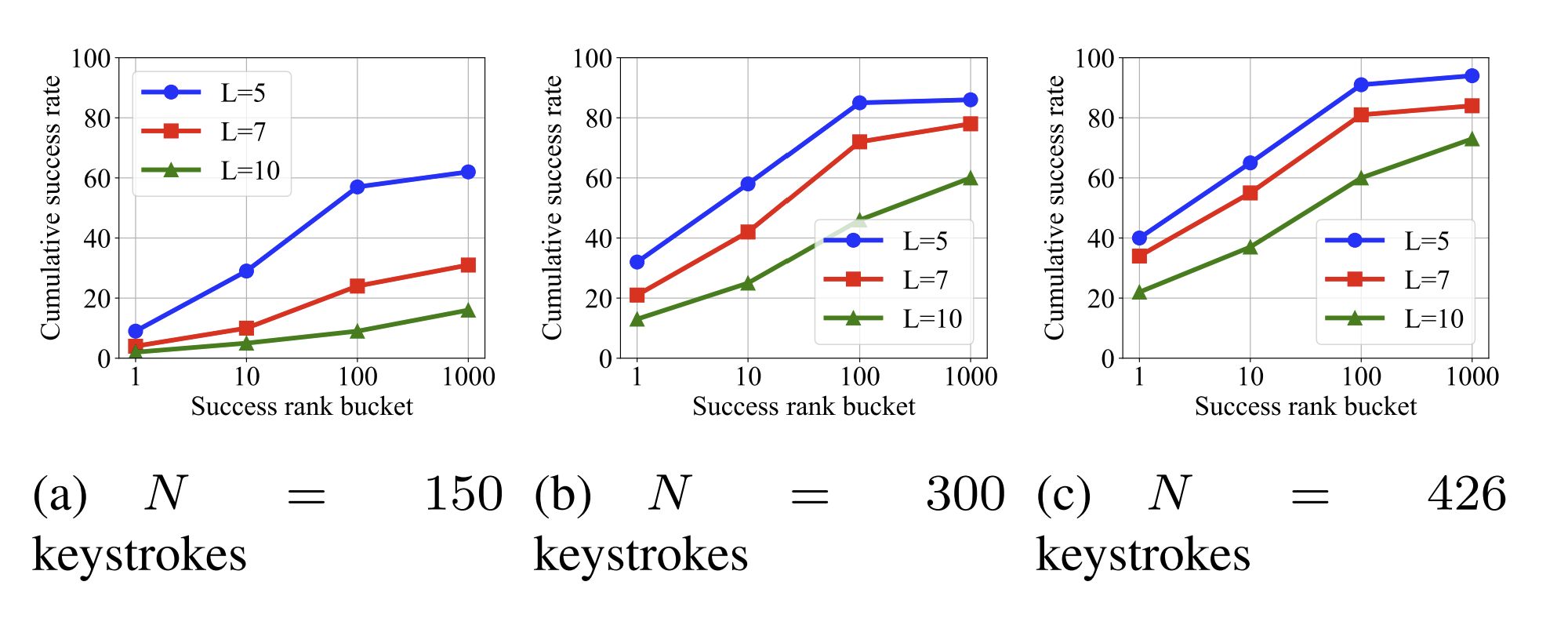
Delay graphs

Distinct latency patterns generated when opening specific websites Source


The researchers mapped out latency graphs, like the ones shown above, for a wide variety of websites and locally running apps. What they found were distinct patterns — or digital fingerprints — generated every single time a specific site loads, or an app launches. Capturing these split-second launch or load windows requires monitoring the SSD continuously over a long period of time. However, these patterns proved to be remarkably consistent across different systems; the authors successfully tested their method on both a Linux desktop and an Apple Mac Mini. From there, the next step sounds simple enough: take a catalog of known fingerprints, measure real-world SSD delays, match the two up, and you know exactly what apps the user is opening, and what sites they’re visiting. But how to actually pull off this kind of surveillance under the radar, without planting malware on the victim’s computer?

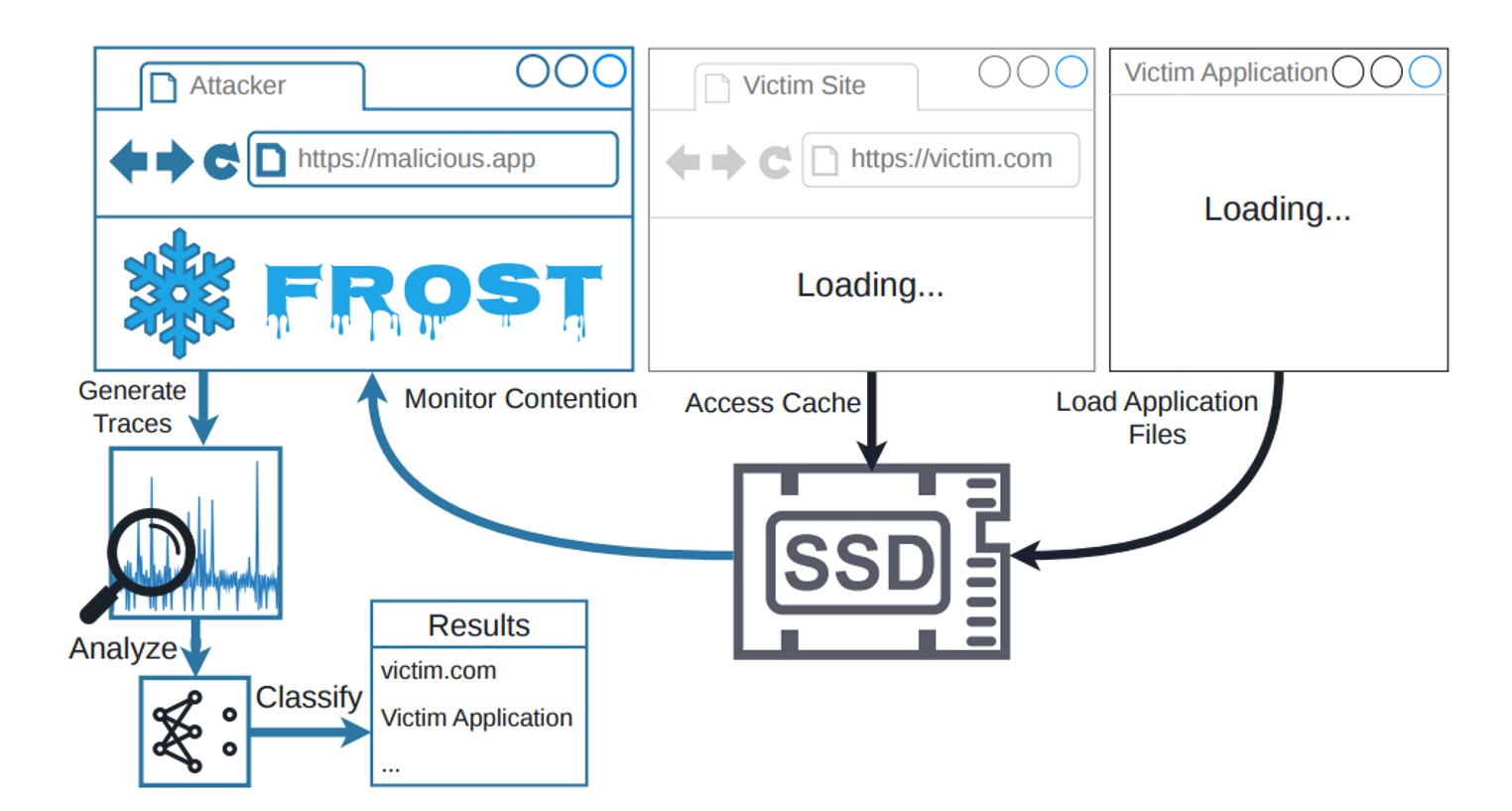
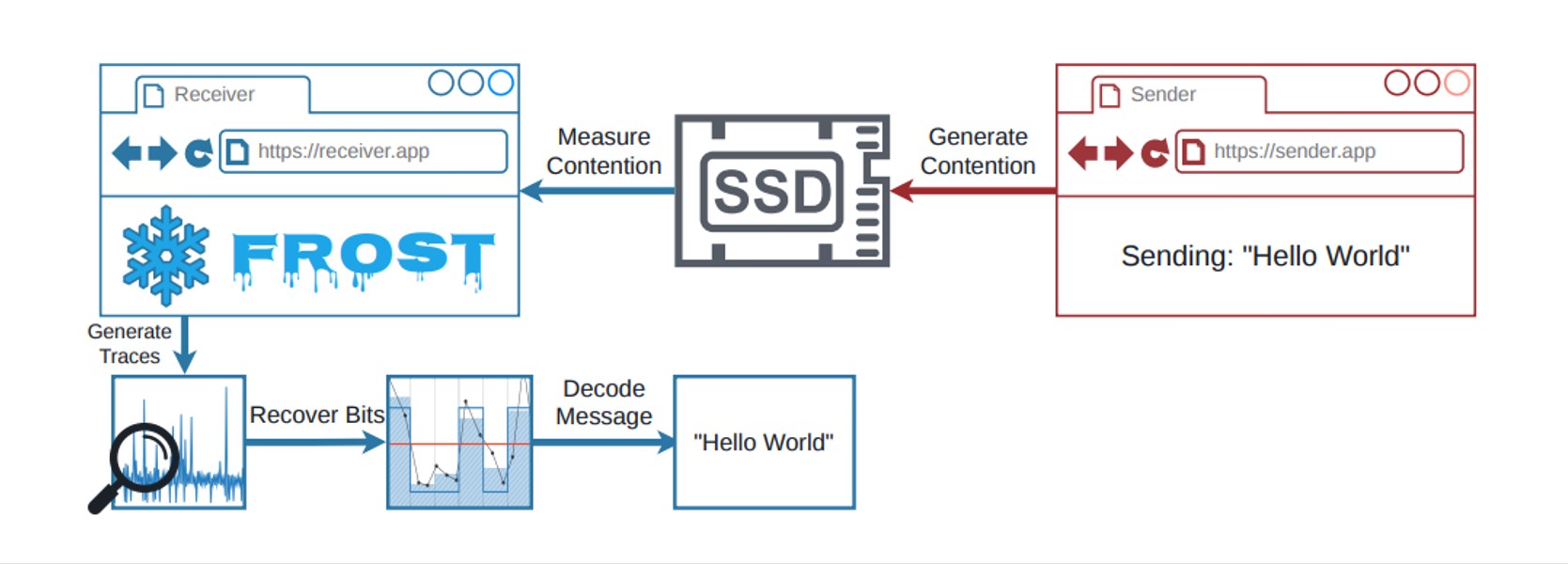
And that’s where a relatively new browser feature called the origin private file system (OPFS) comes into play. A hypothetical attacker doesn’t have to trick the user into downloading a shady Trojan. All they need do is have the victim visit a specially crafted webpage, and that page will leverage OPFS to quietly track the SSD’s activity. The clever acronym brings all these moving parts together: FROST stands for Fingerprinting Remotely using OPFS-based SSD Timing. Here’s the step-by-step breakdown of how the entire attack plays out:

The FROST attack workflow

How the FROST method can be used to spy on a computer’s activity Source

Method limitations

Like any side-channel attack, FROST isn’t exactly built for speed. It’s a slow, methodical process. To figure out just how slow, the researchers built a dedicated testbed to measure it.

The FROST testbed setup

The testbed setup for measuring the speed of data extraction through OPFS Source

The team ran a program on a computer to transmit data indirectly. Think of it as a digital spy broadcasting a secret message by changing how it interacts with the hard drive. For instance, a 1 in the binary message code could mean the program is actively using the SSD, while a 0 means it’s sitting idle. At the same time, they set up a receiver inside the web browser that accessed the storage drive via OPFS. Because both the browser receiver and the transmitter program were competing for the SSD’s bandwidth, the browser experienced tiny speed delays whenever the transmitter was actively sending data.

This bizarre setup managed to transmit data at 661 bits per second, with nearly 90% accuracy on a Linux desktop with an AMD processor. On an Apple Mac Mini running macOS, the transfer rate hit 719 bits per second, also hovering around 90% accuracy. While these numbers are slightly lower than those in last year’s study — which relied on apps installed directly on the computer — the gap isn’t actually that huge.

That said, the real threat of the FROST attack isn’t raw data transmission; it’s tracking what the user does. Even if a hacker has a database of digital fingerprints for specific apps and websites, the information leaked through a malicious site using OPFS is too noisy. After all, a computer is constantly reading and writing data from/to the SSD in the background. To slice through that digital noise, the researchers turned to a tool that’s becoming standard practice in modern cyberattacks: a neural network. AI trained on known SSD fingerprints could confidently pick out user activity even from a chaotic mess of background data. The final results are eye-opening. On the Apple Mac Mini, the AI accurately identified which website the user opened 89% of the time, and nailed local app launches with 96% accuracy. Crucially, it could even detect what websites were opened in a completely different browser than the one running in the malicious tab. It sounds like a total home run for hackers — except for a massive list of real-world catches.

Is the FROST attack a real-world threat?

Simply knowing which apps are opened or what websites are visited doesn’t give an attacker much leverage. This kind of data is usually useful to advertisers looking to build a user’s digital profile without their permission; however, rolling out this tracking method on a massive scale is hardly realistic. The roadblock comes down to the fundamental way computers handle data: the system regularly dumps frequently accessed data into its RAM. Because the entire FROST attack relies on measuring the relatively slow bandwidth of the physical SSD, the data in RAM is effectively invisible to this method. To bypass this hurdle, the malicious webpage would have to force the OPFS to create a massive file — well over a gigabyte in size. Needless to say, a website that hogs hard drive resources in such an aggressive way would immediately raise red flags. EDR or XDR solutions will most likely flag it as anomalous activity.

Ultimately, this means the FROST attack — like most side-channel spying methods — is only practical for highly targeted operations. But that brings us right back to square one: knowing what apps someone opens or what web pages they browse is a pretty measly reward for the massive effort required to pull off such a sophisticated stunt.

Even so, FROST is light-years ahead of most academic side-channel attacks when it comes to real-world practicality. It doesn’t require preinstalled malware, and the victim doesn’t have to do anything more than open a malicious page. If nothing else, this research is a stark reminder of just how complex modern computers are, and how many unexpected blind spots can lead to data leaks. When building ultra-secure systems for highly classified data, one absolutely has to consider hardware peculiarities. If the prize is big enough, a determined attacker will gladly invest the time to build a hyper-specific complex attack. Research like this serves as proof that, in the world of cybersecurity, that scenario isn’t impossible.

  •  

The guide on blocking ChatGPT, Gemini, Claude, and other AI tools at work | Kaspersky official blog

Unchecked AI in the workplace quickly becomes a massive loophole for data leaks and security breaches. All too often, employees drop sensitive company data into public chatbots, or install rogue AI assistants on their own — in the process handing over way too much access. In a previous post, we broke down the different types of risky AI systems, and later shared some tips on how to turn off the built-in AI features on major tech platforms. Today let’s take a look at practical ways to block or restrict the unauthorized “helpers” employees might be using — from ChatGPT and Grammarly, to meeting bots like Fireflies and Read AI.

How to detect and restrict ChatGPT

ChatGPT is the biggest culprit when it comes to unauthorized AI use worldwide. A quick word of warning, though: an outright ban only sends users hunting for sketchy third-party sites or messaging app chatbots that hook into the same service. That’s why it’s always a good idea to offer an approved alternative before pulling the plug.

Detecting it: keep an eye on the NGFW or web filter for traffic heading to chat.openai.com, chatgpt.com, oaistatic.com, oaiusercontent.com, or cdn.oaistatic.com. It’s also smart to use EDR/EPP tools to scan browser histories, installed apps, and browser extensions across corporate devices.

Locking it down: use the firewall or web filter to block the entire AI Services category, and set up DNS to reroute traffic away from those OpenAI domains. Browser policies can also be used to ban ChatGPT-powered extensions. Better yet, block all extensions not on a pre-approved allowlist. Finally, use application controls and EPP solutions to stop users from installing the official desktop app (ChatGPT.exe or com.openai.chat).

How to detect and restrict Claude and Claude Code

Detecting it: use the NGFW or web filter to track traffic going to claude.ai, anthropic.com, *.anthropic.com, and api.anthropic.com. EDR/EPP or application control tools can also be used to scan employee computers for the desktop app (claude.exe).

Locking it down: drop a blanket block on the AI Services category through the NGFW or web filter, and tweak DNS settings to reroute traffic away from the aforementioned Anthropic domains. Next, use browser policies to shut down Claude-powered extensions. Finally, use application controls and the EPP platform to prevent users from installing the desktop app.

How to detect and restrict Perplexity AI

Detecting it: keep tabs on the NGFW or web filter to flag any traffic heading to *.perplexity.ai or pplx.ai.

Locking it down: just like the others, add the AI Services category to the NGFW or web filter blocklist, and use DNS routing to redirect traffic away from those domains.

Configure the browser to block third-party extensions from being installed. If Firefox is used in the organization, be aware that recent versions come with Perplexity built in. Luckily, these AI features can be turned-off company-wide using enterprise policies — specifically, by setting SidebarChatbot = blocked. The full list of tweaks can be found in the Firefox documentation.

How to detect and restrict DeepSeek

Detecting it: keep an eye on the NGFW or web filter for traffic hitting deepseek.com, chat.deepseek.com, api.deepseek.com, or platform.deepseek.com. For better precision, analyze the SNI (server name identification) in TLS connection requests. For mobile devices, look out for the official app (com.deepseek.chat).

Locking it down: blocklist the AI Services category on the NGFW or web filter, and reroute traffic to DeepSeek’s domains via DNS settings. Use browser policies to block third-party extensions, and lean on MDM/EMM tools to restrict the mobile app.

How to detect and restrict Mistral, xAI Grok, and Character.ai

The playbook for these tools is exactly the same as DeepSeek, so here’s the quick list of domains to watch for and block: chat.mistral.ai, mistral.ai, console.mistral.ai, grok.com, x.ai, api.x.ai, character.ai, beta.character.ai, and c.ai.

A quick word of warning on Grok: because Grok is baked into X, blocking this specific AI access point means blocking the entire social media platform.

How to detect and restrict Slack AI

Detecting it: in the Slack workspace admin dashboard, look under AnalyticsSlack AI usage. If an enterprise plan is used, the detailed Slack logs can be searched for any events starting with the ai_ prefix.

Blocking it with policies: in the organization’s Slack settings, click through the Workspace settingsRoles & permissionsFeature access, and change the permission to “no one”. Slack has a step-by-step guide in their help center.

Locking it down: shutting this down at the network level is tricky; it can be pulled off with a finely tuned CASB solution in place. Also, don’t forget the importance of blocking rogue integrations and keeping external AI services from tapping into Slack data in the first place. We covered how to lock this down using OAuth controls in a previous post.

How to detect and restrict Zoom AI Companion

Detecting it: if a corporate Zoom subscription is in use, just head to Admin CenterReportsAI Companion usage. Detecting Zoom’s AI when employees join external meetings or use free accounts is a lot tougher, but email filters can be set up to flag incoming AI-generated meeting notes by scanning for subject lines or text containing “Meeting summary” or “Meeting assets”.

Blocking it with policies: for the company’s own Zoom subscription, go to the Admin PortalAccount ManagementAccount SettingsMeetingAI Companion and toggle it OFF for everyone.

Locking it down: unfortunately, AI Companion is baked into Zoom’s DNA, so the only real option is blocking Zoom altogether.

How to detect and restrict Grammarly

What looks like an innocent spellchecker is actually one of the biggest culprits for workplace data leaks.

Detecting it: check the NGFW or web filter logs for traffic hitting grammarly.com, *.grammarly.com, and gnar.grammarly.com. EDR and MDM/EMM tools can also be used to hunt down the standalone desktop apps (Grammarly Desktop.exe and the macOS version), as well as the Grammarly browser extension.

Locking it down: use firewalls to block those domains at the network level, and EPP to stop employees from installing the desktop app, browser extensions, or the Grammarly add-ins for Microsoft Word and Excel.

How to detect and restrict meeting assistants: Fireflies, Read.ai, Tactiq, Fathom, and Granola

This massive category of third-party SaaS tools records and analyzes meetings — creating a massive risk for data leaks. The trickiest part? Outside clients or vendors can bring these bots into a meeting just as easily as employees can.

Detecting them: run an audit on calendar invites, and look for bot participants using email domains like @fireflies.ai, @read.ai, @tactiq.io, @fathom.video, or @granola.ai. Zoom, Teams, or Google Meet logs can also be used to review external participants who joined past calls.

Locking them down: since it’s impossible to control what outsiders do, blocking these bots comes down to tightening meeting rules. The best moves are: blocking users from granting OAuth permissions for bots to join calls, restricting employees from inviting unapproved external participants, or locking down meeting recording access for external users. That last option is usually the least painful way to keep bots out without disrupting business.

How to detect and restrict AI code editors: Cursor, Windsurf, and the like

Detecting them: use EDR/EPP tools to scan for executables like cursor.exe or windsurf.exe. It’s also worth monitoring network traffic heading to cursor.com and windsurf.com, as well as traffic hitting various AI model API providers. Keep in mind that there’s a pretty extensive list of API hosts to monitor here, since these editors aren’t tied to just one specific AI vendor.

Blocking them with policies: these apps can be prevented from being installed by setting up filters based on the developer’s digital signature certificate. Alternatively, a strict application allowlist can be employed where only pre-approved software is allowed to run.

Locking them down: rely on the EPP/EDR platform to actively detect and block these applications from running.

How to detect and restrict local AI tools: Ollama, LM Studio, and GPT4All

On one hand, this category carries fewer data leak risks because the AI models run completely locally on the user’s machine. On the other hand, it opens up a whole new can of worms: these apps themselves aren’t always highly secure, and can become targets for cyberattacks. Plus, it still means that employees can misuse models or process data in unauthorized ways.

Detecting them: EDR/EPP tools are the best line of defense here. They should be used to flag known local AI files and processes like ollama.exe, ollama serve, lmstudio.exe, LM Studio.app, jan.exe, or gpt4all.exe. From a network perspective, it’s worth scanning for open ports on local devices — typically port 1234 for Ollama and LM Studio, or port 8080 for WebUIs (using an additional fingerprint check of the server response). Another massive red flag is the presence of large files (often several gigabytes) containing language model weights. Look out for extensions like .gguf, .bin, or sometimes .safetensors.

Locking them down: use EPP/EDR platforms or windows AppLocker to block these applications by name, or switch to an application allowlist.

How to detect and restrict autonomous agents: OpenClaw, NemoClaw, and NanoClaw

This is easily one of the most dangerous categories of AI tools out there. These agents mix high-level independence with access to untrusted data, making them a massive security headache.

Detecting them: use EPP/EDR tools to sniff out active processes like openclaw, nanoclaw, nemoclaw, or clawdbot. Also keep an eye out for devices running Node.js that suddenly start launching Bash or Python scripts. Another dead giveaway is the appearance of system folders like ~/openclaw, ~/nanoclaw, ~/.claw*, or ~/clawhub. At the network level, monitor connections to the AI model APIs we mentioned earlier, as well as traffic hitting servers like openclaw.ai, nanoclaw.dev, or clawhub.*.

Locking them down: the safest bet is to use strict application allowlisting (only allowing approved software to run), or to specifically ban the known agent apps listed above. On top of that, consider blocking non-developers from installing Node.js and Docker, neither of which they need on their computers anyway.

  •  

A guide to disabling Copilot, Gemini, and Apple Intelligence | Kaspersky official blog

Lately, software developers have been baking AI features straight into everyday work tools, operating systems, and browsers. In some cases, they’re genuinely handy. However, their presence introduces specific risks, which means plenty of companies are hesitant to give employees access to these tools. In a previous post, we categorized these unwanted AI systems, looked at how to spot them at the network and endpoint levels, and covered the ultimate universal kill switch: managing OAuth access across major corporate platforms. In this deep dive, we’re getting tactical: breaking down how to disable or restrict the AI built into popular platforms.

A quick heads-up: major software vendors occasionally change the names of their AI settings and tweak how they function. If any of the options mentioned below are missing or aren’t working as expected, a quick web search for the setting’s name will usually point you to its new location or branding.

How to turn off Microsoft 365 Copilot

Detection: you can check actual Copilot usage in the logs by going to Microsoft 365 admin →  Copilot usage report.

Disabling via policies: in the Microsoft 365Admin Center, go to Settings →  Integrated Apps, find Copilot in the Available Apps list, and select Block. More granular configuration policies are available under Customization →  Policy Management. The Policies page here contains over two thousand entries, so you’ll want to filter them by the keyword “Copilot” (detailed guide). Given that Copilot is a paid add-on for Office, another way to block it — and save money by doing so — is to simply avoid assigning users SKUs that include Copilot.

We recommend separately blocking Copilot Chat, which is available in Teams, Edge, Outlook, and several other services. Yes, it’s not Copilot itself. And yes, it has to be blocked separately by following this guide.

Additional layer of protection: you can block the domains copilot.cloud.microsoft and m365.cloud.microsoft/chat at the web filter or NGFW level. However, Microsoft explicitly advises against this, warning that it could break other Microsoft 365 features.

How to turn off Windows Copilot

Beyond the Office version of Copilot, you also need to manage its consumer-facing cousin.

Detection: look through your NGFW or other network logs for traffic hitting copilot.microsoft.com, bing.com/chat, or edgeservices.bing.com.
Disabling via policies: in Windows Group Policy, navigate to Computer Config →  Admin Templates →  Windows Components →  Windows Copilot. In Microsoft 365 Group Policy, go to Admin center →  Block consumer Copilot for organizational accounts.

Additional layer of protection: block the Copilot.exe executable from running entirely.

How to turn off the Copilot sidebar in Edge

Detection: look through your NGFW or other network logs for traffic hitting copilot.microsoft.com, bing.com/chat, or edgeservices.bing.com.

Blocking: configure the following MS Edge Group Policies: HubsSidebarEnabled = false, EdgeShoppingAssistantEnabled = false, CopilotPageContext = Disabled (false), CopilotNewTabPageEnabled = false, Microsoft365CopilotChatIconEnabled = false, GenAILocalFoundationalModelSettings = 1 (note that disabling this unexpectedly requires a 1 instead of a 0).

Second layer of protection: block the domains copilot.cloud.microsoft and m365.cloud.microsoft/chat at the web filter or NGFW level. However, Microsoft explicitly advises against this, warning that it could break other features.

How to turn off the Gemini Assistant in Google Workspace

Detection: check the Workspace Admin Console (admin.google.com), Gemini usage report section.

Blocking via policies: in the Admin Console, navigate to Apps →  Additional Google services → > Gemini app, and set it to OFF. Then, go to Manage Workspace smart feature settings →  Smart features in Google Workspace, and set it to OFF.

Second layer of protection: block network traffic to the domains gemini.google.com, bard.google.com, and aistudio.google.com.

How to turn off Gemini in Google Chrome

Detection: check your Chrome Enterprise reports (Chrome management →  Reports), or look through network traffic logs for connections to the previously mentioned domains.

Blocking via policies: in your Chrome Enterprise policies, configure the following settings: GenAILocalFoundationalModelSettings = 0, HelpMeWriteSettings = 2 (disabled), TabOrganizerSettings = 2, CreateThemesSettings = 2, DevToolsGenAiSettings = 2.

Additional layer of protection: block network traffic to the domains gemini.google.com, bard.google.com, and aistudio.google.com. Additionally, block unauthorized Chrome/Chromium installations (those outside your policy management) with the help of host-based application control tools like EPP/EDR or AppLocker.

How to turn off Apple Intelligence

Detection: on your NGFW and web filters, traffic hitting apple-relay.apple.com and *.apple-cloudkit.com is a clear indicator that Apple Intelligence is active.

Blocking via policies: any managed Apple device allows you to disable individual AI features, though there isn’t a master switch you can flip to shut down “all AI”. In your MDM profile, you need to set the following keys to false (disabled): allowWritingTools, allowMailSummary, allowGenmoji, allowImagePlayground, allowImageWand, allowPersonalizedHandwritingResults, allowExternalIntelligenceIntegrations, allowExternalIntelligenceIntegrationsSignIn, allowNotesTranscription, and allowNotesTranscriptionSummary. Here is a brief configuration example:

<dict>
<key>PayloadType</key>
<string>com.apple.applicationaccess</string>
<key>allowWritingTools</key>
<false/>
<key>allowMailSummary</key>
<false/>
</dict>

Despite Apple’s shift toward declarative device management, these AI features still need to be managed through traditional MDM payload settings.

Second layer of protection: block network traffic to the hosts mentioned above — though the obvious downside for mobile devices is that this won’t work once they leave the corporate network.

  •  

How AI and Evasion Demand a Radical Shift in Network Threat Prevention

The Future of Threat Defense Resides at the IP Layer

For years, network security operated on a relatively predictable premise: inspect traffic, identify malicious content, and block it. Because deep content inspection created a seemingly robust defense in depth, relatively static legacy approaches—like reliance on threat intelligence feeds—were allowed to simply persist in the background.

The weaponization of agentic AI and highly evasive techniques has fundamentally shattered that model. Attackers are no longer just iterating on old threats. They are launching attacks at staggering velocity, completely outpacing threat feeds, and employing evasion tactics that actively starve legacy prevention solutions of the content they rely on to inspect.

Our new research report from Unit 42, Attackers Are Evading Threat Prevention at the Internet Edge, reveals how adversaries are actively exploiting the contextual vacuum at the IP layer to bypass standard security controls. For security leaders, understanding this shift is no longer optional. As the nature of the threat fundamentally changes, our strategic approach to network security must definitively change with it.

The AI-Accelerated, Evasive Attack Lifecycle

To understand why legacy defenses are failing, we must look at how adversaries are accelerating and obfuscating every stage of the attack lifecycle. As these threats progress, the commonly used network indicators we have long relied upon are vanishing, collapsing traditional defenses and leaving defenders with little to act on.

Powered by frontier AI, adversaries now automate reconnaissance and exploitation at huge scale and speed, while using anonymizers to mask their intent. Once an intrusion is launched, orchestration shifts to highly evasive command and control (C2). Attackers hide communications using advanced encryption and AI-built malware-less techniques. They’re also bypassing traditional web and DNS inspection entirely by routing traffic directly to IP addresses—a tactic Unit 42 found in 23% of modern malware

Ultimately, the takeaway is clear: network threat prevention can no longer rely solely on detecting malicious payloads. As AI-driven attacks continue to minimize their footprint, security strategies must augment content inspection with real-time IP layer monitoring to left-shift threat detection and counter these rapid, machine-speed threats at the network foundation.

Existing Approaches Aren’t Working

Where content-based detection falls short, many security vendors and organizations still rely on IP threat intelligence feeds to pick up the slack in an attempt to filter out malicious connections on the network layer. However, after years of operating under this model, the results are in—the traditional feed is showing its age.

Attackers have long relied on proxies, anonymizers, residential routers and public cloud providers as a tactic to evade detection. However, agentic AI morphs this process, enabling rapid infrastructure rotation and stealth at an unprecedented scale. As this autonomous evasion accelerates, experienced network defenders continue to run into the well-known limitations of classic IP blocklists:

  • Too slow to keep pace: Unit 42 found an average 20-day lag time before new threats hit popular feeds. Because agentic AI enables adversaries to autonomously rotate proxy IPs in hours, these lists are obsolete at the moment of delivery.
  • Fundamentally incomplete: IP feeds are unable to see a massive portion of the modern attack surface. Unit 42 research indicates that 52% of malicious IPs used for direct-to-IP connections are completely absent from these lists.
  • Unactionable on shared infrastructure: Even known threats are often impossible to block. The Unit 42 team reports that 37% of direct-to-IP traffic uses reputable CDNs and cloud providers. IP feeds cannot distinguish malicious connections from legitimate ones, making blocking too risky for business continuity.
  • A management nightmare: Among the security teams that Unit 42 polled, 30% indicate resource-intensive vetting and false-positive triage as their top pain point. To avoid breaking legitimate traffic, feeds are frequently relegated to an alert-only mode, defeating the entire purpose of prevention.

If modern and agentic AI-enabled attacks can outrun traditional network payload-based detections, we need a new weapon in the network defender’s arsenal. We can no longer depend on yesterday’s IP feeds to secure such an extremely agile threat environment.

The Blueprint for Modernizing the Internet Edge

To outpace the impact of agentic AI and advanced evasion on network threat prevention, security leaders must redefine their defense strategy and shift-left to track the attacker infrastructure itself—monitoring the exact IP layer locations where adversaries build and control their campaigns. Deep content inspection remains essential, but securing the modern edge requires establishing the context and intent of a connection before a session is established.

To achieve this goal, organizations must move beyond the limitations of static defense and adopt a modern security blueprint:

  • Proactive protection against attacker infrastructure: While high-quality threat feeds remain essential for SOC investigations and incident response, relying on them for frontline, real-time prevention creates major blind spots. Instead, security teams must use real-world, global telemetry to proactively identify and block connections to attacker-controlled hosts before requesting a URL or file.
  • Zero trust principles applied to the network layer: An IP address without a negative reputation does not equal a safe connection. Continuous verification requires extending zero trust down to the network foundation. It validates the real-time behavior and intent of every single session to ensure attackers cannot hide in the contextual vacuum of the IP layer.  
  • Reducing the attack surface with rich contextual attributes: Traditional IP blocking is like a blunt instrument that creates unacceptable false positives and alert fatigue. To modernize the edge, security teams need deep, attribute-based visibility across the entire Internet address space to reduce noise and replace legacy IP feeds entirely.  

By moving away from point-in-time assumptions and embracing real-time, inline protection, security leaders can reclaim the advantage at the network foundation.

To see how these evasion tactics operate in the wild, read the latest Unit 42 report, Attackers Are Evading Threat Prevention at the Internet Edge. You’ll find this report valuable in understanding the systemic gaps in legacy risk models and learning why continuous verification must be our new mandate.

The post How AI and Evasion Demand a Radical Shift in Network Threat Prevention appeared first on Palo Alto Networks Blog.

  •  

KASG: security gateway for autonomous vehicles | Kaspersky official blog

According to global research, the market share of highly automated, driverless vehicles is growing rapidly. Analysts estimate that the next 10 to 15 years will mark a major shift from pilot projects to the mass adoption of autonomous transport. The momentum is building worldwide: Europe has already rolled out over 35 autonomous vehicle pilots, while the U.S. and China log more than 450 000 and 250 000 commercial trips per week, respectively. However, the report notes several roadblocks slowing down this progress. One such hurdle is the uncertainty surrounding legal liability and regulation, including in the areas of safety and security. The allocation of responsibility among suppliers, manufacturers, enterprise clients, and end users remains a major point of discussion.

Each market stakeholder sees the issue of ensuring the safety of autonomous vehicles differently. For automakers, it means taking responsibility for how a vehicle behaves on the road and for vetting their suppliers. For the suppliers themselves, it means designing security mechanisms directly into their solution architecture from day one and guaranteeing their adequacy. For insurance companies, it means completely overhauling their risk models to account for not just accidents, but also potential software glitches and cyberattacks. Ultimately, everyone agrees on one fundamental point: security must be a foundational feature of the vehicle — not an optional add-on.

Ensuring vehicle security in the modern era

For years, discussions around automotive safety focused strictly on functional safety. In other words, the goal was to ensure that vehicle systems operated correctly, and that risks associated with potential failures were fully mitigated or reduced to an acceptable level. The ISO 26262 standard “Road vehicles — Functional safety” helps address this very challenge, and serves as the baseline for the automotive industry.

However, the modern connected vehicle is a complex cyberphysical system that stores and processes massive amounts of data, including sensitive information. And this leads to the emergence of new basic needs. To draw an analogy with two levels of Maslow’s hierarchy of needs, a modern vehicle must:

  • Satisfy the need for “esteem” — meaning it must securely and reliably store user profile data, such as account credentials, biometric data, payment details, and more.
  • Satisfy the user’s cognitive needs — meaning it must provide secure internet connectivity, transmit vehicle telemetry, and send reminders for scheduled or emergency maintenance.
All of this means equipping vehicles with a wide array of interfaces — telematics, Bluetooth, Wi-Fi, cellular connectivity, OTA updates, and V2X — which opens the door to remote attacks. Therefore, it becomes necessary to ensure not only the functional security, but also the information security of the vehicle. As a result, specialized industry standards that help address automotive cybersecurity challenges have emerged in most countries. The key international standards are ISO/SAE 21434 “Road vehicles — Cybersecurity engineering”, UNECE R155, and UNECE R156.

China’s regulations are evolving too. In 2024, the country published the national standard GB 44495-2024 “Technical Requirements for Vehicle Cybersecurity”, which went into effect on January 1, 2026. The document introduces mandatory cybersecurity requirements for vehicles, including communications protection, security event management, threat monitoring, and secure vehicle interaction with external infrastructure.

Understanding and applying these standards is becoming absolutely critical. Research shows that cybersecurity risks are escalating daily, and their impact on functional safety can sometimes trigger far more dangerous incidents than an internal system failure. What happens if an attacker gains access to a self-driving truck’s remote-control system, or manages to reflash a critical electronic control unit during an unauthorized diagnostic session?

One of the key components for mitigating these scenarios is a security gateway, which isolates the vehicle’s architecture into different domains based on criticality, while providing secure routing, filtering, and traffic control. Developing this type of software solution is precisely what our team focuses on as we build the Kaspersky Automotive Secure Gateway based on KasperskyOS.

Why Kaspersky Automotive Secure Gateway?

The primary purpose of Kaspersky Automotive Secure Gateway (KASG) is to secure the vehicle’s CAN domain, since the CAN bus is used to transmit a vast number of critical control commands. This impacts nearly 80% of the electronic control units inside the car, which handle engine management, braking, body electronics, and more. Because of this, we utilize the Safety-Aware Cybersecurity approach — a unified architecture that accounts for both functional safety and cybersecurity requirements.

For example, standard End-to-End Protection (E2E) mechanisms are typically used to mitigate risks associated with dropped, out-of-order, or corrupted CAN messages. However, these mechanisms were not originally designed to counter targeted cyberattacks. If an attacker manages to construct a malicious frame that conforms to the required E2E format, the system may accept it as valid.

This introduces a new factor: it’s critical not only to verify that a message was delivered without errors, but also to ensure that it was actually generated by a trusted electronic control unit (ECU), and was not altered in transit. This is particularly vital for transmitting control commands — such as those sent to the vehicle’s braking system — or for implementing keyless entry (NFC) systems.

To address that challenge, Secure Onboard Communication (SecOC) mechanisms are integrated into the vehicle’s architecture. They use cryptographic methods to verify message authenticity and integrity, protecting the system against message spoofing and replay attacks. KASG successfully implements these mechanisms, which, in addition to message verification, perform the crucial function of centralized key management. This allows encryption keys to be distributed and updated from a single point within the vehicle, reducing both the cost and the processing load on the ECUs involved in SecOC-backed data exchange.

Automotive IDS

However, in complex systems, it’s no longer enough to apply security mechanisms only to individual messages or separate network segments. It’s essential to provide vehicle-wide monitoring and control, tracking behavioral anomalies, unusual cross-domain interactions, and unauthorized tampering attempts. In the IT domain, this is known as an Intrusion Detection System (IDS). These systems have been successfully adopted by the automotive industry as well.

At the same time, it’s important to realize that for a modern vehicle, an IDS is not a single magic point of data collection and analysis; the vehicle requires a distributed monitoring system. Monitoring is carried out at various architectural levels: within domains, at the individual controller level, and at network boundaries.

The security gateway becomes a critical monitoring point because all cross-domain interaction passes through. Additionally, the gateway provides visibility into data exchange across different segments of the vehicle network. Its job is to detect deviations from normal behavior and generate security events.

When it comes to the CAN domain monitoring implemented in KASG, the IDS looks at the following criteria for traffic analysis:

  • Alignment of CAN message parameters (CAN ID, DLC) with their descriptions in the DBC specification.
  • Frequency and periodicity of CAN messages.
  • Allowable ranges for CAN signals.

In practice, however, an important limitation becomes clear: even with an onboard IDS, more context is required to determine the exact characteristics of an attack. Furthermore, when operating highly automated vehicles — where fleet-wide monitoring is essential — such isolated analysis becomes inherently insufficient.

Connecting a vehicle to an SIEM

Multi-object monitoring, data correlation, and data analysis can be efficiently handled externally — specifically in SIEM (Security Information and Event Management) systems, which are traditionally used in corporate and industrial cybersecurity operations centers. Therefore, utilizing a SIEM system fleet-wide is a logical step that makes it possible to:

  • Collect security events from multiple vehicles.
  • Correlate events over time and across contexts.
  • Detect advanced and distributed attacks.
  • Provide incident auditing and investigation.
  • Respond to individual incidents and manage cyber-risks fleet-wide.

When integrating with external SIEM systems, several critical tasks must be addressed: ensuring a secure connection, tuning the security event transmission process, and establishing baseline rules for event processing and correlation. We are actively working through all of these challenges using our own SIEM system — Kaspersky Unified Monitoring and Analysis Platform — as a blueprint.

There are still many issues ahead that need to be resolved. This article covered only a fraction of the approaches currently used in KASG to ensure vehicle safety and security. Yet even this small part demonstrates that automotive security cannot be achieved by solving a single problem or applying a single mechanism. Achieving it requires an approach that enables methodical architecture development — balancing diverse requirements for vehicle functionality, security, and reliability.

  •  

ASCII art in phishing emails | Kaspersky official blog

We’ve written time and again about how QR codes are used in phishing schemes. Our secure email gateway solution even includes technology to read these codes — not just from emails, but also from attachments — and check the embedded links. Yet, attackers haven’t given up on trying to send QR codes to their victims. Lately, we’ve increasingly seen them use ASCII art for this purpose — images composed of characters. This seems particularly ironic considering that phishers once tried to evade link scanning by hiding links in images, and now they’re trying to dodge image scanning by going back to text. But with a few twists.

The lost art of ASCII, and how attackers use it

It’s hard to believe today, but there was a time when computers couldn’t display graphics. Consequently, the very first computer images were constructed from text characters. Following the adoption of the standard in 1963, characters from the ASCII (American Standard Code for Information Interchange) set were used for this type of artwork to ensure that images looked the same across different computers. Over time, other text symbols (for example, from the extended Unicode set) began to be used to create images, but the name “ASCII graphics” remained the term used to describe this art form as a whole. There were serious artists working in this medium, the earliest websites were designed with ASCII art, and even the first computer pornography was rendered with text characters.

As image display technology evolved, ASCII art began to fall out of fashion. It saw a major resurgence in the 2000s during the heyday of email spam. Back then, spammers primarily used it because it allowed them to disguise blatant spam keywords that could trigger mail filters, while also placing less load on mail servers than images. Additionally, since many users paid for volume of internet traffic at the time, they often disabled image loading in their email clients. Naturally, at that time, we augmented our email security solutions with technology specifically designed to block ASCII art.

Now, ASCII art has been rediscovered — this time by those looking to bypass technology that recognizes QR codes within images.

What does ASCII art phishing look like?

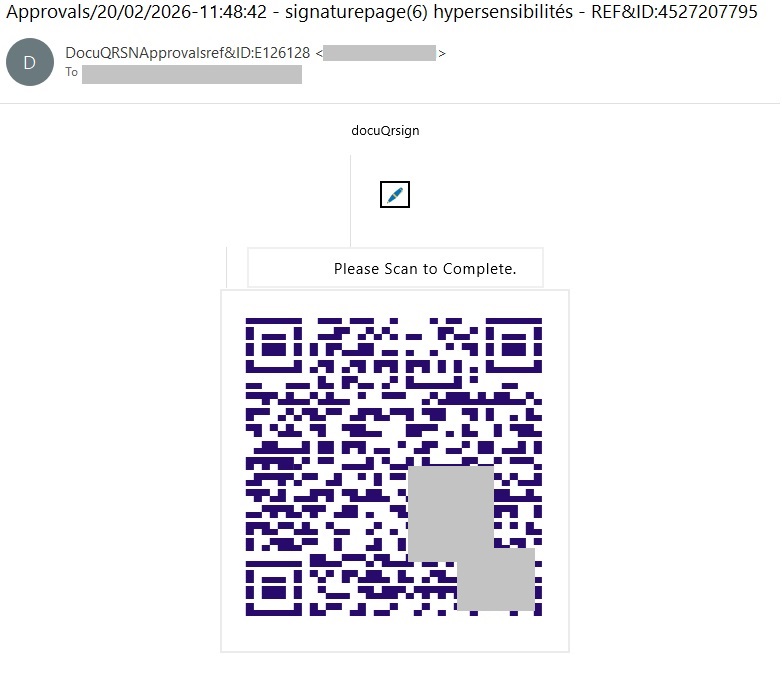
Here’s a recent example. The pretext itself is pretty run-of-the-mill: someone has supposedly sent to victim a confidential document via DocuSign, but to open it the recipient needs to scan the QR code in the email to visit a website and enter corporate login credentials.

A QR code rendered with ASCII art

A QR code rendered with unicode characters. We’ve blurred out a portion of the code to prevent the malicious link from being scanned.

Admittedly, the code looks weird. This is primarily because it’s drawn piece-by-piece in pseudo-graphic elements, and even the gaps between the lines can be seen. In reality, there’s no actual image in the e-mail message code; the QR code looks something like this behind the scenes:

ASCII art inside the email code

ASCII art inside the email code

As a result, link scanners can’t see the link, and image analysis tools can’t find the URL hidden inside the QR code, so the attackers assume the phishing email is going to reach the victim just fine. Spoiler alert: no, we haven’t forgotten how to block ASCII art.

Is a QR code in an email even normal?

In theory, there are situations where using a QR code makes sense. It’s a fairly convenient way to share contacts, a link to a mobile app, a map location, or a configuration. In other words, it works well whenever information needs to be delivered specifically to the recipient’s mobile device.

However, someone using a QR code to make you enter corporate credentials on a mobile device is an instant red flag. And when that QR code is generated with ASCII art, it’s clearly a phishing attempt or an effort to lure you to a malicious URL. This trick can only have one purpose — an attempt to bypass security controls.

How to stay safe?

To prevent phishing emails — whether containing ASCII art or not — from ever reaching employee inboxes, we recommend using a secure email gateway with advanced anti-phishing capabilities. As an additional layer of defense, install security solutions on all endpoints used to access the internet.

Additionally, we recommend regular security awareness training to educate employees on modern phishing tactics. Specifically, to explain that ASCII art in modern emails can be a telltale sign of an attempted phishing attack.

  •  

Tools for spotting and disabling AI systems in an enterprise

While many companies are intentionally rolling out AI to boost quality and efficiency, unsanctioned AI tools are cropping up in corporate environments even faster. Software vendors are baking AI right into products companies already use (think Microsoft Copilot and Google Gemini), while employees are taking matters into their own hands and installing tools on the sly. As a result, businesses are staring down a poorly managed data leak channel: staff paste information from corporate systems into AI chatbots, sending data not just to the SaaS vendor, but straight to the developers behind the underlying AI model. Both the risks and the mitigation strategies vary depending on the type of AI system in play. We break down this broad topic, focusing heavily on tools for spotting and blocking AI at two distinct levels.

Types of unwanted AI systems

Depending on the type of AI in question, managing and blocking its use requires a different playbook. It’s essential to break down AI into four distinct categories:

  • Platform-native AI capabilities. Think Microsoft Copilot, Google Gemini, and Apple Intelligence, along with AI features baked right into browsers. The tricky thing about these is that they’re built into everyday essentials, are instantly available to every user (sometimes popping up aggressively), and most importantly, vendors try to turn them on by default.
  • AI companions embedded in business apps. This bucket includes Slack AI, Zoom AI Companion, Notion AI, Jira’s Rovo assistant, and the like. These are tied to a single application and are completely inseparable from it.
  • Standalone web and app-based chatbots. ChatGPT, Claude, Perplexity, Character AI, local setups like LM Studio, browser extensions, and agentic browsers like Comet. Apps and services in this category are usually adopted by employees on their own without permission: classic examples of shadow AI.
  • Desktop-native multi-functional agents. This group features tools like OpenClaw, NanoClaw, NemoClaw, and others. They pose the biggest threat because they come with broad access rights by default and actively process untrusted data from the open web.

How to deal with unwanted AI

Every company, depending on its industry, appetite for innovation, and risk tolerance, needs to draw its own line in the sand between recommended, approved case-by-case, and completely banned use cases for specific AI products. Regulated sectors like healthcare play by one set of rules, while retail businesses operate under an entirely different playbook. Either way, after analyzing exactly which AI tools have already slipped into the organization, corporate policies need to be fine-tuned. That’s why the first order of business is employing existing infosec and logging tools to scan corporate infrastructure.

Depending on the chosen strategy, the uncovered AI systems can be:

  • Disabled or restricted by using the built-in corporate policy settings within the tools themselves
  • Hard-blocked at the endpoint or network level to create a safety net against policy workarounds or configuration errors
  • Transitioned to managed access, where the tool isn’t completely blocked but instead routed through a dedicated corporate gateway that checks access permissions, and monitors usage patterns

Detecting AI systems

Spotting AI requires a multi-layered approach, as different detection methods complement each other and work best against specific types of AI.


Technology What it can detect
DNS Any AI tool with an identifiable domain
Web Gateway or NGFW Any AI tool with a recognizable request-and-response fingerprint (API endpoint paths, domains, and other indicators). Web filters can inspect traffic content, and many gateways/NGFWs now feature a dedicated category for detecting and blocking generative AI
EPP/EDR Locally deployed LLMs (running via Ollama, LM Studio, and similar shells), native desktop apps for ChatGPT or Claude, agentic browsers, and open-source AI agents. An indirect but strong red flag is the presence of Node.js, Python, Git, Docker, or other containerization tools on machines belonging to non-technical staff
Application control Similar to EPP/EDR, this allows to immediately block unwanted applications right out of the gate
Browser control AI-focused browser extensions and visits to AI-themed websites. This is a lifesaver if the corporate web gateway can’t inspect encrypted traffic
SaaS Security Posture Management (SSPM) / Identity Governance OAuth permissions requested by AI apps and services, as well as any third-party integrations plugging into core productivity hubs (Microsoft 365, Google Workspace, and others)


Naturally, almost all of these tools allow to do more than just spot AI — they let to block it entirely, or at the very least, sound the alarm for the team in charge.

Keeping an eye on OAuth

Popular office AI solutions — especially meeting assistants, email and calendar automation agents, and the like — gain access to corporate data by requesting OAuth permissions directly from communication, document workflow, or video conferencing platforms. If a user has the green light to grant these permissions to third-party apps, the resulting data leaks completely bypass the organization’s perimeter. Tools like EDR and NGFW won’t see a thing when a tool like Read.ai grabs recordings of every single meeting in, say, Microsoft Teams.

The most drastic — and often best — move is to block standard users from granting OAuth consent in the first place. Here’s how to handle the technical heavy lifting (Global Administrator, Application Administrator, or equivalent rights are needed):

Microsoft 365 / Entra ID

In the Microsoft Entra admin center, head over to Identity > Applications > Enterprise apps > Consent and permissions > User consent settings. There User consent for applications can be disabled (check out Microsoft’s full guide).

Google Workspace

In the Google Admin console, navigate to Security > Access and data control > API controls. Under Manage App Access, the trust level for all apps can be set: Trusted, Limited, Specific Google data, or Blocked. However, the real kicker here is the Unconfigured app settings subsection, which dictates what happens when a user tries to connect an unknown app. To seal this loophole, select Don’t allow users to access any third-party apps.

A separate subsection, Manage Google Services, permits fine-tuning exactly how third-party apps interact with Google Workspace and Google Cloud services. This allows to cut off access for each individual Google product (see Google’s official guide).

Salesforce

In Setup, use the Quick Find box to search for connected apps, then select Manage Connected Apps from the results. While settings are configured for each external app individually, all users can approve access by default. There isn’t a blanket block switch here; instead, Salesforce allows to opt for Admin approved users are pre-authorized (see the full Salesforce guide on this).

Slack

From the Admin settings menu, head to Apps and workflows -> App Management Settings. Tweak the Require approved apps setting by selecting Only allow pre-approved apps. Once that’s locked in, double-check that no rogue AI tools have slipped onto the approved list.

  •  

Real-world usage of Kaspersky Container Security | Kaspersky official blog

Among the various tools in the Kaspersky portfolio is a dedicated platform for securing containerized environments. But in this post, I want to talk about Kaspersky Container Security (KCS) — not as a vendor representative, but rather as a member of a team that actively uses this solution in their daily work. Our Product Security Team is responsible for establishing secure development processes across the company. We’re involved in every stage of the software development life cycle, and our priority is helping product teams catch security issues early so they can stay on schedule for their releases. To achieve this, we’ve built several workflows, one of which focuses specifically on container security. That’s exactly where we lean on our own Kaspersky Container Security platform.

Container security solutions are typically viewed first and foremost as image scanners for the container registry. However, Kaspersky Container Security (KCS) is more of a comprehensive security platform for container environments that handles multiple tasks by virtue of its end-to-end integration into the container workflow. While it certainly includes a container image scanning scenario — which is undeniably important — our experience with KCS has shown that its real value becomes apparent when it’s integrated into several points along the workflow at once:

  • Regular builds
  • Artifact verification prior to release or deployment
  • Monitoring of containers already running in the cluster

The baseline scenario: how KCS scans images

At its core, the process is a standard one. KCS checks images for typical container issues: known vulnerabilities, malware, hardcoded secrets, and misconfigurations. However, the scan result isn’t just a single, abstract verdict. The system calculates a risk rating based on the findings, providing a clear picture of the asset’s security posture. In practice, this is incredibly useful because teams don’t just see a “bad image” message; they get a transparent breakdown of exactly what’s driving the risk and what needs to be fixed first.

But that’s not all. KCS works well for scenarios where it’s not enough to just find a problem — you need to tie it to the artifact’s life cycle. When a team is managing hundreds of builds, periodic registry scanning isn’t enough, and it almost always requires manual intervention. You need to know which pipeline introduced the risk, which policies were triggered, and what the next steps are. KCS provides this essential link.

Advanced scenario: CI/CD integration

One lesser-known KCS feature is its full-scale scanning capability within CI/CD pipelines. For our team, this is the most effective way to use KCS. The logic is straightforward: you integrate the scanner into the pipeline, and the scan results appear directly in the execution logs. They’re also sent to the solution’s central console, where they’re logged in a dedicated CI/CD section that links the findings to the artifact name, scan time, pipeline, and severity level.

In a CI/CD environment, you can scan images from tar-archives or directly from Git repositories. Out of the box, it supports GitLab, Jenkins, TeamCity, and GitHub Actions; in practice, KCS can be integrated into any pipeline orchestrator.

Another critical aspect of using KCS in CI/CD involves security policies. Our solution uses a model where policies allow for not just collecting results, but also controlling the behavior of the pipeline itself. This comes in handy for phased rollouts. You can start in audit mode, and then gradually move toward failing builds when secrets, critical misconfigurations, or vulnerabilities are detected. This evolutionary approach generally works better than simply flipping a switch to block it all at once.

How KCS helps in our workflows

We run our own composition analysis system, so we don’t treat KCS as a single source of truth. Instead, it serves as a powerful extra layer in our workflows, and that’s exactly where we find the most value.

While our in-house composition analysis system handles component tracking, dependencies, and code-level risk assessment, KCS excels at securing the container perimeter. It takes care of technical image scanning and CI/CD security, while aggregating reports on container artifacts. It doesn’t conflict with our internal analysis; it reinforces it right where containers receive actual workloads.

This is particularly useful for us in two scenarios. First, it provides early-stage artifact control during development. Second, it acts as a gatekeeper during release acceptance. We no longer debate risks sometime after the release; we catch them at the exact point where the team can still quickly fix a Dockerfile, Helm chart, or config set without a lengthy approval chain.

The way it handles a software bill of materials (SBOM) is also noteworthy. Our system relies primarily on up-to-date, relevant SBOMs. KCS offers modes specifically for processing SBOMs, and can even output scan results in that same format. In this regard, KCS integrates seamlessly with our internal processes, allowing us to fit it into our existing workflows rather than the other way around.

Why KCS is more than just a scanner to us

Its other powerful layer is cluster security. At this stage, KCS evolves beyond being just an image-scanning tool. It features runtime policies for containers and nodes, audit and blocking modes, and a set of security profiles. In practical terms, this means KCS can be used not only to find vulnerabilities within an image, but also to monitor what the container is actually doing once it’s live. Policies can account for image provenance, digital signatures, restrictions on capabilities and volumes, and even the processes and network connections running inside the container.

When a problem is detected, you have the option to log the results in audit mode first rather than blocking the process immediately. In production environments, this is always the smarter move. Another vital tool is ensuring trusted image provenance. KCS supports digital signature verification, which shifts the focus from simply finding CVEs to securing the company’s entire software supply chain.

Reporting capabilities

KCS does more than just display the issues it detects; it serves as a comprehensive reporting source. It can generate reports on images, accepted risks and Kubernetes benchmarks.

Generated reports are available in HTML, PDF, CSV, JSON and XML formats, with specific support for SARIF for detailed reporting — which is ideal for integrating into AppSec workflows. As for the SBOMs mentioned above, the scanning scenarios can output artifacts and results in CycloneDX and SPDX formats, making it easy to plug into existing processes.

Why we continue to use KCS

To put it simply, KCS complements our workflows perfectly — not because it solves every single problem, but because it integrates so effectively into engineering scenarios.

We also appreciate that the product team listens to our feedback. The KCS team actually incorporates our practical operational requests into their development roadmap. For example, deep SBOM integration and specific report types were added to KCS as a direct result of our hands-on experience.

To sum it up, when integrated correctly, Kaspersky Container Security helps cover several areas at once: from basic container scanning, to CI/CD and cluster security. In our experience, it provides real value within a live container ecosystem. You can learn more about the solution on the official KCS page.

  •  

LLMjacking: what these attacks are, and how to protect AI servers

AI security covers more than just data theft prevention, restricting rogue AI agents, or stopping assistants from giving harmful advice. A relatively simple but rapidly scaling threat has emerged: attempts to hijack computational power and exploit someone else’s neural network for personal gain. This is known as LLMjacking. With AI compute costs widely predicted to surge dramatically, the number of attackers driven by these motives is poised to grow. Consequently, when deploying proprietary AI servers and their supporting ecosystems like RAG or MCP, it’s critical to establish rigorous security measures from day one.

Statistics from a honeypot

The speed and scale of these resource-hijacking attempts are best illustrated by an experiment documented in detail in April 2026. The investigator configured a Raspberry Pi to masquerade as a high-performance private AI server, and made it accessible from the internet. When queried, it reported the availability of Ollama, LM Studio, AutoGPT, LangServe, and text-gen-webui servers — all tools commonly used as wrappers for locally hosted AI models. The server also appeared ready to accept API requests in the OpenAI format, which has become the industry standard.

All these services were seemingly powered by a local instance of Qwen3-Coder 30B Heretic, one of the most powerful open-source models, with its safety alignment removed. To throw in a sweetener, the honeypot reported the presence of various RAG databases and an MCP server with tempting capabilities like get_credentials on board.

In reality, the Raspberry Pi was simply hosting 500 pre-saved responses from an actual Qwen3 model, with a lightweight script selecting the most relevant answer for each incoming query. This setup was enough to pass a superficial check while allowing the researcher to probe the attackers’ intentions.

According to the author, Shodan, a popular internet scanning service, discovered the server within three hours of its going live. Just one hour later, requests resembling capability reconnaissance began pouring in. Over the following month, the server handled more than 113 000 requests from thousands of unique IPs, with 23% of that traffic specifically targeted at discovering AI capabilities and exploiting local LLMs and AI agents.

Requests to endpoints like /api/tags and /v1/models allow attackers to fingerprint which models are hosted on a server, while scanning for /.cursor/rules typically precedes an attempt to exploit an AI agent. Similarly, checking /.well-known/mcp.json serves as an inventory of the victim’s MCP servers. While the author makes no mention of the total number of attacks that progressed beyond simple scanning, there were 175 active attempts to hijack the LLM during the final week of the experiment alone.

What are the attackers after?

Based on the researcher’s observations, none of those targeting the decoy server attempted to execute arbitrary code or gain root access. (Editorial note: this is surprising and may point to gaps in logging.) Almost all attacks were aimed at siphoning resources. For example, the following activities were logged during the experiment:

  • A well-structured attempt to parse technical documentation for a microprocessor
  • A prompt to write an erotic novel
  • Requests to parse and structure social media text data regarding new vulnerabilities
  • An attempt to call Anthropic models using the compromised server as an API proxy

It’s worth noting that the reconnaissance of AI resources uses standardized and rapidly evolving tools. Requests from an application named LLM-Scanner originated from the infrastructure of seven different cloud providers across eight countries, suggesting that the raiders have put established methodologies in place, as well as specialized platforms for sharing techniques. By the third week of the experiment, the scanner had been updated with an additional check: it now used simple abstract questions to determine whether it’s interacting with live AI or a honeypot returning canned responses.

Among the non-specific attacks, the experiment recorded numerous attempts to exfiltrate credentials from the .env file. Attackers systematically hunted for this file across every conceivable directory on the server. Leaving an .env file publicly accessible is one of the most elementary mistakes when deploying projects on Laravel, Node.js, and other frameworks, yet it remains a common oversight — particularly among beginners and vibe coders. Consequently, attackers have every reason to expect their efforts to pay off.

Conclusions and defense tips

Scanning publicly accessible servers and attempting to exploit them is nothing new, but the rise of LLMs gives attackers another way to monetize their efforts — one that’s both highly lucrative for them and devastating for their victims. To understand how massive these attacks could become, look at their closest counterpart: the cryptojacking market — where criminals mine cryptocurrency using stolen computational resources. That market grew by 20% in 2025 alone. As AI-powered solutions proliferate, and as major providers hike subscription costs while local AI chips remain in short supply, we should expect LLMjacking to become an industrial-scale phenomenon.

Key defensive measures for private AI infrastructure

  • For AI systems running locally on a single machine, ensure that servers like LM Studio, Ollama, or similar are configured to accept connections only on the local interface (localhost), rather than all available network interfaces. This restricts LLM access to the host machine itself, and prevents the AI from being reachable over the internet.
  • For servers handling remote requests — even if the server only operates within a local corporate network — implement robust authentication and authorization rather than relying solely on API key validation. Solutions based on OIDC or OAuth2 with short-lived tokens are the most effective. This not only defends against LLMjacking, but also allows for more granular tracking of user activity, and prevents API key abuse. Furthermore, keys must be protected from more than just external attackers; a growing risk is the misuse of keys by AI agents themselves. This applies to LLM interfaces as well as MCP, RAG, and others.
  • Use network segmentation and IP allowlists to give AI server access only to the departments, employees, and services that require it.
  • Ensure that all client-server connections are secured with a current version of TLS.
  • Apply the principle of least privilege by separating access to specific services; for instance, MCP and LLM components should have their own distinct access tokens.
  • Ensure an EDR security agent is installed on all workstations and servers, including those hosting AI models.
  • Monitor AI resource consumption, establish usage quotas for different employee roles, and set up alerts for anomalous activity spikes.
  • Maintain detailed logs of LLM responses and requests made to the model and its supporting tools. Integrate these data sources with your SIEM. Ensure logs are resilient against tampering or deletion.

  •  

The Evolution of Kaspersky SIEM | Kaspersky official blog

To put it simply, the classic logic of a SIEM system works as follows: if event A occurs, followed by event B, this may be a sign of an attack, and an information security specialist should be notified. But in today’s environment, this simple scenario is increasingly failing. Just recently, our experts analyzed a high-profile incident: attackers compromised the update infrastructure of the popular Notepad++ software, and distributed malware via the update mechanism. It’s simply impossible to have rules in place in advance that are specifically designed to counter such scenarios.

The attacks themselves have become more sophisticated: attackers use legitimate tools, they attack through the supply chain by compromising software outside the corporate perimeter, stretch out their scenarios over time, and disguise their actions as normal activity. In other words, they do not “break into” the infrastructure; more often than not, they log in and use legitimate software. As a result, the classic fixed rules of the past either fail to trigger, or generate too many false alerts. This is what prompted the shift toward more flexible correlation scenarios.

Dynamically updated SIEM content

Correlation content today isn’t a static set of rules, but a process: it’s constantly evolving and adapting to current threats. In 2025 alone, we released 55 rule-package updates for different versions and languages of our Kaspersky SIEM system. In just one year, we added 10 new rule packs, as well as 250 detection rules and numerous improvements to existing content. This year, we’ve already added 43 new rules and refined another 63. In total, this amounts to over 850 rules covering a significant portion of the MITRE ATT&CK framework.

Kaspersky SIEM rules are written based on insights from our experts who analyze real-world, recent attacks: we primarily draw on the findings of our managed detection and response (MDR) service and our threat research. As a result, our rules cover scenarios — from reconnaissance to privilege escalation — that involve the latest approaches used by attackers. For example, we detect the use of new attack techniques such as ToolShell.

In addition to scheduled updates, the team regularly releases so-called emergency content — rule sets for rapid response to new and unexpected attack techniques. In February, for example, detection rules were released for authentication bypass in Fortinet products via the SSO mechanism: attackers used specially crafted SAML requests to gain access to systems without credentials.

From events to attack chains

Moreover, modern SIEM rules no longer describe individual events, but rather sequences of actions. Scenarios are built around the stages of an attack: from initial access, to privilege escalation and persistence. Kaspersky SIEM’s effectiveness is enhanced through integration with Kaspersky EDR and dedicated rule sets for Active Directory, which implement dozens of attack detection scenarios at various stages. This approach allows us to see not just individual signals, but the full picture.

Integration and internal visibility

Another way to improve the effectiveness of an SIEM system is to expand data sources. A classic SIEM aggregates events from different levels of the infrastructure: from logs to telemetry from endpoints and internal systems. In addition to this, our SIEM system includes specialized rule sets for our other solutions (Kaspersky Security Center, Kaspersky Security for Mail Groups, K Anti-Targeted Attack platform), which allow monitoring of administrator actions, authentication, and service status. As a result, the system becomes a tool not only for detecting attacks, but also for monitoring internal activity.


Overall, SIEM is no longer just a set of rules, but has evolved into a continuously updated detection system. Its effectiveness is determined not by the number of detections, but by their relevance, coherence, and how accurately they reflect the actual actions of attackers. Stay up to date regarding our Kaspersky Unified Monitoring and Analysis Platform (SIEM) on its official product page.

  •  

Supply chain attack via DAEMON Tools | Kaspersky official blog

Our experts have discovered a large-scale supply chain attack via DAEMON Tools – software for emulating optical drives. The attackers managed to inject malicious code into the software installers, and all trojanized executable files are signed with a valid digital signature of AVB Disc Soft – the developer of DAEMON Tools. The malicious version of the program has been circulating since April 8, 2026. At the time of writing, the attack is still ongoing. Researchers at Kaspersky believe this is a targeted attack.

What are the risks of installing the malicious version of DAEMON Tools?

After the Trojanized software is installed on the victim’s computer, a malicious file is launched every time the system starts up – sending a request to a command-and-control server. In response, the server may send a command to download and execute additional malicious payloads.

First, the attackers deploy an information gatherer that collects the MAC address, hostname, DNS domain name, lists of running processes and installed software, and language settings. The malware then sends this information to the command-and-control server.

In some cases, in response to the collected information, the command server sends a minimalistic backdoor to the victim’s machine. It’s capable of downloading additional malicious payloads, executing shell commands, and running shellcode modules in memory.

The backdoor can be used to deploy a more sophisticated implant dubbed as QUIC RAT. It supports multiple communication protocols with the command-and-control server, and is capable of injecting malicious payloads into the notepad.exe and conhost.exe processes.

More detailed technical information, along with indicators of compromise, can be found in the experts’ article on the Securelist blog.

Who’s being targeted?

Since early April, several thousand attempts to install additional malicious payloads via infected DAEMON Tools software have been detected. Most of the infected devices belonged to home users, but approximately 10% of installation attempts were detected on systems running in organizations. Geographically, the victims were spread across around a hundred different countries and territories. Most victims were located in Russia, Brazil, Turkey, Spain, Germany, France, Italy, and China.

Most often, the attack was limited to installing an information collector. The backdoor infected only a dozen machines in government, scientific, and manufacturing organizations, as well as in retail businesses in Russia, Belarus, and Thailand.

What exactly was infected

The malicious code was detected in DAEMON Tools versions ranging from 12.5.0.2421 to 12.5.0.2434. The attackers compromised the files DTHelper.exe, DiscSoftBusServiceLite.exe, and DTShellHlp.exe, which are installed in the main DAEMON Tools directory.

Updated on March 6: Following disclosure, the vendor acknowledged the issue and published a new version of the software to address it. The updated DAEMON Tools version 12.6.0.2445 no longer shows the malicious behavior described in this article.

How to stay safe?

If DAEMON Tools software is used on your computer (or elsewhere in your organization), our experts recommend thoroughly checking the computers on which it is installed for any unusual activity starting from April 8.

In addition, we recommend using reliable security solutions on all home and corporate computers used to access the internet. Our solutions successfully protect users from all malware used in the supply chain attack via DAEMON Tools.

  •  

The motivation of droids from the “Star Wars” universe | Kaspersky official blog

Droids appear in practically every movie or TV series set in the “Star Wars” universe. They usually behave strangely. On the one hand, they give the impression of being independent-thinking beings with their own personalities; on the other, they’re objects: they belong to someone, remain loyal to their owners, and carry out their orders. Most of the time we’re never given any explanation for the droids’ motivations. Why are some of them willing to break the law at their master’s command? What determines who exactly they consider their master? How do they decide whom to remain loyal to and whose orders to follow?

Someone might say, “What’s the difference?” And from the perspective of the average viewer, they’d be absolutely right. But from our perspective, the question of a droid’s loyalty is first and foremost a question of cybersecurity. A droid is a complex cyber-physical system; by influencing its motivation, an attacker can gain access to confidential data, or even cause harm to the actual owner. In 2025, two TV series were released whose creators dealt with the issue of droid ownership. We were presented with two concepts for managing droid motivation. We’ll attempt to examine both of these concepts and their shortcomings in this post. As usual, please be warned that the text may contain spoilers.

“Star Wars: Skeleton Crew”

In “Skeleton Crew”, we’re introduced for the first time to the concept changing droids’ behavior using voice commands. In several instances, a person who’s not the droid’s formal owner attempts to influence its actions by trying to mislead the droid. Overall, it appears this concept was influenced by modern chatbots based on large language models (LLMs) — it bears a striking resemblance to “jailbreak” attempts, i.e., attacks on the model aimed at bypassing security restrictions or built-in filters.

An unnamed droid working as a servant

Fern, a ten-year-old girl, wants her mother to think that she came home early and was studying in her room. But there’s a problem: the home droid knows that’s not true. So Fern uses the “Run memory override” command, and feeds the droid false information in the rather absurd phrasing, “I was home, you just didn’t see me”.

The fact that this method works points to two problems. First, the droid accepts the memory override command from Fern, which means it either lacks account control or has improperly configured permissions. The formal owner of the droid is the mother (otherwise, manipulating the memory would make no sense), but nevertheless, it accepts a potentially dangerous command from Fern. Second, a home droid tasked with watching over a child obviously lacks a built in parental control feature.

Pirate droid SM-33: motivation

The SM-33 droid considers the captain of the ship “Onyx Cinder” to be its owner. That is, it remains loyal not to a specific person, but to a role. A pirate code is used to determine the legitimacy of the right to hold this role. Unfortunately, the entire code isn’t explained to us, but several of its tenets are cited. First, according to the SM-33’s programming, there can be no ship without a captain (if there is no captain, someone must take their place). Second, the person who defeats the captain legally becomes the new captain. Third, if a challenge is invoked, the droid cannot assist the active captain, but must wait for the outcome of a duel. And fourth, a person can be the captain of only one ship — if a person takes command of another vessel, they automatically lose their status as captain of the first.

The SM-33 changes hands three times, strictly following this code. First, Fern lies to him, claiming she killed the previous captain and took his place. Then Jod Na Nawood throws down a challenge and becomes captain when Fern surrenders. Then Jod takes command of a pirate frigate and loses the captain’s seat of the Onyx Ash, but manages to reclaim his rights.

And here’s where an interesting twist occurs. Fern introduces a concept from children’s games —unclaimsies (essentially a reset of claims) — and asserts her own claim to the captain’s seat. She then immediately orders SM-33 to throw the pirates overboard. To many viewers, this moment seemed extremely unrealistic — why would a droid, whose motivation is defined by the pirate code, consider such a transfer of rights to be legitimate? However, if we assume that the droids are controlled by LLMs, then this plot twist is quite explainable.

The Pirate Code is the original system of ethical values embedded in the droid. The chatbot typically assesses the interlocutor’s intent at the very beginning of the dialogue, using a complex (resource-intensive) model for this purpose. Subsequently, to conserve resources and ensure safety during the conversation, simpler models are employed. However, the more context (dialogue history) there is, the more complex and resource-intensive it becomes to assess intent. This is precisely the basis of the popular jailbreak technique, which works on at least some modern LLMs. That is, as a result of prolonged communication with Fern, SM-33 lost the ability to correctly assess new requests for compliance with its original ethical guidelines, and therefore it deemed the statement about nullifying rights to be justified.

SM-33: Access to Memory

In fact, there is another issue with SM-33’s security that’s not directly dependent on whom it considers its owner, but is nonetheless related. The old captain gave the order to forget everything related to the planet At Attin, and to dismantle anyone who begins to take an interest in this matter. Fern, with the admin captain’s privileges, runs her favorite memory override, and forces the droid to retrieve its memories of At Attin, after which SM-33 recalls both the planet and the order to attack the questioner.

And as a result, we realize that, in fact, it did not carry out the old captain’s order; the information about At Attin remained in the droid’s memory; it simply couldn’t find it — that is, if it did delete it, it was only from the index of accessible memories. Perhaps this is some physical property of the droid’s memory, or maybe this can be explained by the fact that SM-33 was programmed not by a professional, but by a pirate. After all, its design includes other suboptimal solutions, such as a power switch accessible to anyone standing nearby, exactly like C-3PO’s. But what makes sense for a protocol droid isn’t exactly suitable for a combat droid designed, among other things, for hand-to-hand combat…

Season 2 of the series “Andor”

In the series “Andor”, the prequel to the film “Rogue One,” we finally see how the main character, Cassian Andor, acquired the reprogrammed Imperial security droid K-2SO to become his partner. And most importantly, the process of how the rebels changed his motivation is shown.

As it turns out, in order for a combat droid loyal to the Empire to stop obeying its original programming, its “cortex” must be replaced — though the replacement cortex can trigger rejection. The specialist says, verbatim: “You’ll hear a lot of nonsense about reprogramming, which makes it sound as though it’s a problem that can be solved from a console, but frankly, that’s nonsense. It’s really all about impulse suppression, which is entirely an engineering and wiring issue.”

In other words, the rebels replace a certain component, after which the droid becomes a being with new moral principles. At the same time, it retains its memory (K-2SO later recalls how it once participated in a parade on Coruscant).


So, what conclusions can we draw from all this? Well, first, it becomes clear that a droid controlled by an LLM is a clear security threat. It can easily be misled and made to act against its rightful owner. And second, the hardware and software platform used to create droids in “Star Wars” is far from ideal. If our colleagues had been responsible for creating the droids, they’d have strived to develop a cyber-immune solution in which functionality would be impossible after a key component was replaced, as would malicious memory manipulation. In other words, it’s a real shame that a long time ago, in a galaxy far, far away, there was no KasperskyOS.

  •  

Eavesdropping via fiber-optic cables | Kaspersky official blog

Researchers from three universities in Hong Kong have published a paper demonstrating a method of eavesdropping through fiber-optic cables. Fiber optics have long been the gold standard for data transmission due to their ability to transfer information at high speeds over long distances. Fiber-optic cabling utilizes ultra-thin glass threads for transmission, and is widely used not only for backbone data lines but also for connecting individual premises. And as it turns out, these very glass threads are sensitive enough to vibrations that they subtly alter the parameters of the optical signal.

Potentially, this allows a fiber-optic cable to be turned into a microphone and intercept room conversations while being kilometers away from the sound source. In other words, this exploits so-called side channels — non-obvious characteristics of everyday home or office appliances that enable information leaks. Of course, this work is largely theoretical, much like other similar studies we’ve covered previously — eavesdropping through mouse sensors, using RAM modules as radio transmitters, exfiltrating data from CCTV sensors, or screen snooping through HDMI cables. However, several news outlets have reported on the Hong Kong researchers’ study as if it were a turnkey method, so let’s try to determine just how dangerous it really is in practice.

Hurdles of optical eavesdropping

The unique characteristics of fiber-optic cables were first considered back in 2012 by Russian researchers, who conceded the theoretical possibility of such an attack. The goal of the Hong Kong researchers was to demonstrate at least some level of practical implementation for eavesdropping.

Network and room layout

Diagram of a provider’s fiber-optic network showing the location of the attacker and the room targeted for eavesdropping. Source

The diagram above illustrates a typical FTTH (fiber-to-the-home) network architecture, where end users or organizations connect directly to a fiber-optic cable. The ISP manages the so-called Optical Distribution Network (ODN), to which end-users are connected. The device on the user’s end is called an Optical Networking Unit (ONU).

An attack leveraging this equipment is quite difficult to execute. To eavesdrop on a specific ONU endpoint, a potential adversary would need access to the provider’s infrastructure and control over the ODN equipment. What exactly is this device? It’s a network router or an optical-to-Ethernet converter — a small box usually tucked away in an office utility closet. Inside the premises, connectivity is provided either by Wi-Fi or a local network using Ethernet cabling. Crucially, the fiber-optic cable is unlikely to run directly into a sensitive area like a CEO’s office — the very place where eavesdropping would be most relevant.

Eavesdropping setup

Schematic representation of the eavesdropping setup on the attacker’s side. Source

And here’s a rough idea of what the attacker’s equipment would look like. Using special tech, they send optical pulses down the fiber-optic cable and measure the parameters of their transmission. Minor vibrations from footsteps in a room near the cable and nearby conversations trigger an effect known as Rayleigh scattering. This effect, in turn, causes minute deviations in the reflected signal’s parameters, which are then captured on the attacker’s end using a photosensor.

Recording the sound of footsteps

Recording the sound of footsteps in a room through a fiber-optic cable. Source

Before moving on to voice recording, the researchers decided to test a simpler scenario. To streamline the task, they ran the fiber-optic cable around the perimeter of the room and recorded footsteps — which generate significant vibration — rather than quiet conversation. This experiment was quite successful — the footsteps were audible. However, human speech proved to be far more challenging to capture. It turned out that even in laboratory conditions, intercepting a conversation between two people was impossible. To make further stages of the attack possible, the researchers assumed the presence of a bug at the fiber’s entry point into the room. This module is essentially a microphone that converts audio signals into vibrations on the optical cable. This amplifies the signal, making it possible to intercept on the attacker’s side.

Not-so-obvious advantages

But wait — if we’re talking about planting a bug in a room, why go through all the trouble with fiber optics? Why not just have the bug transmit the conversation on its own through cellular data or the building’s landline — especially since it’s already sitting right on top of it? Because there’s a distinct advantage to the researchers’ proposed attack scenario.

A regular bug transmitting audio over a cellular network or through the internet is fairly easy to detect, whereas a transmitter relaying data via fiber-optic cable vibrations can operate much more stealthily. Such a tap would be relatively easy to implant during the installation of network equipment, and harder to detect using traditional bug-sweeping tools.

Another major benefit of this hypothetical attack is that the eavesdropping can take place kilometers away from the target room — the attacker wouldn’t have to put themselves at extra risk by being near the target. Theoretically, one could also imagine a scenario where a separate fiber-optic cable is run into a room solely for surveillance purposes without raising much suspicion from those being surveilled.

Practical takeaways

If we frame the question as, “Can attackers remotely eavesdrop on any room that has fiber-optic cabling?” the answer is no; it’s still impossible. However, this work by the Hong Kong researchers, which highlights quirks of a common data transmission medium, demonstrates a technically feasible — albeit unlikely and quite expensive to execute — scenario for a targeted attack.

  •  

Targeting developers: real-world cases, tactics, and defense strategies | Kaspersky official blog

Lately, hackers have been turning up the heat on software developers. On the surface, this might seem like a puzzling move — why go after someone who’s literally paid to understand tech when there are plenty of less-savvy targets in the office? As it turns out, compromising a developer’s machine offers a much bigger payoff for an attacker.

Why developers are such high-value targets

For starters, compromising a coder’s workstation can give attackers a direct line to source code, credentials, authentication tokens, or even the entire development infrastructure. If the company builds software for others, a hijacked dev environment allows attackers to launch a massive supply chain attack, using the company’s products to infect its customer base. If the developer works on internal services, their machine becomes a perfect beachhead for lateral movement, allowing hackers to spread deeper into the corporate network.

Even when attackers are purely chasing cryptocurrency (and let’s face it, tech pros are much more likely to hold crypto than the average person), the malware used in these hits doesn’t just swap out wallet addresses; it vacuums up every scrap of valuable data it can find — especially those login credentials and session tokens. Even if the original attackers don’t care about corporate access, they can easily flip those credentials to initial access brokers or more specialized threat actors on the dark web.

Why developers are sitting ducks

In practice, developers aren’t nearly as good at understanding cyberthreats and spotting social engineering as they think they are. This misconception is a big reason why they often fall prey to cybercriminals. Professional expertise can often create a false sense of digital invincibility. This often leads technical professionals to cut corners on security protocols, bypass restrictions set by the security team, or even disable security software on their corporate machines when it gets in the way of their workflow. That mindset, combined with a job that requires them to constantly download and run third-party code, makes them sitting ducks for cyberattackers.

Attack vectors targeting developers

Once an attacker sets their sights on a software engineer, their go-to move is usually finding a way to slip malicious code onto the machine. But that’s just the tip of the iceberg — hackers are also masters at rebranding classic, battle-tested tactics.

Compromising open-source packages

One of the most common ways to hit a developer is by poisoning open-source software. We’ve seen a flood of these attacks over the past year. A prime example hit in March 2026, when attackers managed to inject malicious code into LiteLLM, a popular Python library hosted in the PyPI repository. Because this library acts as a versatile gateway for connecting various AI agents, it’s baked into a massive number of projects. These trojanized versions of LiteLLM delivered scripts designed to hunt for credentials across the victim’s system. Once stolen, that data serves as a skeleton key for attackers to infiltrate any company that was unlucky enough to download the infected packages.

Malware hidden in technical assignments

Every so often, attackers post enticing job openings for developers, complete with take-home test assignments that are laced with malicious code. For instance, in late February 2026, malicious actors pushed out web application projects built on Next.js via several malicious repositories, framing them as coding tests. Once a developer cloned the repo and fired up the project locally, a script would trigger automatically to download and install a backdoor. The attackers gained full remote access to the developer’s machine.

Fake development tools

Recently, our experts described an attack where hackers used paid search-engine ads to push malware disguised as popular AI tools. One of the primary baits was Claude Code, an AI coding assistant. This campaign specifically targeted developers looking for a way to use AI-assistants under the radar, without getting the green light from their company’s infosec team. The ads directed users to a malicious site that perfectly mimicked the official Claude Code documentation. It even included “installation instructions”, which prompted the user to copy and run a command. In reality, running that command installed an infostealer that harvested credentials and shuttled them off to a remote server.

Social engineering tactics

That said, attackers often stick to the basics when trying to plant malware. A recent investigation into a compromised npm package — Axios — revealed that hackers had gained access to a maintainer’s system using a shockingly simple “outdated software” ruse. The attackers reached out to the Axios repository maintainer while posing as the founder of a well-known company. After some back-and-forth, they invited him to a video interview. When the developer tried to join the meeting on what looked like Microsoft Teams, he hit a fake notification claiming his software was out of date and needed an immediate update. That “update” was actually a Remote Access Trojan, giving the attackers access to his machine.

Niche spam

Sometimes, even a blast of fake notifications does the trick, especially when it’s tailored to the audience. For example, just recently, attackers were caught posting fake alerts in the Discussions tabs of various GitHub projects, claiming there was a critical vulnerability in Visual Studio Code that required an immediate update. Because developers subscribed to those discussions received these alerts directly via email, the notifications looked like legitimate security warnings. Of course, the link in the message didn’t lead to an official patch; it pointed to a “fixed” version of VS Code that was actually laced with malware.

How to safeguard an organization

To minimize the risk of a breach, companies should lean into the following best practices:

  •  

Three Rowhammer attacks targeting GDDR6 | Kaspersky official blog

It’s one of those coincidences: independent university research teams stumble onto something new and prep their papers for publication — only to realize they’ve solved the exact same puzzle using slightly different methods. That’s exactly what happened with GDDRHammer and GeForge. These two studies describe Rowhammer-style attacks that are so similar the researchers decided to publish them as a joint effort. Then, while we were putting this post together, a third study surfaced — GPUBreach — detailing yet another comparable attack. So today we’re looking at all three.

All three theoretical attacks target graphics accelerators, though this term is not entirely accurate anymore since these devices are so good at parallel processing, they’ve moved far beyond just rendering frames in a game and are now the backbone of AI systems. It’s this industrial use case that is most at risk. Picture a cloud provider renting out GPU resources to all comers. These new attacks demonstrate how, in theory, a single malicious customer could go beyond seizing control of an accelerator to compromise the entire server, access sensitive data, and potentially hack the provider’s entire infrastructure. Let’s break down why this kind of attack is even possible.

Rowhammer in a nutshell

We covered Rowhammer in-depth in previous posts, but here’s the quick version. The original attack was first proposed back in 2014, and it exploits the actual physical properties of RAM chips. Individual memory cells are simple components arranged in tight rows. In theory, reading or writing to one cell shouldn’t affect its neighbors. However, because these chips are packed so densely — with millions or even billions of cells per chip — writing to one spot can sometimes modify the cells next to it.

The 2014 study showed that this isn’t just a recipe for random data corruption; it can be weaponized. By repeatedly accessing (or “hammering”, hence the name) a specific area of memory, an attacker can intentionally flip bits in adjacent cells. If an attacker manages to flip the right bits, he can bypass critical security measures to snag sensitive data or run unauthorized code with full privileges.

Since that first discovery, we’ve seen a constant arms race between new Rowhammer defenses and clever ways to bypass them. We’ve also seen the attack evolve to target newer standards like DDR4 and DDR5. That’s a key takeaway here: for every new type of memory that hits the market, researchers essentially have to reinvent the attack from scratch.

Attacking GDDR6 video memory

The first Rowhammer attack on GPUs was presented back in 2025, but the results were relatively modest. At the time, researchers were able to force bit-flips in GDDR6 memory cells, and show how that data corruption could degrade the performance of an AI system.

These latest papers, however, warn of much more damaging attacks on video memory. Using slightly different techniques, GDDRHammer and GeForge manipulate the page tables — basically the master structures that track where data lives in the GPU’s memory. This enables an attacker to read or write to any part of the video memory, and even reach into the main system RAM managed by the CPU. Modifications to page tables are possible because the researchers have found a way to hammer memory cells much more efficiently. They pulled this off despite the hardware using Target Row Refresh, a core defense designed specifically to stop Rowhammer. TRR detects repeated access to specific cells, and forces a data refresh in the neighboring rows to hamper the attack. However, the researchers discovered a specific pattern of access that can bypass TRR.

How realistic are these GPU attacks?

As is usually the case with this type of research, pulling off these attacks in the real world comes with a lot of contingencies. First off, different GPUs behave differently. For instance, the GeForge attack was significantly more effective on the consumer-grade GeForce RTX 3060. On the industrial-strength Nvidia RTX A6000, the attack’s efficiency dropped by more than five times — even though both cards use the exact same GDDR6 memory standard. Going back to our hypothetical scenario of a malicious cloud customer: for an attack to work, they’d first need to identify exactly which accelerator they’ve been assigned, then profile their exploit specifically for that hardware. In short, this would have to be an incredibly sophisticated and expensive targeted attack.

It’s also worth noting that GDDR6 isn’t the latest and greatest anymore. Consumer devices are moving to GDDR7, while professional-grade hardware often uses high-speed HBM memory. These systems come with ECC (Error Correction Code), a built-in mechanism that checks data integrity. ECC can actually be enabled on cards like the Nvidia A6000; while it might take a small bite out of performance, it effectively makes both of these attacks impossible.

Another tool available to owners of AI-focused servers is enabling the IOMMU (input–output memory management unit) — a system that isolates the GPU’s memory from the CPU’s memory. This will prevent an attack from escalating from the graphics accelerator to the main processor and compromising the entire server. This is where the third study, GPUBreach, comes into play. Its main differentiator from GDDRHammer and GeForge is that it can actually bypass even IOMMU protection! It pulls this off by exploiting some fairly traditional bugs found in NVIDIA drivers.

So, despite the existing hurdles, these three studies prove that Rowhammer attacks remain a potent threat. This is especially true in our current AI boom, which relies on massive, expensive, and potentially vulnerable infrastructure packed with dozens or even hundreds of thousands of computing devices. The Rowhammer timeline goes to show that technical barriers almost never hold for long. In standard RAM, researchers have managed to bypass not only basic fixes like Target Row Refresh, but also more advanced — and theoretically bulletproof — solutions like ECC memory. While the extreme complexity of these exploits means they’ll likely never become a mass-market threat, for anyone running expensive computing systems, they’re definitely a risk factor that can’t be ignored.

  •  

How to protect your organization from AirSnitch Wi-Fi vulnerabilities | Kaspersky official blog

At the NDSS Symposium 2026 in San Diego in February, a group of respected researchers presented a study unveiling the AirSnitch attack, which bypasses the Wi-Fi client isolation feature — also commonly known as guest network or device isolation. This attack allows connecting to a single wireless network via an access point, and then gaining access to other connected devices, including those using entirely different service set identifiers (SSIDs) on that same hardware. Targeted devices could easily be running on wireless subnets protected by WPA2 or WPA3 protocols. The attack doesn’t actually break encryption; instead, it exploits the way access points handle group keys and packet routing.

In practical terms, this means that a guest network provides very little in the way of real security. If your guest and employee networks are running on the same physical device, AirSnitch allows a connected attacker to inject malicious traffic into neighboring SSIDs. In some cases, they can even pull off a full-blown man-in-the-middle (MitM) attack.

Wi-Fi security and the role of isolation

Wi-Fi security is constantly evolving; every time a practical attack is made against the latest generation of protection, the industry shifts toward more complex algorithms and procedures. This cycle started with the FMS attacks used to crack WEP encryption keys, and continues to this day: recent examples include the KRACK attacks on WPA2, and the FragAttacks, which impacted every security protocol version from WEP all the way through WPA3.

Attacking modern Wi-Fi networks effectively (and quietly) is no small feat. Most professionals agree that using WPA2/WPA3 with complex keys and separating networks based on their purpose is usually enough for protection. However, only specialists really know that client isolation was never actually standardized within the IEEE 802.11 protocols. Different manufacturers implement isolation in completely different ways — using Layer 2 or Layer 3 of network architecture; in other words, handling it at either the router or the Wi-Fi controller level — meaning the behavior of isolated subnets varies wildly depending on your specific access point or router model.

While marketing claims that client isolation is perfect for keeping restaurant or hotel guests from attacking one another — or ensuring corporate visitors can’t access anything but the internet — in reality, isolation often relies on people not trying to hack it. This is exactly what the AirSnitch research highlights.

Types of AirSnitch attacks

The name AirSnitch doesn’t just refer to a single vulnerability, but a whole family of architectural flaws found in Wi-Fi access points. It’s also the name of an open-source tool used to test routers for these specific weaknesses. However, security professionals need to keep in mind that there’s only a very thin line between testing and attacking.

The model for all these attacks is the same: a malicious client is connected to an access point (AP) where isolation is active. Other users — the targets — are connected to the same SSID or even different SSIDs on that same AP. This is a very realistic scenario; for example, a guest network might be open and unencrypted, or an attacker could simply get the guest Wi-Fi password by posing as a legitimate visitor.

For certain AirSnitch attacks, the attacker needs to know the victim’s MAC or IP address beforehand.  Ultimately, how effective each attack is depends on the specific hardware manufacturer (more on that below).

GTK attack

After the WPA2/WPA3 handshake, the access point and the clients agree on a Group Transient Key (GTK) to handle broadcast traffic. In this scenario, the attacker wraps packets destined for a specific victim inside a broadcast traffic envelope. They then send these directly to the victim while spoofing the access point’s MAC address. This attack only allows for traffic injection, meaning the attacker won’t receive a response. However, even that is enough to deliver malicious ICMPv6 routing advertisements, or DNS and ARP messages to the client — effectively bypassing isolation. This is the most universal version of the attack working on any WPA2/WPA3 network that uses a shared GTK. That said, some enterprise-grade access points support GTK randomization for each individual client, which renders this specific method ineffective.

Broadcast packet redirection

This version of the attack doesn’t even require the attacker to authenticate at the access point first. The attacker sends packets to the AP with a broadcast destination address (FF:FF:FF:FF:FF:FF) and the ToDS flag set to 1.  As a result, many access points treat this packet as legitimate broadcast traffic; they encrypt it using the GTK, and blast it out to every client on the subnet, including the victim. Just like in the previous method, traffic specifically meant for a single victim can be pre-packaged inside.

Router redirection

This attack exploits an architectural gap between Layer 2 and Layer 3 security found in some manufacturers’ hardware. The attacker sends a packet to the access point, setting the victim’s IP address as the destination at the network layer (L3).  However, at the wireless layer (L2), the destination is set to the access point’s own MAC address, so the isolation filter doesn’t trip. The routing subsystem (L3) then dutifully routes the packet back out to the victim, bypassing the L2 isolation entirely. Like the previous methods, this is another transmit-only attack where the attacker can’t see the reply.

Port stealing to intercept packets

The attacker connects to the network using a spoofed version of the victim’s MAC address, and floods the network with ARP responses claiming, “this MAC address is on my port and SSID”.  The target network’s router updates its MAC tables, and starts sending the victim’s traffic to this new port instead. Consequently, traffic intended for the victim ends up with the attacker — even if the victim is connected to a completely different SSID.

In a scenario where the attacker connects via an open, unencrypted network, this means traffic meant for a client on a WPA2/WPA3-secured network is actually broadcast over the open air, where not only the attacker but anyone nearby can sniff it.

Port stealing to send packets

In this version, the attacker connects directly to the victim’s Wi-Fi adapter, and bombards it with ARP requests spoofing the access point’s MAC address. As a result, the victim’s computer starts sending its outgoing traffic to the attacker instead of the network. By running both stealing attacks simultaneously, an attacker can, in several scenarios, execute a full MitM attack.

Practical consequences of AirSnitch attacks

By combining several of the techniques described above, a hacker can pull off some pretty serious moves:

  • Complete bidirectional traffic interception for a MitM attack. This means they can snatch and modify data moving between the victim and the access point without the victim ever knowing.
  • Hopping between SSIDs. An attacker sitting on a guest network can reach hosts on a locked-down corporate network if both are running off the same physical access point.
  • Attacks on RADIUS. Since many companies use RADIUS authentication for their corporate Wi-Fi, an attacker can spoof the access point’s MAC address to intercept initial RADIUS authentication packets. From there, they can brute-force the shared secret. Once they have that, they can spin up a rogue RADIUS server and access point to hijack data from any device that connects to it.
  • Exposing unencrypted data from “secure” subnets: Traffic that’s supposed to be sent to a client under the protection of WPA2/WPA3 can be retransmitted onto an open guest network, where it’s essentially broadcast for anyone to hear.

To pull off these attacks effectively, a hacker needs a device capable of simultaneous data transmission and reception with both the victim’s adapter and the access point. In a real-world scenario, this usually means a laptop with two Wi-Fi adapters running specifically configured Linux drivers. It’s worth noting that the attack isn’t exactly silent: it requires a flood of ARP packets, it can cause brief Wi-Fi glitches when it starts, and network speeds might tank to around 10Mbps. Despite these red flags, it’s still very much a practical threat in many environments.

Vulnerable devices

As part of the study, several enterprise and home access points and routers were put to the test. The list included products from Cisco, Netgear, Ubiquiti, Tenda, D-Link, TP-Link, LANCOM, and ASUS, as well as routers running popular community firmware like DD-WRT and OpenWrt. Every single device tested was vulnerable to at least some of the attacks described here. Even more concerning, the D-Link DIR-3040 and LANCOM LX-6500 were susceptible to every single variation of AirSnitch.

Interestingly, some routers were equipped with protective mechanisms that blocked the attacks, even though the underlying architectural flaws were still present. For example, the Tenda RX2 Pro automatically disconnects any client whose MAC address appears on two BSSIDs simultaneously, which effectively shuts down port stealing.

The researchers emphasize that any network administrator or IT security team serious about defense should test their own specific configurations. That’s the only way to pinpoint exactly which threats are relevant to your organization’s setup.

How to protect your corporate network from AirSnitch

The threat is most immediate for organizations running guest and corporate Wi-Fi networks on the same access points without additional VLAN segmentation. There are also significant risks for companies using RADIUS with outdated settings or weak shared secrets for wireless authentication.

The bottom line is that we need to stop viewing client isolation on an access point as a real security measure, and start seeing it as just a convenience feature. Real security needs to be handled differently:

  • Segment the network using VLANs. Each SSID should have its own VLAN, with strict 802.1Q packet tagging maintained all the way from the access point to the firewall or router.
  • Implement stricter packet inspection at the routing level — depending on the hardware capabilities. Features like Dynamic ARP Inspection, DHCP snooping, and limiting the number of MAC addresses per port help defend against IP/MAC spoofing.
  • Enable individual GTK keys for each client, if your equipment supports it.
  • Use more resilient RADIUS and 802.1X settings, including modern cipher suites and robust shared secrets.
  • Log and analyze EAP/RADIUS authentication anomalies in your SIEM. This helps track many attack attempts beyond just AirSnitch. Other red flag events to watch for include the same MAC address appearing on different SSIDs, spikes in ARP requests, or clients rapidly jumping between BSSIDs or VLANs.
  • Apply security at higher levels of the network topology. Many of these attacks lose their punch if the organization has universally implemented TLS and HSTS for all business application traffic, requires an active VPN for all Wi-Fi connections, or has fully embraced a Zero Trust architecture.

  •  

Hardening security management console settings | Kaspersky official blog

Companies work systematically to reduce their attack surface. They segment networks, manage vulnerabilities, roll out EDR/XDR, and try to automate their response efforts. As paradoxical as it may seem, they often overlook one massive piece of the puzzle: the security of the very tools managing that entire defense system.

This can occur due to a mental blind spot. It’s easy to assume that, because an organization installed all security solutions needed, it’s safe. In reality, any added software (even security tools) actually expands attack surface. This means those tools need protection, too — starting with hardening them through the right settings.

Why a breached security console is a nightmare scenario

Security tools are only as strong as the system running them. If an attacker manages to break into an organization’s infrastructure and seize control of the security management console, they basically have full rein there. It’s the ultimate skeleton key — giving them direct access to centralized policy management, endpoint monitoring, API integrations, and everything in between.

In this scenario, the attacker doesn’t need to waste time finding clever ways to bypass defenses — all they need do is modify the configuration. With console access, a hacker can skip the hard parts of a breach:

  • They don’t have to scout the network; the console gives them a bird’s-eye view of the entire infrastructure and security architecture instantly.
  • No need to hide their malicious activity — they can simply tweak security policies, kill specific tools, or silence some alerts.
  • Instead of inventing ways to spread the payload to endpoints discreetly, they can leverage the console’s built-in tools for mass software and update installation.

This is exactly why control layer compromise is so dangerous. A proactive cybersecurity mindset isn’t about how many tools are implemented; it’s about how resilient corporate security architecture actually is. If the control layer is the weak link, no amount of hi-tech software can mitigate that risk.

How to protect the security console

On paper, most security management systems already have all the mechanisms needed to beef up protection. The problem? These hardening measures — even basic stuff like two-factor authentication — are often available but not mandatory. Security recommendations get published, but they don’t always get implemented in a consistent manner. Sometimes, they’re just flat-out ignored. Even worse, critical security settings that are turned on by default can often be disabled with a single click —propagating that change to every user instantly. And let’s be honest: people often disable these features in the name of convenience.

In the real world, this means that corporate security ends up relying on an admin’s personal discipline. But discipline can’t serve as an architectural defense mechanism.

The modern approach to protecting the control layer is shifting toward a secure-by-default model. In this setup, critical protections are baked into the base configuration, and the ability to turn them off globally is restricted. Essentially, security stops being an optional feature.

It’s all about removing the guesswork from the security of defensive tools, and shrinking the attack surface at the management level.

How we implement this approach in Kaspersky Security Center Linux

Our products are consistently moving toward a model where critical security mechanisms are part of the base architecture rather than an optional feature. We recently released a new version (16.1) of Kaspersky Security Center Linux, where this architectural shift is built into its core principles — primarily by tightening console access control. Now, two-factor authentication is enabled by default, and the ability to disable it globally has been removed. Before upgrading, administrators must ensure 2FA is enabled for all users, including those working through the Web Console or using OpenAPI automation.

This establishes fundamental protection for privileged access at the console level. It reduces the risk of compromised administrative accounts, protects automation channels, lowers the likelihood of API abuse, and eliminates the vulnerabilities that come from making security optional. In this way, the potential attack surface is reduced specifically at the management control layer.

However, as mentioned before, the problem with most consoles and management systems isn’t a lack of security features, but a lack of systematic control over how they’re used. For example, we often see administrators with excessive privileges or insecure administration server connection settings. We’ve already provided a hardening guide for Kaspersky Security Center that covers these issues in detail, but unfortunately not everyone takes the time to read through deep technical manuals.

That’s why, to make sure no one misses the key points, we’ve put together a structured checklist for hardening Kaspersky Security Center Linux, ver. 16.1. This checklist:

  • Allows to verify that authentication and access privileges are configured correctly
  • Helps identify roles and users with excessive privileges
  • Provides guidance on restricting network access to the console
  • Emphasizes the protection of APIs
  • Strengthens encryption requirements
  • Ensures that auditing and logging are set up properly
  • Reduces the risk of configuration gaps

Essentially, this is a tool for a systematic audit of the control layer. It ensures the console doesn’t become an entry point or a tool for attackers to move laterally through infrastructure. The fewer critical settings are left at the user’s discretion — the lower the risk of error or compromise.

Enhanced authentication and structured hardening of the administration console aren’t just minor tweaks; they represent a more thorough approach to security management. We plan to continue developing this protection layer — reducing the attack surface not just at the endpoint level, but within the management system itself. You can learn more about Kaspersky Security Center on the console page, and the hardening checklist is available on our technical support site.

  •  

IndonesianFoods Spam Campaign: 89 000 junk packages in npm

What do the words bakso, sate, and rendang bring to mind? For many, the answer is “nothing”; foodies will recognize them as Indonesian staples; while those who follow cybersecurity news will remember an attack on the Node Package Manager (npm) ecosystem — the tool that lets developers use prebuilt libraries instead of writing every line of code from scratch.

In mid-November, security researcher Paul McCarty reported the discovery of a spam campaign aimed at cluttering the npm registry. Of course, meaningless packages have appeared in the registry before, but in this case, tens of thousands of modules were found with no useful function. Their sole purpose was to inject completely unnecessary dependencies into projects.

The package names featured randomly inserted Indonesian dish names and culinary terms such as bakso, sate, and rendang, which is how the campaign earned the moniker “IndonesianFoods”. The scale was impressive: at the time of discovery, approximately 86 000 packages had been identified.

Below, we dive into how this happened, and what the attackers were actually after.

Inside IndonesianFoods

At first glance, the IndonesianFoods packages didn’t look like obvious junk. They featured standard structures, valid configuration files, and even well-formatted documentation. According to researchers at Endor Labs, this camouflage allowed the packages to persist in the npm registry for nearly two years.

It’s not as if the attackers were aggressively trying to insert their creations into external projects. Instead, they simply flooded the ecosystem with legitimate-looking code, waiting for someone to make a typo or accidentally pick their library from search results. It’s a bit unclear exactly what you’d have to be searching for to mistake a package name for an Indonesian dish, but the original research notes that at least 11 projects somehow managed to include these packages in their builds.

A small portion of these junk packages had a self-replication mechanism baked in: once installed, they would create and publish new packages to the npm registry every seven seconds. These new modules featured random names (also related to Indonesian cuisine) and version numbers — all published, as you’d expect, using the victim’s credentials.

Other malicious packages integrated with the TEA blockchain platform. The TEA project was designed to reward open-source creators with tokens in proportion to the popularity and usage of their code — theoretically operating on a “Proof of Contribution” model.

A significant portion of these packages contained no actual functionality at all, yet they often carried a dozen dependencies — which, as you might guess, pointed to other spam projects within the same campaign. Thus, if a victim mistakenly includes one of these malicious packages, it pulls in several others, some of which have their own dependencies. The result is a final project cluttered with a massive amount of redundant code.

What’s in it for the attackers?

There are two primary theories. The most obvious is that this entire elaborate spam campaign was designed to exploit the aforementioned TEA protocol. Essentially, without making any useful contribution to the open-source community, the attackers earn TEA tokens — which are standard digital assets that can be swapped for other cryptocurrencies on exchanges. By using a web of dependencies and self-replication mechanisms, the attackers pose as legitimate open-source developers to artificially inflate the significance and usage metrics of their packages. In the README files of certain packages, the attackers even boast about their earnings.

However, there’s a more chilling theory. For instance, researcher Garrett Calpouzos suggests that what we’re seeing is merely a proof of concept. The IndonesianFoods campaign could be road-testing a new malware delivery method intended to be sold later to other threat actors.

Why you don’t want junk in your projects

At first glance, the danger to software development organizations might not be obvious: sure, IndonesianFoods clutters the ecosystem, but it doesn’t seem to carry an immediate threat like ransomware or data breaches.  However, redundant dependencies bloat code and waste developers’ system resources. Furthermore, junk packages published under your organization’s name can take a serious toll on your reputation within the developer community.

We also can’t dismiss Calpouzos’s theory. If those spam packages pulled into your software receive an update that introduces truly malicious functionality, they could become a threat not just to your organization, but to your users as well — evolving into a full-blown supply chain attack.

How to safeguard your organization

Spam packages don’t just wander into a project on their own; installing them requires a lapse in judgment from a developer. Therefore, we recommend regularly raising awareness among employees — even the tech-savvy ones — about modern cyberthreats. Our interactive training platform, KASAP (Kaspersky Automated Security Awareness Platform), can help with that.

Additionally, you can prevent infection by using a specialized solution for protecting containerized environments. It scans images and third-party dependencies, integrates into the build process, and monitors containers during runtime.

If you want to learn more about supply chain attacks, we invite you to look at our analytical report Supply chain reaction: securing the global digital ecosystem in an age of interdependence. It’s based on insights from technical experts and reveals how often organizations face supply-chain and trusted-relationship risks, and how they perceive them.

  •  

AMOS and Amatera disguised as AI agents | Kaspersky official blog

We recently discussed how malicious actors are spreading the AMOS infostealer for macOS via Google Ads, leveraging a chat with an AI assistant on the actual OpenAI website to host malicious instructions. We decided to dig a little deeper, only to discover several similar malicious campaigns where attackers attempt to slip users malware disguised as popular AI tools through Google Search ads. If the victims are searching for macOS-specific tools, the payload deployed is the very same AMOS; if they’re on Windows, it’s the Amatera infostealer instead. These campaigns use the popular Chinese AI Doubao, the viral AI assistant OpenClaw, or the coding assistant Claude Code as bait. This means such campaigns pose a threat not only to home users but also to organizations.

The reality is that corporate employees are increasingly using coding assistants like Claude Code, and workflow automation agents like OpenClaw. This brings its own set of risks, which is why many organizations have yet to officially approve (or pay for) access to such tools. Consequently, some employees take matters into their own hands to find these trendy tools, and head straight to Google. They type in a search query and are served a sponsored link leading to a malicious installation guide. Let’s take a closer look at how this attack plays out, using a Claude Code distribution campaign discovered in early March as an example.

The search query

So, a user starts looking for a place to download the Anthropic agent and types something like “Claude Code download” into the search bar. The search engine returns a list of links, with “sponsored links” (paid advertisements) sitting at the top. One of these ads leads the user to a malicious page featuring fake documentation. Interestingly, the site itself is built on Squarespace, a legitimate website builder that helps it bypass anti-phishing filters.

Search result examples

Search results with ads in Romania and Brazil


The attackers’ site meticulously mimics the original Claude Code documentation, complete with installation instructions. Just like the real deal, it prompts the user to copy and run a command. However, once executed, it installs not an AI agent but malware. Essentially, this is just another flavor of the ClickFix attack — one that has earned its own nickname: InstallFix.
Malicious website

Malicious site mimicking installation instructions

Claude Code website

Genuine Claude Code site with installation instructions

Malicious payload

Just like with the original Claude Code, the command for macOS attempts to install an application using the curl command-line utility. In reality, it deploys the AMOS spyware — previously described by our experts on Securelist — which was used in a similar past campaign.

In the case of Windows, the malware is installed using the system utility mshta.exe, which executes HTML-based applications instead of curl, which is used for the genuine Claude Code. This utility deploys the Amatera infostealer, which harvests browser data, crypto-wallet info, as well as information from the user folder, and sends it to a remote server at 144{.}124.235.102.

How to keep your company safe

Interest in AI agents continues to grow, and the emergence of new tools and their rising popularity are creating fresh attack vectors. Specifically, attempting to seek out third-party AI tools can not only jeopardize the source code of projects on the victim’s computer but also lead to the compromise of secrets, confidential corporate files, and user accounts.

To prevent this from happening, the first step should be educating employees about these dangers and the tricks used by threat actors. This can be done using our training platform: Kaspersky Automated Security Awareness. Incidentally, it includes a specialized lesson on the use of AI in corporate environments.

Additionally, we recommend protecting all corporate devices with proven cybersecurity solutions.

We also suggest checking out our previously published article on three approaches to minimizing the risks of using shadow AI.

  •  
❌