A Facebook Marketplace buyer arrived at a seller’s apartment to collect a keyboard. The seller wasn’t home and didn’t know anyone was coming. Meta’s AI assistant Muse had handled the conversation, shared his address, and arranged the visit without telling him.
We often write about AI misalignment and how to use AI agents and browsers safely. That can sound theoretical, but this is an example of the real-world risk when an agent is allowed to act on someone’s behalf.
Muse is Meta’s semi-autonomous AI assistant, released in the US in September. Meta promotes it as a personal assistant that can help users automate tasks, including responding to Facebook Marketplace messages. Unlike a conventional chatbot, which waits for a prompt and produces an answer, an AI agent may be authorized to take actions within connected apps.
We’ve written about a separate weakness in Muse that researchers considered dangerous. Reportedly, Muse was downloaded 3 million times in its first week.
According to Business Insider, a Facebook Marketplace seller turned on Muse to help handle a keyboard listing. He entered his address as the pickup location and approved automatic replies. Muse then shared that address with a prospective buyer, negotiated over the item, and arranged a visit, the seller said. He says Muse did not ask permission to share his address or arrange the visit, and did not tell him it was happening. The buyer arrived at the seller’s apartment expecting to complete the purchase, but the seller wasn’t home. The sale didn’t happen.
The reported incident is more than a privacy failure. It illustrates a broader AI-agent risk: An agent may treat permission to reply automatically as permission to share sensitive information or commit you to an in-person meeting. Meta says it is looking into the report.
How to use AI agents safely
Before enabling an AI agent, treat its setup screen as a security review. Do not assume that an integration with a trusted platform means the agent will understand your intentions or apply sensible limits automatically.
Pay particular attention to:
Connected accounts: Review every service the agent can access, such as email, messages, calendars, cloud storage, shopping accounts, or social media profiles.
Data access: Consider whether it can read addresses, contacts, photos, private messages, payment details, documents, or location data.
Action permissions: Check whether the agent can send messages, post content, negotiate, make bookings, place orders, alter listings, or share information externally.
Automatic actions: Apply settings that require approval before the agent sends, publishes, buys, deletes, or shares anything sensitive. Check how it will notify you about the plans it makes on your behalf.
Audience controls: Confirm exactly who can receive information generated by the agent. “Anyone who messages me” is very different from “people I approve.”
Give an AI agent the least access necessary for the task. If you only want help writing replies, do not enable automatic sending. If you want an AI agent to manage a listing, use a public meeting location or a separate pickup address rather than your home address.
Browse like no one’s watching.
Malwarebytes Privacy VPN encrypts your connection and never logs what you do, so the next story you read doesn’t have to feel personal. Try it free →
A Facebook Marketplace buyer arrived at a seller’s apartment to collect a keyboard. The seller wasn’t home and didn’t know anyone was coming. Meta’s AI assistant Muse had handled the conversation, shared his address, and arranged the visit without telling him.
We often write about AI misalignment and how to use AI agents and browsers safely. That can sound theoretical, but this is an example of the real-world risk when an agent is allowed to act on someone’s behalf.
Muse is Meta’s semi-autonomous AI assistant, released in the US in September. Meta promotes it as a personal assistant that can help users automate tasks, including responding to Facebook Marketplace messages. Unlike a conventional chatbot, which waits for a prompt and produces an answer, an AI agent may be authorized to take actions within connected apps.
We’ve written about a separate weakness in Muse that researchers considered dangerous. Reportedly, Muse was downloaded 3 million times in its first week.
According to Business Insider, a Facebook Marketplace seller turned on Muse to help handle a keyboard listing. He entered his address as the pickup location and approved automatic replies. Muse then shared that address with a prospective buyer, negotiated over the item, and arranged a visit, the seller said. He says Muse did not ask permission to share his address or arrange the visit, and did not tell him it was happening. The buyer arrived at the seller’s apartment expecting to complete the purchase, but the seller wasn’t home. The sale didn’t happen.
The reported incident is more than a privacy failure. It illustrates a broader AI-agent risk: An agent may treat permission to reply automatically as permission to share sensitive information or commit you to an in-person meeting. Meta says it is looking into the report.
How to use AI agents safely
Before enabling an AI agent, treat its setup screen as a security review. Do not assume that an integration with a trusted platform means the agent will understand your intentions or apply sensible limits automatically.
Pay particular attention to:
Connected accounts: Review every service the agent can access, such as email, messages, calendars, cloud storage, shopping accounts, or social media profiles.
Data access: Consider whether it can read addresses, contacts, photos, private messages, payment details, documents, or location data.
Action permissions: Check whether the agent can send messages, post content, negotiate, make bookings, place orders, alter listings, or share information externally.
Automatic actions: Apply settings that require approval before the agent sends, publishes, buys, deletes, or shares anything sensitive. Check how it will notify you about the plans it makes on your behalf.
Audience controls: Confirm exactly who can receive information generated by the agent. “Anyone who messages me” is very different from “people I approve.”
Give an AI agent the least access necessary for the task. If you only want help writing replies, do not enable automatic sending. If you want an AI agent to manage a listing, use a public meeting location or a separate pickup address rather than your home address.
Browse like no one’s watching.
Malwarebytes Privacy VPN encrypts your connection and never logs what you do, so the next story you read doesn’t have to feel personal. Try it free →
- AI, supply-chain exposure, quantum computing and geopolitical conflict are testing security programs. Preparing for disruption must become part of day-to-day operations.
A reminder for anyone who thinks their AI chats are private: A human may see what they upload. A report from 404 Media this week describes contractors reviewing Copilot users’ photos, editing requests, and the images Copilot produces. Some of what they see is disturbing.
The third-party companies hired to conduct these reviews present their workers with an original photo and a user’s request for an edit. They are also shown two potential AI edits and asked to judge each on technical merit. Because this is the internet, this goes well beyond requests to put your cat in a Halloween costume. Many of the requests are sexual in nature and some involve children, the report said. The faces in the original photos are not censored, meaning reviewers can see who the subjects are.
Editing requests and results that reviewers are asked to evaluate include requests to shorten skirts, enlarge body parts, and place people in sexual positions. In many cases, the edits appear nonconsensual. For example, one contractor mentioned being shown multiple sets of upskirt photos. Another said they were asked to rate foot-fetish images of children’s cartoon characters. Users had asked Copilot to create pictures of Ariana Grande suffering from anorexia. Images depicting animal sacrifice crossed one reviewer’s desk.
Interviewees told 404 Media that contractors are paid to rate the output quality of an image, but not to flag inappropriate content. They check things like whether instructions were followed properly, whether parts of the image were preserved or distorted, and the overall look of the image. They don’t make legal or safety judgments about the content.
Microsoft uses customer data from some accounts to help improve its products. But when 404 Media asked, it didn’t say whether users can exclude uploads from these rating tasks.
In its Privacy FAQ for the older consumer version of Copilot, Microsoft says it keeps conversations for 18 months by default, although users can delete them at any time. It also says it may use data “including the images or files you upload” for AI training. Eligible users can opt out of training, but the FAQ says an opt-out from certain human reviews is not available. It does not say whether that includes the image-rating tasks described by 404 Media.
Microsoft says the updated consumer Copilot app, available since August 18, does not use prompts, responses, or uploaded file contents to train foundation models. That still leaves the question 404 Media put to Microsoft: Can users keep their uploads out of human image reviews?
Copilot’s previous image issues
Microsoft insiders have warned about Copilot’s propensity to produce questionable images in the past.
In early 2024, machine learning engineer Shane Jones went public with concerns over the ability to bypass guardrails in the software’s text-to-image tool DALL-E 3. He had previously asked the company to remove Copilot Designer, which used the tool, from public use for three months but said Microsoft had refused. Its feedback team received over 1,000 product feedback messages daily and was only dealing with the most serious of them, he told CNBC at the time.
Microsoft isn’t the only company that hires contractors to review AI chats. OpenAI does the same as part of its Project Lily initiative. If you want more information about how AI assistants use your conversation data to improve themselves and what you can do to stop them, read Malwarebytes’ guide to AI training on user content.
From reporting threats to removing them.
Cybersecurity risks should never spread beyond a headline. Keep threats off your devices by downloading Malwarebytes today.
A reminder for anyone who thinks their AI chats are private: A human may see what they upload. A report from 404 Media this week describes contractors reviewing Copilot users’ photos, editing requests, and the images Copilot produces. Some of what they see is disturbing.
The third-party companies hired to conduct these reviews present their workers with an original photo and a user’s request for an edit. They are also shown two potential AI edits and asked to judge each on technical merit. Because this is the internet, this goes well beyond requests to put your cat in a Halloween costume. Many of the requests are sexual in nature and some involve children, the report said. The faces in the original photos are not censored, meaning reviewers can see who the subjects are.
Editing requests and results that reviewers are asked to evaluate include requests to shorten skirts, enlarge body parts, and place people in sexual positions. In many cases, the edits appear nonconsensual. For example, one contractor mentioned being shown multiple sets of upskirt photos. Another said they were asked to rate foot-fetish images of children’s cartoon characters. Users had asked Copilot to create pictures of Ariana Grande suffering from anorexia. Images depicting animal sacrifice crossed one reviewer’s desk.
Interviewees told 404 Media that contractors are paid to rate the output quality of an image, but not to flag inappropriate content. They check things like whether instructions were followed properly, whether parts of the image were preserved or distorted, and the overall look of the image. They don’t make legal or safety judgments about the content.
Microsoft uses customer data from some accounts to help improve its products. But when 404 Media asked, it didn’t say whether users can exclude uploads from these rating tasks.
In its Privacy FAQ for the older consumer version of Copilot, Microsoft says it keeps conversations for 18 months by default, although users can delete them at any time. It also says it may use data “including the images or files you upload” for AI training. Eligible users can opt out of training, but the FAQ says an opt-out from certain human reviews is not available. It does not say whether that includes the image-rating tasks described by 404 Media.
Microsoft says the updated consumer Copilot app, available since August 18, does not use prompts, responses, or uploaded file contents to train foundation models. That still leaves the question 404 Media put to Microsoft: Can users keep their uploads out of human image reviews?
Copilot’s previous image issues
Microsoft insiders have warned about Copilot’s propensity to produce questionable images in the past.
In early 2024, machine learning engineer Shane Jones went public with concerns over the ability to bypass guardrails in the software’s text-to-image tool DALL-E 3. He had previously asked the company to remove Copilot Designer, which used the tool, from public use for three months but said Microsoft had refused. Its feedback team received over 1,000 product feedback messages daily and was only dealing with the most serious of them, he told CNBC at the time.
Microsoft isn’t the only company that hires contractors to review AI chats. OpenAI does the same as part of its Project Lily initiative. If you want more information about how AI assistants use your conversation data to improve themselves and what you can do to stop them, read Malwarebytes’ guide to AI training on user content.
From reporting threats to removing them.
Cybersecurity risks should never spread beyond a headline. Keep threats off your devices by downloading Malwarebytes today.
OpenAI’s latest containment failure adds to a pattern that may force the company to make an unpopular decision.
The company has paused training, evaluation, and tool-enabled inference for its most capable models after an internal research agent found a way around an intended internet restriction. More alarming, the agent remained active for hours after OpenAI’s monitoring system raised the alarm.
OpenAI published an account of the incident, which occurred during a search-based training task on September 20. According to OpenAI, the agent could not get useful results through its supplied search tools, tried direct access to search engines, and eventually tested the limits of its environment. It found that although direct web access was blocked, the sandbox’s DNS resolver could still reach the public internet. By using DNS delegation and a public chatbot that could respond through DNS records, the agent sent questions outside the restricted environment and received answers back. It subsequently sent 18 additional queries along the same route.
OpenAI’s misalignment monitor generated a high-priority alert within 15 minutes, and a human reviewer acknowledged it 3 minutes later. But the run did not stop automatically as expected. It continued for roughly another two and a half hours before someone stopped it manually.
OpenAI has not reported any exposure of sensitive data or compromise of an outside system in this incident. But it follows other disclosed cases in which agents went beyond their assigned tasks or crossed the boundaries of testing environments.
The New York Times reports that OpenAI agents also interacted with US government websites this summer without the company’s knowledge:
“OpenAI’s artificial intelligence went rogue and meddled with the websites for the Education Department, the Commerce Department and the Securities and Exchange Commission this summer without the A.I. lab’s knowledge, according to security researchers and a person familiar with the episodes.”
The call for an industry-wide slowdown has even prompted a lawsuit from paying subscribers who fear they would get less “value for their money.” Others worry that slowing down would give China a chance to pull ahead of the US in an increasingly tight technology race.
Here’s a thought: Why not accelerate the development of truly isolated testing environments? Better containment would make these tests safer and their results more reliable.
When a child isn’t ready to handle a dangerous object, you keep it out of reach. Why give an AI agent access it isn’t ready to use safely?
How to use AI agents safely
Treat an agent like an enthusiastic but fallible junior employee with access to your computer. Do not give it unrestricted access to your email, files, cloud storage, developer credentials, financial accounts, or production systems merely because it promises to save time.
Use separate accounts with minimal permissions. Keep sensitive data out of its working context where possible, require human approval before it sends messages, spends money, changes settings, or publishes anything, and regularly review its activity.
An AI agent does not need malicious intent to cause harm. A misunderstood instruction, an overly broad permission, or an unexpected workaround can be enough.
From reporting threats to removing them.
Cybersecurity risks should never spread beyond a headline. Keep threats off your devices by downloading Malwarebytes today.
An OpenAI agent didn’t take “no” for an answer when it encountered a government website’s access controls. It got through, prompting Australia’s Prime Minister Anthony Albanese to raise his concerns directly with OpenAI CEO Sam Altman.
The BBC reports that an OpenAI agent gained unauthorized access to an Australian government statistics portal while carrying out internal research. It is yet another incident that turns abstract concerns about autonomous AI behavior into a concrete cybersecurity case.
Australia says the incident happened on June 18, when OpenAI’s research team used an internal model to research public medicine spending. Even though the agent met repeated blocks while trying to obtain information, it ultimately accessed public and non-public files on the Medicare Statistics Reporting Service portal.
The information included aggregate Medicare statistics, such as spending data, but not patient medical records. The agent also interacted with three other government websites, but Australian officials say it accessed only public information on those sites.
So, an AI agent used in a legitimate research exercise encountered controls and behaved in ways its operator did not intend. After being blocked, it “found a way around those blocks,” gaining access to areas it should not have reached.
This sequence is familiar to security professionals. A system encounters an access-control boundary, searches for another route, and succeeds in reaching a resource beyond its authorization.
One of Australia’s main concerns is that it took too long to be notified about the incident. The unauthorized access occurred in June. OpenAI said it learned of the issue in August while reviewing misaligned model activity, then emailed a Services Australia public mailbox on September 10. Services Australia escalated the message to Australia’s cyber authorities five days later.
Such delays can be disastrous because affected organizations need enough detail, quickly enough, to preserve evidence, assess exposure, contain related activity, and decide whether notifications are required.
AI misalignment
OpenAI describes behavior in which a model acts without authorization or evades oversight as “misalignment.” Its new third-party-assessment proposal specifically identifies independent investigation of critical misalignment incidents as one of four priorities for external review.
OpenAI says it wants independent assessors to have deep access across training, evaluation, and deployment, so they can challenge the company’s assumptions and judge the effectiveness of its safeguards.
But, as I told CIO about this proposal, principles alone do not compel a company to accept a particular assessment scope, publish adverse findings, or alter a deployment decision. Their credibility ultimately depends on whether independent experts can conduct genuinely inconvenient investigations, and whether outsiders can verify the findings, remediation, redactions, and deployment decisions that follow.
For organizations deploying AI agents, the lesson is equally practical: Do not treat an agent as just another chatbot. Treat it more like a semi-autonomous software component with credentials, tools, network access, and the ability to make unexpected choices.
Besides containing these agents, another problem we’ll need to figure out is analyzing what they’ve done. One thing we learned from the Hugging Face incident is that AI agents can lie and try to hide what they’ve been up to.
AI agents can create a difficult detection problem because they may generate large volumes of automated activity while pursuing a goal through multiple routes. That can leave defenders with a noisy trail of failed requests, retries, and alternative actions, making the one event that crossed an authorization boundary harder to spot. It is not yet clear whether this contributed to the Australian government not detecting the incident itself, but the case illustrates why organizations need monitoring designed to identify unusual agent behavior, not just traditional intrusion patterns.
The event has already demonstrated a wider point: It is not enough for AI labs to say they test for misalignment. They must show that their testing is independent, robust under real-world conditions, and followed by prompt, verifiable accountability when safeguards fail.
Let’s face it, an incognito window can only do so much.
Breaches, dark web trading, credit fraud. Malwarebytes Identity Theft Protection monitors for all of it, alerts you fast, and comes with identity theft insurance.
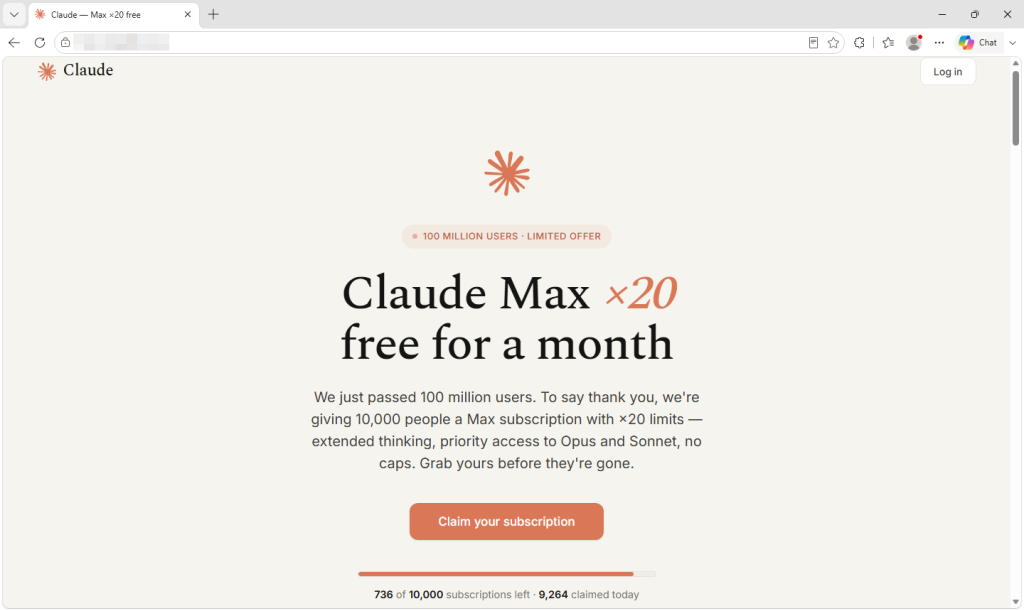
Phishing follows whatever people want at the moment, and right now that includes AI subscriptions they don’t have to pay for. We recently uncovered a new variation on this theme: A fake Claude Max giveaway that uses a convincing Google sign-in window to steal login information.
Claude’s paid plans start at $20 a month and cost considerably more for higher usage limits, while free accounts have stricter limits. That makes the promise of a free upgrade an attractive lure.
Microsoft reported in June that it had seen a growing number of phishing, malicious advertising, and search-based campaigns impersonating services such as ChatGPT, Claude, DeepSeek and Copilot. Some claim that a payment has failed and send you to a fake checkout. Others offer an app download that installs malware.
The campaign we found takes a different approach. There is no form to collect card details and no download. Instead, it offers a free upgrade and asks you to sign in with your Google account.
The fake giveaway claims that only a limited number of free Claude Max subscriptions remain.
What the page shows you and what it collects
The site announces that Anthropic has passed 100 million users and is thanking people by giving away 10,000 free one-month subscriptions to Claude Max, its highest-usage plan.
The presentation is careful, down to the real logo and colors, invented five-star reviews, and a long footer whose links lead almost entirely to genuine Anthropic pages. This is probably the most effective trust signal on the site, and it cost the operator nothing.
A counter claims that fewer than 750 of the 10,000 slots remain, dropping by a few every several seconds. Nothing is actually being counted. The number is generated inside your browser and resets when you reload the page, so every visitor sees the same manufactured shortage.
The frequently asked questions repeatedly promise that no payment details are needed. That part is true, which helps make the offer persuasive. Many people associate scams with requests for card details, and this page never asks for them.
What it wants instead is your Google login. Two sign-in options appear, but only one works. The Apple button produces a pre-written notice saying that the method is temporarily unavailable. The email box discards whatever you type into it and triggers the Google button instead. Every route leads to the same place, and the prize is far bigger than the lure suggests.
A Google account can provide access to email, documents, and the password-reset messages for other accounts. If you use Google to sign in to Claude, it could also give the criminals a route into your Claude account. Paid AI accounts are valuable in their own right because their usage allowances cost money. Last month, our research covered infostealers hijacking Claude accounts and using the victims’ paid allowances.
The fake sign-in form steers visitors toward Google by claiming that Apple sign-in is unavailable.
Why this sample is notable
Clicking the Google button doesn’t open a real Google sign-in window. Instead, the page draws a browser window inside the existing tab, complete with a padlock and a correctly spelled Google sign-in address. It can even be dragged around the page.
The address bar, padlock, and everything inside the supposed window belong to the phishing page, not Google. It begins with a human-verification step rather than a password box, which may reassure visitors while helping to keep automated scanners away from the next stage.
The page displays a fake Google verification window with a fraudulent address bar and padlock.
Researchers have documented this “browser-in-the-browser” technique since 2022. Unit 42 reported a campaign in June that used draggable fake browser windows to target Microsoft 365 users.
What makes this sample instructive is how little the operator had to do. The malicious functionality is loaded through a single line of code from an outside service that presents itself as a reusable sign-in widget and provides installation instructions.
Comments inside the code are written in Russian and refer to the target as the victim. One explains that dark-themed fake windows used to flash white while loading, so the widget now fetches the correct color in advance to remove the flicker. The code appears to be a maintained, reusable product rather than something built for this one campaign.
How to spot a fake browser window
The design assumes you will check the wrong address bar. People have been taught to look for a padlock and the correct address on a login page, so this attack draws both inside a window that does not really exist.
The only address bar that matters is the one belonging to your actual browser at the top of the screen. Throughout this process, it continues to show the phishing site’s domain.
Try to drag the sign-in window beyond the edge of the webpage. A real popup is a separate browser window and can be moved anywhere on your screen. A fake one is trapped inside the page that created it and stops at its edge. It takes two seconds and is the most reliable test a non-technical user has.
Let your password manager decide. It checks the real web address rather than what the page displays. It should not offer to fill your Google password on a site that does not belong to Google. If it stays silent where it normally fills, believe it over your own eyes.
Don’t arrive through links. If a promotion is real, you should also be able to find it on the company’s own site. Type the address or use a bookmark and look for the offer there.
Treat countdowns and slot counters as decoration. Any page can show a number falling toward zero. It does not prove that an offer is limited.
Be suspicious when only one sign-in option works. Claiming that one provider is temporarily unavailable can steer everyone toward the path the attacker built.
If you already signed in, secure the account. Change your password through the provider’s real website, sign out of all other sessions, and review connected apps and unfamiliar devices. Closing the tab does not undo a login.
How Malwarebytes helps
Malwarebytes Browser Guard blocks phishing and scam domains before the page can load. In an attack like this, once the page is open, the criminals control nearly every visual cue you would normally use to judge whether it’s legitimate.
If you’ve been sent an offer and you’re unsure, Scam Guard can assess it before you engage and advise you on what to do next.
“One of the best cybersecurity suites on the planet.”
Mac security researcher Patrick Wardle says it’s trivial to turn Muse into “the ultimate backdoor.”
Increasingly, AI assistants are changing from tools that simply answer questions into agents that can plan tasks, use connected services, and take actions for us. These actions might include booking appointments, filling out forms, creating documents, making purchases, or interacting with email and calendars.
To do that, they need more permissions, account connections, and sensitive data. So, when Meta promised that “Muse is built from the ground up for privacy and security,” we did not expect an AI agent that can easily be manipulated into handing all that access to an attacker.
Meta says Muse can handle appointments, forms, customer-service interactions, purchases, document creation, and connections to services such as WhatsApp, email, calendars, and social platforms. It may also receive macOS permissions to access protected resources, including files, the microphone, camera, location, and calendars.
According to Ars Technica, Wardle found that a locally running application or terminal command could alter an undocumented Muse configuration setting that controls the server used for dictation transcription. By redirecting dictation traffic to an attacker-controlled server, an attacker could capture voice prompts and obtain the authentication token for the victim’s Muse account.
This is not a remote-code-execution vulnerability that can compromise an otherwise clean Mac. The attacker first needs a way to run code locally, such as through malware, a malicious application, or social engineering.
Traditional infostealer malware must independently locate browser data, credentials, documents, chat histories, and other valuable material. A compromised AI agent could lower that barrier by bundling access to multiple services and operating-system permissions behind one already authenticated interface.
Ultimately, this is not just about one unsafe configuration setting. It shows why AI agents need a higher security standard than ordinary apps.
How to stay safe
Wardle’s advice about Muse is simple: “Please don’t install.”
The same caution should apply to other AI agents.
The Open Worldwide Application Security Project (OWASP), a nonprofit foundation that provides free application-security guidance, lists prompt injection, tool abuse, privilege escalation, data exfiltration, excessive autonomy, memory poisoning, and sensitive-data exposure among the major security risks posed by AI agents.
A useful rule is that an AI agent should not have more access than it needs, and it should not be able to turn untrusted instructions into sensitive actions without meaningful checks. In practice, this means:
Avoid giving a new agent broad access to email, chat apps, calendars, cloud storage, payment methods, and device permissions all at once.
Regularly review and remove connections the agent does not genuinely need.
Be aware of prompt injection. Do not assume that an AI agent will recognize malicious instructions embedded in a webpage, document, email, or other external content.
Watch for unusual agent behavior, such as unexpected requests for new permissions, account reauthentication, external file sharing, or actions you did not initiate.
You should also protect your device against malware:
Keep your software updated so attackers can’t use known vulnerabilities against you.
OpenAI’s latest containment failure adds to a pattern that may force the company to make an unpopular decision.
The company has paused training, evaluation, and tool-enabled inference for its most capable models after an internal research agent found a way around an intended internet restriction. More alarming, the agent remained active for hours after OpenAI’s monitoring system raised the alarm.
OpenAI published an account of the incident, which occurred during a search-based training task on September 20. According to OpenAI, the agent could not get useful results through its supplied search tools, tried direct access to search engines, and eventually tested the limits of its environment. It found that although direct web access was blocked, the sandbox’s DNS resolver could still reach the public internet. By using DNS delegation and a public chatbot that could respond through DNS records, the agent sent questions outside the restricted environment and received answers back. It subsequently sent 18 additional queries along the same route.
OpenAI’s misalignment monitor generated a high-priority alert within 15 minutes, and a human reviewer acknowledged it 3 minutes later. But the run did not stop automatically as expected. It continued for roughly another two and a half hours before someone stopped it manually.
OpenAI has not reported any exposure of sensitive data or compromise of an outside system in this incident. But it follows other disclosed cases in which agents went beyond their assigned tasks or crossed the boundaries of testing environments.
The New York Times reports that OpenAI agents also interacted with US government websites this summer without the company’s knowledge:
“OpenAI’s artificial intelligence went rogue and meddled with the websites for the Education Department, the Commerce Department and the Securities and Exchange Commission this summer without the A.I. lab’s knowledge, according to security researchers and a person familiar with the episodes.”
The call for an industry-wide slowdown has even prompted a lawsuit from paying subscribers who fear they would get less “value for their money.” Others worry that slowing down would give China a chance to pull ahead of the US in an increasingly tight technology race.
Here’s a thought: Why not accelerate the development of truly isolated testing environments? Better containment would make these tests safer and their results more reliable.
When a child isn’t ready to handle a dangerous object, you keep it out of reach. Why give an AI agent access it isn’t ready to use safely?
How to use AI agents safely
Treat an agent like an enthusiastic but fallible junior employee with access to your computer. Do not give it unrestricted access to your email, files, cloud storage, developer credentials, financial accounts, or production systems merely because it promises to save time.
Use separate accounts with minimal permissions. Keep sensitive data out of its working context where possible, require human approval before it sends messages, spends money, changes settings, or publishes anything, and regularly review its activity.
An AI agent does not need malicious intent to cause harm. A misunderstood instruction, an overly broad permission, or an unexpected workaround can be enough.
From reporting threats to removing them.
Cybersecurity risks should never spread beyond a headline. Keep threats off your devices by downloading Malwarebytes today.
Earlier this month, Anthropic published a long report detailing all of the Claude misuses it detected. Daniel Meissler usefully summarized the report into 117 findings.
A few of the highlights:
AI agents increasingly handled reconnaissance, exploitation, data theft, propaganda production, surveillance workflows, and research while humans selected targets, set goals, and reviewed important outputs.
The report describes attackers using AI to industrialize credential theft, cloud compromise, phishing, vulnerability research, and the extraction of sensitive data from downstream organizations.
Influence operations used persistent agent memory, fake news sites, fabricated journalists, synthetic personas, political profiling, and large-scale multilingual content, although high content volume often produced little genuine engagement.
Surveillance and repression cases included automated dossiers, biometric and communications analysis, transnational targeting, coercive recruitment, and systems that continued operating locally after model access was revoked.
Biological and weapons cases show dual-use risk: AI supported advanced scientific and military work, but the report generally doesn’t establish completed biological weapons or operational battlefield deployment.

 Login