Normal view

Palo Alto Networks Joins DNS-OARC as a Platinum Member

Palo Alto Networks recently joined the DNS-OARC community as a Platinum Member. Together, our organizations share a commitment to advancing collaboration in research and operational excellence across the global DNS ecosystem. DNS is critical to both internet infrastructure and security, and this collaboration facilitates the sharing of real-world insights among researchers and practitioners.

Our Contribution

We help organizations secure their digital environment with a comprehensive portfolio of cybersecurity solutions spanning Network, Cloud, Security Operations, AI and Identity. Trusted by more than 70,000 customers worldwide and informed by Unit 42® Threat Intelligence, their AI-driven platforms help organizations reduce complexity, modernize with confidence, and securely enable innovation.

As a Platinum Member, our subject matter experts will actively participate in the DNS-OARC community by engaging in discussions and contributing to research on evolving DNS threats and network challenges. The growing intersection of DNS and security makes access to intelligence and experience increasingly important. It strengthens the community’s ability to respond to emerging challenges and improves resilience across the internet.

Through our participation, our customers will gain stronger protection informed by community-driven intelligence and real-world operational insight. These learnings are continuously integrated into our threat intelligence and security capabilities. Our participation signals our support for DNS-OARC’s mission of fostering open dialogue and shared learning across the DNS ecosystem. This collaboration helps bridge DNS operations with broader security practices, improving coordination between operators, researchers and security practitioners.

Our Commitment to the DNS-OARC and Global Communities

Collaboration between our organizations strengthens the connection among DNS operations and modern security practices by bringing together operational insight and a global community dedicated to advancing the internet’s resilience.

For the DNS-OARC community, our commitment enhances knowledge sharing around evolving DNS threats, large-scale network operations and practical approaches to emerging challenges.

For organizations and customers, it reinforces a stronger alignment between DNS infrastructure and security, expands access to community-driven intelligence and supports more resilient, well-informed defenses.

Tong Zhao, Senior Manager of DNS Security Engineering, Palo Alto Networks:

We recognize the critical role of DNS-OARC in DNS operations and research. The teams from Palo Alto Networks believe that our DNS-OARC membership aligns perfectly with our goals. We are eager to participate in and contribute to the DNS community.

Our partnership with the DNC-OARC highlights the value of open collaboration in helping both the community and its participants stay ahead of an increasingly complex threat landscape. To learn more about how our expertise and insights support DNS-OARC’s mission to improve the security and stability of the internet’s DNS, visit DNS-OARC.

The post Palo Alto Networks Joins DNS-OARC as a Platinum Member appeared first on Palo Alto Networks Blog.


Mythos and Cybersecurity

17 April 2026 at 13:02

Last week, Anthropic pulled back the curtain on Claude Mythos Preview, an AI model so capable at finding and exploiting software vulnerabilities that the company decided it was too dangerous to release to the public. Instead, access has been restricted to roughly 50 organizations—Microsoft, Apple, Amazon Web Services, CrowdStrike and other vendors of critical infrastructure—under an initiative called Project Glasswing.

The announcement was accompanied by a barrage of hair-raising anecdotes: thousands of vulnerabilities uncovered across every major operating system and browser, including a 27-year-old bug in OpenBSD, a 16-year-old flaw in FFmpeg. Mythos was able to weaponize a set of vulnerabilities it found in the Firefox browser into 181 usable attacks; Anthropic’s previous flagship model could only achieve two.

This is, in many respects, exactly the kind of responsible disclosure that security researchers have long urged. And yet the public has been given remarkably little with which to evaluate Anthropic’s decision. We have been shown a highlight reel of spectacular successes. However, we can’t tell if we have a blockbuster until they let us see the whole movie.

For example, we don’t know how many times Mythos mistakenly flagged code as vulnerable. Anthropic said security contractors agreed with the AI’s severity rating 198 times, with an 89 per cent severity agreement. That’s impressive, but incomplete. Independent researchers examining similar models have found that AI that detects nearly every real bug also hallucinates plausible-sounding vulnerabilities in patched, correct code.

This matters. A model that autonomously finds and exploits hundreds of vulnerabilities with inhuman precision is a game changer, but a model that generates thousands of false alarms and non-working attacks still needs skilled and knowledgeable humans. Without knowing the rate of false alarms in Mythos’s unfiltered output, we cannot tell whether the examples showcased are representative.

There is a second, subtler problem. Large language models, including Mythos, perform best on inputs that resemble what they were trained on: widely used open-source projects, major browsers, the Linux kernel and popular web frameworks. Concentrating early access among the largest vendors of precisely this software is sensible; it lets them patch first, before adversaries catch up.

But the inverse is also true. Software outside the training distribution—industrial control systems, medical device firmware, bespoke financial infrastructure, regional banking software, older embedded systems—is exactly where out-of-the-box Mythos is likely least able to find or exploit bugs.

However, a sufficiently motivated attacker with domain expertise in one of these fields could nevertheless wield Mythos’s advanced reasoning capabilities as a force multiplier, probing systems that Anthropic’s own engineers lack the specialized knowledge to audit. The danger is not that Mythos fails in those domains; it is that Mythos may succeed for whoever brings the expertise.

Broader, structured access for academic researchers and domain specialists—cardiologists’ partners in medical device security, control-systems engineers, researchers in less prominent languages and ecosystems—would meaningfully reduce this asymmetry. Fifty companies, however well chosen, cannot substitute for the distributed expertise of the entire research community.

None of this is an indictment of Anthropic. By all appearances the company is trying to act responsibly, and its decision to hold the model back is evidence of seriousness.

But Anthropic is a private company and, in some ways, still a start-up. Yet it is making unilateral decisions about which pieces of our critical global infrastructure get defended first, and which must wait their turn.

It has finite staff, finite budget and finite expertise. It will miss things, and when the thing missed is in the software running a hospital or a power grid, the cost will be borne by people who never had a say.

The security problem is far greater than one company and one model. There’s no reason to believe that Mythos Preview is unique. (Not to be outdone, OpenAI announced that its new GPT-5.4-Cyber is so dangerous that the model also will not be released to the general public.) And it’s unclear how much of an advance these new models represent. The security company Aisle was able to replicate many of Anthropic’s published anecdotes using smaller, cheaper, public AI models.

Any decisions we make about whether and how to release these powerful models are more than one company’s responsibility. Ultimately, this will probably lead to regulation. That will be hard to get right and requires a long process of consultation and feedback.

In the short term, we need something simpler: greater transparency and information sharing with the broader community. This doesn’t necessarily mean making powerful models like Claude Mythos widely available. Rather, it means sharing as much data and information as possible, so that we can collectively make informed decisions.

We need globally co-ordinated frameworks for independent auditing, mandatory disclosure of aggregate performance metrics and funded access for academic and civil-society researchers.

This has implications for national security, personal safety and corporate competitiveness. Any technology that can find thousands of exploitable flaws in the systems we all depend on should not be governed solely by the internal judgment of its creators, however well intentioned.

Until that changes, each Mythos-class release will put the world at the edge of another precipice, without any visibility into whether there is a landing out of view just below, or whether this time the drop will be fatal. That is not a choice a for-profit corporation should be allowed to make in a democratic society. Nor should such a company be able to restrict the ability of society to make choices about its own security.

This essay was written with David Lie, and originally appeared in The Globe and Mail.

Closing the Gap by Enhancing Visibility and Mitigating Risks

1 April 2026 at 10:00

In the race to digitise public services, the UK’s digital estate has grown into a vast, borderless ecosystem that manual audits can no longer track. For UK Government departments, local authorities and NHS trusts, it is a sprawling, shifting landscape of cloud workloads, legacy infrastructure, shadow IT and third-party supplier connections.

This complexity creates blind spots that modern threats exploit. Recognising this vulnerability, the UK Government is moving toward a secure-by-design digital infrastructure, with the 2026 Government Cyber Action Plan (GCAP) setting a high bar for resilience. A central theme of the GCAP is the urgent need for the government to have better visibility of cyber security and resilience risk. Fundamentally, organisations cannot secure what they cannot see. As the GCAP explicitly states, the Government will use “data sources from across the government to truly understand government-wide and departmental cyber risks.”

The Challenge: Visibility in a “Landscape”

Many public sector organisations rely on a complex web of spreadsheets, data calls, legacy tools and manually curated lists to create an inventory of their internet-connected assets. But attackers do not look at an organisation's internal lists; they scan the internet for what they have forgotten to secure. Whether it is an unpatched server from a legacy project or a misconfigured database in a department, these "unknown unknowns" are the primary entry points for attackers.

The Strategic Mission: Empowering the Public Sector and Critical Industries

Palo Alto Networks Cortex Xpanse® is an active external attack surface management (EASM) solution that provides an outside-in view of organisations' entire digital footprint. It helps leaders meet national resilience goals:

  • Comprehensive, Continuous Visibility: Xpanse scans the global internet space continuously and identifies every asset associated with an organisation, without requiring software agents to be installed on your systems.
  • Accelerate Response: Leveraging automation, the solution streamlines response processes and enhances collaboration across dispersed teams from the sharing of findings to tracking actions and remediation.
  • Supply Chain Integrity: Inline with the new Cyber Security and Resilience Bill (bringing managed service providers and critical third parties into scope), Xpanse allows organisations to assess the internet-facing security posture of third-party partners and suppliers, ensuring a weak link elsewhere doesn't compromise the broader mission.
  • Alignment with GovAssure: Xpanse provides a consolidated risk profile and inventory for all internet-facing and cloud assets required for GovAssure assessments, turning a manual, months-long audit process into a continuous, data-driven cycle.
  • Investment prioritisation: Xpanse provides that much needed visibility to help executive committees and boards prioritise investment decisions on legacy IT and technical debt.

Aligning to National Cybersecurity Centre (NCSC) Guidance

How external attack surface management products work.

Palo Alto Networks Cortex Xpanse aligns with the National Cyber Security Centre (NCSC) external attack surface management (EASM) buyer's guide by providing automated discovery, continuous monitoring and risk prioritisation of internet-facing assets. It replaces manual, point-in-time audits with a proactive, agentless solution. By automating the discovery of all internet-accessible assets (including shadow IT and unmanaged cloud operations) the platform fulfills the NCSC’s core requirement for continuous global monitoring and rapid attribution. This data-driven approach allows for the automated prioritisation of critical exposures, such as RDP, and integrates seamlessly with multiple third-party automation and visualisation tools, including Cortex XSOAR® and XSIAM, to accelerate remediation with national incident response standards.

In fact, with Palo Alto Networks deployment of Cortex Xpanse, we were able to achieve a 95% reduction in external vulnerability management spending across more than 700,000 cloud instances, while improving coverage and outcomes.

Palo Alto Networks Cortex Xpanse Capabilities
  • Discover Assets: Leveraging organisations' known asset inventory and other data points, Xpanse performs continual, automated discovery of all internet-accessible assets, effectively eliminating blind spots created by shadow IT and unmanaged cloud operations.
  • Obtain Information: Always-on, continuous monitoring of an organisation's entire attack surface through daily scans of the global IP address space, ensuring that newly exposed services are identified quickly and accurately.
  • Perform Analysis: Xpanse automates and prioritises alerts on all identified risks by severity, enabling organisations to optimise resolution and risk management, allowing teams to properly allocate resources and focus on the most critical risks to the organisation.
  • Display Information and Provide Advice: Leveraging a unified view of the internet facing and cloud-based estate, Xpanse provides specific resolver guidance for every identified issue, supporting and monitoring automated resolution through multiple native integrations.
  • Monitor Risk: Always on, discreet continual monitoring provides an independent real time status of the digital estate. Leveraging the threat intelligence capabilities of Palo Alto Networks, Xpanse is uniquely positioned to provide rapid coverage for newly discovered vulnerabilities, exploits or misconfigurations.

Securing the public sector requires a move from manual, point in time assessments to data-driven intelligence. Cortex Xpanse provides the foundations to remove blind spots, secure the supply chain and prevent unknown vulnerabilities in the face of sophisticated threats.

For further information and case studies, visit the links below, or schedule a demo.

  • Palo Alto Networks: Slash false positives, remediation time budget with Cortex attack surface management.
  • U.S. Pentagon: Palo Alto Networks Cortex Xpanse supercharge the Cyber Defences for the Department of Defense.
  • Accenture: Secure rapid growth with Cortex Xpanse.

The post Closing the Gap by Enhancing Visibility and Mitigating Risks appeared first on Palo Alto Networks Blog.

Anatomy of a Cyber World Global Report 2026

25 March 2026 at 12:00

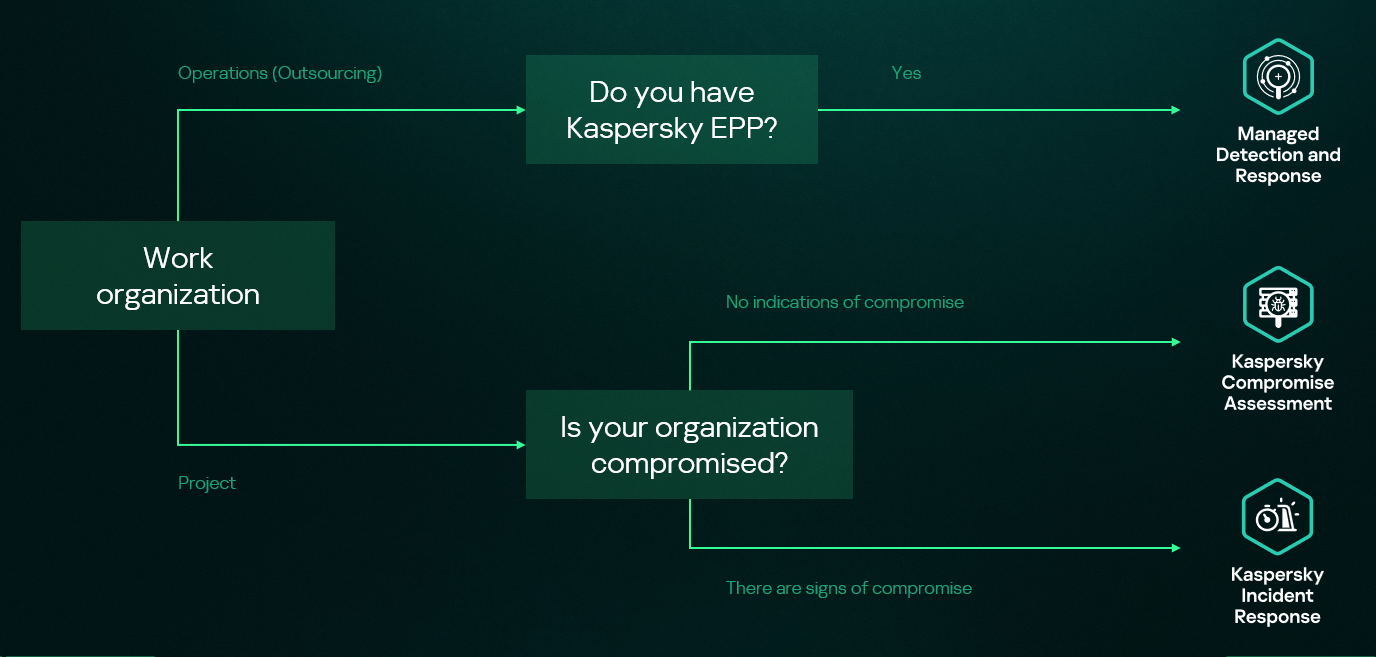
Kaspersky Security Services provide a comprehensive cybersecurity ecosystem, taking enterprise threat protection to another level. Services like Kaspersky Managed Detection and Response and Compromise Assessment allow for timely detection of threats and cyberattacks. SOC Consulting provides a practical approach ensuring the corporate infrastructure stays secured, while Incident Response is suited for timely remediation with a maximized recovery rate.

High-level overview of the MDR, IR and CA connection

High-level overview of the MDR, IR and CA connection

This new report brings together statistics across regions and industries from our Managed Detection and Response and Incident Response services, and for the first time, it also includes insights from our Compromise Assessment and SOC Consulting services — all to provide you with more comprehensive view of different aspects of corporate information security worldwide.

The scope of MDR and IR services

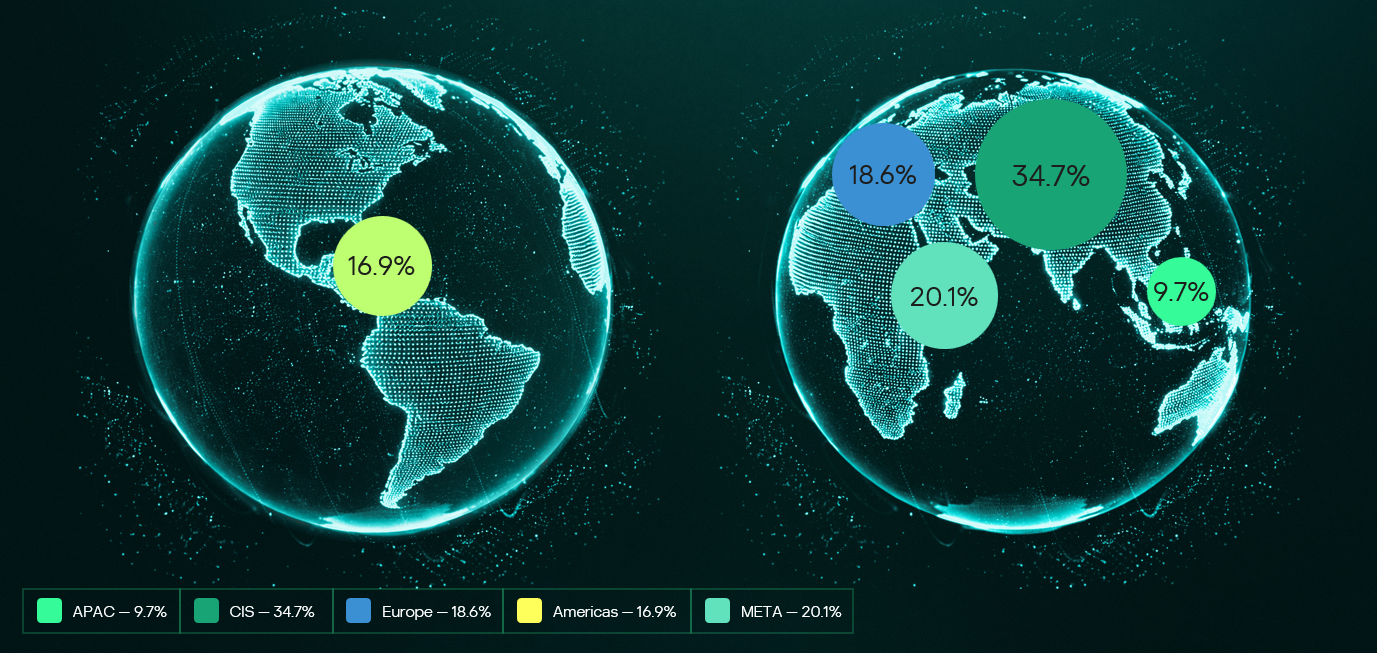
Provision of Kaspersky’s MDR and IR services follows a global approach. The majority of customers accounted for the CIS (34.7%), the Middle East (20.1%), and Europe (18.6%).

Distribution of customers by geographical region, 2025

Distribution of customers by geographical region, 2025

MDR telemetry

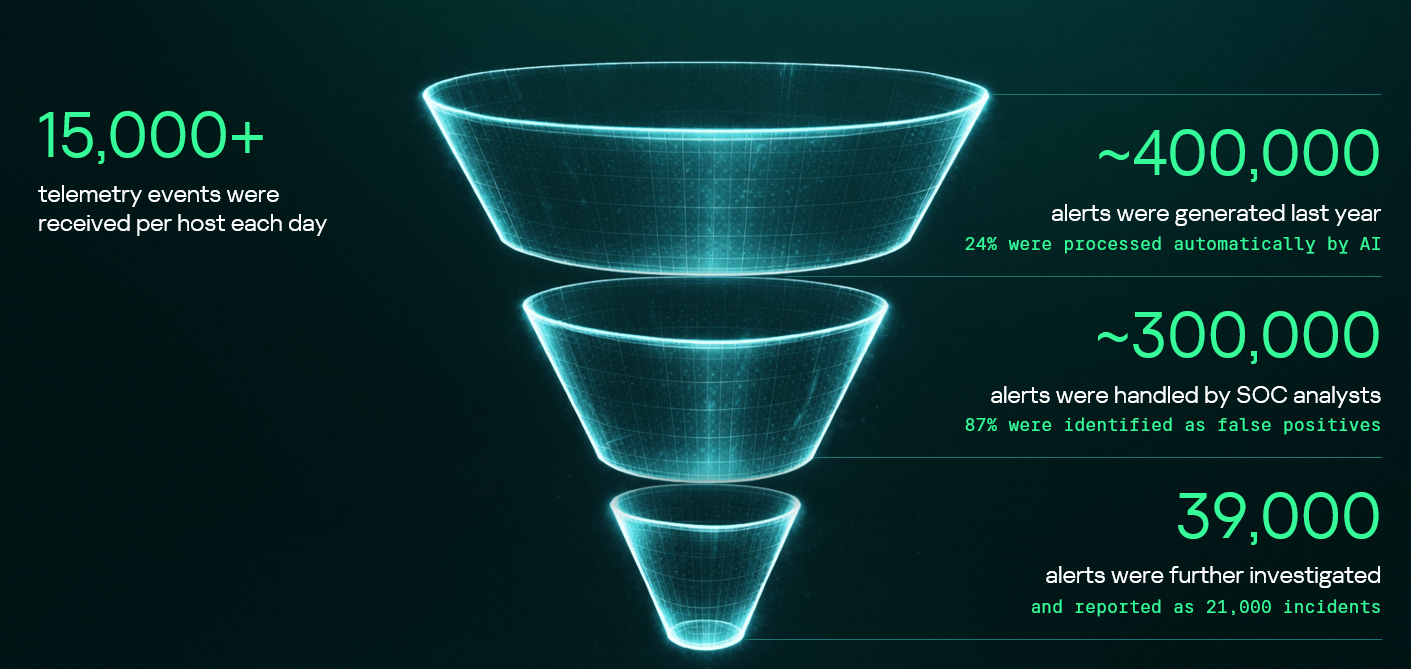
Following the previous year’s numbers, in 2025, the MDR infrastructure received and processed an average of 15,000 telemetry events per host every day, generating security alerts as a result. These alerts are first processed by AI-powered detection logic, after which Kaspersky SOC analysts handle them as required. Overall, a total of approximately 400,000 alerts were generated in 2025. After counting out false positives, 39,000 alerts were further investigated.

MDR telemetry statistics, 2025

MDR telemetry statistics, 2025

Incident statistics

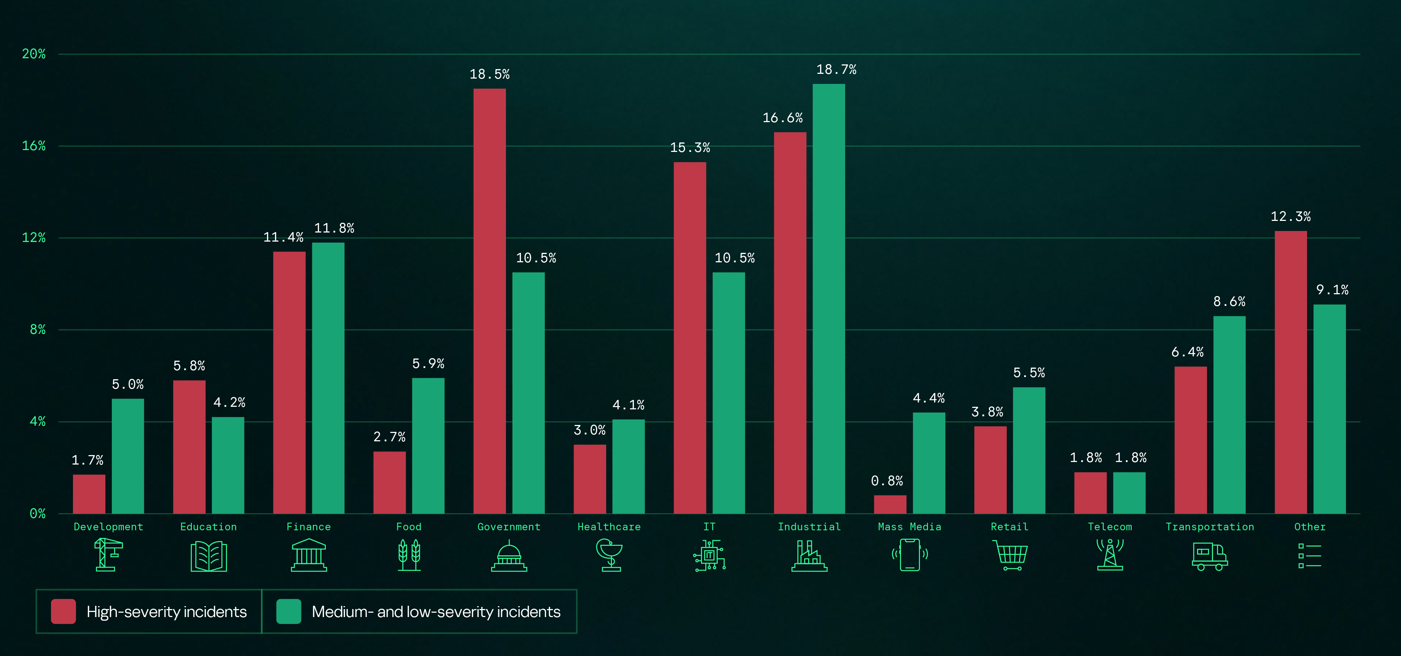
The distribution of remediation requests by industry has slightly changed as compared to previous years’ pattern. Government (18.5%) and industrial (16.6%) organizations are still the most targeted industries in regards to cyberattacks that require incident response activities. However, this year, the IT sector saw a growth in the number of IR requests, eventually being placed third in the overall industry distribution rankings and thus replacing financial organizations, which were targeted less often than in 2024. This is equally true for smaller-scale attacks that can be contained and remediated through automated means — the only difference is that medium- and low-severity incidents are more often experienced by financial organizations.

Distribution of all incidents by industry sector, 2025

Distribution of all incidents by industry sector, 2025

Key trends and statistics

This section presents key findings and trends in cyberattacks in 2025:

  • The number of high-severity incidents decreased, following a downward trend that we’ve been observing since 2021. The majority of those incidents account for APT attacks and red teaming exercises, which indicates two landscape trends. On the one hand, skilled adversaries make efforts to increase impact, while on the other, organizations spend more resources on probing their defense systems.
  • The most common vulnerabilities exploited in the wild were related to Microsoft products. Half of all identified CVEs led to remote code execution, notably without authentication in some cases.
  • Exploitation of public-facing applications, valid accounts, and trusted relationships remain the most popular initial vectors, and their overall share has increased, accounting to over 80% of all attacks in 2025. In particular, attacks through trusted relationships are evolving: their share has increased to 15.5% from 12.8% in 2024. They are also becoming more complex: for instance, we witnessed a case where adversaries had compromised more than two organizations in sequence to ultimately gain access to a third target.
  • Standard Windows utilities remain a popular LotL tool. Adversaries use those to minimize the risk of detection during delivery to a compromised system. The most popular LOLBins we observed in high-severity incidents were powershell.exe (14.4%), rundll32.exe (5.9%), and mshta.exe (3.8%). Among the most popular legitimate tools used in incidents we flag Mimikatz (14.3%), PowerShell (8.1%), PsExec (7.5%), and AnyDesk (7.5%).

The full 2026 Global Report provides additional information about cyberattacks, including real-world cases discovered by Kaspersky experts. We also describe SOC Consulting projects and Compromise Assessment requests. The report includes comprehensive analysis of initial attack vectors in correlation with the MITRE ATT&CK tactics and techniques and the full list of vulnerabilities that we detected during Incident Response engagements.

Anatomy of a Cyber World Global Report 2026

25 March 2026 at 12:00

Kaspersky Security Services provide a comprehensive cybersecurity ecosystem, taking enterprise threat protection to another level. Services like Kaspersky Managed Detection and Response and Compromise Assessment allow for timely detection of threats and cyberattacks. SOC Consulting provides a practical approach ensuring the corporate infrastructure stays secured, while Incident Response is suited for timely remediation with a maximized recovery rate.

High-level overview of the MDR, IR and CA connection

High-level overview of the MDR, IR and CA connection

This new report brings together statistics across regions and industries from our Managed Detection and Response and Incident Response services, and for the first time, it also includes insights from our Compromise Assessment and SOC Consulting services — all to provide you with more comprehensive view of different aspects of corporate information security worldwide.

The scope of MDR and IR services

Provision of Kaspersky’s MDR and IR services follows a global approach. The majority of customers accounted for the CIS (34.7%), the Middle East (20.1%), and Europe (18.6%).

Distribution of customers by geographical region, 2025

Distribution of customers by geographical region, 2025

MDR telemetry

Following the previous year’s numbers, in 2025, the MDR infrastructure received and processed an average of 15,000 telemetry events per host every day, generating security alerts as a result. These alerts are first processed by AI-powered detection logic, after which Kaspersky SOC analysts handle them as required. Overall, a total of approximately 400,000 alerts were generated in 2025. After counting out false positives, 39,000 alerts were further investigated.

MDR telemetry statistics, 2025

MDR telemetry statistics, 2025

Incident statistics

The distribution of remediation requests by industry has slightly changed as compared to previous years’ pattern. Government (18.5%) and industrial (16.6%) organizations are still the most targeted industries in regards to cyberattacks that require incident response activities. However, this year, the IT sector saw a growth in the number of IR requests, eventually being placed third in the overall industry distribution rankings and thus replacing financial organizations, which were targeted less often than in 2024. This is equally true for smaller-scale attacks that can be contained and remediated through automated means — the only difference is that medium- and low-severity incidents are more often experienced by financial organizations.

Distribution of all incidents by industry sector, 2025

Distribution of all incidents by industry sector, 2025

Key trends and statistics

This section presents key findings and trends in cyberattacks in 2025:

  • The number of high-severity incidents decreased, following a downward trend that we’ve been observing since 2021. The majority of those incidents account for APT attacks and red teaming exercises, which indicates two landscape trends. On the one hand, skilled adversaries make efforts to increase impact, while on the other, organizations spend more resources on probing their defense systems.
  • The most common vulnerabilities exploited in the wild were related to Microsoft products. Half of all identified CVEs led to remote code execution, notably without authentication in some cases.
  • Exploitation of public-facing applications, valid accounts, and trusted relationships remain the most popular initial vectors, and their overall share has increased, accounting to over 80% of all attacks in 2025. In particular, attacks through trusted relationships are evolving: their share has increased to 15.5% from 12.8% in 2024. They are also becoming more complex: for instance, we witnessed a case where adversaries had compromised more than two organizations in sequence to ultimately gain access to a third target.
  • Standard Windows utilities remain a popular LotL tool. Adversaries use those to minimize the risk of detection during delivery to a compromised system. The most popular LOLBins we observed in high-severity incidents were powershell.exe (14.4%), rundll32.exe (5.9%), and mshta.exe (3.8%). Among the most popular legitimate tools used in incidents we flag Mimikatz (14.3%), PowerShell (8.1%), PsExec (7.5%), and AnyDesk (7.5%).

The full 2026 Global Report provides additional information about cyberattacks, including real-world cases discovered by Kaspersky experts. We also describe SOC Consulting projects and Compromise Assessment requests. The report includes comprehensive analysis of initial attack vectors in correlation with the MITRE ATT&CK tactics and techniques and the full list of vulnerabilities that we detected during Incident Response engagements.

New findings show how hands-on support can improve water sector cybersecurity

19 March 2026 at 15:01

Cyber threats to water systems are no longer hypothetical. When attacks succeed, communities can face loss of trust, safety concerns, or service disruptions.

Today, Microsoft, in collaboration with the Cyber Readiness Institute (CRI) and the Center on Cyber Technology and Innovation (CCTI), is releasing a report that examines both the urgency of this challenge and what it will take to close the cyber readiness gap in the water sector. The report draws on a pilot program that provided water and wastewater utilities with practical cybersecurity training paired with hands‑on coaching, testing whether real-world support can meaningfully improve cyber readiness.

The findings point to a clear conclusion: improving cyber resilience in the water sector is achievable when training is paired with hands-on support and delivered through trusted sector partners. Because of the success of this pilot, the program is now a permanent offering, giving water utilities continued access to practical training and support to strengthen cyber resilience and better protect their communities from evolving threats.

Why cyber resilience in the water sector matters now

Water and wastewater utilities underpin public health, economic activity, and community resilience across all critical infrastructure. Yet recent assessments from the U.S. intelligence community and public reporting on cyber incidents underscore how exposed many systems remain. Even larger, well-resourced utilities have experienced cyber incidents, highlighting vulnerabilities that are far more pronounced among smaller operators serving rural and underserved communities.

Awareness of cyber risk is growing, but awareness is not preparedness. The challenge is how to move from growing awareness to sustained, operational readiness, especially for utilities with limited time, funding, and technical capacity.

What the pilot set out to test and what it showed

The CRI pilot was designed to answer a practical question facing the water sector: can accessible, behavior‑focused cybersecurity training paired with hands‑on support meaningfully improve cyber readiness?

Participating utilities used CRI’s free Cyber Readiness Program, which focuses on core cybersecurity practices such as strong authentication, software updates, phishing awareness, and secure data handling. Utilities also had access to CRI Certified Cyber Coaches, who worked directly with designated “Cyber Leaders” inside utilities to help translate training into policies, playbooks, and incident response planning. This model paired accessible training with personalized support to help utilities make meaningful progress despite resource constraints. The pilot revealed three clear findings about what helps and what limits cyber readiness in the water sector.

  • CRI program improves readiness: Participating utilities reported stronger cybersecurity fundamentals, greater confidence responding to incidents, and the identification of previously undocumented, yet critical, gaps such as missing continuity plans and weak password practices.
  • Hands-on support accelerates success: Utilities paired with a CRI‑certified coach were significantly more likely to complete the program than those participating on a self‑paced basis.
  • Demand exceeds capacity: While interest in cybersecurity support is high, staffing shortages, limited funding, and dependence on third-party vendors continue to limit utilities’ ability to fully implement improvements. Participation data helps explain this finding: of the 113 utilities that expressed initial interest, 72 began the program and 43 completed it.

Implications for policymakers and the ecosystem

The findings point to a central takeaway for policymakers and the ecosystem: improving cybersecurity outcomes requires moving beyond sharing information to providing hands-on support that helps utilities implement and sustain change.

  • Free resources are necessary but not enough: No-cost guidance alone cannot overcome staffing and funding constraints. Effective programs must include implementation support, like cyber coaches, to drive real outcomes.
  • Incentives increase participation: Tying cybersecurity training to operator licensing or continuing education requirements helps embed cyber readiness into routine professional development.
  • Trusted messengers drive engagement: Participation and completion were highest when programs were facilitated through established sector associations and networks that utilities already trust.

A path forward through collaboration

The lesson from this pilot is clear: cyber readiness improves when training is paired with hands‑on support and facilitated through trusted partners. But the findings also underscore a broader reality: lasting progress will require moving beyond information sharing toward approaches that build real, sustained capacity building on the ground.

At Microsoft, this work reflects a practical commitment to supporting cyber resilience across critical infrastructure, helping to move from awareness to action. Addressing the challenges identified in this report will require continued collaboration among policymakers, sector associations, nonprofits, and the private sector.

This work also complements Microsoft’s broader commitment to be water positive, including minimizing our water use and replenishing more water than we consume[1][2], by helping strengthen the resilience of the water systems and utilities that serve communities. Supporting practical cyber readiness is one way we can contribute to more resilient water systems for the future.

[1] Sustainability | Microsoft

[2] Building Community-First AI Infrastructure – Microsoft On the Issues

The post New findings show how hands-on support can improve water sector cybersecurity appeared first on Microsoft On the Issues.

❌