Vulnerability and exposure management (VM) teams need critical metadata and context that clearly show which issues pose an immediate risk to their organization. While traditional VM frameworks tell defenders how severe a vulnerability may be, they do not provide visibility into how likely threat actors are to exploit it. This leaves security teams overwhelmed in patch backlogs without a clear strategy for prioritization.
Nowhere is this prioritization gap more dangerous than with ransomware. Ransomware-as-a-Service (RaaS) groups no longer choose targets at random. They look for specific technical conditions that make vulnerability exploitation easy, fast, and repeatable. With RaaS attacks rising by 45% period-over-period in H1 2026, organizations need a way to identify the specific traits that make a vulnerability attractive to ransomware operators before an attack occurs.
Flashpoint built the Ransomware Risk score into Flashpoint Vulnerability Intelligence to solve exactly this problem. Since 2022, it has rated newly discovered vulnerabilities based on how closely they resemble those known to be used in ransomware attacks. With the grant of the U.S. Patent No. 12,705,360 on August 11, 2026, the methodology behind the score is now formally patented. This milestone formalizes Flashpoint’s ability to cut through the noise with a proven, threat-informed signal that gives defenders the clarity they need to act on Day Zero.
“As vulnerability disclosures surge, prioritization is more important than ever for security teams. A severity score alone can’t tell you which vulnerabilities pose the greatest real-world risk of exploitation by ransomware actors.
Our patented Ransomware Risk model applies years of threat intelligence to that problem, giving customers an earlier signal and helping them prioritize based on how attackers actually operate.”
josh lefkowitz, co-founder and ceo at flashpoint
Under the Hood: How Flashpoint’s Patented Ransomware Vulnerability Model Works
The patented system evaluates newly disclosed vulnerabilities against the patterns shared by vulnerabilities ransomware groups have exploited. Rather than trying to predict what threat actors will do next, the model learns what past ransomware-exploited vulnerabilities have in common and compares each new flaw against those patterns.
The Four Step Process
Multi-Factor Fingerprinting
Every vulnerability ingested into Flashpoint Vulnerability Intelligence is profiled against more than 60 distinct technical factors. This “fingerprinting” links the vulnerability to key inputs including whether the flaw is remotely exploitable without authentication, whether it affects SCADA or Operational Technology (OT) systems, and its potential impact on data availability, which is central to extortion schemes.
Coordinate Mapping
The model turns each multi-factor fingerprint into a set of values that place it as a single point on a map, so vulnerabilities with similar profiles land close together.
Identifying the Ransomware Neighborhood (Cluster Check)
Flashpoint overlays historical threat data onto the map to establish neighborhoods where vulnerabilities previously exploited in real-world ransomware attacks aggregate.
Similarity and Likelihood Rating
When a new vulnerability is ingested, its coordinates are checked against these neighborhoods. The scoring system calculates its spatial proximity to known ransomware vectors and assigns a clear rating: Low, Medium, High, or Critical.
This four-step method, developed by Flashpoint’s Ben Haynes and Jacob Kouns, is the basis of U.S. Patent No. 12,705,360.
What It Means for Vulnerability Management Teams
By translating complex structural attributes into a single risk score, the patented model delivers four key operational advantages:
Prioritize Beyond CVSS: Leveraging the Ransomware Risk model, security teams can confidently prioritize 1.0 to 6.9 CVSS issues if its structural profile lands it in a “High” or “Critical” ransomware cluster.
Act on Day Zero: Because the Flashpoint model rates all vulnerabilities on disclosure, security teams gain actionable guidance immediately, eliminating the need to wait weeks for external exploitation reports.
Effectively Communicate Risk: CISOs can present clear, business-centric risk statements rather than abstract numerical scores.
Adaptive Ratings: Scores update in near real time as vulnerability details change, and the model keeps adjusting as new vulnerabilities join the set it compares against.
Flashpoint’s Ransomware Risk model is built to enhance, not replace the vulnerability management frameworks organizations already rely on. In fact, it provides even greater value for security teams as our Ransomware Risk model provides clarity for every vulnerability detailed by Flashpoint Vulnerability Intelligence, including over 105,000 issues missed by CVE and NVD.
Within Flashpoint Ignite, security teams have a complete view of vulnerability risk, seeing the score alongside CVSS (v3 and v4), EPSS, Social Risk, and exploit maturity.
Patented Ransomware Risk Score sits beside CVSS and EPSS on every vulnerability record in Flashpoint Ignite
Protect Against Vulnerability and Ransomware Risk Using Flashpoint
Vulnerability management requires more than cataloging. It demands threat-informed prioritization that aligns security operations with real-world business risk. Flashpoint’s patented Ransomware Risk model eliminates guesswork by surfacing the flaws that match the profile of known ransomware targets, allowing security teams to patch what matters most, first.
By combining proprietary knowledge of vulnerability architecture and ransomware attacks, Flashpoint bridges the gap between theoretical and active exposure. Request a demo today to see how our Ransomware Risk model provides the definitive signal needed to stay ahead of extortion groups.
Ransomware Risk FAQs (Frequently Asked Questions)
What is the Ransomware Risk score?
The Ransomware Risk score is a rating in Flashpoint Vulnerability Intelligence that shows how closely a vulnerability resembles those known to be used in ransomware attacks. Each vulnerability is rated Low, Medium, High, or Critical, so security teams can see which ones to patch first to reduce their ransomware exposure.
How is Ransomware Risk different from CVSS and EPSS?
CVSS measures how severe a vulnerability could be, and EPSS estimates how likely it is to be exploited in general. Ransomware Risk adds a ransomware-specific signal that works alongside both, showing how closely a vulnerability matches those ransomware groups have used. In Flashpoint Ignite, all three scores appear together.
What does Flashpoint’s ransomware patent cover?
U.S. Patent No. 12,705,360, granted August 11, 2026, covers Flashpoint’s method for rating how likely a vulnerability is to be used in a ransomware event. Each vulnerability is profiled on more than 60 factors, compared with vulnerabilities used in past ransomware attacks, and rated by similarity. The patent formalizes the model behind the Ransomware Risk score, live since 2022.
How often are Ransomware Risk scores updated?
Ransomware Risk scores update in near real time, so new vulnerabilities are rated as soon as they’re disclosed. The model also keeps adjusting as new vulnerabilities join the body it compares against, so ratings reflect the ransomware landscape as it stands today.
On September 15 this year, Google published details of patches for 110 vulnerabilities in its own Google Pixel smartphones. Among all the disclosed flaws, CVE-2026-58704 stands out the most, for it appears that this zero-day is being exploited in targeted attacks.
In today’s post, we talk about what’s so special about the Google Pixel, and why these devices get security updates all of their own – separate from regular Android updates. We also cover the vulnerabilities addressed in this latest update, with a special focus on the mentioned, most dangerous one – CVE-2026-58704 – and wrap up with tips on how to both protect your device and avoid becoming a victim of cyberattack on it.
Why do Google Pixel phones get security updates separate from Android?
The reader might reasonably wonder: I’ve already installed this month’s Android security updates on my Google Pixel. Isn’t that the same thing? Google Pixel does run on Android and receives those security updates, which are detailed in the monthly Android Security Bulletin. However, manufacturers of Android-based devices use different sets of hardware and software components. That’s why, alongside vulnerabilities common to all Android devices, there are security issues specific to individual manufacturers’ devices.
For its own smartphones, Google publishes separate security updates, covered by a dedicated Pixel Update Bulletin. Rather than replacing the Android Security Bulletin, this document complements it by detailing vulnerabilities specific to devices manufactured by Google. Other Android smartphones also receive similar updates from their manufacturers.
The Pixel Update Bulletin for September 2026 clearly shows why Google needs separate updates for its smartphones in the first place. Many of the vulnerabilities it fixes affect specific Pixel hardware (or hardware-related) components: the modem, bootloader, GPU, fingerprint scanner components, and other parts of the device. On smartphones from other manufacturers, these features might rely on entirely different hardware and software components, so the fixes listed in the Pixel Update Bulletin don’t apply to those phones.
That said, these vulnerabilities could still be relevant for Pixel owners who’ve flashed their devices with custom ROMs. Switching to a different OS doesn’t alter the device’s hardware components, and may not replace the firmware. Therefore, the vulnerabilities themselves may persist, but whether patches are available, and how they’re installed, depends on the specific OS.
CVE-2026-58704: a zero-day vulnerability being actively exploited in the wild
Now let’s look closer at the specific vulnerabilities Google fixed in September. The most significant one is the above-mentioned CVE-2026-58704.
This vulnerability affects the Cellular Modem component, which handles the smartphone’s communication with cellular networks. It stems from a logic error in the code, which, under certain conditions, allows bypassing the intended permission check.
Successful exploitation of CVE-2026-58704 lets attackers escalate privileges on the smartphone to gain broader access to its functions and data. Note that the attack takes place over a cellular network and the threat actors need low-level privileges on the targeted device to start with.
In practice, this means attackers can’t exploit CVE-2026-58704 to attack a Pixel from just anywhere over the internet, as they’d apparently need to either compromise the cellular network the target smartphone is already connected to or, more likely, force it to connect to a malicious base station under their control.
Google hasn’t disclosed all the details of this vulnerability yet, and the related report is not publicly accessible. As a result, the technical details that would show how easy it is for attackers to exploit CVE-2026-58704 remain unknown pending installation of the patches on all devices.
Nevertheless, Google claims that there are signs of limited exploitation of CVE-2026-58704.
What we know about the other 109 vulnerabilities
Of the remaining 109 vulnerabilities found in Google Pixel devices, only one is rated moderate; the others are either high (62) or outright critical (46). Nine of these flaws fall into the RCE (remote code execution) category. This means that if an attacker successfully exploits one of these vulnerabilities, they can remotely force the device to run malicious code. The exact conditions for the attack depend on the specific vulnerability.
Another 88 vulnerabilities fall into the elevation of privilege (EoP) category. These let an attacker who’s already gained a certain level of access to the device expand their privileges. The CVE-2026-58704 vulnerability discussed above falls into this same category, which is why the September bulletin lists 89 EoP vulnerabilities in total.
Finally, 10 vulnerabilities can lead to information disclosure (ID), and two more to denial of service (DoS). In short, that’s a hefty list of flaws, so Google Pixel owners shouldn’t wait around to install the patches.
How to avoid becoming a victim
Google Pixel owners can install the update that fixes the vulnerabilities covered in this post by following this path: Settings → Security & privacy → System & updates → Security update → Install. Keep in mind that the phone will automatically restart to finish installing the update.
To keep your phone secure we recommend the following general measures:
Install security updates on your phone regularly and promptly – whether it’s a Google Pixel, an Android smartphone from a different manufacturer, or even an iPhone.
Avoid installing apps from questionable sources.
Read reviews before installing apps from official stores, since malware isn’t uncommon there too. Users who have already been burned will often sound the alarm in the reviews long before store moderators get around to removing the dangerous app.
Install a reliable security solution to keep you from downloading malware, and warn you about suspicious activity on your device.
The number of vulnerabilities detected in code continues to rise. According to Kaspersky’s threat analysis, 5,200 critical vulnerabilities were found in the first half of this year alone — nearly 50% more than during the same period last year. At the same time, the average gap between the publication of information about a vulnerability and the first attempts to exploit it is shrinking. The rapid development of AI systems plays a significant role in this process: while helping companies find weaknesses in their code, AI simultaneously shows hackers how to exploit them quicker.
It would seem that solving the problem of security gaps is very easy. All you need do is set up a scanner, check the infrastructure more often, and update vulnerable systems. But statistics from the Kaspersky Incident Response service show the opposite: a significant number of cyberattacks begin precisely by exploiting a flaw — and these are often already known flaws, not zero-day vulnerabilities.
Using a scanner does not give you an effective vulnerability management process. A scanner merely finds flaws (not always promptly), and then the IT team is tasked with prioritizing and fixing them. These processes can drag on for weeks, and in the meantime an attacker can easily gain access to the given infrastructure.
Where time is lost
The first delay can occur immediately after information about a vulnerability appears in databases. In addition to monitoring for breaches, the information security team is normally handling a dozen-or-so other tasks, so it relies entirely on the scanner for monitoring. If the scanner is configured to run weekly, a new vulnerability will appear in the report in a few days. In a company where scans are conducted quarterly, this obviously happens much later. Attackers, on the other hand, actively monitor news feeds and learn about new vulnerabilities immediately.
When the report finally reaches the security team, it contains far more than just one issue, raising the question of where to start. Critical vulnerabilities are addressed first, but attackers might exploit more than just those. Meanwhile, prioritization decisions are rarely based on data: often, they’re based on the order of the errors in the report, the name of the vulnerable system (they start with the one everyone’s talking about), or increased activity from its owner. Because of this, the risk of overlooking a serious threat is very high. Finally, the IT department takes on the vulnerability, and… it ends up back in the queue: they need to check the update’s compatibility and wait for a maintenance window.
After installing the update, the specialists close the ticket with a clear conscience and mark the status as completed. But would anyone verify that the patch was applied to all affected machines? Even the one that was turned off at the time of installation? Probably not, and then the company would assume the vulnerability was fixed, even though it’ll actually remain in the infrastructure for an indefinite period. This is the worst possible outcome: the risk remains — yet it’s no longer visible.
Put it all together, and what we get is months passing between disclosure and actual resolution. There’s no one in particular to blame here: every participant in the chain did what they’re supposed to. It’s just that this chain itself is made up of links with gaps between them.
A recipe for vulnerability management
To give attackers as few opportunities to gain access to corporate infrastructure as possible, it’s important to ensure that an organization has four key processes clearly established:
1. Inventory
It’s impossible to verify the security of a system that no one knows exists. At the same time, virtually any large infrastructure will contain things like having had a server set up “for a week” three years ago, a network device left over from previous business owners, or a workstation that was forgotten during an office move. And each of these assets can pose a serious threat.
The goal of inventory management is to ensure complete transparency of the IT infrastructure. To achieve this, an up-to-date list of assets is compiled.
2. Prioritization
When analyzing vulnerabilities, a security specialist shouldn’t rely solely on ratings from public databases such as the NVD, for these don’t always rely the real severity of the actual potential damage caused by exploiting a vulnerability. The specific structure of an organization’s infrastructure will have a significant impact. For example, the same vulnerability in a server located in an isolated segment, and in a system accessible from the internet, represents two very different risks.
Effective prioritization takes into account not only the publicly reported severity level but also the role of the vulnerable asset within the infrastructure, the likelihood of exploitation, and actual attack trends.
3. Configuration settings
Overly permissive access settings, disabled security mechanisms, and default accounts are not technically vulnerabilities, but they often serve as entry points for cybercriminals. To prevent an attacker from exploiting inadequate configuration settings, security teams should follow several basic security best practices:
Blind spots are particularly common at the last stage of the vulnerability management process. Typically, once the IT department formally installs an update, the vulnerability is considered patched. However, before breathing a final sigh of relief, it’s important to at least verify that the patch has been successfully applied to all affected systems and has actually resolved the vulnerability.
It reduces the time between publication of vulnerability data and its detection in assets. The product automatically inventories the infrastructure — tracking even long-forgotten assets — and continuously scans it for vulnerabilities. Scanning is performed in two ways: agent-based and agentless. In the former, the solution runs on top of Kaspersky Endpoint Security, which allows for in-depth analysis of workstations and servers without transmitting service credentials over the network. In the latter, it analyzes ports and services where no agent is present. Both methods complement each other, enabling complete coverage of the company’s infrastructure.
Checks configurations. Compliance with security standards is verified using predefined profiles.
Prioritizes vulnerabilities. Priorities are assigned based on severity level, the characteristics of the specific asset, likelihood of exploitation, and other parameters.
Promptly fixes errors. This involves remediation recommendations and centralized patch management integrated into the familiar administration infrastructure.
Helps ensure that the vulnerability is fully patched. A remediation task is considered complete only after a follow-up verification.
Flashpoint was awarded U.S. Patent No. 12,705,360 for its Ransomware Risk model, which rates how closely new vulnerabilities match those used in ransomware attacks.
Vulnerability and exposure management (VM) teams need critical metadata and context that clearly show which issues pose an immediate risk to their organization. While traditional VM frameworks tell defenders how severe a vulnerability may be, they do not provide visibility into how likely threat actors are to exploit it. This leaves security teams overwhelmed in patch backlogs without a clear strategy for prioritization.
Nowhere is this prioritization gap more dangerous than with ransomware. Ransomware-as-a-Service (RaaS) groups no longer choose targets at random. They look for specific technical conditions that make vulnerability exploitation easy, fast, and repeatable. With RaaS attacks rising by 45% period-over-period in H1 2026, organizations need a way to identify the specific traits that make a vulnerability attractive to ransomware operators before an attack occurs.
Flashpoint built the Ransomware Risk score into Flashpoint Vulnerability Intelligence to solve exactly this problem. Since 2022, it has rated newly discovered vulnerabilities based on how closely they resemble those known to be used in ransomware attacks. With the grant of the U.S. Patent No. 12,705,360 on August 11, 2026, the methodology behind the score is now formally patented. This milestone formalizes Flashpoint’s ability to cut through the noise with a proven, threat-informed signal that gives defenders the clarity they need to act on Day Zero.
“As vulnerability disclosures surge, prioritization is more important than ever for security teams. A severity score alone can’t tell you which vulnerabilities pose the greatest real-world risk of exploitation by ransomware actors.
Our patented Ransomware Risk model applies years of threat intelligence to that problem, giving customers an earlier signal and helping them prioritize based on how attackers actually operate.”
josh lefkowitz, co-founder and ceo at flashpoint
Under the Hood: How Flashpoint’s Patented Ransomware Vulnerability Model Works
The patented system evaluates newly disclosed vulnerabilities against the patterns shared by vulnerabilities ransomware groups have exploited. Rather than trying to predict what threat actors will do next, the model learns what past ransomware-exploited vulnerabilities have in common and compares each new flaw against those patterns.
The Four Step Process
Multi-Factor Fingerprinting
Every vulnerability ingested into Flashpoint Vulnerability Intelligence is profiled against more than 60 distinct technical factors. This “fingerprinting” links the vulnerability to key inputs including whether the flaw is remotely exploitable without authentication, whether it affects SCADA or Operational Technology (OT) systems, and its potential impact on data availability, which is central to extortion schemes.
Coordinate Mapping
The model turns each multi-factor fingerprint into a set of values that place it as a single point on a map, so vulnerabilities with similar profiles land close together.
Identifying the Ransomware Neighborhood (Cluster Check)
Flashpoint overlays historical threat data onto the map to establish neighborhoods where vulnerabilities previously exploited in real-world ransomware attacks aggregate.
Similarity and Likelihood Rating
When a new vulnerability is ingested, its coordinates are checked against these neighborhoods. The scoring system calculates its spatial proximity to known ransomware vectors and assigns a clear rating: Low, Medium, High, or Critical.
This four-step method, developed by Flashpoint’s Ben Haynes and Jacob Kouns, is the basis of U.S. Patent No. 12,705,360.
What It Means for Vulnerability Management Teams
By translating complex structural attributes into a single risk score, the patented model delivers four key operational advantages:
Prioritize Beyond CVSS: Leveraging the Ransomware Risk model, security teams can confidently prioritize 1.0 to 6.9 CVSS issues if its structural profile lands it in a “High” or “Critical” ransomware cluster.
Act on Day Zero: Because the Flashpoint model rates all vulnerabilities on disclosure, security teams gain actionable guidance immediately, eliminating the need to wait weeks for external exploitation reports.
Effectively Communicate Risk: CISOs can present clear, business-centric risk statements rather than abstract numerical scores.
Adaptive Ratings: Scores update in near real time as vulnerability details change, and the model keeps adjusting as new vulnerabilities join the set it compares against.
Flashpoint’s Ransomware Risk model is built to enhance, not replace the vulnerability management frameworks organizations already rely on. In fact, it provides even greater value for security teams as our Ransomware Risk model provides clarity for every vulnerability detailed by Flashpoint Vulnerability Intelligence, including over 105,000 issues missed by CVE and NVD.
Within Flashpoint Ignite, security teams have a complete view of vulnerability risk, seeing the score alongside CVSS (v3 and v4), EPSS, Social Risk, and exploit maturity.
Patented Ransomware Risk Score sits beside CVSS and EPSS on every vulnerability record in Flashpoint Ignite
Protect Against Vulnerability and Ransomware Risk Using Flashpoint
Vulnerability management requires more than cataloging. It demands threat-informed prioritization that aligns security operations with real-world business risk. Flashpoint’s patented Ransomware Risk model eliminates guesswork by surfacing the flaws that match the profile of known ransomware targets, allowing security teams to patch what matters most, first.
By combining proprietary knowledge of vulnerability architecture and ransomware attacks, Flashpoint bridges the gap between theoretical and active exposure. Request a demo today to see how our Ransomware Risk model provides the definitive signal needed to stay ahead of extortion groups.
Ransomware Risk FAQs (Frequently Asked Questions)
What is the Ransomware Risk score?
The Ransomware Risk score is a rating in Flashpoint Vulnerability Intelligence that shows how closely a vulnerability resembles those known to be used in ransomware attacks. Each vulnerability is rated Low, Medium, High, or Critical, so security teams can see which ones to patch first to reduce their ransomware exposure.
How is Ransomware Risk different from CVSS and EPSS?
CVSS measures how severe a vulnerability could be, and EPSS estimates how likely it is to be exploited in general. Ransomware Risk adds a ransomware-specific signal that works alongside both, showing how closely a vulnerability matches those ransomware groups have used. In Flashpoint Ignite, all three scores appear together.
What does Flashpoint’s ransomware patent cover?
U.S. Patent No. 12,705,360, granted August 11, 2026, covers Flashpoint’s method for rating how likely a vulnerability is to be used in a ransomware event. Each vulnerability is profiled on more than 60 factors, compared with vulnerabilities used in past ransomware attacks, and rated by similarity. The patent formalizes the model behind the Ransomware Risk score, live since 2022.
How often are Ransomware Risk scores updated?
Ransomware Risk scores update in near real time, so new vulnerabilities are rated as soon as they’re disclosed. The model also keeps adjusting as new vulnerabilities join the body it compares against, so ratings reflect the ransomware landscape as it stands today.
Over the past year, our Global Emergency Response Team (GERT) has investigated several incidents involving the NightEagle group (also tracked as APT-Q-95). This group has been active since at least 2023 and originally focused on organizations in Asia. We have now identified attacks by the group targeting businesses in Russia. This post examines both known and new tools NightEagle used in its latest campaign.
Initial access
In most incidents, the attackers used compromised valid credentials to gain access to corporate VPNs. VPN connections originated from IP addresses in the Russian segment linked to Cloudflare WARP tunnels, as well as from IP addresses associated with European virtual infrastructure providers.
GhostContainer on Microsoft Exchange
Both during the initial access stage and as the attack progressed, the attackers deployed the GhostContainer backdoor on Microsoft Exchange servers. It incorporates components from several open-source projects, including the Neo-reGeorg tunnel, an exploit for the CVE-2020-0688 vulnerability, and the GhostWebShell class from the ysoserial utility. All of these components are publicly available on GitHub.
We were unable to determine the exact method the attackers used to deliver the backdoor to Microsoft Exchange servers. We believe with a high degree of confidence that they applied a technique already familiar to us: extracting the cryptographic keys used by Microsoft Exchange from the ASP.NET configuration, overwriting the VIEWSTATE framework parameter, and injecting a payload into it, which then launched the GhostContainer backdoor in memory.
The backdoor is a .NET assembly containing three classes that implement its core functionality:
Stub: processes C2 commands delivered to the infected system through the x-owa-urlpostdata headers and evades detection by the Antimalware Scan Interface (AMSI) and Windows Event Log mechanisms by overwriting addresses in amsi.dll and ntdll.dll.
App_Web_843e75cf5b63: accepts the fakePath and fakePageName parameters and creates virtual paths that redirect requests to the App_Web_8c9b251fb5b3 class.
App_Web_8c9b251fb5b3: implements network traffic redirection (proxying) and socket forwarding functionality.
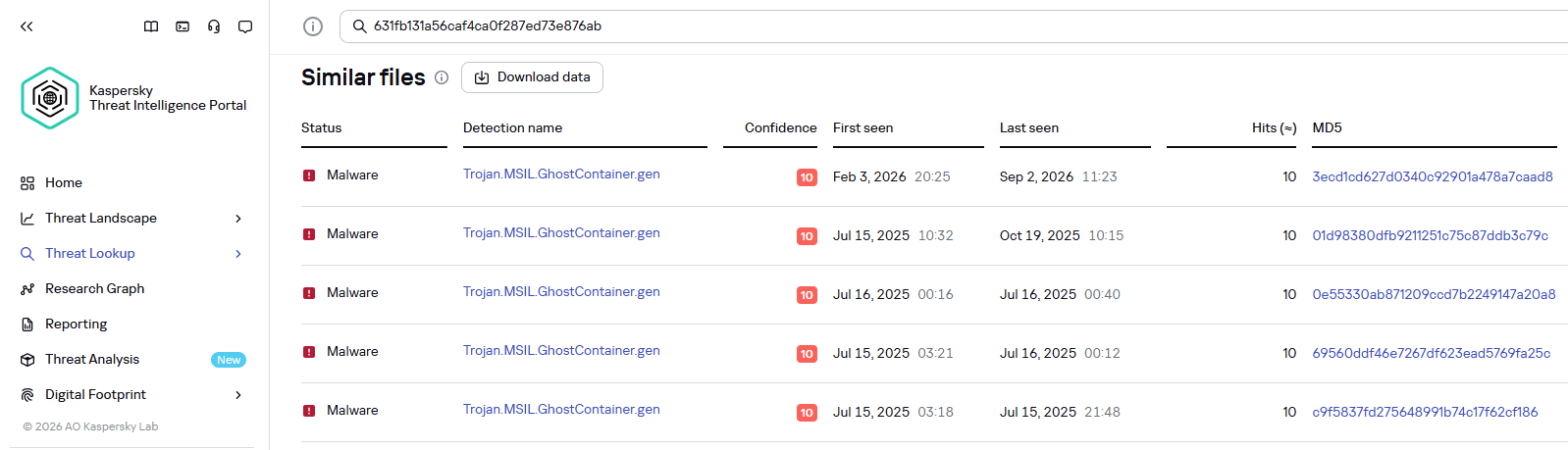
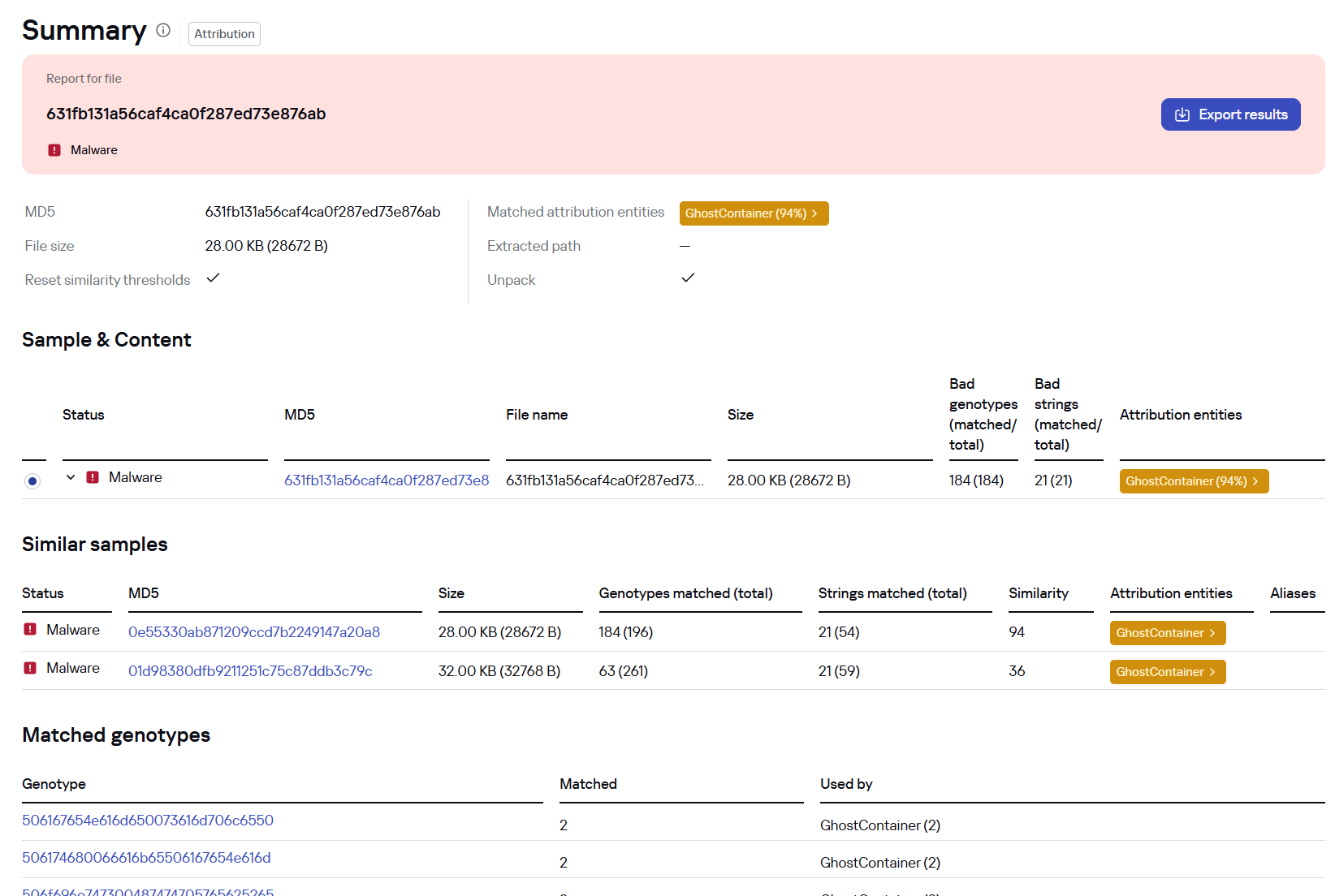
Kaspersky products detect the GhostContainer backdoor as Trojan.MSIL.GhostContainer.gen.
GhostContainer samples identified by the Similarity technology from Kaspersky Threat Analysis
Traffic redirection
Once the attackers gain sufficient privileges during an attack, they leverage RDP to move laterally within the internal network segment. To do this, they download and run tools for tunneling and redirecting network traffic.
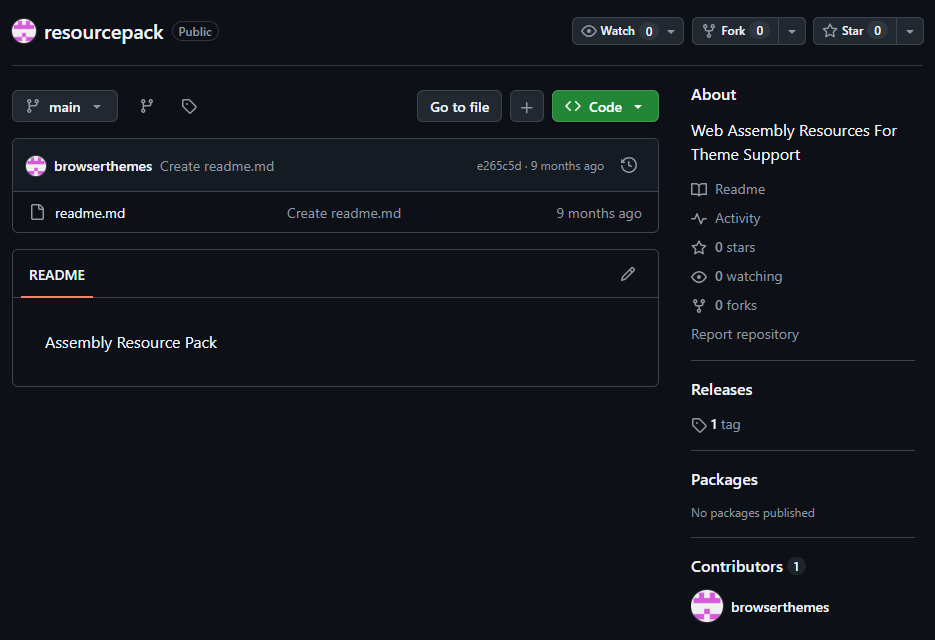
The attackers used GitHub repositories to host their archived tools. The names of the repositories and archives were disguised to look legitimate:
One of the repositories used for storing network tools
The files contained within the archives were also given names mimicking known legitimate software, though unrelated to the archive names:
adobe_32.exe;
AdobeSync.exe;
trueconf.exe;
1cbroker.exe;
1c-office-plugin.exe;
trueconf-broker.exe.
Across the incidents we investigated, we found two tools that the attackers combined for traffic tunneling.
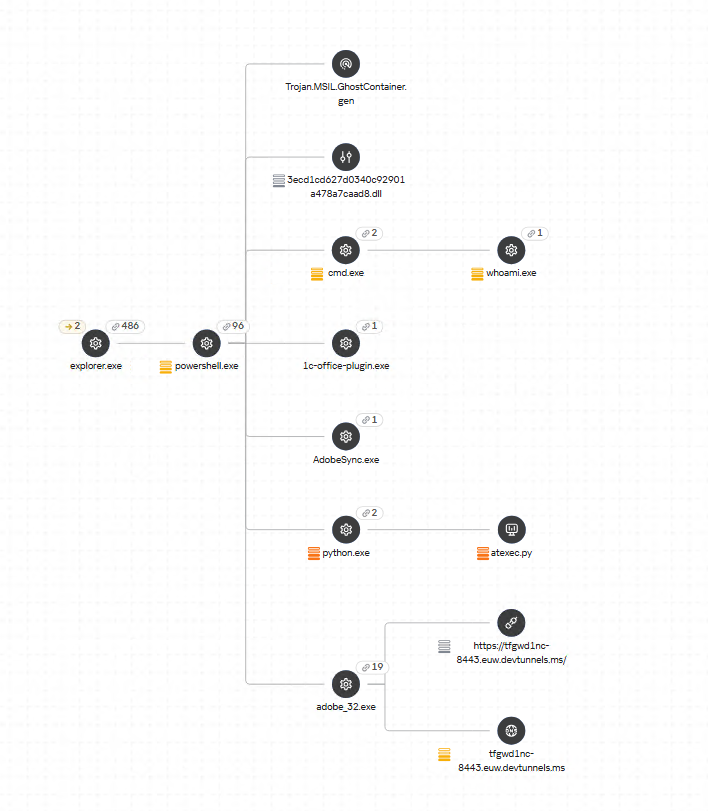
Microsoft dev tunnels
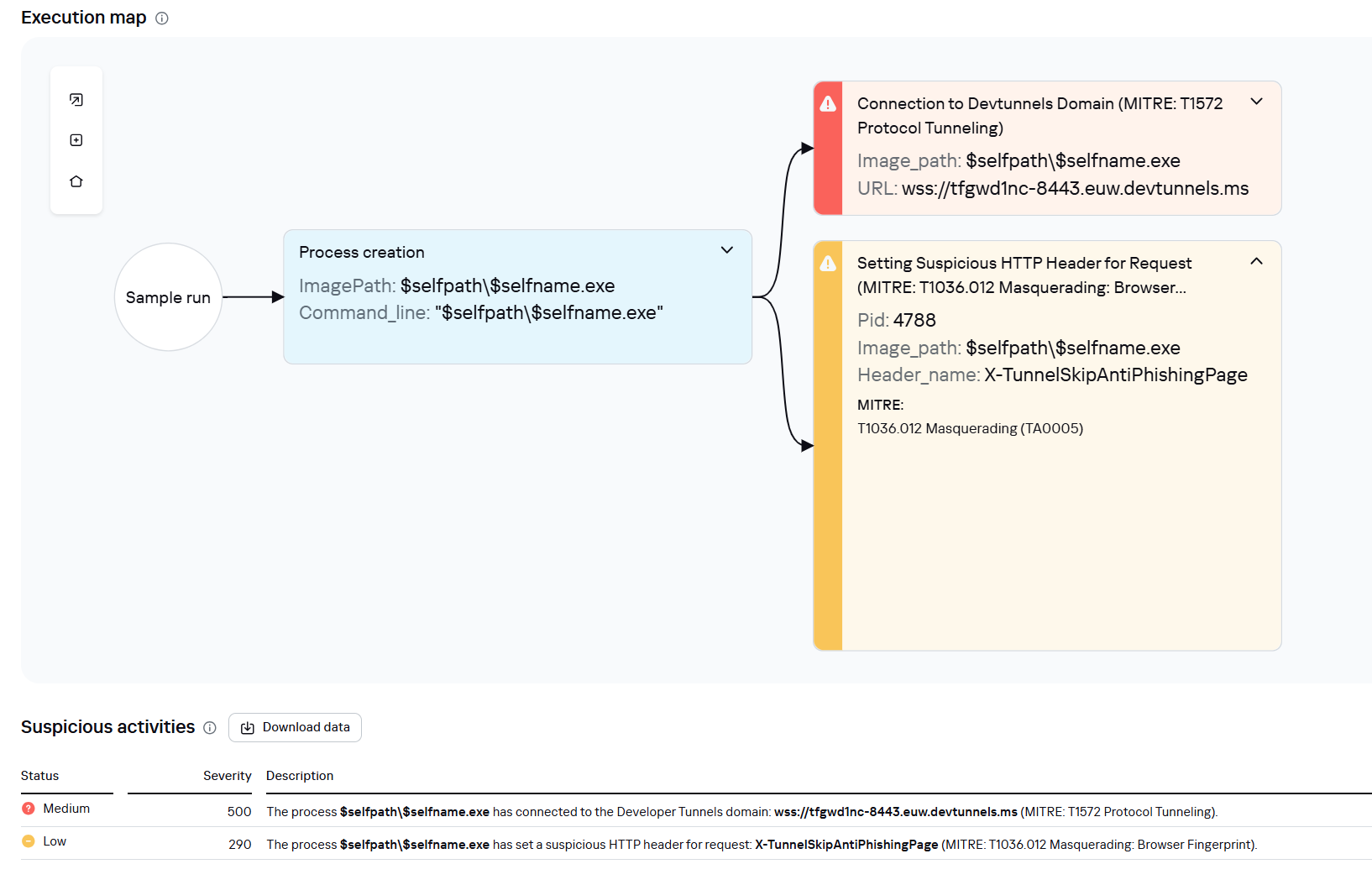
This is a legitimate Microsoft mechanism that allows local web services to be published for internet access on *.*.devtunnels.ms domains. The attackers used this tunneling capability to expose port 3389 (RDP) on the compromised system.
Execution graph of adobe_32.exe in Kaspersky Research Sandbox
rdp2tcp
This is a publicly available tool for tunneling TCP traffic over an established RDP connection. It includes a server component that runs on the target system and a client component that runs on the attacker’s side.
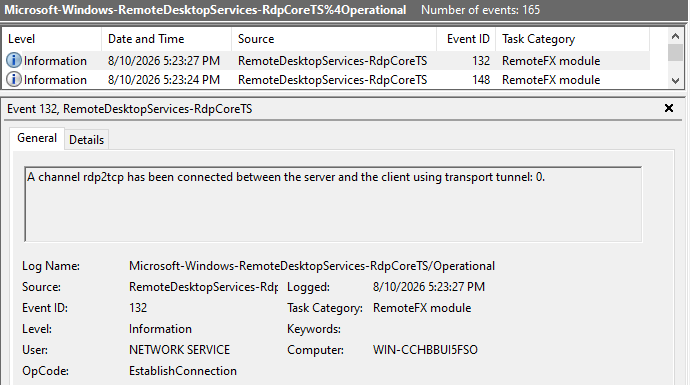
When virtual channels are opened and closed, corresponding events with IDs 132 (channel opened) and 148 (channel closed) are logged in the Microsoft-Windows-RemoteDesktopServices-RdpCoreTS/Operational.evtx Windows log. These events contain the names of the channels (such as XPSRD, cliprdr, Microsoft::Windows::RDS::DisplayControl, and others) used by the RemoteFX module, which extends the capabilities of the RDP protocol.
When the rdp2tcp tool is used, events with IDs 132 and 148 will contain the channel name rdp2tcp or other random alphanumeric combinations chosen by the attackers.
Creation event for a channel named rdp2tcp (server component startup)
The combination of Microsoft dev tunnels and rdp2tcp allows the attackers to maintain network access by using legitimate services without opening additional suspicious ports.
The attackers also used the atexec utility from the Impacket toolkit to create scheduled tasks on target systems. These tasks enabled network port forwarding through standard Windows functionality:
To obtain elevated privileges and move laterally through the network, NightEagle exploited various vulnerabilities in Active Directory. The attackers used previously established tunnels to connect to internal infrastructure systems.
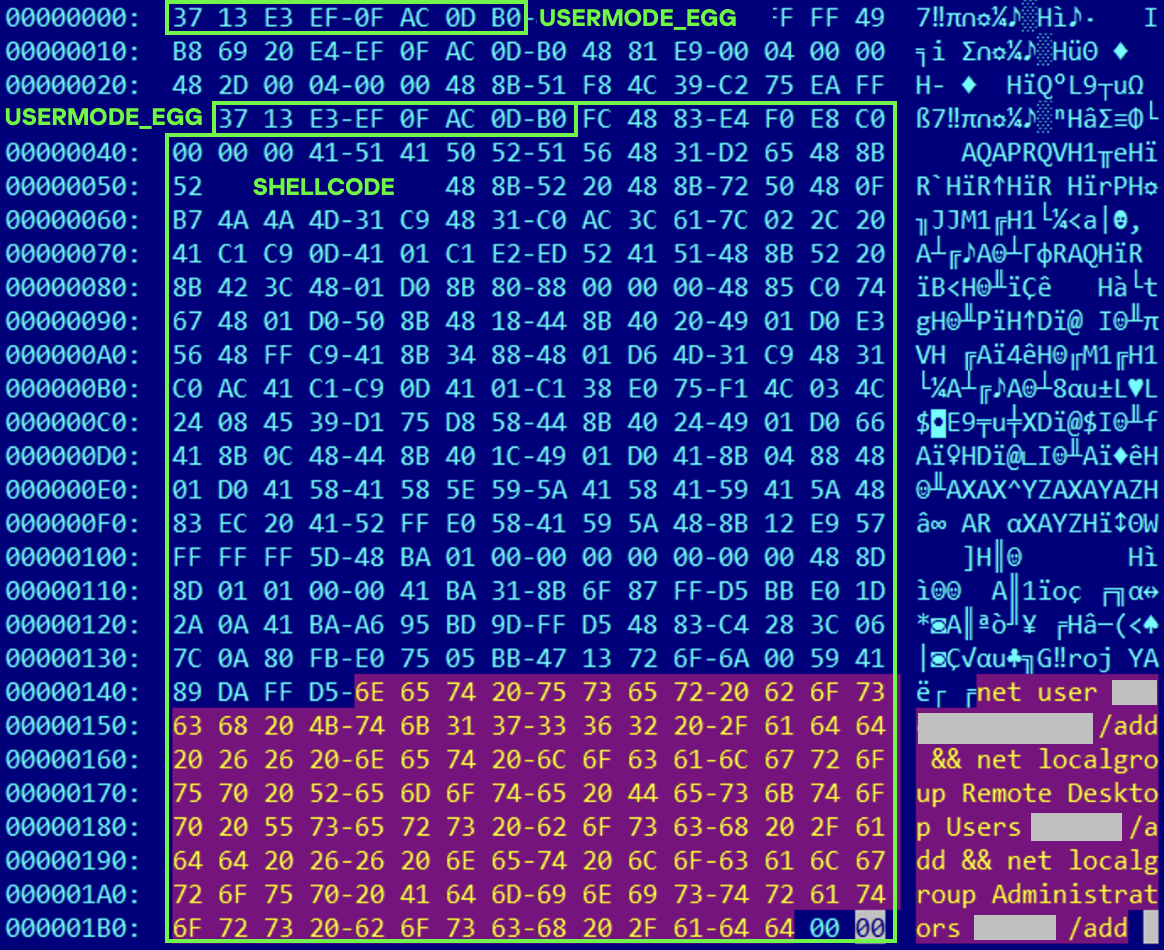
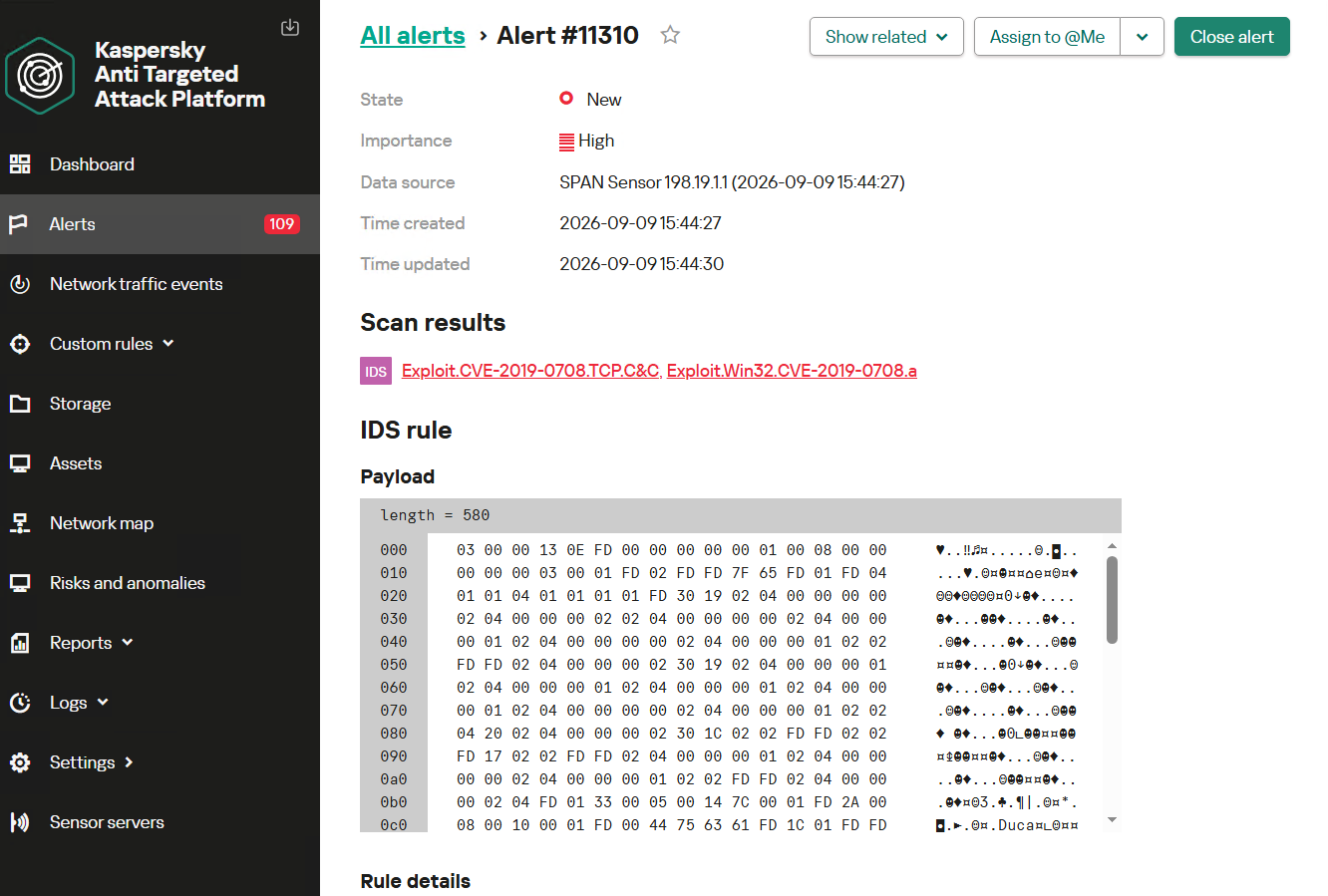
In one incident, they exploited a well-known RDP implementation vulnerability, CVE-2019-0708 (BlueKeep). They used the vulnerable mechanism to create a local account on the system and add it to the Administrators and Remote Desktop Users groups.
Contents of a system memory dump showing artifacts of the CVE-2019-0708 exploit
The attackers also requested Kerberos tickets with a non-standard combination of flags (Forwardable, Proxiable, Renewable) and attempted to replicate the Domain-Password object from the Active Directory database to impersonate the domain controller (a technique known as DCSync) after obtaining an account with sufficient privileges.
Through these methods, the attackers establish persistence in the infrastructure, obtain password hashes for domain accounts, use long-lived Kerberos tickets to gain legitimate access to target resources, and ultimately compromise domain controllers and the victim’s entire Active Directory infrastructure.
Takeaways
To expand the geographic scope of its targets, NightEagle is updating its methods and adopting new techniques for persistence and lateral movement. Despite the group’s efforts to stay hidden, timely detection of anomalies combined with a comprehensive approach to infrastructure protection can significantly hinder the attackers from achieving their goals. Since the attackers rely on known legitimate tools and infrastructure vulnerabilities, well-configured monitoring can help detect NightEagle’s presence on the network.
Detection by Kaspersky solutions
Kaspersky solutions reliably identify the malicious activity described above at various stages of the attack. We showed examples above of how Kaspersky Threat Analysis detects samples of the GhostContainer backdoor and the tunneling utility. This toolkit also includes the analytical solution Kaspersky Threat Attribution Engine (KTAE), which helps SOC analysts and incident responders determine which APT groups malware can be attributed to. The solution uses a proprietary comparison method that measures the similarity between analyzed samples of suspicious files and known malicious samples in Kaspersky’s collection.
The backdoor we discovered showed similarity to previously analyzed GhostContainer samples and a connection to the NightEagle APT group:
Backdoor analysis with KTAE
However, detection scenarios for this kind of attacks are not limited to file analysis. Deploying a backdoor on a target host produces numerous characteristic artifacts, which allow Kaspersky Endpoint Detection and Response Expert to alert users to anomalies in the infrastructure in a timely manner.
This malicious activity is detected by the following rules, available in the repository:
Initial detection of the malicious signature occurs through the generic_ransomware_related_detection rule, based on EPP module events
A critical vulnerability has been discovered in the popular WordPress content management system that allows attackers to execute arbitrary code on the web server. The vulnerability has been assigned the number CVE-2026-87902. The good news is that on September 22, WordPress released an update that patches it. The bad news is that the first attempts to exploit CVE-2026-87902 were detected just a few hours after the patch was released. Therefore, all companies whose corporate websites or blogs run on this platform are advised to update immediately.
WordPress versions affected by CVE-2026-87902
According to data published by WordPress on GitHub, all versions of the CMS from 4.7.0 through 7.1.1 are vulnerable. The company has released updates for all supported branches of the system; a complete table listing the patched version numbers can be found on the company’s GitHub page. The latest version of WordPress should be updated to version 7.1.2 (or newer).
What’s the nature of the CVE-2026-87902 vulnerability, and why is it so dangerous?
Under normal circumstances, WordPress loads PHP template files only from a specific folder within the active theme. However, due to the CVE-2026-87902 vulnerability, an attacker can craft a request to WordPress in such a way that an arbitrary PHP file is included — without requiring any authorization. Yes, the file must already be uploaded to the targeted server in some way, but that’s not really a problem for an attacker.
It sounds like a path traversal vulnerability, but in most publications, CVE-2026-87902 is classified as an RCE (Remote Code Execution) vulnerability because, under certain WordPress and PHP server configurations, the attack can lead to the execution of arbitrary code.
How to stay safe
The only way to secure a corporate WordPress site is to install the latest version. The researcher who discovered the vulnerability also offers several tips for hardening CMS security, but emphasizes that these are meant to complement the patch, not replace it.
The Hacker News lists several PHP filenames and IP addresses used in the attack via CVE-2026-87902. These can serve as indicators that a WordPress instance has been compromised.
Given that only a few hours pass between the publication of information about a vulnerability’s existence and the start of attacks exploiting it, it’s crucial for companies to have a properly configured, centralized vulnerability management system. To achieve this, they should have a specialized solution capable of identifying and resolving vulnerabilities, prioritizing them based on actual risks, and automating remediation processes. Our vulnerability management module for Kaspersky Next Optimum can help with this task.
Over the past year, our Global Emergency Response Team (GERT) has investigated several incidents involving the NightEagle group (also tracked as APT-Q-95). This group has been active since at least 2023 and originally focused on organizations in Asia. We have now identified attacks by the group targeting businesses in Russia. This post examines both known and new tools NightEagle used in its latest campaign.
Initial access
In most incidents, the attackers used compromised valid credentials to gain access to corporate VPNs. VPN connections originated from IP addresses in the Russian segment linked to Cloudflare WARP tunnels, as well as from IP addresses associated with European virtual infrastructure providers.
GhostContainer on Microsoft Exchange
Both during the initial access stage and as the attack progressed, the attackers deployed the GhostContainer backdoor on Microsoft Exchange servers. It incorporates components from several open-source projects, including the Neo-reGeorg tunnel, an exploit for the CVE-2020-0688 vulnerability, and the GhostWebShell class from the ysoserial utility. All of these components are publicly available on GitHub.
We were unable to determine the exact method the attackers used to deliver the backdoor to Microsoft Exchange servers. We believe with a high degree of confidence that they applied a technique already familiar to us: extracting the cryptographic keys used by Microsoft Exchange from the ASP.NET configuration, overwriting the VIEWSTATE framework parameter, and injecting a payload into it, which then launched the GhostContainer backdoor in memory.
The backdoor is a .NET assembly containing three classes that implement its core functionality:
Stub: processes C2 commands delivered to the infected system through the x-owa-urlpostdata headers and evades detection by the Antimalware Scan Interface (AMSI) and Windows Event Log mechanisms by overwriting addresses in amsi.dll and ntdll.dll.
App_Web_843e75cf5b63: accepts the fakePath and fakePageName parameters and creates virtual paths that redirect requests to the App_Web_8c9b251fb5b3 class.
App_Web_8c9b251fb5b3: implements network traffic redirection (proxying) and socket forwarding functionality.
Kaspersky products detect the GhostContainer backdoor as Trojan.MSIL.GhostContainer.gen.
GhostContainer samples identified by the Similarity technology from Kaspersky Threat Analysis
Traffic redirection
Once the attackers gain sufficient privileges during an attack, they leverage RDP to move laterally within the internal network segment. To do this, they download and run tools for tunneling and redirecting network traffic.
The attackers used GitHub repositories to host their archived tools. The names of the repositories and archives were disguised to look legitimate:
One of the repositories used for storing network tools
The files contained within the archives were also given names mimicking known legitimate software, though unrelated to the archive names:
adobe_32.exe;
AdobeSync.exe;
trueconf.exe;
1cbroker.exe;
1c-office-plugin.exe;
trueconf-broker.exe.
Across the incidents we investigated, we found two tools that the attackers combined for traffic tunneling.
Microsoft dev tunnels
This is a legitimate Microsoft mechanism that allows local web services to be published for internet access on *.*.devtunnels.ms domains. The attackers used this tunneling capability to expose port 3389 (RDP) on the compromised system.
Execution graph of adobe_32.exe in Kaspersky Research Sandbox
rdp2tcp
This is a publicly available tool for tunneling TCP traffic over an established RDP connection. It includes a server component that runs on the target system and a client component that runs on the attacker’s side.
When virtual channels are opened and closed, corresponding events with IDs 132 (channel opened) and 148 (channel closed) are logged in the Microsoft-Windows-RemoteDesktopServices-RdpCoreTS/Operational.evtx Windows log. These events contain the names of the channels (such as XPSRD, cliprdr, Microsoft::Windows::RDS::DisplayControl, and others) used by the RemoteFX module, which extends the capabilities of the RDP protocol.
When the rdp2tcp tool is used, events with IDs 132 and 148 will contain the channel name rdp2tcp or other random alphanumeric combinations chosen by the attackers.
Creation event for a channel named rdp2tcp (server component startup)
The combination of Microsoft dev tunnels and rdp2tcp allows the attackers to maintain network access by using legitimate services without opening additional suspicious ports.
The attackers also used the atexec utility from the Impacket toolkit to create scheduled tasks on target systems. These tasks enabled network port forwarding through standard Windows functionality:
To obtain elevated privileges and move laterally through the network, NightEagle exploited various vulnerabilities in Active Directory. The attackers used previously established tunnels to connect to internal infrastructure systems.
In one incident, they exploited a well-known RDP implementation vulnerability, CVE-2019-0708 (BlueKeep). They used the vulnerable mechanism to create a local account on the system and add it to the Administrators and Remote Desktop Users groups.
Contents of a system memory dump showing artifacts of the CVE-2019-0708 exploit
The attackers also requested Kerberos tickets with a non-standard combination of flags (Forwardable, Proxiable, Renewable) and attempted to replicate the Domain-Password object from the Active Directory database to impersonate the domain controller (a technique known as DCSync) after obtaining an account with sufficient privileges.
Through these methods, the attackers establish persistence in the infrastructure, obtain password hashes for domain accounts, use long-lived Kerberos tickets to gain legitimate access to target resources, and ultimately compromise domain controllers and the victim’s entire Active Directory infrastructure.
Takeaways
To expand the geographic scope of its targets, NightEagle is updating its methods and adopting new techniques for persistence and lateral movement. Despite the group’s efforts to stay hidden, timely detection of anomalies combined with a comprehensive approach to infrastructure protection can significantly hinder the attackers from achieving their goals. Since the attackers rely on known legitimate tools and infrastructure vulnerabilities, well-configured monitoring can help detect NightEagle’s presence on the network.
Detection by Kaspersky solutions
Kaspersky solutions reliably identify the malicious activity described above at various stages of the attack. We showed examples above of how Kaspersky Threat Analysis detects samples of the GhostContainer backdoor and the tunneling utility. This toolkit also includes the analytical solution Kaspersky Threat Attribution Engine (KTAE), which helps SOC analysts and incident responders determine which APT groups malware can be attributed to. The solution uses a proprietary comparison method that measures the similarity between analyzed samples of suspicious files and known malicious samples in Kaspersky’s collection.
The backdoor we discovered showed similarity to previously analyzed GhostContainer samples and a connection to the NightEagle APT group:
Backdoor analysis with KTAE
However, detection scenarios for this kind of attacks are not limited to file analysis. Deploying a backdoor on a target host produces numerous characteristic artifacts, which allow Kaspersky Endpoint Detection and Response Expert to alert users to anomalies in the infrastructure in a timely manner.
This malicious activity is detected by the following rules, available in the repository:
Initial detection of the malicious signature occurs through the generic_ransomware_related_detection rule, based on EPP module events

 Login


 Table Of Contents