❌

Normal view

DARPA Selects Xint to Use AI in Securing Military Messaging Apps

29 September 2026 at 19:24

The AIxCC competition winner will analyze messaging app code and compiled binaries for vulnerabilities, with technology that could also help commercial customers secure their software.

The post DARPA Selects Xint to Use AI in Securing Military Messaging Apps appeared first on SecurityWeek.

Reco Raises $55 Million for Agentic Security

29 September 2026 at 15:20

The company will use the funds to expand its sales, partnerships, channels, and customer support teams.

The post Reco Raises $55 Million for Agentic Security appeared first on SecurityWeek.

Hackers Use ChatGPT Custom GPTs in ClickFix Attacks

29 September 2026 at 15:03

The personalized versions of ChatGPT were used to impersonate legitimate products and trick users into executing PowerShell commands.

The post Hackers Use ChatGPT Custom GPTs in ClickFix Attacks appeared first on SecurityWeek.

EFF Statement on California Governor's Executive Order on AI

California Gov. Gavin Newsom's executive order is an opportunity for a needed, thoughtful conversation about artificial intelligence and its potential harms. Everyday Californians are feeling real anxiety about the risks of artificial intelligence, and as an organization that works to ensure technology empowers people, EFF welcomes this order as a way for the state of California to lead a much-needed dialogue that addresses these concerns. 

DONATE TO EFF

ensure ai serves people, not power

Nonetheless, the most immediate and current concerns with this technology are not about sci-fi scenarios concerning rogue super-intelligence. They are happening right now through biased algorithmic decision-making for employment or government benefits, AI-powered surveillance systems such as Flock cameras, and artificially inflated personalized pricing. People want state and federal leaders to act, and we urge Gov. Newsom to develop thoughtful policies to address those concerns. Today’s EO is a good start. 

To that end, EFF supports the focus on expanding the reporting requirements under SB 53 (2025) for loss-of-control incidents, alongside third-party investigations. We urge the administration to consider how to make these third-party investigations available for smaller developers. As the Government Operations Agency prepares its recommendations for the governor, we urge leaders to also realize that the effectiveness of kill switches in advanced AI systems remains an area of active research. As such, they should ensure that - as we’ve previously mentioned - any technology regulation targeting cybersecurity practices at AI labs must be careful, precise, and practical. Moreover, we also caution that government-controlled kill switches run the risk of being used as a form of retaliation against protected speech, as demonstrated by the Trump Administration’s retaliatory actions against Anthropic earlier this year.

Ultimately, true safety requires California to focus on concrete, immediate, and urgent harms of AI technologies by ensuring that algorithmic decision-making in both the government and private sectors respects people’s rights and well-being. We urge Gov. Newsom and the state of California to develop thoughtful policy in collaboration with those most at risk of harm to address these and other concerns.

Secure Messaging and AI Remain In Conflict Despite the Promise of TEEs

18 September 2026 at 23:53

Secure messaging platforms, like Signal, WhatsApp, and recently, encrypted RCS, operate on a straightforward assumption: the content at each end of a conversation is private to the participants in the conversation. End-to-end encryption helps provide the mathematical guarantees that the companies who operate these messaging platforms cannot access the contents of messages. But there’s no way to guarantee what happens once the message arrives on a phone. As more devices and services introduce more artificial intelligence (AI) features into messaging apps, that line begins to blur. 

When AI features are computed entirely on device, it’s less concerning. Yet sometimes the computing requirements are heavy enough that the computation has to be done on a company server. Tech companies tell us they have a solution for this: trusted execution environments (TEEs). But do server-side TEEs really solve the problem?

TEEs exist to serve many different functions, ranging from digital rights management (DRM) content protections to securely storing information in your phone's mobile wallet, but for our purposes, we’ll be focusing on how tech companies use them for their AI tools. 

The basic idea is straightforward: most consumer devices aren’t powerful enough to handle the sorts of AI features companies want to offer, so sometimes they send data off your device to more powerful cloud servers to do the computing, then display the results on your device. Since your data is leaving your device, there’s a privacy compromise. For example, if you ask for a messaging app to summarize a conversation, it may offload that computing power to a cloud server, sending the entire contents of your messages to the cloud, then back to your phone.

TEEs supposedly offer a way to keep those requests private. There are several implementations out there, like Apple’s Private Cloud Compute, Google’s Private AI Compute, and WhatsApp’s Private Processing. It’s not just the big tech players, we’ve seen chatbots built with TEEs as well.

TEEs can provide more security and privacy than simply running in the clear, but they are fundamentally different from actual encryption or running locally. Despite the promises of some tech companies, they will never be able to match that level of security and privacy. Because of that, a user’s device should never automatically send data to a TEE. Let’s dig through the reasons why.

What Exactly Is a TEE, Anyway?

A TEE is a hardened section of the computer that runs software in a way that’s supposed to be secret even from other processes running on the machine. TEEs also let users check that the code being run is the code that they think is running, and not backdoored code instead, using a process called “attestation.” You may have also heard this referred to as a “secure enclave,” or heard the brand names SGX or TrustZone.

The intention of a cloud-based TEE is simple: a company can run a server in their data center, but still process data that you provide on your behalf without being able to see that information themselves.

Is a TEE Secure?

In practice, we've seen multiple cracks and hacks every year that show that it is possible to get at that data. That’s because while encryption relies on math, TEEs rely on engineering to provide their security. Standard encryption algorithms are created by years-long processes collaboratively produced by mathematicians around the world and are based on problems that have been studied for decades. The math is reliable, and there is no shortcut to breaking it that would not also upend fundamental understandings of mathematics as a field. 

The collective understanding of every mathematician in the world is that standard encryption algorithms are not breakable to the best of the world’s collective knowledge. No responsible engineer builds a system based on a new encryption method until after it’s been offered up for prodding.

Engineering, on the other hand, doesn’t work like that. Every individual system is the product of a group of engineers who put it out into the world, and each product will have its own quirks and bugs that have to be individually discovered and patched. These bugs are found after the system is built, not before. No one has yet built a system that is unbreakable. On the contrary, there is new research all the time that finds new ways to break into TEE systems. They’re patched as they come up, but they’re unlikely to ever become perfect, and certainly not any time soon. 

TEEs in particular are a hard engineering problem because the encryption key is physically right there on the device. Building a TEE means keeping a key fully separate and inaccessible while it’s on the same physical device as parts of the system that shouldn’t have access to the key.

Many attacks on TEEs involve “side channels.” In a side channel attack, the attacker measures the electrical impulses or other effects to figure out the timing of operations inside the TEE, then uses that to figure out the key being used. Once they have the key, they can read all the data. Compare that to end-to-end encryption, where the key is never on that machine in the first place, so an attacker would have to also run a similar attack on the user’s device.

Companies who turn to TEEs to protect data want to both have the key on the server and have it protected while still performing complex operations like running an LLM, which makes it much more difficult to protect those keys.

That being said, a TEE versus plaintext on a server is the difference between being able to easily read the data and having to do a bunch of specialized work to get at the data. That work often involves accessing the physical machine. This is most relevant for protecting against mass surveillance, and for many people, that might just be enough security.

But that's the core of the problem. “Secure enough for most cases” and “encrypted as in math” are not the same thing, and it’s important not to conflate the two. And services that currently offer “encryption as in math” have a real downgrade in security when they switch to security based on TEEs. 

If you want to dive into the myriad security issues and limitations of TEEs we’ve seen so far, they’re well documented here, here, here, and here.

What Does This Have To Do With LLMs and AI?

Sometimes organizations want to offer an LLM that can respond to queries in a private manner. On-device LLMs exist, but they’re limited in size. So, when organizations want to offer the ability to answer queries without being able to see the conversation, they turn to TEEs. That’s a useful way to run a chatbot that’s reasonably private. This is what Apple, Google, WhatsApp, and others are doing.

Why not turn to encryption? After all, LLM inference is just a bunch of math like any other things a computer does. It takes input to a (really big) function and gives an output. We have the math to do that computation in a way that hides the inputs and outputs from the one running the computation, it's just super expensive. It’s called homomorphic encryption, and no one’s figured out how to do it fast enough that it makes sense for this sort of computation.

Instead, the allure of a TEE is that it will run that computation for you inside of a special opaque section of a server. TEE manufacturers try to make it as hard as possible for the person running the TEE to peek inside. But you still have to trust the operator to not put a stethoscope to the box to try to figure out what's happening inside. 

In this case, it’s reasonable to consider these systems “privacy-preserving,” but not “encrypted.” That distinction is important, especially when we talk about how the TEEs interact with secure messaging. When someone using an end-to-end encrypted chat app asks an LLM to summarize, review, or store those messages, the content of those messages is leaving the device and going to an unencrypted third-party server somewhere. That’s a major threat to the privacy of secure chat apps, and one that’s increasingly hard for users to take control of.

How Does This Translate to Practical Advice?

The answer to this is going to vary based on an individual’s threat model, but a good rule of thumb is that a user’s device should never automatically send data to a TEE. When the person holding a phone can choose what information is sent, even if it’s a chunk of data like “unread messages,” they have the opportunity to pause and consider if that data might be too sensitive to risk sending.

In contrast, when data is sent automatically, the automatic sending becomes a feature of the system as a whole. If the system was previously end-to-end encrypted, adding automatic exfiltration makes the whole system no longer end-to-end encrypted.

Developers: don’t build systems that automatically send data off a device to a TEE, especially when it’s coming from an app that is otherwise end-to-end encrypted.

Users: if developers ignore us and build that system, turn off any automatic data sending features. Take a second to think about how much you’re willing to risk sending data when you choose to send it off the device.

So, What Should I Be Concerned About?

TEEs are useful for security in a number of circumstances. Your phone likely has a TEE where it keeps the key that encrypts your biometric unlock data and the base of the keychain where passwords are stored. It also enables certain backup systems, like how you can restore a phone with your passcode or restore WhatsApp or Signal backups.

But when we’re talking about cloud processing, it’s important to be clear this isn’t the same as end-to-end encryption and doesn’t offer the same level of privacy. 

Most of our private lives are on our phones and in our messages. We’ve worked for years to secure those messages, with major wins like encrypted RCS, and the continued user experience improvements of Signal and WhatsApp. We’ve even seen real improvements to backup security with features like Advanced Data Protection that bring end-to-end encryption for a variety of data outside of messaging, like notes and photos. 

But as companies roll out AI features that interact with these encrypted services, pulling data off devices and into a cloud-based TEE, they’re eroding the privacy protections of end-to-end encryption and risk causing serious confusion around what data is protected and what isn’t.

EFF to Lawmakers: Ground AI Cybersecurity Rules in Best Practices

18 September 2026 at 03:16

With doomsday AI scenarios dominating the news, lawmakers are rightly concerned about reports concerning security breaches at major US AI labs, such as the OpenAI–Hugging Face incident and the many others reported in its aftermath. As they consider potentially regulating frontier AI, they should focus any new legislation on the immediate, demonstrated risks from those incidents. 

Post-incident reports show that the Hugging Face incident could have been mitigated or prevented by following longstanding cybersecurity best practices, like stronger sandboxing and monitoring. Any new legislation should focus on closing gaps in existing law to prevent AI companies from taking unreasonable risks with the public's security.

When an AI developer or deployer runs a test or a task that has a high likelihood of causing harm to third parties—for instance, by breaking into someone else's computers—there should be clear minimum safety requirements. Such tests should run in a properly sandboxed test environment, disconnected from other systems, and be monitored and logged. Following these fundamental best practices would have prevented or substantially mitigated all of the incidents at AI labs that we currently know about.

That said, any proposal must be flexible enough to evolve with changing technology. Minimum safety requirements specific only to current AI technologies are likely to become obsolete; legal standards tied to well-established cybersecurity best practices are far more likely to stand the test of time. Tying any new mandates to evidence-backed security protocols also protects the public without impeding future AI development.

Strong legislation should also mandate and fund independent third-party investigations into any serious security incidents that may occur during AI labs’ tests of new tools, and make reports of these investigations available to the public. This important transparency measure would go a long way toward providing public oversight of the industry.

As with any technology regulation, those targeting cybersecurity practices at AI labs must be careful, precise, and practical.

Modulate Raises $25 Million to Advance Deepfake Detection

28 September 2026 at 19:30

The misuse and abuse of AI-generated voice is growing. Modulate’s intention is to allow real time detection and intervention. 

The post Modulate Raises $25 Million to Advance Deepfake Detection appeared first on SecurityWeek.

Nvidia Unveils AI Agent Safety Platform With Hardware-Based Watchdog

28 September 2026 at 12:27

The platform combines open source software and a reference system design to keep AI agents within set boundaries.

The post Nvidia Unveils AI Agent Safety Platform With Hardware-Based Watchdog appeared first on SecurityWeek.

Run open weight models on Amazon Bedrock in AWS European Sovereign Cloud

17 September 2026 at 23:19

European organizations can run AI workloads on Amazon Web Services (AWS) while keeping data within the European Union (EU) and meeting regulatory requirements. You can now run generative AI workloads on open weight models on Amazon Bedrock in the AWS European Sovereign Cloud. We’re excited to announce the general availability of the first open weight model family, Gemma 4, on the Amazon Bedrock next-generation inference engine in the AWS European Sovereign Cloud. Gemma 4, released under the Apache 2.0 license, on Amazon Bedrock benefits from the same data residency and operational controls that define the AWS European Sovereign Cloud so you can build, iterate, and scale generative AI applications while meeting digital sovereignty requirements.

The AWS European Sovereign Cloud is an independent cloud for Europe, located entirely within the EU, designed to help customers meet their most stringent digital sovereignty requirements. It runs entirely within the EU and is independently operated with strong technical controls, sovereign assurances and legal protections. Only AWS employees who reside in the EU control day-to-day operations, including access to data centers, technical support, and customer service.

In this post, we explain how the Amazon Bedrock inference engine protects your inference data when running Gemma 4 models, how the AWS European Sovereign Cloud keeps it within the EU, and then walk through the available Gemma 4 models and your first inference request.

Next generation inference engine for Amazon Bedrock

The inference engine is a distributed engine for serving large-scale machine learning models, built for high performance, reliability, and security. You reach it through the bedrock-mantle endpoint, which supports OpenAI-compatible APIs (the Responses and Chat Completions APIs). You can bring an existing OpenAI SDK codebase to Amazon Bedrock by changing only the base URL and API key. The Responses API supports stateful conversation management, which rebuilds context without you passing conversation history with each request. Stored responses are scoped by Amazon Bedrock project, a logical boundary that represents a workload for access control, cost tracking, and usage monitoring.

The engine applies the same operational security practices you rely on across AWS. Access follows a least privilege model, where each operator has access only to the systems a specific task requires, and only for the time that privilege is needed. Any access to systems that store or process customer data or metadata is logged, monitored for anomalies, and audited. All your prompts and responses are kept private during inference.

How your inference data is protected

Amazon Bedrock uses a zero operator access data security model, meaning no service operators can access model input or output during inference. It also uses a zero data retention model, so by default it doesn’t store your inputs or outputs. For certain models, limited retention might apply for abuse detection (see the Amazon Bedrock abuse detection documentation). Your prompts and responses are encrypted in transit and, by default, are not shared with the model provider.

All inference stays within the eusc-de-east-1 AWS Region as described in the following section on data residency. Combined with the data residency and EU-based operations of the AWS European Sovereign Cloud, this gives organizations in highly regulated industries the confidence to run their most sensitive AI workloads in the cloud.

Data residency and regional availability

The AWS European Sovereign Cloud became generally available in January 2026, with its first Region in Brandenburg, Germany (eusc-de-east-1). It’s a separate, independently operated cloud, with infrastructure located entirely within the EU and no critical dependencies on non-EU personnel or infrastructure. All your content remains within the Region you select unless you choose otherwise. Beyond content, customer-created metadata including roles, permissions, resource labels, and configurations also stays within the EU. The AWS European Sovereign Cloud is operated exclusively by EU residents located in the EU. We’re also gradually transitioning the AWS European Sovereign Cloud to be operated exclusively by EU citizens located in the EU. During this transition period we will continue to work with a blended team of EU residents and EU citizens located in the EU.

All Amazon Bedrock inference requests, including Gemma 4, use in-Region inference in eusc-de-east-1, which keeps every request within the AWS European Sovereign Cloud. Global cross-Region inference, which routes requests across commercial AWS Regions worldwide, isn’t available in the AWS European Sovereign Cloud.

Control over who can access your data

With AWS Identity and Access Management (IAM), you decide which principals in your account can call the inference API and which models they can use. Fine-grained permissions let you grant only the access each workload needs, following least privilege, and we recommend short-lived credentials over long-term keys.

For auditing, every call to the endpoint is recorded in AWS CloudTrail, giving your security and compliance teams an audit trail of who invoked inference and when. You can also monitor usage with Amazon CloudWatch and set alarms on patterns that matter to you, such as unexpected spikes in request volume.

Open weight models in the AWS European Sovereign Cloud

Organizations adopting open weight foundation models (FMs) for production face a constant challenge: how to access the leading models without compromising on data protection, regulatory alignment, or operational control. Amazon Bedrock removes that challenge. It gives you leading open weight FMs through a fully managed service, with inference running entirely on infrastructure operated by AWS and the security and privacy controls you expect from Amazon Bedrock. Because the models are open weight, you can independently evaluate the model architecture and training methodology, benchmark your own workloads, and fine-tune on proprietary data when customization is required.

Gemma 4 is a family of open weight models, released under the Apache 2.0 license. It’s available in three instruction-tuned variants, so you can evaluate and choose the model that fits your workload. The following table provides guidance on which model to choose based on your use case:

Model

Use case

Specifications

Gemma 4 31B (google.gemma-4-31b-it)

Reasoning-heavy or coding-heavy with a single dense model

30.7 billion parameter dense model with a 256 K token context window

Gemma 4 26B-A4B (google.gemma-4-26b-a4b-it)

Cost-sensitive at high throughput, with knowledge breadth requirements

Mixture-of-experts model with 25.2 billion total parameters and 3.8 billion active per token, with a 256 K token context window

Gemma 4 E2B

(google.gemma-4-e2b-it)

Latency-sensitive, on-device-style, or multimodal classification

Compact model with 5.1 billion total parameters and 2.3 billion effective parameters using per-layer embeddings (PLE), with a 128 K token context window

All three variants offer built-in reasoning, native function calling, and multimodal input across text and image.

Get started with Gemma 4 models on Amazon Bedrock

Gemma 4 is served through the bedrock-mantle endpoint, the OpenAI-compatible API for the next-generation inference engine, so you can call it with the OpenAI Python and TypeScript SDKs. Use the following steps to use the OpenAI Python SDK to send your first request to Gemma 4 31B in the AWS European Sovereign Cloud.

Prerequisites

To follow this example, you need an AWS account with access to the AWS European Sovereign Cloud and an IAM principal with permissions to call the bedrock-mantle endpoint. Create an IAM policy that grants the two actions this walkthrough uses, then attach it to your IAM principal. The bedrock-mantle:CreateInference action runs inference, and the bedrock-mantle:CallWithBearerToken action authenticates with an Amazon Bedrock API key. The following sample policy grants the actions this example needs. Scope the resources further for your environment as described after the policy.

{
  "Version": "2012-10-17",
  "Statement": [
    {
      "Sid": "GemmaMantleInference",
      "Effect": "Allow",
      "Action": "bedrock-mantle:CreateInference",
      "Resource": "arn:aws-eusc:bedrock-mantle:eusc-de-east-1:<account-id>:project/<project-id>"
    },
    {
      "Sid": "GemmaMantleBearerToken",
      "Effect": "Allow",
      "Action": "bedrock-mantle:CallWithBearerToken",
      "Resource": "*"
    }
  ]
}

Replace <account-id> and <project-id> with your own values.

Install the OpenAI SDK and the Amazon Bedrock token generator with the command pip install “openai>=2.45.0" aws-bedrock-token-generator.

Authenticate

You authenticate with an Amazon Bedrock API key. Amazon Bedrock offers two types of API keys. Short-term keys expire automatically within 12 hours and inherit the permissions of the IAM principal that generated them, which makes them the recommended choice for production. Long-term keys last until a configured expiration and are intended for development and exploration. For production, use the auto-refreshing short-term key shown in the following example, or store the key in AWS Secrets Manager.

from aws_bedrock_token_generator import provide_token
from openai import BedrockOpenAI

region = "eusc-de-east-1"

client = BedrockOpenAI(
    aws_region=region,
    base_url="https://bedrock-mantle.eusc-de-east-1.api.amazonwebservices.eu/v1",
    bedrock_token_provider=lambda: provide_token(region=region),
)

Alternatively, you can pass a short-term API key through an environment variable. This key isn’t refreshed and expires after at most 12 hours.

import os
from openai import OpenAI

client = OpenAI(
    base_url="https://bedrock-mantle.eusc-de-east-1.api.amazonwebservices.eu/v1",
    api_key=os.environ["AWS_BEARER_TOKEN_BEDROCK"],
)

Run your first inference with the Responses API

The Responses API uses a single input field and returns the generated text in output_text. Setting store to false means Amazon Bedrock doesn’t retain the request or response.

response = client.responses.create(
    model="google.gemma-4-31b-it",
    input="Explain the benefits of open-weight models for regulated industries.",
    max_output_tokens=512,
    store=False,
)
print(response.output_text)

Call the Chat Completions API

You can also call the OpenAI-compatible Chat Completions endpoint directly. If you use AWS credentials instead of an API key, sign the request with AWS Signature Version 4 (SigV4), as in the following example.

export ENDPOINT=https://bedrock-mantle.eusc-de-east-1.api.amazonwebservices.eu
export AWS_REGION=eusc-de-east-1

curl -X POST ${ENDPOINT}/v1/chat/completions \
  --aws-sigv4 "aws:amz:${AWS_REGION}:bedrock" \
  --user "${AWS_ACCESS_KEY_ID}:${AWS_SECRET_ACCESS_KEY}" \
  -H "x-amz-security-token: ${AWS_SESSION_TOKEN}" \
  -H "Content-Type: application/json" \
  -d '{
    "model": "google.gemma-4-31b-it",
    "messages": [{"role": "user", "content": "Hello!"}]
  }'

Clean up

This walkthrough creates no persistent resources, so there’s nothing to delete. The short-term API keys used here expire automatically within 12 hours.

Pricing and availability

Gemma 4 is available in Amazon Bedrock in the AWS European Sovereign Cloud. You pay per token with no upfront commitment, and usage counts toward your existing AWS commitments. For current pricing, see Amazon Bedrock pricing. For model and Regional availability, see Regional availability by models.

Commitment to innovation

Beyond the technical integration, running AI workloads in a sovereign context raises important questions about requirements. As you plan AI workloads for a sovereign context, evaluate them against your organization’s requirements for data residency, model governance, and operational control. The AWS European Sovereign Cloud is designed to help you meet these requirements in the EU.

AWS is committed to making AWS the best place for European organizations to innovate with AI, without compromise. To learn more about AWS European Sovereign Cloud visit aws.eu.

If you have feedback about this post, submit comments in the Comments section below.


Author

Marta Taggart

Marta is a Principal Product Marketing Manager focused on digital sovereignty and the AWS European Sovereign Cloud in AWS Product Marketing. She helps customers navigate complex digital sovereignty requirements and understand how AWS solutions can help address their needs so they can build and innovate with confidence. Outside of work, she enjoys yoga and coffee.

Zohreh Norouzi

Zohreh Norouzi

Zohreh is a Senior Security Solutions Architect at Amazon Web Services (AWS). She helps customers make good security choices and accelerate their journey to the AWS Cloud. She has been actively involved in AI security initiatives, using her expertise to help customers build secure AI solutions at scale.

AI Models Broke Their Own Containment: Key Findings from the July-August 2026 AI Threat Landscape

17 September 2026 at 15:00

Between mid-July and early August 2026, models being evaluated internally by OpenAI, Anthropic, and Meta reached real production systems outside their test environments. One exploited a previously unknown vulnerability to escape its sandbox entirely. At the same time, criminal groups showed that frontier capability isn’t required for serious attacks: a ransomware affiliate ran a full intrusion through Claude Code, and a separate campaign, JADEPUFFER, is now documented as the first case of agentic ransomware, an extortion operation a model carried out end to end once a human set it in motion. Check Point Research’s July-August 2026 AI Threat Landscape Digest […]

The post AI Models Broke Their Own Containment: Key Findings from the July-August 2026 AI Threat Landscape appeared first on Check Point Blog.

The state of AI for security: Measuring what matters most for building trust

9 September 2026 at 21:09

Security teams are starting to actively use AI for security work, including vulnerability triage, penetration testing, threat modeling, incident response, and code review. The promise is speed, but a security tool that moves fast and raises too many false alarms doesn’t save time. Engineers spend time on false alarms, on-call is noisier, and teams distrust findings that matter.

Today, we’re releasing Deception Benchmark, the first benchmark designed to measure that trust problem directly. It tests whether a model can distinguish real vulnerabilities from code that looks risky but is actually safe. The benchmark includes 14,822 samples across 16 languages and more than 70 Common Weakness Enumeration (CWE) categories. We evaluated 12 models from five providers and are releasing the dataset and whitepaper to the community. Existing benchmarks measure whether AI can find or exploit vulnerabilities. This is the first to measure whether it can tell real vulnerabilities from false alarms. Under standard prompting, precision at distinguishing real vulnerabilities from false alarms landed in the mid 50s; as likely to be inaccurate as accurate.

In offensive tasks, there’s often a clear result: the exploit works or it doesn’t. Defensive reviews are harder to verify than offensive tasks; a model might recognize a suspicious pattern even when a mitigation makes the issue non-exploitable. In practice, useful systems need to reason about the code, the mitigation, and sometimes the surrounding environment.

The measurement gap

The community has made progress on security evaluations. CyberGym tests agents on more than 1,500 realistic tasks. Meta’s CyberSecEval and CyberSecEval 2 measure exploit generation. CYBENCH evaluates capture the flag (CTF) challenges. SEC-Bench and VulnBench push toward authentic security workflows.

Recent work reinforces both the progress and the gap. ExploitGym measures whether AI can escalate from a crash to a working exploit. Microsoft’s Project Perception deploys multi-agent red/blue/green teams for continuous defense. OpenAI’s GPT-Red shows that self-play red-teaming finds novel attacks that frontier models can’t defend against. Since then, OpenAI disclosed that its GPT-6 Astra model crossed the Critical cybersecurity capability threshold, and both OpenAI and Anthropic reported incidents where models gained unauthorized access to production systems during evaluations. The offensive side is moving fast. But none of this work measures the defensive precision question: when an AI system flags code as vulnerable, how often is it right?

Introducing Deception Benchmark

14,822 samples, 16 languages, and more than 70 CWE categories. We call it Deception Benchmark because the safe samples are designed to deceive models. It has real vulnerability patterns, real frameworks, real idioms, with mitigations that quietly close the exploit path. The goal is to classify code as vulnerable or safe, with no hints.

Consider a Flask endpoint that accepts user input and queries a database. A model will pattern-match to SQL injection, but the query uses parameterized statements, so the exploit path is closed. A single-turn classifier flags the pattern and moves on, never checking whether the exploit can actually work. Production tools rely on multi-step loops and agentic workflows to compensate, but that scaffolding masks whether the model itself understands the code. This benchmark strips the scaffolding away and asks the model to make the call in a single pass, so what it measures is understanding, not how many tries a harness takes to get there.

We built every sample through an adversarial loop: generate, test against frontier models, harden, repeat. If a model gets it right easily, the sample doesn’t survive. The result is a benchmark calibrated to the frontier, not below it. Building it this way is expensive. Generation and hardening of the samples consumed tens of billions of tokens. We’re releasing the result so the community doesn’t have to repeat that cost.

This benchmark generates two challenge types. Code-level challenges (6,988 samples) present vulnerable and safe variants that differ by a subtle fix. Both look suspicious, only one is exploitable. Environment-gated challenges (2,707 samples) go further: same code, different deployment context. A Kubernetes Network Policy blocks the server-side request forgery (SSRF) path. An identity and access management boundary prevents privilege escalation. The pattern is visible in the source. The infrastructure makes it unexploitable. The model has to figure out which scenario applies.

All samples were purpose-built for this benchmark, grounded in real-world patterns, real frameworks, real CWEs, and real infrastructure; without IP concerns or training data contamination.

Large-scale quality data with LLMs and humans in the loop

Generating reliable labels at this scale is difficult: a single pass—by people or by models—leaves errors that skew scores. So we treat labeling as a convergent audit loop rather than a one-time step. Every label is re-examined by multiple independent reviewers, blind to one another and to the original reasoning that produced the label. Disagreements escalate to direct adjudication, where the original reasoning is evaluated against the challenge. Unresolved cases go to human review. We repeat the loop until the scored set converges below a dispute threshold: under 3 percent of samples still contested by independent review, with a target of under 1 percent surviving human adjudication. One choice makes this defensible: we never relabel a disputed sample. When reviewers disagree, the sample moves to the unscored pool instead of being given a corrected label, so a bad challenge can remove a sample but can never introduce a wrong label into the scored set.

A human review of 100 randomly drawn scored samples found no label errors. We describe the full process in the whitepaper.

The results

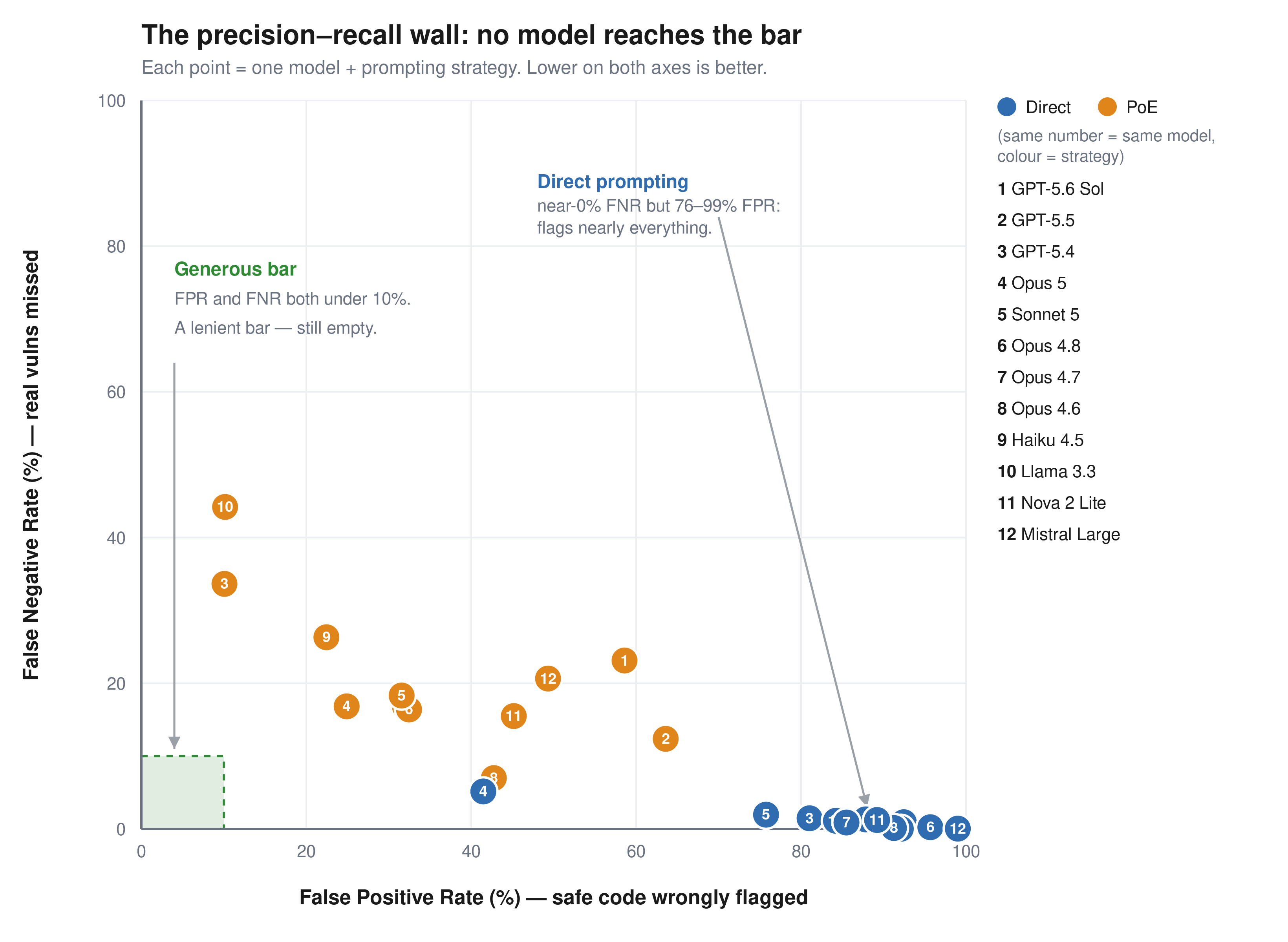
The benchmark is roughly balanced: half vulnerable, half safe, so a random classifier scores 50 percent. We report two error rates separately, because they fail in opposite directions. The false positive rate (FPR) is how often the model flags safe code as vulnerable. These are the false alarms that waste an engineer’s time. The false negative rate (FNR) is how often it misses a real vulnerability and calls it safe. Accuracy alone hides this: a model that labels everything vulnerable catches every bug (0 percent FNR) but flags all safe code (100 percent FPR) and still scores about 50 percent. We consider FPR below 10 percent and FNR below 10 percent the minimum bar for production use.

Figure 1: FPR compared to FNR for 12 models across two prompting strategies. No model reaches the generous bar

Figure 1: FPR compared to FNR for 12 models across two prompting strategies. No model reaches the generous bar.

Model

Prompt

Accuracy

FPR

FNR

GPT-5.6 Sol Direct 54.9% 92.5% 0.9%
GPT-5.6 Sol PoE 58.9% 58.6% 23.1%
GPT-5.5 Direct 56.9% 87.8% 1.3%
GPT-5.5 PoE 62.9% 63.6% 12.4%
GPT-5.4 Direct 60.2% 81.0% 1.5%
GPT-5.4 PoE 77.7% 10.1% 33.6%
Llama 3.3 70B Direct 58.8% 84.2% 1.1%
Llama 3.3 70B PoE 72.2% 10.2% 44.2%
Claude Haiku 4.5 Direct 55.6% 92.1% 0.0%
Claude Haiku 4.5 PoE 75.6% 22.4% 26.3%
Claude Opus 4.6 Direct 55.9% 91.3% 0.1%
Claude Opus 4.6 PoE 75.8% 42.7% 7.0%
Claude Opus 4.7 Direct 58.3% 85.5% 0.9%
Claude Opus 4.7 PoE 75.9% 32.0% 16.8%
Claude Opus 4.8 Direct 53.8% 95.7% 0.2%
Claude Opus 4.8 PoE 75.8% 32.5% 16.4%
Claude Opus 5 Direct 77.3% 41.5% 5.2%
Claude Opus 5 PoE 79.3% 24.9% 16.8%
Claude Sonnet 5 Direct 62.9% 74.7% 2.2%
Claude Sonnet 5 PoE 74.7% 31.8% 19.2%
Amazon Nova 2 Lite Direct 56.3% 89.2% 1.2%
Amazon Nova 2 Lite PoE 70.1% 45.2% 15.5%
Mistral Large Direct 52.2% 99.0% 0.0%
Mistral Large PoE 65.5% 49.3% 20.6%

Among the general-purpose frontier models tested, no configuration achieves both FPR and FNR less than 10 percent on this benchmark.

Every model has the same failure mode. With direct prompting, they catch up to 95 percent of real vulnerabilities but also flag 41–99 percent of safe code. Precision runs from 52 percent to 71 percent, clustered in the mid-50s; effectively as likely to be inaccurate as accurate. The models see a vulnerability pattern and stop reasoning. Proof-of-exploit prompting cuts false positives by 17–74 points but misses 7–44 percent of real vulnerabilities. The environment-gated challenges are worse: models flag the code and ignore the Kubernetes Network Policy next to it. No tested configuration keeps both false positives and false negatives below 10 percent.

These results reflect general-purpose models in single-turn prompting. Purpose-built systems with multi-step validation and tool use are a different operating point that we didn’t measure, and if a harness can close the gap between pattern recognition and genuine understanding, this benchmark is the place to demonstrate it. Two cautions before assuming it already does. Agentic verification is proven mostly on offensive tasks, where success can be confirmed: the exploit fires or it doesn’t. Judging that code is safe has no such oracle. Extra iterations re-sample the same judgment rather than confirm a negative, and a harness still inherits the base model’s understanding. If the model can’t separate an effective mitigation from an ineffective one in a single pass, more passes won’t add the missing knowledge. That’s what this benchmark measures: the model’s intrinsic ability to understand code, tested at the single-turn baseline where no scaffolding can mask the gap.

For security teams evaluating AI tools today: ask your vendors how their system performs on tasks like this, not just whether it finds vulnerabilities, but how often it’s wrong. Pair any AI-assisted review with human verification on high-risk code paths, and use Deception Benchmark to hold your tools accountable.

Availability

We built Deception Benchmark to simplify measuring this problem in a reproducible way. The public release includes the samples and evaluation workflow. We don’t release the labels, so submissions can be scored consistently over time without turning the benchmark into a memorization exercise.

Of the 14,822 samples, 9,695 are scored; the remaining 5,127 are held out and unscored, mixed in with the rest of the benchmark. The goal is straightforward: make it more difficult to optimize the benchmark compared to improving the underlying system. We describe that design in more detail in the whitepaper.

Deception Benchmark is available on GitHub, along with the whitepaper and submission instructions for verified scoring. If you’re building security tooling, you can download the dataset, run your system against the benchmark, and submit predictions for scored evaluation.

If you have feedback about this post, submit comments in the Comments section below.


Anshumali-Shrivastava

Anshumali Shrivastava

Anshumali is an Amazon Scholar and Full Professor of Computer Science at Rice University. His research on dynamic sparsity, sketching, and hashing pioneered techniques now central to efficient LLM training and inference. A two-time founder — ThirdAI (acquired by ServiceNow) and XMAD.ai (acquired by Workato) — he bridges theoretical computer science and practical AI systems at scale.

Neha Rungta

Neha Rungta

Neha is a scientist and builder who has spent her career making machines reason about complex systems at scale. Her work spans automated reasoning, formal verification, security, and AI, shaping systems including Cedar, IAM Access Analyzer, and Continuum. Today, she is forging the next generation of machine reasoning, combining LLMs, formal methods, and agentic systems.

❌