❌

Normal view

Run open weight models on Amazon Bedrock in AWS European Sovereign Cloud

17 September 2026 at 23:19

European organizations can run AI workloads on Amazon Web Services (AWS) while keeping data within the European Union (EU) and meeting regulatory requirements. You can now run generative AI workloads on open weight models on Amazon Bedrock in the AWS European Sovereign Cloud. We’re excited to announce the general availability of the first open weight model family, Gemma 4, on the Amazon Bedrock next-generation inference engine in the AWS European Sovereign Cloud. Gemma 4, released under the Apache 2.0 license, on Amazon Bedrock benefits from the same data residency and operational controls that define the AWS European Sovereign Cloud so you can build, iterate, and scale generative AI applications while meeting digital sovereignty requirements.

The AWS European Sovereign Cloud is an independent cloud for Europe, located entirely within the EU, designed to help customers meet their most stringent digital sovereignty requirements. It runs entirely within the EU and is independently operated with strong technical controls, sovereign assurances and legal protections. Only AWS employees who reside in the EU control day-to-day operations, including access to data centers, technical support, and customer service.

In this post, we explain how the Amazon Bedrock inference engine protects your inference data when running Gemma 4 models, how the AWS European Sovereign Cloud keeps it within the EU, and then walk through the available Gemma 4 models and your first inference request.

Next generation inference engine for Amazon Bedrock

The inference engine is a distributed engine for serving large-scale machine learning models, built for high performance, reliability, and security. You reach it through the bedrock-mantle endpoint, which supports OpenAI-compatible APIs (the Responses and Chat Completions APIs). You can bring an existing OpenAI SDK codebase to Amazon Bedrock by changing only the base URL and API key. The Responses API supports stateful conversation management, which rebuilds context without you passing conversation history with each request. Stored responses are scoped by Amazon Bedrock project, a logical boundary that represents a workload for access control, cost tracking, and usage monitoring.

The engine applies the same operational security practices you rely on across AWS. Access follows a least privilege model, where each operator has access only to the systems a specific task requires, and only for the time that privilege is needed. Any access to systems that store or process customer data or metadata is logged, monitored for anomalies, and audited. All your prompts and responses are kept private during inference.

How your inference data is protected

Amazon Bedrock uses a zero operator access data security model, meaning no service operators can access model input or output during inference. It also uses a zero data retention model, so by default it doesn’t store your inputs or outputs. For certain models, limited retention might apply for abuse detection (see the Amazon Bedrock abuse detection documentation). Your prompts and responses are encrypted in transit and, by default, are not shared with the model provider.

All inference stays within the eusc-de-east-1 AWS Region as described in the following section on data residency. Combined with the data residency and EU-based operations of the AWS European Sovereign Cloud, this gives organizations in highly regulated industries the confidence to run their most sensitive AI workloads in the cloud.

Data residency and regional availability

The AWS European Sovereign Cloud became generally available in January 2026, with its first Region in Brandenburg, Germany (eusc-de-east-1). It’s a separate, independently operated cloud, with infrastructure located entirely within the EU and no critical dependencies on non-EU personnel or infrastructure. All your content remains within the Region you select unless you choose otherwise. Beyond content, customer-created metadata including roles, permissions, resource labels, and configurations also stays within the EU. The AWS European Sovereign Cloud is operated exclusively by EU residents located in the EU. We’re also gradually transitioning the AWS European Sovereign Cloud to be operated exclusively by EU citizens located in the EU. During this transition period we will continue to work with a blended team of EU residents and EU citizens located in the EU.

All Amazon Bedrock inference requests, including Gemma 4, use in-Region inference in eusc-de-east-1, which keeps every request within the AWS European Sovereign Cloud. Global cross-Region inference, which routes requests across commercial AWS Regions worldwide, isn’t available in the AWS European Sovereign Cloud.

Control over who can access your data

With AWS Identity and Access Management (IAM), you decide which principals in your account can call the inference API and which models they can use. Fine-grained permissions let you grant only the access each workload needs, following least privilege, and we recommend short-lived credentials over long-term keys.

For auditing, every call to the endpoint is recorded in AWS CloudTrail, giving your security and compliance teams an audit trail of who invoked inference and when. You can also monitor usage with Amazon CloudWatch and set alarms on patterns that matter to you, such as unexpected spikes in request volume.

Open weight models in the AWS European Sovereign Cloud

Organizations adopting open weight foundation models (FMs) for production face a constant challenge: how to access the leading models without compromising on data protection, regulatory alignment, or operational control. Amazon Bedrock removes that challenge. It gives you leading open weight FMs through a fully managed service, with inference running entirely on infrastructure operated by AWS and the security and privacy controls you expect from Amazon Bedrock. Because the models are open weight, you can independently evaluate the model architecture and training methodology, benchmark your own workloads, and fine-tune on proprietary data when customization is required.

Gemma 4 is a family of open weight models, released under the Apache 2.0 license. It’s available in three instruction-tuned variants, so you can evaluate and choose the model that fits your workload. The following table provides guidance on which model to choose based on your use case:

Model

Use case

Specifications

Gemma 4 31B (google.gemma-4-31b-it)

Reasoning-heavy or coding-heavy with a single dense model

30.7 billion parameter dense model with a 256 K token context window

Gemma 4 26B-A4B (google.gemma-4-26b-a4b-it)

Cost-sensitive at high throughput, with knowledge breadth requirements

Mixture-of-experts model with 25.2 billion total parameters and 3.8 billion active per token, with a 256 K token context window

Gemma 4 E2B

(google.gemma-4-e2b-it)

Latency-sensitive, on-device-style, or multimodal classification

Compact model with 5.1 billion total parameters and 2.3 billion effective parameters using per-layer embeddings (PLE), with a 128 K token context window

All three variants offer built-in reasoning, native function calling, and multimodal input across text and image.

Get started with Gemma 4 models on Amazon Bedrock

Gemma 4 is served through the bedrock-mantle endpoint, the OpenAI-compatible API for the next-generation inference engine, so you can call it with the OpenAI Python and TypeScript SDKs. Use the following steps to use the OpenAI Python SDK to send your first request to Gemma 4 31B in the AWS European Sovereign Cloud.

Prerequisites

To follow this example, you need an AWS account with access to the AWS European Sovereign Cloud and an IAM principal with permissions to call the bedrock-mantle endpoint. Create an IAM policy that grants the two actions this walkthrough uses, then attach it to your IAM principal. The bedrock-mantle:CreateInference action runs inference, and the bedrock-mantle:CallWithBearerToken action authenticates with an Amazon Bedrock API key. The following sample policy grants the actions this example needs. Scope the resources further for your environment as described after the policy.

{
  "Version": "2012-10-17",
  "Statement": [
    {
      "Sid": "GemmaMantleInference",
      "Effect": "Allow",
      "Action": "bedrock-mantle:CreateInference",
      "Resource": "arn:aws-eusc:bedrock-mantle:eusc-de-east-1:<account-id>:project/<project-id>"
    },
    {
      "Sid": "GemmaMantleBearerToken",
      "Effect": "Allow",
      "Action": "bedrock-mantle:CallWithBearerToken",
      "Resource": "*"
    }
  ]
}

Replace <account-id> and <project-id> with your own values.

Install the OpenAI SDK and the Amazon Bedrock token generator with the command pip install “openai>=2.45.0" aws-bedrock-token-generator.

Authenticate

You authenticate with an Amazon Bedrock API key. Amazon Bedrock offers two types of API keys. Short-term keys expire automatically within 12 hours and inherit the permissions of the IAM principal that generated them, which makes them the recommended choice for production. Long-term keys last until a configured expiration and are intended for development and exploration. For production, use the auto-refreshing short-term key shown in the following example, or store the key in AWS Secrets Manager.

from aws_bedrock_token_generator import provide_token
from openai import BedrockOpenAI

region = "eusc-de-east-1"

client = BedrockOpenAI(
    aws_region=region,
    base_url="https://bedrock-mantle.eusc-de-east-1.api.amazonwebservices.eu/v1",
    bedrock_token_provider=lambda: provide_token(region=region),
)

Alternatively, you can pass a short-term API key through an environment variable. This key isn’t refreshed and expires after at most 12 hours.

import os
from openai import OpenAI

client = OpenAI(
    base_url="https://bedrock-mantle.eusc-de-east-1.api.amazonwebservices.eu/v1",
    api_key=os.environ["AWS_BEARER_TOKEN_BEDROCK"],
)

Run your first inference with the Responses API

The Responses API uses a single input field and returns the generated text in output_text. Setting store to false means Amazon Bedrock doesn’t retain the request or response.

response = client.responses.create(
    model="google.gemma-4-31b-it",
    input="Explain the benefits of open-weight models for regulated industries.",
    max_output_tokens=512,
    store=False,
)
print(response.output_text)

Call the Chat Completions API

You can also call the OpenAI-compatible Chat Completions endpoint directly. If you use AWS credentials instead of an API key, sign the request with AWS Signature Version 4 (SigV4), as in the following example.

export ENDPOINT=https://bedrock-mantle.eusc-de-east-1.api.amazonwebservices.eu
export AWS_REGION=eusc-de-east-1

curl -X POST ${ENDPOINT}/v1/chat/completions \
  --aws-sigv4 "aws:amz:${AWS_REGION}:bedrock" \
  --user "${AWS_ACCESS_KEY_ID}:${AWS_SECRET_ACCESS_KEY}" \
  -H "x-amz-security-token: ${AWS_SESSION_TOKEN}" \
  -H "Content-Type: application/json" \
  -d '{
    "model": "google.gemma-4-31b-it",
    "messages": [{"role": "user", "content": "Hello!"}]
  }'

Clean up

This walkthrough creates no persistent resources, so there’s nothing to delete. The short-term API keys used here expire automatically within 12 hours.

Pricing and availability

Gemma 4 is available in Amazon Bedrock in the AWS European Sovereign Cloud. You pay per token with no upfront commitment, and usage counts toward your existing AWS commitments. For current pricing, see Amazon Bedrock pricing. For model and Regional availability, see Regional availability by models.

Commitment to innovation

Beyond the technical integration, running AI workloads in a sovereign context raises important questions about requirements. As you plan AI workloads for a sovereign context, evaluate them against your organization’s requirements for data residency, model governance, and operational control. The AWS European Sovereign Cloud is designed to help you meet these requirements in the EU.

AWS is committed to making AWS the best place for European organizations to innovate with AI, without compromise. To learn more about AWS European Sovereign Cloud visit aws.eu.

If you have feedback about this post, submit comments in the Comments section below.

Author

Marta Taggart

Marta is a Principal Product Marketing Manager focused on digital sovereignty and the AWS European Sovereign Cloud in AWS Product Marketing. She helps customers navigate complex digital sovereignty requirements and understand how AWS solutions can help address their needs so they can build and innovate with confidence. Outside of work, she enjoys yoga and coffee.

Zohreh Norouzi

Zohreh Norouzi

Zohreh is a Senior Security Solutions Architect at Amazon Web Services (AWS). She helps customers make good security choices and accelerate their journey to the AWS Cloud. She has been actively involved in AI security initiatives, using her expertise to help customers build secure AI solutions at scale.

Extend Amazon Bedrock Guardrails to Tool Interactions Using the Strands Agents SDK

27 August 2026 at 18:20

If you’re running AI agents in production, Amazon Bedrock Guardrails protects the model boundary. But your agents also invoke tools, fetch external data, and communicate with other systems. That data flows outside the model boundary, where model-level guardrails can’t reach.

You can extend guardrail coverage to those interactions using three validation checkpoints built with the Strands Agents SDK lifecycle hooks and Amazon Bedrock guardrails. You implement each checkpoint using a Strands life-cycle hook, which validates data at a critical trust boundary without changing your existing tools or agent logic.

Agents can communicate with other systems through the Model Context Protocol (MCP), a standard for connecting AI systems to data sources and tools. You will learn how to implement three validation checkpoints, scope different guardrails to specific tools, and scale them to other agents.

Extending guardrails beyond the model boundary

Amazon Bedrock Guardrails provides protection at the model boundary. Every model invocation is checked: the input prompt is validated before inference, and the model response is validated after inference. You can enforce guardrail use at the account level using AWS Identity and Access Management (IAM) policies, making guardrails mandatory for model calls across your account. You can further refine this by using Amazon Bedrock Guardrails input tagging to mark specific portions of the prompt for evaluation, so trusted content like system prompts can be skipped.

Guardrails cover what the model sees, but agents do more than call models. They invoke tools, pull data from external sources, communicate with MCP servers, and return results to users. These interactions happen outside the model boundary by design, because model-level guardrails focus on the prompts and responses the model itself handles. Adding validation at the tool boundary complements, rather than replaces, that model-level protection.

Model-level guardrails alone leave you exposed in four ways:

  • Tool parameters pass through unchecked. The model decides which tool to use and what parameters to pass. The agent then calls the tool with those parameters. No validation sits between the model’s decision and the tool’s execution. If the parameters inadvertently contain personally identifiable information (PII) or policy-violating content, the tool runs with that content.
  • External data enters without validation. Agents consume data from tool responses, MCP server outputs, and API calls. Without validation at the tool boundary, content from external sources can influence the agent’s behavior before model-level guardrails have a chance to evaluate it.
  • Misleading content can affect reasoning. An agent that retrieves inaccurate or misleading content from an external source might treat it as authoritative, producing skewed recommendations in lending, healthcare, or legal advice.
  • Multi-agent systems can spread bad data downstream. In multi-agent systems, a misconfigured or poorly designed upstream component can pass policy-violating content to downstream agents. Model-level guardrails at each agent’s boundary don’t inspect data flowing between agents at the tool layer.

Three validation checkpoints

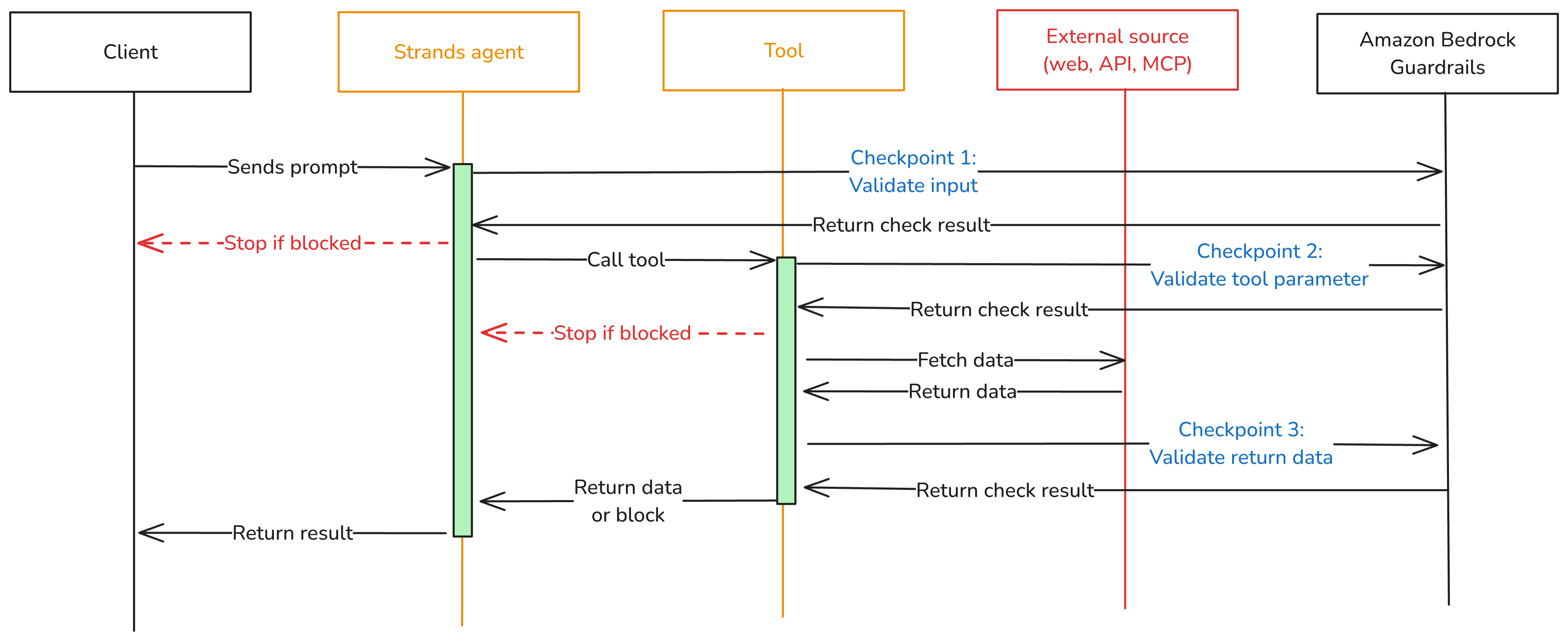
To close these gaps, add three validation checkpoints at each trust boundary where data crosses into or out of your agent as shown in Figure 1.

  • Checkpoint 1: Inbound data validation – Check data before it reaches the model—user input, data from other agents, MCP tool servers, and RAG pipelines. You catch policy-violating or biased content before it enters the model’s context window. In the Strands Agents SDK, you implement this using a BeforeInvocationEvent hook that fires before model inference or tool execution occurs. The hook inspects incoming messages and blocks the request if the content violates policies. The model doesn’t see blocked content.
  • Checkpoint 2: Tool interaction supervision – Before the agent calls a tool, a BeforeToolCallEvent hook checks the parameters it’s about to pass. This is the gap model-level guardrails don’t cover. The model has already decided what to send, but nothing has verified whether that content is safe to act on. If the hook flags the input, the call is canceled before the real-world action occurs.
  • Checkpoint 3: Outbound data validation – Validate results before returning them to the user or passing them to downstream systems. You need this most for tools that ingest external content, like a web search tool fetching web pages from sites outside your control. In Strands, an AfterToolCallEvent hook validates the tool’s return value and replaces it with a block message if the content violates policies.
Figure 1: Three validation checkpoints extend Amazon Bedrock Guardrails from the model boundary to the tool boundary.

Figure 1: Three validation checkpoints extend Amazon Bedrock Guardrails from the model boundary to the tool boundary.

You can adjust the validation intensity of each checkpoint:

  • At Checkpoint 1, use a full Amazon Bedrock guardrail with PII detection, content filtering, and topic enforcement.
  • Checkpoint 2 can be lighter. Configure a separate Amazon Bedrock guardrail with rules tailored to the specific tool being called, or run local checks like regex validation or schema enforcement.
  • For Checkpoint 3, focus on unwanted content detection for tool outputs that return external data.

Mix fast deterministic checks (regex, schema validation, allowlists) with AI-based guardrail evaluations. This keeps latency low.

Implementation

The implementation uses boto3, the AWS SDK for Python, to call the ApplyGuardrail API. The Strands Agents SDK exposes one life-cycle event per checkpoint. Here’s how to implement each one.

Prerequisites

This post assumes you already have a working Strands agent. Your agent should use least-privilege tool access, scoped system prompts, and validated business logic. If you’re starting from scratch, see Strands Agents SDK: A technical deep dive into agent architectures and observability for a step-by-step walk through of building and deploying a Strands agent with Amazon Bedrock Agent Core.

Before implementing the multi-checkpoint approach, you’ will need:

  1. An AWS account with access to Amazon Bedrock
  2. Amazon Bedrock Guardrails configured (see Creating a guardrail)
  3. Python 3.11 or later installed
  4. The Strands Agents SDK installed: pip install strands-agents
  5. AWS credentials configured with permissions for bedrock:ApplyGuardrail and bedrock:InvokeModel
  6. Your guardrail ID and version from the AWS Management Console for Amazon Bedrock (navigate to Guardrails, select your guardrail, and copy the ID)

Create the guardrail validation hook

The GuardrailHook class is a Strands HookProvider. It registers three callbacks, one for each lifecycle event. When Strands triggers an event, the matching callback runs validate_inbound checks user messages, validate_input checks tool parameters before execution, and validate_output checks tool results. All three use the shared _check method, which calls the Amazon Bedrock ApplyGuardrail API.

Create a guardrail_hook.py file and add this implementation. Use the optional tool_names parameter to scope a hook to specific tools, or pass None to apply it everywhere:

import boto3
from strands.hooks import HookProvider, HookRegistry
from strands.hooks.events import (
    BeforeInvocationEvent,
    BeforeToolCallEvent,
    AfterToolCallEvent,
)

class GuardrailHook(HookProvider):

    def __init__(self, guardrail_id, guardrail_version, region_name, tool_names=None):
        self.client = boto3.client("bedrock-runtime", region_name=region_name)
        self.guardrail_id = guardrail_id
        self.guardrail_version = guardrail_version
        self.tool_names = tool_names  # None = apply to all tools

    def register_hooks(self, registry: HookRegistry, **kwargs):
        registry.add_callback(BeforeInvocationEvent, self.validate_inbound)
        registry.add_callback(BeforeToolCallEvent, self.validate_input)
        registry.add_callback(AfterToolCallEvent, self.validate_output)

    def _check(self, content, source="INPUT"):
        """Call Bedrock ApplyGuardrail. Returns True if content is safe."""
        response = self.client.apply_guardrail(
            guardrailIdentifier=self.guardrail_id,
            guardrailVersion=self.guardrail_version,
            source=source,       # "INPUT" applies input policies; "OUTPUT" applies output policies
            content=[{"text": {"text": content}}],
        )
        return response["action"] != "GUARDRAIL_INTERVENED"

    # Checkpoint 1 — BeforeInvocationEvent
    # Validates user input before model inference or tool execution occurs.
    # The model does not see blocked content.
    async def validate_inbound(self, event: BeforeInvocationEvent):
        for msg in reversed(event.messages):
            if msg.get("role") == "user":
                for block in msg.get("content", []):
                    text = block.get("text", "")
                    if text and not self._check(text):
                        event.messages.clear()
                        event.messages.append({
                            "role": "user",
                            "content": [{"text": "Request blocked by safety guardrail."}],
                        })
                        return
                break

    # Checkpoint 2 — BeforeToolCallEvent
    # Validates tool input parameters before the tool executes.
    # Skips tools not in tool_names (if a filter is set).
    async def validate_input(self, event: BeforeToolCallEvent):
        if self.tool_names and event.tool_use.get("name") not in self.tool_names:
            return
        tool_input = event.tool_use.get("input", {})
        for param_value in tool_input.values():
            if isinstance(param_value, str) and not self._check(param_value):
                event.cancel_tool = "This request was blocked by a safety guardrail."
                return

    # Checkpoint 3 — AfterToolCallEvent
    # Validates tool output before it reaches the agent.
    # Skips tools not in tool_names (if a filter is set).
    async def validate_output(self, event: AfterToolCallEvent):
        if self.tool_names and event.tool_use.get("name") not in self.tool_names:
            return
        content_parts = [
            block["text"]
            for block in event.result.get("content", [])
            if "text" in block
        ]
        content = "\n".join(content_parts)
        if content and not self._check(content, source="OUTPUT"):
            event.result = {
                "toolUseId": event.result["toolUseId"],
                "status": "error",
                "content": [{"text": "Content blocked by safety guardrail."}],
            }

Define tools

Strands discovers tools through the @tool decorator. The decorator turns a plain Python function into a tool the model can call, using the function’s docstring and type hints as the tool’s contract. Here are two simple examples used in the registration sections below. A web search tool and a customer data tool:

from strands import tool

@tool
def web_search(query: str) -> str:
    """Search the web and return a result snippet."""
    # Replace with your actual search implementation
    return f"Search results for: {query}"

@tool
def get_customer_data(customer_id: str) -> str:
    """Retrieve customer record by ID."""
    # Replace with your actual data lookup implementation
    return f"Customer record for: {customer_id}"

If you don’t have existing tools, create a tools.py file and copy in the example code above.

Register the hook

Strands activates hooks through the hooks parameter on the Agent constructor. After being registered, the hook’s callbacks run automatically on every matching lifecycle event. No changes are needed in your tools or agent logic. For a single guardrail applied to all tools, create one hook instance and pass it to your agent:

from strands import Agent
from strands.models import BedrockModel
from guardrail_hook import GuardrailHook
from tools import web_search, get_customer_data # Example tools - replace with your tools

# Example model and region selection
model = BedrockModel(
    model_id="us.anthropic.claude-sonnet-4-5",
    region_name="us-east-1",
)

guardrail_hook = GuardrailHook(
    guardrail_id="your-guardrail-id",    # Copy it from the Amazon Bedrock console > Guardrails
    guardrail_version="1",               # Use "DRAFT" for testing
    region_name="us-east-1",             # Region where the guardrails are defined
)

agent = Agent(
    model=model,
    tools=[web_search, get_customer_data], # Example tools
    system_prompt="You are a helpful assistant.", # Example system prompt
    hooks=[guardrail_hook],  # Applied to all tool calls
)

Use different guardrails per tool

Different tools carry different risks. A web search tool fetches external content from untrusted sites and needs strict output filtering. A customer data tool returns internal records and might need PII detection configured differently. The tool_names parameter scopes a hook to specific tools. Strands still runs every registered hook on each event, but hooks skip the call when the tool name doesn’t match. Register one hook per guardrail:

from strands import Agent
from strands.models import BedrockModel
from guardrail_hook import GuardrailHook
from tools import web_search, get_customer_data # Example tools - replace with your tools

# Example model and region selection
model = BedrockModel(
    model_id="us.anthropic.claude-sonnet-4-5",
    region_name="us-east-1",
)
# Strict content filtering and PII detection for web search results
web_search_hook = GuardrailHook(
    guardrail_id="gr-websearch-id",      # Guardrail ID with content filtering + PII detection
    guardrail_version="1",               # Or set to DRAFT
    region_name="us-east-1",             # Change to your region
    tool_names={"web_search"},           # Only applies to the web_search tool
)

# PII detection for customer data — prevents sensitive records from leaking into tool parameters
customer_data_hook = GuardrailHook(
    guardrail_id="gr-customerdata-id",   # Guardrail ID with PII detection
    guardrail_version="1",               # Or set to DRAFT
    region_name="us-east-1",             # Change to your region
    tool_names={"get_customer_data"},    # Only applies to the get_customer_data tool
)

agent = Agent(
    model=model,
    tools=[web_search, get_customer_data],        # Example tools
    system_prompt="You are a helpful assistant.", # Example system prompt
    hooks=[web_search_hook, customer_data_hook],  # Each hook runs only for its assigned tools
)

Each guardrail is configured independently in the Amazon Bedrock console. You can match validation strictness to each tool’s risk level instead of applying one policy across your entire agent.

Test your implementation

Run a quick test with the preceding examples:

  1. Create a project folder and add the following files:
    1. guardrail_hook.py the GuardrailHook class
    2. tools.py the web_search and get_customer_data tool definitions as examples
    3. agent.py the agent setup from the Register the hook section
  2. In agent.py, add a test prompt at the end:
# Send a test prompt
response = agent("Search the web for the latest news on AI security.")
print(response)
  1. Update the guardrail IDs, AWS Region, and model ID in agent.py to match your configuration.
  2. Run the agent from your project folder: python agent.py

The guardrail hook runs at each checkpoint. If the prompt or any tool output is flagged, you’ll see the block message in the response instead of the tool result.

Use the hook across your organization

The GuardrailHook is a standalone HookProvider. Build it once, then attach it to Strands agents by passing it to the hooks parameter. The same hook package can be published as an internal library and consumed by

You can swap guardrail configurations or add checks like regex or schema validation without touching agent or tool code.

Conclusion

Amazon Bedrock Guardrails protects the model boundary, but agents also call tools, consume external data, and return results that never pass through model-level checks. The three validation checkpoints in this post close that gap using Strands Agents SDK lifecycle hooks: BeforeInvocationEvent validates user input, BeforeToolCallEvent validates tool parameters, and AfterToolCallEvent validates tool output. The same GuardrailHook class supports one shared guardrail or different guardrails scoped per tool, and deploys unchanged from local testing to Amazon Bedrock Agent Core Runtime.

To learn more, see:

If you have feedback about this post, submit comments in the Comments section below.


Stephan Traub

Stephan Traub

Stephan is a senior security consultant with AWS Professional Services, where he works closely with customers across different industries. A true technology enthusiast, Stephan is passionate about empowering customers to achieve a robust security posture within their cloud environments and AI workloads. When Stephan isn’t immersed in his AWS work, you can find him on the volleyball court or exploring the world with his family.

Enforce zero data retention on Amazon Bedrock with Bedrock Projects and service control policies

7 July 2026 at 20:18

With the introduction of models that require data sharing with third-party providers—such as Claude Fable 5—organizations need a way to centrally enforce data retention policies. Amazon Bedrock gives you control over whether your prompts and model outputs are retained after an inference request completes. You might need a way to enforce your retention settings across all accounts and have granular control of project data retention when compatible with the selected model.

In this blog post, I walk you through how Amazon Bedrock data retention modes work, the tools available for managing retention—including Amazon Bedrock Projects and service control policies (SCPs)—and how to verify your policy settings are working correctly.

In this post, you will learn:

  • How Amazon Bedrock data retention modes work and what each mode means for your data
  • How to use Amazon Bedrock Projects with compatible models to isolate workloads with different retention needs
  • How to write and deploy an SCP that prevents anyone in your organization from enabling data sharing
  • How data retention modes interact with cross-Region inference profiles
  • How to verify your configuration is working correctly

Understanding data retention modes

You can use Amazon Bedrock to control data retention through a mode setting on your account. This determines what happens to your prompts and outputs after each inference request, which is important to understand as you assess your compliance needs. Not all models require data retention or data sharing, and you might continue to use Amazon Bedrock with models that don’t require data retention or data sharing. See the Amazon Bedrock documentation for the current list of models that require data retention or data sharing. Ultimately, it’s your responsibility as the customer to select models that align with your compliance needs.

Important Note: To help stop the dissemination of child sexual abuse material (“CSAM”), Amazon Bedrock uses automated mechanisms to identify CSAM in model input/output. We may store and review flagged content to determine if it is CSAM for reporting purposes, even when mode is none.

The following modes govern how Amazon Bedrock handles your data:

Mode Behavior Data shared with provider
none Zero data retention. Prompts and responses are processed and immediately discarded. No
default No data is shared with model providers. Some models might require data retention for trust and safety checks for up to 30 days. Consult the model’s terms for specifics. This mode also allows APIs that inherently require retention (for example, Batch API, Responses API with store=true). Models that support zero retention will still operate with zero retention. No
inherit No explicit setting applied, defers to the next higher scope (project defers to account defers to service default). This is the default for new accounts. No
provider_data_share Data is shared with the model provider and retained for up to 30 days for trust and safety. Yes

Understanding mode as a ceiling, not a floor

The most important concept to understand: your configured mode is the upper limit of retention you’re willing to accept; it is not what every request will use. Setting your account to provider_data_share doesn’t mean all your requests suddenly start retaining and sharing data. Models that support zero data retention will still operate with zero retention regardless of your account-level setting.

Think of it as a permissions ceiling:

Your account mode Model you invoke What happens
provider_data_share Claude Sonnet (supports none) Zero retention, Sonnet doesn’t require data sharing or data retention
provider_data_share Claude Fable 5 (requires provider_data_share) Data retained for up to 30 days and might be shared with provider, Fable 5 requires data sharing and data retention
none Claude Sonnet (supports none) Zero retention, no data sharing
none Claude Fable 5 (requires provider_data_share) Blocked, your ceiling is below what the model requires, calls to this model will be denied
default Claude Sonnet (supports none) Zero retention, Sonnet supports it, no data retention or data sharing
default A model requiring retention for safety checks Data is retained, model requires it and your ceiling allows it

Key takeaway: Your mode setting declares the maximum level of data retention you will accept. Models that support zero retention will continue to operate that way regardless of your account setting. Amazon Bedrock is designed so that you do not get more retention than necessary just because your account mode allows it.

Important: provider_data_share isn’t inherited from a model—it’s an explicit opt-in at the account or project level. If your account is set to inherit or default, no model will trigger provider data sharing unless you configure it within your account or project.

Note on inherit behavior: The inherit mode defers to the next scope up in the hierarchy (project defers to account defers to service default). If a project is set to inherit and the account above it is set to provider_data_share, the project will inherit provider_data_share. You will not inherit provider_data_share from a model—that requires an explicit setting at the account or project level.

Note on APIs that require retention: Some Amazon Bedrock APIs require data retention to function regardless of model support, for example, the Batch API and the Responses API with store=true. Setting your mode to none will block these APIs. This is expected behavior: your ceiling of none means you require no retention, so APIs that can’t operate without retention are unavailable.

Why does provider_data_share exist?

Some foundation models require the provider_data_share mode to function. As AI models evolve, so must the mechanism to protect customers and the safety of their use. Models that require provider_data_share have allowed_modes: ["provider_data_share"], meaning they will appear as unavailable unless the account has explicitly opted in. This is by design: AWS requires you to make a conscious decision to share data before you as a customer can use these models. See the current list of models available through Amazon Bedrock and their retention requirements, which can change as new models are released.

If your regulatory requirements, internal policies, or customer commitments prohibit data sharing with third-party model providers, you can enforce this at multiple levels. Amazon Bedrock provides several tools for managing data retention, from fine-grained project-level settings to organization-wide enforcement.

Tools for managing data retention

Amazon Bedrock gives you multiple layers of control over data retention. You can use them independently or combine them for defense-in-depth:

Tool Scope Use case
Amazon Bedrock console Per-account, per-AWS Region Quick configuration and visibility; view and change your retention mode directly in the AWS Management Console.
Amazon Bedrock Projects Per-project within an account Isolate workloads with different retention needs within the same account for compatible models
SCPs Organization-wide Use to prevent any account from opting in to data sharing
IAM policies Per-account or per-principal Fine-grained control, including the management account (which SCPs don’t cover)

Using Amazon Bedrock Projects for granular control

Not every workload in an account has the same data retention requirements. If you’re using the bedrock-mantle endpoint (OpenAI-compatible APIs), you can use Amazon Bedrock Projects to isolate traffic that can accept data retention from traffic that must not be retained—even within the same account.

For example, you might have:

  • A research project where your team needs access to the latest models (including those requiring provider_data_share) for experimentation
  • A production project handling customer data where zero retention is mandatory

With Amazon Bedrock Projects, you can set provider_data_share on the research project while keeping the production project locked to none. Each project enforces its own retention ceiling independently.

How project-level retention works:

  • Each project can have its own data retention mode setting.
  • A project set to inherit will inherit its mode from the account level.
  • A project set to none enforces zero retention regardless of the account setting. Traffic routed through that project can’t trigger data sharing.
  • A project set to provider_data_share allows models requiring data sharing, but only for requests within that project.

This gives organizations the flexibility to adopt new models incrementally while maintaining strict data governance on sensitive workloads. You can manage project settings using the Amazon Bedrock console or the bedrock-mantle API.

Important: Amazon Bedrock Projects are only available on the bedrock-mantle endpoint. They work with models accessed using the OpenAI-compatible APIs (Responses, Chat Completions) and the Anthropic Messages API on the mantle endpoint. Not all models are available on bedrock-mantle; check the endpoint availability by models page for current support.

Workload isolation on the bedrock-runtime endpoint

If you’re using the bedrock-runtime endpoint (Invoke, Converse APIs), project-level data retention isn’t available. The account-level retention mode applies to all requests made through bedrock-runtime.

To achieve workload-level isolation on bedrock-runtime, use separate AWS accounts:

  • Place workloads that need provider_data_share in one account (or OU) without the SCP
  • Place workloads that require zero retention in a separate account (or OU) with the SCP applied

You can use AWS Organizations OUs to group accounts by retention policy and apply SCPs selectively:

Organization Root
├── OU: Zero-Retention (SCP attached — blocks provider_data_share)
│   ├── Account: Production-App-A
│   └── Account: Production-App-B
└── OU: Research (no SCP — allows provider_data_share)
    └── Account: ML-Experimentation

Combining projects with SCPs: If you use an SCP to enforce none at the organization level, it overrides all project-level settings on bedrock-mantle. For accounts where you want project-level flexibility, don’t apply the SCP—use project-level isolation instead. For accounts that must never have data sharing under any circumstances, the SCP provides an unbypassable guarantee across both endpoints.

Using SCPs for organization-wide enforcement

For organizations that need an absolute guarantee that no account can enable data sharing—regardless of who has admin access or which endpoint they use—SCPs provide the strongest enforcement mechanism. SCPs apply to both the Amazon Bedrock control plane (bedrock:PutAccountDataRetention) and the mantle endpoint (bedrock-mantle:PutAccountDataRetention, bedrock-mantle:CreateProject, bedrock-mantle:UpdateProject).

Enforcing zero data retention with an SCP

In this section, I cover how you can use SCPs to manage your data retention policy. I introduce what an SCP is and provide some policies that you can use in your organization.

What is an SCP?

A service control policy (SCP) is a guardrail set at the organization level. It overrides every principal in the organization, including account administrators and root users. Even if someone has full admin permissions, an SCP deny can’t be overridden by an AWS Identity and Access Management (IAM) policy.

SCPs are managed in AWS Organizations and can be attached at different levels:

  • Root – Applies to every account in the organization
  • Organizational unit (OU) – Applies to all accounts in that OU
  • Individual account – Applies only to that specific account

Important: The SCP must be attached to the root OU to cover all accounts. If attached to a child OU, accounts outside that OU will not be protected. Organization admin accounts don’t inherit SCP controls.

The SCP policy

The following policy prevents anyone in the organization from changing the Amazon Bedrock data retention mode to anything other than none.

Important: New accounts default to inherit (not none). Before attaching this SCP, you must explicitly set each account to none. Start by running the following in each account:

aws bedrock put-account-data-retention --region us-east-1 --mode none

If you have hundreds, or thousands of AWS accounts, you will need a way to scale this. See the AWS re:Post article Automate Bedrock Zero Data Retention Across All Accounts in Your Organization to learn how.

Amazon Bedrock policy:

This policy is used to restrict data retention to only be set to none. Any other value than none will be denied.

{
    "Version": "2012-10-17",
    "Statement": [
        {
            "Sid": "RESTRICTBEDROCKDATARETENTION",
            "Effect": "Deny",
            "Action": [
                "bedrock:PutAccountDataRetention"
            ],
            "Resource": "*",
            "Condition": {
                "StringNotEquals": {
                    "bedrock:DataRetentionMode": "none"
                }
            }
        }
    ]
}

How it works

The Condition block uses StringNotEquals, meaning the deny fires for any value that isn’t none. This ensures:

Action Result
Setting mode to none Allowed
Setting mode to provider_data_share Denied by SCP
Setting mode to default Denied by SCP
Setting mode to inherit Denied by SCP

With all the preceding in place you might be wondering what this means for your organization:

  • No one can enable data sharing with model providers – Even account administrators receive Access Denied
  • Models requiring provider_data_share become permanently unavailable – Models that require data sharing (such as Claude Fable 5 and Claude Mythos 5, among others) will not work across the organization
  • All other models continue to work normally – Models that support none mode are unaffected
  • The setting cannot be bypassed – no IAM policy can override an SCP deny

Optional: Block project-level overrides

The bedrock-mantle endpoint supports project-level data retention settings. Without additional SCP coverage, someone could create or update a project with provider_data_share, bypassing the account-level restriction. To prevent this, extend your SCP to include the bedrock-mantle project actions:

{
    "Version": "2012-10-17",
    "Statement": [
        {
            "Sid": "RESTRICTBEDROCKDATARETENTION",
            "Effect": "Deny",
            "Action": [
                "bedrock:PutAccountDataRetention",
                "bedrock-mantle:PutAccountDataRetention",
                "bedrock-mantle:CreateProject",
                "bedrock-mantle:UpdateProject"
            ],
            "Resource": "*",
            "Condition": {
                "StringNotEquals": {
                    "bedrock:DataRetentionMode": "none"
                }
            }
        }
    ]
}

Why doesn’t bedrock-runtime need project-level blocking? Projects don’t exist on the bedrock-runtime endpoint. The only way to change retention for bedrock-runtime traffic is the account-level bedrock:PutAccountDataRetention action, which the base SCP already blocks. The extra CreateProject and UpdateProject actions are only needed because bedrock-mantle allows per-project retention overrides; the project level control iisn’t required on bedrock-runtime.

Data retention and cross-Region inference

When using cross-Region inference profiles, it’s important to understand how data retention mode is evaluated: the mode is evaluated in the source AWS Region of your request, the Region where you make the API call. You don’t need to set the retention mode in every destination Region.

However, there’s an important caveat: while the mode check happens in your source Region, the data itself might be retained in the destination Region where the inference is processed. This is relevant for organizations tracking where retained data resides geographically.

What this means in practice

The following describes how this work in practice with data retention and inference.

  • If your source Region (for example, us-east-1) is set to provider_data_share, requests using a cross-Region inference profile will be permitted, regardless of the retention setting in the destination Region
  • If your source Region is set to none, requests to models requiring provider_data_share will be blocked at the source, before the request is ever routed to a destination Region
  • SCPs continue to apply globally, a single SCP at the root OU blocks provider_data_share in every Region automatically

SCPs are global

While data retention settings are helpful for granular control of data retention settings itself, SCPs can be used to apply data retention settings globally across all Regions automatically. A single SCP attached to the root OU blocks provider_data_share in every Region without needing to configure anything per-region. This is one of the key advantages of using an SCP for enforcement rather than relying on manual configuration.

Verify your configuration

You can verify your data retention settings and SCP enforcement using the AWS Software Development Kit, AWS Command Line Interface (AWS CLI), or the Amazon Bedrock console.

Check your current retention mode

The following provides are options that you can use for checking your current retention mode.

Using the Amazon Bedrock console:

In the AWS Management Console, go to Amazon Bedrock and choose Settings, and then choose Data retention. Here, you can see the current account-level retention mode and change it directly.

Using the AWS CLI (requires CLI version 2.35+):

aws bedrock get-account-data-retention --region us-east-1

Expected response:

{
  "mode": "none",
  "updatedAt": "2026-07-01T01:58:34.684Z"
}

Using the bedrock-mantle API (using a Bedrock API key):

curl https://bedrock-mantle.us-east-1.api.aws/v1/data_retention \
	-H "x-api-key: $BEDROCK_API_KEY"

Expected response:

{
  "mode": "none",
  "updated_at": 1719792000
}

Check a model’s effective mode and allowed modes

You can also use the bedrock-mantle API to check what retention mode is in effect for a specific model, and which modes that model supports:

curl https://bedrock-mantle.us-east-1.api.aws/v1/models/anthropic.claude-fable-5 \ 
  -H "x-api-key: $BEDROCK_API_KEY

Response:

{
  "id": "anthropic.claude-fable-5",
  "status": "available",
  "data_retention": {
    "mode": "provider_data_share",
    "source": "account",
    "allowed_modes": ["provider_data_share"]
  }
}

If the model shows "status": "unavailable", the status_reason field will explain the retention mode conflict.

Verify the SCP is working

To confirm your SCP is actively blocking data retention changes, attempt to set the mode to provider_data_share:

Using AWS CLI:

aws bedrock put-account-data-retention \
  --region us-east-1 \
  --mode provider_data_share

Using bedrock-mantle API:

curl -X PUT https://bedrock-mantle.us-east-1.api.aws/v1/data_retention \
  -H "x-api-key: $BEDROCK_API_KEY" \
  -H "Content-Type: application/json" \
  -d '{ "mode": "provider_data_share" }'

If the SCP is working, you’ll receive an Access Denied error:

An error occurred (AccessDeniedException) when calling the PutAccountDataRetention operation:
User: arn:aws:iam::123456789012:user/admin is not authorized to perform:
bedrock:PutAccountDataRetention with an explicit deny in a service control policy

If the SCP is not working, the request will succeed. If this happens, immediately revert:

aws bedrock put-account-data-retention \
  --region us-east-1 \
  --mode none

Then troubleshoot your SCP attachment:

  • Verify the SCP is attached to the root OU, not a child OU
  • Check the SCP policy syntax and condition keys
  • Remember: the AWS Organizations management account is exempt from SCPs—use an IAM policy to enforce policies on that account

Enable data retention for models that require it

For accounts where you want to use models requiring provider_data_share (accounts where the SCP isn’t applied), set the mode using AWS CLI, the API, or the console:

Using AWS CLI:

aws bedrock put-account-data-retention \
  --region us-east-1 \
  --mode provider_data_share

Using bedrock-mantle API:

curl -X PUT https://bedrock-mantle.us-east-1.api.aws/v1/data_retention \
  -H "x-api-key: $BEDROCK_API_KEY" \
  -H "Content-Type: application/json" \
  -d '{ "mode": "provider_data_share" }'

You can also do this in the Bedrock console in Data retention , under Settings.

Reset data retention back to none

To revert to zero data retention:

Using AWS CLI:

aws bedrock put-account-data-retention \
  --region us-east-1 \
  --mode none

Using bedrock-mantle API:

curl -X PUT https://bedrock-mantle.us-east-1.api.aws/v1/data_retention \
  -H "x-api-key: $BEDROCK_API_KEY" \
  -H "Content-Type: application/json" \
  -d '{ "mode": "none" }'

Manage project-level data retention

You can set data retention at the project level to allow different workloads within the same account to have different retention policies. Update a project’s data retention mode using the bedrock-mantle API:

# Set a project to provider_data_share
curl -X POST https://bedrock-mantle.us-east-1.api.aws/v1/organization/projects/proj_abc123 \
  -H "x-api-key: $BEDROCK_API_KEY" \
  -H "Content-Type: application/json" \
  -d '{ "data_retention": { "mode": "provider_data_share" } }'

# Set a project to none (zero retention)
curl -X POST https://bedrock-mantle.us-east-1.api.aws/v1/organization/projects/proj_abc123 \
  -H "x-api-key: $BEDROCK_API_KEY" \
  -H "Content-Type: application/json" \
  -d '{ "data_retention": { "mode": "none" } }'

# Check a project's current setting
curl -X POST https://bedrock-mantle.us-east-1.api.aws/v1/organization/projects/proj_abc123 \
  -H "x-api-key: $BEDROCK_API_KEY"

How project-level retention resolves: The effective mode for any request is determined by taking the first non-inherit value in the project, account, model default hierarchy. If your project is set to none, it enforces zero retention regardless of the account setting. If your project is set to inherit, it defers to the account-level setting.

Note: Project-level data retention is managed exclusively through the bedrock-mantle API. There is no AWS CLI command for project-level settings. The preceding AWS CLI commands only manage the account-level setting through the Amazon Bedrock control plane.

Conclusion

In this post, I showed you the various methods for managing data retention within Amazon Bedrock, including project-level data retention and organization wide control you can implement using SCPs. Choose the combination that matches your requirements and consult the Amazon Bedrock documentation to confirm each model’s mode requirements before deployment.

For more information about Amazon Bedrock data retention, see the data retention documentation. For SCPs, see service control policies in the AWS Organizations User Guide.

Additional resources

Try the examples in this post and send feedback to AWS re:Post for Amazon Bedrock or through your usual AWS Support contacts.


Rob Higareda

Rob Higareda

Rob is a Principal Solutions Architect in the AWS Security Risk and Compliance organization at AWS, focused on risk assessment for AI-powered services. Rob joined AWS with 20+ years of experience as a systems engineer. He works primarily with regulated customers at AWS and is focused on security and infrastructure design.

Why Policy in Amazon Bedrock AgentCore chose Cedar for securing agentic workflows

20 May 2026 at 22:56

Agents have agency: they adapt and find multiple ways to solve problems. This autonomy creates a fundamental security challenge: the large language model (LLM) at the heart of the agent is non-deterministic, and its decisions can’t be predicted or guaranteed in advance. It can hallucinate harmful actions with complete confidence. It’s vulnerable to prompt injection attacks, where adversaries inject malicious commands through tool responses or user inputs. LLMs don’t robustly differentiate between commands and data, everything is only tokens. For these reasons, if you want defense in depth, you must treat the LLM as an untrusted actor from a security point of view.

The insight is that the LLM can’t affect the external world directly: it has to go through an orchestrator that invokes tools based on the LLM’s output. This is precisely where the controls must be applied. What you need at this boundary is authorization: a decision about whether each tool invocation should be allowed and under what conditions. Consider a customer service agent for an online retailer. Without proper controls, it could process refunds that exceed authorized limits, apply discounts to product categories that should be excluded, or look up one customer’s data while handling another customer’s session.

If you control agents’ access to tools, you can establish a safety envelope within which the agent can operate freely. This differs from two common but unsatisfactory approaches:

  • Creating hard-coded workflows eliminates uncertainty, but by itself defeats the purpose of using an LLM as the brain of the agent, because you’ve built a traditional application with an LLM interface. And even with this restriction, using LLM outputs at any step can open up the same risks. While it’s a useful technique for well-understood workflows, it’s not sufficient for agents that need to adapt.
  • Human-in-the-loop provides a safety net for critical operations, and it will always have a role. But relying on it as the main control mechanism sacrifices autonomy and can lead to approval fatigue.

You need agents that are safe and autonomous. This requires an auditable, deterministic enforcement layer that sits outside the agent and tools. Why outside? Because the LLM’s plan is the thing you can’t trust—it can’t be responsible for enforcing its own constraints. Controls at the LLM layer—such as system prompts and training-time alignment—can be bypassed by prompt injection or hallucination. Hard-coded checks in agent or tool code are more robust, but become difficult to audit and manage at scale, especially when security logic is scattered across many tools and services. Centralizing authorization outside both gives you a single checkpoint the LLM can’t circumvent; one that’s auditable and can be verified independently of the application code.

This is where AgentCore Policies come in. Amazon Bedrock AgentCore Gateway sits between the agent and the remote tools it calls. When you associate a Policy with a Gateway, it blocks everything by default. Policies selectively open this boundary by specifying which tool invocations are allowed and under what conditions. This enforcement applies to all tool traffic routed through the Gateway. For this approach to scale, it must be more straightforward to reason about the policies than about the agent’s behavior.

AgentCore policies are expressed in Cedar. Cedar is an open source authorization policy language developed by AWS that has recently joined the Cloud Native Computing Foundation (CNCF). Cedar was designed with exactly these properties: it’s purpose-built for authorization, readable by humans, and analyzable by machines using automated reasoning. This gives enterprises the ability to scale policy definition and enforcement to their AI agents.

How Cedar is used by Amazon Bedrock AgentCore

Amazon Bedrock AgentCore provides the infrastructure to deploy and manage agents at scale. It includes AgentCore Runtime for hosting agents, AgentCore Gateway for managing how agents connect to tools using Model Context Protocol (MCP), and Policy in AgentCore. Policy intercepts all agent traffic through AgentCore gateways and evaluates each request against defined policies in the policy engine before allowing tool access. Cedar powers the policy layer.

AgentCore Policy uses Cedar and its mathematical analysis capabilities at several points in the AgentCore Gateway workflow: the Cedar authorization engine is used at policy evaluation and Cedar Analysis is used during policy authoring, and in the control plane.

Policy authoring: Developers can write Cedar policies directly or use natural language that gets translated to Cedar through a neuro-symbolic AI feedback loop. Neuro-symbolic AI combines machine learning’s flexibility with automated reasoning’s provable correctness. An LLM generates policies from natural language, while Cedar Analysis validates them using symbolic, mathematical reasoning. The following diagram illustrates this workflow:

Figure 1: Cedar policy generation workflow

Figure 1: Cedar policy generation workflow

An administrator specifies—in natural language—which MCP tools the agent can call and under what conditions. The neuro-symbolic feedback loop then formalizes this description into Cedar policies. Here’s how it works: first, the LLM translates the natural language into Cedar policies. These policies are then run through two stages of verification. In the first stage, AgentCore Policy uses a Cedar schema generator that takes the MCP tool descriptions and produces a Cedar schema. Cedar validates the policies against this schema, helping to ensure that they reference valid tools and parameters and ruling out whole classes of runtime errors. If validation passes, the second stage runs Cedar Analysis, which encodes each policy as a mathematical formula and detects issues like policies that grant or deny everything, or that contain impossible conditions. These mathematical proofs identify errors in the process of translating from the natural language description to Cedar policies, and guide corrections.

The neuro-symbolic feedback loop significantly improves the accuracy of the generated policies. This demonstrates the power of combining neural and symbolic approaches—the LLM provides creative translation from natural language, while automated reasoning provides rigorous validation.

Control plane: When attaching policies to an AgentCore Gateway, Cedar Analysis performs holistic analysis of the entire policy set. Instead of analyzing policies in isolation, it examines how they interact and their combined effect. This analysis identifies potential logical errors—such as conflicting or redundant policies—and detects whether the policy set produces unintended authorization outcomes. When Cedar Analysis detects these errors, the operation fails and returns a description of the issue, so the policy author can fix and retry. See the Formal analysis for policy verification section for examples of the checks.

MCP tool invocation enforcement: Each agent tool request made to the AgentCore gateway is evaluated against Cedar policies which determine whether the MCP tool invocation with the given arguments should be allowed. This creates the safety envelope while allowing the necessary bridges to enable the agent to perform its job.

MCP tool filtering: Cedar enables an additional layer of protection that operates before any tool invocation occurs. When an agent issues a list tools command, AgentCore Gateway uses Cedar’s partial evaluation capability to determine which actions would always be denied under the current policy set. Those actions are omitted from the list tool response. The agent and the underlying LLM never see those tool actions, eliminating an entire class of risk: the agent and LLM can’t attempt to invoke a tool it doesn’t know exists. This is a direct benefit of Cedar’s partial evaluation: the system can determine that certain tool actions are unreachable without needing to wait for an actual tool invocation attempt.

Why Cedar: Analyzability enables safety at scale

Natural language is too ambiguous for security-critical infrastructure, and general-purpose programming languages, like Python, are very expressive but too difficult to analyze. They can have unintended side effects, termination issues, and can be difficult to understand.

Cedar avoids these issues by excluding loops and stateful operations, so policy evaluation terminates in O(n) time in common cases. This bounded execution time means agents can make authorization decisions without disrupting user experience or workflow efficiency.

Cedar is straightforward to read. Regulatory compliance and security audits require policies that humans can understand and verify. Cedar policies read like structured natural language, making them accessible to security teams, compliance officers, and business stakeholders:

// Only allow bulk discounts for premium customers with sufficient quantity
permit (
  principal is AgentCore::OAuthUser,
  action == AgentCore::Action::"ApplyBulkDiscount",
  resource
)
when
{
  principal.hasTag("customer_tier") &&
  principal.getTag("customer_tier") == "Platinum" &&
  context.input.orderQuantity >= 50
}
unless
{
  context.input
    .productTypes
    .containsAny
    (
      ["limited_edition", "seasonal_specials"]
    )
};

Auditors without a technical background can understand this policy: “Allow bulk discounts for platinum customers who order at least 50 items, except for limited edition or seasonal special products.” The unless clause makes the exception clear, which is how business rules are typically expressed in natural language. Notice that this single policy constrains two different sources of data. The customer tier comes from a JSON Web Token (JWT) claim—it can’t be hallucinated or manipulated by the LLM. The tool inputs like order quantity and product types, however, originate from the LLM’s tool call. Cedar policies constrain these inputs to only allowed values, ensuring that even if the LLM produces unexpected arguments, the policy enforcement layer rejects them deterministically.

Cedar is the right choice because it’s fast, straightforward to read, and analyzable through automated reasoning. This analyzability is why you can reason about the safety envelope around agents that’s expressed as Cedar policies. As agentic systems grow the number of tools grows. Without proper tooling, policy management becomes intractable; policies can conflict, create security gaps, or produce unintended authorization outcomes.

In the rest of this section, we examine how Cedar’s analyzability directly addresses this challenge through its deterministic, mathematically sound analysis. Because Cedar analysis can reliably detect conflicts and logical errors across large policy sets it enables scalable policy management through neuro-symbolic AI.

Formal analysis for policy verification

Cedar policies can be encoded as mathematical formulas and analyzed using automated reasoning techniques through a symbolic encoder. This enables AgentCore Policy to provide sophisticated policy verification capabilities during policy authoring and beyond. AgentCore Policy uses this analysis when authoring or attaching policies to detect possible logical errors, such as conflicting or redundant policies. Policy analysis, including policy comparison is available as an open source CLI tool. Next, we will take a look at some concrete examples of these checks.

Detecting logical errors in policies: Cedar Analysis can detect when policies contain logical errors. For example, the following policy has contradictory constraints that mean it can’t allow any request: the customer tier can’t be both gold and platinum at the same time. The intention was to use an || instead of &&, a mistake that can be made by both humans and AI systems that author policies.

// This policy cannot allow any requests due to logical errors
permit (
  principal is AgentCore::OAuthUser,
  action == AgentCore::Action::"ProcessRefund",
  resource
)
when
{
  principal.hasTag("customer_tier") &&
  principal.getTag("customer_tier") == "Gold" &&
  principal.getTag("customer_tier") == "Platinum"
}
unless { context.input.refundAmount > 1000 };

Similarly, Cedar Analysis can detect policies that always allow a given action, usually an indication of an overly permissive policy. For example, the following policy will allow all ApplyBulkDiscount requests because any order quantity will either be greater than or equal to 100 or less than 100.

// This policy allows all ApplyBulkDiscount requests
permit (
  principal is AgentCore::OAuthUser,
  action == AgentCore::Action::"ApplyBulkDiscount",
  resource
)
when
{
  context.input.orderQuantity >= 100 ||
  context.input.orderQuantity < 100 ||
  (principal.hasTag("customer_tier") &&
   principal.getTag("customer_tier") == "Platinum")
};

Detecting such logical errors isn’t easy for humans, and can’t be done by pattern matching: you need the formal rigor of mathematical analysis, which is exactly what Cedar Analysis does.

Detecting policy conflicts: Cedar Analysis can also analyze the entire policy set to detect inconsistencies between different individual policies:

// These policies conflict - Analysis will detect the subtle issue
permit (
  principal is AgentCore::OAuthUser,
  action == AgentCore::Action::"ProcessRefund",
  resource
)
when
{
  principal.hasTag("customer_tier") &&
  principal.getTag("customer_tier") == "Gold" &&
  context.input.refundAmount < 100
};

forbid (
  principal is AgentCore::OAuthUser,
  action == AgentCore::Action::"ProcessRefund",
  resource
)
when
{
  principal.hasTag("customer_tier") &&
  ["Gold", "Platinum"].contains(principal.getTag("customer_tier")) &&
  context.input.refundAmount < 500
};

The permit policy allows gold customers to process refunds less than $100, while the forbid policy blocks gold customers (and platinum customers) from processing refunds less than $500. Because forbid overrides permit in Cedar, the forbid policy would block all gold customer refunds despite the permit policy.

Comparing policy changes: When updating policies, Cedar Analysis can also determine the exact impact of a change. Consider the following update to the unless clause (the policy lines with + have been added and those with - have been removed): we now block ApplyBulkDiscount only when the product type is limited_edition and the quantity exceeds 200.

 permit (
   principal is AgentCore::OAuthUser,
   action == AgentCore::Action::"ProcessRefund",
   resource
 )
 when
 {
   context.input.refundAmount < 500
 };
 
 permit (
   principal is AgentCore::OAuthUser,
   action == AgentCore::Action::"ApplyBulkDiscount",
   resource
 )
 when
 {
   context.input.orderQuantity >= 50
 }
 unless
 {
-  context.input.productTypes.containsAny(["limited_edition"])
+  context.input.productTypes.containsAny(["limited_edition"]) &&
+  context.input.orderQuantity > 200
 };

At first glance, adding a condition to the unless clause might seem more restrictive. In fact, it’s the opposite: narrowing when the unless applies means the permit now covers more requests. For example, an order of 73 units of a limited_edition product would have been blocked before but is now allowed. Cedar Analysis can automatically detect this and generates the following table showing the difference in permissiveness between the original policy set and the updated one:

Principal type

Action

Resource type

Status

OAuthUser

ProcessRefund

Gateway

Equivalent

OAuthUser

ApplyBulkDiscount

Gateway

More permissive

In the preceding example, the analysis tells us that the updated policy allows allows exactly the same ProcessRefund requests, but allows more ApplyBulkDiscount requests.

This formal verification capability is essential when agents operate autonomously and can affect the real world. Organizations need mathematical certainty that their policies will behave as intended.

Deterministic behavior for reliable governance

Unlike probabilistic AI models, enterprise security requires deterministic guarantees. Cedar policies always produce the same authorization decision for identical requests, regardless of evaluation order or system state. Cedar’s default deny, forbid wins, no ordering semantics help ensure predictable behavior.

// Policy evaluation order does not affect the authorization decision
permit(
    principal,
    action == AgentCore::Action::"ProcessRefund",
    resource
) when {
    context.input.refundAmount < 500
};

forbid(
    principal,
    action == AgentCore::Action::"ProcessRefund", 
    resource
) when {
    context.input.orderDate.offset(duration("90d")) < context.system.now
};

Whether the permit or forbid policy is evaluated first, a refund request over $500 will always be denied, and any refund issued more than 90 days after the order date will also be denied. This predictability gives enterprises confidence in their agent governance.

From policies to production

By choosing AgentCore Policy and Cedar, organizations can deploy autonomous agents with policies they can reason about mathematically, not only hope the agents work correctly. Cedar’s combination of expressiveness, readability, and formal verification means that you can design agents with the flexibility needed to function and the certainty security teams demand.

Automated reasoning has already proven its value across AWS, from AWS IAM Access Analyzer verifying access policies to provable security for network configurations. Applying these same techniques to agentic AI is a natural extension: as agents take on more responsibility, the need for mathematically grounded guarantees only grows. The neuro-symbolic approach we’ve described in this post—combining LLM flexibility with the rigor of automated reasoning—points toward a future where agents can be both more autonomous and more trustworthy, because the verification keeps pace with the autonomy.

Learn more

Policy is now available as part of Amazon Bedrock AgentCore Gateway. To learn more about Cedar and its capabilities, visit the Cedar website, try the Cedar playground, or join the Cedar community on Slack.

For more information about Policy in Amazon Bedrock AgentCore Gateway, visit the AWS documentation or explore the AgentCore Gateway console.

If you have feedback about this post, submit comments in the Comments section below.

Liana Hadarean

Liana Hadarean

Liana is a Principal Applied Scientist at AWS. She has worked on the code analysis tools that power Amazon Q Java security detectors, and is now a contributor to the Cedar policy language.

John Tristan

Jean-Baptiste Tristan

Jean-Baptiste is a Senior Principal Applied Scientist at AWS Agentic AI where he works on neurosymbolic AI and agentic safety.

Security posture improvement in the AI era

1 May 2026 at 22:58

It’s only been a few weeks since Anthropic announced the Claude Mythos Preview model and launched Project Glasswing with AWS and other leading organizations. This has generated a lot of discussion about the future of cybersecurity and what the ever-increasing capabilities of foundation models mean to organizations.

As AWS CISO Amy Herzog pointed out in the Project Glasswing announcement, “At AWS, we build defenses before threats emerge, from our custom silicon up through the technology stack. Security isn’t a phase for us; it’s continuous and embedded in everything we do.”

Read more from Amy about this in Building AI defenses at scale: Before the threats emerge.

While the discussion around the future of cybersecurity is important, the only thing we know for certain is that organizations need to be able to react quickly to the rapid changes AI is bringing to technology and business in general. And you can’t react quickly if your security fundamentals aren’t dialed in.

The security hygiene gap

It’s easy to assume you have the foundational security elements covered, or to overlook some completely. Basic security use cases like identity management, threat detection, vulnerability management, data protection, and network security can be inconsistently implemented across cloud environments. While AI is reshaping the security landscape, strong security fundamentals continue to be essential for every organization, regardless of size or industry.

These are the security basics that matter whether or not you’re adopting AI: patching consistently, enforcing least-privilege access, enabling logging and monitoring, encrypting data at rest and in transit, and reviewing security configurations regularly. When these fundamentals are in place, you’re better positioned to take advantage of AI-driven tools and respond to newly discovered vulnerabilities, wherever they come from.

While the concepts that drive security fundamentals are universal, implementing them in your environment is best done with an understanding of the context unique to your organization. That’s why we have a multitude of freely available materials—like the AWS Well-Architected Framework—that you can use to help ask the right questions and implement changes in your environment. We also offer programs like the Security Health Improvement Program (SHIP) to help you improve your security posture through prescriptive guidance and continuous improvement.

What is the Security Health Improvement Program (SHIP)?

SHIP is a no-cost program available to every AWS customer, regardless of support tier. SHIP provides a proven, data-driven methodology to:

  • Assess your current security posture using data from your AWS environment
  • Identify specific opportunities to improve across 10 core security use cases
  • Build a prioritized action plan tailored to your environment
  • Establish a mechanism for continuous security improvement

The program is led by AWS Solutions Architects and Technical Account Managers who take you through a personalized report, contextualize findings for your environment, and help you build a prioritized action plan.

Why SHIP matters in the AI era

Project Glasswing highlights an important shift: AI-powered tools are accelerating the pace of vulnerability discovery, which means organizations need to be prepared to assess and respond to findings and changing situations faster than before. In addition to external factors, as organizations adopt AI—whether deploying foundation models, building agentic workflows, or using AI-powered services—how they implement their security controls must change as well. A strong security foundation is what makes confident AI adoption possible.

Here’s how SHIP helps:

Address foundational security gaps proactively

SHIP uses a data-driven methodology to identify opportunities to improve and optimize across 10 core security use cases: threat detection, cloud security posture management, application security testing, configuration management, access governance, vulnerability management, application protection, network security, encryption, and secrets management. The program includes a SHIP assessment to identify critical security findings related to your current security posture, so your team can build a prioritized roadmap for improvement tailored to your environment.

Establish the security baseline AI workloads require

Before you deploy your first model on Amazon Bedrock or build agentic workflows with Amazon Bedrock AgentCore, you need confidence that your underlying infrastructure follows security best practices. SHIP uses actual data from your environment to provide prescriptive, specific guidance rather than generic security recommendations. This is especially relevant as AI-driven vulnerability discovery tools become more widely available: organizations with strong baselines will be able to act on new findings quickly and effectively.

Build a mechanism for continuous security improvement

As AI capabilities evolve, organizations benefit from having a repeatable process to assess and strengthen their security posture over time. SHIP establishes the methodology and mechanisms for your team to continuously assess, prioritize, and improve. By building this operational capability, you’re strengthening your organization’s ability to adapt and contributing to broader industry resilience. As the cybersecurity community integrates AI into defense strategies, SHIP helps you maintain foundational best practices so you can adopt these innovations effectively and with confidence.

Getting started is straightforward

SHIP is available today, at no cost, to every AWS customer. Here’s how to get started:

  1. Talk to your AWS account team. Ask about scheduling a SHIP engagement, or request one directly on the SHIP page.
  2. Attend a SHIP Activation Day. AWS regularly hosts hands-on workshops where you can run the SHIP assessment with AWS Solutions Architects and start building your improvement plan.
  3. Explore the prescriptive guidance. Consult the AWS Well-Architected Framework – Security Lens for documentation, reference architectures, and implementation guides you can start using today.

Take the next step together

AWS is committed to being the most secure cloud, from our participation in Project Glasswing to the security embedded in every layer of our infrastructure. Security is a shared responsibility, and programs like SHIP give customers the tools, guidance, and support to strengthen their security foundations so they can build confidently, no matter what comes next.

Ready to improve your security posture? Contact your AWS account team to schedule a SHIP engagement, or visit the SHIP resources page to learn more.

Celeste Bishop

Celeste Bishop

Celeste is a Senior Security Specialist at AWS, based in Austin, Texas. Over the past five years, she has held a range of security-focused roles spanning field and product marketing, developer relations, and executive engagement. She partners closely with customers, security leaders, and field teams to help organizations operate securely in the cloud. Celeste holds a Bachelor’s in Economics from the University of Texas at Austin.

Designing trust and safety into Amazon Bedrock powered applications

29 April 2026 at 21:27

Generative AI brings promising innovation, transforming how individuals and organizations approach everything from customer service to content creation and more. As AI continues to expand its capabilities, organizations are increasingly focused on how they can integrate the responsible AI concepts into the development lifecycle of their AI applications.

Research from Accenture and Amazon Web Services (AWS) reveals compelling evidence for the business value of responsible AI practices, both internally within their organizations and externally to their users. Organizations that communicate a mature approach to responsible AI see an 82% improvement in employee trust in AI adoption, which directly leads to increased innovation. Additionally, companies that offer responsible AI-enabled products and services experience a 25% increase in customer loyalty and satisfaction.

Understanding the core dimensions of responsible AI

AWS identifies these key dimensions that form the backbone of responsible AI implementation:

  • Safety focuses on preventing harmful system output and misuse. This dimension focuses on steering AI systems to prioritize user and system safety.
  • Controllability focuses on mechanisms that monitor and steer AI system behavior. This dimension refers to the ability to manage, guide, and constrain AI systems to operate within specific parameters.
  • Fairness considers the impacts of AI on different groups of users.
  • Explainability focuses on understanding and evaluating system outputs.
  • Security and privacy focuses on making sure that data and models are appropriately obtained, used, and protected.
  • Veracity and robustness focuses on achieving correct system outputs, even with unexpected or adversarial inputs.
  • Governance makes sure that development, deployment, and management of AI systems align with ethical standards, legal requirements, and societal values.
  • Transparency focuses on understanding how AI systems make decisions, why the systems produce specific results, and what data the systems use.

It’s a best practice to review and apply all these dimensions to your AI implementation. For more information, see Considerations for addressing the core dimensions of responsible AI for Amazon Bedrock applications.

The responsible AI lifecycle

When you implement AI systems, you should build safety into every phase of the AWS responsible AI lifecycle. The responsible AI lifecycle consists of the following three phases, each with distinct responsibility considerations for the safety dimension:

  1. In the design and development phases, thoroughly evaluate potential safety risks. Understand what you want your AI application to do, what you don’t want it to do, and what you want to prevent it from doing. You should build safety guardrails into your systems from the beginning and make sure that your development teams understand the capabilities and limits of your AI application.
  2. In the deployment phase, theory meets reality. During this phase, you should implement robust safety measures through multiple layers, from comprehensive user training to proactive monitoring and review processes. Every application, product, and feature must include clear safety protocols and user guidelines. You must think beyond the launch of an application and consider how to launch a holistic safety framework. This framework—which can contain steps such as red team testing—must protect your brand, users, and stakeholders.
  3. In the operations phase, it’s important to maintain vigilance. Safety, like security, isn’t something you set up once and then ignore. Safety requires continuous monitoring and adaptation. To catch potential safety issues early, you can implement real-time feedback mechanisms to conduct regular performance evaluations. You can also continuously monitor for shifts in how your application is used, or functions that could compromise safety. Because safety considerations and risks evolve as technology evolves, it’s crucial to understand that adjustments are necessary over time.

For more information, see the Responsible use of AI guide.

Abuse detection

Foundation models in Amazon Bedrock are inherently designed with safety mechanisms to prevent harmful outputs. However, you can implement additional input safety systems in production environments to provide critical early detection capabilities to identify problematic content, users, or patterns.

Note: Amazon Bedrock might implement automated abuse detection mechanisms to identify potential violations of the AWS Acceptable Use Policy (AUP) and Service Terms, including the Responsible AI Policy or a third-party model provider’s AUP.

See the Amazon Bedrock abuse detection document for more information.

AI abuse prevention tools and techniques

To maintain trust in your AI services, preventative action is key, while also efficiently planning and managing development resources. Introduce observability and safety guardrails early in development to support long-term scalability and help identify potential issues before they affect your users. To begin this process, thoroughly scope your AI use case with the following actions:

  • Understand your users
  • Anticipate potential misuse scenarios
  • Define your risk tolerance

This scope guides your development of a precise safety framework that addresses the specific risks of your AI implementation while you maintain expected performance. For this scope, you can use AWS specialized tools designed specifically to monitor and protect Amazon Bedrock applications.

Using CloudWatch to monitor Amazon Bedrock

Amazon CloudWatch provides essential visibility into AI system behavior and performance. When you configure comprehensive logging, you can capture important information across user segments and interaction types, such as the following:

  • Request volumes
  • Response latencies
  • Rejection rates
  • Content filtering triggers

You can use this information to identify potential abuse patterns or unexpected behaviors before they affect operations. CloudWatch dashboards visualize metrics according to monitoring priorities, and automated alerts provide prompt notification when you exceed thresholds. This infrastructure transforms interaction data into actionable insights and supports continuous safety improvement.

Note: By default, Amazon Bedrock logging is turned off. You must turn on logging for your application. To configure this, contact your account manager.

Using Amazon Bedrock Guardrails to customize safeguards

Amazon Bedrock Guardrails offers configurable protection mechanisms tailored to specific risk profiles and content policies. You can customize Bedrock Guardrails to match your application requirements, such as:

  • Define domain-relevant undesirable topics
  • Configure appropriate content filtering thresholds
  • Configure sensitive information detection and redaction parameters aligned with data policies

Additionally, you can configure controls that prioritize accuracy and prevent hallucinations while maintaining creative flexibility based on your application needs. When you thoughtfully configure Guardrails, you can balance performance and safety according to your specific use case requirements and risk factors.

The abuse response process

As AI safety evolves and new risks emerge, abuse might still occur even if you implement safety mechanisms. If you receive an abuse report from the AWS Trust & Safety team, then complete the following steps to help effectively address the issue:

  1. Acknowledge receipt: Acknowledge the receipt of the abuse report within 24 hours. If your team is still conducting their investigation, then inform AWS that the investigation is ongoing. Provide the number of days expected to complete the investigation.
  2. Investigate the issue: Thoroughly investigate the issue, including examining the logs (if enabled), reviewing Amazon Bedrock inputs, and checking for unauthorized access. While AWS abuse reports include a small sample of prompt IDs for you to investigate, investigate usage of your Amazon Bedrock application. Check for patterns to see if there’s a systemic issue that’s leading to abuse.
  3. Take appropriate action: If appropriate, take action to implement fixes, update safeguards, address violating users, or redesign features. Consider if you need systemic or root-cause fixes, rather than addressing one abusive end user. An abuse incident by one user could indicate vulnerabilities in your safety mechanisms that can lead to continuous abuse.
  4. Report back to AWS Trust & Safety: Following your investigation and implementation of fixes, provide an update to AWS Trust & Safety on your findings and remediation steps. Be transparent about what happened and how you addressed the issue. If you think that no violation occurred, then provide context on how you came to this conclusion. Include examples of the prompts and your business use case where possible.

Conclusion

To learn more about safety and responsible AI development, explore AWS resources, including the Responsible AI portal and machine learning best practices documentation. These resources provide additional tools and frameworks to build safe, effective AI systems that drive innovation and maintain safety standards.

Victor Lungu Victor Lungu
Victor is a Trust & Safety AI Abuse Specialist at AWS, based in Dublin. Victor works across a broad range of AI safety domains including content safety and emerging AI risks

Building AI defenses at scale: Before the threats emerge

7 April 2026 at 20:02

At AWS, we’ve spent decades developing processes and tools that enable us to defend millions of customers simultaneously, wherever they operate around the world. AI has been an extremely helpful addition to the automation our security and threat intelligence teams do every day, and we’re still early in this journey. Our AI-powered log analysis system has reduced the time SecOps engineers spend analyzing security logs from an average of six hours to just seven minutes, a 50x productivity increase that lets us detect and respond to threats faster than ever. Across AWS, we analyze over 400 trillion network flows per day to detect patterns that signal emerging threats. In 2025 alone, we blocked over 300 million attempts to maliciously encrypt customer files hosted on Amazon S3. At this scale, every improvement in our operations helps protect all customers. AI is already helping us make our defenses stronger for everyone, and I’m excited to see that improvement continue.

A new class of AI for cybersecurity

Today, Anthropic announced Project Glasswing, a cybersecurity initiative designed to secure the world’s most critical software and advance the cybersecurity practices the industry will need as AI grows more capable. Organizations that build or maintain critical digital infrastructure are getting early access to Claude Mythos Preview, a new class of AI model, to find and patch vulnerabilities in the systems the world depends on. Given our role in securing some of the world’s most essential infrastructure, AWS is playing an integral part in advancing this work.

As part of Project Glasswing, we’ve already applied Claude Mythos Preview to critical AWS codebases that undergo continuous AI-powered security reviews, and even in those well-tested environments, it’s helped us identify additional opportunities to strengthen our code. In our internal testing, Claude Mythos Preview has proven more productive than previous models at surfacing security findings, requiring less manual guidance from our engineers to deliver actionable results. We’ve also given early access to a select group of AWS customers, who are deploying Claude Mythos Preview in their own security workflows and helping shape how the model evolves.

As AI tools grow more powerful in their ability to identify security issues, so must our ability to use them defensively. To that end, we’ve been working closely with Anthropic to help ensure Claude Mythos Preview is ready for enterprise use. AWS is Anthropic’s primary cloud provider for mission-critical workloads, safety research, and foundation model development. More broadly, AWS provides the foundational infrastructure that the world’s leading AI companies rely on to build, train, and deploy their most advanced models. We’re bringing decades of security experience to this partnership, helping to ensure Claude Mythos Preview is ready for even more organizations to build upon and operate securely at scale.

Claude Mythos Preview signals an upcoming wave of models that can find vulnerabilities and build working exploits at a scale and speed we haven’t seen before. Anthropic and AWS are taking a deliberately cautious approach to release. Access begins with a small number of organizations, prioritizing internet-critical companies and open-source maintainers whose software and digital services impact hundreds of millions of users. The goal: find and fix vulnerabilities in the world’s most critical software. Claude Mythos Preview is available in gated research preview through Amazon Bedrock with enterprise-grade security controls, including customer-managed encryption, VPC isolation, and detailed logging, so your team can explore Claude Mythos Preview’s capabilities without exposing production assets to unnecessary risk.

AWS architects services with security at the core

Our work with Project Glasswing is grounded in a philosophy we’ve developed over two decades of securing mission-critical workloads: you can’t wait for threats to materialize before building your defenses. You have to look around corners, adopt new technologies, build protections first, deploy them in your own operations at scale, and refine them based on what you learn.

That’s exactly what we’ve done at AWS with AI and security. Our approach spans the full spectrum: proactive defense through threat hunting and vulnerability research, dynamic response to active campaigns, and third-party certifications that verify our security practices meet the highest industry standards. This operational experience has taught us where AI accelerates security work and where human judgment remains essential. And it’s reinforced that security innovation must be pragmatic: proven in production before we ask you to rely on it.

That’s also why we help define what secure AI looks like. We became the first major cloud provider to achieve ISO 42001 certification for AI services. We’re active participants in OWASP, the Coalition for Secure AI, and the Frontier Model Forum. And we co-founded the Open Cybersecurity Schema Framework (OCSF) to enable better threat intelligence sharing across the ecosystem. The AWS Nitro System provides mathematically proven isolation for workloads. Systems and services like KMS, Nitro, EKS, and Lambda are designed with zero-operator access architectures, meaning AWS personnel can’t access your data. These aren’t aspirational goals. They’re how we operate today, at scale, every day.

Amazon Bedrock is where these principles come to life for AI. Bedrock provides policy-enforced access controls, built-in evaluation tools to measure how effectively models identify and validate vulnerabilities, and the ability to run workloads inside your own virtual private cloud. AWS is also the first cloud provider to achieve FedRAMP High and Department of Defense Security Requirements Guide Impact Level 4 and 5 authorizations for generally available Claude foundation models. Amazon Bedrock is already where the most security-sensitive organizations trust Anthropic’s technology, and it makes perfect sense for Claude Mythos Preview.

How to get started today

The same principles that guide our work at AWS scale apply regardless of which AI tools you’re using: comprehensive observability, defense in depth, automation where it adds value, and human judgment where it’s essential. Here’s how to put them into practice.

Prepare for the next generation of AI security. Claude Mythos Preview signals an upcoming wave of AI models that will transform cybersecurity. Start strengthening your security posture now so your organization is ready as these capabilities become more broadly available. Claude Mythos Preview is available in gated preview through Amazon Bedrock, and access is limited to an initial allow-list of organizations. If your organization has been allow-listed, your AWS account team will reach out directly.

Run on-demand penetration testing with AWS Security Agent. Now generally available, AWS Security Agent delivers autonomous penetration testing that operates 24/7 at a fraction of the cost of manual penetration tests. It transforms penetration testing from a periodic bottleneck into an on-demand capability that scales with your development velocity across AWS, Azure, GCP, other cloud providers, and on-premises. AWS Security Agent represents a new class of frontier agents: autonomous systems that work independently to achieve goals, scale to tackle concurrent tasks, and run persistently without constant human oversight. It deploys specialized AI agents to discover, validate, and report security vulnerabilities through sophisticated multi-step scenarios. Unlike traditional scanners that generate findings without validation, AWS Security Agent identifies potential vulnerabilities, then attempts to exploit them with targeted payloads and attack chains to confirm they are legitimate security risks. Each finding includes CVSS risk scores, application-specific severity ratings, detailed reproduction steps, and remediation suggestions. The result: penetration testing that once took weeks now completes in hours, scales across your entire application portfolio, and helps you get started with remediation instead of leaving you with a report. New customers can explore AWS Security Agent with a 2-month free trial.

Build AI applications you can trust with Amazon Bedrock. For teams building with generative AI, the challenge isn’t just making AI work, it’s making AI work safely. Amazon Bedrock provides the security and safety controls you need to deploy AI responsibly. Its Automated Reasoning capability is the first and only AI safeguard to use formal logic to help prevent factual errors from hallucinations, providing verifiable explanations with 99% accuracy, a capability we’ve refined over more than a decade of applying formal methods across AWS storage, identity, and networking. Amazon Bedrock also provides customizable guardrails that block harmful content and enforce your content policies, along with comprehensive observability to track AI behavior and detect anomalies across your workloads.

The threat landscape isn’t waiting

The threat landscape isn’t waiting for us to catch up. Nation-state actors, ransomware operators, and supply chain attackers are already using AI to scale their operations. Our job is to stay ahead by building defenses first, deploying them at scale, and sharing what we learn so the entire community benefits.

That’s what we do every day at AWS. We build in security from the start, ensuring it works and scales before we ask customers to rely on it. We set standards rather than follow them. And we look around corners to address tomorrow’s challenges today.

As AI capabilities continue to evolve, this approach won’t change. We’ll keep building defenses first, refining them at scale, and working with partners like Anthropic to ensure the next generation of AI security tools meets the real-world needs of enterprises defending at this scale.

Learn More

If you have feedback about this post, submit comments in the Comments section below.
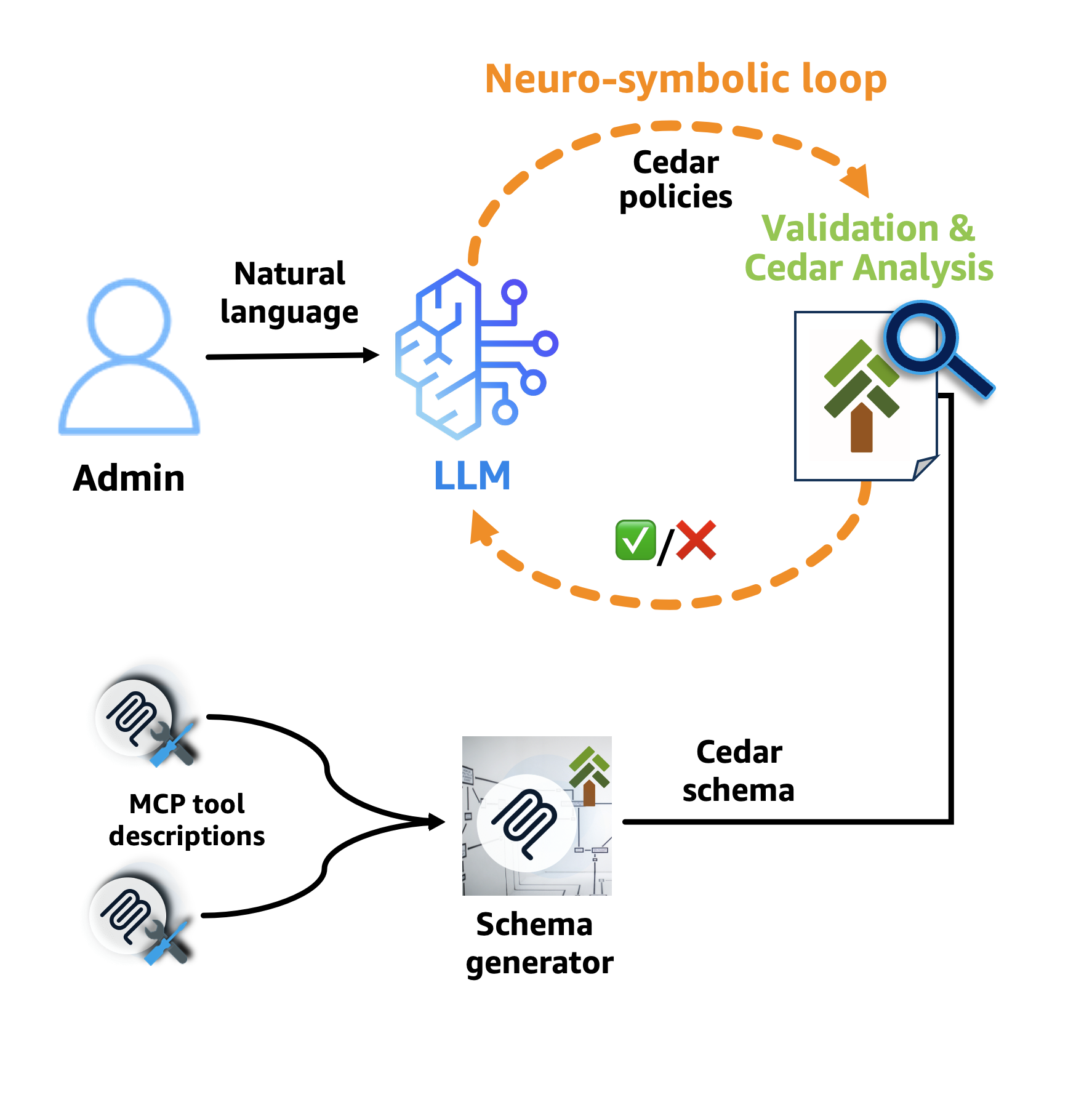
Amy Herzog

Amy Herzog is Vice President and Chief Information Security Officer (CISO) at Amazon Web Services (AWS) where she leads a global organization of cloud security professionals in a company in which security is the top priority. Prior to joining AWS, Amy served as CISO for Amazon’s Devices and Services, Media and Entertainment, and Advertising businesses, overseeing the security of consumer technology offerings such as Alexa+ and Ring, and playing a key role in the secure development of Project Kuiper, Amazon’s initiative to provide fast, reliable broadband to customers and communities around the world through low earth orbit satellites.

❌