Normal view

The State of Ransomware – Q1 2026

11 May 2026 at 11:58

Key Findings

  • Consolidation after peak fragmentation: The top 10 ransomware groups accounted for 71% of all Q1 2026 victims, a sharp reversal from the fragmentation seen in Q3 2025. The ransomware ecosystem is once again consolidating around fewer, more dominant operators.
  • Volume stabilization at historically high levels: There were 2,122 victims posted on data leak sites (DLS), making this period the second-highest Q1 on record. The long growth trend is stabilizing.
  • Qilin’s sustained dominance: Qilin maintained its position as the most prominent ransomware operation for the third consecutive quarter, posting 338 victims.
  • The Gentlemen is the breakout story of Q1 2026 reaching the third place on the global ransomware list, increasing their victim count from 40 victims in Q4 2025 to 166 in Q1 2026.
  • LockBit 5.0 comeback confirmed: LockBit posted 163 victims in Q1 2026, climbing to fourth place.

Ransomware in Q1 2026: Consolidation at Scale

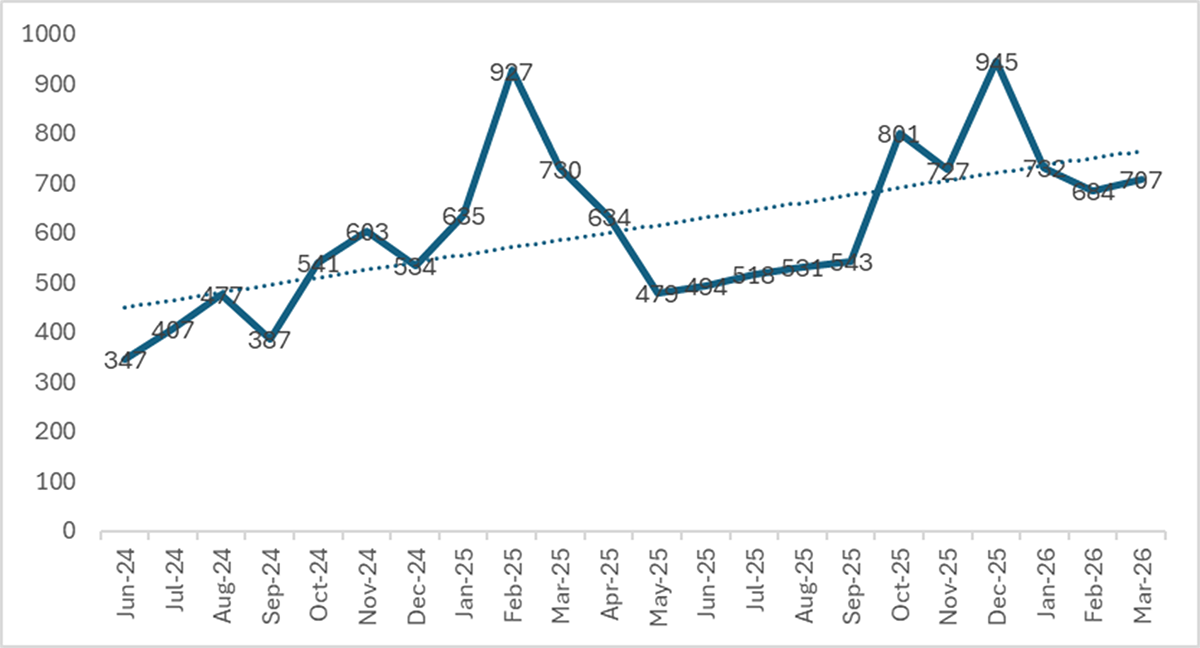
During the first quarter of 2026, we monitored more than 70 active data leak sites (DLS) that collectively listed 2,122 new victims. This figure represents a 12.2% decline from the Q4 2025 all-time record of 2,416 victims but remains the second-highest Q1 on record at 117% above Q1 2024 (977 victims) and is keeping in line with the elevated baseline established through 2025.

Figure 1 – Total number of reported ransomware victims in DLS, per month (Jun 2024 – Mar 2026).

Monthly volumes within Q1 were consistently stable: in January there were 732 recorded victims, 684 in February, and 706 in March. This reflects a sustained operating rate of an average of 707 victims per month in Q1 2026.

The headline year-over-year (YoY) comparison shows a 7.1% decline from the 2,285 victims in Q1 2025. However, this comparison is misleading as the Q1 2025 numbers were heavily inflated by Cl0p’s Cleo mass-exploitation campaign which contributed approximately 390 victims in a single burst. If we exclude Cl0p from both periods, there were 1,894 victims in Q1 2025 versus 1,995 in Q1 2026, an actual YoY increase of 5.3%. The underlying growth trend in ransomware operations persists, even as the most dramatic spikes subside.

From fragmentation to consolidation

The most significant structural development seen in Q1 2026 is not the volume of attacks but the consolidation of the different operators conducting them. After two years of steady fragmentation, during which the number of active groups grew from 51 in Q1 2024 to a peak of 85 in Q3 2025 and the Top-10 share of victims fell from 68% to 57%, the ecosystem has decisively reversed course.

In Q1 2026, the top 10 groups accounted for 71.1% of all DLS-posted victims, which is the highest concentration since Q1 2024 when the ecosystem was far smaller. The number of active groups shrank from 85 to 71. Fourteen groups that were active in Q4 2025 disappeared entirely, while 21 new names appeared. However, most of the newcomers posted fewer than 10 victims, failing to take advantage of the disappearance of established mid-tier operators.

This is a common pattern repeated throughout the ecosystem’s history: law enforcement actions disrupt the ransomware market, affiliates scatter, and survivors who avoid disruption absorb the displaced talent pool and grow. Groups such as Qilin, Akira, The Gentlemen, and LockBit, who together claimed 41% of all victims in Q1, capitalized on the instability of their competitors. In Q1 2026, Qilin alone posted more victims than the combined output of the bottom 50 groups.

This dynamic carries implications beyond statistics. The consolidation of the ecosystem around fewer, more dominant operators changes its character. Larger RaaS brands invest in operational consistency, including functional decryption tools, because their business model depends on the perception that victim payment results in data recovery. In contrast, the ransomware fragmentation we saw in 2025 introduced dozens of transient operators with no such incentive to invest any effort in decryption. An example is Obscura, whose encryption bug renders files over 1 GB permanently unrecoverable regardless of payment. For defenders and incident responders, consolidation means facing fewer but more capable adversaries.

Figure 2 – Top 10 ransomware groups by number of publicly claimed victims – Q1 2026.

Notable surges and declines

Comparing the data between Q4 2025 and Q1 2026 reveals which groups are absorbing the affiliate talent pool, and which are failing to take advantage of it.

Surges:

  • The Gentlemen grew by 315%, going from 40 claimed victims to 166, making them the biggest story of Q1 2026, covered in detail below.
  • LockBit 5.0 activity increased by 106%, from 79 victims to 163.
  • Nightspire, a closed-group operation with OneDrive cloud encryption capability, expanded by 183% from 29 victims to 82, sustaining growth across two consecutive quarters.
  • Play posted a 64% increase, going from 74 victims to 121.

Declines:

  • SafePay fell by 77%, going from 97 victims to 22. SafePay is a centralized, non-RaaS operation whose DLS was marked inactive from mid-March 2026 through early April for unknown reasons.
  • Devman declined by 70%, from 82 victims to 25. The ransomware’s operator “Tramp”, a former Conti and Black Basta affiliate, was added to Interpol’s wanted list in January 2026. All three DLS sites went offline by early February.
  • Sinobi dropped by 42%, from 139 victims to 80. After a strong January (56 victims), activity collapsed to just 7 victims in March. As of the time of this publication, no postings were recorded in April.
Figure 3 – Interpol’s Red Notice for Devman’s operator, Nefedov.

Actor Spotlight: The Gentlemen – The Breakout Story of Q1 2026

The Gentlemen is the most significant new ransomware operation to emerge in recent months. Going from zero victims in August 2025 to 166 in Q1 2026, the group achieved third place globally through a combination of pre-existing access stockpiles, aggressive geographic diversification, and a deliberate rejection of the traditional US-centric targeting model.

Figure 4 – The Gentlemen monthly victim trajectory, February peak: 82 victims in a single month.

Origins: A Qilin defection

The Gentlemen was founded by a threat actor known as Hastalamuerte – an experienced Qilin affiliate, who left the Qilin RaaS program following a dispute over an unpaid commission of approximately $48,000. This explains both its rapid operational capability and its sophistication: the operators started with established tradecraft, tooling, and, crucially, a stockpile of pre-compromised access.

The FortiGate stockpile

The group’s most distinctive asset is a cache of approximately 14,700 pre-exploited FortiGate devices, exploited primarily via CVE-2024-55591 (a critical authentication bypass in FortiOS/FortiProxy). In addition to the exploited devices, the operators maintain 969 validated brute-forced FortiGate VPN credentials ready for attack. This stockpile provides The Gentlemen with a supply of ready-to-use initial access tools far exceeding what typical RaaS affiliates acquire through real-time exploitation or access broker purchases.

How was this stockpile acquired? According to this report, Hastalamuerte was an experienced affiliate who had previously worked with Embargo, LockBit, and Medusa before joining Qilin. Before creating their own RaaS platform, The Gentlemen’s operators “experimented with various affiliate models used by other prominent ransomware groups.” The 14,700-device inventory likely predates the group’s September 2025 launch. Publishing 38 victims within weeks of beginning operation strongly suggests pre-existing access in the form of a massive number of compromised devices rather than real-time exploitation.

A non-Western targeting model

The Gentlemen’s geographic distribution is a striking outlier. Only 13.3% of its victims are based in the United States, compared to the ecosystem average of 49.6%. Thailand (10.8%), Brazil (6.0%), and India (4.2%) all feature prominently on their victim list.

This may reflect the geographic distribution of exploitable FortiGate devices; the group attacks where it has pre-positioned access, and that access happens to be concentrated in APAC and Latin American networks. This is an infrastructure-driven pattern rather than a deliberate targeting strategy: the operators did not choose Thailand or Brazil based on strategic preference but are exploiting access they already have.

However, we cannot exclude a secondary factor: deliberate avoidance of US targets to reduce law enforcement risk. The Gentlemen is a Russian-speaking operation founded by an affiliate who already experienced the consequences of ransomware ecosystem disputes. The decision to exploit a globally distributed stockpile while bypassing US devices – if that is what is occurring – would represent rational risk management given the heightened US law enforcement posture.

LockBit 5.0: Making a Comeback

LockBit posted 163 victims in Q1 2026 (an increase of 106% compared to Q4 2025), climbing from outside the top 10 to fourth place globally. After an initial surge of 85 victims in January (likely to reflect the accumulation of access during the pre-launch period), activity dipped to just 33 victims in February before climbing back to 45 in March. This dip-and-recovery trajectory is characteristic of a program rebuilding its affiliate base instead of exhausting a one-time stockpile, assuming these are genuine reports and not recycled or fictional reports.

Until its takedown in early 2024, LockBit was the most dominant RaaS operation globally, responsible for 20–30% of all data-leak site victim postings. Following Operation Cronos, several arrests and data seizures disrupted the group’s infrastructure. 

Figure 5 – LockBit’s DLS-published victims (Q1 2023 – Q1 2026).

The new LockBit 5.0 was officially launched on the RAMP underground forum in September 2025, coinciding with the sixth anniversary of the operation. The new version introduced multi-platform support (Windows, Linux, ESXi), enhanced evasion and anti-analysis mechanisms, faster encryption routines, and randomized 16-character file extensions to disrupt signature-based detection. New affiliates were required to provide a Bitcoin deposit of approximately $500.

Geographic diversification: from US dominance to global spread

LockBit’s geographic targeting has undergone a dramatic and measurable shift since its last appearance. Historically, the United States accounted for over 50% of LockBit’s victims – consistent with the ecosystem-wide baseline. In Q1 2026, US victims represented just 21.2% of LockBit’s total, with Italy (8.6%), Brazil (8.6%), and Turkey (5.1%) picking up the slack.

The shift away from US victims is new. Despite no documented forum announcements, the circumstantial evidence is strong: the direction is specifically toward non-US and European nations or countries with less aggressive behavior toward ransomware operators such as Italy, Brazil, and Turkey. The result is a nearly 30-percentage-point (pp) drop in US-based victims, despite an overall 106% increase in victims compared to Q4 2025.

The reaction to law enforcement actions may not result in a lower overall attack volume, but operators such as LockBitSUpp appear to be trying to redirect their activity away from the enforcing jurisdictions. Whether this represents a deliberate strategic decision or an emergent consequence of attracting affiliates from different geographic backgrounds remains an open question.

DragonForce: The Cartel Model Under Pressure

DragonForce posted 101 victims in Q1 2026 (an increase of 29% compared to Q4 2025), with a steep climb from 10 victims in January to 35 in February and 56 in March. This trajectory suggests an operation gaining momentum rather than depleting stockpiled access.

DragonForce continues to distinguish itself through its public relations strategy and “cartel” branding, positioning itself as an umbrella organization for multiple sub-brands. However, our investigation indicates that the cartel model is smaller than advertised:

  • Devman, which split from DragonForce in July 2025, saw their victim totals collapse from 82 (Q4 2025) to 25 (Q1 2026). Twenty-four of those victims were posted in January.
  • Coinbase Cartel, initially reported as a DragonForce sub-brand, has been independently linked to the ShinyHunters operation by Bitdefender.
  • Obscura, cited as a potential cartel member, posted only around 20 victims in total.

DragonForce’s technical capabilities remain genuine with multi-platform support and the group actively recruits affiliates. Its data audit service, which analyzes stolen datasets exceeding 300 GB to identify the most valuable information for extortion leverage, represents genuine innovation in the extortion model. However, the broader cartel narrative appears to be more marketing than substance.

Geographic Distribution of Victims – Q1 2026

The geographic distribution of ransomware victims in Q1 2026 maintains the fundamental pattern established over previous quarters: the United States accounts for just under half of all reported cases (49.6%), with Western developed economies making up the clear majority of targets.

Figure 6 – Top 10 targeted countries, Q1 2026.

The most notable development is Thailand’s entry into the top 10 for the first time, driven almost entirely by The Gentlemen, for whom Thai organizations constitute 10.8% of total victims. Taiwan also rose sharply (from 8 victims to 26), while South Korea dropped out entirely. This confirms that Qilin’s Q3 2025 financial sector campaign targeting 30 South Korean organizations was a one-off event rather than a sustained targeting shift.

Per-Actor Geographic Targeting: Distinct Patterns

A per-actor analysis of the top 20 groups’ country distributions reveals that the ecosystem-level averages mask dramatically different targeting strategies. We identified six distinct geographic patterns by measuring each actor’s deviation from the 49.6% US baseline.

Pattern 1 – Extreme US focus (>75% US). These actors target the United States at rates far exceeding the ecosystem average:

  • Play (85.1% US) operates as a closed group with a Russia-nexus lineage and centralized target selection that consistently prefers US organizations.
  • Sinobi (76.2% US) explicitly targets US mid-market manufacturing and construction.
  • Genesis (93.1% US) whose near-exclusive US focus (27 of 29 confirmed victims) and emphasis on the Healthcare sector (20.7%) is striking for an emerging actor with no documented affiliate program.

Pattern 2 – Deliberate US avoidance (<25% US). These actors are going in the opposite direction:

  • Tengu (11.4% US) is the most geographically diversified actor in the top 20, with victims spread across Indonesia (8.6%), Mexico (8.6%), India (6.9%), and Italy (5.8%).
  • LockBit (21.5% US) represents deliberate post-disruption diversification, as discussed above.

Pattern 3 – Vulnerability related distribution:

  • Cl0p’s geographic anomalies (18.1% Canada and 8.7% Australia). Cl0p’s traditional mass exploitation campaigns produce victim distributions that mirror the installed base of the exploited software, in this case EBS campaign (CVE-2025-61882).
  • The Gentlemen (13.3% US) reflects the geographic distribution of its approximately 14,700-device FortiGate access stockpile, which is concentrated in Thailand (10.8%), Brazil (6%), and India (4.2%).

Country-Level Actor Dominance: When One Group Shapes a Nation’s Threat Profile

Flipping the analysis from “which countries does an actor target” to “which actors dominate each country” reveals an even more striking picture. Several countries’ entire ransomware threat profiles are defined by a single actor’s operational choices.

Single-actor-shaped countries:

CountryDominant actorShare
ThailandThe Gentlemen53%
ArgentinaQilin39%
MexicoLockBit37%
AustraliaCl0p34%
SwitzerlandAkira31%
BrazilLockBit31%

Thailand’s case is the most extreme: more than half of all Thai ransomware victims are claimed by The Gentlemen. Without this single group, Thailand would not even appear in the top-10 most-attacked countries. Similarly, without Cl0p’s Oracle EBS campaign, Australia and Canada would show substantially lower victim counts. These findings underscore that country-level ransomware statistics are frequently shaped by one actor’s specific access inventory, software exploitation campaign, or strategic redirection – not by broad shifts in the threat landscape.

Multi-actor convergence countries. Two countries stand out for having three or more actors independently converging to create unusually diverse threat environments:

  • Turkey (23 victims): LockBit (6 victims) + DragonForce (5 victims) + The Gentlemen (5 victims), 70% of Turkey’s victim totals are due to the activity of just three actors.
  • Japan (21 victims): The Gentlemen (6 victims) + Everest (4 victims) + Nightspire (3 victims). = 62% of the victims are due to three distinct actors. Both The Gentlemen and Nightspire exploit the same FortiGate vulnerability (CVE-2024-55591).

Ransomware Attacks by Industry – Q1 2026

The industry distribution of ransomware victims in Q1 2026 shows continued cross-sector impact, with a few notable concentrations.

Figure 7 – Ransomware victims by industry, Q1 2026.

As with geographic patterns, ecosystem-level industry averages mask fundamentally different targeting strategies at the actor level. A per-actor analysis of the top 20 groups reveals that sector selection is driven by at least three distinct observations.

Software footprint targeting. Cl0p’s 53.5% Business Services concentration (+18.6 percentage points above baseline) does not reflect a preference for professional services firms. It reflects the user base of Oracle EBS, the enterprise application exploited in the Q1 2026 campaign. Mass exploitation campaigns produce industry distributions that mirror the deployment pattern of the exploited software. This is the same dynamic observed in Cl0p’s geographic analysis, where Canada and Australia were over-represented because of Oracle EBS adoption.

Operational disruption maximization. Akira’s targeting of Consumer Goods (23.9%, +9.8 percentage points above baseline) and Industrial Manufacturing (17.8%, +6.7 percentage points above baseline), a combined 41.7% versus the 25.1% baseline, is consistent with an economically optimized model. These sectors share high downtime costs (production lines, supply chain dependencies) and complex IT/OT environments that make recovery without decryption keys extremely difficult. With $244 million in total proceeds and a 34% share of IR engagements, Akira’s sector selection reflects deliberate targeting of firms where the pressure to pay is greatest. This is not opportunistic; it’s the Conti lineage playbook applied to the sectors where it generates the highest return per incident.

Anubis stands apart from all other top-20 actors in its willingness to target healthcare (13.0%, +8.3 percentage points above baseline) and critical infrastructure (8.7%, +7.7 percentage points above baseline).

Conclusion

In Q1 2026, the ransomware ecosystem entered a new phase. After two years of steady fragmentation, the market is reconsolidating around a smaller number of dominant operators. Qilin, Akira, The Gentlemen, and LockBit together account for 41% of all victims. Domination by the top-10 actors has returned to levels not seen since early 2024.

This consolidation is not a return to the previous state. The emerging dominant groups are more technically capable, more geographically diversified, and more resilient to disruption than their predecessors. At the same time, the economic foundations of ransomware are showing signs of stress. Payment rates have fallen to historic lows. Mass data-theft campaigns are generating diminishing returns. The gap between the growing number of DLS-posted victims (2,122 in Q1 2026) and the declining monetization per victim may accelerate the current consolidation squeezing out operators who cannot achieve sufficient scale or sophistication to remain profitable.

The post The State of Ransomware – Q1 2026 appeared first on Check Point Research.
Canvas Breach Disrupts Schools & Colleges Nationwide

8 May 2026 at 04:58

An ongoing data extortion attack targeting the widely-used education technology platform Canvas disrupted classes and coursework at school districts and universities across the United States today, after a cybercrime group defaced the service’s login page with a ransom demand that threatened to leak data from 275 million students and faculty across nearly 9,000 educational institutions.

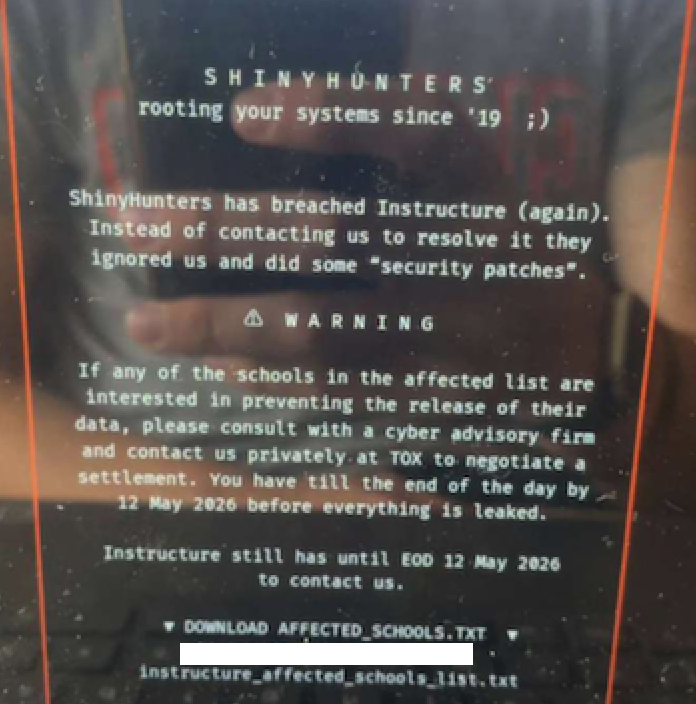
A screenshot shared by a reader showing the extortion message that was shown on the Canvas login page today.

Canvas parent firm Instructure responded to today’s defacement attacks by disabling the platform, which is used by thousands of schools, universities and businesses to manage coursework and assignments, and to communicate with students.

Instructure acknowledged a data breach earlier this week, after the cybercrime group ShinyHunters claimed responsibility and said they would leak data on tens of millions of students and faculty unless paid a ransom. The stated deadline for payment was initially set at May 6, but it was later pushed back to May 12.

In a statement on May 6, Instructure said the investigation so far shows the stolen information includes “certain identifying information of users at affected institutions, such as names, email addresses, and student ID numbers, as well as as messages among users.” The company said it found no evidence the breached data included more sensitive information, such as passwords, dates of birth, government identifiers or financial information.

The May 6 update stated that Canvas was fully operational, and that Instructure was not seeing any ongoing unauthorized activity on their platform. “At this stage, we believe the incident has been contained,” Instructure wrote.

However, by mid-day on Thursday, May 7, students and faculty at dozens of schools and universities were flooding social media sites with comments saying that a ransom demand from ShinyHunters had replaced the usual Canvas login page. Instructure responded by pulling Canvas offline and replacing the portal with the message, “Canvas is currently undergoing scheduled maintenance. Check back soon.”

“We anticipate being up soon, and will provide updates as soon as possible,” reads the current message on Instructure’s status page.

While the data stolen by ShinyHunters may or may not contain particularly sensitive information (ShinyHunters claims it includes several billion private messages among students and teachers, as well as names, phone numbers and email addresses), this attack could hardly have come at a worse time for Instructure: Many of the affected schools and universities are in the middle of final exams, and a prolonged outage could be highly damaging for the company.

The extortion message that greeted countless Canvas users today advised the affected schools to negotiate their own ransom payments to prevent the publication of their data — regardless of whether Instructure decides to pay.

“ShinyHunters has breached Instructure (again),” the extortion message read. “Instead of contacting us to resolve it they ignored us and did some ‘security patches.'”

A source close to the investigation who was not authorized to speak to the press told KrebsOnSecurity that a number of universities have already approached the cybercrime group about paying. The same source also pointed out that the ShinyHunters data leak blog no longer lists Instructure among its current extortion victims, and that the samples of data stolen from Canvas customers were removed as well. Data extortion groups like ShinyHunters will typically only remove victims from their leak sites after receiving an extortion payment or after a victim agrees to negotiate.

Dipan Mann, founder and CEO of the security firm Cloudskope, slammed Instructure for referring to today’s outage as a “scheduled maintenance” event on its status page. Mann said Shiny Hunters first demonstrated they’d breached Instructure on May 1, prompting Instructure’s Chief Information Security Officer Steve Proud to declare the following day that the incident had been contained. But Mann said today’s attack is at least the third time in the past eight months that Instructure has been breached by ShinyHunters.

In a blog post today, Mann noted that in September 2025, ShinyHunters released thousands of internal University of Pennsylvania files — donor records, internal memos, and other confidential materials — through what the Daily Pennsylvanian and other outlets later determined was, in part, a Canvas/Instructure-mediated access path.

“Penn was the named victim,” Mann wrote. “Instructure was the mechanism. The incident was treated as a Penn-specific story by most of the national press and quietly handled by Instructure as a customer-specific matter. That framing was wrong then. It is dramatically more wrong in light of the May 2026 events, which now look like the planned escalation of an attack pattern that ShinyHunters had been working against Instructure’s environment for at least eight months prior. The September 2025 Penn breach was the proof of concept. The May 1, 2026 incident was the production run. The May 7, 2026 recompromise was ShinyHunters demonstrating publicly that the May 2 ‘containment’ did not happen.”

In February, a ShinyHunters spokesperson told The Daily Pennsylvanian that Penn failed to pay a $1 million ransom demand. On March 5, ShinyHunters published 461 megabytes worth of data stolen from Penn, including thousands of files such as donor records and internal memos.

ShinyHunters is a prolific and fluid cybercriminal group that specializes in data theft and extortion. They typically gain access to companies through voice phishing and social engineering attacks that often involve impersonating IT personnel or other trusted members of a targeted organization.

Last month, ShinyHunters relieved the home security giant ADT of personal information on 5.5 million customers. The extortion group told BleepingComputer they breached the company by compromising an employee’s Okta single sign-on account in a voice phishing attack that enabled access to ADT’s Salesforce instance. BleepingComputer says ShinyHunters recently has taken credit for a number of extortion attacks against high-profile organizations, including Medtronic, Rockstar Games, McGraw Hill, 7-Eleven and the cruise line operator Carnival.

The attack on Canvas customers is just one of several major cybercrime campaigns being launched by ShinyHunters at the moment, said Charles Carmakal, chief technology officer at the Google-owned Mandiant Consulting. Carmakal declined to comment specifically on the Canvas breach, but said “there are multiple concurrent and discrete ShinyHunters intrusion and extortion campaigns happening right now.”

Cloudskope’s Mann said what happens next depends largely on whether Instructure’s customers — the universities, K-12 districts, and education ministries paying for Canvas — choose to apply pressure or absorb the breach quietly.

“The history of education-vendor incidents suggests the path of least resistance is the second one,” he concluded.

Update, May 8, 11:05 a.m. ET: Instructure has published an incident update page that includes more information about the breach. Instructure said its Canvas portal is functioning normally again, and that the hackers exploited an issue related to Free-for-Teacher accounts.

“This is the same issue that led to the unauthorized access the prior week,” Instructure wrote. “As a result, we have made the difficult decision to temporarily shut down Free-for-Teacher accounts. These accounts have been a core part of our platform, and we’re committed to resolving the issues with these accounts.”

Instructure said affected organizations were notified on May 6.

“If your organization is affected, Instructure will contact your organization’s primary contacts directly,” the update states. “Please don’t rely on third-party lists or social media posts naming potentially affected organizations as those lists aren’t verified. Instructure will confirm validated information through direct outreach to all affected organizations.”

Update, May 11, 10:16 p.m. ET: Instructure posted an update saying they paid their extortionists in exchange for a promise to destroy the stolen data. “The data was returned to us,” the update reads. “We received digital confirmation of data destruction (shred logs). We have been informed that no Instructure customers will be extorted as a result of this incident, publicly or otherwise.”

Threat landscape for industrial automation systems in Q4 2025

15 April 2026 at 14:30

Statistics across all threats

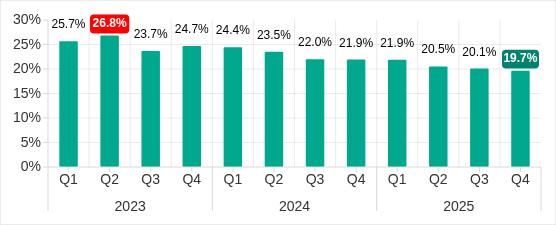
The percentage of ICS computers on which malicious objects were blocked has been decreasing since the beginning of 2024. In Q4 2025, it was 19.7%. Over the past three years, the percentage has decreased by 1.36 times, and by 1.25 times since Q4 2023.

Percentage of ICS computers on which malicious objects were blocked, Q1 2023–Q4 2025

Percentage of ICS computers on which malicious objects were blocked, Q1 2023–Q4 2025

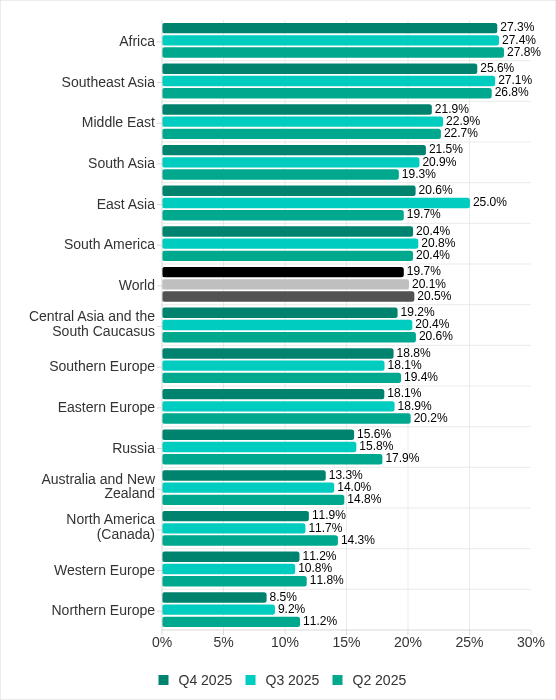
Regionally, in Q4 2025, the percentage of ICS computers on which malicious objects were blocked ranged from 8.5% in Northern Europe to 27.3% in Africa.

Regions ranked by percentage of ICS computers on which malicious objects were blocked

Regions ranked by percentage of ICS computers on which malicious objects were blocked

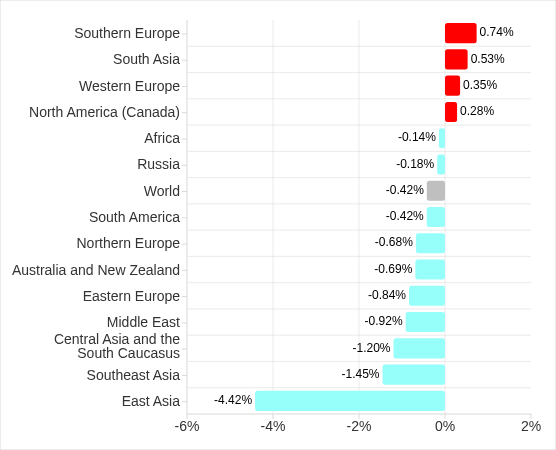
Four regions saw an increase in the percentage of ICS computers on which malicious objects were blocked. The most notable increases occurred in Southern Europe and South Asia. In Q3 2025, East Asia experienced a sharp increase triggered by the local spread of malicious scripts, but the figure has since returned to normal.

Changes in percentage of ICS computers on which malicious objects were blocked, Q4 2025

Changes in percentage of ICS computers on which malicious objects were blocked, Q4 2025

Feature of the quarter: worms in email

In Q4 2025, the percentage of ICS computers on which wormsinemailattachments were blocked increasedinallregions of the world.

Many of the blocked threats were related to the worm Backdoor.MSIL.XWorm. This malware is designed to persist on the system and then remotely control it.

Interestingly, this threat was not detected on ICS computers in the previous quarter, yet it appeared in all regions in Q4 2025.

A study found that the active spread of Backdoor.MSIL.XWorm via phishing emails was likely linked to the use by hackers of another malware obfuscation technique that was actively used during massive phishing campaigns in Q4 2025. These campaigns have been known since 2024 as “Curriculum-vitae-catalina”.

The attackers distributed phishing emails to HR managers, recruiters, and employees responsible for hiring. The messages were disguised as responses from job applicants with subjects such as “Resume” or “Attached Resume” and contained a malicious executable file under the guise of a curriculum vitae. Typically, the file was named Curriculum Vitae-Catalina.exe. When executed, it infected the system.

In Q4 2025, the threat spread across regions in two waves — one in October and another in November. Russia, Western Europe, South America, and North America (Canada) were attacked in October. A spike in Backdoor.MSIL.XWorm blocking was observed in other regions in November. The attack subsided in all regions in December.

The highest percentage of ICS computers on which Backdoor.MSIL.XWorm was blocked was observed in regions where threats from email clients had been historically blocked at high rates on ICS computers: Southern Europe, South America, and the Middle East.

At the same time, in Africa, where USB storage media are still actively used, the threat was also detected when removable devices were connected to ICS computers.

Selected industries

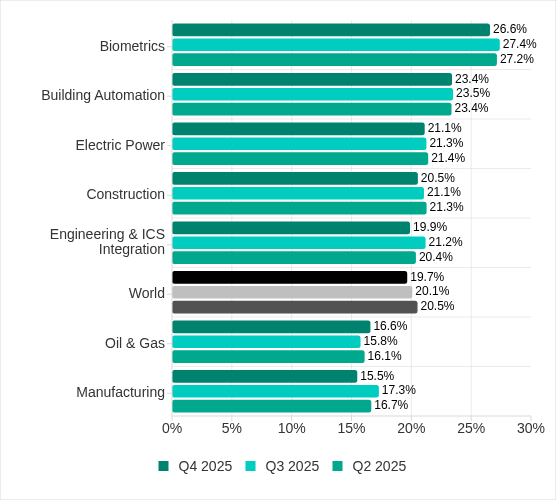
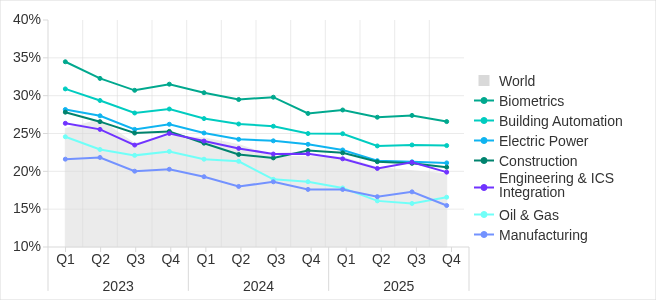
The biometrics sector has historically led the rankings of industries and OT infrastructures surveyed in this report in terms of the percentage of ICS computers on which malicious objects were blocked.

These systems are characterized by accessibility to and from the internet, as well as minimal cybersecurity controls by the consumer organization.

Rankings of industries and OT infrastructure by percentage of ICS computers on which malicious objects were blocked

Rankings of industries and OT infrastructure by percentage of ICS computers on which malicious objects were blocked

In Q4 2025, the percentage of ICS computers on which malicious objects were blocked increased only in one sector: oil and gas. The corresponding figures increased in two regions: Russia, and Central Asia and the South Caucasus.

However, if we look at a broader time span, there is a downward trend in all the surveyed industries.

Percentage of ICS computers on which malicious objects were blocked in selected industries

Percentage of ICS computers on which malicious objects were blocked in selected industries

Diversity of detected malicious objects

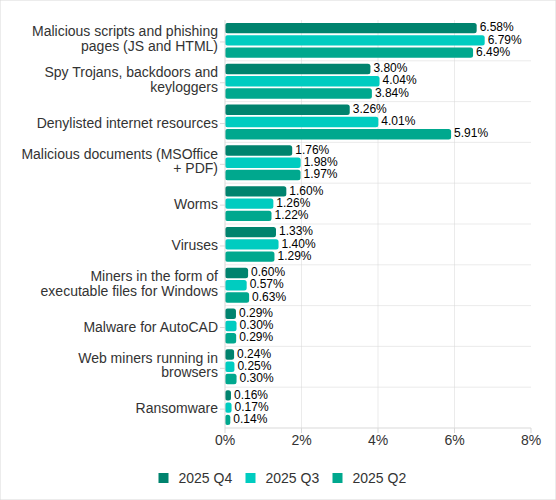
In Q4 2025, Kaspersky protection solutions blocked malware from 10,142 different malware families of various categories on industrial automation systems.

Percentage of ICS computers on which the activity of malicious objects from various categories was blocked

Percentage of ICS computers on which the activity of malicious objects from various categories was blocked

In Q4 2025, there was an increase in the percentage of ICS computers on which worms, and miners in the form of executable files for Windows were blocked. These were the only categories that exhibited an increase.

Main threat sources

Depending on the threat detection and blocking scenario, it is not always possible to reliably identify the source. The circumstantial evidence for a specific source can be the blocked threat’s type (category).

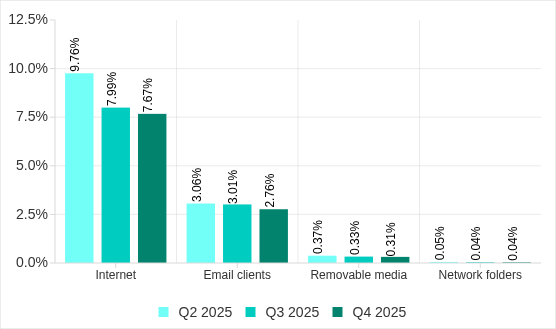
The internet (visiting malicious or compromised internet resources; malicious content distributed via messengers; cloud data storage and processing services and CDNs), email clients (phishing emails), and removable storage devices remain the primary sources of threats to computers in an organization’s technology infrastructure.

In Q4 2025, the percentage of ICS computers on which malicious objects from various sources were blocked decreased. All sources except email clients saw their lowest levels in three years.

Percentage of ICS computers on which malicious objects from various sources were blocked

Percentage of ICS computers on which malicious objects from various sources were blocked

The same computer can be attacked by several categories of malware from the same source during a quarter. That computer is counted when calculating the percentage of attacked computers for each threat category, but is only counted once for the threat source (we count unique attacked computers). In addition, it is not always possible to accurately determine the initial infection attempt. Therefore, the total percentage of ICS computers on which various categories of threats from a certain source were blocked can exceed the percentage of computers affected by the source itself.

  • In Q4 2025, the percentage of ICS computers on which threats from the internet were blocked decreased to 7.67% and reached its lowest level since the beginning of 2023. The main categories of internet threats are malicious scripts and phishing pages, and denylisted internet resources. The percentage ranged from 3.96% in Northern Europe to 11.33% in South Asia.
  • The main categories of threats from email clients blocked on ICS computers were malicious scripts and phishing pages, spyware, and malicious documents. Most of the spyware detected in phishing emails was delivered as a password archive or a multi-layered script embedded in office document files. The percentage of ICS computers on which threats from email clients were blocked ranged from 0.64% in Northern Europe to 6.34% in Southern Europe.
  • The main categories of threats that were blocked when removable media was connected to ICS computers were worms, viruses, and spyware. The percentage of ICS computers on which threats from removable media were blocked ranged from 0.05% in Australia and New Zealand to 1.41% in Africa.
  • The main categories of threats that spread through network folders in Q4 2025 were viruses, AutoCAD malware, worms, and spyware. The percentage of ICS computers on which threats from network folders were blocked ranged from 0.01% in Northern Europe to 0.18% in East Asia.

Threat categories

Typical attacks blocked within an OT network are multi-step sequences of malicious activities, where each subsequent step of the attackers is aimed at increasing privileges and/or gaining access to other systems by exploiting the security problems of industrial enterprises, including OT infrastructures.

Malicious objects used for initial infection

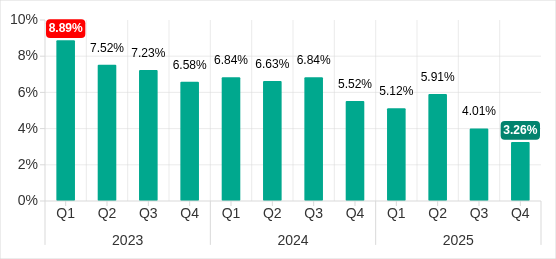
In Q4 2025, the percentage of ICS computers on which denylisted internet resources were blocked decreased to 3.26%. This is the lowest quarterly figure since the beginning of 2022, and it has decreased by 1.8 times since Q2 2025.

Percentage of ICS computers on which denylisted internet resources were blocked, Q1 2023–Q4 2025

Percentage of ICS computers on which denylisted internet resources were blocked, Q1 2023–Q4 2025

Regionally, the percentage of ICS computers on which denylisted internet resources were blocked ranged from 1.74% in Northern Europe to 3.93% in Southeast Asia, which displaced Africa from first place. Russia rounded out the top three regions for this indicator.

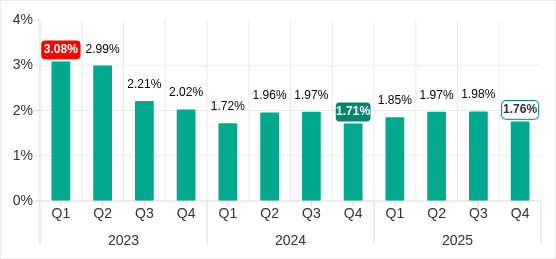
The percentage of ICS computers on which malicious documents were blocked increased for three consecutive quarters. However, in Q4 2025 it decreased by 0.22 pp to 1.76%.

Percentage of ICS computers on which malicious documents were blocked, Q1 2023–Q4 2025

Percentage of ICS computers on which malicious documents were blocked, Q1 2023–Q4 2025

Regionally, the percentage ranged from 0.46% in Northern Europe to 3.82% in Southern Europe. In Q4 2025, the indicator increased in Eastern Europe, Russia, and Western Europe.

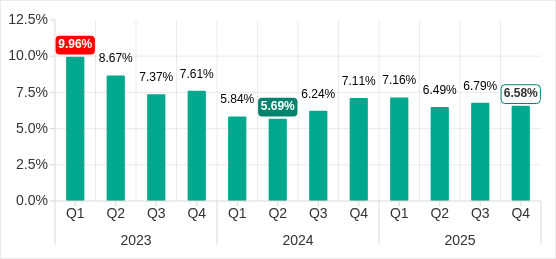
The percentage of ICS computers on which malicious scripts and phishing pages were blocked decreased to 6.58%. Despite the decline, this category led the rankings of threat categories in terms of the percentage of ICS computers on which they were blocked.

Percentage of ICS computers on which malicious scripts and phishing pages were blocked, Q1 2023–Q4 2025

Percentage of ICS computers on which malicious scripts and phishing pages were blocked, Q1 2023–Q4 2025

Regionally, the percentage ranged from 2.52% in Northern Europe to 10.50% in South Asia. The indicator increased in South Asia, South America, Southern Europe, and Africa. South Asia saw the most notable increase, at 3.47 pp.

Next-stage malware

Malicious objects used to initially infect computers deliver next-stage malware — spyware, ransomware, and miners — to victims’ computers. As a rule, the higher the percentage of ICS computers on which the initial infection malware is blocked, the higher the percentage for next-stage malware.

In Q4 2025, the percentage of ICS computers on which spyware, ransomware and web miners were blocked decreased. The rates were:

  • Spyware: 3.80% (down 0.24 pp). For the second quarter in a row, spyware took second place in the rankings of threat categories in terms of the percentage of ICS computers on which it was blocked.
  • Ransomware: 0.16% (down 0.01 pp).
  • Web miners: 0.24% (down 0.01 pp), this is the lowest level observed thus far in the period under review.

The percentage of ICS computers on which miners in the form of executable files for Windows were blocked increased to 0.60% (up 0.03 pp).

Self-propagating malware

Self-propagating malware (worms and viruses) is a category unto itself. Worms and virus-infected files were originally used for initial infection, but as botnet functionality evolved, they took on next-stage characteristics.

To spread across ICS networks, viruses and worms rely on removable media and network folders and are distributed in the form of infected files, such as archives with backups, office documents, pirated games and hacked applications. In rarer and more dangerous cases, web pages with network equipment settings, as well as files stored in internal document management systems, product lifecycle management (PLM) systems, resource management (ERP) systems and other web services are infected.

In Q4 2025, the percentage of ICS computers on which worms were blocked increased by 1.6 times to 1.60%. As mentioned above, this increase is related to a global phishing attack that spread the Backdoor.MSIL.XWorm backdoor worm across all regions of the world. The percentage increased in all regions. The biggest increase (up by 2.16 times) was in Southern Europe. The malware was primary distributed through email clients, and Southern Europe led the way in terms of the percentage of ICS computers on which threats from email clients were blocked.

The percentage of ICS computers on which viruses were blocked decreased to 1.33%.

AutoCAD malware

This category of malware can spread in a variety of ways, so it does not belong to a specific group.

After an increase in the previous quarter, the percentage of ICS computers on which AutoCAD malware was blocked decreased to 0.29% in Q4 2025.

For more information on industrial threats see the full version of the report.

Threat landscape for industrial automation systems in Q4 2025

15 April 2026 at 14:30

Statistics across all threats

The percentage of ICS computers on which malicious objects were blocked has been decreasing since the beginning of 2024. In Q4 2025, it was 19.7%. Over the past three years, the percentage has decreased by 1.36 times, and by 1.25 times since Q4 2023.

Percentage of ICS computers on which malicious objects were blocked, Q1 2023–Q4 2025

Percentage of ICS computers on which malicious objects were blocked, Q1 2023–Q4 2025

Regionally, in Q4 2025, the percentage of ICS computers on which malicious objects were blocked ranged from 8.5% in Northern Europe to 27.3% in Africa.

Regions ranked by percentage of ICS computers on which malicious objects were blocked

Regions ranked by percentage of ICS computers on which malicious objects were blocked

Four regions saw an increase in the percentage of ICS computers on which malicious objects were blocked. The most notable increases occurred in Southern Europe and South Asia. In Q3 2025, East Asia experienced a sharp increase triggered by the local spread of malicious scripts, but the figure has since returned to normal.

Changes in percentage of ICS computers on which malicious objects were blocked, Q4 2025

Changes in percentage of ICS computers on which malicious objects were blocked, Q4 2025

Feature of the quarter: worms in email

In Q4 2025, the percentage of ICS computers on which wormsinemailattachments were blocked increasedinallregions of the world.

Many of the blocked threats were related to the worm Backdoor.MSIL.XWorm. This malware is designed to persist on the system and then remotely control it.

Interestingly, this threat was not detected on ICS computers in the previous quarter, yet it appeared in all regions in Q4 2025.

A study found that the active spread of Backdoor.MSIL.XWorm via phishing emails was likely linked to the use by hackers of another malware obfuscation technique that was actively used during massive phishing campaigns in Q4 2025. These campaigns have been known since 2024 as “Curriculum-vitae-catalina”.

The attackers distributed phishing emails to HR managers, recruiters, and employees responsible for hiring. The messages were disguised as responses from job applicants with subjects such as “Resume” or “Attached Resume” and contained a malicious executable file under the guise of a curriculum vitae. Typically, the file was named Curriculum Vitae-Catalina.exe. When executed, it infected the system.

In Q4 2025, the threat spread across regions in two waves — one in October and another in November. Russia, Western Europe, South America, and North America (Canada) were attacked in October. A spike in Backdoor.MSIL.XWorm blocking was observed in other regions in November. The attack subsided in all regions in December.

The highest percentage of ICS computers on which Backdoor.MSIL.XWorm was blocked was observed in regions where threats from email clients had been historically blocked at high rates on ICS computers: Southern Europe, South America, and the Middle East.

At the same time, in Africa, where USB storage media are still actively used, the threat was also detected when removable devices were connected to ICS computers.

Selected industries

The biometrics sector has historically led the rankings of industries and OT infrastructures surveyed in this report in terms of the percentage of ICS computers on which malicious objects were blocked.

These systems are characterized by accessibility to and from the internet, as well as minimal cybersecurity controls by the consumer organization.

Rankings of industries and OT infrastructure by percentage of ICS computers on which malicious objects were blocked

Rankings of industries and OT infrastructure by percentage of ICS computers on which malicious objects were blocked

In Q4 2025, the percentage of ICS computers on which malicious objects were blocked increased only in one sector: oil and gas. The corresponding figures increased in two regions: Russia, and Central Asia and the South Caucasus.

However, if we look at a broader time span, there is a downward trend in all the surveyed industries.

Percentage of ICS computers on which malicious objects were blocked in selected industries

Percentage of ICS computers on which malicious objects were blocked in selected industries

Diversity of detected malicious objects

In Q4 2025, Kaspersky protection solutions blocked malware from 10,142 different malware families of various categories on industrial automation systems.

Percentage of ICS computers on which the activity of malicious objects from various categories was blocked

Percentage of ICS computers on which the activity of malicious objects from various categories was blocked

In Q4 2025, there was an increase in the percentage of ICS computers on which worms, and miners in the form of executable files for Windows were blocked. These were the only categories that exhibited an increase.

Main threat sources

Depending on the threat detection and blocking scenario, it is not always possible to reliably identify the source. The circumstantial evidence for a specific source can be the blocked threat’s type (category).

The internet (visiting malicious or compromised internet resources; malicious content distributed via messengers; cloud data storage and processing services and CDNs), email clients (phishing emails), and removable storage devices remain the primary sources of threats to computers in an organization’s technology infrastructure.

In Q4 2025, the percentage of ICS computers on which malicious objects from various sources were blocked decreased. All sources except email clients saw their lowest levels in three years.

Percentage of ICS computers on which malicious objects from various sources were blocked

Percentage of ICS computers on which malicious objects from various sources were blocked

The same computer can be attacked by several categories of malware from the same source during a quarter. That computer is counted when calculating the percentage of attacked computers for each threat category, but is only counted once for the threat source (we count unique attacked computers). In addition, it is not always possible to accurately determine the initial infection attempt. Therefore, the total percentage of ICS computers on which various categories of threats from a certain source were blocked can exceed the percentage of computers affected by the source itself.

  • In Q4 2025, the percentage of ICS computers on which threats from the internet were blocked decreased to 7.67% and reached its lowest level since the beginning of 2023. The main categories of internet threats are malicious scripts and phishing pages, and denylisted internet resources. The percentage ranged from 3.96% in Northern Europe to 11.33% in South Asia.
  • The main categories of threats from email clients blocked on ICS computers were malicious scripts and phishing pages, spyware, and malicious documents. Most of the spyware detected in phishing emails was delivered as a password archive or a multi-layered script embedded in office document files. The percentage of ICS computers on which threats from email clients were blocked ranged from 0.64% in Northern Europe to 6.34% in Southern Europe.
  • The main categories of threats that were blocked when removable media was connected to ICS computers were worms, viruses, and spyware. The percentage of ICS computers on which threats from removable media were blocked ranged from 0.05% in Australia and New Zealand to 1.41% in Africa.
  • The main categories of threats that spread through network folders in Q4 2025 were viruses, AutoCAD malware, worms, and spyware. The percentage of ICS computers on which threats from network folders were blocked ranged from 0.01% in Northern Europe to 0.18% in East Asia.

Threat categories

Typical attacks blocked within an OT network are multi-step sequences of malicious activities, where each subsequent step of the attackers is aimed at increasing privileges and/or gaining access to other systems by exploiting the security problems of industrial enterprises, including OT infrastructures.

Malicious objects used for initial infection

In Q4 2025, the percentage of ICS computers on which denylisted internet resources were blocked decreased to 3.26%. This is the lowest quarterly figure since the beginning of 2022, and it has decreased by 1.8 times since Q2 2025.

Percentage of ICS computers on which denylisted internet resources were blocked, Q1 2023–Q4 2025

Percentage of ICS computers on which denylisted internet resources were blocked, Q1 2023–Q4 2025

Regionally, the percentage of ICS computers on which denylisted internet resources were blocked ranged from 1.74% in Northern Europe to 3.93% in Southeast Asia, which displaced Africa from first place. Russia rounded out the top three regions for this indicator.

The percentage of ICS computers on which malicious documents were blocked increased for three consecutive quarters. However, in Q4 2025 it decreased by 0.22 pp to 1.76%.

Percentage of ICS computers on which malicious documents were blocked, Q1 2023–Q4 2025

Percentage of ICS computers on which malicious documents were blocked, Q1 2023–Q4 2025

Regionally, the percentage ranged from 0.46% in Northern Europe to 3.82% in Southern Europe. In Q4 2025, the indicator increased in Eastern Europe, Russia, and Western Europe.

The percentage of ICS computers on which malicious scripts and phishing pages were blocked decreased to 6.58%. Despite the decline, this category led the rankings of threat categories in terms of the percentage of ICS computers on which they were blocked.

Percentage of ICS computers on which malicious scripts and phishing pages were blocked, Q1 2023–Q4 2025

Percentage of ICS computers on which malicious scripts and phishing pages were blocked, Q1 2023–Q4 2025

Regionally, the percentage ranged from 2.52% in Northern Europe to 10.50% in South Asia. The indicator increased in South Asia, South America, Southern Europe, and Africa. South Asia saw the most notable increase, at 3.47 pp.

Next-stage malware

Malicious objects used to initially infect computers deliver next-stage malware — spyware, ransomware, and miners — to victims’ computers. As a rule, the higher the percentage of ICS computers on which the initial infection malware is blocked, the higher the percentage for next-stage malware.

In Q4 2025, the percentage of ICS computers on which spyware, ransomware and web miners were blocked decreased. The rates were:

  • Spyware: 3.80% (down 0.24 pp). For the second quarter in a row, spyware took second place in the rankings of threat categories in terms of the percentage of ICS computers on which it was blocked.
  • Ransomware: 0.16% (down 0.01 pp).
  • Web miners: 0.24% (down 0.01 pp), this is the lowest level observed thus far in the period under review.

The percentage of ICS computers on which miners in the form of executable files for Windows were blocked increased to 0.60% (up 0.03 pp).

Self-propagating malware

Self-propagating malware (worms and viruses) is a category unto itself. Worms and virus-infected files were originally used for initial infection, but as botnet functionality evolved, they took on next-stage characteristics.

To spread across ICS networks, viruses and worms rely on removable media and network folders and are distributed in the form of infected files, such as archives with backups, office documents, pirated games and hacked applications. In rarer and more dangerous cases, web pages with network equipment settings, as well as files stored in internal document management systems, product lifecycle management (PLM) systems, resource management (ERP) systems and other web services are infected.

In Q4 2025, the percentage of ICS computers on which worms were blocked increased by 1.6 times to 1.60%. As mentioned above, this increase is related to a global phishing attack that spread the Backdoor.MSIL.XWorm backdoor worm across all regions of the world. The percentage increased in all regions. The biggest increase (up by 2.16 times) was in Southern Europe. The malware was primary distributed through email clients, and Southern Europe led the way in terms of the percentage of ICS computers on which threats from email clients were blocked.

The percentage of ICS computers on which viruses were blocked decreased to 1.33%.

AutoCAD malware

This category of malware can spread in a variety of ways, so it does not belong to a specific group.

After an increase in the previous quarter, the percentage of ICS computers on which AutoCAD malware was blocked decreased to 0.29% in Q4 2025.

For more information on industrial threats see the full version of the report.

Germany Doxes “UNKN,” Head of RU Ransomware Gangs REvil, GandCrab

6 April 2026 at 04:07

An elusive hacker who went by the handle “UNKN” and ran the early Russian ransomware groups GandCrab and REvil now has a name and a face. Authorities in Germany say 31-year-old Russian Daniil Maksimovich Shchukin headed both cybercrime gangs and helped carry out at least 130 acts of computer sabotage and extortion against victims across the country between 2019 and 2021.

Shchukin was named as UNKN (a.k.a. UNKNOWN) in an advisory published by the German Federal Criminal Police (the “Bundeskriminalamt” or BKA for short). The BKA said Shchukin and another Russian — 43-year-old Anatoly Sergeevitsch Kravchuk — extorted nearly $2 million euros across two dozen cyberattacks that caused more than 35 million euros in total economic damage.

Daniil Maksimovich SHCHUKIN, a.k.a. UNKN, and Anatoly Sergeevitsch Karvchuk, alleged leaders of the GandCrab and REvil ransomware groups.

Germany’s BKA said Shchukin acted as the head of one of the largest worldwide operating ransomware groups GandCrab and REvil, which pioneered the practice of double extortion — charging victims once for a key needed to unlock hacked systems, and a separate payment in exchange for a promise not to publish stolen data.

Shchukin’s name appeared in a Feb. 2023 filing (PDF) from the U.S. Justice Department seeking the seizure of various cryptocurrency accounts associated with proceeds from the REvil ransomware gang’s activities. The government said the digital wallet tied to Shchukin contained more than $317,000 in ill-gotten cryptocurrency.

The GandCrab ransomware affiliate program first surfaced in January 2018, and paid enterprising hackers huge shares of the profits just for hacking into user accounts at major corporations. The GandCrab team would then try to expand that access, often siphoning vast amounts of sensitive and internal documents in the process. The malware’s curators shipped five major revisions to the GandCrab code, each corresponding with sneaky new features and bug fixes aimed at thwarting the efforts of computer security firms to stymie the spread of the malware.

On May 31, 2019, the GandCrab team announced the group was shutting down after extorting more than $2 billion from victims. “We are a living proof that you can do evil and get off scot-free,” GandCrab’s farewell address famously quipped. “We have proved that one can make a lifetime of money in one year. We have proved that you can become number one by general admission, not in your own conceit.”

The REvil ransomware affiliate program materialized around the same as GandCrab’s demise, fronted by a user named UNKNOWN who announced on a Russian cybercrime forum that he’d deposited $1 million in the forum’s escrow to show he meant business. By this time, many cybersecurity experts had concluded REvil was little more than a reorganization of GandCrab.

UNKNOWN also gave an interview to Dmitry Smilyanets, a former malicious hacker hired by Recorded Future, wherein UNKNOWN described a rags-to-riches tale unencumbered by ethics and morals.

“As a child, I scrounged through the trash heaps and smoked cigarette butts,” UNKNOWN told Recorded Future. “I walked 10 km one way to the school. I wore the same clothes for six months. In my youth, in a communal apartment, I didn’t eat for two or even three days. Now I am a millionaire.”

As described in The Ransomware Hunting Team by Renee Dudley and Daniel Golden, UNKNOWN and REvil reinvested significant earnings into improving their success and mirroring practices of legitimate businesses. The authors wrote:

“Just as a real-world manufacturer might hire other companies to handle logistics or web design, ransomware developers increasingly outsourced tasks beyond their purview, focusing instead on improving the quality of their ransomware. The higher quality ransomware—which, in many cases, the Hunting Team could not break—resulted in more and higher pay-outs from victims. The monumental payments enabled gangs to reinvest in their enterprises. They hired more specialists, and their success accelerated.”

“Criminals raced to join the booming ransomware economy. Underworld ancillary service providers sprouted or pivoted from other criminal work to meet developers’ demand for customized support. Partnering with gangs like GandCrab, ‘cryptor’ providers ensured ransomware could not be detected by standard anti-malware scanners. ‘Initial access brokerages’ specialized in stealing credentials and finding vulnerabilities in target networks, selling that access to ransomware operators and affiliates. Bitcoin “tumblers” offered discounts to gangs that used them as a preferred vendor for laundering ransom payments. Some contractors were open to working with any gang, while others entered exclusive partnerships.”

REvil would evolve into a feared “big-game-hunting” machine capable of extracting hefty extortion payments from victims, largely going after organizations with more than $100 million in annual revenues and fat new cyber insurance policies that were known to pay out.

Over the July 4, 2021 weekend in the United States, REvil hacked into and extorted Kaseya, a company that handled IT operations for more than 1,500 businesses, nonprofits and government agencies. The FBI would later announce they’d infiltrated the ransomware group’s servers prior to the Kaseya hack but couldn’t tip their hand at the time. REvil never recovered from that core compromise, or from the FBI’s release of a free decryption key for REvil victims who couldn’t or didn’t pay.

Shchukin is from Krasnodar, Russia and is thought to reside there, the BKA said.

“Based on the investigations so far, it is assumed that the wanted person is abroad, presumably in Russia,” the BKA advised. “Travel behaviour cannot be ruled out.”

There is little that connects Shchukin to UNKNOWN’s various accounts on the Russian crime forums. But a review of the Russian crime forums indexed by the cyber intelligence firm Intel 471 shows there is plenty connecting Shchukin to a hacker identity called “Ger0in” who operated large botnets and sold “installs” — allowing other cybercriminals to rapidly deploy malware of their choice to thousands of PCs in one go. However, Ger0in was only active between 2010 and 2011, well before UNKNOWN’s appearance as the REvil front man.

A review of the mugshots released by the BKA at the image comparison site Pimeyes found a match on this birthday celebration from 2023, which features a young man named Daniel wearing the same fancy watch as in the BKA photos.

Images from Daniil Shchukin’s birthday party celebration in Krasnodar in 2023.

Update, April 6, 12:06 p.m. ET: A reader forwarded this English-dubbed audio recording from a ccc.de (37C3) conference talk in Germany from 2023 that previously outed Shchukin as the REvil leader (Shchuckin is mentioned at around 24:25).

‘CanisterWorm’ Springs Wiper Attack Targeting Iran

23 March 2026 at 16:43

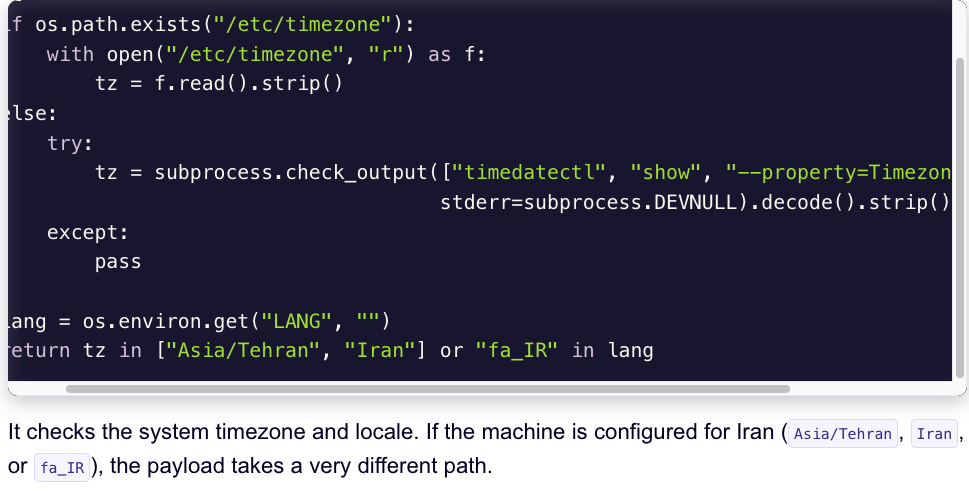
A financially motivated data theft and extortion group is attempting to inject itself into the Iran war, unleashing a worm that spreads through poorly secured cloud services and wipes data on infected systems that use Iran’s time zone or have Farsi set as the default language.

Experts say the wiper campaign against Iran materialized this past weekend and came from a relatively new cybercrime group known as TeamPCP. In December 2025, the group began compromising corporate cloud environments using a self-propagating worm that went after exposed Docker APIs, Kubernetes clusters, Redis servers, and the React2Shell vulnerability. TeamPCP then attempted to move laterally through victim networks, siphoning authentication credentials and extorting victims over Telegram.

A snippet of the malicious CanisterWorm that seeks out and destroys data on systems that match Iran’s timezone or have Farsi as the default language. Image: Aikido.dev.

In a profile of TeamPCP published in January, the security firm Flare said the group weaponizes exposed control planes rather than exploiting endpoints, predominantly targeting cloud infrastructure over end-user devices, with Azure (61%) and AWS (36%) accounting for 97% of compromised servers.

“TeamPCP’s strength does not come from novel exploits or original malware, but from the large-scale automation and integration of well-known attack techniques,” Flare’s Assaf Morag wrote. “The group industrializes existing vulnerabilities, misconfigurations, and recycled tooling into a cloud-native exploitation platform that turns exposed infrastructure into a self-propagating criminal ecosystem.”

On March 19, TeamPCP executed a supply chain attack against the vulnerability scanner Trivy from Aqua Security, injecting credential-stealing malware into official releases on GitHub actions. Aqua Security said it has since removed the harmful files, but the security firm Wiz notes the attackers were able to publish malicious versions that snarfed SSH keys, cloud credentials, Kubernetes tokens and cryptocurrency wallets from users.

Over the weekend, the same technical infrastructure TeamPCP used in the Trivy attack was leveraged to deploy a new malicious payload which executes a wiper attack if the user’s timezone and locale are determined to correspond to Iran, said Charlie Eriksen, a security researcher at Aikido. In a blog post published on Sunday, Eriksen said if the wiper component detects that the victim is in Iran and has access to a Kubernetes cluster, it will destroy data on every node in that cluster.

“If it doesn’t it will just wipe the local machine,” Eriksen told KrebsOnSecurity.

Image: Aikido.dev.

Aikido refers to TeamPCP’s infrastructure as “CanisterWorm” because the group orchestrates their campaigns using an Internet Computer Protocol (ICP) canister — a system of tamperproof, blockchain-based “smart contracts” that combine both code and data. ICP canisters can serve Web content directly to visitors, and their distributed architecture makes them resistant to takedown attempts. These canisters will remain reachable so long as their operators continue to pay virtual currency fees to keep them online.

Eriksen said the people behind TeamPCP are bragging about their exploits in a group on Telegram and claim to have used the worm to steal vast amounts of sensitive data from major companies, including a large multinational pharmaceutical firm.

“When they compromised Aqua a second time, they took a lot of GitHub accounts and started spamming these with junk messages,” Eriksen said. “It was almost like they were just showing off how much access they had. Clearly, they have an entire stash of these credentials, and what we’ve seen so far is probably a small sample of what they have.”

Security experts say the spammed GitHub messages could be a way for TeamPCP to ensure that any code packages tainted with their malware will remain prominent in GitHub searches. In a newsletter published today titled GitHub is Starting to Have a Real Malware Problem, Risky Business reporter Catalin Cimpanu writes that attackers often are seen pushing meaningless commits to their repos or using online services that sell GitHub stars and “likes” to keep malicious packages at the top of the GitHub search page.

This weekend’s outbreak is the second major supply chain attack involving Trivy in as many months. At the end of February, Trivy was hit as part of an automated threat called HackerBot-Claw, which mass exploited misconfigured workflows in GitHub Actions to steal authentication tokens.

Eriksen said it appears TeamPCP used access gained in the first attack on Aqua Security to perpetrate this weekend’s mischief. But he said there is no reliable way to tell whether TeamPCP’s wiper actually succeeded in trashing any data from victim systems, and that the malicious payload was only active for a short time over the weekend.

“They’ve been taking [the malicious code] up and down, rapidly changing it adding new features,” Eriksen said, noting that when the malicious canister wasn’t serving up malware downloads it was pointing visitors to a Rick Roll video on YouTube.

“It’s a little all over the place, and there’s a chance this whole Iran thing is just their way of getting attention,” Eriksen said. “I feel like these people are really playing this Chaotic Evil role here.”

Cimpanu observed that supply chain attacks have increased in frequency of late as threat actors begin to grasp just how efficient they can be, and his post documents an alarming number of these incidents since 2024.

“While security firms appear to be doing a good job spotting this, we’re also gonna need GitHub’s security team to step up,” Cimpanu wrote. “Unfortunately, on a platform designed to copy (fork) a project and create new versions of it (clones), spotting malicious additions to clones of legitimate repos might be quite the engineering problem to fix.”

Update, 2:40 p.m. ET: Wiz is reporting that TeamPCP also pushed credential stealing malware to the KICS vulnerability scanner from Checkmarx, and that the scanner’s GitHub Action was compromised between 12:58 and 16:50 UTC today (March 23rd).

Navigating 2026’s Converged Threats: Insights from Flashpoint’s Global Threat Intelligence Report

Blogs

Blog

Navigating 2026’s Converged Threats: Insights from Flashpoint’s Global Threat Intelligence Report

In this post, we preview the critical findings of the 2026 Global Threat Intelligence Report, highlighting how the collapse of traditional security silos and the rise of autonomous, machine-speed attacks are forcing a total reimagining of modern defense.

SHARE THIS:
Default Author Image
March 11, 2026

The cybersecurity landscape has reached a point of total convergence, where the silos that once separated malware, identity, and infrastructure have collapsed into a single, high-velocity threat engine. Simultaneously, the threat landscape is shifting from human-led attacks to machine-speed operations as a result of agentic AI, which acts as a force multiplier for the modern adversary.

Flashpoint’s 2026 Global Threat Intelligence Report

Flashpoint’s 2026 Global Threat Intelligence Report (GTIR) was developed to anchor security leaders — from threat intelligence and vulnerability management teams to physical security professionals and the CISO’s office — with the data required to navigate this year’s greatest threats, rife with infostealers, vulnerabilities, ransomware, and malicious insiders.

Our report uncovers several staggering metrics that illustrate the industrialization of modern cybercrime:

  • AI-related illicit activity skyrocketed by 1,500% in a single month at the end of 2025.
  • 3.3 billion compromised credentials and cloud tokens have turned identity into the primary exploit vector.
  • From January 2025 to December 2025, ransomware incidents rose by 53%, as attackers pivot from technical encryption to “pure-play” identity extortion.
  • Vulnerability disclosures surged by 12% from January 2025 to December 2025, with the window between discovery and mass exploitation effectively vanishing.

These findings are derived from Flashpoint’s Primary Source Collection (PSC), a specialized operating model that collects intelligence directly from original sources, driven by an organization’s unique Priority Intelligence Requirements (PIR). The 2026 Global Threat Intelligence Report leverages this ground-truth data to provide a strategic framework for the year ahead. Download to gain:

  1. A Clear Understanding of the New Convergence Between Identity and AI
    Discover how threat actors are preparing to transition from generative tools to sophisticated agentic frameworks. Learn how 3.3 billion compromised credentials are being weaponized via automated orchestration to bypass legacy defenses and exploit the connective tissue of modern corporate APIs.
  2. Intelligence on the “Franchise Model” of Global Extortion
    Gain deep insight into the professionalized operations of today’s most prolific threat actors. From the industrial efficiency of RaaS groups like RansomHub and Clop to the market dominance of the next generation of infostealer malware, we break down the economics driving today’s cybercrime ecosystem.
  3. A Blueprint for Proactive Defense and Risk Mitigation
    Leverage the latest trends, in-depth analysis, and data-driven insights driven by Primary Source Collection to bolster your security posture by identifying and proactively defending against rising attack vectors.

As attackers automate exploitation of identity, vulnerabilities, and ransomware, defenders who rely on fragmented visibility will fall behind. To keep pace, organizations must ground their decisions in primary-source intelligence that is drawn from adversarial environments, so that decision-makers can get ahead of this accelerating threat cycle.”

Josh Lefkowitz, CEO & Co-Founder at Flashpoint

The Top Threats at a Glance

Our latest report identifies four driving themes shaping the 2026 threat landscape:

2026 Is the Era of Agentic-Based Cyberattacks

Flashpoint identified a 1,500% rise in AI-related illicit discussions between November and December 2025, signaling a rapid transition from criminal curiosity to the active development of malicious frameworks. Built on data pulled from criminal environments and shaped by fraud use cases, these systems scrape data, adjust messaging for specific targets, rotate infrastructure, and learn from failed attempts without the need for constant human involvement.

2026 is the era of agentic-based cyberattacks. We’ve seen a 1,500% increase in AI-related illicit discussions in a single month, signaling increased interest in developing malicious frameworks. The discussions evolve into vibe-coded, AI-supported phishing lures, malware, and cybercrime venues. When iteration becomes cheap through automation, attackers can afford to fail repeatedly until they find a successful foothold.

Ian Gray, Vice President of Cyber Threat Intelligence Operations at Flashpoint

Identity Is the New Exploit

Flashpoint observed over 11.1 million machines infected with infostealers in 2025, fueling a massive inventory of 3.3 billion stolen credentials and cloud tokens. The fundamental mechanics of cybercrime have shifted from breaking in to logging in, as attackers leverage stolen session cookies to behave like legitimate users.

The Patching Window Is Rapidly Closing

Vulnerability disclosures surged by 12% in 2025, with 1 in 3 (33%) vulnerabilities having publicly available exploit code. The strategic gap between discovery and weaponization is increasingly vanishing, as evidenced by mass exploitation of zero-day vulnerabilities in as little as 24 hours after discovery.

Ransomware Is Hacking the Person, Not the Code

As technical defenses against encryption harden, ransomware groups are pivoting to the path of least resistance: human trust. This approach has led to a 53% increase in ransomware, with RaaS groups being responsible for over 87% of all ransomware attacks.

Build Resilience in a Converged Landscape

The findings in the 2026 Global Threat Intelligence Report make one thing clear: incremental improvements to legacy security models are no longer sufficient. As adversaries transition to machine-speed operations, the strategic advantage shifts to organizations that can maintain visibility into the adversarial environments where these attacks are born.

Protecting organizations and communities requires an intelligence-first approach. Download Flashpoint’s 2026 Global Threat Intelligence Report to gain clarity and the data-driven insights needed to safeguard critical assets.

Get Your Copy

The post Navigating 2026’s Converged Threats: Insights from Flashpoint’s Global Threat Intelligence Report appeared first on Flashpoint.

Ransomware attacks on schools and colleges | Kaspersky official blog

6 March 2026 at 18:30

Back when ransomware was just a startup industry, the primary goal of the attackers was simple: encrypt data, then extort a ransom in exchange for decrypting it. Because of this, cybercriminals mostly targeted commercial enterprises — companies that valued their data enough to justify a hefty payout. Schools and colleges were generally left alone — hackers assumed educators didn’t have the kind of data worth paying a ransom for.

But times have changed, and so has the ransomware groups’ business model. The focus has shifted from payment for decryption, to extortion in exchange for non-disclosure of stolen data. Now, the “incentive” to pay isn’t just about restoring the company’s normal operations, but rather avoiding regulatory trouble, potential lawsuits, and reputational damage. And it’s this shift that’s put educational institutions in the crosshairs.

In this post, we discuss several cases of ransomware attacks on educational organizations, why they took place, and how to keep cybercriminals out of the classroom.

Attacks on educational institutions in 2025–2026

In February 2026, the Sapienza University of Rome, one of Europe’s oldest and largest higher education institutions, suffered a ransomware attack. Internal systems were down for three days. According to sources familiar with the incident, the cybercriminals sent the university’s administration a link leading to a ransom demand. Upon clicking the link, a countdown timer started on the site that opened — counting down from  72 hours: the time the attackers demands needed to be met. As of now, there’s still no word on whether the university administration paid up or not.

Unfortunately, this case isn’t an exception. At the very end of 2025, attackers targeted another Italian educational institution — a vocational training center in the small city of Treviso. Things aren’t looking much better in the UK, either: in the same year, Blacon High School was hit by ransomware. Its administration had to shut its doors for two days to restore its IT systems, assess the scale of the incident, and prevent the attack from spreading further through the network.

In fact, a UK government study suggests these incidents are just part of a broader trend. According to its 2025 data, cyberincidents hit 60% of secondary schools, 85% of colleges, and 91% of universities. Across the pond, American researchers also noted that in the first quarter of 2025, ransomware attacks in the global education sector surged by 69% year on year. Clearly, the trend is global.

Why schools and universities are becoming easy targets

The core of the problem is that modern educational organizations are rapidly incorporating digital services into their operations. A typical school or university infrastructure now manages a dizzying array of services:

  • Electronic gradebooks and registers
  • Distance learning platforms
  • Admission systems and databases for storing applicants’ personal data
  • Cloud storage for educational materials
  • Internal staff and student portals
  • Email for faculty, students, and the administration to communicate

While these systems make education more convenient and manageable, they also drastically expand the attack surface. Every new service and every additional user account is a potential doorway for a phishing campaign, access compromise, or a personal data leak.

According to a UK study, the primary vector for these attacks is basic phishing. But that’s not all that surprising: since the education sector was off the cybercriminals’ radar for so long, cybersecurity training for both staff and students was hardly a priority. As a result, even the most seasoned professors can find themselves falling for a fake email purportedly sent by the “dean” or the “school principal”.

But it’s not just the faculty. Students themselves often unwittingly act as mules for malware. In many institutions, students still frequently hand in assignments on USB flash drives. These drives travel across various home or public devices, picking up malicious digital hitchhikers along the way. All it takes is one infected USB drive plugged into a campus workstation to give an attacker a foothold in the internal network.

It’s worth noting that while USB drives aren’t as ubiquitous as they were a decade ago, they remain a staple in the educational environment. Dismissing the threats they carry isn’t a good idea.

How to ensure the cybersecurity of educational infrastructure

Let’s face it: training every literature and biology teacher to spot phishing emails is now easy, quick task. Similarly, the educational system isn’t going to cut down on USB usage overnight.

Fortunately, a robust security solution (such as Kaspersky Small Office Security) can do the heavy lifting for you. It’s ideal for schools and colleges that need set-it-and-forget-it protection without a steep learning curve. Plus, it’s affordable even for institutions operating on a tight budget, and doesn’t require constant management.

At the same time, Kaspersky Small Office Security addresses all the threats we’ve discussed above: it blocks clicks on phishing links, automatically scans USB drives the moment they’re plugged in, and prevents suspicious files from executing on devices connected to the school’s network.

Iranian Conflict Intelligence Dashboard Immediately Available for ThreatConnect

6 March 2026 at 15:00

The escalation of geopolitical tensions specifically focused on the Iranian Conflict over the last days of February 2026 has intensified the significant cyber and physical security risks to organizations globally. 

With threat activity emanating from advanced Iranian state-sponsored actors, aligned hacktivist collectives, and opportunistic criminal groups, security teams must remain agile, informed, and proactive. 

The Iranian Conflict Intelligence Dashboard has been updated to equip defenders with timely, high-fidelity intelligence that specifically reflects the dynamic threat environment shaped by this high-profile regional conflict with a heightened focus on Iran-linked activity.

Key Threat Actor Groups & Campaign Themes Tracked Include:

  • IRGC-affiliated Cyber Units (e.g., APT33, APT34, APT39, APT42): Tracking activity from primary state-sponsored groups.
  • Proxies and Ideological Hacktivist Actors: Monitoring activity from groups like CyberAv3ngers, APT IRAN, Handala Hack, Lulzsec, Dark Storm Team, GhostSec, Cyber Islamic Resistance, and others aligned with Iranian strategic interests.
  • Coordinated Influence and Disinformation Campaigns.
  • OT and Critical Infrastructure Targeting Efforts, particularly those targeting Israeli and Western assets.

Rather than tracking isolated threats, the –Iranian Conflict Intelligence Dashboard dashboard provides strategic context and operational detail across the broader cyber conflict spectrum, enabling faster detection, response, and mitigation.

Key Benefits:

  • Conflict-Centric Intelligence Aggregation – Centralized indicators of compromise (IOCs), TTPs, and threat insights related to Iranian-linked campaigns, sourced from open source intelligence (OSINT), premium threat feeds, and internal telemetry.
  • Live Threat Environment Tracking – Monitors shifts in activity across major adversary groups, cyber incidents, defacements, DDoS campaigns, and geopolitical events fueling escalation.
  • Accelerated Incident Response – Enriched and correlated intelligence to support triage, prioritization, and response activities during periods of elevated tension or retaliatory operations.
  • Custom Visualization & Analysis – Interactive dashboards featuring timeline analysis, actor overlap matrices, infrastructure clustering, and geographic threat origination maps.
  • ThreatConnect Automation Integration – Seamless correlation with existing ThreatConnect adversary profiles, intrusion sets, and signature-based alerts to identify high-risk overlaps with organizational environments.

Leveraging this dashboard allows security teams to anticipate conflict-related threats, understand attacker motivations, and tailor defenses to emerging risks as the Iranian cyber conflict evolves.

Specific Intelligence Focus: Iranian Malware List

  • APT42: tamecat, tabbycat, vbrevshell, powerpost, brokeyolk, chairsmack, asyncrat
  • APT34: powbat, powruner, bondupdater
  • APT33: shapeshift, dropshot, turnedup, nanocore, netwire, alfa shell
  • Other Related Malware: Gh0st Rat, quasarrat, amadey, bittersweet, cointoss, lateop

Specific Intelligence Focus: Iranian ICS Targets

ICS Systems Likely to be targeted by Iranian threat actors (based on analysis like the Censys report):

  • “Unitronics” or (“Vision” AND (PLC OR HMI))
  • “Tridium” or “Niagara”
  • “Orpak” or “SiteOmat”
  • “red lion”

Dashboard Components Include:

  1. Indicators linked to state-sponsored and proxy cyber operations.
  2. Threat groups aligned to Iranian strategic cyber interests.
  3. Reports and advisories referencing the conflict, regional escalations, or actor-attributed activity.
  4. Campaign tracking with attribution timelines, victimology insights, and strategic objectives.
  5. MITRE ATT&CK techniques used by affiliated groups, mapped to known incidents.
  6. Keyword and tag intelligence trends across conflict-related reporting.
  7. Infrastructure associations (e.g., shared IPs, domains, malware hashes).
  8. Actor and alias mapping, including cross-reference to public and private sector intelligence.
  9. Vulnerabilities linked to recent Iran intelligence activity.

Screen Capture of Iranian Conflict Intelligence Dashboard

Lead Contributor – Adrian Dela Cruz , Customer Success Engineer

To gain access to the Iranian Conflict Intelligence Dashboard, please reach out to your Customer Success team or reach out to us through our contact form.

The dashboard is also available here, and can be added manually to your ThreatConnect instance.

The post Iranian Conflict Intelligence Dashboard Immediately Available for ThreatConnect appeared first on ThreatConnect.

Please Don’t Feed the Scattered Lapsus ShinyHunters

2 February 2026 at 17:15

A prolific data ransom gang that calls itself Scattered Lapsus ShinyHunters (SLSH) has a distinctive playbook when it seeks to extort payment from victim firms: Harassing, threatening and even swatting executives and their families, all while notifying journalists and regulators about the extent of the intrusion. Some victims reportedly are paying — perhaps as much to contain the stolen data as to stop the escalating personal attacks. But a top SLSH expert warns that engaging at all beyond a “We’re not paying” response only encourages further harassment, noting that the group’s fractious and unreliable history means the only winning move is not to pay.

Image: Shutterstock.com, @Mungujakisa

Unlike traditional, highly regimented Russia-based ransomware affiliate groups, SLSH is an unruly and somewhat fluid English-language extortion gang that appears uninterested in building a reputation of consistent behavior whereby victims might have some measure of confidence that the criminals will keep their word if paid.

That’s according to Allison Nixon, director of research at the New York City based security consultancy Unit 221B. Nixon has been closely tracking the criminal group and individual members as they bounce between various Telegram channels used to extort and harass victims, and she said SLSH differs from traditional data ransom groups in other important ways that argue against trusting them to do anything they say they’ll do — such as destroying stolen data.

Like SLSH, many traditional Russian ransomware groups have employed high-pressure tactics to force payment in exchange for a decryption key and/or a promise to delete stolen data, such as publishing a dark web shaming blog with samples of stolen data next to a countdown clock, or notifying journalists and board members of the victim company. But Nixon said the extortion from SLSH quickly escalates way beyond that — to threats of physical violence against executives and their families, DDoS attacks on the victim’s website, and repeated email-flooding campaigns.

SLSH is known for breaking into companies by phishing employees over the phone, and using the purloined access to steal sensitive internal data. In a January 30 blog post, Google’s security forensics firm Mandiant said SLSH’s most recent extortion attacks stem from incidents spanning early to mid-January 2026, when SLSH members pretended to be IT staff and called employees at targeted victim organizations claiming that the company was updating MFA settings.

“The threat actor directed the employees to victim-branded credential harvesting sites to capture their SSO credentials and MFA codes, and then registered their own device for MFA,” the blog post explained.

Victims often first learn of the breach when their brand name is uttered on whatever ephemeral new public Telegram group chat SLSH is using to threaten, extort and harass their prey. According to Nixon, the coordinated harassment on the SLSH Telegram channels is part of a well-orchestrated strategy to overwhelm the victim organization by manufacturing humiliation that pushes them over the threshold to pay.

Nixon said multiple executives at targeted organizations have been subject to “swatting” attacks, wherein SLSH communicated a phony bomb threat or hostage situation at the target’s address in the hopes of eliciting a heavily armed police response at their home or place of work.

“A big part of what they’re doing to victims is the psychological aspect of it, like harassing executives’ kids and threatening the board of the company,” Nixon told KrebsOnSecurity. “And while these victims are getting extortion demands, they’re simultaneously getting outreach from media outlets saying, ‘Hey, do you have any comments on the bad things we’re going to write about you.”

In a blog post today, Unit 221B argues that no one should negotiate with SLSH because the group has demonstrated a willingness to extort victims based on promises that it has no intention to keep. Nixon points out that all of SLSH’s known members hail from The Com, shorthand for a constellation of cybercrime-focused Discord and Telegram communities which serve as a kind of distributed social network that facilitates instant collaboration.

Nixon said Com-based extortion groups tend to instigate feuds and drama between group members, leading to lying, betrayals, credibility destroying behavior, backstabbing, and sabotaging each other.

“With this type of ongoing dysfunction, often compounding by substance abuse, these threat actors often aren’t able to act with the core goal in mind of completing a successful, strategic ransom operation,” Nixon wrote. “They continually lose control with outbursts that put their strategy and operational security at risk, which severely limits their ability to build a professional, scalable, and sophisticated criminal organization network for continued successful ransoms – unlike other, more tenured and professional criminal organizations focused on ransomware alone.”

Intrusions from established ransomware groups typically center around encryption/decryption malware that mostly stays on the affected machine. In contrast, Nixon said, ransom from a Com group is often structured the same as violent sextortion schemes against minors, wherein members of The Com will steal damaging information, threaten to release it, and “promise” to delete it if the victim complies without any guarantee or technical proof point that they will keep their word. She writes:

A key component of SLSH’s efforts to convince victims to pay, Nixon said, involves manipulating the media into hyping the threat posed by this group. This approach also borrows a page from the playbook of sextortion attacks, she said, which encourages predators to keep targets continuously engaged and worrying about the consequences of non-compliance.

“On days where SLSH had no substantial criminal ‘win’ to announce, they focused on announcing death threats and harassment to keep law enforcement, journalists, and cybercrime industry professionals focused on this group,” she said.

An excerpt from a sextortion tutorial from a Com-based Telegram channel. Image: Unit 221B.

Nixon knows a thing or two about being threatened by SLSH: For the past several months, the group’s Telegram channels have been replete with threats of physical violence against her, against Yours Truly, and against other security researchers. These threats, she said, are just another way the group seeks to generate media attention and achieve a veneer of credibility, but they are useful as indicators of compromise because SLSH members tend to name drop and malign security researchers even in their communications with victims.

“Watch for the following behaviors in their communications to you or their public statements,” Unit 221B’s advisory reads. “Repeated abusive mentions of Allison Nixon (or “A.N”), Unit 221B, or cybersecurity journalists—especially Brian Krebs—or any other cybersecurity employee, or cybersecurity company. Any threats to kill, or commit terrorism, or violence against internal employees, cybersecurity employees, investigators, and journalists.”

Unit 221B says that while the pressure campaign during an extortion attempt may be traumatizing to employees, executives, and their family members, entering into drawn-out negotiations with SLSH incentivizes the group to increase the level of harm and risk, which could include the physical safety of employees and their families.

“The breached data will never go back to the way it was, but we can assure you that the harassment will end,” Nixon said. “So, your decision to pay should be a separate issue from the harassment. We believe that when you separate these issues, you will objectively see that the best course of action to protect your interests, in both the short and long term, is to refuse payment.”

Mustang Panda Intelligence Dashboard Immediately Available for ThreatConnect

28 January 2026 at 15:00

Mustang Panda—also known in industry and government reporting as BASIN, BRONZE PRESIDENT, CAMARO DRAGON, EARTH PRETA, FIREANT, G0129, HIVE015, HoneyMyte, LUMINOUS MOTH, Polaris, RedDelta, STATELY TAURUS, TA416, TANTALUM, TEMP.HEX, TWILL TYPHOON, or UNC6384—is a highly active, state-sponsored Chinese cyber-espionage group assessed to operate under the People’s Republic of China (PRC). Active for over a decade, the group is distinguished by its high operational tempo and “volume over stealth” approach to espionage.

Mustang Panda has consistently targeted entities that intersect with Beijing’s geopolitical priorities, particularly government and diplomatic institutions, maritime logistics organizations, and religious institutions. Their campaigns demonstrate a persistent focus on intelligence collection related to foreign policy, trade routes, and sensitive diplomatic engagements.

Multiple cybersecurity vendors and government agencies assess with high confidence that Mustang Panda operates in alignment with PRC strategic objectives, based on victimology patterns, infrastructure choices, and activity timing that aligns with Chinese working hours (UTC+8).

The new Mustang Panda Dashboard in ThreatConnect offers security teams centralized visibility into this highly active and adaptable adversary.

Key Benefits:

  • Centralized Intelligence: Aggregates Mustang Panda-related IOCs, TTPs, malware families, and campaign telemetry from open sources, commercial feeds, and internal data.
  • Continuous Threat Tracking: Monitors real-time updates on actor infrastructure, targeting patterns, and evolving tradecraft.
  • Accelerated Incident Response: Provides enriched, contextual intelligence to reduce detection-to-response timelines.
  • Visual Reporting & Executive Insights: Interactive charts, timelines, and executive-ready dashboards support risk prioritization and communication.
  • Automated Correlation: Leverages ThreatConnect’s automation engine to map Mustang Panda indicators across intrusion sets, malware families, and victim profiles.

Mustang Panda’s consistent targeting of government, diplomatic, and maritime entities underscores the ongoing risk to sensitive political and economic interests worldwide. 

The Mustang Panda Dashboard equips defenders with the ability to visualize campaigns, correlate activity, and act decisively—directly within the ThreatConnect platform.

Note: To maximize the value of this dashboard, organizations may benefit from integration with premium threat intelligence sources such as Dataminr, Mandiant, Recorded Future, or CrowdStrike.

Lead Contributor – Travis Meyers, Customer Success Manager

To gain access to the Mustang Panda Dashboard, please connect with your Customer Success team or reach out to us through our contact form.

Further Resources

For more detailed information and resources on Salt Typhoon, please refer to the following:

Resource Description Link
MITRE As a not-for-profit organization, MITRE acts in the public interest by delivering objective, cost-effective solutions to many of the world’s biggest challenges. MITRE Article
The Hacker News THN Media Private Limited, the parent organization behind The Hacker News (THN), stands as a top and reliable source for the latest updates in cybersecurity. As an independent outlet, we offer balanced and thorough insights into the cybersecurity sector, trusted by professionals and enthusiasts alike. THN Article
Reuters Reuters is the leading global source of news coverage. We have been licensing content and information to media organizations, technology companies, governments and corporations since 1851. Reuters Article

We urge all organizations to remain vigilant and proactive in their cybersecurity efforts. By implementing these recommendations, you can significantly reduce your risk and protect your critical assets.

Mustang Panda Known Exploited Vulnerabilities

CVE ID Product Description
CVE-2025-55182 IoT / Web Apps React2Shell: Critical flaw exploited by the RondoDox botnet (associated with Mustang Panda) to compromise IoT devices.
CVE-2025-14847 MongoDB MongoBleed: Active exploitation allowing unauthenticated attackers to coerce servers into leaking sensitive memory data.
CVE-2025-9491 Windows UI LNK Bypass: Confirmed extensive exploitation by Mustang Panda to deliver PlugX via malicious shortcut files
CVE-2025-41244 VMware Tools Exploited alongside Windows flaws for privilege escalation and persistence.
CVE-2024-21893 Ivanti Connect Secure Authentication bypass used to deploy MetaRAT (PlugX variant) targeting shipping companies in Japan.
CVE-2024-0012 Palo Alto PAN-OS Exploited for authentication bypass, often leading to ransomware-like behavior or espionage.
CVE-2025-10585 Google Chrome Zero-day in the V8 engine, patched but actively exploited.
CVE-2023-4966 Citrix NetScaler Citrix Bleed: Session hijacking vulnerability used to bypass authentication.
CVE-2025-6202 DRAM (Hardware) Rowhammer Variant: Advanced hardware-level attack bypassing DDR5 protections.

The post Mustang Panda Intelligence Dashboard Immediately Available for ThreatConnect appeared first on ThreatConnect.

The Top Threat Actor Groups Targeting the Financial Sector

Blogs

Blog

The Top Threat Actor Groups Targeting the Financial Sector

In this post, we identify and analyze the top threat actors that have been actively targeting the financial sector between 2024 and 2026.

SHARE THIS:
Default Author Image
January 6, 2026

Between 2024 and 2026, Flashpoint analysts have observed the financial sector as a top target of threat actors, with 406 publicly disclosed victims falling prey to ransomware attacks alone—representing seven percent of all ransomware victim listings during that period.

However, ransomware is just one piece of the complex threat actor puzzle. The financial sector is also grappling with threats stemming from sophisticated Advanced Persistent Threat (APT) groups, the risks associated with third-party compromises, the illicit trade in initial access credentials, the ever-present danger of insider threats, and the emerging challenge of deepfake and impersonation fraud.

Why Finance?

The financial sector has long been one of the most attractive targets for threat actors, consistently ranking among the most targeted industries globally.

These institutions manage massive volumes of sensitive data—from high-value financial transactions and confidential customer information to vast sums of capital, making them especially lucrative for threat actors seeking financial gain. Additionally, the urgency and criticality of financial operations increases the chances that victim organizations will succumb to extortion and ransom demands.

Even beyond direct financial incentives, the financial sector remains an attractive target due to its deep interconnectivity with other industries.This means that malicious actors may simply target financial institutions to gain information about another target organization, as a single data breach can have far-reaching and cascading consequences for involved partners and third parties.

The Threat Actors Targeting the Financial Sector

To understand the complexities of the financial threat landscape, organizations need a comprehensive understanding of the key players involved. The following threat actors represent some of the most prominent and active groups targeting the financial sector between April 2024 and April 2025:

RansomHub

Despite being a relatively new Ransomware-as-a-Service (RaaS) group that emerged in February 2024, RansomHub quickly rose to prominence, becoming the second-most active ransomware group in 2024. Notably, they claimed 38 victims in the financial sector between April 2024 and April 2025. Their known TTPs include phishing and exploiting vulnerabilities. RansomHub is also known to heavily target the healthcare sector.

Akira

Active since March 2023, Akira has demonstrated increasingly sophisticated tactics and has targeted a significant number of victims across various sectors. Between April 2024 and April 2025, they targeted 34 organizations within the financial sector. Evidence suggests a potential link to the defunct Conti ransomware group. Akira commonly gains initial access through compromised credentials, Virtual Private Network (VPN) vulnerabilities, and Remote Desktop Protocol (RDP). They employ a double extortion model, exfiltrating data before encryption.

LockBit Ransomware

A long-standing and highly prolific RaaS group operating since at least September 2019, LockBit continued to be a major threat to the financial sector, claiming 29 publicly disclosed victims between April 2024 and April 2025. LockBit utilizes various initial access methods, including phishing, exploitation of known vulnerabilities, and compromised remote services.

Most notably, in June 2024, LockBit claimed it gained access to the US Federal Reserve, stating that they exfiltrated 33 TB of data. However, Flashpoint analysts found that the data posted on the Federal Reserve listing appears to belong to another victim, Evolve Bank & Trust.

FIN7

This financially motivated threat actor group, originating from Eastern Europe and active since at least 2015, focuses on stealing payment card data. They employ social engineering tactics and create elaborate infrastructure to achieve their goals, reportedly generating over $1 billion USD in revenue between 2015 and 2021. Their targets within the financial sector include interbank transfer systems (SWIFT, SAP), ATM infrastructure, and point-of-sale (POS) terminals. Initial access is often gained through phishing and exploiting public-facing applications.

Scattering Spider

Emerging in 2022, Scattered Spider has quickly become known for its rapid exploitation of compromised environments, particularly targeting financial services, cryptocurrency services, and more. They are notorious for using SMS phishing and fake Okta single sign-on pages to steal credentials and move laterally within networks. Their primary motivation is financial gain.

Lazarus Group

This advanced persistent threat (APT) group, backed by the North Korean government, has demonstrated a broad range of targets, including cryptocurrency exchanges and financial institutions. Their campaigns are driven by financial profit, cyberespionage, and sabotage. Lazarus Group employs sophisticated spear-phishing emails, malware disguised in image files, and watering-hole attacks to gain initial access.

Top Attack Vectors Facing the Financial Sector

Between April 2024 and April 2025, our analysts observed 6,406 posts pertaining to financial sector access listings within Flashpoint’s forum collections. How are these prolific threat actor groups gaining a foothold into financial data and systems? Examining Flashpoint intelligence, malicious actors are capitalizing on third-party compromises, initial access brokers, insider threats, amongst other attack vectors:

Third-Party Compromise

Ransomware attacks targeting third-party vendors can have a direct and significant impact on financial institutions through data exposure and compromised credentials. The Clop ransomware gang’s exploitation of the MOVEit vulnerability in December 2024 serves as a stark reminder of this risk.

Initial Access Brokers (IABs)

Initial Access Brokers specialize in gaining initial access to networks and selling these access credentials to other threat groups, including ransomware operators. Their tactics include phishing, the use of information-stealing malware, and exploiting RDP credentials, posing a significant risk to financial entities. Between April 2024 and April 2025, analysts observed 6,406 posts pertaining to financial sector access listings within Flashpoint’s forum collections.

Insider Threat

Malicious insiders, whether recruited or acting independently, can provide direct access to sensitive data and systems within financial institutions. Telegram has emerged as a prominent platform for advertising and recruiting insider services targeting the financial sector.

Deepfake and Impersonation

The increasing sophistication and accessibility of AI tools are enabling new forms of fraud. Deepfakes can bypass traditional security measures by creating convincing audio and video impersonations. While still evolving, this threat vector, along with other impersonation tactics like BEC and vishing, presents a growing concern for the financial sector. Within the past year, analysts observed 1,238 posts across fraud-related Telegram channels discussing impersonation of individuals working for financial institutions.

Defend Against Financial Threats Using Flashpoint

The financial sector remains a high-value target, facing a persistent and evolving array of threats. Understanding the tactics, techniques, and procedures (TTPs) of these top threat actors, as well as the broader threat landscape, is crucial for financial institutions to develop and implement effective security strategies.

Flashpoint is proud to offer a dedicated threat intelligence solution for banks and financial institutions. Our platform combines comprehensive data collection, AI-powered analysis, and expert human insight to deliver actionable intelligence, safeguarding your critical assets and operations. Request a demo today to see how our intelligence can empower your security team.

Request a demo today.

❌