Normal view
Hackers publiceren namen en bestelinfo van klanten van kledingmerk Under Armour
Miljoenen bluetoothapparaten met Google Fast Pair zijn vatbaar voor hack
Let's Encrypt maakt TLS-certificaten van 160 uur algemeen beschikbaar
Mullvad heeft OpenVPN volledig uitgefaseerd en vervangen door Wireguard
Politie waarschuwt via eigen nepwebshop voor ticketfraude op Marktplaats
Predator Spyware Turns Failed Attacks Into Intelligence for Future Exploits
The Predator spyware is more sophisticated and dangerous than previously realized.
The post Predator Spyware Turns Failed Attacks Into Intelligence for Future Exploits appeared first on SecurityWeek.
Broadcom Wi-Fi Chipset Flaw Allows Hackers to Disrupt Networks
The vulnerability was discovered in Asus routers, but all devices using the affected chipset are susceptible to attacks.
The post Broadcom Wi-Fi Chipset Flaw Allows Hackers to Disrupt Networks appeared first on SecurityWeek.
Antwerps ziekenhuis stopt operaties vanwege IT-storing, 'gaat om cyberaanval'
Interrail meldt datalek waarbij mogelijk ID's en IBAN-nummers zijn gestolen
Instagram stopt ongevraagde resetmails die 'externe partij' kon sturen
NCSC verwacht dat bug in automatiseringstool n8n snel zal worden uitgebuit
Rolstoelen Whill hadden geen bluetoothbeveiliging, besturing was over te nemen
Who Benefited from the Aisuru and Kimwolf Botnets?
Our first story of 2026 revealed how a destructive new botnet called Kimwolf has infected more than two million devices by mass-compromising a vast number of unofficial Android TV streaming boxes. Today, we’ll dig through digital clues left behind by the hackers, network operators and services that appear to have benefitted from Kimwolf’s spread.
On Dec. 17, 2025, the Chinese security firm XLab published a deep dive on Kimwolf, which forces infected devices to participate in distributed denial-of-service (DDoS) attacks and to relay abusive and malicious Internet traffic for so-called “residential proxy” services.
The software that turns one’s device into a residential proxy is often quietly bundled with mobile apps and games. Kimwolf specifically targeted residential proxy software that is factory installed on more than a thousand different models of unsanctioned Android TV streaming devices. Very quickly, the residential proxy’s Internet address starts funneling traffic that is linked to ad fraud, account takeover attempts and mass content scraping.
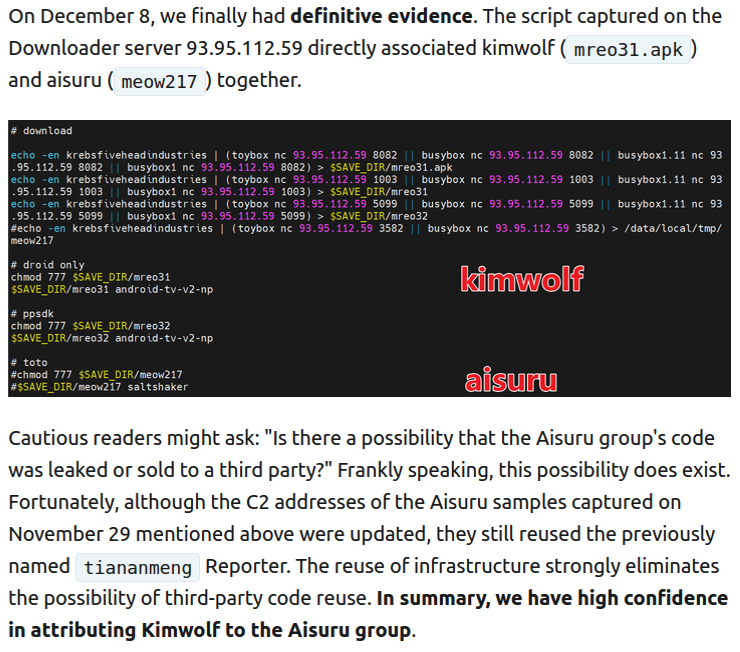
The XLab report explained its researchers found “definitive evidence” that the same cybercriminal actors and infrastructure were used to deploy both Kimwolf and the Aisuru botnet — an earlier version of Kimwolf that also enslaved devices for use in DDoS attacks and proxy services.
XLab said it suspected since October that Kimwolf and Aisuru had the same author(s) and operators, based in part on shared code changes over time. But it said those suspicions were confirmed on December 8 when it witnessed both botnet strains being distributed by the same Internet address at 93.95.112[.]59.
Image: XLab.
RESI RACK
Public records show the Internet address range flagged by XLab is assigned to Lehi, Utah-based Resi Rack LLC. Resi Rack’s website bills the company as a “Premium Game Server Hosting Provider.” Meanwhile, Resi Rack’s ads on the Internet moneymaking forum BlackHatWorld refer to it as a “Premium Residential Proxy Hosting and Proxy Software Solutions Company.”
Resi Rack co-founder Cassidy Hales told KrebsOnSecurity his company received a notification on December 10 about Kimwolf using their network “that detailed what was being done by one of our customers leasing our servers.”
“When we received this email we took care of this issue immediately,” Hales wrote in response to an email requesting comment. “This is something we are very disappointed is now associated with our name and this was not the intention of our company whatsoever.”
The Resi Rack Internet address cited by XLab on December 8 came onto KrebsOnSecurity’s radar more than two weeks before that. Benjamin Brundage is founder of Synthient, a startup that tracks proxy services. In late October 2025, Brundage shared that the people selling various proxy services which benefitted from the Aisuru and Kimwolf botnets were doing so at a new Discord server called resi[.]to.
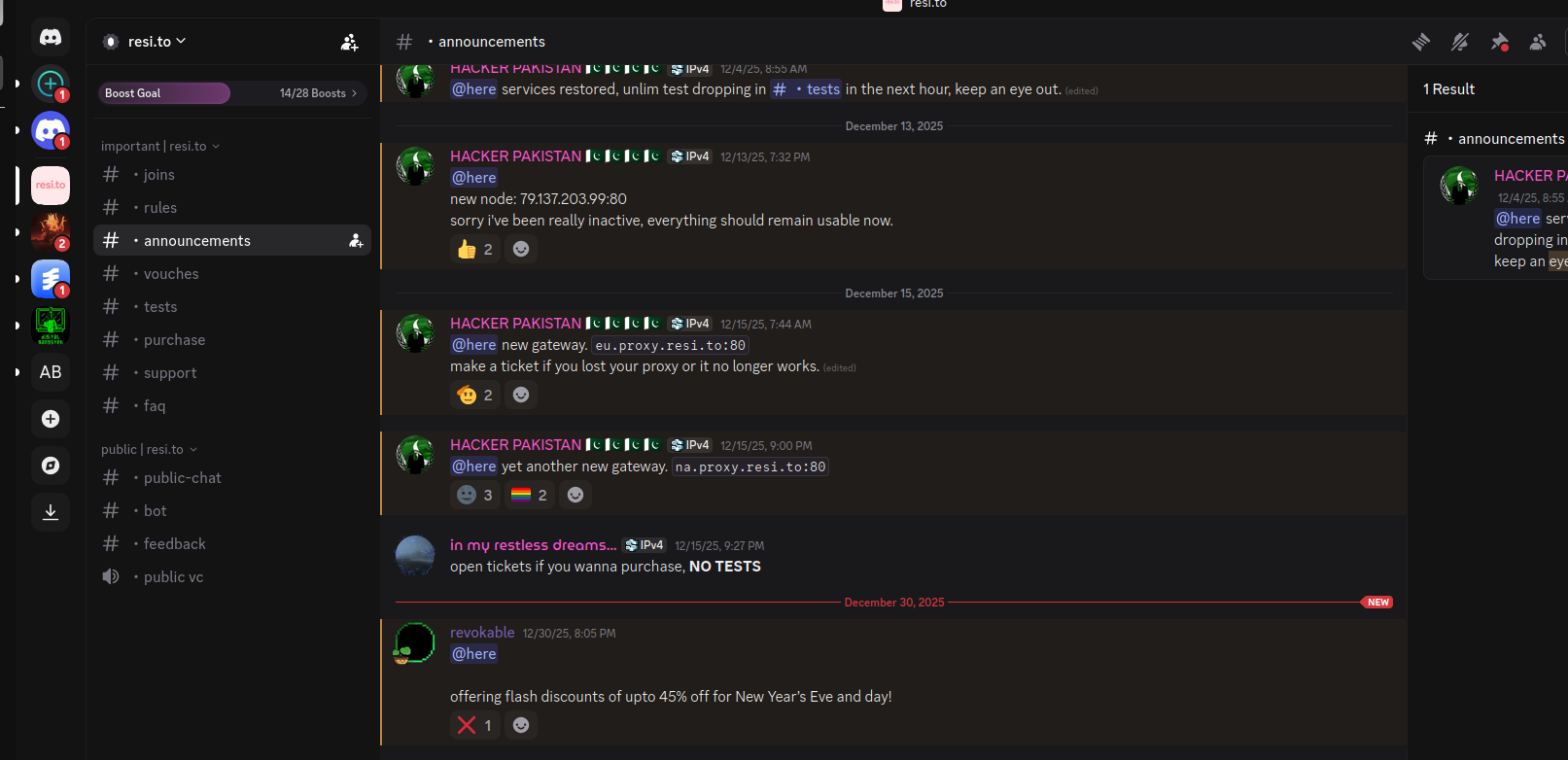
On November 24, 2025, a member of the resi-dot-to Discord channel shares an IP address responsible for proxying traffic over Android TV streaming boxes infected by the Kimwolf botnet.
When KrebsOnSecurity joined the resi[.]to Discord channel in late October as a silent lurker, the server had fewer than 150 members, including “Shox” — the nickname used by Resi Rack’s co-founder Mr. Hales — and his business partner “Linus,” who did not respond to requests for comment.
Other members of the resi[.]to Discord channel would periodically post new IP addresses that were responsible for proxying traffic over the Kimwolf botnet. As the screenshot from resi[.]to above shows, that Resi Rack Internet address flagged by XLab was used by Kimwolf to direct proxy traffic as far back as November 24, if not earlier. All told, Synthient said it tracked at least seven static Resi Rack IP addresses connected to Kimwolf proxy infrastructure between October and December 2025.
Neither of Resi Rack’s co-owners responded to follow-up questions. Both have been active in selling proxy services via Discord for nearly two years. According to a review of Discord messages indexed by the cyber intelligence firm Flashpoint, Shox and Linus spent much of 2024 selling static “ISP proxies” by routing various Internet address blocks at major U.S. Internet service providers.
In February 2025, AT&T announced that effective July 31, 2025, it would no longer originate routes for network blocks that are not owned and managed by AT&T (other major ISPs have since made similar moves). Less than a month later, Shox and Linus told customers they would soon cease offering static ISP proxies as a result of these policy changes.
Shox and Linux, talking about their decision to stop selling ISP proxies.
DORT & SNOW
The stated owner of the resi[.]to Discord server went by the abbreviated username “D.” That initial appears to be short for the hacker handle “Dort,” a name that was invoked frequently throughout these Discord chats.
Dort’s profile on resi dot to.
This “Dort” nickname came up in KrebsOnSecurity’s recent conversations with “Forky,” a Brazilian man who acknowledged being involved in the marketing of the Aisuru botnet at its inception in late 2024. But Forky vehemently denied having anything to do with a series of massive and record-smashing DDoS attacks in the latter half of 2025 that were blamed on Aisuru, saying the botnet by that point had been taken over by rivals.
Forky asserts that Dort is a resident of Canada and one of at least two individuals currently in control of the Aisuru/Kimwolf botnet. The other individual Forky named as an Aisuru/Kimwolf botmaster goes by the nickname “Snow.”
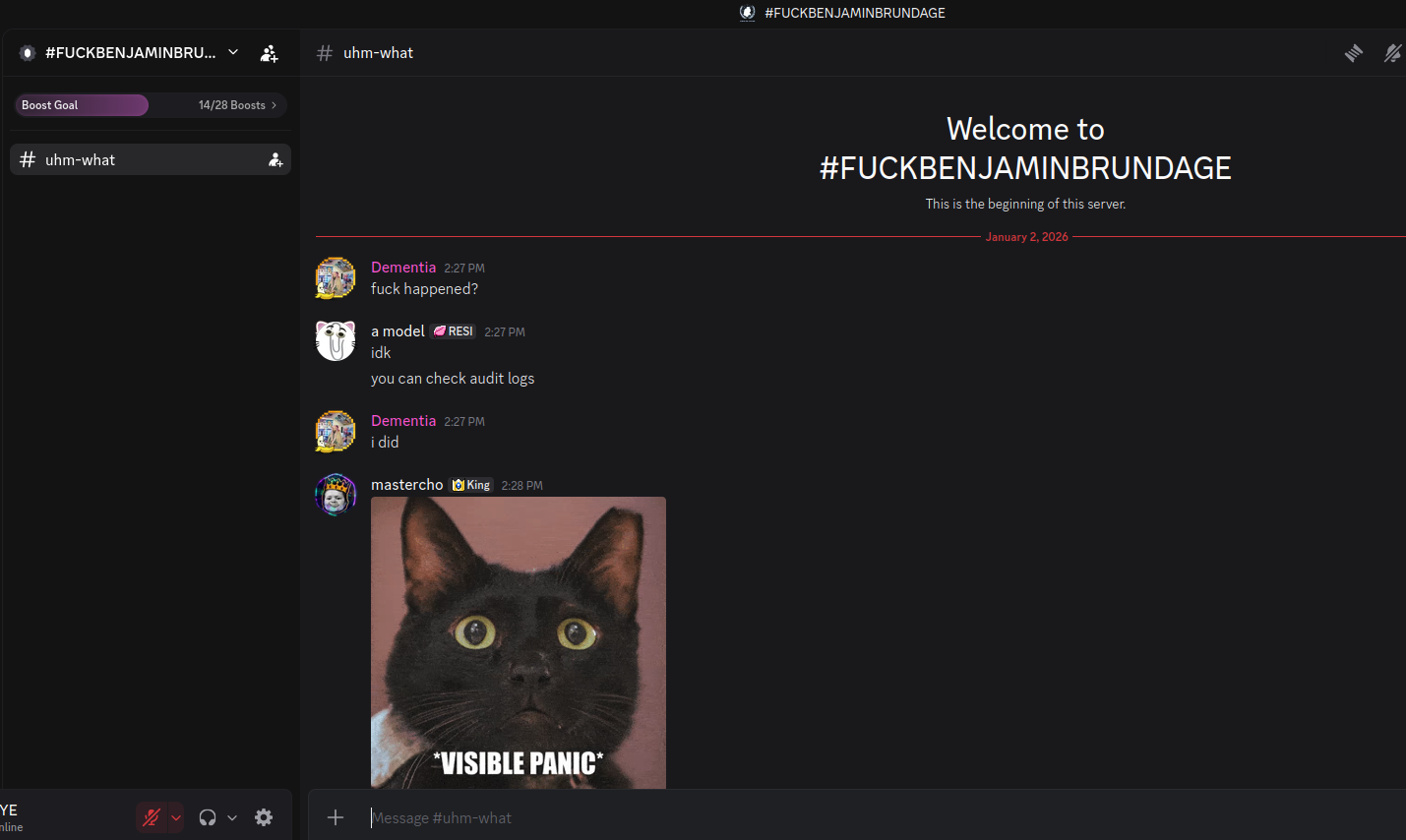
On January 2 — just hours after our story on Kimwolf was published — the historical chat records on resi[.]to were erased without warning and replaced by a profanity-laced message for Synthient’s founder. Minutes after that, the entire server disappeared.
Later that same day, several of the more active members of the now-defunct resi[.]to Discord server moved to a Telegram channel where they posted Brundage’s personal information, and generally complained about being unable to find reliable “bulletproof” hosting for their botnet.
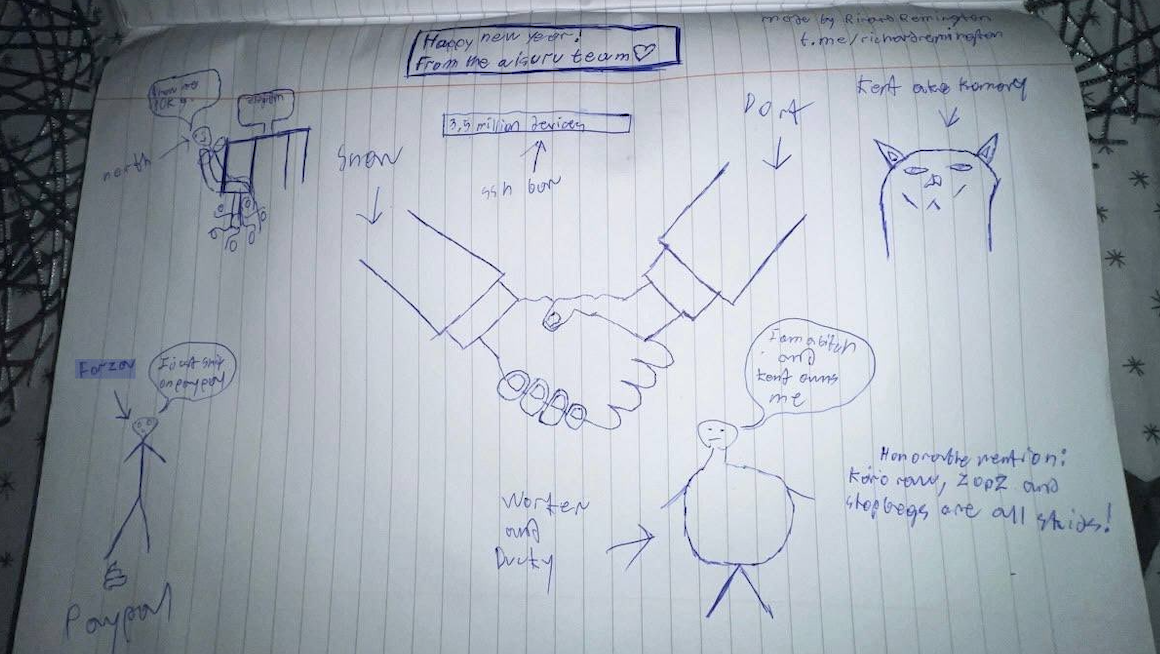
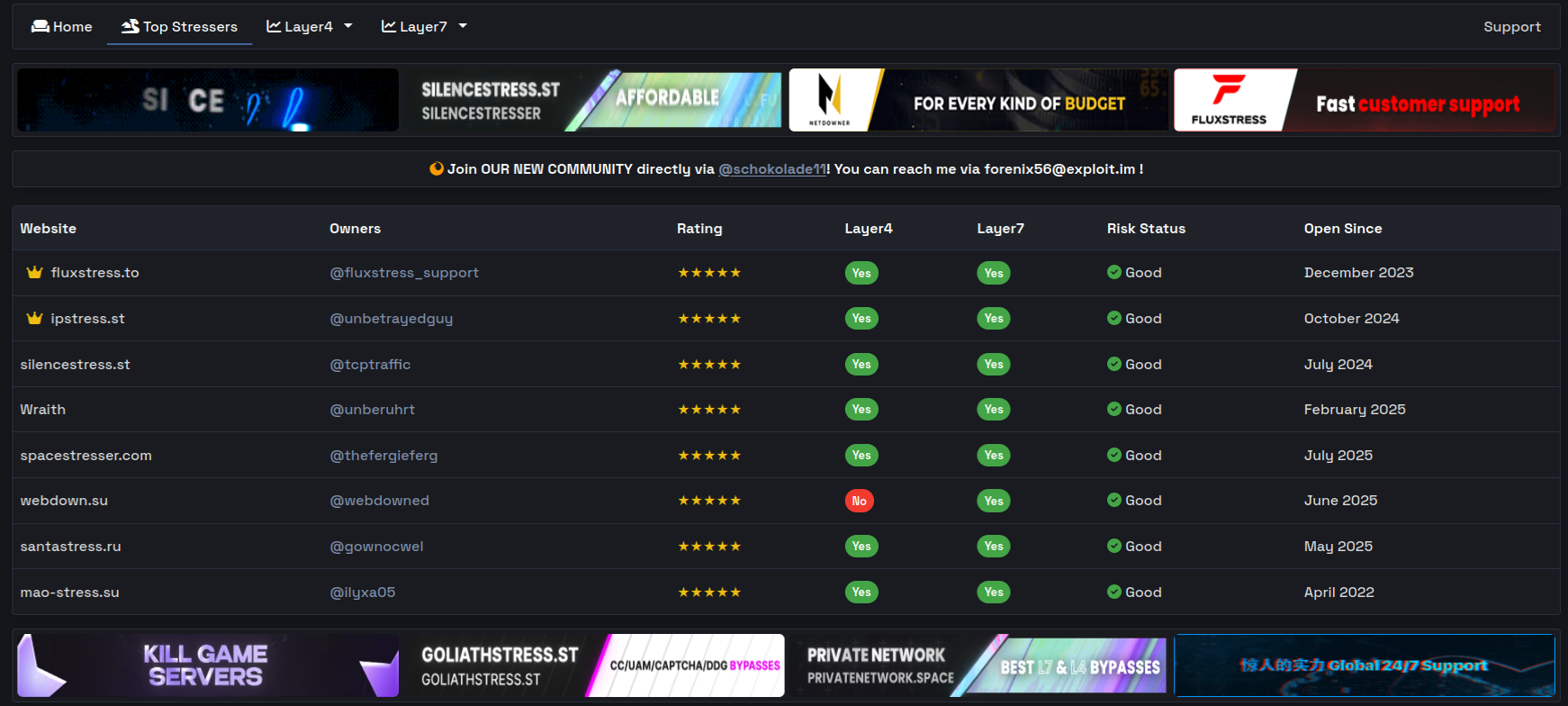
Hilariously, a user by the name “Richard Remington” briefly appeared in the group’s Telegram server to post a crude “Happy New Year” sketch that claims Dort and Snow are now in control of 3.5 million devices infected by Aisuru and/or Kimwolf. Richard Remington’s Telegram account has since been deleted, but it previously stated its owner operates a website that caters to DDoS-for-hire or “stresser” services seeking to test their firepower.
BYTECONNECT, PLAINPROXIES, AND 3XK TECH
Reports from both Synthient and XLab found that Kimwolf was used to deploy programs that turned infected systems into Internet traffic relays for multiple residential proxy services. Among those was a component that installed a software development kit (SDK) called ByteConnect, which is distributed by a provider known as Plainproxies.
ByteConnect says it specializes in “monetizing apps ethically and free,” while Plainproxies advertises the ability to provide content scraping companies with “unlimited” proxy pools. However, Synthient said that upon connecting to ByteConnect’s SDK they instead observed a mass influx of credential-stuffing attacks targeting email servers and popular online websites.
A search on LinkedIn finds the CEO of Plainproxies is Friedrich Kraft, whose resume says he is co-founder of ByteConnect Ltd. Public Internet routing records show Mr. Kraft also operates a hosting firm in Germany called 3XK Tech GmbH. Mr. Kraft did not respond to repeated requests for an interview.
In July 2025, Cloudflare reported that 3XK Tech (a.k.a. Drei-K-Tech) had become the Internet’s largest source of application-layer DDoS attacks. In November 2025, the security firm GreyNoise Intelligence found that Internet addresses on 3XK Tech were responsible for roughly three-quarters of the Internet scanning being done at the time for a newly discovered and critical vulnerability in security products made by Palo Alto Networks.
Source: Cloudflare’s Q2 2025 DDoS threat report.
LinkedIn has a profile for another Plainproxies employee, Julia Levi, who is listed as co-founder of ByteConnect. Ms. Levi did not respond to requests for comment. Her resume says she previously worked for two major proxy providers: Netnut Proxy Network, and Bright Data.
Synthient likewise said Plainproxies ignored their outreach, noting that the Byteconnect SDK continues to remain active on devices compromised by Kimwolf.
A post from the LinkedIn page of Plainproxies Chief Revenue Officer Julia Levi, explaining how the residential proxy business works.
MASKIFY
Synthient’s January 2 report said another proxy provider heavily involved in the sale of Kimwolf proxies was Maskify, which currently advertises on multiple cybercrime forums that it has more than six million residential Internet addresses for rent.
Maskify prices its service at a rate of 30 cents per gigabyte of data relayed through their proxies. According to Synthient, that price range is insanely low and is far cheaper than any other proxy provider in business today.
“Synthient’s Research Team received screenshots from other proxy providers showing key Kimwolf actors attempting to offload proxy bandwidth in exchange for upfront cash,” the Synthient report noted. “This approach likely helped fuel early development, with associated members spending earnings on infrastructure and outsourced development tasks. Please note that resellers know precisely what they are selling; proxies at these prices are not ethically sourced.”
Maskify did not respond to requests for comment.
The Maskify website. Image: Synthient.
BOTMASTERS LASH OUT
Hours after our first Kimwolf story was published last week, the resi[.]to Discord server vanished, Synthient’s website was hit with a DDoS attack, and the Kimwolf botmasters took to doxing Brundage via their botnet.
The harassing messages appeared as text records uploaded to the Ethereum Name Service (ENS), a distributed system for supporting smart contracts deployed on the Ethereum blockchain. As documented by XLab, in mid-December the Kimwolf operators upgraded their infrastructure and began using ENS to better withstand the near-constant takedown efforts targeting the botnet’s control servers.
An ENS record used by the Kimwolf operators taunts security firms trying to take down the botnet’s control servers. Image: XLab.
By telling infected systems to seek out the Kimwolf control servers via ENS, even if the servers that the botmasters use to control the botnet are taken down the attacker only needs to update the ENS text record to reflect the new Internet address of the control server, and the infected devices will immediately know where to look for further instructions.
“This channel itself relies on the decentralized nature of blockchain, unregulated by Ethereum or other blockchain operators, and cannot be blocked,” XLab wrote.
The text records included in Kimwolf’s ENS instructions can also feature short messages, such as those that carried Brundage’s personal information. Other ENS text records associated with Kimwolf offered some sage advice: “If flagged, we encourage the TV box to be destroyed.”
An ENS record tied to the Kimwolf botnet advises, “If flagged, we encourage the TV box to be destroyed.”
Both Synthient and XLabs say Kimwolf targets a vast number of Android TV streaming box models, all of which have zero security protections, and many of which ship with proxy malware built in. Generally speaking, if you can send a data packet to one of these devices you can also seize administrative control over it.
If you own a TV box that matches one of these model names and/or numbers, please just rip it out of your network. If you encounter one of these devices on the network of a family member or friend, send them a link to this story (or to our January 2 story on Kimwolf) and explain that it’s not worth the potential hassle and harm created by keeping them plugged in.

Happy 16th Birthday, KrebsOnSecurity.com!
KrebsOnSecurity.com celebrates its 16th anniversary today! A huge “thank you” to all of our readers — newcomers, long-timers and drive-by critics alike. Your engagement this past year here has been tremendous and truly a salve on a handful of dark days. Happily, comeuppance was a strong theme running through our coverage in 2025, with a primary focus on entities that enabled complex and globally-dispersed cybercrime services.
Image: Shutterstock, Younes Stiller Kraske.
In May 2024, we scrutinized the history and ownership of Stark Industries Solutions Ltd., a “bulletproof hosting” provider that came online just two weeks before Russia invaded Ukraine and served as a primary staging ground for repeated Kremlin cyberattacks and disinformation efforts. A year later, Stark and its two co-owners were sanctioned by the European Union, but our analysis showed those penalties have done little to stop the Stark proprietors from rebranding and transferring considerable network assets to other entities they control.
In December 2024, KrebsOnSecurity profiled Cryptomus, a financial firm registered in Canada that emerged as the payment processor of choice for dozens of Russian cryptocurrency exchanges and websites hawking cybercrime services aimed at Russian-speaking customers. In October 2025, Canadian financial regulators ruled that Cryptomus had grossly violated its anti-money laundering laws, and levied a record $176 million fine against the platform.
![]()
In September 2023, KrebsOnSecurity published findings from researchers who concluded that a series of six-figure cyberheists across dozens of victims resulted from thieves cracking master passwords stolen from the password manager service LastPass in 2022. In a court filing in March 2025, U.S. federal agents investigating a spectacular $150 million cryptocurrency heist said they had reached the same conclusion.
Phishing was a major theme of this year’s coverage, which peered inside the day-to-day operations of several voice phishing gangs that routinely carried out elaborate, convincing, and financially devastating cryptocurrency thefts. A Day in the Life of a Prolific Voice Phishing Crew examined how one cybercrime gang abused legitimate services at Apple and Google to force a variety of outbound communications to their users, including emails, automated phone calls and system-level messages sent to all signed-in devices.
Nearly a half-dozen stories in 2025 dissected the incessant SMS phishing or “smishing” coming from China-based phishing kit vendors, who make it easy for customers to convert phished payment card data into mobile wallets from Apple and Google. In an effort to wrest control over this phishing syndicate’s online resources, Google has since filed at least two John Doe lawsuits targeting these groups and dozens of unnamed defendants.
In January, we highlighted research into a dodgy and sprawling content delivery network called Funnull that specialized in helping China-based gambling and money laundering websites distribute their operations across multiple U.S.-based cloud providers. Five months later, the U.S. government sanctioned Funnull, identifying it as a top source of investment/romance scams known as “pig butchering.”
Image: Shutterstock, ArtHead.
In May, Pakistan arrested 21 people alleged to be working for Heartsender, a phishing and malware dissemination service that KrebsOnSecurity first profiled back in 2015. The arrests came shortly after the FBI and the Dutch police seized dozens of servers and domains for the group. Many of those arrested were first publicly identified in a 2021 story here about how they’d inadvertently infected their computers with malware that gave away their real-life identities.
In April, the U.S. Department of Justice indicted the proprietors of a Pakistan-based e-commerce company for conspiring to distribute synthetic opioids in the United States. The following month, KrebsOnSecurity detailed how the proprietors of the sanctioned entity are perhaps better known for operating an elaborate and lengthy scheme to scam westerners seeking help with trademarks, book writing, mobile app development and logo designs.
Earlier this month, we examined an academic cheating empire turbocharged by Google Ads that earned tens of millions of dollars in revenue and has curious ties to a Kremlin-connected oligarch whose Russian university builds drones for Russia’s war against Ukraine.
An attack drone advertised on a website hosted in the same network as Russia’s largest private education company — Synergy University.
As ever, KrebsOnSecurity endeavored to keep close tabs on the world’s biggest and most disruptive botnets, which pummeled the Internet this year with distributed denial-of-service (DDoS) assaults that were two to three times the size and impact of previous record DDoS attacks.
In June, KrebsOnSecurity.com was hit by the largest DDoS attack that Google had ever mitigated at the time (we are a grateful guest of Google’s excellent Project Shield offering). Experts blamed that attack on an Internet-of-Things botnet called Aisuru that had rapidly grown in size and firepower since its debut in late 2024. Another Aisuru attack on Cloudflare just days later practically doubled the size of the June attack against this website. Not long after that, Aisuru was blamed for a DDoS that again doubled the previous record.
In October, it appeared the cybercriminals in control of Aisuru had shifted the botnet’s focus from DDoS to a more sustainable and profitable use: Renting hundreds of thousands of infected Internet of Things (IoT) devices to proxy services that help cybercriminals anonymize their traffic.
However, it has recently become clear that at least some of the disruptive botnet and residential proxy activity attributed to Aisuru last year likely was the work of people responsible for building and testing a powerful botnet known as Kimwolf. Chinese security firm XLab, which was the first to chronicle Aisuru’s rise in 2024, recently profiled Kimwolf as easily the world’s biggest and most dangerous collection of compromised machines — with approximately 1.83 million devices under its thumb as of December 17.
XLab noted that the Kimwolf author “shows an almost ‘obsessive’ fixation on the well-known cybersecurity investigative journalist Brian Krebs, leaving easter eggs related to him in multiple places.”
Image: XLab, Kimwolf Botnet Exposed: The Massive Android Botnet with 1.8 million infected devices.
I am happy to report that the first KrebsOnSecurity stories of 2026 will go deep into the origins of Kimwolf, and examine the botnet’s unique and highly invasive means of spreading digital disease far and wide. The first in that series will include a somewhat sobering and global security notification concerning the devices and residential proxy services that are inadvertently helping to power Kimwolf’s rapid growth.
Thank you once again for your continued readership, encouragement and support. If you like the content we publish at KrebsOnSecurity.com, please consider making an exception for our domain in your ad blocker. The ads we run are limited to a handful of static images that are all served in-house and vetted by me (there is no third-party content on this site, period). Doing so would help further support the work you see here almost every week.
And if you haven’t done so yet, sign up for our email newsletter! (62,000 other subscribers can’t be wrong, right?). The newsletter is just a plain text email that goes out the moment a new story is published. We send between one and two emails a week, we never share our email list, and we don’t run surveys or promotions.
Thanks again, and Happy New Year everyone! Be safe out there.
Threat landscape for industrial automation systems in Q3 2025
![]()
Statistics across all threats
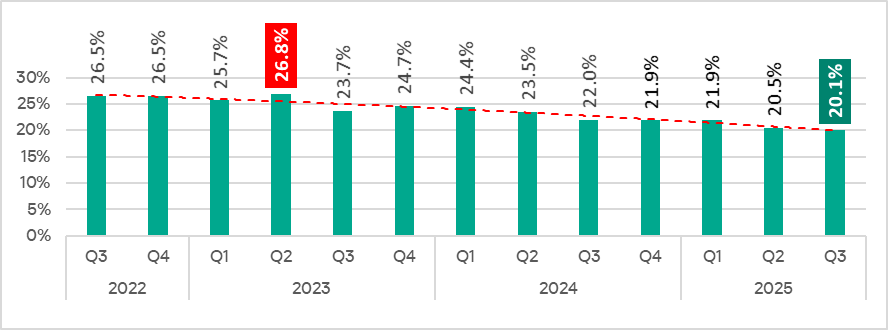
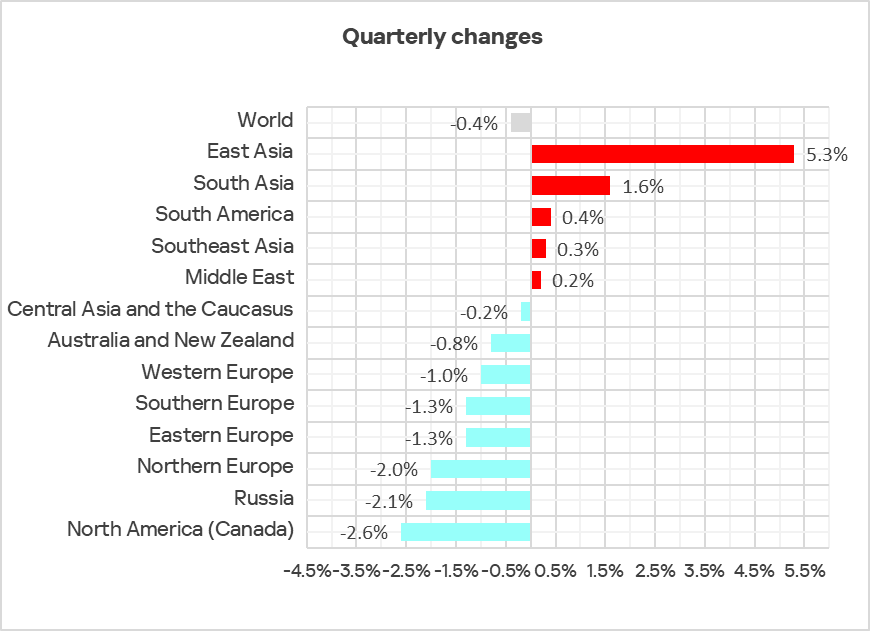
In Q3 2025, the percentage of ICS computers on which malicious objects were blocked decreased from the previous quarter by 0.4 pp to 20.1%. This is the lowest level for the observed period.
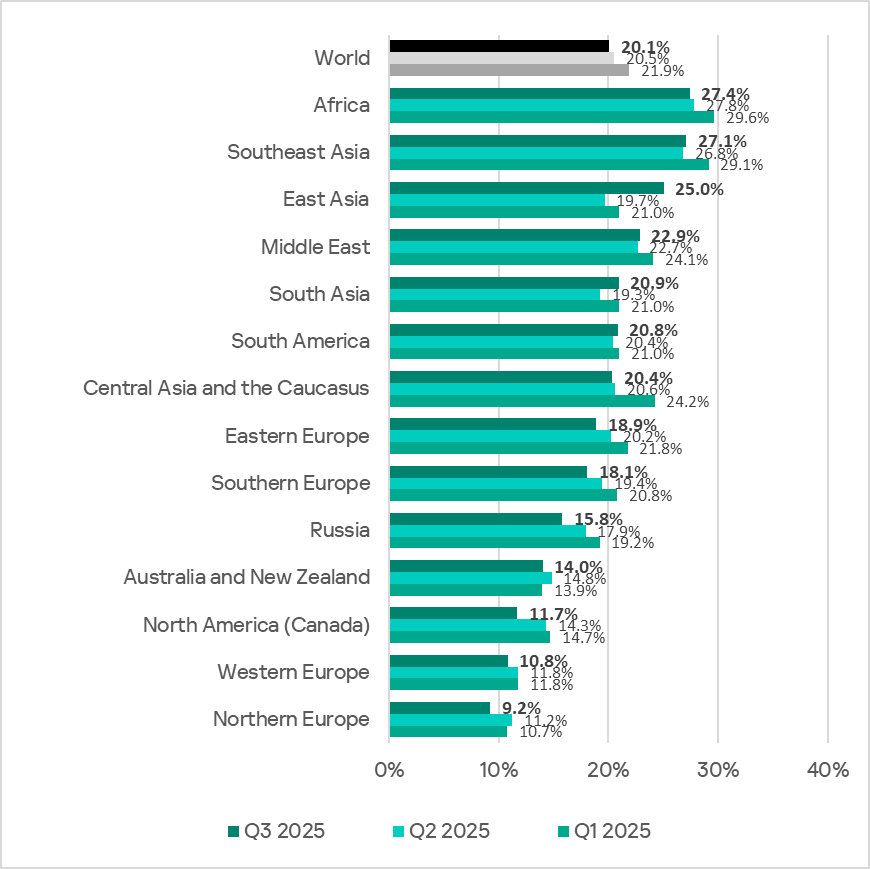
Regionally, the percentage of ICS computers on which malicious objects were blocked ranged from 9.2% in Northern Europe to 27.4% in Africa.
In Q3 2025, the percentage increased in five regions. The most notable increase occurred in East Asia, triggered by the local spread of malicious scripts in the OT infrastructure of engineering organizations and ICS integrators.
Selected industries
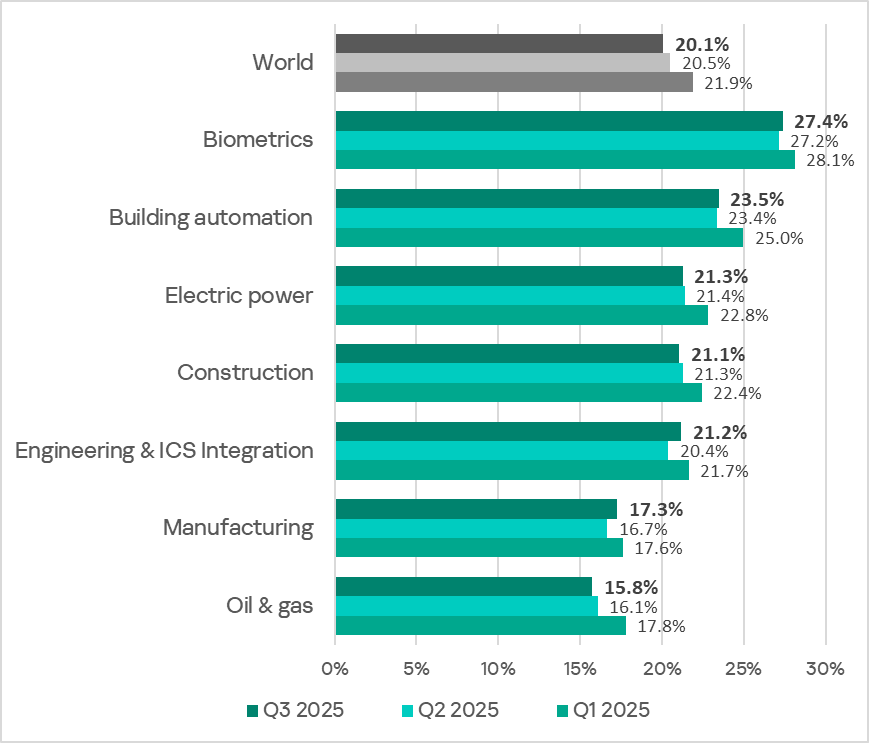
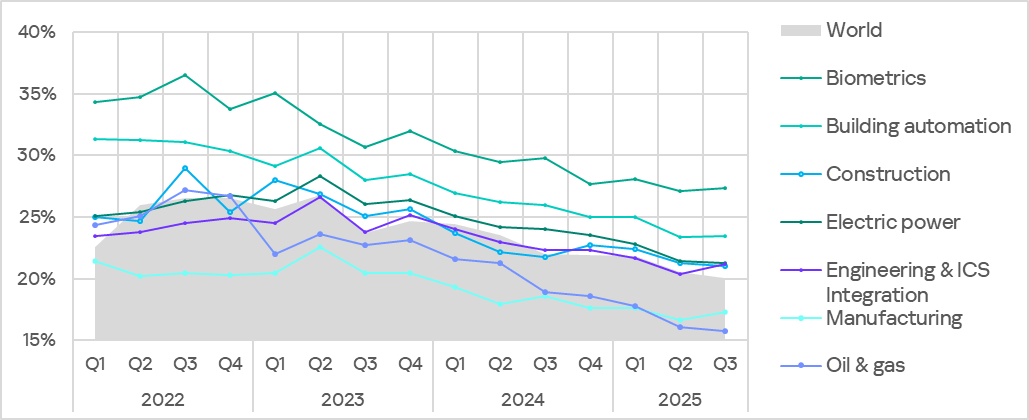
The biometrics sector traditionally led the rankings of the industries and OT infrastructures surveyed in this report in terms of the percentage of ICS computers on which malicious objects were blocked.
Rankings of industries and OT infrastructures by percentage of ICS computers on which malicious objects were blocked
In Q3 2025, the percentage of ICS computers on which malicious objects were blocked increased in four of the seven surveyed industries. The most notable increases were in engineering and ICS integrators, and manufacturing.
Diversity of detected malicious objects
In Q3 2025, Kaspersky protection solutions blocked malware from 11,356 different malware families of various categories on industrial automation systems.
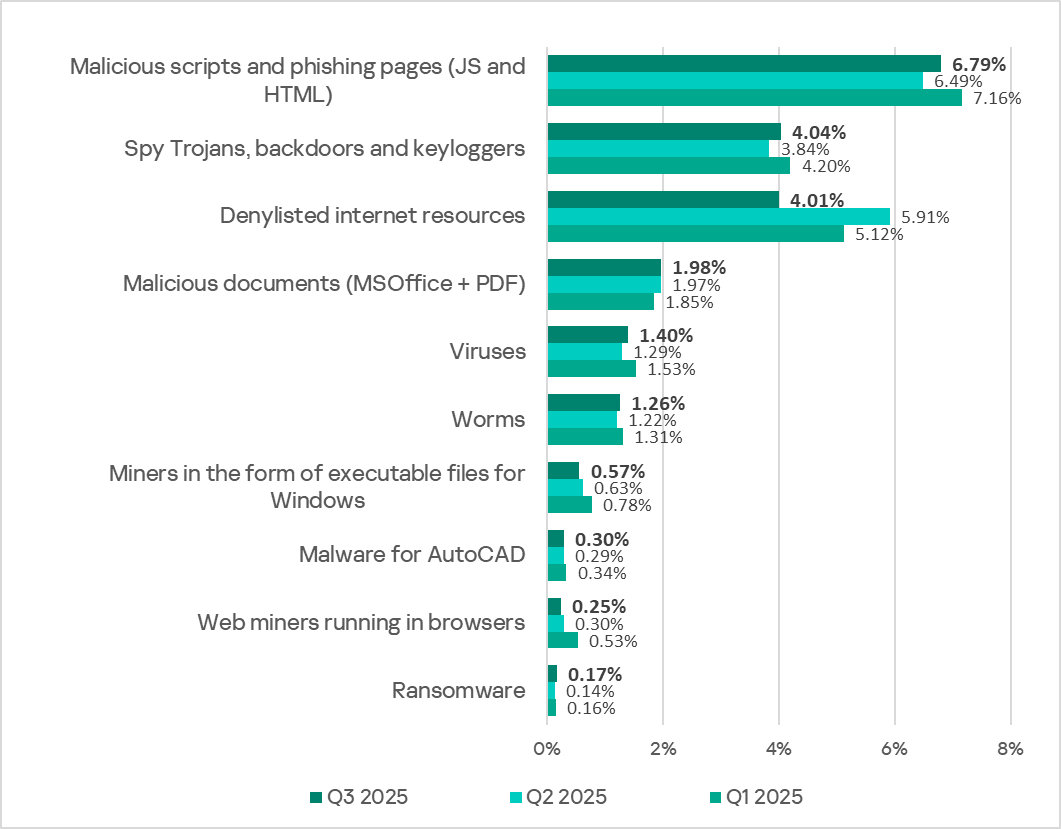
Percentage of ICS computers on which the activity of malicious objects of various categories was blocked
In Q3 2025, there was a decrease in the percentage of ICS computers on which denylisted internet resources and miners of both categories were blocked. These were the only categories that exhibited a decrease.
Main threat sources
Depending on the threat detection and blocking scenario, it is not always possible to reliably identify the source. The circumstantial evidence for a specific source can be the blocked threat’s type (category).
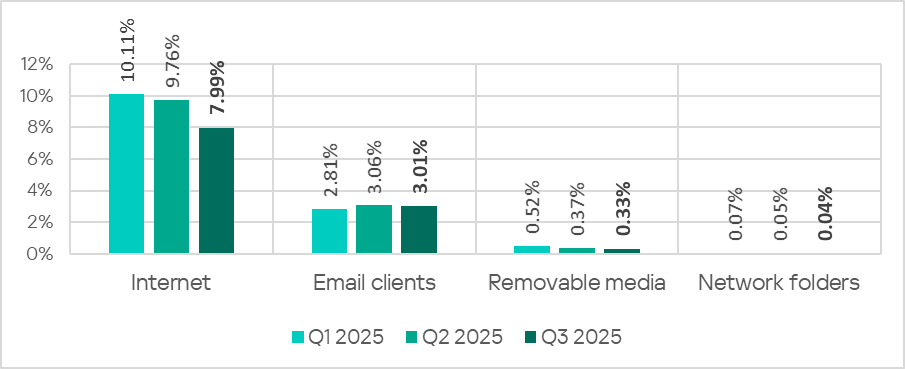
The internet (visiting malicious or compromised internet resources; malicious content distributed via messengers; cloud data storage and processing services and CDNs), email clients (phishing emails), and removable storage devices remain the primary sources of threats to computers in an organization’s technology infrastructure.
In Q3 2025, the percentage of ICS computers on which malicious objects from various sources were blocked decreased.
The same computer can be attacked by several categories of malware from the same source during a quarter. That computer is counted when calculating the percentage of attacked computers for each threat category, but is only counted once for the threat source (we count unique attacked computers). In addition, it is not always possible to accurately determine the initial infection attempt. Therefore, the total percentage of ICS computers on which various categories of threats from a certain source were blocked can exceed the percentage of threats from the source itself.
- The main categories of threats from the internet blocked on ICS computers in Q3 2025 were malicious scripts and phishing pages, and denylisted internet resources. The percentage ranged from 4.57% in Northern Europe to 10.31% in Africa.
- The main categories of threats from email clients blocked on ICS computers were malicious scripts and phishing pages, spyware, and malicious documents. Most of the spyware detected in phishing emails was delivered as a password-protected archive or a multi-layered script embedded in an office document. The percentage of ICS computers on which threats from email clients were blocked ranged from 0.78% in Russia to 6.85% in Southern Europe.
- The main categories of threats that were blocked when removable media was connected to ICS computers were worms, viruses, and spyware. The percentage of ICS computers on which threats from this source were blocked ranged from 0.05% in Australia and New Zealand to 1.43% in Africa.
- The main categories of threats that spread through network folders were viruses, AutoCAD malware, worms, and spyware. The percentages of ICS computers where threats from this source were blocked ranged from 0.006% in Northern Europe to 0.20% in East Asia.
Threat categories
Typical attacks blocked within an OT network are multi-step sequences of malicious activities, where each subsequent step of the attackers is aimed at increasing privileges and/or gaining access to other systems by exploiting the security problems of industrial enterprises, including technological infrastructures.
Malicious objects used for initial infection
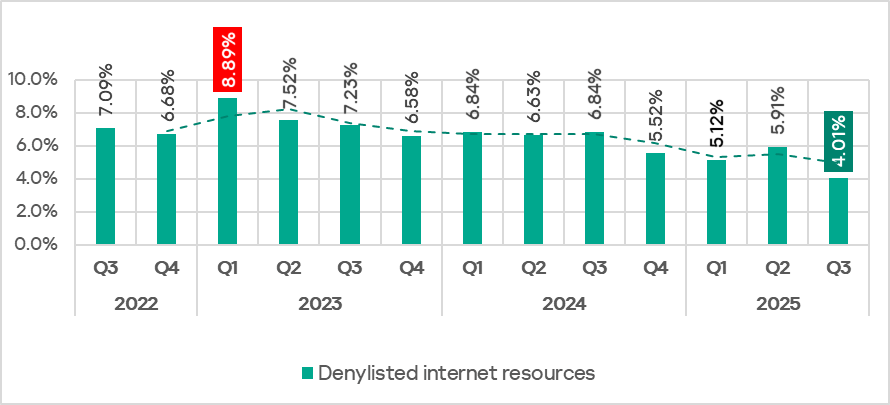
In Q3 2025, the percentage of ICS computers on which denylisted internet resources were blocked decreased to 4.01%. This is the lowest quarterly figure since the beginning of 2022.
Regionally, the percentage of ICS computers on which denylisted internet resources were blocked ranged from 2.35% in Australia and New Zealand to 4.96% in Africa. Southeast Asia and South Asia were also among the top three regions for this indicator.
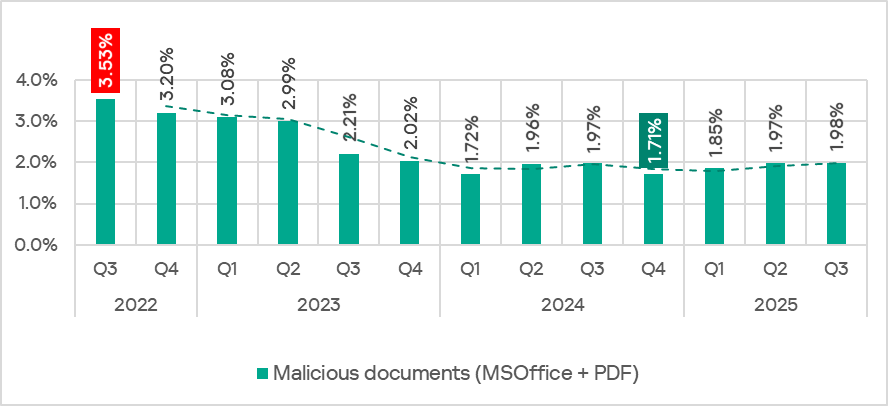
The percentage of ICS computers on which malicious documents were blocked has grown for three consecutive quarters, following a decline at the end of 2024. In Q3 2025, it reached 1,98%.
The indicator increased in four regions: South America, East Asia, Southeast Asia, and Australia and New Zealand. South America saw the largest increase as a result of a large-scale phishing campaign in which attackers used new exploits for an old vulnerability (CVE-2017-11882) in Microsoft Office Equation Editor to deliver various spyware to victims’ computers. It is noteworthy that the attackers in this phishing campaign used localized Spanish-language emails disguised as business correspondence.
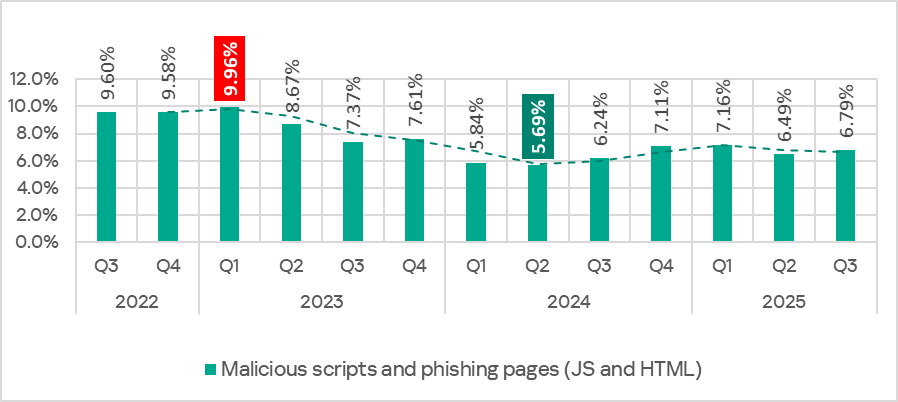
In Q3 2025, the percentage of ICS computers on which malicious scripts and phishing pages were blocked increased to 6.79%. This category led the rankings of threat categories in terms of the percentage of ICS computers on which they were blocked.
Percentage of ICS computers on which malicious scripts and phishing pages were blocked, Q3 2022–Q3 2025
Regionally, the percentage of ICS computers on which malicious scripts and phishing pages were blocked ranged from 2.57% in Northern Europe to 9.41% in Africa. The top three regions for this indicator were Africa, East Asia, and South America. The indicator increased the most in East Asia (by a dramatic 5.23 pp) as a result of the local spread of malicious spyware scripts loaded into the memory of popular torrent clients including MediaGet.
Next-stage malware
Malicious objects used to initially infect computers deliver next-stage malware — spyware, ransomware, and miners — to victims’ computers. As a rule, the higher the percentage of ICS computers on which the initial infection malware is blocked, the higher the percentage for next-stage malware.
In Q3 2025, the percentage of ICS computers on which spyware and ransomware were blocked increased. The rates were:
- spyware: 4.04% (up 0.20 pp);
- ransomware: 0.17% (up 0.03 pp).
The percentage of ICS computers on which miners of both categories were blocked decreased. The rates were:
- miners in the form of executable files for Windows: 0.57% (down 0.06 pp), it’s the lowest level since Q3 2022;
- web miners: 0.25% (down 0.05 pp). This is the lowest level since Q3 2022.
Self-propagating malware
Self-propagating malware (worms and viruses) is a category unto itself. Worms and virus-infected files were originally used for initial infection, but as botnet functionality evolved, they took on next-stage characteristics.
To spread across ICS networks, viruses and worms rely on removable media and network folders in the form of infected files, such as archives with backups, office documents, pirated games and hacked applications. In rarer and more dangerous cases, web pages with network equipment settings, as well as files stored in internal document management systems, product lifecycle management (PLM) systems, resource management (ERP) systems and other web services are infected.
In Q3 2025, the percentage of ICS computers on which worms and viruses were blocked increased to 1.26% (by 0.04 pp) and 1.40% (by 0.11 pp), respectively.
AutoCAD malware
This category of malware can spread in a variety of ways, so it does not belong to a specific group.
In Q3 2025, the percentage of ICS computers on which AutoCAD malware was blocked slightly increased to 0.30% (by 0.01 pp).
For more information on industrial threats see the full version of the report.


Threat landscape for industrial automation systems in Q3 2025
![]()
Statistics across all threats
In Q3 2025, the percentage of ICS computers on which malicious objects were blocked decreased from the previous quarter by 0.4 pp to 20.1%. This is the lowest level for the observed period.
Regionally, the percentage of ICS computers on which malicious objects were blocked ranged from 9.2% in Northern Europe to 27.4% in Africa.
In Q3 2025, the percentage increased in five regions. The most notable increase occurred in East Asia, triggered by the local spread of malicious scripts in the OT infrastructure of engineering organizations and ICS integrators.
Selected industries
The biometrics sector traditionally led the rankings of the industries and OT infrastructures surveyed in this report in terms of the percentage of ICS computers on which malicious objects were blocked.
Rankings of industries and OT infrastructures by percentage of ICS computers on which malicious objects were blocked
In Q3 2025, the percentage of ICS computers on which malicious objects were blocked increased in four of the seven surveyed industries. The most notable increases were in engineering and ICS integrators, and manufacturing.
Diversity of detected malicious objects
In Q3 2025, Kaspersky protection solutions blocked malware from 11,356 different malware families of various categories on industrial automation systems.
Percentage of ICS computers on which the activity of malicious objects of various categories was blocked
In Q3 2025, there was a decrease in the percentage of ICS computers on which denylisted internet resources and miners of both categories were blocked. These were the only categories that exhibited a decrease.
Main threat sources
Depending on the threat detection and blocking scenario, it is not always possible to reliably identify the source. The circumstantial evidence for a specific source can be the blocked threat’s type (category).
The internet (visiting malicious or compromised internet resources; malicious content distributed via messengers; cloud data storage and processing services and CDNs), email clients (phishing emails), and removable storage devices remain the primary sources of threats to computers in an organization’s technology infrastructure.
In Q3 2025, the percentage of ICS computers on which malicious objects from various sources were blocked decreased.
The same computer can be attacked by several categories of malware from the same source during a quarter. That computer is counted when calculating the percentage of attacked computers for each threat category, but is only counted once for the threat source (we count unique attacked computers). In addition, it is not always possible to accurately determine the initial infection attempt. Therefore, the total percentage of ICS computers on which various categories of threats from a certain source were blocked can exceed the percentage of threats from the source itself.
- The main categories of threats from the internet blocked on ICS computers in Q3 2025 were malicious scripts and phishing pages, and denylisted internet resources. The percentage ranged from 4.57% in Northern Europe to 10.31% in Africa.
- The main categories of threats from email clients blocked on ICS computers were malicious scripts and phishing pages, spyware, and malicious documents. Most of the spyware detected in phishing emails was delivered as a password-protected archive or a multi-layered script embedded in an office document. The percentage of ICS computers on which threats from email clients were blocked ranged from 0.78% in Russia to 6.85% in Southern Europe.
- The main categories of threats that were blocked when removable media was connected to ICS computers were worms, viruses, and spyware. The percentage of ICS computers on which threats from this source were blocked ranged from 0.05% in Australia and New Zealand to 1.43% in Africa.
- The main categories of threats that spread through network folders were viruses, AutoCAD malware, worms, and spyware. The percentages of ICS computers where threats from this source were blocked ranged from 0.006% in Northern Europe to 0.20% in East Asia.
Threat categories
Typical attacks blocked within an OT network are multi-step sequences of malicious activities, where each subsequent step of the attackers is aimed at increasing privileges and/or gaining access to other systems by exploiting the security problems of industrial enterprises, including technological infrastructures.
Malicious objects used for initial infection
In Q3 2025, the percentage of ICS computers on which denylisted internet resources were blocked decreased to 4.01%. This is the lowest quarterly figure since the beginning of 2022.
Regionally, the percentage of ICS computers on which denylisted internet resources were blocked ranged from 2.35% in Australia and New Zealand to 4.96% in Africa. Southeast Asia and South Asia were also among the top three regions for this indicator.
The percentage of ICS computers on which malicious documents were blocked has grown for three consecutive quarters, following a decline at the end of 2024. In Q3 2025, it reached 1,98%.
The indicator increased in four regions: South America, East Asia, Southeast Asia, and Australia and New Zealand. South America saw the largest increase as a result of a large-scale phishing campaign in which attackers used new exploits for an old vulnerability (CVE-2017-11882) in Microsoft Office Equation Editor to deliver various spyware to victims’ computers. It is noteworthy that the attackers in this phishing campaign used localized Spanish-language emails disguised as business correspondence.
In Q3 2025, the percentage of ICS computers on which malicious scripts and phishing pages were blocked increased to 6.79%. This category led the rankings of threat categories in terms of the percentage of ICS computers on which they were blocked.
Percentage of ICS computers on which malicious scripts and phishing pages were blocked, Q3 2022–Q3 2025
Regionally, the percentage of ICS computers on which malicious scripts and phishing pages were blocked ranged from 2.57% in Northern Europe to 9.41% in Africa. The top three regions for this indicator were Africa, East Asia, and South America. The indicator increased the most in East Asia (by a dramatic 5.23 pp) as a result of the local spread of malicious spyware scripts loaded into the memory of popular torrent clients including MediaGet.
Next-stage malware
Malicious objects used to initially infect computers deliver next-stage malware — spyware, ransomware, and miners — to victims’ computers. As a rule, the higher the percentage of ICS computers on which the initial infection malware is blocked, the higher the percentage for next-stage malware.
In Q3 2025, the percentage of ICS computers on which spyware and ransomware were blocked increased. The rates were:
- spyware: 4.04% (up 0.20 pp);
- ransomware: 0.17% (up 0.03 pp).
The percentage of ICS computers on which miners of both categories were blocked decreased. The rates were:
- miners in the form of executable files for Windows: 0.57% (down 0.06 pp), it’s the lowest level since Q3 2022;
- web miners: 0.25% (down 0.05 pp). This is the lowest level since Q3 2022.
Self-propagating malware
Self-propagating malware (worms and viruses) is a category unto itself. Worms and virus-infected files were originally used for initial infection, but as botnet functionality evolved, they took on next-stage characteristics.
To spread across ICS networks, viruses and worms rely on removable media and network folders in the form of infected files, such as archives with backups, office documents, pirated games and hacked applications. In rarer and more dangerous cases, web pages with network equipment settings, as well as files stored in internal document management systems, product lifecycle management (PLM) systems, resource management (ERP) systems and other web services are infected.
In Q3 2025, the percentage of ICS computers on which worms and viruses were blocked increased to 1.26% (by 0.04 pp) and 1.40% (by 0.11 pp), respectively.
AutoCAD malware
This category of malware can spread in a variety of ways, so it does not belong to a specific group.
In Q3 2025, the percentage of ICS computers on which AutoCAD malware was blocked slightly increased to 0.30% (by 0.01 pp).
For more information on industrial threats see the full version of the report.


CISA warns ASUS Live Update backdoor is still exploitable, seven years on
Recently, the Cybersecurity and Infrastructure Security Agency (CISA) added (along with two others) a vulnerability in ASUS Live Update to its catalog of Known Exploited Vulnerabilities (KEV).
The KEV catalog lists vulnerabilities that are known to be exploited in the wild and sets patch deadlines for Federal Civilian Executive Branch (FCEB) agencies. When CISA adds an issue to this list, it’s a strong signal that exploitation is real, ongoing, and urgent.
The ASUS Live Update Embedded Malicious Code vulnerability, tracked as CVE-2025-59374 (with a CVSS score of 9.3), affects Live Update, a utility commonly used to deliver firmware and software updates to ASUS devices.
This isn’t the first time ASUS Live Update has been linked to serious security incidents. In 2019, ASUS responded to media reports about attacks on the Live Update tool by advanced persistent threat (APT) groups, stating that:
“A small number of devices have been implanted with malicious code through a sophisticated attack on our Live Update servers in an attempt to target a very small and specific user group.”
Later investigations revealed that a sophisticated supply chain attack mounted in 2018, attributed to Chinese state-sponsored attackers, had inserted a backdoor into ASUS Live Update. The attack was particularly effective because that utility came preinstalled on most ASUS devices and was used to the automatically update BIOS, UEFI, drivers, and other components.
CISA now notes that the affected devices could be abused to perform unintended actions if certain conditions are met. Originally, the attackers reportedly targeted only around 600 specific devices, based on hashed MAC addresses hardcoded in various versions of the tool. This was despite the fact that millions of users may have downloaded the backdoored utility.
Support for the ASUS Live Update application has since been discontinued. The final intended version of ASUS Live Update was 3.6.15, but it will continue to provide software updates. This is likely why a CVE was assigned and why the vulnerability was added to the KEV catalog. There was no official “why now” statement from ASUS, MITRE, or CISA, but the timing aligns with a legacy, end-of-support product being reclassified as a vulnerability with confirmed active exploitation.
What do ASUS users need to do?
First of all, make sure you’re running a clean version of the utility. ASUS urges users to update to version 3.6.8 or later to address known security issues.
- Right-click the ASUS Live Update icon at the bottom-right corner of your Windows screen
- Click About to see the version information as the shown in the picture below.

- If you are on an older version, open the program and click Check update immediately
- ASUS Live Update will automatically find the latest driver and utility.
- Click Install
- After updating, recheck and ensure it shows “No updates.”
Alternatively, you can download and install the latest version manually. ASUS’ own support article describes the only official way to get the current Live Update package:
- Go to the ASUS Official Website (asus.com)
- Use the search box to find your exact model (e.g., UX580GD)
- Open the product page and click Support → Driver & Tools
- Select your operating system (e.g., Windows 10/11 64-bit).
- In the Utilities section, locate ASUS Live Update and click Download
This is as close as we could get you to a “direct” official download. The URL is different for every model and ASUS does not provide a central Live Update installer directory. While this makes it harder than it maybe should be, we do recommend using this official download. Given the history of supply chain abuse involving this tool, downloading it from third-party sources is a risk not worth taking.
We don’t just report on threats—we remove them
Cybersecurity risks should never spread beyond a headline. Keep threats off your devices by downloading Malwarebytes today.
CISA warns ASUS Live Update backdoor is still exploitable, seven years on
Recently, the Cybersecurity and Infrastructure Security Agency (CISA) added (along with two others) a vulnerability in ASUS Live Update to its catalog of Known Exploited Vulnerabilities (KEV).
The KEV catalog lists vulnerabilities that are known to be exploited in the wild and sets patch deadlines for Federal Civilian Executive Branch (FCEB) agencies. When CISA adds an issue to this list, it’s a strong signal that exploitation is real, ongoing, and urgent.
The ASUS Live Update Embedded Malicious Code vulnerability, tracked as CVE-2025-59374 (with a CVSS score of 9.3), affects Live Update, a utility commonly used to deliver firmware and software updates to ASUS devices.
This isn’t the first time ASUS Live Update has been linked to serious security incidents. In 2019, ASUS responded to media reports about attacks on the Live Update tool by advanced persistent threat (APT) groups, stating that:
“A small number of devices have been implanted with malicious code through a sophisticated attack on our Live Update servers in an attempt to target a very small and specific user group.”
Later investigations revealed that a sophisticated supply chain attack mounted in 2018, attributed to Chinese state-sponsored attackers, had inserted a backdoor into ASUS Live Update. The attack was particularly effective because that utility came preinstalled on most ASUS devices and was used to the automatically update BIOS, UEFI, drivers, and other components.
CISA now notes that the affected devices could be abused to perform unintended actions if certain conditions are met. Originally, the attackers reportedly targeted only around 600 specific devices, based on hashed MAC addresses hardcoded in various versions of the tool. This was despite the fact that millions of users may have downloaded the backdoored utility.
Support for the ASUS Live Update application has since been discontinued. The final intended version of ASUS Live Update was 3.6.15, but it will continue to provide software updates. This is likely why a CVE was assigned and why the vulnerability was added to the KEV catalog. There was no official “why now” statement from ASUS, MITRE, or CISA, but the timing aligns with a legacy, end-of-support product being reclassified as a vulnerability with confirmed active exploitation.
What do ASUS users need to do?
First of all, make sure you’re running a clean version of the utility. ASUS urges users to update to version 3.6.8 or later to address known security issues.
- Right-click the ASUS Live Update icon at the bottom-right corner of your Windows screen
- Click About to see the version information as the shown in the picture below.

- If you are on an older version, open the program and click Check update immediately
- ASUS Live Update will automatically find the latest driver and utility.
- Click Install
- After updating, recheck and ensure it shows “No updates.”
Alternatively, you can download and install the latest version manually. ASUS’ own support article describes the only official way to get the current Live Update package:
- Go to the ASUS Official Website (asus.com)
- Use the search box to find your exact model (e.g., UX580GD)
- Open the product page and click Support → Driver & Tools
- Select your operating system (e.g., Windows 10/11 64-bit).
- In the Utilities section, locate ASUS Live Update and click Download
This is as close as we could get you to a “direct” official download. The URL is different for every model and ASUS does not provide a central Live Update installer directory. While this makes it harder than it maybe should be, we do recommend using this official download. Given the history of supply chain abuse involving this tool, downloading it from third-party sources is a risk not worth taking.
We don’t just report on threats—we remove them
Cybersecurity risks should never spread beyond a headline. Keep threats off your devices by downloading Malwarebytes today.
From Linear to Complex: An Upgrade in RansomHouse Encryption
Operators behind RansomHouse, a ransomware-as-a-service (RaaS) group, have upgraded their encryption methods from single-phase to complex and layered.
The post From Linear to Complex: An Upgrade in RansomHouse Encryption appeared first on Unit 42.