Normal view

AI assistant in Kaspersky Container Security

3 March 2026 at 17:13

Modern software development relies on containers and the use of third-party software modules. On the one hand, this greatly facilitates the creation of new software, but on the other, it gives attackers additional opportunities to compromise the development environment. News about attacks on the supply chain through the distribution of malware via various repositories appears with alarming regularity. Therefore, tools that allow the scanning of images have long been an essential part of secure software development.

Our portfolio has long included a solution for protecting container environments. It allows the scanning of images at different stages of development for malware, known vulnerabilities, configuration errors, the presence of confidential data in the code, and so on. However, in order to make an informed decision about the state of security of a particular image, the operator of the cybersecurity solution may need some more context. Of course, it’s possible to gather this context independently, but if a thorough investigation is conducted manually each time, development may be delayed for an unpredictable period of time. Therefore, our experts decided to add the ability to look at the image from a fresh perspective; of course, not with a human eye — AI is indispensable nowadays.

OpenAI API

Our Kaspersky Container Security solution (a key component of Kaspersky Cloud Workload Security) now supports an application programming interface for connecting external large language models. So, if a company has deployed a local LLM (or has a subscription to connect a third-party model) that supports the OpenAI API, it’s possible to connect the LLM to our solution. This gives a cybersecurity expert the opportunity to get both additional context about uploaded images and an independent risk assessment by means of a full-fledged AI assistant capable of quickly gathering the necessary information.

The AI provides a description that clearly explains what the image is for, what application it contains, what it does specifically, and so on. Additionally, the assistant conducts its own independent analysis of the risks of using this image and highlights measures to minimize these risks (if any are found). We’re confident that this will speed up decision-making and incident investigations and, overall, increase the security of the development process.

What else is new in Cloud Workload Security?

In addition to adding API to connect the AI assistant, our developers have made a number of other changes to the products included in the Kaspersky Cloud Workload Security offering. First, they now support single sign-on (SSO) and a multi-domain Active Directory, which makes it easier to deploy solutions in cloud and hybrid environments. In addition, Kaspersky Cloud Workload Security now scans images more efficiently and supports advanced security policy capabilities. You can learn more about the product on its official page.

Who is the Kimwolf Botmaster “Dort”?

28 February 2026 at 13:01

In early January 2026, KrebsOnSecurity revealed how a security researcher disclosed a vulnerability that was used to build Kimwolf, the world’s largest and most disruptive botnet. Since then, the person in control of Kimwolf — who goes by the handle “Dort” — has coordinated a barrage of distributed denial-of-service (DDoS), doxing and email flooding attacks against the researcher and this author, and more recently caused a SWAT team to be sent to the researcher’s home. This post examines what is knowable about Dort based on public information.

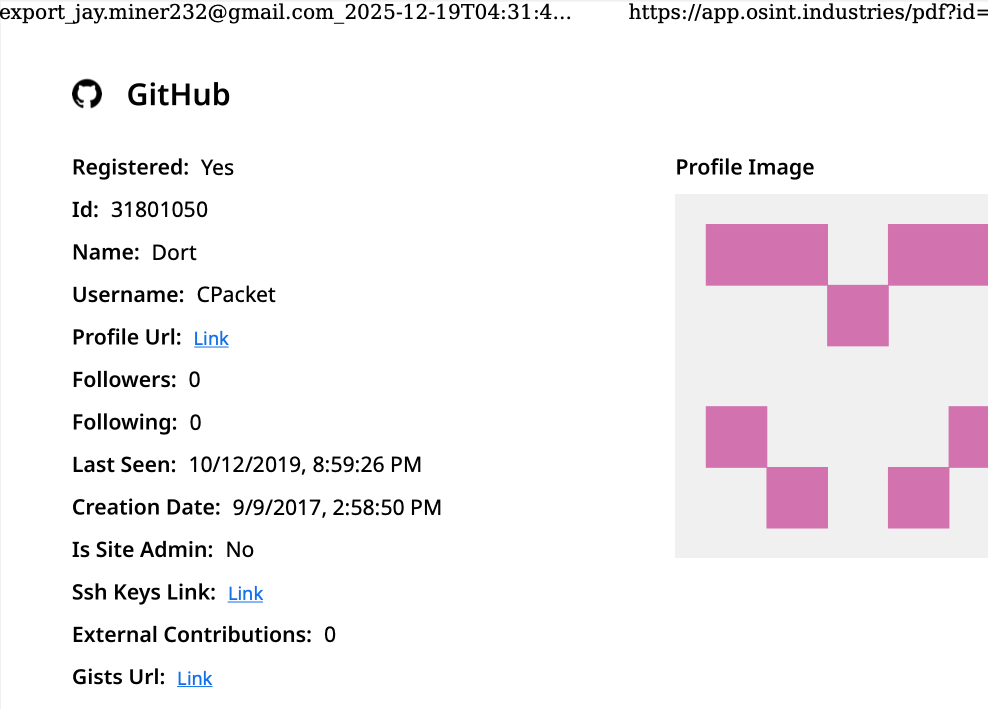
A public “dox” created in 2020 asserted Dort was a teenager from Canada (DOB August 2003) who used the aliases “CPacket” and “M1ce.” A search on the username CPacket at the open source intelligence platform OSINT Industries finds a GitHub account under the names Dort and CPacket that was created in 2017 using the email address jay.miner232@gmail.com.

Image: osint.industries.

The cyber intelligence firm Intel 471 says jay.miner232@gmail.com was used between 2015 and 2019 to create accounts at multiple cybercrime forums, including Nulled (username “Uubuntuu”) and Cracked (user “Dorted”); Intel 471 reports that both of these accounts were created from the same Internet address at Rogers Canada (99.241.112.24).

Dort was an extremely active player in the Microsoft game Minecraft who gained notoriety for their “Dortware” software that helped players cheat. But somewhere along the way, Dort graduated from hacking Minecraft games to enabling far more serious crimes.

Dort also used the nickname DortDev, an identity that was active in March 2022 on the chat server for the prolific cybercrime group known as LAPSUS$. Dort peddled a service for registering temporary email addresses, as well as “Dortsolver,” code that could bypass various CAPTCHA services designed to prevent automated account abuse. Both of these offerings were advertised in 2022 on SIM Land, a Telegram channel dedicated to SIM-swapping and account takeover activity.

The cyber intelligence firm Flashpoint indexed 2022 posts on SIM Land by Dort that show this person developed the disposable email and CAPTCHA bypass services with the help of another hacker who went by the handle “Qoft.”

“I legit just work with Jacob,” Qoft said in 2022 in reply to another user, referring to their exclusive business partner Dort. In the same conversation, Qoft bragged that the two had stolen more than $250,000 worth of Microsoft Xbox Game Pass accounts by developing a program that mass-created Game Pass identities using stolen payment card data.

Who is the Jacob that Qoft referred to as their business partner? The breach tracking service Constella Intelligence finds the password used by jay.miner232@gmail.com was reused by just one other email address: jacobbutler803@gmail.com. Recall that the 2020 dox of Dort said their date of birth was August 2003 (8/03).

Searching this email address at DomainTools.com reveals it was used in 2015 to register several Minecraft-themed domains, all assigned to a Jacob Butler in Ottawa, Canada and to the Ottawa phone number 613-909-9727.

Constella Intelligence finds jacobbutler803@gmail.com was used to register an account on the hacker forum Nulled in 2016, as well as the account name “M1CE” on Minecraft. Pivoting off the password used by their Nulled account shows it was shared by the email addresses j.a.y.m.iner232@gmail.com and jbutl3@ocdsb.ca, the latter being an address at a domain for the Ottawa-Carelton District School Board.

Data indexed by the breach tracking service Spycloud suggests that at one point Jacob Butler shared a computer with his mother and a sibling, which might explain why their email accounts were connected to the password “jacobsplugs.” Neither Jacob nor any of the other Butler household members responded to requests for comment.

The open source intelligence service Epieos finds jacobbutler803@gmail.com created the GitHub account “MemeClient.” Meanwhile, Flashpoint indexed a deleted anonymous Pastebin.com post from 2017 declaring that MemeClient was the creation of a user named CPacket — one of Dort’s early monikers.

Why is Dort so mad? On January 2, KrebsOnSecurity published The Kimwolf Botnet is Stalking Your Local Network, which explored research into the botnet by Benjamin Brundage, founder of the proxy tracking service Synthient. Brundage figured out that the Kimwolf botmasters were exploiting a little-known weakness in residential proxy services to infect poorly-defended devices — like TV boxes and digital photo frames — plugged into the internal, private networks of proxy endpoints.

By the time that story went live, most of the vulnerable proxy providers had been notified by Brundage and had fixed the weaknesses in their systems. That vulnerability remediation process massively slowed Kimwolf’s ability to spread, and within hours of the story’s publication Dort created a Discord server in my name that began publishing personal information about and violent threats against Brundage, Yours Truly, and others.

Dort and friends incriminating themselves by planning swatting attacks in a public Discord server.

Last week, Dort and friends used that same Discord server (then named “Krebs’s Koinbase Kallers”) to threaten a swatting attack against Brundage, again posting his home address and personal information. Brundage told KrebsOnSecurity that local police officers subsequently visited his home in response to a swatting hoax which occurred around the same time that another member of the server posted a door emoji and taunted Brundage further.

Dort, using the alias “Meow,” taunts Synthient founder Ben Brundage with a picture of a door.

Someone on the server then linked to a cringeworthy (and NSFW) new Soundcloud diss track recorded by the user DortDev that included a stickied message from Dort saying, “Ur dead nigga. u better watch ur fucking back. sleep with one eye open. bitch.”

“It’s a pretty hefty penny for a new front door,” the diss track intoned. “If his head doesn’t get blown off by SWAT officers. What’s it like not having a front door?”

With any luck, Dort will soon be able to tell us all exactly what it’s like.

Update, 10:29 a.m.: Jacob Butler responded to requests for comment, speaking with KrebsOnSecurity briefly via telephone. Butler said he didn’t notice earlier requests for comment because he hasn’t really been online since 2021, after his home was swatted multiple times. He acknowledged making and distributing a Minecraft cheat long ago, but said he hasn’t played the game in years and was not involved in Dortsolver or any other activity attributed to the Dort nickname after 2021.

“It was a really old cheat and I don’t remember the name of it,” Butler said of his Minecraft modification. “I’m very stressed, man. I don’t know if people are going to swat me again or what. After that, I pretty much walked away from everything, logged off and said fuck that. I don’t go online anymore. I don’t know why people would still be going after me, to be completely honest.”

When asked what he does for a living, Butler said he mostly stays home and helps his mom around the house because he struggles with autism and social interaction. He maintains that someone must have compromised one or more of his old accounts and is impersonating him online as Dort.

“Someone is actually probably impersonating me, and now I’m really worried,” Butler said. “This is making me relive everything.”

But there are issues with Butler’s timeline. For example, Jacob’s voice in our phone conversation was remarkably similar to the Jacob/Dort whose voice can be heard in this Sept. 2022 Clash of Code competition between Dort and another coder (Dort lost). At around 6 minutes and 10 seconds into the recording, Dort launches into a cursing tirade that mirrors the stream of profanity in the diss rap that Dortdev posted threatening Brundage. Dort can be heard again at around 16 minutes; at around 26:00, Dort threatens to swat his opponent.

Butler said the voice of Dort is not his, exactly, but rather that of an impersonator who had likely cloned his voice.

“I would like to clarify that was absolutely not me,” Butler said. “There must be someone using a voice changer. Or something of the sorts. Because people were cloning my voice before and sending audio clips of ‘me’ saying outrageous stuff.”

Understanding the DarkCloud Infostealer

Blogs

Blog

Understanding the DarkCloud Infostealer

In this post, we analyze DarkCloud, a commercially available infostealer written in Visual Basic 6.0, examine its encryption and evasion techniques, and assess how this low-cost malware can provide threat actors with enterprise-wide access through harvested credentials.

SHARE THIS:
Default Author Image
February 25, 2026

Infostealers continue to dominate the initial access landscape in 2026, lowering the barrier to breach through scalable credential theft. DarkCloud illustrates how low-cost, commercialized malware is reshaping the initial access landscape.

First observed in 2022 and attributed to a developer known as “Darkcloud Coder” (formerly “BluCoder” on Telegram), DarkCloud is openly sold through Telegram and a clearnet storefront with subscription tiers starting at just US$30. Despite being marketed as “surveillance software,” its technical focus is unmistakable: high-volume credential harvesting and structured data exfiltration across browsers, email clients, financial data, and contact networks.

A screenshot from DarkCloud’s clearnet site calling itself “surveillance software.” (Source: DarkCloud clearnet site)

At the technical level, DarkCloud is written in Visual Basic 6.0 and compiled into a native C/C++ application. This legacy language choice is unusual in modern malware development — and likely deliberate. By leveraging outdated but still supported runtime components, DarkCloud appears to benefit from lower detection rates while maintaining full credential theft functionality.

Despite its relatively low cost, DarkCloud should not be dismissed as unsophisticated. Flashpoint assesses it as a potent entry-level threat that can provide adversaries with the keys to an entire corporate network through harvested credentials.

The Commercialization of DarkCloud

DarkCloud describes itself as a keylogger despite the original advertisement on XSS describing it as an infostealer. (Source: DarkCloud)

DarkCloud represents a mature example of commodity malware-as-a-service.

It is openly sold through Telegram and a clearnet website, where it is misleadingly labeled as a keylogger. While it does include keylogging capabilities, this is only a minor component of a much broader infostealing toolkit.

Its real value proposition is credential harvesting across browsers, email clients, file transfer applications, VPN software, and more.

This dual positioning — public-facing “surveillance software” and underground stealer — provides plausible deniability while enabling large-scale credential operations.

Why Visual Basic 6.0 Matters

One of the most notable aspects of DarkCloud is its use of Visual Basic 6.0.

The payload is written in VB6 and compiled into a native C/C++ application. Microsoft no longer supports VB6 in its modern development environment, and VB6 applications rely on legacy components such as MSVBVM60.DLL for execution.

Flashpoint assesses this legacy language choice is deliberate, both for its simplicity and its potential to evade modern detection models.

In testing, Flashpoint analysts generated equivalent payloads in C/C++ and VB6. The VB6 variant produced significantly fewer detections in VirusTotal scans.

The implication is clear: older languages are not necessarily obsolete in adversary tradecraft. In some cases, they may be strategically advantageous.

Encryption and String Obfuscation

DarkCloud employs a layered string encryption scheme that complicates static and dynamic analysis.

Most internal strings are encrypted and decrypted at runtime using Visual Basic’s Rnd() pseudo-random number generator, combined with a custom seed-generation algorithm.

The process involves:

  • Hex-encoded encrypted strings
  • Base64-encoded keys
  • Seed calculation through a custom algorithm
  • Resetting the VB pseudo-random number generator to a known state
  • Iterative Rnd() calls to reconstruct plaintext strings

By resetting the PRNG with a known value before applying the calculated seed, the malware ensures deterministic output during decryption.

This approach does not rely on novel cryptography, but rather on abusing legacy language behavior to frustrate reverse engineering.

Credential Theft at Scale

DarkCloud’s primary objective is credential collection.

It targets:

Email clients:

  • Outlook
  • eM Client
  • FoxMail
  • Thunderbird
  • 163Mail
  • MailMaster

File transfer applications:

  • FileZilla
  • WinSCP
  • CoreFTP

Browsers:

  • Google Chrome
  • Microsoft Edge
  • Mozilla Firefox
  • Brave
  • Opera
  • Yandex
  • Vivaldi
  • (and many additional Chromium- and Firefox-based browsers)

Other applications:

  • Pidgin
  • NordVPN

When extracting browser data, DarkCloud steals:

  • Login credentials
  • Cookies
  • Credit card information

Email applications are additionally scraped for contact lists. This is likely intended to seed future phishing campaigns.

DarkCloud stores collected data locally in two directories under %APPDATA%\Microsoft\Windows\Templates. One directory (“DBS”) stores copied database files, while another (“_”) stores parsed data in unencrypted text format.

This local staging enables continuous exfiltration while maintaining structured log output.

Exfiltration Methods: Flexibility for Threat Actors

DarkCloud supports four exfiltration methods:

  • SMTP
  • FTP
  • Telegram
  • HTTP

SMTP and FTP require hardcoded credentials within each binary. Email subjects include the victim machine’s hostname and username, and stolen data is transmitted as attachments.

HTTP exfiltration appears less frequently used, though the capability is present.

This flexibility allows operators to tailor deployments depending on infrastructure preferences and operational security requirements.

From BluStealer to DarkCloud

Flashpoint analysts identified notable similarities between DarkCloud’s regular expressions for credit card parsing and those found in a publicly documented project known as “A310LoggerStealer,” also referred to as BluStealer.

The regex patterns appear in identical order and format.

Combined with the developer’s prior alias “BluCoder,” Flashpoint assesses that A310LoggerStealer likely represents an earlier iteration of what became DarkCloud.

This evolution reflects a common pattern in commodity malware development: incremental refinement rather than radical innovation.

A Potent Entry-Level Threat

Despite its relatively low cost, DarkCloud should not be dismissed as unsophisticated.

Its marketing as surveillance software attempts to normalize its presence while providing plausible deniability for buyers. Technically, however, its focus is clear: large-scale credential harvesting across browsers, email clients, financial data, and contact networks.

Flashpoint assesses DarkCloud as a potent entry-level threat that can provide adversaries with the keys to an entire corporate network through harvested credentials.

In a landscape where identity is the new perimeter, even a US$30 subscription can be operationally devastating.

Defending Against Commodity Infostealers

Commodity infostealers like DarkCloud may be commercially accessible, but defending against them requires enterprise-grade vigilance.

Organizations should:

  • Treat phishing-delivered ZIP/RAR attachments as high-risk initial access vectors
  • Monitor for abnormal data exfiltration over SMTP, FTP, and Telegram
  • Audit credential reuse across browser and email applications
  • Prioritize credential rotation and incident response playbooks following suspected compromise

Infostealers like DarkCloud are not breakthrough malware families. They do not rely on zero-days or advanced exploits.

Instead, they exploit scale, accessibility, and identity exposure.

To understand how credential harvesting campaigns are evolving and to embed real-time intelligence into your detection workflows, request a demo today and see how Flashpoint intelligence strengthens your defense posture.

Begin your free trial today.

The post Understanding the DarkCloud Infostealer appeared first on Flashpoint.

Check Point Named Leader in GigaOm Radar for Cloud Network Security For 3 Years in a Row – Protects 22 Cloud Vendors

17 February 2026 at 13:00

In today’s multi-cloud world, businesses deploy workloads across dozens of public and private clouds, each with their own network topology, security controls, and operational quirks. Over time this flexibility comes at a cost of increasing complexity and risk. How can budget minded IT team sanely enforce complex security policies, prevent AI-powered cyber breaches by foreign entities, and maintain geographical compliance across such a diverse environment?  They can do so with a partner that leads with an open garden, agnostic approach. Check Point cloud firewalls, called CloudGuard Network Security, provide integrations across 22 leading public and private cloud vendors from AWS, […]

The post Check Point Named Leader in GigaOm Radar for Cloud Network Security For 3 Years in a Row – Protects 22 Cloud Vendors appeared first on Check Point Blog.

WAF Security Test Results 2026: Why Prevention-First Matters More Than Ever

11 February 2026 at 13:00

Introduction: Security Testing Must Evolve with Attacks As cyber threats rise, web applications, GenAI workloads, and APIs have become prime targets. WAFs remain a critical first line of defense, but as attackers move beyond basic OWASP Top 10 techniques, WAF testing must evolve. Modern attacks increasingly rely on evasion methods, payload padding, and zero-day techniques designed to bypass signature-based WAFs. The WAF Comparison Project 2026 presents the results of our third annual, real-world evaluation of WAF efficacy (see the last year result here), using over 1 million legitimate requests and 74,000 malicious payloads to assess 14 leading WAF vendors, including […]

The post WAF Security Test Results 2026: Why Prevention-First Matters More Than Ever appeared first on Check Point Blog.

Who Operates the Badbox 2.0 Botnet?

26 January 2026 at 17:11

The cybercriminals in control of Kimwolf — a disruptive botnet that has infected more than 2 million devices — recently shared a screenshot indicating they’d compromised the control panel for Badbox 2.0, a vast China-based botnet powered by malicious software that comes pre-installed on many Android TV streaming boxes. Both the FBI and Google say they are hunting for the people behind Badbox 2.0, and thanks to bragging by the Kimwolf botmasters we may now have a much clearer idea about that.

Our first story of 2026, The Kimwolf Botnet is Stalking Your Local Network, detailed the unique and highly invasive methods Kimwolf uses to spread. The story warned that the vast majority of Kimwolf infected systems were unofficial Android TV boxes that are typically marketed as a way to watch unlimited (pirated) movie and TV streaming services for a one-time fee.

Our January 8 story, Who Benefitted from the Aisuru and Kimwolf Botnets?, cited multiple sources saying the current administrators of Kimwolf went by the nicknames “Dort” and “Snow.” Earlier this month, a close former associate of Dort and Snow shared what they said was a screenshot the Kimwolf botmasters had taken while logged in to the Badbox 2.0 botnet control panel.

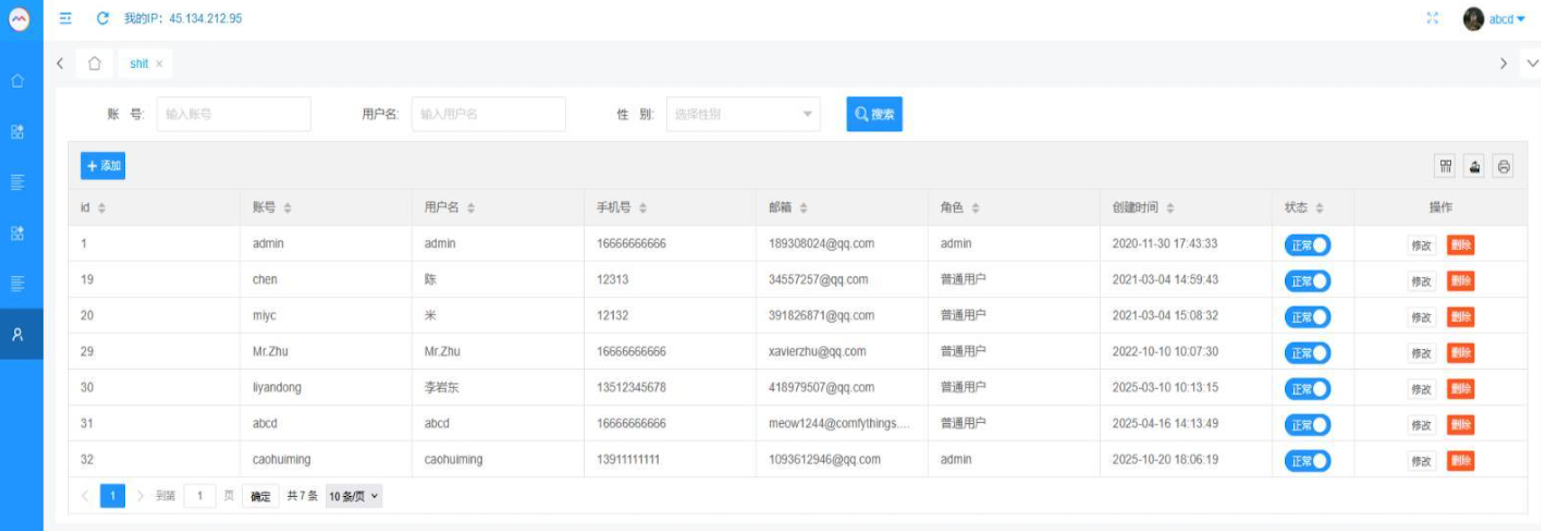
That screenshot, a portion of which is shown below, shows seven authorized users of the control panel, including one that doesn’t quite match the others: According to my source, the account “ABCD” (the one that is logged in and listed in the top right of the screenshot) belongs to Dort, who somehow figured out how to add their email address as a valid user of the Badbox 2.0 botnet.

The control panel for the Badbox 2.0 botnet lists seven authorized users and their email addresses. Click to enlarge.

Badbox has a storied history that well predates Kimwolf’s rise in October 2025. In July 2025, Google filed a “John Doe” lawsuit (PDF) against 25 unidentified defendants accused of operating Badbox 2.0, which Google described as a botnet of over ten million unsanctioned Android streaming devices engaged in advertising fraud. Google said Badbox 2.0, in addition to compromising multiple types of devices prior to purchase, also can infect devices by requiring the download of malicious apps from unofficial marketplaces.

Google’s lawsuit came on the heels of a June 2025 advisory from the Federal Bureau of Investigation (FBI), which warned that cyber criminals were gaining unauthorized access to home networks by either configuring the products with malware prior to the user’s purchase, or infecting the device as it downloads required applications that contain backdoors — usually during the set-up process.

The FBI said Badbox 2.0 was discovered after the original Badbox campaign was disrupted in 2024. The original Badbox was identified in 2023, and primarily consisted of Android operating system devices (TV boxes) that were compromised with backdoor malware prior to purchase.

KrebsOnSecurity was initially skeptical of the claim that the Kimwolf botmasters had hacked the Badbox 2.0 botnet. That is, until we began digging into the history of the qq.com email addresses in the screenshot above.

CATHEAD

An online search for the address 34557257@qq.com (pictured in the screenshot above as the user “Chen“) shows it is listed as a point of contact for a number of China-based technology companies, including:

Beijing Hong Dake Wang Science & Technology Co Ltd.
Beijing Hengchuang Vision Mobile Media Technology Co. Ltd.
Moxin Beijing Science and Technology Co. Ltd.

The website for Beijing Hong Dake Wang Science is asmeisvip[.]net, a domain that was flagged in a March 2025 report by HUMAN Security as one of several dozen sites tied to the distribution and management of the Badbox 2.0 botnet. Ditto for moyix[.]com, a domain associated with Beijing Hengchuang Vision Mobile.

A search at the breach tracking service Constella Intelligence finds 34557257@qq.com at one point used the password “cdh76111.” Pivoting on that password in Constella shows it is known to have been used by just two other email accounts: daihaic@gmail.com and cathead@gmail.com.

Constella found cathead@gmail.com registered an account at jd.com (China’s largest online retailer) in 2021 under the name “陈代海,” which translates to “Chen Daihai.” According to DomainTools.com, the name Chen Daihai is present in the original registration records (2008) for moyix[.]com, along with the email address cathead@astrolink[.]cn.

Incidentally, astrolink[.]cn also is among the Badbox 2.0 domains identified in HUMAN Security’s 2025 report. DomainTools finds cathead@astrolink[.]cn was used to register more than a dozen domains, including vmud[.]net, yet another Badbox 2.0 domain tagged by HUMAN Security.

XAVIER

A cached copy of astrolink[.]cn preserved at archive.org shows the website belongs to a mobile app development company whose full name is Beijing Astrolink Wireless Digital Technology Co. Ltd. The archived website reveals a “Contact Us” page that lists a Chen Daihai as part of the company’s technology department. The other person featured on that contact page is Zhu Zhiyu, and their email address is listed as xavier@astrolink[.]cn.

A Google-translated version of Astrolink’s website, circa 2009. Image: archive.org.

Astute readers will notice that the user Mr.Zhu in the Badbox 2.0 panel used the email address xavierzhu@qq.com. Searching this address in Constella reveals a jd.com account registered in the name of Zhu Zhiyu. A rather unique password used by this account matches the password used by the address xavierzhu@gmail.com, which DomainTools finds was the original registrant of astrolink[.]cn.

ADMIN

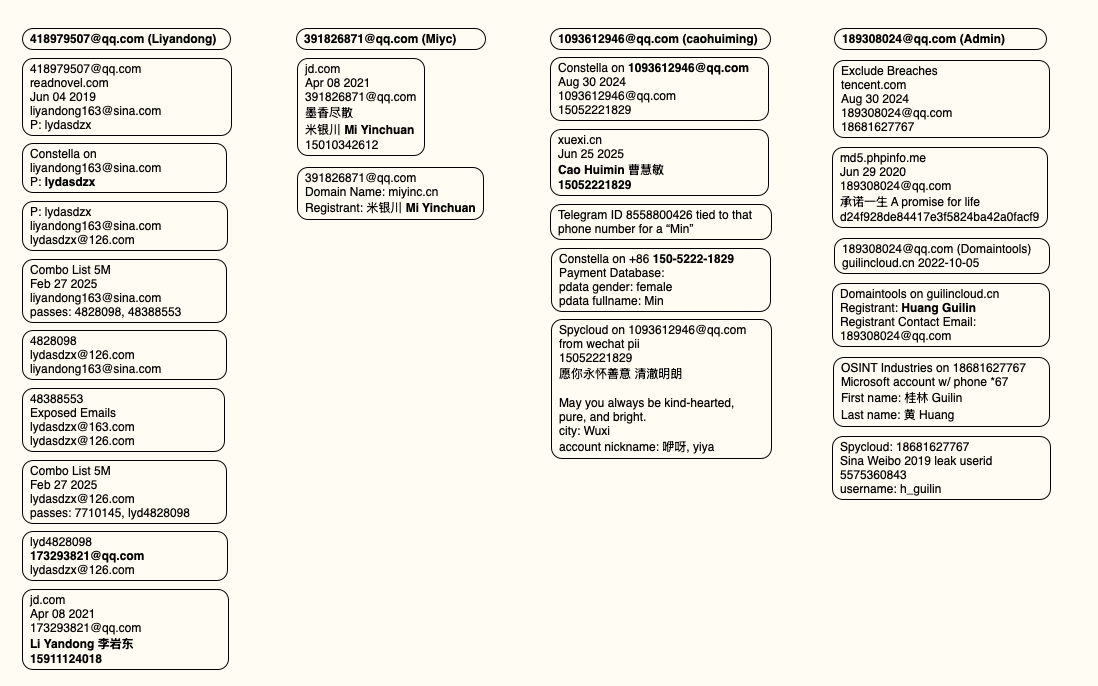
The very first account listed in the Badbox 2.0 panel — “admin,” registered in November 2020 — used the email address 189308024@qq.com. DomainTools shows this email is found in the 2022 registration records for the domain guilincloud[.]cn, which includes the registrant name “Huang Guilin.”

Constella finds 189308024@qq.com is associated with the China phone number 18681627767. The open-source intelligence platform osint.industries reveals this phone number is connected to a Microsoft profile created in 2014 under the name Guilin Huang (桂林 黄). The cyber intelligence platform Spycloud says that phone number was used in 2017 to create an account at the Chinese social media platform Weibo under the username “h_guilin.”

The public information attached to Guilin Huang’s Microsoft account, according to the breach tracking service osintindustries.com.

The remaining three users and corresponding qq.com email addresses were all connected to individuals in China. However, none of them (nor Mr. Huang) had any apparent connection to the entities created and operated by Chen Daihai and Zhu Zhiyu — or to any corporate entities for that matter. Also, none of these individuals responded to requests for comment.

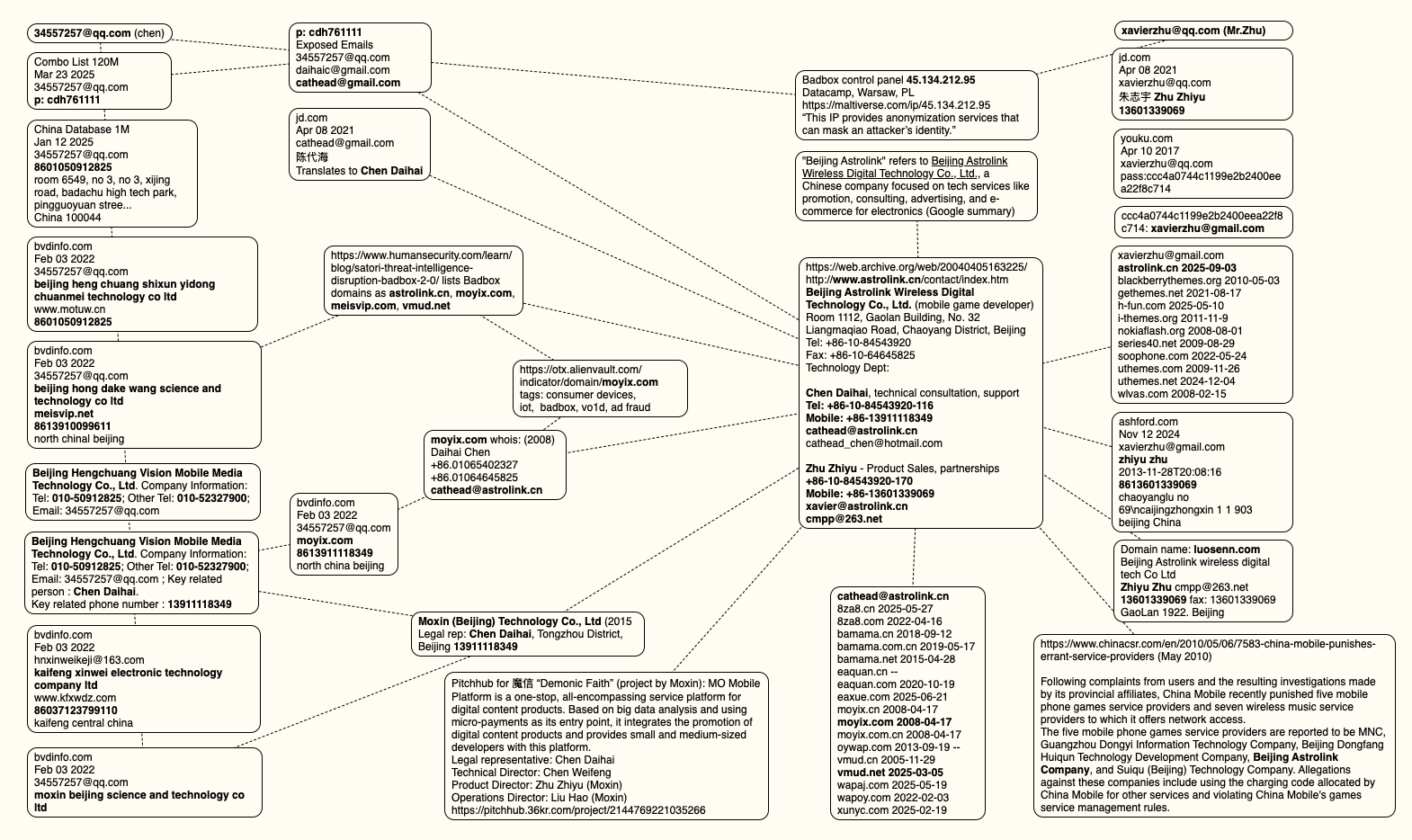
The mind map below includes search pivots on the email addresses, company names and phone numbers that suggest a connection between Chen Daihai, Zhu Zhiyu, and Badbox 2.0.

This mind map includes search pivots on the email addresses, company names and phone numbers that appear to connect Chen Daihai and Zhu Zhiyu to Badbox 2.0. Click to enlarge.

UNAUTHORIZED ACCESS

The idea that the Kimwolf botmasters could have direct access to the Badbox 2.0 botnet is a big deal, but explaining exactly why that is requires some background on how Kimwolf spreads to new devices. The botmasters figured out they could trick residential proxy services into relaying malicious commands to vulnerable devices behind the firewall on the unsuspecting user’s local network.

The vulnerable systems sought out by Kimwolf are primarily Internet of Things (IoT) devices like unsanctioned Android TV boxes and digital photo frames that have no discernible security or authentication built-in. Put simply, if you can communicate with these devices, you can compromise them with a single command.

Our January 2 story featured research from the proxy-tracking firm Synthient, which alerted 11 different residential proxy providers that their proxy endpoints were vulnerable to being abused for this kind of local network probing and exploitation.

Most of those vulnerable proxy providers have since taken steps to prevent customers from going upstream into the local networks of residential proxy endpoints, and it appeared that Kimwolf would no longer be able to quickly spread to millions of devices simply by exploiting some residential proxy provider.

However, the source of that Badbox 2.0 screenshot said the Kimwolf botmasters had an ace up their sleeve the whole time: Secret access to the Badbox 2.0 botnet control panel.

“Dort has gotten unauthorized access,” the source said. “So, what happened is normal proxy providers patched this. But Badbox doesn’t sell proxies by itself, so it’s not patched. And as long as Dort has access to Badbox, they would be able to load” the Kimwolf malware directly onto TV boxes associated with Badbox 2.0.

The source said it isn’t clear how Dort gained access to the Badbox botnet panel. But it’s unlikely that Dort’s existing account will persist for much longer: All of our notifications to the qq.com email addresses listed in the control panel screenshot received a copy of that image, as well as questions about the apparently rogue ABCD account.

Check Point Supports Google Cloud Network Security Integration

7 January 2026 at 13:00

Simplifying Cloud Network Security When securing cloud landscapes, it’s critically important to eliminate any downtime or performance degradation that firewall or gateway implementation may cause. To address these challenges, Check Point is proud to announce our support for Google Cloud Network Security Integration. This innovation creates a nondisruptive approach to cloud firewall deployment, increasing network security without negatively impacting performance. Scaling Hybrid Cloud Network Security Network security and performance are critical to any organization, but this is especially true for industries under heavy regulations like financial services, healthcare, and government. So over time these organizations gain comfort, expertise, and confidence […]

The post Check Point Supports Google Cloud Network Security Integration appeared first on Check Point Blog.

Meet Rey, the Admin of ‘Scattered Lapsus$ Hunters’

26 November 2025 at 18:22

A prolific cybercriminal group that calls itself “Scattered LAPSUS$ Hunters” has dominated headlines this year by regularly stealing data from and publicly mass extorting dozens of major corporations. But the tables seem to have turned somewhat for “Rey,” the moniker chosen by the technical operator and public face of the hacker group: Earlier this week, Rey confirmed his real life identity and agreed to an interview after KrebsOnSecurity tracked him down and contacted his father.

Scattered LAPSUS$ Hunters (SLSH) is thought to be an amalgamation of three hacking groups — Scattered Spider, LAPSUS$ and ShinyHunters. Members of these gangs hail from many of the same chat channels on the Com, a mostly English-language cybercriminal community that operates across an ocean of Telegram and Discord servers.

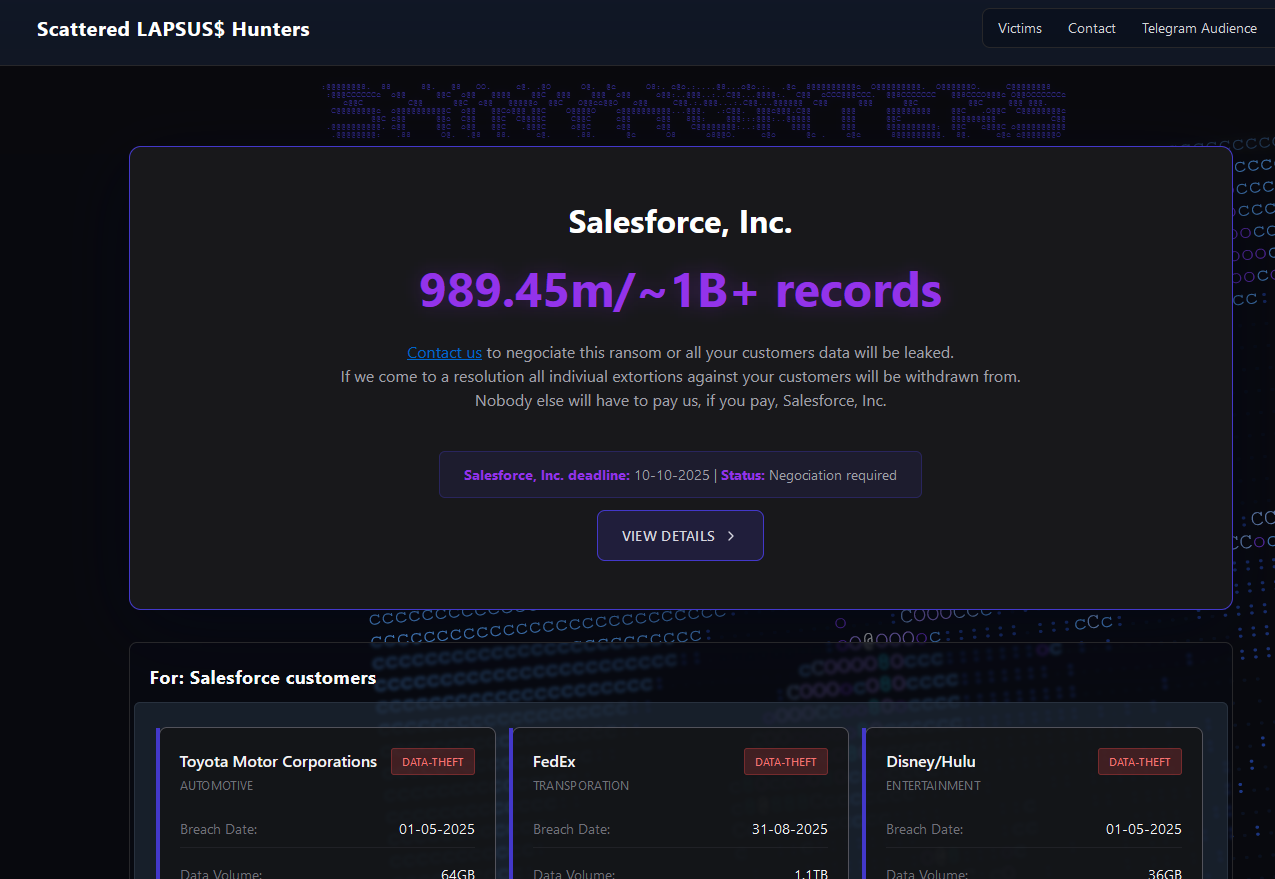
In May 2025, SLSH members launched a social engineering campaign that used voice phishing to trick targets into connecting a malicious app to their organization’s Salesforce portal. The group later launched a data leak portal that threatened to publish the internal data of three dozen companies that allegedly had Salesforce data stolen, including ToyotaFedExDisney/Hulu, and UPS.

The new extortion website tied to ShinyHunters, which threatens to publish stolen data unless Salesforce or individual victim companies agree to pay a ransom.

Last week, the SLSH Telegram channel featured an offer to recruit and reward “insiders,” employees at large companies who agree to share internal access to their employer’s network for a share of whatever ransom payment is ultimately paid by the victim company.

SLSH has solicited insider access previously, but their latest call for disgruntled employees started making the rounds on social media at the same time news broke that the cybersecurity firm Crowdstrike had fired an employee for allegedly sharing screenshots of internal systems with the hacker group (Crowdstrike said their systems were never compromised and that it has turned the matter over to law enforcement agencies).

The Telegram server for the Scattered LAPSUS$ Hunters has been attempting to recruit insiders at large companies.

Members of SLSH have traditionally used other ransomware gangs’ encryptors in attacks, including malware from ransomware affiliate programs like ALPHV/BlackCat, Qilin, RansomHub, and DragonForce. But last week, SLSH announced on its Telegram channel the release of their own ransomware-as-a-service operation called ShinySp1d3r.

The individual responsible for releasing the ShinySp1d3r ransomware offering is a core SLSH member who goes by the handle “Rey” and who is currently one of just three administrators of the SLSH Telegram channel. Previously, Rey was an administrator of the data leak website for Hellcat, a ransomware group that surfaced in late 2024 and was involved in attacks on companies including Schneider Electric, Telefonica, and Orange Romania.

A recent, slightly redacted screenshot of the Scattered LAPSUS$ Hunters Telegram channel description, showing Rey as one of three administrators.

Also in 2024, Rey would take over as administrator of the most recent incarnation of BreachForums, an English-language cybercrime forum whose domain names have been seized on multiple occasions by the FBI and/or by international authorities. In April 2025, Rey posted on Twitter/X about another FBI seizure of BreachForums.

On October 5, 2025, the FBI announced it had once again seized the domains associated with BreachForums, which it described as a major criminal marketplace used by ShinyHunters and others to traffic in stolen data and facilitate extortion.

“This takedown removes access to a key hub used by these actors to monetize intrusions, recruit collaborators, and target victims across multiple sectors,” the FBI said.

Incredibly, Rey would make a series of critical operational security mistakes last year that provided multiple avenues to ascertain and confirm his real-life identity and location. Read on to learn how it all unraveled for Rey.

WHO IS REY?

According to the cyber intelligence firm Intel 471, Rey was an active user on various BreachForums reincarnations over the past two years, authoring more than 200 posts between February 2024 and July 2025. Intel 471 says Rey previously used the handle “Hikki-Chan” on BreachForums, where their first post shared data allegedly stolen from the U.S. Centers for Disease Control and Prevention (CDC).

In that February 2024 post about the CDC, Hikki-Chan says they could be reached at the Telegram username @wristmug. In May 2024, @wristmug posted in a Telegram group chat called “Pantifan” a copy of an extortion email they said they received that included their email address and password.

The message that @wristmug cut and pasted appears to have been part of an automated email scam that claims it was sent by a hacker who has compromised your computer and used your webcam to record a video of you while you were watching porn. These missives threaten to release the video to all your contacts unless you pay a Bitcoin ransom, and they typically reference a real password the recipient has used previously.

“Noooooo,” the @wristmug account wrote in mock horror after posting a screenshot of the scam message. “I must be done guys.”

A message posted to Telegram by Rey/@wristmug.

In posting their screenshot, @wristmug redacted the username portion of the email address referenced in the body of the scam message. However, they did not redact their previously-used password, and they left the domain portion of their email address (@proton.me) visible in the screenshot.

O5TDEV

Searching on @wristmug’s rather unique 15-character password in the breach tracking service Spycloud finds it is known to have been used by just one email address: cybero5tdev@proton.me. According to Spycloud, those credentials were exposed at least twice in early 2024 when this user’s device was infected with an infostealer trojan that siphoned all of its stored usernames, passwords and authentication cookies (a finding that was initially revealed in March 2025 by the cyber intelligence firm KELA).

Intel 471 shows the email address cybero5tdev@proton.me belonged to a BreachForums member who went by the username o5tdev. Searching on this nickname in Google brings up at least two website defacement archives showing that a user named o5tdev was previously involved in defacing sites with pro-Palestinian messages. The screenshot below, for example, shows that 05tdev was part of a group called Cyb3r Drag0nz Team.

Rey/o5tdev’s defacement pages. Image: archive.org.

A 2023 report from SentinelOne described Cyb3r Drag0nz Team as a hacktivist group with a history of launching DDoS attacks and cyber defacements as well as engaging in data leak activity.

“Cyb3r Drag0nz Team claims to have leaked data on over a million of Israeli citizens spread across multiple leaks,” SentinelOne reported. “To date, the group has released multiple .RAR archives of purported personal information on citizens across Israel.”

The cyber intelligence firm Flashpoint finds the Telegram user @05tdev was active in 2023 and early 2024, posting in Arabic on anti-Israel channels like “Ghost of Palestine” [full disclosure: Flashpoint is currently an advertiser on this blog].

‘I’M A GINTY’

Flashpoint shows that Rey’s Telegram account (ID7047194296) was particularly active in a cybercrime-focused channel called Jacuzzi, where this user shared several personal details, including that their father was an airline pilot. Rey claimed in 2024 to be 15 years old, and to have family connections to Ireland.

Specifically, Rey mentioned in several Telegram chats that he had Irish heritage, even posting a graphic that shows the prevalence of the surname “Ginty.”

Rey, on Telegram claiming to have association to the surname “Ginty.” Image: Flashpoint.

Spycloud indexed hundreds of credentials stolen from cybero5dev@proton.me, and those details indicate that Rey’s computer is a shared Microsoft Windows device located in Amman, Jordan. The credential data stolen from Rey in early 2024 show there are multiple users of the infected PC, but that all shared the same last name of Khader and an address in Amman, Jordan.

The “autofill” data lifted from Rey’s family PC contains an entry for a 46-year-old Zaid Khader that says his mother’s maiden name was Ginty. The infostealer data also shows Zaid Khader frequently accessed internal websites for employees of Royal Jordanian Airlines.

MEET SAIF

The infostealer data makes clear that Rey’s full name is Saif Al-Din Khader. Having no luck contacting Saif directly, KrebsOnSecurity sent an email to his father Zaid. The message invited the father to respond via email, phone or Signal, explaining that his son appeared to be deeply enmeshed in a serious cybercrime conspiracy.

Less than two hours later, I received a Signal message from Saif, who said his dad suspected the email was a scam and had forwarded it to him.

“I saw your email, unfortunately I don’t think my dad would respond to this because they think its some ‘scam email,'” said Saif, who told me he turns 16 years old next month. “So I decided to talk to you directly.”

Saif explained that he’d already heard from European law enforcement officials, and had been trying to extricate himself from SLSH. When asked why then he was involved in releasing SLSH’s new ShinySp1d3r ransomware-as-a-service offering, Saif said he couldn’t just suddenly quit the group.

“Well I cant just dip like that, I’m trying to clean up everything I’m associated with and move on,” he said.

The former Hellcat ransomware site. Image: Kelacyber.com

He also shared that ShinySp1d3r is just a rehash of Hellcat ransomware, except modified with AI tools. “I gave the source code of Hellcat ransomware out basically.”

Saif claims he reached out on his own recently to the Telegram account for Operation Endgame, the codename for an ongoing law enforcement operation targeting cybercrime services, vendors and their customers.

“I’m already cooperating with law enforcement,” Saif said. “In fact, I have been talking to them since at least June. I have told them nearly everything. I haven’t really done anything like breaching into a corp or extortion related since September.”

Saif suggested that a story about him right now could endanger any further cooperation he may be able to provide. He also said he wasn’t sure if the U.S. or European authorities had been in contact with the Jordanian government about his involvement with the hacking group.

“A story would bring so much unwanted heat and would make things very difficult if I’m going to cooperate,” Saif said. “I’m unsure whats going to happen they said they’re in contact with multiple countries regarding my request but its been like an entire week and I got no updates from them.”

Saif shared a screenshot that indicated he’d contacted Europol authorities late last month. But he couldn’t name any law enforcement officials he said were responding to his inquiries, and KrebsOnSecurity was unable to verify his claims.

“I don’t really care I just want to move on from all this stuff even if its going to be prison time or whatever they gonna say,” Saif said.

Google Cloud Security Threat Horizons Report #12 Is Out!

31 July 2025 at 20:57

This is my completely informal, uncertified, unreviewed and otherwise completely unofficial blog inspired by my reading of our next Cloud Threat Horizons Report, #12 (full version) that we just released (the official blog for #1 report, my unofficial blogs for #2, #3, #4, #5, #6, #7, #8, #9, #10 and #11).

My favorite quotes from the report follow below:

  • “Google Cloud’s latest research highlights that common hygiene gaps like credential issues and misconfigurations are persistently exploited by threat actors to gain entry into cloud environments. During the first half of 2025, weak or absent credentials were the predominant threat, accounting for 47.1% of incidents. Misconfigurations (29.4%) and API/UI compromises (11.8%) followed as the next most frequently observed initial access vectors.“
THR 12 cloud compromise visual
  • Notably, compared to H2 2024, we observed a 4.9% decrease in misconfiguration-based access and a 5.3% decrease in API/UI compromises (i.e., when an unauthorized entity gains access to, or manipulates a system or data through an application’s user-facing screen or its programmatic connections). This shift appears to be partly absorbed by the rise of leaked credentials representing 2.9% of initial access in H1 2025. [A.C. — It gently suggests that while we’re making some progress on configurations, the attackers are moving to where the fruit is even more low-hanging: already leaked credentials.]
  • “Foundational security remains the strongest defense: Google Cloud research indicates that credential compromise and misconfiguration remain the primary entry points for threat actors into cloud environments, emphasizing the critical need for robust identity and access management and proactive vulnerability management.” [A.C. — it won’t be the magical AI that saves you, it would be not given admin to employees]
  • “Financially motivated threat groups are increasingly targeting backup systems as part of their primary objective, challenging traditional disaster recovery, and underscoring the need for resilient solutions like Cloud Isolated Recovery Environments (CIRE) to ensure business continuity.” [A.C. — if your key defense against ransomware is still backups, well, we got some “news” got you…]
  • “Advanced threat actors are leveraging social engineering to steal credentials and session cookies, bypassing MFA to compromise cloud environments for financial theft, often targeting high-value assets.” [A.C. — this is NOT an anti-MFA stance, this is a reminder that MFA helps a whole lot, yet if yours can be bypassed, then its value diminishes]
  • “Threat actors are increasingly co-opting trusted cloud storage services as a key component in their initial attack chains, deceptively using these platforms to host seemingly benign decoy files, often PDFs.“ and “threat actors used .desktop files to infect systems by downloading decoy PDFs from legitimate cloud storage services from multiple providers, a tactic that deceives victims while additional malicious payloads are downloaded in the background[A.C. — a nice example of thinking about how the defender will respond by the attacker here]
  • more traditional disaster recovery approaches, focused primarily on technical restoration, often fall short in addressing the complexities of recovering from a cyber event, particularly the need to re-establish trust with third parties.” [A.C. — The technical recovery is only half the battle. This speaks to the human element of incident response, and the broader impact of a breach.]

Now, go and read the THR 12 report!

Related posts:


Google Cloud Security Threat Horizons Report #12 Is Out! was originally published in Anton on Security on Medium, where people are continuing the conversation by highlighting and responding to this story.

Reconnaissance: Azure Cloud w/ Kevin Klingbile

By: BHIS
7 October 2024 at 17:16

This webcast was originally published on September 26, 2024. In this video, Kevin Klingbile from Black Hills Information Security discusses the intricacies of Azure Cloud services and M365, focusing on […]

The post Reconnaissance: Azure Cloud w/ Kevin Klingbile appeared first on Black Hills Information Security, Inc..

Introducing GraphRunner: A Post-Exploitation Toolset for Microsoft 365

By Beau Bullock & Steve Borosh TL;DR We built a post-compromise toolset called GraphRunner for interacting with the Microsoft Graph API. It provides various tools for performing reconnaissance, persistence, and […]

The post Introducing GraphRunner: A Post-Exploitation Toolset for Microsoft 365 appeared first on Black Hills Information Security, Inc..

How to Purge Google and Start Over – Part 1

By: BHIS
27 March 2019 at 17:27

Mike Felch// A Tale of Blue Destroying Red Let me start by sharing a story about a fairly recent red team engagement against a highly-secured technical customer that didn’t end […]

The post How to Purge Google and Start Over – Part 1 appeared first on Black Hills Information Security, Inc..

Deploy REMnux to the Cloud, Reverse Engineering Malware in the Cloud

By: BHIS
1 February 2018 at 16:48

Carrie Roberts //* REMnux is a free virtual machine image with Reverse Engineering Malware tools preinstalled. REMnux is maintained by Lenny Zeltser with extensive help from David Westcott and is available from https://remnux.org. I have […]

The post Deploy REMnux to the Cloud, Reverse Engineering Malware in the Cloud appeared first on Black Hills Information Security, Inc..

❌