Normal view

The Top Threat Actor Groups Targeting the Financial Sector

Blogs

Blog

The Top Threat Actor Groups Targeting the Financial Sector

In this post, we identify and analyze the top threat actors that have been actively targeting the financial sector between 2024 and 2026.

SHARE THIS:
Default Author Image
January 6, 2026

Between 2024 and 2026, Flashpoint analysts have observed the financial sector as a top target of threat actors, with 406 publicly disclosed victims falling prey to ransomware attacks alone—representing seven percent of all ransomware victim listings during that period.

However, ransomware is just one piece of the complex threat actor puzzle. The financial sector is also grappling with threats stemming from sophisticated Advanced Persistent Threat (APT) groups, the risks associated with third-party compromises, the illicit trade in initial access credentials, the ever-present danger of insider threats, and the emerging challenge of deepfake and impersonation fraud.

Why Finance?

The financial sector has long been one of the most attractive targets for threat actors, consistently ranking among the most targeted industries globally.

These institutions manage massive volumes of sensitive data—from high-value financial transactions and confidential customer information to vast sums of capital, making them especially lucrative for threat actors seeking financial gain. Additionally, the urgency and criticality of financial operations increases the chances that victim organizations will succumb to extortion and ransom demands.

Even beyond direct financial incentives, the financial sector remains an attractive target due to its deep interconnectivity with other industries.This means that malicious actors may simply target financial institutions to gain information about another target organization, as a single data breach can have far-reaching and cascading consequences for involved partners and third parties.

The Threat Actors Targeting the Financial Sector

To understand the complexities of the financial threat landscape, organizations need a comprehensive understanding of the key players involved. The following threat actors represent some of the most prominent and active groups targeting the financial sector between April 2024 and April 2025:

RansomHub

Despite being a relatively new Ransomware-as-a-Service (RaaS) group that emerged in February 2024, RansomHub quickly rose to prominence, becoming the second-most active ransomware group in 2024. Notably, they claimed 38 victims in the financial sector between April 2024 and April 2025. Their known TTPs include phishing and exploiting vulnerabilities. RansomHub is also known to heavily target the healthcare sector.

Akira

Active since March 2023, Akira has demonstrated increasingly sophisticated tactics and has targeted a significant number of victims across various sectors. Between April 2024 and April 2025, they targeted 34 organizations within the financial sector. Evidence suggests a potential link to the defunct Conti ransomware group. Akira commonly gains initial access through compromised credentials, Virtual Private Network (VPN) vulnerabilities, and Remote Desktop Protocol (RDP). They employ a double extortion model, exfiltrating data before encryption.

LockBit Ransomware

A long-standing and highly prolific RaaS group operating since at least September 2019, LockBit continued to be a major threat to the financial sector, claiming 29 publicly disclosed victims between April 2024 and April 2025. LockBit utilizes various initial access methods, including phishing, exploitation of known vulnerabilities, and compromised remote services.

Most notably, in June 2024, LockBit claimed it gained access to the US Federal Reserve, stating that they exfiltrated 33 TB of data. However, Flashpoint analysts found that the data posted on the Federal Reserve listing appears to belong to another victim, Evolve Bank & Trust.

FIN7

This financially motivated threat actor group, originating from Eastern Europe and active since at least 2015, focuses on stealing payment card data. They employ social engineering tactics and create elaborate infrastructure to achieve their goals, reportedly generating over $1 billion USD in revenue between 2015 and 2021. Their targets within the financial sector include interbank transfer systems (SWIFT, SAP), ATM infrastructure, and point-of-sale (POS) terminals. Initial access is often gained through phishing and exploiting public-facing applications.

Scattering Spider

Emerging in 2022, Scattered Spider has quickly become known for its rapid exploitation of compromised environments, particularly targeting financial services, cryptocurrency services, and more. They are notorious for using SMS phishing and fake Okta single sign-on pages to steal credentials and move laterally within networks. Their primary motivation is financial gain.

Lazarus Group

This advanced persistent threat (APT) group, backed by the North Korean government, has demonstrated a broad range of targets, including cryptocurrency exchanges and financial institutions. Their campaigns are driven by financial profit, cyberespionage, and sabotage. Lazarus Group employs sophisticated spear-phishing emails, malware disguised in image files, and watering-hole attacks to gain initial access.

Top Attack Vectors Facing the Financial Sector

Between April 2024 and April 2025, our analysts observed 6,406 posts pertaining to financial sector access listings within Flashpoint’s forum collections. How are these prolific threat actor groups gaining a foothold into financial data and systems? Examining Flashpoint intelligence, malicious actors are capitalizing on third-party compromises, initial access brokers, insider threats, amongst other attack vectors:

Third-Party Compromise

Ransomware attacks targeting third-party vendors can have a direct and significant impact on financial institutions through data exposure and compromised credentials. The Clop ransomware gang’s exploitation of the MOVEit vulnerability in December 2024 serves as a stark reminder of this risk.

Initial Access Brokers (IABs)

Initial Access Brokers specialize in gaining initial access to networks and selling these access credentials to other threat groups, including ransomware operators. Their tactics include phishing, the use of information-stealing malware, and exploiting RDP credentials, posing a significant risk to financial entities. Between April 2024 and April 2025, analysts observed 6,406 posts pertaining to financial sector access listings within Flashpoint’s forum collections.

Insider Threat

Malicious insiders, whether recruited or acting independently, can provide direct access to sensitive data and systems within financial institutions. Telegram has emerged as a prominent platform for advertising and recruiting insider services targeting the financial sector.

Deepfake and Impersonation

The increasing sophistication and accessibility of AI tools are enabling new forms of fraud. Deepfakes can bypass traditional security measures by creating convincing audio and video impersonations. While still evolving, this threat vector, along with other impersonation tactics like BEC and vishing, presents a growing concern for the financial sector. Within the past year, analysts observed 1,238 posts across fraud-related Telegram channels discussing impersonation of individuals working for financial institutions.

Defend Against Financial Threats Using Flashpoint

The financial sector remains a high-value target, facing a persistent and evolving array of threats. Understanding the tactics, techniques, and procedures (TTPs) of these top threat actors, as well as the broader threat landscape, is crucial for financial institutions to develop and implement effective security strategies.

Flashpoint is proud to offer a dedicated threat intelligence solution for banks and financial institutions. Our platform combines comprehensive data collection, AI-powered analysis, and expert human insight to deliver actionable intelligence, safeguarding your critical assets and operations. Request a demo today to see how our intelligence can empower your security team.

Request a demo today.

Hackers Accessed University of Hawaii Cancer Center Patient Data; They Weren’t Immediately Notified

12 January 2026 at 03:09

UH officials refused to provide key information, including which cancer research project had been affected or how much UH paid the hackers to regain access to files.

The post Hackers Accessed University of Hawaii Cancer Center Patient Data; They Weren’t Immediately Notified appeared first on SecurityWeek.

Threat landscape for industrial automation systems in Q3 2025

25 December 2025 at 11:00

Statistics across all threats

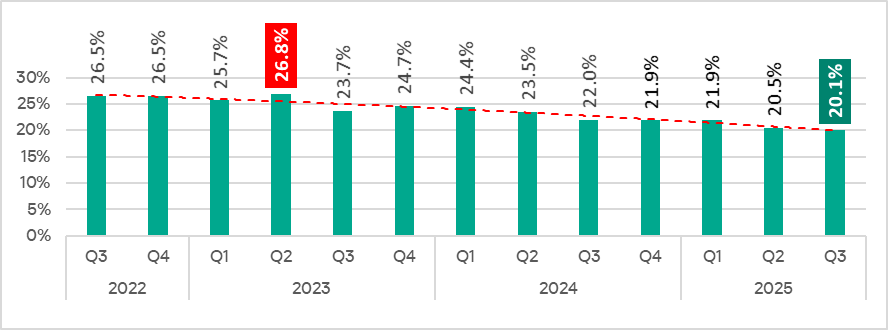
In Q3 2025, the percentage of ICS computers on which malicious objects were blocked decreased from the previous quarter by 0.4 pp to 20.1%. This is the lowest level for the observed period.

Percentage of ICS computers on which malicious objects were blocked, Q3 2022–Q3 2025

Percentage of ICS computers on which malicious objects were blocked, Q3 2022–Q3 2025

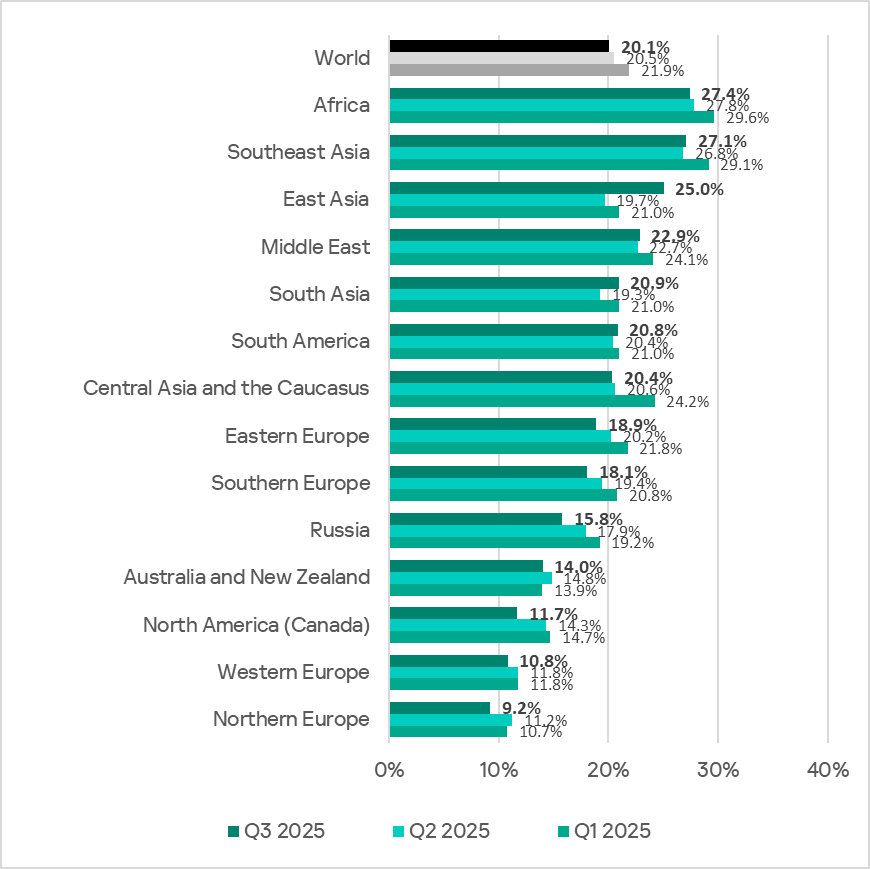
Regionally, the percentage of ICS computers on which malicious objects were blocked ranged from 9.2% in Northern Europe to 27.4% in Africa.

Regions ranked by percentage of ICS computers on which malicious objects were blocked

Regions ranked by percentage of ICS computers on which malicious objects were blocked

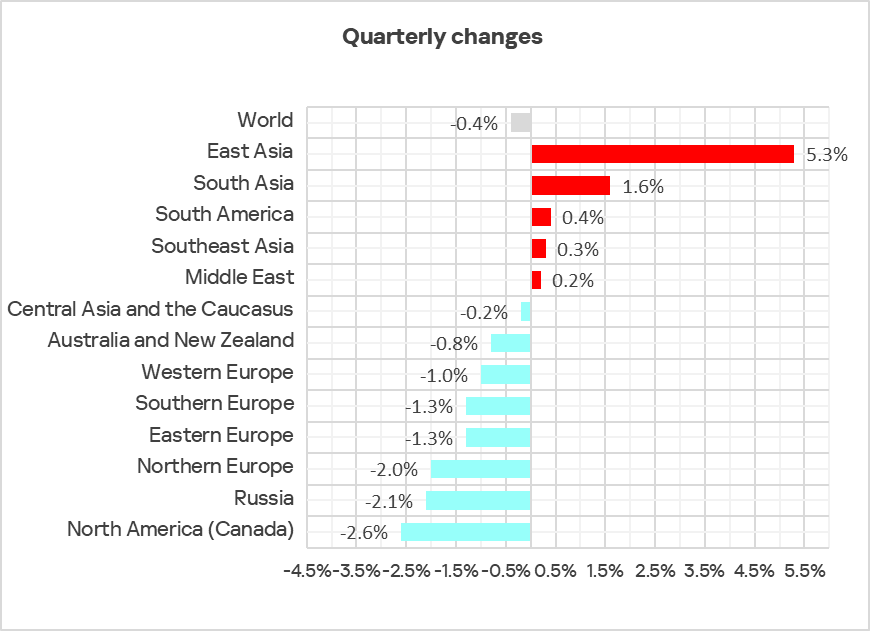
In Q3 2025, the percentage increased in five regions. The most notable increase occurred in East Asia, triggered by the local spread of malicious scripts in the OT infrastructure of engineering organizations and ICS integrators.

Changes in the percentage of ICS computers on which malicious objects were blocked, Q3 2025

Changes in the percentage of ICS computers on which malicious objects were blocked, Q3 2025

Selected industries

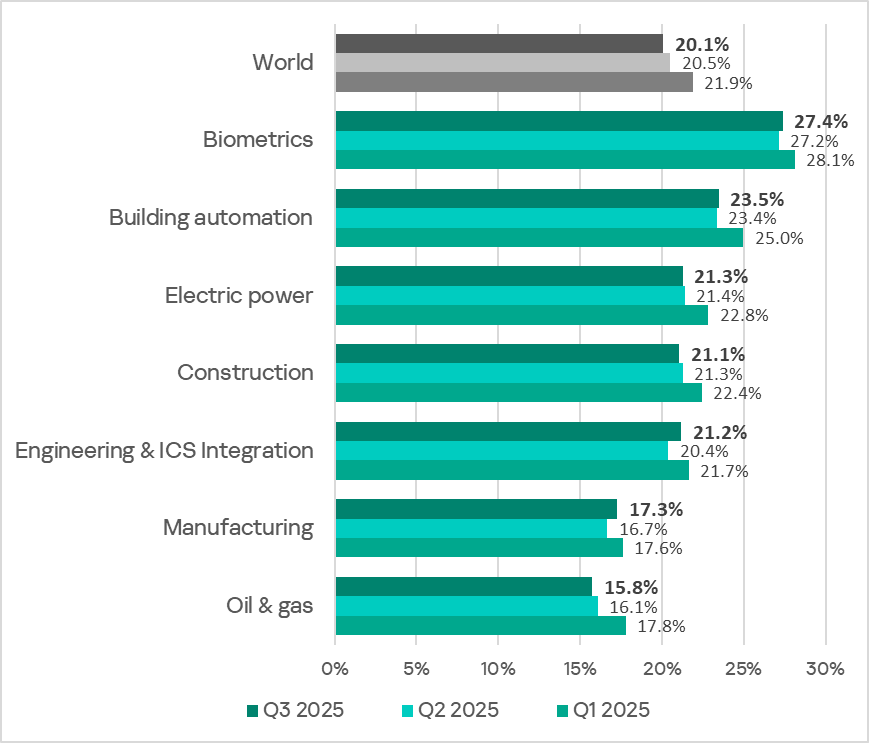
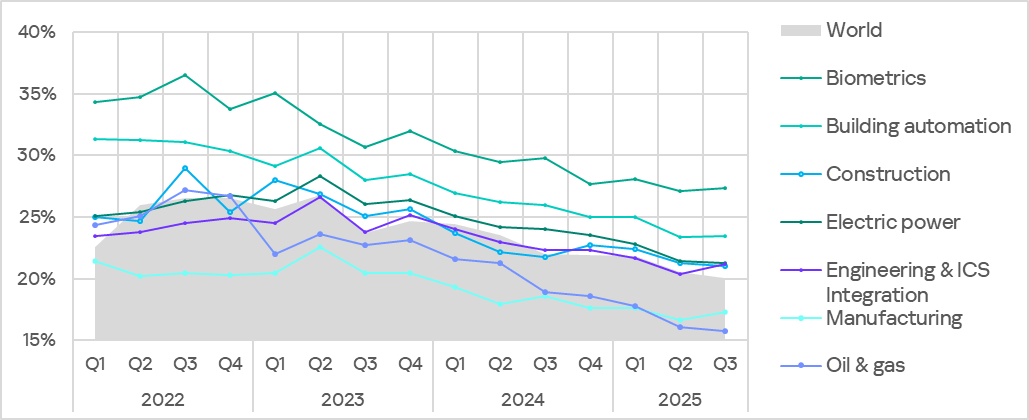
The biometrics sector traditionally led the rankings of the industries and OT infrastructures surveyed in this report in terms of the percentage of ICS computers on which malicious objects were blocked.

Rankings of industries and OT infrastructures by percentage of ICS computers on which malicious objects were blocked

Rankings of industries and OT infrastructures by percentage of ICS computers on which malicious objects were blocked

In Q3 2025, the percentage of ICS computers on which malicious objects were blocked increased in four of the seven surveyed industries. The most notable increases were in engineering and ICS integrators, and manufacturing.

Percentage of ICS computers on which malicious objects were blocked in selected industries

Percentage of ICS computers on which malicious objects were blocked in selected industries

Diversity of detected malicious objects

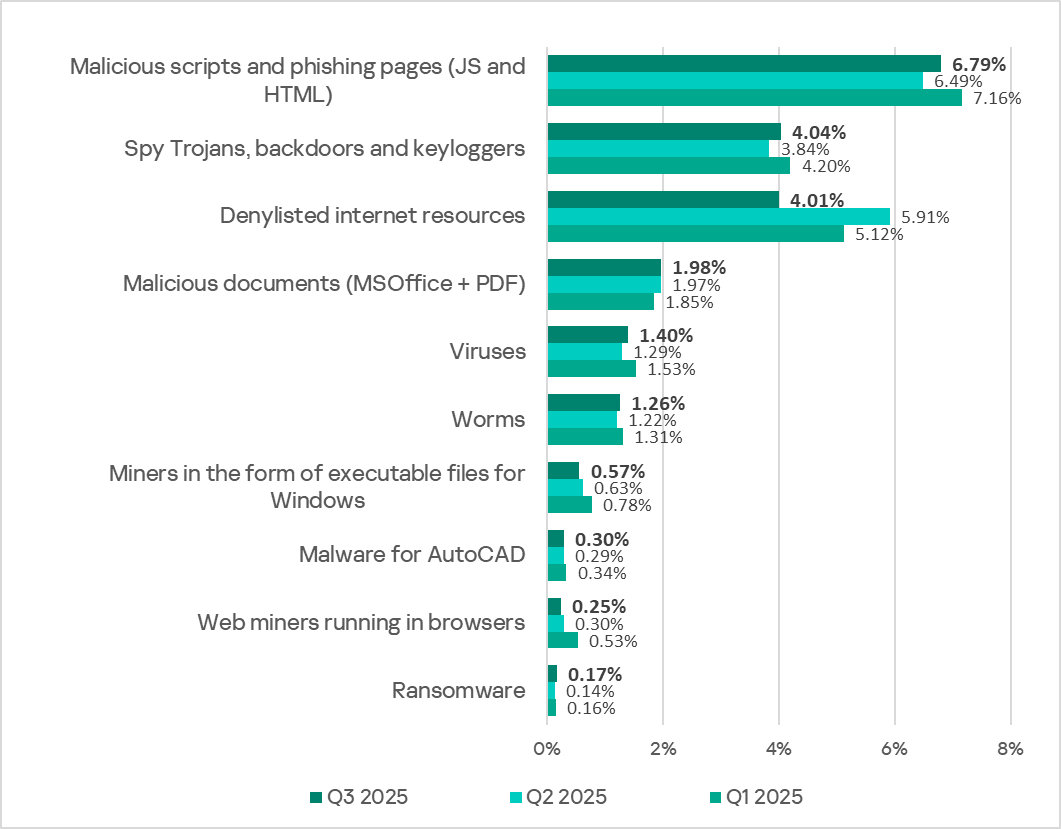
In Q3 2025, Kaspersky protection solutions blocked malware from 11,356 different malware families of various categories on industrial automation systems.

Percentage of ICS computers on which the activity of malicious objects of various categories was blocked

Percentage of ICS computers on which the activity of malicious objects of various categories was blocked

In Q3 2025, there was a decrease in the percentage of ICS computers on which denylisted internet resources and miners of both categories were blocked. These were the only categories that exhibited a decrease.

Main threat sources

Depending on the threat detection and blocking scenario, it is not always possible to reliably identify the source. The circumstantial evidence for a specific source can be the blocked threat’s type (category).

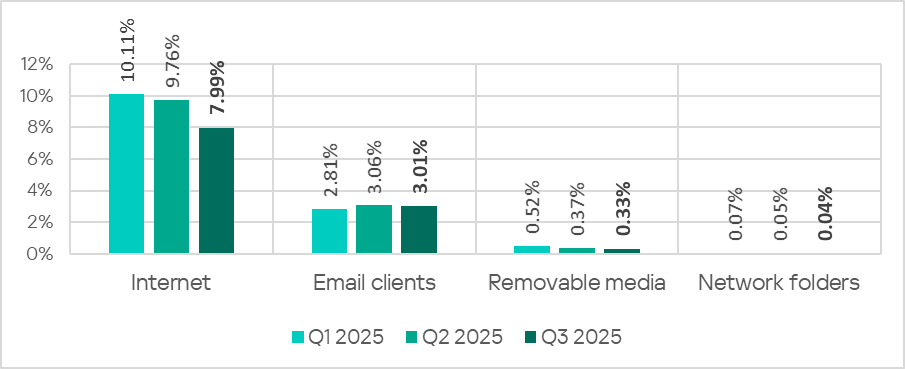
The internet (visiting malicious or compromised internet resources; malicious content distributed via messengers; cloud data storage and processing services and CDNs), email clients (phishing emails), and removable storage devices remain the primary sources of threats to computers in an organization’s technology infrastructure.

In Q3 2025, the percentage of ICS computers on which malicious objects from various sources were blocked decreased.

Percentage of ICS computers on which malicious objects from various sources were blocked

Percentage of ICS computers on which malicious objects from various sources were blocked

The same computer can be attacked by several categories of malware from the same source during a quarter. That computer is counted when calculating the percentage of attacked computers for each threat category, but is only counted once for the threat source (we count unique attacked computers). In addition, it is not always possible to accurately determine the initial infection attempt. Therefore, the total percentage of ICS computers on which various categories of threats from a certain source were blocked can exceed the percentage of threats from the source itself.

  • The main categories of threats from the internet blocked on ICS computers in Q3 2025 were malicious scripts and phishing pages, and denylisted internet resources. The percentage ranged from 4.57% in Northern Europe to 10.31% in Africa.
  • The main categories of threats from email clients blocked on ICS computers were malicious scripts and phishing pages, spyware, and malicious documents. Most of the spyware detected in phishing emails was delivered as a password-protected archive or a multi-layered script embedded in an office document. The percentage of ICS computers on which threats from email clients were blocked ranged from 0.78% in Russia to 6.85% in Southern Europe.
  • The main categories of threats that were blocked when removable media was connected to ICS computers were worms, viruses, and spyware. The percentage of ICS computers on which threats from this source were blocked ranged from 0.05% in Australia and New Zealand to 1.43% in Africa.
  • The main categories of threats that spread through network folders were viruses, AutoCAD malware, worms, and spyware. The percentages of ICS computers where threats from this source were blocked ranged from 0.006% in Northern Europe to 0.20% in East Asia.

Threat categories

Typical attacks blocked within an OT network are multi-step sequences of malicious activities, where each subsequent step of the attackers is aimed at increasing privileges and/or gaining access to other systems by exploiting the security problems of industrial enterprises, including technological infrastructures.

Malicious objects used for initial infection

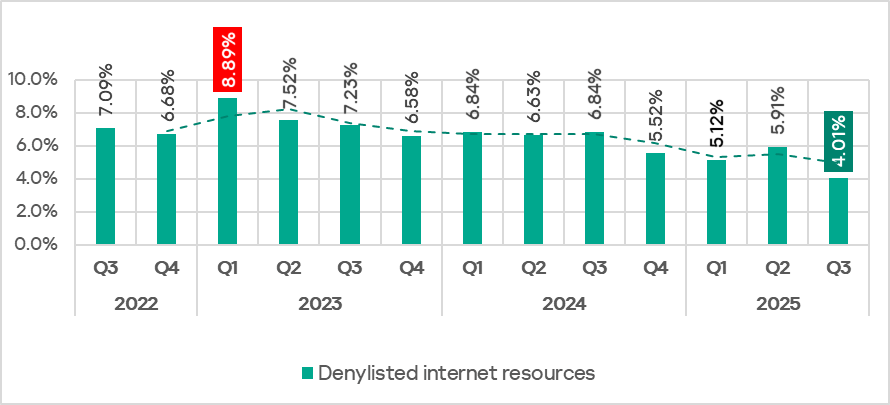
In Q3 2025, the percentage of ICS computers on which denylisted internet resources were blocked decreased to 4.01%. This is the lowest quarterly figure since the beginning of 2022.

Percentage of ICS computers on which denylisted internet resources were blocked, Q3 2022–Q3 2025

Percentage of ICS computers on which denylisted internet resources were blocked, Q3 2022–Q3 2025

Regionally, the percentage of ICS computers on which denylisted internet resources were blocked ranged from 2.35% in Australia and New Zealand to 4.96% in Africa. Southeast Asia and South Asia were also among the top three regions for this indicator.

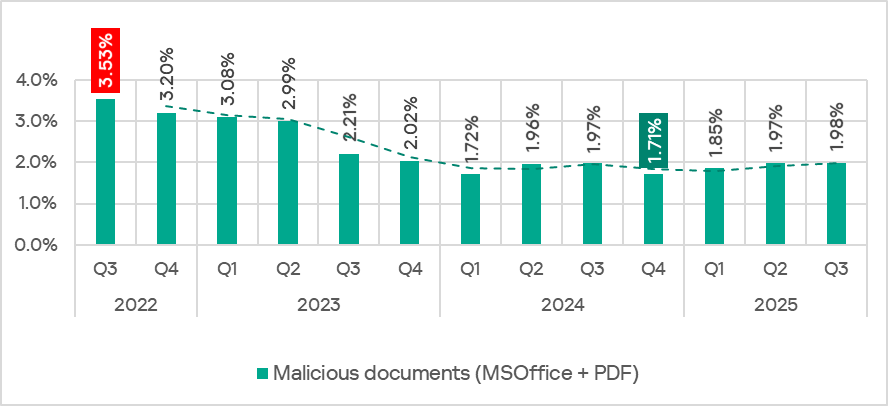
The percentage of ICS computers on which malicious documents were blocked has grown for three consecutive quarters, following a decline at the end of 2024. In Q3 2025, it reached 1,98%.

Percentage of ICS computers on which malicious documents were blocked, Q3 2022–Q3 2025

Percentage of ICS computers on which malicious documents were blocked, Q3 2022–Q3 2025

The indicator increased in four regions: South America, East Asia, Southeast Asia, and Australia and New Zealand. South America saw the largest increase as a result of a large-scale phishing campaign in which attackers used new exploits for an old vulnerability (CVE-2017-11882) in Microsoft Office Equation Editor to deliver various spyware to victims’ computers. It is noteworthy that the attackers in this phishing campaign used localized Spanish-language emails disguised as business correspondence.

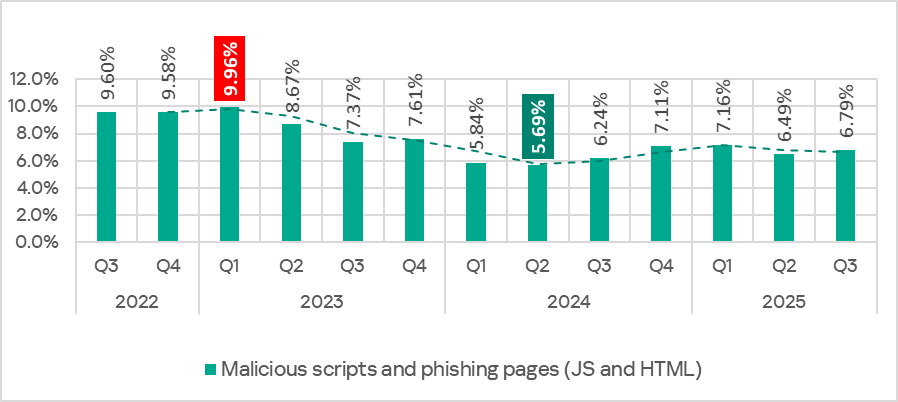
In Q3 2025, the percentage of ICS computers on which malicious scripts and phishing pages were blocked increased to 6.79%. This category led the rankings of threat categories in terms of the percentage of ICS computers on which they were blocked.

Percentage of ICS computers on which malicious scripts and phishing pages were blocked, Q3 2022–Q3 2025

Percentage of ICS computers on which malicious scripts and phishing pages were blocked, Q3 2022–Q3 2025

Regionally, the percentage of ICS computers on which malicious scripts and phishing pages were blocked ranged from 2.57% in Northern Europe to 9.41% in Africa. The top three regions for this indicator were Africa, East Asia, and South America. The indicator increased the most in East Asia (by a dramatic 5.23 pp) as a result of the local spread of malicious spyware scripts loaded into the memory of popular torrent clients including MediaGet.

Next-stage malware

Malicious objects used to initially infect computers deliver next-stage malware — spyware, ransomware, and miners — to victims’ computers. As a rule, the higher the percentage of ICS computers on which the initial infection malware is blocked, the higher the percentage for next-stage malware.
In Q3 2025, the percentage of ICS computers on which spyware and ransomware were blocked increased. The rates were:

  • spyware: 4.04% (up 0.20 pp);
  • ransomware: 0.17% (up 0.03 pp).

The percentage of ICS computers on which miners of both categories were blocked decreased. The rates were:

  • miners in the form of executable files for Windows: 0.57% (down 0.06 pp), it’s the lowest level since Q3 2022;
  • web miners: 0.25% (down 0.05 pp). This is the lowest level since Q3 2022.

Self-propagating malware

Self-propagating malware (worms and viruses) is a category unto itself. Worms and virus-infected files were originally used for initial infection, but as botnet functionality evolved, they took on next-stage characteristics.

To spread across ICS networks, viruses and worms rely on removable media and network folders in the form of infected files, such as archives with backups, office documents, pirated games and hacked applications. In rarer and more dangerous cases, web pages with network equipment settings, as well as files stored in internal document management systems, product lifecycle management (PLM) systems, resource management (ERP) systems and other web services are infected.

In Q3 2025, the percentage of ICS computers on which worms and viruses were blocked increased to 1.26% (by 0.04 pp) and 1.40% (by 0.11 pp), respectively.

AutoCAD malware

This category of malware can spread in a variety of ways, so it does not belong to a specific group.

In Q3 2025, the percentage of ICS computers on which AutoCAD malware was blocked slightly increased to 0.30% (by 0.01 pp).

For more information on industrial threats see the full version of the report.

Threat landscape for industrial automation systems in Q3 2025

25 December 2025 at 11:00

Statistics across all threats

In Q3 2025, the percentage of ICS computers on which malicious objects were blocked decreased from the previous quarter by 0.4 pp to 20.1%. This is the lowest level for the observed period.

Percentage of ICS computers on which malicious objects were blocked, Q3 2022–Q3 2025

Percentage of ICS computers on which malicious objects were blocked, Q3 2022–Q3 2025

Regionally, the percentage of ICS computers on which malicious objects were blocked ranged from 9.2% in Northern Europe to 27.4% in Africa.

Regions ranked by percentage of ICS computers on which malicious objects were blocked

Regions ranked by percentage of ICS computers on which malicious objects were blocked

In Q3 2025, the percentage increased in five regions. The most notable increase occurred in East Asia, triggered by the local spread of malicious scripts in the OT infrastructure of engineering organizations and ICS integrators.

Changes in the percentage of ICS computers on which malicious objects were blocked, Q3 2025

Changes in the percentage of ICS computers on which malicious objects were blocked, Q3 2025

Selected industries

The biometrics sector traditionally led the rankings of the industries and OT infrastructures surveyed in this report in terms of the percentage of ICS computers on which malicious objects were blocked.

Rankings of industries and OT infrastructures by percentage of ICS computers on which malicious objects were blocked

Rankings of industries and OT infrastructures by percentage of ICS computers on which malicious objects were blocked

In Q3 2025, the percentage of ICS computers on which malicious objects were blocked increased in four of the seven surveyed industries. The most notable increases were in engineering and ICS integrators, and manufacturing.

Percentage of ICS computers on which malicious objects were blocked in selected industries

Percentage of ICS computers on which malicious objects were blocked in selected industries

Diversity of detected malicious objects

In Q3 2025, Kaspersky protection solutions blocked malware from 11,356 different malware families of various categories on industrial automation systems.

Percentage of ICS computers on which the activity of malicious objects of various categories was blocked

Percentage of ICS computers on which the activity of malicious objects of various categories was blocked

In Q3 2025, there was a decrease in the percentage of ICS computers on which denylisted internet resources and miners of both categories were blocked. These were the only categories that exhibited a decrease.

Main threat sources

Depending on the threat detection and blocking scenario, it is not always possible to reliably identify the source. The circumstantial evidence for a specific source can be the blocked threat’s type (category).

The internet (visiting malicious or compromised internet resources; malicious content distributed via messengers; cloud data storage and processing services and CDNs), email clients (phishing emails), and removable storage devices remain the primary sources of threats to computers in an organization’s technology infrastructure.

In Q3 2025, the percentage of ICS computers on which malicious objects from various sources were blocked decreased.

Percentage of ICS computers on which malicious objects from various sources were blocked

Percentage of ICS computers on which malicious objects from various sources were blocked

The same computer can be attacked by several categories of malware from the same source during a quarter. That computer is counted when calculating the percentage of attacked computers for each threat category, but is only counted once for the threat source (we count unique attacked computers). In addition, it is not always possible to accurately determine the initial infection attempt. Therefore, the total percentage of ICS computers on which various categories of threats from a certain source were blocked can exceed the percentage of threats from the source itself.

  • The main categories of threats from the internet blocked on ICS computers in Q3 2025 were malicious scripts and phishing pages, and denylisted internet resources. The percentage ranged from 4.57% in Northern Europe to 10.31% in Africa.
  • The main categories of threats from email clients blocked on ICS computers were malicious scripts and phishing pages, spyware, and malicious documents. Most of the spyware detected in phishing emails was delivered as a password-protected archive or a multi-layered script embedded in an office document. The percentage of ICS computers on which threats from email clients were blocked ranged from 0.78% in Russia to 6.85% in Southern Europe.
  • The main categories of threats that were blocked when removable media was connected to ICS computers were worms, viruses, and spyware. The percentage of ICS computers on which threats from this source were blocked ranged from 0.05% in Australia and New Zealand to 1.43% in Africa.
  • The main categories of threats that spread through network folders were viruses, AutoCAD malware, worms, and spyware. The percentages of ICS computers where threats from this source were blocked ranged from 0.006% in Northern Europe to 0.20% in East Asia.

Threat categories

Typical attacks blocked within an OT network are multi-step sequences of malicious activities, where each subsequent step of the attackers is aimed at increasing privileges and/or gaining access to other systems by exploiting the security problems of industrial enterprises, including technological infrastructures.

Malicious objects used for initial infection

In Q3 2025, the percentage of ICS computers on which denylisted internet resources were blocked decreased to 4.01%. This is the lowest quarterly figure since the beginning of 2022.

Percentage of ICS computers on which denylisted internet resources were blocked, Q3 2022–Q3 2025

Percentage of ICS computers on which denylisted internet resources were blocked, Q3 2022–Q3 2025

Regionally, the percentage of ICS computers on which denylisted internet resources were blocked ranged from 2.35% in Australia and New Zealand to 4.96% in Africa. Southeast Asia and South Asia were also among the top three regions for this indicator.

The percentage of ICS computers on which malicious documents were blocked has grown for three consecutive quarters, following a decline at the end of 2024. In Q3 2025, it reached 1,98%.

Percentage of ICS computers on which malicious documents were blocked, Q3 2022–Q3 2025

Percentage of ICS computers on which malicious documents were blocked, Q3 2022–Q3 2025

The indicator increased in four regions: South America, East Asia, Southeast Asia, and Australia and New Zealand. South America saw the largest increase as a result of a large-scale phishing campaign in which attackers used new exploits for an old vulnerability (CVE-2017-11882) in Microsoft Office Equation Editor to deliver various spyware to victims’ computers. It is noteworthy that the attackers in this phishing campaign used localized Spanish-language emails disguised as business correspondence.

In Q3 2025, the percentage of ICS computers on which malicious scripts and phishing pages were blocked increased to 6.79%. This category led the rankings of threat categories in terms of the percentage of ICS computers on which they were blocked.

Percentage of ICS computers on which malicious scripts and phishing pages were blocked, Q3 2022–Q3 2025

Percentage of ICS computers on which malicious scripts and phishing pages were blocked, Q3 2022–Q3 2025

Regionally, the percentage of ICS computers on which malicious scripts and phishing pages were blocked ranged from 2.57% in Northern Europe to 9.41% in Africa. The top three regions for this indicator were Africa, East Asia, and South America. The indicator increased the most in East Asia (by a dramatic 5.23 pp) as a result of the local spread of malicious spyware scripts loaded into the memory of popular torrent clients including MediaGet.

Next-stage malware

Malicious objects used to initially infect computers deliver next-stage malware — spyware, ransomware, and miners — to victims’ computers. As a rule, the higher the percentage of ICS computers on which the initial infection malware is blocked, the higher the percentage for next-stage malware.
In Q3 2025, the percentage of ICS computers on which spyware and ransomware were blocked increased. The rates were:

  • spyware: 4.04% (up 0.20 pp);
  • ransomware: 0.17% (up 0.03 pp).

The percentage of ICS computers on which miners of both categories were blocked decreased. The rates were:

  • miners in the form of executable files for Windows: 0.57% (down 0.06 pp), it’s the lowest level since Q3 2022;
  • web miners: 0.25% (down 0.05 pp). This is the lowest level since Q3 2022.

Self-propagating malware

Self-propagating malware (worms and viruses) is a category unto itself. Worms and virus-infected files were originally used for initial infection, but as botnet functionality evolved, they took on next-stage characteristics.

To spread across ICS networks, viruses and worms rely on removable media and network folders in the form of infected files, such as archives with backups, office documents, pirated games and hacked applications. In rarer and more dangerous cases, web pages with network equipment settings, as well as files stored in internal document management systems, product lifecycle management (PLM) systems, resource management (ERP) systems and other web services are infected.

In Q3 2025, the percentage of ICS computers on which worms and viruses were blocked increased to 1.26% (by 0.04 pp) and 1.40% (by 0.11 pp), respectively.

AutoCAD malware

This category of malware can spread in a variety of ways, so it does not belong to a specific group.

In Q3 2025, the percentage of ICS computers on which AutoCAD malware was blocked slightly increased to 0.30% (by 0.01 pp).

For more information on industrial threats see the full version of the report.

From Linear to Complex: An Upgrade in RansomHouse Encryption

17 December 2025 at 12:00

Operators behind RansomHouse, a ransomware-as-a-service (RaaS) group, have upgraded their encryption methods from single-phase to complex and layered.

The post From Linear to Complex: An Upgrade in RansomHouse Encryption appeared first on Unit 42.

01flip: Multi-Platform Ransomware Written in Rust

10 December 2025 at 12:00

01flip is a new ransomware family fully written in Rust. Activity linked to 01flip points to alleged dark web data leaks.

The post 01flip: Multi-Platform Ransomware Written in Rust appeared first on Unit 42.

Flashpoint’s Top 5 Predictions for the 2026 Threat Landscape

Blogs

Blog

Flashpoint’s Top 5 Predictions for the 2026 Threat Landscape

Flashpoint’s forward-looking threat insights for security and executive teams, provides the strategic foresight needed to prepare for the convergence of AI, identity, and physical security threats in 2026.

SHARE THIS:
Default Author Image
December 2, 2025

As the global threat landscape accelerates its transformation, 2026 marks an inflection point requiring defensive strategies to fundamentally shift. The volatility observed in 2025 has paved the way for an era soon to be defined by AI-weaponized autonomy, information-stealing malware, systemic instability of public vulnerability systems, and the complete convergence of digital and physical risk.

Flashpoint offers a unique window into these complexities, providing organizations with the foresight needed to navigate what lies ahead. Drawing from Flashpoint’s leading intelligence and primary source collections, we highlight five key trends shaping the 2026 threat landscape. These insights aim to help organizations not only understand what’s next but also build the resilience needed to withstand and adapt to emerging challenges.

Prediction 1: Agentic AI Threats Will Weaponize Autonomy, Forcing a New Defensive Standard

2026 will see continued evolution of AI threats, with future attacks centering on autonomy and integration. Across the deep and dark web, Flashpoint is observing threat actors move past experimentation and into operational use of illegal AI. 

As attackers train custom fraud-tuned LLMs (Large Language Models) and multilingual phishing tools directly on illicit data, these AI models will become more capable. The criminal intent shaping their misuse will also become more sophisticated. Additionally, 2026 will see a greater marketplace for paid jailbreaking communities and synthetic media kits for KYC (Know Your Customer) bypass.

These advancements are enabling criminals to move beyond simple tools and engage in scaled, autonomous fraud operations, leading to two major shifts:

  1. Agentic AI is becoming the true flashpoint: Threat actors will be using agentic systems to automate reconnaissance, generate synthetic identities, and iterate on fraud playbooks in near real-time. In this SaaS ecosystem, AI will help attackers leverage subscription tiers and customer feedback loops at scale.
  2. The attack surface will shift to focus on AI Integrations: Organizations are increasingly plugging LLMs into live data streams, internal tools, identity systems, and autonomous agents. This practice often lacks the same security vetting, access controls, and monitoring applied to other enterprise systems. As such, attackers will heavily target these integrations, such as APIs, plugins, and system connections, rather than the models themselves.

The ubiquity of automation has dramatically increased attack tempo, leaving many security teams behind the curve. While automation can replace repetitive tasks across the enterprise, organizations must not make the critical mistake of substituting human judgement for AI at the intelligence level.

This is paramount because a critical threat in 2026 is Agentic AI autonomy weaponized against soft targets—API integrations and identity systems. The only winning defense will be human-led and AI-scaled, prioritizing purposeful use to keep organizations ahead of this exponential risk.

Josh Lefkowitz, CEO at Flashpoint

These evolving AI threats will force a fundamental shift in defensive strategies. Defenders will have to shift to deploying systems around AI rather than trust them on their own.

Prediction 2: Identity Compromise via Infostealers Will Become the Foundation of Every Attack

Infostealers will become the entry point, the data broker, the reconnaissance layer, and the fuel for everything that comes after a cyberattack. This shift is already in motion and is accelerating rapidly: in just the first half of 2025, infostealers were responsible for 1.8 billion stolen credentials, an 800% spike from the start of the year. However, 2026 will redefine the malware’s role, making its most valuable output being access, rather than disruption.

Infostealers will become the upstream event that powers the rest of the attack chain. Identity and session data will be increasingly targeted, since it gives attackers immediate access into victim environments. Ransomware, fraud, data theft, and extortion will simply be downstream ways to monetize.

This upstream approach defines the new reality of the attack chain, which is already operational. Nearly every major stealer strain Flashpoint observes now exfiltrates the following:

  • Autofill PII (personable identifiable information)
  • Saved addresses
  • Phone numbers
  • Internal URLs
  • Browsing history
  • Cloud app tokens

An organization’s attack surface is no longer just composed of their own networks. It is the entire digital identity of their employees and partners. This new reality requires security teams to take a new approach. Instead of attempting to block attacks, they must proactively detect compromised credentials before they are weaponized. This will be the difference between reacting to a data breach and preventing one.

The infostealer economy has fully industrialized the attack chain, making initial compromise a low-cost commodity. Multiple security incidents in 2025 tie back to credentials found in infostealer logs. This reality has underscored the critical importance of digital trust—specifically, verifying who can access what resources. For 2026, identity is the perimeter to watch, and security teams must proactively hunt for compromised credentials before they’re weaponized.

Ian Gray, Vice President of Intelligence at Flashpoint

Prediction 3: CVE Volatility Will Force Redundancy in Vulnerability Intelligence

The temporary funding crisis at CVE in April 2025 and the subsequent CISA stopgap extension through March 2026 exposed the systemic fragility of a centralized vulnerability intelligence model. With the future of the CVE/NVD system hanging in the balance, 2026 will be defined by the urgent need for redundancy and diversification in vulnerability intelligence.

In today’s vulnerability intelligence ecosystem, nearly every organization’s vulnerability management framework relies on CVE and NVD—including its “alternatives” such as the EUVD (European Union Vulnerability Database). The CVE system has grown into a critical global cybersecurity utility, relied upon by nearly all vulnerability scanners, SIEM platforms, patch management tools, threat intelligence feeds, and compliance reports. A complete shutdown of CVE would result in a widespread loss of institutional infrastructure.

The next generation of security needs to be built on practices that are resilient, diversified, and intelligence-driven. It should be focused on providing insights that can be used to take action such as threat actor behavior, likelihood of exploitation in the wild, relevance to ransomware campaigns, and business context. Security teams will need to leverage a comprehensive source of vulnerability intelligence such as Flashpoint’s VulnDB that provides full coverage for CVE, while also cataloging more than 100,000 vulnerabilities missed by CVE and NVD.

Prediction 4: Executive Protection Will Remain a Critical Challenge as Cyber-Physical Threats Converge

The continued blurring of lines between cyber, physical, and geopolitical threats will elevate the risk to organizational leadership, turning executive protection into a holistic intelligence function in 2026. The rise of information warfare combined with physical world convergence means the threat to key personnel is no longer purely digital.

In the aftermath of the tragic December 2024 assassination of United Healthcare’s CEO, Flashpoint has seen the continued circulation and glorification of “wanted-style posters” of executives in extremist communities. Additionally, Flashpoint has seen nation-state actors participate, using espionage and influence to target high-value individuals.
Organizations must adopt an integrated approach that connects insights from threat actor chatter and a wealth of other OSINT sources. This fusion of intelligence is essential for applying frameworks to ensure the safety of leadership and key personnel.

Prediction 5: Extortion Shifts to Identity-Based Supply Chain Risk

2025 was marked by several large-scale extortion campaigns, demonstrating how the threat landscape is rapidly evolving. Ransomware operations have shifted into a straight extortion play. Flashpoint has observed a surge in new entrants to the ransomware market, accompanied by a decline in the quality and decorum of ransomware groups.

Furthermore, vishing campaigns attributed to “Scattered Spider” have highlighted weaknesses in identity, trust, and verification. Campaigns from “Scattered LAPSUS$ Hunters” have also exposed vulnerabilities in third-party integrations. These attacks culminated in extortion, showcasing that modern attacks will target trusted users and trusted applications for initial access, and will forgo ransomware in place of data access.

As this shift continues into 2026, threat actors will increasingly focus their efforts on exploiting human behavior and identity systems. Instead of attempting to spend resources on breaking network perimeters, attackers will instead socially engineer employees to gain access to corporate systems at scale. This change in TTPs will undoubtedly greatly increase supply chain risk, especially for third parties.

Charting a Path Through an Evolving Threat Landscape with Flashpoint Intelligence

These five predictions highlight the transformative trends shaping the future of cybersecurity and threat intelligence. Staying ahead of these challenges demands more than just reactive measures—it requires actionable intelligence, strategic foresight, and cross-sector collaboration. By embracing these principles and investing in proactive security strategies, organizations can not only mitigate risks but also seize opportunities to enhance their resilience.

As the threat landscape continues to rapidly evolve, staying informed and prepared are critical components of risk mitigation. With the right tools, insights, and partnerships, security teams can navigate the complexities ahead and safeguard what matters most.

Request a demo.

The post Flashpoint’s Top 5 Predictions for the 2026 Threat Landscape appeared first on Flashpoint.

Meet Rey, the Admin of ‘Scattered Lapsus$ Hunters’

26 November 2025 at 18:22

A prolific cybercriminal group that calls itself “Scattered LAPSUS$ Hunters” has dominated headlines this year by regularly stealing data from and publicly mass extorting dozens of major corporations. But the tables seem to have turned somewhat for “Rey,” the moniker chosen by the technical operator and public face of the hacker group: Earlier this week, Rey confirmed his real life identity and agreed to an interview after KrebsOnSecurity tracked him down and contacted his father.

Scattered LAPSUS$ Hunters (SLSH) is thought to be an amalgamation of three hacking groups — Scattered Spider, LAPSUS$ and ShinyHunters. Members of these gangs hail from many of the same chat channels on the Com, a mostly English-language cybercriminal community that operates across an ocean of Telegram and Discord servers.

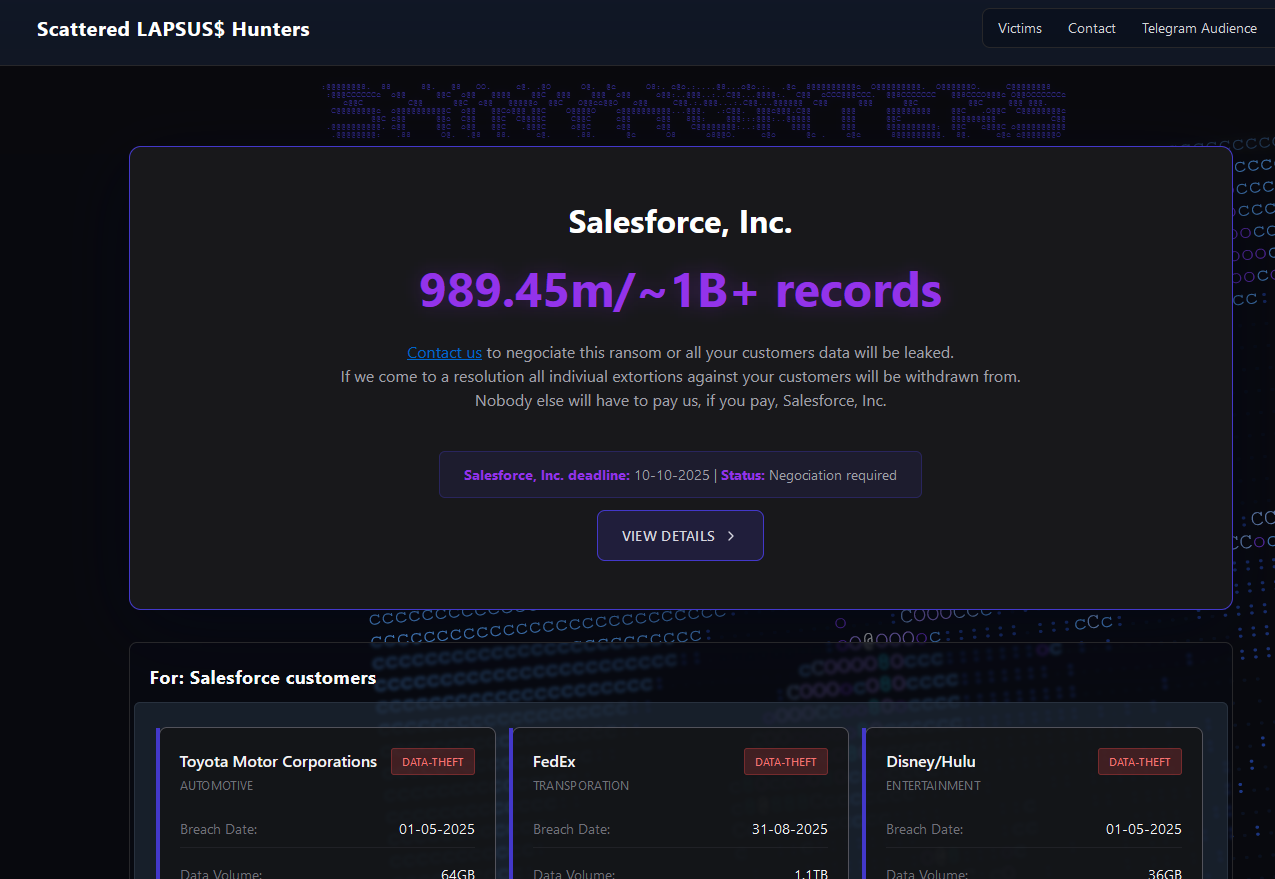
In May 2025, SLSH members launched a social engineering campaign that used voice phishing to trick targets into connecting a malicious app to their organization’s Salesforce portal. The group later launched a data leak portal that threatened to publish the internal data of three dozen companies that allegedly had Salesforce data stolen, including ToyotaFedExDisney/Hulu, and UPS.

The new extortion website tied to ShinyHunters, which threatens to publish stolen data unless Salesforce or individual victim companies agree to pay a ransom.

Last week, the SLSH Telegram channel featured an offer to recruit and reward “insiders,” employees at large companies who agree to share internal access to their employer’s network for a share of whatever ransom payment is ultimately paid by the victim company.

SLSH has solicited insider access previously, but their latest call for disgruntled employees started making the rounds on social media at the same time news broke that the cybersecurity firm Crowdstrike had fired an employee for allegedly sharing screenshots of internal systems with the hacker group (Crowdstrike said their systems were never compromised and that it has turned the matter over to law enforcement agencies).

The Telegram server for the Scattered LAPSUS$ Hunters has been attempting to recruit insiders at large companies.

Members of SLSH have traditionally used other ransomware gangs’ encryptors in attacks, including malware from ransomware affiliate programs like ALPHV/BlackCat, Qilin, RansomHub, and DragonForce. But last week, SLSH announced on its Telegram channel the release of their own ransomware-as-a-service operation called ShinySp1d3r.

The individual responsible for releasing the ShinySp1d3r ransomware offering is a core SLSH member who goes by the handle “Rey” and who is currently one of just three administrators of the SLSH Telegram channel. Previously, Rey was an administrator of the data leak website for Hellcat, a ransomware group that surfaced in late 2024 and was involved in attacks on companies including Schneider Electric, Telefonica, and Orange Romania.

A recent, slightly redacted screenshot of the Scattered LAPSUS$ Hunters Telegram channel description, showing Rey as one of three administrators.

Also in 2024, Rey would take over as administrator of the most recent incarnation of BreachForums, an English-language cybercrime forum whose domain names have been seized on multiple occasions by the FBI and/or by international authorities. In April 2025, Rey posted on Twitter/X about another FBI seizure of BreachForums.

On October 5, 2025, the FBI announced it had once again seized the domains associated with BreachForums, which it described as a major criminal marketplace used by ShinyHunters and others to traffic in stolen data and facilitate extortion.

“This takedown removes access to a key hub used by these actors to monetize intrusions, recruit collaborators, and target victims across multiple sectors,” the FBI said.

Incredibly, Rey would make a series of critical operational security mistakes last year that provided multiple avenues to ascertain and confirm his real-life identity and location. Read on to learn how it all unraveled for Rey.

WHO IS REY?

According to the cyber intelligence firm Intel 471, Rey was an active user on various BreachForums reincarnations over the past two years, authoring more than 200 posts between February 2024 and July 2025. Intel 471 says Rey previously used the handle “Hikki-Chan” on BreachForums, where their first post shared data allegedly stolen from the U.S. Centers for Disease Control and Prevention (CDC).

In that February 2024 post about the CDC, Hikki-Chan says they could be reached at the Telegram username @wristmug. In May 2024, @wristmug posted in a Telegram group chat called “Pantifan” a copy of an extortion email they said they received that included their email address and password.

The message that @wristmug cut and pasted appears to have been part of an automated email scam that claims it was sent by a hacker who has compromised your computer and used your webcam to record a video of you while you were watching porn. These missives threaten to release the video to all your contacts unless you pay a Bitcoin ransom, and they typically reference a real password the recipient has used previously.

“Noooooo,” the @wristmug account wrote in mock horror after posting a screenshot of the scam message. “I must be done guys.”

A message posted to Telegram by Rey/@wristmug.

In posting their screenshot, @wristmug redacted the username portion of the email address referenced in the body of the scam message. However, they did not redact their previously-used password, and they left the domain portion of their email address (@proton.me) visible in the screenshot.

O5TDEV

Searching on @wristmug’s rather unique 15-character password in the breach tracking service Spycloud finds it is known to have been used by just one email address: cybero5tdev@proton.me. According to Spycloud, those credentials were exposed at least twice in early 2024 when this user’s device was infected with an infostealer trojan that siphoned all of its stored usernames, passwords and authentication cookies (a finding that was initially revealed in March 2025 by the cyber intelligence firm KELA).

Intel 471 shows the email address cybero5tdev@proton.me belonged to a BreachForums member who went by the username o5tdev. Searching on this nickname in Google brings up at least two website defacement archives showing that a user named o5tdev was previously involved in defacing sites with pro-Palestinian messages. The screenshot below, for example, shows that 05tdev was part of a group called Cyb3r Drag0nz Team.

Rey/o5tdev’s defacement pages. Image: archive.org.

A 2023 report from SentinelOne described Cyb3r Drag0nz Team as a hacktivist group with a history of launching DDoS attacks and cyber defacements as well as engaging in data leak activity.

“Cyb3r Drag0nz Team claims to have leaked data on over a million of Israeli citizens spread across multiple leaks,” SentinelOne reported. “To date, the group has released multiple .RAR archives of purported personal information on citizens across Israel.”

The cyber intelligence firm Flashpoint finds the Telegram user @05tdev was active in 2023 and early 2024, posting in Arabic on anti-Israel channels like “Ghost of Palestine” [full disclosure: Flashpoint is currently an advertiser on this blog].

‘I’M A GINTY’

Flashpoint shows that Rey’s Telegram account (ID7047194296) was particularly active in a cybercrime-focused channel called Jacuzzi, where this user shared several personal details, including that their father was an airline pilot. Rey claimed in 2024 to be 15 years old, and to have family connections to Ireland.

Specifically, Rey mentioned in several Telegram chats that he had Irish heritage, even posting a graphic that shows the prevalence of the surname “Ginty.”

Rey, on Telegram claiming to have association to the surname “Ginty.” Image: Flashpoint.

Spycloud indexed hundreds of credentials stolen from cybero5dev@proton.me, and those details indicate that Rey’s computer is a shared Microsoft Windows device located in Amman, Jordan. The credential data stolen from Rey in early 2024 show there are multiple users of the infected PC, but that all shared the same last name of Khader and an address in Amman, Jordan.

The “autofill” data lifted from Rey’s family PC contains an entry for a 46-year-old Zaid Khader that says his mother’s maiden name was Ginty. The infostealer data also shows Zaid Khader frequently accessed internal websites for employees of Royal Jordanian Airlines.

MEET SAIF

The infostealer data makes clear that Rey’s full name is Saif Al-Din Khader. Having no luck contacting Saif directly, KrebsOnSecurity sent an email to his father Zaid. The message invited the father to respond via email, phone or Signal, explaining that his son appeared to be deeply enmeshed in a serious cybercrime conspiracy.

Less than two hours later, I received a Signal message from Saif, who said his dad suspected the email was a scam and had forwarded it to him.

“I saw your email, unfortunately I don’t think my dad would respond to this because they think its some ‘scam email,'” said Saif, who told me he turns 16 years old next month. “So I decided to talk to you directly.”

Saif explained that he’d already heard from European law enforcement officials, and had been trying to extricate himself from SLSH. When asked why then he was involved in releasing SLSH’s new ShinySp1d3r ransomware-as-a-service offering, Saif said he couldn’t just suddenly quit the group.

“Well I cant just dip like that, I’m trying to clean up everything I’m associated with and move on,” he said.

The former Hellcat ransomware site. Image: Kelacyber.com

He also shared that ShinySp1d3r is just a rehash of Hellcat ransomware, except modified with AI tools. “I gave the source code of Hellcat ransomware out basically.”

Saif claims he reached out on his own recently to the Telegram account for Operation Endgame, the codename for an ongoing law enforcement operation targeting cybercrime services, vendors and their customers.

“I’m already cooperating with law enforcement,” Saif said. “In fact, I have been talking to them since at least June. I have told them nearly everything. I haven’t really done anything like breaching into a corp or extortion related since September.”

Saif suggested that a story about him right now could endanger any further cooperation he may be able to provide. He also said he wasn’t sure if the U.S. or European authorities had been in contact with the Jordanian government about his involvement with the hacking group.

“A story would bring so much unwanted heat and would make things very difficult if I’m going to cooperate,” Saif said. “I’m unsure whats going to happen they said they’re in contact with multiple countries regarding my request but its been like an entire week and I got no updates from them.”

Saif shared a screenshot that indicated he’d contacted Europol authorities late last month. But he couldn’t name any law enforcement officials he said were responding to his inquiries, and KrebsOnSecurity was unable to verify his claims.

“I don’t really care I just want to move on from all this stuff even if its going to be prison time or whatever they gonna say,” Saif said.

The Dual-Use Dilemma of AI: Malicious LLMs

25 November 2025 at 12:00

The line between research tool and threat creation engine is thin. We examine the capabilities of WormGPT 4 and KawaiiGPT, two malicious LLMs.

The post The Dual-Use Dilemma of AI: Malicious LLMs appeared first on Unit 42.

Tips to make your summer travels cyber safe

17 June 2025 at 15:51

Ready, set, pack! Summer travel season is here and that means family road trips, beach vacations, international adventures and more. While summertime is prime time for getaways, did you know it’s also prime time for online fraud? Scammers are targeting the travel industry, putting millions of travelers at increased risk. Research shows that the travel and tourism sector ranked third in cyberattacks, with nearly 31% of hospitality organizations experiencing a data breach and a record 340 million people affected by cybercrimes. According to Mastercard, travel-related fraud in 2024 increased by 18% during the summer peak season and 28% in the winter peak season. 

Why travelers are prime targets

Being in an unfamiliar environment can put your personal information at risk if you’re relying on public Wi-Fi networks, using shared devices, and carrying valuable personal and business data on mobile devices. Let’s be honest, when you go into “vacation mode” and start relaxing, it’s only natural that you might also start letting your guard down. Even the best trips can have stressful moments, and when you miss a flight or get lost in a new destination, it’s easy to become less vigilant about protecting your cybersecurity. This is especially true when you travel to foreign countries. In fact, 90% of international travelers admit to risky tech practices while abroad. Fewer than 1 in 3 travelers (31%) protect their data with a virtual private network (VPN) when traveling internationally.

What to know before you go

Believe it or not, the risks to your data security start long before your vacation begins. As soon as you start booking your trip, the cybercriminals start circling. Fraud rates in sectors associated with the early stages of trip planning increased more than 12% between 2023 and 2024. At a time when inflation and economic pressures are on the rise, people are looking for deep discounts, and scammers are seizing the opportunity to steal your private data and your money.

  • Fake travel websites and rental listings: When you find a killer price on a luxury cruise, a European tour or an oceanfront Airbnb, take another look before you book! Scammers use phony offers, manipulated destination photos, and fake confirmation links to lure victims into “purchasing” great travel deals. Always double check and confirm you’re dealing with a legitimate website or listing before you hand over any credit card information.
  • Phishing scams: Phishing scams that target travel-related platforms are on the rise. Cybercriminals pose as legitimate organizations and use fake emails, text messages and phone calls to lure you into giving up financial information. These messages often ask you to click on links that embed malicious software onto your device and steal your sensitive data. In 2024, the travel website booking.com reported a 500%-900% increase in travel-related phishing scams. This rise was attributed to the large number of scams using AI, making it easier for criminals to mimic trusted sources. If you get a suspicious message, call the company or go to their website and log in directly before clicking on any links.
  • Loyalty fraud: Loyalty fraud, also known as points fraud, happens when scammers steal points or personal information from a loyalty program. The travel industry is especially vulnerable to this type of attack because so many travel-related companies, including travel agents, cruise lines, airlines and hotels, offer points programs for frequent travelers. Thieves often access loyalty accounts with credentials stolen in a data breach. Be sure to create strong passwords for your accounts and check your balances regularly.

Pre-trip security

Before you hit the road, help protect your digital data and devices with a few simple security practices.

  • Alert your financial institutions: Only about half of travelers (52%) alert their financial institutions before traveling abroad, but it’s a powerful way to fight cybercrime. When banks and credit card companies know your travel plans, it’s much easier for them to flag any suspicious transactions.
  • Turn off your Bluetooth:  Bluetooth technology automatically creates wireless connections and can give cybercriminals the ability to see what apps and websites you’re logged into. Only 44% of travelers say they make sure to turn off their Bluetooth signal, but it’s a simple way to thwart hackers. It’s also a good idea to turn off device sharing features and update your passwords before a trip.
  • Update your Wi-Fi setting: Joining unknown Wi-Fi networks is very risky and can open up your personal data to hackers. Since public Wi-Fi often has weak security,  it’s important that your phone doesn’t connect to unsecured networks automatically. Make sure to go into your phone settings and disable auto-join for unknown Wi-Fi networks. It’s a simple way to add a layer of protection when you travel.
  • Use “Find My Device” features: Enable the tracking features on your devices that can locate them if they’re lost or stolen – Find My device for iOS and Find Hub for Android.

Cybersecurity travel risks

  • Rental cars: Did you know that the simple act of syncing your phone to your rental car’s infotainment system can expose your sensitive information to cybercrime? Your phone contains all kinds of information that hackers can use, including contacts, text messages, passwords and more. Infotainment systems store your information each time you connect, and it stays there unless you manually delete it. Security experts say while 57% of people sync their phones to rental cars, only half of them take steps to remove their information. Always remember to delete your profile and data from your rental car before returning it!
  • Screen snoopers: Be cautious of screen snoopers (aka shoulder surfers) who try to see the activity on your laptop or phone in public places like planes, airports, and restaurants. To prevent hackers from stealing your passwords and other private information, use privacy screen protectors to shield your screens from prying eyes and always stay aware of your surroundings.
  • Airport and hotel Wi-Fi:  Always be wary of public Wi-Fi networks when you’re on the road. They’re often unprotected and can make it easy for cybercriminals to intercept your data. Poor Wi-Fi security at airports and hotels can allow hackers to swipe your credentials, lock you out of accounts, and even demand a ransom for your stolen data. To ensure safety while online on public WIFI, purchase a VPN for your devices, like Webroot’s Secure VPN.
  • Fake hotspot attacks: Fraudsters often set up fake hotspots to steal your information. Sometimes they alter the name of a genuine hotspot slightly (Starbucks-Coffee instead of StarbucksCoffee) to trick you into connecting. Always double-check the full network name before logging on to a public hotspot. Also, check to see if the site is using encryption. Legitimate sites that begin with “https” protect your information and make it unreadable to hackers.
  • Charging stations: Public charging stations are super convenient when you’re running low on battery, but they can also pose security risks. Cybercriminals can install malicious software on these stations to steal your device’s data, a tactic known as juice jacking. Always avoid plugging directly into public charging stations and play it safe by packing your own wall chargers, car chargers and external batteries when you travel.
  • Business centers and airport Lounges: Business Centers and lounges typically provide desktop computers for simple tasks like checking emails or printing boarding passes. While convenient, these public computers may be risky, as attackers can plant malware or install hardware that records your keystrokes. When traveling, use your personal devices whenever possible.

Travel safety best practices

  • Use Wi-Fi networks safely: Always connect using the public Wi-Fi setting, and do not enable auto-reconnect. Always confirm an HTTPS connection when browsing the internet. Avoid accessing websites that require you to supply personal data, such as social security numbers.
  • Avoid financial sites: Refrain from checking your personal banking apps or financial information over public Wi-Fi.
  • Use VPN protection: A VPN encrypts your internet connection, providing a secure channel for your data. Webroot Secure VPN gives you security and peace of mind by protecting your personal information when you’re on public Wi-Fi.
  • Enable two-factor authentication: Use Two-factor Authentication (TFA) on your gadgets and electronic devices. Adding an extra layer of security to your accounts can prevent unauthorized access.
  • Limit public posts about your location: Avoid sharing specific details about your location and travel plans on social media to prevent potential targeting by scammers.
  • Check mobile device settings: Adjust the screen settings on your devices to allow for a shorter automatic sleep feature. Implement screen locks, biometric security, and privacy settings for location services.
  • Bring portable chargers: Avoid using public charging stations by bringing your own power sources.
  • Install comprehensive security software: Use antivirus solutions to safeguard you from online threats, including bank fraud and identity theft. Webroot Total Protection offers comprehensive security, including real-time threat detection and response, automatic updates, and cloud backup. Other features include Wi-Fi security monitoring, secure browsing, and password management.

No matter what your summer destination, make cybersecurity part of your travel plans. From securing your Wi-Fi connection and turning off Bluetooth to enabling two-factor authentication, small steps can make a big difference. Let Webroot keep all your digital data safe while you’re on the go. Then all you have to worry about is remembering to turn on your out-of-office reply!

Looking for more information?

Fighting Back Against Loyalty Fraud

Travel-Related Phishing

Protect Yourself Against AI Phishing Attacks

Travel Scams to Watch Out For

The post Tips to make your summer travels cyber safe appeared first on Webroot Blog.

Build strong digital defenses for your entire family

28 May 2025 at 20:37

The month of June is a time for fun in the sun and a break from the school year, but did you know it’s also the perfect time to step up your family’s online security? June is Internet Safety Month, a yearly reminder to strengthen your defenses against online threats. In today’s hyper-connected world, we use the internet for just about everything, from shopping to banking to streaming and work. That goes for your kids as well. Many of their favorite activities, including gaming and connecting with friends on social media, are connected to the internet.  While all this access means added convenience, it also means constant threats to your family’s online safety.

From phishing scams to malware, hackers are constantly looking for ways to exploit weaknesses in cybersecurity systems and software. Their goal is always the same: to get access to personal data and use it for profit. The rising numbers tell the story. In 2024, the FBI’s Internet Crime Complaint Center (IC3) received more than 850,000 cybercrime complaints, with reported losses exceeding $10.3 billion. This is partly due to the increase in data breaches. Studies show that 51% of Americans report they’ve been victims of a data breach, and 64% say they’ve changed their online behavior for fear of escalating online threats like ransomware and identity theft.

Keep summer screen time safe

It’s not just adults getting targeted online. Children and teens are increasingly exposed to scams (even extortion scams), cyberbullying, and inappropriate content—especially during summer when screen time surges. A recent Pew Research study found that 45% of teens are online almost constantly. So how do you let your kids enjoy their screens safely? Webroot Total Protection and Webroot Essentials offer parental controls that make it easy to manage your children’s online activity and content access. You can block specific websites, filter out inappropriate content and set daily limits on computer time. You can also monitor what sites your kids visit and interact with, and even tailor different levels of protection for each child. Whether your kids are watching YouTube, chatting on Discord, or gaming with friends, it’s a simple way to keep them safe without having to hover over them every time they’re online. 

Protect every device

As we spend more time on our mobile devices, cybercriminals are following suit. A recent security report shows that 70% of fraud is now carried out through mobile channels. From phones and tablets to laptops, the mobile devices your family relies on daily are brimming with personal data. Now more than ever, we need to take steps to protect ourselves and our family. Webroot Essentials provides multi-device protection with real-time threat intelligence. Whether you’re on Android, iOS, Windows or Mac, all the devices in your household are constantly safeguarded against the latest online threats.

Strengthen your password security

Are you still using passwords like your dog’s name and 123? And what about your kids? Chances are their Roblox passwords aren’t as tough to hack as they should be. If there’s one weak link in most people’s security, it’s their passwords. Cybercriminals know that, and they’re taking full advantage. In fact, the 2025 Verizon Data Breach Investigations Report found 81% of data breaches were caused by compromised passwords. Here are some tips to keep all your family’s passwords secure.

  • Make it complicated: It’s important to create long and complex passwords and avoid using anything that’s easy to guess. That means no “Password” or “123456”. It also means no pet names or kid’s names, since hackers can often find those details on social media.
  •  Don’t recycle: Never use the same login for more than one account. It may be easier to remember, but if your username and password for one account are exposed in a data breach, hackers can use them to try and break into all your other accounts.
  • Use a password manager: Let a password manager save you some headaches by doing the hard work for you. Webroot solutions include password managers that store credentials and credit card information and automatically fill in login information, so the whole family can stay secure without having to remember every login. Be careful storing your credit card information on shared devices. You don’t want a shipment of 70,000 lollipops at your door.

Defend against social engineering scams

It’s important to stay aware of the latest online threats. Social engineering scams are designed to gain your trust and then trick you into sharing sensitive details by clicking on fake links or downloading malicious software. The most common type of social engineering is phishing. In a phishing attack, hackers pretend to be someone you trust and use fraudulent emails, texts and websites to try and steal personal information.

Scammers often use phishing to target children. They pose as friends, influencers, or game platforms to trick them into clicking fake links and handing over details like credit card numbers. These scams often start with an offer of an exciting reward or a prize. Take some time to talk with your kids about these common scams.

  • Fake game reward scams: Kids are offered free in-game currency on a popular platform like Fortnite, then asked to click phony links and provide sensitive details. It’s important to remind your children to redeem rewards through official game platforms only and never enter login or payment information into random pop-ups or suspicious links.
  • Social media impersonation scams: Scammers create fake social media profiles to pose as a friend, classmate, or influencer, and use stolen photos or AI-generated content to build seemingly legitimate profiles. The goal is to trick kids into clicking dangerous links or downloading malware. Make sure your children know that even if someone looks familiar, they may not be who they say they are.
  • Friendship and romance scams: A scammer builds an emotional connection with a child, then starts asking for sensitive info like Social Security numbers, photos, or money. Remind your kids that if someone won’t use video chat or meet in person, they’re probably not legitimate. Also remind your children, adding people to your social media friends group
  • Influencer giveaway scams: Fake influencer accounts host phony contests and message “winners” asking for a fee or bank account details. Remind your kids that they should only follow verified social media accounts, and that a real contest won’t ask them to pay to redeem a prize.

Secure your home network

Home security means more than just deadbolts and alarms. With smart TVs, video doorbells, and wireless thermostats, our homes are more connected than ever. While all these Internet of Things (IoT) devices making our lives more convenient, each one is a potential entry point for hackers. Webroot Secure VPN provides encrypted connections for safe browsing at home. When your family is on the go, it protects your online privacy on unsecured networks and shields your personal information from cyberthieves.

Internet safety checklist

  • Update all your operating systems and applications to the latest versions – make sure to do the same for your kids.
  • Enable automatic updates for software and security for the entire family.
  • Run a full system scan to detect any existing malware on all devices in your household.
  • Enable multi-factor authentication on all critical accounts.
  • Create unique passwords for each online account.
  • Change passwords for your family’s most important accounts often, such as banking, email, and social media.
  • Review settings on all social media accounts and make sure all kids’ profiles are private.
  • Check app permissions, especially on your kids’ devices.
  • Clear all browser cookies and caches monthly.
  • Be cautious with suspicious links or unknown senders. Be sure the whole family knows to verify sender addresses before responding to requests for information or clicking any links.
  • Consider comprehensive online security with Webroot Total Protection, which includes antivirus and identity protection, unlimited cloud backup, and up to $1 million in identity theft expense reimbursement. Get protection for up to ten devices and peace of mind that your family’s digital lives are secure.

Cybercriminals never take a break and neither should you. Internet Safety Month is the perfect opportunity to step up the digital safety of your entire household. And remember – online security isn’t just an annual event. Your sensitive data deserves year-round protection, and you can get it with family-friendly solutions from Webroot. Don’t wait for a data breach or other disaster to take action. Keep your kids safe and your data secure by strengthening your digital defenses today!

Looking for more information?

Avoiding Scams that Target Kids and Teens

Protecting Young Online Gamers

How Americans View Data Privacy

Social Security Numbers and Identity Theft

Protect Yourself from AI-Enabled Phishing

Common Types of Phishing Attacks

Why Use a Password Manager?

Defending Your Digital Identity from Evolving Threats

The post Build strong digital defenses for your entire family appeared first on Webroot Blog.

The danger of data breaches — what you really need to know

22 April 2025 at 17:09

In today’s digital world, your personal data is like cold hard cash, and that’s why cyberthieves are always looking for ways to steal it. Whether it’s an email address, a credit card number, or even medical records, your personal information is incredibly valuable in the wrong hands.

For hackers, breaking into a company database is like hitting the mother lode, giving them access to millions of personal records. Why? Because whether you know it or not, many companies are collecting and storing your private data. Think about all the information you hand over when you order something online, like your full name, your credit card number, your home address, and maybe even your birthdate just to snag an extra discount. If a company you do business with becomes part of a data breach, cybercriminals may have full access to your confidential information.

Unfortunately, data breaches are on the rise and affecting more companies and consumers than ever. In 2024, more than 1.3 billion people received notices that their information was exposed in a data breach. Chances are you’ve received at least one of these letters, which means you have been put at risk for identity theft and major financial losses.

What are data breaches and how do they happen?

Data breaches occur when sensitive, protected, or confidential data is hacked or leaked from a company or organization. Sometimes businesses are targeted because they have outdated or weak security. While no industry is immune, some sectors are more likely to become victims of breaches because of the sensitive nature of the data they handle. Here are some of the most likely targets for access to consumer data:

  • Healthcare organizations: Healthcare companies are a prime target for cybercrime due to the large amounts of sensitive data they store, which includes personal information and medical records. In 2024, there were 14 data breaches involving 1 million or more healthcare records. The largest breach affected an estimated 190 million people and a ransom of 22 million dollars was collected by the hackers.
  • Financial services industry: Banks, insurance companies and other financial organizations offer a wealth of opportunity for hackers who can use stolen bank account and credit card information for their own financial gain. In 2024, mortgage lender LoanDepot was the victim of a cyberattack that compromised the information of more than 16 million individuals.
  • Retail and e-commerce: Retail and ecommerce businesses are vulnerable to breaches because they handle and store vast amounts of customer payment information, including addresses, credit card numbers and more. Many retailers operate both brick-and-mortar stores and ecommerce platforms and rely on a variety of mobile apps, PoS (point-of-sale) systems, and cloud-based platforms, which creates more entry points for hackers to exploit.
  • Tech companies: With access to user data, software systems and intellectual property, tech firms are frequent targets. Apple, Twitter and Meta have all reportedly been victims of cyberattacks.
  • Government agencies: Because government organizations store highly sensitive information, social security numbers, they are considered especially high-value targets for cyberattacks.

The most-wanted data

The type of information stolen in data breaches varies depending on the organization, but here’s a list of the kind of data cybercriminals are seeking:

  • Emails and passwords
  • Payment and credit card information
  • Medical records and health data
  • Social Security numbers
  • Driver’s license numbers
  • Banking details and account numbers

What hackers do with your data

Once data is exposed in a breach, cybercriminals will test your usernames and password combinations across thousands of sites, knowing that most people recycle their emails and passwords. Here are just some of the ways hackers exploit your stolen information:

  • Identity theft: Hackers use your personal info to impersonate you. They can open accounts in your name, apply for loans, and even file false tax returns.
  • Selling it on the dark web: Stolen data is frequently sold to the highest bidder on dark web marketplaces. This makes it accessible to a worldwide network of criminals.
  • Phishing and social engineering: Using your personal information, scammers can craft more convincing phishing emails or messages to trick you into giving up even more sensitive details, like passwords and PIN numbers.
  • Financial exploitation: When your credit card numbers or bank account details are compromised, cyber thieves can use that information to make financial transactions in your name. They can rack up charges on your credit cards and even drain your bank accounts.
  • Data reuse and repurposing: It’s important to remember that your stolen information can be used for fraud and theft even years after a data breach, so it’s crucial to stop using recycled usernames and passwords on both old and new accounts or systems.
  • Hijacking online accounts: If your login credentials (usernames and passwords) are leaked, all your online accounts are put at risk. Besides your financial accounts, cyber thieves can also access your social media accounts and other platforms, leading to a major loss of privacy in addition to monetary losses.

How to minimize the risks

  • Stay alert: Be on the lookout for any signs of fraud and use an identity protection plan to guard against suspicious activity. Webroot Total Protection monitors the dark web for you and sends alerts if your email or personal information has been found in a breach.
  • Use strong, unique passwords: Strong, unique passwords are a simple, yet powerful security tool. Webroot Essentials plans offer password managers that do the hard work for you, keeping all your passwords safe and encrypted while you remember just one password for a quick and seamless login on every site and app.
  • Enable two-factor authentication (2FA): Turn on two-factor identification wherever possible, especially for financial accounts and email. This adds an extra step to your login process and makes it much harder for hackers to gain access. Also, remember to update and reset your passwords on a regular basis and always delete any old, unused online accounts.
  • Keep your devices protected: Always keep your device software updated and use antivirus and internet security software. Webroot Premium protects your devices from malware, viruses and phishing attempts and provides identity protection so you’re immediately alerted if your information is leaked in a data breach or found on the dark web. If you do become a victim of identity theft, you’ll have 24/7 U.S.-based customer support and up to $1 million in expense reimbursement.
  • Update your identity protection plan: Remember to keep your identity protection plan updated, so your personal details like birthdate, Social Security number and driver’s license number are current. Make sure all your family members are onboarded, especially children and older relatives. Also, get real time fraud detection by setting up threshold alerts on your financial accounts so you’re notified of any suspicious transactions as soon as they occur.
  • Monitor constantly: It’s important to remember that even if your personal data was exposed years ago, it can still resurface and cause problems at any time. Especially when it comes to children and the elderly, suspicious financial activity can happen without their knowledge and go undetected. For example, it’s not uncommon for a young student to find out they have a poor credit score only when they to try to open their first credit card account. The student had no idea that a cybercriminal used their information for fraudulent purposes and is forced to go through a difficult and costly process to restore their good credit. Most identity protection plans include monitoring and remediation, even if the fraud happened years ago and is affecting you or your family today.

Data breaches are a fact of life in the digital world we live in, but you can protect yourself with some smart security measures. By using strong passwords, password managers, antivirus software, and identity protection plans, you can reduce your risk of becoming a victim of cybercrime, and even get help to restore your identity, your financial losses and your reputation.

It’s like putting a lock on your personal data. When it comes to your sensitive information, it’s always better to be safe than sorry.

Looking for more information and solutions?

Top cyberthreats of 2025

Keeping educational systems secure

How to keep your personal data safe

Protect yourself from identity theft

Safeguarding your devices from malware

The post The danger of data breaches — what you really need to know appeared first on Webroot Blog.

The Seven Phases of a Ransomware Attack: A Step-by-Step Breakdown of the Attack Lifecycle

Blogs

Blog

The Seven Phases of a Ransomware Attack: A Step-by-Step Breakdown of the Attack Lifecycle

Understanding the anatomy of a ransomware attack empowers security teams to strengthen defenses, reduce the risk of successful attacks, and protect organizations from the serious consequences of a ransomware incident

SHARE THIS:
Default Author Image
July 10, 2023

Ransomware attacks are pervasive and devastating, targeting organizations and causing havoc on operations, finances, and reputation. To defend against these threats, security teams must understand the ransomware attack lifecycle.

As reliance on digital systems and networks increases, the risk of ransomware attacks grows exponentially. These attacks can cripple businesses, disrupt services, compromise data, and lead to significant financial losses. Cybercriminals continually evolve their tactics, demanding constant adaptation from security teams.

In this blog, we will explore the intricacies of ransomware, breaking down the attack lifecycle. Understanding this anatomy empowers security teams to strengthen defenses, reduce the risk of successful attacks, and protect organizations from the serious consequences of a ransomware incident.

Phase 1: Reconnaissance and target selection

Phase 1 of a ransomware attack involves the threat actor researching and selecting organizations to attack. During this phase, threat actors identify potential targets and gather critical information about them.

Identifying potential targets

Threat actors engage in reconnaissance to identify organizations that are more likely to yield a high return on their malicious activities. They carefully assess factors such as the industry, size, financial stability, and the value of the data held by the potential targets. Organizations that heavily rely on their digital infrastructure and are more likely to pay a ransom to regain access to critical systems and data are prime targets.

Techniques used for reconnaissance

Threat actors employ various techniques to gather information during the reconnaissance phase. These techniques may include passive reconnaissance, where they collect publicly available data from websites, social media platforms, and professional networking sites. They may also utilize active reconnaissance, such as scanning for open ports and vulnerabilities, conducting phishing campaigns to gather employee information, or leveraging third-party sources like leaked databases and dark web forums.

Vulnerability factors

Several factors can make organizations more vulnerable to targeting during the reconnaissance phase: 

  • Lack of Security Awareness: Organizations that do not prioritize cybersecurity awareness and training for their employees may inadvertently provide attackers with valuable information through social engineering tactics.
  • Inadequate Patch Management: Failure to promptly apply software patches and updates leaves systems vulnerable to known vulnerabilities that threat actors can exploit.
  • Weak Access Controls: Poorly managed user accounts, weak passwords, and insufficient access controls increase the likelihood of unauthorized access to sensitive systems and data.
  • Absence of Network Segmentation: If an organization’s network lacks proper segmentation, a successful initial access point can provide attackers with the opportunity to move laterally within the network and escalate privileges.
  • Lack of Monitoring and Detection: Organizations that lack robust monitoring and detection capabilities may not notice the initial signs of a reconnaissance attempt, allowing threat actors to proceed undetected.

Phase 2: Initial access

Phase 2 of a ransomware attack is the critical stage where threat actors strive to gain initial access to an organization’s network and systems.

During this stage, threat actors employ a range of techniques to achieve initial access, including:

  • Phishing Emails: One of the most common and successful methods, threat actors craft convincing emails designed to deceive recipients into clicking on malicious links or opening infected attachments.
  • Exploit Kits: These toolkits contain prepackaged exploits that target vulnerabilities in software, commonly used web browsers, or plugins. By visiting compromised websites, unsuspecting users can unwittingly trigger the exploit kit and grant the attacker initial access.
  • Vulnerable Software: Exploiting weaknesses in software, particularly outdated or unpatched applications, is another avenue threat actors may exploit to gain a foothold within an organization’s network. This was recently observed through CLOP’s use of the MOVEit and GoAnywhere MFT vulnerabilities to attack over 100 organizations globally.
VulnDB’s vulnerability intelligence record highlighting the severity and importance of the MOVEit vulnerability.

Social engineering tactics play a significant role in the success of initial access attempts. Threat actors exploit human psychology to deceive individuals and gain access to sensitive information or systems.

Pretexting, where a false scenario or pretext is created to gain the target’s trust, and baiting, which offers enticing rewards or incentives, are common social engineering tactics used to manipulate individuals. Moreover, tailgating—or taking advantage of individuals holding doors open for others—can be used to gain unauthorized physical access to secure areas within an organization.

Phase 3: Lateral movement and privilege escalation

Once threat actors have gained initial access to an organization’s network and systems, they proceed to Phase 3 of a ransomware attack: lateral movement and privilege escalation. 

This stage involves the navigation and expansion of their reach within the compromised network. Threat actors explore the compromised network to locate valuable data, critical systems, and potential targets for encryption.

They employ lateral movement, traversing through the network to gain control over multiple machines, servers, or devices, which increases the likelihood of finding and encrypting valuable information while making it challenging for defenders to contain the attack.

Threat actors may use several techniques to achieve lateral movement.

  • Exploiting Misconfigurations: They take advantage of misconfigured network shares, weak or shared passwords, and unsecured remote desktop protocols (RDP) to gain unauthorized access to other systems within the network.
  • Credential Theft and Reuse: They employ various tactics to steal or acquire legitimate user credentials, such as using keyloggers, credential harvesting, or compromising administrative accounts. These stolen credentials are then reused to move laterally within the network.
  • Pass-the-Hash: This technique involves stealing hashed credentials from compromised systems and using them to authenticate and gain access to other systems without needing to know the plaintext passwords.

Once within the network, threat actors seek to escalate their privileges. By elevating their access rights, they gain increased control over critical systems and can maneuver more freely within the network. Privilege escalation techniques may include:

  • Exploiting Vulnerabilities: They identify vulnerabilities in software, operating systems, or network configurations that can be leveraged to elevate their privileges. This may involve exploiting unpatched systems or misconfigured permissions.
  • Leveraging Stolen Credentials: If threat actors have successfully stolen credentials during the initial access phase, they can use these credentials to escalate their privileges within the network, gaining administrative or higher-level access.
  • Abusing Trusted Applications or Services: They manipulate trusted applications or services that have higher privileges or access rights to gain elevated permissions within the network.

It is important to note that lateral movement and privilege escalation are not necessarily linear processes. Threat actors adapt their tactics based on the network’s topology, security measures, and available targets, maneuvering opportunistically within the network.

Phase 4: Deployment of ransomware payload

In Phase 4 of a ransomware attack, threat actors execute their ultimate objective: deploying the ransomware payload. This phase involves the encryption of the victim’s files and the subsequent demand for a ransom payment.

Ransomware comes in various forms, each with its own characteristics and objectives. Some common types include:

  • Encryption Ransomware: This type of ransomware encrypts the victim’s files, rendering them inaccessible until a decryption key is obtained by paying the ransom. Examples include notorious strains like WannaCry and Ryuk.
  • Locker Ransomware: Locker ransomware locks the victim out of their system or specific applications, denying access to the device or critical functionalities. It often displays a ransom message directly on the victim’s screen, demanding payment to regain access.
  • Hybrid Ransomware: Hybrid ransomware combines elements of both encrypting and locker ransomware. It encrypts files while simultaneously locking the victim out of the system, amplifying the impact and urgency of the attack.

To deploy the ransomware payload effectively, threat actors may leverage various techniques including:

  • Email Attachments and Links: Malicious attachments or links embedded within phishing emails are a common delivery method for ransomware. Opening the attachment or clicking on the link initiates the download and execution of the ransomware payload.
  • Drive-by Downloads: By visiting compromised or malicious websites, victims unknowingly trigger the download and execution of ransomware through vulnerabilities in their web browsers or plugins.
  • Exploit Kits: Exploit kits can exploit vulnerabilities in software or operating systems to deliver ransomware onto the victim’s system. The kits automatically detect and target vulnerabilities, enabling threat actors to distribute the ransomware payload more efficiently.

Ransomware-as-a-Service (RaaS) and its role in the attack lifecycle

Ransomware-as-a-Service (RaaS) has emerged as a significant contributor to the proliferation of ransomware attacks. RaaS allows less technically skilled threat actors to access ransomware tools and infrastructure developed by more sophisticated actors. It operates on a profit-sharing model, where the developers take a percentage of the ransom payments. RaaS lowers the barrier to entry for cybercriminals, enabling the widespread distribution and execution of ransomware attacks.

Recommended Reading: The History and Evolution of Ransomware Attacks

RaaS platforms provide aspiring threat actors with user-friendly interfaces, technical support, and even customer service. They often offer customization options, allowing attackers to tailor the ransomware to their specific targets. The availability of RaaS has led to a surge in ransomware attacks globally, as it empowers a wider range of cybercriminals to participate in these lucrative campaigns.

Flashpoint’s monthly ransomware infographic highlighting the most prevalent groups, industries, and nations involved in ransomware events.

Phase 5: Encryption and impact

The true consequences of the attack begin to unfold during the encryption and impact phase. During this phase, threat actors encrypt the victim’s files and inflict significant damage on their systems. 

Ransomware employs sophisticated encryption algorithms to lock the victim’s files, rendering them inaccessible without the decryption key. The encryption process typically targets a wide range of file types, including documents, images, videos, databases, and more. Threat actors often use strong encryption algorithms like RSA or AES to ensure the victim cannot decrypt the files without the decryption key.

As the encryption process unfolds, the victim’s files become unusable, with each file typically receiving a unique encryption key. The ransomware may also overwrite or modify the original file, making recovery without the decryption key even more challenging. The impact on the victim’s systems can be severe, leading to operational disruption, data loss, financial consequences, and reputational damage.

The consequences of a successful ransomware attack can be devastating for both organizations and individuals, and often entails many of the following:

  • Operational Disruption: Ransomware attacks can cripple an organization’s operations, causing significant disruptions and downtime. Critical systems may become inaccessible, leading to productivity losses, delayed services, and financial repercussions.
  • Data Loss and Corruption: If proper backups are not in place, victims may lose access to their valuable data permanently. Ransomware may also corrupt files during the encryption process, making recovery even more challenging.
  • Financial Losses: Organizations may face substantial financial losses due to ransom payments, costs associated with recovery and remediation efforts, and potential regulatory penalties. Moreover, there may be indirect financial impacts stemming from reputational damage and customer loss.
  • Reputational Damage: Publicly disclosed ransomware attacks can tarnish an organization’s reputation. Clients, partners, and stakeholders may lose trust in the organization’s ability to protect sensitive information, leading to a loss of business opportunities and customer confidence.
  • Legal and Regulatory Ramifications: Depending on the nature of the compromised data, organizations may face legal and regulatory consequences, especially if personal or sensitive information is involved. Violations of data protection regulations can result in significant fines and legal liabilities.

Phase 6: Extortion and communication

In Phase 6 of a ransomware attack, threat actors establish communication with their victims and begin the process of extortion. At this time, they’ll demand ransom payments in exchange for providing the decryption keys or access to the victim’s systems. 

During this phase, threat actors initiate contact with the victim to convey their demands and establish a line of communication. They often use anonymizing technologies, such as the Tor network, to mask their identities and make it difficult to trace their activities. Communication can occur through various channels, including email, instant messaging platforms, or even dedicated ransom negotiation portals set up by the attackers.

Threat actors employ different methods to demand ransom payments from their victims. These may include:

  • Bitcoin or Cryptocurrency Payments: Threat actors typically demand ransom payments in cryptocurrencies, such as Bitcoin, due to the pseudonymous and decentralized nature of these currencies, which makes them difficult to trace.
  • Payment Deadlines and Threats: Threat actors often impose strict deadlines for payment, accompanied by threats of permanently deleting the decryption keys or increasing the ransom amount if the deadline is not met. These tactics aim to pressure victims into complying with their demands.
  • Proof of Data Exfiltration: In some cases, threat actors may claim to have exfiltrated sensitive data from the victim’s systems and threaten to publicly release it unless the ransom is paid. This adds an additional layer of pressure and urgency for victims to comply.

Engaging or not engaging with threat actors during the extortion phase raises legal and ethical considerations. Organizations must carefully evaluate their options:

  • Legal Considerations: Paying the ransom may be illegal in some jurisdictions or against organizational policies. Additionally, organizations may have legal obligations to report the incident, particularly if personal or sensitive data has been compromised.
  • Funding Criminal Activities: Paying the ransom may contribute to funding further criminal activities, as the money can be used to finance future attacks. Supporting cybercriminals through ransom payments perpetuates the ransomware ecosystem.
  • No Guarantee of Decryption: There is no guarantee that threat actors will provide the decryption keys or restore access to the victim’s systems even after the ransom is paid. Organizations must consider the risk of paying the ransom and not receiving the promised outcome.
  • Cyber Insurance Coverage: Organizations with cyber insurance policies should consult with their insurance providers regarding their coverage and the implications of paying the ransom.

It is crucial for organizations to consult legal counsel, law enforcement agencies, and experienced incident response professionals before making any decisions regarding ransom payment. Each situation is unique, and a thorough evaluation of the risks, legal obligations, and ethical considerations is necessary.

Phase 7: Recovery and mitigation

The recovery and mitigation phase of an attack is where organizations focus on restoring systems, recovering encrypted data, and implementing measures to prevent future attacks.

Recovering from a ransomware attack requires a systematic approach. Key strategies for recovering encrypted data and restoring systems include:

  • Isolate and Contain: Immediately isolate the affected systems to prevent further spread of the ransomware. Disconnect compromised devices from the network and shut them down to mitigate the risk of re-infection.
  • Incident Analysis: Conduct a thorough analysis of the incident to identify the ransomware variant, its impact, and the compromised systems. This analysis can help determine the appropriate recovery strategy.
  • Data Restoration: If backups are available, restore data from clean and secure backups. It is crucial to ensure backups are offline or properly protected to prevent them from being compromised by the ransomware.
  • Decrypting Data: In some cases, decryption tools may be available from trusted sources, such as law enforcement agencies or security companies. These tools can help decrypt files without paying the ransom. However, this is not always possible, depending on the specific ransomware variant.
  • System Rebuilding: In situations where data restoration is not feasible or backups are unavailable, organizations may need to rebuild affected systems from scratch using known good configurations and software.

Effectively responding to ransomware incidents requires a well-defined incident response plan, and may include some of these best practices:

  • Incident Response Plan: Develop a comprehensive incident response plan that outlines the steps to be taken in the event of a ransomware attack. This plan should include roles and responsibilities, communication protocols, and predefined actions for different scenarios.
  • Rapid Response: Ensure you have the alerting capabilities to act swiftly and decisively to contain the attack, isolate affected systems, and initiate the recovery process. Promptly engage internal IT teams, incident response experts, and relevant stakeholders.
  • Communication and Notification: Establish clear lines of communication both internally and externally. Notify appropriate personnel, such as legal, PR, and executive teams, and consider legal and regulatory obligations for disclosing incidents involving compromised data.
  • Forensic Investigation: Conduct a thorough forensic investigation to understand the root cause, identify the attack vector, and collect evidence for potential legal actions or future prevention measures.
  • Employee Awareness and Training: Continuously educate employees about the risks of ransomware, phishing, and social engineering. Regularly train staff on cybersecurity best practices, including strong password management, recognizing suspicious emails, and reporting incidents promptly.

Prevention is key in mitigating future ransomware attacks. Implementing proactive security measures can significantly reduce the risk and impact of such incidents. Consider these important measures:

  • Patch Management: Regularly apply security patches and updates to operating systems, software, and firmware to address known vulnerabilities that threat actors often exploit.
  • Endpoint Protection: Deploy robust antivirus and anti-malware solutions, along with advanced endpoint detection and response (EDR) tools to detect and block malicious activities.
  • Network Segmentation: Implement network segmentation to restrict lateral movement and contain the impact of an attack. Separating critical systems from the rest of the network helps prevent the rapid spread of ransomware.
  • Least Privilege Access: Enforce the principle of least privilege, granting users only the necessary access rights required to perform their duties. This minimizes the potential damage that can be caused by compromised accounts.
  • Regular Data Backups: Maintain regular, encrypted, and secure offline backups of critical data. Regularly test the restoration process to ensure backups are viable for recovery in the event of a ransomware incident.

Know your enemy

Ransomware attacks continue to evolve, becoming more sophisticated and widespread. Threat actors adapt their tactics, techniques, and tools to exploit vulnerabilities and maximize their financial gain. As such, ongoing vigilance and adaptation are essential.

But at each stage of a ransomware attack, robust threat intelligence can stop an emerging risk in its tracks and minimize—or even prevent—damage to your organization.

An effective threat intelligence program enables you to understand threat actors and their TTPs each step of the way. Critical capabilities for your threat intelligence program include:

  • Vulnerability intelligence that gives practitioners access to real-time, comprehensive information so that they can understand the scope of the incident and develop effective response strategies to make faster, informed decisions and mitigate the attack. 
  • A robust alerting system that allows security practitioners o set up customizable, automated ransomware alerts of leaked assets as a result of an extortion incident, and gain insight into the extent of exposure and damage. 
  • Real-time and continuous data collection that includes background and assessments of the vulnerability, status updates with timelines, known victims, change logs, and intelligence that contributes to a more holistic understanding of a risk and informs decision-making.
  • managed attribution solution that allows intelligence teams to shift from defense to offense by enabling security teams to safely and anonymously conduct investigations.
  • Robust risk management practices and incident response plans in place in order to respond effectively and recover from security breaches.
Flashpoint’s ransomware dashboard provides an up-to-date, easy-to-consume view of global ransomware trends, victims, as well as the ransomware groups themselves.

To learn more about how Flashpoint empowers security teams to prevent and respond to ransomware attacks, begin a free trial, or watch this video to discover the top ways to prevent an attack at your organization.

Request a demo today.

Lessons From Clop: Combating Ransomware and Cyber Extortion Events

Blogs

Blog

Lessons From Clop: Combating Ransomware and Cyber Extortion Events

Recent attacks from Clop emphasize the importance of implementing an organization-wide ransomware and cyber extortion strategy, from preparedness to detection and isolation

Share:
Default Author Image
June 27, 2023

Lessons from Clop

It’s been one month since the Clop ransomware group began exploiting the MOVEit vulnerability (CVE-2023-34362 (VulnDB ID: 322555) to claim nearly 100 victims across the globe, many of which have come public. This attack comes on the heels of Clop leveraging the GoAnywhere MFT vulnerability (CVE-2023-0669), which led them to claim they’d illegally obtained information for more than 100 companies.

When a ransomware or cyber extortion event occurs, security teams are racing against the clock:

  • What do we know about the cybercriminal group that’s claiming responsibility for an attack or double extortion?
  • Is our organization affected? If so, what is the extent of the breach and its impact on our systems, networks, people, and data?
  • How do we respond to and mitigate the situation?
Flashpoint Ignite’s finished intelligence is readily available to all teams to help mitigate risk across the entire organization.

These questions are of vital importance to organizations across the public and private sectors. And the recent Clop attacks—which affected organizations across the globe in nearly every vertical—are yet another example of why it’s vital to have proactive defense measures in place.

Targeting upstream data providers

First, it’s vital to have a deep understanding of the adversary, such as a RaaS (ransomware-as-a-service) group like Clop. Here are five ways that ransomware groups like Clop attack targets, as well as the threat vectors they seen to exploit:

  1. Supply chain attacks. As illustrated through MOVEit, Clop often targets upstream software vendors or service providers so that it can cast a wide net. A number of the known Clop victims are companies who were attacked via a third-party vendor. Attackers like Clop may exploit vulnerabilities in the communication or data exchange between these companies, or compromise the software or hardware components supplied by third-party providers to inject malicious code or backdoors.
  2. Cloud Service Providers (CSP). If a cloud service provider experiences a security breach, it can potentially impact third parties that utilize their cloud services in several ways. Clop successfully breached a cloud service provider, giving them potential access to highly sensitive information.
  3. Managed Service Providers (MSPs), who inherently have access to clients’ IT infrastructure, are also a lucrative target for ransomware groups like Clop as they service a multitude of businesses. 
  4. Software vulnerabilities are common, as ransomware groups often exploit known vulnerabilities in widely used software. Here, Clop exploited MOVEit, a file transfer software used by organizations globally, to install a malicious web shell called LEMURLOOT.
  5. Zero-days. Ransomware groups may also exploit zero-day vulnerabilities, or previously unknown security flaws, in software leveraged by a wide range of organizations.  

Putting vulnerabilities into context

VulnDB’s vulnerability intelligence record highlighting the severity and importance of the MOVEit vulnerability.

CLOP’s use of the MOVEit and GoAnywhere MFT vulnerabilities provide us with two recent high-profile examples of the power and impact of the group’s attacks—as well as the damage they can have on victims. 

It also shines a bright light onto the level of information and context that CTI analysts and vulnerability management teams require in order to better prioritize and take action on the vulnerabilities likely to be used in ransomware and other attacks. 

Tools such as Flashpoint’s VulnDB can unpack vulnerabilities like MOVEit in order to provide practitioners with access to real-time, comprehensive information so that they can understand the scope of the incident and develop effective response strategies to make faster, informed decisions and mitigate the attack. 

This includes information about 300,000 vulnerabilities, including thousands not listed in the public source, as well as robust metadata and numerous prioritization and prediction metrics, including:

  • a CVSS score
  • social risk score
  • EPSS score
  • ransomware likelihood score
  • supplemental information on which versions of software may be affected

Furthermore, when equipped with this context, vulnerability practitioners should be able to gain an active understanding of how the software, services, and other third-party assets they use are affected.

Alerting for faster awareness and remediation

Speed is crucial when responding to or setting up defenses for a ransomware or cyber extortion event. In order to stay current on known exploits and better understand potential organization risks, vulnerability managers, analysts, and researchers should be able to set up customizable, automated ransomware alerts of leaked assets as a result of an extortion incident, and gain insight into the extent of exposure and damage. 

The combination of threat intelligence and vulnerability intelligence is a powerful weapon against adversaries. For instance, when a ransomware event occurs, vulnerability practitioners should be able to easily raise their awareness levels by using a robust alerting system. From there, they can quickly drill down into supplemental information to identify if exploits are being shared, see which threat actors are discussing the vulnerability across all illicit and open-source communities (forums, chats, ransomware sites, paste sites, blogs, social media, e.g.), and better assess the risk.

Flashpoint’s ransomware dashboard provides an up-to-date, easy-to-consume view of global ransomware trends, victims, as well as the ransomware groups themselves.

Understanding incidents as they unfold

Gaining continuous intelligence and context on ransomware attacks is vital throughout an attack, which often extends for weeks in the public sphere (and undoubtedly longer behind closed doors). It is therefore important to ensure that your organization is being provided with an active understanding of the situation as it unfolds in real-time—beyond vulnerability intelligence.

Flashpoint’s Intelligence Team, for example, delivers to customers incident pages and regular updates that communicate the most important details of an extortion event in progress. This includes background and assessments of the vulnerability, status updates with timelines, known victims, change logs, and intelligence that contributes to a more holistic understanding of a risk and informs decision-making.

Managed attribution for investigations

A managed attribution solution allows intelligence teams to shift from defense to offense by enabling security teams to safely and anonymously conduct investigations. Analysts will often access or download files from a ransomware blog to verify if their organization was impacted in the incident. While doing so, it’s vital to protect and keep your organization safe via a secure research environment that is isolated from analyst browsers, computers and network infrastructure. Flashpoint’s Managed Attribution solution allows security teams to interact with files, conduct online investigations, and browse safely without risk to their organization.   

Ransomware response and readiness

To quickly assess, contain, and mitigate the impact of such incidents, it is crucial for organizations to have robust risk management practices in place. This includes conducting thorough due diligence when selecting third-party vendors, assessing their security practices, actively monitoring their security posture, and implementing contractual obligations and security controls to protect the company’s interests. 

Additionally, it’s crucial to have incident response plans in place in order to respond effectively and recover from security breaches.In the event that an organization is impacted by ransomware, having a well-practiced incident response plan can greatly minimize damages. This includes: 

  • Creating an Incident Response playbook
  • Holding mandatory training sessions for employees
  • Enabling staff members to proactively thwart attacks

Ransomware and cyber extortion events are undoubtedly stressful and challenging, but there are practical and proven ways to lessen that burden to reduce risk across your organization. To learn more about how Flashpoint empowers security teams to prevent and respond to ransomware attacks, contact us, sign up for a free trial, or watch this video to understand the top ways to prevent a ransomware attack at your organization.

Request a demo today.

Risk Intelligence Index: Cyber Threat Landscape by the Numbers

Blogs

Blog

Risk Intelligence Index: Cyber Threat Landscape by the Numbers

Flashpoint’s monthly look at the cyber risk ecosystem affecting organizations around the world, including intelligence, news, data, and analysis about ransomware, vulnerabilities, insider threats, and takedowns of illicit forums and shops.

SHARE THIS:
Default Author Image
April 13, 2023
Table Of Contents
subscribe to our newsletter

Ransomware

Flashpoint’s latest ransomware infographic paints a sobering picture of the evolving threat landscape, as cybercriminals employ increasingly sophisticated—and effective—tactics. Last month, our analysts observed a total of 397 ransomware attacks.

Key takeaways for the state of ransomware

  • Organizations in the United States bore the brunt of ransomware attacks, accounting for a staggering 211 incidents—a 66 percent increase compared to last month.
  • The top three industries targeted by ransomware were Professional Services, Internet Software & Services, and Construction & Engineering.
  • Clop ransomware has emerged as one of the most active ransomware groups, securing the second spot in March’s top 10 ranking. Last month, Clop garnered attention by exploiting a remote code execution vulnerability—allegedly enabling them to acquire data from over 100 organizations, although they only disclosed a few victim names on their blog.

Vulnerabilities

According to our intelligence, 2,245 new vulnerabilities were reported in March, with 379 of them being missed by the Common Vulnerabilities and Exposures (CVE) and National Vulnerability Database (NVD).

Key takeaways for the state of vulnerability intelligence

  • Approximately 34 percent of March’s disclosed vulnerabilities are rated as high-to-critical in severity, which if exploited, could pose a significant risk to an organization’s security posture.
  • Over 78 percent of March’s vulnerabilities are remotely exploitable, meaning that if threat actors are able to leverage these issues, they can execute malicious code no matter where the device is located.
  • Nearly 29 percent of March’s vulnerabilities already have a documented public exploit, which drastically lessens the difficulty to exploit.
  • Vulnerability Management teams can potentially lessen workloads by nearly 88 percent by first focusing on actionable, high severity vulnerabilities—i.e., vulnerabilities that are remotely exploitable, that have a public exploit, and a viable solution; 253 of March’s vulnerabilities meet this criteria.

Insider Threat

The tactic of recruiting insiders has become immensely popular amongst threat actors aiming to breach systems and/or commit ransomware attacks.

In March, our analysts collected 5,586 posts advertising insider services—both from threat actors seeking insiders and malicious employees offering their services. Of those, 1,127 were unique posts from individuals in illicit and underground communities.

Key takeaways for the state of insider threat intelligence

  • In March, Flashpoint tracked 5,586 posts related to insider threats activity—both from threat actors attempting to solicit insider-facilitated access and from disgruntled employees offering their services. Of the total, 1,127 were unique postings.
  • At this time, the Telecom industry is the most targeted sector, followed by Financial and Retail.
  • Looking into the state of insider threats further, Flashpoint found that the majority of insider threat related postings originated from inside the organization with malicious insiders offering their services. Most of this activity came from the Telecom sector. 

Takedowns

In March 2023, there were numerous takedowns, voluntary shutdowns, and arrests affecting ransomware, markets, account shops, card shops, and individual cybercriminals. Here are the high-profile takedowns.

Breach Forums

On March 21, 2023, mid-tier hacking forum Breach Forums was shut down following the arrest of its administrator, Conor Brian Fitzpatrick (aka “pompompurin”), six days prior.

Read the court doc here.

Worldwiredlabs

On March 3, a US Magistrate Judge issued a seizure warrant for Worldwiredlabs[.]com, a domain used by cybercriminals to sell malware, including remote access trojan (RAT) “NetWire,” which is capable of targeting and infecting major computer operating systems.

On March 7, an international law enforcement effort led to the seizure of Worldwiredlabs. The FBI had begun its investigation in 2020, and uncovered that it was the only known online distributor of NetWire.

Read the court doc here.

Get best-in-class intel

The following data is derived from the Flashpoint Intelligence Platform and VulnDB, the most comprehensive and timely source of vulnerability intelligence available. Sign up for a free trial today.

Request a demo today.

EvilNominatus Ransomware

As part of our monitoring of malicious files in current use, we detected a malicious BAT file that was uploaded to VirusTotal from Iran. This file executes a ransomware that we associated with the EvilNominatus ransomware, initially exposed at the end of 2021. It seems that the ransomware’s developer is a young Iranian, who bragged about its development on Twitter.

At this point, we have no details regarding any victims of this ransomware. We publish this research due to the malware’s unique method of operation, and the low number of AV engines capable of detecting it.

The original BAT file the research is based on was only detected by two AV engines on VirusTotal. Another BAT file that was discovered later, which shares characteristics with the first one, wasn’t detected by any AV engines. Other files that were either generated by the BAT files or communicated with them to carry out attacks were detected by multiple AV engines. Therefore, we assess that the tool’s general level of risk is low at this point.

Read the full report:

❌