Normal view

Malwarebytes earns AV-TEST Top Product award, aces other third-party tests

17 June 2026 at 11:41

Our job is to protect people from online threats, and independent testing is one of the best ways to measure how well we’re doing.

Malwarebytes nabbed AV-TEST’s Top Product award after scoring 17.5 points out of a possible 18 in the research organization’s most recent Windows security test. The award is the latest in a string of endorsements from third-party testers whose ongoing evaluations help keep us sharp.

Here’s a closer look at the results.

AV-TEST Windows Consumer Security Product Test

AV-TEST’s Windows Consumer Security Product Test, which took place in March and April, assessed 14 security applications across three categories: how well they protected Windows PCs from malware, how much they slowed down a device, and how often they raised false alarms.

AV-TEST noted in its synopsis:

“We focused on realistic test scenarios and challenged the products against real-world threats. Products had to demonstrate their capabilities using all components and protection layers.”

To receive the Top Product award, companies had to score 17.5 points or higher out of a total of 18, earning a maximum of six points in each category. Malwarebytes has received a Top Product endorsement from AV-TEST more than a dozen times since it first began taking the test in 2018.

MRG Effitas Consumer Assessment Certification

Malwarebytes once again came out on top in the MRG Effitas Consumer Assessment Certification, which tested eight security products to measure their ability to block malware, protect against phishing, and avoid false positives.

Malwarebytes was the only company to achieve Level 1 Certification, meaning we succeeded in stopping all 300 in-the-wild infections without causing damage to the device or its data, generated zero false positives, and blocked at least 79% of phishing attempts. Our phishing detection rate was 100%.

This certification is particularly impressive because the test used newly discovered malware samples, meaning most security products had not encountered them before.

AVLab Advanced In-the-Wild Malware Test

Continuing our winning streak, Malwarebytes received a perfect score (421/421) in AVLab’s Advanced In-The-Wild Malware Test, earning an “Excellent” certificate. The test applied existing threats currently circulating online, delivered the way a real user would come across them.

To receive the “Excellent” certification, a security product had to stop at least 99.6% of malware threats, either before they could run or during an attack. We detected and blocked every single real-world threat in an average of 0.508 seconds—a full 3 seconds faster than the industry average.

These types of independent assessments are important. They keep us on top of our game, which in turn keeps our customers safe.


CNET Editors' Choice Award 2026

“One of the best cybersecurity suites on the planet.” 

According to CNET. Read their review


Keep getting calls from questionable numbers? Meet Scam Number Check

3 June 2026 at 14:16

Have you ever gotten a phone call and had a gut feeling that those random digits looked extra suspicious? It happens to millions of people every day. While many people have trained themselves to ignore such calls, they still pose a threat across the US. In fact, scammers stole more than $21 billion from Americans last year, according to the latest IC3 report.

That’s why we created Scam Number Check.

Now, instead of risking a call with a scammer, you can look up a number and get a clear answer in seconds.

How to use Scam Number Check

We know scam calls happen every day, and they can cost victims a lot of money. So we designed Scam Number Check to be really simple to use. It’s free, private, and instant.

Here’s how:

  • Go to Malwarebytes’ Scam Number Check and enter the phone number.
  • If the number looks suspicious, you can choose whether to block or report it. Remember, reporting suspicious numbers helps protect others.

Understanding the results

Scam Number Check can provide one of three verdicts when you check a phone number. Here’s what each means and how you should proceed:

  • Do not trust this number. Multiple people have flagged this number as a scam. Don’t call back, don’t share personal info, and don’t send money if they ask.
  • This number seems safe. Based on available data, this number has not been associated with suspicious activity. It is our recommendation that you proceed with caution in this case.
  • We don’t have enough info. No information is available in the threat intelligence database. This doesn’t mean it’s safe, so proceed with caution.

Why it matters

Scammers like to pile on the pressure and create fake urgency so you don’t have time to think. If you don’t recognize a number, let it go to voicemail first. Then check the number with Scam Number Check to see if it’s been linked to scams or suspicious activity. This simple extra step might help you avoid sharing personal information, sending money, or falling for impersonation scams.

Scams are getting harder to spot every day. By making Malwarebytes even better at catching threats, we’re helping you stay one step ahead of scammers and cybercriminals.

Don’t recognize that number? Check it now.

Your phone called. It needs a cleanup.

1 June 2026 at 10:31

Does it sometimes take your phone a few minutes to accomplish one simple task? That can be wildly frustrating.

But you’re in luck, because we’ve got a free tool that scans your phone for leftover files, temporary data, outdated caches and helps you clean up all that junk.

Introducing our Junk Cleaner for Android.

The new, free feature in our app clears out your unused files, helps protect your privacy, frees up valuable storage space, and improves your device’s performance.

Start cleaning up your phone now. Download the app and clear out your junk.

google-play-badge

How to clean up your Android device

1. Open the Malwarebytes app on your Android device

2. On the Junk Cleaner card, tap Clean

If this is your first time using Junk Cleaner, you’ll need to grant permissions:

  • Allow file access: Tap Give permission, then turn on Allow Malwarebytes to manage all files.
  • Allow usage access: Tap Go to Settings. Under App usage data, tap Malwarebytes, then turn on Permit access to app usage data. If the toggle is grayed out, follow the on-screen instructions to enable access.

3. Return to the Junk Cleaner screen and tap Refresh

4. Tap Select all, then Clean all

Once the cleanup is complete, you’ll see an “All clean” screen showing how much storage space you freed up.

Prefer to remove files individually? Just select the files or folders you want to delete, then tap Clean.

Important: Once files are deleted with Junk Cleaner, they cannot be recovered using the Malwarebytes app.

Get started

Download Malwarebytes for Android and start cleaning up your device today.

Not a Malwarebytes user yet? No problem, it’s never too late to start. Whether you’re looking for yourself, your family, or a small business, we have a range of plans to choose from.


CNET Editors' Choice Award 2026

“One of the best cybersecurity suites on the planet.” 

According to CNET. Read their review


Catch spyware in the act with Windows Webcam Monitoring

21 May 2026 at 12:19

You’re working hard late at night, replying to emails and planning the week ahead. Then suddenly, a PDF file requests access to your camera.  Why would a PDF need camera access? 

Cybercriminals often disguise spyware inside seemingly harmless files and programs. An unexpected request for access to your webcam can be a red flag that something is amiss. 

Malwarebytes Windows Webcam Monitoring alerts you if a program tries to access your camera, so you can allow trusted programs to continue or block suspicious ones instantly. 

Spyware doesn’t just steal passwords. Some malicious apps try to access webcams to secretly spy on victims or capture sensitive information. 

What does Windows Webcam Monitoring do?  

  • Sends you an instant alert when a program tries to access your webcam.  
  • Allows only the programs you trust to access your camera, blocking everything else. 
  • Lets you manage notification preferences in Privacy Controls. A dedicated “Webcam Monitoring” table shows recognized programs and gives you control over which apps trigger alerts, and which don’t. 

With the benefit of real-time alerts, Windows Webcam Monitoring gives you visibility into which programs are trying to access your devices. And when it’s something you don’t recognize, it may even help you stop spyware before it can spy on you. 

At Malwarebytes, we believe security shouldn’t be complicated. Windows Webcam Monitoring is another step toward giving you simple, proactive protection that works automatically, so you can stay focused on pretty much anything else.  

Ready to take control?

Update Malwarebytes for Windows, go to Privacy Controls and enable Webcam Monitoring.


Real-time protection. Zero effort. 


Why Malwarebytes blocks some Yahoo Mail redirects

14 May 2026 at 12:47

Some Malwarebytes users have recently noticed frequent web protection alerts while reading email in Yahoo Mail’s web interface. These alerts are caused by background connections from the Yahoo Mail page to a set of third‑party domains that our products and other security tools currently classify as risky.

What we are seeing under the hood

When you open Yahoo Mail in a browser, the page loads various embedded components for navigation, features, and metrics. As part of this, the interface makes calls to domains such as cook.howduhtable.com and related subdomains, sometimes in the context of URLs that include /ybar/mail.yahoo.com/ and a long encoded parameter. That encoded string often resolves to a URL like:

https://gpt.mail.yahoo.net/sandbox?client=novation&version=0.1&haq=1&cache=1

This suggests the traffic is being routed through what appears to be a sandboxed web component that Yahoo can use for things like telemetry, testing infrastructure, or mail features. It may also be part of an advertising or tracking flow, but at this time we cannot say with certainty exactly what purpose Yahoo is using it for.

Regardless of intent, multiple security systems have observed these redirect domains and assigned them poor reputations. Characteristics include:

  • Frequently changing, opaque subdomains that do not resemble normal consumer‑facing Yahoo addresses
  • Use of encoded parameters and chained redirects that make it difficult for users, and sometimes defenders, to see the final destination at a glance
  • Existing detections and blocklists from other vendors that classify the infrastructure as suspicious or potentially malicious

Because of these signals, Malwarebytes Web Protection and Browser Guard have been blocking a growing list of related subdomains to protect users, which is why some people see repeated alerts while using Yahoo Mail.

What we are not saying

It is important to be clear about what we do and do not know.

We have not established that Yahoo Mail itself is compromised or that Yahoo is deliberately distributing malware through its mail platform. What we can say is that third‑party or internal components invoked from within the Yahoo Mail web interface are making connections through domains that behave very similarly to infrastructure commonly associated with malicious or deceptive advertising and tracking.

From a security standpoint, this creates unnecessary risk. Any mechanism that injects content or runs sandboxed components via opaque redirect chains could, if misused or subverted in the future, expose users to harmful content without them ever clicking a suspicious link.

Blocking these domains is a precautionary step in line with our normal protection standards.

Why Malwarebytes blocks these redirects

Our decision to block these connections is based on a combination of technical behavior and third‑party reputation data:

  • The redirects are triggered by embedded components in the Yahoo Mail interface, not by users intentionally browsing to those domains
  • The infrastructure relies on frequently changing, non‑descriptive domains and subdomains, a pattern we often see in malicious or evasive advertising and tracking systems
  • Multiple security vendors and automated reputation feeds already flag these domains as risky or malicious, and some have seen them associated with unwanted or harmful activity

Because of this, Malwarebytes products currently block connections to these third‑party domains when they are invoked as part of Yahoo Mail’s web experience. This does not mean that all of Yahoo Mail is considered malicious. It means we are specifically interrupting a narrow set of background calls that present elevated risk.

What this means for users

If you use Yahoo Mail in a browser with Malwarebytes enabled, you may see:

  • Web protection or MWAC alerts referencing domains like cook.howduhtable.com or similar names while you are reading or composing email
  • Multiple alerts in a short period, because the mail interface may retry or rotate through different subdomains or IP addresses in the same family

In most cases, your email content itself still loads, though certain embedded elements, metrics, or ad‑related content may fail to load or behave differently.

How to stay safe and reduce interruptions

You should not need to lower your protection to continue using Yahoo Mail. Here are some practical steps you can take:

  • Keep Malwarebytes protection enabled
    Leaving Web Protection and Browser Guard on ensures blocks remain in place if these redirects change behavior or begin serving harmful content in the future.
  • Avoid allowlisting the suspicious domains
    While it’s technically possible to add exclusions for individual domains, doing so would allow their traffic to load unfiltered in your browser. We don’t recommend this unless you fully understand and accept the risk.
  • Use private/incognito windows for Yahoo Mail
    Accessing Yahoo Mail in a private/incognito session can help reduce persistence of certain tracking and advertising data because the browser discards cookies and local storage when you close the window.
  • Clear cookies and site data periodically
    If you see repeated alerts, clearing Yahoo‑related cookies and cached data may reduce some of the underlying tracking behavior that triggers these redirects.
  • Consider fewer‑ads options
    Yahoo offers paid plans that reduce or remove ads, and users can also use reputable content‑blocking extensions alongside Malwarebytes to cut down on ad‑driven behavior in webmail interfaces.

Our ongoing monitoring

The domains and infrastructure involved in these redirects are operated outside Malwarebytes, and their configuration or behavior may change over time. We are actively monitoring telemetry, sandbox reports, and reputation data for these domains and related infrastructure, and we will adjust our detections if new information emerges.

Our priority is to keep users safe while being transparent about why protection events occur, especially in widely used services such as webmail. If we learn more about the exact role of this component within Yahoo Mail, or if Yahoo provides additional clarity, we will update this article accordingly.


Stop threats before they can do any harm.

Malwarebytes Browser Guard blocks phishing pages and malicious sites automatically. Free, one click to install. Add it to your browser →

Browser Guard gets even better with Access Control 

16 April 2026 at 14:40

Have you ever been on a website when a pop-up suddenly asked for access to your camera, microphone, location, or notifications? Whether you clicked “allow,” dismissed it, or just wondered why it appeared, those permission requests aren’t always harmless. Some sites can abuse those permissions.

With Access Control, a new feature in Browser Guard, you decide exactly which websites can access your device and stop the rest. That means you choose which websites can: 

  • Use your camera
  • Use your microphone
  • Access your location
  • Send you notifications 

Further, not only can you control which websites have access to your devices, but you can also block websites or even require those specific sites to request permission every single time they try to gain access to your machines. You can always allow trusted sites to access your camera or location while blocking everything else.  

Access Control is now available for Malwarebytes subscribers using Chrome and Edge browsers on a Windows device. 

How to use Access Control 

We designed Access Control to be both powerful and simple because we know every moment you spend getting set up is another moment you’re left unprotected.  

How to use Access Control:  

  • Install/Open Browser Guard: Click the Malwarebytes icon in your browser’s header 
  • Access Dashboard: Click the Dashboard tab at the bottom of the extension panel. 
  • Navigate to Access Control: On the left sidebar of the web page, select Access Control. 
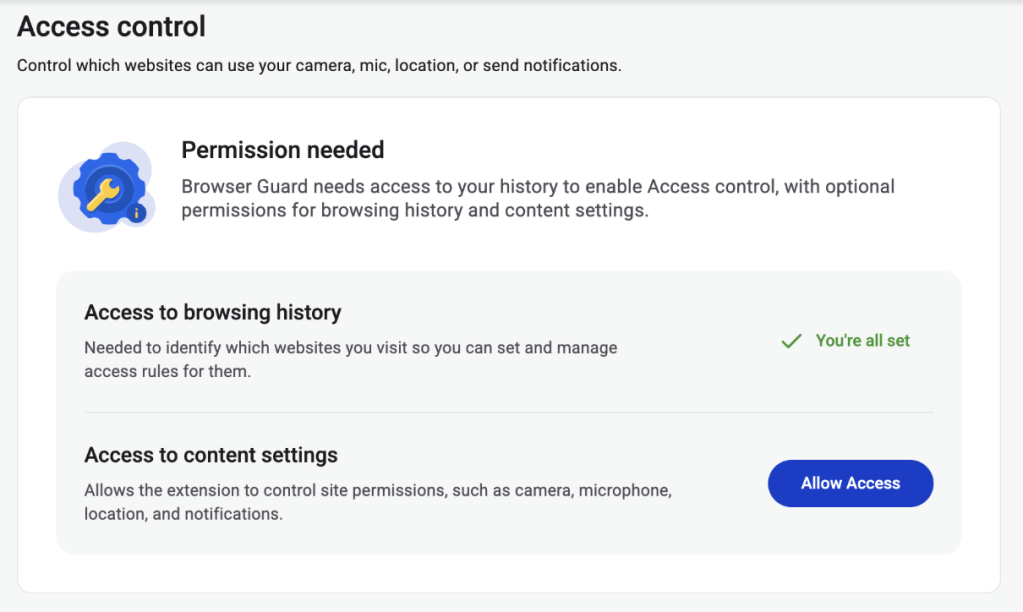
  • Manage Permissions: See visited websites, click “Allow” to enable or disable Malwarebytes’ ability to see visited sites.
  • Access Control requires some access to your browsing to protect you online
  • Access Control lets you choose individual sites to block and allow

This feature is rolling out in beta first, so you might see improvements and updates as we refine it. Currently, the feature works across Chrome and Edge, but will roll out to other browsers soon.  

Access Control is another step toward making privacy simple and accessible.  Not a subscriber yet? Check out  Malwarebytes’ plans today to unlock this feature and more. 


We don’t just report on threats—we remove them

Cybersecurity risks should never spread beyond a headline. Keep threats off your devices by downloading Malwarebytes today.
Windows File Shredder: When deleting a file isn’t enough

5 March 2026 at 12:07

Most of us think deleting a file means it’s gone for good. But “delete” on a Windows device often just means “out of sight,” not necessarily “out of reach.”

That’s where File Shredder, a new feature within Malwarebytes Tools for Windows, comes in. File Shredder lets you securely delete files from your hard drive or USB drive, so the files are not just removed—but completely unrecoverable, even with specialized recovery software.

What File Shredder does differently

When you delete a file by placing it in your Recycle Bin and emptying the contents, your computer typically removes the reference to it—but the data itself can remain on the drive until it’s overwritten. That leftover data can sometimes be recovered using basic digital tools, some of which can even be downloaded for free online. These data traces pose a problem if the file you want to delete includes personal, financial, or other sensitive information, like tax documents, scanned IDs, contracts, or anything else you would like to remain private forever.

File Shredder goes beyond standard deletion by instead permanently overwriting the file data, ensuring it can’t be reconstructed or recovered. Once a file is shredded, it’s gone for good—no undo, no recovery, no second chances.

That makes File Shredder especially useful when:

  • You’re cleaning up sensitive files before selling or donating a device
  • You need to securely remove files from a USB drive
  • You’re minimizing digital clutter without leaving data behind
  • You want peace of mind that private files stay private

How to use File Shredder

File Shredder is designed to be powerful without being complicated.

To use File Shredder:

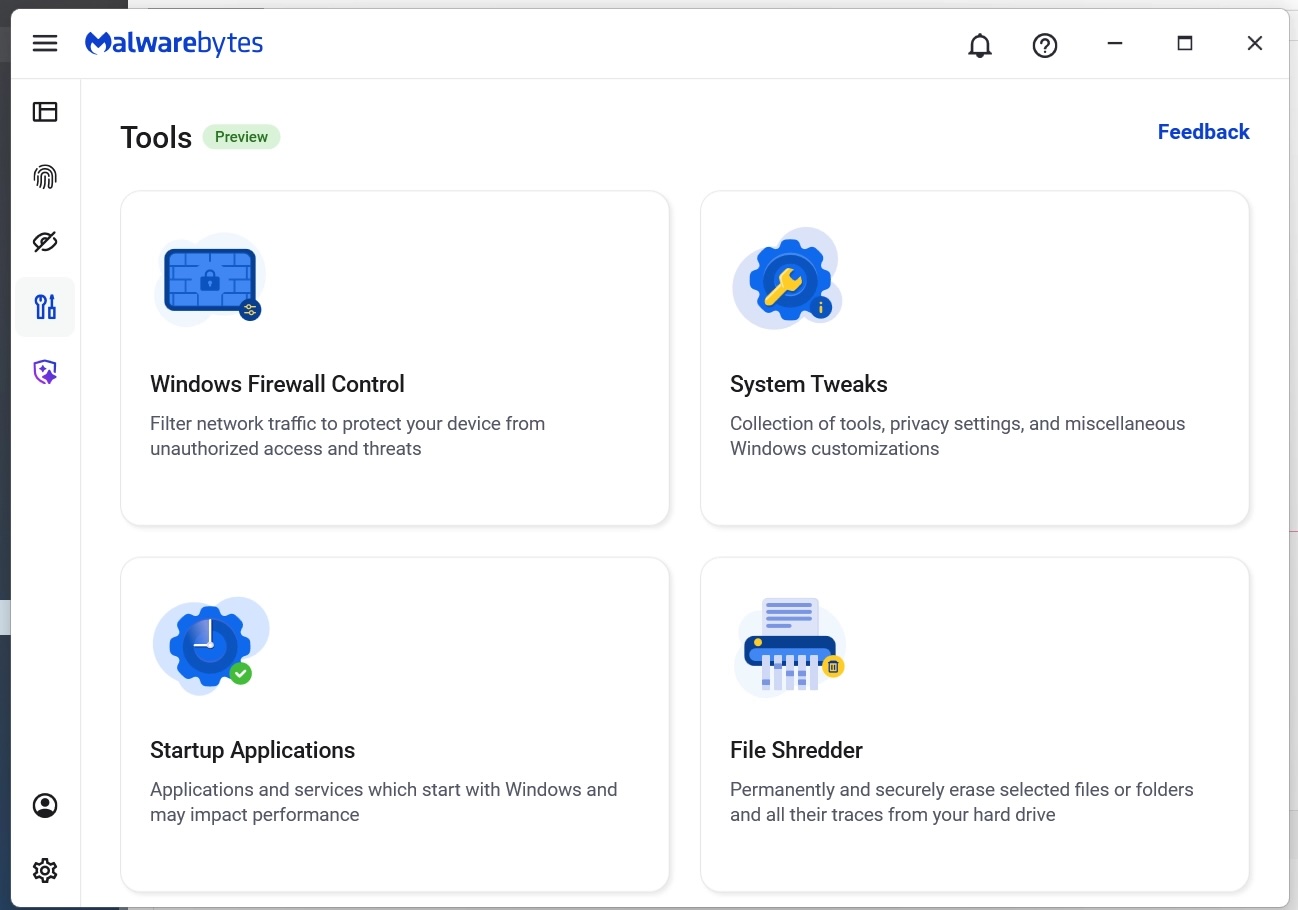
  • Open the Malwarebytes app and select the “Tools” icon from the lefthand menu (the screwdriver and wrench icon)
  • From this menu, find and click on “File Shredder”
  • Once here, you can manually add files or folders to the list and then click on the button “Delete permanently”
  • You will be asked to confirm your request before File Shredder deletes the files
  • The Malwarebytes Tools screen
  • Manually select files and folders for deletion
  • Confirm your deletion requests
  • Done!

After your files are deleted by File Shredder you can move on, confident that the data can’t be accessed again.

Protection means your data is in your control

Cybersecurity isn’t just about blocking threats—it’s also about giving you control over your own data. File Shredder provides a way to do exactly that, helping you close the door on files that you no longer want on your devices.

Because when you’re done with a file, it should really be done.


We don’t just report on threats—we remove them

Cybersecurity risks should never spread beyond a headline. Keep threats off your devices by downloading Malwarebytes today.

Chrome “preloading” could be leaking your data and causing problems in Browser Guard

17 February 2026 at 19:25

This article explains why Chrome’s “preloading” feature can cause scary-looking blocks in Malwarebytes Browser Guard and how to turn it off.

Modern browsers want to provide content instantly. To do that, Chrome includes a feature called page preloading. When this is enabled, Chrome doesn’t just wait for you to click a link. It guesses what you’re likely to click next and starts loading those pages in the background—before you decide whether to visit them.

That guesswork happens in several places. When you type a search into the address bar, Chrome may start preloading one or more of the top search results so that, if you click them, they open almost immediately. It can also preload pages that are linked from the site you’re currently on, based on Google’s prediction that they’re “likely next steps.” All of this happens quietly, without any extra tabs opening, and often without any obvious sign that more pages are being fetched.​

From a performance point of view, that’s clever. From a privacy and security point of view, it’s more complicated.

Those preloaded pages can run code, drop cookies, and contact servers, even if you never actually visit them in the traditional sense. In other words, your browser can talk to a site you didn’t consciously choose to open.​

Malwarebytes Browser Guard inspects web traffic and blocks connections to domains it considers malicious or suspicious. So, if Chrome decides to preload a search result that leads to a site on our blocklist, Browser Guard will still do its job and stop that background connection. The result can be confusing: You see a warning page (called a block page) for a site you don’t recognize and are sure you never clicked.

Nothing unusual is happening there, and it does not mean your browser is “clicking links by itself.” It simply means Chrome’s preloading feature made a behind-the-scenes request, and Browser Guard intercepted it as designed. Other privacy tools take a similar approach. Some popular content blockers disable preloading by default because it leaks more data and can contact unwanted sites.

For now, the simplest way to stop these unexpected block pages is to turn off preloading in Chrome’s settings, which prevents those speculative background requests.

How to manage Chrome’s preloading setting

We recommend turning off page preloading in Chrome to protect your browsing privacy and to stop seeing unexpected block pages when searching the web. If you don’t want to turn off page preloading, you can try using a different browser and repeating your search.

To turn off page preloading:

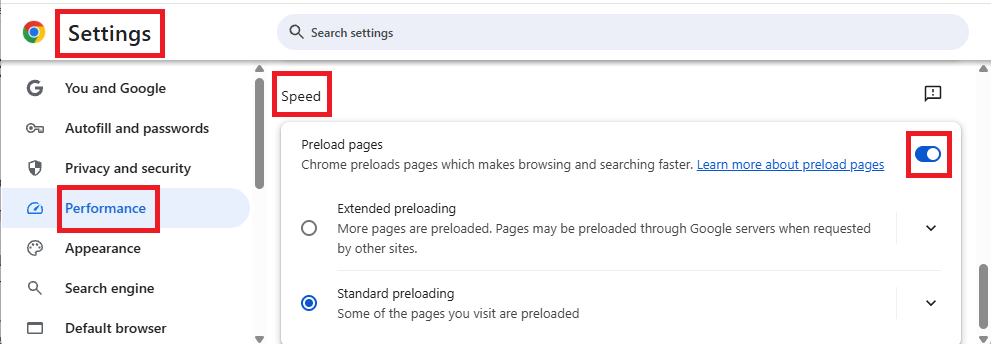
  1. In your browser search bar, enter: chrome://settings
  2. In the left sidebar, click Performance.
  3. Scroll down to Speed, then toggle Preload pages off.

How to turn preload pages on and off

We don’t just report on data privacy—we help you remove your personal information

Cybersecurity risks should never spread beyond a headline. With Malwarebytes Personal Data Remover, you can scan to find out which sites are exposing your personal information, and then delete that sensitive data from the internet.

Scam Guard for desktop: A second set of eyes for suspicious moments 

17 February 2026 at 14:50

Scams aren’t so obvious anymore. They’re well-written, have working grammar, and can lead victims to very convincing branded webpages. Scammers increasingly use AI tools to clone sites and create highly sophisticated scams at scale, so don’t expect to rely on spotting obvious typos anymore.

That’s why Scam Guard, Malwarebytes’ free, AI-powered scam detection assistant, is now available on Windows and Mac. Previously mobile-only, Scam Guard helps you quickly figure out whether something you’re looking at is risky, all before you click, reply, or share. 

When something feels off but you’re not sure what

Scams show up everywhere: emails, texts, pop-ups, messages, and websites that look legitimate. But when you’re moving fast, it’s easy to slip up. 

Scam Guard is designed for exactly those moments. If you’re unsure about a message or link, you can ask Scam Guard to take a look. It uses AI to analyze the content and give you a clear, fast assessment so you can decide what to do next with more confidence. 

How Scam Guard helps 

Scam Guard provides a quick reality check just when you need it: 

  • Real-time threat intelligence: An AI-powered chat companion backed by decades of Malwarebytes threat intelligence and cybersecurity expertise. Get instant verdicts you can trust, plus clear next steps.
  • Comprehensive scam detection: It flags suspicious messages and links, spots common scam tactics, and explains why something is risky. It covers romance, phishing, financial, text, robocall, and shipping scams, and more.
  • Built for where scams start: Works right on your desktop, where many scams begin.
  • 24/7 support: Available around the clock, so you can get help anytime you need it.

Stop wondering to yourself “Is this legit?” With Scam Guard, you get an answer you can trust.  

Now on desktop, right where scams happen 

Many scams target users while they’re on their computers—checking email, browsing the web, or managing accounts. Bringing Scam Guard to Windows and Mac helps where it’s most useful. 

Whether you’re reviewing an unexpected message, a pop-up that feels urgent, or a deal that sounds a little too good, Scam Guard gives you a smarter way to pause and check before reacting.  Here’s how to share a scam with Scam Guard on your computer.

Extra protection, without extra stress 

Staying safe online shouldn’t mean becoming suspicious of everything. It should mean having the right tools when something doesn’t add up. Scam Guard is there to help you slow down, spot warning signs, and avoid costly mistakes. It makes it easier to protect yourself from scams.


We don’t just report on scams—we help detect them

Cybersecurity risks should never spread beyond a headline. If something looks dodgy to you, check if it’s a scam using Malwarebytes Scam Guard. Submit a screenshot, paste suspicious content, or share a link, text or phone number, and we’ll tell you if it’s a scam or legit. Available with Malwarebytes Premium Security for all your devices, and in the Malwarebytes app for iOS and Android.

Malwarebytes earns PCMag Best Tech Brand spot, scores 100% with MRG Effitas 

11 February 2026 at 11:09

Malwarebytes is on a roll.  Recently named one of PCMag’s “Best Tech Brands for 2026,” Malwarebytes also scored 100% on the first-ever MRG Effitas consumer security product test, cementing the fact that we are loved by users and trusted by experts.  

But don’t take our word for it.

As PCMag Principal Writer Neil J. Rubenking said:

“If your antivirus fails, and it don’t look good, who ya gonna call? The answer: Malwarebytes. Even tech support agents from competitors have instructed us to use it.”

PCMag

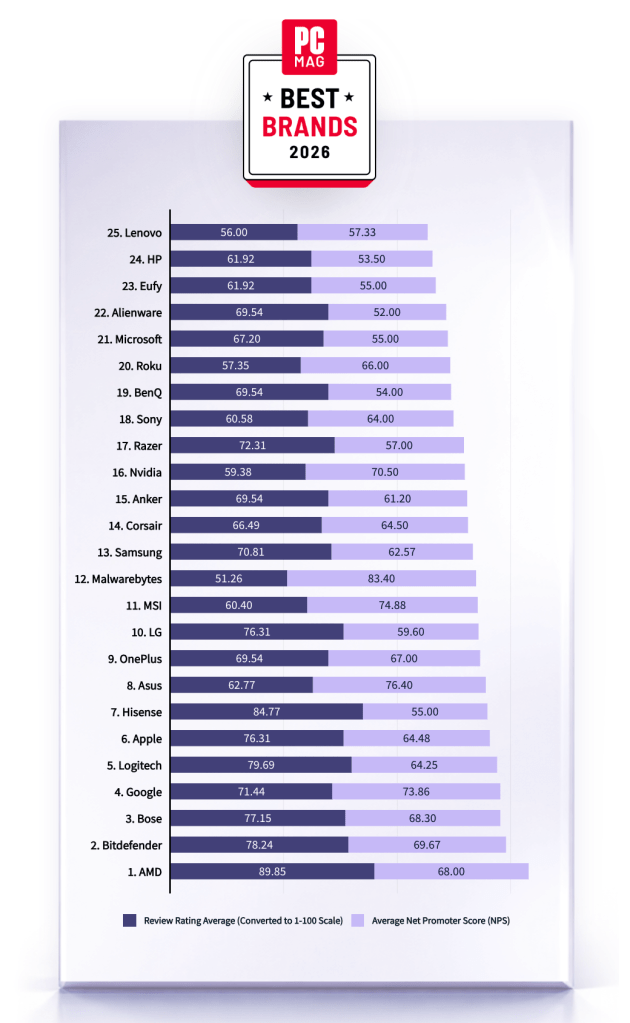
Malwarebytes has been named one of PCMag’s Best Tech Brands for 2026. Coming in at #12, Malwarebytes makes the list with the highest Net Promoter Score (NPS) of all the brands in the list (likelihood to recommend by users).

With this ranking, Malwarebytes made its third appearance as a PCMag Best Tech Brand! We’ve also achieved the year’s highest average Net Promoter Score, at 83.40. (Last year, we had the second-highest NPS, after only Toyota).

Best Brands 2026 from PC Mag

But NPS alone can’t put us on the list—excellent reviews are needed, too. PCMag’s Rubenking found plenty to be happy about in his assessments of our products in 2025. For example, Malwarebytes Premium adds real-time multi-layered detection that eradicates most malware to the stellar stopping power you get on demand in the free edition.

MRG Effitas

Malwarebytes has aced the first-ever MRG Effitas Consumer Assessment and Certification, which evaluated eight security applications to determine their capabilities in stopping malware, phishing, and other online threats. We detected and stopped all in-the-wild malware infections and phishing samples while also generating zero false positives.

We’re beyond excited to have reached a 100% detection rate for in-the-wild malware as well as a 100% rate for all phishing samples with zero false positives. 

The testing criteria is designed to determine how well a product works to do what it promises based on what MRG Effitas refers to as “metrics that matter.” We understand that the question isn’t if a system will encounter malware, but when.

Malwarebytes is proud to be recognized for its work in protecting people against everyday threats online.


We don’t just report on threats—we remove them

Cybersecurity risks should never spread beyond a headline. Keep threats off your devices by downloading Malwarebytes today.

Scam-checking just got easier: Malwarebytes is now in ChatGPT 

2 February 2026 at 14:45

If you’ve ever stared at a suspicious text, email, or link and thought “Is this a scam… or am I overthinking it?” Well, you’re not alone. 

Scams are getting harder to spot, and even savvy internet users get caught off guard. That’s why Malwarebytes is the first cybersecurity provider available directly inside ChatGPT, bringing trusted threat intelligence to millions of people right where these questions happen. 

Simply ask: “Malwarebytes, is this a scam?” and you’ll get a clear, informed answer—super fast. 

How to access 

To access Malwarebytes inside ChatGPT:

  • Sign in to ChatGPT  
  • Go to Apps  
  • Search for Malwarebytes and press Connect  
  • From then on, you can “@Malwarebytes” to check if a text message, DM, email, or other  content seems malicious.  

Cybersecurity help, right when and where you need it 

Malwarebytes in ChatGPT lets you tap into our cybersecurity expertise without ever leaving the conversation. Whether something feels off or you want a second opinion, you can get trusted guidance in no time at all. 

Here’s what you can do: 

Spot scams faster 

Paste in a suspicious text message, email, or DM and get: 

  • A clear, point-by-point breakdown of phishing or any known red flags 
  • An explanation of why something looks risky 
  • Practical next steps to help you stay safe 

You won’t get any jargon or guessing from us. What you will get is 100% peace of mind. 

Check links, domains, and phone numbers 

Not sure if a URL, website, or phone number is legit? Ask for a risk assessment informed by Malwarebytes threat intelligence, including: 

  • Signs of suspicious activity 
  • Whether the link or sender has been associated with scams 
  • If a domain is newly registered, follows redirects, or other potentially suspicious elements 
  • What to do next—block it, ignore it, or proceed with caution 

Powered by real threat intelligence 

The verdicts you get aren’t based on vibes or generic advice. They’re powered by Malwarebytes’ continuously updated threat intelligence—the same real-world data that helps protect millions of devices and people worldwide every day. 

If you spot something suspicious, you can submit it directly to Malwarebytes through ChatGPT. Those reports help strengthen threat intelligence, making the internet safer not just for you, but for everyone.

  • Link reputation scanner: Checks URLs against threat intelligence databases, detects newly registered domains (<30 days), and follows redirects.
  • Phone number reputation check: Validates phone numbers against scam/spam databases, including carrier and location details.  
  • Email address reputation check: Analyzes email domains for phishing & other malicious activity.  
  • WHOIS domain lookup: Retrieves registration data such as registrar, creation and expiration dates, and abuse of contacts.  
  • Verify domain legitimacy: Look up domain registration details to identify newly created or suspicious websites commonly used in phishing attacks.  
  • Get geographic context: Receive warnings when phone numbers originate from unexpected regions, a common indicator of international scam operations. 

Available now 

Malwarebytes in ChatGPT is available wherever ChatGPT apps are available.

To get started, just ask ChatGPT: 

“Malwarebytes, is this a scam?” 

For deeper insights, proactive protection, and human support, download the Malwarebytes app—our security solutions are designed to stop threats before they reach you, and the damage is done.

Celebrating reviews and recognitions for Malwarebytes in 2025

12 January 2026 at 14:00

Independent recognition matters in cybersecurity, and it matters a lot to us. It shows how security products perform when they’re tested against in-the-wild threats, using lab environments designed to reflect what people actually face in the real world.

In 2025, Malwarebytes earned awards and recognition from a steady stream of third-party testing labs and industry groups. Here’s what those tests looked like and what they found.  

AVLab Cybersecurity Foundation: Real-world malware, real results  

Malwarebytes earned another Advanced In-The-Wild badge from AVLab Cybersecurity Foundation in 2025, continuing a run of accolades.

In November, AVLab Cybersecurity Foundation tested 244 real-world malware samples across 14 cybersecurity products. Malwarebytes Premium Security detected every single one. On top of that, it removed threats with an average remediation time of 2.18 seconds—nearly 12 seconds faster than the industry average.  

That result also marked our third Excellent badge in 2025, following earlier tests in July and September.

Earlier in the year, Malwarebytes Premium Security was also named Product of the Year for the third consecutive year, after it blocked 100% of in-the-wild malware samples. 

MRG Effitas: Consistent Android protection, proven over time

For the seventh consecutive time, Malwarebytes earned MRG Effitas’ Android 360° Certificate in November, one of the toughest independent tests in mobile security, underscoring the strength and reliability of Malwarebytes Mobile Security

MRG Effitas conducted in-depth testing of Android antivirus apps using real-world scenarios, combining in-the-wild malware with benign samples to assess detection gaps and weaknesses. 

Our mobile protection received the highest marks, achieving a near-perfect detection rate in MRG Effitas’ rigorous lab testing, reaffirming what our customers already know: Malwarebytes stops threats before they can cause harm. 

PCMag Readers’ Choice Awards: Multiple category wins 

Not all validation comes from labs. In PCMag’s 2025 Readers’ Choice Awards, Malwarebytes topped three award categories based on reader feedback: Best PC Security Suite, Best Android Antivirus, and Best iOS/iPadOS Antivirus.

A Digital Trends 2025 Recommended Product

Malwarebytes for Windows earned a Digital Trends 2025 Recommended Product designation, with reviewers highlighting its ease of use, fast and effective customer support, and strong value for money. 

CNET: Best Malware Removal Service 2025 

CNET named Malwarebytes the Best Malware Removal Service 2025 after testing setup, features, design, and performance. The review highlighted standout capabilities, including top-tier malware removal and comprehensive Browser Guard web protection. 

AV Comparatives Stalkerware Test: 100% detection rate

In collaboration with the Electronic Frontier Foundation (EFF), AV-Comparatives tested 13 Android security solutions against 17 stalkerware-type apps—software often used for covert surveillance and abuse.

Only a few products handled detection and alerting responsibly. Malwarebytes was the only solution to achieve a 100% detection rate in the September 2025 test.

What we learned from a year of testing

All these results highlight our mission to reimagine security and protect people and data across all devices and platforms. 

Recent innovations like Malwarebytes Scam Guard for Mobile and Windows Tools for PC set new standards for privacy and affordable protection, enhanced by AI-powered features like Trusted Advisor, your built-in personal digital health hub available on all platforms.

We’re grateful to the independent organizations that continue to test our products and to the users who trust Malwarebytes every day.


We don’t just report on threats—we help safeguard your entire digital identity

Cybersecurity risks should never spread beyond a headline. Protect your, and your family’s, personal information by using identity protection.

❌