Normal view

AI Use by the US Government

17 June 2026 at 13:04

On 14 April, the Trump administration quietly acknowledged the widespread use of AI to automate government processes. The office of management and budget (OMB) disclosed a staggering 3,611 active or planned use cases for AI across the federal government. The list has ballooned by 70% from the one published in the final year of the Biden administration, and includes many disturbing-seeming plans to hand over sensitive governmental functions to AI.

Scanning this list, many readers may find many causes for alarm. It represents a transfer of decision processes from human to machine on a massive scale over matters of individual freedom, public health and well-being, nuclear reactor safety and more.

Consider these examples. The Health and Human Services’ (HHS) office of administration for children and families hired the world’s “scariest AI company,” Palantir—notorious for its work on behalf of the military, the CIA and ICE—to scan all grant applications to flag those not ideologically aligned with the administration’s dictates. The Federal Bureau of Prisons is developing an AI system to assess the “potential for misconduct for newly admitted inmates,” routing people into high-security confinement before they have actually done anything wrong in their custody. These read like programs fit for a Philip K Dick or George Orwell novel.

Other use cases insert AI into life-and-death decision making. The Department of Veterans Affairs is developing an AI that will listen in on calls to the veterans crisis line, and then gather information from external databases to assess the mental state and suicide risk of the caller.

The Department of Energy is testing the use of AI to control nuclear reactors, targeting a way to autonomously respond to potential nuclear safety incidents. Here’s one that’s disturbing for its retirement, rather than its deployment: the state department has ended a program to use AI to forecast mass civilian killings, which had been intended to aid conflict prevention.

While it’s easy to raise questions about these and similar uses of AI, the reality is that any of these programs could be implemented responsibly. In some cases, like the HHS system, the AI might be enforcing alignment to a policy prescription that opponents abhor. But that concern is more about the policy itself rather than the idea that agencies should comply with executive orders.

In other cases, there may even be bipartisan agreement on the goal, like taking urgent action to help veterans at risk of self-harm. Lots of work and validation is needed to prove AI safe and effective for these use cases and convince the public it is appropriate, but the idea is plausible.

In other cases, a scary-sounding AI use may not even be new. The use of predictive methods and statistics to assign prisoner security classifications goes back decades, even if such systems are often biased and ineffective.

Using autonomous systems for model predictive control (MPC) of nuclear reactors is a well studied, and a widely applied aspect of nuclear plant management. And the recently disclosed addition of AI was initiated under the Biden administration.

But anyone reviewing the 2025 inventory could be forgiven for leaping to severe conclusions. What matters are the details of how the AI system is used, and here the inventory is severely lacking.

The disclosures carry minimal information, and lack the context necessary to understand their purpose and approach. The descriptions are typically just a sentence, and rarely more than a paragraph.

And while the process theoretically involves some form of public consultation, in reality there is generally none. It would take an eagle-eyed citizen to even come across this disclosure. Unless you read FedScoop regularly, or watch the OMB’s federal chief information officer’s GitHub account, you probably missed it.

Only one of the examples cited above (the DoJ) even proposes to involve the public. Under the administration’s policy, it’s not required for the rest because they are not classified as “high impact” use cases—a label that is applied inconsistently across agencies.

We wrote a book surveying applications of AI to democratic processes worldwide, including executive agencies as well as the courts, legislatures and politics. Our conclusion was that, while there are inappropriate applications of AI in governance that should be resisted, an urgent need to reform the economics of AI, and an imperative for renovating the democratic systems it is being unleashed on, there are also valuable and beneficial use cases for AI in government.

Machine translation is a good example. Customs and Border Protection (CBP) has deployed an AI translation system to help officers when human interpreters are not available. The idea that CBP, an agency under heavy scrutiny for reported abuses of human rights, would direct people to talk to a machine instead of a person may strike many as inhumane.

It’s true that human interpreters have very real advantages when it comes to understanding nuance from physical cues and social context. But an officer with a competent AI translator available immediately is better than one who cannot communicate with the person in front of them.

The Trump administration’s AI use case inventory has 70 such translation use cases, up from 58 in the Biden administration’s 2024 disclosure.

Disclosure of AI use cases could be a means to build public confidence and trust, but only if paired with consistent, meaningful public consultation. Washington DC and California are actively engaging the public to determine where and how it’s appropriate to use AI in government processes, or for government to regulate AI use in society.

Both have held public deliberations on this topic at a wide scale, using AI platforms. These examples demonstrate the potential for capturing broad-based public input to steer AI policy.

The international gold standard was arguably set by the French in 2016, via their Digital Republic Act. The law, itself informed by an online citizen consultation, requires all algorithms used to automate government administrative decisions to be subject to public records requests, to be appealable to a human reviewer, and to have mandatory notification of the use of automation to those affected by the decisions.

Canada offers another example of what more rigorous and participatory disclosure might look like. In 2025, they launched an AI use case registry, not unlike the US inventory. However, Canada also has a federal directive mandating a transparent risk-scoring and impact assessment process for automated systems that make administrative decisions about citizens.

That longstanding directive requires a detailed explanation of risks and benefits as well as consultation with certain stakeholders from the conception of the AI use case. The Canadian system could be improved; it could require a public comment period and an obligation for agencies to respond substantively to feedback before engaging in sensitive uses of AI.

AI offers real potential to improve the efficacy, efficiency and accessibility of government. But, equally, there is legitimate reason for public concern and distrust that can only be addressed through transparency and dialog. The US should adopt, at the federal and state level, algorithmic impact risk assessment procedures and public comment processes to facilitate a safe, trusted, equitable transformation of government agencies to take advantage of modern technology.

This essay was written with Nathan E. Sanders, and originally appeared in The Guardian.

Deepfake posting sites depicting famous women taken down by feds

16 June 2026 at 12:31

Thanks to Uncle Sam, anyone trying to find nonconsensual intimate deepfakes on CFake.com and SOCFake.com will be disappointed. The US Departments of Justice (DOJ) and Homeland Security has seized the two domain names under the TAKE IT DOWN Act.

The TAKE IT DOWN Act, signed in May 2025, is the first US federal statute criminalizing the publication of nonconsensual intimate imagery, including AI-generated forgeries. It imposes penalties of up to two years’ imprisonment, gives covered platforms 48 hours to remove flagged content, and grants the forfeiture powers the DOJ just used.

According to the seizure warrants, the digital forgeries depicted “politicians, first ladies of multiple countries, royalty, journalists, television presenters, athletes, entertainers, and others,” and visitors could browse them under tags including “rape,” “forced,” and “degradation”.

The authorities didn’t just snag the sites, though. They got the alleged operator of CFake.com, in an international effort.

The US alerted the Paris prosecutor’s office to a French national in Nice who was allegedly running CFake.com. French investigators counted roughly 300,000 images and 7,000 videos depicting 14,000 people across CFake.com, drawing four million monthly views from 200,000 user accounts.

They then arrested the IT professional, who had no prior criminal record. They also found around $64,000 in Ether cryptocurrency at his home in advertising revenue from the site.

The man will be tried on July 7 in Paris for carrying out illicit transactions online and providing nonconsensual sexual deepfakes. The former offence carries a potential seven years’ imprisonment and a €500,000 (approximately $580,000) fine. The latter could yield three years and a €75,000 ($87,000) fine.

Providers and accused providers of nonconsensual intimate deepfakes have also been held in the US. In April, James Strahler II from Ohio pleaded guilty to cyberstalking, producing child sexual abuse material, and publishing digital forgeries.

Strahler had downloaded produced over 700 images and animations posted to a child sexual abuse site, and had sent deepfake material to at least six adult women, including one sent to a victim’s coworkers.

Last month, the DoJ also arrested Cornelius Shannon and Arturo Hernandez under the TAKE IT DOWN Act for publishing thousands of deepfake images of prominent women and those not in the public eye.

Other countries are also taking action. Anthony Rontondo was arrested by Australian authorities in May last year for posting deepfaked pictures of prominent Australian women. He eventually received an AU$343,000 fine.

How prevalent are deepfakes?

These seizures and prosecutions are encouraging, but prosecutors trying to force non-consensual deepfakes offline face a rising tide of such material. Requests for and sharing of nonconsensual deepfake imagery have risen, with activity migrating across platforms. Deepfake incidents overall jumped 257% in 2024, and girls accounted for 94% of victims in reported AI-generated child sexual abuse cases.

Seizing a distribution point removes a storefront. It does not remove the AI models used to produce the material, the anonymous hosting providers downstream, or the demand that draws visitors in the first place.

What you can do

If you or someone you know are depicted in a nonconsensual deepfake, keep dated screenshots, URLs, and any communications as evidence before filing a takedown request and reporting it to the authorities.

Limit the high-resolution face images you and your children post publicly, since school portraits and social media profile pictures are the raw material these tools need.

Take advantage of expert advice to help protect yourself from non-consensual deepfakes:


Let’s face it, an incognito window can only do so much. 
 
Breaches, dark web trading, credit fraud. Malwarebytes Identity Theft Protection monitors for all of it, alerts you fast, and comes with identity theft insurance. 

Claude Fable 5 and Mythos 5 “abruptly disabled” after US gov. ban

15 June 2026 at 16:32

Anthropic has been ordered by the US government to cut off its newest Claude Fable 5 and Mythos 5 models for fear of abuse by adversaries.

Reuters reports that Anthropic said it will “abruptly ​disable” its most advanced AI models for all users after the US government ordered it to suspend access to the models for foreign nationals, citing national security ‌concerns.

Officials reportedly believe a jailbreak could turn Fable 5 and Mythos 5 into vulnerability-discovery tools for adversaries, so Anthropic says it is disabling them worldwide rather than try to nationality‑filter access, since it is virtually impossible to verify every user’s nationality.

In a statement on its website, Anthropic says:

“The letter did not provide specific details of its national security concern. Our understanding is that the government believes it has become aware of a method of bypassing, or “jailbreaking” Fable 5. We reviewed a demonstration of this specific technique being used to identify a small number of previously known, minor vulnerabilities. These vulnerabilities all appear relatively simple, and we have found that other publicly-available models are able to discover them as well without requiring a bypass.”

Mythos 5 is the non-public full version, which is currently used only by government agencies and selected corporate partners to harden their systems. Fable 5 is a Mythos-class model that should supposedly be safe for general use.

It makes sense to me that if Fable 5 is easy to jailbreak, that it should fall under the same restrictions as Mythos 5. However, Anthropic maintains that it has built-in safeguards that mean queries on some topics will instead receive a response from the next-most-capable model, Claude Opus 4.8. 

The relationship between the US government and Anthropic had shown signs of easing in parts of the US government after tensions over military use, surveillance, and autonomous weapons. In March, defense Secretary Pete Hegseth designated the San Francisco-based company a “supply-chain risk to national security.”

To understand the nature of the argument, it is necessary to understand that Mythos 5 is described in multiple reports as particularly effective at identifying software vulnerabilities, including long‑standing bugs in complex, legacy systems such as those in banking and other critical infrastructure. Many view this as dual‑use: great for defense hardening, but catastrophic in the wrong hands.

In recent updates from major software vendors like Microsoft and Google, we’ve seen a growth in numbers of patched vulnerabilities after the vendors began using AI-guided search for new vulnerabilities in their own software. We also know that Mozilla found over 270 Firefox vulnerabilities with the aid of Anthropic’s new Claude Mythos model. 

What this means

In the wrong hands these vulnerabilities could definitely do a lot of harm. So, it looks like it will take some time before regular consumers and developers will gain access to Fable 5 and Mythos 5 entirely. However, existing Anthropic models (older Claude variants) remain available.

For home users who were simply chatting with Claude or using it to help with basic scripting, the change will mostly show up as “this specific version is unavailable” rather than a broader AI blackout.

Removing a high‑end vulnerability‑finding model from broad circulation increases the effort required for less‑resourced cybercriminals to automate discovery of complex bugs in consumer‑facing software and services only by so much. There are other models available on the black market that might be just as effective. And for most cybercriminals, turning a vulnerability into a method they can utilize in an exploit is much more relevant.


We don’t just report on threats—we remove them

Cybersecurity risks should never spread beyond a headline. Keep threats off your devices by downloading Malwarebytes today.

Deepfake porn sites are going offline (re-air) (Lock and Code S07E12)

15 June 2026 at 16:32

This week on the Lock and Code podcast…

If you weren’t taking deepfakes seriously before, it’s too late now to ignore them.

According to new research from Malwarebytes, one in three people who use AI every day said it’s okay to generate pornography of people without their consent.

Nearly 10 years ago, “deepfake” technology provided hobbyists and film editors with artificial intelligence (AI) tools to swap the face of one person onto the body of another. In its infancy, this technology brought silly film experiments like swapping Tom Cruise in Mission Impossible with Keanu Reeves. Today, this same technology produces something far more harmful—fake nude images of teenagers.

On the Lock and Code podcast today with host David Ruiz, we are re-visiting an interview from 2024, in which we spoke with a lawyer named David Chiu about his lawsuit against 16 deepfake nude generation websites.

The websites named in that lawsuit often needed just one image of a person to generate fake pornography. And while nearly everyone has at least one image of themselves online, even if they had hundreds, the path towards deletion is somewhat understood—start by deactivating and deleting popular social media accounts. But for teenagers today, raised mostly online, and who share images directly with friends and boyfriends and girlfriends and exes, it’s likely impossible to remove every visual trace of themselves. Also, they shouldn’t have to face this problem alone.

The Lock and Code podcast frequently discusses structural problems that require individual management. You have to skirt corporate data collection. You have to find the automated license plate readers in your hometown. You have to review every single message you get with a certain antagonism, to guard yourself against scams.

So, it’s rare to encounter a solution that benefits more than one person.

Chiu serves as the City Attorney for San Francisco, which means his department can file a lawsuit on behalf of not just the people of San Francisco, but also California, and that’s what his team did in going after the deepfake websites.

Since then, Chiu’s department has shut down 10 deepfake nude websites, and it received a settlement agreement from a company called Briver LLC to no longer operate any website that creates nonconsensual deepfake pornography.

And, as California goes, so goes the nation.

In May of last year, the Take It Down Act became effective as law in the United States, which criminalizes “revenge porn” and AI-generated nonconsensual intimate imagery. The law is not perfect but so far it is being used as intended. Last month, two men in the US were among the first to be charged with violating the Take It Down act for allegedly creating deepfake nudes that, according to the AP, “included both celebrities as well as private women, including recent high school graduates.”

Today, we revisit our conversation with San Francisco City Attorney David Chiu about the important fight against deepfake porn and the clear threat that his department found against the public.

“At least one of these websites specifically promotes the non-consensual nature of this. So, and I’ll just quote, ‘Imagine wasting time taking her out on dates when you can just use website X to get her nudes.'”

Tune in today to listen to the full conversation.

Show notes and credits:

Intro Music: “Spellbound” by Kevin MacLeod (incompetech.com)
Licensed under Creative Commons: By Attribution 4.0 License
http://creativecommons.org/licenses/by/4.0/
Outro Music: “Good God” by Wowa (unminus.com)


Listen up—Malwarebytes doesn’t just talk cybersecurity, we provide it.

Protect yourself from online attacks that threaten your identity, your files, your system, and your financial well-being with our exclusive offer for Malwarebytes Premium Security for Lock and Code listeners.

Bernie Sanders’ AI Sovereign Wealth Fund Plan

12 June 2026 at 13:03

Let no one accuse Bernie Sanders of ducking the big questions. Writing in the New York Times last week, the senator asked: “Will the future of humanity be determined by a handful of billionaires who have promoted and developed AI, with virtually no democratic input, who stand to become even richer and more powerful than they are today?”

We agree entirely that this is one of the most potent questions facing global democracy today. Our book, Rewiring Democracy, surveys the emerging uses for and impacts of AI in democracy around the world and reaches the same conclusion: that the most urgent risk posed by AI is the concentration of power, wealth and control among tech oligarchs.

And yet we reached a vastly different conclusion than Sanders on what to do about it.

The senator points to a once radical but increasingly popular solution: creating a US sovereign wealth fund by taking 50% stock in AI companies such as Anthropic, OpenAI and xAI. The argument in favor of this is twofold. One: it would establish democratic control over the AI companies, giving the government “the power, through its voting shares and an equal representation on each company’s board, to block decisions that hurt our citizens and to push for policies that help them.” Two: it would return a big chunk of the economic rewards of soaring AI valuations to the public, ensuring “trillions of dollars potentially generated by AI are used to improve the lives of all of us.”

We laud both these goals unreservedly.

We wholeheartedly agree that there must be public influence over the development and use of AI, just as we demand the government intervene to ensure that automakers, drugmakers, airlines and other industries balance profitability with public safety and the public interest. And we credit the senator with recognizing that there are more levers for the government to pull beyond the promulgation of regulation to achieve this.

And we also agree that the obscene, dangerous accumulation of wealth among AI companies needs to be disrupted. As OpenAI and Anthropic race to be minted as the world’s latest trillion-dollar AI companies, we should recognize that—whether or not it constitutes a bubble—these staggering market capitalizations represent a transfer of wealth. The flow of money goes from the smaller businesses and actual people using AI, and being subjected to it, to the owners of these tech companies.

That includes the world’s 86 AI billionaires “seeking to maximize their power and profit” aiming to decide the “fate of humanity… behind closed doors in Silicon Valley,” as Sanders said.

And yet, while we do not outright oppose the taking of AI company stock, or of a US sovereign wealth fund, there are better ways to achieve Sanders’ stated goals.

Public ownership of these companies entangles corporate profit and valuation with the public interest. It would incentivize the government to clear regulations, permit the exploitation of workers and users, suppress competition, encourage AI adoption regardless of the responsibleness of the implementation or appropriateness of the use case, and otherwise act on behalf of corporate interests.

After all, if growing, say, Nvidia from its first $5tn in value to its next $5tn also represents a doubling in value of this segment of the sovereign wealth fund, then you can expect the fund managers to support chip sales, foreign and domestic, with the same zeal as the company’s private investors.

This is not an effective way to influence corporations to act in the public interest. In fact, it makes corporate influence on the government more likely.

We should be wary of this possibility because we’ve seen it before. Ownership of substantial stakes in oil companies by the Norwegian sovereign wealth fund, the world’s largest, does not seem to have steered those corporations to pro-environmental policies. Instead, the Norwegian government’s dependence on those companies has inhibited them from taking climate action. Here in the US, public employee pension funds merit the same criticism: the fiduciary duty to generate wealth overwhelms any intention to direct their corporate holdings in the public interest.

A better answer is to separate the two goals. The standard way to share private rewards with the broader society that made them possible is taxation. Senator Elizabeth Warren has proposed an excise tax on datacenters’ energy use. Others have proposed an AI token tax, which has much the same effect.

As to the goal of reshaping AI in the public interest, we have proposed an AI Public Option. The concept is for governments, be it federal or state, to establish publicly developed and operated AI models run by public institutions under democratic control. The idea is not to eliminate corporate AI or to seize it as a public asset, but rather for government to provide a competitive baseline that private AI offerings must meet or exceed to win business—just like the notion of a healthcare public option.

The Swiss have trailblazed this approach. Apertus is a large language model built by Swiss public servants, researchers at Swiss universities, using appropriately licensed training data and pre-existing Swiss public supercomputing infrastructure powered by renewable energy.

While Apertus doesn’t seriously compete with the latest OpenAI and Anthropic models on performance benchmarks, it blows them out of the water in transparency, sustainability and compliance with EU regulations including adherence to copyright. It’s a nascent project, but suggestive of how public institutions can apply competitive pressure for corporate actors to behave responsibly.

Don’t confuse public AI with “sovereign AI,” the notion that every country needs to invest in domestic AI infrastructure. Sovereign AI is often invoked as a marketing scheme for big tech companies looking to sell to governments; it demands public investment without guaranteeing public control.

Sanders is a bold and savvy political operator. So why is he pursuing the sovereign wealth fund strategy when he must be aware of these risks? It may be due to another argument he makes in his op-ed: that the Trump administration and the billionaire owners of AI are aligned to the idea.

It’s expedient to capitalize on rare moments of seeming alignment across diverse political factions, but it also behooves us to ask why the AI billionaires are open to this extraordinary intervention. The answer, of course, is that they believe that for every dollar ceded to government stock expropriation, they will get back more in favorable government policies to protect that newfound investment.

Energy taxation is a straightforward way to make AI companies pay for the social disruption of their technologies. Public AI represents a non-monetary mechanism for governments to shape the development of AI, complementary to direct regulation of private actors, one with a far greater chance of influencing corporate behavior towards the public interest. We urge Sanders and other political leaders to consider them.

This essay was written with Nathan E. Sanders, and originally appeared in The Guardian.

Google can be liable for false AI Overviews, court rules

11 June 2026 at 18:09

A German court has ruled that Google can be held directly responsible for defamatory claims produced by its AI Overviews. Basically, the court said that telling people they should double-check AI search results is not enough to deny liability for what those results say.

This kind of warning may not be enough.
This kind of warning may not be enough

The Munich Regional Court issued a preliminary injunction against Google after two German publishers discovered that AI Overviews falsely portrayed them as involved in scams and “dubious business practices,” even though the linked articles did not support those claims.

The decision could echo far beyond Germany. The court effectively found that Google can be held directly liable for defamatory content generated by its AI Overviews. The court cut through the usual “it’s just AI, don’t trust it too much” messaging and made one thing clear: If you build a system that confidently smears people or companies, you may be responsible for what it says, even when the content was “hallucinated” by AI.

AI Overviews are not harmless suggestions. In this case, the court treated them as Google’s own statements, with all the legal baggage that comes with that.

When the publishers sent a cease-and-desist letter, Google did not promptly stop similar claims from appearing. That detail turned out to be crucial in the ruling. The court noted that, unlike traditional search results, which simply list third-party content, AI Overviews generate “independent, new, and substantive statements.”

And since only Google can adjust the models and the logic that create those statements, only Google can reliably stop the system from repeating the same or similar falsehoods. In this case, the court found that Google can be held responsible.

For years, search engines have enjoyed broad protection under the logic that some harmful content is unavoidable when indexing the open web at scale. Showing a search result does not mean endorsing it. The search engine is a channel, not a publisher.

That changes when an AI Overview summarizes, rephrases, and sometimes invents facts, then publishes them at the top of search results.

AI Overviews are an extra feature, not essential to how search works. However, the appeal of AI summaries is their fast, confident answers, which is exactly what makes them dangerous. When those answers are wrong, many users may not click through to check the sources.

The ruling is preliminary and may be appealed, but the signal is clear: AI search output is not magic dust that makes liability disappear. Disclaimers about possible mistakes may not be enough when a system is deployed at scale, creates new content, and is designed to be trusted.

By the numbers

Google AI Overviews are powered by Gemini, Google’s AI model. Like other AI systems, it can produce confident answers that are wrong or poorly supported.

Pew Research studied browsing data from hundreds of users and found that when an AI Overview appears on a Google results page, clicks to traditional search results drop from around 15% to about 8%. 

A New York Times analysis of AI Overviews found that they were accurate roughly nine out of ten times. But with Google processing more than five trillion searches a year, even a small error rate could mean millions of wrong answers.

And those mistakes are not always due to bad sources. Even when Google links to a page with the correct information, its AI can still produce a false answer. More than half of the accurate responses were classified as “ungrounded,” meaning the websites cited by the AI Overview did not fully support the information it provided.

The main lesson here is to double-check AI search responses. Don’t trust an answer just because it’s presented confidently and includes links.

Users can be steered toward real threats, or away from effective protections, simply because an AI system sounded convincing on a search page.

If you find false or defamatory AI summaries about yourself or your company, document them thoroughly. Take screenshots, save the search terms, file correction requests, and keep records of the platform’s response. Or the lack of one.


Scammers don’t need to hack you. They just need you to click once. 

Malwarebytes Identity Theft Protection catches suspicious activity before it becomes a problem.

88% of people struggle to tell what’s real online

10 June 2026 at 13:45

What would you trade for a technology that can do almost anything? For many people, the answer is clear: Everything they thought they could trust.

In a few, short years, Artificial Intelligence (AI) tools have granted people unfettered access to easier writing, faster image generation, quicker coding, and near-instantaneous answers, advice, and information—advantages they value and want. But the same tools that can spruce up a dating profile or reimagine an old photograph can also manipulate the broader world online, and people are noticing.

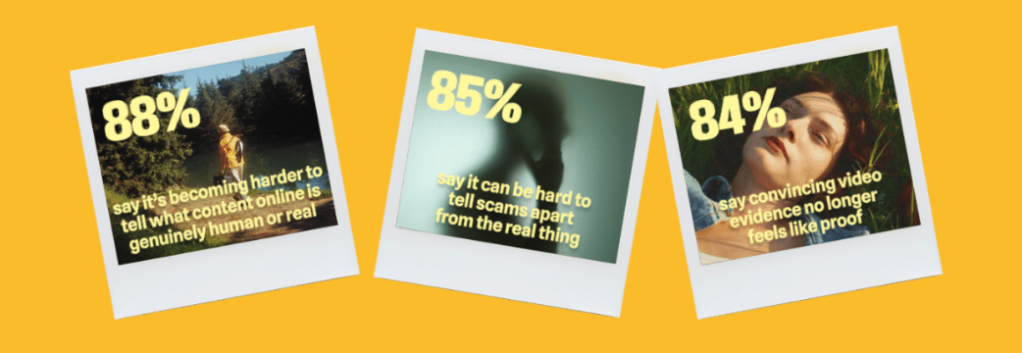
According to new research from Malwarebytes, 88% of people said it’s becoming harder to tell what content online is genuinely human or real, with 84% saying that “convincing video evidence” no longer feels like proof. Further, 85% said it can be hard to tell scams apart from the real thing—a major uptick from the 66% who said the same thing last year.

Statistics from the Face Value report

These are the first signs of AI’s counterfeit world. Replete with fake websites, fake products, fake videos, fake pictures, fake voices, and even fake people, it is threatening to swallow the web.

The latest report from Malwarebytes, Face value: How AI is reshaping trust, identity, and scams exposes the hidden cost of AI on the public: an excess of fraud that is dismantling trust in reality and in one another.

The damage arrives in large moments and small, from the US parent who said they “received a voicemail that sounded exactly like my son’s voice, saying he was in trouble and needed money for legal fees,” to the two entirely unrelated respondents fooled by the same AI-generated video of rabbits bouncing on a trampoline, to the individual worried about “my grandfather showing me AI slop and he thought it was real.”

For this research, Malwarebytes surveyed 1,500 adults aged 18 and older across the US, UK, Austria, Germany, and Switzerland about their uses, feelings, and concerns regarding AI. The sample was equally split for gender with a spread of ages, geographical regions, and race groups, and weighted to provide a balanced view.

The complete findings can be found in the full report:

Here are some of the key takeaways and findings:

  • 88% said it’s becoming harder to tell what content online is genuinely human or real
  • 84% said convincing video evidence no longer feels like proof 
  • 85% of people said it’s hard to tell a scam from the real thing (up from 66% last year)
  • 50% have experienced some form of AI fraud or scam, such as being misled by AI-generated photos of products or receiving a highly personalized scam message
  • 19% have specifically experienced some form of AI-driven identity harm, including the 10% who have had someone use AI to generate sexually explicit content of them without permission
  • 81% fear someone stealing their family’s likeness, yet only 13% have created a family codeword to guard against it
  • 67% worry about voice cloning, yet only 19% have turned off voicemail recordings to prevent it
  • 45% say it’s okay to use AI for personal emotional tasks (like writing wedding vows or a eulogy)
  • 34% say it’s okay to use AI to help create or improve a dating profile
  • One in three self-avowed daily users of AI said it’s okay to generate explicit images of someone without their consent 

Defeat would be the wrong lesson to take from all this. It is true now that the internet requires assistance, but there are plenty of safe places to seek help.

While Malwarebytes works to provide new tools, we’d like to remind both the AI anxious and the eager about the first rule of the internet: Remember the human. People’s voices, bodies, choices, and agency belong to them and them alone. 

As for every fake video, product, website, and image, understand that there’s help. No one needs to navigate an artificial internet alone. Whether through scam detection, identity protection, and simple awareness, people have more options than they may realize.

Critical Zcash Vulnerability Found and Fixed

8 June 2026 at 19:06

If you’re a user—owner?—of this cryptocurrency, this is important:

On May 29, the security researcher Taylor Hornby found a critical vulnerability in Zcash Orchard privacy pool using Claude Opus 4.8. The Zcash team hired Hornby specifically to look for this kind of issue. He found one fast enough to be embarrassing.

The Orchard pool is the newest and most advanced shielded transaction system in the cryptocurrency Zcash. Introduced in 2022, it allows users to send and receive ZEC while keeping transaction details private. It uses zero-knowledge proofs to validate transactions without revealing amounts or participants. The bug: a specific check that was supposed to validate transaction inputs wasn’t actually enforcing the rules it appeared to enforce. An attacker could have exploited the flaw to feed false inputs into that check and generate ZEC from nothing, with the zero-knowledge proof system blessing the fraudulent transaction as valid.

It’s fixed; that’s the good news. The bad news is that there’s no way of knowing if anyone exploited the vulnerability to steal money. And this fragility is the fundamental problem that makes blockchain such a bad idea.

Americans lost nearly $900 million to AI-powered scams, FBI says

8 June 2026 at 17:02

The 2025 Federal Bureau of Investigation (FBI) Internet Crime Report shows that Americans reported $893,346,472 in AI‑related scam losses.

Those losses stem from 22,364 AI-related complaints. And these figures represent only the reported losses, which may well be the proverbial tip of the iceberg.

The main drivers behind the rise in AI-powered scams are voice cloning, deepfake images and videos, and AI‑generated scripts. These tools have supercharged classic fraud schemes such as romance scams, kidnapping and extortion calls, fake influencers, and government impersonation.

Michael Machtinger, deputy assistant director of the FBI Cyber Division, told the Wall Street Journal:

“AI-created fraudulent communications can look very official and very legitimate to even the most trained individuals.”

The FBI and financial institutions recommend verifying identities via official contact channels. One of their biggest concerns is government impersonation scams, which have evolved from crude IRS gift‑card phone calls into sophisticated, multi‑channel operations that combine spoofed caller ID, stolen agency logos, and AI‑generated audio and video of public officials.

This report, and others like it, shows how AI is being weaponized to automate research on victims, generate convincing scripts, and create highly believable deepfake personas at scale.

AI is also increasingly used in business email compromise (BEC), romance scams, and impersonation fraud. In BEC cases involving AI, losses have already reached tens of millions of dollars for businesses alone.

For a broader look at why AI is simultaneously fueling scams like these and becoming indispensable to defending against them, see my article AI: Threat, tool, or both?

It explains how both defenders and criminals use AI to find vulnerabilities, and why security vendors increasingly rely on AI to process vast amounts of telemetry, detect anomalies, and keep pace with threats that “no longer move at human speed.”

How to stay safe

Consumer protection agencies have documented a growing list of the ways scammers are using AI to try to rip people off. The main problem is that we can no longer take it at face value that the person we’re talking to is who they claim to be.

Government agencies and financial institutions recommend that you:

  • Be skeptical of urgent payment demands, especially those involving cryptocurrency or gift cards
  • Limit the amount of voice and video content you share publicly, as it can be reused by scammers
  • Report incidents quickly to your bank(s) and IC3.gov

Pro tip: Malwarebytes Scam Guard can help you determine whether a message is a scam and guide you through the next steps.


Something feel off? Check it before you click.  

Malwarebytes Scam Guard helps you analyze suspicious links, texts, and screenshots instantly.  

Available with Malwarebytes Premium Security for all your devices, and in the Malwarebytes app for iOS and Android.  

Try it free → 

Anthropic’s Project Glasswing Update

8 June 2026 at 13:01

In April, Anthropic initated Project Glasswing. The idea was to let companies use their new model to find and fix vulnerabilities in their own software. It was a fantastic PR move, and so many press outlets have uncritically parroted Anthropic’s claims that it’s now common wisdom that Mythos is better at finding software vulnerabilities than other models. Which is just not true.

In any case, Anthropic has published a Project Glasswing status report. It’s finding a lot of vulnerabilities in software—yay! Some of them are even dangerous. But almost none of them has been patched. It’s weird. There’s something fishy about the data that I don’t understand. That Anthropic refuses to release details—that it just says “trust us”—is a big problem here.

AI Worm

5 June 2026 at 15:21

Researchers have prototyped an AI-powered internet worm.

The coolest thing about the prototype is that it carries its own LLM with it, and runs it on computers that have been broken into.

This is the closest to John Brunner’s original 1975 conception of a computer worm that I’ve seen.

AI: Threat, tool, or both?

5 June 2026 at 10:56

Public attitudes toward Artificial Intelligence (AI) are changing, and we wanted to understand why.

A recent Pew Research survey found that about half of adults say the increased use of AI in daily life makes them more concerned than excited, and that concern has grown over the last few years. People tend to worry most about long‑term social effects (jobs, creativity, relationships, misinformation), even while many do use AI tools and see some practical benefits, particularly for data analysis and routine tasks.

Data from an older UK survey already showed something similar. Awareness of highly visible AI technologies, such as driverless cars and facial recognition is high, but awareness of AI in welfare assessments, loan decisions, or care services is much lower. Concern about many of these use cases has risen since 2022. In other words, people feel AI is everywhere, but don’t always understand where or how it’s being used, and that makes people cautious.

The concern is usually less about science‑fiction extinction scenarios and more about social and economic harm. People worry about their jobs disappearing, a loss of creativity, the spread of disinformation, and increased surveillance, more than about killer robot scenarios.

Research into public attitudes towards AI repeatedly finds that people hold conflicting views, shaped by narratives of admiration and hype on one side and threat and dystopia on the other.

They see genuine benefits in the technology, but are increasingly wary of how companies, governments, and criminals might use it. Basically, people aren’t scared of AI itself, but about who’s using it and for what purpose.

Cybersecurity

AI in cybersecurity is a special case. When asked in which field of AI research they would invest an unlimited amount of money, people chose the fields of medicine and cybersecurity.

People increasingly recognize that AI is now a tool used by both defenders and cybercriminals. Few would feel comfortable with defenders refusing to use AI while attackers continue to adopt it.

Security products use machine learning to process huge volumes of data, detect unusual behavior, prioritize alerts, and identify threats faster than human analysts could alone.

At the same time, cybercriminals are using AI to create more convincing phishing emails, clone voices, generate fake images and videos, automate research on victims, and develop malware that can evade traditional detection techniques.

Both sides use AI-assisted tools to find software vulnerabilities that could be exploited to defraud people or breach systems, so vendors want to patch them before cybercriminals exploit them.

While studies consistently show that cybersecurity is one of the AI applications people worry about most, they also see that AI is increasingly necessary to keep pace with modern threats. A 2025 study focusing on AI in cybersecurity found that the public widely recognizes the technical benefits of AI‑driven defenses (speed, scale, accuracy), while remaining concerned about privacy, bias, and job displacement in security operations.

That is why the AI debate in cybersecurity feels different from the debate in many other fields. People may be uneasy about AI, but they also understand that the threat landscape no longer moves at human speed. Attackers already use automation, scale, and increasingly AI‑assisted workflows, so defensive teams that refuse to adapt would simply be slower and less effective.

Our mission at Malwarebytes is twofold: reduce the risks created by AI, and use AI to prevent, detect, and respond to threats. We’ve been using machine learning in our security products for nearly two decades, developing proprietary detection systems that help identify malicious code and suspicious behavior at a scale and speed that would be impossible manually.

Coming soon: How AI is changing trust online

Malwarebytes recently surveyed 1,500 adults across the US, UK, Austria, Germany, and Switzerland about their experiences with AI. The findings reveal a growing uncertainty about what people can trust online, alongside increasing concern about scams, impersonation, and AI-generated deception.

Stay tuned for the full Malwarebytes report on how AI is reshaping trust, identity, and scams.

Use AI safely

If you use AI in a security context, keep your data hygiene strict. Don’t paste passwords, customer data, or sensitive incident details into public AI tools. Treat AI-generated outputs as untrusted until verified, especially when they touch code, logs, indicators, or policy decisions.

AI can be useful for summarizing information, indentifying patterns, and producing first drafts, but keep a human in the loop for anything that affects access, containment, legal decisions, or public communications. Where possible, prefer enterprise or local deployments with logging, access control, and clear data-retention rules.

Also remember that AI can hallucinate confidently. In security work, that means every output needs validation against logs, documentation, source code, or other primary evidence before you act on it.


Something feel off? Check it before you click.  

Malwarebytes Scam Guard helps you analyze suspicious links, texts, and screenshots instantly.  

Available with Malwarebytes Premium Security for all your devices, and in the Malwarebytes app for iOS and Android.  

Try it free → 

Hacking Meta’s AI Chatbot

4 June 2026 at 13:04

Hackers are convincing Meta’s AI support chatbot to let them take over other peoples’ accounts:

A video posted on X showed the step-by-step process to hack someone’s Instagram account. The hacker allegedly used a VPN to spoof the targets’ presumed location to avoid triggering Instagram’s automated account protections. Then, the hacker opened a chat with Meta AI Support Assistant and asked the bot to add a new email address to the target’s account. The chatbot can be seen sending a verification code to the email address provided by the hacker; the hacker then shares the verification code with the chatbot, which prompts the chatbot to show a button to “Reset Password.” The hacker enters a new password and takes over the victim’s account.

[…]

On Monday, Instagram spokesperson Andy Stone said in a reply to Wong’s post and others that the issue was now fixed. It’s unclear how many Instagram users had their accounts improperly accessed.

It’s not that easy. Probably this particular tactic is now blocked. But there are others, many others, and they cannot be blocked as a class. The real problem is that LLM chatbots are not trustworthy enough for this application.

Another news article.

Meta’s AI support bot happily handed Instagram accounts to hackers

4 June 2026 at 11:09

Customer service chatbots have one job: get the user what they’re asking for without bothering a human. Meta’s new AI support assistant took that brief a little too seriously. Over the past few months, attackers have been opening support chats, telling the bot they were locked out of Instagram accounts they didn’t own, and walking away with the keys.

Over the weekend, Meta pushed an emergency patch after Instagram accounts belonging to the Obama White House (now dormant), beauty retailer Sephora, and a senior US Space Force official were taken over and briefly defaced with pro-Iranian imagery. Security researcher and former Meta employee Jane Manchun Wong was also hit.

How the trick worked

The attack was simple. Attackers worked out where the account owner lived (there are lists of account owners’ home cities online, or they could just research the target). Then they used a VPN to match the target account’s geographic region, which avoided raising flags with Instagram’s security systems.

Then they started a normal password reset and opened the support chat. They asked the AI bot providing support to change the email address on the account, and it did exactly that, sending a one-time code straight to the attacker’s inbox.

To do this, the chatbot appears to have been wired into Meta’s account management systems with permission to make account changes, but without being taught how to verify it was talking to the real account owner. Security people have a name for that: “confused deputy.” The term has been around since the 1980s.

In fairness to the confused bot, attackers were successful even if the enhanced security was triggered. They would apparently create video deepfakes of their targets using images that were harvested from—you guessed it—Instagram.

Meta hoisted on its own AI petard

Meta has been shedding headcount and pouring money into AI, and rolled out its AI-powered support assistant earlier this year to help handle account recovery and other support requests.

The downside is that the AI appears to have been given the ability to perform actions such as email changes and password resets without applying enough safeguards to confirm the user’s identity first.

Meta communications executive Andy Stone said on X that the issue was resolved and impacted accounts were being secured. The company has not disclosed how many accounts were affected.

What actually worked

Why would anyone want to hack an Instagram account anyway? Revenge can be a driver, but more often than not, financial gain is the goal. Hijackers have blackmailed businesses that rely on those accounts for marketing.

Attackers using this technique have also been spotted targeting “OG” accounts with short or highly desirable usernames. If you joined Instagram early and registered a memorable handle, it can be worth thousands of dollars on underground markets.

What can you do to protect yourself?

A perennial piece of advice still holds: turn on multi-factor authentication (MFA). According to veteran cybersecurity reporter Brian Krebs, the attack failed against accounts that had MFA enabled, including those using SMS codes.

That doesn’t make MFA perfect, but it adds an important layer of protection.

So the practical advice is unglamorous:

  • Open Instagram’s Settings
  • Navigate to your Meta Accounts Center
  • Turn on Two-factor authentication. An authenticator app is better than SMS, but either is better than nothing.

Do it now, because this might not yet be over. TheCyberSecGuru reports that another attack is circulating, this time using an Android emulator called BlueStacks running a modified version of Instagram to send new prompts with hidden characters designed to manipulate the AI.

Expect more snafus from “helpful” bots

This won’t be the last attack against AI chatbots. As more companies use AI to reduce customer support costs, their attack surface will grow, and they’ll make plenty of mistakes as they try to balance security and functionality.

The Meta exploit is patched, but the confused deputy concept is not. And there’s nothing quite as damaging as a confused AI with the keys to your digital life.


Scammers don’t need to hack you. They just need you to click once. 

Malwarebytes Identity Theft Protection catches suspicious activity before it becomes a problem.

❌