Cybersecurity researchers have flagged fresh activity from a China-aligned threat actor known as Webworm in 2025, deploying custom backdoors that employ Discord and Microsoft Graph API for command-and-control (C2 or C&C) communications.
Webworm, first publicly documented by Broadcom-owned Symantec in September 2022, is assessed to be active since at least 2022, targeting government agencies
New Industry Data Just Released Suggests Not.
On May 19th, 2026, Orchid Security released the results of our Identity Gap: Snapshot 2026. Among the findings, "identity dark matter" (the unseen, unmanaged elements of identity) now overshadows the visible elements 57% vs. 43%. And it couldn't have occurred at a worse time, with enterprises embracing Agent AI with both arms (and unfortunately, as
Mozilla has published release notes for Firefox browser version 151.0, and this update includes several genuinely meaningful privacy and security improvements.
Three changes stand out in particular:
Stronger anti‑fingerprinting
Broader protection for local network access
More control over private sessions and permissions
Note that Mozilla says several Firefox 151 features are “part of a progressive roll out,” meaning they will appear for some users first and be expanded over time. So, you may not see all of them immediately.
Privacy
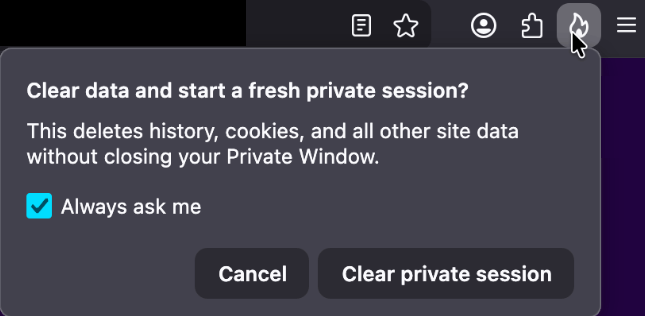
One of the more visible additions is a new “end private session” control in Private Browsing Mode. Instead of closing every private window to clear your traces, you now get a dedicated fire‑icon button next to the address bar that wipes the current private session’s data and immediately starts a fresh one.
End private session button
Under the hood, this clears the usual private browsing artifacts for that session, including history, cookies, cached files, and other site data that would normally disappear only when the last private window closes.
For people who routinely mix normal and private windows, this is safer and less error‑prone than hunting down every private tab before you walk away from the machine.
Firefox 151 also tightens its defenses against browser fingerprinting in the default “Standard” Enhanced Tracking Protection (ETP) mode. Mozilla says Firefox now limits the amount of device and browser information exposed to websites in a way that reduces the number of uniquely identifiable users by about 14% overall, and by roughly 49% on macOS.
This makes it harder for trackers to pick you out of the crowd, especially on platforms with fewer users to begin with (like certain macOS configurations). This reduces the privacy risk surface by default, which makes it harder for phishing and landing pages that redirect visitors to “categorize” you.
Another important change is Firefox’s “local network access restrictions,” which are now rolling out to all users, not just those who turned Enhanced Tracking Protection to Strict.
This means that when a website wants to communicate with devices on your local network, or with apps and services running on your machine, Firefox now asks for permission first. Chrome and Edge have been rolling out similar permission prompts.
The most notable example is CVE‑2026‑8953, a sandbox escape due to a use‑after‑free in the Disability Access APIs component. While there are currently no reports of in‑the‑wild exploitation for this specific bug at the time of writing, this is the kind of bug cybercriminals love.
A use-after-free (UAF) is a software memory vulnerability where a program attempts to access a memory location after it has been freed. If the program fails to clear the pointer to that freed memory, attackers can manipulate the error to crash the system or execute arbitrary code. A memory corruption leading to a sandbox escape is exactly the kind of link attackers want to complete a browser exploit chain.
How to update
If you’re running Firefox in a home or small‑office environment, we recommend updating to Firefox 151 as soon as possible to get the fingerprinting protections, local network access prompts, and security patches.
To update Firefox:
Open Firefox
Click the menu (three stacked lines) in the upper-right corner
Go to Help > About Firefox
Firefox will automatically check for updates and begin downloading them
Restart the browser when prompted to complete the update
Once your Firefox browser has been updated, it will show a green checkmark along with the message: “Firefox is up to date.”
Let’s face it, an incognito window can only do so much.
Breaches, dark web trading, credit fraud. Malwarebytes Identity Theft Protection monitors for all of it, alerts you fast, and comes with identity theft insurance.
GitHub on Tuesday said it's investigating unauthorized access to its internal repositories after the notorious threat actor known as TeamPCP listed the platform's source code and internal organizations for sale on a cybercrime forum.
"While we currently have no evidence of impact to customer information stored outside of GitHub's internal repositories (such as our customers' enterprises,
AI-generated lookalike domains are now embedded inside the third-party scripts running on your web properties. Here's why your current stack can't see them, and what detection actually requires.
Download the CISO Expert Guide to Typosquatting in the AI Era →
TL;DR
Typosquatting is no longer a user problem. Attackers now embed lookalike domains inside legitimate third-party scripts.
GitHub, the world's biggest code repository and DevOps platform, fell victim to a malicious Visual Studio Code (VS Code) extension. The company's initial assessment is that only internal repositories were exfiltrated. The incident was reported by GitHub on X, with follow-up posts revealing a "poisoned VS Code extension" as the cause. The Microsoft-owned code shack continues to "analyze logs, validate secret rotation, and monitor for any follow-on activity." One GitHub post references "the attacker's current claims of ~3,800 repositories" as consistent with its investigation. This may refer to a post attributed to TeamPCP, the malware crew linked to the Shai-Hulud worm, the code for which has been published and caused widespread damage. In a post, the crew advertised GitHub's internal source code for sale, claiming around 4,000 repositories. They said it was not a ransom and if no buyer was found, they would leak the code for free. Claims like these should be treated with caution. A key concern for GitHub users is whether private repositories are at risk, either immediately or in the future if the attackers have gained a foothold into internal systems via stolen credentials. Risks include leakage of commercial code and credentials. Although best practice is not to check secrets into any repository, public or private, some organizations are less disciplined about this when repositories are private. Last month, Wiz Research discovered a remote code execution flaw in GitHub.com and GitHub Enterprise Server (the self-hosted version), which the researchers said was "remarkably easy to exploit." The vulnerability was discovered using AI. Developer reactions to GitHub's latest problems combine alarm and resignation – plus some humor. "How did the attackers find a large enough uptime window to get in?" quipped one. GitHub is in some difficulty. This compromise comes after a surge in npm attacks, many related to Shai-Hulud code, which the company has failed to prevent despite being aware of the issue since September 2025. Further, the platform has reliability issues caused in part by AI bots hoovering public code to feed large language models – problems that led HashiCorp co-founder Mitchell Hashimoto to declare GitHub "no longer a place for serious work." Another said that "the era where a developer machine with source code access also has access to meaningful security systems should be over. Internal repository access should mean nothing... GitHub compromise could happen at any time, even from GitHub themselves." Issues with cloud platforms also increase the appeal of self-hosted systems such as the open source
Don't miss this virtual event as we explore how to cut through alert fatigue, leverage AI and unified platforms to accelerate investigations, and apply actionable threat intelligence.
ExifTool is a widely adopted utility for reading and writing metadata in image, PDF, audio, and video files. It is available both as a standalone command-line application and as a library that can be embedded in other software. In this article, we break down CVE-2026-3102, an ExifTool vulnerability discovered by Kaspersky’s Global Research and Analysis Team (GReAT) in February 2026 and patched by the developers within the same month. Affecting macOS systems with ExifTool version 13.49 and earlier, this flaw could let an attacker run arbitrary commands by hiding instructions inside an image file’s metadata.
This investigation originated from revisiting an n-day vulnerability I first examined years ago: CVE-2021-22204. That flaw exploited weak regex-based sanitization before feeding user input into an eval sink. By auditing adjacent input validation routines across ExifTool codebase for similar oversights, I discovered CVE-2026-3102. Successful exploitation of CVE-2026-3102 enables an attacker to execute arbitrary shell commands with the privileges of the user invoking ExifTool, potentially leading to full system compromise.
Technical details
Disclaimer
Exploiting CVE-2026-3102 requires the -n (also known as -printConv) flag and outputs machine-readable data without additional processing.
Tracing the vulnerable sink
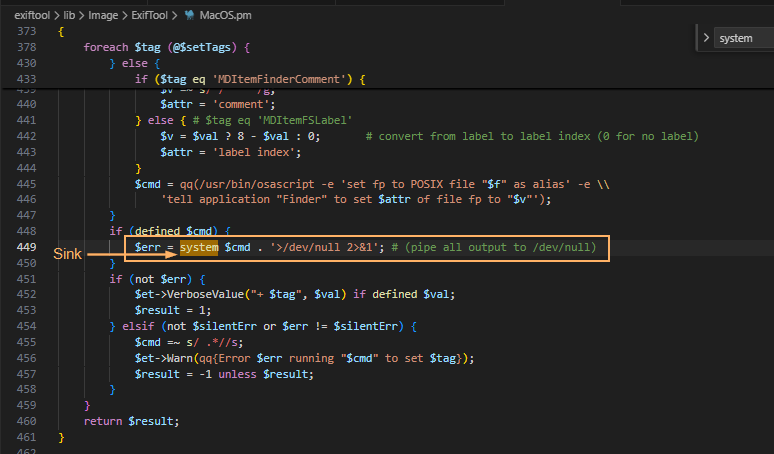
Taint analysis (aka tainted data analysis) allows for the detection of “dirty” data that reaches dangerous locations without validation. In this context, a “sink” is a point or function in a program where data or a parameter marked as “tainted” or originating from an untrusted source (e.g., user input) can affect the program’s behavior. In ExifTool, these functions are eval and system, both of which are capable of executing system commands. While CVE-2021-22204 exploited an eval function as a sink, this vulnerability (CVE-2026-3102) targets the system function. Knowing the vulnerable sink, we needed to trace how user-controlled data reaches it. Below, we break down the details.
Finding an unsanitized date value
The screenshot above shows where the system() sink resides within the SetMacOSTags function. Tracing backward from system(), we identified the $cmd variable as the source of the executed command. This variable is assembled from three inputs: $file (properly sanitized), $setTags (processed iteratively), and $val (user-controlled and, crucially, left unsanitized in the vulnerable branch).
In ExifTool, a tag is a named metadata field. When parsing an image, the utility extracts date and time values from standard EXIF records or macOS filesystem attributes. To handle file creation dates on macOS, ExifTool relies on the Spotlight system attribute MDItemFSCreationDate. Within the program code, this attribute maps to the internal alias $FileCreateDate. These two identifiers govern how the file creation date is stored and applied.
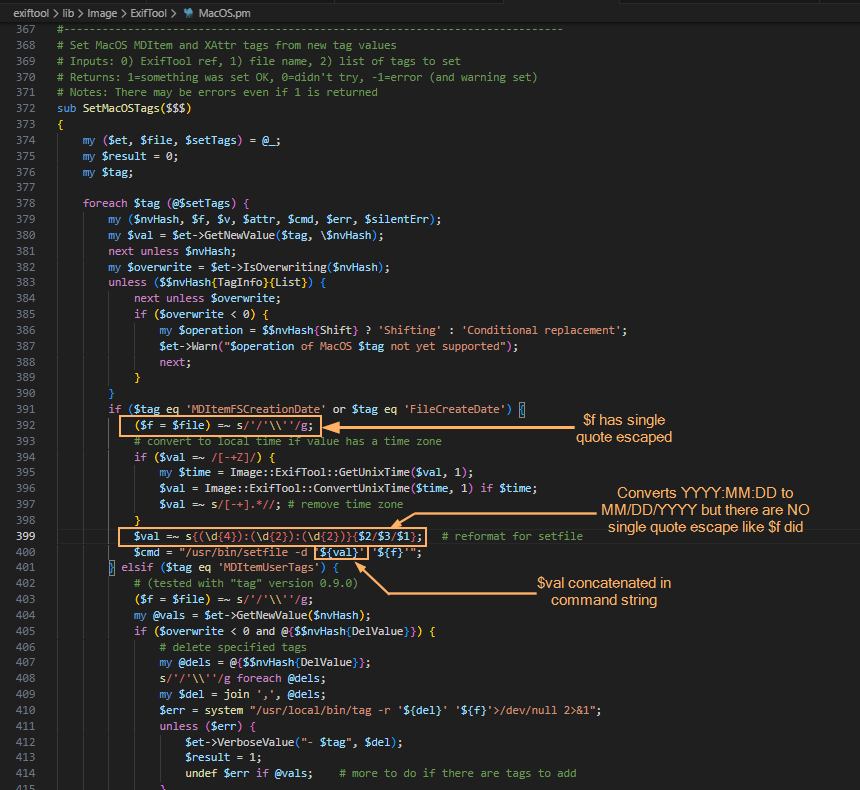
This creates a critical link to the vulnerability: when parsing an image, ExifTool iterates through the discovered tags. The current tag’s name is assigned to the $tag variable, while its text content (e.g., a date string) is assigned to $val. The vulnerable code path is triggered only when $tag matches MDItemFSCreationDate or $FileCreateDate. At this point, the tag’s content flows into $val and is passed to the SetMacOSTags function. As shown in the screenshot below, the filename parameter is properly escaped, but the date value ($val) is not. Because the date is extracted directly from file metadata, an attacker can inject quotes into this field. This breaks the command structure and allows the payload to execute via the system() sink.
The following screenshots show some of the tags that can be modified. With the vulnerable parameter identified, the next challenge was delivery: how to place our payload into FileCreateDate without triggering early validation? We found the answer in the official documentation.
Planning the payload delivery
Let’s refer to the documentation to understand how ExifTool handles tag operations and identify a legitimate feature that can be repurposed for exploitation. Specifically, we need to find a way to deliver our payload into the vulnerable FileCreateDate parameter. When looking for macOS-related tags as well as FileCreateDate, we can find the following information:
To write or delete metadata, tag values are assigned using –TAG=[VALUE], and/or the -geotag, -csv= or -json=
To copy or move metadata, the -tagsFromFile feature is used.
To trigger the vulnerability, we need to copy a string (date format: MM/DD/YYYY) using the -tagsFromFile feature, as this operation invokes the SetMacOSTags function where the unsanitized $val parameter reaches the system() sink.
Why copy instead of writing directly? Because the vulnerable code path (SetMacOSTags) is only triggered when metadata is copied into FileCreateDate — not when it is written directly. By using -tagsFromFile, we can prepare a “source” tag (e.g., DateTimeOriginal) that accepts arbitrary values and copy that value into FileCreateDate, thereby invoking the vulnerable function with our controlled input.
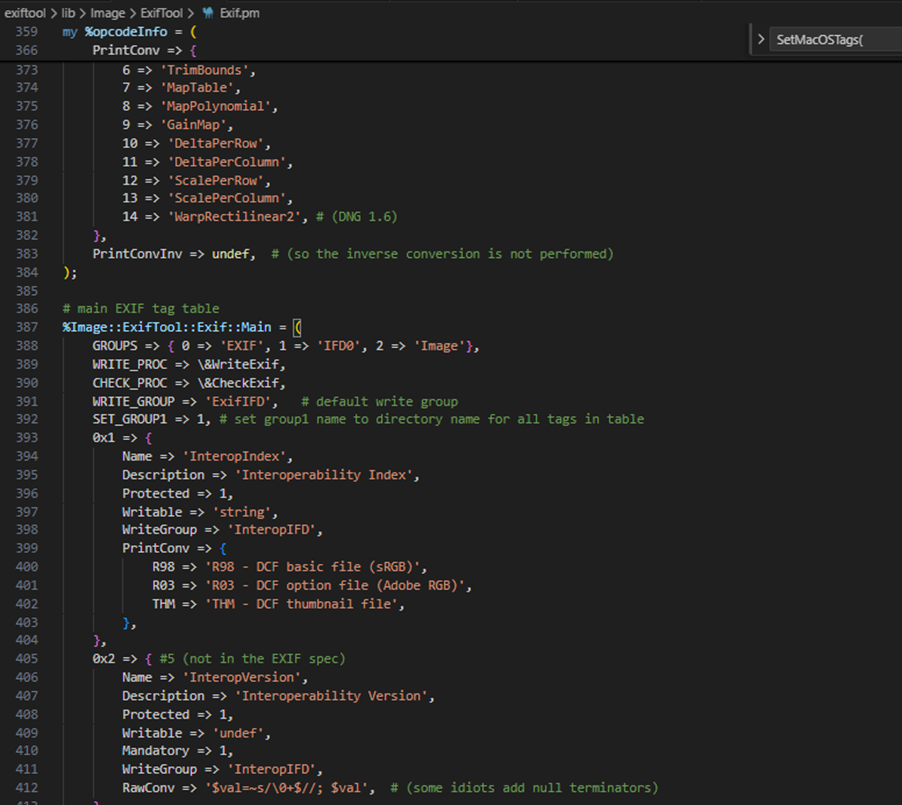
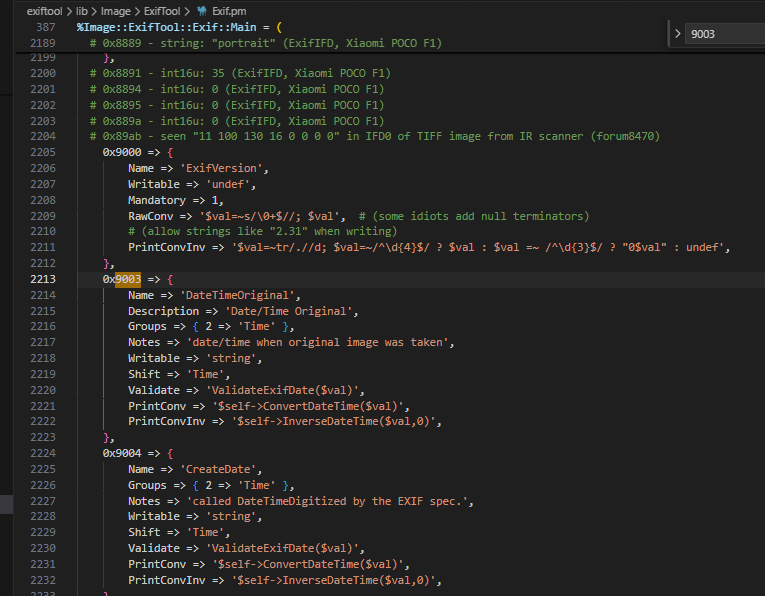
Furthermore, we want to introduce single quotes (since they are not being escaped in $val). For starters, we can look for date-time tag and copy via -tagsFromFile by searching the EXIF tag table. Direct assignment to FileCreateDate is heavily validated, so we looked for a source tag that accepts raw values and can be copied into the target field. The following snippet shows the beginning of said table.
When doing the analysis, I made use of DateTimeOriginal though I believe you can also use CreateDate which is 0x9004 (see the following screenshot). Initial attempts to inject malformed dates failed: ExifTool’s built-in filter rejected the input. To bypass this, we examined how the tool handles raw metadata.
Bypassing the filter
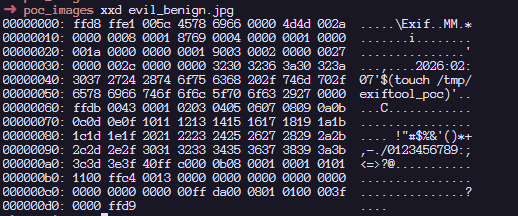
To confirm that the PrintConvInv filter rejects invalid dates when written directly, I ran the following command, where evil_benign.jpg is a normal JPG with an invalid date time format. We are greeted with the error message: Invalid date/time. This requires the time as well. The next screenshot confirms that direct exploitation fails: ExifTool’s date validation detects the malformed input and rejects the change, activating the internal PrintConvInv filter.
That said, it is possible to ignore the formatting and use the -n flag which accepts raw values instead of human-readable value. The -n flag skips the PrintConvInv conversion step, which is exactly where input sanitization occurs. This confirmed we could park unsanitized data in a source tag. The final step was to trigger the vulnerable code path by copying that data into FileCreateDate. This means we should now be able to modify the DateTimeOriginal tag with the invalid date time format with an -n flag. Examining the EXIF metadata tag, we can confirm that we can store a raw value without a proper human readable format that ExifTool accepts:
Triggering the exploit
To inject commands, we have to revisit the single quote injection into this datetime related tag.
The following screenshot shows that we have successfully set the datetime metadata with the single quote. With the payload safely stored in a source tag, the next step was to copy it into FileCreateDate, triggering the vulnerable system() call.
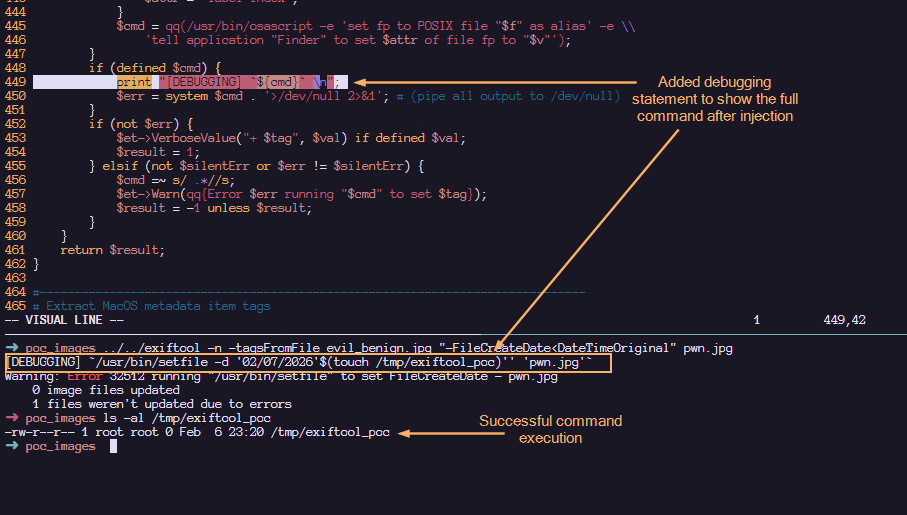
The next step now is to copy the datetime tag to a file which invokes SetMacOSTags. According to the documentation, this is how we can copy the data from the SRC tag to the FileCreateDate tag as seen in the SetMacOSTags with the -tagsFromFile feature.
Here, we confirm that the payload has been executed! Note that when copying tags in MacOS (Darwin), the /usr/bin/setfile command is used. To view the full $cmd value before the injection, I have added the debugging statement to displaying the actual command that is executed within the system function.
Upon injection, we can see that our command gets executed via command substitution. The single quotes that we added helped to make the entire command syntactically valid. The following shows a more detailed labelling and their roles in making this command line injection successful:
Such an image can appear completely benign and easily find its way into a newsroom or any organization that processes photos on macOS using ExifTool. Once processed, an attacker could silently deploy a Trojan for covert data exfiltration, drop additional malware, or use the compromised machine as a foothold to expand the attack within the victim’s network.
Patch analysis
After verifying successful exploitation, we examined how the maintainer addressed the flaw in version 13.50. In the vulnerable version of ExifTool, commands were sanitized before being concatenated together. This means that it is possible to concatenate single quotes which led to the exploitation. However, by abstracting the system call into a dedicated wrapper and requiring a list of arguments instead of concatenated string, the fix removes the need for any manual escaping altogether.
1. Replacing string form to argument list form:
#### BEFORE
$cmd = "/usr/bin/setfile -d '${val}' '${f}'";
system $cmd;

#### AFTER
system('/usr/bin/setfile', '-d', $val, $file);
2. Create new System() wrapper. In version 13.49, the output is piped to /dev/null . To maintain that logic, the wrapper would temporarily redirect STDOUT/STDERR to /dev/null and restore them after the call.
# Call system command, redirecting all I/O to /dev/null
# Inputs: system arguments
# Returns: system return code
sub System
{
    open(my $oldout, ">&STDOUT");
    open(my $olderr, ">&STDERR");
    open(STDOUT, '>', '/dev/null');
    open(STDERR, '>', '/dev/null');
    my $result = system(@_);
    open(STDOUT, ">&", $oldout);
    open(STDERR, ">&", $olderr);
    return $result;
}
How to protect against ExifTool vulnerability
It’s critical to ensure that all photo processing workflows are using the updated version. You should verify that all asset management platforms, photo organization apps, and any bulk image processing scripts running on Macs are calling ExifTool version 13.50 or later, and don’t contain an embedded older copy of the ExifTool library.
ExifTool, like any software, may contain additional vulnerabilities of this class. To harden defenses, I recommend using Kaspersky Open Source Software Threats Data Feed for continuous monitoring of open-source components in your software supply chain, and Kaspersky for macOS as comprehensive endpoint protection. Additionally, isolate processing of untrusted files on dedicated machines or virtual environments with strictly limited network and storage access. If you work with freelancers, contractors, or allow BYOD, enforce a policy that only devices with an active macOS security solution can access your corporate network.
Conclusions
CVE-2026-3102 highlights the risks of inconsistent input sanitization in tools that bridge high-level metadata parsing with platform-specific utilities. While exploitation requires explicit flag usage (-n) and is restricted to macOS, the vulnerability underscores the danger of manual escaping routines in evolving codebases. The transition to list-form system execution provides a robust, architecture-level fix that eliminates shell interpretation risks entirely. This case reinforces a core security principle: replacing fragile string concatenation with secure, list-based API calls remains the most reliable mitigation against command injection.
London’s Metropolitan Police – the UK’s largest police force – asked tech companies to give officers access to private communications data over 700,000 times in 2025 alone, according to figures obtained by The Register under the Freedom of Information Act. These statistics expose the monitoring of everyday platforms like takeaway delivery services, and also show a massive surge in the force's surveillance of the users of low cost MVNO LycaMobile. Additionally, our FoI exposed the acquisition of data from encrypted messaging services designed to offer privacy. Since 2024, the Met says that it has obtained communications data (CD) from Proton’s privacy-focused mail service users 139 times. CD is not messaging content, but metadata. In Proton’s case, this could include account payment details and, in some instances, IP addresses. Although Proton did not dispute these figures, a spokesperson told us: "Proton does not transmit data directly to any foreign law enforcement agencies," adding that it operates under a “strict legal framework” so all requests must go through the Swiss authorities. Requests for data that don’t meet Proton’s legal and human rights requirements are refused, which it has an "established practice" of doing, according to the spokesperson. The Met also claims that it has acquired data results from ProtonVPN, although the non-profit says this is "highly dubious and inconsistent with our technical reality [...] because Proton VPN does not log user activity, there is no data to provide," referring El Reg to its transparency report. “We engage with every request in good faith, but we simply cannot hand over what we do not collect,” Proton said. The Met’s data also suggests encrypted messenger Signal has provided data once since 2024. But this is also, apparently, contrary to records that the non-profit holds. A spokesperson told us: “Signal collects very little data about its users to begin with and publishes the requests we respond to at signal.org/bigbrother. We have not shared any user data in response to a legal request originating from the United Kingdom.” If data was shared by Signal it could only include phone numbers, when the account was created, and when the user last accessed the platform. When queried about the denials by both Proton and Signal, the police force said it couldn’t comment on the specifics of how it acquired the data. The Met Police says that all companies “have a legal obligation” to cooperate with officials thanks to the powers of the Office for Communications Data Authorizations (OCDA). The OCDA is now a part of the Investigatory Powers Commissioner’s Office (IPCO), which monitors the select public authorities, law enforcement agencies, and government departments with the power to acquire comms data. But there’s some fog around authorizations for the police, according to Dr Bernard Keenan, a law lecturer and surveillance researcher at University College London: “When it comes to communications data and metadata, it’s seen as a less severe intrusion than intercepting or accessing the content of a message, and so while the police need an authorization to get it, the decision is delegated to designated senior officers. So it’s something that the police can do operationally, more-or-less autonomously.” Sources compromised In 2024, the year of the most recent IPCO annual report, it was found that these authorizations to all law enforcement agencies affected lawyers 219 times and journalists on 157 occasions. This came with a caveat: “Most [CD] applications relating to sensitive professionals were submitted because the individual had been a victim of a crime.” While CD does not contain message content itself, there remains a risk that contacts such as a journalist’s sources could be disclosed. Also in the report is the revelation that in 2024, 106 warrant applications were issued to specifically identify journalists’ sources, and under these separate powers, the request could also include the communications content itself. There’s no requirement to inform sensitive professionals they have been targeted in this way, and while ordinary law enforcement agencies need to seek a judge’s approval, intelligence and security spies are exempt from this. Tim Dawson, freelance organizer at the National Union of Journalists - who also convenes the International Federation of Journalists’ working group on surveillance - said: “UK legislation lays down clear guardrails for law enforcement agencies obtaining communications data, and includes protections specifically for journalists.” But he continued: “The NUJ does not consider these are sufficiently robust. More disturbingly, however, it is clear that they are sometimes ignored – just look at the cases around the attempted prosecution of Barry McCaffrey and Trevor Birney.” These two journalists were unlawfully spied on by the Met and Police Service Northern Ireland to identify the source of allegedly stolen police documents used in a documentary about paramilitary killings during the Troubles. The police had claimed that information revealed in the film had breached the Official Secrets Act. McCaffrey and Birney used judicial review [PDF] to challenge the police action and the court ruled that the searches were unlawful. 'The digital border is expanding through policing' In 2025, the number of requests sent by the Met to MVNO LycaMobile increased by almost 500 percent year-on-year, rising from 15,702 to 93,527. This drastic spike was totally absent for other British network providers such as Vodafone, O2, Three, and Lebara. Considering LycaMobile’s focus on cheap overseas calling, and the likelihood of foreign nationals using its service, concerns have been raised that this data could be used for a crackdown on immigration. Fizza Qureshi, chief executive of Migrants’ Rights Network, a charity that researches the digital hostile environment, said: “A 500 percent surge in data requests from the Metropolitan Police to a network used largely by migrants and racialized people makes clear that the digital border is expanding through policing.” This checks out, considering the Home Office recently said immigration enforcement officers can now, under the Border Security, Asylum, and Immigration Act 2025, rifle through the mouths of undocumented migrants to search for hidden SIM-cards — as part of new powers granted to seize phones and gather digital intelligence. The new powers came into force last year in December, despite legal reviews finding procedural unfairness of such searches. In 2022, a High Court ruling found the Home Office’s controversial seizure and retention of over 2,000 migrants’ mobile phones was unlawful. “Migrants and racialized people are singled out for surveillance that would never be tolerated elsewhere,” according to Qureshi. “They are treated as acceptable subjects for intrusive monitoring, from phone records to delivery routes. This marks part of a wider trend of pre-emptive criminalization of migrants and racialized people and is an enormous infringement of our right to privacy.” While a Met spokesperson denied any indication that the increase was specifically related to immigration crime, they offered a pretty milquetoast example that an increase in requests to a specific mobile operator could have been due to its increased popularity. If this were the case, Lycamobile would have needed to have grown its users from an estimated 2 million to 10 million for the surge to be consistent. LycaMobile did not respond to The Register’s queries. Additionally, Counter Terrorism Policing (CTP) – a part of the Met – started a procurement process for software for a Communication Exploitation Data Tool last year. Some of the requirements listed on the procurement notice were to process data from Uber rides and deliveries to be used for “intelligence analysis.” At the time of publication, it read: It’s understood the requirements for the project have now changed. When asked for further details, including if a supplier has been found, a CTP spokesperson told The Register: “We previously confirmed a routine tender process to procure software, however further details on systems and their use will not be made publicly available.” This is not surprising given the operational secrecy around national security tech; or, in this case, takeaway delivery surveillance. Dr Keenan explained: “It’s what the government wants the police to be doing: bringing in these capacities to synthesize multiple different data points to use them effectively and to have these powerful surveillance technologies.” The Met Police requested data from ride and food delivery services Uber, Bolt, JustEat, Deliveroo, and Dominos Pizza a sum total of 768 times in 2025. Hundreds of delivery drivers were arrested last year in a spate of immigration enforcement operations, not long after gig economy firms pledged to use facial recognition checks and fraud detection tech to clamp down on illegal working. In response to all of the findings and questions posed by El Reg, a Met spokesperson said: “Every year the Met makes thousands of requests for communications data from a wide range of companies and telephone providers. The information provided helps our officers gather intelligence, solve crimes and find missing people.” ®
Microsoft on Tuesday released a mitigation for a BitLocker bypass vulnerability named YellowKey following its public disclosure last week.
The zero-day flaw, now tracked as CVE-2026-45585, carries a CVSS score of 6.8. It has been described as a BitLocker security feature bypass.
"Microsoft is aware of a security feature bypass vulnerability in Windows publicly referred to as 'YellowKey,'" the
Grafana Labs, on May 19, 2026, said an investigation into its recent breach found no evidence of customer production systems or operations being compromised.
It said the scope of the incident is limited to the Grafana Labs GitHub environment, which includes public and private source code along with internal GitHub repositories.
"After the initial assessment, we found that in addition to source
Verizon’s 2026 DBIR finds vulnerability exploitation has overtaken credential abuse as the leading breach vector, as AI accelerates attacks, patching delays worsen, and ransomware and third-party compromises continue to surge.
Microsoft seized websites and took down hundreds of virtual machines running a cybercrime service that allegedly sold code-signing certificates to ransomware gangs, thus making their malware look like legitimate software – and allowing criminals to infect thousands of machines in the US, including at least 12 owned and operated by the Windows giant. The malware signing-as-a-service operation called Fox Tempest has been around since May 2025, and abuses Microsoft’s Artifact Signing code-signing service. This service allows developers to digitally sign their software applications, signaling to the Windows operating system and end-user that the software is authentic, and hasn’t been tampered with. Since May 2025, the Fox Tempest crew – referred to as John Doe 1 and 2 in court documents unsealed on Tuesday – used fake identities and impersonated real organizations, allowing them to create more than 580 fraudulent Microsoft accounts. They then used these accounts to abuse Microsoft’s Artifact Signing service and obtain real code-signing credentials, then sold the code-signing certificates to other criminals for thousands of dollars. According to Microsoft, Fox Tempest’s customers included a ransomware group Redmond tracks as Vanilla Tempest (aka Vice Spider, Vice Society, Rhysida), which allegedly used the certificates to digitally sign malware and make it appear legitimate to Windows and users. This also allowed the ransomware slingers “to more easily deploy the malware onto the computers of unsuspecting victims without their consent,” according to the court documents [PDF]. Malware included Windows backdoor Oyster, infostealers Lumma and Vidar, and Rhysida ransomware. Vanilla Tempest “unlawfully accessed victims’ computers and devices, exfiltrated and stole the personal and confidential information of victims, deployed ransomware designed to encrypt victims’ files and systems, and extorted victims by demanding payment in exchange for restoring access to, or suppressing, their data,” the civil complaint continues, adding that the criminal activity remains ongoing. In a subsequent blog post, Microsoft Digital Crimes Unit attorney Steven Masada said the tech company's investigation “further linked Fox Tempest to various additional ransomware affiliates and families, including INC, Qilin, Akira, and others.” Between February and March, the Digital Crimes Unit (DCU), working with “a cooperating source,” anonymously bought and tested the code signing service from John Doe 2, aka SamCodeSign. “These test purchases allowed DCU investigators to observe first-hand how Fox Tempest Defendants operate the service, the information a purchaser is provided, and the instructions given by SamCodeSign to connect to the service and sign the test software created by Microsoft,” the court documents say. “Additionally, the test purchases allowed DCU to identify cryptocurrency wallets used by Fox Tempest Defendants.” During the first test purchase, the source filled out a Google Form asking them to select how quickly they needed the certificates. Standard costs $5,000, while priority runs $7,500 and expedited carries a hefty $9,500 price tag. SamCodeSign then sent a direct message to the source and requested the $7,500 payment to be sent to a bitcoin wallet, according to screenshots (translated from Russian) in the court documents. After the source paid up, SamCodeSign sent instructions on how to access the virtual machine and complete the code signing process. “Microsoft has identified thousands of customer machines, including more than a dozen machines owned and operated by Microsoft, in the United States that have been impacted by malware signed with certificates originating from the tenants created by Fox Tempest Defendants,” the complaint says. ®
For years, civil society organizations, workers, journalists, and human rights experts have warned that major technology companies risk enabling grave human rights abuses when they provide cloud computing, AI, and surveillance infrastructure to governments implicated in violations of international and humanitarian law. While many companies pay lip service to evaluating customers and contracts for human rights implications (lip service Exhibit A: Palantir!), too often those processes fail to provide any meaningful accountability when their standards are not met or are simply ignored. But recent developments at Microsoft suggest that accountability for failing to uphold the human rights standards that a company itself sets, even if incomplete, is possible.
According to recent reporting, Microsoft’s Israel chief has departed amid an escalating ethical controversy surrounding the company’s business relationships with the Israeli Ministry of Defense. The move follows months of scrutiny, internal dissent, and sustained pressure from inside the organization along with press and civil society, especially after a report by The Guardian revealed that Microsoft technologies were used in systems connected to mass surveillance and military targeting operations in Gaza in ways that appeared to violate Microsoft’s own standards. This did not happen overnight.
In September 2025, Microsoft reportedly suspended certain services after initial investigations raised serious concerns about how its cloud and AI infrastructure may have been used. That alone distinguished Microsoft from many of its peers. Rather than simply dismissing mounting concerns or hiding behind vague claims of neutrality, Microsoft appeared to recognize that providing technology in conflict settings creates real human rights responsibilities. Now, after additional investigation and continued public scrutiny, it appears the company has taken another step, one that should send a strong signal to others that violating Microsoft’s human rights commitments could cost you your job. This is important.
There is still much more Microsoft should do, of course. The company has yet to fully disclose the scope of its findings, explain exactly which services were suspended, or clarify what safeguards remain in place to prevent its technologies from contributing to human rights abuses in the future. We shouldn’t have to infer the connection between this employment action and the company’s investigation.
Just prior to reports that Microsoft had fired its Israel Country General Manager, EFF joined Access Now, Amnesty International, Fight for the Future, and 7amleh in a joint May 7, 2026 letter to Microsoft leadership calling on the company to publicly release the findings of its investigation, suspend business relationships tied to serious human rights abuses, and implement meaningful safeguards to prevent its technologies from contributing to further harm. The letter detailed allegations regarding Microsoft’s reported provision of Azure cloud and AI services to Israeli military and intelligence units involved in surveillance and targeting operations, while also pressing the company to take concrete human rights due diligence measures going forward. Those demands remain urgent, even as Microsoft appears to be taking some of the steps we urged.
But even as we push for more, it is important to recognize when a company takes steps in the right direction. Because this is what it means to put human rights commitments into practice. It means acknowledging that human rights policies are not just branding exercises or transparency reports. It means accepting that companies providing cloud infrastructure and AI services have responsibilities when credible evidence emerges that their technologies may be enabling violations of international law. And it means taking concrete action when those risks become known.
The allegations facing Microsoft are serious. Human rights organizations and investigative reporting have documented claims that Microsoft Azure services were used by Israeli military and intelligence units to process large-scale surveillance data, support AI-assisted targeting systems, and sustain military cloud infrastructure during the war in Gaza. The concerns raised extend beyond ordinary business risk; they implicate potential complicity in violations of international humanitarian and human rights law.
Faced with these allegations, Microsoft could have chosen the path many tech companies take: deny everything, attack critics, suppress worker dissent, and continue business as usual. Instead, the company appears to have begun responding to the evidence.
Technology companies are not powerless bystanders. Cloud providers and AI companies make choices every day about who gets access to their infrastructure, under what conditions, and with what oversight. When companies claim to uphold human rights principles, those commitments should have operational consequences. Too many companies, in both international and domestic policing contexts, provide technology to institutions that violate people’s human rights and civil liberties, then fall back on the claim that they are merely providing a service that their customers can use how they see fit. This is an ethical failing that falls short of most companies’ publicly expressed commitments. Microsoft’s recent actions suggest that sustained public pressure, worker organizing, investigative journalism, and civil society advocacy can force even the world’s largest technology companies to respond.
Google and Amazon should especially see this as a clear example to follow. Both companies also provide services to the Israeli Ministry of Defense and have faced yearsofcriticism over those contracts and services, including from EFF. Yet neither has demonstrated the level of responsiveness or accountability that Microsoft has shown. If Microsoft can suspend services, investigate allegations, and make leadership changes amid mounting evidence and ethical concerns, then other cloud giants can no longer pretend that meaningful action is impossible.
The technology industry has spent years insisting that ethics and human rights matter. The real test has always been whether those principles survive when profits, government contracts, and geopolitical pressure are on the line. Microsoft’s recent steps are not the end of that story, but they may mark the beginning of what real accountability can look like.
We’re looking at you, Amazon and Google. If Microsoft can do it, why can’t you?
The US Cybersecurity and Infrastructure Security Agency (CISA) left open a GitHub repository named “Private-CISA” containing plain-text passwords, private keys, tokens, and secrets – with obvious file names like “external-secret-repo-creds.yaml” and “AWS-Workspace-Firefox-Passwords.csv” – for six months. GitGuardian researcher Guillaume Valadon, fresh off a recent talk on Kubernetes secret leaks, found the public repository on May 14, and told The Register that he “quickly understood that the leak was bad and that time was running out. A national agency having 844 MB of production infrastructure material in a public GitHub repository for six months is as serious as a secrets leak gets.” Valadon, who previously spent nine years at France’s CISA equivalent, ANSSI, told us the leak included tokens for CISA's internal JFrog Artifactory, Azure registry keys, AWS credentials, Kubernetes manifests, ArgoCD application files, Terraform infrastructure code, GitHub personal access tokens, and Entra ID SAML certificates. GitGuardian reported the leaky repository to CISA on May 14, and the agency took it down a day later. A CISA spokesperson told The Register that it was aware of the report and is investigating. "Currently, there is no indication that any sensitive data was compromised as a result of this incident.” It’s not a good look for the nation’s infosec agency, which hasn’t had a permanent boss since Trump took office, is facing hundreds of millions of dollars in budgets cuts on top of deep cuts to staff and funding last year, and has suffered its share of embarrassing security snafus in the interim. In a Tuesday blog, Valadon said he initially thought the repo “was a hoax, given how suspicious the directory names (Backup-April-2026/, All Backups/, LZ-Artifactory/, Kubernetes-Important-Yaml-Files/, ENTRA ID - SAML Certificates/ ...), file names (external-secret-repo-creds.yaml, CAWS GitHub Token.txt, Important AWS Tokens.txt, AWS-Workspace-Firefox-Passwords.csv, Kube-Config.txt ...), and their contents (private keys, personal and professional GitHub tokens, AWS secrets, ...) seemed too good to be true,” Valadon wrote. It wasn’t a hoax – “The Cybersecurity and Infrastructure Security Agency is aware of the reported exposure and is continuing to investigate the situation,” but it was a “catalogue of unsafe practices,” he added, containing passwords stored in plain text, backups committed to Git, and an “explicit” how-to guide for disabling GitHub's secret scanning. After initially reporting the leak through the CERT/CC portal, and only receiving an auto-acknowledgement as of the morning of May 15 – a Friday – Valadon alerted security journalist Brian Krebs about the publicly exposed secrets, which seemed to speed up CISA’s processes. By 6 pm EST that night, the feds took down the repository. Valadon told The Reg he gives CISA credit for quickly deleting the repository. “Most of our responsible disclosures take much longer, and many are never fixed,” he said. “Managing to take the repository offline in a day is impressive work.” He doesn’t know if any other parties with less altruistic intentions found the secrets first, although the fact that the repository was never forked (based on public GitHub events) would seem to indicate that it wasn’t widely circulated on the dark web. “The only ones that can answer definitively is GitHub,” Valadon said. GitHub did not immediately respond to The Register’s inquiry. GitGuardian isn’t aware of any of the exposed credentials being abused by unauthorized individuals “Each category of secret in the repository unlocks a specific attack path,” Valadon said. “Stacked together, they cover the full range: from destructive attacks and ransomware extortion to quiet, long-term persistence inside CISA's build and deployment pipeline. That last scenario worried me the most, and it's why I escalated through every channel we had until the repository was taken offline.” Plus, the committer used both a CISA-issued contractor email and a personal Yahoo email across the same commits, and created the repository using a personal GitHub account. “That mixed-identity pattern is one of the hardest surfaces for security teams to cover, and it's where the worst leaks happen,” Valadon said.®

 Login
Login